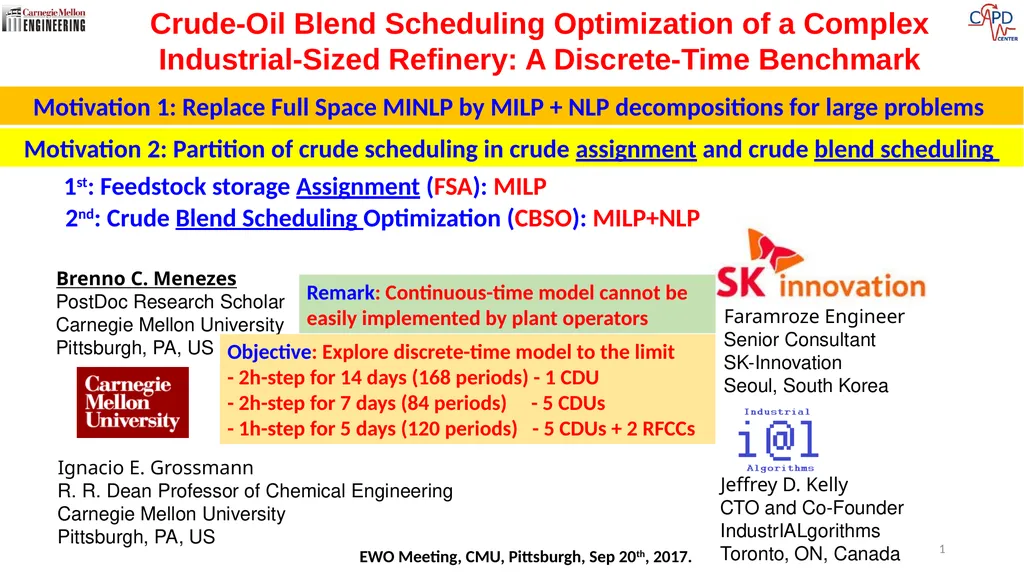
Brenno C. Menezes PostDoc Research Scholar Carnegie Mellon University Pittsburgh, PA, US Jeffrey D. Kelly CTO and Co-Founder IndustrIALgorithms Toronto, ON, Canada Crude-Oil Blend Scheduling Optimization of a Complex Industrial-Sized
"Brenno C. Menezes PostDoc Research Scholar" is the property of its rightful owner. Permission is granted to
download and print the materials on this website for personal, non-commercial use only, and to display it
on your personal computer provided you do not modify the materials and that you retain all copyright
notices contained in the materials. By downloading content from our website, you accept the terms of this
agreement.
Presentation Transcript
01
Brenno C. Menezes
PostDoc Research Scholar
Carnegie Mellon University
Pittsburgh, PA, US Jeffrey D. Kelly
CTO and Co-Founder
IndustrIALgorithms
Toronto, ON, Canada Crude-Oil Blend Scheduling Optimization of a Complex Industrial-Sized Refinery: A Discrete-Time Benchmark EWO Meeting, CMU, Pittsburgh, Sep 20th, 2017. Ignacio E. Grossmann
R. R. Dean Professor of Chemical Engineering
Carnegie Mellon University
Pittsburgh, PA, US Faramroze Engineer
Senior Consultant
SK-Innovation
Seoul, South Korea 1st: Feedstock storage Assignment (FSA): MILP 2nd: Crude Blend Scheduling Optimization (CBSO): MILP+NLP 1 Remark: Continuous-time model cannot be easily implemented by plant operators Objective: Explore discrete-time model to the limit
- 2h-step for 14 days (168 periods) - 1 CDU
- 2h-step for 7 days (84 periods) - 5 CDUs
- 1h-step for 5 days (120 periods) - 5 CDUs + 2 RFCCs Motivation 1: Replace Full Space MINLP by MILP + NLP decompositions for large problems Motivation 2: Partition of crude scheduling in crude assignment and crude blend scheduling<br>
02
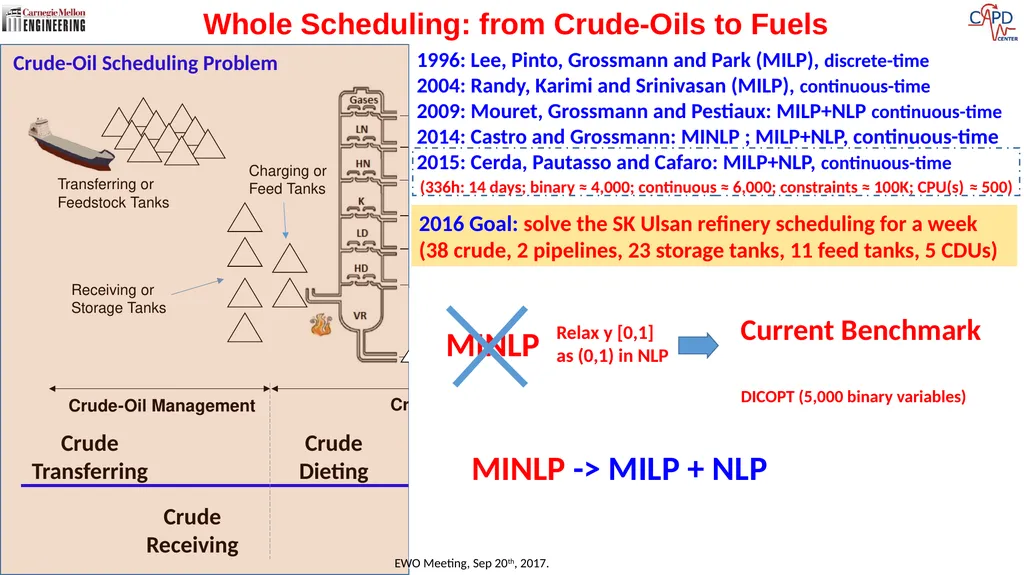
Crude Transferring Refinery Units Fuel Deliveries Fuel Blending Crude Dieting Crude Receiving Hydrocarbon Flow FCC DHT NHT KHT REF DC BLENS RFCC Fuel gas LPG Naphtha Gasoline Kerosene Diesel Diluent Fuel oil Asphalt Crude-Oil Management Crude-to-Fuel Transformation Blend-Shop Charging or Feed Tanks Whole Scheduling: from Crude-Oils to Fuels Crude-Oil Scheduling Problem Receiving or Storage Tanks Transferring or Feedstock Tanks VDU 1996: Lee, Pinto, Grossmann and Park (MILP), discrete-time
2004: Randy, Karimi and Srinivasan (MILP), continuous-time
2009: Mouret, Grossmann and Pestiaux: MILP+NLP continuous-time
2014: Castro and Grossmann: MINLP ; MILP+NLP, continuous-time
2015: Cerda, Pautasso and Cafaro: MILP+NLP, continuous-time
(336h: 14 days; binary ≈ 4,000; continuous ≈ 6,000; constraints ≈ 100K; CPU(s) ≈ 500) 2 2016 Goal: solve the SK Ulsan refinery scheduling for a week (38 crude, 2 pipelines, 23 storage tanks, 11 feed tanks, 5 CDUs) EWO Meeting, Sep 20th, 2017. MINLP -> MILP + NLP MINLP Relax y [0,1]
as (0,1) in NLP Current Benchmark
DICOPT (5,000 binary variables)<br>
03
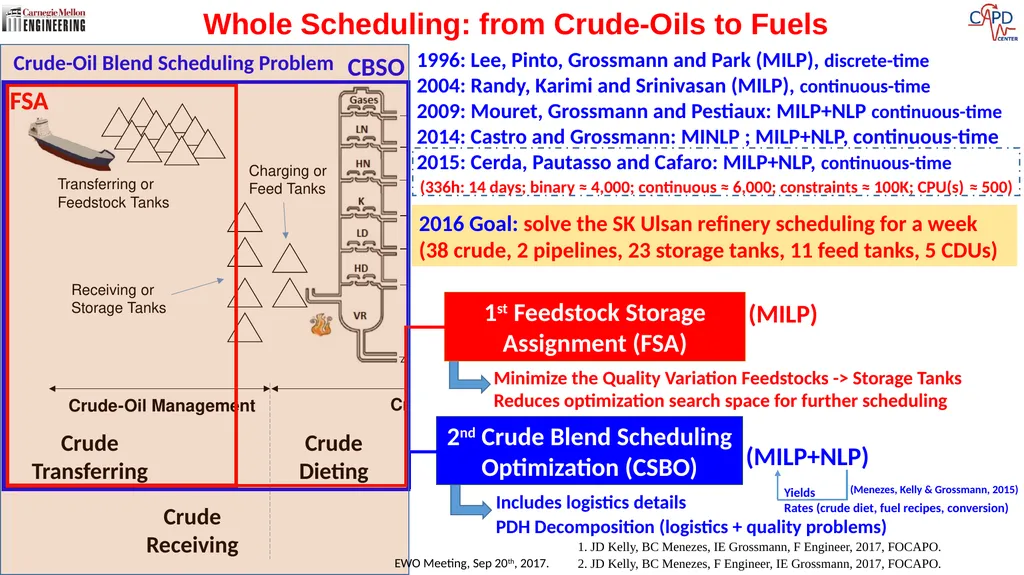
Crude Transferring Refinery Units Fuel Deliveries Fuel Blending Crude Dieting Crude Receiving Hydrocarbon Flow FCC DHT NHT KHT REF DC BLENS RFCC Fuel gas LPG Naphtha Gasoline Kerosene Diesel Diluent Fuel oil Asphalt Crude-Oil Management Crude-to-Fuel Transformation Blend-Shop Charging or Feed Tanks Whole Scheduling: from Crude-Oils to Fuels Crude-Oil Blend Scheduling Problem Receiving or Storage Tanks Transferring or Feedstock Tanks FSA VDU (MILP+NLP) PDH Decomposition (logistics + quality problems) Includes logistics details 1996: Lee, Pinto, Grossmann and Park (MILP), discrete-time
2004: Randy, Karimi and Srinivasan (MILP), continuous-time
2009: Mouret, Grossmann and Pestiaux: MILP+NLP continuous-time
2014: Castro and Grossmann: MINLP ; MILP+NLP, continuous-time
2015: Cerda, Pautasso and Cafaro: MILP+NLP, continuous-time
(336h: 14 days; binary ≈ 4,000; continuous ≈ 6,000; constraints ≈ 100K; CPU(s) ≈ 500) 3 (MILP) 2016 Goal: solve the SK Ulsan refinery scheduling for a week (38 crude, 2 pipelines, 23 storage tanks, 11 feed tanks, 5 CDUs) Minimize the Quality Variation Feedstocks -> Storage Tanks Reduces optimization search space for further scheduling 2nd Crude Blend Scheduling Optimization (CSBO) Yields
Rates (crude diet, fuel recipes, conversion) (Menezes, Kelly & Grossmann, 2015) 1. JD Kelly, BC Menezes, IE Grossmann, F Engineer, 2017, FOCAPO. 2. JD Kelly, BC Menezes, F Engineer, IE Grossmann, 2017, FOCAPO. MINLP -> MILP + NLP 1st Feedstock Storage Assignment (FSA) FSA CBSO EWO Meeting, Sep 20th, 2017.<br>
04
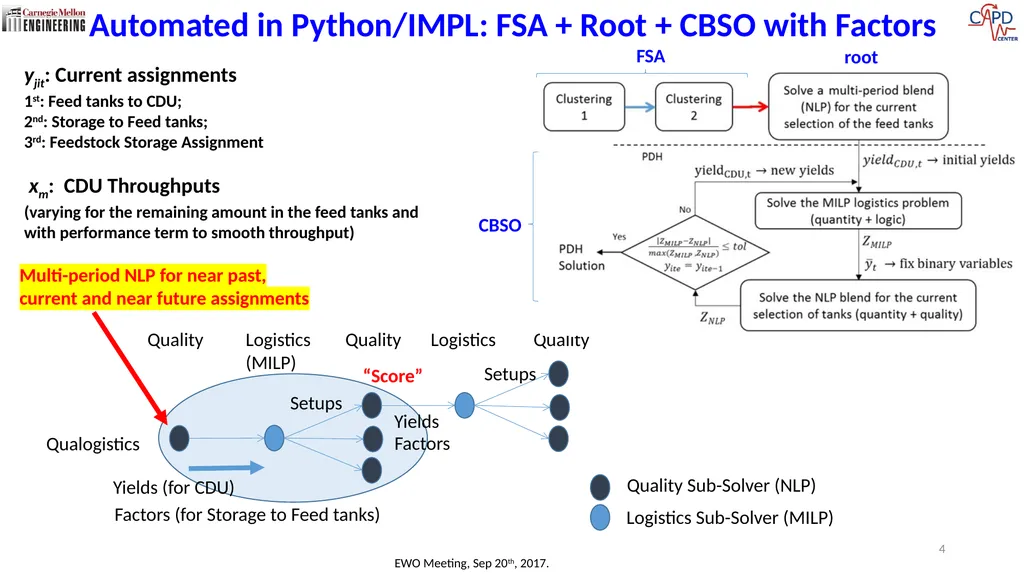
Automated in Python/IMPL: FSA + Root + CBSO with Factors 4 Logistics
(MILP) Quality Yields (for CDU) Setups Quality Yields Logistics Quality Setups Qualogistics Quality Sub-Solver (NLP) Logistics Sub-Solver (MILP) “Score” yjit: Current assignments
1st: Feed tanks to CDU;
2nd: Storage to Feed tanks;
3rd: Feedstock Storage Assignment
xm: CDU Throughputs
(varying for the remaining amount in the feed tanks and with performance term to smooth throughput) Multi-period NLP for near past, current and near future assignments Factors Factors (for Storage to Feed tanks) FSA root CBSO EWO Meeting, Sep 20th, 2017.<br>
05
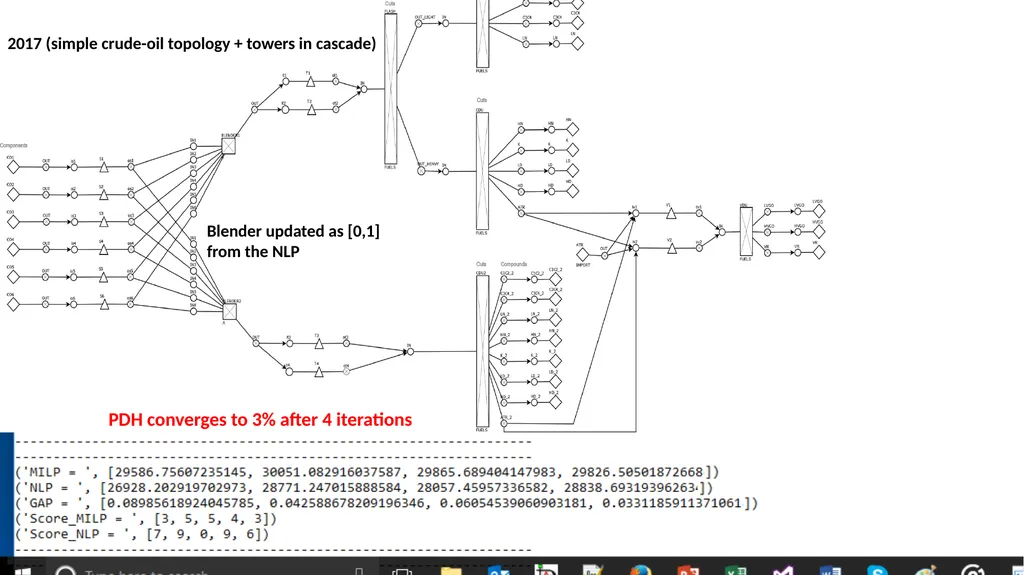
5 2017 (simple crude-oil topology + towers in cascade) Blender updated as [0,1] from the NLP PDH converges to 3% after 4 iterations<br>
06
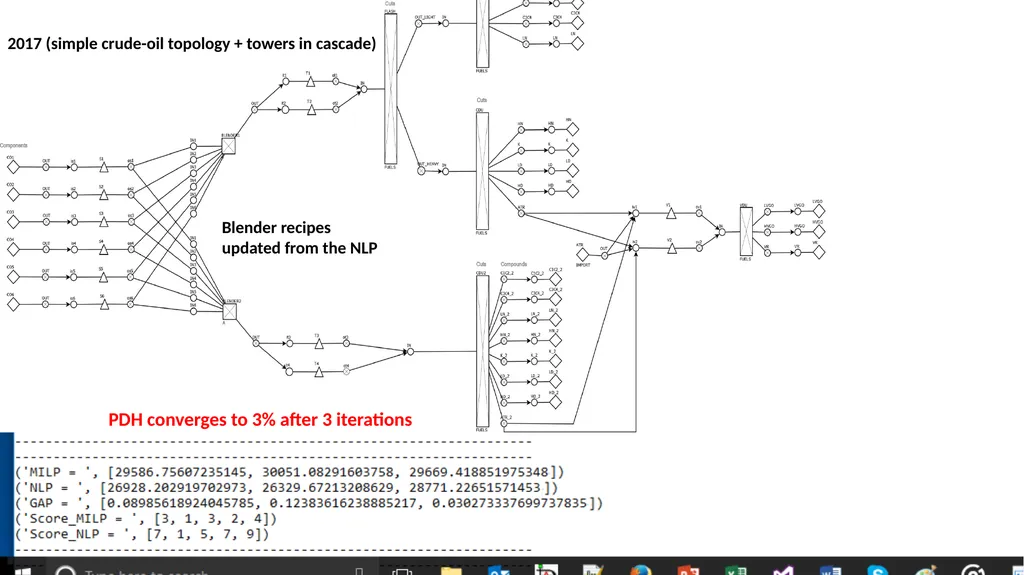
6 Blender recipes updated from the NLP 2017 (simple crude-oil topology + towers in cascade) PDH converges to 3% after 3 iterations<br>
07
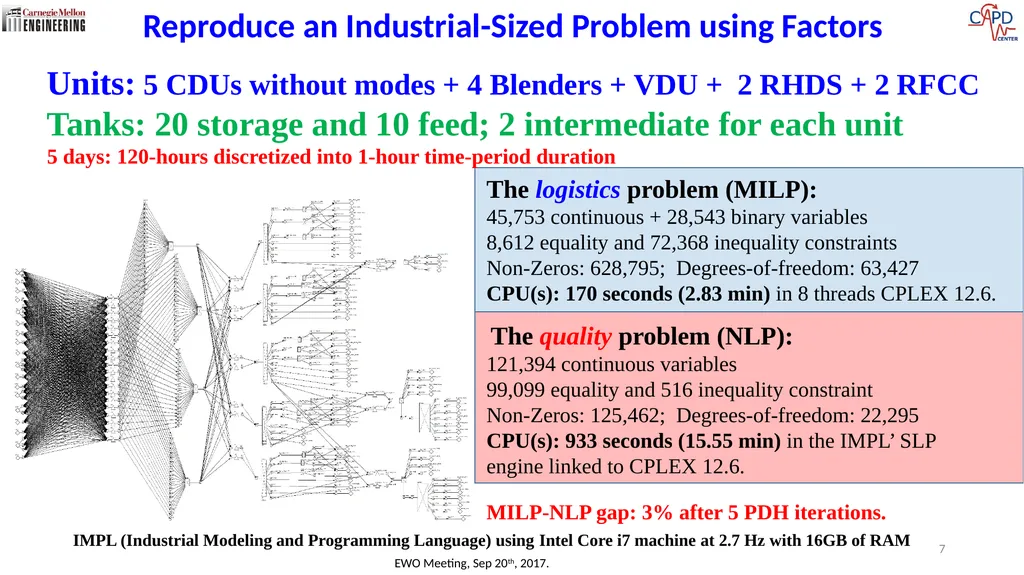
Reproduce an Industrial-Sized Problem using Factors 7 The logistics problem (MILP):
45,753 continuous + 28,543 binary variables
8,612 equality and 72,368 inequality constraints
Non-Zeros: 628,795; Degrees-of-freedom: 63,427
CPU(s): 170 seconds (2.83 min) in 8 threads CPLEX 12.6.
The quality problem (NLP):
121,394 continuous variables
99,099 equality and 516 inequality constraint
Non-Zeros: 125,462; Degrees-of-freedom: 22,295
CPU(s): 933 seconds (15.55 min) in the IMPL’ SLP
engine linked to CPLEX 12.6.
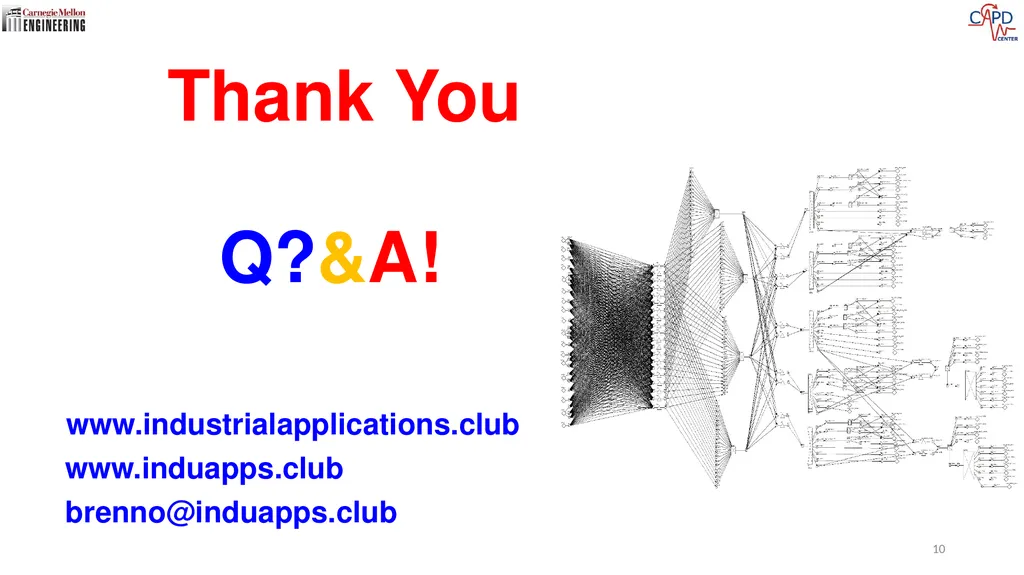
MILP-NLP gap: 3% after 5 PDH iterations. Units: 5 CDUs without modes + 4 Blenders + VDU + 2 RHDS + 2 RFCC
Tanks: 20 storage and 10 feed; 2 intermediate for each unit
5 days: 120-hours discretized into 1-hour time-period duration IMPL (Industrial Modeling and Programming Language) using Intel Core i7 machine at 2.7 Hz with 16GB of RAM EWO Meeting, Sep 20th, 2017.<br>
08
2016 (real crude-oil topology + simplified towers) NEXT STEPS 2017 (simple crude-oil topology + towers in cascade) 2018 (Full crude-oil topology and Full Refinery) EWO Meeting, Sep 20th, 2017.<br>
09
Conclusion 9 Novelty:
Segregates crude management in storage assignment1 and crude blend scheduling.2
Phenomenological decomposition in logistics (MILP) and quality (NLP) problems applied in a scheduling problem updating crude-oil recipes and distillate yields. Impact for industrial applications:
UOPSS modeling, pre-solving, and parallel processing, reverse polish notation, complex number for derivatives, among others, solved for the 1st time a highly complex refinery scheduling. (MILP 50K binary variables and NLP 120K continuous with 60% NLP) 1. JD Kelly, BC Menezes, IE Grossmann, F Engineer, 2017, FOCAPO. 2. JD Kelly, BC Menezes, F Engineer, IE Grossmann, 2017, FOCAPO. EWO Meeting, Sep 20th, 2017.<br>
10
Thank You 10 Q?&A! www.industrialapplications.club www.induapps.club brenno@induapps.club<br>