
BRIEFING ON THE MANDATE AND RESPONSIBILITIES OF
PC
Published · 25 slides · 0 views

1 / 1
Description
BRIEFING ON THE MANDATE AND RESPONSIBILITIES OF THE DEPARTMENTS OF MINERAL AND PETROLEUM RESOURCE AND ENERGY AND ELECTRICITY ENTITIES 26 NOVEMBER 2024 1 2 Purpose Brief overview of the DMRE Entities Department of Mineral and Petroleum
Related Topics
Share
Embed code
Download this presentation From Below
"BRIEFING ON THE MANDATE AND RESPONSIBILITIES OF" is the property of its rightful owner. Permission is granted to download and print the materials on this website for personal, non-commercial use only, and to display it on your personal computer provided you do not modify the materials and that you retain all copyright notices contained in the materials. By downloading content from our website, you accept the terms of this agreement.
Presentation Transcript
01
BRIEFING ON THE MANDATE AND RESPONSIBILITIES OF THE DEPARTMENTS OF MINERAL AND PETROLEUM RESOURCE AND ENERGY AND ELECTRICITY ENTITIES
26 NOVEMBER 2024 1<br>
26 NOVEMBER 2024 1<br>
02
2 Purpose
Brief overview of the DMRE
Entities – Department of Mineral and Petroleum Resources
Entities – Department of Electricity and Energy
Conclusion CONTENT<br>
Brief overview of the DMRE
Entities – Department of Mineral and Petroleum Resources
Entities – Department of Electricity and Energy
Conclusion CONTENT<br>
03
PURPOSE PURPOSE:
Briefing by the Department of Mineral Resources and Energy
An introduction to the Department and key entities of the Department
Mandates and responsibilities of both the department and entities 3<br>
Briefing by the Department of Mineral Resources and Energy
An introduction to the Department and key entities of the Department
Mandates and responsibilities of both the department and entities 3<br>
04
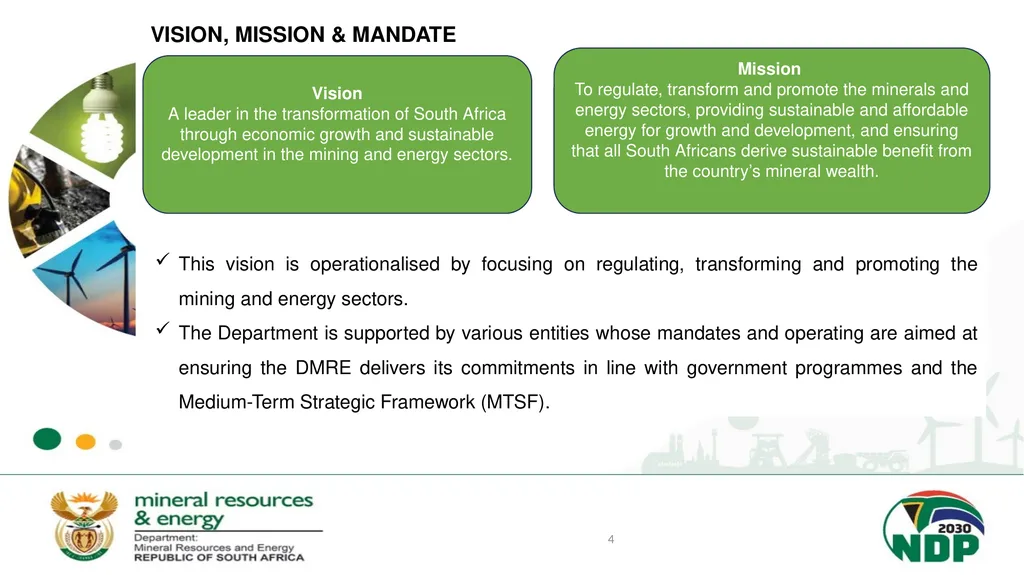
4 This vision is operationalised by focusing on regulating, transforming and promoting the mining and energy sectors.
The Department is supported by various entities whose mandates and operating are aimed at ensuring the DMRE delivers its commitments in line with government programmes and the Medium-Term Strategic Framework (MTSF). Vision
A leader in the transformation of South Africa through economic growth and sustainable development in the mining and energy sectors. Mission
To regulate, transform and promote the minerals and energy sectors, providing sustainable and affordable energy for growth and development, and ensuring that all South Africans derive sustainable benefit from the country’s mineral wealth. VISION, MISSION & MANDATE<br>
The Department is supported by various entities whose mandates and operating are aimed at ensuring the DMRE delivers its commitments in line with government programmes and the Medium-Term Strategic Framework (MTSF). Vision
A leader in the transformation of South Africa through economic growth and sustainable development in the mining and energy sectors. Mission
To regulate, transform and promote the minerals and energy sectors, providing sustainable and affordable energy for growth and development, and ensuring that all South Africans derive sustainable benefit from the country’s mineral wealth. VISION, MISSION & MANDATE<br>
05
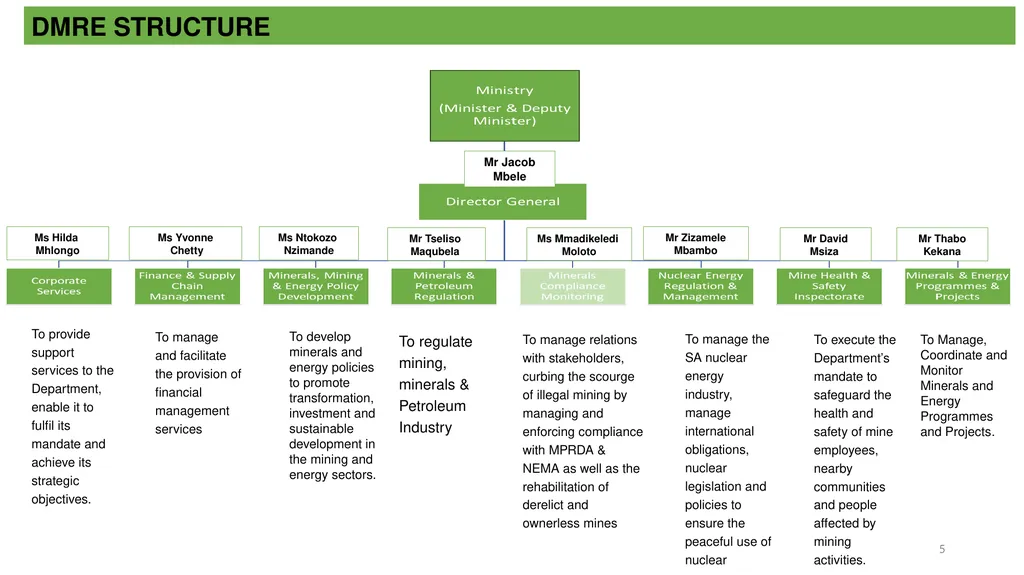
5 Ms Hilda
Mhlongo Ms Yvonne
Chetty Mr Tseliso
Maqubela Ms Mmadikeledi Moloto Ms Ntokozo
Nzimande Mr Zizamele Mbambo Mr David Msiza Mr Thabo Kekana Mr Jacob Mbele To Manage, Coordinate and Monitor Minerals and Energy Programmes and Projects. To regulate mining, minerals & Petroleum Industry To develop minerals and energy policies to promote transformation, investment and sustainable development in the mining and energy sectors. To manage and facilitate the provision of financial management services To provide support services to the Department, enable it to fulfil its mandate and achieve its strategic objectives. To execute the Department’s mandate to safeguard the health and safety of mine employees, nearby communities and people affected by mining activities. To manage the SA nuclear energy industry, manage international obligations, nuclear legislation and policies to ensure the peaceful use of nuclear energy. To manage relations with stakeholders, curbing the scourge of illegal mining by managing and enforcing compliance with MPRDA & NEMA as well as the rehabilitation of derelict and ownerless mines DMRE STRUCTURE<br>
Mhlongo Ms Yvonne
Chetty Mr Tseliso
Maqubela Ms Mmadikeledi Moloto Ms Ntokozo
Nzimande Mr Zizamele Mbambo Mr David Msiza Mr Thabo Kekana Mr Jacob Mbele To Manage, Coordinate and Monitor Minerals and Energy Programmes and Projects. To regulate mining, minerals & Petroleum Industry To develop minerals and energy policies to promote transformation, investment and sustainable development in the mining and energy sectors. To manage and facilitate the provision of financial management services To provide support services to the Department, enable it to fulfil its mandate and achieve its strategic objectives. To execute the Department’s mandate to safeguard the health and safety of mine employees, nearby communities and people affected by mining activities. To manage the SA nuclear energy industry, manage international obligations, nuclear legislation and policies to ensure the peaceful use of nuclear energy. To manage relations with stakeholders, curbing the scourge of illegal mining by managing and enforcing compliance with MPRDA & NEMA as well as the rehabilitation of derelict and ownerless mines DMRE STRUCTURE<br>
06
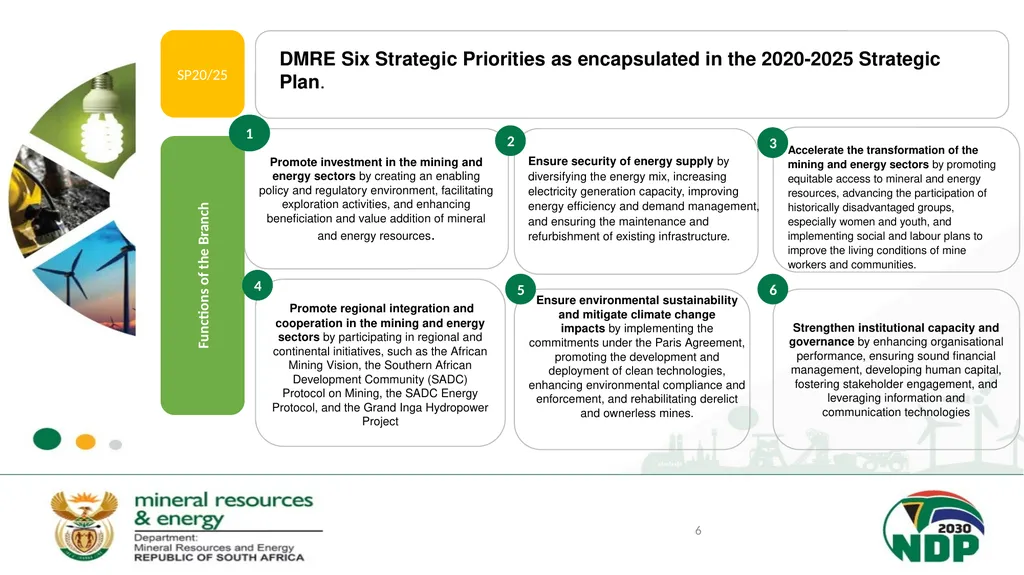
2 3 4 5 6 Ensure security of energy supply by diversifying the energy mix, increasing electricity generation capacity, improving energy efficiency and demand management, and ensuring the maintenance and refurbishment of existing infrastructure. Ensure environmental sustainability and mitigate climate change impacts by implementing the commitments under the Paris Agreement, promoting the development and deployment of clean technologies, enhancing environmental compliance and enforcement, and rehabilitating derelict and ownerless mines. 6<br>
07
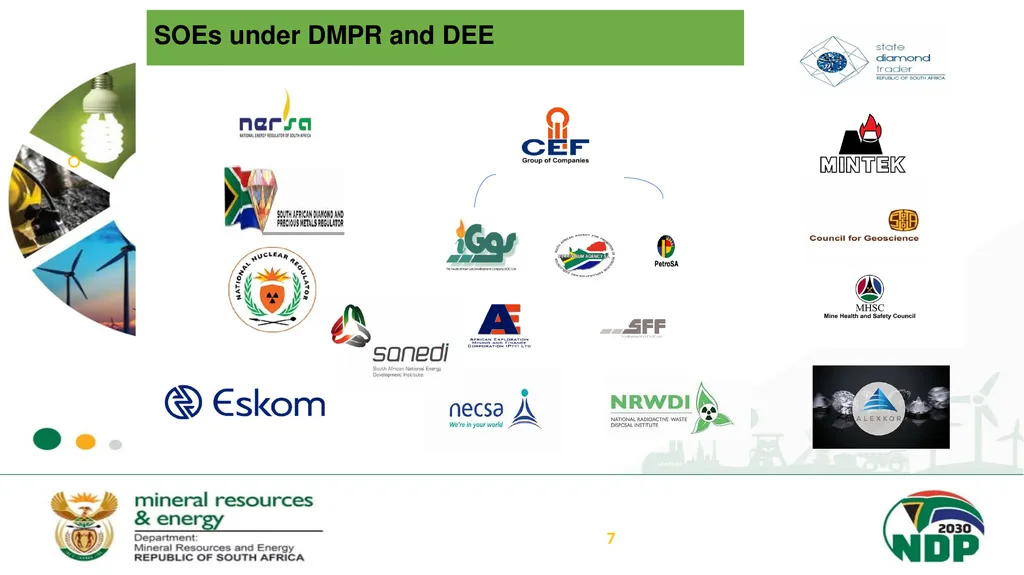
SOEs under DMPR and DEE 7<br>
08
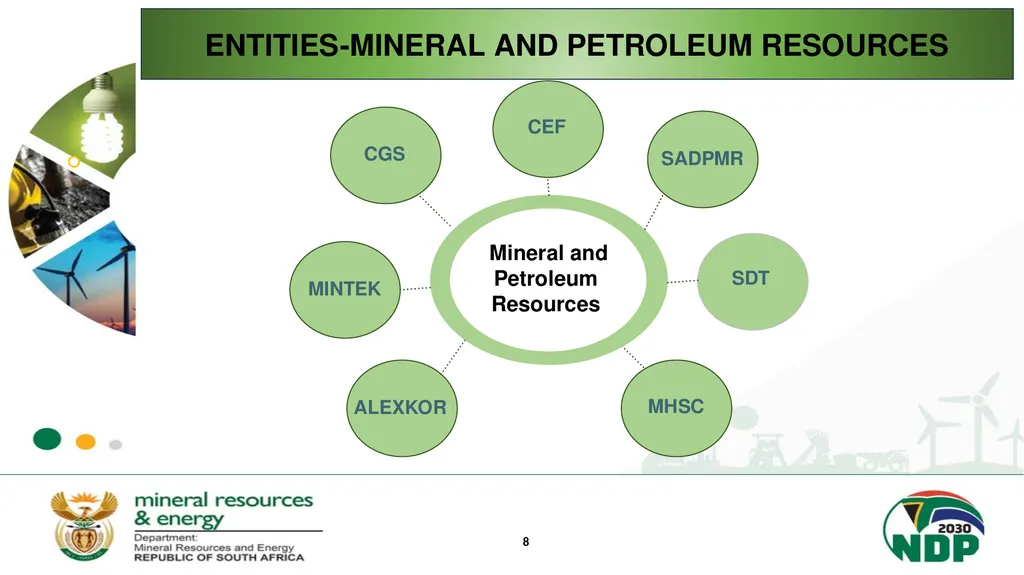
8 ALEXKOR ENTITIES-MINERAL AND PETROLEUM RESOURCES Mineral and Petroleum
Resources CGS MINTEK ALEXKOR SDT SADPMR CEF MHSC<br>
Resources CGS MINTEK ALEXKOR SDT SADPMR CEF MHSC<br>
09
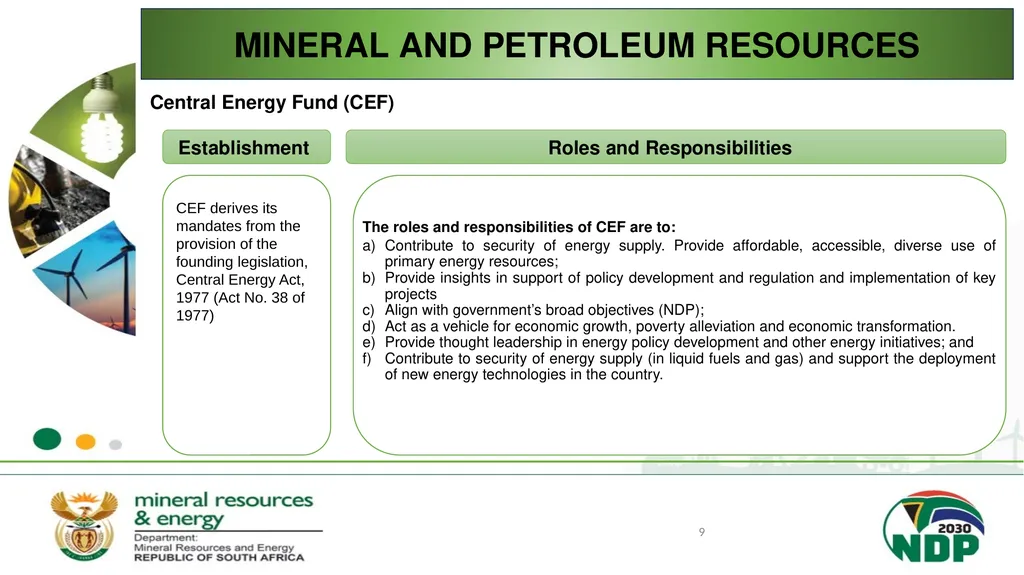
Establishment CEF derives its mandates from the provision of the founding legislation, Central Energy Act, 1977 (Act No. 38 of 1977) Roles and Responsibilities The roles and responsibilities of CEF are to:
Contribute to security of energy supply. Provide affordable, accessible, diverse use of primary energy resources;
Provide insights in support of policy development and regulation and implementation of key projects
Align with government’s broad objectives (NDP);
Act as a vehicle for economic growth, poverty alleviation and economic transformation.
Provide thought leadership in energy policy development and other energy initiatives; and
Contribute to security of energy supply (in liquid fuels and gas) and support the deployment of new energy technologies in the country. MINERAL AND PETROLEUM RESOURCES Central Energy Fund (CEF) 9<br>
Contribute to security of energy supply. Provide affordable, accessible, diverse use of primary energy resources;
Provide insights in support of policy development and regulation and implementation of key projects
Align with government’s broad objectives (NDP);
Act as a vehicle for economic growth, poverty alleviation and economic transformation.
Provide thought leadership in energy policy development and other energy initiatives; and
Contribute to security of energy supply (in liquid fuels and gas) and support the deployment of new energy technologies in the country. MINERAL AND PETROLEUM RESOURCES Central Energy Fund (CEF) 9<br>
10
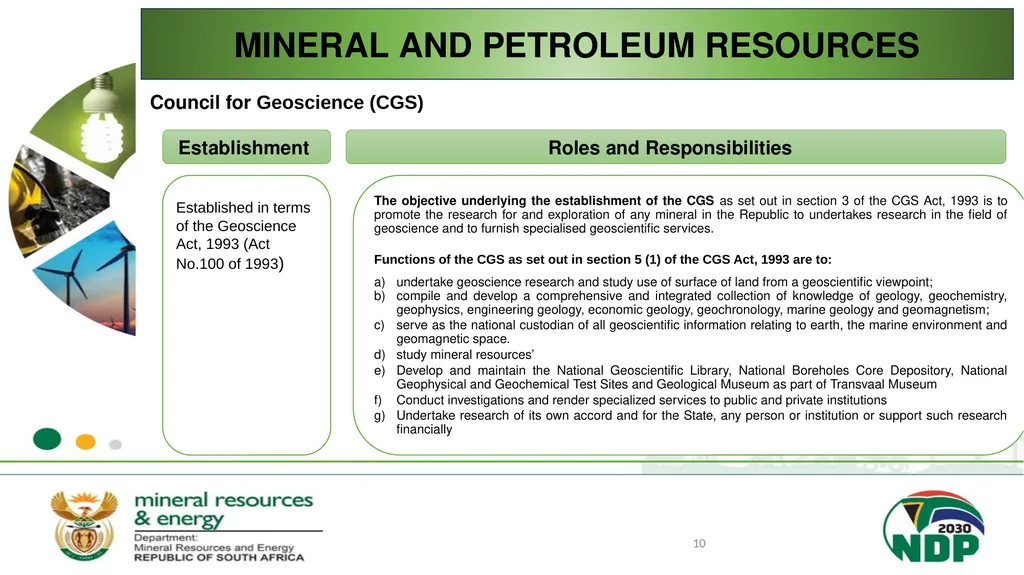
Establishment Established in terms of the Geoscience Act, 1993 (Act No.100 of 1993) Roles and Responsibilities The objective underlying the establishment of the CGS as set out in section 3 of the CGS Act, 1993 is to promote the research for and exploration of any mineral in the Republic to undertakes research in the field of geoscience and to furnish specialised geoscientific services.
Functions of the CGS as set out in section 5 (1) of the CGS Act, 1993 are to:
undertake geoscience research and study use of surface of land from a geoscientific viewpoint;
compile and develop a comprehensive and integrated collection of knowledge of geology, geochemistry, geophysics, engineering geology, economic geology, geochronology, marine geology and geomagnetism;
serve as the national custodian of all geoscientific information relating to earth, the marine environment and geomagnetic space.
study mineral resources’
Develop and maintain the National Geoscientific Library, National Boreholes Core Depository, National Geophysical and Geochemical Test Sites and Geological Museum as part of Transvaal Museum
Conduct investigations and render specialized services to public and private institutions
Undertake research of its own accord and for the State, any person or institution or support such research financially MINERAL AND PETROLEUM RESOURCES Council for Geoscience (CGS) 10<br>
Functions of the CGS as set out in section 5 (1) of the CGS Act, 1993 are to:
undertake geoscience research and study use of surface of land from a geoscientific viewpoint;
compile and develop a comprehensive and integrated collection of knowledge of geology, geochemistry, geophysics, engineering geology, economic geology, geochronology, marine geology and geomagnetism;
serve as the national custodian of all geoscientific information relating to earth, the marine environment and geomagnetic space.
study mineral resources’
Develop and maintain the National Geoscientific Library, National Boreholes Core Depository, National Geophysical and Geochemical Test Sites and Geological Museum as part of Transvaal Museum
Conduct investigations and render specialized services to public and private institutions
Undertake research of its own accord and for the State, any person or institution or support such research financially MINERAL AND PETROLEUM RESOURCES Council for Geoscience (CGS) 10<br>
11
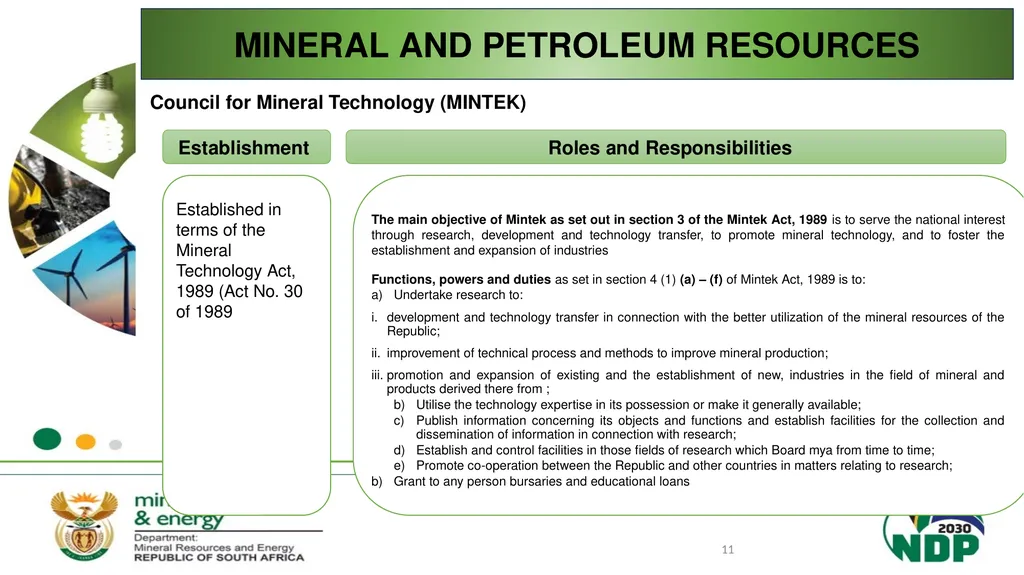
Establishment Established in terms of the Mineral Technology Act, 1989 (Act No. 30 of 1989 Roles and Responsibilities The main objective of Mintek as set out in section 3 of the Mintek Act, 1989 is to serve the national interest through research, development and technology transfer, to promote mineral technology, and to foster the establishment and expansion of industries
Functions, powers and duties as set in section 4 (1) (a) – (f) of Mintek Act, 1989 is to:
Undertake research to:
development and technology transfer in connection with the better utilization of the mineral resources of the Republic;
improvement of technical process and methods to improve mineral production;
promotion and expansion of existing and the establishment of new, industries in the field of mineral and products derived there from ;
Utilise the technology expertise in its possession or make it generally available;
Publish information concerning its objects and functions and establish facilities for the collection and dissemination of information in connection with research;
Establish and control facilities in those fields of research which Board mya from time to time;
Promote co-operation between the Republic and other countries in matters relating to research;
Grant to any person bursaries and educational loans MINERAL AND PETROLEUM RESOURCES Council for Mineral Technology (MINTEK) 11<br>
Functions, powers and duties as set in section 4 (1) (a) – (f) of Mintek Act, 1989 is to:
Undertake research to:
development and technology transfer in connection with the better utilization of the mineral resources of the Republic;
improvement of technical process and methods to improve mineral production;
promotion and expansion of existing and the establishment of new, industries in the field of mineral and products derived there from ;
Utilise the technology expertise in its possession or make it generally available;
Publish information concerning its objects and functions and establish facilities for the collection and dissemination of information in connection with research;
Establish and control facilities in those fields of research which Board mya from time to time;
Promote co-operation between the Republic and other countries in matters relating to research;
Grant to any person bursaries and educational loans MINERAL AND PETROLEUM RESOURCES Council for Mineral Technology (MINTEK) 11<br>
12
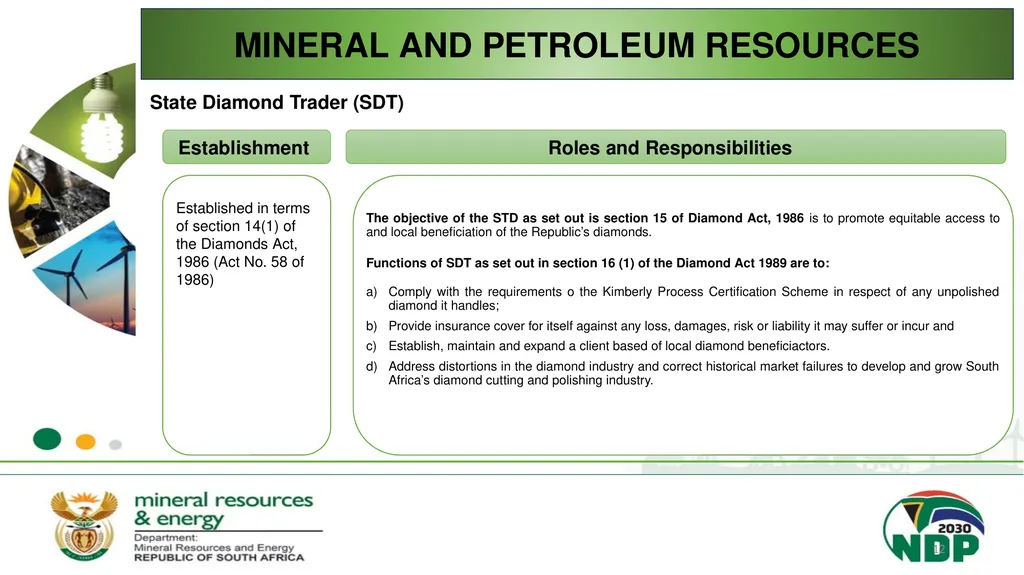
Establishment Established in terms of section 14(1) of the Diamonds Act, 1986 (Act No. 58 of 1986) Roles and Responsibilities The objective of the STD as set out is section 15 of Diamond Act, 1986 is to promote equitable access to and local beneficiation of the Republic’s diamonds.
Functions of SDT as set out in section 16 (1) of the Diamond Act 1989 are to:
Comply with the requirements o the Kimberly Process Certification Scheme in respect of any unpolished diamond it handles;
Provide insurance cover for itself against any loss, damages, risk or liability it may suffer or incur and
Establish, maintain and expand a client based of local diamond beneficiactors.
Address distortions in the diamond industry and correct historical market failures to develop and grow South Africa’s diamond cutting and polishing industry. MINERAL AND PETROLEUM RESOURCES State Diamond Trader (SDT) 12<br>
Functions of SDT as set out in section 16 (1) of the Diamond Act 1989 are to:
Comply with the requirements o the Kimberly Process Certification Scheme in respect of any unpolished diamond it handles;
Provide insurance cover for itself against any loss, damages, risk or liability it may suffer or incur and
Establish, maintain and expand a client based of local diamond beneficiactors.
Address distortions in the diamond industry and correct historical market failures to develop and grow South Africa’s diamond cutting and polishing industry. MINERAL AND PETROLEUM RESOURCES State Diamond Trader (SDT) 12<br>
13
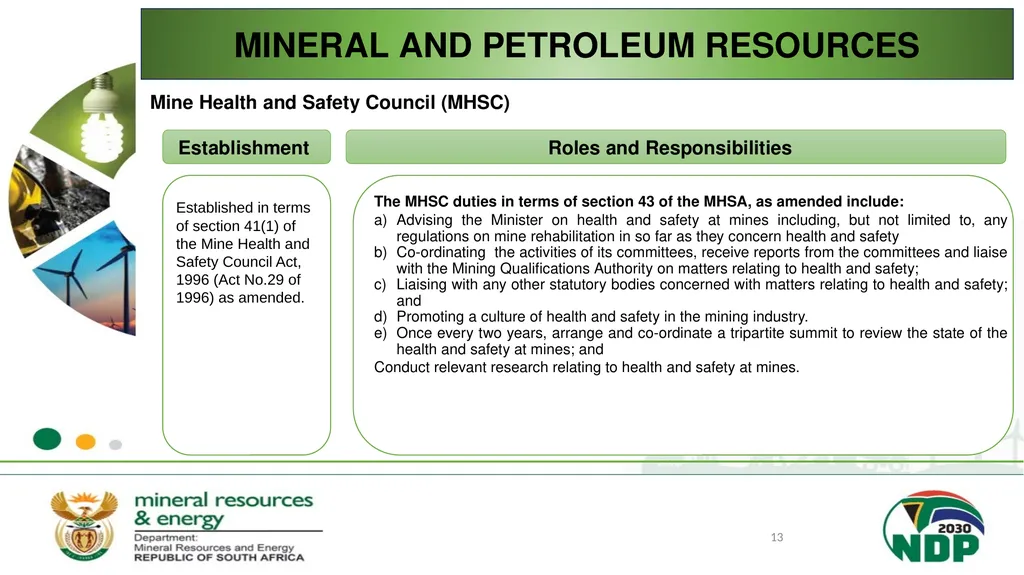
Establishment Established in terms of section 41(1) of the Mine Health and Safety Council Act, 1996 (Act No.29 of 1996) as amended. Roles and Responsibilities The MHSC duties in terms of section 43 of the MHSA, as amended include:
Advising the Minister on health and safety at mines including, but not limited to, any regulations on mine rehabilitation in so far as they concern health and safety
Co-ordinating the activities of its committees, receive reports from the committees and liaise with the Mining Qualifications Authority on matters relating to health and safety;
Liaising with any other statutory bodies concerned with matters relating to health and safety; and
Promoting a culture of health and safety in the mining industry.
Once every two years, arrange and co-ordinate a tripartite summit to review the state of the health and safety at mines; and
Conduct relevant research relating to health and safety at mines. MINERAL AND PETROLEUM RESOURCES Mine Health and Safety Council (MHSC) 13<br>
Advising the Minister on health and safety at mines including, but not limited to, any regulations on mine rehabilitation in so far as they concern health and safety
Co-ordinating the activities of its committees, receive reports from the committees and liaise with the Mining Qualifications Authority on matters relating to health and safety;
Liaising with any other statutory bodies concerned with matters relating to health and safety; and
Promoting a culture of health and safety in the mining industry.
Once every two years, arrange and co-ordinate a tripartite summit to review the state of the health and safety at mines; and
Conduct relevant research relating to health and safety at mines. MINERAL AND PETROLEUM RESOURCES Mine Health and Safety Council (MHSC) 13<br>
14
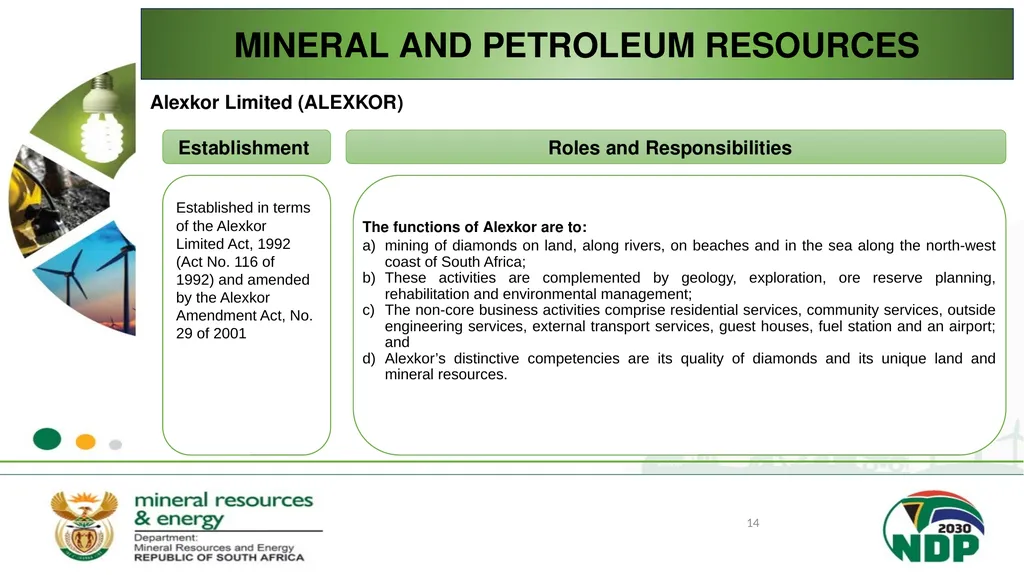
Establishment Established in terms of the Alexkor Limited Act, 1992 (Act No. 116 of 1992) and amended by the Alexkor Amendment Act, No. 29 of 2001 Roles and Responsibilities The functions of Alexkor are to:
mining of diamonds on land, along rivers, on beaches and in the sea along the north-west coast of South Africa;
These activities are complemented by geology, exploration, ore reserve planning, rehabilitation and environmental management;
The non-core business activities comprise residential services, community services, outside engineering services, external transport services, guest houses, fuel station and an airport; and
Alexkor’s distinctive competencies are its quality of diamonds and its unique land and mineral resources. MINERAL AND PETROLEUM RESOURCES Alexkor Limited (ALEXKOR) 14<br>
mining of diamonds on land, along rivers, on beaches and in the sea along the north-west coast of South Africa;
These activities are complemented by geology, exploration, ore reserve planning, rehabilitation and environmental management;
The non-core business activities comprise residential services, community services, outside engineering services, external transport services, guest houses, fuel station and an airport; and
Alexkor’s distinctive competencies are its quality of diamonds and its unique land and mineral resources. MINERAL AND PETROLEUM RESOURCES Alexkor Limited (ALEXKOR) 14<br>
15
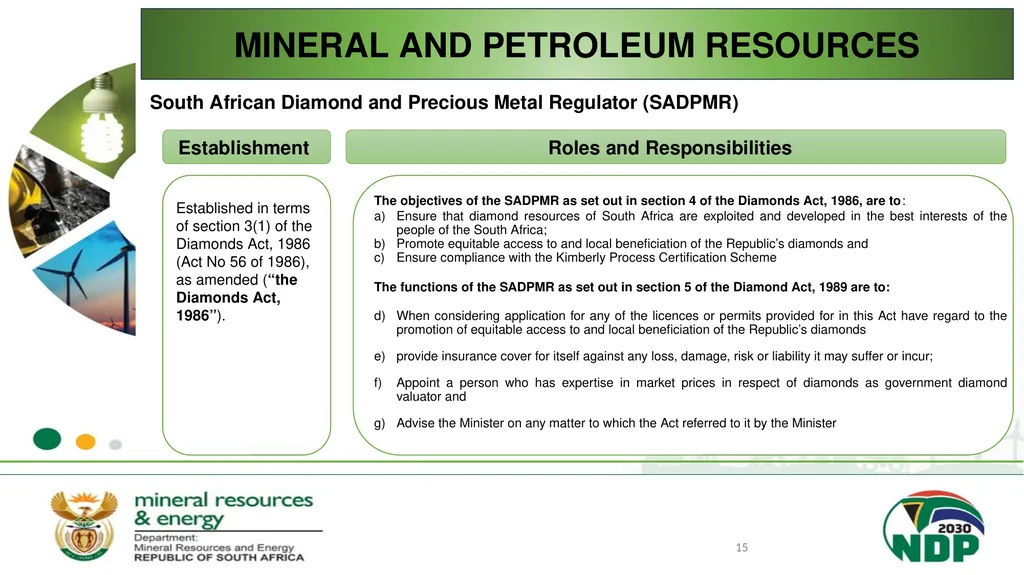
Establishment Established in terms of section 3(1) of the Diamonds Act, 1986 (Act No 56 of 1986), as amended (“the Diamonds Act, 1986”). Roles and Responsibilities The objectives of the SADPMR as set out in section 4 of the Diamonds Act, 1986, are to:
Ensure that diamond resources of South Africa are exploited and developed in the best interests of the people of the South Africa;
Promote equitable access to and local beneficiation of the Republic’s diamonds and
Ensure compliance with the Kimberly Process Certification Scheme
The functions of the SADPMR as set out in section 5 of the Diamond Act, 1989 are to:
When considering application for any of the licences or permits provided for in this Act have regard to the promotion of equitable access to and local beneficiation of the Republic’s diamonds
provide insurance cover for itself against any loss, damage, risk or liability it may suffer or incur;
Appoint a person who has expertise in market prices in respect of diamonds as government diamond valuator and
Advise the Minister on any matter to which the Act referred to it by the Minister MINERAL AND PETROLEUM RESOURCES South African Diamond and Precious Metal Regulator (SADPMR) 15<br>
Ensure that diamond resources of South Africa are exploited and developed in the best interests of the people of the South Africa;
Promote equitable access to and local beneficiation of the Republic’s diamonds and
Ensure compliance with the Kimberly Process Certification Scheme
The functions of the SADPMR as set out in section 5 of the Diamond Act, 1989 are to:
When considering application for any of the licences or permits provided for in this Act have regard to the promotion of equitable access to and local beneficiation of the Republic’s diamonds
provide insurance cover for itself against any loss, damage, risk or liability it may suffer or incur;
Appoint a person who has expertise in market prices in respect of diamonds as government diamond valuator and
Advise the Minister on any matter to which the Act referred to it by the Minister MINERAL AND PETROLEUM RESOURCES South African Diamond and Precious Metal Regulator (SADPMR) 15<br>
16
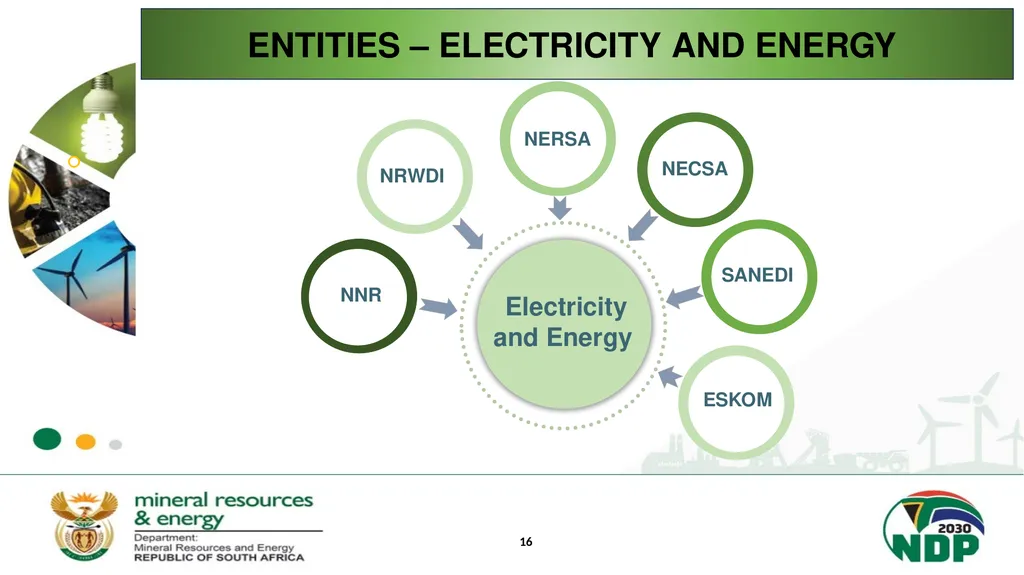
16 ALEXKOR Electricity and Energy NERSA ESKOM NRWDI SANEDI NNR NECSA ENTITIES – ELECTRICITY AND ENERGY<br>
17
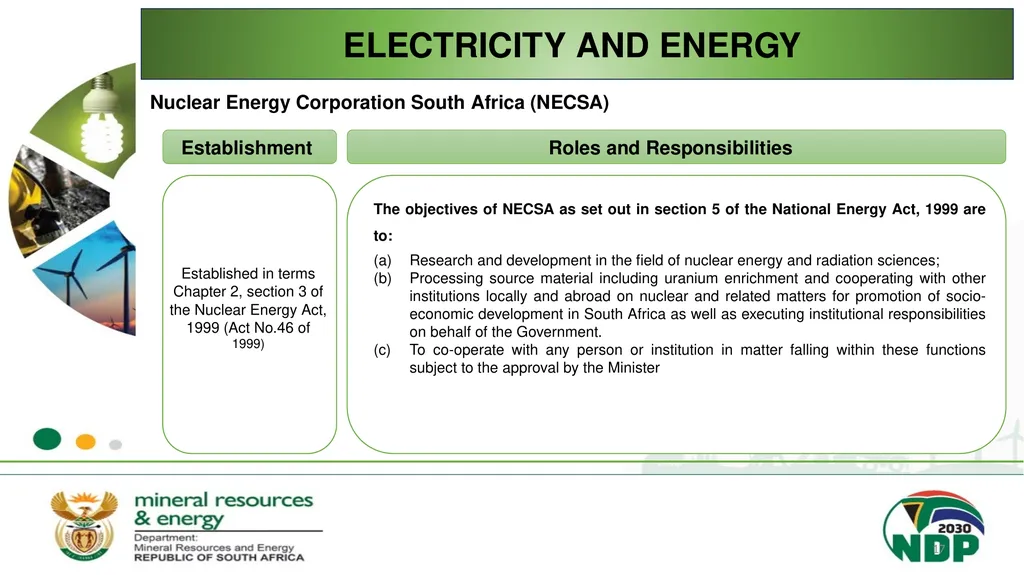
Establishment Established in terms Chapter 2, section 3 of the Nuclear Energy Act, 1999 (Act No.46 of 1999) Roles and Responsibilities The objectives of NECSA as set out in section 5 of the National Energy Act, 1999 are to:
Research and development in the field of nuclear energy and radiation sciences;
Processing source material including uranium enrichment and cooperating with other institutions locally and abroad on nuclear and related matters for promotion of socio-economic development in South Africa as well as executing institutional responsibilities on behalf of the Government.
To co-operate with any person or institution in matter falling within these functions subject to the approval by the Minister Nuclear Energy Corporation South Africa (NECSA) ELECTRICITY AND ENERGY 17<br>
Research and development in the field of nuclear energy and radiation sciences;
Processing source material including uranium enrichment and cooperating with other institutions locally and abroad on nuclear and related matters for promotion of socio-economic development in South Africa as well as executing institutional responsibilities on behalf of the Government.
To co-operate with any person or institution in matter falling within these functions subject to the approval by the Minister Nuclear Energy Corporation South Africa (NECSA) ELECTRICITY AND ENERGY 17<br>
18
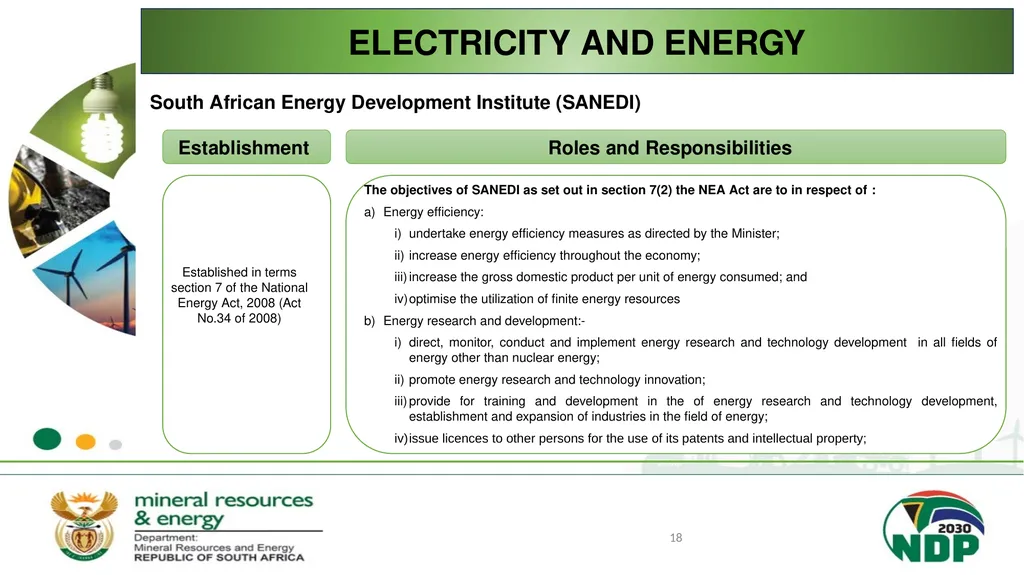
Establishment Established in terms section 7 of the National Energy Act, 2008 (Act No.34 of 2008) Roles and Responsibilities The objectives of SANEDI as set out in section 7(2) the NEA Act are to in respect of :
Energy efficiency:
undertake energy efficiency measures as directed by the Minister;
increase energy efficiency throughout the economy;
increase the gross domestic product per unit of energy consumed; and
optimise the utilization of finite energy resources
Energy research and development:-
direct, monitor, conduct and implement energy research and technology development in all fields of energy other than nuclear energy;
promote energy research and technology innovation;
provide for training and development in the of energy research and technology development, establishment and expansion of industries in the field of energy;
issue licences to other persons for the use of its patents and intellectual property; South African Energy Development Institute (SANEDI) ELECTRICITY AND ENERGY 18<br>
Energy efficiency:
undertake energy efficiency measures as directed by the Minister;
increase energy efficiency throughout the economy;
increase the gross domestic product per unit of energy consumed; and
optimise the utilization of finite energy resources
Energy research and development:-
direct, monitor, conduct and implement energy research and technology development in all fields of energy other than nuclear energy;
promote energy research and technology innovation;
provide for training and development in the of energy research and technology development, establishment and expansion of industries in the field of energy;
issue licences to other persons for the use of its patents and intellectual property; South African Energy Development Institute (SANEDI) ELECTRICITY AND ENERGY 18<br>
19
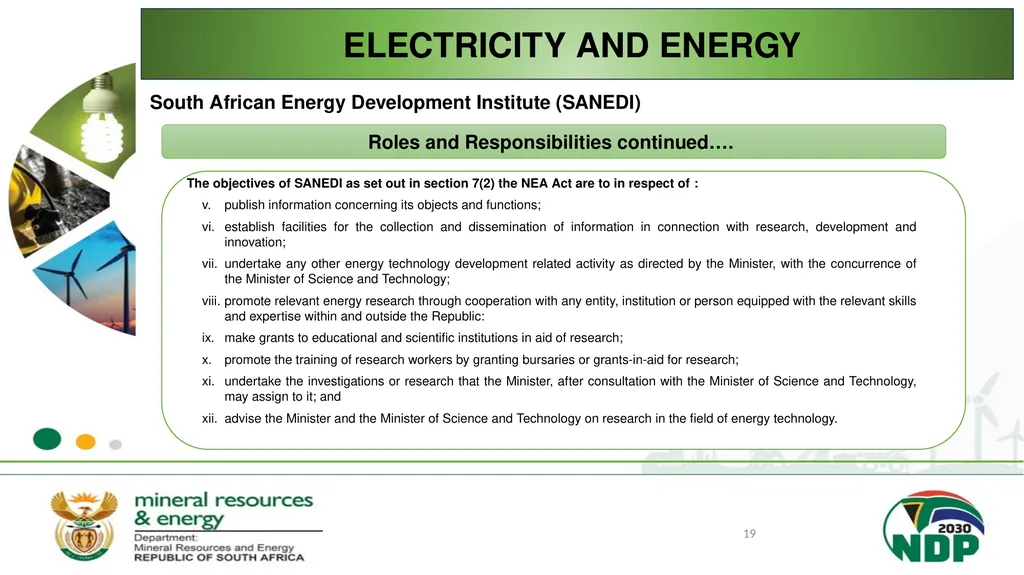
Roles and Responsibilities continued…. The objectives of SANEDI as set out in section 7(2) the NEA Act are to in respect of :
publish information concerning its objects and functions;
establish facilities for the collection and dissemination of information in connection with research, development and innovation;
undertake any other energy technology development related activity as directed by the Minister, with the concurrence of the Minister of Science and Technology;
promote relevant energy research through cooperation with any entity, institution or person equipped with the relevant skills and expertise within and outside the Republic:
make grants to educational and scientific institutions in aid of research;
promote the training of research workers by granting bursaries or grants-in-aid for research;
undertake the investigations or research that the Minister, after consultation with the Minister of Science and Technology, may assign to it; and
advise the Minister and the Minister of Science and Technology on research in the field of energy technology. South African Energy Development Institute (SANEDI) ELECTRICITY AND ENERGY 19<br>
publish information concerning its objects and functions;
establish facilities for the collection and dissemination of information in connection with research, development and innovation;
undertake any other energy technology development related activity as directed by the Minister, with the concurrence of the Minister of Science and Technology;
promote relevant energy research through cooperation with any entity, institution or person equipped with the relevant skills and expertise within and outside the Republic:
make grants to educational and scientific institutions in aid of research;
promote the training of research workers by granting bursaries or grants-in-aid for research;
undertake the investigations or research that the Minister, after consultation with the Minister of Science and Technology, may assign to it; and
advise the Minister and the Minister of Science and Technology on research in the field of energy technology. South African Energy Development Institute (SANEDI) ELECTRICITY AND ENERGY 19<br>
20
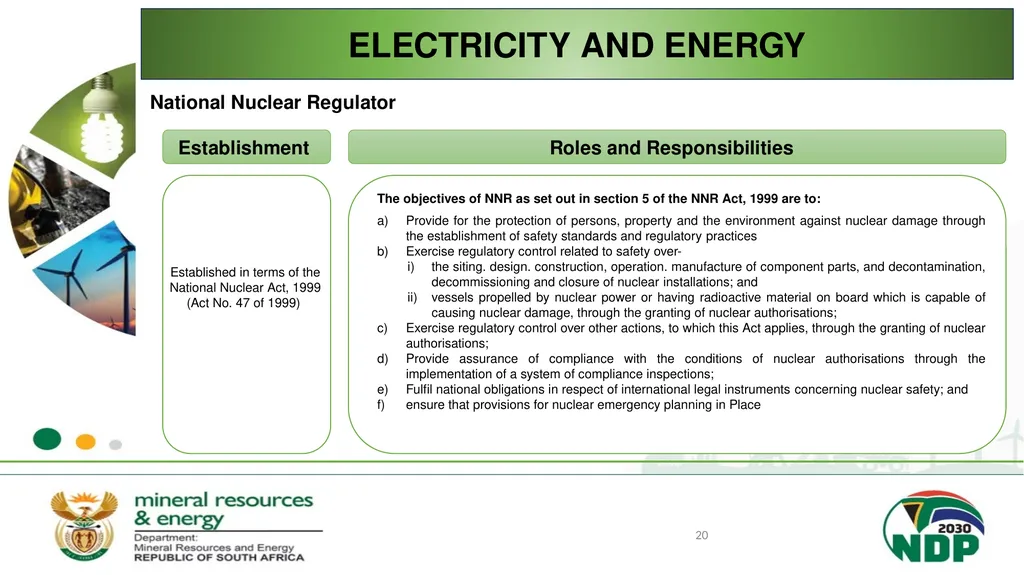
Establishment Established in terms of the National Nuclear Act, 1999 (Act No. 47 of 1999) Roles and Responsibilities The objectives of NNR as set out in section 5 of the NNR Act, 1999 are to:
Provide for the protection of persons, property and the environment against nuclear damage through the establishment of safety standards and regulatory practices
Exercise regulatory control related to safety over-
the siting. design. construction, operation. manufacture of component parts, and decontamination, decommissioning and closure of nuclear installations; and
vessels propelled by nuclear power or having radioactive material on board which is capable of causing nuclear damage, through the granting of nuclear authorisations;
Exercise regulatory control over other actions, to which this Act applies, through the granting of nuclear authorisations;
Provide assurance of compliance with the conditions of nuclear authorisations through the implementation of a system of compliance inspections;
Fulfil national obligations in respect of international legal instruments concerning nuclear safety; and
ensure that provisions for nuclear emergency planning in Place National Nuclear Regulator ELECTRICITY AND ENERGY 20<br>
Provide for the protection of persons, property and the environment against nuclear damage through the establishment of safety standards and regulatory practices
Exercise regulatory control related to safety over-
the siting. design. construction, operation. manufacture of component parts, and decontamination, decommissioning and closure of nuclear installations; and
vessels propelled by nuclear power or having radioactive material on board which is capable of causing nuclear damage, through the granting of nuclear authorisations;
Exercise regulatory control over other actions, to which this Act applies, through the granting of nuclear authorisations;
Provide assurance of compliance with the conditions of nuclear authorisations through the implementation of a system of compliance inspections;
Fulfil national obligations in respect of international legal instruments concerning nuclear safety; and
ensure that provisions for nuclear emergency planning in Place National Nuclear Regulator ELECTRICITY AND ENERGY 20<br>
21
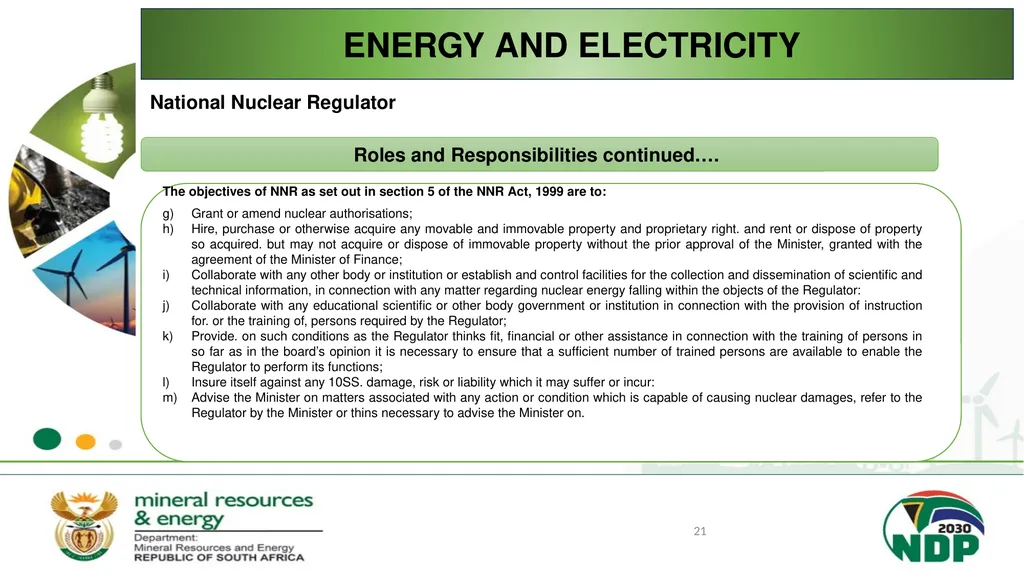
Roles and Responsibilities continued…. The objectives of NNR as set out in section 5 of the NNR Act, 1999 are to:
Grant or amend nuclear authorisations;
Hire, purchase or otherwise acquire any movable and immovable property and proprietary right. and rent or dispose of property so acquired. but may not acquire or dispose of immovable property without the prior approval of the Minister, granted with the agreement of the Minister of Finance;
Collaborate with any other body or institution or establish and control facilities for the collection and dissemination of scientific and technical information, in connection with any matter regarding nuclear energy falling within the objects of the Regulator:
Collaborate with any educational scientific or other body government or institution in connection with the provision of instruction for. or the training of, persons required by the Regulator;
Provide. on such conditions as the Regulator thinks fit, financial or other assistance in connection with the training of persons in so far as in the board’s opinion it is necessary to ensure that a sufficient number of trained persons are available to enable the Regulator to perform its functions;
Insure itself against any 10SS. damage, risk or liability which it may suffer or incur:
Advise the Minister on matters associated with any action or condition which is capable of causing nuclear damages, refer to the Regulator by the Minister or thins necessary to advise the Minister on. National Nuclear Regulator ENERGY AND ELECTRICITY 21<br>
Grant or amend nuclear authorisations;
Hire, purchase or otherwise acquire any movable and immovable property and proprietary right. and rent or dispose of property so acquired. but may not acquire or dispose of immovable property without the prior approval of the Minister, granted with the agreement of the Minister of Finance;
Collaborate with any other body or institution or establish and control facilities for the collection and dissemination of scientific and technical information, in connection with any matter regarding nuclear energy falling within the objects of the Regulator:
Collaborate with any educational scientific or other body government or institution in connection with the provision of instruction for. or the training of, persons required by the Regulator;
Provide. on such conditions as the Regulator thinks fit, financial or other assistance in connection with the training of persons in so far as in the board’s opinion it is necessary to ensure that a sufficient number of trained persons are available to enable the Regulator to perform its functions;
Insure itself against any 10SS. damage, risk or liability which it may suffer or incur:
Advise the Minister on matters associated with any action or condition which is capable of causing nuclear damages, refer to the Regulator by the Minister or thins necessary to advise the Minister on. National Nuclear Regulator ENERGY AND ELECTRICITY 21<br>
22
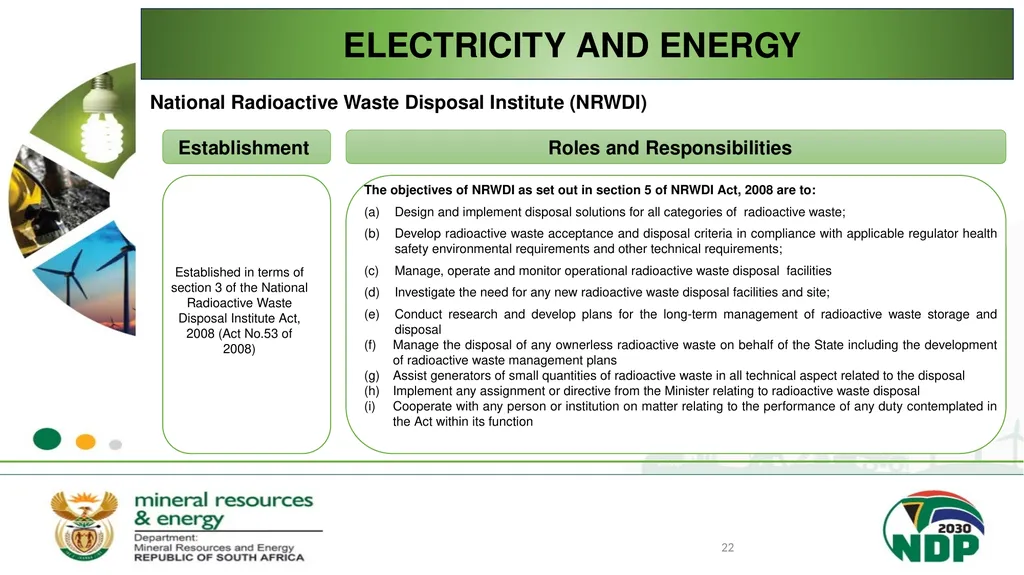
Establishment Established in terms of section 3 of the National Radioactive Waste Disposal Institute Act, 2008 (Act No.53 of 2008) Roles and Responsibilities The objectives of NRWDI as set out in section 5 of NRWDI Act, 2008 are to:
Design and implement disposal solutions for all categories of radioactive waste;
Develop radioactive waste acceptance and disposal criteria in compliance with applicable regulator health safety environmental requirements and other technical requirements;
Manage, operate and monitor operational radioactive waste disposal facilities
Investigate the need for any new radioactive waste disposal facilities and site;
Conduct research and develop plans for the long-term management of radioactive waste storage and disposal
Manage the disposal of any ownerless radioactive waste on behalf of the State including the development of radioactive waste management plans
Assist generators of small quantities of radioactive waste in all technical aspect related to the disposal
Implement any assignment or directive from the Minister relating to radioactive waste disposal
Cooperate with any person or institution on matter relating to the performance of any duty contemplated in the Act within its function National Radioactive Waste Disposal Institute (NRWDI) ELECTRICITY AND ENERGY 22<br>
Design and implement disposal solutions for all categories of radioactive waste;
Develop radioactive waste acceptance and disposal criteria in compliance with applicable regulator health safety environmental requirements and other technical requirements;
Manage, operate and monitor operational radioactive waste disposal facilities
Investigate the need for any new radioactive waste disposal facilities and site;
Conduct research and develop plans for the long-term management of radioactive waste storage and disposal
Manage the disposal of any ownerless radioactive waste on behalf of the State including the development of radioactive waste management plans
Assist generators of small quantities of radioactive waste in all technical aspect related to the disposal
Implement any assignment or directive from the Minister relating to radioactive waste disposal
Cooperate with any person or institution on matter relating to the performance of any duty contemplated in the Act within its function National Radioactive Waste Disposal Institute (NRWDI) ELECTRICITY AND ENERGY 22<br>
23
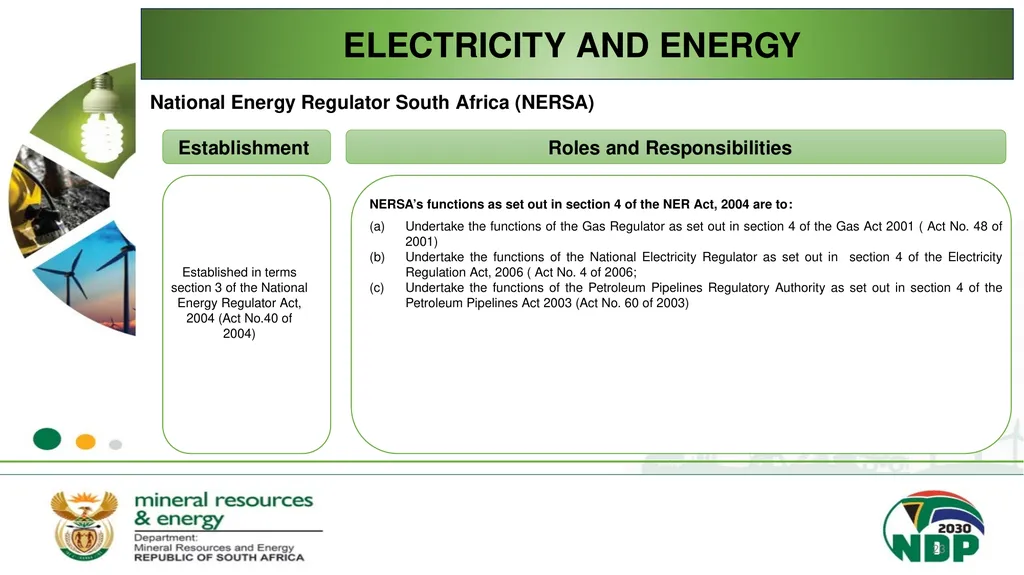
Establishment Established in terms section 3 of the National Energy Regulator Act, 2004 (Act No.40 of 2004) Roles and Responsibilities NERSA’s functions as set out in section 4 of the NER Act, 2004 are to:
Undertake the functions of the Gas Regulator as set out in section 4 of the Gas Act 2001 ( Act No. 48 of 2001)
Undertake the functions of the National Electricity Regulator as set out in section 4 of the Electricity Regulation Act, 2006 ( Act No. 4 of 2006;
Undertake the functions of the Petroleum Pipelines Regulatory Authority as set out in section 4 of the Petroleum Pipelines Act 2003 (Act No. 60 of 2003) National Energy Regulator South Africa (NERSA) ELECTRICITY AND ENERGY 23<br>
Undertake the functions of the Gas Regulator as set out in section 4 of the Gas Act 2001 ( Act No. 48 of 2001)
Undertake the functions of the National Electricity Regulator as set out in section 4 of the Electricity Regulation Act, 2006 ( Act No. 4 of 2006;
Undertake the functions of the Petroleum Pipelines Regulatory Authority as set out in section 4 of the Petroleum Pipelines Act 2003 (Act No. 60 of 2003) National Energy Regulator South Africa (NERSA) ELECTRICITY AND ENERGY 23<br>
24
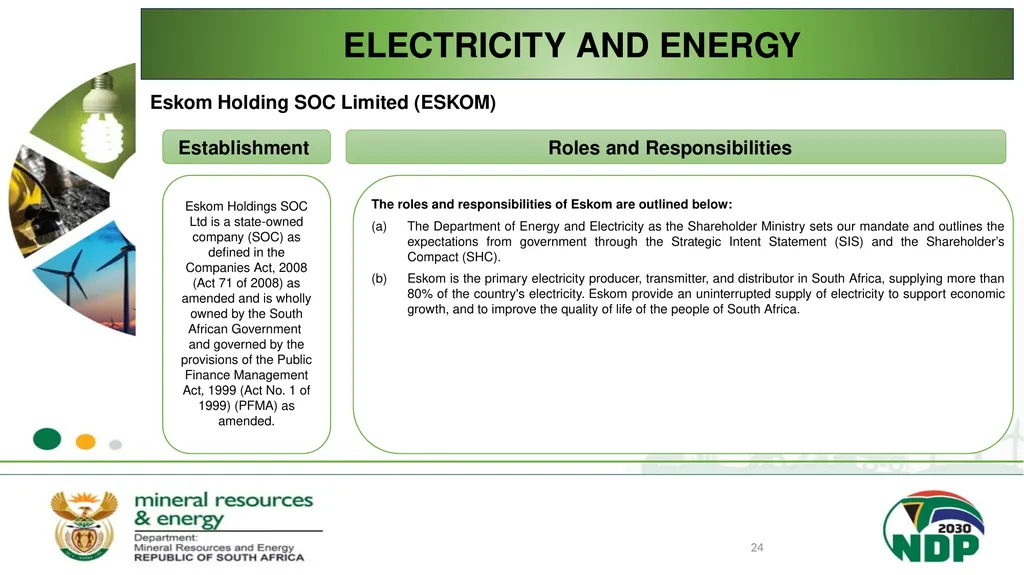
Establishment Eskom Holdings SOC Ltd is a state-owned company (SOC) as defined in the Companies Act, 2008 (Act 71 of 2008) as amended and is wholly owned by the South African Government and governed by the provisions of the Public Finance Management Act, 1999 (Act No. 1 of 1999) (PFMA) as amended. Roles and Responsibilities The roles and responsibilities of Eskom are outlined below:
The Department of Energy and Electricity as the Shareholder Ministry sets our mandate and outlines the expectations from government through the Strategic Intent Statement (SIS) and the Shareholder’s Compact (SHC).
Eskom is the primary electricity producer, transmitter, and distributor in South Africa, supplying more than 80% of the country's electricity. Eskom provide an uninterrupted supply of electricity to support economic growth, and to improve the quality of life of the people of South Africa. ELECTRICITY AND ENERGY Eskom Holding SOC Limited (ESKOM) 24<br>
The Department of Energy and Electricity as the Shareholder Ministry sets our mandate and outlines the expectations from government through the Strategic Intent Statement (SIS) and the Shareholder’s Compact (SHC).
Eskom is the primary electricity producer, transmitter, and distributor in South Africa, supplying more than 80% of the country's electricity. Eskom provide an uninterrupted supply of electricity to support economic growth, and to improve the quality of life of the people of South Africa. ELECTRICITY AND ENERGY Eskom Holding SOC Limited (ESKOM) 24<br>
25
Thank you 25<br>