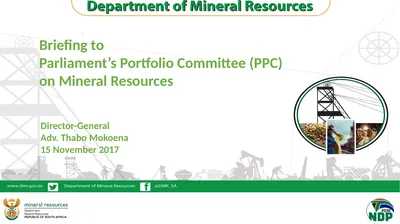
Briefing to Parliament’s Portfolio Committee (PPC)

Published  . 0 views
↓ Download
Briefing to Parliament’s Portfolio Committee (PPC)
1 / 1
Briefing to Parliament’s Portfolio Committee (PPC) - slide 1 of 28 Briefing to Parliament’s Portfolio Committee (PPC) - slide 2 of 28 Briefing to Parliament’s Portfolio Committee (PPC) - slide 3 of 28 Briefing to Parliament’s Portfolio Committee (PPC) - slide 4 of 28 Briefing to Parliament’s Portfolio Committee (PPC) - slide 5 of 28 Briefing to Parliament’s Portfolio Committee (PPC) - slide 6 of 28 Briefing to Parliament’s Portfolio Committee (PPC) - slide 7 of 28 Briefing to Parliament’s Portfolio Committee (PPC) - slide 8 of 28 Briefing to Parliament’s Portfolio Committee (PPC) - slide 9 of 28 Briefing to Parliament’s Portfolio Committee (PPC) - slide 10 of 28 Briefing to Parliament’s Portfolio Committee (PPC) - slide 11 of 28 Briefing to Parliament’s Portfolio Committee (PPC) - slide 12 of 28 Briefing to Parliament’s Portfolio Committee (PPC) - slide 13 of 28 Briefing to Parliament’s Portfolio Committee (PPC) - slide 14 of 28 Briefing to Parliament’s Portfolio Committee (PPC) - slide 15 of 28 Briefing to Parliament’s Portfolio Committee (PPC) - slide 16 of 28 Briefing to Parliament’s Portfolio Committee (PPC) - slide 17 of 28 Briefing to Parliament’s Portfolio Committee (PPC) - slide 18 of 28 Briefing to Parliament’s Portfolio Committee (PPC) - slide 19 of 28 Briefing to Parliament’s Portfolio Committee (PPC) - slide 20 of 28 Briefing to Parliament’s Portfolio Committee (PPC) - slide 21 of 28 Briefing to Parliament’s Portfolio Committee (PPC) - slide 22 of 28 Briefing to Parliament’s Portfolio Committee (PPC) - slide 23 of 28 Briefing to Parliament’s Portfolio Committee (PPC) - slide 24 of 28 Briefing to Parliament’s Portfolio Committee (PPC) - slide 25 of 28 Briefing to Parliament’s Portfolio Committee (PPC) - slide 26 of 28 Briefing to Parliament’s Portfolio Committee (PPC) - slide 27 of 28 Briefing to Parliament’s Portfolio Committee (PPC) - slide 28 of 28
Description: Briefing to Parliaments Portfolio Committee (PPC) on Mineral Resources Director-General Adv. Thabo Mokoena 15 November 2017 2 Presentation Outline Background Application process and transparency thereof Integration of Management

Related Topics

Download Presentation

"Briefing to Parliament’s Portfolio Committee (PPC)" is the property of its rightful owner. Permission is granted to download and print the materials on this website for personal, non-commercial use only, and to display it on your personal computer provided you do not modify the materials and that you retain all copyright notices contained in the materials. By downloading content from our website, you accept the terms of this agreement.

Presentation Transcript

slide1. Briefing to
Parliament’s Portfolio Committee (PPC)
on Mineral Resources Director-General
Adv. Thabo Mokoena
15 November 2017<br>
slide2. 2 Presentation Outline Background
Application process and transparency thereof
Integration of Management Information System
Applications and status thereof
Conclusion<br>
slide3. 3 Background OUR MANDATE

S3 of MPRDA deals with the custodianship of the nation’s minerals and petroleum resources
The state exercises its custodianship through the Minister of Mineral Resources by giving the Minister the powers to ensure the development and management of the South Africa’s mineral and petroleum resources S3(2) of MPRDA<br>
slide4. OUR MANDATE cont…

Chapter 4 of the MPRDA deals with among others
- processes and criteria of dealing with applications for the rights
- management thereof
- obligations of the holders 4 Background cont…<br>
slide5. Section 6 of the Act deals the principles of administration (e.g. reasonable time, transparency, etc. hence SAMRAD)
SAMRAD is the South African Mineral Resources Administration System that the department is using in administering the application process for the mineral rights
The system is programmed with business rules as per MPRDA to ensure transparency
Status of the application is available on the system and progress is updated progressively as decisions are made 5 Application process and transparency thereof<br>
slide6. As indicated previously, there is a need for system enhancement
However, the department stopped the enhancement but rather took a decision for system improvement which will be inclusive of integration with other systems like Mine Health Safety 6 Integration of Management Information Systems<br>
slide7. Integration of Management Information Systems cont… 7 The Department is currently in the process of investing into an Integrated System to be developed over a five year period in phases as follows:
Phase 1 – Process mapping and Enterprise Architecture = To be advertised by end of November 2017
Phase 2 – Infrastructure enhancement (servers and bandwidth)
Phase 3 – System procurement and implementation
The Department is confident that this process will simplify the process and make it more efficient<br>
slide8. 8 Applications and Status<br>
slide9. 9 Applications and Status: Eastern Cape<br>
slide10. Applications and Status: Free State 10<br>
slide11. Applications and Status: Gauteng 11<br>
slide12. Applications and Status: Limpopo 12<br>
slide13. 13 Applications and Status: Northern Cape<br>
slide14. 14 Applications and Status: North West<br>
slide15. 15 Applications and Status: Mpumalanga<br>
slide16. Applications and Status: Western Cape 16<br>
slide17. 17 Applications and Status: KwaZulu-Natal<br>
slide18. 18 Applications and Status: SUMMARY<br>
slide19. 19 Foreign company interest South Africa’s mineral sector is part of the global economic community
International investors having interest in the SA mining sector are as follows:
North America: USA and Canada
Europe: France, Italy, Spain, United Kingdom, Belgium
Asia: China, Russia, India, Japan, Turkey
Australia: Australia
There are 350 rights issued to companies with foreign content<br>
slide20. 20 Foreign company mineral interests Energy minerals (include coal and uranium)
Metals (as steel and precious metals)
Industrial minerals (non–metallic minerals used in a range of industrial applications including clays, limestone, silica sand, phosphate rock)
Construction minerals (include sand and gravel, brick clay and crushed rock aggregates for manufacturing of concrete, bricks and pipes and in building houses and roads)<br>
slide21. 21 Foreign company list<br>
slide22. 22 South African company mineral interests<br>
slide23. Proportion of rights issued to SA v Foreign 23<br>
slide24. Administrative challenges 24 Lack of funding to provide for required human resource capacity to implement the Departmental mandate
High volumes of applications received and less human capacity to process within stipulated time frames resulting in delays in processing and finalising applications
Lack of financial capacity to provide for systems and technology for monitoring and evaluation of compliance with the Act
No integration in the management of mining data (mineral regulation, mine health and safety, mineral policy and promotion<br>
slide25. Administrative challenges cont… 25 High costs associated with lodgement of applications (i.e EIA costs and provision for rehabilitation guarantees)
Technical nature of the content of application requirements
HDSA applicants are unable to fully comply with authorisation requirements within stipulated times
Landowner’s denial of applicants to prospect / mine on their properties<br>
slide26. Measures to address 26 Assistance of HDSA applicants to comply with requirements even if the process runs over the stipulated time
Engaging Council for GeoScience and MinTEK to provide technical assistance
Need for intervention for a financing mechanism to assist HDSA applicants
Where landowners deny access to properties – utilise the provision of section 54 of MPRDA to mediate over disputes<br>
slide27. 27 Conclusion There is really a need for the department to be more financially resourced to deal with its majority of the challenges

Processing of applications in a seamless and cost effective manner including improving on turnaround time

Integrated systems to improve data availability and reliability<br>