
British Academy Where we Live Next: Policy


Description: British Academy Where we Live Next: Policy Insights Workshops Professor Jane Wills, University of Exeter, Cornwall, j.wills2exeter.ac.uk 12 September 2024 The changing geography of nature recovery policy and practice: Insights from the
Related Topics
Download Presentation
"British Academy Where we Live Next: Policy" is the property of its rightful owner. Permission is granted to download and print the materials on this website for personal, non-commercial use only, and to display it on your personal computer provided you do not modify the materials and that you retain all copyright notices contained in the materials. By downloading content from our website, you accept the terms of this agreement.
Presentation Transcript
slide1. British Academy
Where we Live Next: Policy Insights Workshops Professor Jane Wills, University of Exeter, Cornwall, j.wills2@exeter.ac.uk
12 September 2024 The changing geography of nature recovery policy and practice: Insights from the NaRReD research<br>
slide2. Introduction Three-year Economic and Social Research Council (ESRC) funded project: Nature Recovery and Regional Development (NaRReD).
Exploring the intersection between NR and socio-economic development paths and outcomes – planning, business, jobs, skills, quality of life.
In partnership with Britain’s Leading Edge (BLE), a network of 12 local authorities on the rural-periphery of England (places without major cities). Local authorities rich in natural capital with relatively weak economies and significant socio-economic challenges.
Preliminary focus on Local Nature Recovery Strategies (LNRS) and the enhanced duties for local authorities to map priority areas for local nature recovery (for 2025) as determined by the Environment Act (2021).
Interviews with local authority officers to explore approach, opportunities and challenges, public engagement, integration with local planning and development paths. Background
Challenges
Solutions<br>
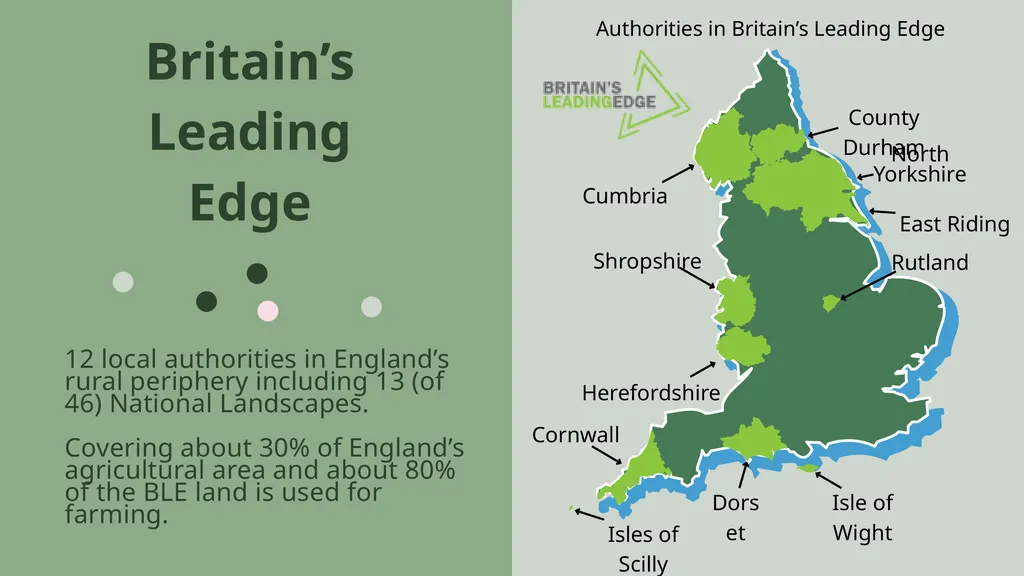
slide3. Britain’s Leading Edge 12 local authorities in England’s rural periphery including 13 (of 46) National Landscapes.
Covering about 30% of England’s agricultural area and about 80% of the BLE land is used for farming. Authorities in Britain’s Leading Edge County Durham North Yorkshire East Riding Cumbria Shropshire Herefordshire Cornwall Dorset Isle of Wight Isles of Scilly Rutland<br>
slide4. The changing geography of nature recovery
Beyond designations and specialists (SSSIs, NNR/NMRs, National Landscapes, Ramsar sites …)
Beyond conservation or ecological restoration to nature recovery - working definition:
“action taken to improve habitat quality, coverage and connections, to enhance biodiversity and species abundance, requiring a place-based collaborative and community-focussed approach”
LNRS mapping existing sites and new opportunities through consultation.
Potential to foster a broader civic coalition – councils (inc parishes), conservationists, farmers and land managers, businesses, communities.<br>
slide5. The challenges faced in delivering
place-sensitive nature recovery Ensuring that precious habitats are created, protected and extended, with space for other animals and organisms to live and flourish, with support from the people living there.
Via policy that is developed in ways that reflects local priorities and capacity to deliver.
Ensuring integration with other priorities - without being trumped from others or above.
Mobilising appropriate private sector investment (eg BNG and biodiversity credits).
Enabling access to the ELM scheme and scaling up activity for nature-positive farming and land management.
Identifying and mobilising the broadest coalition of actors to act for nature in the local area.
Ensuring delivery with strong political leadership (from in and beyond the locality) and sufficient resources.<br>
slide6. Emerging solutions and the diversity of place-sensitive visions, policies and practices Local authority leadership.
Oversight and support from Natural England and strong links with other government bodies such as the Environment Agency.
Partnerships with conservation organisations and integration of ecological recorders and records.
Experimentation with Systematic Conservation Management mapping (Cornwall).
Engagement with key groups of stakeholders in targeted events (especially farmers and land managers).
Leadership from the grassroots (hyper-local parishes Shropshire and the IoW).
Public communication and engagement events.
Creation of new platforms to attract private sector investment.
Thinking ahead to delivery.<br>
slide7. Summary The new geography of NR – visualised via the LNRS maps – can engage and mobilise a broader coalition of people committed to change: Nature recovery can involve everybody.
People share space and the quality of the environment matters to everyone and everything, including the plants and other organisms living with us.
For the first time, farmers and land managers are being paid for public (environmental) goods and developers are required to pay for BNG, so there are resources for nature recovery that provide resources for change.
The change of national government raises the spectre of a change in direction, especially given commitments to housing, renewable energy and additional infrastructure. There is a danger nature recovery will be side-lined again. It is a critical time for nature recovery.
And not just in the UK: The UN decade of ‘Ecosystem Restoration’ (2020s) aims “to prevent, halt and reverse the degradation of ecosystems on every continent and in every ocean.”<br>
slide8. Comments, questions and further engagement very welcome, now or another day! To get in touch:
Prof. Jane Wills
J.Wills2@exeter.ac.uk
Dr Jack Reed
J.Reed2@exeter.ac.uk https://www.exeter.ac.uk/research/esi/research/projects/naturerecoveryandregionaldevelopment/<br>
Where we Live Next: Policy Insights Workshops Professor Jane Wills, University of Exeter, Cornwall, j.wills2@exeter.ac.uk
12 September 2024 The changing geography of nature recovery policy and practice: Insights from the NaRReD research<br>
slide2. Introduction Three-year Economic and Social Research Council (ESRC) funded project: Nature Recovery and Regional Development (NaRReD).
Exploring the intersection between NR and socio-economic development paths and outcomes – planning, business, jobs, skills, quality of life.
In partnership with Britain’s Leading Edge (BLE), a network of 12 local authorities on the rural-periphery of England (places without major cities). Local authorities rich in natural capital with relatively weak economies and significant socio-economic challenges.
Preliminary focus on Local Nature Recovery Strategies (LNRS) and the enhanced duties for local authorities to map priority areas for local nature recovery (for 2025) as determined by the Environment Act (2021).
Interviews with local authority officers to explore approach, opportunities and challenges, public engagement, integration with local planning and development paths. Background
Challenges
Solutions<br>
slide3. Britain’s Leading Edge 12 local authorities in England’s rural periphery including 13 (of 46) National Landscapes.
Covering about 30% of England’s agricultural area and about 80% of the BLE land is used for farming. Authorities in Britain’s Leading Edge County Durham North Yorkshire East Riding Cumbria Shropshire Herefordshire Cornwall Dorset Isle of Wight Isles of Scilly Rutland<br>
slide4. The changing geography of nature recovery
Beyond designations and specialists (SSSIs, NNR/NMRs, National Landscapes, Ramsar sites …)
Beyond conservation or ecological restoration to nature recovery - working definition:
“action taken to improve habitat quality, coverage and connections, to enhance biodiversity and species abundance, requiring a place-based collaborative and community-focussed approach”
LNRS mapping existing sites and new opportunities through consultation.
Potential to foster a broader civic coalition – councils (inc parishes), conservationists, farmers and land managers, businesses, communities.<br>
slide5. The challenges faced in delivering
place-sensitive nature recovery Ensuring that precious habitats are created, protected and extended, with space for other animals and organisms to live and flourish, with support from the people living there.
Via policy that is developed in ways that reflects local priorities and capacity to deliver.
Ensuring integration with other priorities - without being trumped from others or above.
Mobilising appropriate private sector investment (eg BNG and biodiversity credits).
Enabling access to the ELM scheme and scaling up activity for nature-positive farming and land management.
Identifying and mobilising the broadest coalition of actors to act for nature in the local area.
Ensuring delivery with strong political leadership (from in and beyond the locality) and sufficient resources.<br>
slide6. Emerging solutions and the diversity of place-sensitive visions, policies and practices Local authority leadership.
Oversight and support from Natural England and strong links with other government bodies such as the Environment Agency.
Partnerships with conservation organisations and integration of ecological recorders and records.
Experimentation with Systematic Conservation Management mapping (Cornwall).
Engagement with key groups of stakeholders in targeted events (especially farmers and land managers).
Leadership from the grassroots (hyper-local parishes Shropshire and the IoW).
Public communication and engagement events.
Creation of new platforms to attract private sector investment.
Thinking ahead to delivery.<br>
slide7. Summary The new geography of NR – visualised via the LNRS maps – can engage and mobilise a broader coalition of people committed to change: Nature recovery can involve everybody.
People share space and the quality of the environment matters to everyone and everything, including the plants and other organisms living with us.
For the first time, farmers and land managers are being paid for public (environmental) goods and developers are required to pay for BNG, so there are resources for nature recovery that provide resources for change.
The change of national government raises the spectre of a change in direction, especially given commitments to housing, renewable energy and additional infrastructure. There is a danger nature recovery will be side-lined again. It is a critical time for nature recovery.
And not just in the UK: The UN decade of ‘Ecosystem Restoration’ (2020s) aims “to prevent, halt and reverse the degradation of ecosystems on every continent and in every ocean.”<br>
slide8. Comments, questions and further engagement very welcome, now or another day! To get in touch:
Prof. Jane Wills
J.Wills2@exeter.ac.uk
Dr Jack Reed
J.Reed2@exeter.ac.uk https://www.exeter.ac.uk/research/esi/research/projects/naturerecoveryandregionaldevelopment/<br>