"BroadbandUSA Connectivity Assessment Tool -" is the property of its rightful owner. Permission is granted to
download and print the materials on this website for personal, non-commercial use only, and to display it
on your personal computer provided you do not modify the materials and that you retain all copyright
notices contained in the materials. By downloading content from our website, you accept the terms of this
agreement.
NTIA Update
Partner comments
Beta operations
Q and A<br>
03
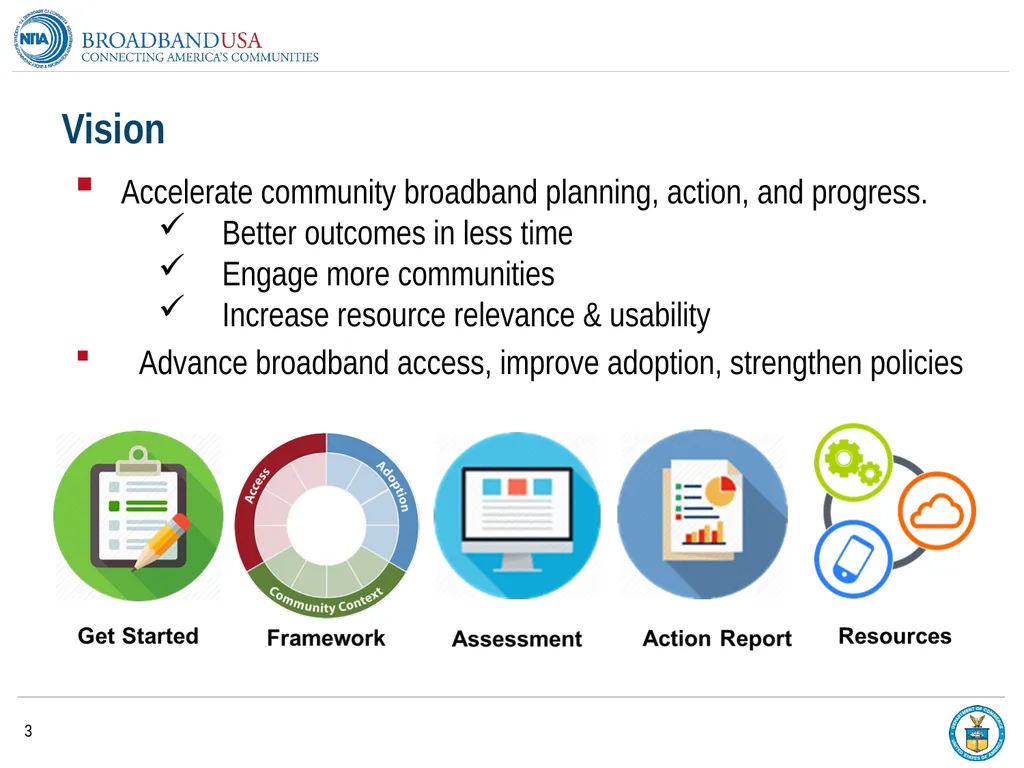
Accelerate community broadband planning, action, and progress.
Better outcomes in less time
Engage more communities
Increase resource relevance & usability
Advance broadband access, improve adoption, strengthen policies Vision<br>
04
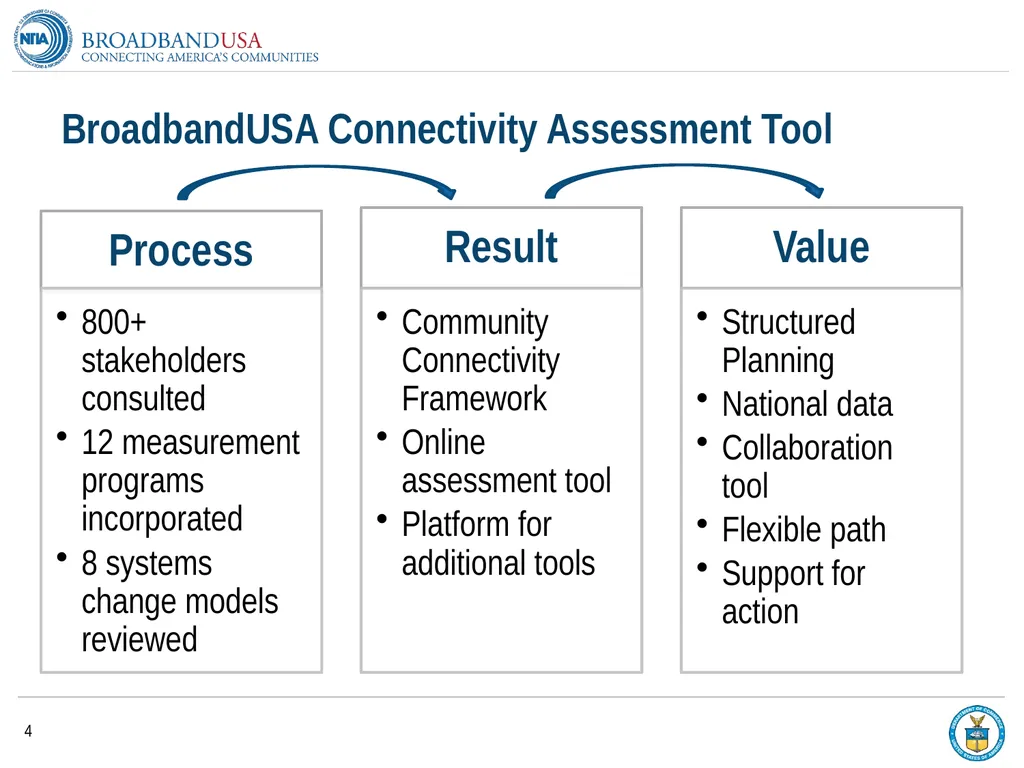
BroadbandUSA Connectivity Assessment Tool<br>
05
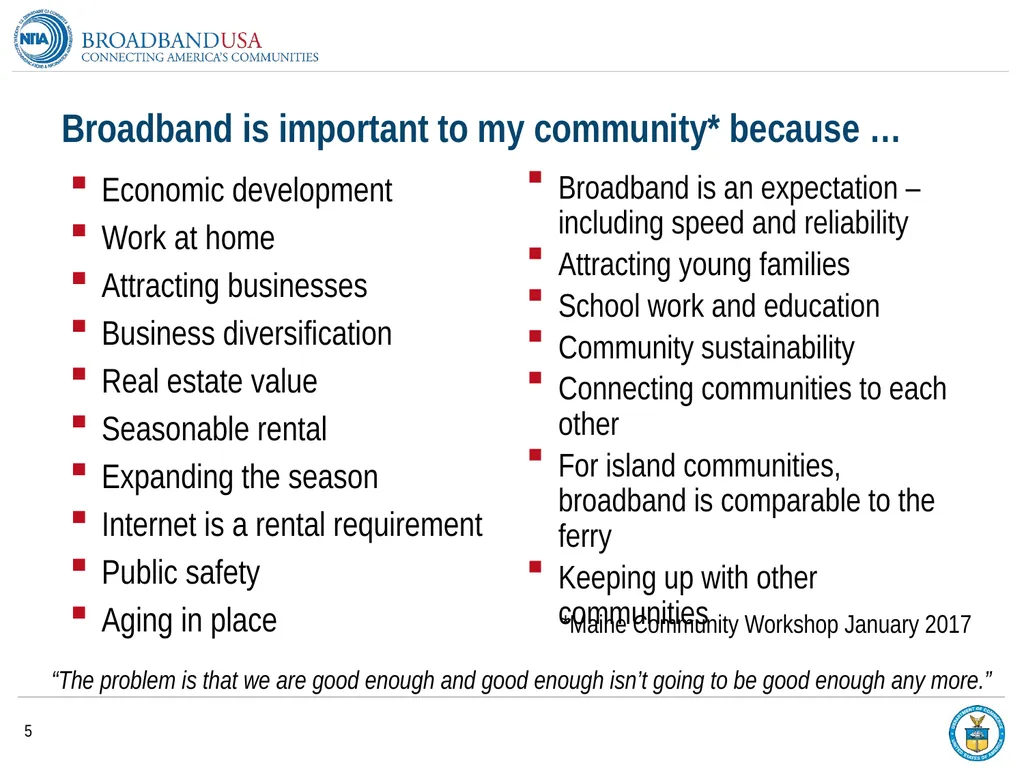
Economic development
Work at home
Attracting businesses
Business diversification
Real estate value
Seasonable rental
Expanding the season
Internet is a rental requirement
Public safety
Aging in place Broadband is an expectation – including speed and reliability
Attracting young families
School work and education
Community sustainability
Connecting communities to each other
For island communities, broadband is comparable to the ferry
Keeping up with other communities Broadband is important to my community* because … “The problem is that we are good enough and good enough isn’t going to be good enough any more.” *Maine Community Workshop January 2017<br>
06
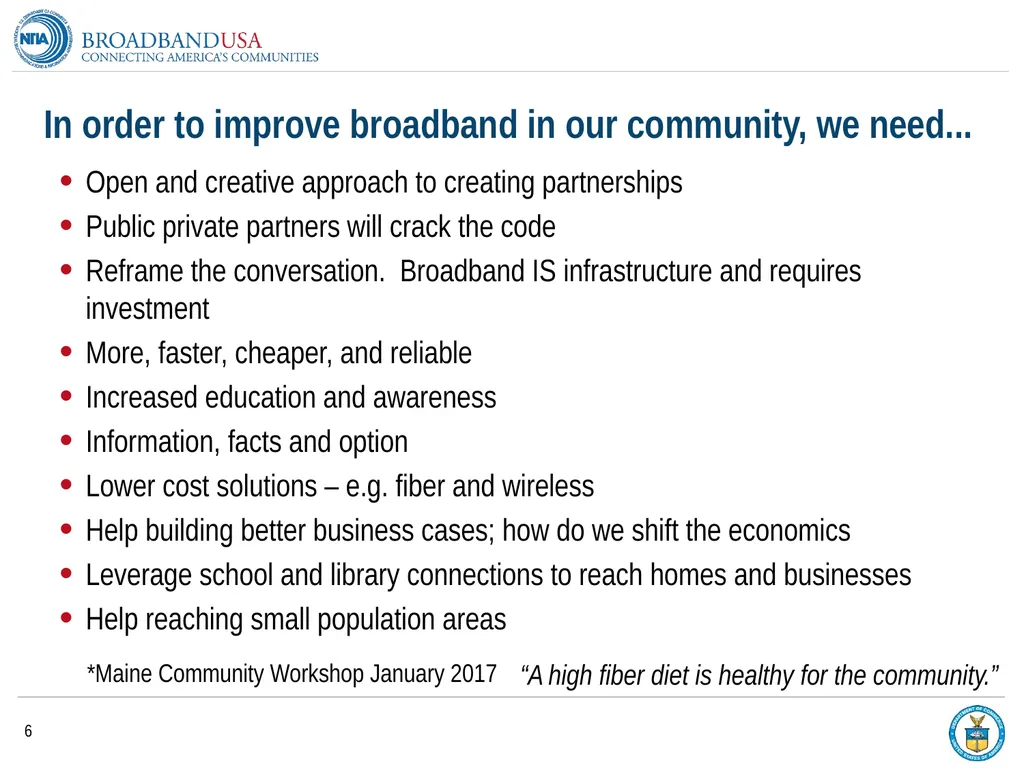
In order to improve broadband in our community, we need... Open and creative approach to creating partnerships
Public private partners will crack the code
Reframe the conversation. Broadband IS infrastructure and requires investment
More, faster, cheaper, and reliable
Increased education and awareness
Information, facts and option
Lower cost solutions – e.g. fiber and wireless
Help building better business cases; how do we shift the economics
Leverage school and library connections to reach homes and businesses
Help reaching small population areas “A high fiber diet is healthy for the community.” *Maine Community Workshop January 2017<br>
07
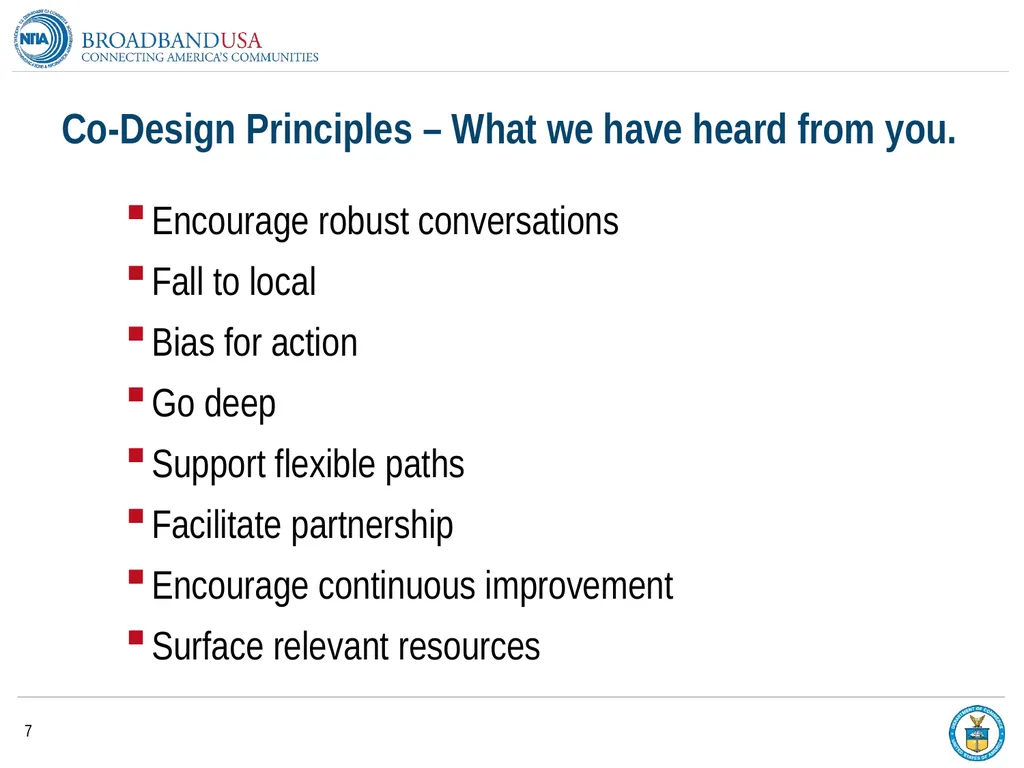
Co-Design Principles – What we have heard from you. Encourage robust conversations
Fall to local
Bias for action
Go deep
Support flexible paths
Facilitate partnership
Encourage continuous improvement
Surface relevant resources<br>
08
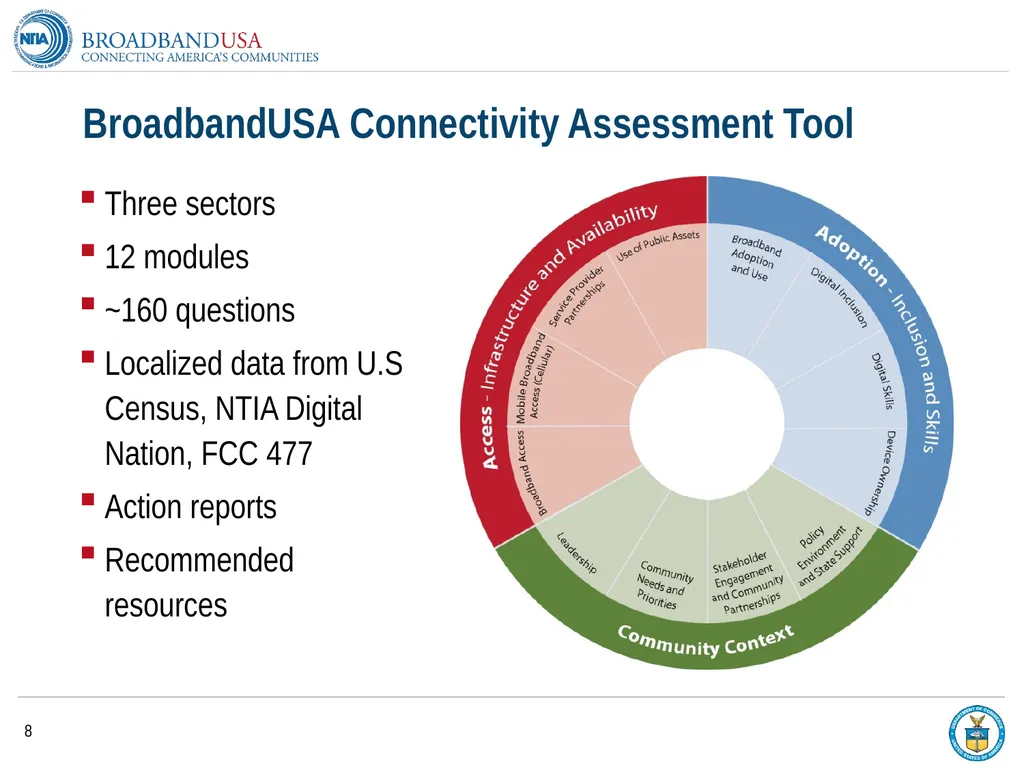
BroadbandUSA Connectivity Assessment Tool Three sectors
12 modules
~160 questions
Localized data from U.S Census, NTIA Digital Nation, FCC 477
Action reports
Recommended resources<br>
09
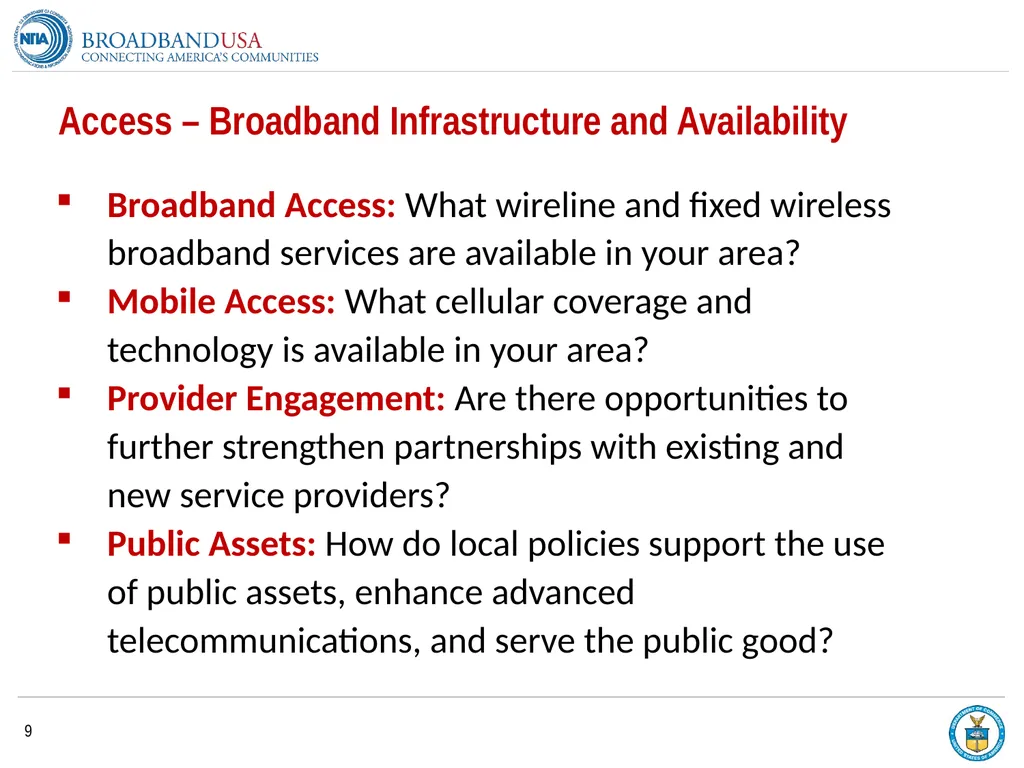
Access – Broadband Infrastructure and Availability<br>
10
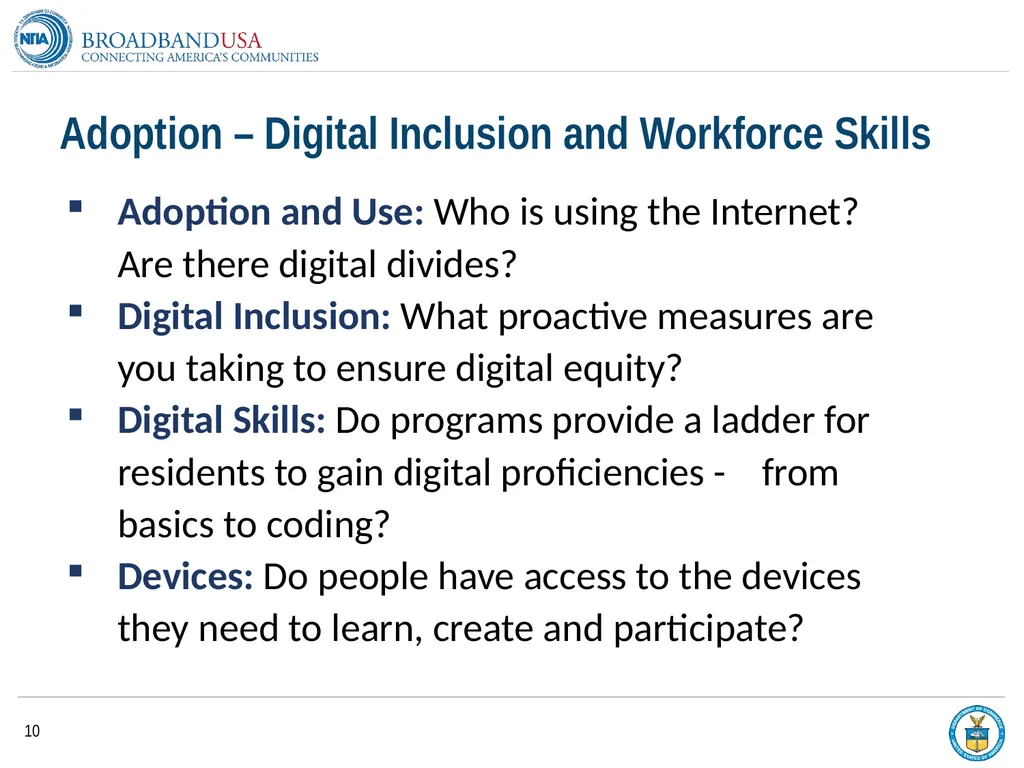
Adoption – Digital Inclusion and Workforce Skills<br>
11
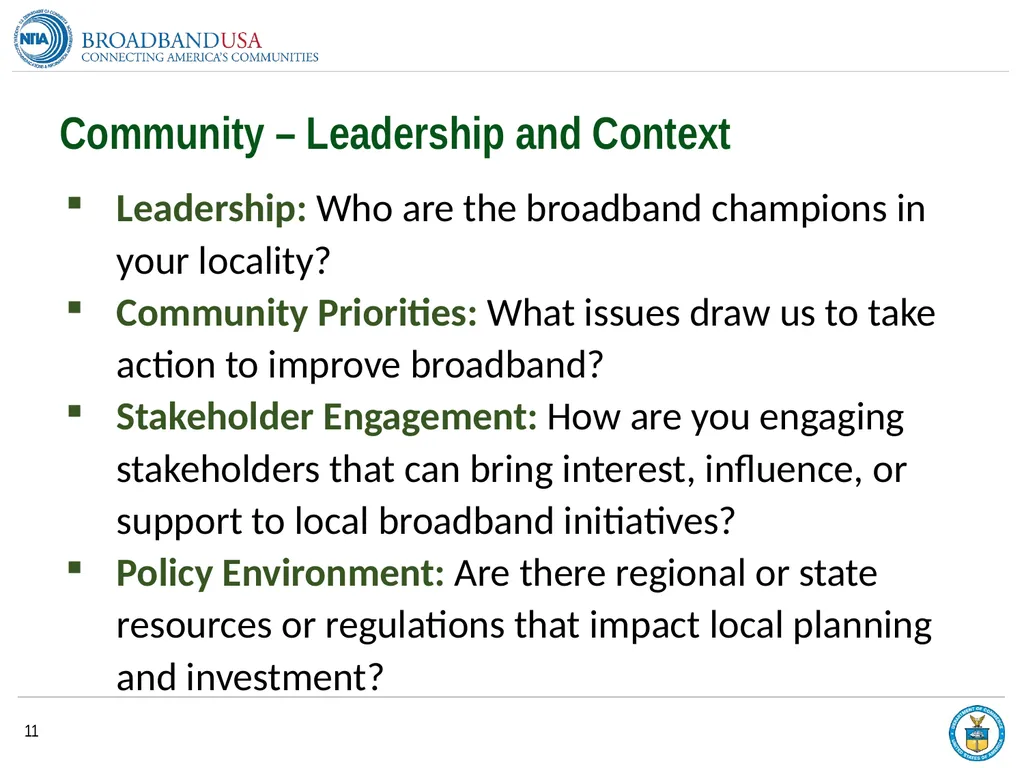
Community – Leadership and Context<br>
12
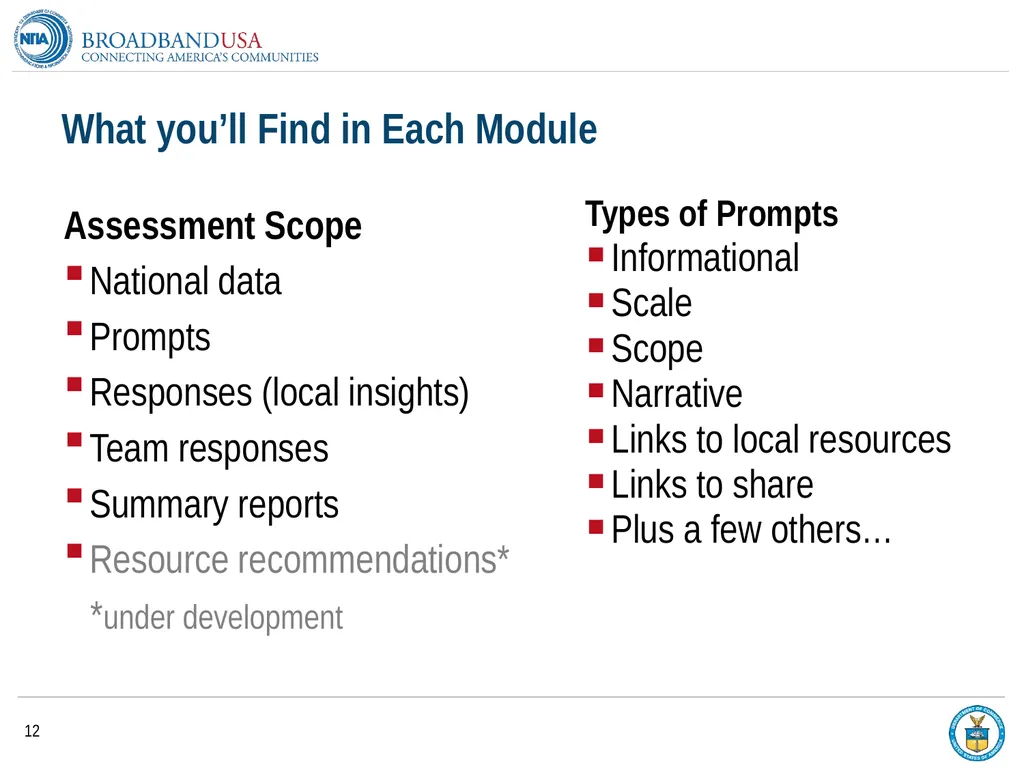
Assessment Scope
National data
Prompts
Responses (local insights)
Team responses
Summary reports
Resource recommendations*
*under development What you’ll Find in Each Module Types of Prompts
Informational
Scale
Scope
Narrative
Links to local resources
Links to share
Plus a few others…<br>
13
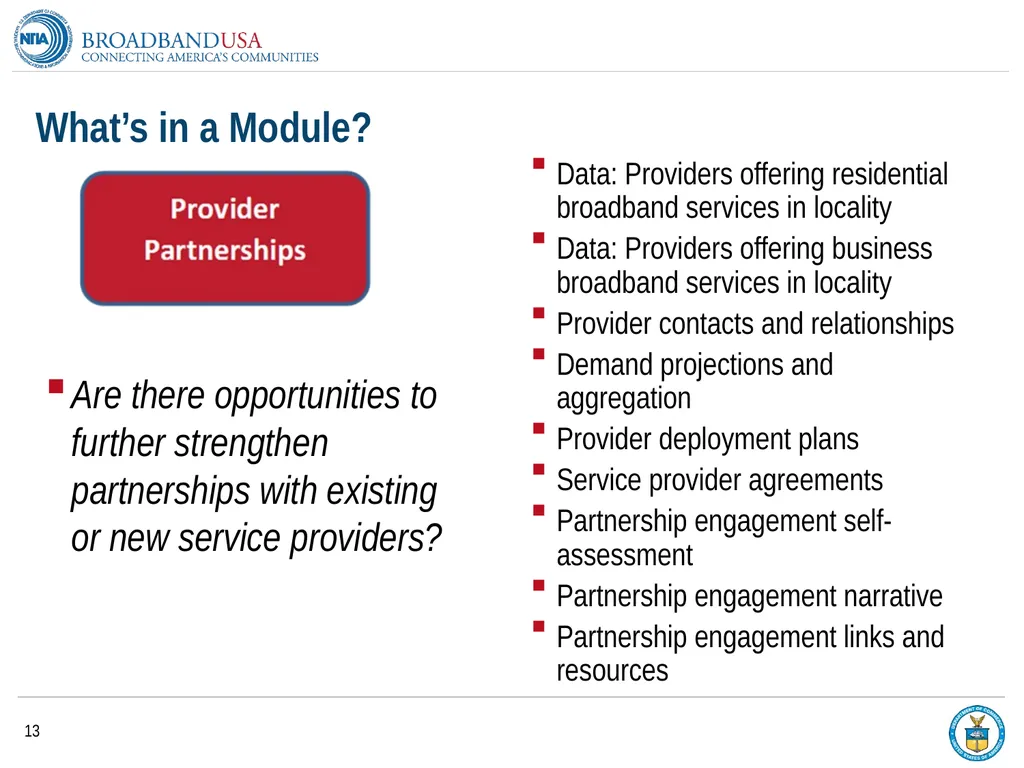
What’s in a Module? Data: Providers offering residential broadband services in locality
Data: Providers offering business broadband services in locality
Provider contacts and relationships
Demand projections and aggregation
Provider deployment plans
Service provider agreements
Partnership engagement self-assessment
Partnership engagement narrative
Partnership engagement links and resources Are there opportunities to further strengthen partnerships with existing or new service providers?<br>
14
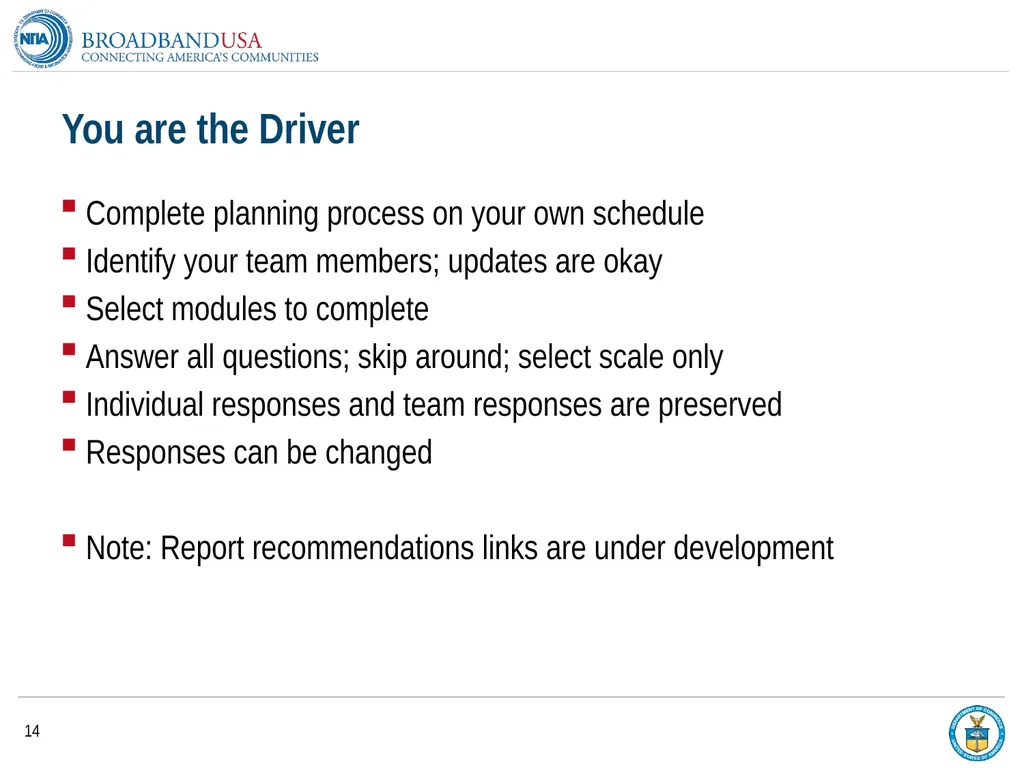
You are the Driver Complete planning process on your own schedule
Identify your team members; updates are okay
Select modules to complete
Answer all questions; skip around; select scale only
Individual responses and team responses are preserved
Responses can be changed
Note: Report recommendations links are under development<br>
15
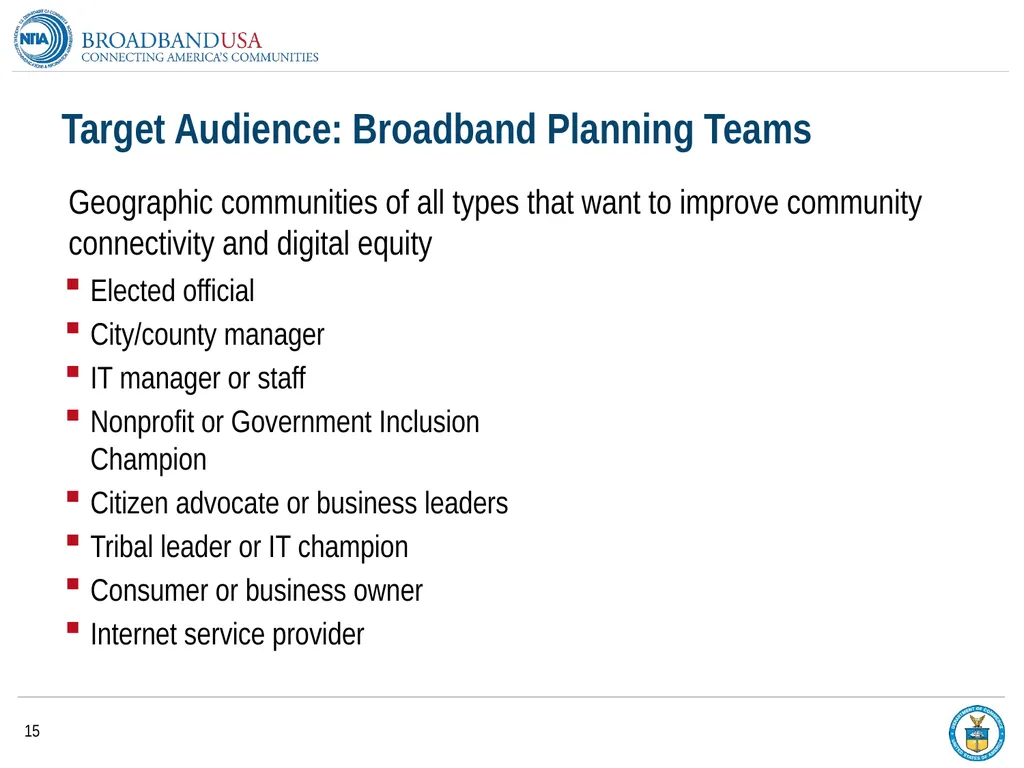
Geographic communities of all types that want to improve community connectivity and digital equity Elected official
City/county manager
IT manager or staff
Nonprofit or Government Inclusion Champion
Citizen advocate or business leaders
Tribal leader or IT champion
Consumer or business owner
Internet service provider Target Audience: Broadband Planning Teams<br>
16
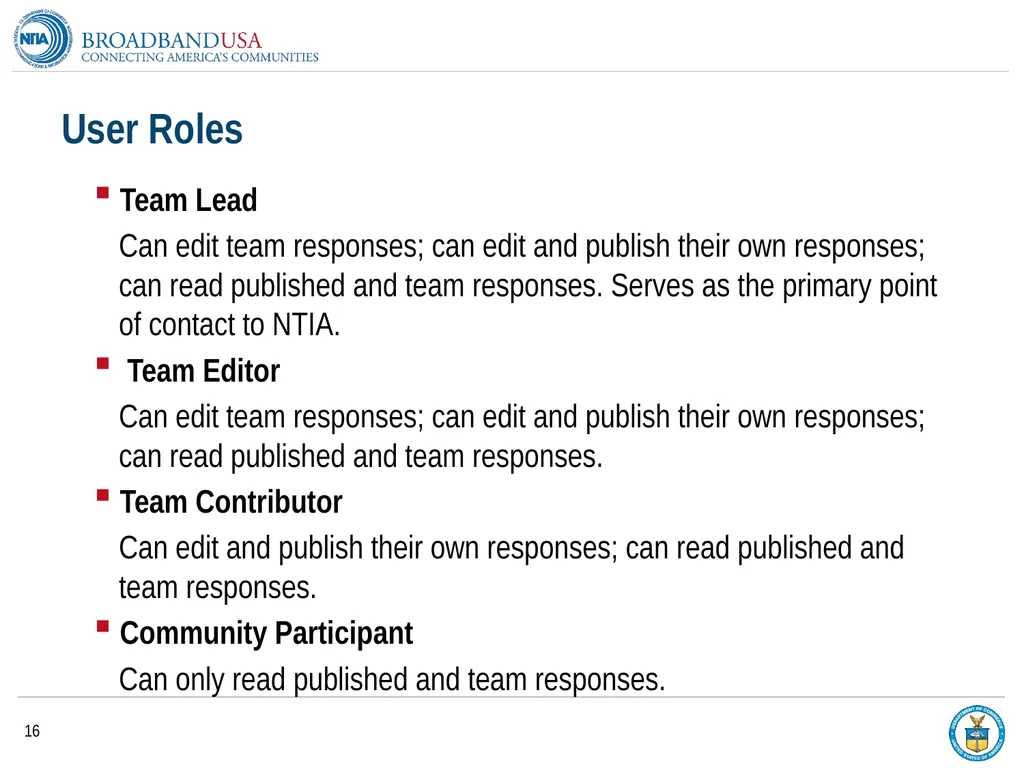
User Roles Team Lead
Can edit team responses; can edit and publish their own responses; can read published and team responses. Serves as the primary point of contact to NTIA.
Team Editor
Can edit team responses; can edit and publish their own responses; can read published and team responses.
Team Contributor
Can edit and publish their own responses; can read published and team responses.
Community Participant
Can only read published and team responses.<br>
17
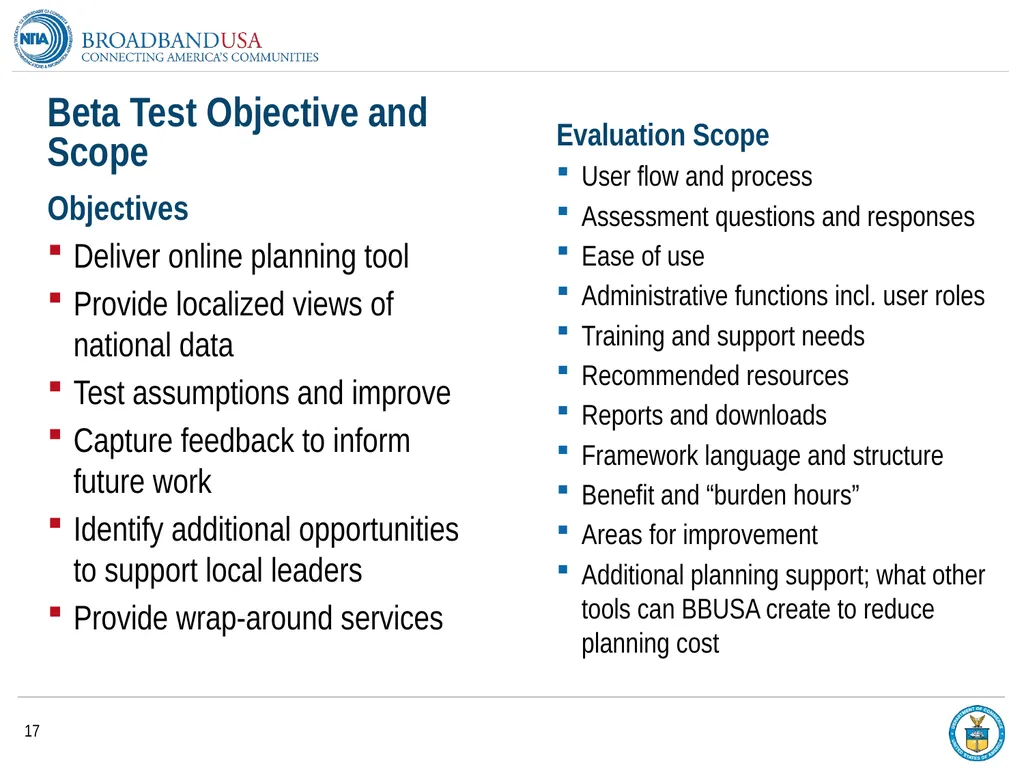
Objectives
Deliver online planning tool
Provide localized views of national data
Test assumptions and improve
Capture feedback to inform future work
Identify additional opportunities to support local leaders
Provide wrap-around services Evaluation Scope
User flow and process
Assessment questions and responses
Ease of use
Administrative functions incl. user roles
Training and support needs
Recommended resources
Reports and downloads
Framework language and structure
Benefit and “burden hours”
Areas for improvement
Additional planning support; what other tools can BBUSA create to reduce planning cost Beta Test Objective and Scope<br>
18
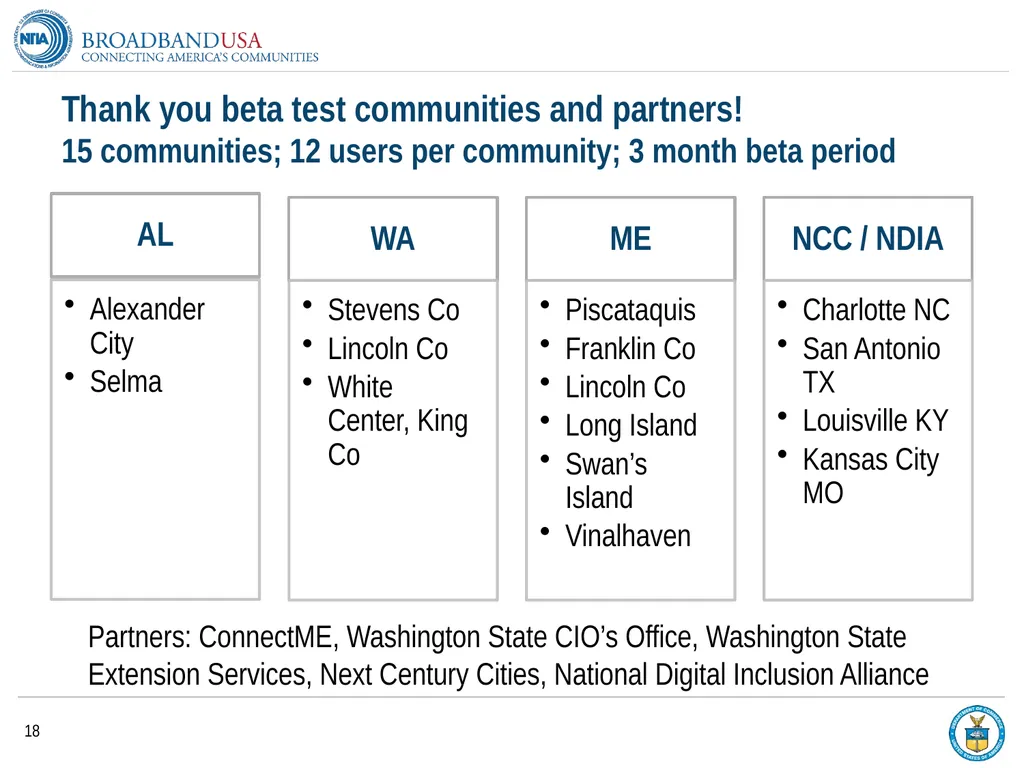
Thank you beta test communities and partners! 15 communities; 12 users per community; 3 month beta period Partners: ConnectME, Washington State CIO’s Office, Washington State Extension Services, Next Century Cities, National Digital Inclusion Alliance<br>
19
For More Information The BroadbandUSA Connectivity Assessment Tool is the first tool in a suite of tools that NTIA BroadbandUSA is creating to support broadband and economic development.
Email BroadbandUSA@ntia.doc.gov or call or write:
Laura Spining LSpining@ntia.doc.gov (202) 482-5637
Karen Perry KPerry@ntia.doc.gov (206) 861-6043<br>