Broadcast Programming Paul Parker Donald McKinnon Production Scheduling Spring 13 Agenda Problem Overview Our Solution Analysis Conclusion Extensions 2 Problem Overview (1) Description: Schedule shows of equal duration such that the sum of
"Broadcast Programming Paul Parker Donald McKinnon" is the property of its rightful owner. Permission is granted to
download and print the materials on this website for personal, non-commercial use only, and to display it
on your personal computer provided you do not modify the materials and that you retain all copyright
notices contained in the materials. By downloading content from our website, you accept the terms of this
agreement.
Share
Embed code
Presentation Transcript
01
Broadcast Programming Paul Parker
Donald McKinnon
Production Scheduling Spring ‘13<br>
02
Agenda Problem Overview
Our Solution
Analysis
Conclusion
Extensions 2<br>
03
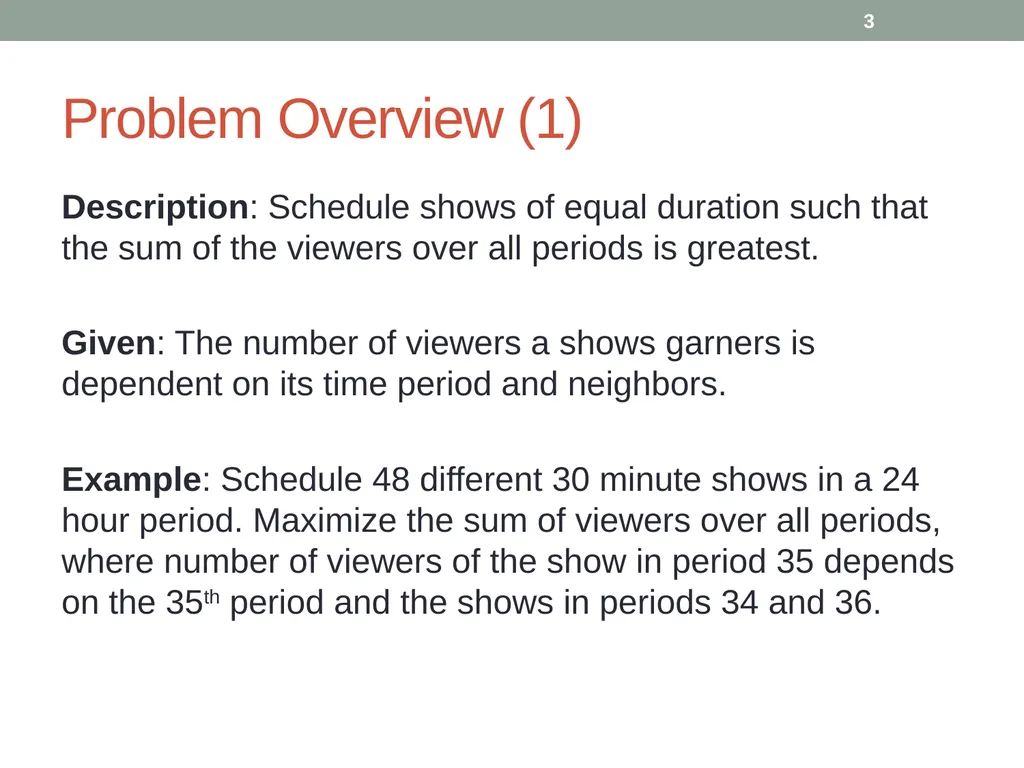
Problem Overview (1) Description: Schedule shows of equal duration such that the sum of the viewers over all periods is greatest.
Given: The number of viewers a shows garners is dependent on its time period and neighbors.
Example: Schedule 48 different 30 minute shows in a 24 hour period. Maximize the sum of viewers over all periods, where number of viewers of the show in period 35 depends on the 35th period and the shows in periods 34 and 36. 3<br>
04
Problem Overview (2) Upper Bound:
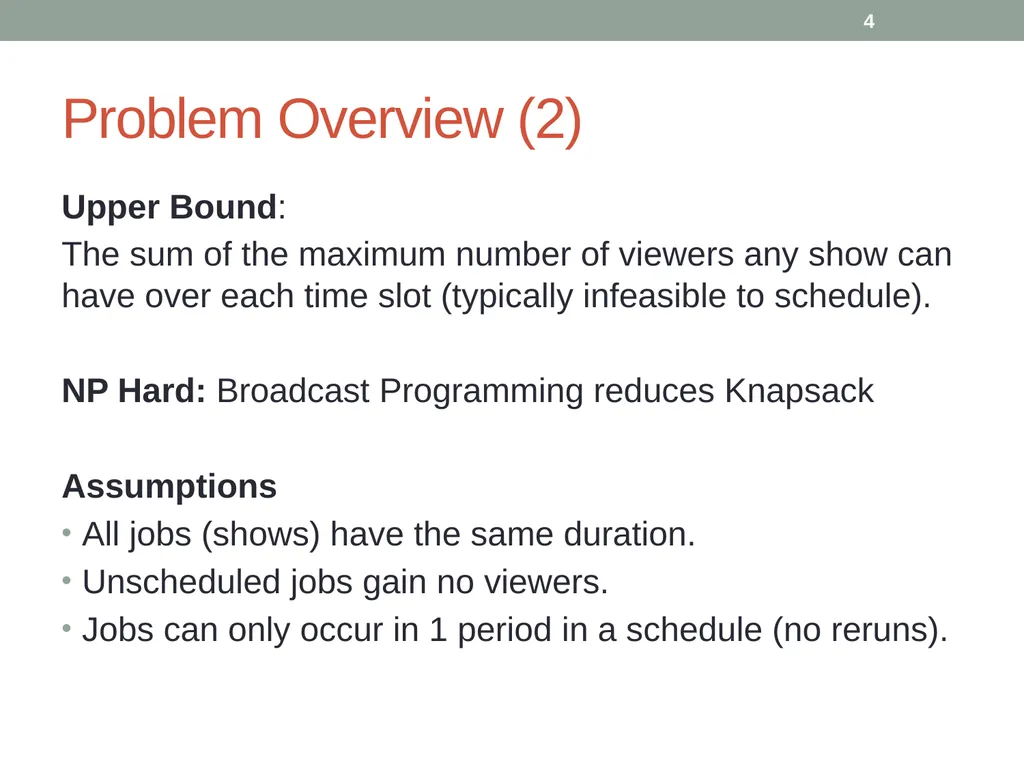
The sum of the maximum number of viewers any show can have over each time slot (typically infeasible to schedule).
NP Hard: Broadcast Programming reduces Knapsack
Assumptions
All jobs (shows) have the same duration.
Unscheduled jobs gain no viewers.
Jobs can only occur in 1 period in a schedule (no reruns). 4<br>
05
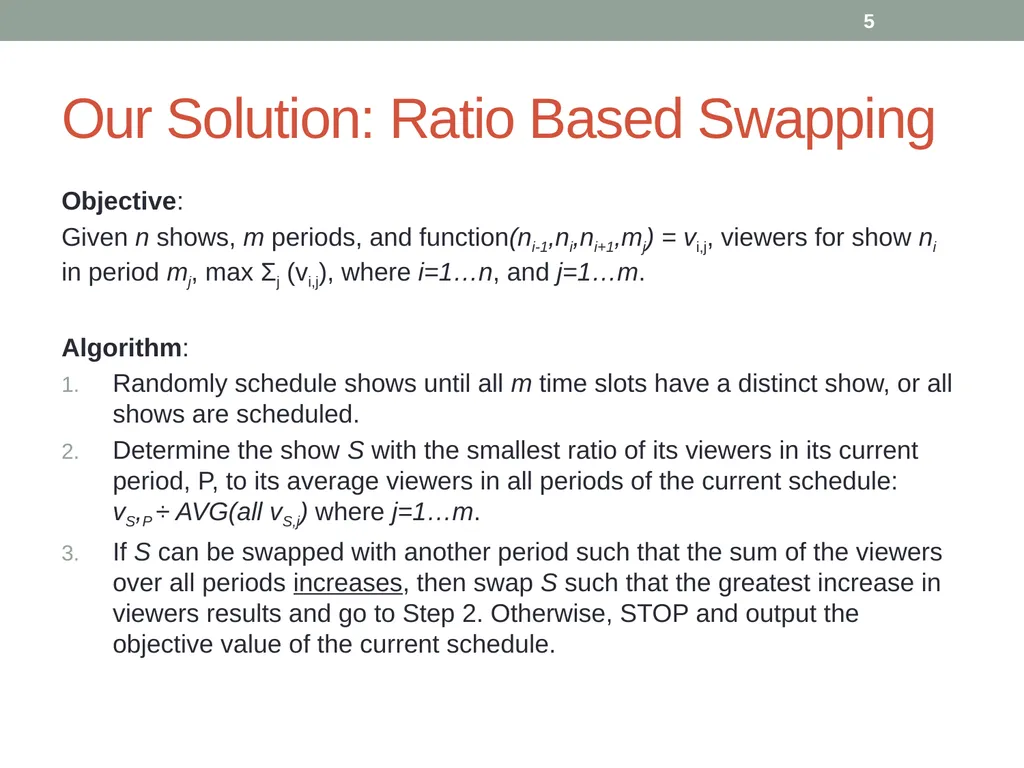
Our Solution: Ratio Based Swapping Objective:
Given n shows, m periods, and function(ni-1,ni,ni+1,mj) = vi,j, viewers for show ni in period mj, max Σj (vi,j), where i=1…n, and j=1…m.
Algorithm:
Randomly schedule shows until all m time slots have a distinct show, or all shows are scheduled.
Determine the show S with the smallest ratio of its viewers in its current period, P, to its average viewers in all periods of the current schedule: vS,P ÷ AVG(all vS,j) where j=1…m.
If S can be swapped with another period such that the sum of the viewers over all periods increases, then swap S such that the greatest increase in viewers results and go to Step 2. Otherwise, STOP and output the objective value of the current schedule. 5<br>
06
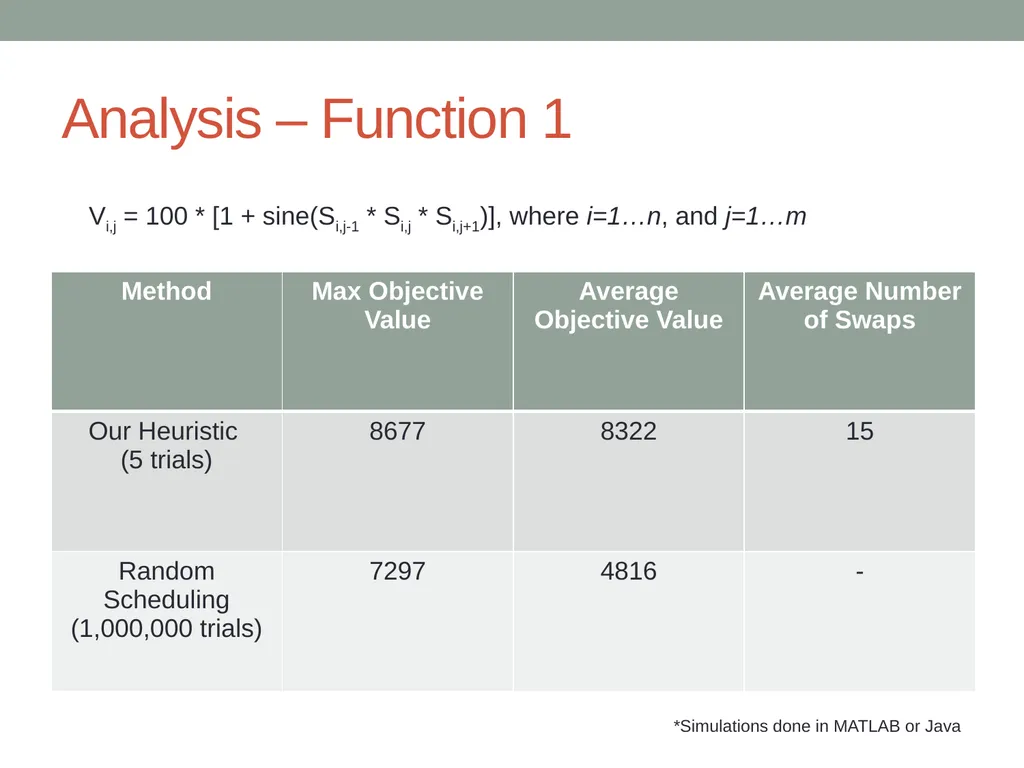
Analysis – Function 1 *Simulations done in MATLAB or Java Vi,j = 100 * [1 + sine(Si,j-1 * Si,j * Si,j+1)], where i=1…n, and j=1…m<br>
07
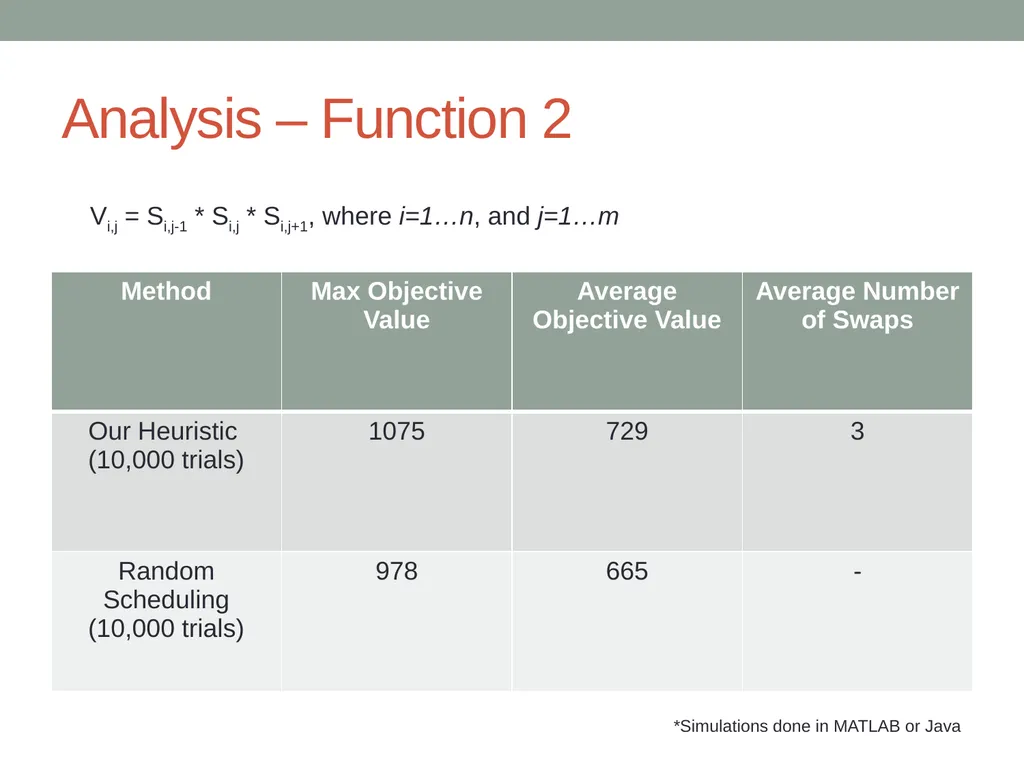
Analysis – Function 2 *Simulations done in MATLAB or Java Vi,j = Si,j-1 * Si,j * Si,j+1, where i=1…n, and j=1…m<br>
08
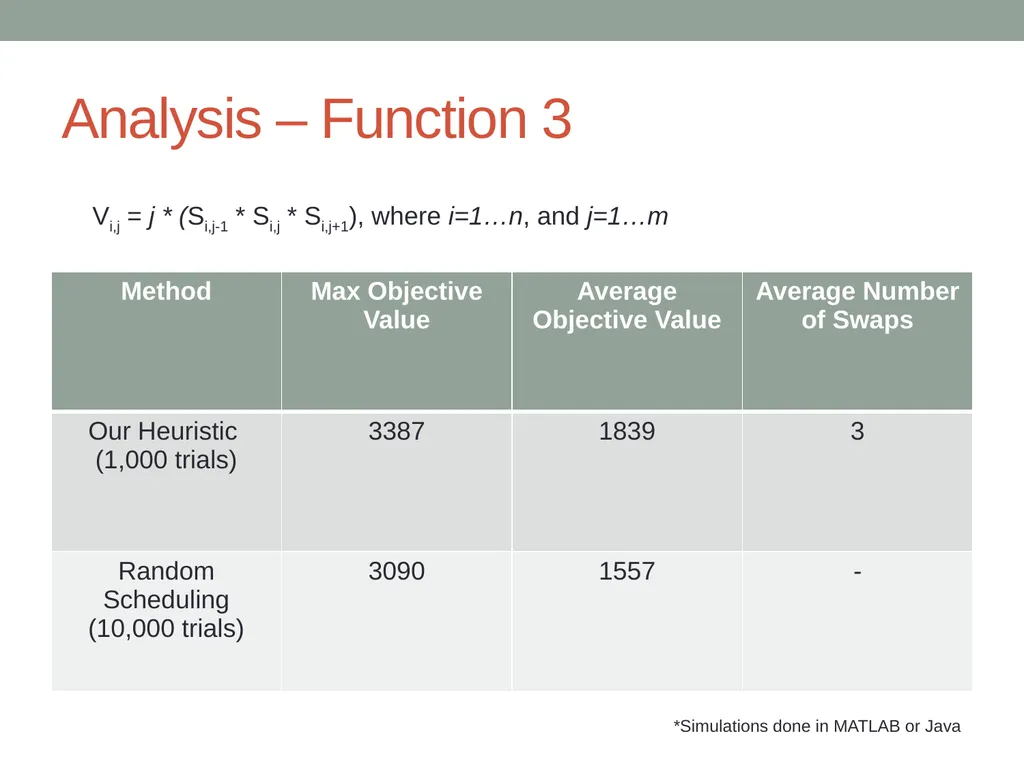
Analysis – Function 3 *Simulations done in MATLAB or Java Vi,j = j * (Si,j-1 * Si,j * Si,j+1), where i=1…n, and j=1…m<br>
09
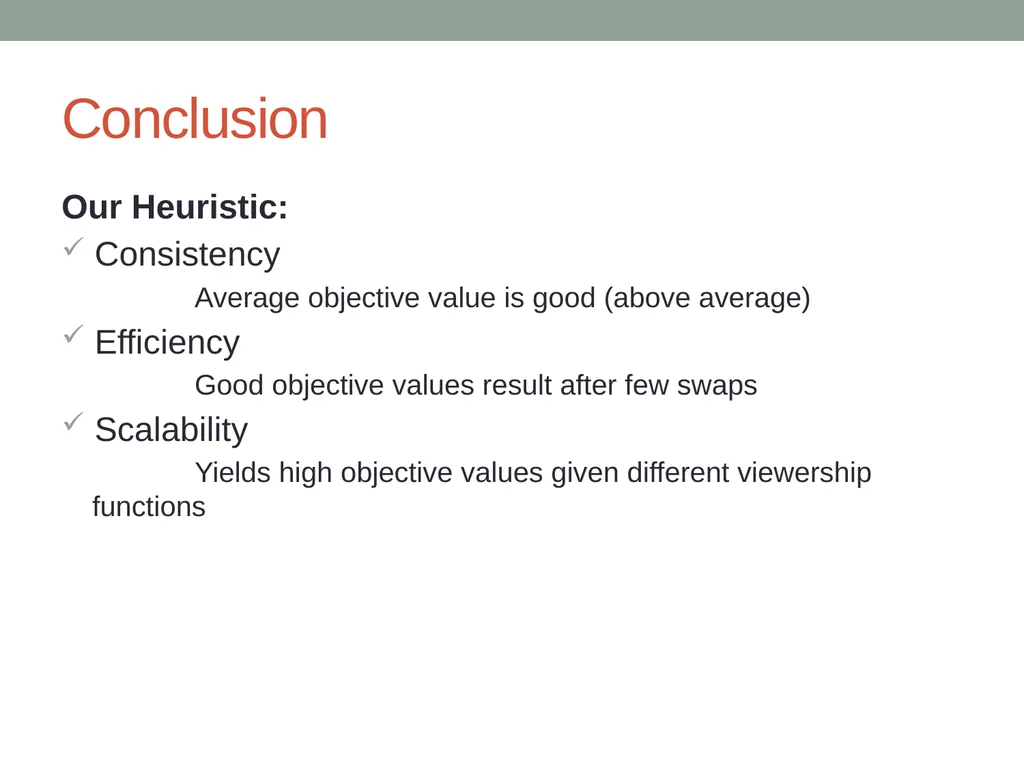
Conclusion Our Heuristic:
Consistency
Average objective value is good (above average)
Efficiency
Good objective values result after few swaps
Scalability
Yields high objective values given different viewership functions<br>
10
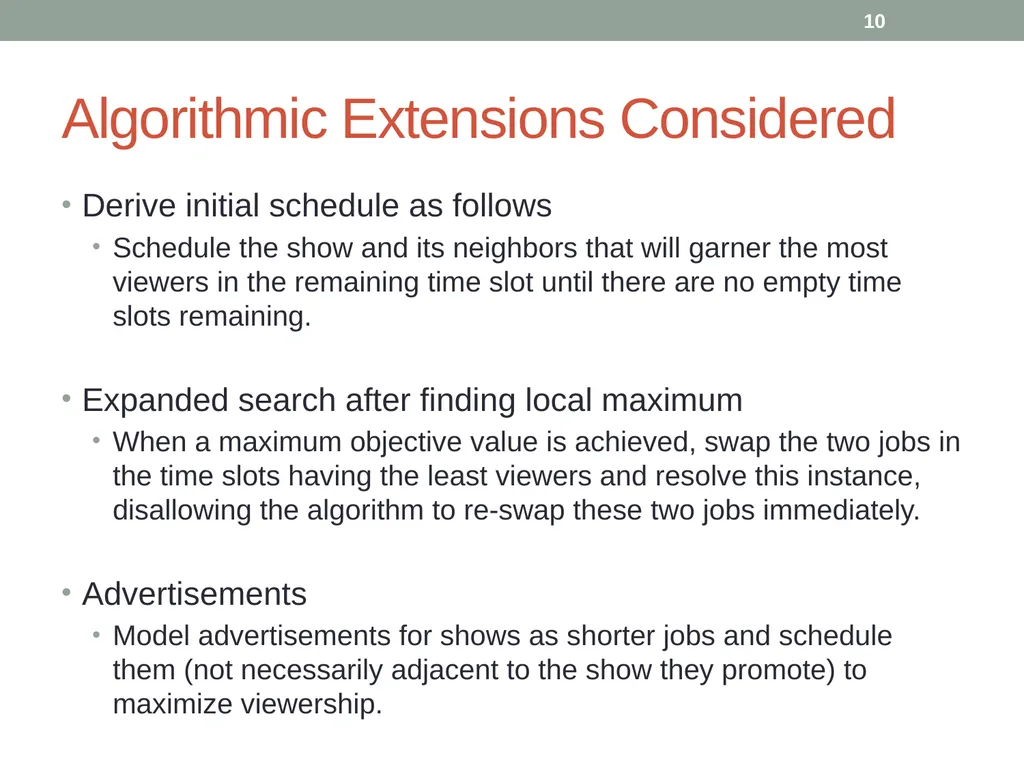
Algorithmic Extensions Considered Derive initial schedule as follows
Schedule the show and its neighbors that will garner the most viewers in the remaining time slot until there are no empty time slots remaining.
Expanded search after finding local maximum
When a maximum objective value is achieved, swap the two jobs in the time slots having the least viewers and resolve this instance, disallowing the algorithm to re-swap these two jobs immediately.
Advertisements
Model advertisements for shows as shorter jobs and schedule them (not necessarily adjacent to the show they promote) to maximize viewership. 10<br>
11
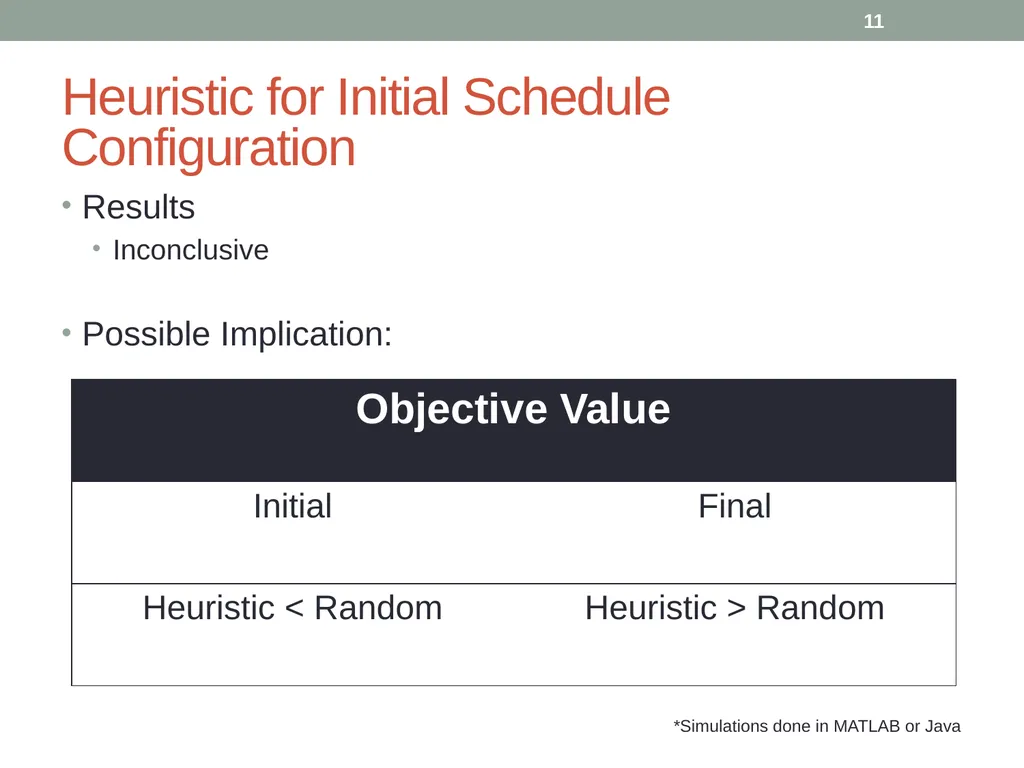
Heuristic for Initial Schedule Configuration Results
Inconclusive
Possible Implication: 11 *Simulations done in MATLAB or Java<br>