
Brucellosis Dr. Bipin Kumar Assistant Professor


Description: Brucellosis Dr. Bipin Kumar Assistant Professor Department of Veterinary Medicine Bihar Veterinary College, Patna (Bihar Animal Sciences University, Patna) Brucellosis (Contagious abortion, Bang disease) The genus Brucella consists of
Related Topics
Download Presentation
"Brucellosis Dr. Bipin Kumar Assistant Professor" is the property of its rightful owner. Permission is granted to download and print the materials on this website for personal, non-commercial use only, and to display it on your personal computer provided you do not modify the materials and that you retain all copyright notices contained in the materials. By downloading content from our website, you accept the terms of this agreement.
Presentation Transcript
slide1. Brucellosis Dr. Bipin Kumar
Assistant Professor Department of Veterinary Medicine
Bihar Veterinary College, Patna
(Bihar Animal Sciences University, Patna)<br>
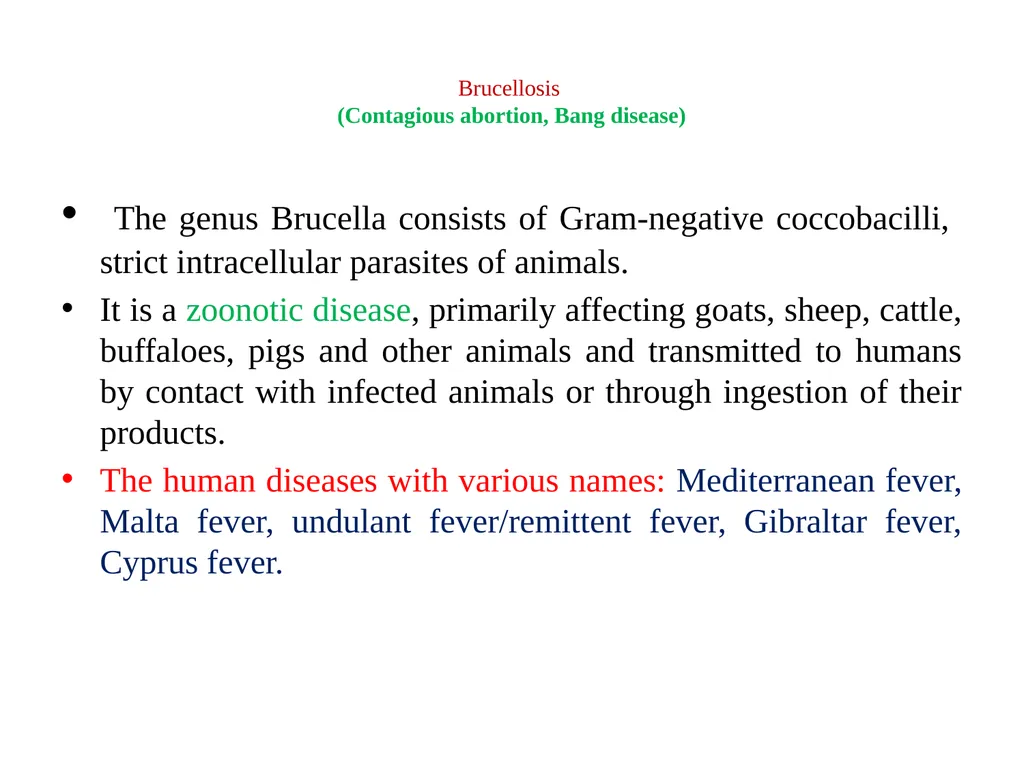
slide2. Brucellosis (Contagious abortion, Bang disease) The genus Brucella consists of Gram-negative coccobacilli, strict intracellular parasites of animals.
It is a zoonotic disease, primarily affecting goats, sheep, cattle, buffaloes, pigs and other animals and transmitted to humans by contact with infected animals or through ingestion of their products.
The human diseases with various names: Mediterranean fever, Malta fever, undulant fever/remittent fever, Gibraltar fever, Cyprus fever.<br>
slide3. Brucella belongs to family Brucellaceae.
Genus Brucella encompasses 9 recognized spp—6 terrestrial sp. & 3 marine spp.
Terrestrial sp. are B.melitensis, B.abortus, B.suis, B.canis, B. ovis, B.neotamae.
Marine spp are B.delphini, B. pinnipediae, B. cetaceae.
Brucellae species are small, gram-negative aerobic coccobacilli, 0.5-0.7 µm x 0.6-1.5 µm in size.
They are nonmotile, noncapsulated, nonsporing and non- acid fast.<br>
slide4. Brucellae are strict aerobes.
Br. Abortus is capnophilic, many strains requiring 5-10% C02 for growth.
The media employed currently are serum dextrose agar, serum potato infusion agar, trypticase soy agar, or tryptose agar.
Erythritol has a specially stimulating effect on the growth of Brucellae.
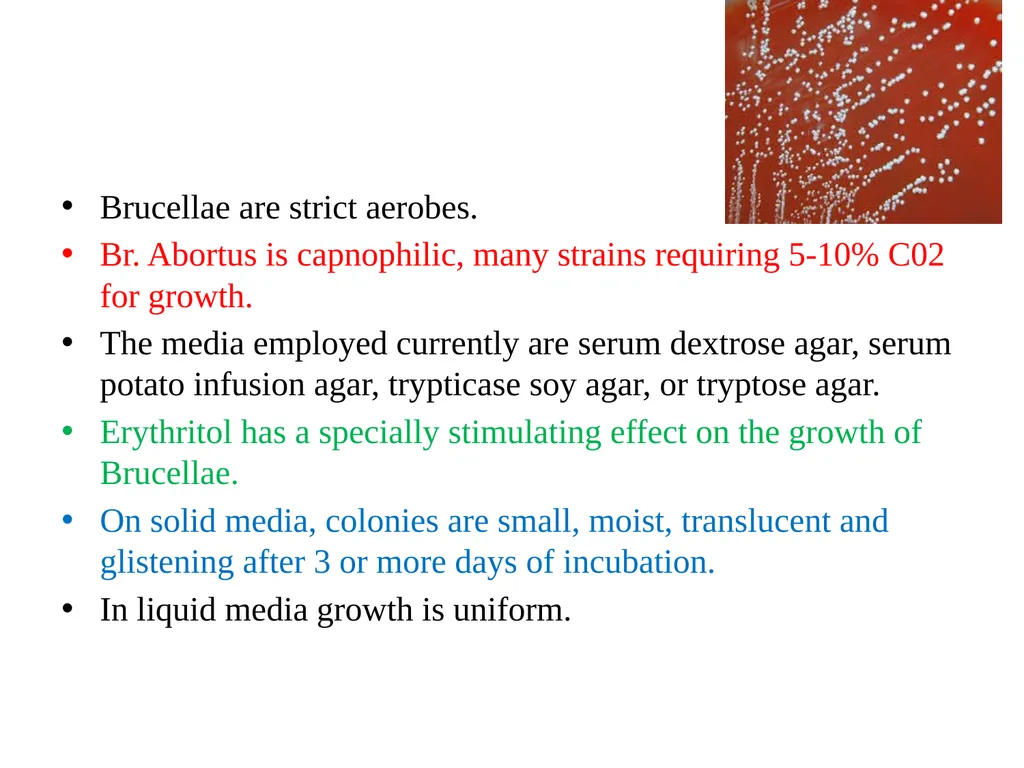
On solid media, colonies are small, moist, translucent and glistening after 3 or more days of incubation.
In liquid media growth is uniform.<br>
slide5. Transmission Oral entry : Ingestion of contaminated animal products (often raw milk or its derivatives). contact with contaminated fingers.
2. Aerosols: Inhalation of bacteria. Contamination of the conjunctivae.
3. Percutaneous infection: through skin abrasions or by accidental inoculation.<br>
slide6. Pathogenesis Intracellular location & survival of the organism contribute to its virulence & pathogenesis.
All three major species of Brucella are pathogenic to human beings.
Br. melitensis is the most pathogenic, Br. abortus and Br. suis of intermediate pathogenic.
Incubation period is 1-4 weeks.<br>
slide7. Clinical symptoms Abortion is the most obvious manifestation.
Infections may also cause stillborn or weak calves, retained placentas, and reduced milk yield.
Usually, general health is not impaired in uncomplicated abortions.
Seminal vesicles, ampullae, testicles, and epididymides may be infected in bulls; therefore, organisms are present in the semen.
Testicular abscesses may occur.
Longstanding infections may result in arthritic joints in some cattle.<br>
slide8. Diagnosis Culture and isolation
Serology: both IgG and IgM antibodies appear in the serum 7-10 days after infection.
IgM antibodies persist for up to 3 months after which these antibodies decline.
In chronic brucellosis only IgG can be demonstrated, as IgM are absent.
As IgG antibodies persist for many months or years, demonstration of significant rise in the antibody titer is the definitive serological evidence of brucellosis.
Antibody titer of 1: 160 is the presumptive evidence of Brucella infection.<br>
slide9. Most serological studies for diagnosis of Brucellosis are based on antibody detection, These include:
Serum agglutination test –SAT (standard tube agglutination)
Rose Bengal test- Slide agglutination
ELISA
Complement fixation
Immunecapture-agglutination
Whole cell preparations of Brucella antigens are used in IFA, Agglutination.
Purified LPS/ Protein extracts are used for ELISA.<br>
slide10. Brucella skin test
Brucella skin test is a delayed type of hypersensitivity reaction to brucella antigen.
In this test, brucellin, a protein extract of the bacteria, is used as an antigen and is administered intradermally.
The presence of erythema and induration of 6 mm or more within 24 hours is suggestive of positive reaction.
This test is positive only in chronic brucellosis but negative in acute brucellosis.
Repeated negative skin test excludes brucellosis.<br>
slide11. Milk ring test
This is a frequently used serological test for demonstration of antibodies in the milk of an animal.
This is a screening test used to detect the presence of Brucella infection in infected cattle.
In this test, a concentrated suspension of killed B. abortus or B. melitensis stained with hematoxylin is used as antigen.
This test is performed by adding a drop of colored brucella antigen to a sample of whole milk in a test tube.
Then it is mixed, and mixed suspension is incubated in a water bath at 70°C for 40-50 minutes.
In a positive test, if antibodies are present in the milk, the bacilli are agglutinated and raised with the cream to form a blue ring at the top, leaving the milk unstained.
In a negative test, the milk remains uniformly blue without formation of any colored ring.<br>
slide12. Treatment,Prevention & Control 1. Persons handling the animals should use protective clothing and gloves.
2. Pasteurisation or boiling of milk should be done.
3. Vaccination: Cattle should be vaccinated with live attenuated Br. abortus strain 19, RB 51 for cows.
4. Unimmunized infected animals should be slaughtered.
5. Br. abortus strain 19-BA, a more attenuated variant of strain 19, has been widely employed for human immunisation.<br>
slide13. Thank You<br>
Assistant Professor Department of Veterinary Medicine
Bihar Veterinary College, Patna
(Bihar Animal Sciences University, Patna)<br>
slide2. Brucellosis (Contagious abortion, Bang disease) The genus Brucella consists of Gram-negative coccobacilli, strict intracellular parasites of animals.
It is a zoonotic disease, primarily affecting goats, sheep, cattle, buffaloes, pigs and other animals and transmitted to humans by contact with infected animals or through ingestion of their products.
The human diseases with various names: Mediterranean fever, Malta fever, undulant fever/remittent fever, Gibraltar fever, Cyprus fever.<br>
slide3. Brucella belongs to family Brucellaceae.
Genus Brucella encompasses 9 recognized spp—6 terrestrial sp. & 3 marine spp.
Terrestrial sp. are B.melitensis, B.abortus, B.suis, B.canis, B. ovis, B.neotamae.
Marine spp are B.delphini, B. pinnipediae, B. cetaceae.
Brucellae species are small, gram-negative aerobic coccobacilli, 0.5-0.7 µm x 0.6-1.5 µm in size.
They are nonmotile, noncapsulated, nonsporing and non- acid fast.<br>
slide4. Brucellae are strict aerobes.
Br. Abortus is capnophilic, many strains requiring 5-10% C02 for growth.
The media employed currently are serum dextrose agar, serum potato infusion agar, trypticase soy agar, or tryptose agar.
Erythritol has a specially stimulating effect on the growth of Brucellae.
On solid media, colonies are small, moist, translucent and glistening after 3 or more days of incubation.
In liquid media growth is uniform.<br>
slide5. Transmission Oral entry : Ingestion of contaminated animal products (often raw milk or its derivatives). contact with contaminated fingers.
2. Aerosols: Inhalation of bacteria. Contamination of the conjunctivae.
3. Percutaneous infection: through skin abrasions or by accidental inoculation.<br>
slide6. Pathogenesis Intracellular location & survival of the organism contribute to its virulence & pathogenesis.
All three major species of Brucella are pathogenic to human beings.
Br. melitensis is the most pathogenic, Br. abortus and Br. suis of intermediate pathogenic.
Incubation period is 1-4 weeks.<br>
slide7. Clinical symptoms Abortion is the most obvious manifestation.
Infections may also cause stillborn or weak calves, retained placentas, and reduced milk yield.
Usually, general health is not impaired in uncomplicated abortions.
Seminal vesicles, ampullae, testicles, and epididymides may be infected in bulls; therefore, organisms are present in the semen.
Testicular abscesses may occur.
Longstanding infections may result in arthritic joints in some cattle.<br>
slide8. Diagnosis Culture and isolation
Serology: both IgG and IgM antibodies appear in the serum 7-10 days after infection.
IgM antibodies persist for up to 3 months after which these antibodies decline.
In chronic brucellosis only IgG can be demonstrated, as IgM are absent.
As IgG antibodies persist for many months or years, demonstration of significant rise in the antibody titer is the definitive serological evidence of brucellosis.
Antibody titer of 1: 160 is the presumptive evidence of Brucella infection.<br>
slide9. Most serological studies for diagnosis of Brucellosis are based on antibody detection, These include:
Serum agglutination test –SAT (standard tube agglutination)
Rose Bengal test- Slide agglutination
ELISA
Complement fixation
Immunecapture-agglutination
Whole cell preparations of Brucella antigens are used in IFA, Agglutination.
Purified LPS/ Protein extracts are used for ELISA.<br>
slide10. Brucella skin test
Brucella skin test is a delayed type of hypersensitivity reaction to brucella antigen.
In this test, brucellin, a protein extract of the bacteria, is used as an antigen and is administered intradermally.
The presence of erythema and induration of 6 mm or more within 24 hours is suggestive of positive reaction.
This test is positive only in chronic brucellosis but negative in acute brucellosis.
Repeated negative skin test excludes brucellosis.<br>
slide11. Milk ring test
This is a frequently used serological test for demonstration of antibodies in the milk of an animal.
This is a screening test used to detect the presence of Brucella infection in infected cattle.
In this test, a concentrated suspension of killed B. abortus or B. melitensis stained with hematoxylin is used as antigen.
This test is performed by adding a drop of colored brucella antigen to a sample of whole milk in a test tube.
Then it is mixed, and mixed suspension is incubated in a water bath at 70°C for 40-50 minutes.
In a positive test, if antibodies are present in the milk, the bacilli are agglutinated and raised with the cream to form a blue ring at the top, leaving the milk unstained.
In a negative test, the milk remains uniformly blue without formation of any colored ring.<br>
slide12. Treatment,Prevention & Control 1. Persons handling the animals should use protective clothing and gloves.
2. Pasteurisation or boiling of milk should be done.
3. Vaccination: Cattle should be vaccinated with live attenuated Br. abortus strain 19, RB 51 for cows.
4. Unimmunized infected animals should be slaughtered.
5. Br. abortus strain 19-BA, a more attenuated variant of strain 19, has been widely employed for human immunisation.<br>
slide13. Thank You<br>