
Budget 2017: An assessment, with emphasis on the
AS
Published · 29 slides · 0 views

1 / 1


Description
Budget 2017: An assessment, with emphasis on the fiscal framework and revenue proposals Mr Jugal Mahabir and Dr Seán Muller, Public and Environmental Economics Research Centre (PEERC), University of Johannesburg 1st March 2017 Critical
Related Topics
Share
Embed code
Download this presentation From Below
"Budget 2017: An assessment, with emphasis on the" is the property of its rightful owner. Permission is granted to download and print the materials on this website for personal, non-commercial use only, and to display it on your personal computer provided you do not modify the materials and that you retain all copyright notices contained in the materials. By downloading content from our website, you accept the terms of this agreement.
Presentation Transcript
01
Budget 2017: An assessment, with emphasis on the fiscal framework and revenue proposals Mr Jugal Mahabir and Dr Seán Muller, Public and Environmental Economics Research Centre (PEERC), University of Johannesburg 1st March 2017<br>
02
Critical questions for the Finance Committees<br>
03
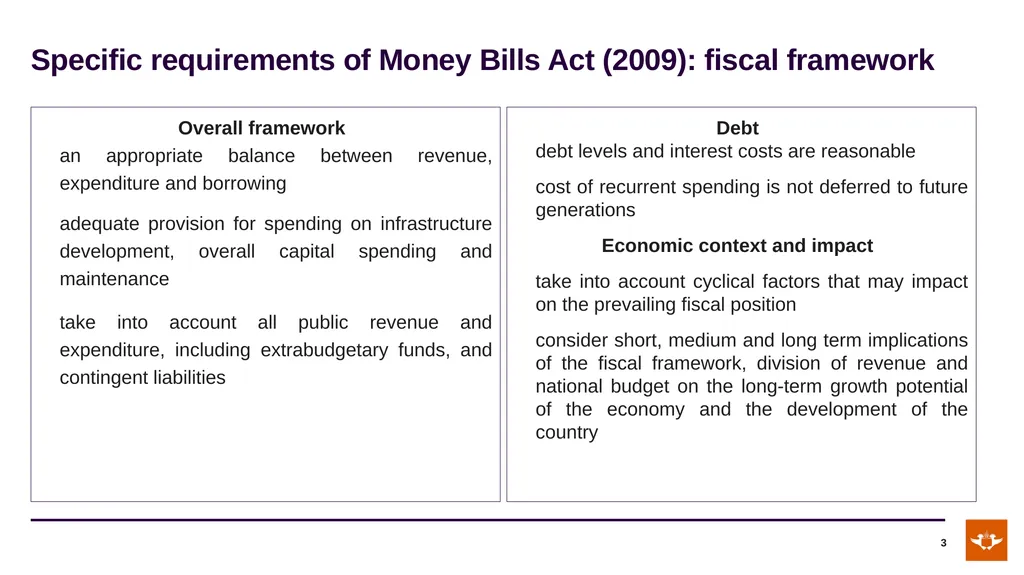
Overall framework
an appropriate balance between revenue, expenditure and borrowing
adequate provision for spending on infrastructure development, overall capital spending and maintenance
take into account all public revenue and expenditure, including extrabudgetary funds, and contingent liabilities Specific requirements of Money Bills Act (2009): fiscal framework Debt
debt levels and interest costs are reasonable
cost of recurrent spending is not deferred to future generations
Economic context and impact
take into account cyclical factors that may impact on the prevailing fiscal position
consider short, medium and long term implications of the fiscal framework, division of revenue and national budget on the long-term growth potential of the economy and the development of the country<br>
04
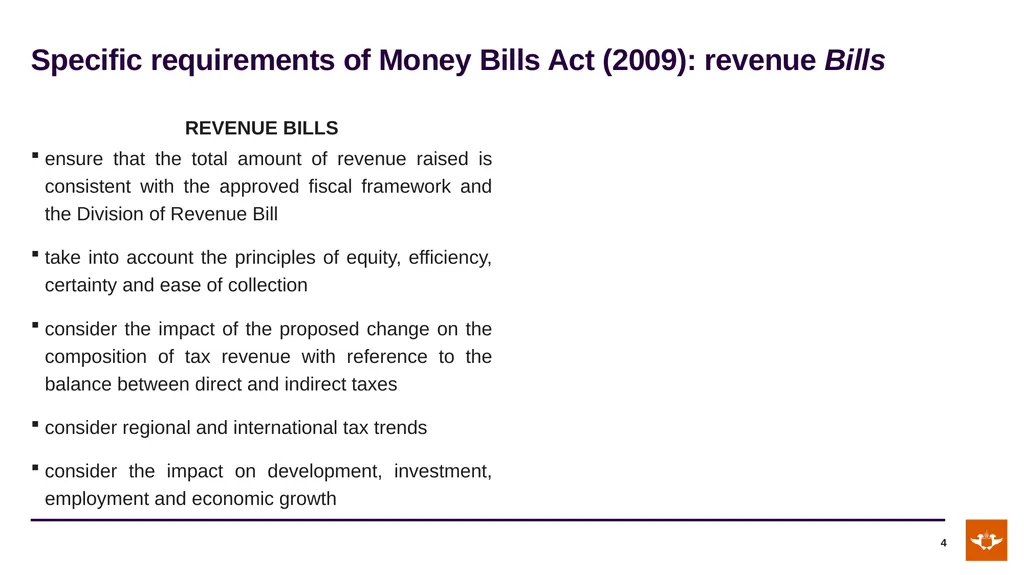
REVENUE BILLS
ensure that the total amount of revenue raised is consistent with the approved fiscal framework and the Division of Revenue Bill
take into account the principles of equity, efficiency, certainty and ease of collection
consider the impact of the proposed change on the composition of tax revenue with reference to the balance between direct and indirect taxes
consider regional and international tax trends
consider the impact on development, investment, employment and economic growth Specific requirements of Money Bills Act (2009): revenue Bills<br>
05
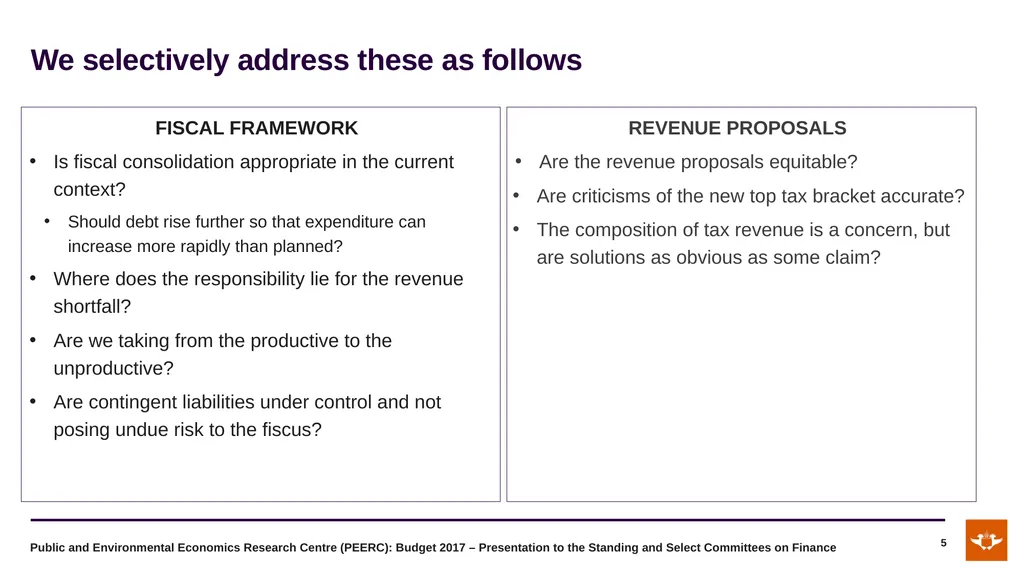
FISCAL FRAMEWORK
Is fiscal consolidation appropriate in the current context?
Should debt rise further so that expenditure can increase more rapidly than planned?
Where does the responsibility lie for the revenue shortfall?
Are we taking from the productive to the unproductive?
Are contingent liabilities under control and not posing undue risk to the fiscus? We selectively address these as follows REVENUE PROPOSALS
Are the revenue proposals equitable?
Are criticisms of the new top tax bracket accurate?
The composition of tax revenue is a concern, but are solutions as obvious as some claim? Public and Environmental Economics Research Centre (PEERC): Budget 2017 – Presentation to the Standing and Select Committees on Finance<br>
06
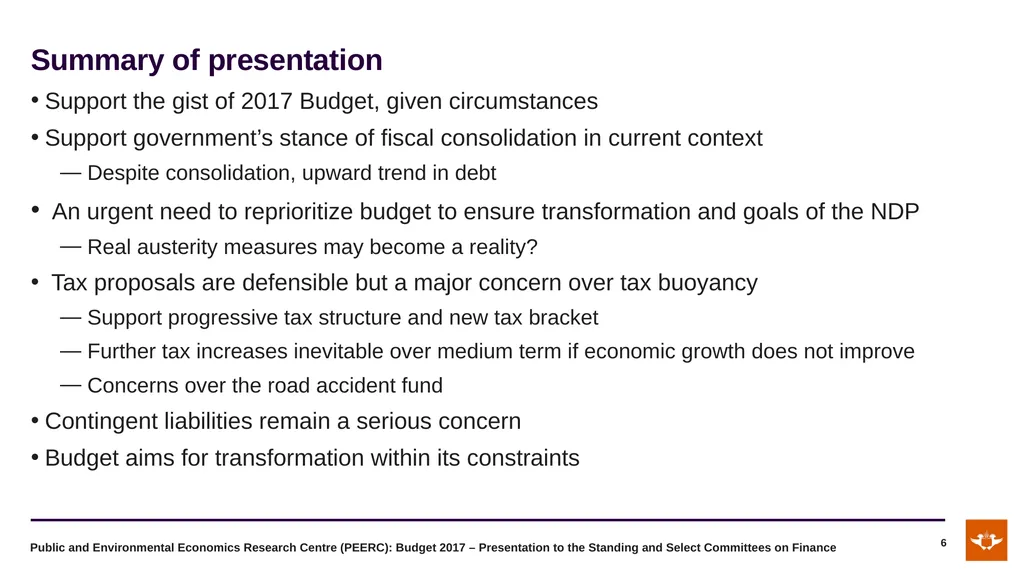
Support the gist of 2017 Budget, given circumstances
Support government’s stance of fiscal consolidation in current context
Despite consolidation, upward trend in debt
An urgent need to reprioritize budget to ensure transformation and goals of the NDP
Real austerity measures may become a reality?
Tax proposals are defensible but a major concern over tax buoyancy
Support progressive tax structure and new tax bracket
Further tax increases inevitable over medium term if economic growth does not improve
Concerns over the road accident fund
Contingent liabilities remain a serious concern
Budget aims for transformation within its constraints Summary of presentation Public and Environmental Economics Research Centre (PEERC): Budget 2017 – Presentation to the Standing and Select Committees on Finance<br>
07
Brief reflection on forecasts underpinning Budget 2017<br>
08
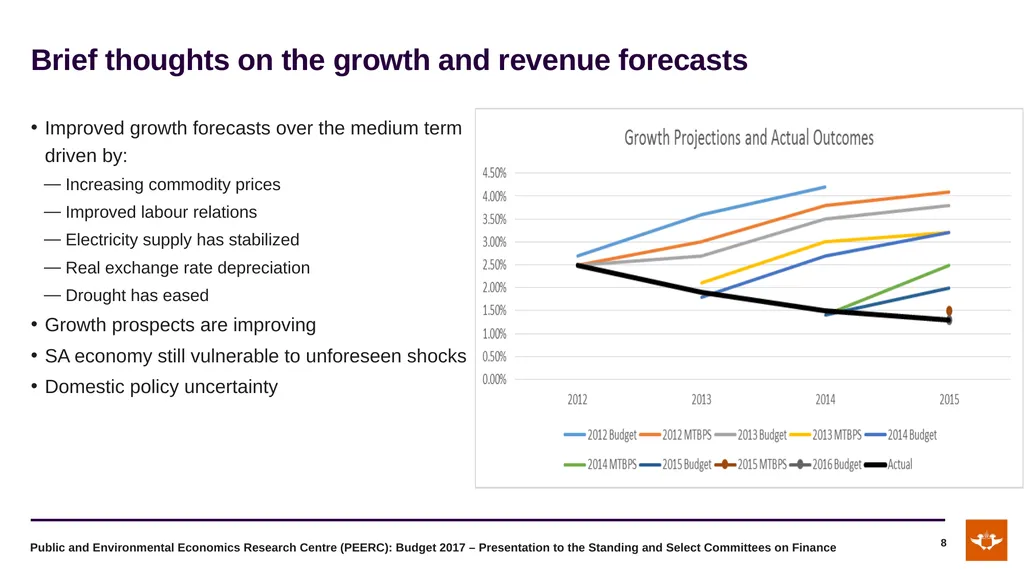
Improved growth forecasts over the medium term driven by:
Increasing commodity prices
Improved labour relations
Electricity supply has stabilized
Real exchange rate depreciation
Drought has eased
Growth prospects are improving
SA economy still vulnerable to unforeseen shocks
Domestic policy uncertainty Brief thoughts on the growth and revenue forecasts Public and Environmental Economics Research Centre (PEERC): Budget 2017 – Presentation to the Standing and Select Committees on Finance<br>
09
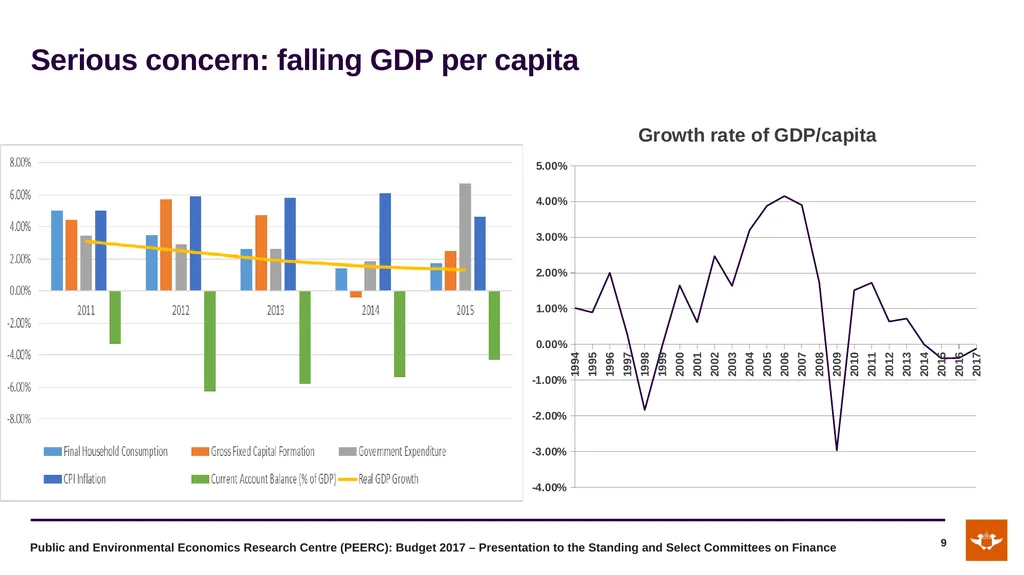
Serious concern: falling GDP per capita Public and Environmental Economics Research Centre (PEERC): Budget 2017 – Presentation to the Standing and Select Committees on Finance<br>
10
Why fiscal consolidation makes sense<br>
11
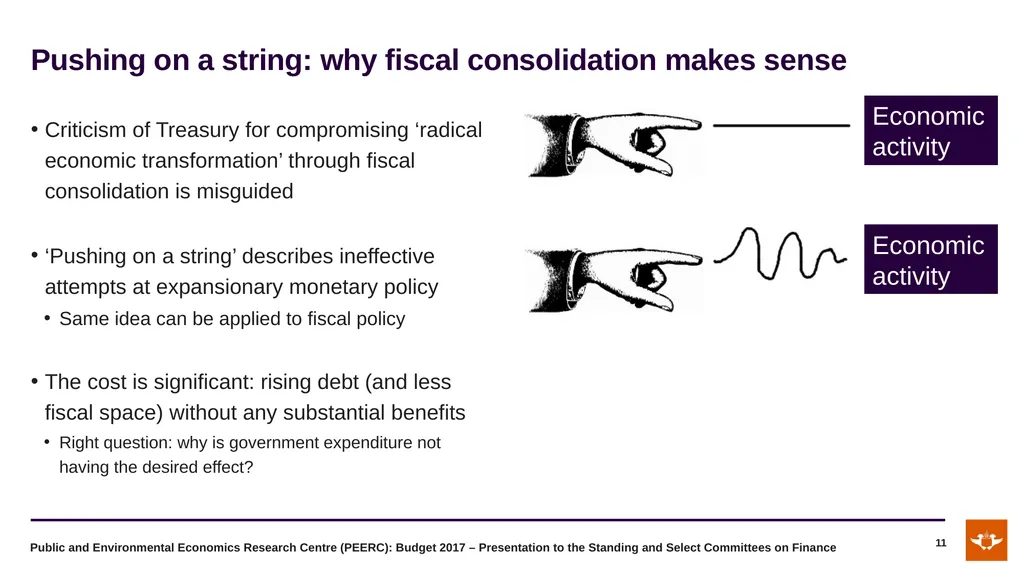
Criticism of Treasury for compromising ‘radical economic transformation’ through fiscal consolidation is misguided
‘Pushing on a string’ describes ineffective attempts at expansionary monetary policy
Same idea can be applied to fiscal policy
The cost is significant: rising debt (and less fiscal space) without any substantial benefits
Right question: why is government expenditure not having the desired effect? Pushing on a string: why fiscal consolidation makes sense Economic
activity Economic
activity Public and Environmental Economics Research Centre (PEERC): Budget 2017 – Presentation to the Standing and Select Committees on Finance<br>
12
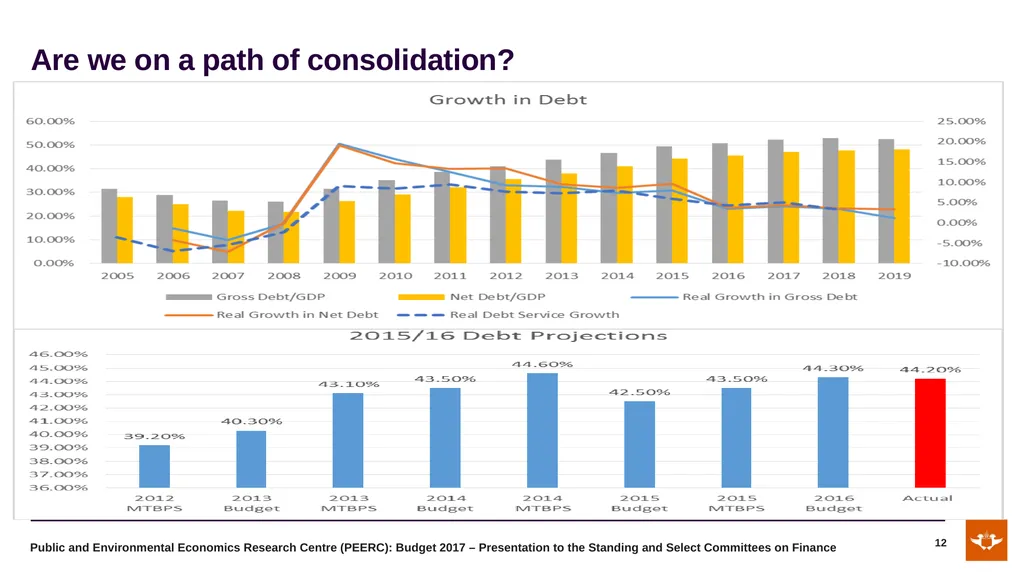
Are we on a path of consolidation? Public and Environmental Economics Research Centre (PEERC): Budget 2017 – Presentation to the Standing and Select Committees on Finance<br>
13
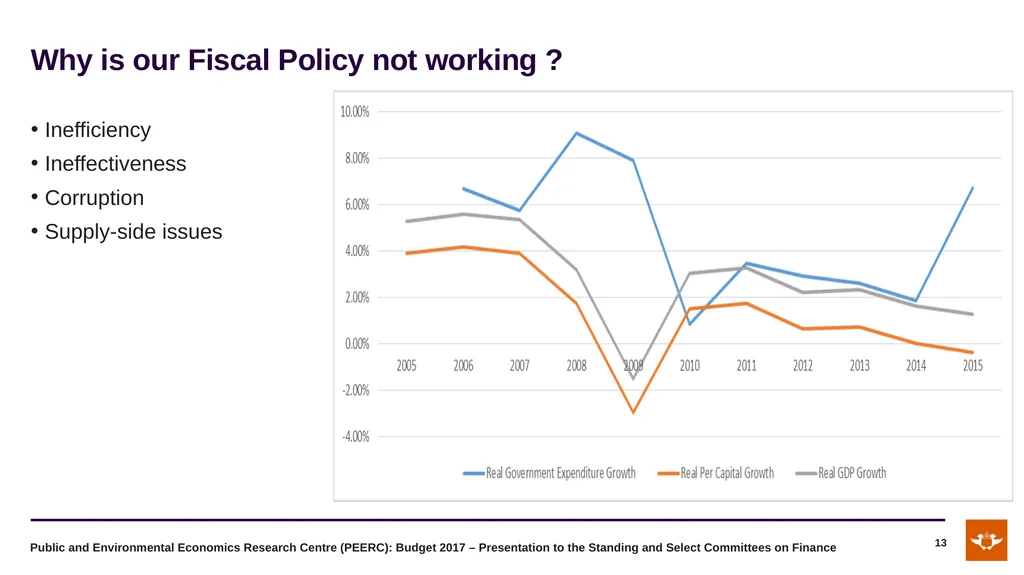
Inefficiency
Ineffectiveness
Corruption
Supply-side issues Why is our Fiscal Policy not working ? Public and Environmental Economics Research Centre (PEERC): Budget 2017 – Presentation to the Standing and Select Committees on Finance<br>
Ineffectiveness
Corruption
Supply-side issues Why is our Fiscal Policy not working ? Public and Environmental Economics Research Centre (PEERC): Budget 2017 – Presentation to the Standing and Select Committees on Finance<br>
14
Despite efforts by economists, there’s no magical, correct debt threshold (in general, or for any country)
Nevertheless, well established that:
As Debt/GDP rises probability of default rises (all else equal)
Typically a negative relationship between debt levels and credit ratings
Cost of borrowing increases with lower credit rating
Negative relationship between ‘high’ debt levels and long-run economic growth Should we allow debt levels to rise further? Public and Environmental Economics Research Centre (PEERC): Budget 2017 – Presentation to the Standing and Select Committees on Finance<br>
15
Reduction in expenditure ceilings and public sector posts<br>
16
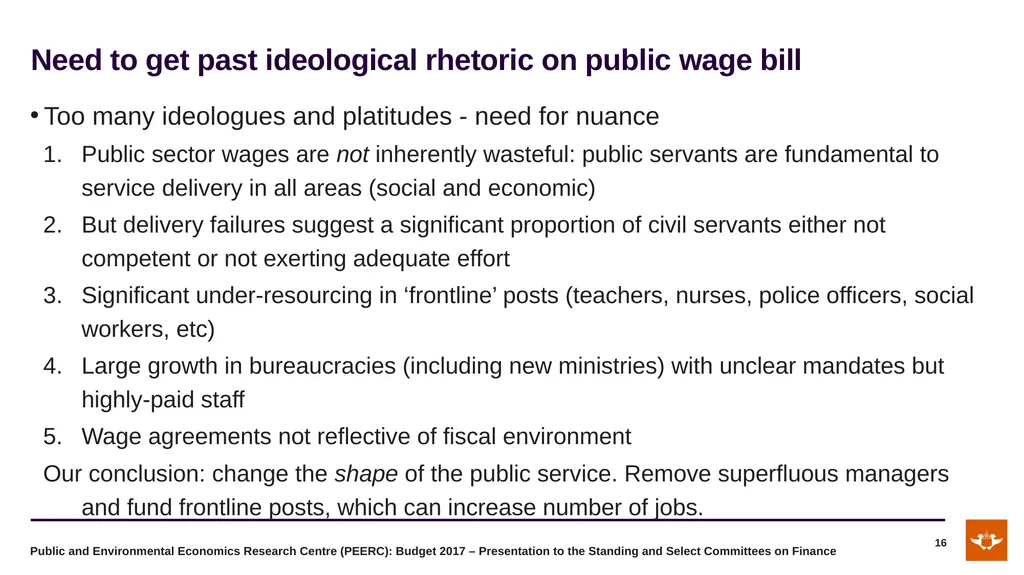
Too many ideologues and platitudes - need for nuance
Public sector wages are not inherently wasteful: public servants are fundamental to service delivery in all areas (social and economic)
But delivery failures suggest a significant proportion of civil servants either not competent or not exerting adequate effort
Significant under-resourcing in ‘frontline’ posts (teachers, nurses, police officers, social workers, etc)
Large growth in bureaucracies (including new ministries) with unclear mandates but highly-paid staff
Wage agreements not reflective of fiscal environment
Our conclusion: change the shape of the public service. Remove superfluous managers and fund frontline posts, which can increase number of jobs. Need to get past ideological rhetoric on public wage bill Public and Environmental Economics Research Centre (PEERC): Budget 2017 – Presentation to the Standing and Select Committees on Finance<br>
17
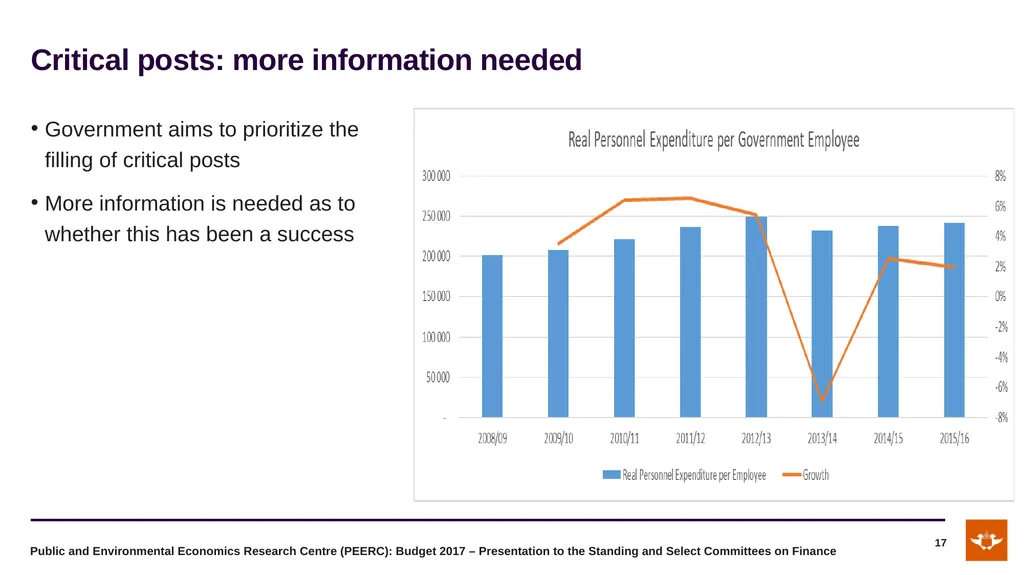
Government aims to prioritize the filling of critical posts
More information is needed as to whether this has been a success Critical posts: more information needed Public and Environmental Economics Research Centre (PEERC): Budget 2017 – Presentation to the Standing and Select Committees on Finance<br>
More information is needed as to whether this has been a success Critical posts: more information needed Public and Environmental Economics Research Centre (PEERC): Budget 2017 – Presentation to the Standing and Select Committees on Finance<br>
18
Revenue shortfall and proposals for 2017/18<br>
19
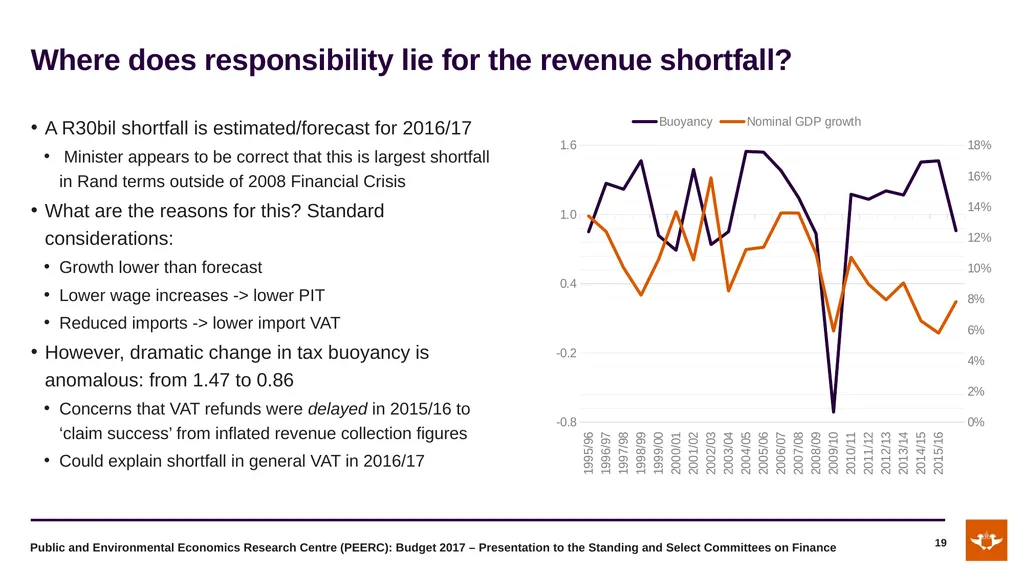
A R30bil shortfall is estimated/forecast for 2016/17
Minister appears to be correct that this is largest shortfall in Rand terms outside of 2008 Financial Crisis
What are the reasons for this? Standard considerations:
Growth lower than forecast
Lower wage increases -> lower PIT
Reduced imports -> lower import VAT
However, dramatic change in tax buoyancy is anomalous: from 1.47 to 0.86
Concerns that VAT refunds were delayed in 2015/16 to ‘claim success’ from inflated revenue collection figures
Could explain shortfall in general VAT in 2016/17 Where does responsibility lie for the revenue shortfall? Public and Environmental Economics Research Centre (PEERC): Budget 2017 – Presentation to the Standing and Select Committees on Finance<br>
20
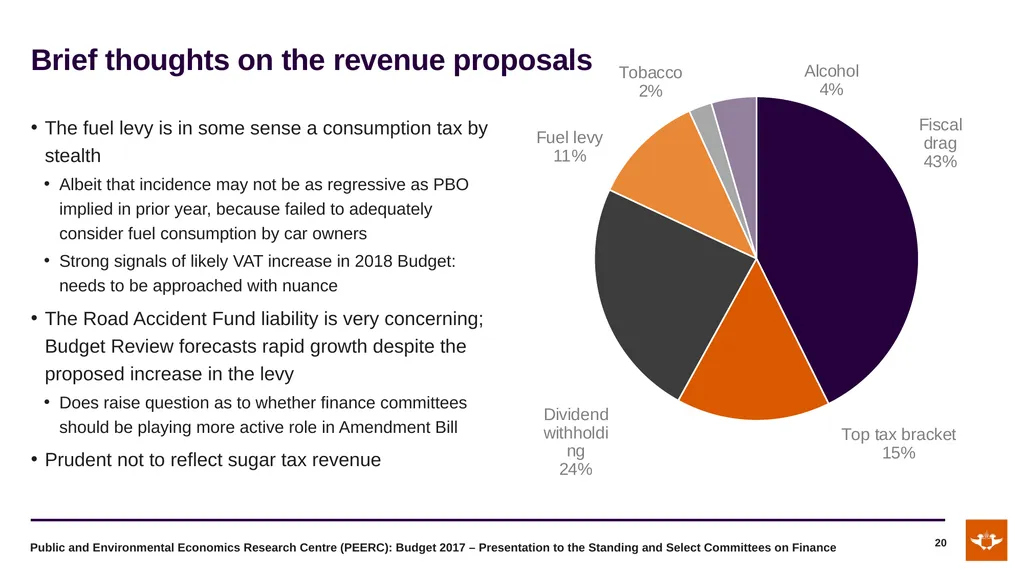
The fuel levy is in some sense a consumption tax by stealth
Albeit that incidence may not be as regressive as PBO implied in prior year, because failed to adequately consider fuel consumption by car owners
Strong signals of likely VAT increase in 2018 Budget: needs to be approached with nuance
The Road Accident Fund liability is very concerning; Budget Review forecasts rapid growth despite the proposed increase in the levy
Does raise question as to whether finance committees should be playing more active role in Amendment Bill
Prudent not to reflect sugar tax revenue Brief thoughts on the revenue proposals Public and Environmental Economics Research Centre (PEERC): Budget 2017 – Presentation to the Standing and Select Committees on Finance<br>
21
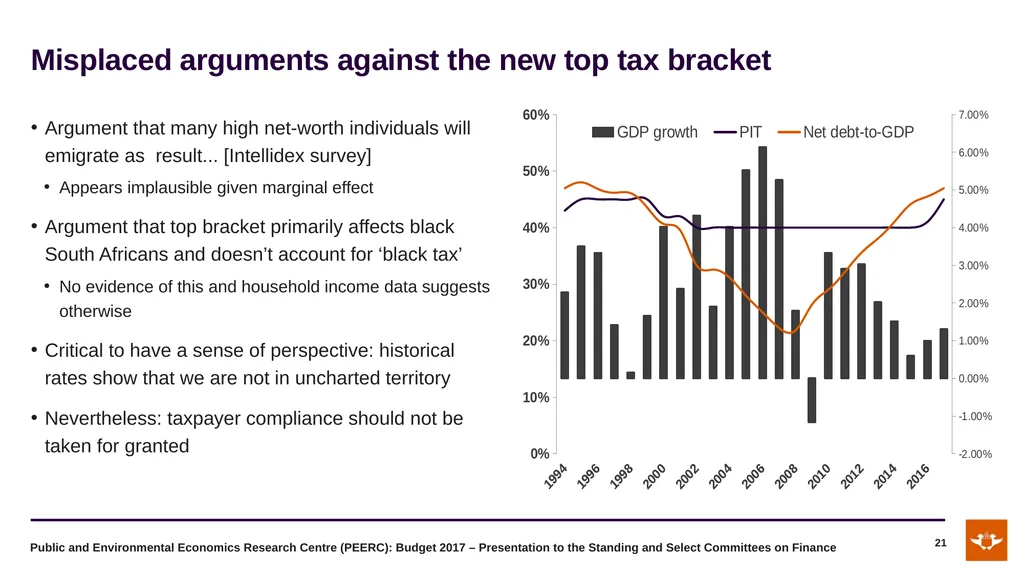
Argument that many high net-worth individuals will emigrate as result... [Intellidex survey]
Appears implausible given marginal effect
Argument that top bracket primarily affects black South Africans and doesn’t account for ‘black tax’
No evidence of this and household income data suggests otherwise
Critical to have a sense of perspective: historical rates show that we are not in uncharted territory
Nevertheless: taxpayer compliance should not be taken for granted Misplaced arguments against the new top tax bracket Public and Environmental Economics Research Centre (PEERC): Budget 2017 – Presentation to the Standing and Select Committees on Finance<br>
22
Contingent liabilities<br>
23
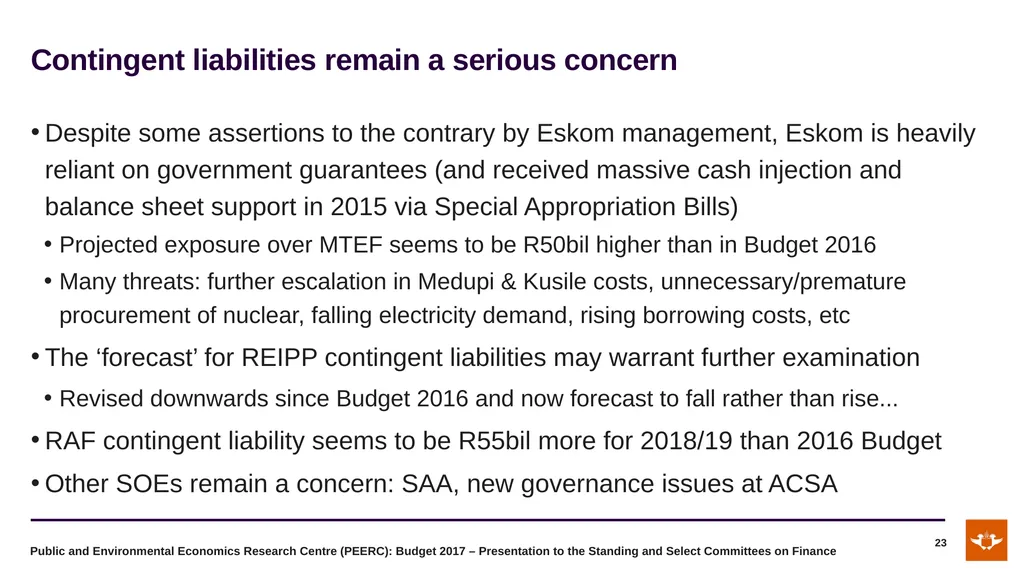
Despite some assertions to the contrary by Eskom management, Eskom is heavily reliant on government guarantees (and received massive cash injection and balance sheet support in 2015 via Special Appropriation Bills)
Projected exposure over MTEF seems to be R50bil higher than in Budget 2016
Many threats: further escalation in Medupi & Kusile costs, unnecessary/premature procurement of nuclear, falling electricity demand, rising borrowing costs, etc
The ‘forecast’ for REIPP contingent liabilities may warrant further examination
Revised downwards since Budget 2016 and now forecast to fall rather than rise...
RAF contingent liability seems to be R55bil more for 2018/19 than 2016 Budget
Other SOEs remain a concern: SAA, new governance issues at ACSA Contingent liabilities remain a serious concern Public and Environmental Economics Research Centre (PEERC): Budget 2017 – Presentation to the Standing and Select Committees on Finance<br>
24
Radical economic transformation & Budget 2017<br>
25
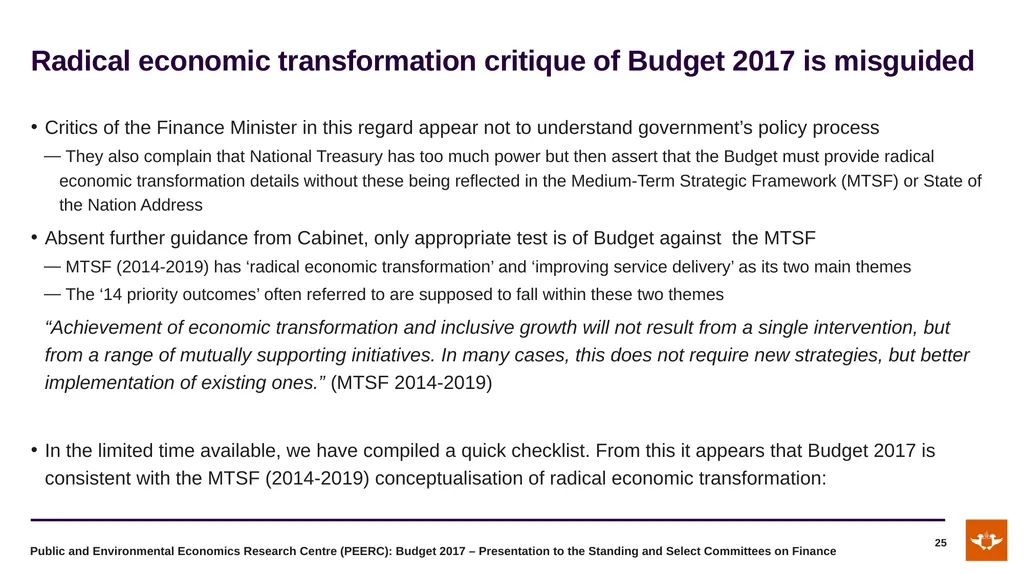
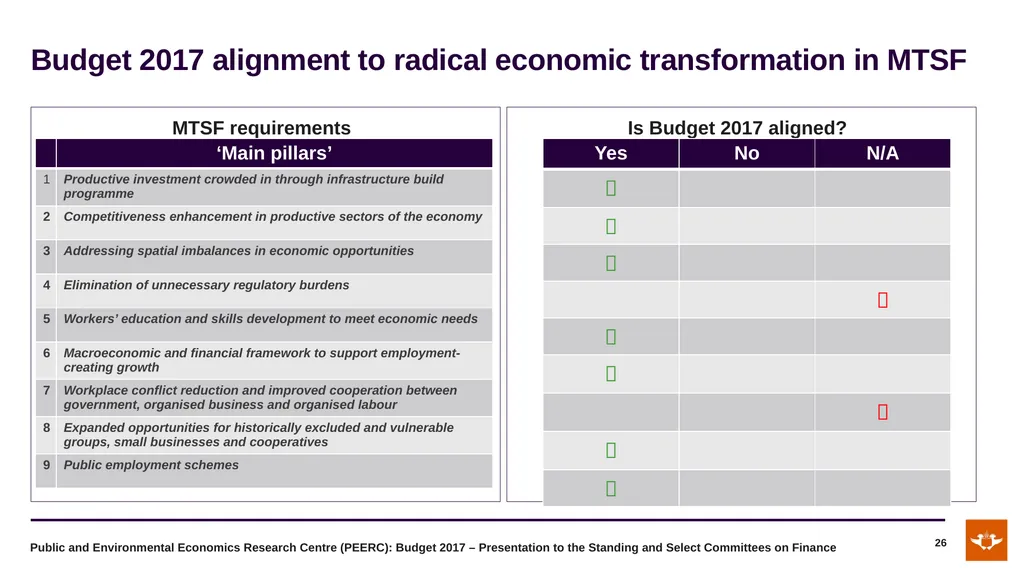
Critics of the Finance Minister in this regard appear not to understand government’s policy process
They also complain that National Treasury has too much power but then assert that the Budget must provide radical economic transformation details without these being reflected in the Medium-Term Strategic Framework (MTSF) or State of the Nation Address
Absent further guidance from Cabinet, only appropriate test is of Budget against the MTSF
MTSF (2014-2019) has ‘radical economic transformation’ and ‘improving service delivery’ as its two main themes
The ‘14 priority outcomes’ often referred to are supposed to fall within these two themes
“Achievement of economic transformation and inclusive growth will not result from a single intervention, but from a range of mutually supporting initiatives. In many cases, this does not require new strategies, but better implementation of existing ones.” (MTSF 2014-2019)
In the limited time available, we have compiled a quick checklist. From this it appears that Budget 2017 is consistent with the MTSF (2014-2019) conceptualisation of radical economic transformation: Radical economic transformation critique of Budget 2017 is misguided Public and Environmental Economics Research Centre (PEERC): Budget 2017 – Presentation to the Standing and Select Committees on Finance<br>
26
MTSF requirements Budget 2017 alignment to radical economic transformation in MTSF Is Budget 2017 aligned? Public and Environmental Economics Research Centre (PEERC): Budget 2017 – Presentation to the Standing and Select Committees on Finance<br>
27
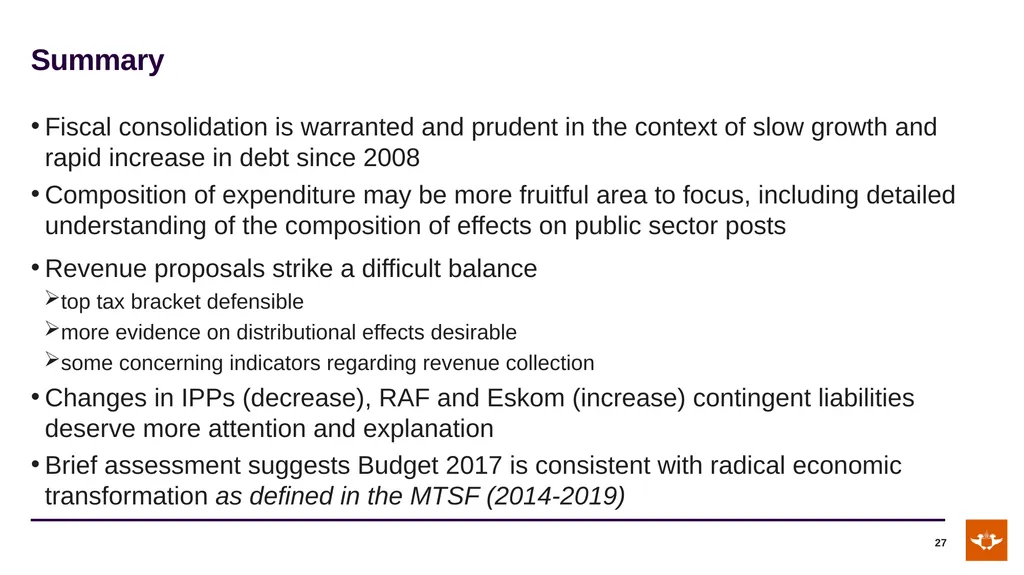
Fiscal consolidation is warranted and prudent in the context of slow growth and rapid increase in debt since 2008
Composition of expenditure may be more fruitful area to focus, including detailed understanding of the composition of effects on public sector posts
Revenue proposals strike a difficult balance
top tax bracket defensible
more evidence on distributional effects desirable
some concerning indicators regarding revenue collection
Changes in IPPs (decrease), RAF and Eskom (increase) contingent liabilities deserve more attention and explanation
Brief assessment suggests Budget 2017 is consistent with radical economic transformation as defined in the MTSF (2014-2019) Summary<br>
28
THANK YOU<br>
29
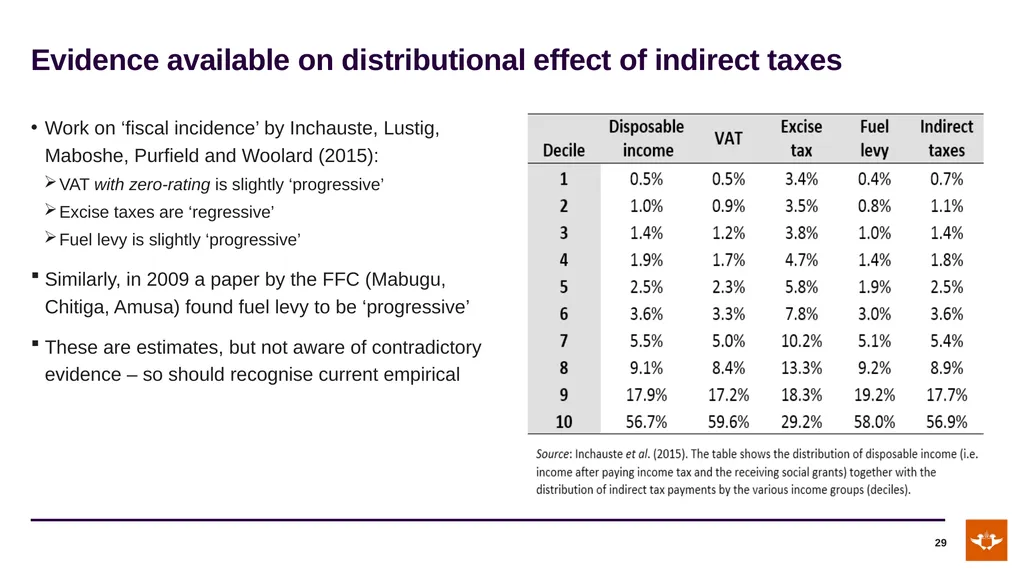
Work on ‘fiscal incidence’ by Inchauste, Lustig, Maboshe, Purfield and Woolard (2015):
VAT with zero-rating is slightly ‘progressive’
Excise taxes are ‘regressive’
Fuel levy is slightly ‘progressive’
Similarly, in 2009 a paper by the FFC (Mabugu, Chitiga, Amusa) found fuel levy to be ‘progressive’
These are estimates, but not aware of contradictory evidence – so should recognise current empirical Evidence available on distributional effect of indirect taxes<br>