
Building an organizational Recovery-Oriented
JO
Published · 39 slides · 0 views

1 / 1


Description
Building an organizational Recovery-Oriented system of Care A Seven-part series 2 Recovery management training overview: Why are we here? To recognize that, despite many difficult and life-changing experiences, recovery is possible for
Related Topics
Share
Embed code
Download this presentation From Below
"Building an organizational Recovery-Oriented" is the property of its rightful owner. Permission is granted to download and print the materials on this website for personal, non-commercial use only, and to display it on your personal computer provided you do not modify the materials and that you retain all copyright notices contained in the materials. By downloading content from our website, you accept the terms of this agreement.
Presentation Transcript
01
Building an organizational Recovery-Oriented system of Care A Seven-part series<br>
02
2 Recovery management training overview: Why are we here? To recognize that, despite many difficult and life-changing experiences, recovery is possible for people with mental health and/or substance use conditions.
To identify beliefs, principles and practices that are critical in guiding our work to help those we serve rebuild meaningful, valued and satisfying lives.<br>
To identify beliefs, principles and practices that are critical in guiding our work to help those we serve rebuild meaningful, valued and satisfying lives.<br>
03
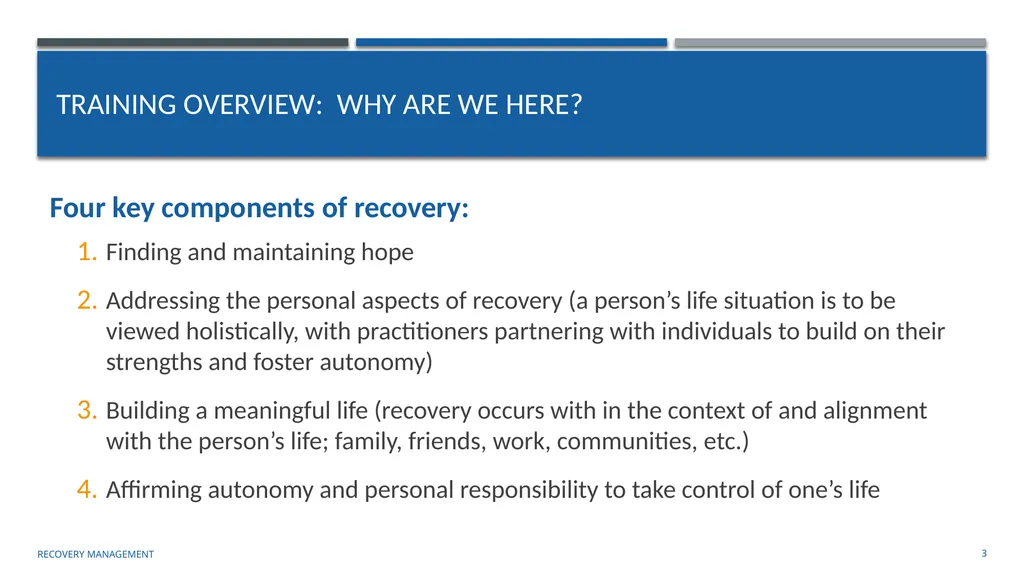
3 Recovery management training overview: Why are we here? Four key components of recovery:
Finding and maintaining hope
Addressing the personal aspects of recovery (a person’s life situation is to be viewed holistically, with practitioners partnering with individuals to build on their strengths and foster autonomy)
Building a meaningful life (recovery occurs with in the context of and alignment with the person’s life; family, friends, work, communities, etc.)
Affirming autonomy and personal responsibility to take control of one’s life<br>
Finding and maintaining hope
Addressing the personal aspects of recovery (a person’s life situation is to be viewed holistically, with practitioners partnering with individuals to build on their strengths and foster autonomy)
Building a meaningful life (recovery occurs with in the context of and alignment with the person’s life; family, friends, work, communities, etc.)
Affirming autonomy and personal responsibility to take control of one’s life<br>
04
4 Recovery management training overview: goals Develop a shared conceptual framework and language to transform our organization’s culture and practices.
Embrace the principles, values, knowledge, skills and behaviors that underlie recovery-oriented services and supports.
Explore a foundational approach to recovery-oriented care that can be adapted to the wide variety of services and supports provided by our organization.<br>
Embrace the principles, values, knowledge, skills and behaviors that underlie recovery-oriented services and supports.
Explore a foundational approach to recovery-oriented care that can be adapted to the wide variety of services and supports provided by our organization.<br>
05
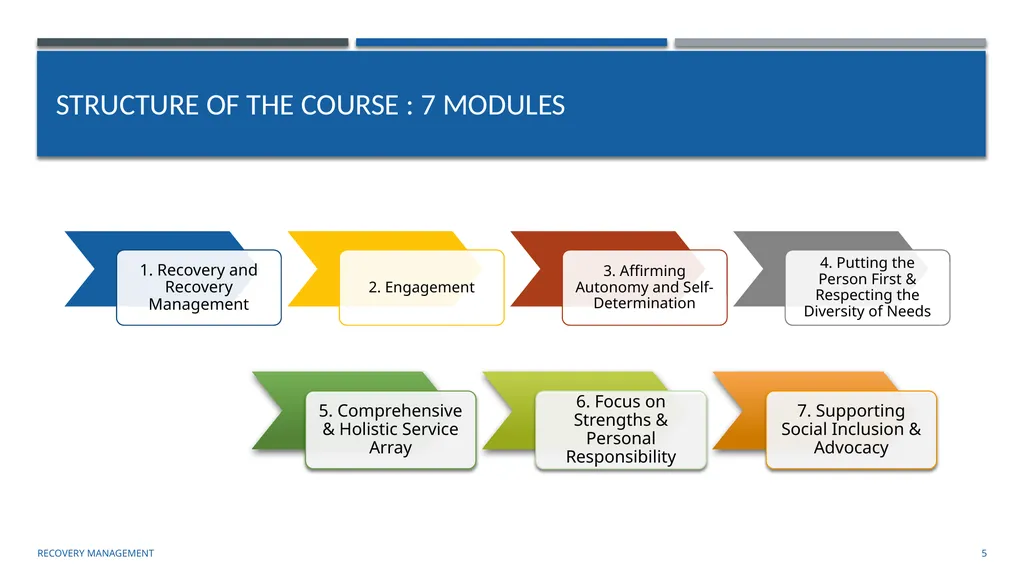
5 Recovery management Structure of the course : 7 Modules<br>
06
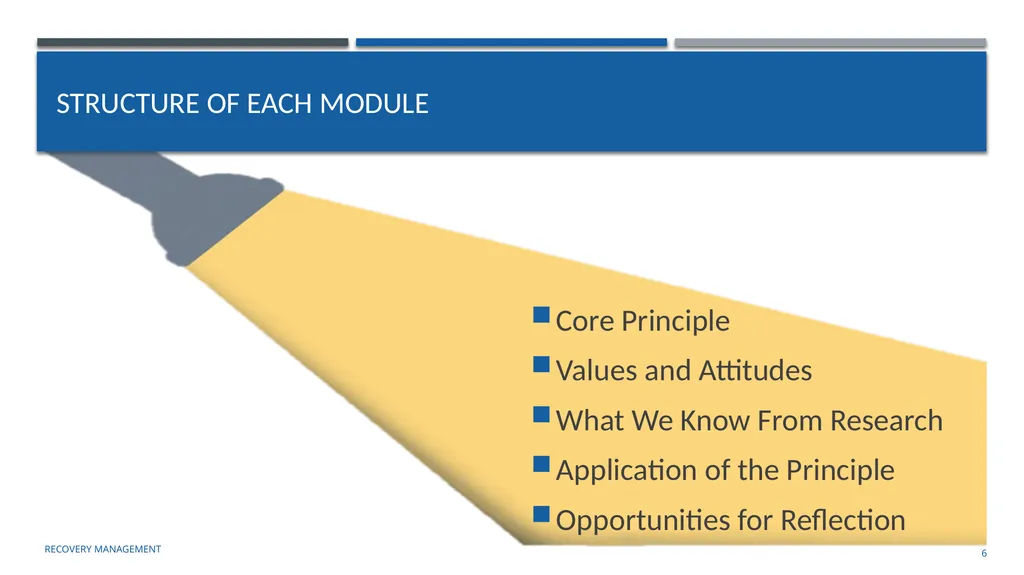
6 Recovery management Structure of each Module Core Principle
Values and Attitudes
What We Know From Research
Application of the Principle
Opportunities for Reflection<br>
Values and Attitudes
What We Know From Research
Application of the Principle
Opportunities for Reflection<br>
07
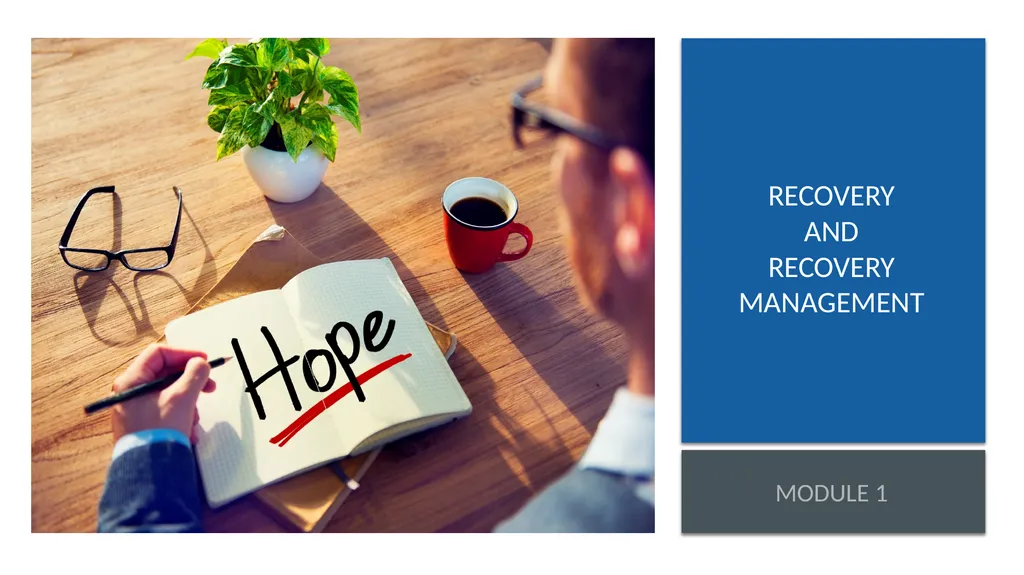
Recovery
And
Recovery management Module 1<br>
08
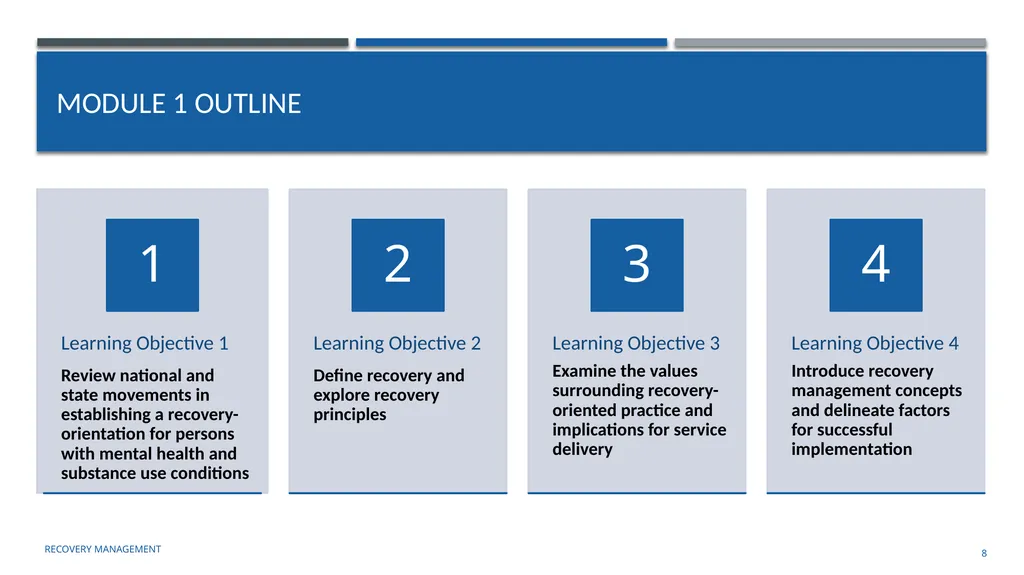
8 Recovery management Module 1 Outline<br>
09
Core principle Recovery orientation Recovery management 9<br>
10
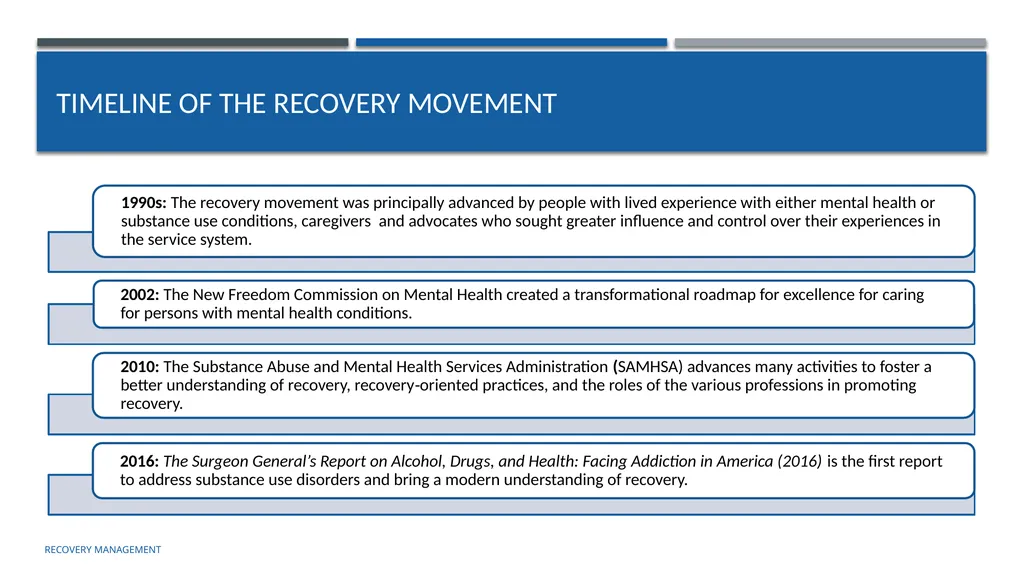
10 Recovery management Timeline of the recovery Movement<br>
11
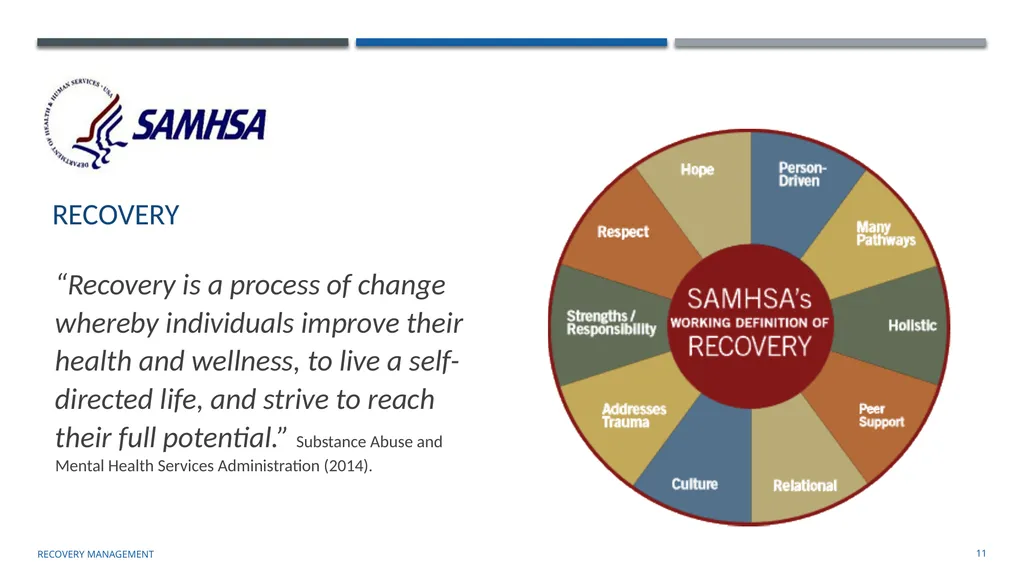
Recovery “Recovery is a process of change whereby individuals improve their health and wellness, to live a self-directed life, and strive to reach their full potential.” Substance Abuse and Mental Health Services Administration (2014). Recovery management 11<br>
12
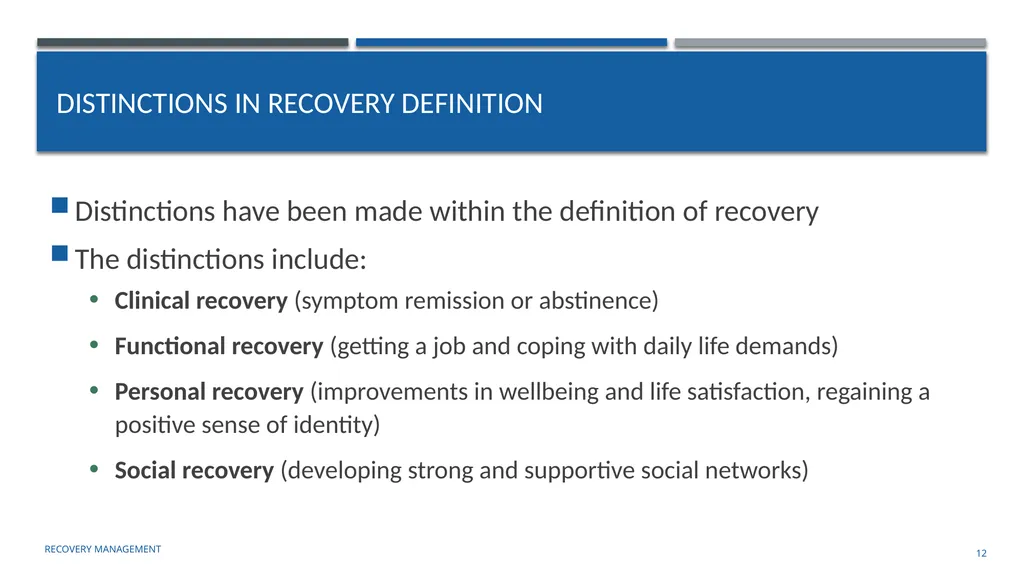
12 Recovery management Distinctions in recovery definition Distinctions have been made within the definition of recovery
The distinctions include:
Clinical recovery (symptom remission or abstinence)
Functional recovery (getting a job and coping with daily life demands)
Personal recovery (improvements in wellbeing and life satisfaction, regaining a positive sense of identity)
Social recovery (developing strong and supportive social networks)<br>
The distinctions include:
Clinical recovery (symptom remission or abstinence)
Functional recovery (getting a job and coping with daily life demands)
Personal recovery (improvements in wellbeing and life satisfaction, regaining a positive sense of identity)
Social recovery (developing strong and supportive social networks)<br>
13
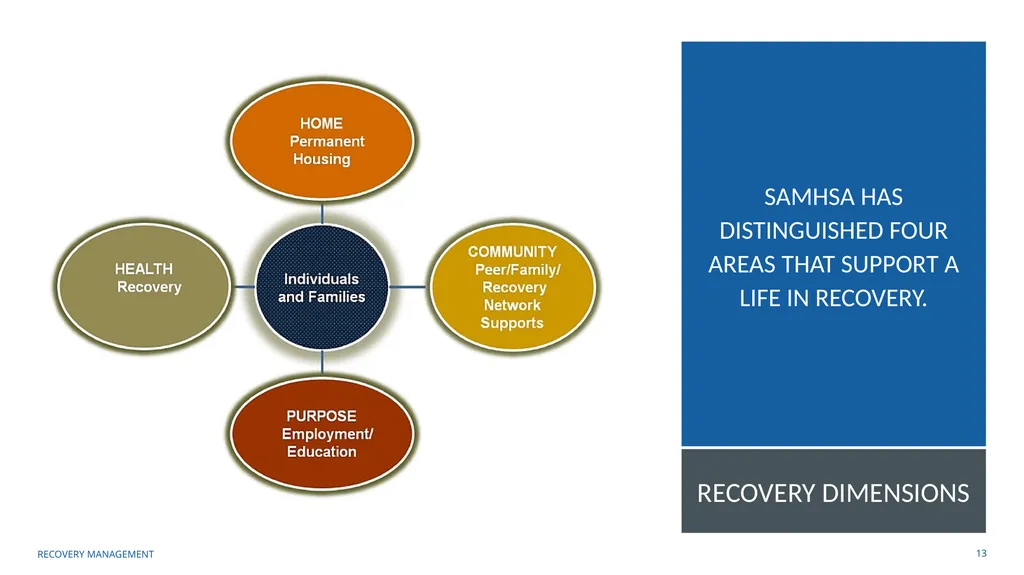
RECOVERY DIMENSIONS SAMHSA has distinguished four areas that support a life in recovery. Recovery management 13<br>
14
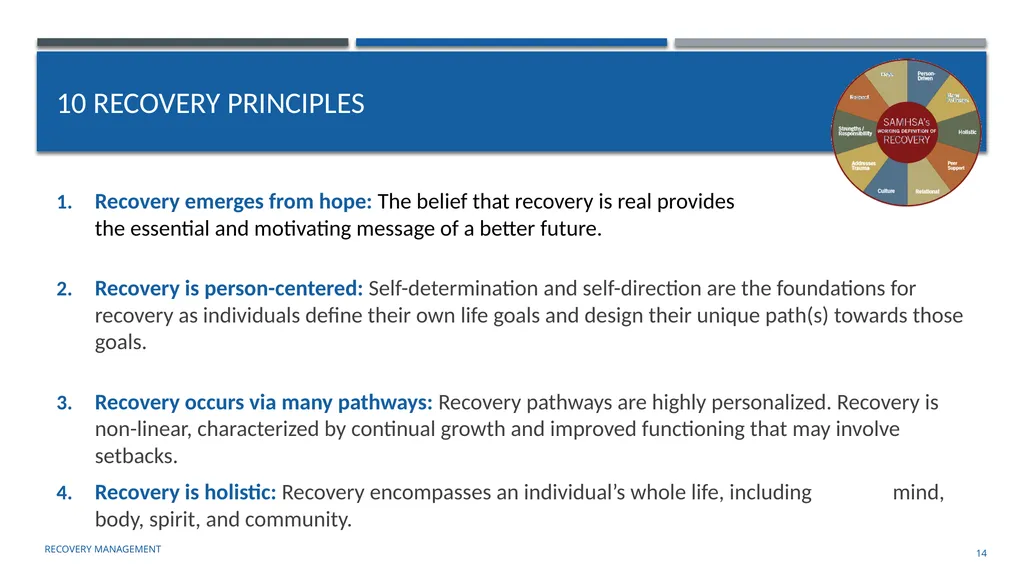
14 Recovery management 10 Recovery principles Recovery emerges from hope: The belief that recovery is real provides
the essential and motivating message of a better future.
Recovery is person-centered: Self-determination and self-direction are the foundations for recovery as individuals define their own life goals and design their unique path(s) towards those goals.
Recovery occurs via many pathways: Recovery pathways are highly personalized. Recovery is non-linear, characterized by continual growth and improved functioning that may involve setbacks.
Recovery is holistic: Recovery encompasses an individual’s whole life, including mind, body, spirit, and community.<br>
Recovery is person-centered: Self-determination and self-direction are the foundations for recovery as individuals define their own life goals and design their unique path(s) towards those goals.
Recovery occurs via many pathways: Recovery pathways are highly personalized. Recovery is non-linear, characterized by continual growth and improved functioning that may involve setbacks.
Recovery is holistic: Recovery encompasses an individual’s whole life, including mind, body, spirit, and community.<br>
15
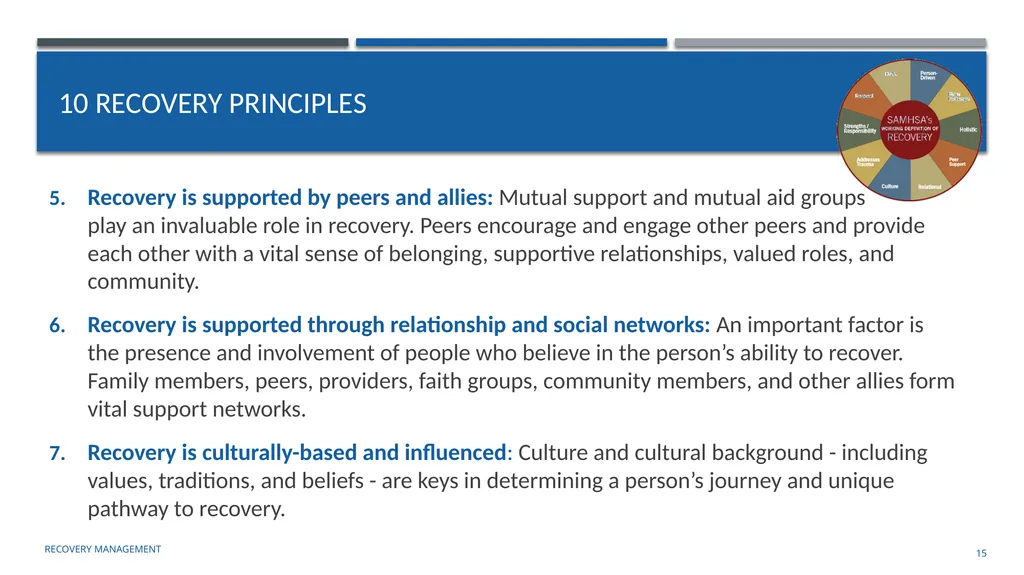
15 Recovery management 10 Recovery principles Recovery is supported by peers and allies: Mutual support and mutual aid groups
play an invaluable role in recovery. Peers encourage and engage other peers and provide each other with a vital sense of belonging, supportive relationships, valued roles, and community.
Recovery is supported through relationship and social networks: An important factor is the presence and involvement of people who believe in the person’s ability to recover. Family members, peers, providers, faith groups, community members, and other allies form vital support networks.
Recovery is culturally-based and influenced: Culture and cultural background - including values, traditions, and beliefs - are keys in determining a person’s journey and unique pathway to recovery.<br>
Recovery is supported through relationship and social networks: An important factor is the presence and involvement of people who believe in the person’s ability to recover. Family members, peers, providers, faith groups, community members, and other allies form vital support networks.
Recovery is culturally-based and influenced: Culture and cultural background - including values, traditions, and beliefs - are keys in determining a person’s journey and unique pathway to recovery.<br>
16
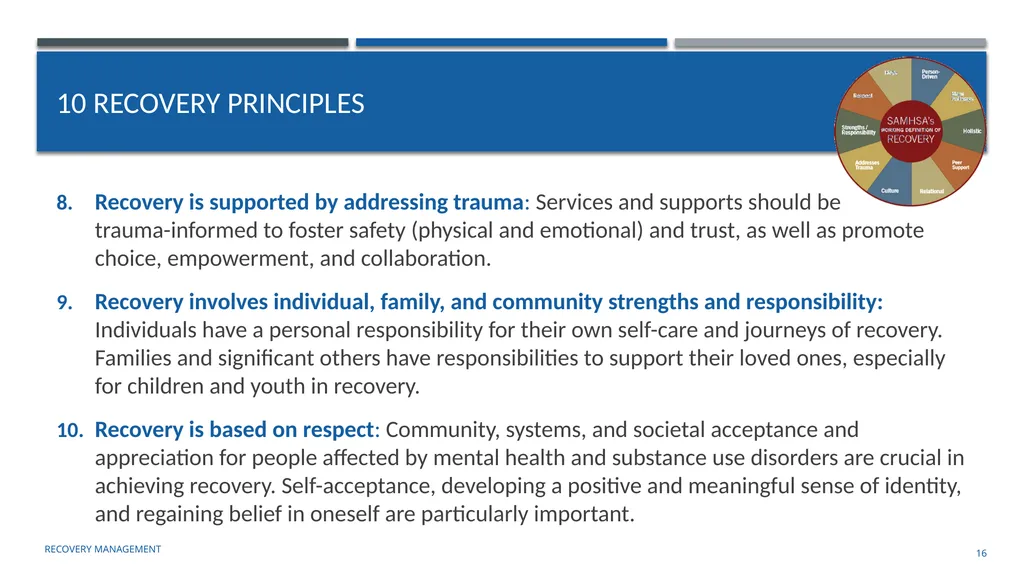
16 Recovery management 10 Recovery principles Recovery is supported by addressing trauma: Services and supports should be
trauma-informed to foster safety (physical and emotional) and trust, as well as promote choice, empowerment, and collaboration.
Recovery involves individual, family, and community strengths and responsibility: Individuals have a personal responsibility for their own self-care and journeys of recovery. Families and significant others have responsibilities to support their loved ones, especially for children and youth in recovery.
Recovery is based on respect: Community, systems, and societal acceptance and appreciation for people affected by mental health and substance use disorders are crucial in achieving recovery. Self-acceptance, developing a positive and meaningful sense of identity, and regaining belief in oneself are particularly important.<br>
Recovery involves individual, family, and community strengths and responsibility: Individuals have a personal responsibility for their own self-care and journeys of recovery. Families and significant others have responsibilities to support their loved ones, especially for children and youth in recovery.
Recovery is based on respect: Community, systems, and societal acceptance and appreciation for people affected by mental health and substance use disorders are crucial in achieving recovery. Self-acceptance, developing a positive and meaningful sense of identity, and regaining belief in oneself are particularly important.<br>
17
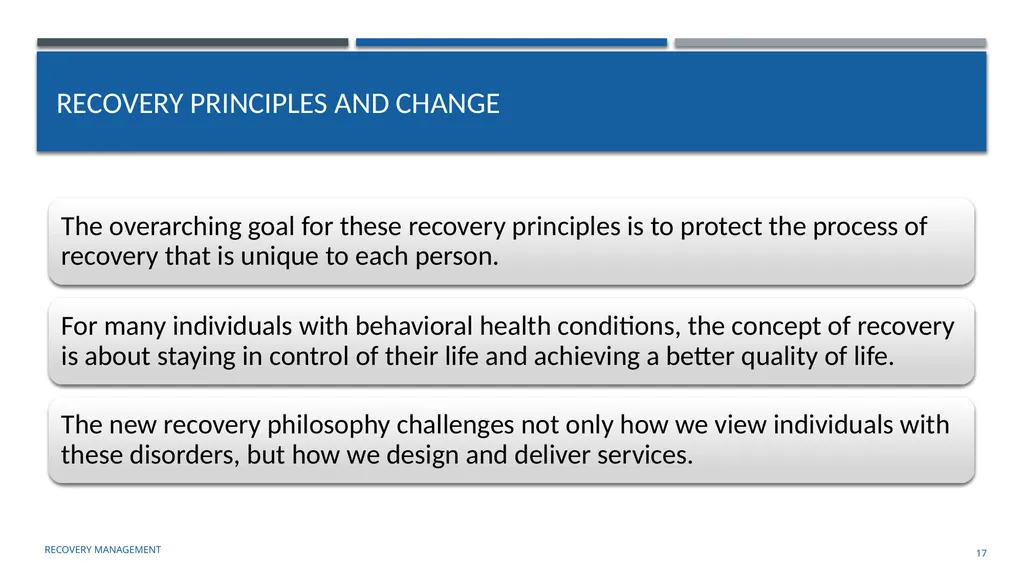
17 Recovery management Recovery principles and change<br>
18
QuestionS? 18 Which of the recovery principles and values resonate most with you?
Why are these important? Recovery management<br>
Why are these important? Recovery management<br>
19
Values & attitudes Recovery orientation Recovery management 19<br>
20
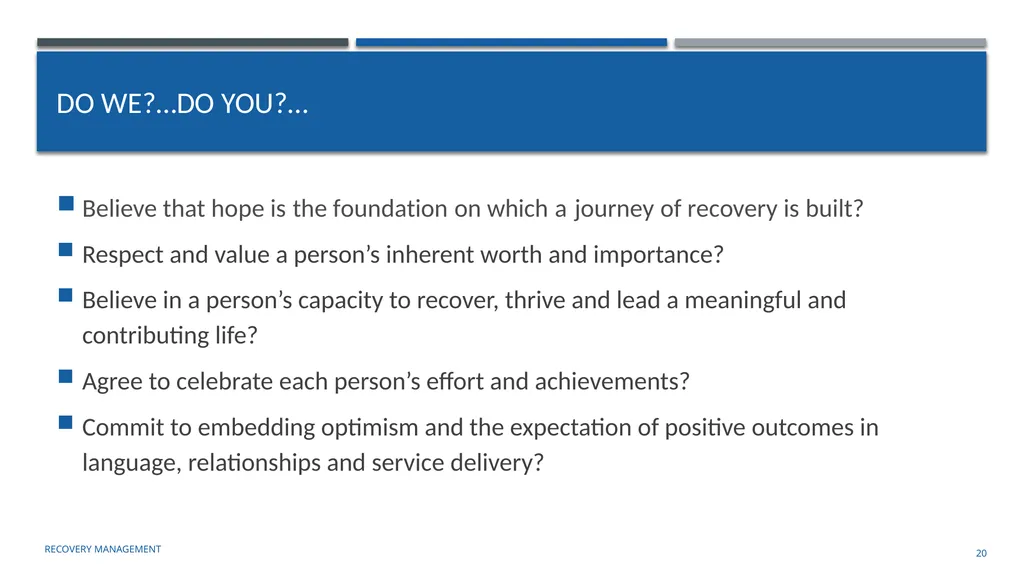
20 Recovery management Do we?…Do You?… Believe that hope is the foundation on which a journey of recovery is built?
Respect and value a person’s inherent worth and importance?
Believe in a person’s capacity to recover, thrive and lead a meaningful and contributing life?
Agree to celebrate each person’s effort and achievements?
Commit to embedding optimism and the expectation of positive outcomes in language, relationships and service delivery?<br>
Respect and value a person’s inherent worth and importance?
Believe in a person’s capacity to recover, thrive and lead a meaningful and contributing life?
Agree to celebrate each person’s effort and achievements?
Commit to embedding optimism and the expectation of positive outcomes in language, relationships and service delivery?<br>
21
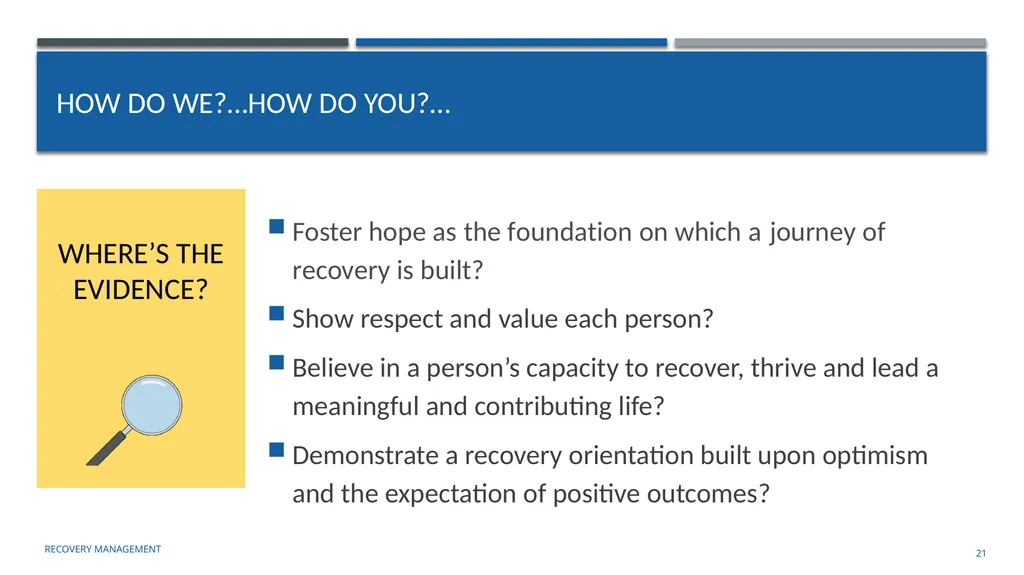
21 Recovery management How Do we?…How Do You?… Foster hope as the foundation on which a journey of recovery is built?
Show respect and value each person?
Believe in a person’s capacity to recover, thrive and lead a meaningful and contributing life?
Demonstrate a recovery orientation built upon optimism and the expectation of positive outcomes? WHERE’S THE EVIDENCE?<br>
Show respect and value each person?
Believe in a person’s capacity to recover, thrive and lead a meaningful and contributing life?
Demonstrate a recovery orientation built upon optimism and the expectation of positive outcomes? WHERE’S THE EVIDENCE?<br>
22
What we know
From research Recovery orientation Recovery management 22<br>
23
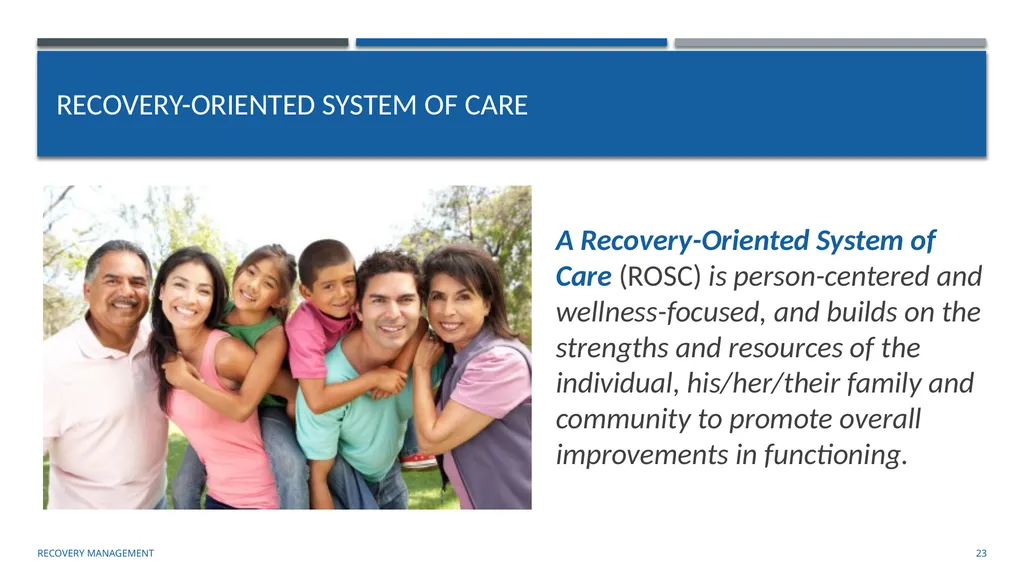
23 Recovery management A Recovery-Oriented System of Care (ROSC) is person-centered and wellness-focused, and builds on the strengths and resources of the individual, his/her/their family and community to promote overall improvements in functioning. RECOVERY-ORIENTED SYSTEM OF CARE<br>
24
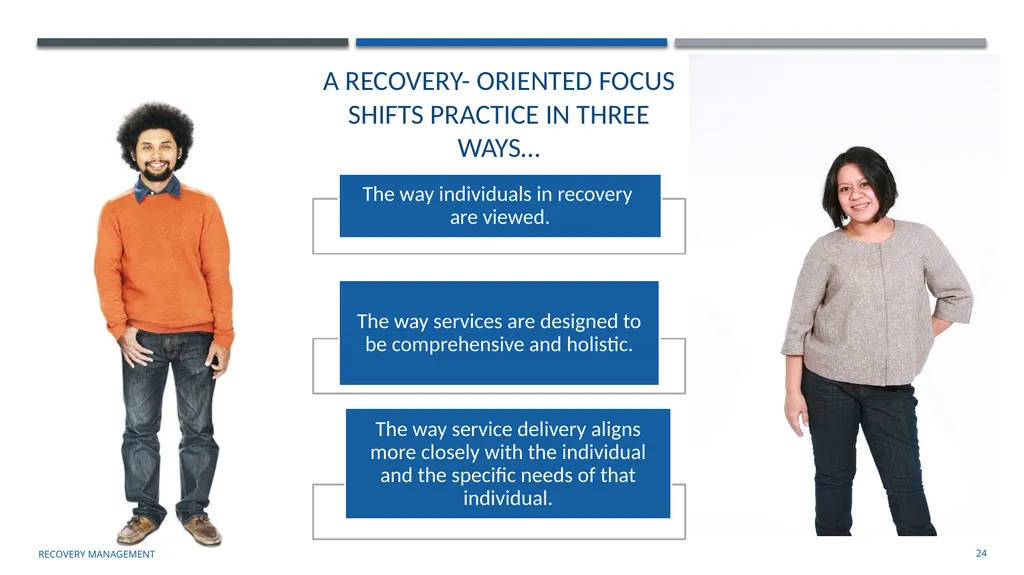
a Recovery- oriented focus ShiftS practice in three ways… Recovery management 24<br>
25
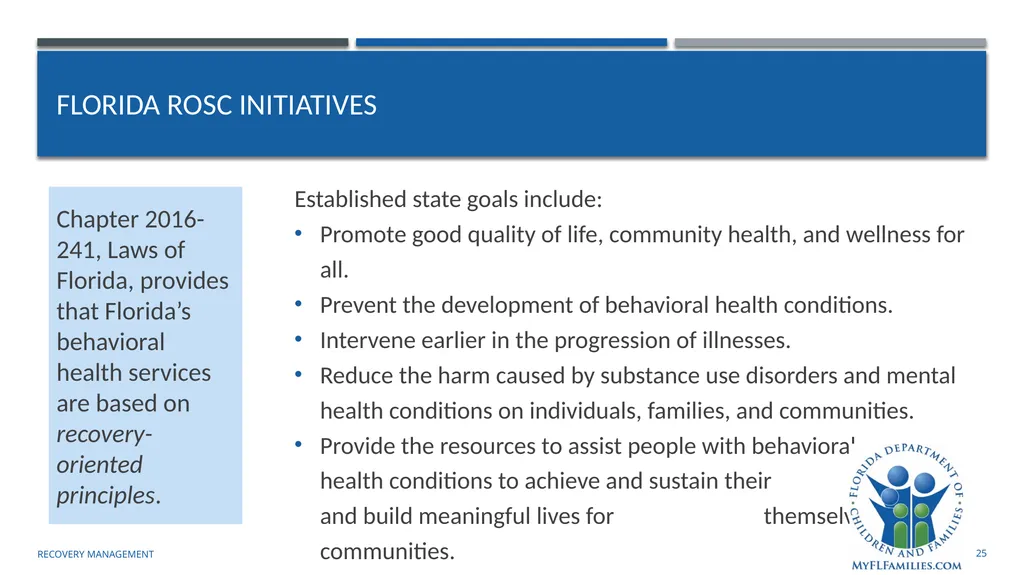
25 Recovery Management Chapter 2016-241, Laws of Florida, provides that Florida’s behavioral health services are based on recovery-oriented principles. Established state goals include:
Promote good quality of life, community health, and wellness for all.
Prevent the development of behavioral health conditions.
Intervene earlier in the progression of illnesses.
Reduce the harm caused by substance use disorders and mental health conditions on individuals, families, and communities.
Provide the resources to assist people with behavioral health conditions to achieve and sustain their wellness and build meaningful lives for themselves in their communities. FLORIDA ROSC INITIATIVES<br>
Promote good quality of life, community health, and wellness for all.
Prevent the development of behavioral health conditions.
Intervene earlier in the progression of illnesses.
Reduce the harm caused by substance use disorders and mental health conditions on individuals, families, and communities.
Provide the resources to assist people with behavioral health conditions to achieve and sustain their wellness and build meaningful lives for themselves in their communities. FLORIDA ROSC INITIATIVES<br>
26
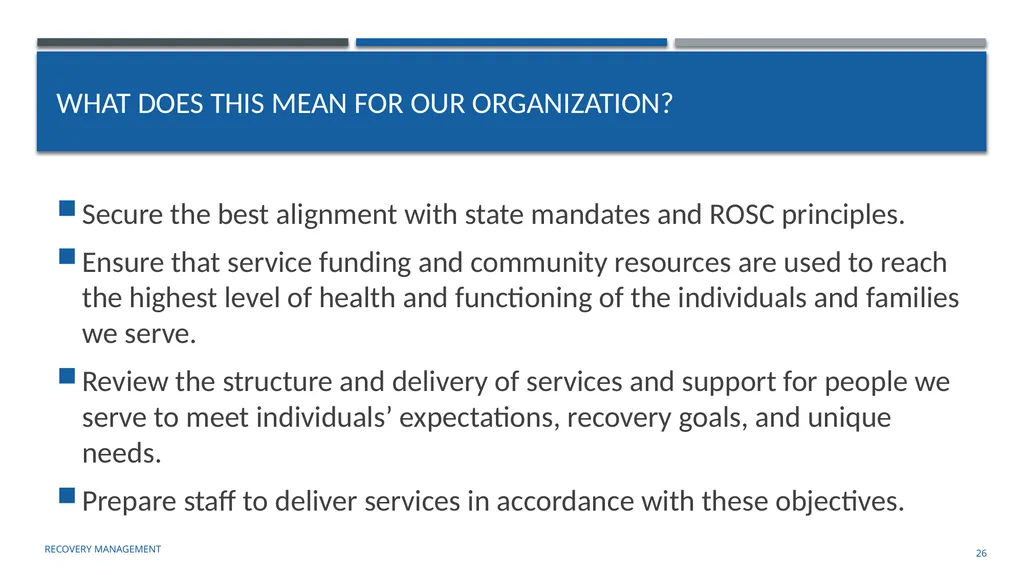
26 Recovery management Secure the best alignment with state mandates and ROSC principles.
Ensure that service funding and community resources are used to reach the highest level of health and functioning of the individuals and families we serve.
Review the structure and delivery of services and support for people we serve to meet individuals’ expectations, recovery goals, and unique needs.
Prepare staff to deliver services in accordance with these objectives. What does this mean for our organization?<br>
Ensure that service funding and community resources are used to reach the highest level of health and functioning of the individuals and families we serve.
Review the structure and delivery of services and support for people we serve to meet individuals’ expectations, recovery goals, and unique needs.
Prepare staff to deliver services in accordance with these objectives. What does this mean for our organization?<br>
27
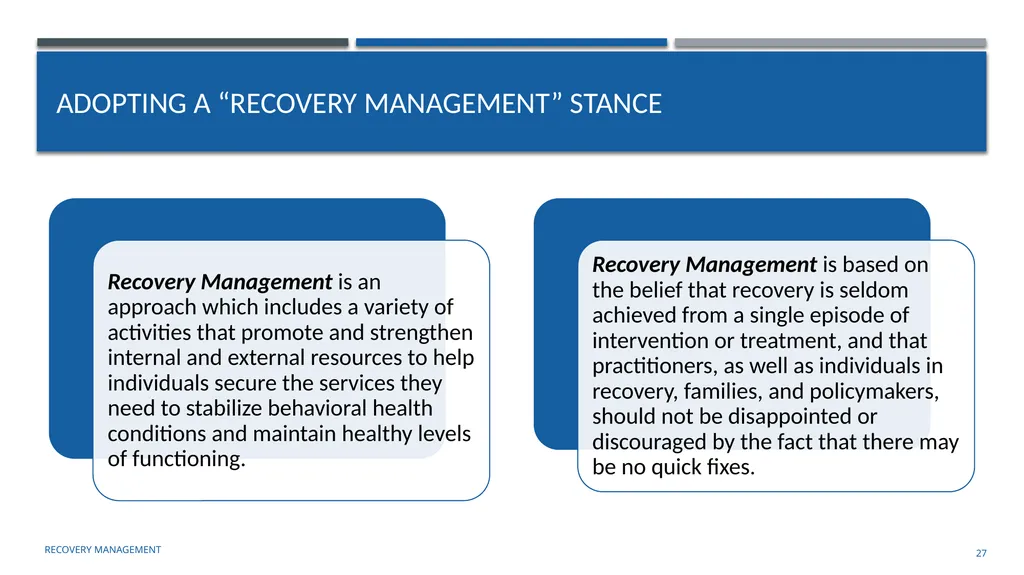
27 Recovery management Adopting a “recovery management” stance<br>
28
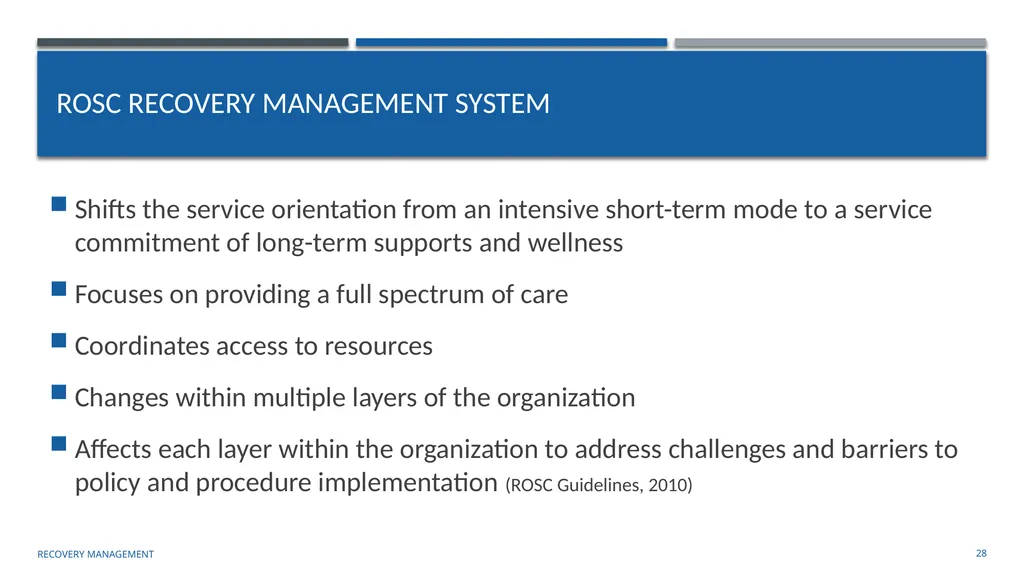
28 Recovery management Shifts the service orientation from an intensive short-term mode to a service commitment of long-term supports and wellness
Focuses on providing a full spectrum of care
Coordinates access to resources
Changes within multiple layers of the organization
Affects each layer within the organization to address challenges and barriers to policy and procedure implementation (ROSC Guidelines, 2010) Rosc recovery management system<br>
Focuses on providing a full spectrum of care
Coordinates access to resources
Changes within multiple layers of the organization
Affects each layer within the organization to address challenges and barriers to policy and procedure implementation (ROSC Guidelines, 2010) Rosc recovery management system<br>
29
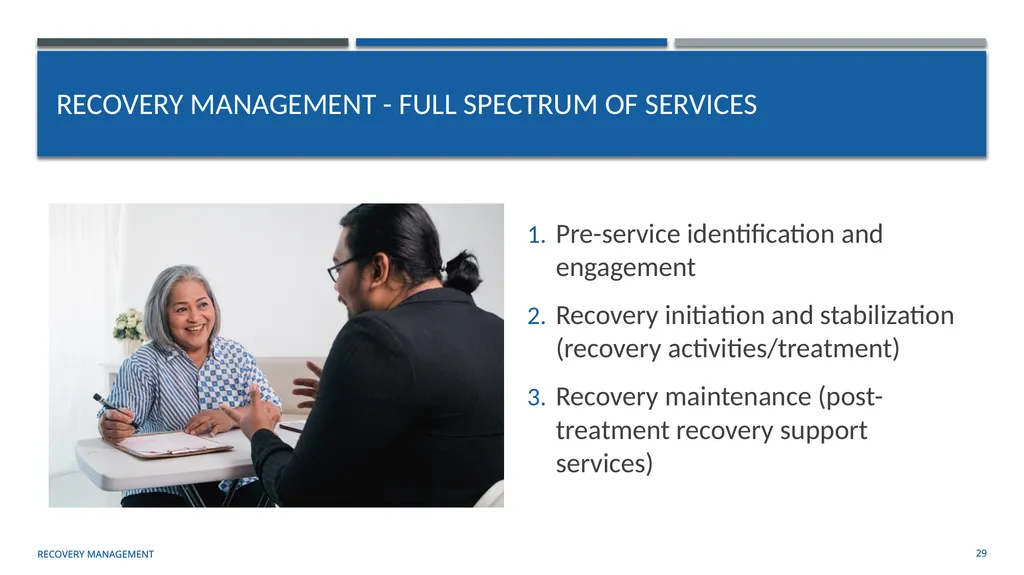
29 Recovery management 29 Recovery management Recovery management - full spectrum of services Pre-service identification and engagement
Recovery initiation and stabilization (recovery activities/treatment)
Recovery maintenance (post-treatment recovery support services)<br>
Recovery initiation and stabilization (recovery activities/treatment)
Recovery maintenance (post-treatment recovery support services)<br>
30
Application to
practice Recovery Orientation Recovery management 30<br>
31
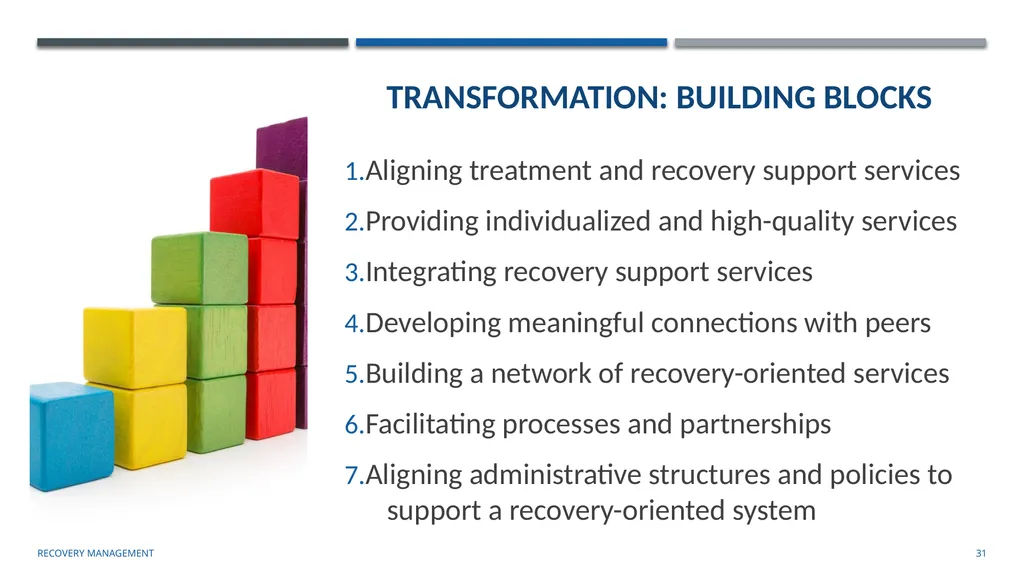
Transformation: Building blocks 31 Aligning treatment and recovery support services
Providing individualized and high-quality services
Integrating recovery support services
Developing meaningful connections with peers
Building a network of recovery-oriented services
Facilitating processes and partnerships
Aligning administrative structures and policies to support a recovery-oriented system Recovery management<br>
Providing individualized and high-quality services
Integrating recovery support services
Developing meaningful connections with peers
Building a network of recovery-oriented services
Facilitating processes and partnerships
Aligning administrative structures and policies to support a recovery-oriented system Recovery management<br>
32
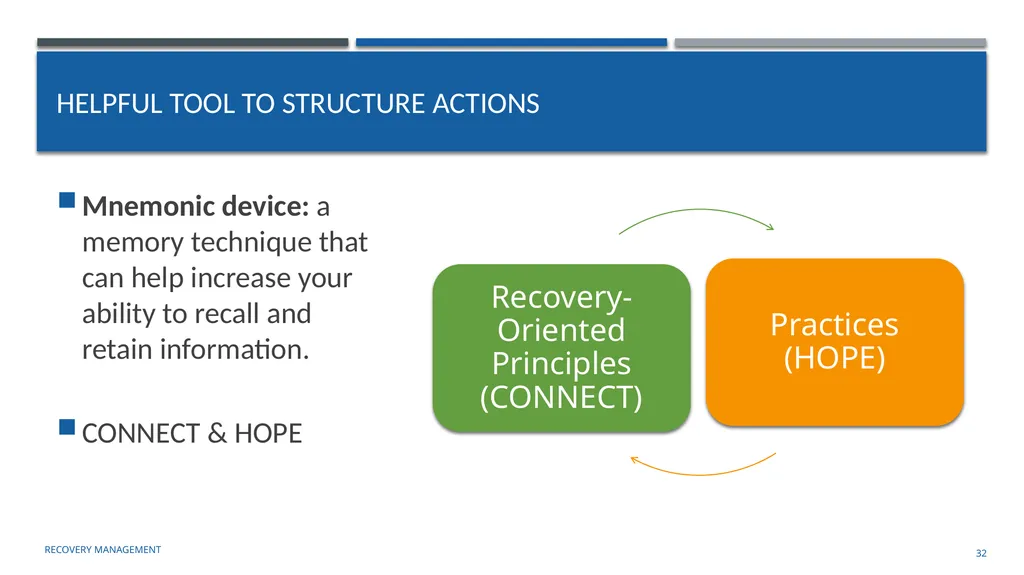
32 Recovery management Helpful tool to structure actions Mnemonic device: a memory technique that can help increase your ability to recall and retain information.
CONNECT & HOPE<br>
CONNECT & HOPE<br>
33
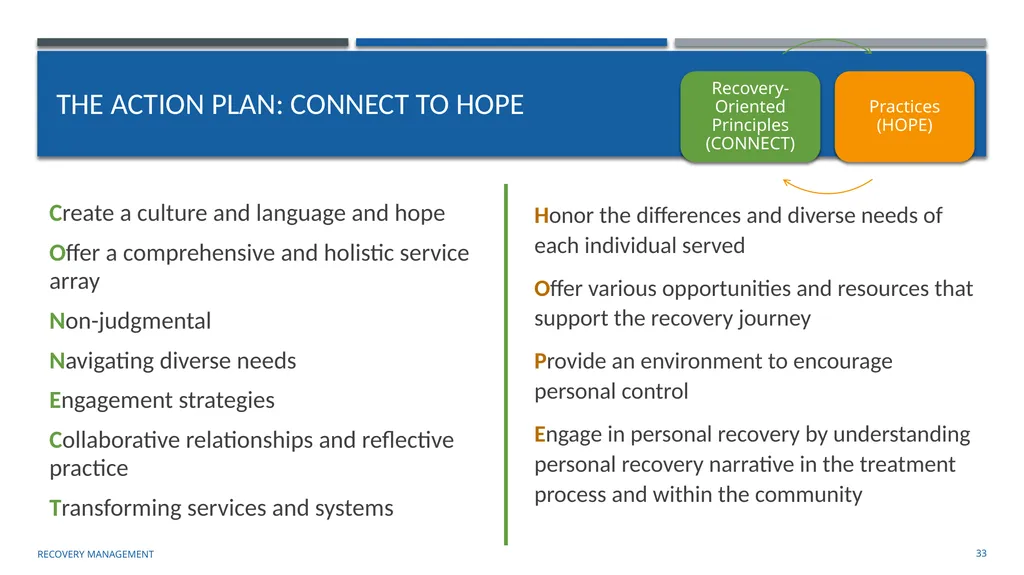
33 Recovery management The Action plan: Connect To Hope Create a culture and language and hope
Offer a comprehensive and holistic service array
Non-judgmental
Navigating diverse needs
Engagement strategies
Collaborative relationships and reflective practice
Transforming services and systems Honor the differences and diverse needs of each individual served
Offer various opportunities and resources that support the recovery journey
Provide an environment to encourage personal control
Engage in personal recovery by understanding personal recovery narrative in the treatment process and within the community<br>
Offer a comprehensive and holistic service array
Non-judgmental
Navigating diverse needs
Engagement strategies
Collaborative relationships and reflective practice
Transforming services and systems Honor the differences and diverse needs of each individual served
Offer various opportunities and resources that support the recovery journey
Provide an environment to encourage personal control
Engage in personal recovery by understanding personal recovery narrative in the treatment process and within the community<br>
34
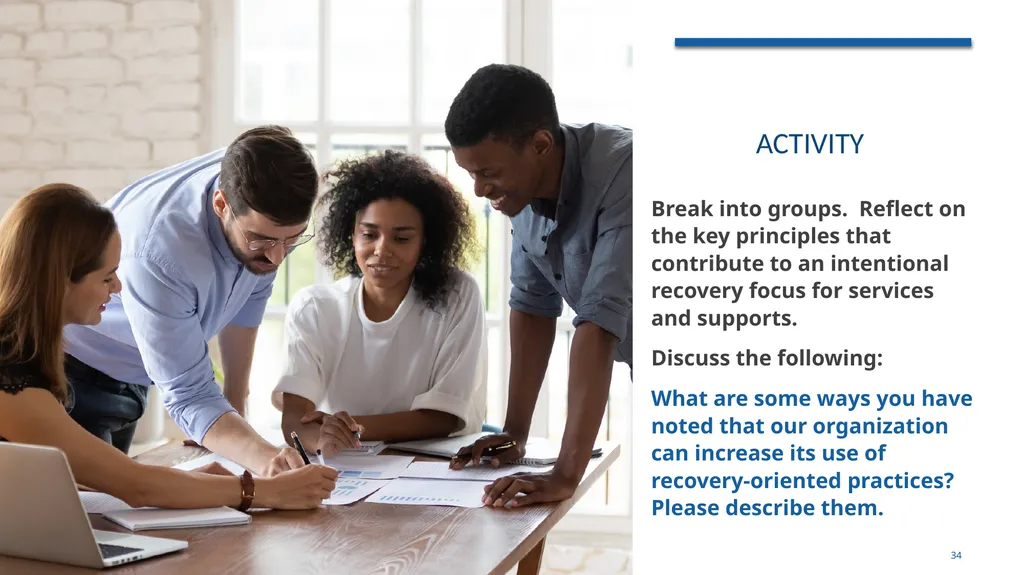
Activity Break into groups. Reflect on the key principles that contribute to an intentional recovery focus for services and supports.
Discuss the following:
What are some ways you have noted that our organization can increase its use of recovery-oriented practices? Please describe them. Recovery management 34<br>
Discuss the following:
What are some ways you have noted that our organization can increase its use of recovery-oriented practices? Please describe them. Recovery management 34<br>
35
Questions for
Reflection Recovery Orientation Recovery management 35<br>
36
Reflective practice Please reflect on the following questions and write down your responses.
Direct Service provider: What impact does an intentional recovery focus have on your day-to-day work? How do you model “hope” and create a climate of optimism/encourage positive outcomes with the people you serve?
Management: Consider the transformation process towards a Recovery-Oriented System. What are your strengths? What do you want to work on first within the framework? What are your challenges and barriers?
Administrative (to include support staff): How welcoming are you when someone in need of help calls or comes through our door? Do you practice patience for a lost individual? How can you be an extension of the ROSC framework? Recovery management 36<br>
Direct Service provider: What impact does an intentional recovery focus have on your day-to-day work? How do you model “hope” and create a climate of optimism/encourage positive outcomes with the people you serve?
Management: Consider the transformation process towards a Recovery-Oriented System. What are your strengths? What do you want to work on first within the framework? What are your challenges and barriers?
Administrative (to include support staff): How welcoming are you when someone in need of help calls or comes through our door? Do you practice patience for a lost individual? How can you be an extension of the ROSC framework? Recovery management 36<br>
37
37 Recovery management references Davidson, L., O’Connel, M.J., Staeheli, M., Weingarten, R., et al. (2001). Concepts of recovery in behavioral health: History, review of the evidence, and critique. Psychiatric Services, 52(4), 482-5.
Florida Department of Children and Families. Recovery-Oriented System of Care (website). https://www.myflfamilies.com/service-programs/samh/rosc/index.shtml
Hyde, P. (2011). Shaping the Future: Challenges and Opportunities (conference presentation). Washington, DC: SAMHSA.
Jaiswal. A., Carmichael, K., Gupta, S., Siemens, T., et al (2020). Essential elements that contribute to the recovery of persons with severe mental illness: A systematic scoping study. Frontiers in Psychiatry (11). Retrieved from https://www.frontiersin.org/article/10.3389/fpsyt.2020.586230
Mental Health Commission of Canada. (2015). Recovery Guidelines. Ottawa, ON: Author. https://www.mentalhealthcommission.ca/wp-content/uploads/drupal/MHCC_RecoveryGuidelines_ENG_0.pdf
New Freedom Commission on Mental Health (2003). Achieving the Promise: Transforming Mental Health Care in America. Final Report. DHHS Pub. No. SMA-03-3832. Rockville, MD.<br>
Florida Department of Children and Families. Recovery-Oriented System of Care (website). https://www.myflfamilies.com/service-programs/samh/rosc/index.shtml
Hyde, P. (2011). Shaping the Future: Challenges and Opportunities (conference presentation). Washington, DC: SAMHSA.
Jaiswal. A., Carmichael, K., Gupta, S., Siemens, T., et al (2020). Essential elements that contribute to the recovery of persons with severe mental illness: A systematic scoping study. Frontiers in Psychiatry (11). Retrieved from https://www.frontiersin.org/article/10.3389/fpsyt.2020.586230
Mental Health Commission of Canada. (2015). Recovery Guidelines. Ottawa, ON: Author. https://www.mentalhealthcommission.ca/wp-content/uploads/drupal/MHCC_RecoveryGuidelines_ENG_0.pdf
New Freedom Commission on Mental Health (2003). Achieving the Promise: Transforming Mental Health Care in America. Final Report. DHHS Pub. No. SMA-03-3832. Rockville, MD.<br>
38
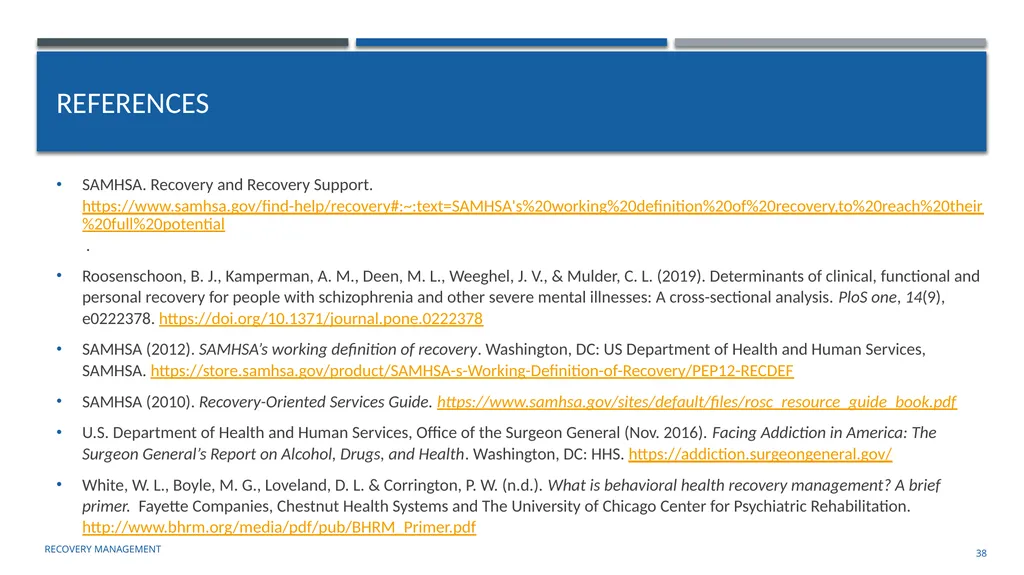
38 Recovery management references SAMHSA. Recovery and Recovery Support. https://www.samhsa.gov/find-help/recovery#:~:text=SAMHSA's%20working%20definition%20of%20recovery,to%20reach%20their%20full%20potential .
Roosenschoon, B. J., Kamperman, A. M., Deen, M. L., Weeghel, J. V., & Mulder, C. L. (2019). Determinants of clinical, functional and personal recovery for people with schizophrenia and other severe mental illnesses: A cross-sectional analysis. PloS one, 14(9), e0222378. https://doi.org/10.1371/journal.pone.0222378
SAMHSA (2012). SAMHSA’s working definition of recovery. Washington, DC: US Department of Health and Human Services, SAMHSA. https://store.samhsa.gov/product/SAMHSA-s-Working-Definition-of-Recovery/PEP12-RECDEF
SAMHSA (2010). Recovery-Oriented Services Guide. https://www.samhsa.gov/sites/default/files/rosc_resource_guide_book.pdf
U.S. Department of Health and Human Services, Office of the Surgeon General (Nov. 2016). Facing Addiction in America: The Surgeon General’s Report on Alcohol, Drugs, and Health. Washington, DC: HHS. https://addiction.surgeongeneral.gov/
White, W. L., Boyle, M. G., Loveland, D. L. & Corrington, P. W. (n.d.). What is behavioral health recovery management? A brief primer. Fayette Companies, Chestnut Health Systems and The University of Chicago Center for Psychiatric Rehabilitation. http://www.bhrm.org/media/pdf/pub/BHRM_Primer.pdf<br>
Roosenschoon, B. J., Kamperman, A. M., Deen, M. L., Weeghel, J. V., & Mulder, C. L. (2019). Determinants of clinical, functional and personal recovery for people with schizophrenia and other severe mental illnesses: A cross-sectional analysis. PloS one, 14(9), e0222378. https://doi.org/10.1371/journal.pone.0222378
SAMHSA (2012). SAMHSA’s working definition of recovery. Washington, DC: US Department of Health and Human Services, SAMHSA. https://store.samhsa.gov/product/SAMHSA-s-Working-Definition-of-Recovery/PEP12-RECDEF
SAMHSA (2010). Recovery-Oriented Services Guide. https://www.samhsa.gov/sites/default/files/rosc_resource_guide_book.pdf
U.S. Department of Health and Human Services, Office of the Surgeon General (Nov. 2016). Facing Addiction in America: The Surgeon General’s Report on Alcohol, Drugs, and Health. Washington, DC: HHS. https://addiction.surgeongeneral.gov/
White, W. L., Boyle, M. G., Loveland, D. L. & Corrington, P. W. (n.d.). What is behavioral health recovery management? A brief primer. Fayette Companies, Chestnut Health Systems and The University of Chicago Center for Psychiatric Rehabilitation. http://www.bhrm.org/media/pdf/pub/BHRM_Primer.pdf<br>
39
THANK YOU! Questions?<br>