
Building Bridges to End GBV & Increase Young
CB
Published · 39 slides · 0 views

1 / 1
Description
Building Bridges to End GBV Increase Young Peoples Access to SRH Information Services By Oby Nwankwo Executive Director CIRDDOC Nigeria Expert: UN CEDAW Committee Introduction The project is implemented by CIRDDOC in collaboration with
Related Topics
Share
Embed code
Download this presentation From Below
"Building Bridges to End GBV & Increase Young" is the property of its rightful owner. Permission is granted to download and print the materials on this website for personal, non-commercial use only, and to display it on your personal computer provided you do not modify the materials and that you retain all copyright notices contained in the materials. By downloading content from our website, you accept the terms of this agreement.
Presentation Transcript
01
Building Bridges to End GBV & Increase Young People’s Access to SRH Information & Services By
Oby Nwankwo
Executive Director CIRDDOC Nigeria
Expert: UN CEDAW Committee<br>
Oby Nwankwo
Executive Director CIRDDOC Nigeria
Expert: UN CEDAW Committee<br>
02
Introduction The project is implemented by CIRDDOC in collaboration with Coalition of Eastern NGOs (CENGOs) – Umbrella organization of over 100 NGOs.
CENGOS is present in 9 states of the former Eastern Region
Project location – 6 states (Anambra, Enugu, Imo, Rivers, Cross River, Ebonyi).
Managed by the State Coordinators and their team.<br>
CENGOS is present in 9 states of the former Eastern Region
Project location – 6 states (Anambra, Enugu, Imo, Rivers, Cross River, Ebonyi).
Managed by the State Coordinators and their team.<br>
03
Thematic areas of Amplify Change CIRDDOC is working towards Gender-Based Violence
Access to comprehensive reproductive health services
Sexual health of young people and girls<br>
Access to comprehensive reproductive health services
Sexual health of young people and girls<br>
04
Over all Objectives To build a movement to end GBV and promote SRHR,
To create an enabling environment for marginalized groups to access quality reproductive health information & services,
To increase young people’s awareness on GBV & SRHR through opening greater space for discussion of often silenced issues of sexuality and reproduction,
To build capacity of CSOs to develop skills to advance the SRHR agenda.<br>
To create an enabling environment for marginalized groups to access quality reproductive health information & services,
To increase young people’s awareness on GBV & SRHR through opening greater space for discussion of often silenced issues of sexuality and reproduction,
To build capacity of CSOs to develop skills to advance the SRHR agenda.<br>
05
Problems or Challenges the project seeks to overcome Violence against women and girls.
Longstanding social & cultural norms that reinforce acceptability of GBV in society.
Rape including marital rape which creates a risk of trauma and could lead to unwanted pregnancy and/or HIV/AIDS.<br>
Longstanding social & cultural norms that reinforce acceptability of GBV in society.
Rape including marital rape which creates a risk of trauma and could lead to unwanted pregnancy and/or HIV/AIDS.<br>
06
Problems & Challenges Limited capacity of women and girls to negotiate the terms & conditions of sex.
High maternal & child mortality & morbidity ratios resulting from some of these factors.
Harmful practices such as FGM, Early/child marriage which may have severe and debilitating SHR consequences.<br>
High maternal & child mortality & morbidity ratios resulting from some of these factors.
Harmful practices such as FGM, Early/child marriage which may have severe and debilitating SHR consequences.<br>
07
Problems and Challenges Customs, religion and tradition which exclude young people from access to reproductive health information and services.
High rate of ignorance on SRHR - the general belief that exposing young girls to sexuality education encourages them to engage in sexual relations early in life.
Unwanted pregnancies resulting to risky & unsafe abortions.
Limited capacity of NGOs in SRHRs.
Culture of silence on GBV and SRHR.<br>
High rate of ignorance on SRHR - the general belief that exposing young girls to sexuality education encourages them to engage in sexual relations early in life.
Unwanted pregnancies resulting to risky & unsafe abortions.
Limited capacity of NGOs in SRHRs.
Culture of silence on GBV and SRHR.<br>
08
Four Areas for Action of the
Network Grant Capacity Building
Evidence Gathering
Communications
Networking<br>
Evidence Gathering
Communications
Networking<br>
09
Capacity Building Capacity building workshops for NGOs to:
increase their knowledge of GBV and SRHR.
enhance their advocacy skills to hold government accountable on their commitments to gender equality, SRHR, social inclusion and freedom from violence.
promote capable leaders, sound admin and financial management, and strong governance.
A strong capacity base, to engage policy makers on implementation of SRHRs policies and laws & increased budgetary allocation.
Technical support to recipients of AmplifyChange Strengthening and Innovation grants.<br>
increase their knowledge of GBV and SRHR.
enhance their advocacy skills to hold government accountable on their commitments to gender equality, SRHR, social inclusion and freedom from violence.
promote capable leaders, sound admin and financial management, and strong governance.
A strong capacity base, to engage policy makers on implementation of SRHRs policies and laws & increased budgetary allocation.
Technical support to recipients of AmplifyChange Strengthening and Innovation grants.<br>
10
Evidence Gathering Young people and women trained as researchers and Budget Monitors and trackers.
Field work to gather evidence on the status of SRHR in the communities – quality of services provided by health centres.
Field work to monitor Ministry of Health budget– allocation, disbursements & implementation.
Youth hotline and social media outlets as data collection platforms for urban youth to share their stories, dispel myths and discuss issues affecting their sexual health.
Mapping of existing laws on GBV and Reproductive health and Rights<br>
Field work to gather evidence on the status of SRHR in the communities – quality of services provided by health centres.
Field work to monitor Ministry of Health budget– allocation, disbursements & implementation.
Youth hotline and social media outlets as data collection platforms for urban youth to share their stories, dispel myths and discuss issues affecting their sexual health.
Mapping of existing laws on GBV and Reproductive health and Rights<br>
11
Use of Evidence Gathered To identify the gap between government commitments to laws and policies with actual realities on the ground.
To publish a policy brief to be presented at state level policy dialogues aimed at amending policies to become oriented towards the needs of marginalized women & young people,
To generate an increase in the local level demand for improved health governance and service provision.
To feed into the development of advocacy messages for more allocation to Health – minimum of 15% (Abuja declaration).
Publication of existing laws with Guidelines in a simplified form<br>
To publish a policy brief to be presented at state level policy dialogues aimed at amending policies to become oriented towards the needs of marginalized women & young people,
To generate an increase in the local level demand for improved health governance and service provision.
To feed into the development of advocacy messages for more allocation to Health – minimum of 15% (Abuja declaration).
Publication of existing laws with Guidelines in a simplified form<br>
12
Advocacy campaign Advocacy visits to Houses of Assembly
Advocacy Visits to Traditional Rulers
Advocacy visits to Ministry of Health (on Budget)
Monitoring visits to Health centres on quality of services<br>
Advocacy Visits to Traditional Rulers
Advocacy visits to Ministry of Health (on Budget)
Monitoring visits to Health centres on quality of services<br>
13
Communications Communication platforms for the promotion of SRHR and condemnation of GBV are created.
Recognizing traditional leaders’ enormous influence over cultural practices, they will be targeted as one platform for transformation into public opponents of adolescent pregnancy & GBV.
A platform of several multichannel communication components - TV, radio dramas in the mass media…, & the social mobilization component will be created for positive change in broader community attitudes & behaviors to reduce adolescent pregnancy and GBV will be achieved.
1 million youth voices in support of SRHR will be collected through an online platform, essay competition, public dialogues, and interviews.<br>
Recognizing traditional leaders’ enormous influence over cultural practices, they will be targeted as one platform for transformation into public opponents of adolescent pregnancy & GBV.
A platform of several multichannel communication components - TV, radio dramas in the mass media…, & the social mobilization component will be created for positive change in broader community attitudes & behaviors to reduce adolescent pregnancy and GBV will be achieved.
1 million youth voices in support of SRHR will be collected through an online platform, essay competition, public dialogues, and interviews.<br>
14
Communications 2 Existing youth organizations constitute a Platform for public dialogues/debate that allow individuals and communities to challenge existing social norms and cultural practices that prevent them from fully exercising their SRHR.
Print and electronic media involved in the capacity building so that reporting on SRHR matters will be from an informed position.
Policy briefs will be published – for Speakers of 9 Parliaments & policy makers for increased funding for SRHR education & services.<br>
Print and electronic media involved in the capacity building so that reporting on SRHR matters will be from an informed position.
Policy briefs will be published – for Speakers of 9 Parliaments & policy makers for increased funding for SRHR education & services.<br>
15
Communication 3 - Activities Step It Up (SIU) Campaign - rallies, public meetings, solemn processions, vigils, etc. simultaneously in 6 states.
Design and Production of IEC Materials - T Shirts, Jingles
Airing of the jingles
Airing of Nollywood TV Drama series on GBV
Half-yearly Newsletter
2- Day Training workshop for Traditional Rulers on SRHR and SGBV
On line Essay Competition - Call for entries, shortlisting, Prizes
Hotline & Social Media Outlet<br>
Design and Production of IEC Materials - T Shirts, Jingles
Airing of the jingles
Airing of Nollywood TV Drama series on GBV
Half-yearly Newsletter
2- Day Training workshop for Traditional Rulers on SRHR and SGBV
On line Essay Competition - Call for entries, shortlisting, Prizes
Hotline & Social Media Outlet<br>
16
Networking Strengthening of CENGOS and mobilizing new actors within it for SRHR work.
A shared context on SRHR & GBV for members to exchange information & personal experiences in a way that builds understanding & insight.
For smaller NGOs, a platform for them to learn about SRHR & GBV.
For those already engaged in SRHR & GBV projects, to improve their practice by providing a forum to identify solutions to common problems & a process to collect & evaluate best practices.
New knowledge is generated to help people transform their practice to accommodate changes.<br>
A shared context on SRHR & GBV for members to exchange information & personal experiences in a way that builds understanding & insight.
For smaller NGOs, a platform for them to learn about SRHR & GBV.
For those already engaged in SRHR & GBV projects, to improve their practice by providing a forum to identify solutions to common problems & a process to collect & evaluate best practices.
New knowledge is generated to help people transform their practice to accommodate changes.<br>
17
Networking activities Quarterly meetings of the Coordinating Committee.
Training workshop on GBV & SRHR for coalition members to increase the pool of actors in the field of SRHR and GBV.
Quarterly Newsletter in place to encourage free flow of ideas.
Online interactive platform/ public dialogue/debate with youth CSOs
Forum of CENGOS members and Board<br>
Training workshop on GBV & SRHR for coalition members to increase the pool of actors in the field of SRHR and GBV.
Quarterly Newsletter in place to encourage free flow of ideas.
Online interactive platform/ public dialogue/debate with youth CSOs
Forum of CENGOS members and Board<br>
18
Other activities Capturing Lessons learnt through journal entries, categorized by project knowledge areas
procurement management,
risk management,
quality management,
time management,
cost management,
human resource management, and
communications management.
Compilation & Publication of Lessons Learnt Document to provide value for future use<br>
procurement management,
risk management,
quality management,
time management,
cost management,
human resource management, and
communications management.
Compilation & Publication of Lessons Learnt Document to provide value for future use<br>
19
Other Activities State level policy dialogues in all 6 states to present findings and advocate for improvement on budgetary allocation and services.
Monitoring & Evaluation, Periodic Reporting – half yearly.
Project closure narrative and financial reporting.<br>
Monitoring & Evaluation, Periodic Reporting – half yearly.
Project closure narrative and financial reporting.<br>
20
Anticipated Changes that the Project will achieve SRHR movement in place comprising NGOs with skills and tools to advance the SRHR agenda.
Increased awareness on GBV, SRHR issues, and HTPs.
Enhanced awareness of & use of existing laws to advocate for HTPs abolition.
Public denunciation of HTPs & teenage pregnancy by traditional institutions.
Increased demand and access of young people for contraceptives, information and services.
More young people advocating for their SRHR.
More CSOs advocating for an end to GBV & the effective implementation of the Comprehensive Sexuality Education policy.
Empowered women & girls through access to GBV & SRHR information.<br>
Increased awareness on GBV, SRHR issues, and HTPs.
Enhanced awareness of & use of existing laws to advocate for HTPs abolition.
Public denunciation of HTPs & teenage pregnancy by traditional institutions.
Increased demand and access of young people for contraceptives, information and services.
More young people advocating for their SRHR.
More CSOs advocating for an end to GBV & the effective implementation of the Comprehensive Sexuality Education policy.
Empowered women & girls through access to GBV & SRHR information.<br>
21
AmplifyChange strategic Outcomes Movement Building
Increased Individual Awareness of SRHR as Human Rights
Access to reproductive health resources, information and service
Transform Social Norms
Change Policies & Laws<br>
Increased Individual Awareness of SRHR as Human Rights
Access to reproductive health resources, information and service
Transform Social Norms
Change Policies & Laws<br>
22
Movement Building Building, maintaining partnerships, & giving technical support to partners.
Exchange of information, skills development to advance the SRHR agenda, deepening knowledge, popularizing activism on SRHR.
Mobilize youth and women led NGOs & others to promote a rights-based approach to SRHR.<br>
Exchange of information, skills development to advance the SRHR agenda, deepening knowledge, popularizing activism on SRHR.
Mobilize youth and women led NGOs & others to promote a rights-based approach to SRHR.<br>
23
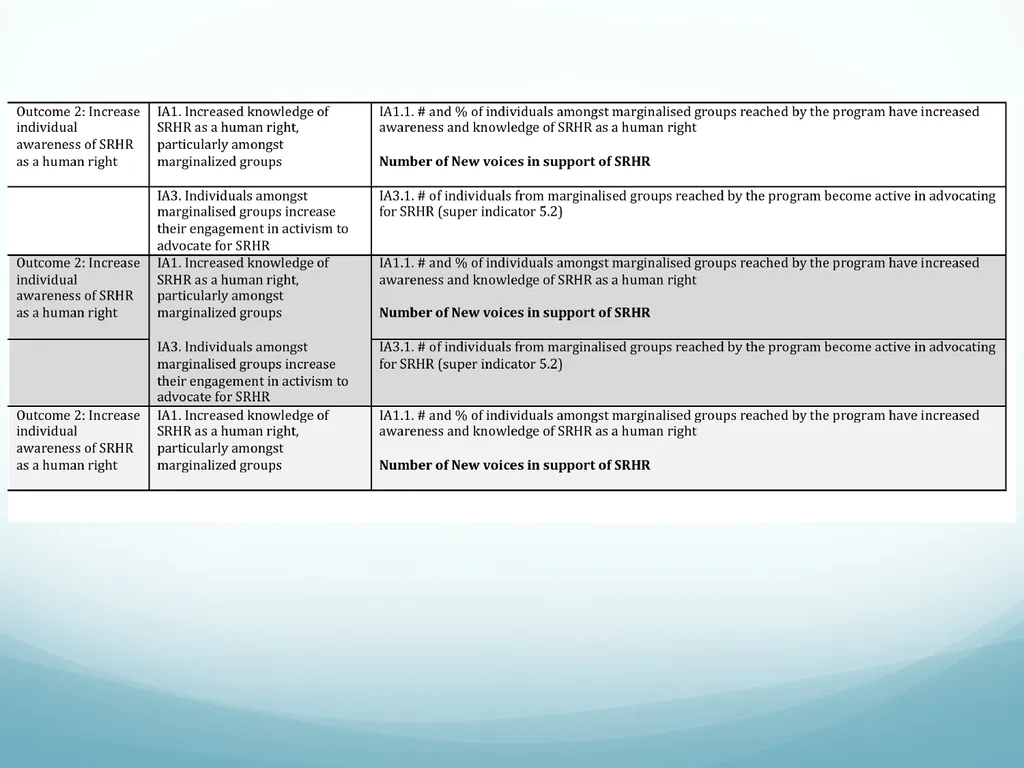
Increased individual awareness and agency Create awareness on SRHR and freedom from violence as human rights.
Open greater space for discussion of the often silenced issues of sexuality & reproduction,
Provide virtual & physical platforms for exchange of ideas by young people.
Highlight gap between government commitments to international laws & policies with actual realities on ground.
Expand the no of women & young people who know their SRHRs and understand GBV, & have access to effective means of redress when rights are violated.
Access to high-quality information & services women need to improve their SRHR, experience safe pregnancy & childbirth, avoid unwanted pregnancy and be free from violence.<br>
Open greater space for discussion of the often silenced issues of sexuality & reproduction,
Provide virtual & physical platforms for exchange of ideas by young people.
Highlight gap between government commitments to international laws & policies with actual realities on ground.
Expand the no of women & young people who know their SRHRs and understand GBV, & have access to effective means of redress when rights are violated.
Access to high-quality information & services women need to improve their SRHR, experience safe pregnancy & childbirth, avoid unwanted pregnancy and be free from violence.<br>
24
Change social norms Address the culture of silence arising from shame and embarrassment that trail public discussion of sexuality related issues.
Address young people’s vulnerability to coercion, abuse, exploitation, unintended pregnancy etc. as a result.
Address the way society thinks about women's body and sexuality.<br>
Address young people’s vulnerability to coercion, abuse, exploitation, unintended pregnancy etc. as a result.
Address the way society thinks about women's body and sexuality.<br>
25
Change Social Norms 2 Traditional rulers will denounce the social norms that have adverse effects on SRHRs of women and young girls and constitute GBV.
GBV will be presented as barbaric and unacceptable.
A combination of social taboos, religious and cultural beliefs make access to sexuality education and services for young people difficult.
Religious and cultural institutions believe that exposing young people to sexuality education will lead to early sexual relations and promiscuity.
Religious and cultural institutions & service providers are being targeted to change these norms and policies through awareness raising and education.<br>
GBV will be presented as barbaric and unacceptable.
A combination of social taboos, religious and cultural beliefs make access to sexuality education and services for young people difficult.
Religious and cultural institutions believe that exposing young people to sexuality education will lead to early sexual relations and promiscuity.
Religious and cultural institutions & service providers are being targeted to change these norms and policies through awareness raising and education.<br>
26
Changes policies and laws Change is anticipated in the following areas:
Girls who get pregnant in schools are expelled without an option to return – unwritten policy.
Limited or no access of young persons to SRHR services by service providers.<br>
Girls who get pregnant in schools are expelled without an option to return – unwritten policy.
Limited or no access of young persons to SRHR services by service providers.<br>
27
Amplify Change Strategic/Key Targets Survivors of violence, Persons With Disabilities, including the Youth within the following categories:
Indigenous Groups/Rural women and men
People living with HIV and AIDS
Survivors of violence<br>
Indigenous Groups/Rural women and men
People living with HIV and AIDS
Survivors of violence<br>
28
Numbers intended to reach People living with HIV and AIDS - 90
Indigenous Groups - 90
Survivors of violence – 90
Indirectly
Number of People: 12,000,000<br>
Indigenous Groups - 90
Survivors of violence – 90
Indirectly
Number of People: 12,000,000<br>
29
How success will be measured Using a checklist for each project activity to ensure the delivery of project outcomes within the envisaged timeframe.
Combined M&E team use a logical framework that guides project implementation.
Mid- term and end of project evaluation exercises carried out by the joint team.
Self evaluation forms used for workshops.
Attention will be paid on the fit between budget & budget implementation.<br>
Combined M&E team use a logical framework that guides project implementation.
Mid- term and end of project evaluation exercises carried out by the joint team.
Self evaluation forms used for workshops.
Attention will be paid on the fit between budget & budget implementation.<br>
30
How success will be measured 2 Reports of the activities, media coverage, pictures, audio & video recording to track, analyze, document & share progress, lessons, challenges & failures that may arise.
Qualitative and quantitative methods would be used to track and conduct analysis of impact of our work on our project beneficiaries, NGOs, policies & practices of government & private institutions, and partners mid term and at the end of the project.
Information on outcomes & progress of activities would be utilized to review success & draw lessons that will inform decisions and future plans.<br>
Qualitative and quantitative methods would be used to track and conduct analysis of impact of our work on our project beneficiaries, NGOs, policies & practices of government & private institutions, and partners mid term and at the end of the project.
Information on outcomes & progress of activities would be utilized to review success & draw lessons that will inform decisions and future plans.<br>
31
How project promotes gender equality Ensures that from the onset membership of all the working teams is gender sensitive.
In the selection of participants and resource persons to all the capacity building programs, gender balance is uppermost in our minds.
In engaging the youth, extra care will be taken to ensure that male youths are also involved in the ICT discussion platforms.
Resource materials for the project will respect gender equality.
Because male involvement in issues of reproductive health and rights is critical for success to be achieved, male led NGOs and reproductive rights NGOs will be involved.<br>
In the selection of participants and resource persons to all the capacity building programs, gender balance is uppermost in our minds.
In engaging the youth, extra care will be taken to ensure that male youths are also involved in the ICT discussion platforms.
Resource materials for the project will respect gender equality.
Because male involvement in issues of reproductive health and rights is critical for success to be achieved, male led NGOs and reproductive rights NGOs will be involved.<br>
32
Risks and Mitigation Strategies Management: As with coalitions, some members may not be team players & may prove difficult to work with.
Fiduciary: Trust issues may arise in the disbursement of funds. Project is implemented through well established teams: Implementation, M& E, Finance, Communications, Dispute Resolution & Procurement teams.
Orientation will clarify issues for such persons & the Dispute Resolution team will handle such issues.
Funds will be managed in line with the approved budget in a transparent manner.
The fit between budget & budget implementation & procurement of materials will be constantly monitored by the M&E team.<br>
Fiduciary: Trust issues may arise in the disbursement of funds. Project is implemented through well established teams: Implementation, M& E, Finance, Communications, Dispute Resolution & Procurement teams.
Orientation will clarify issues for such persons & the Dispute Resolution team will handle such issues.
Funds will be managed in line with the approved budget in a transparent manner.
The fit between budget & budget implementation & procurement of materials will be constantly monitored by the M&E team.<br>
33
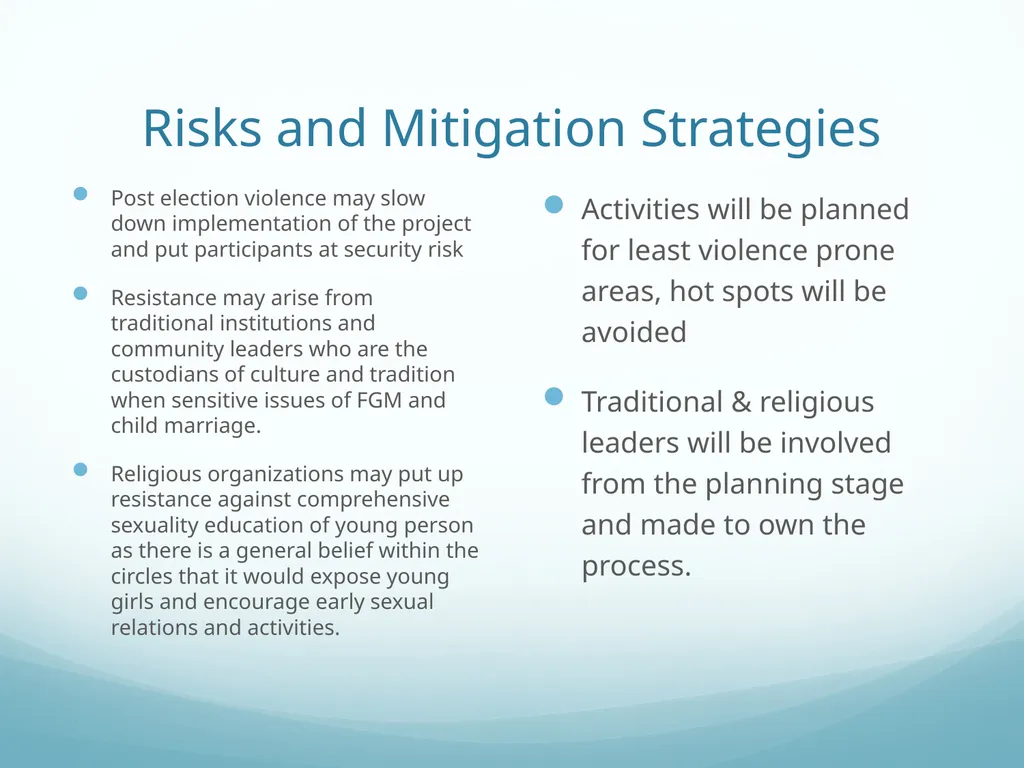
Risks and Mitigation Strategies Post election violence may slow down implementation of the project and put participants at security risk
Resistance may arise from traditional institutions and community leaders who are the custodians of culture and tradition when sensitive issues of FGM and child marriage.
Religious organizations may put up resistance against comprehensive sexuality education of young person as there is a general belief within the circles that it would expose young girls and encourage early sexual relations and activities. Activities will be planned for least violence prone areas, hot spots will be avoided
Traditional & religious leaders will be involved from the planning stage and made to own the process.<br>
Resistance may arise from traditional institutions and community leaders who are the custodians of culture and tradition when sensitive issues of FGM and child marriage.
Religious organizations may put up resistance against comprehensive sexuality education of young person as there is a general belief within the circles that it would expose young girls and encourage early sexual relations and activities. Activities will be planned for least violence prone areas, hot spots will be avoided
Traditional & religious leaders will be involved from the planning stage and made to own the process.<br>
34
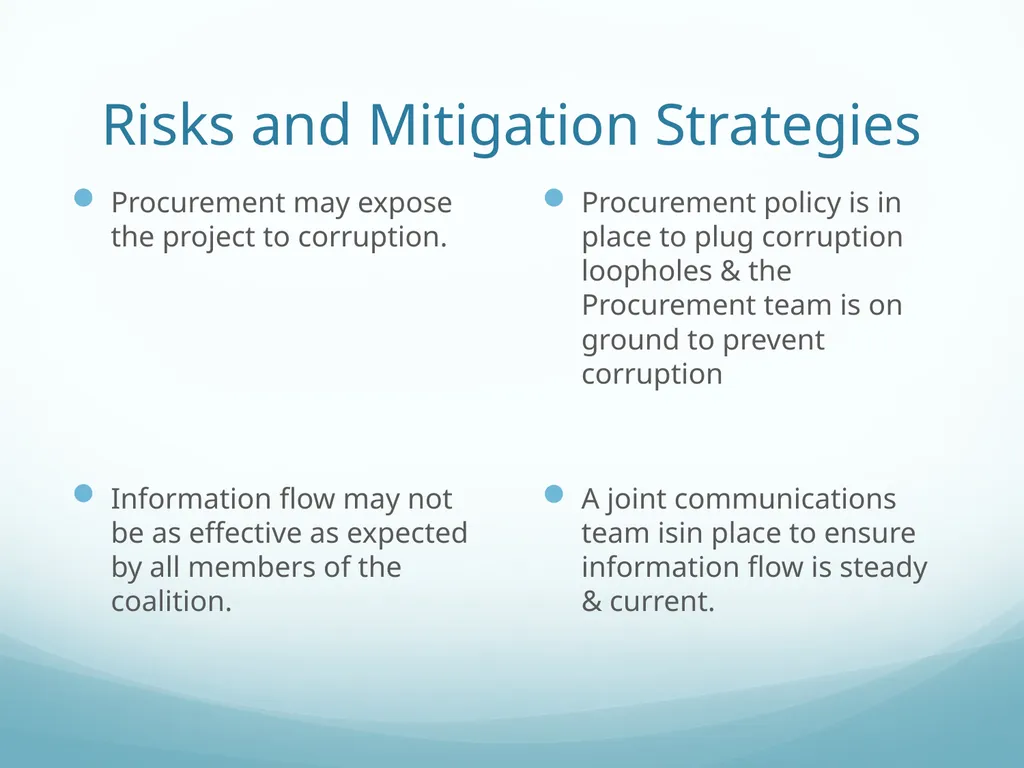
Risks and Mitigation Strategies Procurement may expose the project to corruption.
Information flow may not be as effective as expected by all members of the coalition. Procurement policy is in place to plug corruption loopholes & the Procurement team is on ground to prevent corruption
A joint communications team isin place to ensure information flow is steady & current.<br>
Information flow may not be as effective as expected by all members of the coalition. Procurement policy is in place to plug corruption loopholes & the Procurement team is on ground to prevent corruption
A joint communications team isin place to ensure information flow is steady & current.<br>
35
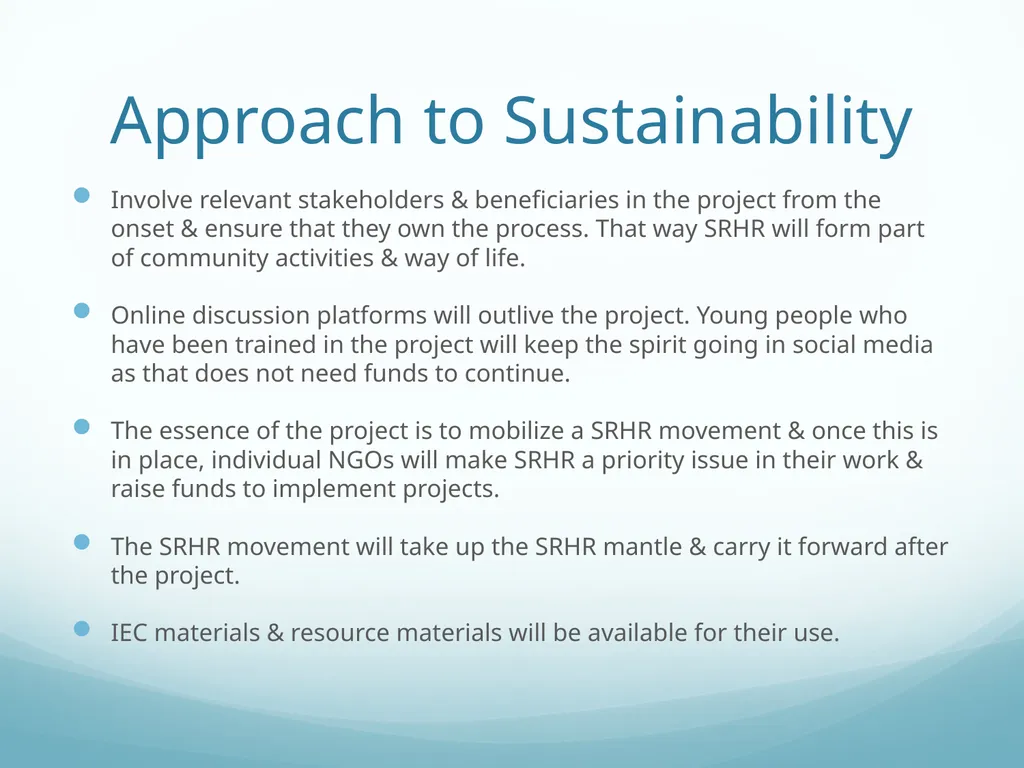
Approach to Sustainability Involve relevant stakeholders & beneficiaries in the project from the onset & ensure that they own the process. That way SRHR will form part of community activities & way of life.
Online discussion platforms will outlive the project. Young people who have been trained in the project will keep the spirit going in social media as that does not need funds to continue.
The essence of the project is to mobilize a SRHR movement & once this is in place, individual NGOs will make SRHR a priority issue in their work & raise funds to implement projects.
The SRHR movement will take up the SRHR mantle & carry it forward after the project.
IEC materials & resource materials will be available for their use.<br>
Online discussion platforms will outlive the project. Young people who have been trained in the project will keep the spirit going in social media as that does not need funds to continue.
The essence of the project is to mobilize a SRHR movement & once this is in place, individual NGOs will make SRHR a priority issue in their work & raise funds to implement projects.
The SRHR movement will take up the SRHR mantle & carry it forward after the project.
IEC materials & resource materials will be available for their use.<br>
36
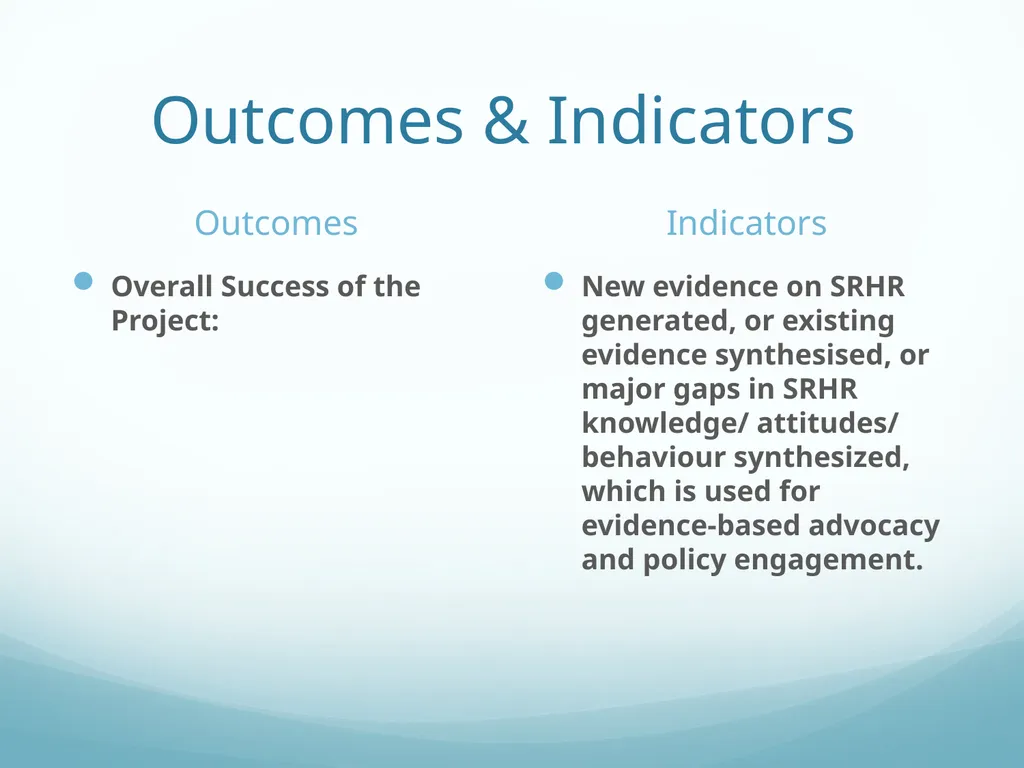
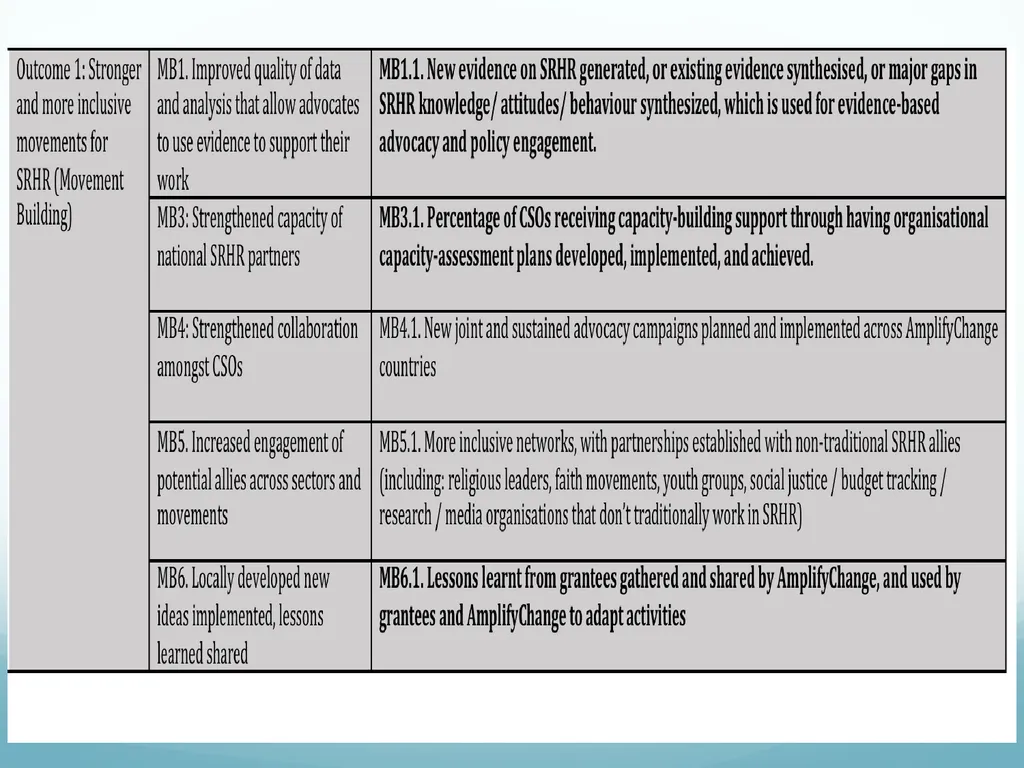
Outcomes & Indicators Outcomes Overall Success of the Project: Indicators New evidence on SRHR generated, or existing evidence synthesised, or major gaps in SRHR knowledge/ attitudes/ behaviour synthesized, which is used for evidence-based advocacy and policy engagement.<br>
37
Thanks for your attention<br>