
‘Building Our Industrial Strategy’ LEP Board
GB
Published · 22 slides · 0 views

1 / 1


Description
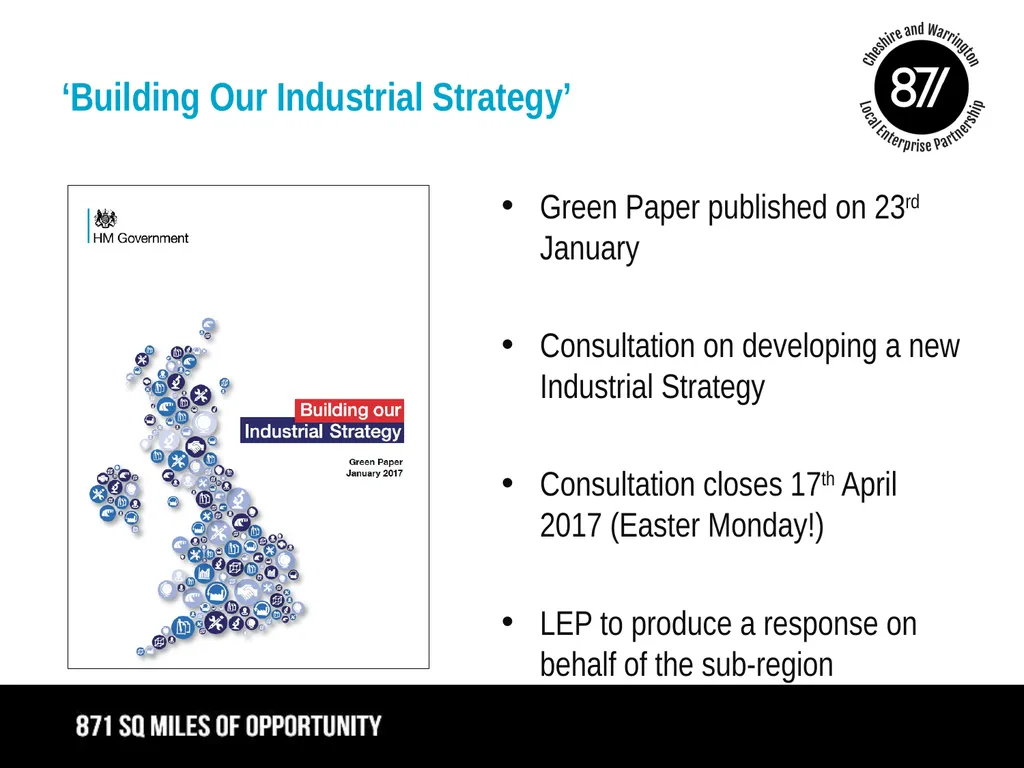
Building Our Industrial Strategy LEP Board Meeting 15th February 2017 Building Our Industrial Strategy Green Paper published on 23rd January Consultation on developing a new Industrial Strategy Consultation closes 17th April 2017
Related Topics
Share
Embed code
Download this presentation From Below
"‘Building Our Industrial Strategy’ LEP Board" is the property of its rightful owner. Permission is granted to download and print the materials on this website for personal, non-commercial use only, and to display it on your personal computer provided you do not modify the materials and that you retain all copyright notices contained in the materials. By downloading content from our website, you accept the terms of this agreement.
Presentation Transcript
01
‘Building Our Industrial Strategy’
LEP Board Meeting
15th February 2017<br>
LEP Board Meeting
15th February 2017<br>
02
‘Building Our Industrial Strategy’ Green Paper published on 23rd January
Consultation on developing a new Industrial Strategy
Consultation closes 17th April 2017 (Easter Monday!)
LEP to produce a response on behalf of the sub-region<br>
Consultation on developing a new Industrial Strategy
Consultation closes 17th April 2017 (Easter Monday!)
LEP to produce a response on behalf of the sub-region<br>
03
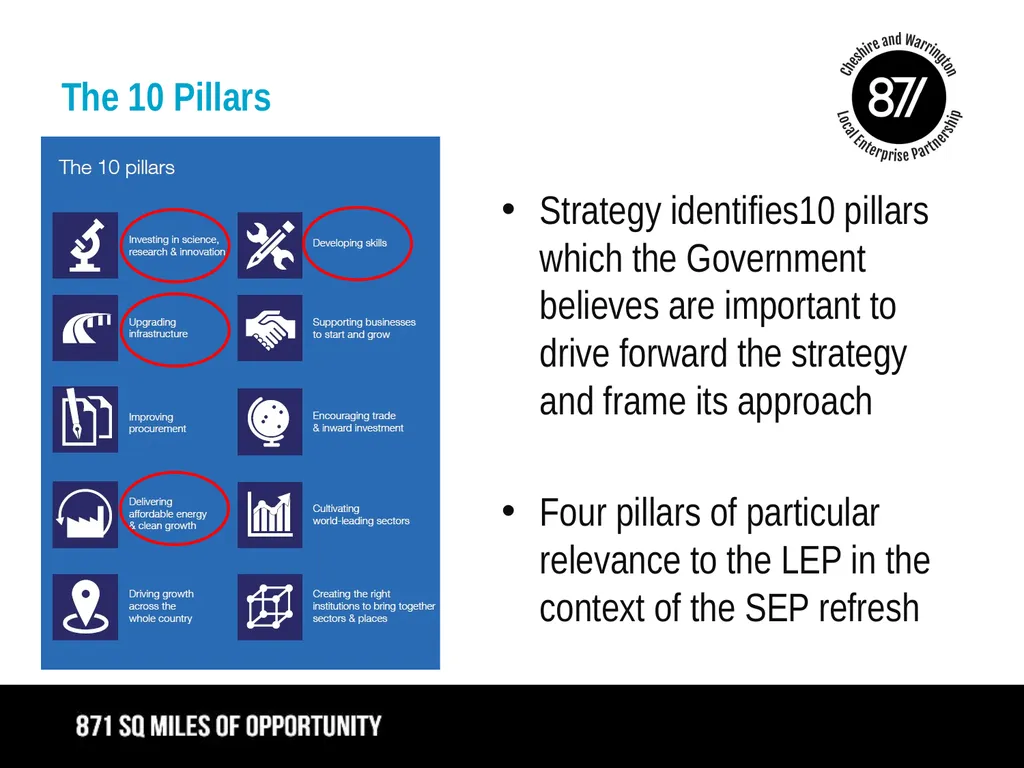
The 10 Pillars Strategy identifies10 pillars which the Government believes are important to drive forward the strategy and frame its approach
Four pillars of particular relevance to the LEP in the context of the SEP refresh<br>
Four pillars of particular relevance to the LEP in the context of the SEP refresh<br>
04
Resonance with LEP priorities “Investing in science, research and innovation”:
UKRI will develop and deliver a clear strategy from fundamental research through to business innovation
Potential to create new research institutions to back local strengths in world-class research or drive forward priority technologies (such as battery technology, energy storage and grid technology linked to electric vehicles)
Building a pipeline of talent for an innovative economy
Creation of Industrial Strategy Challenge Fund
Links to Cheshire Science Corridor<br>
UKRI will develop and deliver a clear strategy from fundamental research through to business innovation
Potential to create new research institutions to back local strengths in world-class research or drive forward priority technologies (such as battery technology, energy storage and grid technology linked to electric vehicles)
Building a pipeline of talent for an innovative economy
Creation of Industrial Strategy Challenge Fund
Links to Cheshire Science Corridor<br>
05
Resonance with LEP priorities “Developing skills”
Strong emphasis on development of technical skills and provision of higher level technical qualifications. Reforms to FE into a “new system of technical education”
New Institutes of Technology in all regions – though possibly city-based
Better use of data and intelligence to identify and address industry skills needs
Acknowledges need to incentivise business to invest in skills development alongside public sector investment. Links between skills and variances in regional productivity
Highlights importance of supporting lifelong learning and availability of good quality careers advice
Digital Economy Bill – potential for free basic digital skills training to those adults in England who need it<br>
Strong emphasis on development of technical skills and provision of higher level technical qualifications. Reforms to FE into a “new system of technical education”
New Institutes of Technology in all regions – though possibly city-based
Better use of data and intelligence to identify and address industry skills needs
Acknowledges need to incentivise business to invest in skills development alongside public sector investment. Links between skills and variances in regional productivity
Highlights importance of supporting lifelong learning and availability of good quality careers advice
Digital Economy Bill – potential for free basic digital skills training to those adults in England who need it<br>
06
Resonance with LEP priorities “Upgrading infrastructure”
Acknowledges importance of better connectivity in supporting higher growth and living standards. This includes good digital infrastructure.
Infrastructure investment unlocks private sector investment including housing
Potential for new Public – Private Partnerships to give private sector a role in delivering infrastructure
Need to better match infrastructure to local plans and to support local growth<br>
Acknowledges importance of better connectivity in supporting higher growth and living standards. This includes good digital infrastructure.
Infrastructure investment unlocks private sector investment including housing
Potential for new Public – Private Partnerships to give private sector a role in delivering infrastructure
Need to better match infrastructure to local plans and to support local growth<br>
07
Resonance with LEP priorities “Delivering affordable energy & clean growth”
Government role to fund ‘basic energy research’ which is too long term for the market to deliver: ultimately though it will be the private sector that drives the low carbon economy
Need to ensure the shift to a low carbon economy is done in a way that minimises the costs to UK businesses, taxpayers and consumers
Highlights the roll out of electric vehicles as a driver in ensuring that the grid is smart and resilient to new demands
Commitment to a programme of research and innovation in energy storage and other smart technologies.
Potential to position Cheshire and Warrington as a focal point for this research<br>
Government role to fund ‘basic energy research’ which is too long term for the market to deliver: ultimately though it will be the private sector that drives the low carbon economy
Need to ensure the shift to a low carbon economy is done in a way that minimises the costs to UK businesses, taxpayers and consumers
Highlights the roll out of electric vehicles as a driver in ensuring that the grid is smart and resilient to new demands
Commitment to a programme of research and innovation in energy storage and other smart technologies.
Potential to position Cheshire and Warrington as a focal point for this research<br>
08
‘Creating the Right Institutions’ In addition to the four pillars previously highlighted, Green Paper identifies the importance of ‘creating the right institutions to bring together sectors and places’
Includes local business and finance institutions, leadership institutions, interest groups and advocacy groups, institutions that support innovation (including universities and science parks / innovation districts), cultural, sporting and quality of life institutions and connectivity institutions (ports and airports)
Includes explicit reference to LEPs and their role in delivering local growth, giving businesses “a direct role in shaping the future of their local communities”.
Raises point of learning from best practice and working with local areas to ‘identify and help develop local specialisms, putting place the right institutions with the right powers to help support local areas of economic strength’<br>
Includes local business and finance institutions, leadership institutions, interest groups and advocacy groups, institutions that support innovation (including universities and science parks / innovation districts), cultural, sporting and quality of life institutions and connectivity institutions (ports and airports)
Includes explicit reference to LEPs and their role in delivering local growth, giving businesses “a direct role in shaping the future of their local communities”.
Raises point of learning from best practice and working with local areas to ‘identify and help develop local specialisms, putting place the right institutions with the right powers to help support local areas of economic strength’<br>
09
Responding to the Consultation The LEP should lead the Industrial Strategy debate in Cheshire and Warrington
We should aim to hold a couple of business-focused engagement events to facilitate this
Our response to the consultation should: -
Remind government of the means by which we think our economy should grow
Note the alignment with our SEP
Note the opportunities for us to align ourselves with the Green Paper (e.g. energy systems, Institutes of Technology)
Identify any gaps in government’s thinking<br>
We should aim to hold a couple of business-focused engagement events to facilitate this
Our response to the consultation should: -
Remind government of the means by which we think our economy should grow
Note the alignment with our SEP
Note the opportunities for us to align ourselves with the Green Paper (e.g. energy systems, Institutes of Technology)
Identify any gaps in government’s thinking<br>
10
Industrial Strategy
The Ten Pillars: Key Points
and Consultation Questions<br>
The Ten Pillars: Key Points
and Consultation Questions<br>
11
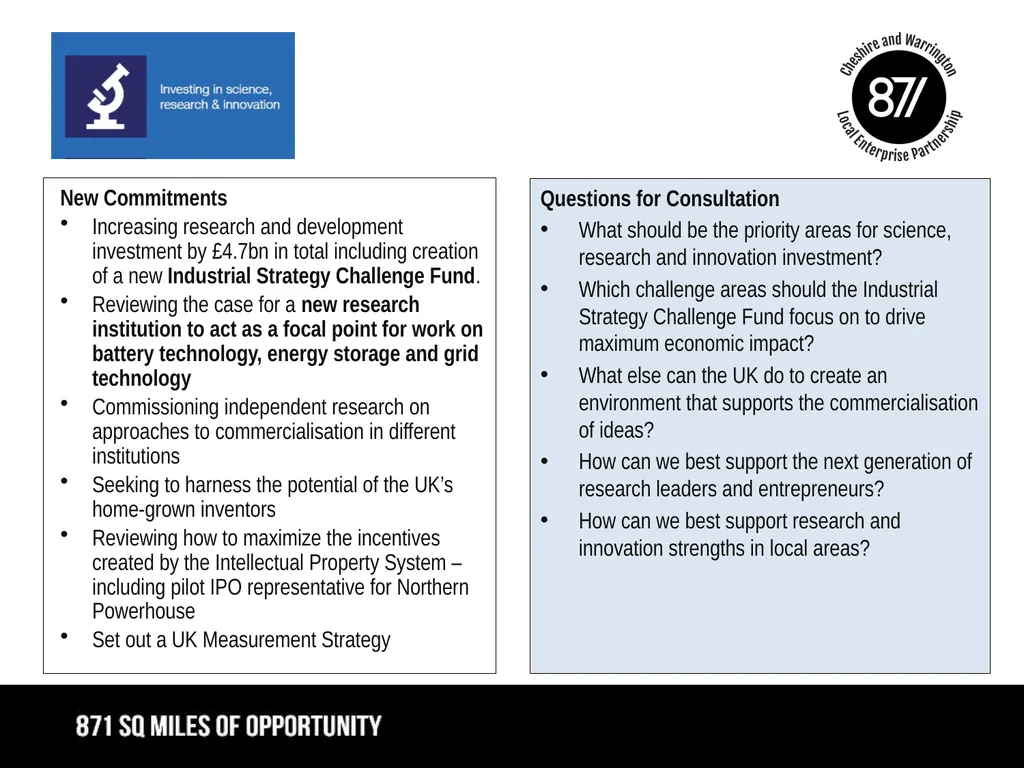
New Commitments
Increasing research and development investment by £4.7bn in total including creation of a new Industrial Strategy Challenge Fund.
Reviewing the case for a new research institution to act as a focal point for work on battery technology, energy storage and grid technology
Commissioning independent research on approaches to commercialisation in different institutions
Seeking to harness the potential of the UK’s home-grown inventors
Reviewing how to maximize the incentives created by the Intellectual Property System – including pilot IPO representative for Northern Powerhouse
Set out a UK Measurement Strategy Questions for Consultation
What should be the priority areas for science, research and innovation investment?
Which challenge areas should the Industrial Strategy Challenge Fund focus on to drive maximum economic impact?
What else can the UK do to create an environment that supports the commercialisation of ideas?
How can we best support the next generation of research leaders and entrepreneurs?
How can we best support research and innovation strengths in local areas?<br>
Increasing research and development investment by £4.7bn in total including creation of a new Industrial Strategy Challenge Fund.
Reviewing the case for a new research institution to act as a focal point for work on battery technology, energy storage and grid technology
Commissioning independent research on approaches to commercialisation in different institutions
Seeking to harness the potential of the UK’s home-grown inventors
Reviewing how to maximize the incentives created by the Intellectual Property System – including pilot IPO representative for Northern Powerhouse
Set out a UK Measurement Strategy Questions for Consultation
What should be the priority areas for science, research and innovation investment?
Which challenge areas should the Industrial Strategy Challenge Fund focus on to drive maximum economic impact?
What else can the UK do to create an environment that supports the commercialisation of ideas?
How can we best support the next generation of research leaders and entrepreneurs?
How can we best support research and innovation strengths in local areas?<br>
12
New Commitments
Creating a ‘proper’ system of technical education
£170m of capital funding towards creation of new Institutes of technology to deliver higher technical education in STEM subjects
Exploring how to support FE colleges to be centres of excellence in teaching maths and English
Improving information for learners interested in a technical education
Improving the take up of maths including seeking partners to open specialist mathematics schools
Work towards a joined-up, authoritative view of sector specific skills gaps
Publication of comprehensive careers strategy
Explore new approaches to encourage lifelong learning
Taking action to address differences in skills levels between different areas Questions for Consultation
What more can we do to improve basic skills? How can we make a success of the new transition year? Should we change the way that those resitting basic qualifications study, to focus more on basic skills experience?
Do you agree with the different elements of the vision for the new technical education system set out here? Are there further lessons from other countries’ systems?
How can we make the application process for FE colleges and apprenticeships clearer and simpler, drawing lessons from the HE sector?
What skills shortages do we have or expect to have, in particular sectors or local areas, and how can we link the skills needs of industry to skills provision by educational institutions in local areas?
How can we enable and encourage people to retrain and upskill throughout their working lives, particularly in places where industries are changing or declining? Are there particular sectors where this could be appropriate?<br>
Creating a ‘proper’ system of technical education
£170m of capital funding towards creation of new Institutes of technology to deliver higher technical education in STEM subjects
Exploring how to support FE colleges to be centres of excellence in teaching maths and English
Improving information for learners interested in a technical education
Improving the take up of maths including seeking partners to open specialist mathematics schools
Work towards a joined-up, authoritative view of sector specific skills gaps
Publication of comprehensive careers strategy
Explore new approaches to encourage lifelong learning
Taking action to address differences in skills levels between different areas Questions for Consultation
What more can we do to improve basic skills? How can we make a success of the new transition year? Should we change the way that those resitting basic qualifications study, to focus more on basic skills experience?
Do you agree with the different elements of the vision for the new technical education system set out here? Are there further lessons from other countries’ systems?
How can we make the application process for FE colleges and apprenticeships clearer and simpler, drawing lessons from the HE sector?
What skills shortages do we have or expect to have, in particular sectors or local areas, and how can we link the skills needs of industry to skills provision by educational institutions in local areas?
How can we enable and encourage people to retrain and upskill throughout their working lives, particularly in places where industries are changing or declining? Are there particular sectors where this could be appropriate?<br>
13
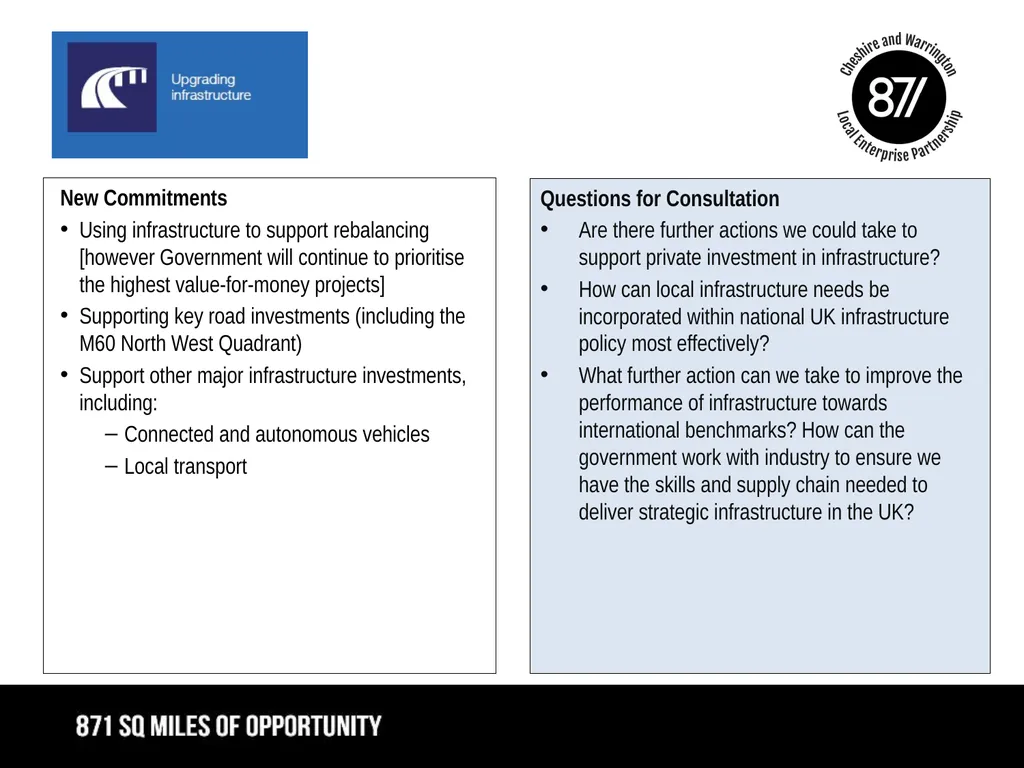
New Commitments
Using infrastructure to support rebalancing [however Government will continue to prioritise the highest value-for-money projects]
Supporting key road investments (including the M60 North West Quadrant)
Support other major infrastructure investments, including:
Connected and autonomous vehicles
Local transport Questions for Consultation
Are there further actions we could take to support private investment in infrastructure?
How can local infrastructure needs be incorporated within national UK infrastructure policy most effectively?
What further action can we take to improve the performance of infrastructure towards international benchmarks? How can the government work with industry to ensure we have the skills and supply chain needed to deliver strategic infrastructure in the UK?<br>
Using infrastructure to support rebalancing [however Government will continue to prioritise the highest value-for-money projects]
Supporting key road investments (including the M60 North West Quadrant)
Support other major infrastructure investments, including:
Connected and autonomous vehicles
Local transport Questions for Consultation
Are there further actions we could take to support private investment in infrastructure?
How can local infrastructure needs be incorporated within national UK infrastructure policy most effectively?
What further action can we take to improve the performance of infrastructure towards international benchmarks? How can the government work with industry to ensure we have the skills and supply chain needed to deliver strategic infrastructure in the UK?<br>
14
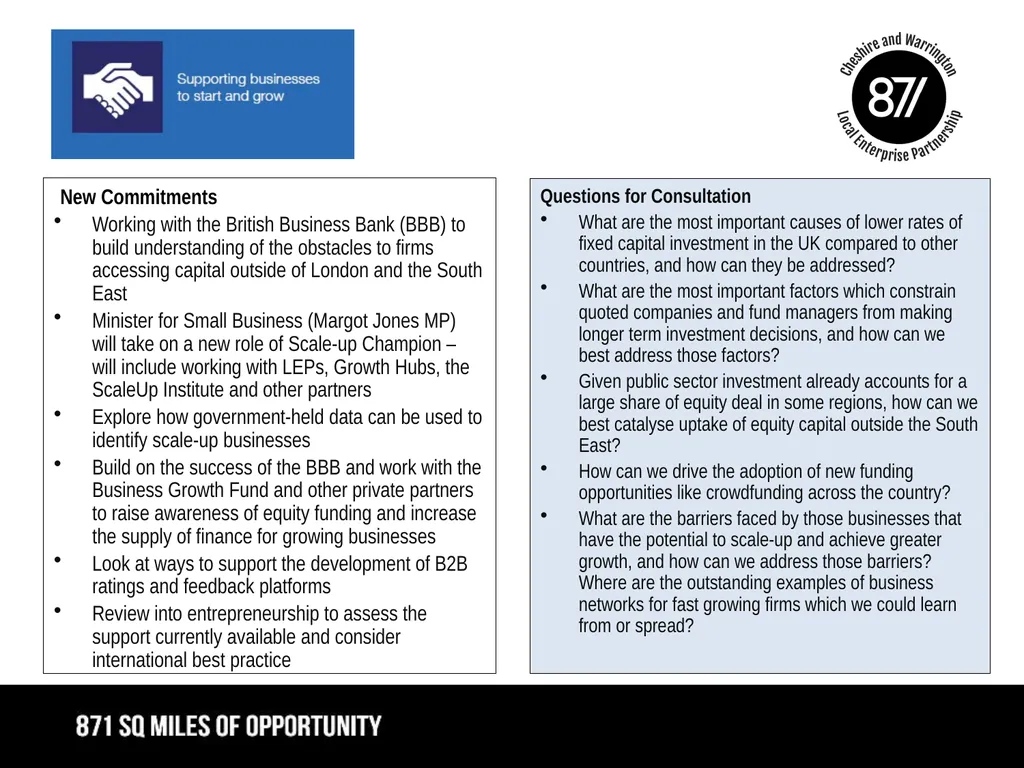
New Commitments
Working with the British Business Bank (BBB) to build understanding of the obstacles to firms accessing capital outside of London and the South East
Minister for Small Business (Margot Jones MP) will take on a new role of Scale-up Champion – will include working with LEPs, Growth Hubs, the ScaleUp Institute and other partners
Explore how government-held data can be used to identify scale-up businesses
Build on the success of the BBB and work with the Business Growth Fund and other private partners to raise awareness of equity funding and increase the supply of finance for growing businesses
Look at ways to support the development of B2B ratings and feedback platforms
Review into entrepreneurship to assess the support currently available and consider international best practice Questions for Consultation
What are the most important causes of lower rates of fixed capital investment in the UK compared to other countries, and how can they be addressed?
What are the most important factors which constrain quoted companies and fund managers from making longer term investment decisions, and how can we best address those factors?
Given public sector investment already accounts for a large share of equity deal in some regions, how can we best catalyse uptake of equity capital outside the South East?
How can we drive the adoption of new funding opportunities like crowdfunding across the country?
What are the barriers faced by those businesses that have the potential to scale-up and achieve greater growth, and how can we address those barriers? Where are the outstanding examples of business networks for fast growing firms which we could learn from or spread?<br>
Working with the British Business Bank (BBB) to build understanding of the obstacles to firms accessing capital outside of London and the South East
Minister for Small Business (Margot Jones MP) will take on a new role of Scale-up Champion – will include working with LEPs, Growth Hubs, the ScaleUp Institute and other partners
Explore how government-held data can be used to identify scale-up businesses
Build on the success of the BBB and work with the Business Growth Fund and other private partners to raise awareness of equity funding and increase the supply of finance for growing businesses
Look at ways to support the development of B2B ratings and feedback platforms
Review into entrepreneurship to assess the support currently available and consider international best practice Questions for Consultation
What are the most important causes of lower rates of fixed capital investment in the UK compared to other countries, and how can they be addressed?
What are the most important factors which constrain quoted companies and fund managers from making longer term investment decisions, and how can we best address those factors?
Given public sector investment already accounts for a large share of equity deal in some regions, how can we best catalyse uptake of equity capital outside the South East?
How can we drive the adoption of new funding opportunities like crowdfunding across the country?
What are the barriers faced by those businesses that have the potential to scale-up and achieve greater growth, and how can we address those barriers? Where are the outstanding examples of business networks for fast growing firms which we could learn from or spread?<br>
15
New Commitments
Rolling out a “balanced scorecard” approach across all major central government construction, infrastructure and capital investment projects over £10 million
Trial different aspects of designing and gathering supplier feedback in public sector procurement Questions for Consultation
Are there further steps that the Government can take to support innovation through public procurement?
What further steps can be taken to use public procurement to drive the industrial strategy in areas where government is the main client, such as healthcare and defence? Do we have the right institutions and policies in place in these sectors to exploit government’s purchasing power to drive economic growth?<br>
Rolling out a “balanced scorecard” approach across all major central government construction, infrastructure and capital investment projects over £10 million
Trial different aspects of designing and gathering supplier feedback in public sector procurement Questions for Consultation
Are there further steps that the Government can take to support innovation through public procurement?
What further steps can be taken to use public procurement to drive the industrial strategy in areas where government is the main client, such as healthcare and defence? Do we have the right institutions and policies in place in these sectors to exploit government’s purchasing power to drive economic growth?<br>
16
New Commitments
Building future trading relationships.
Creating a new more active “Team UK” approach to winning overseas contracts, with the government helping convene consortia of companies to back a single UK bid for major overseas projects.
Developing a new, more strategic approach to inward investment. DIT will review learning from successful inward investment promotion agencies across the globe (reporting 2017). Government will also consider whether there should be a greater emphasis on the effect of investment projects on growth.
Working with behavioral insights experts to improve targeting of potential exporters
Exploring how to maximize opportunities that a UK presence at existing trade fairs could offer for businesses Questions for Consultation
What can the Government do to improve our support for firms wanting to start exporting? What can the Government do to improve support for firms in increasing their exports?
What can we learn from other countries to improve our support for inward investment and how can we measure its success? Should we put more emphasis on measuring the impact of Foreign Direct Investment on growth?<br>
Building future trading relationships.
Creating a new more active “Team UK” approach to winning overseas contracts, with the government helping convene consortia of companies to back a single UK bid for major overseas projects.
Developing a new, more strategic approach to inward investment. DIT will review learning from successful inward investment promotion agencies across the globe (reporting 2017). Government will also consider whether there should be a greater emphasis on the effect of investment projects on growth.
Working with behavioral insights experts to improve targeting of potential exporters
Exploring how to maximize opportunities that a UK presence at existing trade fairs could offer for businesses Questions for Consultation
What can the Government do to improve our support for firms wanting to start exporting? What can the Government do to improve support for firms in increasing their exports?
What can we learn from other countries to improve our support for inward investment and how can we measure its success? Should we put more emphasis on measuring the impact of Foreign Direct Investment on growth?<br>
17
New Commitments
Setting out in 2017 a long-term road map to minimise business energy costs
Commissioning a review of the opportunities to reduce the costs of achieving our decarbonisation goals in the power and industrial sectors
Reviewing the opportunities for growth from the energy sector and the opportunities for the UK
Publication of an Emissions Reduction Plan during 2017, providing long-term certainty for investors.
Review the case for a new research institution to act as a focal point for work on battery technology, energy storage and grid technology (reporting in early 2017) Questions for Consultation
What are the most important steps the Government should take to limit energy costs over the long term?
How can we move towards a position in which energy is supplied by competitive markets without the requirement for ongoing subsidy?
How can the Government, business and researchers work together to develop the competitive opportunities from innovation in energy and our existing industrial strengths?
How can the Government support businesses in realising cost savings through greater resource and energy efficiency?<br>
Setting out in 2017 a long-term road map to minimise business energy costs
Commissioning a review of the opportunities to reduce the costs of achieving our decarbonisation goals in the power and industrial sectors
Reviewing the opportunities for growth from the energy sector and the opportunities for the UK
Publication of an Emissions Reduction Plan during 2017, providing long-term certainty for investors.
Review the case for a new research institution to act as a focal point for work on battery technology, energy storage and grid technology (reporting in early 2017) Questions for Consultation
What are the most important steps the Government should take to limit energy costs over the long term?
How can we move towards a position in which energy is supplied by competitive markets without the requirement for ongoing subsidy?
How can the Government, business and researchers work together to develop the competitive opportunities from innovation in energy and our existing industrial strengths?
How can the Government support businesses in realising cost savings through greater resource and energy efficiency?<br>
18
New Commitments
The Government welcomes work on early sector deals (in life sciences, ultra low emission vehicles, industrial digitisation and creative industries)
Sector deals will be open to all and the Government is prepared to work with any sector that can organise behind strong leadership to address shared challenges and opportunities Questions for Consultation
How can the Government and industry help sectors come together to identify the opportunities for a ‘sector deal’ to address – especially where industries are fragmented or not well defined?
How can the Government ensure that ‘sector deals’ promote competition and incorporate the interests of new entrants?
How can the Government and industry collaborate to enable growth in new sectors of the future that emerge around new technologies and new business models?<br>
The Government welcomes work on early sector deals (in life sciences, ultra low emission vehicles, industrial digitisation and creative industries)
Sector deals will be open to all and the Government is prepared to work with any sector that can organise behind strong leadership to address shared challenges and opportunities Questions for Consultation
How can the Government and industry help sectors come together to identify the opportunities for a ‘sector deal’ to address – especially where industries are fragmented or not well defined?
How can the Government ensure that ‘sector deals’ promote competition and incorporate the interests of new entrants?
How can the Government and industry collaborate to enable growth in new sectors of the future that emerge around new technologies and new business models?<br>
19
New Commitments
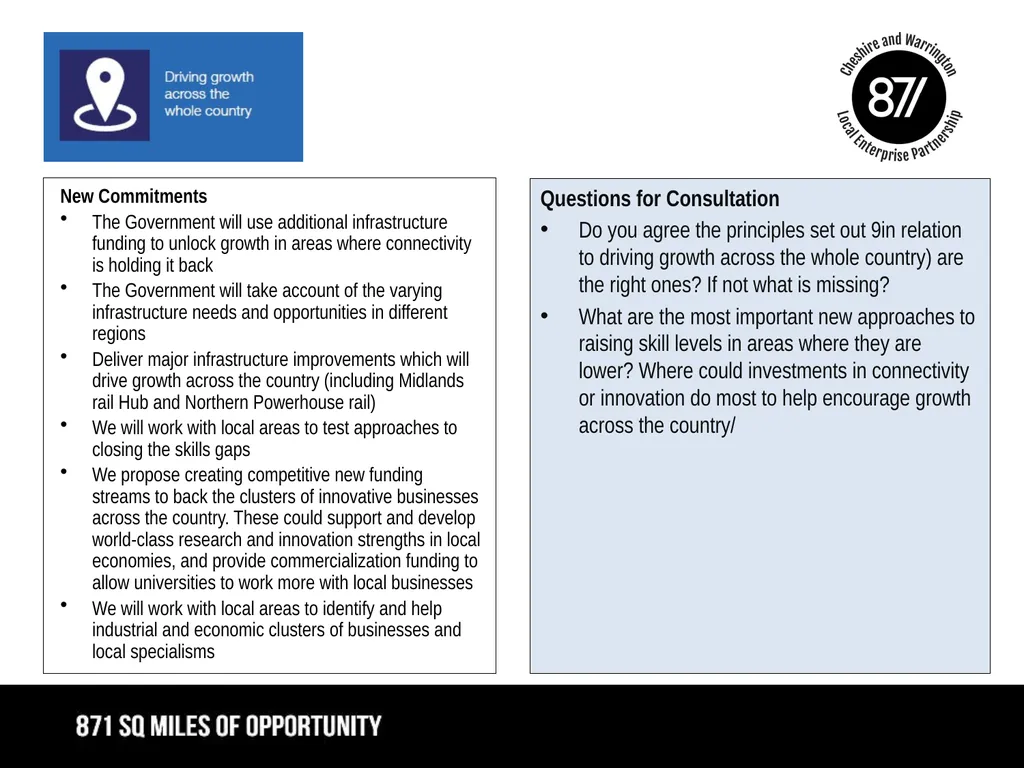
The Government will use additional infrastructure funding to unlock growth in areas where connectivity is holding it back
The Government will take account of the varying infrastructure needs and opportunities in different regions
Deliver major infrastructure improvements which will drive growth across the country (including Midlands rail Hub and Northern Powerhouse rail)
We will work with local areas to test approaches to closing the skills gaps
We propose creating competitive new funding streams to back the clusters of innovative businesses across the country. These could support and develop world-class research and innovation strengths in local economies, and provide commercialization funding to allow universities to work more with local businesses
We will work with local areas to identify and help industrial and economic clusters of businesses and local specialisms Questions for Consultation
Do you agree the principles set out 9in relation to driving growth across the whole country) are the right ones? If not what is missing?
What are the most important new approaches to raising skill levels in areas where they are lower? Where could investments in connectivity or innovation do most to help encourage growth across the country/<br>
The Government will use additional infrastructure funding to unlock growth in areas where connectivity is holding it back
The Government will take account of the varying infrastructure needs and opportunities in different regions
Deliver major infrastructure improvements which will drive growth across the country (including Midlands rail Hub and Northern Powerhouse rail)
We will work with local areas to test approaches to closing the skills gaps
We propose creating competitive new funding streams to back the clusters of innovative businesses across the country. These could support and develop world-class research and innovation strengths in local economies, and provide commercialization funding to allow universities to work more with local businesses
We will work with local areas to identify and help industrial and economic clusters of businesses and local specialisms Questions for Consultation
Do you agree the principles set out 9in relation to driving growth across the whole country) are the right ones? If not what is missing?
What are the most important new approaches to raising skill levels in areas where they are lower? Where could investments in connectivity or innovation do most to help encourage growth across the country/<br>
20
New Commitments (1)
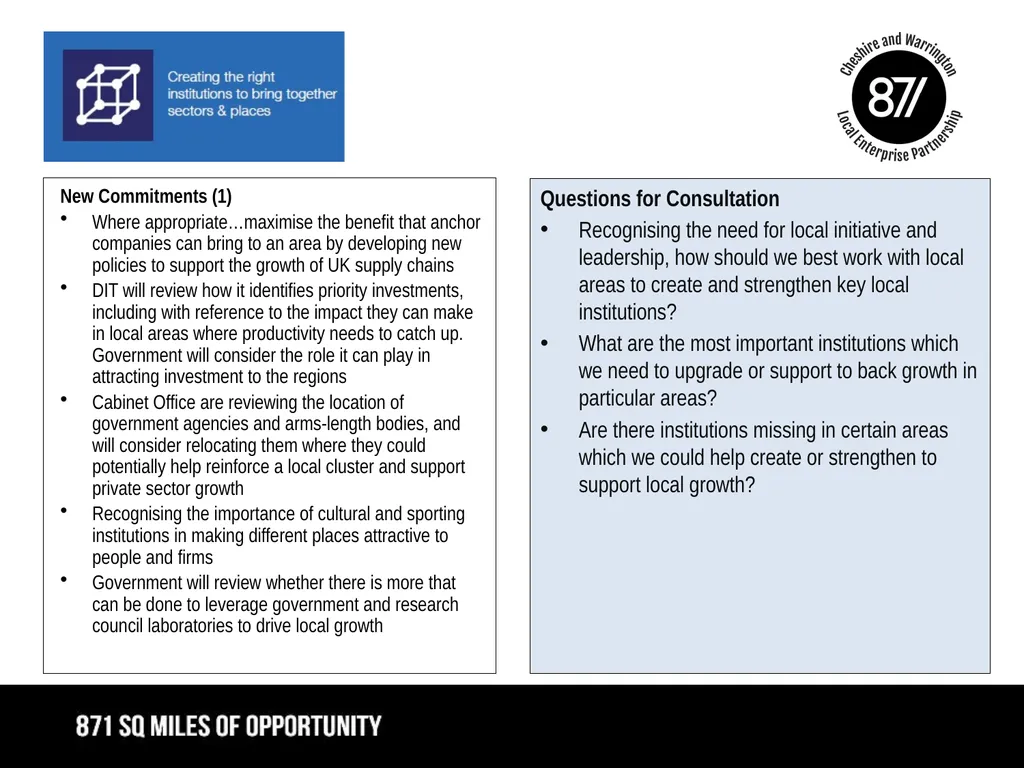
Where appropriate…maximise the benefit that anchor companies can bring to an area by developing new policies to support the growth of UK supply chains
DIT will review how it identifies priority investments, including with reference to the impact they can make in local areas where productivity needs to catch up. Government will consider the role it can play in attracting investment to the regions
Cabinet Office are reviewing the location of government agencies and arms-length bodies, and will consider relocating them where they could potentially help reinforce a local cluster and support private sector growth
Recognising the importance of cultural and sporting institutions in making different places attractive to people and firms
Government will review whether there is more that can be done to leverage government and research council laboratories to drive local growth Questions for Consultation
Recognising the need for local initiative and leadership, how should we best work with local areas to create and strengthen key local institutions?
What are the most important institutions which we need to upgrade or support to back growth in particular areas?
Are there institutions missing in certain areas which we could help create or strengthen to support local growth?<br>
Where appropriate…maximise the benefit that anchor companies can bring to an area by developing new policies to support the growth of UK supply chains
DIT will review how it identifies priority investments, including with reference to the impact they can make in local areas where productivity needs to catch up. Government will consider the role it can play in attracting investment to the regions
Cabinet Office are reviewing the location of government agencies and arms-length bodies, and will consider relocating them where they could potentially help reinforce a local cluster and support private sector growth
Recognising the importance of cultural and sporting institutions in making different places attractive to people and firms
Government will review whether there is more that can be done to leverage government and research council laboratories to drive local growth Questions for Consultation
Recognising the need for local initiative and leadership, how should we best work with local areas to create and strengthen key local institutions?
What are the most important institutions which we need to upgrade or support to back growth in particular areas?
Are there institutions missing in certain areas which we could help create or strengthen to support local growth?<br>
21
New Commitments (2)
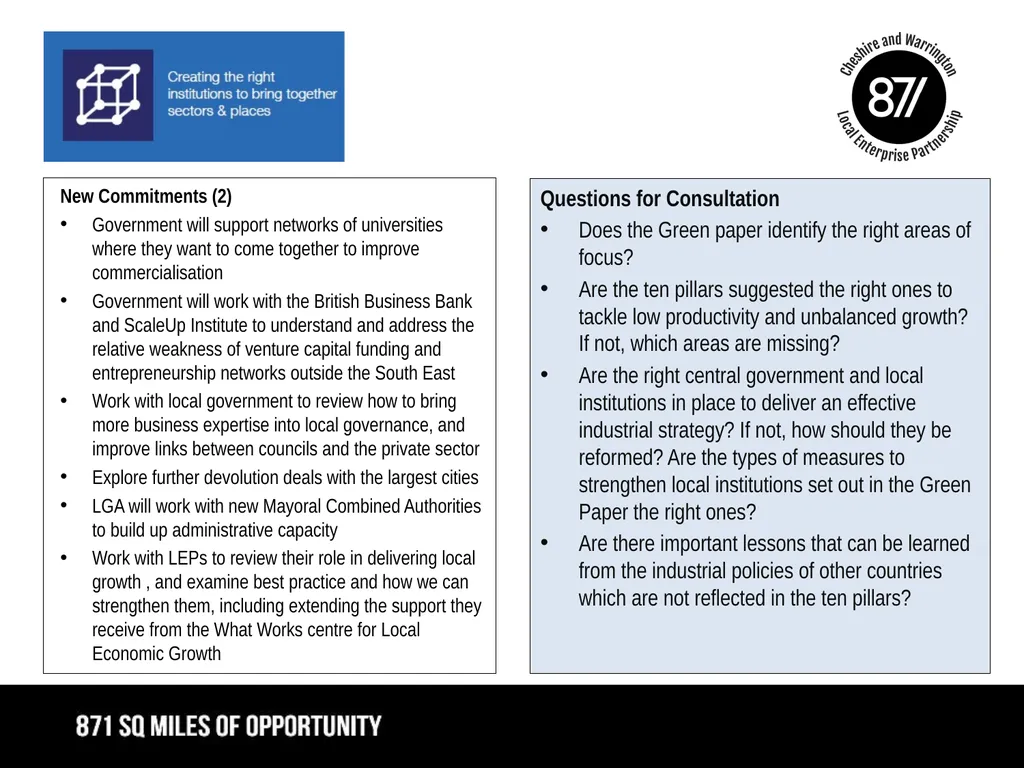
Government will support networks of universities where they want to come together to improve commercialisation
Government will work with the British Business Bank and ScaleUp Institute to understand and address the relative weakness of venture capital funding and entrepreneurship networks outside the South East
Work with local government to review how to bring more business expertise into local governance, and improve links between councils and the private sector
Explore further devolution deals with the largest cities
LGA will work with new Mayoral Combined Authorities to build up administrative capacity
Work with LEPs to review their role in delivering local growth , and examine best practice and how we can strengthen them, including extending the support they receive from the What Works centre for Local Economic Growth Questions for Consultation
Does the Green paper identify the right areas of focus?
Are the ten pillars suggested the right ones to tackle low productivity and unbalanced growth? If not, which areas are missing?
Are the right central government and local institutions in place to deliver an effective industrial strategy? If not, how should they be reformed? Are the types of measures to strengthen local institutions set out in the Green Paper the right ones?
Are there important lessons that can be learned from the industrial policies of other countries which are not reflected in the ten pillars?<br>
Government will support networks of universities where they want to come together to improve commercialisation
Government will work with the British Business Bank and ScaleUp Institute to understand and address the relative weakness of venture capital funding and entrepreneurship networks outside the South East
Work with local government to review how to bring more business expertise into local governance, and improve links between councils and the private sector
Explore further devolution deals with the largest cities
LGA will work with new Mayoral Combined Authorities to build up administrative capacity
Work with LEPs to review their role in delivering local growth , and examine best practice and how we can strengthen them, including extending the support they receive from the What Works centre for Local Economic Growth Questions for Consultation
Does the Green paper identify the right areas of focus?
Are the ten pillars suggested the right ones to tackle low productivity and unbalanced growth? If not, which areas are missing?
Are the right central government and local institutions in place to deliver an effective industrial strategy? If not, how should they be reformed? Are the types of measures to strengthen local institutions set out in the Green Paper the right ones?
Are there important lessons that can be learned from the industrial policies of other countries which are not reflected in the ten pillars?<br>
22
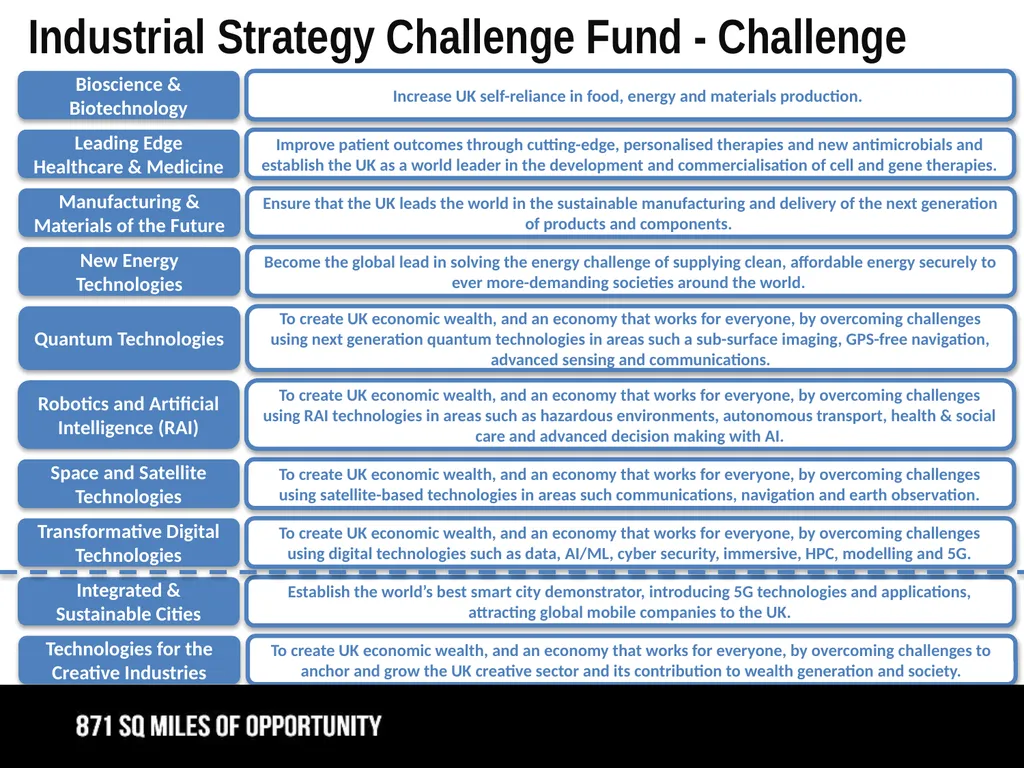
Industrial Strategy Challenge Fund - Challenge Areas<br>