
Bureau of Health Workforce Program Update for
TD
Published · 27 slides · 0 views

1 / 1


Description
Bureau of Health Workforce Program Update for State Offices of Rural Health September 10, 2014 Kimberly Kleine Bureau of Health Workforce Health Resources and Services Administration U.S. Department of Health and Human Services Bureau of
Related Topics
Share
Embed code
Download this presentation From Below
"Bureau of Health Workforce Program Update for" is the property of its rightful owner. Permission is granted to download and print the materials on this website for personal, non-commercial use only, and to display it on your personal computer provided you do not modify the materials and that you retain all copyright notices contained in the materials. By downloading content from our website, you accept the terms of this agreement.
Presentation Transcript
01
Bureau of Health Workforce Program Update
for State Offices of Rural Health
September 10, 2014 Kimberly Kleine
Bureau of Health Workforce
Health Resources and Services Administration
U.S. Department of Health and Human Services<br>
Bureau of Health Workforce
Health Resources and Services Administration
U.S. Department of Health and Human Services<br>
02
Bureau of Health Workforce (BHW) Created in May 2014, the Bureau of Health Workforce brings together HRSA’s key workforce programs previously housed in two bureaus: Health Professions and Clinician Recruitment and Service
Better meets the need for a well-trained, well-distributed 21st century workforce through realignment and built in connectivity
Annual Appropriation of more than $1Billion that supports over 40 workforce programs and a staff of more than 450 people
Supports the health care workforce across the entire training continuum – from academic training of nurses, physicians, and other clinicians to clinicians currently providing health care in underserved and rural communities across the United States<br>
Better meets the need for a well-trained, well-distributed 21st century workforce through realignment and built in connectivity
Annual Appropriation of more than $1Billion that supports over 40 workforce programs and a staff of more than 450 people
Supports the health care workforce across the entire training continuum – from academic training of nurses, physicians, and other clinicians to clinicians currently providing health care in underserved and rural communities across the United States<br>
03
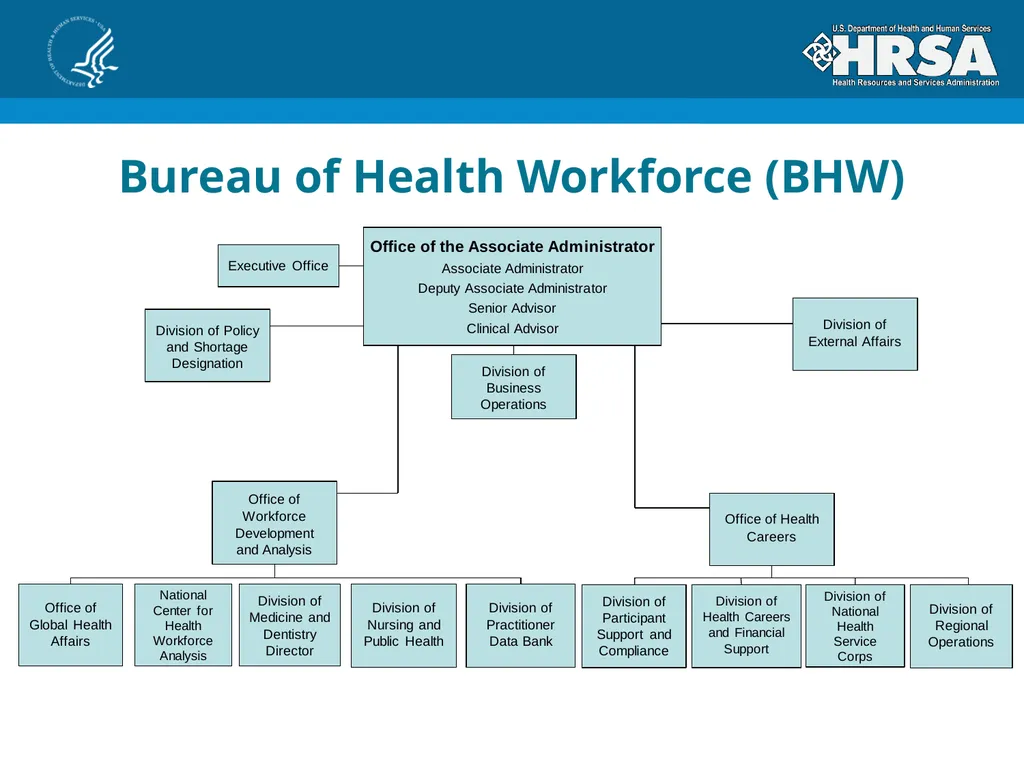
Bureau of Health Workforce (BHW)<br>
04
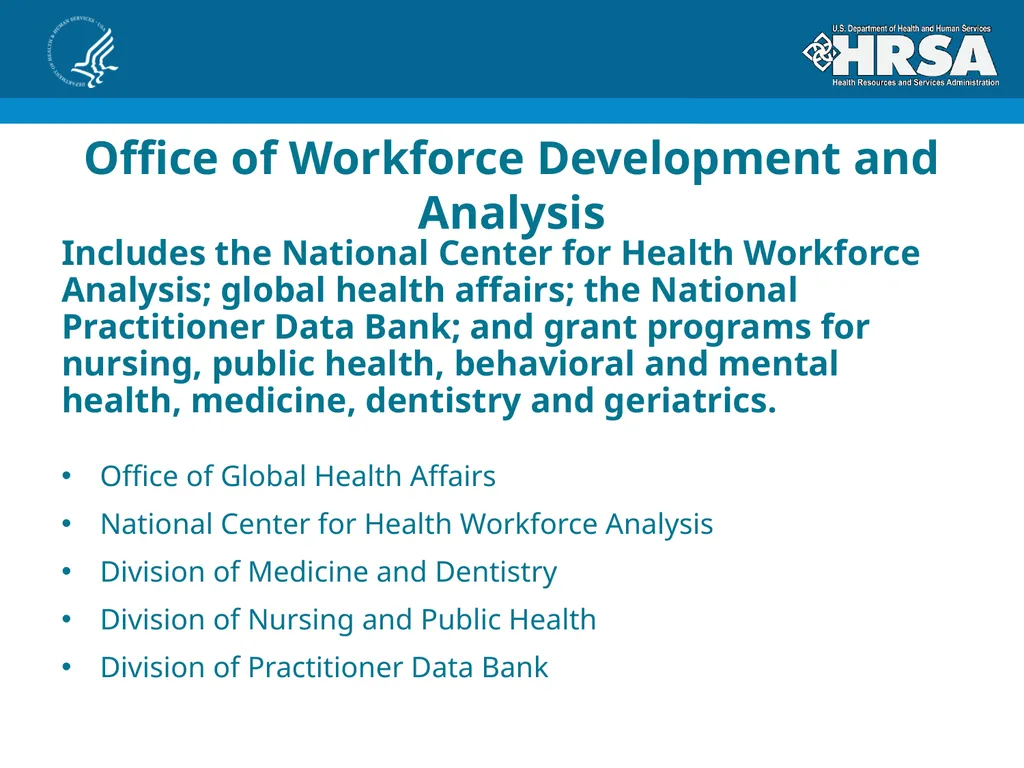
Office of Workforce Development and Analysis Includes the National Center for Health Workforce Analysis; global health affairs; the National Practitioner Data Bank; and grant programs for nursing, public health, behavioral and mental health, medicine, dentistry and geriatrics.
Office of Global Health Affairs
National Center for Health Workforce Analysis
Division of Medicine and Dentistry
Division of Nursing and Public Health
Division of Practitioner Data Bank<br>
Office of Global Health Affairs
National Center for Health Workforce Analysis
Division of Medicine and Dentistry
Division of Nursing and Public Health
Division of Practitioner Data Bank<br>
05
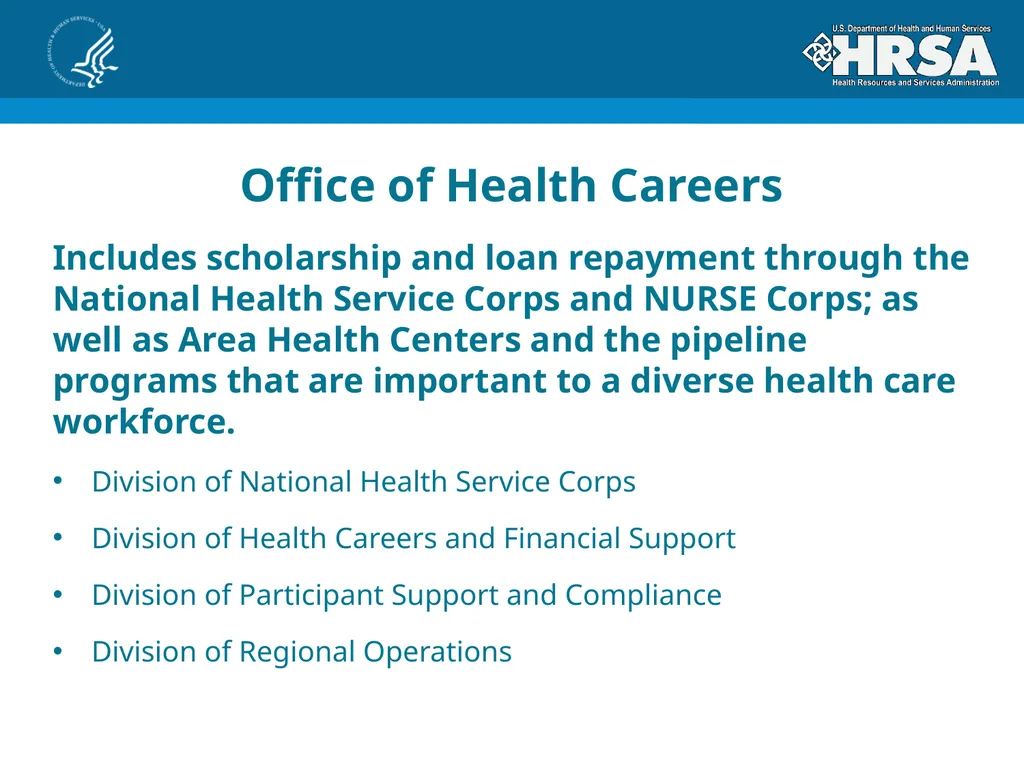
Office of Health Careers Includes scholarship and loan repayment through the National Health Service Corps and NURSE Corps; as well as Area Health Centers and the pipeline programs that are important to a diverse health care workforce.
Division of National Health Service Corps
Division of Health Careers and Financial Support
Division of Participant Support and Compliance
Division of Regional Operations<br>
Division of National Health Service Corps
Division of Health Careers and Financial Support
Division of Participant Support and Compliance
Division of Regional Operations<br>
06
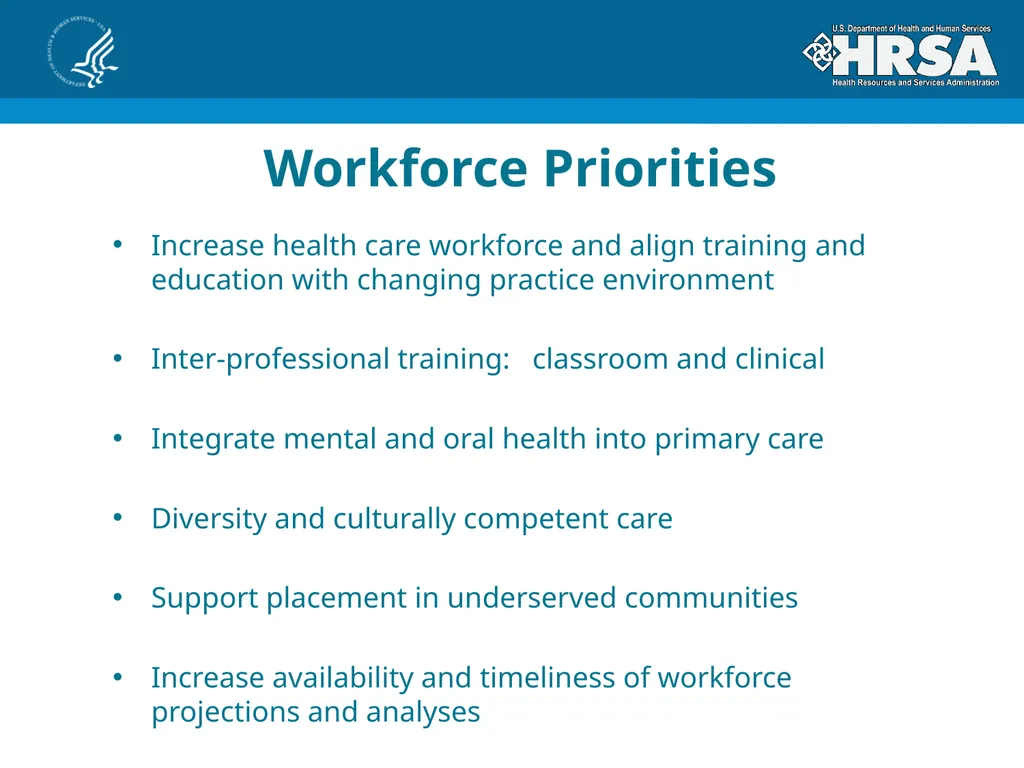
Workforce Priorities Increase health care workforce and align training and education with changing practice environment
Inter-professional training: classroom and clinical
Integrate mental and oral health into primary care
Diversity and culturally competent care
Support placement in underserved communities
Increase availability and timeliness of workforce projections and analyses<br>
Inter-professional training: classroom and clinical
Integrate mental and oral health into primary care
Diversity and culturally competent care
Support placement in underserved communities
Increase availability and timeliness of workforce projections and analyses<br>
07
Supporting Rural
Workforce Development<br>
Workforce Development<br>
08
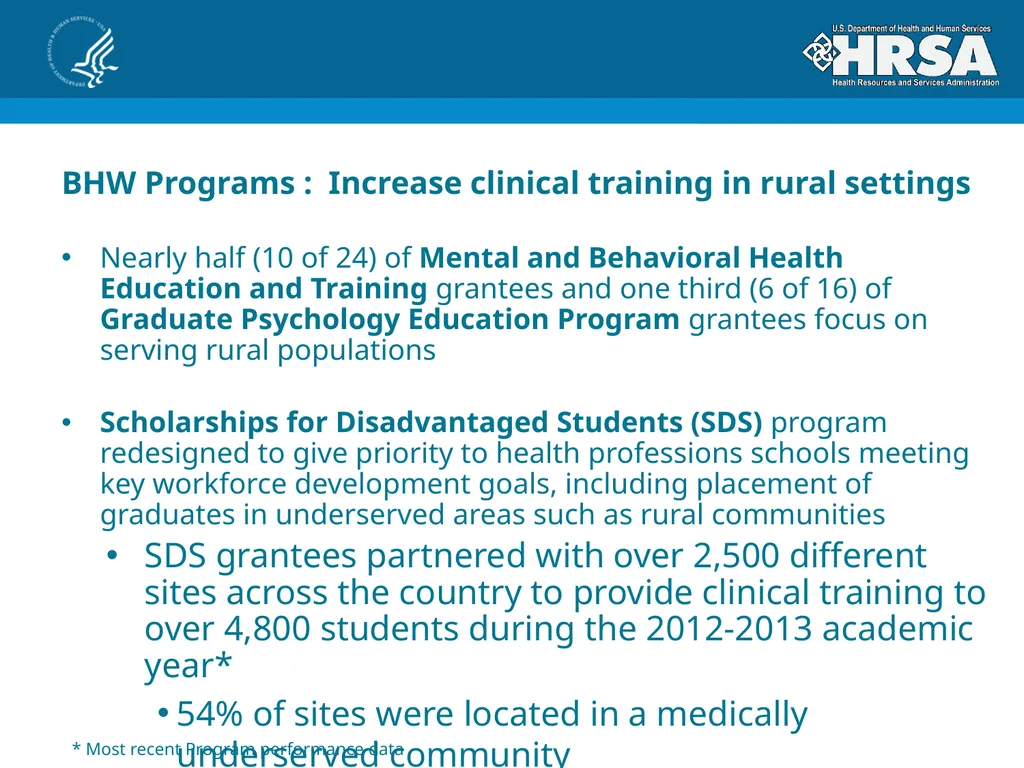
BHW Programs : Increase clinical training in rural settings
Nearly half (10 of 24) of Mental and Behavioral Health Education and Training grantees and one third (6 of 16) of Graduate Psychology Education Program grantees focus on serving rural populations
Scholarships for Disadvantaged Students (SDS) program redesigned to give priority to health professions schools meeting key workforce development goals, including placement of graduates in underserved areas such as rural communities
SDS grantees partnered with over 2,500 different sites across the country to provide clinical training to over 4,800 students during the 2012-2013 academic year*
54% of sites were located in a medically underserved community
14% of training sites were located in rural areas * Most recent Program performance data<br>
Nearly half (10 of 24) of Mental and Behavioral Health Education and Training grantees and one third (6 of 16) of Graduate Psychology Education Program grantees focus on serving rural populations
Scholarships for Disadvantaged Students (SDS) program redesigned to give priority to health professions schools meeting key workforce development goals, including placement of graduates in underserved areas such as rural communities
SDS grantees partnered with over 2,500 different sites across the country to provide clinical training to over 4,800 students during the 2012-2013 academic year*
54% of sites were located in a medically underserved community
14% of training sites were located in rural areas * Most recent Program performance data<br>
09
Area Health Education Centers (AHEC) expose medical students and health professions students to primary care and practice in rural and underserved communities; the AHEC program works to improve the distribution, diversity, quality and supply of the primary care health professions workforce serving in rural and underserved areas
Public Health Training Centers (PHTC) focus on the needs of underserved populations, and many specifically focus on rural issues; grantees provide continuing education training activities for public health students, faculty, and members of the public health workforce
25% (1 out of every 4) trainees trained during the 2012-2013 academic year reported being employed in a medically underserved community and/or rural area * Most recent Program performance data<br>
Public Health Training Centers (PHTC) focus on the needs of underserved populations, and many specifically focus on rural issues; grantees provide continuing education training activities for public health students, faculty, and members of the public health workforce
25% (1 out of every 4) trainees trained during the 2012-2013 academic year reported being employed in a medically underserved community and/or rural area * Most recent Program performance data<br>
10
Primary Care Training and Enhancement (PCTE)
Program strengthens medical education for physicians and physician assistants; the program provided direct financial support to 532 students, residents, and fellows during the 2012-2013 academic year*
25% (1 out of every 4) trainees reported coming from a rural background * Most recent Program performance data<br>
Program strengthens medical education for physicians and physician assistants; the program provided direct financial support to 532 students, residents, and fellows during the 2012-2013 academic year*
25% (1 out of every 4) trainees reported coming from a rural background * Most recent Program performance data<br>
11
Teaching Health Center GME Program Teaching Health Center Graduate Medical Education (THCGME) Program expands residency training in community-based settings
$230 million, five-year initiative (FY 2011-2015) created by the Affordable Care Act
Residency programs include family medicine, internal medicine, pediatrics, obstetrics and gynecology, psychiatry, geriatrics, and general dentistry
Community-based settings include urban, rural, and tribal communities
Program is instrumental in increasing access to health care services for people who are geographically isolated, economically or medically vulnerable
36% of THCGME programs provided clinical training at a rural site during the 2012-2013 academic year; and 29% of residents trained at a rural site, providing 38,445 hours of patient care*
$83.4 million in ACA funding for 2014-2015 academic year
Will support training of more than 550 residents in 60 Teaching Health Centers
Expanding states with Teaching Health Centers from 21 to 24 * Most recent Program performance data<br>
$230 million, five-year initiative (FY 2011-2015) created by the Affordable Care Act
Residency programs include family medicine, internal medicine, pediatrics, obstetrics and gynecology, psychiatry, geriatrics, and general dentistry
Community-based settings include urban, rural, and tribal communities
Program is instrumental in increasing access to health care services for people who are geographically isolated, economically or medically vulnerable
36% of THCGME programs provided clinical training at a rural site during the 2012-2013 academic year; and 29% of residents trained at a rural site, providing 38,445 hours of patient care*
$83.4 million in ACA funding for 2014-2015 academic year
Will support training of more than 550 residents in 60 Teaching Health Centers
Expanding states with Teaching Health Centers from 21 to 24 * Most recent Program performance data<br>
12
FY 2015 Budget Request<br>
13
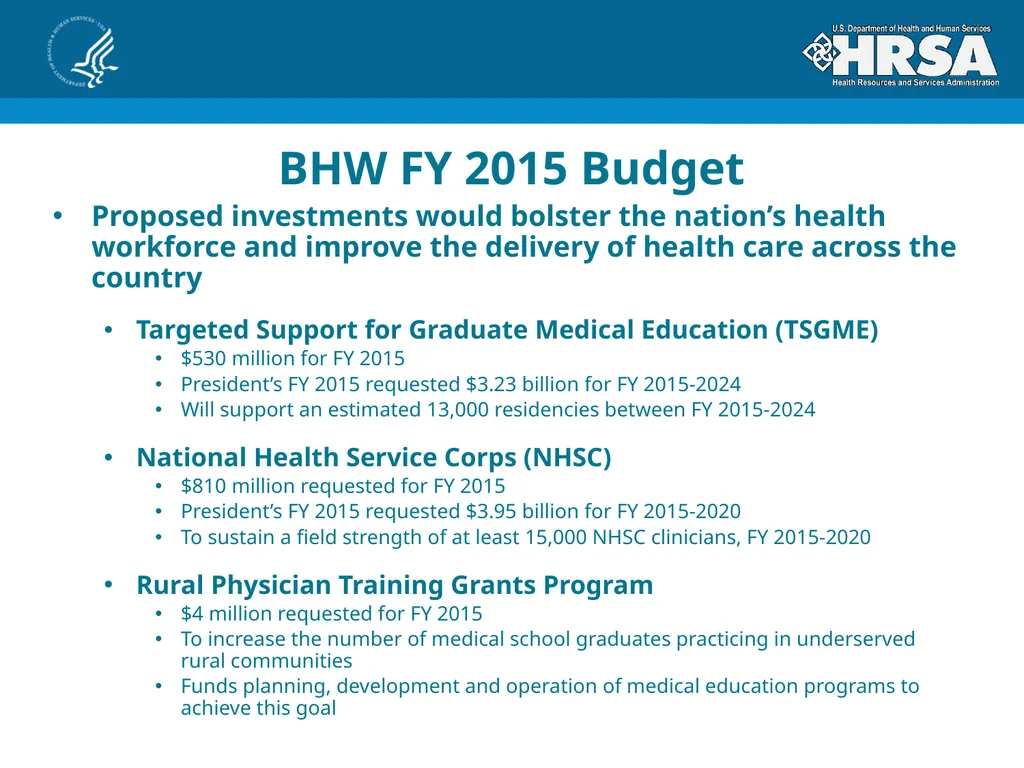
BHW FY 2015 Budget Proposed investments would bolster the nation’s health workforce and improve the delivery of health care across the country
Targeted Support for Graduate Medical Education (TSGME)
$530 million for FY 2015
President’s FY 2015 requested $3.23 billion for FY 2015-2024
Will support an estimated 13,000 residencies between FY 2015-2024
National Health Service Corps (NHSC)
$810 million requested for FY 2015
President’s FY 2015 requested $3.95 billion for FY 2015-2020
To sustain a field strength of at least 15,000 NHSC clinicians, FY 2015-2020
Rural Physician Training Grants Program
$4 million requested for FY 2015
To increase the number of medical school graduates practicing in underserved rural communities
Funds planning, development and operation of medical education programs to achieve this goal<br>
Targeted Support for Graduate Medical Education (TSGME)
$530 million for FY 2015
President’s FY 2015 requested $3.23 billion for FY 2015-2024
Will support an estimated 13,000 residencies between FY 2015-2024
National Health Service Corps (NHSC)
$810 million requested for FY 2015
President’s FY 2015 requested $3.95 billion for FY 2015-2020
To sustain a field strength of at least 15,000 NHSC clinicians, FY 2015-2020
Rural Physician Training Grants Program
$4 million requested for FY 2015
To increase the number of medical school graduates practicing in underserved rural communities
Funds planning, development and operation of medical education programs to achieve this goal<br>
14
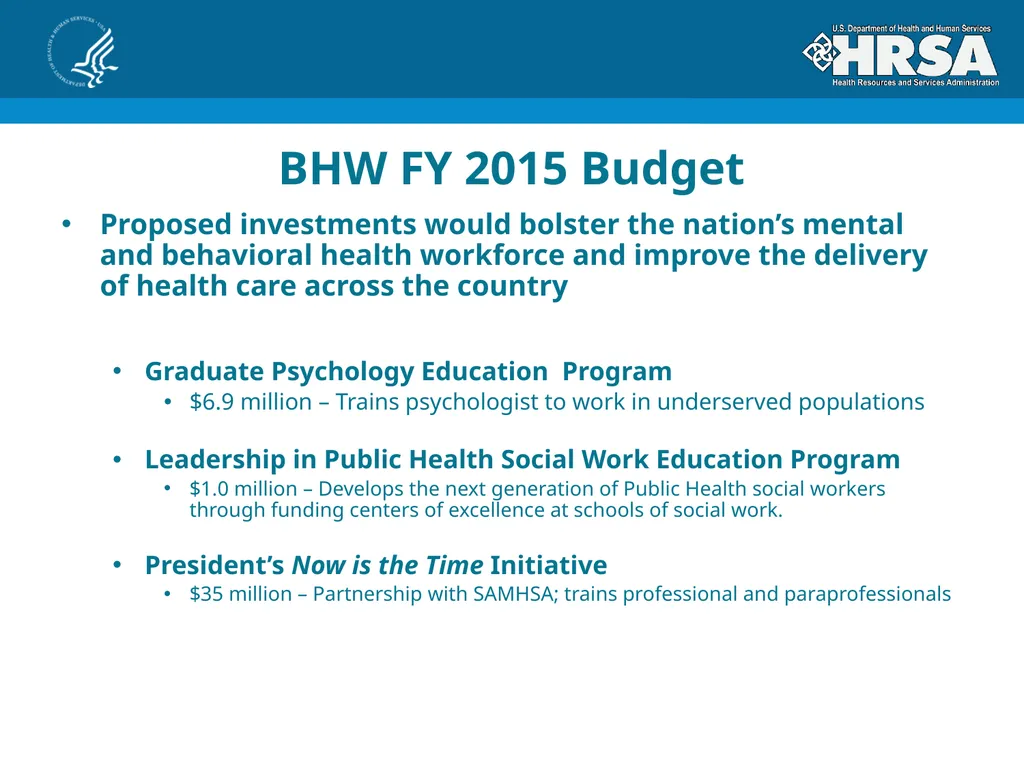
BHW FY 2015 Budget Proposed investments would bolster the nation’s mental and behavioral health workforce and improve the delivery of health care across the country
Graduate Psychology Education Program
$6.9 million – Trains psychologist to work in underserved populations
Leadership in Public Health Social Work Education Program
$1.0 million – Develops the next generation of Public Health social workers through funding centers of excellence at schools of social work.
President’s Now is the Time Initiative
$35 million – Partnership with SAMHSA; trains professional and paraprofessionals<br>
Graduate Psychology Education Program
$6.9 million – Trains psychologist to work in underserved populations
Leadership in Public Health Social Work Education Program
$1.0 million – Develops the next generation of Public Health social workers through funding centers of excellence at schools of social work.
President’s Now is the Time Initiative
$35 million – Partnership with SAMHSA; trains professional and paraprofessionals<br>
15
NHSC
Rural Engagement<br>
Rural Engagement<br>
16
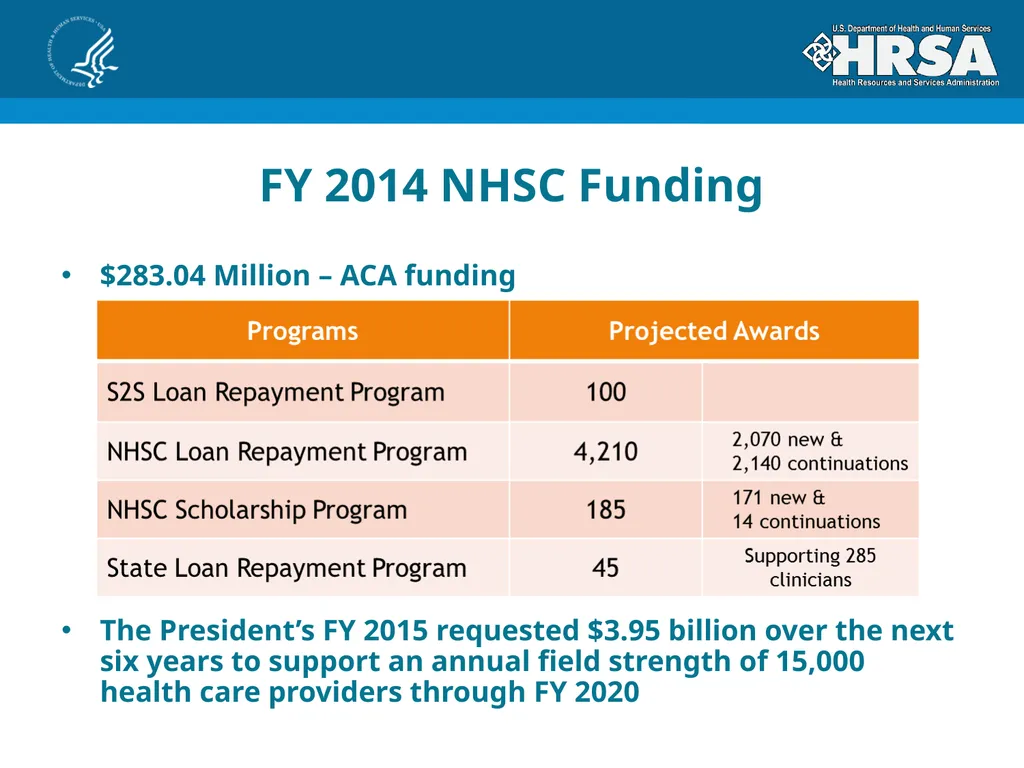
FY 2014 NHSC Funding $283.04 Million – ACA funding
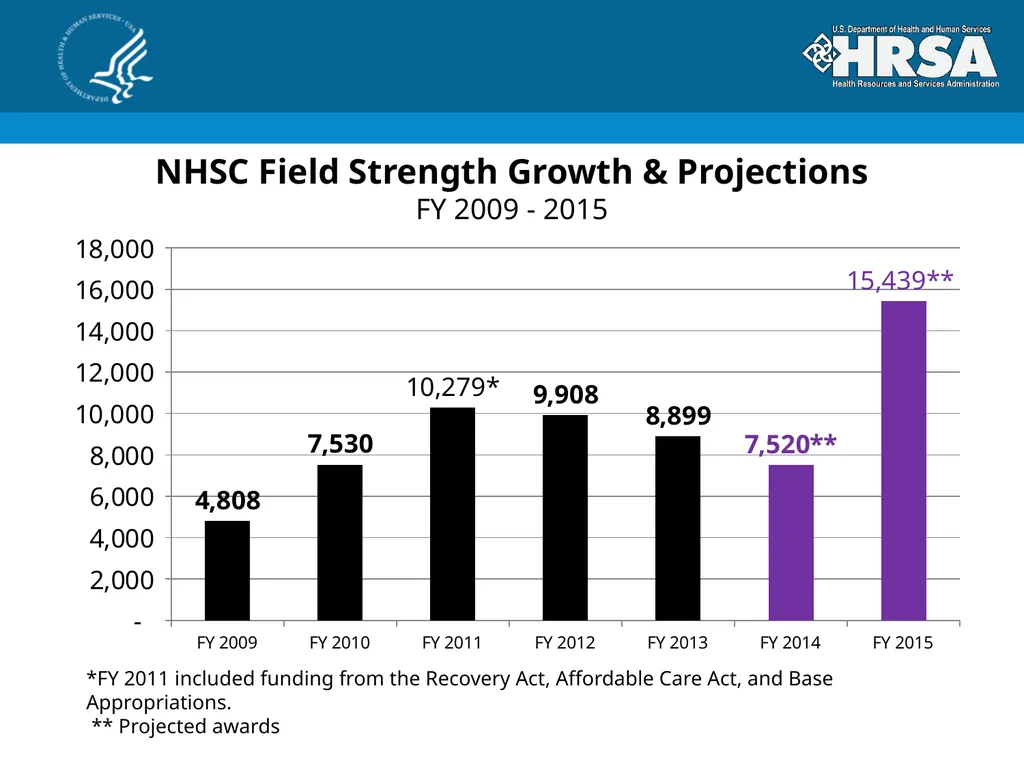
The President’s FY 2015 requested $3.95 billion over the next six years to support an annual field strength of 15,000 health care providers through FY 2020<br>
The President’s FY 2015 requested $3.95 billion over the next six years to support an annual field strength of 15,000 health care providers through FY 2020<br>
17
NHSC Field Strength Growth & Projections
FY 2009 - 2015 *FY 2011 included funding from the Recovery Act, Affordable Care Act, and Base Appropriations.
** Projected awards<br>
FY 2009 - 2015 *FY 2011 included funding from the Recovery Act, Affordable Care Act, and Base Appropriations.
** Projected awards<br>
18
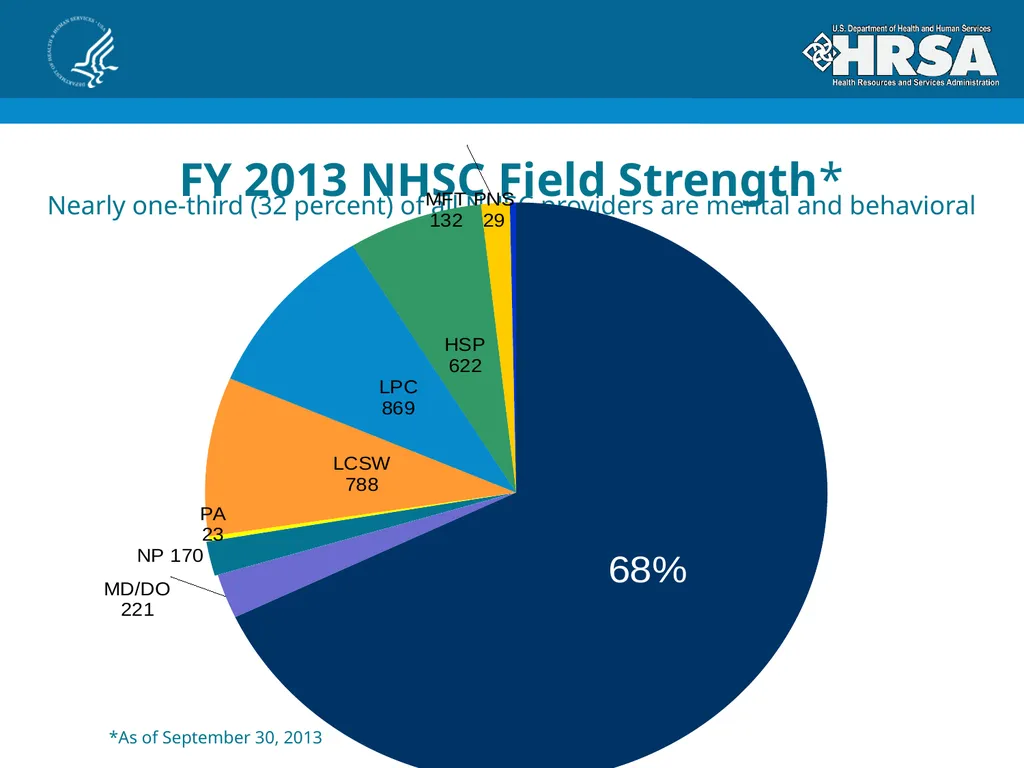
As of September 30, 2013, nearly 8,900 NHSC clinicians were working in communities with limited access to health care * Mental and Behavioral Health Provider disciplines include: Health Service Psychologist, Licensed Clinical Social Worker, Psychiatric Nurse Specialist, Marriage and Family Therapist, and Licensed Professional Counselor<br>
19
*As of September 30, 2013 FY 2013 NHSC Field Strength* Nearly one-third (32 percent) of all NHSC providers are mental and behavioral health<br>
20
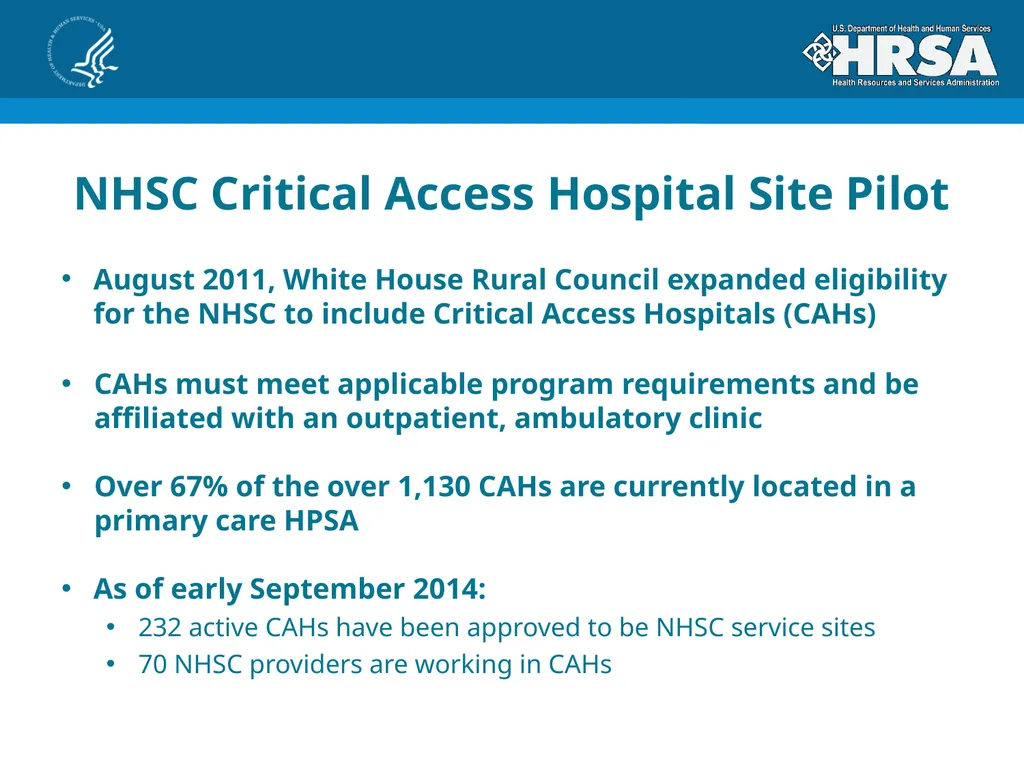
NHSC Critical Access Hospital Site Pilot August 2011, White House Rural Council expanded eligibility for the NHSC to include Critical Access Hospitals (CAHs)
CAHs must meet applicable program requirements and be affiliated with an outpatient, ambulatory clinic
Over 67% of the over 1,130 CAHs are currently located in a primary care HPSA
As of early September 2014:
232 active CAHs have been approved to be NHSC service sites
70 NHSC providers are working in CAHs<br>
CAHs must meet applicable program requirements and be affiliated with an outpatient, ambulatory clinic
Over 67% of the over 1,130 CAHs are currently located in a primary care HPSA
As of early September 2014:
232 active CAHs have been approved to be NHSC service sites
70 NHSC providers are working in CAHs<br>
21
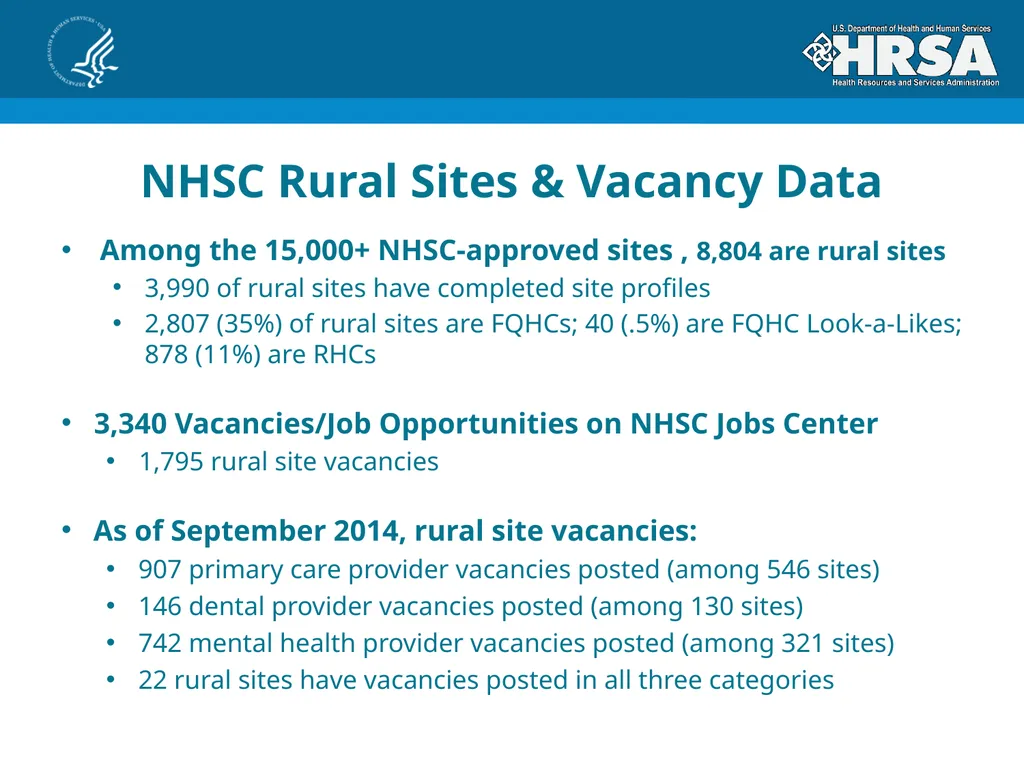
NHSC Rural Sites & Vacancy Data Among the 15,000+ NHSC-approved sites , 8,804 are rural sites
3,990 of rural sites have completed site profiles
2,807 (35%) of rural sites are FQHCs; 40 (.5%) are FQHC Look-a-Likes; 878 (11%) are RHCs
3,340 Vacancies/Job Opportunities on NHSC Jobs Center
1,795 rural site vacancies
As of September 2014, rural site vacancies:
907 primary care provider vacancies posted (among 546 sites)
146 dental provider vacancies posted (among 130 sites)
742 mental health provider vacancies posted (among 321 sites)
22 rural sites have vacancies posted in all three categories<br>
3,990 of rural sites have completed site profiles
2,807 (35%) of rural sites are FQHCs; 40 (.5%) are FQHC Look-a-Likes; 878 (11%) are RHCs
3,340 Vacancies/Job Opportunities on NHSC Jobs Center
1,795 rural site vacancies
As of September 2014, rural site vacancies:
907 primary care provider vacancies posted (among 546 sites)
146 dental provider vacancies posted (among 130 sites)
742 mental health provider vacancies posted (among 321 sites)
22 rural sites have vacancies posted in all three categories<br>
22
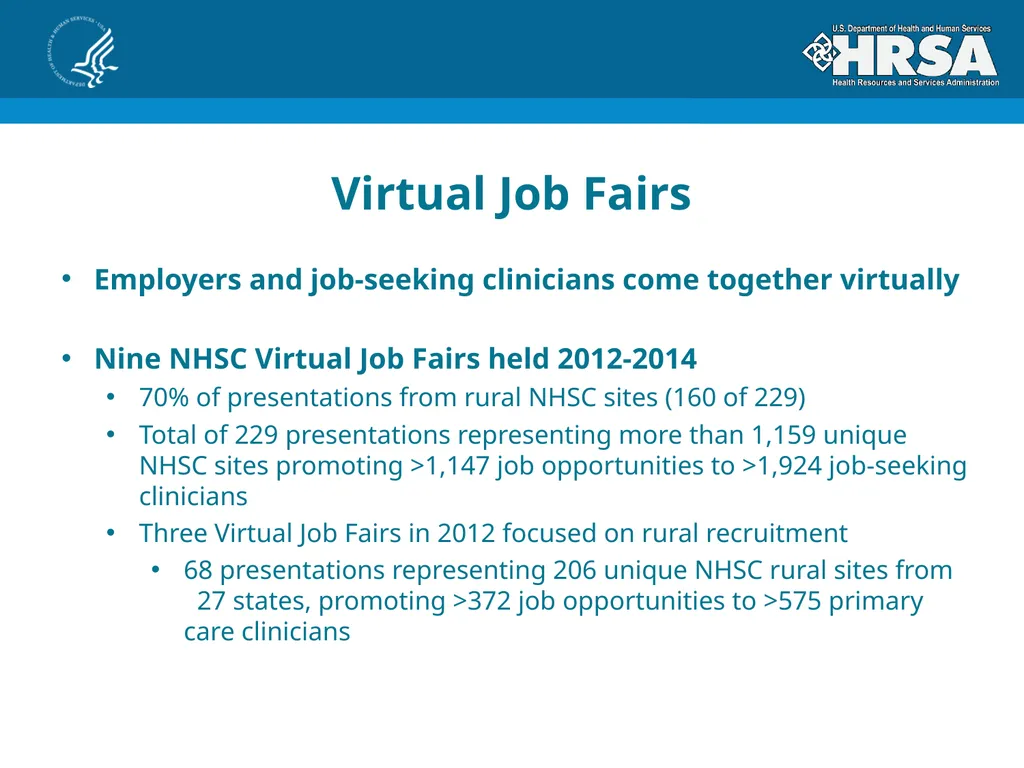
Virtual Job Fairs Employers and job-seeking clinicians come together virtually
Nine NHSC Virtual Job Fairs held 2012-2014
70% of presentations from rural NHSC sites (160 of 229)
Total of 229 presentations representing more than 1,159 unique NHSC sites promoting >1,147 job opportunities to >1,924 job-seeking clinicians
Three Virtual Job Fairs in 2012 focused on rural recruitment
68 presentations representing 206 unique NHSC rural sites from 27 states, promoting >372 job opportunities to >575 primary care clinicians<br>
Nine NHSC Virtual Job Fairs held 2012-2014
70% of presentations from rural NHSC sites (160 of 229)
Total of 229 presentations representing more than 1,159 unique NHSC sites promoting >1,147 job opportunities to >1,924 job-seeking clinicians
Three Virtual Job Fairs in 2012 focused on rural recruitment
68 presentations representing 206 unique NHSC rural sites from 27 states, promoting >372 job opportunities to >575 primary care clinicians<br>
23
Affordable Care Act<br>
24
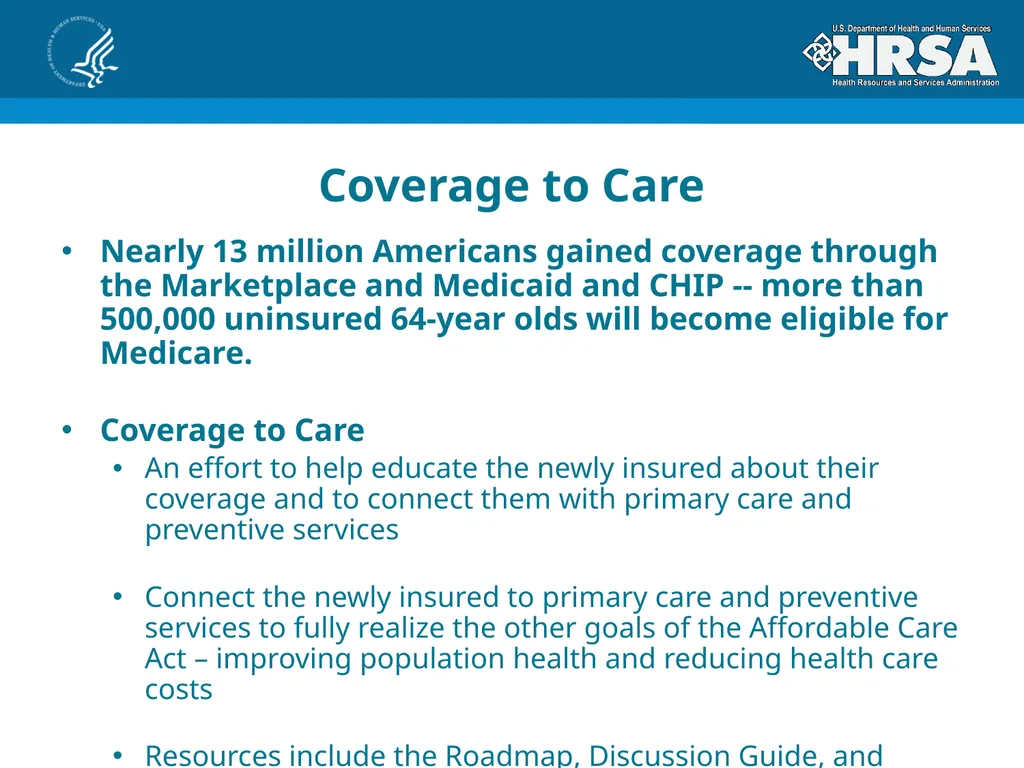
Coverage to Care Nearly 13 million Americans gained coverage through the Marketplace and Medicaid and CHIP -- more than 500,000 uninsured 64-year olds will become eligible for Medicare.
Coverage to Care
An effort to help educate the newly insured about their coverage and to connect them with primary care and preventive services
Connect the newly insured to primary care and preventive services to fully realize the other goals of the Affordable Care Act – improving population health and reducing health care costs
Resources include the Roadmap, Discussion Guide, and videos at http://marketplace.cms.gov/c2c<br>
Coverage to Care
An effort to help educate the newly insured about their coverage and to connect them with primary care and preventive services
Connect the newly insured to primary care and preventive services to fully realize the other goals of the Affordable Care Act – improving population health and reducing health care costs
Resources include the Roadmap, Discussion Guide, and videos at http://marketplace.cms.gov/c2c<br>
25
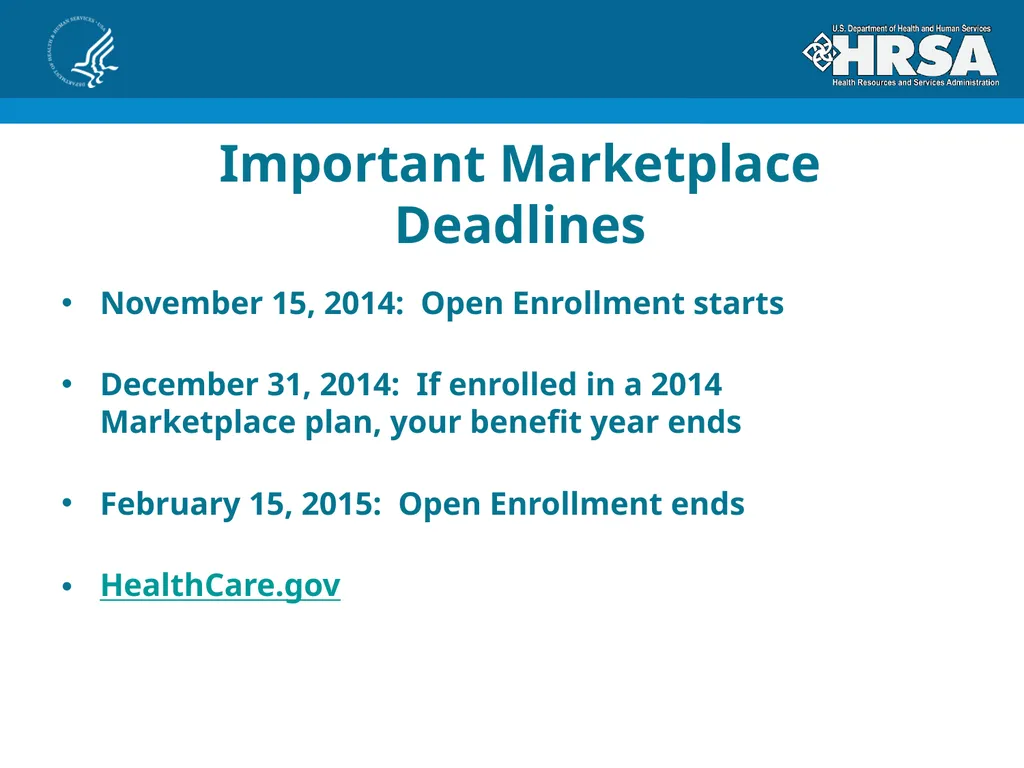
Important Marketplace Deadlines November 15, 2014: Open Enrollment starts
December 31, 2014: If enrolled in a 2014 Marketplace plan, your benefit year ends
February 15, 2015: Open Enrollment ends
HealthCare.gov<br>
December 31, 2014: If enrolled in a 2014 Marketplace plan, your benefit year ends
February 15, 2015: Open Enrollment ends
HealthCare.gov<br>
26
Questions/Discussion<br>
27
Contact Information Kimberly Kleine
Director
Office of Health Careers
Bureau of Health Workforce
kkleine@hrsa.gov<br>
Director
Office of Health Careers
Bureau of Health Workforce
kkleine@hrsa.gov<br>