
Business Analysis & Valuation Using Financial
CP
Published · 224 slides · 0 views

1 / 1















Description
Business Analysis Valuation Using Financial Statements Lecture Notes Professor David M. Chen Graduate Institute of Finance Palepu, Krishna G., Paul M. Healy, and Victor L. Bernard 3rd edn, South-Western, Thomson, 2004 Content I. Framework
Related Topics
Share
Embed code
Download this presentation From Below
"Business Analysis & Valuation Using Financial" is the property of its rightful owner. Permission is granted to download and print the materials on this website for personal, non-commercial use only, and to display it on your personal computer provided you do not modify the materials and that you retain all copyright notices contained in the materials. By downloading content from our website, you accept the terms of this agreement.
Presentation Transcript
01
Business Analysis
& Valuation
Using Financial Statements Lecture Notes
Professor David M. Chen
Graduate Institute of Finance
Palepu, Krishna G., Paul M. Healy, and Victor L. Bernard
3rd edn, South-Western, Thomson, 2004<br>
Professor David M. Chen
Graduate Institute of Finance
Palepu, Krishna G., Paul M. Healy, and Victor L. Bernard
3rd edn, South-Western, Thomson, 2004<br>
02
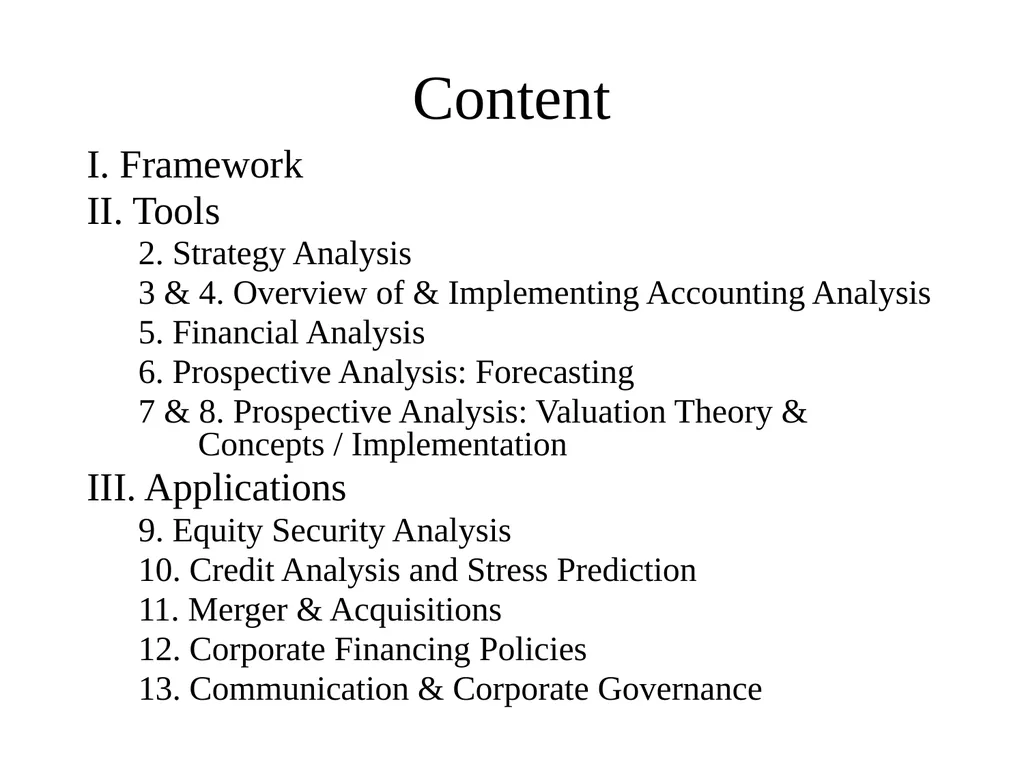
Content I. Framework
II. Tools
2. Strategy Analysis
3 & 4. Overview of & Implementing Accounting Analysis
5. Financial Analysis
6. Prospective Analysis: Forecasting
7 & 8. Prospective Analysis: Valuation Theory & Concepts / Implementation
III. Applications
9. Equity Security Analysis
10. Credit Analysis and Stress Prediction
11. Merger & Acquisitions
12. Corporate Financing Policies
13. Communication & Corporate Governance<br>
II. Tools
2. Strategy Analysis
3 & 4. Overview of & Implementing Accounting Analysis
5. Financial Analysis
6. Prospective Analysis: Forecasting
7 & 8. Prospective Analysis: Valuation Theory & Concepts / Implementation
III. Applications
9. Equity Security Analysis
10. Credit Analysis and Stress Prediction
11. Merger & Acquisitions
12. Corporate Financing Policies
13. Communication & Corporate Governance<br>
03
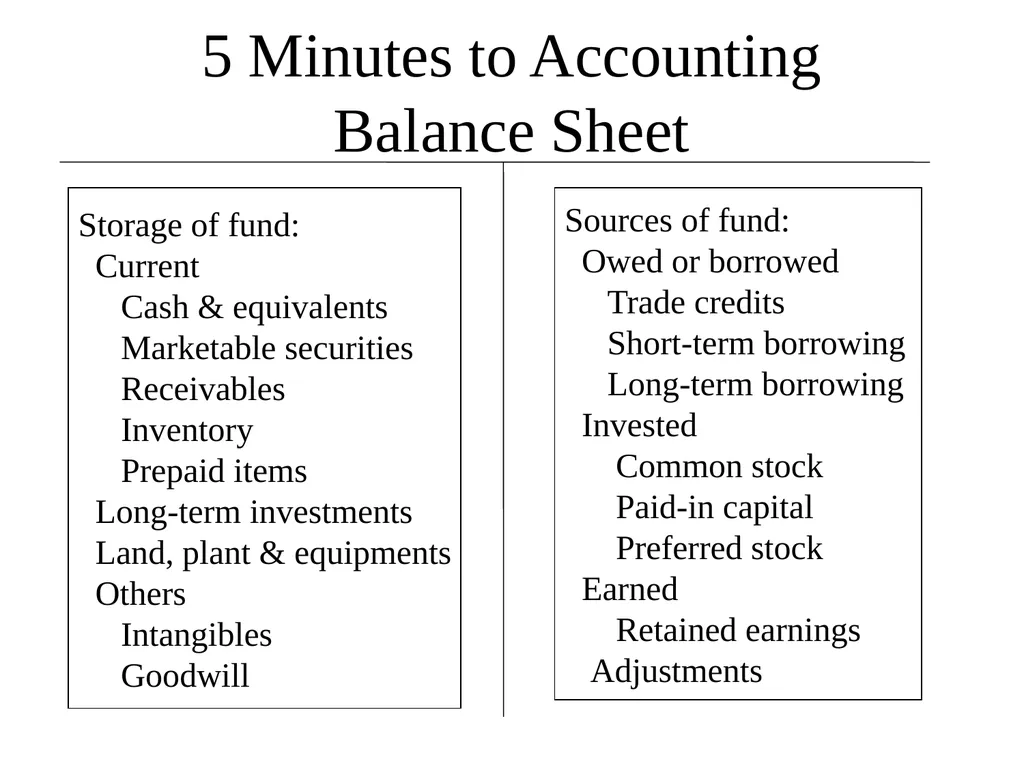
5 Minutes to Accounting
Balance Sheet Sources of fund:
Owed or borrowed
Trade credits
Short-term borrowing
Long-term borrowing
Invested
Common stock
Paid-in capital
Preferred stock
Earned
Retained earnings
Adjustments Storage of fund:
Current
Cash & equivalents
Marketable securities
Receivables
Inventory
Prepaid items
Long-term investments
Land, plant & equipments
Others
Intangibles
Goodwill<br>
Owed or borrowed
Trade credits
Short-term borrowing
Long-term borrowing
Invested
Common stock
Paid-in capital
Preferred stock
Earned
Retained earnings
Adjustments Storage of fund:
Current
Cash & equivalents
Marketable securities
Receivables
Inventory
Prepaid items
Long-term investments
Land, plant & equipments
Others
Intangibles
Goodwill<br>
04
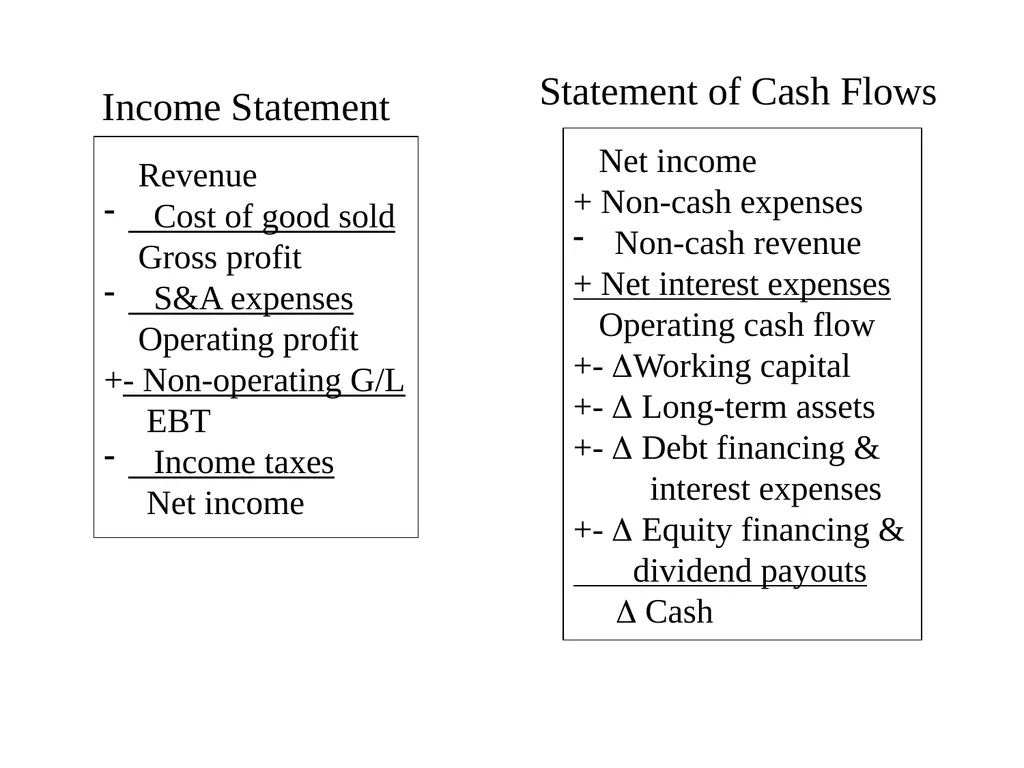
Income Statement Statement of Cash Flows Revenue
Cost of good sold
Gross profit
S&A expenses
Operating profit
+- Non-operating G/L
EBT
Income taxes
Net income Net income
+ Non-cash expenses
Non-cash revenue
+ Net interest expenses
Operating cash flow
+- Working capital
+- Long-term assets
+- Debt financing &
interest expenses
+- Equity financing &
dividend payouts
Cash<br>
Cost of good sold
Gross profit
S&A expenses
Operating profit
+- Non-operating G/L
EBT
Income taxes
Net income Net income
+ Non-cash expenses
Non-cash revenue
+ Net interest expenses
Operating cash flow
+- Working capital
+- Long-term assets
+- Debt financing &
interest expenses
+- Equity financing &
dividend payouts
Cash<br>
05
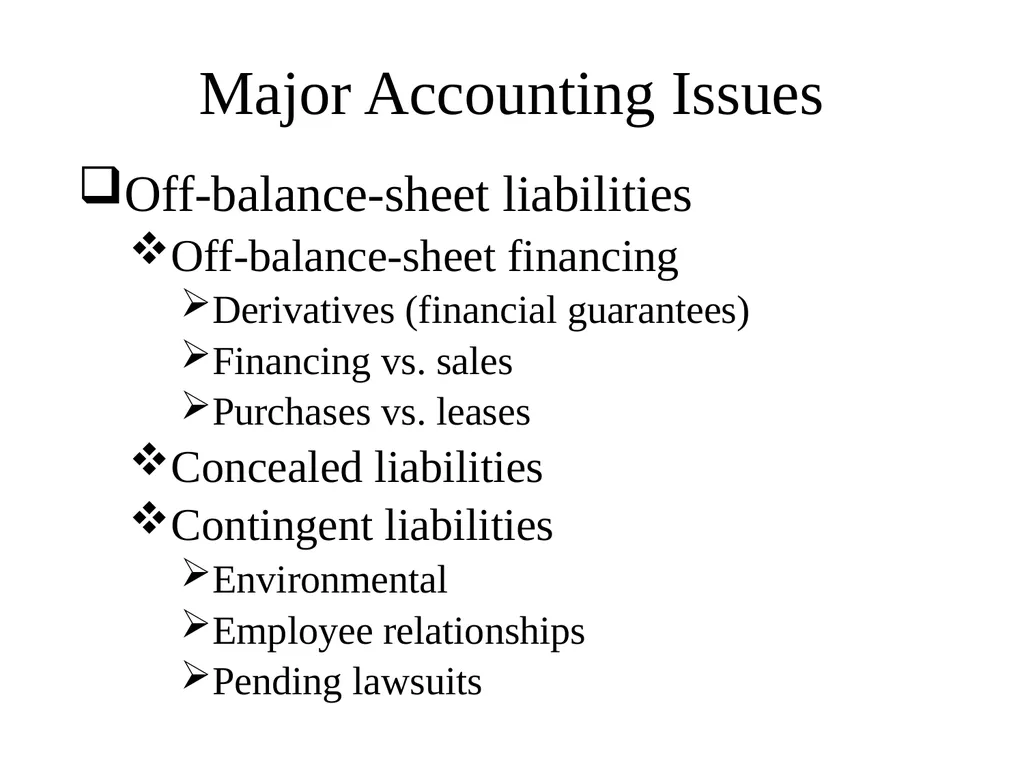
Major Accounting Issues Off-balance-sheet liabilities
Off-balance-sheet financing
Derivatives (financial guarantees)
Financing vs. sales
Purchases vs. leases
Concealed liabilities
Contingent liabilities
Environmental
Employee relationships
Pending lawsuits<br>
Off-balance-sheet financing
Derivatives (financial guarantees)
Financing vs. sales
Purchases vs. leases
Concealed liabilities
Contingent liabilities
Environmental
Employee relationships
Pending lawsuits<br>
06
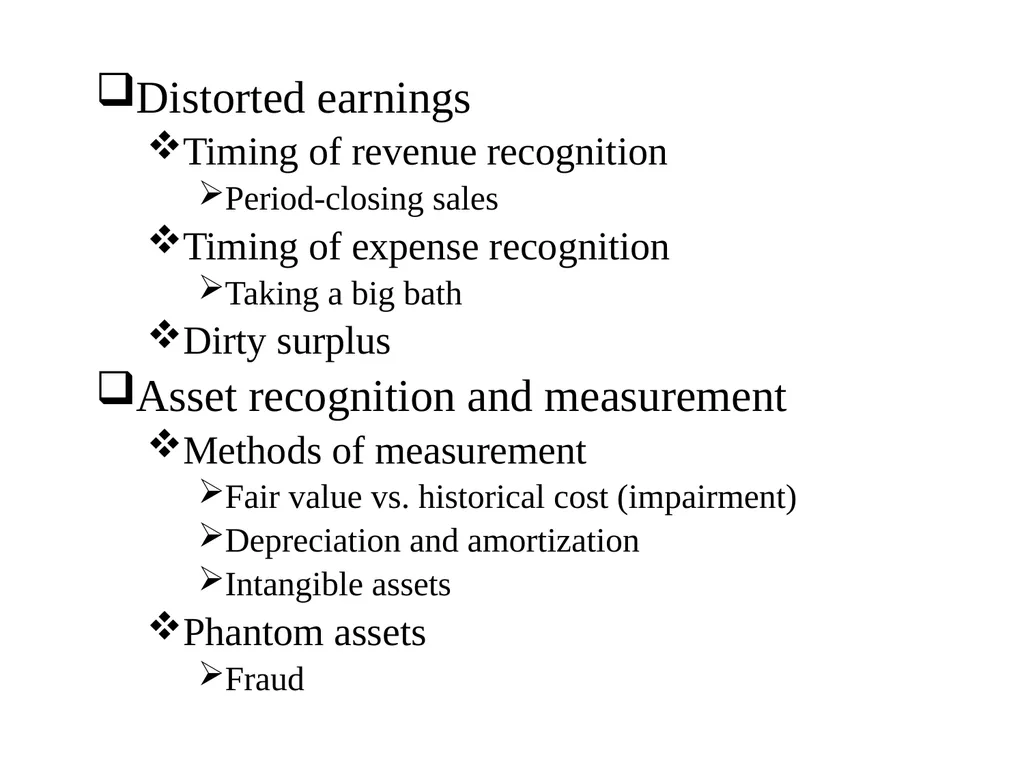
Distorted earnings
Timing of revenue recognition
Period-closing sales
Timing of expense recognition
Taking a big bath
Dirty surplus
Asset recognition and measurement
Methods of measurement
Fair value vs. historical cost (impairment)
Depreciation and amortization
Intangible assets
Phantom assets
Fraud<br>
Timing of revenue recognition
Period-closing sales
Timing of expense recognition
Taking a big bath
Dirty surplus
Asset recognition and measurement
Methods of measurement
Fair value vs. historical cost (impairment)
Depreciation and amortization
Intangible assets
Phantom assets
Fraud<br>
07
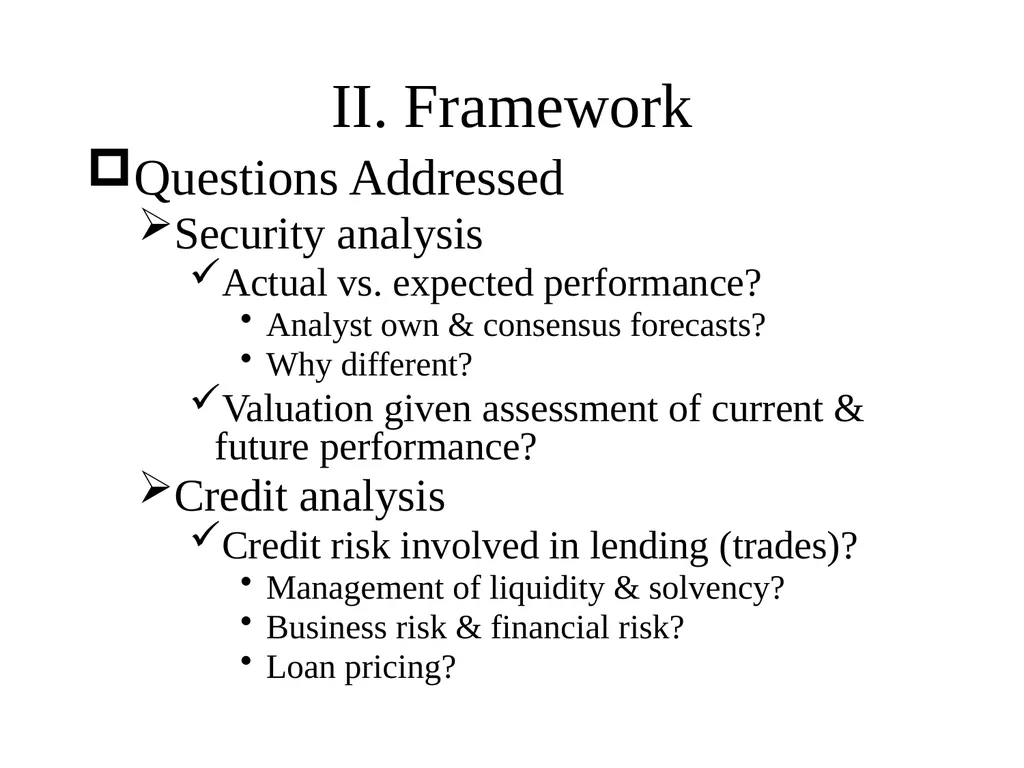
II. Framework Questions Addressed
Security analysis
Actual vs. expected performance?
Analyst own & consensus forecasts?
Why different?
Valuation given assessment of current & future performance?
Credit analysis
Credit risk involved in lending (trades)?
Management of liquidity & solvency?
Business risk & financial risk?
Loan pricing?<br>
Security analysis
Actual vs. expected performance?
Analyst own & consensus forecasts?
Why different?
Valuation given assessment of current & future performance?
Credit analysis
Credit risk involved in lending (trades)?
Management of liquidity & solvency?
Business risk & financial risk?
Loan pricing?<br>
08
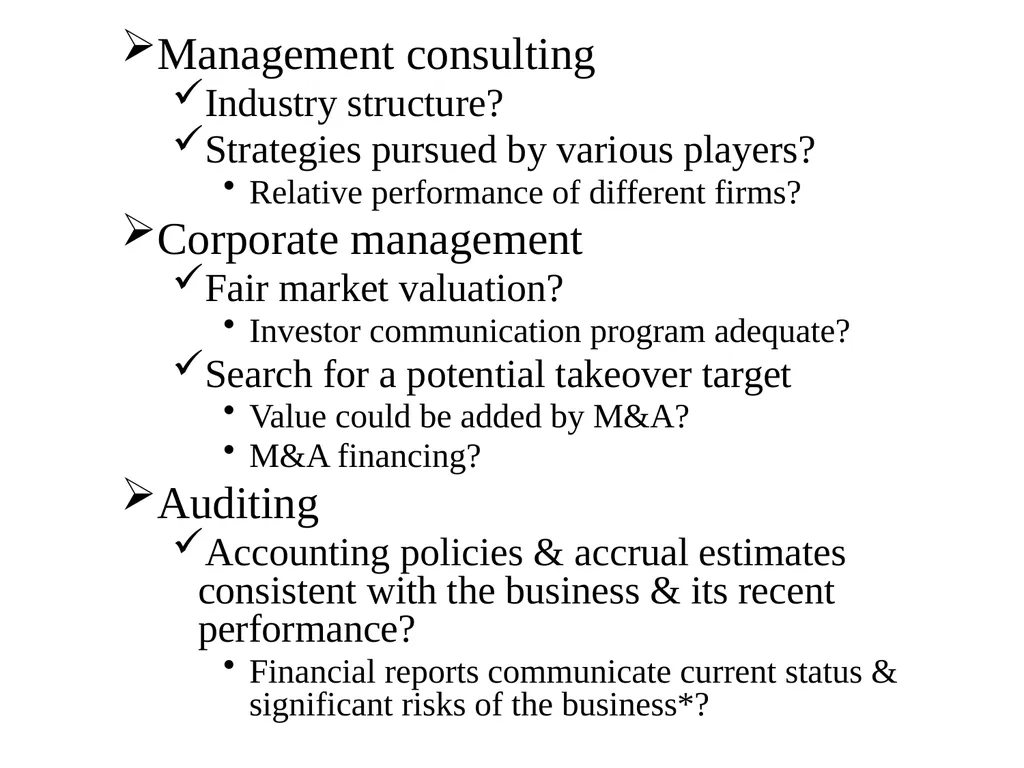
Management consulting
Industry structure?
Strategies pursued by various players?
Relative performance of different firms?
Corporate management
Fair market valuation?
Investor communication program adequate?
Search for a potential takeover target
Value could be added by M&A?
M&A financing?
Auditing
Accounting policies & accrual estimates consistent with the business & its recent performance?
Financial reports communicate current status & significant risks of the business*?<br>
Industry structure?
Strategies pursued by various players?
Relative performance of different firms?
Corporate management
Fair market valuation?
Investor communication program adequate?
Search for a potential takeover target
Value could be added by M&A?
M&A financing?
Auditing
Accounting policies & accrual estimates consistent with the business & its recent performance?
Financial reports communicate current status & significant risks of the business*?<br>
09
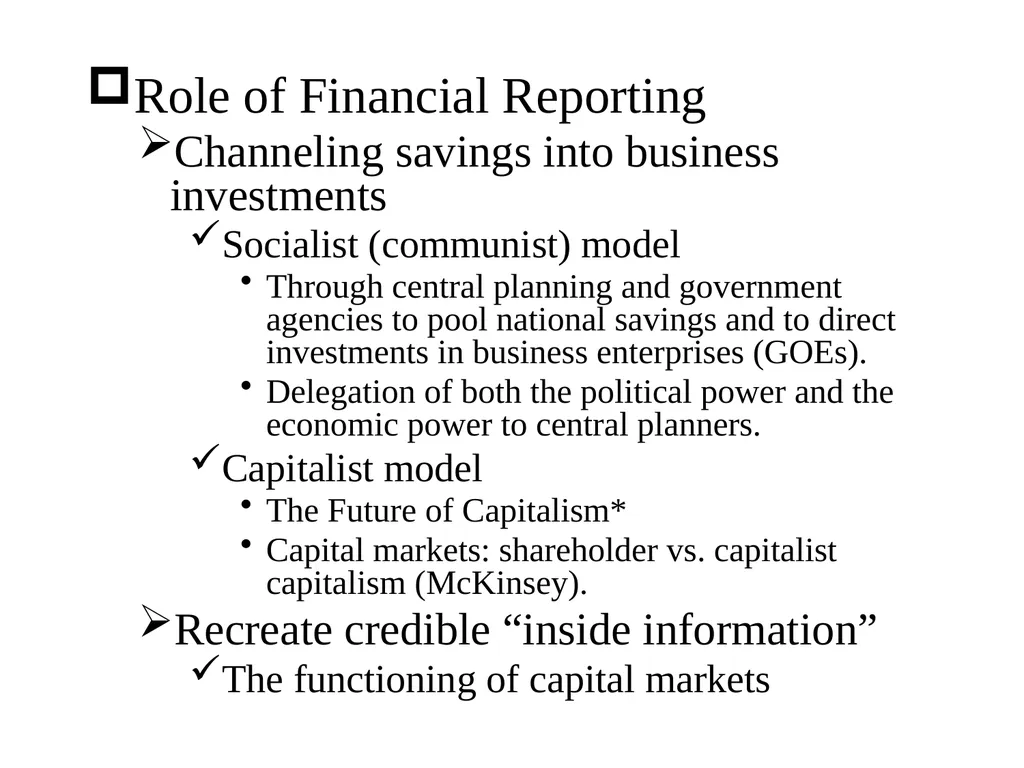
Role of Financial Reporting
Channeling savings into business investments
Socialist (communist) model
Through central planning and government agencies to pool national savings and to direct investments in business enterprises (GOEs).
Delegation of both the political power and the economic power to central planners.
Capitalist model
The Future of Capitalism*
Capital markets: shareholder vs. capitalist capitalism (McKinsey).
Recreate credible “inside information”
The functioning of capital markets<br>
Channeling savings into business investments
Socialist (communist) model
Through central planning and government agencies to pool national savings and to direct investments in business enterprises (GOEs).
Delegation of both the political power and the economic power to central planners.
Capitalist model
The Future of Capitalism*
Capital markets: shareholder vs. capitalist capitalism (McKinsey).
Recreate credible “inside information”
The functioning of capital markets<br>
10
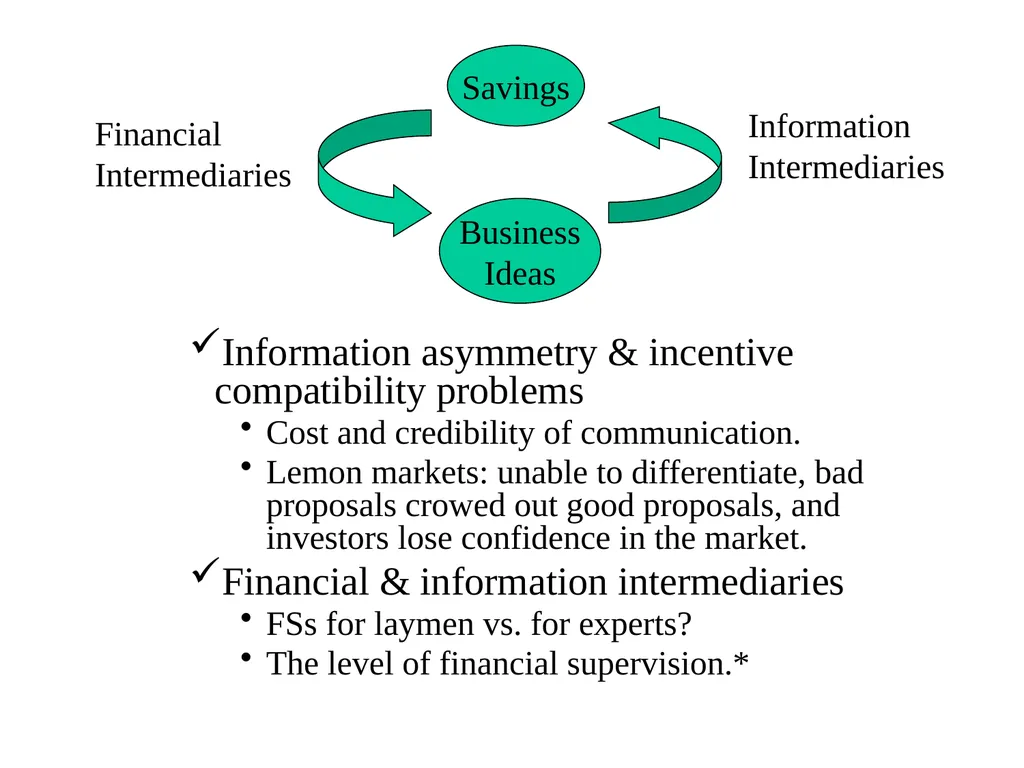
Information asymmetry & incentive compatibility problems
Cost and credibility of communication.
Lemon markets: unable to differentiate, bad proposals crowed out good proposals, and investors lose confidence in the market.
Financial & information intermediaries
FSs for laymen vs. for experts?
The level of financial supervision.* Savings Business
Ideas Information
Intermediaries Financial
Intermediaries<br>
Cost and credibility of communication.
Lemon markets: unable to differentiate, bad proposals crowed out good proposals, and investors lose confidence in the market.
Financial & information intermediaries
FSs for laymen vs. for experts?
The level of financial supervision.* Savings Business
Ideas Information
Intermediaries Financial
Intermediaries<br>
11
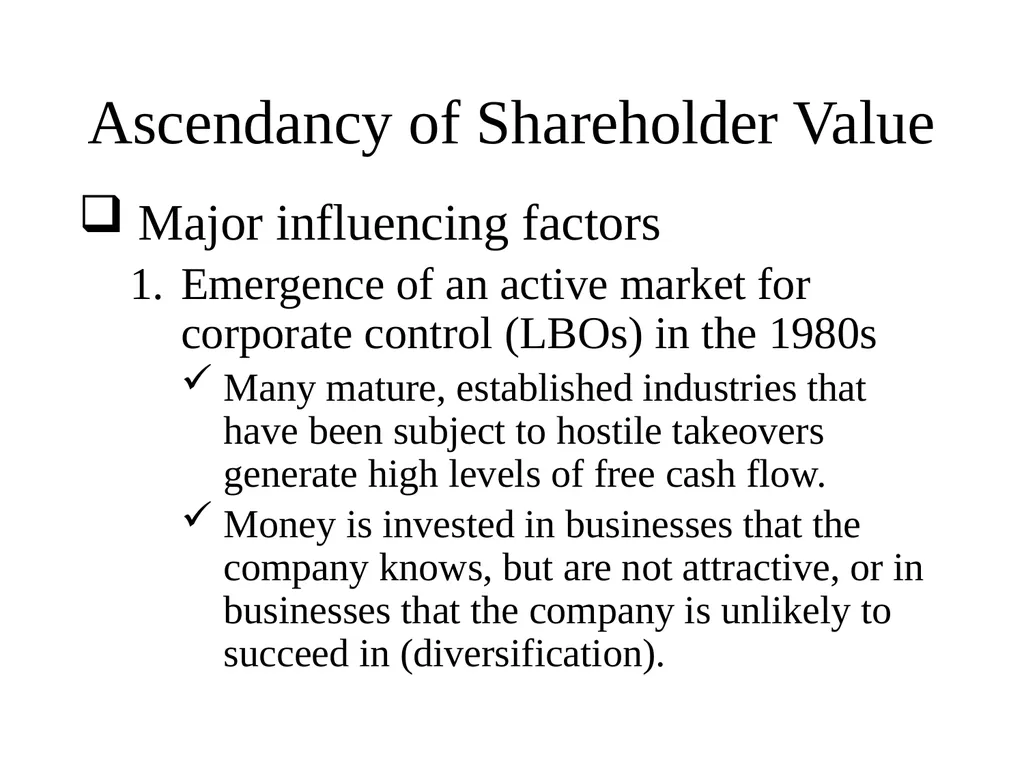
Ascendancy of Shareholder Value Major influencing factors
Emergence of an active market for corporate control (LBOs) in the 1980s
Many mature, established industries that have been subject to hostile takeovers generate high levels of free cash flow.
Money is invested in businesses that the company knows, but are not attractive, or in businesses that the company is unlikely to succeed in (diversification).<br>
Emergence of an active market for corporate control (LBOs) in the 1980s
Many mature, established industries that have been subject to hostile takeovers generate high levels of free cash flow.
Money is invested in businesses that the company knows, but are not attractive, or in businesses that the company is unlikely to succeed in (diversification).<br>
12
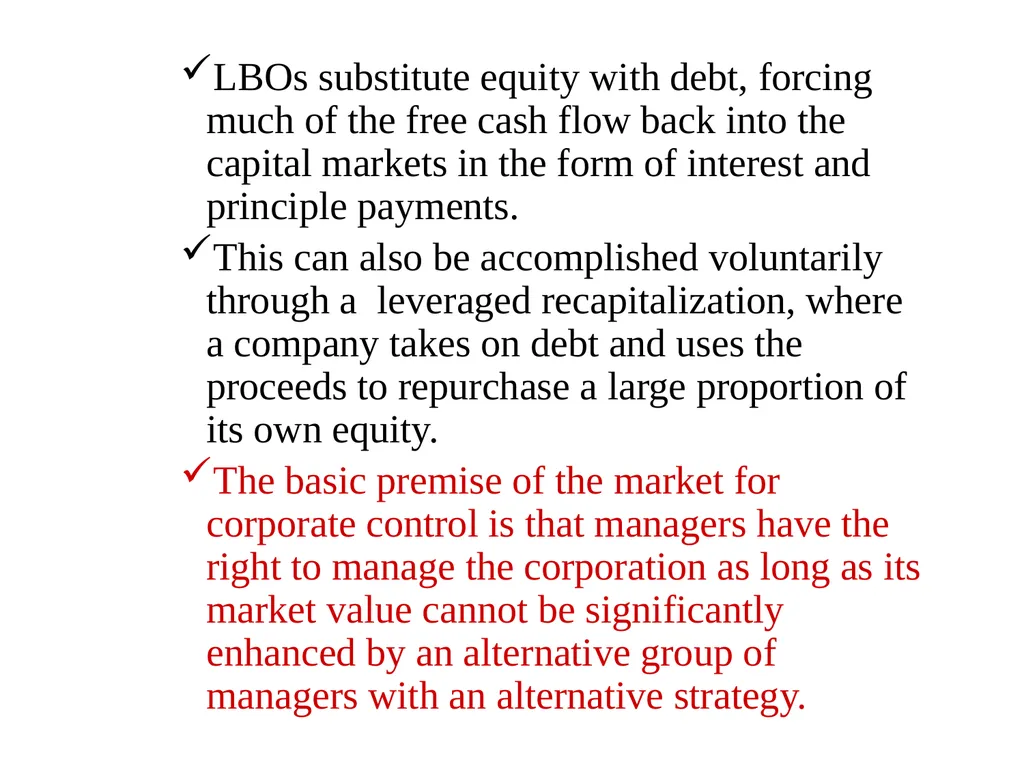
LBOs substitute equity with debt, forcing much of the free cash flow back into the capital markets in the form of interest and principle payments.
This can also be accomplished voluntarily through a leveraged recapitalization, where a company takes on debt and uses the proceeds to repurchase a large proportion of its own equity.
The basic premise of the market for corporate control is that managers have the right to manage the corporation as long as its market value cannot be significantly enhanced by an alternative group of managers with an alternative strategy.<br>
This can also be accomplished voluntarily through a leveraged recapitalization, where a company takes on debt and uses the proceeds to repurchase a large proportion of its own equity.
The basic premise of the market for corporate control is that managers have the right to manage the corporation as long as its market value cannot be significantly enhanced by an alternative group of managers with an alternative strategy.<br>
13
Growing importance of equity-based features in the pay package of most senior executives.
Perceived divergence between managers’ and shareholders’ interest.
Anxiousness over 10 years of falling corporate profitability and stagnant share prices.
The increasing attention paid to stakeholder arguments, which, in the eyes of shareholder value proponents, had become an excuse for inadequate performance.
Agency theory called for redesigning management’s incentives to be more closely aligned with the interests of the shareholders.<br>
Perceived divergence between managers’ and shareholders’ interest.
Anxiousness over 10 years of falling corporate profitability and stagnant share prices.
The increasing attention paid to stakeholder arguments, which, in the eyes of shareholder value proponents, had become an excuse for inadequate performance.
Agency theory called for redesigning management’s incentives to be more closely aligned with the interests of the shareholders.<br>
14
By 1998, the estimated PV of stock options represented 45% of the median pay package of CEOs.
A movement developed to require that nonexecutive board members have an equity stack in the companies they represented so that they would be more inclined to pay attention to shareholder returns, if only for self-interest.
By the late 1990s, 48% of medium and large companies had a stock grant or option package for board members, in contrast to virtually none in 1983.
The widening use of stock options has greatly increased the importance of shareholder returns in the measurement of managerial performance.*<br>
A movement developed to require that nonexecutive board members have an equity stack in the companies they represented so that they would be more inclined to pay attention to shareholder returns, if only for self-interest.
By the late 1990s, 48% of medium and large companies had a stock grant or option package for board members, in contrast to virtually none in 1983.
The widening use of stock options has greatly increased the importance of shareholder returns in the measurement of managerial performance.*<br>
15
Increased penetration of equity holdings as a percentage of household assets.
Growing segments of the population are becoming shareholders through mutual funds and retirement programs.
Among the most vocal proponents of shareholder value are the managers of major retirement systems.
Privatization of large government monopolies where governments became active marketers of the share of these companies.
The old notions of labor vs. capital are losing currency.<br>
Growing segments of the population are becoming shareholders through mutual funds and retirement programs.
Among the most vocal proponents of shareholder value are the managers of major retirement systems.
Privatization of large government monopolies where governments became active marketers of the share of these companies.
The old notions of labor vs. capital are losing currency.<br>
16
Growing recognition that many social systems are heading for insolvency.
Most of the public pension plans are set up as pay-as-you-go systems: contributions of workers today are used to pay the retirement of current retirees, however, the number of workers to support one retiree is decreasing.*
Have to move to some form of funded pension system where at least a part of the premiums that workers pay are actually set aside for their retirement.
The challenge is how to make it through the transition: no solution unless the savings in the funded part (raising retirement premiums) of the system generate attractive returns.<br>
Most of the public pension plans are set up as pay-as-you-go systems: contributions of workers today are used to pay the retirement of current retirees, however, the number of workers to support one retiree is decreasing.*
Have to move to some form of funded pension system where at least a part of the premiums that workers pay are actually set aside for their retirement.
The challenge is how to make it through the transition: no solution unless the savings in the funded part (raising retirement premiums) of the system generate attractive returns.<br>
17
Shareholder Capitalism
The U.S. corporate focus on shareholder value tends to limit investment in outdated strategies, even encourage divestment, well before any competing governance model would.
It is hard to claim that the capital markets are shortsighted compared with other corporate governors—the high number and value of technology and internet companies going public in recent years attests to this.
McKinsey Global Institute attributed the U.S. advantage in GDP per capita to much higher factor productivity, especially capital productivity (financial returns).*<br>
The U.S. corporate focus on shareholder value tends to limit investment in outdated strategies, even encourage divestment, well before any competing governance model would.
It is hard to claim that the capital markets are shortsighted compared with other corporate governors—the high number and value of technology and internet companies going public in recent years attests to this.
McKinsey Global Institute attributed the U.S. advantage in GDP per capita to much higher factor productivity, especially capital productivity (financial returns).*<br>
18
Virtuous cycle: the most productive and innovative companies would create the highest returns to shareholders and attract better workers, who would be more productive and increase returns further (Adam Smith).
An economy’s ability to create jobs, or its lack thereof, is the better measure of fairness.
A company that focuses on building shareholder value is served well by being a good corporate citizen: does not come at the expense of other stakeholders.
Market economy: market value added is positively related to labor productivity as well as employment growth.<br>
An economy’s ability to create jobs, or its lack thereof, is the better measure of fairness.
A company that focuses on building shareholder value is served well by being a good corporate citizen: does not come at the expense of other stakeholders.
Market economy: market value added is positively related to labor productivity as well as employment growth.<br>
19
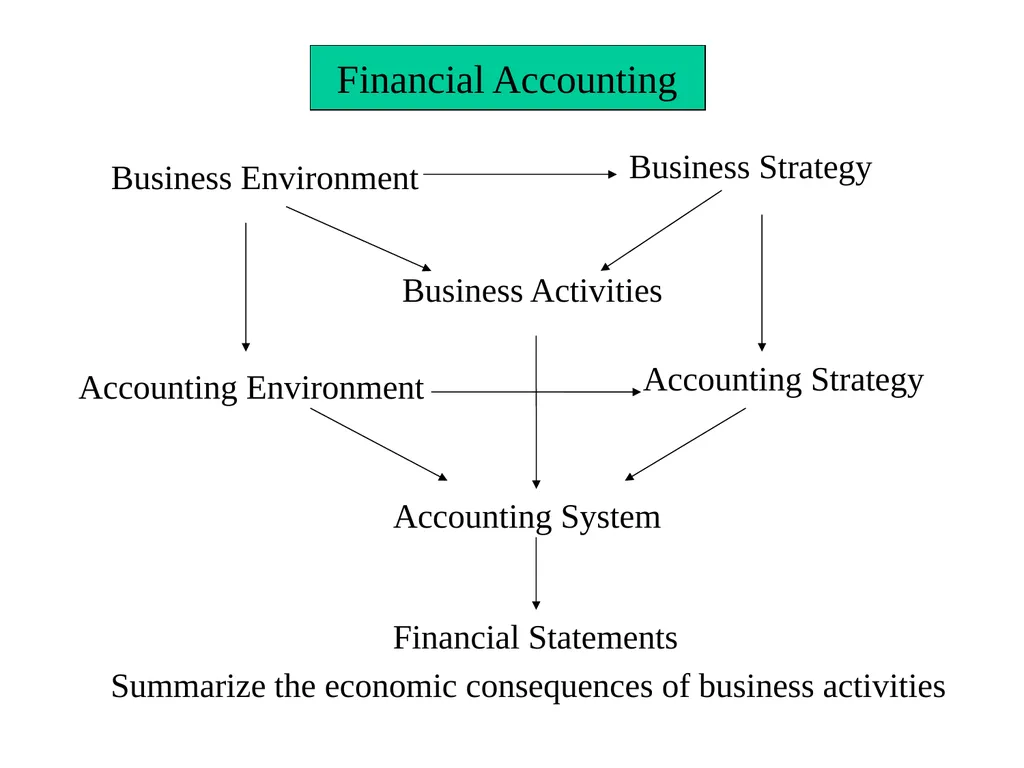
Business Environment Business Strategy Business Activities Accounting Environment Accounting Strategy Accounting System Financial Statements Summarize the economic consequences of business activities Financial Accounting<br>
20
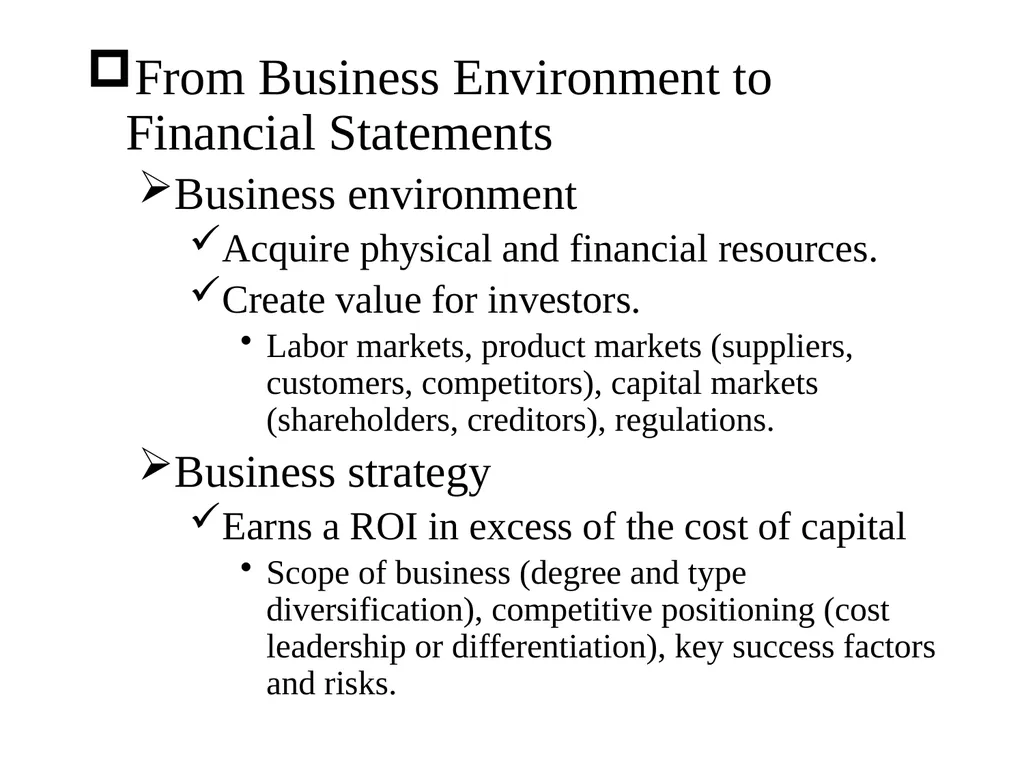
From Business Environment to Financial Statements
Business environment
Acquire physical and financial resources.
Create value for investors.
Labor markets, product markets (suppliers, customers, competitors), capital markets (shareholders, creditors), regulations.
Business strategy
Earns a ROI in excess of the cost of capital
Scope of business (degree and type diversification), competitive positioning (cost leadership or differentiation), key success factors and risks.<br>
Business environment
Acquire physical and financial resources.
Create value for investors.
Labor markets, product markets (suppliers, customers, competitors), capital markets (shareholders, creditors), regulations.
Business strategy
Earns a ROI in excess of the cost of capital
Scope of business (degree and type diversification), competitive positioning (cost leadership or differentiation), key success factors and risks.<br>
21
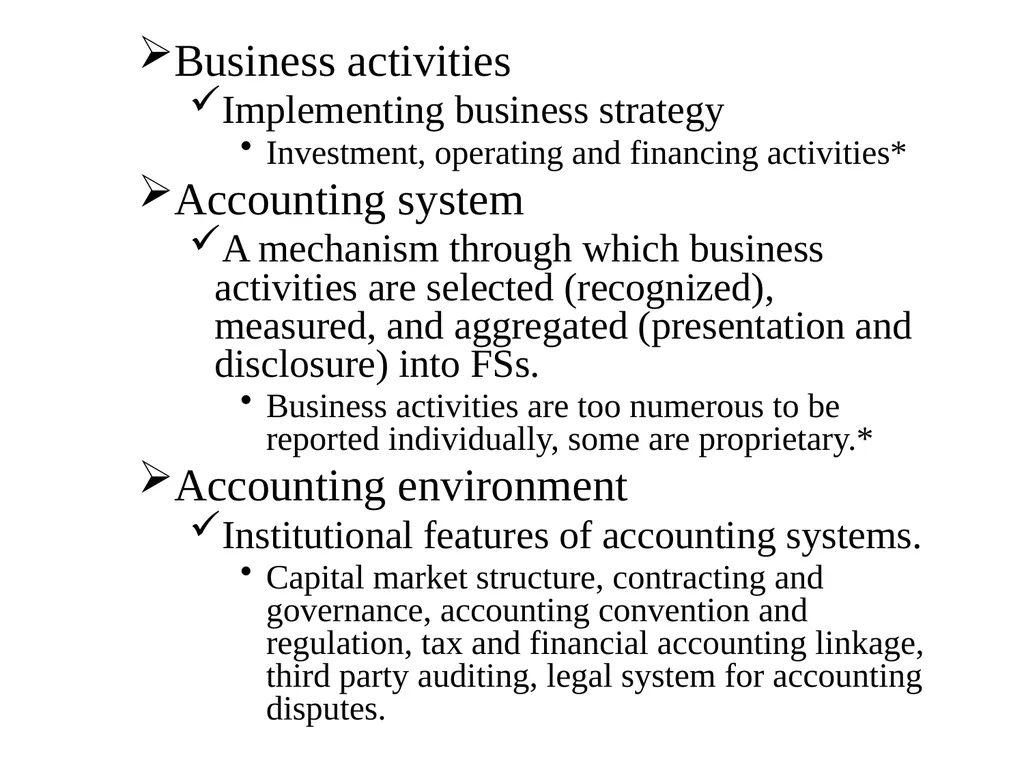
Business activities
Implementing business strategy
Investment, operating and financing activities*
Accounting system
A mechanism through which business activities are selected (recognized), measured, and aggregated (presentation and disclosure) into FSs.
Business activities are too numerous to be reported individually, some are proprietary.*
Accounting environment
Institutional features of accounting systems.
Capital market structure, contracting and governance, accounting convention and regulation, tax and financial accounting linkage, third party auditing, legal system for accounting disputes.<br>
Implementing business strategy
Investment, operating and financing activities*
Accounting system
A mechanism through which business activities are selected (recognized), measured, and aggregated (presentation and disclosure) into FSs.
Business activities are too numerous to be reported individually, some are proprietary.*
Accounting environment
Institutional features of accounting systems.
Capital market structure, contracting and governance, accounting convention and regulation, tax and financial accounting linkage, third party auditing, legal system for accounting disputes.<br>
22
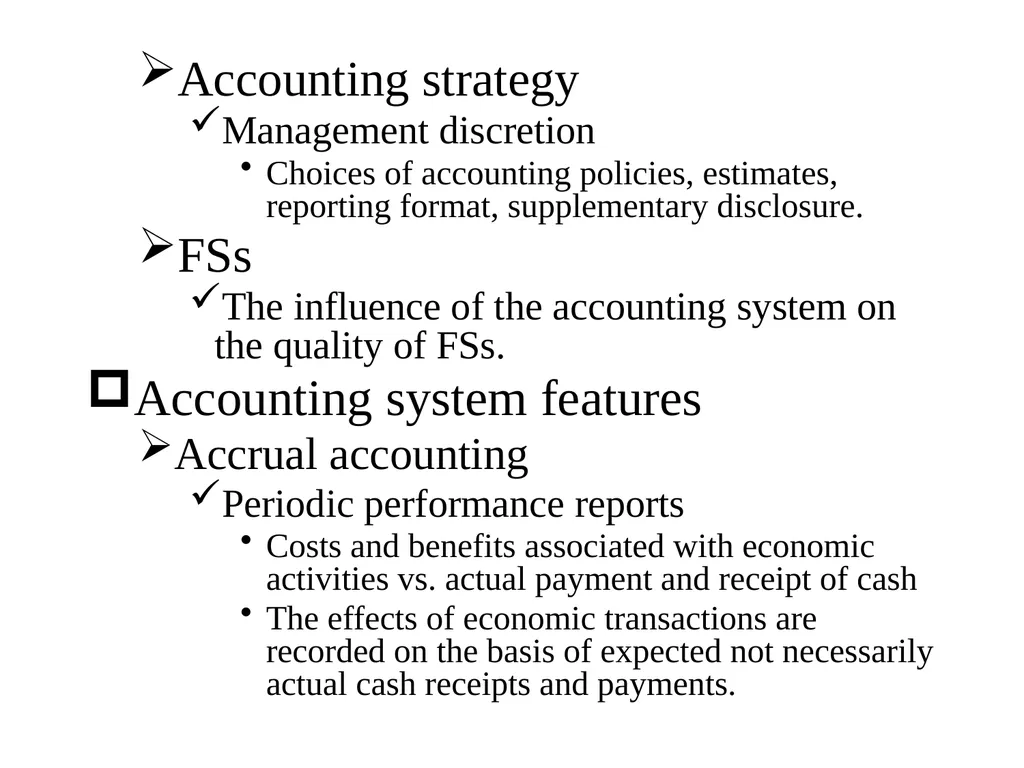
Accounting strategy
Management discretion
Choices of accounting policies, estimates, reporting format, supplementary disclosure.
FSs
The influence of the accounting system on the quality of FSs.
Accounting system features
Accrual accounting
Periodic performance reports
Costs and benefits associated with economic activities vs. actual payment and receipt of cash
The effects of economic transactions are recorded on the basis of expected not necessarily actual cash receipts and payments.<br>
Management discretion
Choices of accounting policies, estimates, reporting format, supplementary disclosure.
FSs
The influence of the accounting system on the quality of FSs.
Accounting system features
Accrual accounting
Periodic performance reports
Costs and benefits associated with economic activities vs. actual payment and receipt of cash
The effects of economic transactions are recorded on the basis of expected not necessarily actual cash receipts and payments.<br>
23
Accounting standards and auditing
The expectations of future cash flow consequences are subjective and rely on a variety of assumptions.
The accounting discretion granted to managers is potentially valuable because it allows them to reflect inside information, however, they have incentives to use accounting discretion to distort reported profits by making biased assumptions (management performance assessments, accounting based contracts).
Accounting conventions are responses to concerns about distortion, yet they attempt to limit managers’ optimistic bias by imposing their own pessimistic bias (conservatism, measurability).
Uniform accounting standards GAAP attempt to reduce managers’ ability to record similar economic transactions in dissimilar ways: SFAS (FASB), IFRS (IASB).<br>
The expectations of future cash flow consequences are subjective and rely on a variety of assumptions.
The accounting discretion granted to managers is potentially valuable because it allows them to reflect inside information, however, they have incentives to use accounting discretion to distort reported profits by making biased assumptions (management performance assessments, accounting based contracts).
Accounting conventions are responses to concerns about distortion, yet they attempt to limit managers’ optimistic bias by imposing their own pessimistic bias (conservatism, measurability).
Uniform accounting standards GAAP attempt to reduce managers’ ability to record similar economic transactions in dissimilar ways: SFAS (FASB), IFRS (IASB).<br>
24
Increased uniformity comes at the expense of reduced flexibility for managers to reflect genuine business differences in FSs.
If accounting standards are too rigid, they may induce managers to expend economic resources to restructure business transactions to achieve a desired accounting results.*
Third party auditing provide a verification of the integrity of the reported FSs, ensures that managers use accounting rules and convention consistently over time, and their accounting estimates are reasonable.
May also reduce the quality of financial reporting because it constraints the kind of accounting rules and conventions that evolve over time. Auditors are likely to argue against accounting standards producing numbers that are difficult to audit.
The threat of lawsuits and resulting penalties have the benefits of improving the accuracy of disclosure.<br>
If accounting standards are too rigid, they may induce managers to expend economic resources to restructure business transactions to achieve a desired accounting results.*
Third party auditing provide a verification of the integrity of the reported FSs, ensures that managers use accounting rules and convention consistently over time, and their accounting estimates are reasonable.
May also reduce the quality of financial reporting because it constraints the kind of accounting rules and conventions that evolve over time. Auditors are likely to argue against accounting standards producing numbers that are difficult to audit.
The threat of lawsuits and resulting penalties have the benefits of improving the accuracy of disclosure.<br>
25
However, it might also discourage managers and auditors from supporting accounting proposals requiring risky forecasts, such as forward-looking disclosures.
Managers’ reporting strategy
Some flexibility
Accounting alternatives and estimates
Voluntary disclosures
Proprietary information
Manipulate investors’ perceptions
Opportunity and challenge in doing business analysis
Separate distortion and noise from information
Gain valuable business insights<br>
Managers’ reporting strategy
Some flexibility
Accounting alternatives and estimates
Voluntary disclosures
Proprietary information
Manipulate investors’ perceptions
Opportunity and challenge in doing business analysis
Separate distortion and noise from information
Gain valuable business insights<br>
26
From FSs to business analysis
Get at managers’ inside information from public FS data.
About current performance and future prospects
Successful intermediaries have at least as good an understanding of the industry economies as well as a reasonable good understanding of the firm’s competitive strategy.
Although outside analysts have an information disadvantage, they are more objective.*
Business strategy analysis
Identify key profit drivers and business risks
Assess the company’s profit potential at a qualitative level.<br>
Get at managers’ inside information from public FS data.
About current performance and future prospects
Successful intermediaries have at least as good an understanding of the industry economies as well as a reasonable good understanding of the firm’s competitive strategy.
Although outside analysts have an information disadvantage, they are more objective.*
Business strategy analysis
Identify key profit drivers and business risks
Assess the company’s profit potential at a qualitative level.<br>
27
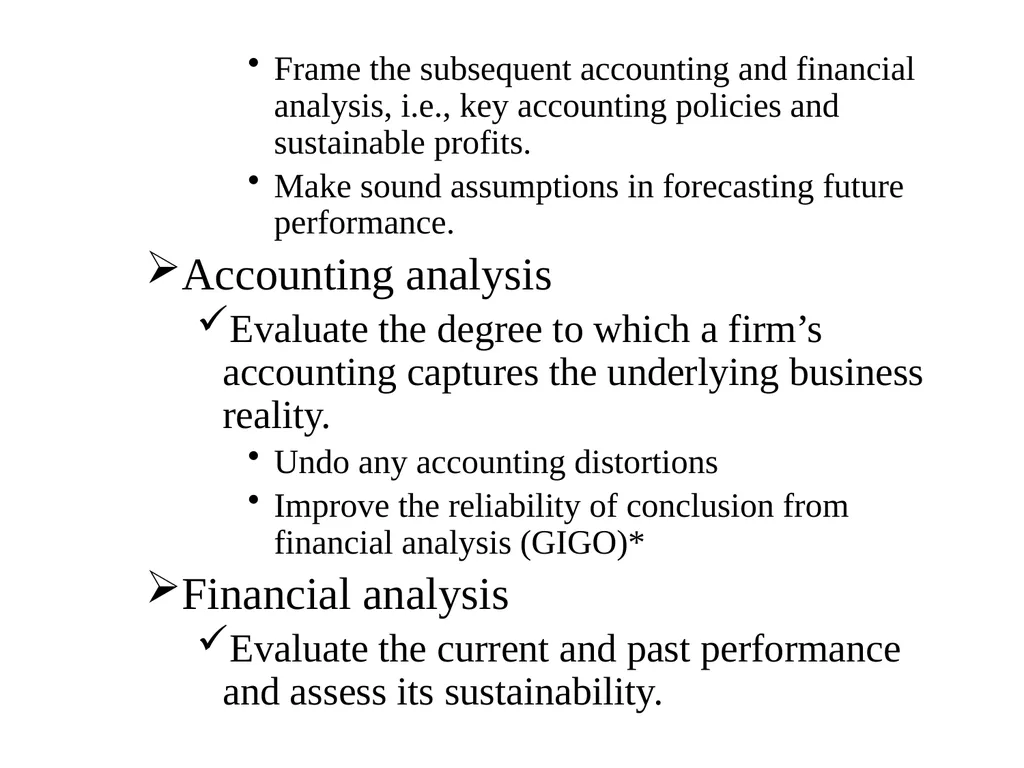
Frame the subsequent accounting and financial analysis, i.e., key accounting policies and sustainable profits.
Make sound assumptions in forecasting future performance.
Accounting analysis
Evaluate the degree to which a firm’s accounting captures the underlying business reality.
Undo any accounting distortions
Improve the reliability of conclusion from financial analysis (GIGO)*
Financial analysis
Evaluate the current and past performance and assess its sustainability.<br>
Make sound assumptions in forecasting future performance.
Accounting analysis
Evaluate the degree to which a firm’s accounting captures the underlying business reality.
Undo any accounting distortions
Improve the reliability of conclusion from financial analysis (GIGO)*
Financial analysis
Evaluate the current and past performance and assess its sustainability.<br>
28
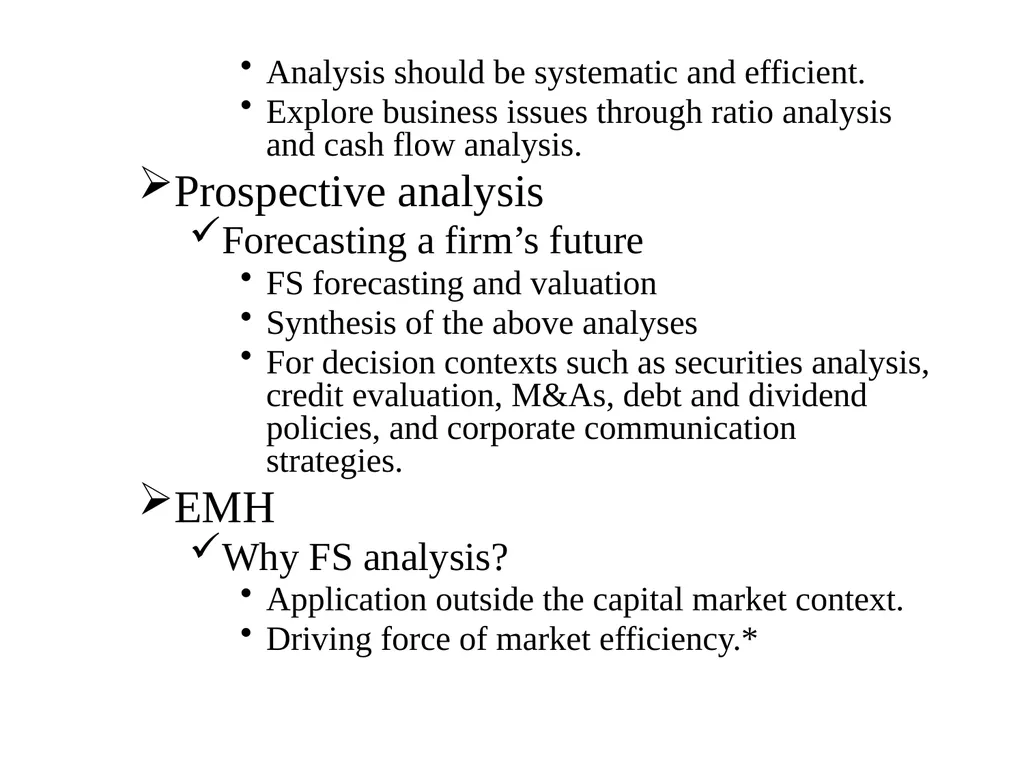
Analysis should be systematic and efficient.
Explore business issues through ratio analysis and cash flow analysis.
Prospective analysis
Forecasting a firm’s future
FS forecasting and valuation
Synthesis of the above analyses
For decision contexts such as securities analysis, credit evaluation, M&As, debt and dividend policies, and corporate communication strategies.
EMH
Why FS analysis?
Application outside the capital market context.
Driving force of market efficiency.*<br>
Explore business issues through ratio analysis and cash flow analysis.
Prospective analysis
Forecasting a firm’s future
FS forecasting and valuation
Synthesis of the above analyses
For decision contexts such as securities analysis, credit evaluation, M&As, debt and dividend policies, and corporate communication strategies.
EMH
Why FS analysis?
Application outside the capital market context.
Driving force of market efficiency.*<br>
29
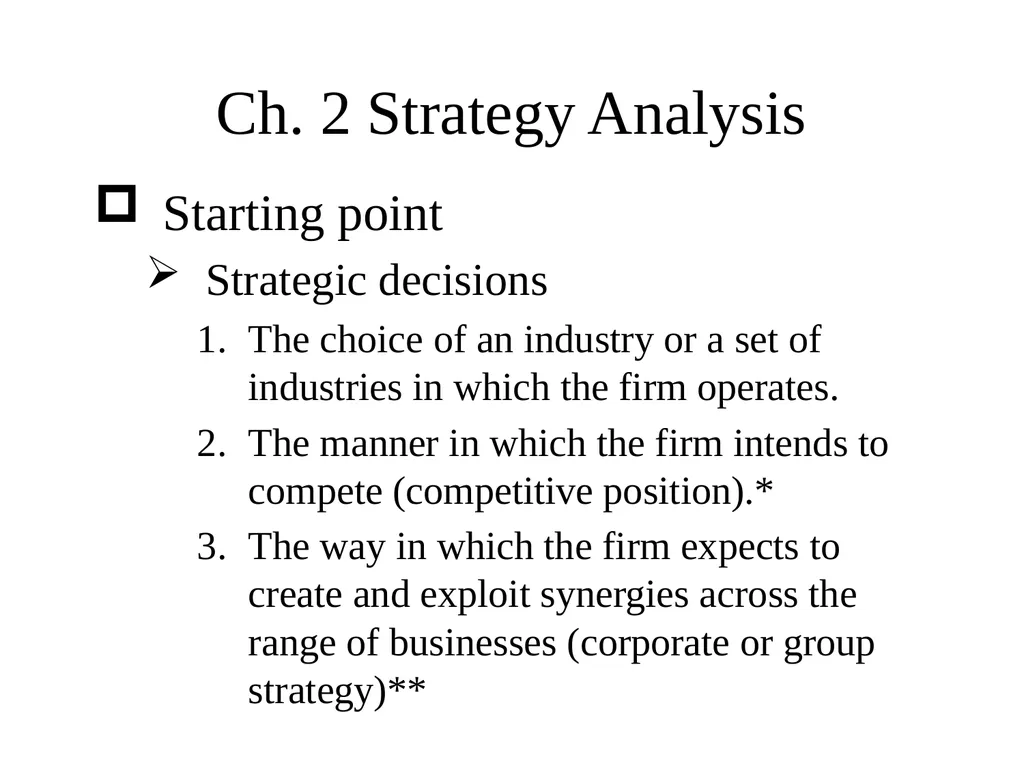
Ch. 2 Strategy Analysis Starting point
Strategic decisions
The choice of an industry or a set of industries in which the firm operates.
The manner in which the firm intends to compete (competitive position).*
The way in which the firm expects to create and exploit synergies across the range of businesses (corporate or group strategy)**<br>
Strategic decisions
The choice of an industry or a set of industries in which the firm operates.
The manner in which the firm intends to compete (competitive position).*
The way in which the firm expects to create and exploit synergies across the range of businesses (corporate or group strategy)**<br>
30
Roles
Probe the economics of a firm at a qualitative level
Subsequent accounting and financial analysis is grounded in business reality.
Identify profit drivers and key risks.
Assess the sustainability of current performance
Make realistic forecasts of future performance
Industry analysis
The profitability of various industries differs systematically and predictably over time.
Industrial organization: influence of industry structure on profitability.<br>
Probe the economics of a firm at a qualitative level
Subsequent accounting and financial analysis is grounded in business reality.
Identify profit drivers and key risks.
Assess the sustainability of current performance
Make realistic forecasts of future performance
Industry analysis
The profitability of various industries differs systematically and predictably over time.
Industrial organization: influence of industry structure on profitability.<br>
31
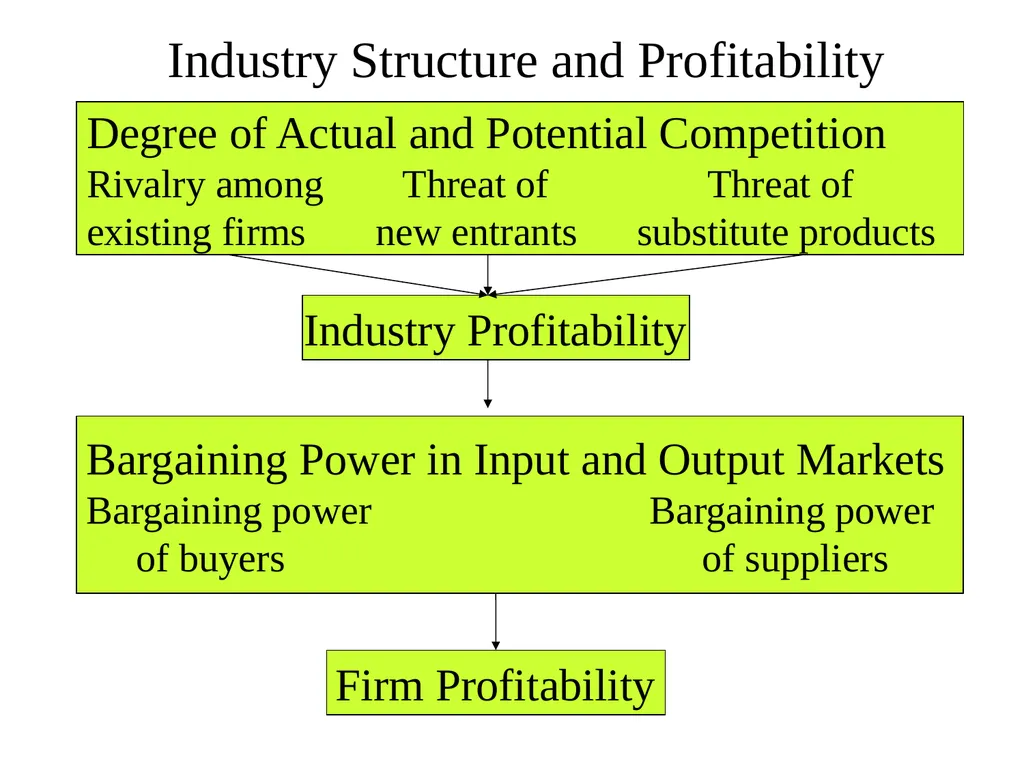
Degree of Actual and Potential Competition
Rivalry among Threat of Threat of
existing firms new entrants substitute products Industry Structure and Profitability Industry Profitability Bargaining Power in Input and Output Markets
Bargaining power Bargaining power
of buyers of suppliers Firm Profitability<br>
Rivalry among Threat of Threat of
existing firms new entrants substitute products Industry Structure and Profitability Industry Profitability Bargaining Power in Input and Output Markets
Bargaining power Bargaining power
of buyers of suppliers Firm Profitability<br>
32
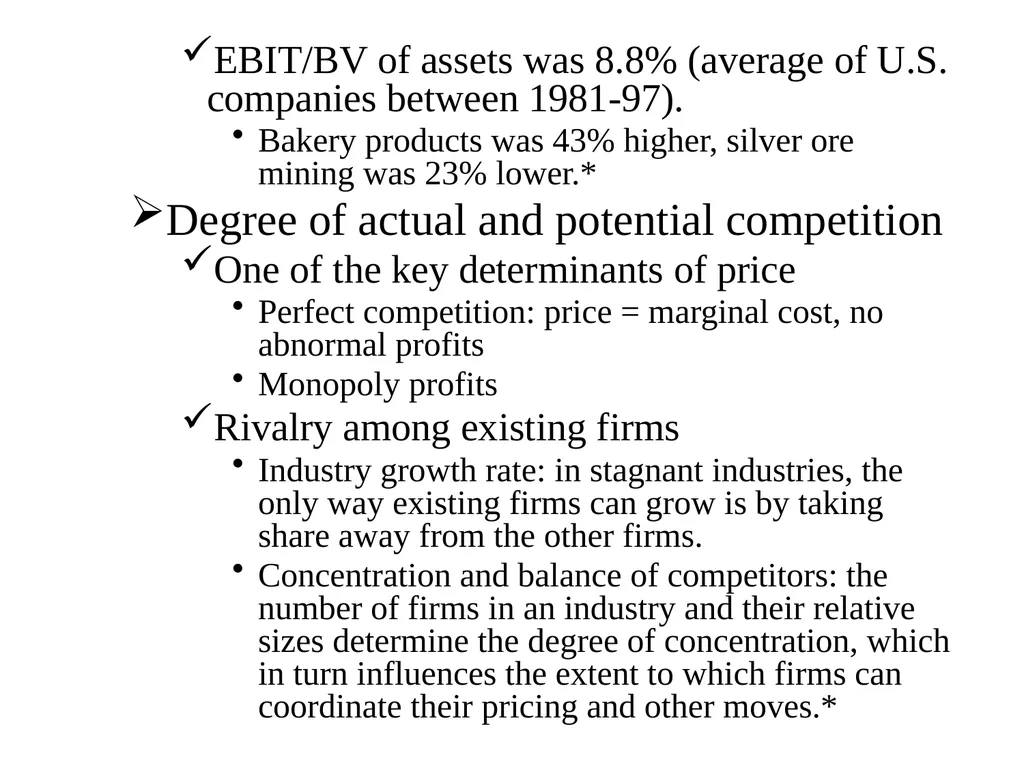
EBIT/BV of assets was 8.8% (average of U.S. companies between 1981-97).
Bakery products was 43% higher, silver ore mining was 23% lower.*
Degree of actual and potential competition
One of the key determinants of price
Perfect competition: price = marginal cost, no abnormal profits
Monopoly profits
Rivalry among existing firms
Industry growth rate: in stagnant industries, the only way existing firms can grow is by taking share away from the other firms.
Concentration and balance of competitors: the number of firms in an industry and their relative sizes determine the degree of concentration, which in turn influences the extent to which firms can coordinate their pricing and other moves.*<br>
Bakery products was 43% higher, silver ore mining was 23% lower.*
Degree of actual and potential competition
One of the key determinants of price
Perfect competition: price = marginal cost, no abnormal profits
Monopoly profits
Rivalry among existing firms
Industry growth rate: in stagnant industries, the only way existing firms can grow is by taking share away from the other firms.
Concentration and balance of competitors: the number of firms in an industry and their relative sizes determine the degree of concentration, which in turn influences the extent to which firms can coordinate their pricing and other moves.*<br>
33
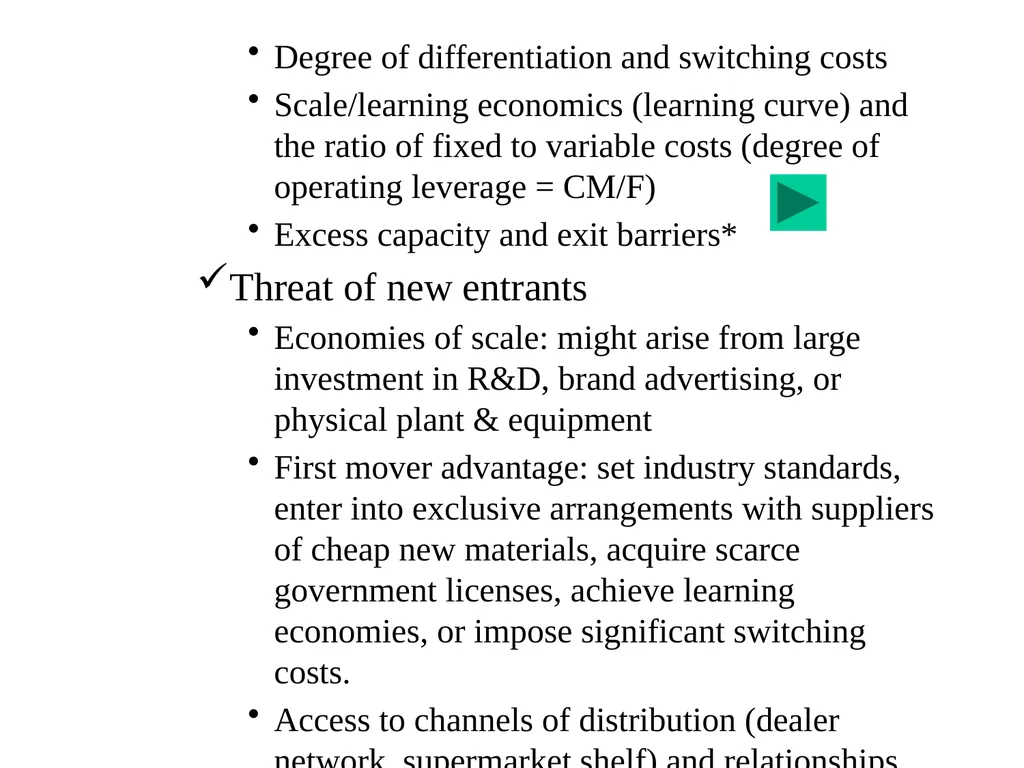
Degree of differentiation and switching costs
Scale/learning economics (learning curve) and the ratio of fixed to variable costs (degree of operating leverage = CM/F)
Excess capacity and exit barriers*
Threat of new entrants
Economies of scale: might arise from large investment in R&D, brand advertising, or physical plant & equipment
First mover advantage: set industry standards, enter into exclusive arrangements with suppliers of cheap new materials, acquire scarce government licenses, achieve learning economies, or impose significant switching costs.
Access to channels of distribution (dealer network, supermarket shelf) and relationships<br>
Scale/learning economics (learning curve) and the ratio of fixed to variable costs (degree of operating leverage = CM/F)
Excess capacity and exit barriers*
Threat of new entrants
Economies of scale: might arise from large investment in R&D, brand advertising, or physical plant & equipment
First mover advantage: set industry standards, enter into exclusive arrangements with suppliers of cheap new materials, acquire scarce government licenses, achieve learning economies, or impose significant switching costs.
Access to channels of distribution (dealer network, supermarket shelf) and relationships<br>
34
Profit 0 Sales F F’ cm% cm’% BE’ BE Substituting fixed for variable<br>
35
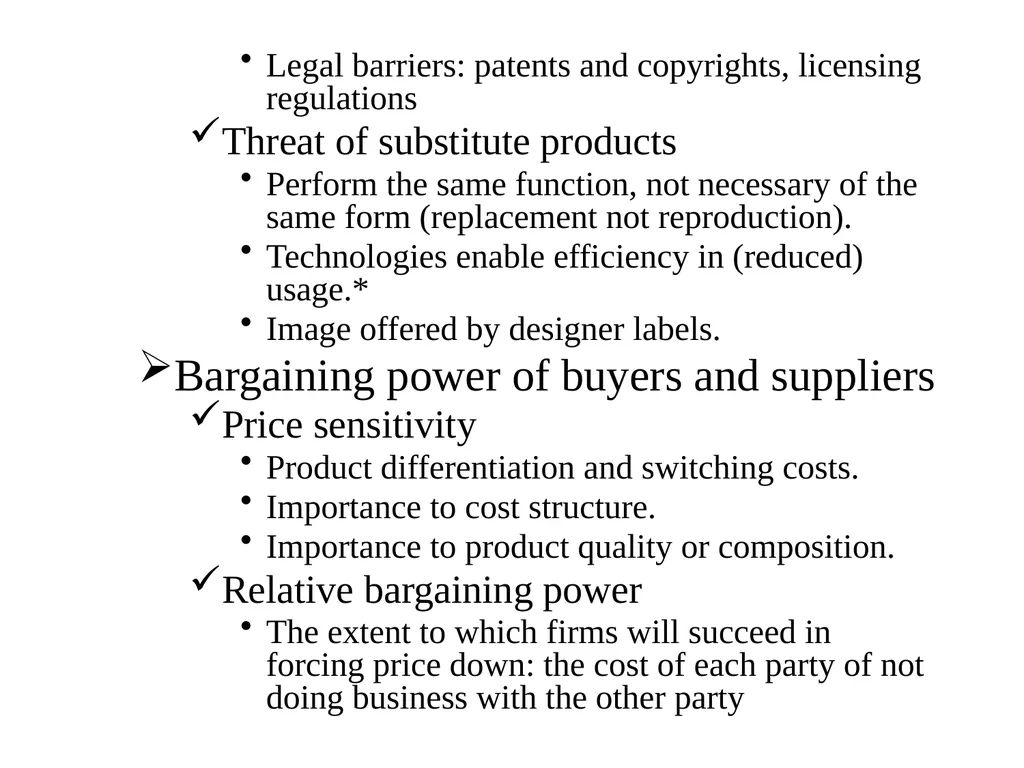
Legal barriers: patents and copyrights, licensing regulations
Threat of substitute products
Perform the same function, not necessary of the same form (replacement not reproduction).
Technologies enable efficiency in (reduced) usage.*
Image offered by designer labels.
Bargaining power of buyers and suppliers
Price sensitivity
Product differentiation and switching costs.
Importance to cost structure.
Importance to product quality or composition.
Relative bargaining power
The extent to which firms will succeed in forcing price down: the cost of each party of not doing business with the other party<br>
Threat of substitute products
Perform the same function, not necessary of the same form (replacement not reproduction).
Technologies enable efficiency in (reduced) usage.*
Image offered by designer labels.
Bargaining power of buyers and suppliers
Price sensitivity
Product differentiation and switching costs.
Importance to cost structure.
Importance to product quality or composition.
Relative bargaining power
The extent to which firms will succeed in forcing price down: the cost of each party of not doing business with the other party<br>
36
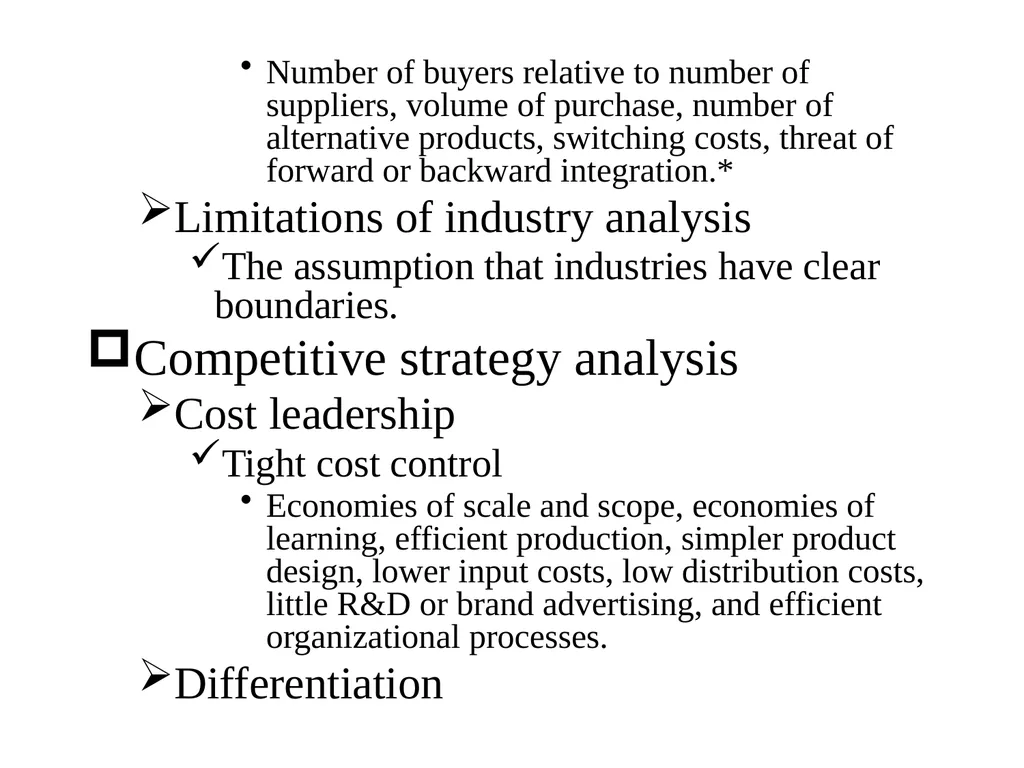
Number of buyers relative to number of suppliers, volume of purchase, number of alternative products, switching costs, threat of forward or backward integration.*
Limitations of industry analysis
The assumption that industries have clear boundaries.
Competitive strategy analysis
Cost leadership
Tight cost control
Economies of scale and scope, economies of learning, efficient production, simpler product design, lower input costs, low distribution costs, little R&D or brand advertising, and efficient organizational processes.
Differentiation<br>
Limitations of industry analysis
The assumption that industries have clear boundaries.
Competitive strategy analysis
Cost leadership
Tight cost control
Economies of scale and scope, economies of learning, efficient production, simpler product design, lower input costs, low distribution costs, little R&D or brand advertising, and efficient organizational processes.
Differentiation<br>
37
Provide a product or service that is distinct in some important respect valued by the customer.
Identify one or more attributes of a product that customers value: quality, appearance, variety, reputation or brand image, bundled services, delivery time, or turnkey solutions.
Position itself to meet the chosen customer need in a unique manner.
Achieve differentiation at a cost that is lower than the price the customer is willing to pay.
Investments in R&D, engineering skills, and marketing capabilities.
The organizational structures and control systems need to foster creativity and innovation.
Mutually exclusive
Firms that straddle the two are considered to be “stuck in the middle”<br>
Identify one or more attributes of a product that customers value: quality, appearance, variety, reputation or brand image, bundled services, delivery time, or turnkey solutions.
Position itself to meet the chosen customer need in a unique manner.
Achieve differentiation at a cost that is lower than the price the customer is willing to pay.
Investments in R&D, engineering skills, and marketing capabilities.
The organizational structures and control systems need to foster creativity and innovation.
Mutually exclusive
Firms that straddle the two are considered to be “stuck in the middle”<br>
38
Not able to attract price conscious customers and unable to provide adequate differentiation to attract premium price customers.
Firms cannot completely ignore the dimension on which they are not primarily competing: distinctive and high quality yet inexpensive.*
Achieving and sustaining competitive advantage
The capabilities needed to implement and sustain the chosen strategy
Acquire the core competencies (economic assets) needed and structure value chain (the set of activities performed to convert inputs into outputs) in an appropriate way.**
Difficult for competitors to imitate.
Questions asked
Key success factors and risks associated with chosen competitive strategy?<br>
Firms cannot completely ignore the dimension on which they are not primarily competing: distinctive and high quality yet inexpensive.*
Achieving and sustaining competitive advantage
The capabilities needed to implement and sustain the chosen strategy
Acquire the core competencies (economic assets) needed and structure value chain (the set of activities performed to convert inputs into outputs) in an appropriate way.**
Difficult for competitors to imitate.
Questions asked
Key success factors and risks associated with chosen competitive strategy?<br>
39
Having resources and capabilities to deal with?
Making irreversible commitments to bridge the capabilities gap?
Structuring activities consistently?
Creating barriers to imitate?
Having flexibility to address potential changes in the industry structure that might dissipate competitive advantage?
Corporate strategy analysis (scope)*
Multibusiness organization
The average number of segments operated by the top 500 U.S. companies is 11 in 1992.
An attempt to reduce the diversity and focus on a relatively few core businesses: diversified companies trade at a discount in the stock market relative to a comparable portfolio of focused companies, M&A of two unrelated businesses often fail to create value, and value can be created through spin-offs and asset sales.<br>
Making irreversible commitments to bridge the capabilities gap?
Structuring activities consistently?
Creating barriers to imitate?
Having flexibility to address potential changes in the industry structure that might dissipate competitive advantage?
Corporate strategy analysis (scope)*
Multibusiness organization
The average number of segments operated by the top 500 U.S. companies is 11 in 1992.
An attempt to reduce the diversity and focus on a relatively few core businesses: diversified companies trade at a discount in the stock market relative to a comparable portfolio of focused companies, M&A of two unrelated businesses often fail to create value, and value can be created through spin-offs and asset sales.<br>
40
Managers’ decisions to diversify and expand are driven by a desire to maximize the size rather than shareholder value, incentive misalignment problems, and capital markets find it difficult to monitor and value multibusiness organizations.*
Evaluate the economic consequences of managing all the different businesses under one corporate umbrella.
Sources of value creation
Relative transaction cost of performing a set of activities inside the firm versus using the market mechanism, in particular, when coordination among independent firms is costly due to market transaction costs.
Transaction costs: production process involves specialized assets such as human capital skills, proprietary technology, other organizational know-how that is not easily available in the marketplace, and market imperfection such as information and incentive problem.<br>
Evaluate the economic consequences of managing all the different businesses under one corporate umbrella.
Sources of value creation
Relative transaction cost of performing a set of activities inside the firm versus using the market mechanism, in particular, when coordination among independent firms is costly due to market transaction costs.
Transaction costs: production process involves specialized assets such as human capital skills, proprietary technology, other organizational know-how that is not easily available in the marketplace, and market imperfection such as information and incentive problem.<br>
41
Emerging economies often suffer from market imperfection because of poorly developed intermediation infrastructure.
Internal advantages: lower communication costs because confidentiality can be protected and credibility can be assured through internal mechanism, headquarters office can play a critical role in reducing costs of enforcing agreements, organizational subunits can share nontradable or nondivisible assets.
Top management may lack the specialized information and skills necessary to maintain businesses across several different industries. Can be remedied by creating a decentralized organization, hiring specialist managers and providing with proper incentives, but will potentially decrease goal congruence.
Questions asked
Significant imperfections in the product, labor, or financial markets?<br>
Internal advantages: lower communication costs because confidentiality can be protected and credibility can be assured through internal mechanism, headquarters office can play a critical role in reducing costs of enforcing agreements, organizational subunits can share nontradable or nondivisible assets.
Top management may lack the specialized information and skills necessary to maintain businesses across several different industries. Can be remedied by creating a decentralized organization, hiring specialist managers and providing with proper incentives, but will potentially decrease goal congruence.
Questions asked
Significant imperfections in the product, labor, or financial markets?<br>
42
Special resources such as brand names, proprietary know-how, access to scarce distribution channels, and special organizational processes?
Good fit between specialized resources and the portfolio of businesses?
Allocation of decision rights between the headquarters office and business units?
Internal measurement, information, and incentive system to reduce agency costs?
Cases
Personal computer industry
Intense competition and low profitability
The industry was fragmented with many firms producing virtually identical products, though top five vendors controlling close to 60% of the market.<br>
Good fit between specialized resources and the portfolio of businesses?
Allocation of decision rights between the headquarters office and business units?
Internal measurement, information, and incentive system to reduce agency costs?
Cases
Personal computer industry
Intense competition and low profitability
The industry was fragmented with many firms producing virtually identical products, though top five vendors controlling close to 60% of the market.<br>
43
Component cost accounted for more than 60% of total hardware costs and volume purchases reduced these costs, hence intense competition for market share.
Brand name and service became less important as buyers became more informed about the technology.
Switching costs were relatively low.
Access to distribution was not a significant barrier (direct mail & internet-based sales). Computer superstores were willing to carry several brands.
Very few barriers to entering the industry (assembled in a dormitory room).
Apple’s and workstations offered competition as substitutes.
Key hardware and software components were controlled by firms with virtual monopoly (Intel, Microsoft).<br>
Brand name and service became less important as buyers became more informed about the technology.
Switching costs were relatively low.
Access to distribution was not a significant barrier (direct mail & internet-based sales). Computer superstores were willing to carry several brands.
Very few barriers to entering the industry (assembled in a dormitory room).
Apple’s and workstations offered competition as substitutes.
Key hardware and software components were controlled by firms with virtual monopoly (Intel, Microsoft).<br>
44
Corporate buyers were highly price sensitive (a significant IT cost).
Tremendous pressure on firms to introduce new products rapidly, maintain high quality and provide excellent customer support.
Dell’s low-cost competitive strategy
Direct selling: saving on retail markups
Made-to-order manufacturing: a system of flexible manufacturing (5 days), save inventory working capital and write-off costs.
Third-party service: telephoned-based and third-party maintenance service (Xerox).*
Low accounts receivable: pay by credit card or electronic payment.
Focused investment in R&D: primarily in creating low-cost, high velocity organization that can respond quickly to changes.<br>
Tremendous pressure on firms to introduce new products rapidly, maintain high quality and provide excellent customer support.
Dell’s low-cost competitive strategy
Direct selling: saving on retail markups
Made-to-order manufacturing: a system of flexible manufacturing (5 days), save inventory working capital and write-off costs.
Third-party service: telephoned-based and third-party maintenance service (Xerox).*
Low accounts receivable: pay by credit card or electronic payment.
Focused investment in R&D: primarily in creating low-cost, high velocity organization that can respond quickly to changes.<br>
45
Electronic commerce
Amazon.com, an online bookseller in 1995 and went public in 1997 with a market cap of $561m and increasing to $36b by April 1999.
Jeff Bezos moved the company into many other areas, claimed that its brand, loyal customer base, and ability to execute electronic commerce were valuable assets that can be exploited in a number of other online business areas: CDs, videos, gifts, prescription drugs, pet suppliers, and groceries (a “customer” company).
Traditional retailers such as Barnes & Noble, Wal-Mart, and CVs who are boosting their online efforts also have valuable brand names, execution capabilities, and customer loyalty.
Expanding rapidly into so many different areas is likely to confuse customers, dilute brand name, and increase the chance of poor execution.*<br>
Amazon.com, an online bookseller in 1995 and went public in 1997 with a market cap of $561m and increasing to $36b by April 1999.
Jeff Bezos moved the company into many other areas, claimed that its brand, loyal customer base, and ability to execute electronic commerce were valuable assets that can be exploited in a number of other online business areas: CDs, videos, gifts, prescription drugs, pet suppliers, and groceries (a “customer” company).
Traditional retailers such as Barnes & Noble, Wal-Mart, and CVs who are boosting their online efforts also have valuable brand names, execution capabilities, and customer loyalty.
Expanding rapidly into so many different areas is likely to confuse customers, dilute brand name, and increase the chance of poor execution.*<br>
46
Ch. 3 Accounting Analysis Overview
Purpose
Improve the reliability of conclusions from financial analysis (GIGO)
Evaluate the degree to which a firm’s accounting captures its underlying business reality.
Identifying places where there is accounting flexibility
Evaluating the appropriateness of the firm’s accounting policies and estimates<br>
Purpose
Improve the reliability of conclusions from financial analysis (GIGO)
Evaluate the degree to which a firm’s accounting captures its underlying business reality.
Identifying places where there is accounting flexibility
Evaluating the appropriateness of the firm’s accounting policies and estimates<br>
47
Consistent with stated strategy
Undo any accounting distortions
Adjusting a firm’s accounting numbers using cash flow and footnote information
Institutional Framework
Accrual accounting
Recording of costs and benefits associated with economic activities.
The effects of economic transactions are recorded on the basis of expected, not necessarily actual, cash receipts and payments.
Revenue
Economic resources earned during a time period
Governed by the realization principle<br>
Undo any accounting distortions
Adjusting a firm’s accounting numbers using cash flow and footnote information
Institutional Framework
Accrual accounting
Recording of costs and benefits associated with economic activities.
The effects of economic transactions are recorded on the basis of expected, not necessarily actual, cash receipts and payments.
Revenue
Economic resources earned during a time period
Governed by the realization principle<br>
48
The firm has provided all, or substantially all, the goods or services to be delivered to the customer
The customer has paid cash or is expected to pay cash with a reasonable degree of certainty
Expenses
Economic resources used up in a time period
Governed by the matching and conservatism principles*
Costs directly associated with revenues recognized in the same period (COGS)
Costs associated with benefits that are consumed in this time period (period expenses)
Or, resources whose future benefits are not reasonably certain (R&D, advertising)
Expenses vs. losses<br>
The customer has paid cash or is expected to pay cash with a reasonable degree of certainty
Expenses
Economic resources used up in a time period
Governed by the matching and conservatism principles*
Costs directly associated with revenues recognized in the same period (COGS)
Costs associated with benefits that are consumed in this time period (period expenses)
Or, resources whose future benefits are not reasonably certain (R&D, advertising)
Expenses vs. losses<br>
49
Assets
Economic resources owned by a firm
Likely to produce future economic benefits
And, measurable with a reasonable degree of certainty*
Costs: sacrifice foregone to acquire goods or services, initially as assets then as expenses.
Liabilities
Economic obligation of a firm arising from benefits received in the past
Required to be met with a reasonable degree of certainty.*
And, whose timing is reasonably well defined
Equity: net worth (limited liability)<br>
Economic resources owned by a firm
Likely to produce future economic benefits
And, measurable with a reasonable degree of certainty*
Costs: sacrifice foregone to acquire goods or services, initially as assets then as expenses.
Liabilities
Economic obligation of a firm arising from benefits received in the past
Required to be met with a reasonable degree of certainty.*
And, whose timing is reasonably well defined
Equity: net worth (limited liability)<br>
50
Delegate reporting to management
Involves complex judgments
Sales with customer financing*
Potential defaults
R&D assets or contingent liabilities
Contractual commitments such as lease arrangements or post-retirement plans
Costs and benefits
Use their accounting discretion to reflect inside information in reported FSs
But have an incentive to distort reported profits by making biased assumptions
Manipulate accounting numbers in contracts between the firm and outsiders
GAAPs, external auditing, and legal system to reduce the cost and preserve the benefit (only institutional investors’ supervision is effective).<br>
Involves complex judgments
Sales with customer financing*
Potential defaults
R&D assets or contingent liabilities
Contractual commitments such as lease arrangements or post-retirement plans
Costs and benefits
Use their accounting discretion to reflect inside information in reported FSs
But have an incentive to distort reported profits by making biased assumptions
Manipulate accounting numbers in contracts between the firm and outsiders
GAAPs, external auditing, and legal system to reduce the cost and preserve the benefit (only institutional investors’ supervision is effective).<br>
51
GAAPs
Historical cost convention to reduce value manipulation
Limits the information that is available to investors about the potential of the assets
Fair value and impairment
Uniform accounting Standards
Create a uniform accounting language and increase the credibility of FSs
Regulate how particular types of transactions are recorded to limit management’s ability to misuse accounting judgment
Rigid standards work best for economic transactions whose accounting judgment is not predicated on managers’ proprietary information.<br>
Historical cost convention to reduce value manipulation
Limits the information that is available to investors about the potential of the assets
Fair value and impairment
Uniform accounting Standards
Create a uniform accounting language and increase the credibility of FSs
Regulate how particular types of transactions are recorded to limit management’s ability to misuse accounting judgment
Rigid standards work best for economic transactions whose accounting judgment is not predicated on managers’ proprietary information.<br>
52
At the expense of reduced flexibility to reflect genuine business differences
Likely to be disfunctional because they prevent managers from using their superior business knowledge.
May induce managers to expend economic resources to structure business transactions to achieve a desired accounting result.*
SEC has the legal authority to set accounting standards
Typically relies on private sector accounting bodies to undertake this task
FASB’s SFAS since 1973
IASB’s IFRS after reform since 1998<br>
Likely to be disfunctional because they prevent managers from using their superior business knowledge.
May induce managers to expend economic resources to structure business transactions to achieve a desired accounting result.*
SEC has the legal authority to set accounting standards
Typically relies on private sector accounting bodies to undertake this task
FASB’s SFAS since 1973
IASB’s IFRS after reform since 1998<br>
53
External auditing
All listed companies are required
GAASs set by AICPA
Issue an opinion on published FSs
Primary responsibility still rests with corporate managers
Imperfect
Cannot review all of a firm’s transactions
Failure because of lapses in quality or lapses in judgment by auditors who fail to challenge management for fear of losing future business.
Outside supervision replaces peer reviews
Also under international harmonization because of capital markets integration.
Constrain the type of accounting rules and conventions that evolve over time<br>
All listed companies are required
GAASs set by AICPA
Issue an opinion on published FSs
Primary responsibility still rests with corporate managers
Imperfect
Cannot review all of a firm’s transactions
Failure because of lapses in quality or lapses in judgment by auditors who fail to challenge management for fear of losing future business.
Outside supervision replaces peer reviews
Also under international harmonization because of capital markets integration.
Constrain the type of accounting rules and conventions that evolve over time<br>
54
Auditors are likely to argue against accounting standards that produce numbers which are difficult to audit, even if the proposed rules produce relevant information for investors.
Legal system
Adjudicate disputes between managers, auditors, and investors
The threat of lawsuits and resulting penalties have the beneficial effect of improving FSs.
The potential for significant legal liability might also discourage managers and auditors from supporting accounting proposals requiring risky forecasts.<br>
Legal system
Adjudicate disputes between managers, auditors, and investors
The threat of lawsuits and resulting penalties have the beneficial effect of improving FSs.
The potential for significant legal liability might also discourage managers and auditors from supporting accounting proposals requiring risky forecasts.<br>
55
Quality Factors
Noise and bias from accounting rules
Conservatism: not possible
Timing of recognition due to double-entry accounting.
Managerial behavior may not necessarily be consistent with conservatism.
Dissimilar economic events with similar accounting rules, e.g., R&D
Forecast errors
The extent of errors depends on a variety of factors
The complex of the business transactions<br>
Noise and bias from accounting rules
Conservatism: not possible
Timing of recognition due to double-entry accounting.
Managerial behavior may not necessarily be consistent with conservatism.
Dissimilar economic events with similar accounting rules, e.g., R&D
Forecast errors
The extent of errors depends on a variety of factors
The complex of the business transactions<br>
56
The predictability of the firm’s environment
Unforeseen economic-wide changes.
Managers’ accounting choices
Incentives to exercise discretion to achieve certain objectives
Accounting based debt covenants
Management compensation
Corporate control contests: in hostile takeovers and proxy fights, accounting numbers are used extensively in debating managers’ performance.
Tax considerations
Regulatory considerations: to influence regulatory outcomes such as antitrust actions, import tariffs, and tax policies.
Capital market considerations (IPOs, ECBs, may simply due to market timing)<br>
Unforeseen economic-wide changes.
Managers’ accounting choices
Incentives to exercise discretion to achieve certain objectives
Accounting based debt covenants
Management compensation
Corporate control contests: in hostile takeovers and proxy fights, accounting numbers are used extensively in debating managers’ performance.
Tax considerations
Regulatory considerations: to influence regulatory outcomes such as antitrust actions, import tariffs, and tax policies.
Capital market considerations (IPOs, ECBs, may simply due to market timing)<br>
57
Stakeholder considerations: labor unions, suppliers, and customers (stockholders, community)
Competitive considerations: segment disclosure, new entrants.
Level of disclosures
Managers can choose disclosure policies that make it more or less costly for external users to understand the true economic picture.
Voluntary disclosures: Letter to the shareholders, MD&A, footnotes (part of FSs)<br>
Competitive considerations: segment disclosure, new entrants.
Level of disclosures
Managers can choose disclosure policies that make it more or less costly for external users to understand the true economic picture.
Voluntary disclosures: Letter to the shareholders, MD&A, footnotes (part of FSs)<br>
58
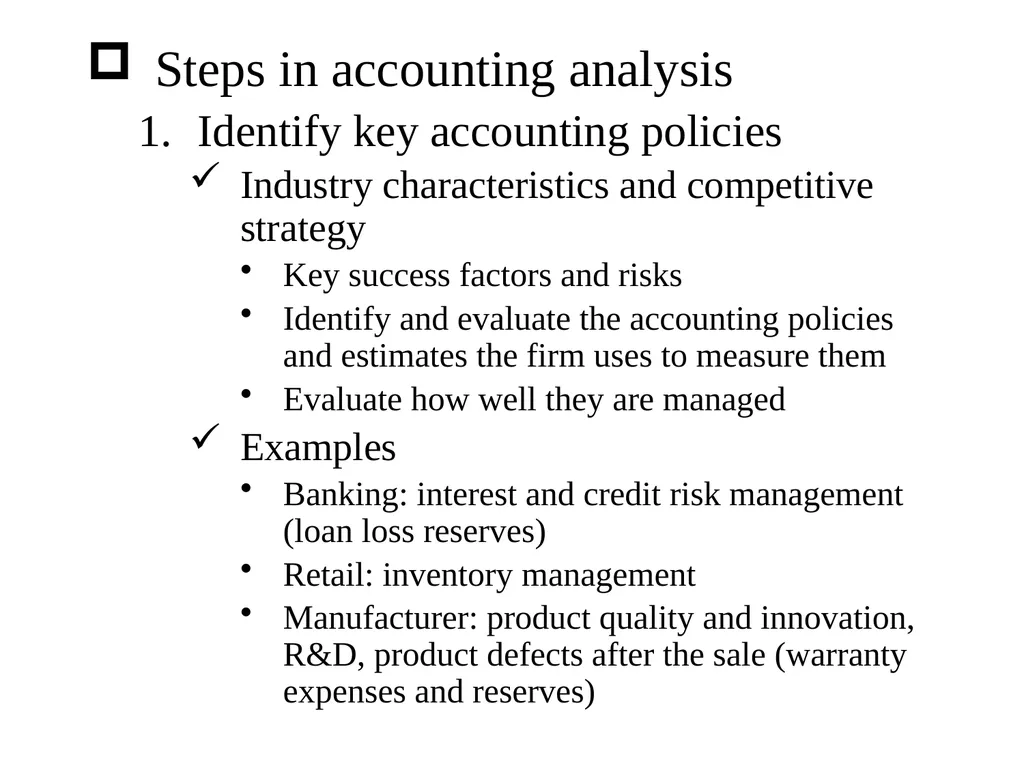
Steps in accounting analysis
Identify key accounting policies
Industry characteristics and competitive strategy
Key success factors and risks
Identify and evaluate the accounting policies and estimates the firm uses to measure them
Evaluate how well they are managed
Examples
Banking: interest and credit risk management (loan loss reserves)
Retail: inventory management
Manufacturer: product quality and innovation, R&D, product defects after the sale (warranty expenses and reserves)<br>
Identify key accounting policies
Industry characteristics and competitive strategy
Key success factors and risks
Identify and evaluate the accounting policies and estimates the firm uses to measure them
Evaluate how well they are managed
Examples
Banking: interest and credit risk management (loan loss reserves)
Retail: inventory management
Manufacturer: product quality and innovation, R&D, product defects after the sale (warranty expenses and reserves)<br>
59
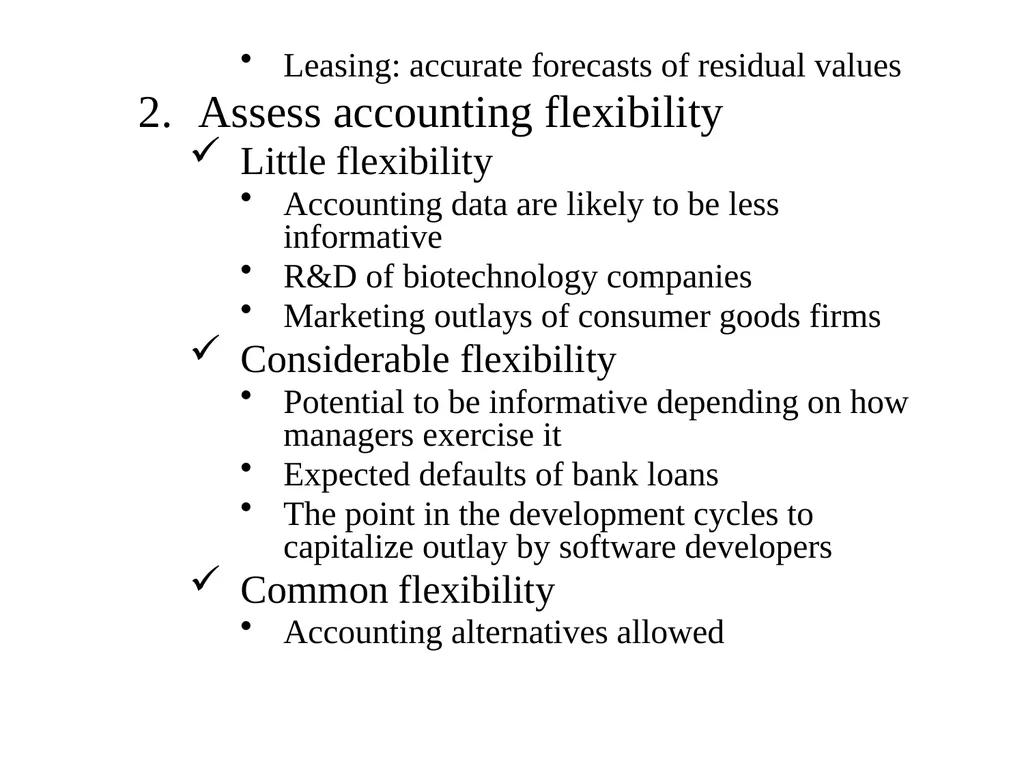
Leasing: accurate forecasts of residual values
Assess accounting flexibility
Little flexibility
Accounting data are likely to be less informative
R&D of biotechnology companies
Marketing outlays of consumer goods firms
Considerable flexibility
Potential to be informative depending on how managers exercise it
Expected defaults of bank loans
The point in the development cycles to capitalize outlay by software developers
Common flexibility
Accounting alternatives allowed<br>
Assess accounting flexibility
Little flexibility
Accounting data are likely to be less informative
R&D of biotechnology companies
Marketing outlays of consumer goods firms
Considerable flexibility
Potential to be informative depending on how managers exercise it
Expected defaults of bank loans
The point in the development cycles to capitalize outlay by software developers
Common flexibility
Accounting alternatives allowed<br>
60
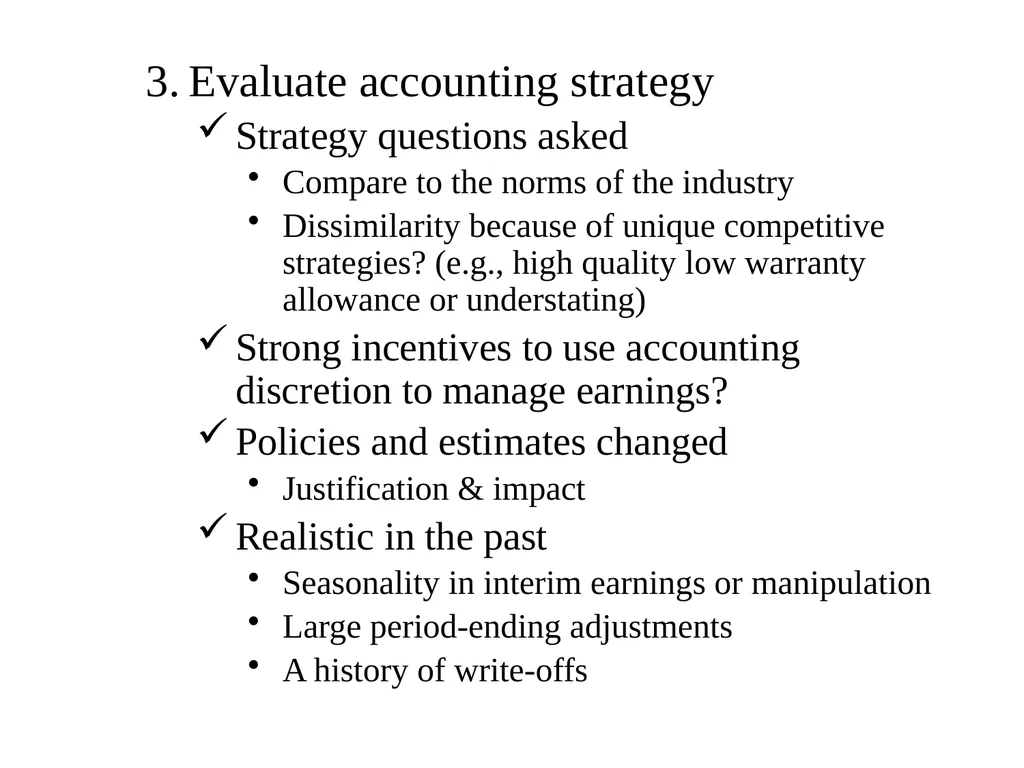
Evaluate accounting strategy
Strategy questions asked
Compare to the norms of the industry
Dissimilarity because of unique competitive strategies? (e.g., high quality low warranty allowance or understating)
Strong incentives to use accounting discretion to manage earnings?
Policies and estimates changed
Justification & impact
Realistic in the past
Seasonality in interim earnings or manipulation
Large period-ending adjustments
A history of write-offs<br>
Strategy questions asked
Compare to the norms of the industry
Dissimilarity because of unique competitive strategies? (e.g., high quality low warranty allowance or understating)
Strong incentives to use accounting discretion to manage earnings?
Policies and estimates changed
Justification & impact
Realistic in the past
Seasonality in interim earnings or manipulation
Large period-ending adjustments
A history of write-offs<br>
61
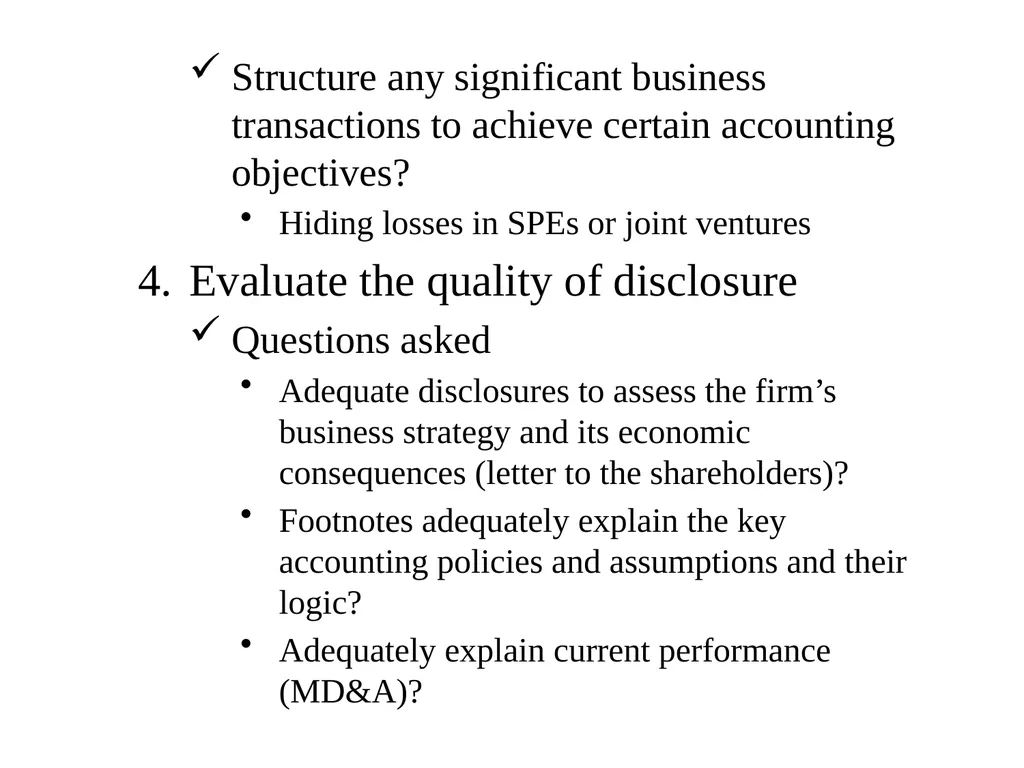
Structure any significant business transactions to achieve certain accounting objectives?
Hiding losses in SPEs or joint ventures
Evaluate the quality of disclosure
Questions asked
Adequate disclosures to assess the firm’s business strategy and its economic consequences (letter to the shareholders)?
Footnotes adequately explain the key accounting policies and assumptions and their logic?
Adequately explain current performance (MD&A)?<br>
Hiding losses in SPEs or joint ventures
Evaluate the quality of disclosure
Questions asked
Adequate disclosures to assess the firm’s business strategy and its economic consequences (letter to the shareholders)?
Footnotes adequately explain the key accounting policies and assumptions and their logic?
Adequately explain current performance (MD&A)?<br>
62
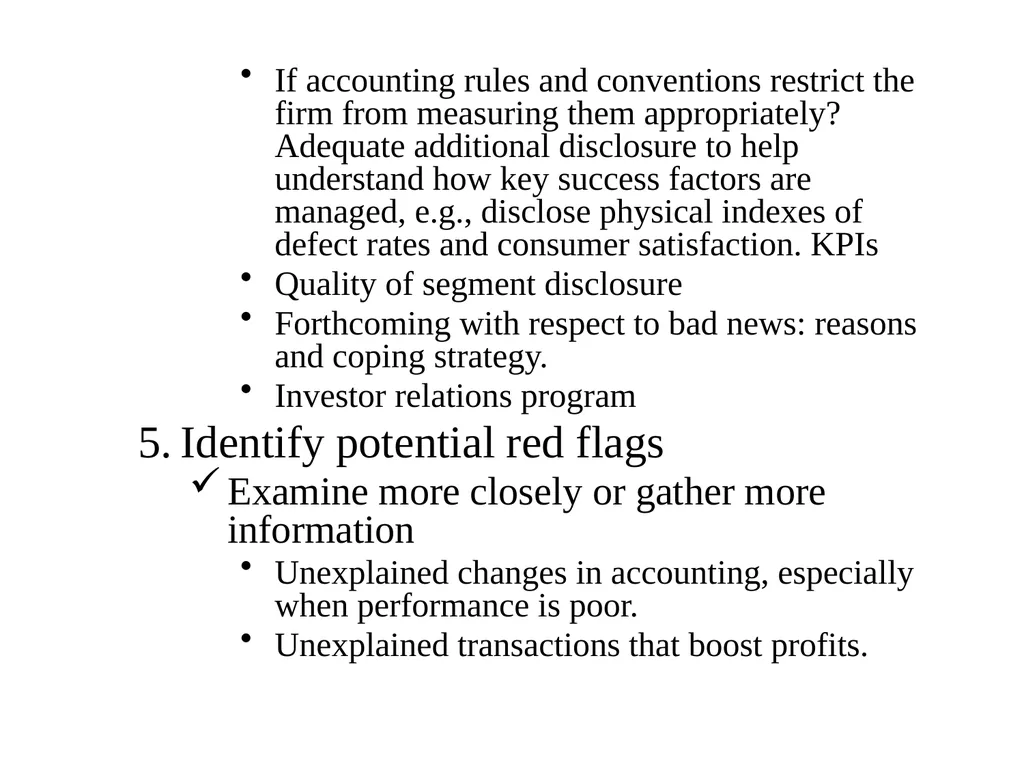
If accounting rules and conventions restrict the firm from measuring them appropriately? Adequate additional disclosure to help understand how key success factors are managed, e.g., disclose physical indexes of defect rates and consumer satisfaction. KPIs
Quality of segment disclosure
Forthcoming with respect to bad news: reasons and coping strategy.
Investor relations program
Identify potential red flags
Examine more closely or gather more information
Unexplained changes in accounting, especially when performance is poor.
Unexplained transactions that boost profits.<br>
Quality of segment disclosure
Forthcoming with respect to bad news: reasons and coping strategy.
Investor relations program
Identify potential red flags
Examine more closely or gather more information
Unexplained changes in accounting, especially when performance is poor.
Unexplained transactions that boost profits.<br>
63
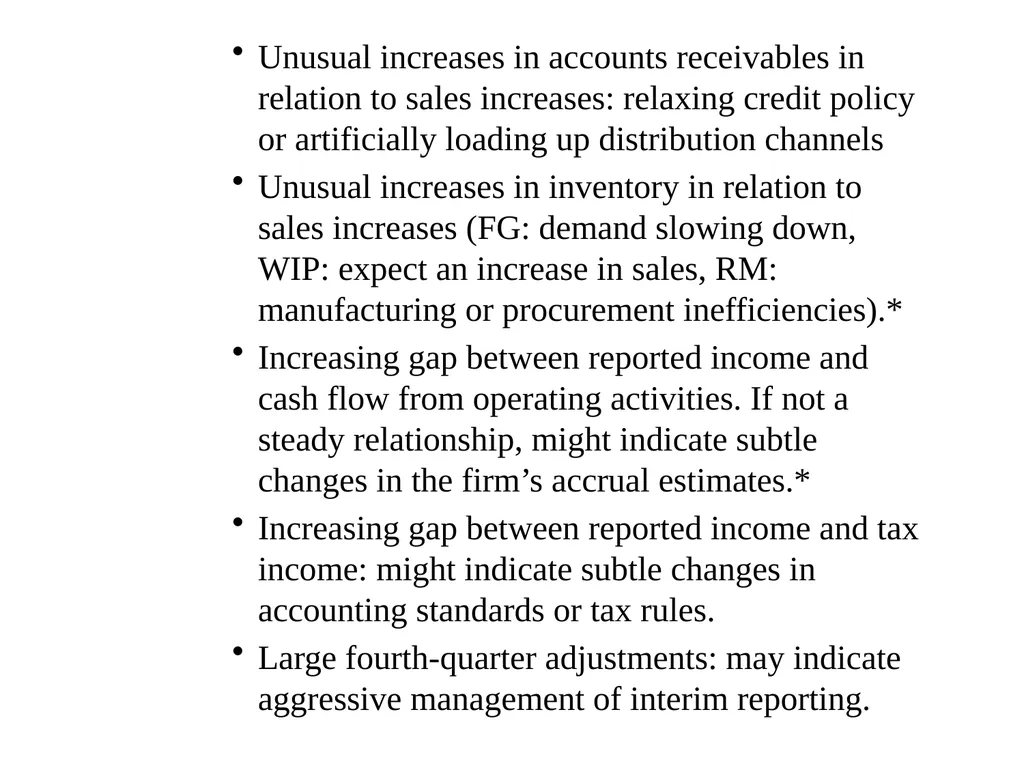
Unusual increases in accounts receivables in relation to sales increases: relaxing credit policy or artificially loading up distribution channels
Unusual increases in inventory in relation to sales increases (FG: demand slowing down, WIP: expect an increase in sales, RM: manufacturing or procurement inefficiencies).*
Increasing gap between reported income and cash flow from operating activities. If not a steady relationship, might indicate subtle changes in the firm’s accrual estimates.*
Increasing gap between reported income and tax income: might indicate subtle changes in accounting standards or tax rules.
Large fourth-quarter adjustments: may indicate aggressive management of interim reporting.<br>
Unusual increases in inventory in relation to sales increases (FG: demand slowing down, WIP: expect an increase in sales, RM: manufacturing or procurement inefficiencies).*
Increasing gap between reported income and cash flow from operating activities. If not a steady relationship, might indicate subtle changes in the firm’s accrual estimates.*
Increasing gap between reported income and tax income: might indicate subtle changes in accounting standards or tax rules.
Large fourth-quarter adjustments: may indicate aggressive management of interim reporting.<br>
64
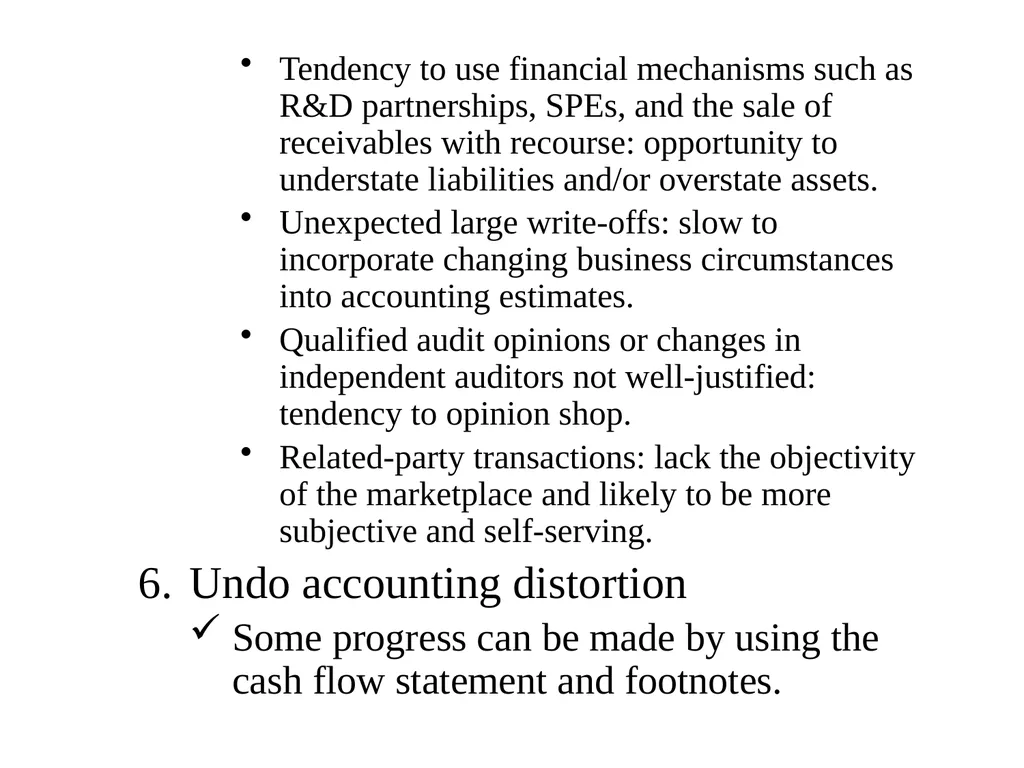
Tendency to use financial mechanisms such as R&D partnerships, SPEs, and the sale of receivables with recourse: opportunity to understate liabilities and/or overstate assets.
Unexpected large write-offs: slow to incorporate changing business circumstances into accounting estimates.
Qualified audit opinions or changes in independent auditors not well-justified: tendency to opinion shop.
Related-party transactions: lack the objectivity of the marketplace and likely to be more subjective and self-serving.
Undo accounting distortion
Some progress can be made by using the cash flow statement and footnotes.<br>
Unexpected large write-offs: slow to incorporate changing business circumstances into accounting estimates.
Qualified audit opinions or changes in independent auditors not well-justified: tendency to opinion shop.
Related-party transactions: lack the objectivity of the marketplace and likely to be more subjective and self-serving.
Undo accounting distortion
Some progress can be made by using the cash flow statement and footnotes.<br>
65
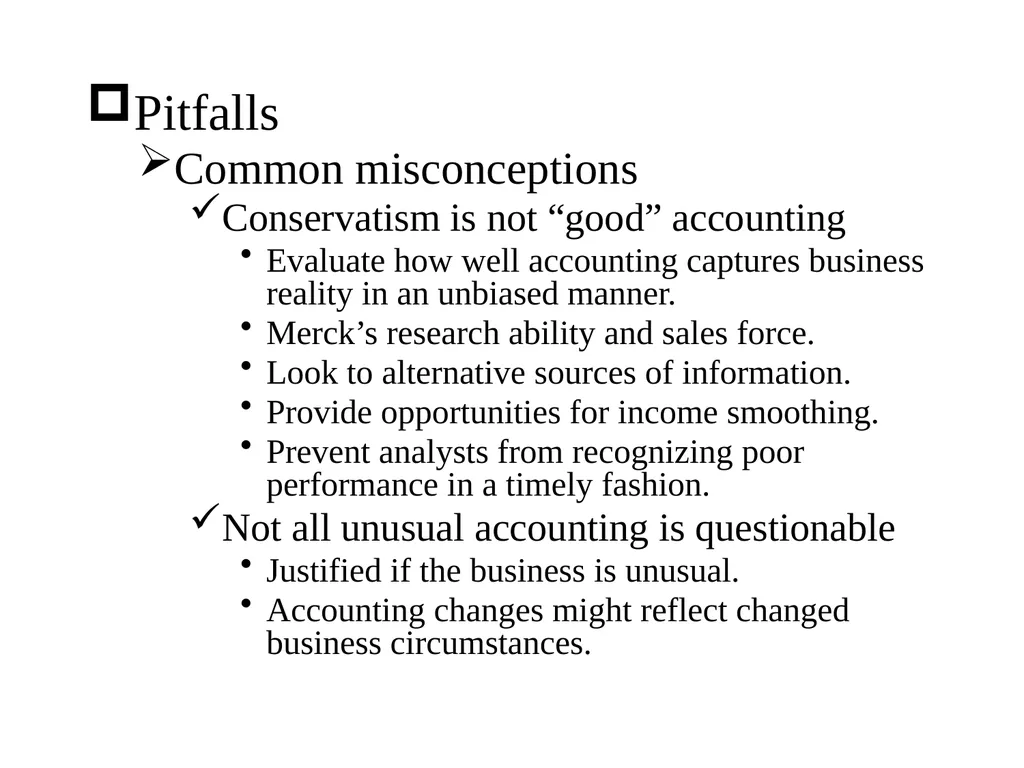
Pitfalls
Common misconceptions
Conservatism is not “good” accounting
Evaluate how well accounting captures business reality in an unbiased manner.
Merck’s research ability and sales force.
Look to alternative sources of information.
Provide opportunities for income smoothing.
Prevent analysts from recognizing poor performance in a timely fashion.
Not all unusual accounting is questionable
Justified if the business is unusual.
Accounting changes might reflect changed business circumstances.<br>
Common misconceptions
Conservatism is not “good” accounting
Evaluate how well accounting captures business reality in an unbiased manner.
Merck’s research ability and sales force.
Look to alternative sources of information.
Provide opportunities for income smoothing.
Prevent analysts from recognizing poor performance in a timely fashion.
Not all unusual accounting is questionable
Justified if the business is unusual.
Accounting changes might reflect changed business circumstances.<br>
66
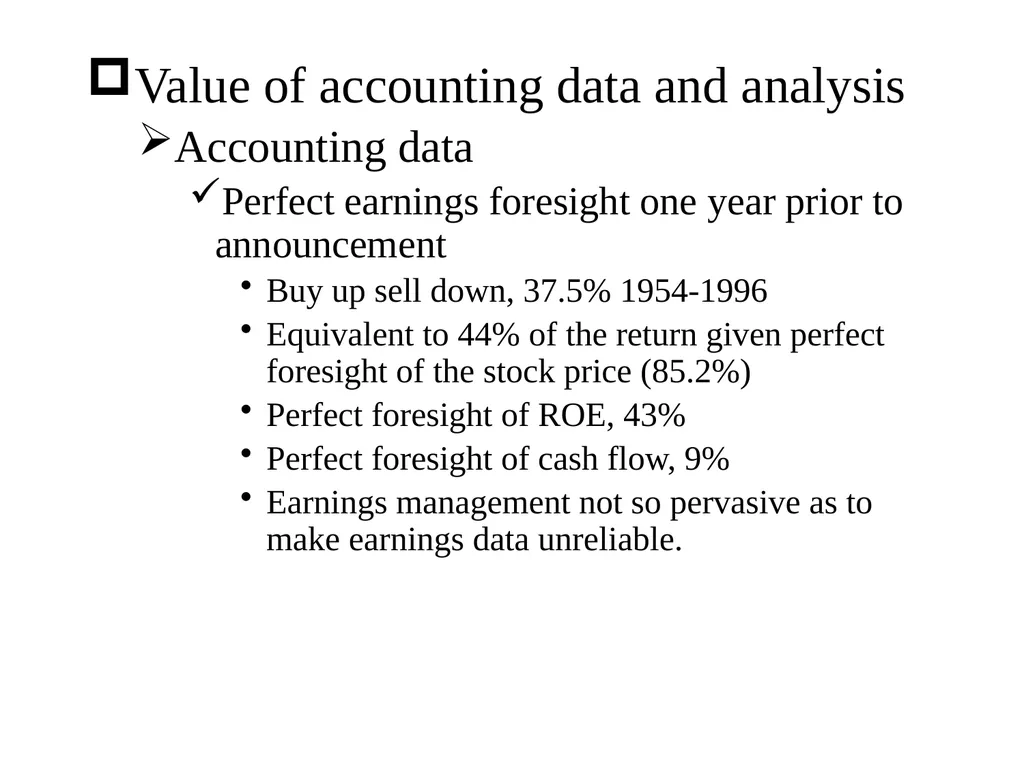
Value of accounting data and analysis
Accounting data
Perfect earnings foresight one year prior to announcement
Buy up sell down, 37.5% 1954-1996
Equivalent to 44% of the return given perfect foresight of the stock price (85.2%)
Perfect foresight of ROE, 43%
Perfect foresight of cash flow, 9%
Earnings management not so pervasive as to make earnings data unreliable.<br>
Accounting data
Perfect earnings foresight one year prior to announcement
Buy up sell down, 37.5% 1954-1996
Equivalent to 44% of the return given perfect foresight of the stock price (85.2%)
Perfect foresight of ROE, 43%
Perfect foresight of cash flow, 9%
Earnings management not so pervasive as to make earnings data unreliable.<br>
67
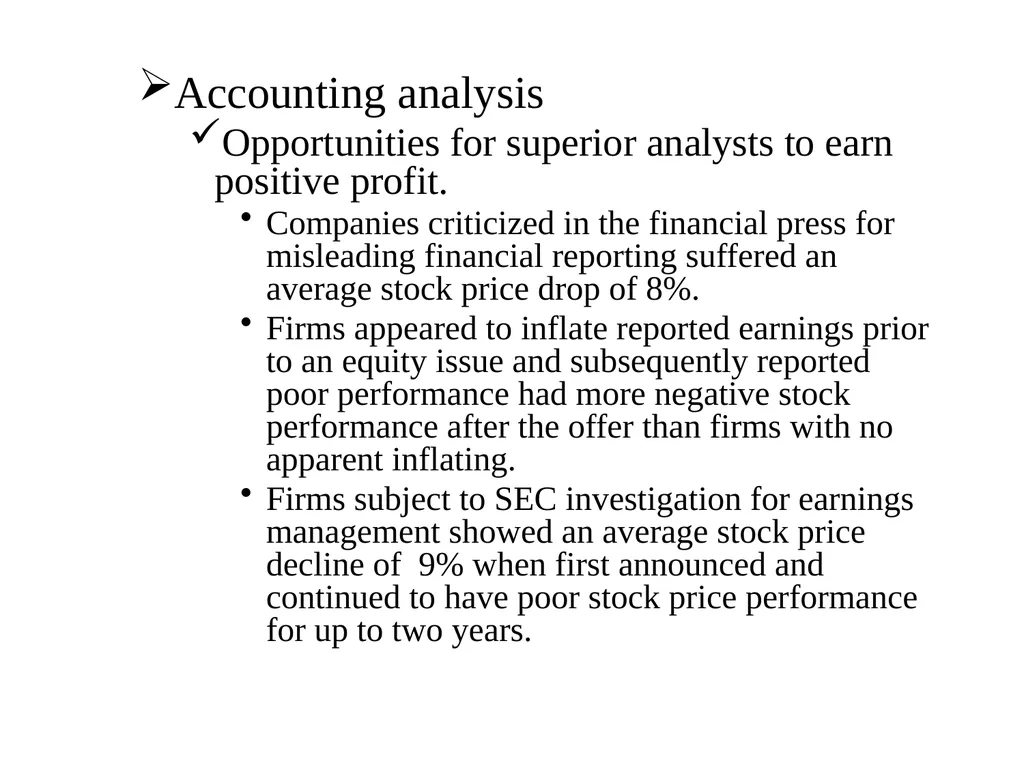
Accounting analysis
Opportunities for superior analysts to earn positive profit.
Companies criticized in the financial press for misleading financial reporting suffered an average stock price drop of 8%.
Firms appeared to inflate reported earnings prior to an equity issue and subsequently reported poor performance had more negative stock performance after the offer than firms with no apparent inflating.
Firms subject to SEC investigation for earnings management showed an average stock price decline of 9% when first announced and continued to have poor stock price performance for up to two years.<br>
Opportunities for superior analysts to earn positive profit.
Companies criticized in the financial press for misleading financial reporting suffered an average stock price drop of 8%.
Firms appeared to inflate reported earnings prior to an equity issue and subsequently reported poor performance had more negative stock performance after the offer than firms with no apparent inflating.
Firms subject to SEC investigation for earnings management showed an average stock price decline of 9% when first announced and continued to have poor stock price performance for up to two years.<br>
68
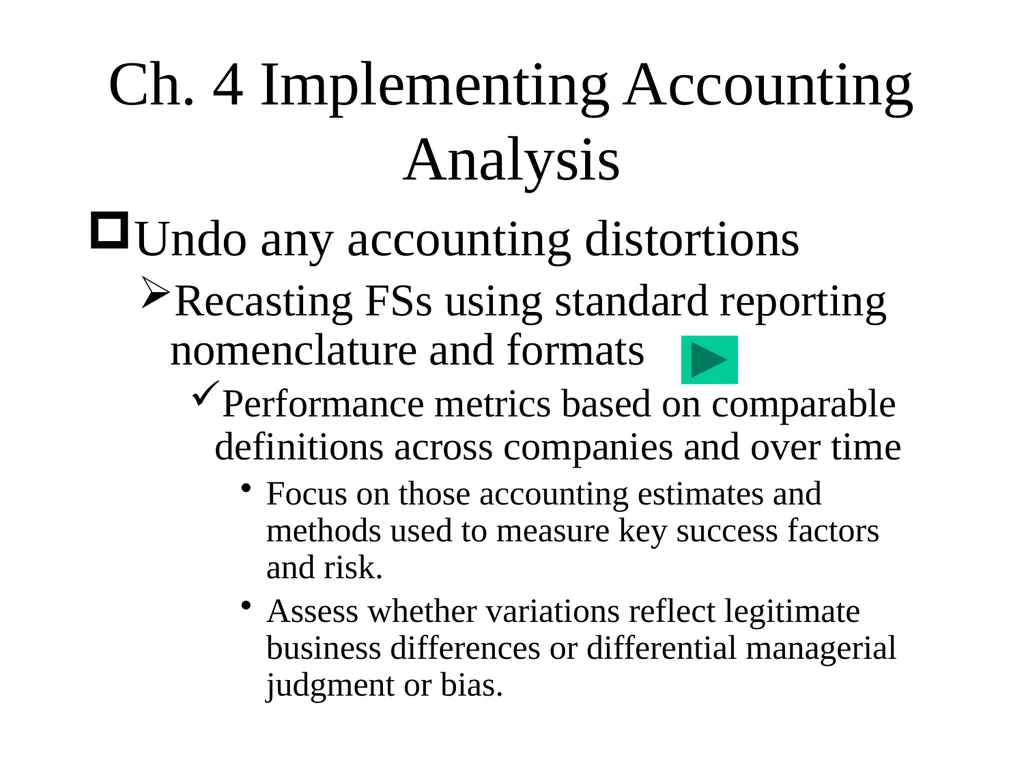
Ch. 4 Implementing Accounting Analysis Undo any accounting distortions
Recasting FSs using standard reporting nomenclature and formats
Performance metrics based on comparable definitions across companies and over time
Focus on those accounting estimates and methods used to measure key success factors and risk.
Assess whether variations reflect legitimate business differences or differential managerial judgment or bias.<br>
Recasting FSs using standard reporting nomenclature and formats
Performance metrics based on comparable definitions across companies and over time
Focus on those accounting estimates and methods used to measure key success factors and risk.
Assess whether variations reflect legitimate business differences or differential managerial judgment or bias.<br>
69
Recasting Standardized income statement format
Sales
Revenues
Membership fees
Commissions
Licenses
Cost of sales*
Cost of merchandise sold
Cost of products sold
Cost of revenues
Cost of services
Depreciation on manufacturing facilities<br>
Sales
Revenues
Membership fees
Commissions
Licenses
Cost of sales*
Cost of merchandise sold
Cost of products sold
Cost of revenues
Cost of services
Depreciation on manufacturing facilities<br>
70
SG&A
General & administrative
Marketing & sales
Salaries and benefits
Servicing & maintenance
Depreciation on SG&A Facilities
Other operating expenses*
Amortization of intangibles
Product development
R&D
Provision for losses on credit sales
Pre-opening costs
Special charges (inventory, asset write-off)<br>
General & administrative
Marketing & sales
Salaries and benefits
Servicing & maintenance
Depreciation on SG&A Facilities
Other operating expenses*
Amortization of intangibles
Product development
R&D
Provision for losses on credit sales
Pre-opening costs
Special charges (inventory, asset write-off)<br>
71
Net interest expense (income)
Interest income
Interest expense
Investment income
Equity income from associates
Dividend income
Rental income
Other income
Gains on sale of investments/long-term assets (operating)
Foreign exchange gains (operating)
Pre-tax gains from accounting changes<br>
Interest income
Interest expense
Investment income
Equity income from associates
Dividend income
Rental income
Other income
Gains on sale of investments/long-term assets (operating)
Foreign exchange gains (operating)
Pre-tax gains from accounting changes<br>
72
Other expense
Losses on sale of investments/long-term assets
Foreign exchange losses
Pre-tax losses from accounting changes
Restructuring charges
Merger expenses
Asset impairments
Minority interest
Tax expense
Provision for taxes
Unusual items (after tax)
Any gains or losses reported on an after tax-basis (extraordinary items, nonrecurring charges, effect of accounting changes)<br>
Losses on sale of investments/long-term assets
Foreign exchange losses
Pre-tax losses from accounting changes
Restructuring charges
Merger expenses
Asset impairments
Minority interest
Tax expense
Provision for taxes
Unusual items (after tax)
Any gains or losses reported on an after tax-basis (extraordinary items, nonrecurring charges, effect of accounting changes)<br>
73
Standardized balance sheet format
Assets
Cash and marketable securities
Cash
Short-term investments
Time deposits
Accounts receivable
Accounts/trade receivables
Trade debtors
Inventory
Inventory
Finished goods
Raw materials
Work-in-process
Stocks<br>
Assets
Cash and marketable securities
Cash
Short-term investments
Time deposits
Accounts receivable
Accounts/trade receivables
Trade debtors
Inventory
Inventory
Finished goods
Raw materials
Work-in-process
Stocks<br>
74
Deferred taxes – current asset
Other current assets
Prepaid expenses
Tax refundable
Current assets of discontinued operations
Due from affiliates, due from employees
Long-term tangible asset
Plant, property & equipment
Land
Non-current assets of discontinued operations
Long-term intangible assets
Goodwill
Software development costs
Deferred financing costs
Deferred subscriber acquisition costs
Trademarks, license rights
Deferred charges<br>
Other current assets
Prepaid expenses
Tax refundable
Current assets of discontinued operations
Due from affiliates, due from employees
Long-term tangible asset
Plant, property & equipment
Land
Non-current assets of discontinued operations
Long-term intangible assets
Goodwill
Software development costs
Deferred financing costs
Deferred subscriber acquisition costs
Trademarks, license rights
Deferred charges<br>
75
Deferred taxes – LT asset
Other long-term assets
Long-term investments
Long-term receivables
Investment in sales-type or direct financing leases
Liabilities and Equity
Short-term debt
Notes payable
Current portion of long-term debt
Current portion of capital lease obligation
Accounts payable
Accounts/trade payables
Trade creditors<br>
Other long-term assets
Long-term investments
Long-term receivables
Investment in sales-type or direct financing leases
Liabilities and Equity
Short-term debt
Notes payable
Current portion of long-term debt
Current portion of capital lease obligation
Accounts payable
Accounts/trade payables
Trade creditors<br>
76
Other current liabilities
Accrued expenses
Accrued liabilities
Taxes payable
Dividends payable
Deferred (unearned) revenue
Customer advances
Deferred taxes – current liabilities
Long-term debt
Long-term debt
Senior term notes
Subordinated debt
Capital lease obligations
Convertible debt
Pension/post-retirement benefit obligation
Deferred taxes – long-term liabilities<br>
Accrued expenses
Accrued liabilities
Taxes payable
Dividends payable
Deferred (unearned) revenue
Customer advances
Deferred taxes – current liabilities
Long-term debt
Long-term debt
Senior term notes
Subordinated debt
Capital lease obligations
Convertible debt
Pension/post-retirement benefit obligation
Deferred taxes – long-term liabilities<br>
77
Other long-term liabilities (non-interest bearing)
Non-current deferred (unearned) revenue
Other non-current liabilities
Minority interest
Preferred stock
Preferred stock
Preferred convertible stock
Common stockholder’s equity
Common stock
Additional paid-in capital
Capital in excess of par
Treasury stock
Retained earnings
Cumulative foreign currency gains and losses
Accumulated other comprehensive income<br>
Non-current deferred (unearned) revenue
Other non-current liabilities
Minority interest
Preferred stock
Preferred stock
Preferred convertible stock
Common stockholder’s equity
Common stock
Additional paid-in capital
Capital in excess of par
Treasury stock
Retained earnings
Cumulative foreign currency gains and losses
Accumulated other comprehensive income<br>
78
Standardized cash flow statement format
Net income
Non-operating gains (losses)
Gain (loss) on sale of investments/non-current assets
Cumulative effect of accounting changes
Gain (loss) on foreign exchange
Extraordinary gains (losses)
Long-term operating accruals
Depreciation and amortization
Deferred revenues/costs
Deferred income taxes
Impairment of non-current assets
Other non-cash charges to operations<br>
Net income
Non-operating gains (losses)
Gain (loss) on sale of investments/non-current assets
Cumulative effect of accounting changes
Gain (loss) on foreign exchange
Extraordinary gains (losses)
Long-term operating accruals
Depreciation and amortization
Deferred revenues/costs
Deferred income taxes
Impairment of non-current assets
Other non-cash charges to operations<br>
79
Equity earnings of affiliates/unconsolidated subsidiaries, net of cash received
Minority interest
Stock bonus awards
Net (investments in) or liquidation of operating working capital: changes in
Trade accounts receivable
Other receivable
Prepaid expenses
Trade accounts payable
Accrued expenses
Due from affiliates
Accounts payable and accrued expenses
Refundable/payable income taxes
Inventories<br>
Minority interest
Stock bonus awards
Net (investments in) or liquidation of operating working capital: changes in
Trade accounts receivable
Other receivable
Prepaid expenses
Trade accounts payable
Accrued expenses
Due from affiliates
Accounts payable and accrued expenses
Refundable/payable income taxes
Inventories<br>
80
Provision for doubtful accounts
Other current liabilities
Other current assets
Net (investments in) or liquidation of operating long-term assets
Purchase/sales of non-current assets
Acquisition of R&D
Acquisition/sales of business
Capital expenditures
Equity investments
Acquisition of subsidiary stock
Capitalization of computer software development costs
Cost in excess of the fair value of net assets acquired (goodwill)<br>
Other current liabilities
Other current assets
Net (investments in) or liquidation of operating long-term assets
Purchase/sales of non-current assets
Acquisition of R&D
Acquisition/sales of business
Capital expenditures
Equity investments
Acquisition of subsidiary stock
Capitalization of computer software development costs
Cost in excess of the fair value of net assets acquired (goodwill)<br>
81
Investment in sales-type and direct financing leases
Net debt (repayment) or issuance
Principal payments on debt
Borrowings (repayments) under credit facility
Issuance (repayment) of long-term debt
Net increase (decrease) in short-term borrowings
Notes payable
Dividend (payments)
Cash dividends paid on common stock
Cash dividends paid on preferred stock
Distributions<br>
Net debt (repayment) or issuance
Principal payments on debt
Borrowings (repayments) under credit facility
Issuance (repayment) of long-term debt
Net increase (decrease) in short-term borrowings
Notes payable
Dividend (payments)
Cash dividends paid on common stock
Cash dividends paid on preferred stock
Distributions<br>
82
Net stock (repurchase) or issuance
Proceeds from issuance of common stock
Issue of common stock for services
Issue (redemption) of preferred securities
Issue of subsidiary equity
Purchase (issue) of treasury stock<br>
Proceeds from issuance of common stock
Issue of common stock for services
Issue (redemption) of preferred securities
Issue of subsidiary equity
Purchase (issue) of treasury stock<br>
83
Even if accounting rules are adhered to consistently, distortion can arise because accounting rules themselves do a poor job of capturing firm economics.
Information taken from footnotes, cash flow statement and other sources may enable a precise adjustment, otherwise make an approximate adjustment.*
Once any asset and liability misstatements have been identified
Make adjustments to the balance sheet at the beginning and/or end of the current year, as well as needed adjustments to revenues and expenses in the latest income statement.
Ensure that the most recent financial ratios used to evaluate a firm’s performance and forecast its future results are based on financial data that appropriately reflect its business economics.<br>
Information taken from footnotes, cash flow statement and other sources may enable a precise adjustment, otherwise make an approximate adjustment.*
Once any asset and liability misstatements have been identified
Make adjustments to the balance sheet at the beginning and/or end of the current year, as well as needed adjustments to revenues and expenses in the latest income statement.
Ensure that the most recent financial ratios used to evaluate a firm’s performance and forecast its future results are based on financial data that appropriately reflect its business economics.<br>
84
Asset Distortions
Definition of assets
Resources that a firm owns or controls as a result of past business transactions, and which are expected to produce future economic benefits that can be measured with a reasonable degree of certainty.
Ownership or control
Difficult for accounting rules to capture all of the subtleties associated with ownership.
Permits managers to groom打扮transactions so that essentially similar transactions can be reported in very different ways: important assets may be omitted from the balance sheet even though the firm bears many of the economic risks of ownership.<br>
Definition of assets
Resources that a firm owns or controls as a result of past business transactions, and which are expected to produce future economic benefits that can be measured with a reasonable degree of certainty.
Ownership or control
Difficult for accounting rules to capture all of the subtleties associated with ownership.
Permits managers to groom打扮transactions so that essentially similar transactions can be reported in very different ways: important assets may be omitted from the balance sheet even though the firm bears many of the economic risks of ownership.<br>
85
There may be legitimate differences in opinion between managers and analysts over residual ownership risks borne by the company (recognition and derecognition).
Aggressive revenue recognition which boost earnings is also likely to affect asset values: recognized only when products have been shipped or services have been provided to the customer, when the customer has a legal commitment to pay, and when cash collection is reasonable likely. Hence frequently coincides with ownership of a receivable.
Examples
Leases: bankruptcy of airlines
Discounting receivables with recourse
Revenue recognition: transactions with nonconsolidated affiliates or at period’s end.
Securitization (true sales): nonconsolidated SPEs<br>
Aggressive revenue recognition which boost earnings is also likely to affect asset values: recognized only when products have been shipped or services have been provided to the customer, when the customer has a legal commitment to pay, and when cash collection is reasonable likely. Hence frequently coincides with ownership of a receivable.
Examples
Leases: bankruptcy of airlines
Discounting receivables with recourse
Revenue recognition: transactions with nonconsolidated affiliates or at period’s end.
Securitization (true sales): nonconsolidated SPEs<br>
86
Future economic benefits
Measured with reasonable certainty.
Difficult to accurately forecast the future benefits associated with capital outlays.
Whether a competitor will offer a new product or service.
Whether the products manufactured at a new plant will be the type that customers want to buy.
Whether changes in oil prices will make the oil drilling equipment manufactured less valuable.
Accounting rules deal with these challenges by stipulating which types of resources can be recorded as assets and which cannot.
Yet, economic benefits should not be a yes or no question, nor should be measured at cost.*
Example: R&D expenses
Generally considered highly uncertain.<br>
Measured with reasonable certainty.
Difficult to accurately forecast the future benefits associated with capital outlays.
Whether a competitor will offer a new product or service.
Whether the products manufactured at a new plant will be the type that customers want to buy.
Whether changes in oil prices will make the oil drilling equipment manufactured less valuable.
Accounting rules deal with these challenges by stipulating which types of resources can be recorded as assets and which cannot.
Yet, economic benefits should not be a yes or no question, nor should be measured at cost.*
Example: R&D expenses
Generally considered highly uncertain.<br>
87
May never deliver promised products, the products generated may not be economically viable, or products may be made obsolete by competitors’ research.
Exception: SFAS 86 requires software development costs be capitalized once the software reaches the stage of technological feasibility.
Impairments
The possibility that asset values are misstated.
SFAS 144: an impairment loss (difference between the fair value and book value) be recognized on a long-term asset when its book value exceeds the undiscounted cash flows expected to be generated from future use and sale. Measurement of impairment is based on discounted cash flows<br>
Exception: SFAS 86 requires software development costs be capitalized once the software reaches the stage of technological feasibility.
Impairments
The possibility that asset values are misstated.
SFAS 144: an impairment loss (difference between the fair value and book value) be recognized on a long-term asset when its book value exceeds the undiscounted cash flows expected to be generated from future use and sale. Measurement of impairment is based on discounted cash flows<br>
88
Markets for many long-term operating assets are illiquid or incomplete, making it highly subjective to decide whether an asset is impaired and to infer its fair value.
The task of impairment judgment is delegated to management, with oversight by the auditor.
Potentially leaving opportunities for management bias and for legitimate differences in opinion between managers and analysts over asset valuations.
Independent valuation internal as well as external.
Overstated assets
Incentives to increase reported earnings
Delays in writing down current assets
Impaired if book values fall below realizable values.<br>
The task of impairment judgment is delegated to management, with oversight by the auditor.
Potentially leaving opportunities for management bias and for legitimate differences in opinion between managers and analysts over asset valuations.
Independent valuation internal as well as external.
Overstated assets
Incentives to increase reported earnings
Delays in writing down current assets
Impaired if book values fall below realizable values.<br>
89
Write-offs are charged directly to earnings.
Where management of inventories and receivables is a key success factor, analysts need to be particularly cognizant of this form of earnings management: overstocking (offer customer discounts or credit extension).
Warning signs: growing days’ inventory, days’ receivable, write-down by competitors, and business downturns for major customers.
Underestimated reserves
Allowances for bad debts or loan losses.
Warning signs: growing days’ receivable, business downturns for major clients, and loan delinquencies.
Accelerated recognition of revenue
Increasing receivables (at the period’s end while cash collection may not be reasonably likely).<br>
Where management of inventories and receivables is a key success factor, analysts need to be particularly cognizant of this form of earnings management: overstocking (offer customer discounts or credit extension).
Warning signs: growing days’ inventory, days’ receivable, write-down by competitors, and business downturns for major customers.
Underestimated reserves
Allowances for bad debts or loan losses.
Warning signs: growing days’ receivable, business downturns for major clients, and loan delinquencies.
Accelerated recognition of revenue
Increasing receivables (at the period’s end while cash collection may not be reasonably likely).<br>
90
Delayed write-downs of long-term assets
Deteriorating industry/firm economic conditions.
Aggressive growth through acquisitions (intangible assets and goodwill impairments).
Heavy asset-intensive firms in volatile markets.
Warning signs: declining long-term asset turnover, return on assets lower than the cost of capital, write-downs by other firms, overpayment for or unsuccessful integration of key acquisitions.
Understated depreciation/amortization on long-term assets
Estimates of asset lives, salvage values, and amortization schedules. 摩爾定律
Heavy asset businesses: airlines, utilities, and semiconductor foundries.<br>
Deteriorating industry/firm economic conditions.
Aggressive growth through acquisitions (intangible assets and goodwill impairments).
Heavy asset-intensive firms in volatile markets.
Warning signs: declining long-term asset turnover, return on assets lower than the cost of capital, write-downs by other firms, overpayment for or unsuccessful integration of key acquisitions.
Understated depreciation/amortization on long-term assets
Estimates of asset lives, salvage values, and amortization schedules. 摩爾定律
Heavy asset businesses: airlines, utilities, and semiconductor foundries.<br>
91
Case: Dot-com stock market crash in April 2000.
A ripple effect on firms selling equipment to the telecommunications and internet industries, e.g., Lucent Technologies.
First sign of a downturn came in the June 2000 quarter, when earnings declined markedly YoY.
This pattern persists through the next two quarters with reported operating losses of $2.1b and $4.8b, respectively.
Reported year-end inventory $6.9b was $1.5b higher YoY, yet fourth quarter sales $5.8b declined precipitously from $9.9b previous year.
Day’s inventory increase from 58 days to 107 days, gross margins declined from 47% to 22%, yet recorded no inventory impairment charge.
Can assess the problems by talking to Lucent’s customers and by observing the performance of other firms in the industry.<br>
A ripple effect on firms selling equipment to the telecommunications and internet industries, e.g., Lucent Technologies.
First sign of a downturn came in the June 2000 quarter, when earnings declined markedly YoY.
This pattern persists through the next two quarters with reported operating losses of $2.1b and $4.8b, respectively.
Reported year-end inventory $6.9b was $1.5b higher YoY, yet fourth quarter sales $5.8b declined precipitously from $9.9b previous year.
Day’s inventory increase from 58 days to 107 days, gross margins declined from 47% to 22%, yet recorded no inventory impairment charge.
Can assess the problems by talking to Lucent’s customers and by observing the performance of other firms in the industry.<br>
92
Inventory write-down was $536m in March 2001, $143m in June, and $11m in September.
Accounts receivable allowances increased from 5% in September 2000 to 7% in December.
Requires a thorough review of the short-term cash generating potential of major customers.
Reported estimates were 8.7% in March 2001, 11.2% in June, 12.5% in September, and 19.5% in December (帳齡分析).
Case: MicroStrategy, a software company
Recognized revenues from the sale of licenses “after execution of a licensing agreement and shipment of the product, provided that no significant Company obligations remain and the resulting receivable is deemed collectible by management.”<br>
Accounts receivable allowances increased from 5% in September 2000 to 7% in December.
Requires a thorough review of the short-term cash generating potential of major customers.
Reported estimates were 8.7% in March 2001, 11.2% in June, 12.5% in September, and 19.5% in December (帳齡分析).
Case: MicroStrategy, a software company
Recognized revenues from the sale of licenses “after execution of a licensing agreement and shipment of the product, provided that no significant Company obligations remain and the resulting receivable is deemed collectible by management.”<br>
93
Booking two contracts (announced several days after the quarter’s end) worth $27m as quarterly revenues.
Cost of license revenues is only 3% (should be a prepaid expense, no inventory).
Restate FSs: Accounts receivable were reduced from $61.1m to $37.6m for 1999 (contracts not fully executed by the Company in the reporting period).
Case: merger between AOL and Time Warner
Enabling AOL to cross-sell TW’s content to its large subscriber base, goodwill valued at $128b in December 2001.
Disney’s acquisition of ABC had faced difficulties in realizing their potential.<br>
Cost of license revenues is only 3% (should be a prepaid expense, no inventory).
Restate FSs: Accounts receivable were reduced from $61.1m to $37.6m for 1999 (contracts not fully executed by the Company in the reporting period).
Case: merger between AOL and Time Warner
Enabling AOL to cross-sell TW’s content to its large subscriber base, goodwill valued at $128b in December 2001.
Disney’s acquisition of ABC had faced difficulties in realizing their potential.<br>
94
Why AOL had to buy TW to access its content (simply sign a long-term licensing agreement)?
Raised questions about AOL and TW relations with existing customers and suppliers: TW sells to AOL’s competitor Microsoft, AOL’s deals with TW’s competitors, and even if TW content become stale, AOL has no choice but to continue supplying.
Questions quickly answered when Internet sector stocks crashed.
Goodwill write-down of $54b in March 2002, additional write-down of $45.5b at the end of 2002.<br>
Raised questions about AOL and TW relations with existing customers and suppliers: TW sells to AOL’s competitor Microsoft, AOL’s deals with TW’s competitors, and even if TW content become stale, AOL has no choice but to continue supplying.
Questions quickly answered when Internet sector stocks crashed.
Goodwill write-down of $54b in March 2002, additional write-down of $45.5b at the end of 2002.<br>
95
Understated assets
Incentives to deflate reported earnings
Income smoothing
Performed exceptional well and decided to store away some of the current strong earnings for a rainy day.
Overstating period expenses
Take a bath
In a particular bad year to create the appearance of a turnaround in following years.
Incentives to understate liabilities
Neither the assets nor the accompanying obligations are shown on the balance sheet.
Operating lease, discounting receivables with recourse, offset.<br>
Incentives to deflate reported earnings
Income smoothing
Performed exceptional well and decided to store away some of the current strong earnings for a rainy day.
Overstating period expenses
Take a bath
In a particular bad year to create the appearance of a turnaround in following years.
Incentives to understate liabilities
Neither the assets nor the accompanying obligations are shown on the balance sheet.
Operating lease, discounting receivables with recourse, offset.<br>
96
Conservative accounting rules
Expense R&D and advertising outlays
Pooling of interests
Under double-entry accounting, conservative is followed by aggressive.
Common forms
Overstated write-downs of current assets: can also arise when managers are less optimistic about the future prospects.
Overestimated reserves
Overestimated write-downs of long-term assets
Overstated depreciation/amortization: accelerated tax depreciation
Excluded goodwill using pooling*<br>
Expense R&D and advertising outlays
Pooling of interests
Under double-entry accounting, conservative is followed by aggressive.
Common forms
Overstated write-downs of current assets: can also arise when managers are less optimistic about the future prospects.
Overestimated reserves
Overestimated write-downs of long-term assets
Overstated depreciation/amortization: accelerated tax depreciation
Excluded goodwill using pooling*<br>
97
Lease assets off balance sheet: whether the lessee has effectively accepted most of the risks of ownership, such as obsolescence and physical deterioration
SFAS 13 require purchase treatment if any of the following holds: ownership is transferred to the lessee at the end of the lease term; the lessee has the option to purchase for a bargain price at the end of the term; the lease term is 75% or more of the asset’s expected useful life; the present value of the lease payments is 90% or more of the fair value of the asset.
Opportunities for management to circumvent the spirit of the distinction between capital and operating leases, likely to be an important issue for the heavy asset industries.<br>
SFAS 13 require purchase treatment if any of the following holds: ownership is transferred to the lessee at the end of the lease term; the lessee has the option to purchase for a bargain price at the end of the term; the lease term is 75% or more of the asset’s expected useful life; the present value of the lease payments is 90% or more of the fair value of the asset.
Opportunities for management to circumvent the spirit of the distinction between capital and operating leases, likely to be an important issue for the heavy asset industries.<br>
98
Discounted receivables with recourse: still retains considerable collection risk. *
SFAS 140 requires to be considered sold if the seller cedes control to the financier beyond the reach of the seller’s creditors should seller file for bankruptcy; the financier has the right to pledge or sell the receivables; and the seller has no commitment to repurchase.
If with recourse, requires the seller to continue to estimate bad debt losses. Also requires the seller to have experience in estimating the value of the recourse liability (allowances for credit and refinancing risks).
Affect both income and liability: gains and losses on the sales to be excluded, interest income on the notes receivable and interest expenses on the loan to be recorded.<br>
SFAS 140 requires to be considered sold if the seller cedes control to the financier beyond the reach of the seller’s creditors should seller file for bankruptcy; the financier has the right to pledge or sell the receivables; and the seller has no commitment to repurchase.
If with recourse, requires the seller to continue to estimate bad debt losses. Also requires the seller to have experience in estimating the value of the recourse liability (allowances for credit and refinancing risks).
Affect both income and liability: gains and losses on the sales to be excluded, interest income on the notes receivable and interest expenses on the loan to be recorded.<br>
99
Key intangible assets not reported: inflates ROE, will not be mean-reverting to the cost of capital. Make it difficult to assess whether the firm’s business model works (against the matching concept and obscures operating performance). Likely to be important for firms in software, pharmaceutical, branded consumer products, and subscription businesses.*
Case: Lufthansa, German national airline
In 2001, depreciated aircraft over 12 years on a straight-line basis with estimated residual value of 15% of initial cost, for both financial and tax reporting purposes. British Airways (BA): 20 years & 8% for financial reporting purpose.
Reflect different fly routes, asset management strategies (newer planes, lower maintenance cost, lower fuel costs, cargos vs. passengers).<br>
Case: Lufthansa, German national airline
In 2001, depreciated aircraft over 12 years on a straight-line basis with estimated residual value of 15% of initial cost, for both financial and tax reporting purposes. British Airways (BA): 20 years & 8% for financial reporting purpose.
Reflect different fly routes, asset management strategies (newer planes, lower maintenance cost, lower fuel costs, cargos vs. passengers).<br>
100
Case: Johnson and Johnson
Acquired 234.4m shares of ALZA (book value $1.6b) in June 2001 for a price of 229.6m shares of J&J valued at $12.2b.
Case: Japan Airlines (JAL)
Rents part of flight equipment
Using the operating method though qualify as capital leases.
Depreciate the present value of lease payments and apportion lease payments between interest expenses and repayment of long-term debt.
Case: Microsoft
Does not capitalize any R&D costs.
Expected life of software is about 3 years.
Capitalize and amortize those passed the stage of technological feasibility.<br>
Acquired 234.4m shares of ALZA (book value $1.6b) in June 2001 for a price of 229.6m shares of J&J valued at $12.2b.
Case: Japan Airlines (JAL)
Rents part of flight equipment
Using the operating method though qualify as capital leases.
Depreciate the present value of lease payments and apportion lease payments between interest expenses and repayment of long-term debt.
Case: Microsoft
Does not capitalize any R&D costs.
Expected life of software is about 3 years.
Capitalize and amortize those passed the stage of technological feasibility.<br>
101
Liability Distortions
Definition of liabilities
Economic obligations arising from benefits received in the past, and the amount and timing is known with reasonable certainty.*
Has an obligation been incurred?
A plan to restructure
By laying off employees: a commitment made?
Software license
Received cash for a five-year contract: report the full amount as revenues or should some of it represent the on going commitment to the customer for servicing and supporting.<br>
Definition of liabilities
Economic obligations arising from benefits received in the past, and the amount and timing is known with reasonable certainty.*
Has an obligation been incurred?
A plan to restructure
By laying off employees: a commitment made?
Software license
Received cash for a five-year contract: report the full amount as revenues or should some of it represent the on going commitment to the customer for servicing and supporting.<br>
102
Can the obligation be measured?
Environmental cleanup*
Pension and post-retirement benefits
Future warranty and insurance claim
Understated liabilities
Likely reasons
Key commitments that are difficult to value and therefore not considered liabilities for financial reporting purposes.
Incentives to overstate the soundness of financial position or to boost earnings.
Unearned (deferred) revenues understated
Aggressive revenue recognition: cash received but the product or service has yet to be provided.<br>
Environmental cleanup*
Pension and post-retirement benefits
Future warranty and insurance claim
Understated liabilities
Likely reasons
Key commitments that are difficult to value and therefore not considered liabilities for financial reporting purposes.
Incentives to overstate the soundness of financial position or to boost earnings.
Unearned (deferred) revenues understated
Aggressive revenue recognition: cash received but the product or service has yet to be provided.<br>
103
Bundle service contracts with the sale of a product (unless incrementally charged): separating the price of the product from the price of the service is subjective.
Loans from discounted receivables
Long-term liabilities for leases
Pension and post-retirement obligations are not fully recorded
Defined benefits vs. defined contributions.
Estimate the present value of the commitments that have been earned by employees over their years of working for the firm: future wage rates, retirement ages, worker attribution 耗損rates, life expectancies, health insurance costs, and discount rate.*
This obligation is offset by any assets that has been committed to fund future plan benefits.<br>
Loans from discounted receivables
Long-term liabilities for leases
Pension and post-retirement obligations are not fully recorded
Defined benefits vs. defined contributions.
Estimate the present value of the commitments that have been earned by employees over their years of working for the firm: future wage rates, retirement ages, worker attribution 耗損rates, life expectancies, health insurance costs, and discount rate.*
This obligation is offset by any assets that has been committed to fund future plan benefits.<br>
104
Are the assumptions made by the firm to estimate realistic? Use sensitivity information to adjust for any optimism.
Incremental benefit commitments arising from changes to a plan, and changes in the plan funding status arising from abnormal investment returns on plan assets, are smoothed over time rather than recognized immediately.
The smoothing process understates obligations: The increased obligation from increased plan benefits for current workers has to be amortized over employees’ average expected remaining years of service. The unexpected increase or decrease in value of plan assets in a given year, or the impact of adjustment in actuarial assumptions, is reflected gradually.<br>
Incremental benefit commitments arising from changes to a plan, and changes in the plan funding status arising from abnormal investment returns on plan assets, are smoothed over time rather than recognized immediately.
The smoothing process understates obligations: The increased obligation from increased plan benefits for current workers has to be amortized over employees’ average expected remaining years of service. The unexpected increase or decrease in value of plan assets in a given year, or the impact of adjustment in actuarial assumptions, is reflected gradually.<br>
105
The value of liability reported is the unfunded obligation less the unrecognized.
The pension cost each year comprises service cost (additional year of service) + interest cost (multiplying the beginning obligation by the discount rate) + amortization of any prior period service costs +/- amortization of actuarial gains and losses (changes in assumptions) – expected return on plan assets (the expected long-term return multiplied by beginning assets under management).
Actual cost comprises actual return on plan assets and without amortizations of prior period adjustments.<br>
The pension cost each year comprises service cost (additional year of service) + interest cost (multiplying the beginning obligation by the discount rate) + amortization of any prior period service costs +/- amortization of actuarial gains and losses (changes in assumptions) – expected return on plan assets (the expected long-term return multiplied by beginning assets under management).
Actual cost comprises actual return on plan assets and without amortizations of prior period adjustments.<br>
106
Case: MicroStrategy
Bundles customer support and software updates with initial licensing agreements.
Conceded in March 2000: overstated revenues on contracts that involved significant future customization and consulting by $54.5m in 1999.
Stock price plummeted 94%
Case: Computer Associates
Reported a contingent liability of $218m in 2002 for receivable (from long-term licensing contracts) discounted with recourse.<br>
Bundles customer support and software updates with initial licensing agreements.
Conceded in March 2000: overstated revenues on contracts that involved significant future customization and consulting by $54.5m in 1999.
Stock price plummeted 94%
Case: Computer Associates
Reported a contingent liability of $218m in 2002 for receivable (from long-term licensing contracts) discounted with recourse.<br>
107
Equity Distortions
A residual claim
Arise primarily from distortions in assets and liabilities.
Unique forms
Debt like equity
Preferred stock with mandatory redemption or put option.
Overstate equity and understate debt.
Hybrid securities
Convertible debt and debt with warrants attached
Without separating the components, overstate debt and understate equity.
Understate interest expense if treated as bond, because of low coupon rate (may even be negative).<br>
A residual claim
Arise primarily from distortions in assets and liabilities.
Unique forms
Debt like equity
Preferred stock with mandatory redemption or put option.
Overstate equity and understate debt.
Hybrid securities
Convertible debt and debt with warrants attached
Without separating the components, overstate debt and understate equity.
Understate interest expense if treated as bond, because of low coupon rate (may even be negative).<br>
108
If equity component is separated, it will be a deep discount bond and discount amortization is also an interest expense.
Some may have put option with put rate compensating investor for the market interest rate, the interest expense should be based on put rate rather than coupon rate. (PLYER)
Stock option expenses
Top management owned or had a claim to 13.2% of their company’s shares in 1997, almost double the 1989 percentage.
No expense is typically recorded either when they are issued or when they are exercised. Many managers view options as a low-cost form of compensation.
Choose APB 25 the intrinsic value method or SFAS 123 the fair value method.
Overuse of options can encourage earnings management to boost short-term stock prices.*<br>
Some may have put option with put rate compensating investor for the market interest rate, the interest expense should be based on put rate rather than coupon rate. (PLYER)
Stock option expenses
Top management owned or had a claim to 13.2% of their company’s shares in 1997, almost double the 1989 percentage.
No expense is typically recorded either when they are issued or when they are exercised. Many managers view options as a low-cost form of compensation.
Choose APB 25 the intrinsic value method or SFAS 123 the fair value method.
Overuse of options can encourage earnings management to boost short-term stock prices.*<br>
109
PLYER Puttable Low-yield Equity-linked Redeemable Economic substance Nominal Put rate Coupon
rate Forced
Conversion Conversion The call option (redeemable) reduces the value of conversion right,
more of an equity component, its value should be deducted from the
conversion right, an EI, rather than deducted from the liability
component, a straight bond with non-equity components. Issuer’s advantages Holders’ advantages<br>
rate Forced
Conversion Conversion The call option (redeemable) reduces the value of conversion right,
more of an equity component, its value should be deducted from the
conversion right, an EI, rather than deducted from the liability
component, a straight bond with non-equity components. Issuer’s advantages Holders’ advantages<br>
110
Cash and stock bonuses for employees are treated as earnings distributions rather than expenses. Stock bonuses should be expensed at market price rather than at par.*
Case: Amazon.com
On February 3, 1999, completed an offering of $1.25b of 4.75% Convertible Subordinated Note due in 2009.
Several month earlier issued senior notes with an annual interest rate of 10%.
The value of $1.25b convertible at a 10% discount rate is only $0.87b, implying the conversion premium was worth at least $0.38b.
Case: Microsoft
Uses stock options extensively and reports by the intrinsic method (fair value $3.377b, June 2001).<br>
Case: Amazon.com
On February 3, 1999, completed an offering of $1.25b of 4.75% Convertible Subordinated Note due in 2009.
Several month earlier issued senior notes with an annual interest rate of 10%.
The value of $1.25b convertible at a 10% discount rate is only $0.87b, implying the conversion premium was worth at least $0.38b.
Case: Microsoft
Uses stock options extensively and reports by the intrinsic method (fair value $3.377b, June 2001).<br>
111
Misconceptions
Assets
If paid for a resource, must be an asset
A mistake or ill-intended*
Impaired
Inconsistent: R&D vs. purchased goodwill
If can’t kick a resource, really isn’t an asset
Rapid write-off or exclusion of intangibles
If bought, yes; if developed, no
Recording acquired but not internally generated intangibles<br>
Assets
If paid for a resource, must be an asset
A mistake or ill-intended*
Impaired
Inconsistent: R&D vs. purchased goodwill
If can’t kick a resource, really isn’t an asset
Rapid write-off or exclusion of intangibles
If bought, yes; if developed, no
Recording acquired but not internally generated intangibles<br>
112
Market values only relevant if intend to sell
Avoid an economic loss by simply not selling.*
May be true for operating assets
Gains selling or cherry picking
Liabilities
Prudent to provide for a rainy day
Conservative can be as misleading as aggressive
Income smoothing
Off-balance-sheet financing preferable
Underestimate true leverage
Equity
Dirty surplus for unrealized gains & losses*
Financial instruments available for sale or used to hedge uncertain future cash flows.
Foreign operations currency translations.<br>
Avoid an economic loss by simply not selling.*
May be true for operating assets
Gains selling or cherry picking
Liabilities
Prudent to provide for a rainy day
Conservative can be as misleading as aggressive
Income smoothing
Off-balance-sheet financing preferable
Underestimate true leverage
Equity
Dirty surplus for unrealized gains & losses*
Financial instruments available for sale or used to hedge uncertain future cash flows.
Foreign operations currency translations.<br>
113
Multibusiness Organizations
Financial Statement Analysis Professor David M. Chen
Graduate Institute of Finance
Fu Jen Catholic University
July 2006<br>
Graduate Institute of Finance
Fu Jen Catholic University
July 2006<br>
114
Motivation Conglomerates in 1980
Diversification
M&As after oil crises*
Financial engineering in 1985
Off-balance-sheet and off-income-statement
Committed to this area of research since 1983.
New economy in 1995
Intellectual properties
Advocating increasing returns (network effect)
Quoted from Professor 林鐘雄: no suitable data to analyze and no history to guide. Econometric analysis neglects regime shift.**
Asia financial crisis in 1997
All three happened closely together<br>
Diversification
M&As after oil crises*
Financial engineering in 1985
Off-balance-sheet and off-income-statement
Committed to this area of research since 1983.
New economy in 1995
Intellectual properties
Advocating increasing returns (network effect)
Quoted from Professor 林鐘雄: no suitable data to analyze and no history to guide. Econometric analysis neglects regime shift.**
Asia financial crisis in 1997
All three happened closely together<br>
115
Accounting Issues Fair value vs. historical cost
Off-balance-sheet assets and liabilities
Financial vs. non-financial firm commitments
Impairment assessment
If not measured at fair value through profit or loss (FVtPL).
Tangible vs. intangible assets
Purchased vs. self-developed
Groups vs. individual firms
Definition of control
Variable interests
Consolidation policies and segmental reporting<br>
Off-balance-sheet assets and liabilities
Financial vs. non-financial firm commitments
Impairment assessment
If not measured at fair value through profit or loss (FVtPL).
Tangible vs. intangible assets
Purchased vs. self-developed
Groups vs. individual firms
Definition of control
Variable interests
Consolidation policies and segmental reporting<br>
116
Others
Shareholders’ Equity
Compound instruments, equity-like debts
True sales
Continuing involvement
Off-income-statement expenses
Boards and employees stock (options) and/or cash bonus
Dirty surplus
Unrealized gains or losses recognized as equity adjustments (FVtEA)
Over dilution
Stock dividends recorded at par<br>
Shareholders’ Equity
Compound instruments, equity-like debts
True sales
Continuing involvement
Off-income-statement expenses
Boards and employees stock (options) and/or cash bonus
Dirty surplus
Unrealized gains or losses recognized as equity adjustments (FVtEA)
Over dilution
Stock dividends recorded at par<br>
117
Framework A Portfolio approach
Based on resources deployment
As a business analysis and valuation model
For multibusiness organizations
E.g., conglomerates, holding companies, business groups, or multidivisions.
Each business unit may be in a distinct business life-cycle stage.
Difficult to monitor and value.<br>
Based on resources deployment
As a business analysis and valuation model
For multibusiness organizations
E.g., conglomerates, holding companies, business groups, or multidivisions.
Each business unit may be in a distinct business life-cycle stage.
Difficult to monitor and value.<br>
118
Firm
Value Firm Growth &
Profitability Product Market
Strategies* Financial Market
Policies Operating
Management Operating
Investments Financing
Decisions Dividend
Policy Managing
Revenue &
Expenses Managing
WC & Fixed
Assets Managing
Liabilities
& Equity Managing
Repurchase
& Payout Financial
Investments Managing
FVtPL AfS,
& HtM<br>
Value Firm Growth &
Profitability Product Market
Strategies* Financial Market
Policies Operating
Management Operating
Investments Financing
Decisions Dividend
Policy Managing
Revenue &
Expenses Managing
WC & Fixed
Assets Managing
Liabilities
& Equity Managing
Repurchase
& Payout Financial
Investments Managing
FVtPL AfS,
& HtM<br>
119
Firm
Value Group Growth &
Profitability Diversification
Strategies Integration
Strategies* Unrelated
Investments** Strategic
Investments Managing Risks
& Returns Managing
Subsidiaries Managing
Associates Managing
Joint Ventures Not recommended Treated as
financial investments<br>
Value Group Growth &
Profitability Diversification
Strategies Integration
Strategies* Unrelated
Investments** Strategic
Investments Managing Risks
& Returns Managing
Subsidiaries Managing
Associates Managing
Joint Ventures Not recommended Treated as
financial investments<br>
120
Resources deployment
Controlling interest (consolidation)
Net operating asset (NOA)
Net working capital (NWC)
Net long-term operating asset (NLTOA)
Net financial asset (typically negative)
Financial investments (FI)*
Interest-bearing liabilities (IBL)
Non-operating/financial Assets (XOFA)
Idle assets,leased assets, non-operating real estates, business units to be disposed of, etc.
Future resources**
In-process research and development (IPR&D)
Influential interest
Equity-method investments (EMI)<br>
Controlling interest (consolidation)
Net operating asset (NOA)
Net working capital (NWC)
Net long-term operating asset (NLTOA)
Net financial asset (typically negative)
Financial investments (FI)*
Interest-bearing liabilities (IBL)
Non-operating/financial Assets (XOFA)
Idle assets,leased assets, non-operating real estates, business units to be disposed of, etc.
Future resources**
In-process research and development (IPR&D)
Influential interest
Equity-method investments (EMI)<br>
121
Cash cows IPR&D
Real options Tangible
& Intangible
Operating assets Business Unit Life-Cycle Cash furnace Cash liquidation M&A
Exit mechanism<br>
Real options Tangible
& Intangible
Operating assets Business Unit Life-Cycle Cash furnace Cash liquidation M&A
Exit mechanism<br>
122
Business unit life-cycle
Cash furnace (金爐)
Long-term R&D initiatives (IPR&D)
Roadmap, milestones
Valuation
Accounted as expenses though may have positive value implications.
Off-balance-sheet real options
Future investment opportunities
Cash cows (金牛)*
Tangible and intangible operating assets
Valuation
Fair value of identifiable intangible assets
Goodwill
DCF, economic profit (abnormal earnings)<br>
Cash furnace (金爐)
Long-term R&D initiatives (IPR&D)
Roadmap, milestones
Valuation
Accounted as expenses though may have positive value implications.
Off-balance-sheet real options
Future investment opportunities
Cash cows (金牛)*
Tangible and intangible operating assets
Valuation
Fair value of identifiable intangible assets
Goodwill
DCF, economic profit (abnormal earnings)<br>
123
Cash liquidation (金拍)
Gravity
Competition: gradually phase out due to diminishing returns
Innovations: obsolescence
Valuation
Exit mechanism (M&A)*
Mean reverting (discontinuous reengineering)
Liquidation value
Group strategy
Apportionment of scare resources among these three stages of life cycle, e.g., 2:7:1.
Reflected in the apportionment of scarce equity among the five categories of net assets.<br>
Gravity
Competition: gradually phase out due to diminishing returns
Innovations: obsolescence
Valuation
Exit mechanism (M&A)*
Mean reverting (discontinuous reengineering)
Liquidation value
Group strategy
Apportionment of scare resources among these three stages of life cycle, e.g., 2:7:1.
Reflected in the apportionment of scarce equity among the five categories of net assets.<br>
124
Financial Analysis Goal
Assess the performance of a firm in the context of its stated goals and strategy.
Tools
Ratio analysis
How various line items relate to one another.
Evaluate the effectiveness of the firm’s competitive strategies
Frame questions for further probing.
The foundation for making forecasts.
Cash flow analysis
Liquidity
Cash management.*<br>
Assess the performance of a firm in the context of its stated goals and strategy.
Tools
Ratio analysis
How various line items relate to one another.
Evaluate the effectiveness of the firm’s competitive strategies
Frame questions for further probing.
The foundation for making forecasts.
Cash flow analysis
Liquidity
Cash management.*<br>
125
Comparisons
Time-series
Holding firm-specific factors constant and examining the effectiveness of a firm’s strategy overtime.
Cross-sectional (same industry)
Holding industry-level factors constant.
See the impact of different strategies on financial ratios and relative performance.
Benchmarking
Rates of return relative to the cost of capital, a competitor’s ROE or a goal.
Standardized format (model)
Facilitate direct comparison across firms and overtime.<br>
Time-series
Holding firm-specific factors constant and examining the effectiveness of a firm’s strategy overtime.
Cross-sectional (same industry)
Holding industry-level factors constant.
See the impact of different strategies on financial ratios and relative performance.
Benchmarking
Rates of return relative to the cost of capital, a competitor’s ROE or a goal.
Standardized format (model)
Facilitate direct comparison across firms and overtime.<br>
126
Assessing overall profitability
Traditional decomposition*
ROA = ROS x asset turnover (negatively related? winner takes all)
On average over long periods, large publicly traded firms in the U.S. generated ROEs in the range of 11-13%.**
For ratio computation, use beginning balance. In practice, most analysts use ending balance for simplicity.
Mean-reverting to the cost of equity capital in a long-run competitive equilibrium.<br>
Traditional decomposition*
ROA = ROS x asset turnover (negatively related? winner takes all)
On average over long periods, large publicly traded firms in the U.S. generated ROEs in the range of 11-13%.**
For ratio computation, use beginning balance. In practice, most analysts use ending balance for simplicity.
Mean-reverting to the cost of equity capital in a long-run competitive equilibrium.<br>
127
ROE > cost of equity capital over the long run → market value > book value, and vice versa.
Exceptions to mean-reverting
Industry conditions and competitive strategy that cause a firm to generate supernormal超常(or subnormal遜常) economic profits, at least over the short run.*
Distortions due to accounting.**
Proposed model
Decomposing ROE into drivers: operating, financial, non-operating/financial, IPR&D and EMI.<br>
Exceptions to mean-reverting
Industry conditions and competitive strategy that cause a firm to generate supernormal超常(or subnormal遜常) economic profits, at least over the short run.*
Distortions due to accounting.**
Proposed model
Decomposing ROE into drivers: operating, financial, non-operating/financial, IPR&D and EMI.<br>
128
Sustainable (earnings) growth rate SGR
= ROE x (1 – Dividend payout ratios)
The rate at which a firm can grow while keeping its policies and profitability unchanged.
Provides a benchmark against which a firm’s growth plans can be evaluated.
All the ratios are linked to it, an analyst can examine its key drivers.
If intends to grow at a higher rate, could assess which of the ratios are likely to change.
Historical value of key financial ratios
For each of the years 1984 to 2003
ROE (11.2%), NOP margin (6.3%), operating asset turnover (1.51), RoOA (7.8%), SPRD (2.6%), net financial leverage (1.06), sustainable growth rate (5.0%).
Average over the 20 years.<br>
= ROE x (1 – Dividend payout ratios)
The rate at which a firm can grow while keeping its policies and profitability unchanged.
Provides a benchmark against which a firm’s growth plans can be evaluated.
All the ratios are linked to it, an analyst can examine its key drivers.
If intends to grow at a higher rate, could assess which of the ratios are likely to change.
Historical value of key financial ratios
For each of the years 1984 to 2003
ROE (11.2%), NOP margin (6.3%), operating asset turnover (1.51), RoOA (7.8%), SPRD (2.6%), net financial leverage (1.06), sustainable growth rate (5.0%).
Average over the 20 years.<br>
129
Segmental Analysis Disaggregated data*
Analysis by individual business segments
Can reveal potential differences in the performance of each business unit
to pinpoint areas where a company’s strategy is working and where it is not.
Computing ratios of physical data
Particularly useful for young firms and young industries where accounting data may not fully capture business economics due to conservative accounting rules.
Productivity (lead indicators)
Hotel: room occupancy rates
Cellular telephone: acquisition cost per new subscriber, subscriber retention rate. (KPIs)<br>
Analysis by individual business segments
Can reveal potential differences in the performance of each business unit
to pinpoint areas where a company’s strategy is working and where it is not.
Computing ratios of physical data
Particularly useful for young firms and young industries where accounting data may not fully capture business economics due to conservative accounting rules.
Productivity (lead indicators)
Hotel: room occupancy rates
Cellular telephone: acquisition cost per new subscriber, subscriber retention rate. (KPIs)<br>
130
Cash Flow Analysis Net income
Non-operating losses (gains)
Operating accruals
Bonus adjustment (Taiwan special)
Operating cash flow before net working capital investments
Net (investment in) liquidation of non-financial WC
Net increase (decrease) in XCL
Operating cash flow before in net long-term operating investments
Net (investment in) liquidation of LTOA
Net increase (decrease) in XLL<br>
Non-operating losses (gains)
Operating accruals
Bonus adjustment (Taiwan special)
Operating cash flow before net working capital investments
Net (investment in) liquidation of non-financial WC
Net increase (decrease) in XCL
Operating cash flow before in net long-term operating investments
Net (investment in) liquidation of LTOA
Net increase (decrease) in XLL<br>
131
Cash flow before financial investments (free cash flow from operation, FCFO)
Gains (losses) from FI
Net (increase) in liquidation of FI
Cash flow before non-operating-financial investments*
Non-operating-financial gains (losses)
Net (increase in) liquidation of XOFI
Cash flow before equity-method investments
EMI gains (losses)
Net (increase in) liquidation of EMIs<br>
Gains (losses) from FI
Net (increase) in liquidation of FI
Cash flow before non-operating-financial investments*
Non-operating-financial gains (losses)
Net (increase in) liquidation of XOFI
Cash flow before equity-method investments
EMI gains (losses)
Net (increase in) liquidation of EMIs<br>
132
Cash flow before investments in innovative R&D
(IPR&D expenses)
Net (investment in) liquidation IPR&D
assets*
Free 可支配cash flow (FCF) available to debt and equity (to assets, FCFA)**
(After-tax net interest expense)
Net debt (repayment) or issuance
FCF available to equity (FCFE)
(Cash dividend payments)
Stock (repurchase) or issuance
Net increase (decrease) in cash balance<br>
(IPR&D expenses)
Net (investment in) liquidation IPR&D
assets*
Free 可支配cash flow (FCF) available to debt and equity (to assets, FCFA)**
(After-tax net interest expense)
Net debt (repayment) or issuance
FCF available to equity (FCFE)
(Cash dividend payments)
Stock (repurchase) or issuance
Net increase (decrease) in cash balance<br>
133
Forecasting IS projection
Major assumptions
ΔS%: sales growth rate
COGS%: COGS/revenue
S&A%: S&A/Sales
NOPT%: tax rate on NOP
NFP%: NFP margin
XOFP%: XOFP margin
EMIP%: EMIP margin
IPRDE%: IPRDE/E<br>
Major assumptions
ΔS%: sales growth rate
COGS%: COGS/revenue
S&A%: S&A/Sales
NOPT%: tax rate on NOP
NFP%: NFP margin
XOFP%: XOFP margin
EMIP%: EMIP margin
IPRDE%: IPRDE/E<br>
134
BS projection
Major assumptions
NWCTO: NWC turnover
NLTOATO: NLTOATO turnover
DPO%: dividend payout ratio
Include bonus to employees and board members
STKD%: stock dividend as a percentage of dividend
Include stock bonus to employees
SHR: number of shares outstanding
XE assumed the same as last year<br>
Major assumptions
NWCTO: NWC turnover
NLTOATO: NLTOATO turnover
DPO%: dividend payout ratio
Include bonus to employees and board members
STKD%: stock dividend as a percentage of dividend
Include stock bonus to employees
SHR: number of shares outstanding
XE assumed the same as last year<br>
135
Valuation Valuation of OE (VOE)#
DCF: FCF capitalization
ΔNOA: net investment in operation
ΔNOA%: NOA growth rate = ΔNOA/NOA = NOP*RI%/NOA
RI% = NOP reinvestment rate
FCFO: FCF from operation = cash flow before financial investments = NOP-ΔNOA*
FCFA: FCF available to debt and equity (asset)
FCFE: FCF available to equity
Economic profit (abnormal earnings) capitalization (NOP – OE x cost of equity)<br>
DCF: FCF capitalization
ΔNOA: net investment in operation
ΔNOA%: NOA growth rate = ΔNOA/NOA = NOP*RI%/NOA
RI% = NOP reinvestment rate
FCFO: FCF from operation = cash flow before financial investments = NOP-ΔNOA*
FCFA: FCF available to debt and equity (asset)
FCFE: FCF available to equity
Economic profit (abnormal earnings) capitalization (NOP – OE x cost of equity)<br>
136
Valuation of non-operating equities
Value of XE (VXE)
Liquidation value for idle assets, income-capitalization value for rented assets, market value for real estates, etc.
For business units to be disposed of
Valuation is similar to that of EMI except certain discounts may have to be taken if put on sale.
May need to estimate cost of disposal or even liquidation value.
Value of IE (VIE)
Listed: EMI measured at market value.
Unlisted: refer to valuation by venture capitals or valuation professionals.<br>
Value of XE (VXE)
Liquidation value for idle assets, income-capitalization value for rented assets, market value for real estates, etc.
For business units to be disposed of
Valuation is similar to that of EMI except certain discounts may have to be taken if put on sale.
May need to estimate cost of disposal or even liquidation value.
Value of IE (VIE)
Listed: EMI measured at market value.
Unlisted: refer to valuation by venture capitals or valuation professionals.<br>
137
Any operating synergy associated with strategic alliances would have already been reflected in NOP and hence, incorporated in VOE.
Non-control discount, volume discount and even loss of synergy value may be relevant depends on strategic considerations.
Value of FE (VFE)
Value of FI (VFI)
FIs are valued as mutual funds with special attention paid to private equities.
Value of IBL (VIBL)
Value of the group (VG) = VOE + VXE + VIE + VFI
Option pricing model: the value of a risky debt is equal to the price of a risk-free debt with the same maturity minus the price of a put written on the value of the group<br>
Non-control discount, volume discount and even loss of synergy value may be relevant depends on strategic considerations.
Value of FE (VFE)
Value of FI (VFI)
FIs are valued as mutual funds with special attention paid to private equities.
Value of IBL (VIBL)
Value of the group (VG) = VOE + VXE + VIE + VFI
Option pricing model: the value of a risky debt is equal to the price of a risk-free debt with the same maturity minus the price of a put written on the value of the group<br>
138
VIBL = Min (IBL, VG), need to determine the maturity of IBL and the volatility of VG.
The weighted average maturity of IBL may be a candidate for the put option’s maturity, and the riskiness of IBL determine the value of the put (i.e., credit risk discount for IBL).
The volatility of VG may be estimated as the volatility of a portfolio (i.e., taking into account correlations among VOE, VFI, VXE and VIE).
VFE=VFI - VIBL
Value of equity (VE)
VE = VOE + VFE + VXE + VIE + VIPRD
VIPRD: value of innovative R&D. May also include value of future investment opportunities.<br>
The weighted average maturity of IBL may be a candidate for the put option’s maturity, and the riskiness of IBL determine the value of the put (i.e., credit risk discount for IBL).
The volatility of VG may be estimated as the volatility of a portfolio (i.e., taking into account correlations among VOE, VFI, VXE and VIE).
VFE=VFI - VIBL
Value of equity (VE)
VE = VOE + VFE + VXE + VIE + VIPRD
VIPRD: value of innovative R&D. May also include value of future investment opportunities.<br>
139
Credit Rating A simple approach based on Basel 2
Credit risk mitigation
Standardized supervisory haircuts for collateral, paragraphs 152-153.
Treat group assets as collateral for interest-bearing debt.*
Measure default distance
Based either on market or on accounting
Short-term rating
Based on expected one-year performance.
Long-term rating
Based on expected three-year performance.<br>
Credit risk mitigation
Standardized supervisory haircuts for collateral, paragraphs 152-153.
Treat group assets as collateral for interest-bearing debt.*
Measure default distance
Based either on market or on accounting
Short-term rating
Based on expected one-year performance.
Long-term rating
Based on expected three-year performance.<br>
140
Computation
Haircuts
Table of standard supervisory haircuts
The haircut for currency risk is 8%.
For non-eligible instruments (e.g., non-investment grade corporate debt securities), the haircut to be applied should be the same as the one for equity traded on a recognized exchange that is not part of a main index.
Non-eligible collateral
Real estates, equipments, intangible assets, etc
Haircuts based on domestic banking practice
Short-term vs. long-term rating
The standard supervisory haircuts are for very short-term credit, may need to adjust to the appropriate time horizon.
May consider stress conditions<br>
Haircuts
Table of standard supervisory haircuts
The haircut for currency risk is 8%.
For non-eligible instruments (e.g., non-investment grade corporate debt securities), the haircut to be applied should be the same as the one for equity traded on a recognized exchange that is not part of a main index.
Non-eligible collateral
Real estates, equipments, intangible assets, etc
Haircuts based on domestic banking practice
Short-term vs. long-term rating
The standard supervisory haircuts are for very short-term credit, may need to adjust to the appropriate time horizon.
May consider stress conditions<br>
141
Default distance
Group asset distance (GAdist) = Group asset after haircut (GAahc) – IBL; GA = NOA + FI + XOFA + EMI + IPRDA
Debt coverage ratio (DCR) = GAahc / IBL
Interest coverage ratio (ICR) : EBITDA / interest expense
Net income forecast adjustment (NIfa) = min (0, net income forecast), assuming 100% payout ratio. (Three years if long-term rating)
Volatility of market value of equity (VoMVE) = standard deviation of rate of return on equity (SDE) x value per share (VPS) x SHR<br>
Group asset distance (GAdist) = Group asset after haircut (GAahc) – IBL; GA = NOA + FI + XOFA + EMI + IPRDA
Debt coverage ratio (DCR) = GAahc / IBL
Interest coverage ratio (ICR) : EBITDA / interest expense
Net income forecast adjustment (NIfa) = min (0, net income forecast), assuming 100% payout ratio. (Three years if long-term rating)
Volatility of market value of equity (VoMVE) = standard deviation of rate of return on equity (SDE) x value per share (VPS) x SHR<br>
142
Volatility of market value of the group (VoMVG): derived from VoMVE using the option pricing model (refer to Moody’s KMV model).*
Default distance based on market value (DDM) = (MVG – IBL) / VoMVG
EBI volatility based on market (EBIVm) = VoMVG / (MVG/EBI)
Default distance based on accounting using EBIVm (DDAm) = (GAdist + NIfa) / EBIVm
EBI volatility based on accounting (EBIVa) = standard deviation of RoGA x GA
Default distance based on accounting using EBIVa (DDAa) = (GAdist + NIfa) / EBIVa<br>
Default distance based on market value (DDM) = (MVG – IBL) / VoMVG
EBI volatility based on market (EBIVm) = VoMVG / (MVG/EBI)
Default distance based on accounting using EBIVm (DDAm) = (GAdist + NIfa) / EBIVm
EBI volatility based on accounting (EBIVa) = standard deviation of RoGA x GA
Default distance based on accounting using EBIVa (DDAa) = (GAdist + NIfa) / EBIVa<br>
143
If it is difficult to measure group variables, alternatively, DDM = MVE / VoMVE*
Net income volatility based on market (NIVm) = VoMVE / (MVE/NI)
Default distance based on accounting using NIVm (DDAm) = (GAdist + NIfa) / NIVm
Net income volatility based on accounting (NIVa) = standard deviation of ROE x E
Default distance based on accounting using NIVa (DDAa) = (GAdist + NIfa) / NIVa
Credit rating
Rating based on DCR, ICR, DDM, DDAm and DDAa separately.
Observe historical performance of each rating indicator to assign weight and to compute the weighted average rating.<br>
Net income volatility based on market (NIVm) = VoMVE / (MVE/NI)
Default distance based on accounting using NIVm (DDAm) = (GAdist + NIfa) / NIVm
Net income volatility based on accounting (NIVa) = standard deviation of ROE x E
Default distance based on accounting using NIVa (DDAa) = (GAdist + NIfa) / NIVa
Credit rating
Rating based on DCR, ICR, DDM, DDAm and DDAa separately.
Observe historical performance of each rating indicator to assign weight and to compute the weighted average rating.<br>
144
Assessing operating management
Decomposing ROS
Common-sized income statement
Questions asked
Are the margins consistent with stated competitive strategy?
Are the margins changing? Why?
What are the underlying business causes?
Are overhead and administrative costs managed well? Are the business activities driving these costs necessary?*
Evaluating investment management
Working capital management
Credit policies and distribution policies determine the optimal level of accounts receivable.<br>
Decomposing ROS
Common-sized income statement
Questions asked
Are the margins consistent with stated competitive strategy?
Are the margins changing? Why?
What are the underlying business causes?
Are overhead and administrative costs managed well? Are the business activities driving these costs necessary?*
Evaluating investment management
Working capital management
Credit policies and distribution policies determine the optimal level of accounts receivable.<br>
145
Credit policies consistent with the marketing strategy? Artificially increase sales by loading the distribution channels?
The nature of the production process and the need for buffer stocks determine the optimal level of inventory.
Use modern manufacturing techniques? Has good vendor and logistics management systems? New products planned? Mismatch between forecasts and actual sales?
Accounts payable is a routine source of financing for the firm’s working capital.
Taking advantage of trade credit? Relying too much on trade credit? The implicit costs?
Long-term asset management*
Investment in PP&E consistent with the competitive strategy?
Has a sound policy of acquisition and divestures (including integrated subsidiaries)?<br>
The nature of the production process and the need for buffer stocks determine the optimal level of inventory.
Use modern manufacturing techniques? Has good vendor and logistics management systems? New products planned? Mismatch between forecasts and actual sales?
Accounts payable is a routine source of financing for the firm’s working capital.
Taking advantage of trade credit? Relying too much on trade credit? The implicit costs?
Long-term asset management*
Investment in PP&E consistent with the competitive strategy?
Has a sound policy of acquisition and divestures (including integrated subsidiaries)?<br>
146
Evaluating financial management
Distinguish interest-bearing liabilities and other forms of liabilities.
Interest is tax deductible; impose discipline on management to reduce wasteful expenditures; easier to communicate proprietary information to private lenders than to public capital markets.*
Covenants restricting operating, investment, and financing decisions.
Firms with low business risk can rely heavily on debt financing (those with high business risk or intangible assets intensive should not).
Managers’ attitude towards risk and financial flexibility often determine a firm’s debt policies.
All risks transferred to the government by setting up national banks as hostages.*
Include those with implicit interest charge such as capital lease, pension, and off-balance-sheet obligations.<br>
Distinguish interest-bearing liabilities and other forms of liabilities.
Interest is tax deductible; impose discipline on management to reduce wasteful expenditures; easier to communicate proprietary information to private lenders than to public capital markets.*
Covenants restricting operating, investment, and financing decisions.
Firms with low business risk can rely heavily on debt financing (those with high business risk or intangible assets intensive should not).
Managers’ attitude towards risk and financial flexibility often determine a firm’s debt policies.
All risks transferred to the government by setting up national banks as hostages.*
Include those with implicit interest charge such as capital lease, pension, and off-balance-sheet obligations.<br>
147
May want to calculate the coverage ratio of all fixed financial obligations such as interest payment, lease payments, debt repayment (paid after-tax): fixed-charge coverage.
Borrow money to pay cash dividends or to purchase treasury stock?
Dividend policy
Signaling, clientele<br>
Borrow money to pay cash dividends or to purchase treasury stock?
Dividend policy
Signaling, clientele<br>
148
Analysis
Questions addressed (cash flow)
Internal generating ability
If negative, why? Due to growth, or losses, or difficulty in managing working capital.
Meet short-term financial obligations
Without reducing operating flexibility?
Investment in growth
Consistent with the business strategy? Rely on external financing?*
Dividend payments
Rely on external financing or from free cash flow? Dividend policy sustainable?<br>
Questions addressed (cash flow)
Internal generating ability
If negative, why? Due to growth, or losses, or difficulty in managing working capital.
Meet short-term financial obligations
Without reducing operating flexibility?
Investment in growth
Consistent with the business strategy? Rely on external financing?*
Dividend payments
Rely on external financing or from free cash flow? Dividend policy sustainable?<br>
149
External financing
Equity, short-term debt, or long-term debt? Consistent with overall business risk?
Excess cash flow after capital investments
Long-term trend? Deployment of free cash flow?
Earnings quality
Significant differences between net income and operating cash flow? Sources? Due to accounting policies? One-time events?*
Relationship between cash flow and net income changing over time? Changes in business conditions or accounting policies and estimates?
The time lag between the recognition of revenues and expenses and the receipt and disbursement of cash flows? Type of uncertainties to be resolved in between?
Changes in receivables, inventories, and payables normal? Adequate explanation?<br>
Equity, short-term debt, or long-term debt? Consistent with overall business risk?
Excess cash flow after capital investments
Long-term trend? Deployment of free cash flow?
Earnings quality
Significant differences between net income and operating cash flow? Sources? Due to accounting policies? One-time events?*
Relationship between cash flow and net income changing over time? Changes in business conditions or accounting policies and estimates?
The time lag between the recognition of revenues and expenses and the receipt and disbursement of cash flows? Type of uncertainties to be resolved in between?
Changes in receivables, inventories, and payables normal? Adequate explanation?<br>
150
Factors
State of the product or service*
Healthy or mature in a steady state (cash cow)
Incubating or growing state: R&D and advertising & marketing intensive (cash furnace)
Divesting state (cash liquidation 金拍)
Growth strategy, industry characteristics, and credit policies.**<br>
State of the product or service*
Healthy or mature in a steady state (cash cow)
Incubating or growing state: R&D and advertising & marketing intensive (cash furnace)
Divesting state (cash liquidation 金拍)
Growth strategy, industry characteristics, and credit policies.**<br>
151
Nordstrom vs. TJX Nordstrom
A leading fashion specialty retailer
Offer a wide variety of high-end apparel, shoes, and accessories for men, women, and children.
In the middle of implementing a restructuring and turnaround strategy. As of January 31, 2002, operated 156 stores, including 80 full-line stores, 45 Rack stores, two free-standing shoe stores, and one Last Chance clearing store.
Dissatisfied with inconsistent earnings performance in recent years, introduced a new management team in August 2000.<br>
A leading fashion specialty retailer
Offer a wide variety of high-end apparel, shoes, and accessories for men, women, and children.
In the middle of implementing a restructuring and turnaround strategy. As of January 31, 2002, operated 156 stores, including 80 full-line stores, 45 Rack stores, two free-standing shoe stores, and one Last Chance clearing store.
Dissatisfied with inconsistent earnings performance in recent years, introduced a new management team in August 2000.<br>
152
Announced a turnaround plan including improving inventory control, expense control, and merchandising, as well as the implementation of new information systems.
In October 2000, Acquired Faconnable, S.A. of Nice, France, a designer, wholesaler and retailer of high quality women’s and men’s clothing and accessories, operated 24 Faconnable boutiques in Europe and 4 in U.S.*
Had to contend with shifting consumers’ perceptions of the brand.*
From a single shoe store in 1901, its strategy consistently emphasized the breadth and depth of its quality offerings.
An aggressive expansion plan in recent years that included opening bigger and more glamorous stores, coupled with unbalanced merchandising strategy that favored stocking the highest quality product, rather than matching the quality of offerings to key price points.<br>
In October 2000, Acquired Faconnable, S.A. of Nice, France, a designer, wholesaler and retailer of high quality women’s and men’s clothing and accessories, operated 24 Faconnable boutiques in Europe and 4 in U.S.*
Had to contend with shifting consumers’ perceptions of the brand.*
From a single shoe store in 1901, its strategy consistently emphasized the breadth and depth of its quality offerings.
An aggressive expansion plan in recent years that included opening bigger and more glamorous stores, coupled with unbalanced merchandising strategy that favored stocking the highest quality product, rather than matching the quality of offerings to key price points.<br>
153
Resulted in an increase in its average price point & the erosion of its value position.
Alienated a portion of its core customer base as the brand became increasingly associated with premium pricing.
Recognized the need to subdue its elitist image by management and securities analysts alike.
But will it convey a confusing message: is Nordstrom a high-end retailer?
Other key strategies
Makes significant investment in its stores.
Has a credit card operation.
A new perpetual inventory management system was on track to fully implemented by the second quarter of 2002.
Alterations to merchandising strategy provided more price balance to the product mix.<br>
Alienated a portion of its core customer base as the brand became increasingly associated with premium pricing.
Recognized the need to subdue its elitist image by management and securities analysts alike.
But will it convey a confusing message: is Nordstrom a high-end retailer?
Other key strategies
Makes significant investment in its stores.
Has a credit card operation.
A new perpetual inventory management system was on track to fully implemented by the second quarter of 2002.
Alterations to merchandising strategy provided more price balance to the product mix.<br>
154
TJX Companies
The leading off-price apparel and home fashions retailer in the U.S. and worldwide.
Divisions are united by the same strategy
As of January 31, 2002, operated 1,665 retail outlets through its T.J. Maxx, T.K. Maxx (Europe), Marshall’s, HomeGoods, HomeSense (Canada), A.J. Wright, and Winners stores.
Offering a rapidly changing assortment of quality, brand-name merchandise at 20-60% below department and specialty store regular prices by buying opportunistically and by operating with a highly efficient distribution network and a low cost structure.*<br>
The leading off-price apparel and home fashions retailer in the U.S. and worldwide.
Divisions are united by the same strategy
As of January 31, 2002, operated 1,665 retail outlets through its T.J. Maxx, T.K. Maxx (Europe), Marshall’s, HomeGoods, HomeSense (Canada), A.J. Wright, and Winners stores.
Offering a rapidly changing assortment of quality, brand-name merchandise at 20-60% below department and specialty store regular prices by buying opportunistically and by operating with a highly efficient distribution network and a low cost structure.*<br>
155
For customers, these brands are synonymous with value. Because they are so strong, TJX is able to spend far less than the industry average on advertising specials or promotions. Instead, advertising campaigns keep stores at the top of customers’ minds as places to find great bargains on quality merchandise.
Continuous improvement to inventory management: allowed buyers to further delay purchase decisions, getting better deals in the process, while maintaining confidence that goods will arrive in stores in a timely manner.
Stock rating upgraded to Strong Buy: we believe TJX is a long-term growth story with an attractive inventory and new business concepts that are expected to perform well.<br>
Continuous improvement to inventory management: allowed buyers to further delay purchase decisions, getting better deals in the process, while maintaining confidence that goods will arrive in stores in a timely manner.
Stock rating upgraded to Strong Buy: we believe TJX is a long-term growth story with an attractive inventory and new business concepts that are expected to perform well.<br>
156
Goldman, Sachs & Co.
Equity research ratings
RL (Recommended List)
Expected to provide price gains of at least 10 percentage points greater than the market over the next 6 to18 months.
MO (Market Outperformer)
Expected to provide price gains of at least 5 to10 percentage points greater than the market over the same period.
MP: Market Performer
Expected to provide price gains similar to the market.
MU (Market Underperformer)
Expected to provide price gains of at least 5 percentage points less than the market.<br>
Equity research ratings
RL (Recommended List)
Expected to provide price gains of at least 10 percentage points greater than the market over the next 6 to18 months.
MO (Market Outperformer)
Expected to provide price gains of at least 5 to10 percentage points greater than the market over the same period.
MP: Market Performer
Expected to provide price gains similar to the market.
MU (Market Underperformer)
Expected to provide price gains of at least 5 percentage points less than the market.<br>
157
In addition, Goldman Sachs had one shorter-term rating, Trading Buy
Expected to provide price gains of at least 20 percentage points sometime in the next 6 to 9 months.
Research conflict
The percentage of issuers being assigned one of the top two investment ratings ranged from 72% in the first quarter of 1999 to 50% in the last quarter of 2001. The percentage of companies assigned a MU rating did not rise above 1.1% during the relevant period.<br>
Expected to provide price gains of at least 20 percentage points sometime in the next 6 to 9 months.
Research conflict
The percentage of issuers being assigned one of the top two investment ratings ranged from 72% in the first quarter of 1999 to 50% in the last quarter of 2001. The percentage of companies assigned a MU rating did not rise above 1.1% during the relevant period.<br>
158
Relationship between ROS and asset turnover: conventionally thought to be negative because price decreases lead to increases in volume, but it can be positive by using resources to promote sales rather than tying them up in low performing assets (high service and maintenance costs). A discount retailer can have a higher NOP margin than a premium retailer.
Operating ROA can be significantly higher than ROA: utilize non-interest-bearing liabilities to finance operating assets and reduce cash and marketable securities when business is highly profitable.
Operating ROA would be mean-reverting toward the weighted average cost of capital. For large firms in the U.S. over long periods of time, it is in the range of 9-11%.
The cost of differentiation has to be commensurate with the price premium earned.<br>
Operating ROA can be significantly higher than ROA: utilize non-interest-bearing liabilities to finance operating assets and reduce cash and marketable securities when business is highly profitable.
Operating ROA would be mean-reverting toward the weighted average cost of capital. For large firms in the U.S. over long periods of time, it is in the range of 9-11%.
The cost of differentiation has to be commensurate with the price premium earned.<br>
159
NOP should exclude nonrecurring items if one is extrapolating current performance into the future.
Own credit card operations will increase days’ receivables considerably.
Under severe economic conditions, compare EBITDA with net interest expense. Leasing expenses should be treated as depreciation when making cross-sectional comparison.
Two measures to evaluate a firm’s tax expense: the ratio of tax expense to sales vs. to earnings. Footnote provides a detailed account of why the average tax rate differs from the statutory rate.
The benefits of tax planning strategies may be outweighed by the increased business costs (e.g., operations located in tax heavens affect asset utilization).
Using non-cancelable operating leases potentially inflate operating asset turnovers.<br>
Own credit card operations will increase days’ receivables considerably.
Under severe economic conditions, compare EBITDA with net interest expense. Leasing expenses should be treated as depreciation when making cross-sectional comparison.
Two measures to evaluate a firm’s tax expense: the ratio of tax expense to sales vs. to earnings. Footnote provides a detailed account of why the average tax rate differs from the statutory rate.
The benefits of tax planning strategies may be outweighed by the increased business costs (e.g., operations located in tax heavens affect asset utilization).
Using non-cancelable operating leases potentially inflate operating asset turnovers.<br>
160
* With abundant cash, still borrow heavily to increase financial leverage. Repurchase stocks when ROE is high to create an even higher ROE. Under price multiple, this is the best way to pay cash dividends.<br>
161
Ch. 12 M&A, and Joint Ventures History
US
Became notorious in the late 1800s in the US with the activity of the “robber barons”
The consolidating activities of J.P. Morgan and others in the early 1900s.
Recent waves
In the booming economy of the late 1960s.
In the controversial restructuring wave of the 1980s.
The mega-deals at the close of the 1990s.<br>
US
Became notorious in the late 1800s in the US with the activity of the “robber barons”
The consolidating activities of J.P. Morgan and others in the early 1900s.
Recent waves
In the booming economy of the late 1960s.
In the controversial restructuring wave of the 1980s.
The mega-deals at the close of the 1990s.<br>
162
Euro
Driven by the introduction of the Euro.
Overcapacity in many industries
Steps taken (albeit halting) to make capital markets shareholder-friendly.
M&A
General functions
An increasingly important means of reallocating resources in the global economy.
Executing corporate strategies.
Infrastructure has grown up to facilitate
Including investment bankers, lawyers, consultants, public relations firms, accountants, deal magazine, private investors and investigators.<br>
Driven by the introduction of the Euro.
Overcapacity in many industries
Steps taken (albeit halting) to make capital markets shareholder-friendly.
M&A
General functions
An increasingly important means of reallocating resources in the global economy.
Executing corporate strategies.
Infrastructure has grown up to facilitate
Including investment bankers, lawyers, consultants, public relations firms, accountants, deal magazine, private investors and investigators.<br>
163
Winners & losers
The reality is that there are as many answers as there are deals and vantage points from which to argue.
May be good for shareholders of both companies but bad for the economy if it creates a monopoly position detrimental to consumers.
An individual who loses job or a town that loses its main plant to merger cutbacks are not immediately (and may never be) better off than they were.
Conversely, real improvement in efficiency can lead to higher quality and less costly products.
The economy overall is likely to be more vibrant, opportunity-rich, and create more job if resources are continuously moved out of lower value uses into more profitable ones.<br>
The reality is that there are as many answers as there are deals and vantage points from which to argue.
May be good for shareholders of both companies but bad for the economy if it creates a monopoly position detrimental to consumers.
An individual who loses job or a town that loses its main plant to merger cutbacks are not immediately (and may never be) better off than they were.
Conversely, real improvement in efficiency can lead to higher quality and less costly products.
The economy overall is likely to be more vibrant, opportunity-rich, and create more job if resources are continuously moved out of lower value uses into more profitable ones.<br>
164
Academic research
Ex ante market reactions
Taking into account not only expected costs and benefits of the deal, but also the market’s expectation of whether the deal will actually be consummated.
Assuming
The market is smart and able to size up the price paid, potential synergies, and integration ability of the management involved to arrive at an unbiased estimate of the likelihood of a deal adding to the value of a company.
Findings
Shareholders of acquired companies receiving on average a 20% premium in a friendly merger and a 35% in a hostile takeover.<br>
Ex ante market reactions
Taking into account not only expected costs and benefits of the deal, but also the market’s expectation of whether the deal will actually be consummated.
Assuming
The market is smart and able to size up the price paid, potential synergies, and integration ability of the management involved to arrive at an unbiased estimate of the likelihood of a deal adding to the value of a company.
Findings
Shareholders of acquired companies receiving on average a 20% premium in a friendly merger and a 35% in a hostile takeover.<br>
165
Shareholders of acquiring companies, on average, earned small returns that are not even statistically different from zero.
Because competition among acquirers forces the target’s price up to the point where little or no expected benefit to acquiring shareholders is left.
Investors are skeptical about the likelihood of acquirers getting more than they pay for in a deal.
Deals expected to create value
For acquirers whose stocks moved significantly near the announcement of a deal, 42% were winners and 58% losers.
Bigger value creation overall: if the deal is judged a marginal or losing position overall, acquirers’ share prices dropped 98% of the time. If there is seen to be substantial juice, it is much more likely that the acquirer will be able to capture a portion while paying a fair price.<br>
Because competition among acquirers forces the target’s price up to the point where little or no expected benefit to acquiring shareholders is left.
Investors are skeptical about the likelihood of acquirers getting more than they pay for in a deal.
Deals expected to create value
For acquirers whose stocks moved significantly near the announcement of a deal, 42% were winners and 58% losers.
Bigger value creation overall: if the deal is judged a marginal or losing position overall, acquirers’ share prices dropped 98% of the time. If there is seen to be substantial juice, it is much more likely that the acquirer will be able to capture a portion while paying a fair price.<br>
166
Lower premium paid (less than 10%): three times as likely to see their stock prices affected favorably by the announcement.
Buy subsidiaries or divisions of other companies: could be due to lack of publicly traded price to anchor price negotiations, the desire of sellers to complete a transaction so management can rid itself of a problem division, or perhaps the ability of the acquirer to integrate the business more rapidly and effectively.
Better-run acquirers: acquirers whose five-year ROICs were above average for their industries were statistically more likely to see their stock price rise upon announcement of a deal.
Ex post
Looking back to see how what did happen compares with what had been hoped for.<br>
Buy subsidiaries or divisions of other companies: could be due to lack of publicly traded price to anchor price negotiations, the desire of sellers to complete a transaction so management can rid itself of a problem division, or perhaps the ability of the acquirer to integrate the business more rapidly and effectively.
Better-run acquirers: acquirers whose five-year ROICs were above average for their industries were statistically more likely to see their stock price rise upon announcement of a deal.
Ex post
Looking back to see how what did happen compares with what had been hoped for.<br>
167
116 acquisition programs of Fortune 200 largest US industrials or Financial Times top 150 UK industrials between 1972 and 1983
A program is judged successful if it earned its cost of capital or better on funds invested in it, after giving the programs at least 3 years to season.
61% ended in failure, only 23% in success.
The greatest chance of success was for those programs where acquirers bought smaller companies (purchase price less than 10% of the acquirer’s MV) in related businesses (the target’s market were similar to those of the acquirer). (45% vs. 14% if target was large and in an unrelated line of business)
92% of the successful US programs, acquirers had high performance core business.<br>
A program is judged successful if it earned its cost of capital or better on funds invested in it, after giving the programs at least 3 years to season.
61% ended in failure, only 23% in success.
The greatest chance of success was for those programs where acquirers bought smaller companies (purchase price less than 10% of the acquirer’s MV) in related businesses (the target’s market were similar to those of the acquirer). (45% vs. 14% if target was large and in an unrelated line of business)
92% of the successful US programs, acquirers had high performance core business.<br>
168
13 LBOs and 8 US corporate buyers of businesses that seemed not to have synergies with the acquiree.
Overall these 21 companies were very successful.
They made 829 acquisition and 80% believed they had earned more than the cost of capital.
The US corporate acquirers averaged more than 18% return over a 10-year period, outperforming the S&P 500.
The buyout firms reported that return to investors exceed 35% in the period.
They focused on quickly improving operating performance at acquired companies.
Identified and created big incentive for the top leaders at the companies and replaced them if their performance did not make the grade.<br>
Overall these 21 companies were very successful.
They made 829 acquisition and 80% believed they had earned more than the cost of capital.
The US corporate acquirers averaged more than 18% return over a 10-year period, outperforming the S&P 500.
The buyout firms reported that return to investors exceed 35% in the period.
They focused on quickly improving operating performance at acquired companies.
Identified and created big incentive for the top leaders at the companies and replaced them if their performance did not make the grade.<br>
169
Focused on the cash flow generated by the business, rather than accounting earnings.
Used an active and interactive involvement among owners, board members, and management to push the pace of change and created a sense of urgency.
Many of the acquirers had their personal wealth involved in each deal. They concentrated on buying at reasonable prices, identifying concrete operating improvements, and extracting their investment within five years. (Management of large corporate acquirers has little direct stake in a business it buys and can be easily deluded into accepting “strategic” arguments for paying more.*)
Reasons for failure
Overpay<br>
Used an active and interactive involvement among owners, board members, and management to push the pace of change and created a sense of urgency.
Many of the acquirers had their personal wealth involved in each deal. They concentrated on buying at reasonable prices, identifying concrete operating improvements, and extracting their investment within five years. (Management of large corporate acquirers has little direct stake in a business it buys and can be easily deluded into accepting “strategic” arguments for paying more.*)
Reasons for failure
Overpay<br>
170
The more time and effort that has gone into a deal, the harder it is to admit that it won’t create value for shareholders at a given price or on particular terms, regardless of sheer business logic.
Overoptimistic appraisal of market potential
Assuming market will rebound from a cyclical slump or a company will turn around.
Assuming rapid growth will continue indefinitely.
Points out the need for an independent assessment of the value of a company on a standalone basis as the essential underpinning of any deal.
If you pay a premium, you will either need to capture synergies or improve operations.<br>
Overoptimistic appraisal of market potential
Assuming market will rebound from a cyclical slump or a company will turn around.
Assuming rapid growth will continue indefinitely.
Points out the need for an independent assessment of the value of a company on a standalone basis as the essential underpinning of any deal.
If you pay a premium, you will either need to capture synergies or improve operations.<br>
171
Overestimation of synergies
Synergy either stands for the pipe dreams of management or a hard-nosed rationale for a deal. Often a little of both.
The estimation of deal benefits became disconnected from reality somewhere along the way. “The Vision Thing” often underlies such situation.
Poor due diligence
Due diligence has an intensive legal and accounting aspect to it that involves large number of accountants and lawyers working long hours in unpleasant conditions.
There is also a need for secrecy and speed, since leaks can prompt problems with securities regulators, customers, suppliers and employees.
Many participants are either inexperienced or not sure what they are looking for.<br>
Synergy either stands for the pipe dreams of management or a hard-nosed rationale for a deal. Often a little of both.
The estimation of deal benefits became disconnected from reality somewhere along the way. “The Vision Thing” often underlies such situation.
Poor due diligence
Due diligence has an intensive legal and accounting aspect to it that involves large number of accountants and lawyers working long hours in unpleasant conditions.
There is also a need for secrecy and speed, since leaks can prompt problems with securities regulators, customers, suppliers and employees.
Many participants are either inexperienced or not sure what they are looking for.<br>
172
Many people do not want to be the bearer of bad news.
Put it all together, sometimes even major problems that should have been caught slop through and blow up, usually in the year after closing.
Overbidding
The winner’s curse: if your are the winner in a bidding war, why did your competitors drop out.
Poor post-acquisition implementation
The complex task of integrating two different organizations.
Relationships with customers, employers, and suppliers are often disrupted during the process.
Rather than improving the target’s performance by injecting better management talent, end up chasing much of the talent out.<br>
Put it all together, sometimes even major problems that should have been caught slop through and blow up, usually in the year after closing.
Overbidding
The winner’s curse: if your are the winner in a bidding war, why did your competitors drop out.
Poor post-acquisition implementation
The complex task of integrating two different organizations.
Relationships with customers, employers, and suppliers are often disrupted during the process.
Rather than improving the target’s performance by injecting better management talent, end up chasing much of the talent out.<br>
173
Death spiral
Candidates are screened on basis of industry and company growth and returns.
One or two candidates are rejected on basis of objective DCF analysis.
Frustration sets in. Pressures build to do a deal. DCF analysis is tainted by unrealistic expectations of synergies.
Deal is consummated at large premium.
Post-acquisitions experience reveals expected synergies are illusory.
Company’s returns are reduced and stock price falls.<br>
Candidates are screened on basis of industry and company growth and returns.
One or two candidates are rejected on basis of objective DCF analysis.
Frustration sets in. Pressures build to do a deal. DCF analysis is tainted by unrealistic expectations of synergies.
Deal is consummated at large premium.
Post-acquisitions experience reveals expected synergies are illusory.
Company’s returns are reduced and stock price falls.<br>
174
Steps in successful M&A
Step 1: Do your homework
Value your own company and understand the changing structure of your industry and the players in it, then you should have a clear vision of the value-adding approach that will work best.
Strengthen or leverage core business by gaining access to
New customers or customer segment
Complementary or better products and services
Capitalize on functional economies of scale
In distribution or manufacturing
To cut costs and improve product and service quality.<br>
Step 1: Do your homework
Value your own company and understand the changing structure of your industry and the players in it, then you should have a clear vision of the value-adding approach that will work best.
Strengthen or leverage core business by gaining access to
New customers or customer segment
Complementary or better products and services
Capitalize on functional economies of scale
In distribution or manufacturing
To cut costs and improve product and service quality.<br>
175
Benefit from technology or skills transfer
If the niche skills of some companies can be applied to larger volumes of business or opportunity, they can be a source of real value.
Focus on how revenue will increase or costs will fall
The fact of merger itself will disrupt customer relationships, leading to loss of business.
Smart competitors use mergers as prime opportunity to break into new accounts, including recruiting star salespeople or product specialists.
Customers are not shy about asking for price and other concessions in the midst of merger, which salespeople will be eager to offer for fear of losing the business and getting bad publicity.
Managerial hubris creates overly optimistic self-assessments of skills that can be leveraged.<br>
If the niche skills of some companies can be applied to larger volumes of business or opportunity, they can be a source of real value.
Focus on how revenue will increase or costs will fall
The fact of merger itself will disrupt customer relationships, leading to loss of business.
Smart competitors use mergers as prime opportunity to break into new accounts, including recruiting star salespeople or product specialists.
Customers are not shy about asking for price and other concessions in the midst of merger, which salespeople will be eager to offer for fear of losing the business and getting bad publicity.
Managerial hubris creates overly optimistic self-assessments of skills that can be leveraged.<br>
176
Sales forces might not be integrated to move more product through the same number of salesperson if they do not make exactly the same customer call for the merging companies.
Housekeeping/homework tasks
Identifying the details that are necessary for getting a transaction evaluated and approved (or not) ahead of time.
Knowing who in the organization needs to approve a deal as a formal matter.
What must go to the board of directors and when?
Which types of deals must shareholders approve?
Are there any restrictions on types of consideration, issuance of options to an acquired company’s employees, or changes to benefit plans?
Which regulators will need to be consulted and what are the criteria for deal approval?<br>
Housekeeping/homework tasks
Identifying the details that are necessary for getting a transaction evaluated and approved (or not) ahead of time.
Knowing who in the organization needs to approve a deal as a formal matter.
What must go to the board of directors and when?
Which types of deals must shareholders approve?
Are there any restrictions on types of consideration, issuance of options to an acquired company’s employees, or changes to benefit plans?
Which regulators will need to be consulted and what are the criteria for deal approval?<br>
177
Are there customer, supplier, employee, or other contracts that contain provisions that would be affected by various types of transactions?
What is the company’s tax profile, how would it be affected by possible transactions?
Step 2: identify and screen candidates
Investment bankers
Often if a banker approaches you, odds are that the company is being widely shopped.
You will likely end up paying top dollar to acquire it after a time-pressed evaluation and due diligence process.
Actively screen and cultivate candidates
Develop a database and set of files on all prospective candidates in your area of interest.
It is likely that you will track many candidates for several years.<br>
What is the company’s tax profile, how would it be affected by possible transactions?
Step 2: identify and screen candidates
Investment bankers
Often if a banker approaches you, odds are that the company is being widely shopped.
You will likely end up paying top dollar to acquire it after a time-pressed evaluation and due diligence process.
Actively screen and cultivate candidates
Develop a database and set of files on all prospective candidates in your area of interest.
It is likely that you will track many candidates for several years.<br>
178
You will be aware of many candidates as a result of business strategy work.
Winnow the universe of candidates by employing a list of knock-out criteria.
A set of candidates that have solid businesses; offer potential for revenue and cost synergies; fit culturally so they can be integrated with least disruption; are affordable, and are available or at least possible for purchase.
Step 3: assess candidates in depth
Valuing each candidate
Standalone value: average securities analyst estimates, past performance, management pronouncements.
Identifying strategy for creating value
Net synergies from the combination: how long it will take to capture.<br>
Winnow the universe of candidates by employing a list of knock-out criteria.
A set of candidates that have solid businesses; offer potential for revenue and cost synergies; fit culturally so they can be integrated with least disruption; are affordable, and are available or at least possible for purchase.
Step 3: assess candidates in depth
Valuing each candidate
Standalone value: average securities analyst estimates, past performance, management pronouncements.
Identifying strategy for creating value
Net synergies from the combination: how long it will take to capture.<br>
179
Synergies that can be captured by a competitor.
Universal: general available to any logical acquirer with capable management and adequate resources. Economies of scale (leveraging fixed costs) and some exploitable opportunities (raising prices, cutting overhead, and eliminating waste)
Endemic: available to only a few acquirers, typically those in the same industry as the seller. Economies of scope (broad-ended geographic coverage) and most exploitable opportunities (redundant sales forces)
Unique: only by a specific buyer.
Consider restructuring and financial engineering.
Maximize the value to you while minimize the price you have to pay.
Keep tax experts involved.<br>
Universal: general available to any logical acquirer with capable management and adequate resources. Economies of scale (leveraging fixed costs) and some exploitable opportunities (raising prices, cutting overhead, and eliminating waste)
Endemic: available to only a few acquirers, typically those in the same industry as the seller. Economies of scope (broad-ended geographic coverage) and most exploitable opportunities (redundant sales forces)
Unique: only by a specific buyer.
Consider restructuring and financial engineering.
Maximize the value to you while minimize the price you have to pay.
Keep tax experts involved.<br>
180
Step 4: contact, court, and negotiate
Many sellers do not want to sell.
Hostile bid will make the job of finalizing your assessment of the target very difficult and set a poor tone for effective integration after the deal.
Purposes of a discreet courtship process
Learn more about whether there is a good fit.
Convince the sellers to sell.
Convince them to sell to you, preferably through exclusive negotiations
Acquirers who fail because they overbid or could not make the acquisition work, often become targets themselves.
Negotiation is an art<br>
Many sellers do not want to sell.
Hostile bid will make the job of finalizing your assessment of the target very difficult and set a poor tone for effective integration after the deal.
Purposes of a discreet courtship process
Learn more about whether there is a good fit.
Convince the sellers to sell.
Convince them to sell to you, preferably through exclusive negotiations
Acquirers who fail because they overbid or could not make the acquisition work, often become targets themselves.
Negotiation is an art<br>
181
Lookout for creative ways to handle stumbling blocks
Contingent payment structure such as “earnouts” keyed to achieve profit targets can help bridge the gap.
Payments tied to customer retention.
Stay-put payments, stock plans and the like can help ensure key staff remain long enough.
Step 5: post-merger integration
PMM is a fancy phrase for figuring out how to recoup your investment.
Define the new business model
Unify strategic direction
Develop new operating model
Set clear targets, accountability, and performance incentives<br>
Contingent payment structure such as “earnouts” keyed to achieve profit targets can help bridge the gap.
Payments tied to customer retention.
Stay-put payments, stock plans and the like can help ensure key staff remain long enough.
Step 5: post-merger integration
PMM is a fancy phrase for figuring out how to recoup your investment.
Define the new business model
Unify strategic direction
Develop new operating model
Set clear targets, accountability, and performance incentives<br>
182
Ideally this game plan will begin as part of the deal negotiations, be firmed up between signing and closing, and be ready for implementation immediately after the close.
Resolve uncertainty and conflicts
Mergers generate tremendous excitement and distress
Decide top management
Embrace top performers
Communicate to get employee buy-in
Respond to external pressures
Sell deal to key customers
Communicate with external stakeholders
Keep regulators satisfied
The sooner cash flow improvement can be realized the better from a value perspective.<br>
Resolve uncertainty and conflicts
Mergers generate tremendous excitement and distress
Decide top management
Embrace top performers
Communicate to get employee buy-in
Respond to external pressures
Sell deal to key customers
Communicate with external stakeholders
Keep regulators satisfied
The sooner cash flow improvement can be realized the better from a value perspective.<br>
183
Joint ventures
Differ from acquisitions
Effectively partnerships and their creation does not usually involve a takeover premium to either party.
To be successful they must be structured to allow effective control.
As a form of alliance, JV can be focused on pieces of the business system (a sales JV or a production or development JV) and can be dissolved after a period of time.
M&As tend to deal with the entire business system of a company and are more permanent in nature.
Findings<br>
Differ from acquisitions
Effectively partnerships and their creation does not usually involve a takeover premium to either party.
To be successful they must be structured to allow effective control.
As a form of alliance, JV can be focused on pieces of the business system (a sales JV or a production or development JV) and can be dissolved after a period of time.
M&As tend to deal with the entire business system of a company and are more permanent in nature.
Findings<br>
184
Both cross-border acquisition and cross-border alliances have roughly the same success rate (about 50%)
Acquisitions work well for core businesses and existing geographical areas. Alliances are more effective for edging into related businesses or new geographic areas.
Alliances between strong and week rarely work.
Successful alliances must be able to evolve beyond their initial objectives. This requires autonomy and flexibility.
More than 75% of the alliances that are terminated end with an acquisition by one of the parents.
Alliance options<br>
Acquisitions work well for core businesses and existing geographical areas. Alliances are more effective for edging into related businesses or new geographic areas.
Alliances between strong and week rarely work.
Successful alliances must be able to evolve beyond their initial objectives. This requires autonomy and flexibility.
More than 75% of the alliances that are terminated end with an acquisition by one of the parents.
Alliance options<br>
185
Motivation
M&As benefit from geographical overlap
Synergies such as consolidation of production facilities, integration of distribution networks, and reorganization of sales forces are more easily achieved by high geographical proximity.
Alliances are usually intended to expand the geographical reach of the partners.
Ownership structure
Evenly split JVs have 60% probability of success compared with only 31% if uneven.
When one partner is weak, the weak link becomes a drag on the venture’s competitiveness and hinders successful management.
When one parent has a majority stake, it tends to dominate decision making and puts its own interests above those of the partner, or the JV itself.<br>
M&As benefit from geographical overlap
Synergies such as consolidation of production facilities, integration of distribution networks, and reorganization of sales forces are more easily achieved by high geographical proximity.
Alliances are usually intended to expand the geographical reach of the partners.
Ownership structure
Evenly split JVs have 60% probability of success compared with only 31% if uneven.
When one partner is weak, the weak link becomes a drag on the venture’s competitiveness and hinders successful management.
When one parent has a majority stake, it tends to dominate decision making and puts its own interests above those of the partner, or the JV itself.<br>
186
Autonomy and flexibility
Important because the relative power of the parents will inevitably change, markets and customer needs will shift, and new technologies arise.
Can be built by giving the JV a strong, independent president and a full business system of its own and providing it with an independent, powerful board of directors.
Life span
More than 75% of the terminated partnerships were acquired by one of the partners.
It is useful to prepare for the break-up of the alliance.
Often the natural buyer is the company that is most willing to invest to build the JV.<br>
Important because the relative power of the parents will inevitably change, markets and customer needs will shift, and new technologies arise.
Can be built by giving the JV a strong, independent president and a full business system of its own and providing it with an independent, powerful board of directors.
Life span
More than 75% of the terminated partnerships were acquired by one of the partners.
It is useful to prepare for the break-up of the alliance.
Often the natural buyer is the company that is most willing to invest to build the JV.<br>
187
Ch. 13 Communication and Governance Increasingly important
Market collapses
Accounting misstatements
Lack of corporate transparency
Governance problems
Conflicts of interest
Among intermediaries charged with monitoring management and corporate disclosure.
Challenges<br>
Market collapses
Accounting misstatements
Lack of corporate transparency
Governance problems
Conflicts of interest
Among intermediaries charged with monitoring management and corporate disclosure.
Challenges<br>
188
Communicating credibly with skeptical outside investors.
More difficult than ever to raise capital.
New regulations
Increase accountability and financial competence for audit committee and external auditors.
Governance overview
Manager optimism in reporting
Genuinely positive about prospects
Unwillingly emphasize the positive and downplay the negative
Agency problems<br>
More difficult than ever to raise capital.
New regulations
Increase accountability and financial competence for audit committee and external auditors.
Governance overview
Manager optimism in reporting
Genuinely positive about prospects
Unwillingly emphasize the positive and downplay the negative
Agency problems<br>
189
Retail
Investors Information Demand Side Managers Professional
Investors Information
Analyzers Internal
Governance
Agents Assurance
Professionals $$ Advice Credible
Financial
Statements Business & financial information (other sources) Standard Setters &Capital Market Regulators Information Supply Side<br>
Investors Information Demand Side Managers Professional
Investors Information
Analyzers Internal
Governance
Agents Assurance
Professionals $$ Advice Credible
Financial
Statements Business & financial information (other sources) Standard Setters &Capital Market Regulators Information Supply Side<br>
190
Reporting consistently poor earnings increases the likelihood that top management will be replaced, either by the board of directors or by an acquirer who takes over the firm.
Issuing new equity
Entrepreneurs tend to take their firm public after disclosure of strong reported, but frequently unsustainable, earnings performance.
Seasoned equity offers typically follow strong, but again unsustainable, stock and earnings performance.
Appears to be at least partially due to earnings management.<br>
Issuing new equity
Entrepreneurs tend to take their firm public after disclosure of strong reported, but frequently unsustainable, earnings performance.
Seasoned equity offers typically follow strong, but again unsustainable, stock and earnings performance.
Appears to be at least partially due to earnings management.<br>
191
Rational investors respond by discounting the stock, demanding a hefty new issue discount, and in extreme cases refusing to purchase the new stock.
This raises the cost of capital and potentially leaves some of the best ventures and projects unfunded.
Financial and information intermediaries
Internal governance agencies
Corporate boards are responsible for monitoring a firm’s management by reviewing business strategy, evaluating and rewarding top management, and assuring the flow of credible information to external parties.
Assurance professionals
External auditors enhance the credibility of financial information provided by managers.
Information analyzers<br>
This raises the cost of capital and potentially leaves some of the best ventures and projects unfunded.
Financial and information intermediaries
Internal governance agencies
Corporate boards are responsible for monitoring a firm’s management by reviewing business strategy, evaluating and rewarding top management, and assuring the flow of credible information to external parties.
Assurance professionals
External auditors enhance the credibility of financial information provided by managers.
Information analyzers<br>
192
Financial analysts and rating agencies are responsible for gathering and analyzing information to provide performance forecasts and investment recommendations to both professional and retail individual investors.
Professional investors
Banks, mutual funds, insurance, and venture capital firms make investment decisions on behalf of dispersed investors. Responsible for valuing and selecting investment opportunities.
Organizational design
Determine the level and quality of information and residual information and agency problems in capital markets.
Key design questions.
What are the optimal incentive schemes for rewarding top managers?<br>
Professional investors
Banks, mutual funds, insurance, and venture capital firms make investment decisions on behalf of dispersed investors. Responsible for valuing and selecting investment opportunities.
Organizational design
Determine the level and quality of information and residual information and agency problems in capital markets.
Key design questions.
What are the optimal incentive schemes for rewarding top managers?<br>
193
Should auditors assure that financial reports comply with accounting standards or represent a firm’s underlying economics?
Should there be detailed accounting standards or a few broad accounting principles?
What should be the organizational form and business scope of auditors and analysts?
What incentive schemes should be used for professional investors to align their interests with individual investors?
Economic and institutional factors
The ability to write and enforce optimal contracts.
Proprietary costs that might make disclosure costly for investors.
Regulatory imperfections.
Management communication<br>
Should there be detailed accounting standards or a few broad accounting principles?
What should be the organizational form and business scope of auditors and analysts?
What incentive schemes should be used for professional investors to align their interests with individual investors?
Economic and institutional factors
The ability to write and enforce optimal contracts.
Proprietary costs that might make disclosure costly for investors.
Regulatory imperfections.
Management communication<br>
194
Information asymmetry
At least in the short or even medium term.
Difficult to value new and innovative investments.
Valuations will tend to be noisy.
Make stock prices relatively noisy, leading management at various times to consider their firms to be either seriously over- or undervalued.
Undervalue makes it more costly to raise new financing and increases the chance of a takeover by a hostile acquirer, with an accompanying reduction in their job security.
Overvalue raises the concern about legal liability for failing to disclose information relevant to investors.
A word of caution
Difficult for managers to be realistic.<br>
At least in the short or even medium term.
Difficult to value new and innovative investments.
Valuations will tend to be noisy.
Make stock prices relatively noisy, leading management at various times to consider their firms to be either seriously over- or undervalued.
Undervalue makes it more costly to raise new financing and increases the chance of a takeover by a hostile acquirer, with an accompanying reduction in their job security.
Overvalue raises the concern about legal liability for failing to disclose information relevant to investors.
A word of caution
Difficult for managers to be realistic.<br>
195
It is natural that many managers believe that their firms are undervalued by the market.
It is part of their job to sell the company to new employees, customers, suppliers, and investors.
Forecasting the firm’s future performance objectively requires them to judge their own capabilities as managers.
Many managers may argue that investors are uninformed and that their firm is undervalued. Only some can back that up with solid evidence.
Key analyses
Compare management forecasts with those of analysts.
Is there a significant difference?
Because of different expectations about economy-wide performance? Managers may understand their own businesses better than analysts, but they may not be any better at forecasting macroeconomic conditions.<br>
It is part of their job to sell the company to new employees, customers, suppliers, and investors.
Forecasting the firm’s future performance objectively requires them to judge their own capabilities as managers.
Many managers may argue that investors are uninformed and that their firm is undervalued. Only some can back that up with solid evidence.
Key analyses
Compare management forecasts with those of analysts.
Is there a significant difference?
Because of different expectations about economy-wide performance? Managers may understand their own businesses better than analysts, but they may not be any better at forecasting macroeconomic conditions.<br>
196
Can managers identify any explanatory factors?
Analysts unaware of positive new R&D results.
Different information about customer responses to new products and marketing campaigns.
These type of differences could indicate that the firm faces an information problem.
FPIC Insurance Group
Provider of liability insurance for doctors and hospitals in Florida
Stock price declined from $45.25 to $ 14.25 in 1999/8.
Began on 8/10, the day the company reported a 48% jump in second-quarter profits to $7.4 mln.
In part attributable to the Florida Physicians unit releasing $8.1 mln in reserves compared with $4 mln in the year-ago quarter.<br>
Analysts unaware of positive new R&D results.
Different information about customer responses to new products and marketing campaigns.
These type of differences could indicate that the firm faces an information problem.
FPIC Insurance Group
Provider of liability insurance for doctors and hospitals in Florida
Stock price declined from $45.25 to $ 14.25 in 1999/8.
Began on 8/10, the day the company reported a 48% jump in second-quarter profits to $7.4 mln.
In part attributable to the Florida Physicians unit releasing $8.1 mln in reserves compared with $4 mln in the year-ago quarter.<br>
197
Reported higher-than-expected claims in a health insurance plan offered to Florida Dental Association members.
Reuters: reflected investors’ concern about the quality of earnings.
Spokeswoman: as far as we are concerned, we had a great quarter.
COO: decision to release the unit’s reserves was normal business practices and based on expectations of future claims. Had increased its rates for the dental association insurance.
Was the firm previously overvalued? What events explain the company’s sudden drop in stock value? What options are available to correct the market’s view of the company?
Through financial reporting
Accounting reports
Not only provide a record of past transactions, also reflect management estimates and forecasts of the future, bad debt & lives of tangible assets.<br>
Reuters: reflected investors’ concern about the quality of earnings.
Spokeswoman: as far as we are concerned, we had a great quarter.
COO: decision to release the unit’s reserves was normal business practices and based on expectations of future claims. Had increased its rates for the dental association insurance.
Was the firm previously overvalued? What events explain the company’s sudden drop in stock value? What options are available to correct the market’s view of the company?
Through financial reporting
Accounting reports
Not only provide a record of past transactions, also reflect management estimates and forecasts of the future, bad debt & lives of tangible assets.<br>
198
Investors are likely to be skeptical.
Factors that increase the credibility
Accounting standards and auditing
Monitoring by financial analysts
Management reputation
Limitations
Accounting rule limitations
No rules or unable to distinguish between poor and successful performers, e.g., quality improvements, human resource development programs, R&D, and customer service.
Takes time to develop appropriate standards for many new types of economic transactions.
Compromises between different interest groups.
Auditor and analyst limitations
Do not have the same understanding of the firm’s business as managers.<br>
Factors that increase the credibility
Accounting standards and auditing
Monitoring by financial analysts
Management reputation
Limitations
Accounting rule limitations
No rules or unable to distinguish between poor and successful performers, e.g., quality improvements, human resource development programs, R&D, and customer service.
Takes time to develop appropriate standards for many new types of economic transactions.
Compromises between different interest groups.
Auditor and analyst limitations
Do not have the same understanding of the firm’s business as managers.<br>
199
Most severe for firms with distinctive business strategies or operate in emerging industries.
Auditors’ decisions in these circumstances are likely to be dominated by concerns about legal liability.
Conflicts of interest can potentially induce auditors to side with management to retain the audit or to sell profitable non-audit services to clients.
Can also arise for analysts who provide favorable ratings and research on companies to support investment banking services or to increase trading volume.
Limited management credibility
Managers of new firms, firms with volatile earnings, firms in financial distress, and firms with poor track records.
Accounting communication for FPIC
Reported a loss reserve of $242.3 mln, 1998.<br>
Auditors’ decisions in these circumstances are likely to be dominated by concerns about legal liability.
Conflicts of interest can potentially induce auditors to side with management to retain the audit or to sell profitable non-audit services to clients.
Can also arise for analysts who provide favorable ratings and research on companies to support investment banking services or to increase trading volume.
Limited management credibility
Managers of new firms, firms with volatile earnings, firms in financial distress, and firms with poor track records.
Accounting communication for FPIC
Reported a loss reserve of $242.3 mln, 1998.<br>
200
Management warned: the uncertainties inherent in estimating ultimate losses on the basis of past experience have grown significantly in recent years, principally as a result of judicial expansion of liability standards and expansive interpretations of insurance contracts.
May be further affected by, among other factors, changes in the rates of inflation and changes in the propensities of individuals to file claims.
Relatively greater for companies writing long-tail casualty insurance.
FPIC has actually quite conservative in prior years’ forecasts and has historically incurred fewer losses than it had initially predicted.
By being conservative, management may have raised questions about its ability to forecast losses reliably in the future, or given investors the impression that it had been managing earnings.
Why reversal?<br>
May be further affected by, among other factors, changes in the rates of inflation and changes in the propensities of individuals to file claims.
Relatively greater for companies writing long-tail casualty insurance.
FPIC has actually quite conservative in prior years’ forecasts and has historically incurred fewer losses than it had initially predicted.
By being conservative, management may have raised questions about its ability to forecast losses reliably in the future, or given investors the impression that it had been managing earnings.
Why reversal?<br>
201
Key analyses
Key business risks that have to be managed effectively?
Process and controls in place to manage risks?
Key business risks reflected in the FSs?
Message sent through estimates or choices of accounting methods?
Has been unable to deliver on the forecasts underlying these choices?
The market seems to be ignoring the message?
Communicate about key risks that cannot be reflected in accounting reports?
Other forms of communication
Analyst meetings
Appoint a director of public relations to provide further regular contact with analysts seeking more information.<br>
Key business risks that have to be managed effectively?
Process and controls in place to manage risks?
Key business risks reflected in the FSs?
Message sent through estimates or choices of accounting methods?
Has been unable to deliver on the forecasts underlying these choices?
The market seems to be ignoring the message?
Communicate about key risks that cannot be reflected in accounting reports?
Other forms of communication
Analyst meetings
Appoint a director of public relations to provide further regular contact with analysts seeking more information.<br>
202
Firms are more likely to host conference calls if they are in industries where FS data fail to capture key business fundamentals on a timely basis.
Appears to provide new information to analysts about a firm’s performance and future prospects.
Regulation Fair Disclosure (Reg FD)
Became effective in October 2000.
Firms that provide material nonpublic information to security analysts or professional investors must simultaneously (or promptly thereafter) disclose the information to the public.
Has reduced the information that managers are willing to disclose in conference calls and private meetings.
Selected financial policies
Does not provide potentially proprietary information to competitors.<br>
Appears to provide new information to analysts about a firm’s performance and future prospects.
Regulation Fair Disclosure (Reg FD)
Became effective in October 2000.
Firms that provide material nonpublic information to security analysts or professional investors must simultaneously (or promptly thereafter) disclose the information to the public.
Has reduced the information that managers are willing to disclose in conference calls and private meetings.
Selected financial policies
Does not provide potentially proprietary information to competitors.<br>
203
Dividend payouts
Dividend payouts tend to be sticky in the sense that managers are reluctant to cut dividends.
Managers will only increase dividends when they are confident that they will be able to sustain the increased rate in future years.
Stock repurchases
An expensive way to communicate with outside investors, typically pay a hefty premium in tender offer, potentially diluting the value of the shares that are not tendered.
Fees to investment banks, lawyers, and share solicitation fees are not trivial.
Firms using stock repurchase to communicate have accounting assets that reflect less of firm value and have high general information asymmetry.<br>
Dividend payouts tend to be sticky in the sense that managers are reluctant to cut dividends.
Managers will only increase dividends when they are confident that they will be able to sustain the increased rate in future years.
Stock repurchases
An expensive way to communicate with outside investors, typically pay a hefty premium in tender offer, potentially diluting the value of the shares that are not tendered.
Fees to investment banks, lawyers, and share solicitation fees are not trivial.
Firms using stock repurchase to communicate have accounting assets that reflect less of firm value and have high general information asymmetry.<br>
204
Financing choices
May be willing to provide proprietary information to a knowledgeable private investor or a bank that agrees to provide the company with a significant new loan.
The terms of the new financing arrangement and the credibility of the new lender or stockholder can provide investors with information to reassess the value of the firm.
The increased concentration of ownership and the role of large block holders in corporate governance can have a positive effect on valuation.
Such as leveraged buyouts, start-ups backed by venture capital firms, equity partnership investments.*
Management buyout, takes the firm private and hopes to run the firm for several years and then take the company public again.<br>
May be willing to provide proprietary information to a knowledgeable private investor or a bank that agrees to provide the company with a significant new loan.
The terms of the new financing arrangement and the credibility of the new lender or stockholder can provide investors with information to reassess the value of the firm.
The increased concentration of ownership and the role of large block holders in corporate governance can have a positive effect on valuation.
Such as leveraged buyouts, start-ups backed by venture capital firms, equity partnership investments.*
Management buyout, takes the firm private and hopes to run the firm for several years and then take the company public again.<br>
205
Hedging
If investors are unable to distinguish between unexpected changes in reported earnings due to management performance and transitory shocks that are beyond managers’ control.
Other communication for FPIC
Announced on 1999/8/12 that it would immediately begin stock repurchase up to 429,000 shares.
Price recovered from $21 to $26 and subsequently fell further to $14.25.*
Key analyses
Less costly form of communication?
Sufficient free cash flow to implement a share repurchase program or to increase dividends?
Changing the mix of owners?
Increasing management ownership?<br>
If investors are unable to distinguish between unexpected changes in reported earnings due to management performance and transitory shocks that are beyond managers’ control.
Other communication for FPIC
Announced on 1999/8/12 that it would immediately begin stock repurchase up to 429,000 shares.
Price recovered from $21 to $26 and subsequently fell further to $14.25.*
Key analyses
Less costly form of communication?
Sufficient free cash flow to implement a share repurchase program or to increase dividends?
Changing the mix of owners?
Increasing management ownership?<br>
206
Auditor analysis
UK system
Auditors undertake a broader review than their US counterparts.
Not only assess whether the FSs are prepared in accordance with UK GAAP, but also to judge whether they fairly reflect the client’s underlying economic performance.
Key procedures
Understanding the client’s business and industry to identify key risks.
Evaluating the firm’s internal control system to assess whether it is likely to produce reliable information.<br>
UK system
Auditors undertake a broader review than their US counterparts.
Not only assess whether the FSs are prepared in accordance with UK GAAP, but also to judge whether they fairly reflect the client’s underlying economic performance.
Key procedures
Understanding the client’s business and industry to identify key risks.
Evaluating the firm’s internal control system to assess whether it is likely to produce reliable information.<br>
207
Performing preliminary analytic procedures to identify unusual events and possible errors.
Collecting specific evidence on controls, transactions, and account balance details to form the basis for the auditor’s opinion.
Presenting a summary of audit scope and findings to the Audit Committee of the firm’s board of directors.
Detection of fraud is the domain of the internal audit.
Challenges facing audit industry
Critical events in mid-1970s
Federal Trade Commission, concerned with a potential oligopoly by the large audit firms, made a decision to pressure the major firms to compete aggressively with each other for clients.<br>
Collecting specific evidence on controls, transactions, and account balance details to form the basis for the auditor’s opinion.
Presenting a summary of audit scope and findings to the Audit Committee of the firm’s board of directors.
Detection of fraud is the domain of the internal audit.
Challenges facing audit industry
Critical events in mid-1970s
Federal Trade Commission, concerned with a potential oligopoly by the large audit firms, made a decision to pressure the major firms to compete aggressively with each other for clients.<br>
208
Shift in legal standards that enable investors of companies with accounting problems to seek legal redress against the auditor without having to show that they had specifically relied on questionable accounting information in making their investment decisions. They could assert that they had relied on the stock price itself, which has been affected by the misleading disclosures.
Increasing litigiousness.
Audit firms responses
Lobbied for mechanical accounting and auditing standards and developed standard operating procedures to reduce the variability in audits.
Aggressively pursuing a high volume strategy, audit partner compensation and promotion became more closely linked to a cordial relationship with top management that attracted new audit clients and retained existing clients. Make it difficult for partners to be effective watchdogs.<br>
Increasing litigiousness.
Audit firms responses
Lobbied for mechanical accounting and auditing standards and developed standard operating procedures to reduce the variability in audits.
Aggressively pursuing a high volume strategy, audit partner compensation and promotion became more closely linked to a cordial relationship with top management that attracted new audit clients and retained existing clients. Make it difficult for partners to be effective watchdogs.<br>
209
Developing new higher margin, higher growth consulting services, this deflected top management energy and partner talent from audit side to the more profitable consulting part.
Recent regulatory changes
The SEC has banned audit firms from providing certain types of consulting services to their clients.
The Sarbanes-Oxley Act requires the Audit Committee of the Board of Directors to become more active in appointing and reviewing the audit.
Also requires the CEO and CFO to sign off that the financials fairly represent the financial performance of the company.
Role of financial analysis tools
Strategy analysis<br>
Recent regulatory changes
The SEC has banned audit firms from providing certain types of consulting services to their clients.
The Sarbanes-Oxley Act requires the Audit Committee of the Board of Directors to become more active in appointing and reviewing the audit.
Also requires the CEO and CFO to sign off that the financials fairly represent the financial performance of the company.
Role of financial analysis tools
Strategy analysis<br>
210
How to narrow the scope of their work, has to decide where to focus attention and time.
Identify those few key areas of the business that are critical to the organization’s survival and future success.
These are the areas that investors want to understand. Also likely to be areas worth further testing and analysis to assess their impact on the FSs.
It is important that the auditor develop the expertise to be able to identify the one or two key risks facing their clients.
Accounting analysis
How the key success factors and risks are reflected in the FSs.
Evaluate management judgment reflected in the key FSs items, design tests and collect evidence accordingly.<br>
Identify those few key areas of the business that are critical to the organization’s survival and future success.
These are the areas that investors want to understand. Also likely to be areas worth further testing and analysis to assess their impact on the FSs.
It is important that the auditor develop the expertise to be able to identify the one or two key risks facing their clients.
Accounting analysis
How the key success factors and risks are reflected in the FSs.
Evaluate management judgment reflected in the key FSs items, design tests and collect evidence accordingly.<br>
211
Financial analysis
Part of analytic review
Any unusual performance changes, relative to the past or to competitors.
Whether clients are facing business problems that might induce management to conceal losses or to keep key obligations off the balance sheet.
To ensure that the reasons can be fully explained and to determine what additional tests are required.
Prospective analysis
The market’s perception of a client’s future performance provides a useful benchmark for affirming or disconfirming the auditor’s assessment of the client’s prospects.
Is the client failing to disclose some critical information known to the auditor or is the auditor too optimistic or pessimistic?<br>
Part of analytic review
Any unusual performance changes, relative to the past or to competitors.
Whether clients are facing business problems that might induce management to conceal losses or to keep key obligations off the balance sheet.
To ensure that the reasons can be fully explained and to determine what additional tests are required.
Prospective analysis
The market’s perception of a client’s future performance provides a useful benchmark for affirming or disconfirming the auditor’s assessment of the client’s prospects.
Is the client failing to disclose some critical information known to the auditor or is the auditor too optimistic or pessimistic?<br>
212
Is additional disclosure required to help investors get a more realistic view of the company’s prospects?
Are the estimates and forecasts made by management realistic?
Auditing FPIC
How well the company manages claim risk?
Why changes reserve policy? Reflects a change in business model (less risky clients)? Evidence?
Over-reserving in earlier periods? Why did auditor approve it? Why changes now?
Justifiable? Pressure to meet unrealistic market expectations?*
Information about a representative sample of outstanding claims. Realistic given prior settlements and experiences for other firms?
Additional information can the firm provide to investors? Need to be audited?<br>
Are the estimates and forecasts made by management realistic?
Auditing FPIC
How well the company manages claim risk?
Why changes reserve policy? Reflects a change in business model (less risky clients)? Evidence?
Over-reserving in earlier periods? Why did auditor approve it? Why changes now?
Justifiable? Pressure to meet unrealistic market expectations?*
Information about a representative sample of outstanding claims. Realistic given prior settlements and experiences for other firms?
Additional information can the firm provide to investors? Need to be audited?<br>
213
Audit committee reviews
Responsible for overseeing the work of the auditor and for reviewing the internal control.
Mandated by many stock exchanges, typically comprise three to four outside directors who meet regularly before or after their full board meetings.
Recommendations of the Blue Ribbon Committee on Improving the Effectiveness of Corporate Audit Committees. Define best practices for judging audit committee members’ independence and their qualifications.
Sarbanes-Oxley Act requires that audit committees take formal responsibility for appointing, overseeing, and negotiating fees with external auditors. Members are required to be independent directors with no consulting or other potential compromising relation to management. At least one has financial expertise.<br>
Responsible for overseeing the work of the auditor and for reviewing the internal control.
Mandated by many stock exchanges, typically comprise three to four outside directors who meet regularly before or after their full board meetings.
Recommendations of the Blue Ribbon Committee on Improving the Effectiveness of Corporate Audit Committees. Define best practices for judging audit committee members’ independence and their qualifications.
Sarbanes-Oxley Act requires that audit committees take formal responsibility for appointing, overseeing, and negotiating fees with external auditors. Members are required to be independent directors with no consulting or other potential compromising relation to management. At least one has financial expertise.<br>
214
Not in a position to catch management fraud or auditors’ failure on a timely basis. How to add value?
80/20 rule: devoting most of its time to assessing the effectiveness of those few policies and decisions that have the most impact
Should be especially proactive in requesting information that helps them evaluate how the firm is managing its key risks, since it can also help them judge the quality of the FSs.
Need to focus on capital market expectations, not just statutory financial reports. Important to oversee the firm’s investor relations strategy and ensure that management sets realistic expectations for both the short and long term.<br>
80/20 rule: devoting most of its time to assessing the effectiveness of those few policies and decisions that have the most impact
Should be especially proactive in requesting information that helps them evaluate how the firm is managing its key risks, since it can also help them judge the quality of the FSs.
Need to focus on capital market expectations, not just statutory financial reports. Important to oversee the firm’s investor relations strategy and ensure that management sets realistic expectations for both the short and long term.<br>