Business Intelligence Chapter 1 BI Basic Concept M. Afdal, ST., M.Kom m.afdaluin-suska.ac.id Introduction : Overall goals of this class Students are able to analyze digital business strategies using digital marketing techniques such as SEO
"Business Intelligence Chapter 1 BI Basic Concept" is the property of its rightful owner. Permission is granted to
download and print the materials on this website for personal, non-commercial use only, and to display it
on your personal computer provided you do not modify the materials and that you retain all copyright
notices contained in the materials. By downloading content from our website, you accept the terms of this
agreement.
Share
Embed code
Presentation Transcript
01
Business Intelligence Chapter 1 BI Basic Concept M. Afdal, ST., M.Kom m.afdal@uin-suska.ac.id<br>
02
Introduction : Overall goals of this class Students are able to analyze digital business strategies using digital marketing techniques such as SEO and SEM for the benefit of entrepreneurs.
Students are able to use the tools used in obtaining, processing, evaluating, and visualizing data for business purposes.
At the end of the course, students are expected to be able to complete the project given by the lecturer.<br>
03
Main Literature Victor Finch (2017). Data Analytics For Beginners: Your Ultimate Guide To Learn And Master Data Analysis - Get Your Business Intelligence Right And Accelerate Growth. CreateSpace Independent Publishing Platform
Greg Deckler, Brett Powell, Leon Gordon (2022). Mastering Microsoft Power BI: Expert techniques to create interactive insights for effective data analytics and business intelligence, 2nd Edition. Packt Publishing
Steve Williams: Business Intelligence Strategy and Big Data Analytics, Morgan Kaufman Elsevier, 2016
Jason Brownlee, Machine Learning Mastery With Weka, E-Book, 2017
Nikhil Ketkar, Deep Learning with Python, Apress, 2017
François Chollet, Deep Learning with Python, Manning Publications Co., 2018.<br>
04
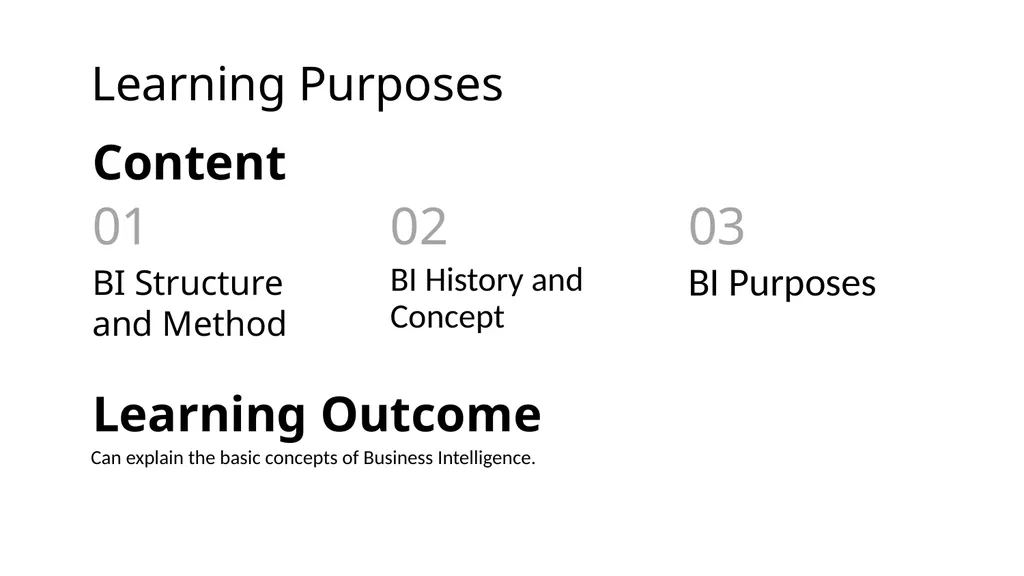
Learning Purposes Can explain the basic concepts of Business Intelligence. BI History and Concept BI Purposes 01 02 03 BI Structure and Method Content Learning Outcome<br>
05
BI History and Concept 01<br>
06
Business Intelligence Business intelligence (BI) is a set of strategies and technologies enterprises use to analyze business information and transform it into actionable insights that inform strategic and tactical business decisions.<br>
07
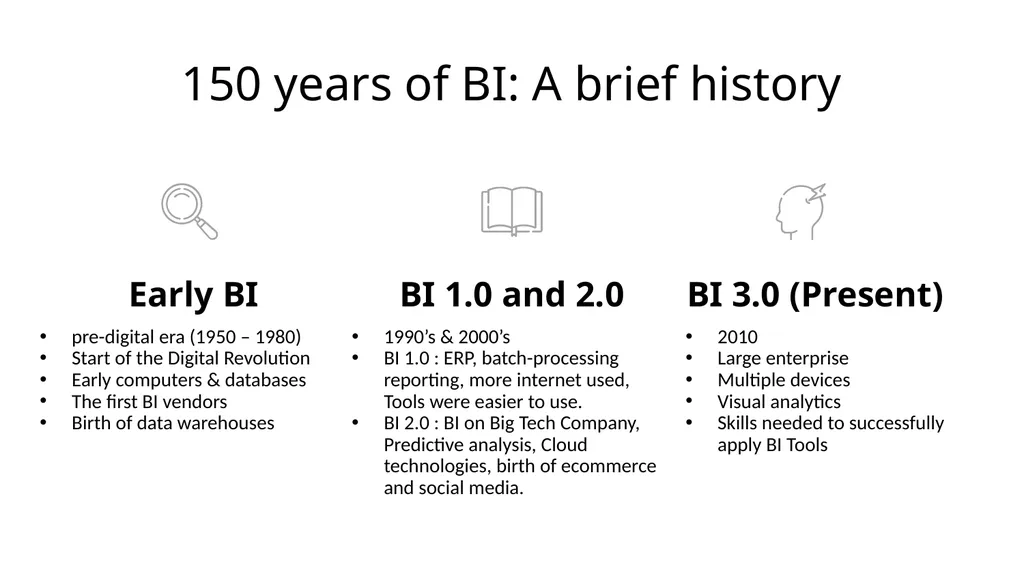
150 years of BI: A brief history pre-digital era (1950 – 1980)
Start of the Digital Revolution
Early computers & databases
The first BI vendors
Birth of data warehouses 1990’s & 2000’s
BI 1.0 : ERP, batch-processing reporting, more internet used, Tools were easier to use.
BI 2.0 : BI on Big Tech Company, Predictive analysis, Cloud technologies, birth of ecommerce and social media. 2010
Large enterprise
Multiple devices
Visual analytics
Skills needed to successfully apply BI Tools Early BI BI 1.0 and 2.0 BI 3.0 (Present)<br>
08
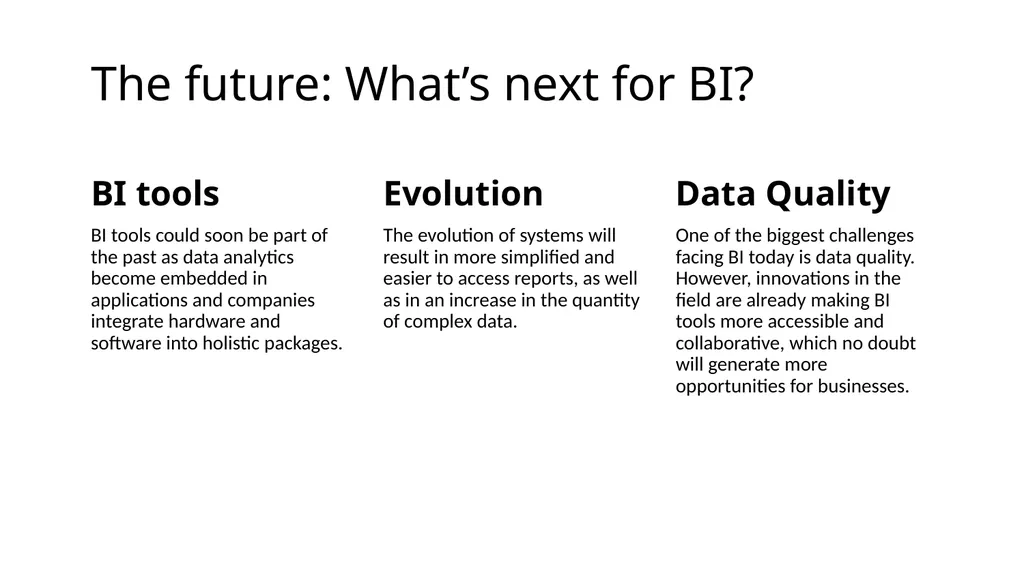
The future: What’s next for BI? BI tools could soon be part of the past as data analytics become embedded in applications and companies integrate hardware and software into holistic packages. The evolution of systems will result in more simplified and easier to access reports, as well as in an increase in the quantity of complex data. One of the biggest challenges facing BI today is data quality. However, innovations in the field are already making BI tools more accessible and collaborative, which no doubt will generate more opportunities for businesses. BI tools Evolution Data Quality<br>
09
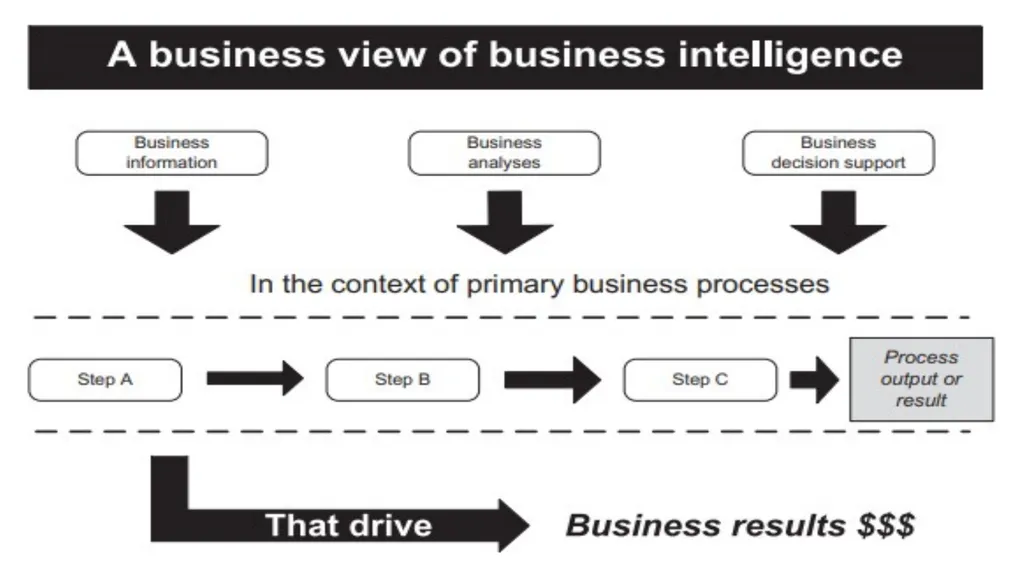
—Steve Williams, 2016 “The strategic challenge for BI has always been to figure out how to leverage BI in the context of the core business processes that drive business results”<br>
10
BI Purposes 02<br>
11
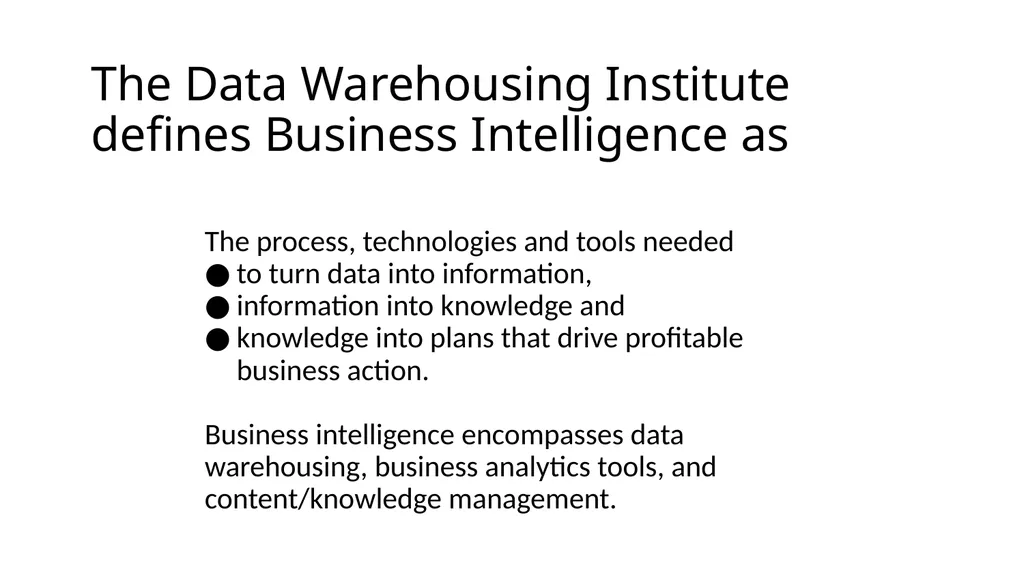
The Data Warehousing Institute defines Business Intelligence as The process, technologies and tools needed
to turn data into information,
information into knowledge and
knowledge into plans that drive profitable business action.
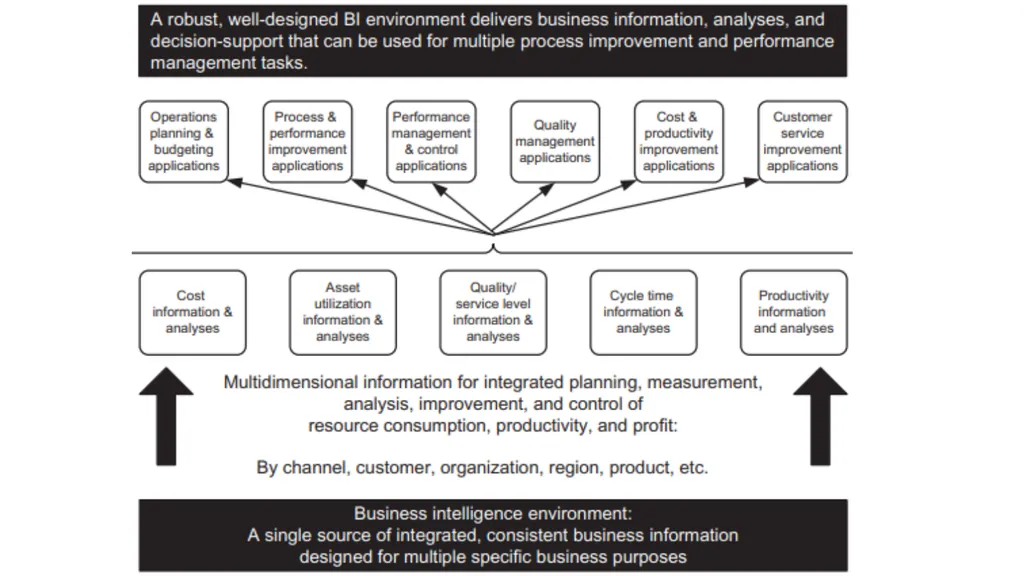
Business intelligence encompasses data warehousing, business analytics tools, and content/knowledge management.<br>
12
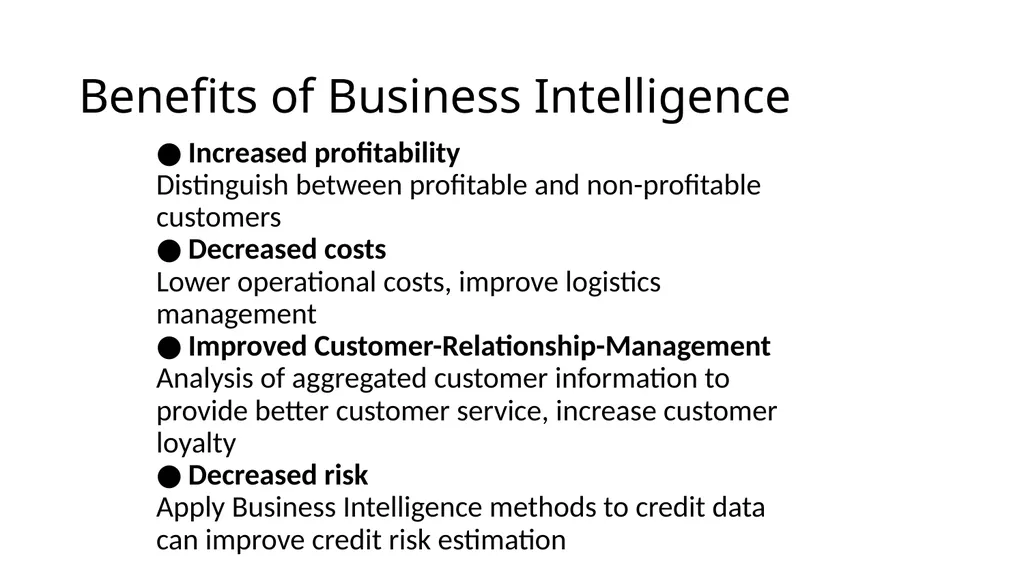
Benefits of Business Intelligence Increased profitability
Distinguish between profitable and non-profitable customers
Decreased costs
Lower operational costs, improve logistics management
Improved Customer-Relationship-Management
Analysis of aggregated customer information to provide better customer service, increase customer loyalty
Decreased risk
Apply Business Intelligence methods to credit data can improve credit risk estimation<br>
13
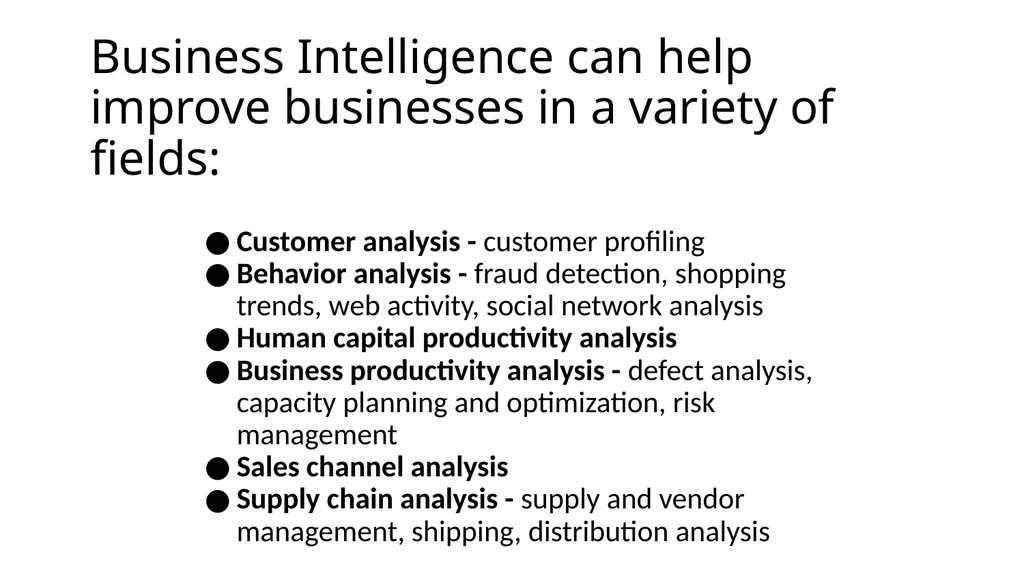
Business Intelligence can help improve businesses in a variety of fields: Customer analysis - customer profiling
Behavior analysis - fraud detection, shopping trends, web activity, social network analysis
Human capital productivity analysis
Business productivity analysis - defect analysis, capacity planning and optimization, risk management
Sales channel analysis
Supply chain analysis - supply and vendor management, shipping, distribution analysis<br>
14
BI Structure and Method 03<br>
15
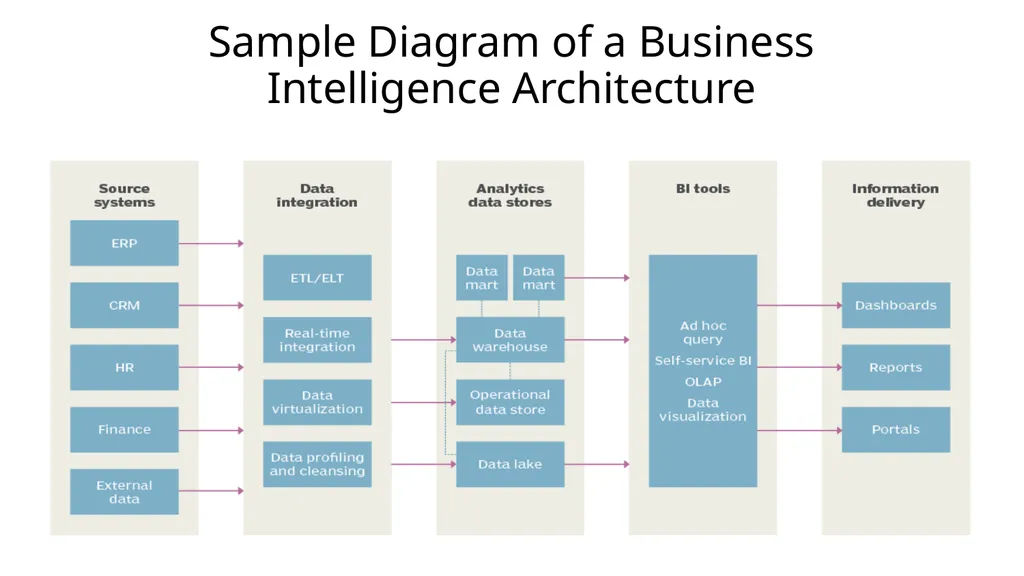
Sample Diagram of a Business Intelligence Architecture<br>
16
References Steve Williams: Business Intelligence Strategy and Big Data Analytics, Morgan Kaufman Elsevier, 2016
https://www.cio.com/article/221963/history-of-business-intelligence.html<br>