
Business Plan or Project Report 1. What is a
CM
Published · 21 slides · 0 views

1 / 1



Description
Business Plan or Project Report 1. What is a Business Plan or Project Report? BP or Project Report, is a simple brief data-sheet that gives you an insight into the following: i) How much money, manpower and material would be required to set
Related Topics
Share
Embed code
Download this presentation From Below
"Business Plan or Project Report 1. What is a" is the property of its rightful owner. Permission is granted to download and print the materials on this website for personal, non-commercial use only, and to display it on your personal computer provided you do not modify the materials and that you retain all copyright notices contained in the materials. By downloading content from our website, you accept the terms of this agreement.
Presentation Transcript
01
Business Plan or Project Report<br>
02
1. What is a Business Plan or Project Report?
BP or Project Report, is a simple brief data-sheet that gives you an insight into the following:
i) How much money, manpower and material would be required to set up the project?
ii) What type of machines would be required?
iii) What are the sources of technology that would be required? and
iv) What would be the economic gains from the project?
In short, is a brief outline of the project that tells you quickly about the viability of the project, so as to help you decide whether it is worth pursuing further or not.<br>
i) How much money, manpower and material would be required to set up the project?
ii) What type of machines would be required?
iii) What are the sources of technology that would be required? and
iv) What would be the economic gains from the project?
In short, is a brief outline of the project that tells you quickly about the viability of the project, so as to help you decide whether it is worth pursuing further or not.<br>
03
2. Why Business Plan or Project Report?
There are other advantages of preparing a PPR also:
i) You get enough data quickly to fill up the form required for provisional registration of your unit with the state government. It is a must before commencing various time consuming formalities connected with planning and setting up of a small - scale unit.
ii) The data you get from the report will help you in completing certain formalities in anticipation of setting up a project.
For example, if you want to set up an electronic unit, you have to get your production programme approved from the concerned State/Central Government department. For this, you have to supply data about the projected production level and raw-material requirement, which you could get from report.
iii) It will help you identify in advance the infrastructural requirement for your project and sound the concerned government agencies accordingly so that you can get necessary facilities such as land/shed at the right time.
iv) Finally, the major contribution of a BP at the nascent stage of your entrepreneurial career is that it instills confidence in you and motivates you to start the time-consuming process of data collection and preparation of a Detailed Project Report (DPR).<br>
There are other advantages of preparing a PPR also:
i) You get enough data quickly to fill up the form required for provisional registration of your unit with the state government. It is a must before commencing various time consuming formalities connected with planning and setting up of a small - scale unit.
ii) The data you get from the report will help you in completing certain formalities in anticipation of setting up a project.
For example, if you want to set up an electronic unit, you have to get your production programme approved from the concerned State/Central Government department. For this, you have to supply data about the projected production level and raw-material requirement, which you could get from report.
iii) It will help you identify in advance the infrastructural requirement for your project and sound the concerned government agencies accordingly so that you can get necessary facilities such as land/shed at the right time.
iv) Finally, the major contribution of a BP at the nascent stage of your entrepreneurial career is that it instills confidence in you and motivates you to start the time-consuming process of data collection and preparation of a Detailed Project Report (DPR).<br>
04
3. How to Prepare a PPR?
Let us, now see how best one can prepare a BP.
a) In this section titled,’ General’, there is an item ‘location’.
You may not be in a position to pinpoint the exact location, but then, you should indicate the city/industrial estate where you want to set up the unit. What is important is that you should satisfy yourself whether the location, in terms of geographical area, is appropriate after taking into account the availability of raw material, labour, marketing etc., and the cost involved in transportation of raw-material/finished goods if they are freight-sensitive.
Further, you will have to indicate whether you will be setting up the unit in rented premises or in the industrial area or in a place owned by you.
This information will help your adviser/counselor in identifying your requirement of land/shed so as to make certain advance arrangement with concerned agency that provides land/shed.<br>
Let us, now see how best one can prepare a BP.
a) In this section titled,’ General’, there is an item ‘location’.
You may not be in a position to pinpoint the exact location, but then, you should indicate the city/industrial estate where you want to set up the unit. What is important is that you should satisfy yourself whether the location, in terms of geographical area, is appropriate after taking into account the availability of raw material, labour, marketing etc., and the cost involved in transportation of raw-material/finished goods if they are freight-sensitive.
Further, you will have to indicate whether you will be setting up the unit in rented premises or in the industrial area or in a place owned by you.
This information will help your adviser/counselor in identifying your requirement of land/shed so as to make certain advance arrangement with concerned agency that provides land/shed.<br>
05
b) The information called for under this point pertains to your educational qualification, experience etc.
These are readily available and therefore, can be presented easily. This information will help the adviser to understand whether the project proposition vis-à-vis the background is likely to be acceptable to the financial institutions.
c) This point deals with various details of the proposed project in terms of raw- material requirement, production programme etc.
Here, you may be required to move around and collect the information since you will not be having it readily.
For example, more often than not, you may not know the specification or even the names of the machinery you need. In such a case, you must approach your adviser/other knowledgeable persons and ask them for their guidance on the sources for getting the necessary information.<br>
These are readily available and therefore, can be presented easily. This information will help the adviser to understand whether the project proposition vis-à-vis the background is likely to be acceptable to the financial institutions.
c) This point deals with various details of the proposed project in terms of raw- material requirement, production programme etc.
Here, you may be required to move around and collect the information since you will not be having it readily.
For example, more often than not, you may not know the specification or even the names of the machinery you need. In such a case, you must approach your adviser/other knowledgeable persons and ask them for their guidance on the sources for getting the necessary information.<br>
06
You may refer to ready-made project profiles available with the trainer or District Industries Centre or any good library.
Approach people trading in the product and get information from them. You may visit one or more existing units manufacturing the same product that you have in mind. Though difficult, it is the best source of collecting information that you need.
The manufacturers/suppliers of machinery can also give quite a good amount of information. A chat with the consultants of the State Technical Consultancy Organization.
In short, what is important is that you should identify the sources of information and get into action at the first instance to collect necessary information.
You can utilise the time devoted for market survey for collecting such information.
You need to keep in mind certain points while collecting and presenting such information pertaining to point No.2 as noted below:<br>
Approach people trading in the product and get information from them. You may visit one or more existing units manufacturing the same product that you have in mind. Though difficult, it is the best source of collecting information that you need.
The manufacturers/suppliers of machinery can also give quite a good amount of information. A chat with the consultants of the State Technical Consultancy Organization.
In short, what is important is that you should identify the sources of information and get into action at the first instance to collect necessary information.
You can utilise the time devoted for market survey for collecting such information.
You need to keep in mind certain points while collecting and presenting such information pertaining to point No.2 as noted below:<br>
07
d) While listing down the machinery, care has to be taken to indicate the power requirement.
This could be useful for further calculations. While arriving at the total cost of machinery, you have to take into account the cost of transportation, sales tax, insurance, handling charges etc.
In short, you have to consider the ‘landed cost’ i.e. cost of machinery plus all other expenses till they reach the factory site.
At this stage, it is not necessary to identify in detail each component of the landed cost of the machinery.
What can be done is that depending on nature of the machinery and sources of supply, rough estimates in terms of 20% or so the quoted price of the machinery can be made and added to the total cost of the machinery.
Any extra charges for installation/erection of the machinery must also form a part of the cost under this head.<br>
This could be useful for further calculations. While arriving at the total cost of machinery, you have to take into account the cost of transportation, sales tax, insurance, handling charges etc.
In short, you have to consider the ‘landed cost’ i.e. cost of machinery plus all other expenses till they reach the factory site.
At this stage, it is not necessary to identify in detail each component of the landed cost of the machinery.
What can be done is that depending on nature of the machinery and sources of supply, rough estimates in terms of 20% or so the quoted price of the machinery can be made and added to the total cost of the machinery.
Any extra charges for installation/erection of the machinery must also form a part of the cost under this head.<br>
08
Here, the items that you propose to manufacture and the quantity to be produced in a year must be indicated.
The moment you have a list of machinery, you can calculate the quantity of goods that can be produced in a year based on the capacity of machinery.
Further, while indicating production for the year, it is not advisable to assume that you shall be able to produce 100% of what the machinery can produce at its maximum capacity in a year.<br>
The moment you have a list of machinery, you can calculate the quantity of goods that can be produced in a year based on the capacity of machinery.
Further, while indicating production for the year, it is not advisable to assume that you shall be able to produce 100% of what the machinery can produce at its maximum capacity in a year.<br>
09
Suppose a machine can produce 100 kgs. of an item per day (8hrs.) , it would be wrong to assume that the annual production would be 30,000 kgs. (we normally calculate annual production on the basis of 300 working days in a year).
It is so because that in a given year, the machine may break down calling for repairs and consequently, calling for a shut-down or there may be power-cuts or raw-material shortage.
Thus, considering such eventualities the total quantity to be produced in a year may be calculated, as a thumb- rule at 70% or 80%, or so of the equipment capacity.<br>
It is so because that in a given year, the machine may break down calling for repairs and consequently, calling for a shut-down or there may be power-cuts or raw-material shortage.
Thus, considering such eventualities the total quantity to be produced in a year may be calculated, as a thumb- rule at 70% or 80%, or so of the equipment capacity.<br>
10
Sales revenue which can be calculated by multiplying the annual production with the selling price per unit.
While deciding the selling price, there is no need to go into the details of the product cost at this stage.
What you have to do is to look at the market price of the product which you intend to manufacture and deduct any comission or discount at the retailer and wholesaler level so that you can get an idea of ex-factory price.
Raw materials. You are required to indicate item- wise requirements of raw-materials in terms of quantity and value.
Further, the sources of procurement of these raw-materials i.e. places from where you intend to buy these materials should be indicated.
This exercise will help you in identifying where the raw materials would be easily available and whether it is necessary for you to procure raw-materials from far off places.
While giving the list of raw materials required for production, raw-materials required for packing, materials/stores required for maintenance of machinery (for example , grease, cotton, waste etc.) and those materials required for testing (for example chemicals used for testing if your unit needs a testing laboratory).<br>
While deciding the selling price, there is no need to go into the details of the product cost at this stage.
What you have to do is to look at the market price of the product which you intend to manufacture and deduct any comission or discount at the retailer and wholesaler level so that you can get an idea of ex-factory price.
Raw materials. You are required to indicate item- wise requirements of raw-materials in terms of quantity and value.
Further, the sources of procurement of these raw-materials i.e. places from where you intend to buy these materials should be indicated.
This exercise will help you in identifying where the raw materials would be easily available and whether it is necessary for you to procure raw-materials from far off places.
While giving the list of raw materials required for production, raw-materials required for packing, materials/stores required for maintenance of machinery (for example , grease, cotton, waste etc.) and those materials required for testing (for example chemicals used for testing if your unit needs a testing laboratory).<br>
11
‘Utilities’ those inputs that do not form a part of the end product but facilitate the production are included. Such items are electricity, coal, furnace oil, diesel/petrol, compressed air, water and the like.
As far as electricity is concerned, you should take into account the power required for lighting of factory premises and to run motors or generate heat.
1) The cost you have to incur on purchase and installation of machinery?
2) Cost of land/shed irrespective of whether they are already owned by you or whether you have to purchase them on ownership/lease basis.
3) Payment, if any, to be made for acquisition of technical know how.
4) All expenses other than those indicated above such as preparation of project report, market survey traveling expenses for data collection deposit to be given to electricity board/telephone department etc.
All these expenses can collectively be termed as preliminary and preoperative expenses.<br>
As far as electricity is concerned, you should take into account the power required for lighting of factory premises and to run motors or generate heat.
1) The cost you have to incur on purchase and installation of machinery?
2) Cost of land/shed irrespective of whether they are already owned by you or whether you have to purchase them on ownership/lease basis.
3) Payment, if any, to be made for acquisition of technical know how.
4) All expenses other than those indicated above such as preparation of project report, market survey traveling expenses for data collection deposit to be given to electricity board/telephone department etc.
All these expenses can collectively be termed as preliminary and preoperative expenses.<br>
12
Manpower requirements.
There are just 3 classifications based on skill-level under this head in the proforma.
Your man power requirements will be for a) operating machinery, b) assembly of final product, packing and supervision, c) selling/marketing staff d) office work.
While taking into account the wages/salaries, you must keep in mind the wages offered by other manufacturers in the field and the Minimum Wages Act.
In case you decide to take help or employ your own family members, you must take into account their salaries also.
You can safely add 20% or so over and above the wages to the account for additional benefits that you have to provide for your workers.
Read Minimum Wages Act<br>
There are just 3 classifications based on skill-level under this head in the proforma.
Your man power requirements will be for a) operating machinery, b) assembly of final product, packing and supervision, c) selling/marketing staff d) office work.
While taking into account the wages/salaries, you must keep in mind the wages offered by other manufacturers in the field and the Minimum Wages Act.
In case you decide to take help or employ your own family members, you must take into account their salaries also.
You can safely add 20% or so over and above the wages to the account for additional benefits that you have to provide for your workers.
Read Minimum Wages Act<br>
13
Market study/market survey has been dealt with separately elsewhere. The only thing that you have to keep in mind is that the report will be incomplete without a market survey report.
Such a survey report would tell you where you would stand in the market when you start questions, i.e. “CAN I SELL IT?”, while ansewering this question the survey coupled with PPR would also answer the other question, i.e. “CAN YOU TAKEN OUT OF IT”.
Cost of the Project and Profitability.
By the time you start working on this point, the information that you would have collected so far would help you in making necessary calculations as explained below:
1) The cost you have to incur on purchase and installation of machinery;
2) Cost of land/shed irrespective of whether they are already owned by you or whether you have to purchase them on ownership/lease basis.
3) Payment, if any, to be made for acquisition of technical know-how.
4) All expenses other than those indicated above such as, preparation of project report, market survey, traveling expenses for data collection, deposit to be given to electricity board/telephone department etc. All these expenses can collectively be termed as preliminary and pre-operative expenses.<br>
Such a survey report would tell you where you would stand in the market when you start questions, i.e. “CAN I SELL IT?”, while ansewering this question the survey coupled with PPR would also answer the other question, i.e. “CAN YOU TAKEN OUT OF IT”.
Cost of the Project and Profitability.
By the time you start working on this point, the information that you would have collected so far would help you in making necessary calculations as explained below:
1) The cost you have to incur on purchase and installation of machinery;
2) Cost of land/shed irrespective of whether they are already owned by you or whether you have to purchase them on ownership/lease basis.
3) Payment, if any, to be made for acquisition of technical know-how.
4) All expenses other than those indicated above such as, preparation of project report, market survey, traveling expenses for data collection, deposit to be given to electricity board/telephone department etc. All these expenses can collectively be termed as preliminary and pre-operative expenses.<br>
14
Working Capital which refers to the value of all other forms of assets such as:
1) Stock of raw Materials
2) Stock of Finished Goods
3) Value of goods that are under process i.e., semi-finished goods.
4) Money you have to receive from your customers for the goods you have sold them on credit.
5) The cash you have to maintain to meet day-to-day expenses.<br>
1) Stock of raw Materials
2) Stock of Finished Goods
3) Value of goods that are under process i.e., semi-finished goods.
4) Money you have to receive from your customers for the goods you have sold them on credit.
5) The cash you have to maintain to meet day-to-day expenses.<br>
15
For the stock of raw materials, you must find out how much time it takes to procure the raw-materials and accordingly decide how many days, requirements of raw- materials you need to stock.
You have to do the same exercise keeping in mind how many days of output i.e. requirements of buyers will enable cost savings/convenience in transportation of finished goods from your factory.
While indicating the value of finished goods, you can take its ex-factory price into account at this stage without going into the intricacies calculating the ‘cost value’ of the finished goods.
As far as semi- finished goods are concerned, you must find out how many days it takes to convert raw-materials into finished goods.
While assessing the value of semi - finished goods, you can take the average of raw material cost and the ex- factory price of finished goods with out going into the details of calculations.<br>
You have to do the same exercise keeping in mind how many days of output i.e. requirements of buyers will enable cost savings/convenience in transportation of finished goods from your factory.
While indicating the value of finished goods, you can take its ex-factory price into account at this stage without going into the intricacies calculating the ‘cost value’ of the finished goods.
As far as semi- finished goods are concerned, you must find out how many days it takes to convert raw-materials into finished goods.
While assessing the value of semi - finished goods, you can take the average of raw material cost and the ex- factory price of finished goods with out going into the details of calculations.<br>
16
As regards debtors you must find out to what extent the existing manufacturers in the field offer credit to the buyers (normally such credit facilities range from 30 to 50 days).
For example, if the existing manufacturers are offering 30 days credit facility, you can safely assume that your buyers will be expecting at least 30 days credit.
In other words, you would get the payment for the goods that you sell today only after 30 days.
You can calculate production in terms of quantity and value for 30 days period which gives you the figure pertaining to the total ‘debtors’ for calculation of working capital.
As regards cash on hand, you have to make a rough estimate of how much cash you would require i.e., payment to workers, conveyance expenses etc. which forms a part of working capital.<br>
For example, if the existing manufacturers are offering 30 days credit facility, you can safely assume that your buyers will be expecting at least 30 days credit.
In other words, you would get the payment for the goods that you sell today only after 30 days.
You can calculate production in terms of quantity and value for 30 days period which gives you the figure pertaining to the total ‘debtors’ for calculation of working capital.
As regards cash on hand, you have to make a rough estimate of how much cash you would require i.e., payment to workers, conveyance expenses etc. which forms a part of working capital.<br>
17
Having worked out the total cost of the project, you must identify the sources of financing the project.
The fixed capital can be financed to the extent of say about 75% to 80% by way of ‘long term loan’ from State Finance Corporation of Commercial Banks.
The funds for working capital to the extent of say about 60% to 75% of the requirements would come from commercial banks.
The funds for working capital to the extent of say about 60% to 75% of the requirement would come from commercial banks as ‘Working Capital Loan’.<br>
The fixed capital can be financed to the extent of say about 75% to 80% by way of ‘long term loan’ from State Finance Corporation of Commercial Banks.
The funds for working capital to the extent of say about 60% to 75% of the requirements would come from commercial banks.
The funds for working capital to the extent of say about 60% to 75% of the requirement would come from commercial banks as ‘Working Capital Loan’.<br>
18
If your unit is coming up in a backward area, you will be eligible for capital subsidy to the extent of 10% to 25% of the Fixed Capital depending upon the location and the government policy for that location.
Your own investment which should be around 10-20% of the projected cost will also from a source such as, deposits/loans from friends and relatives.
You have to keep in mind that the loan component as far possible should not exceed 70-80% of the total ‘Cost of the Project’.<br>
Your own investment which should be around 10-20% of the projected cost will also from a source such as, deposits/loans from friends and relatives.
You have to keep in mind that the loan component as far possible should not exceed 70-80% of the total ‘Cost of the Project’.<br>
19
Project profitability
Manufacturing expenses:
Here, you have to include commission payable to the salesmen in case you have to appoint sales staff under such persons.
Further, you may have to add a lump sum amount towards advertisement and publicity expenses.
In case you are supplying the goods at the door-steps of the buyers you have to take into account the transportation cost from the factory to the buyers’ place.
All these items of cost together constitute ‘Sales and Distribution Expenses’.<br>
Manufacturing expenses:
Here, you have to include commission payable to the salesmen in case you have to appoint sales staff under such persons.
Further, you may have to add a lump sum amount towards advertisement and publicity expenses.
In case you are supplying the goods at the door-steps of the buyers you have to take into account the transportation cost from the factory to the buyers’ place.
All these items of cost together constitute ‘Sales and Distribution Expenses’.<br>
20
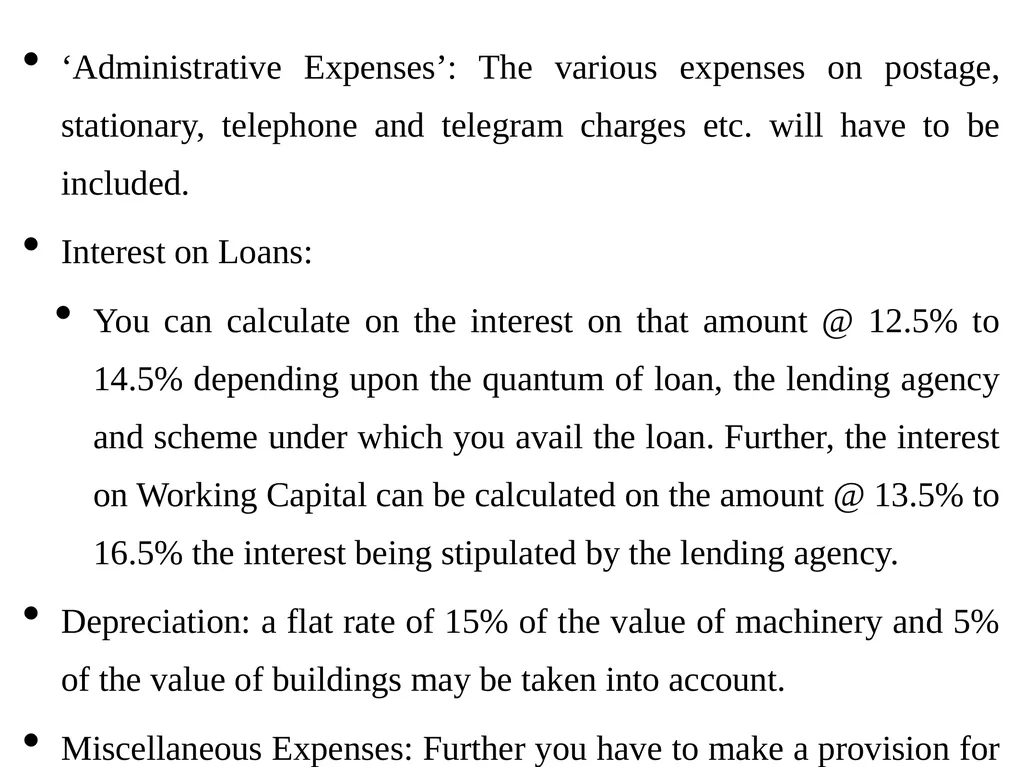
‘Administrative Expenses’: The various expenses on postage, stationary, telephone and telegram charges etc. will have to be included.
Interest on Loans:
You can calculate on the interest on that amount @ 12.5% to 14.5% depending upon the quantum of loan, the lending agency and scheme under which you avail the loan. Further, the interest on Working Capital can be calculated on the amount @ 13.5% to 16.5% the interest being stipulated by the lending agency.
Depreciation: a flat rate of 15% of the value of machinery and 5% of the value of buildings may be taken into account.
Miscellaneous Expenses: Further you have to make a provision for certain expenses which cannot be put under the title Miscellaneous Expenses. For this purpose, you can make an estimate on lump sum basis.<br>
Interest on Loans:
You can calculate on the interest on that amount @ 12.5% to 14.5% depending upon the quantum of loan, the lending agency and scheme under which you avail the loan. Further, the interest on Working Capital can be calculated on the amount @ 13.5% to 16.5% the interest being stipulated by the lending agency.
Depreciation: a flat rate of 15% of the value of machinery and 5% of the value of buildings may be taken into account.
Miscellaneous Expenses: Further you have to make a provision for certain expenses which cannot be put under the title Miscellaneous Expenses. For this purpose, you can make an estimate on lump sum basis.<br>
21
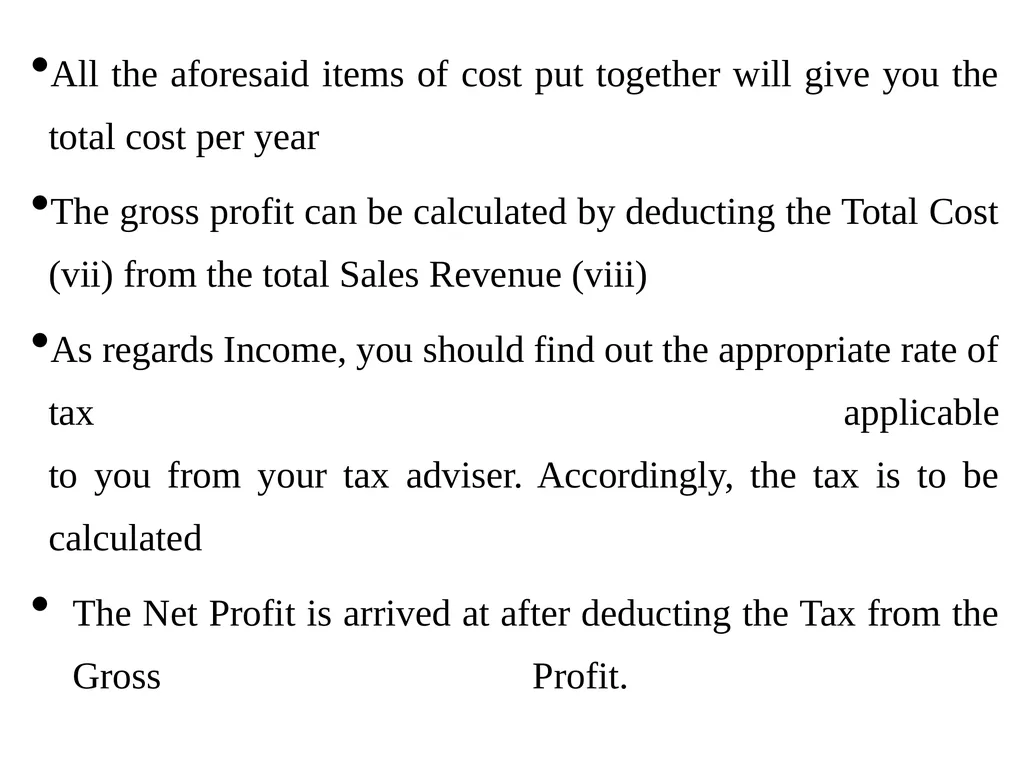
All the aforesaid items of cost put together will give you the total cost per year
The gross profit can be calculated by deducting the Total Cost (vii) from the total Sales Revenue (viii)
As regards Income, you should find out the appropriate rate of tax applicable to you from your tax adviser. Accordingly, the tax is to be calculated
The Net Profit is arrived at after deducting the Tax from the Gross Profit.<br>
The gross profit can be calculated by deducting the Total Cost (vii) from the total Sales Revenue (viii)
As regards Income, you should find out the appropriate rate of tax applicable to you from your tax adviser. Accordingly, the tax is to be calculated
The Net Profit is arrived at after deducting the Tax from the Gross Profit.<br>