
Business Reports Introduction Reports are written
SN
Published · 101 slides · 0 views

1 / 1



Description
Business Reports Introduction Reports are written to 1. analyse a situation 2. offer an alternative method of operation 3. study the growth rate of a company 4. observe the trend in socio-political-psychological changes happening around us
Related Topics
Share
Embed code
Download this presentation From Below
"Business Reports Introduction Reports are written" is the property of its rightful owner. Permission is granted to download and print the materials on this website for personal, non-commercial use only, and to display it on your personal computer provided you do not modify the materials and that you retain all copyright notices contained in the materials. By downloading content from our website, you accept the terms of this agreement.
Presentation Transcript
01
Business Reports<br>
02
Introduction Reports are written to
1. analyse a situation
2. offer an alternative method of operation
3. study the growth rate of a company
4. observe the trend in socio-political-psychological changes happening around us in all walks of life .<br>
1. analyse a situation
2. offer an alternative method of operation
3. study the growth rate of a company
4. observe the trend in socio-political-psychological changes happening around us in all walks of life .<br>
03
Definition A business report is a formal communication written for a specific purpose, conveying authentic information to a well-defined audience in a completely impartial and objective manner. Written in a conventional or usable form, it describes the procedures followed in the collection and examination of data, analyses the facts collected, derives conclusions from them, and gives recommendations, if necessary.<br>
04
A formal piece of writing
A factual account
Written with a specific purpose
Written in an organized manner
Written for a specific audience
Includes only relevant information
Written in an objective manner .<br>
A factual account
Written with a specific purpose
Written in an organized manner
Written for a specific audience
Includes only relevant information
Written in an objective manner .<br>
05
Significance 1. Reports help professionals plan, acquire, execute, organize, coordinate, manage, and evaluate business activities in an effective way.
2. Reports facilitate the flow of information to ensure smooth execution of tasks so as to meet the challenges successfully.
3. Sometimes it serves as a record of facts where information is organised and recorded for the readers’ benefit. Thus, reports also serve as a repository of information.
4. Reports enable the authorities to take timely decisions. They may also be used for further analysis.
5. They can be helpful in creating awareness among shareholders and other investors when reports are sent to them regarding the market position of the company from time to time.<br>
2. Reports facilitate the flow of information to ensure smooth execution of tasks so as to meet the challenges successfully.
3. Sometimes it serves as a record of facts where information is organised and recorded for the readers’ benefit. Thus, reports also serve as a repository of information.
4. Reports enable the authorities to take timely decisions. They may also be used for further analysis.
5. They can be helpful in creating awareness among shareholders and other investors when reports are sent to them regarding the market position of the company from time to time.<br>
06
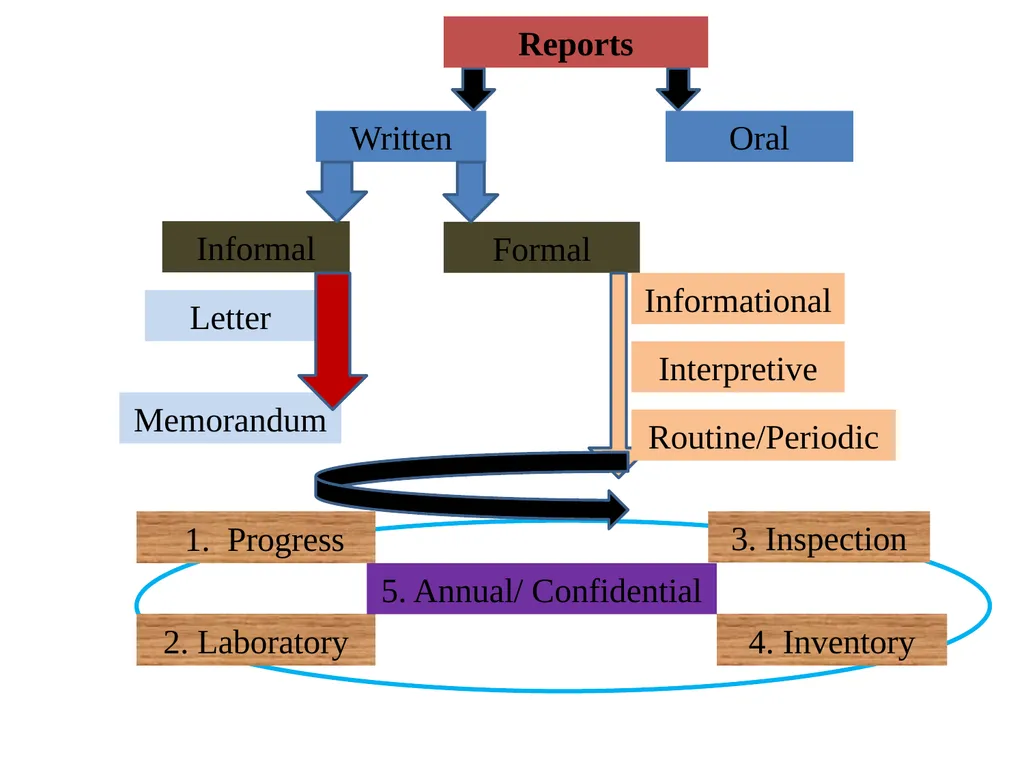
Reports Written Oral Informal Formal Letter Memorandum Informational Interpretive Routine/Periodic 1. Progress 2. Laboratory 3. Inspection 4. Inventory 5. Annual/ Confidential<br>
07
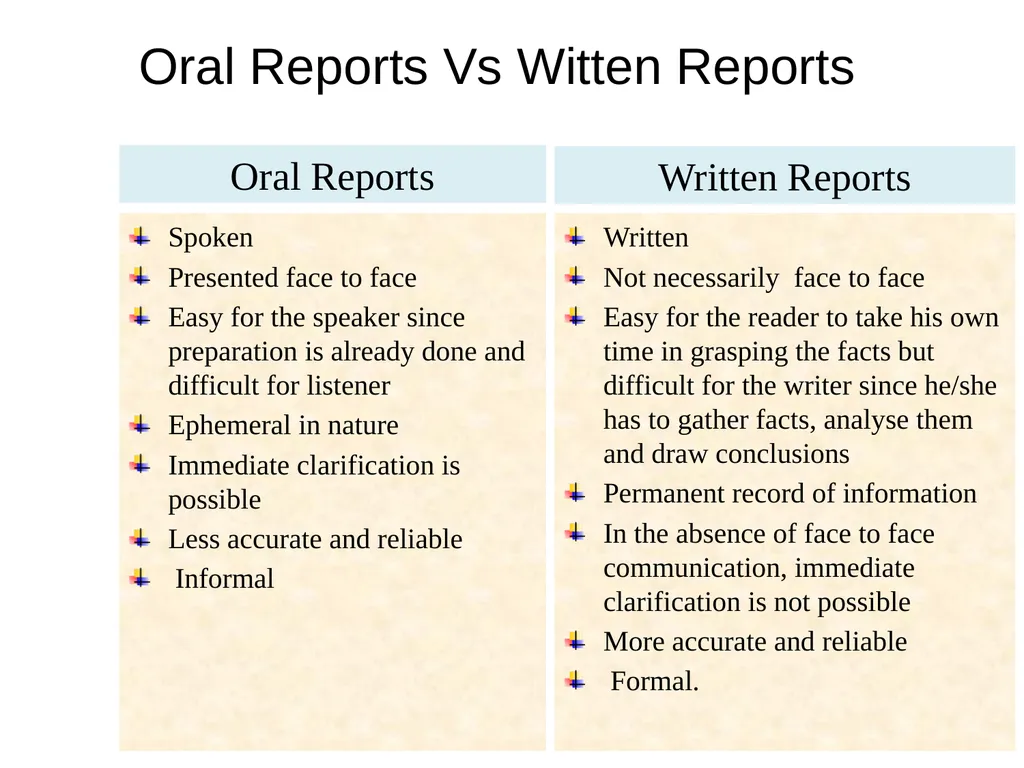
Spoken
Presented face to face
Easy for the speaker since preparation is already done and difficult for listener
Ephemeral in nature
Immediate clarification is possible
Less accurate and reliable
Informal Written
Not necessarily face to face
Easy for the reader to take his own time in grasping the facts but difficult for the writer since he/she has to gather facts, analyse them and draw conclusions
Permanent record of information
In the absence of face to face communication, immediate clarification is not possible
More accurate and reliable
Formal. Oral Reports Vs Witten Reports Oral Reports Written Reports<br>
Presented face to face
Easy for the speaker since preparation is already done and difficult for listener
Ephemeral in nature
Immediate clarification is possible
Less accurate and reliable
Informal Written
Not necessarily face to face
Easy for the reader to take his own time in grasping the facts but difficult for the writer since he/she has to gather facts, analyse them and draw conclusions
Permanent record of information
In the absence of face to face communication, immediate clarification is not possible
More accurate and reliable
Formal. Oral Reports Vs Witten Reports Oral Reports Written Reports<br>
08
Informal Reports 1. Letter Reports
2. Memo Reports<br>
2. Memo Reports<br>
09
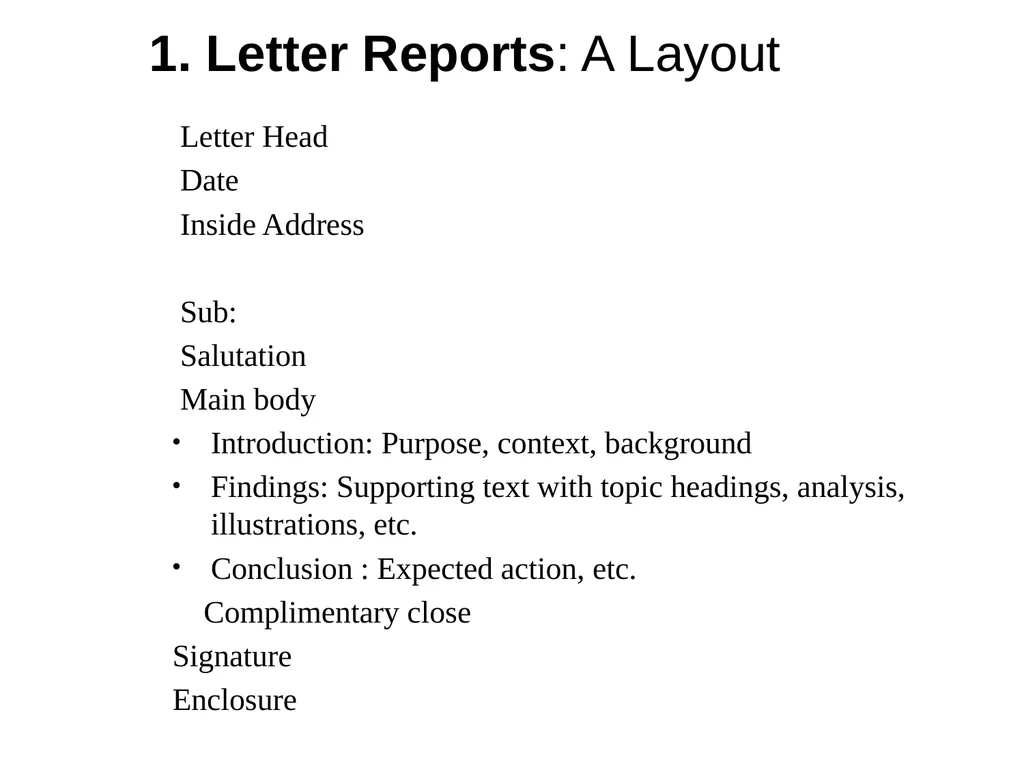
1. Letter Reports: A Layout Letter Head
Date
Inside Address
Sub:
Salutation
Main body
Introduction: Purpose, context, background
Findings: Supporting text with topic headings, analysis, illustrations, etc.
Conclusion : Expected action, etc.
Complimentary close
Signature
Enclosure<br>
Date
Inside Address
Sub:
Salutation
Main body
Introduction: Purpose, context, background
Findings: Supporting text with topic headings, analysis, illustrations, etc.
Conclusion : Expected action, etc.
Complimentary close
Signature
Enclosure<br>
10
Tips for Writing Letter Reports 1. Type the letter using a word processor. Letter reports should not be handwritten.
2. Use full block format of business letters in which all lines start at the left.
3. Use company’s letterhead or use formal, 8½-inch-by-11‑inch or A4 size paper.
4. Set objectives of report, identify reader, gather facts, and analyse them critically so as to put across the findings in the report appropriately.
5. Can use one or two illustrations to support verbal analysis.
6. Use ‘I’ and ‘you’ to maintain informality to a little extent. Adopt a style that does not sound too bookish or prosaic.
7. Remember to include appropriate salutations and a complementary close.
8. Before sending it to the reader, ensure that there are no typographical or grammatical errors.
9. Maintain proper margin and line spacing to create a proper impact on the reader.<br>
2. Use full block format of business letters in which all lines start at the left.
3. Use company’s letterhead or use formal, 8½-inch-by-11‑inch or A4 size paper.
4. Set objectives of report, identify reader, gather facts, and analyse them critically so as to put across the findings in the report appropriately.
5. Can use one or two illustrations to support verbal analysis.
6. Use ‘I’ and ‘you’ to maintain informality to a little extent. Adopt a style that does not sound too bookish or prosaic.
7. Remember to include appropriate salutations and a complementary close.
8. Before sending it to the reader, ensure that there are no typographical or grammatical errors.
9. Maintain proper margin and line spacing to create a proper impact on the reader.<br>
11
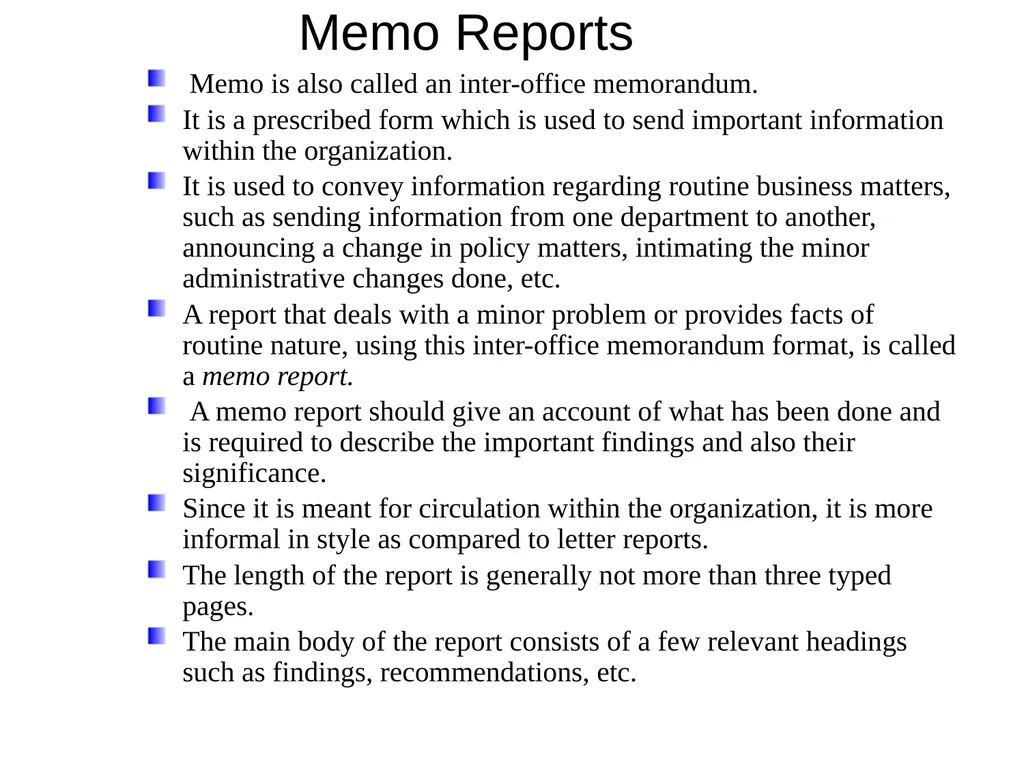
Memo Reports Memo is also called an inter-office memorandum.
It is a prescribed form which is used to send important information within the organization.
It is used to convey information regarding routine business matters, such as sending information from one department to another, announcing a change in policy matters, intimating the minor administrative changes done, etc.
A report that deals with a minor problem or provides facts of routine nature, using this inter-office memorandum format, is called a memo report.
A memo report should give an account of what has been done and is required to describe the important findings and also their significance.
Since it is meant for circulation within the organization, it is more informal in style as compared to letter reports.
The length of the report is generally not more than three typed pages.
The main body of the report consists of a few relevant headings such as findings, recommendations, etc.<br>
It is a prescribed form which is used to send important information within the organization.
It is used to convey information regarding routine business matters, such as sending information from one department to another, announcing a change in policy matters, intimating the minor administrative changes done, etc.
A report that deals with a minor problem or provides facts of routine nature, using this inter-office memorandum format, is called a memo report.
A memo report should give an account of what has been done and is required to describe the important findings and also their significance.
Since it is meant for circulation within the organization, it is more informal in style as compared to letter reports.
The length of the report is generally not more than three typed pages.
The main body of the report consists of a few relevant headings such as findings, recommendations, etc.<br>
12
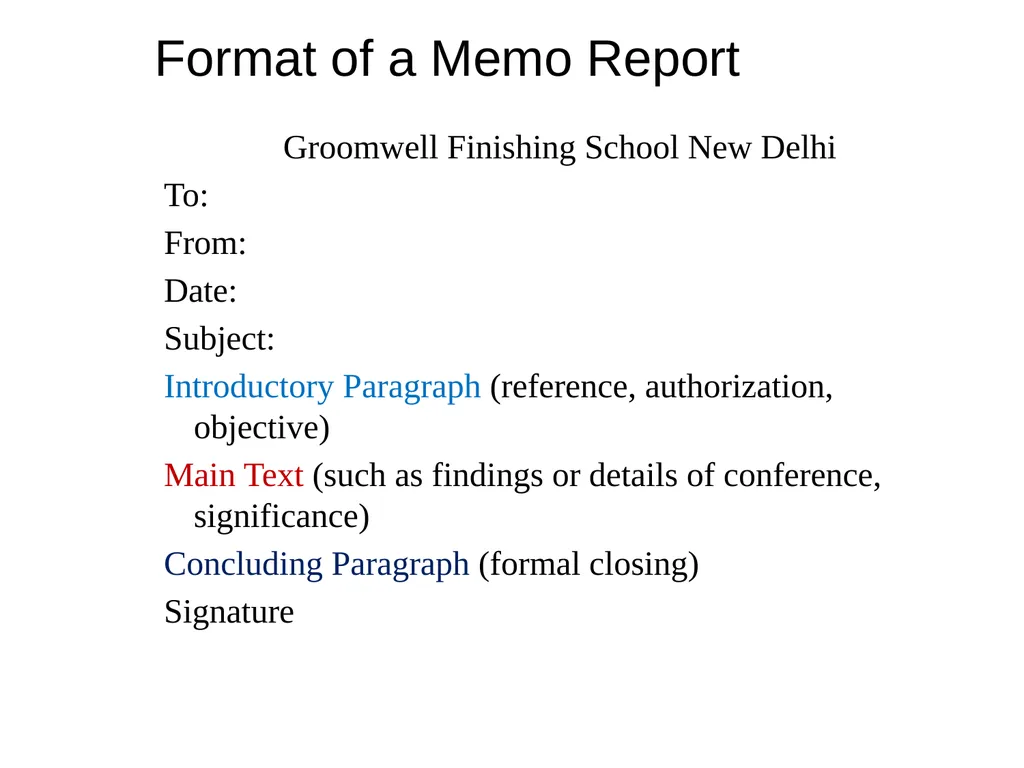
Format of a Memo Report Groomwell Finishing School New Delhi
To:
From:
Date:
Subject:
Introductory Paragraph (reference, authorization, objective)
Main Text (such as findings or details of conference, significance)
Concluding Paragraph (formal closing)
Signature<br>
To:
From:
Date:
Subject:
Introductory Paragraph (reference, authorization, objective)
Main Text (such as findings or details of conference, significance)
Concluding Paragraph (formal closing)
Signature<br>
13
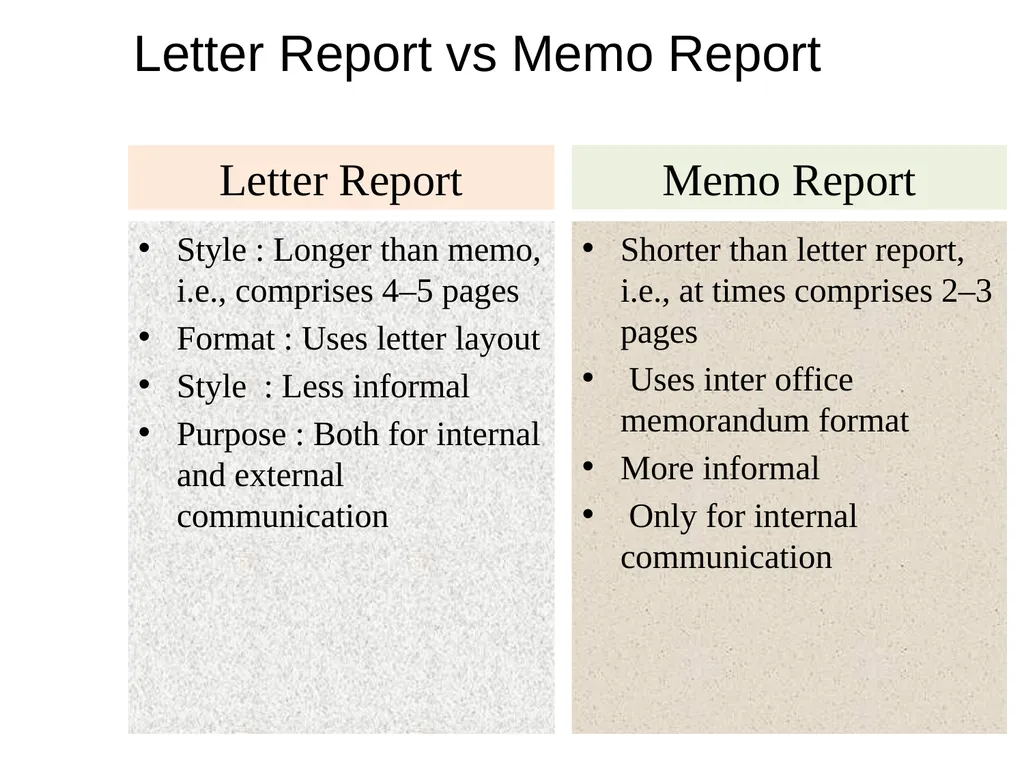
Letter Report vs Memo Report Style : Longer than memo, i.e., comprises 4–5 pages
Format : Uses letter layout
Style : Less informal
Purpose : Both for internal and external communication Shorter than letter report, i.e., at times comprises 2–3 pages
Uses inter office memorandum format
More informal
Only for internal communication Letter Report Memo Report<br>
Format : Uses letter layout
Style : Less informal
Purpose : Both for internal and external communication Shorter than letter report, i.e., at times comprises 2–3 pages
Uses inter office memorandum format
More informal
Only for internal communication Letter Report Memo Report<br>
14
Formal Reports Routine/Periodic Reports
Informational Reports
Interpretive Reports<br>
Informational Reports
Interpretive Reports<br>
15
Routine/Periodic Reports Progress Report
Inspection Report
Annual Confidential Report
Laboratory Report
Inventory Report on Employees<br>
Inspection Report
Annual Confidential Report
Laboratory Report
Inventory Report on Employees<br>
16
Progress Report Information about status or progress of particular project by organization during a specific period
An account of various stages of project in chronological order along with details of work completed till date &amount of work left
It may also make a mention of special problems that may arise during the course of work progress
These reports are also written on the construction work of a factory building or dams for water supply schemes or on the construction of a huge institute premises, etc.<br>
An account of various stages of project in chronological order along with details of work completed till date &amount of work left
It may also make a mention of special problems that may arise during the course of work progress
These reports are also written on the construction work of a factory building or dams for water supply schemes or on the construction of a huge institute premises, etc.<br>
17
Laboratory Reports Written by scientists and students of engineering, science etc. who work regularly in laboratories
Provides a step-by-step account of the process to be followed in completing a certain task
Consists of a brief summary of the findings so that it becomes comprehensible when others read
This pro forma necessarily includes the name of the experiment, the apparatus used, the procedure followed, and the findings and conclusions.<br>
Provides a step-by-step account of the process to be followed in completing a certain task
Consists of a brief summary of the findings so that it becomes comprehensible when others read
This pro forma necessarily includes the name of the experiment, the apparatus used, the procedure followed, and the findings and conclusions.<br>
18
Inspection Report Routine reports compiled only after a thorough investigation of objects or products
Used by organizations either (a) to see whether the product is functioning properly or needs some repair, or (b) to see whether the quality of the piece of equipment is up to the standard or not
Helps in checking the quality of products in a systematic manner and ensures the right standard and smooth functioning of equipment
Normally submitted to the executive heads of the maintenance, production or sales departments
A report of this type is written in a prescribed pro forma
The purpose of such reports is to keep a check on the mishandling and poor production of equipment.<br>
Used by organizations either (a) to see whether the product is functioning properly or needs some repair, or (b) to see whether the quality of the piece of equipment is up to the standard or not
Helps in checking the quality of products in a systematic manner and ensures the right standard and smooth functioning of equipment
Normally submitted to the executive heads of the maintenance, production or sales departments
A report of this type is written in a prescribed pro forma
The purpose of such reports is to keep a check on the mishandling and poor production of equipment.<br>
19
Inventory Report Often computer-generated and requires the user to input relevant data regarding the stock on hand
Submitted at regular intervals, may be weekly or monthly or annually on the amounts and kinds of items in stock, stock-out ratios and projected needs and order dates for supplies
Include statistical details including the number, amount, and type of material required
Written by the person who checks the stocks and fills in all the details in a prescribed form and signs it.<br>
Submitted at regular intervals, may be weekly or monthly or annually on the amounts and kinds of items in stock, stock-out ratios and projected needs and order dates for supplies
Include statistical details including the number, amount, and type of material required
Written by the person who checks the stocks and fills in all the details in a prescribed form and signs it.<br>
20
Annual Confidential Report Submitted annually by controlling officers on their subordinates regarding their work performance and behaviour
Determine a professional’s appraisal
Important decisions such as promotion, demotion, transfer, or termination of a contract are normally based on the study of such reports
It is not easy to prepare the pro forma of this report because there are certain human attributes which are hard to assess
Sometimes questions are included and some space is given for providing short explanation.<br>
Determine a professional’s appraisal
Important decisions such as promotion, demotion, transfer, or termination of a contract are normally based on the study of such reports
It is not easy to prepare the pro forma of this report because there are certain human attributes which are hard to assess
Sometimes questions are included and some space is given for providing short explanation.<br>
21
Informational Reports Entails all the details related to the subject under discussion
Develop understanding of the aims, objectives, organization, policies, regulations, procedures, problems, and future outlook of a company
Here the data collected is presented in an organized form and the situation is presented as it is and not as it should be
Convey information so as to serve various purposes such as making a discussion, determining a course of action and coordinating the operation of the organization
Neither data analysis is done nor are recommendations provided
Attention should be given to present the material in a proper way
Each part should prepare the reader for what is to come, and discussion of one point should be complete before another point is taken up
Writing an effective informative report : Collect data, arrange it in a proper order, and present it in a manner that is suitable for business communication.<br>
Develop understanding of the aims, objectives, organization, policies, regulations, procedures, problems, and future outlook of a company
Here the data collected is presented in an organized form and the situation is presented as it is and not as it should be
Convey information so as to serve various purposes such as making a discussion, determining a course of action and coordinating the operation of the organization
Neither data analysis is done nor are recommendations provided
Attention should be given to present the material in a proper way
Each part should prepare the reader for what is to come, and discussion of one point should be complete before another point is taken up
Writing an effective informative report : Collect data, arrange it in a proper order, and present it in a manner that is suitable for business communication.<br>
22
Interpretive Reports Also known as analytical or investigative reports
Help the readers analyse, interpret, and evaluate facts and ideas
Differs from an informational report, as it analyses and interprets data obtained & arrives at some conclusions & recommendations & leads reader to some course of action
The major emphasis is on the analysis of the results of an investigation or the proposed solution to the problem
The report writer analyses and interprets the data in such a way that it naturally leads to some suggestions which may be of great importance when implemented.
The writers of such reports try their level best to present their findings and recommendations in the most convincing and persuasive way
The report submitted by the director or secretary to the shareholders is an example of an interpretive report.<br>
Help the readers analyse, interpret, and evaluate facts and ideas
Differs from an informational report, as it analyses and interprets data obtained & arrives at some conclusions & recommendations & leads reader to some course of action
The major emphasis is on the analysis of the results of an investigation or the proposed solution to the problem
The report writer analyses and interprets the data in such a way that it naturally leads to some suggestions which may be of great importance when implemented.
The writers of such reports try their level best to present their findings and recommendations in the most convincing and persuasive way
The report submitted by the director or secretary to the shareholders is an example of an interpretive report.<br>
23
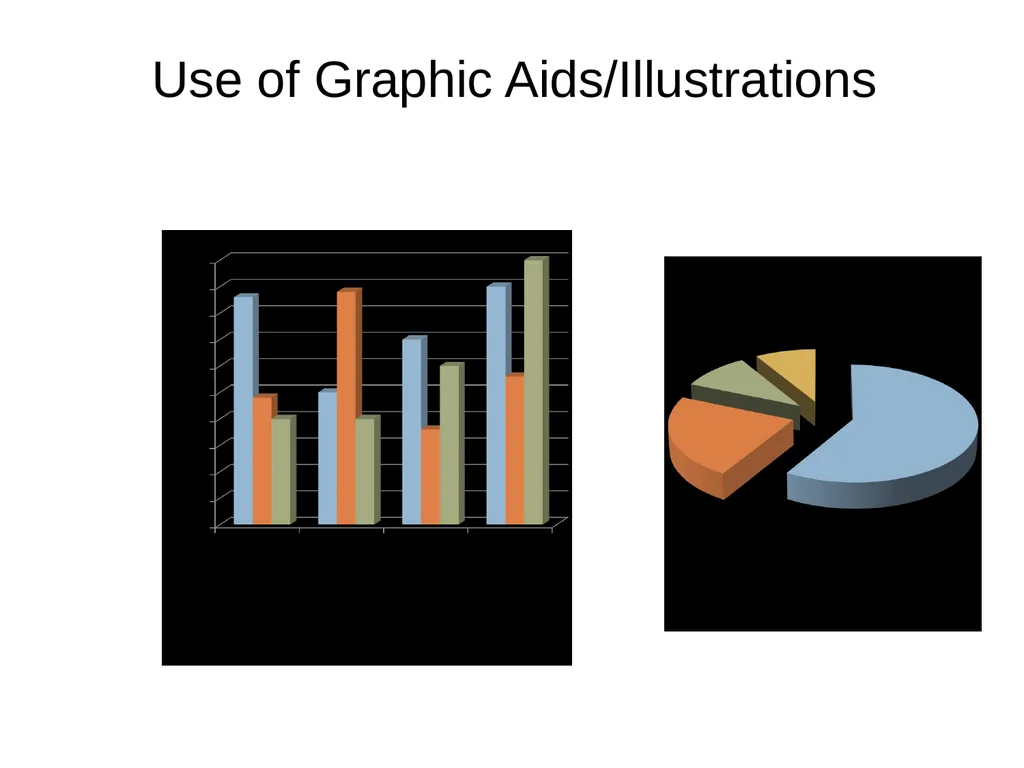
Use of Graphic Aids/Illustrations<br>
24
1. Use of Graphic Aids/Illustrations When to use?
When you have a mass of statistics to present
When you have to explain complex ideas.
Why should we use them?
They lend a distinctive professional flair to presentations
They help to clarify and reinforce the information
Illustrations help us present large details in less space and with greater accuracy
They undoubtedly make the descriptions clear, vivid, and eye-catching
They communicate more effectively and accurately .<br>
When you have a mass of statistics to present
When you have to explain complex ideas.
Why should we use them?
They lend a distinctive professional flair to presentations
They help to clarify and reinforce the information
Illustrations help us present large details in less space and with greater accuracy
They undoubtedly make the descriptions clear, vivid, and eye-catching
They communicate more effectively and accurately .<br>
25
2. Use of Graphic Aids/Illustrations How to use?
Illustrations should be neat, accurate, and self-contained
Contents should be closely related to the text
They should be explained and placed as close to the first reference as possible
Size of the illustration should be big enough to be clearly visible
If you photocopy or directly copy from another source, you must give proper credit to source
Illustrations should be numbered and captioned as suggested below:
1. Tables–Roman numerals at the top
2. Figures–Arabic numerals at the .<br>
Illustrations should be neat, accurate, and self-contained
Contents should be closely related to the text
They should be explained and placed as close to the first reference as possible
Size of the illustration should be big enough to be clearly visible
If you photocopy or directly copy from another source, you must give proper credit to source
Illustrations should be numbered and captioned as suggested below:
1. Tables–Roman numerals at the top
2. Figures–Arabic numerals at the .<br>
26
Mind that …. 1. Place the graphic aids as close to the related text as possible; usually following the paragraph in which it is introduced.
2. Always refer to a graphic aid in the report text (e.g., ‘Figure 1 illustrates’).
3. Give a title and number for tables and charts. Tables are usually numbered separately; the term figure may be used for graphic aids other than tables (e.g., Table I, Figure 1, Figure 2, Table II, Figure 3). Or, a numbering scheme identifying the type of figure may be used (Table I, Chart 1, Map 1, etc.).
4. Table numbers and their captions (titles) are given at the top of the tables in capital roman numerals, whereas figure numbers are given at the bottom of the figure along with the caption.
5. Graphics are usually included in the ‘Discussion’ section of the report. Generally you require to include your results graphically as well as in written form .<br>
2. Always refer to a graphic aid in the report text (e.g., ‘Figure 1 illustrates’).
3. Give a title and number for tables and charts. Tables are usually numbered separately; the term figure may be used for graphic aids other than tables (e.g., Table I, Figure 1, Figure 2, Table II, Figure 3). Or, a numbering scheme identifying the type of figure may be used (Table I, Chart 1, Map 1, etc.).
4. Table numbers and their captions (titles) are given at the top of the tables in capital roman numerals, whereas figure numbers are given at the bottom of the figure along with the caption.
5. Graphics are usually included in the ‘Discussion’ section of the report. Generally you require to include your results graphically as well as in written form .<br>
27
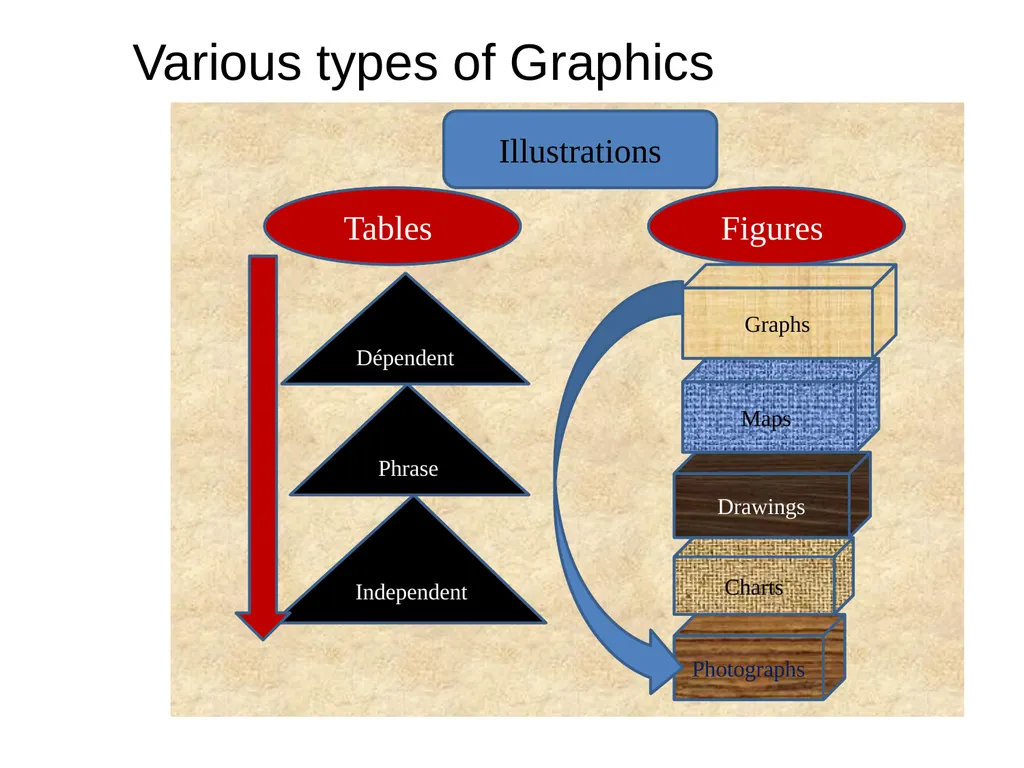
Various types of Graphics Illustrations Tables Figures Dépendent Phrase Independent Graphs Maps Drawings Charts Photographs<br>
28
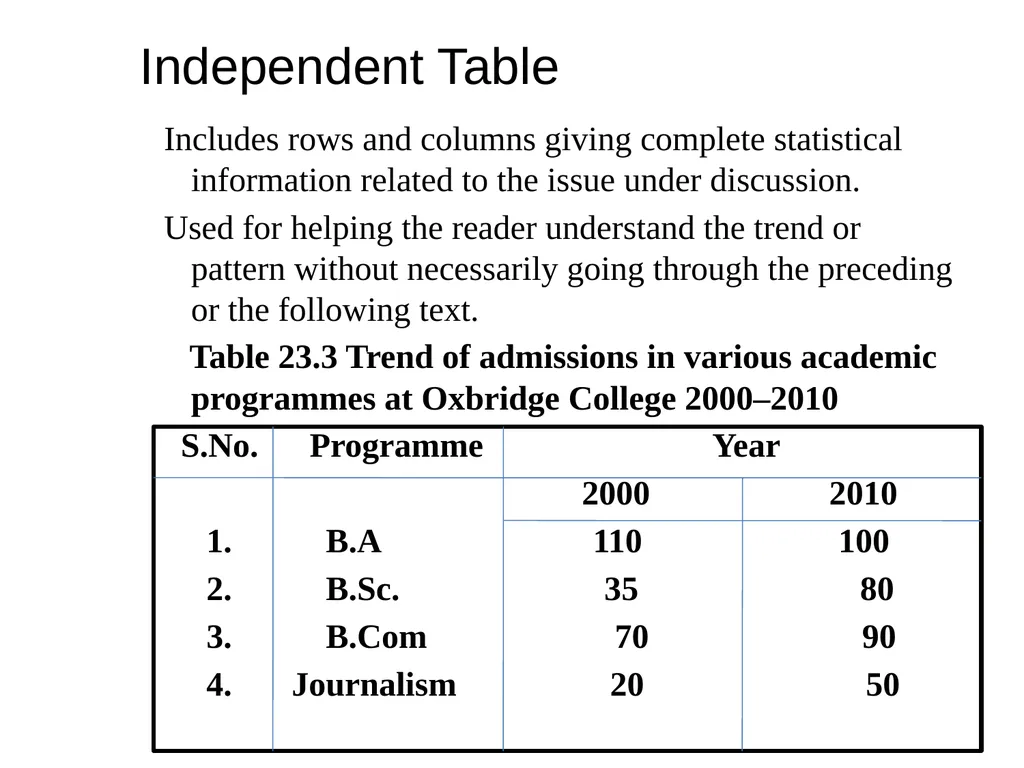
Independent Table Includes rows and columns giving complete statistical information related to the issue under discussion.
Used for helping the reader understand the trend or pattern without necessarily going through the preceding or the following text.
Table 23.3 Trend of admissions in various academic programmes at Oxbridge College 2000–2010
S.No. Programme Year
2000 2010
1. B.A 110 100
2. B.Sc. 35 80
3. B.Com 70 90
4. Journalism 20 50<br>
Used for helping the reader understand the trend or pattern without necessarily going through the preceding or the following text.
Table 23.3 Trend of admissions in various academic programmes at Oxbridge College 2000–2010
S.No. Programme Year
2000 2010
1. B.A 110 100
2. B.Sc. 35 80
3. B.Com 70 90
4. Journalism 20 50<br>
29
Dependent Table Dependent table is the one which is closely associated with the text preceding and following it. It cannot be interpreted effectively independent of the text.<br>
30
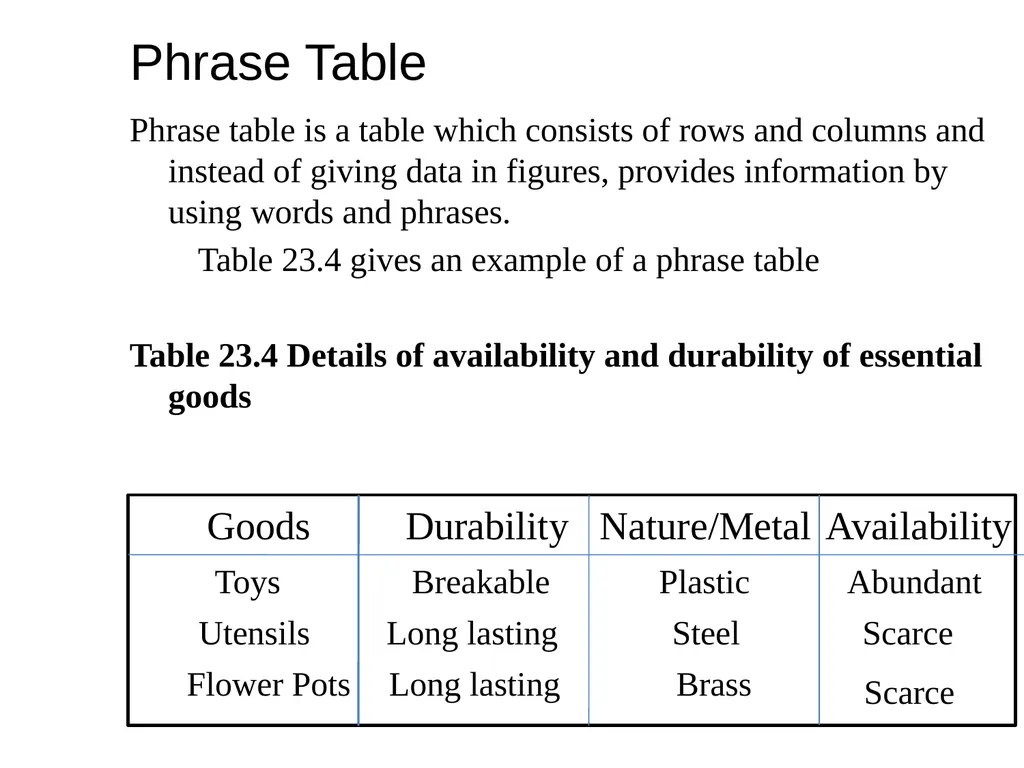
Phrase Table Phrase table is a table which consists of rows and columns and instead of giving data in figures, provides information by using words and phrases.
Table 23.4 gives an example of a phrase table
Table 23.4 Details of availability and durability of essential goods Goods Toys Utensils Flower Pots Durability Breakable Long lasting Long lasting Nature/Metal Plastic Steel Brass Availability Abundant Scarce Scarce<br>
Table 23.4 gives an example of a phrase table
Table 23.4 Details of availability and durability of essential goods Goods Toys Utensils Flower Pots Durability Breakable Long lasting Long lasting Nature/Metal Plastic Steel Brass Availability Abundant Scarce Scarce<br>
31
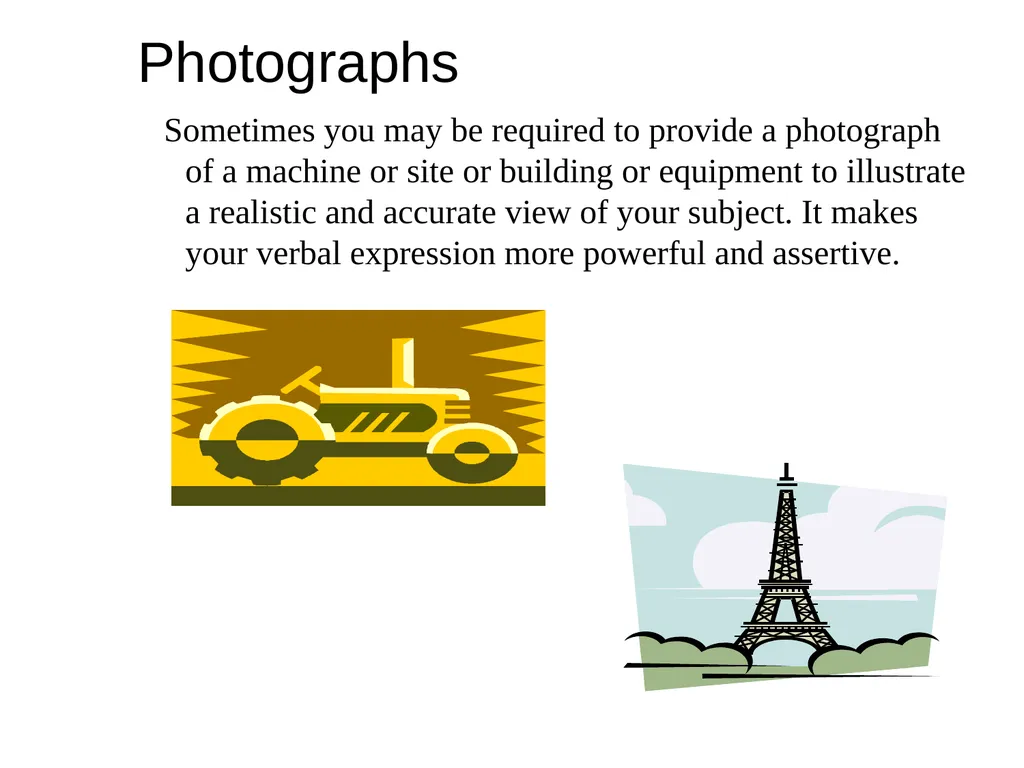
Photographs Sometimes you may be required to provide a photograph of a machine or site or building or equipment to illustrate a realistic and accurate view of your subject. It makes your verbal expression more powerful and assertive.<br>
32
Maps Maps are the other wonderful aids which help you depict geographical and spatial distribution. For example, the spatial location of a produce, building, route, highways, minerals, etc. can easily be presented by showing maps.<br>
33
Charts The tables and graphs show quantitative analysis and relationship among various heads, whereas charts in a report give the non-quantitative information. For example, an organizational chart illustrates the positions, units, deparements, or functions of an organization or the way they are connected to one another. A flow chart, on the other hand, shows pictorially how a series of events/activities/operations are arranged to complete a full cycle.<br>
34
Graphs Graphs are the illustrations which help the author in presenting the data in a creative, colourful, and catchy manner. Graphs help the reader understand the various trends and patterns that the report intends to project.
Graphs are of various types :
Rectilinear • Multiple line • Bar • Pie
Semi-log • Pictorial • Scatter • Surface<br>
Graphs are of various types :
Rectilinear • Multiple line • Bar • Pie
Semi-log • Pictorial • Scatter • Surface<br>
35
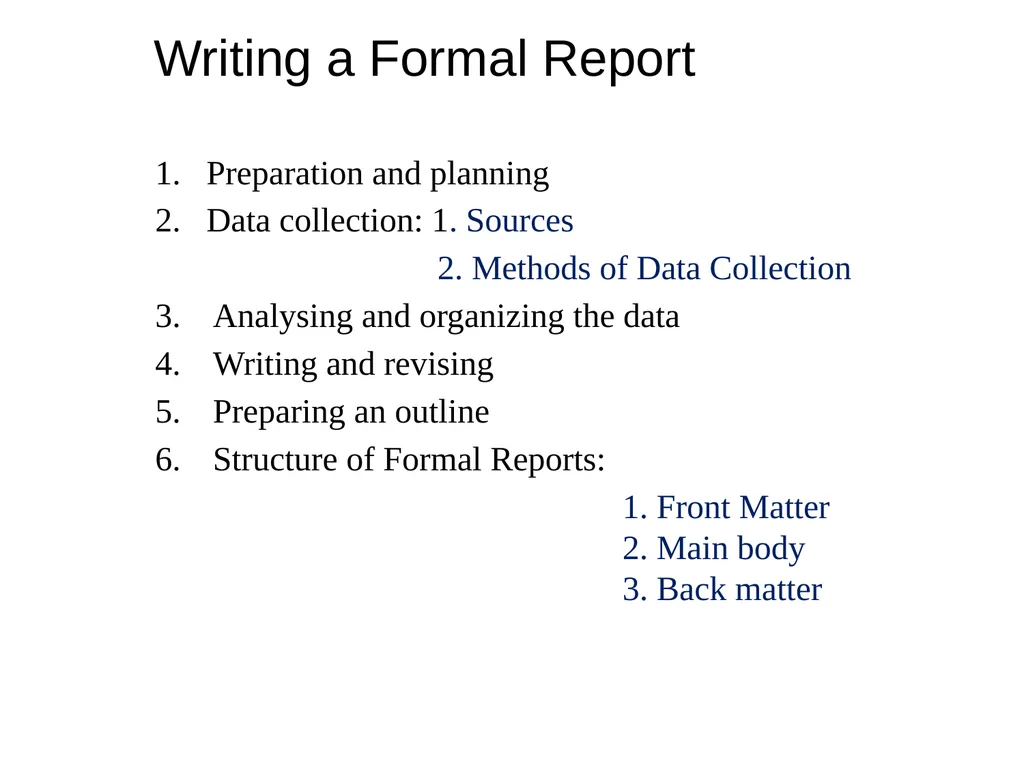
Writing a Formal Report Preparation and planning
Data collection: 1. Sources
2. Methods of Data Collection
Analysing and organizing the data
Writing and revising
Preparing an outline
Structure of Formal Reports:
1. Front Matter 2. Main body 3. Back matter<br>
Data collection: 1. Sources
2. Methods of Data Collection
Analysing and organizing the data
Writing and revising
Preparing an outline
Structure of Formal Reports:
1. Front Matter 2. Main body 3. Back matter<br>
36
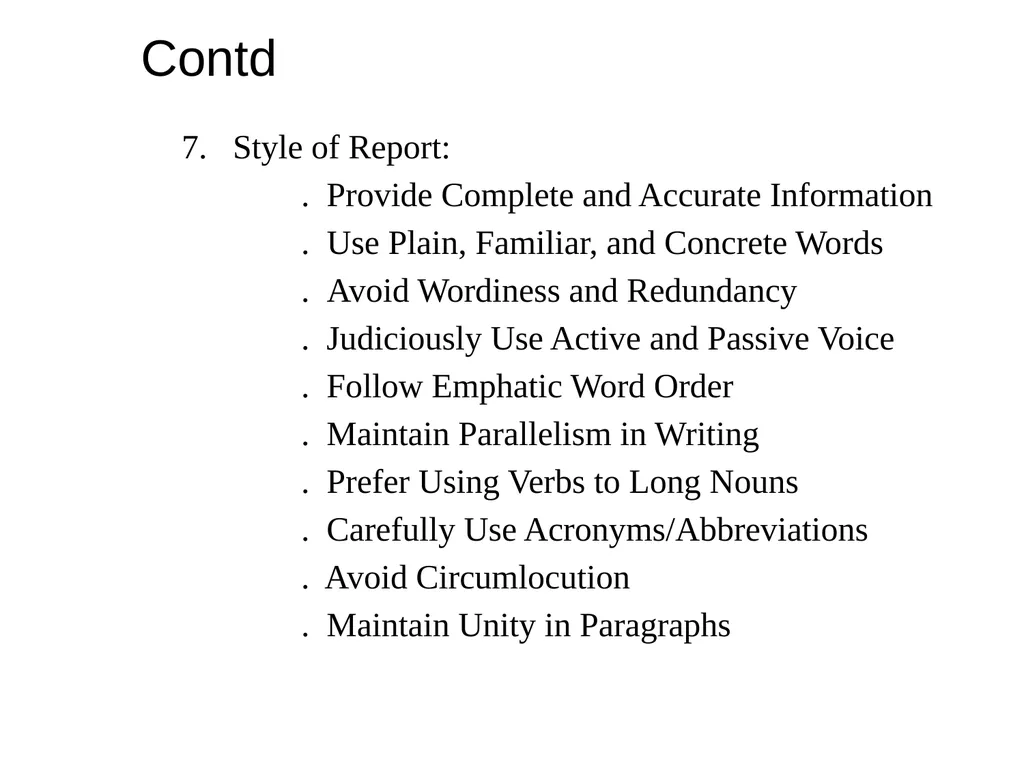
Contd Style of Report:
. Provide Complete and Accurate Information
. Use Plain, Familiar, and Concrete Words
. Avoid Wordiness and Redundancy
. Judiciously Use Active and Passive Voice
. Follow Emphatic Word Order
. Maintain Parallelism in Writing
. Prefer Using Verbs to Long Nouns
. Carefully Use Acronyms/Abbreviations
. Avoid Circumlocution
. Maintain Unity in Paragraphs<br>
. Provide Complete and Accurate Information
. Use Plain, Familiar, and Concrete Words
. Avoid Wordiness and Redundancy
. Judiciously Use Active and Passive Voice
. Follow Emphatic Word Order
. Maintain Parallelism in Writing
. Prefer Using Verbs to Long Nouns
. Carefully Use Acronyms/Abbreviations
. Avoid Circumlocution
. Maintain Unity in Paragraphs<br>
37
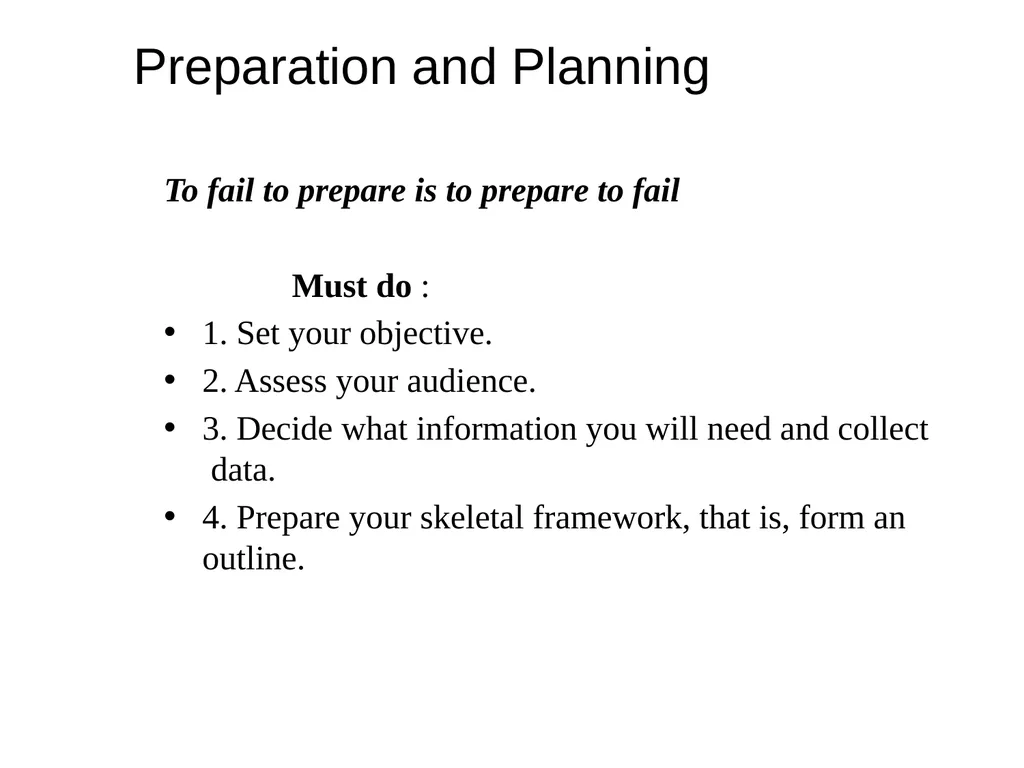
Preparation and Planning To fail to prepare is to prepare to fail
Must do :
1. Set your objective.
2. Assess your audience.
3. Decide what information you will need and collect data.
4. Prepare your skeletal framework, that is, form an outline.<br>
Must do :
1. Set your objective.
2. Assess your audience.
3. Decide what information you will need and collect data.
4. Prepare your skeletal framework, that is, form an outline.<br>
38
Data Collection The next step after defining your objective, scope and purpose is to collect relevant data. Recognizing the sources of information and collecting information become the primary tasks at this stage. Formal writing cannot depend on imagination and assumptions. It requires solid proof. This marks the importance of data collection in report writing<br>
39
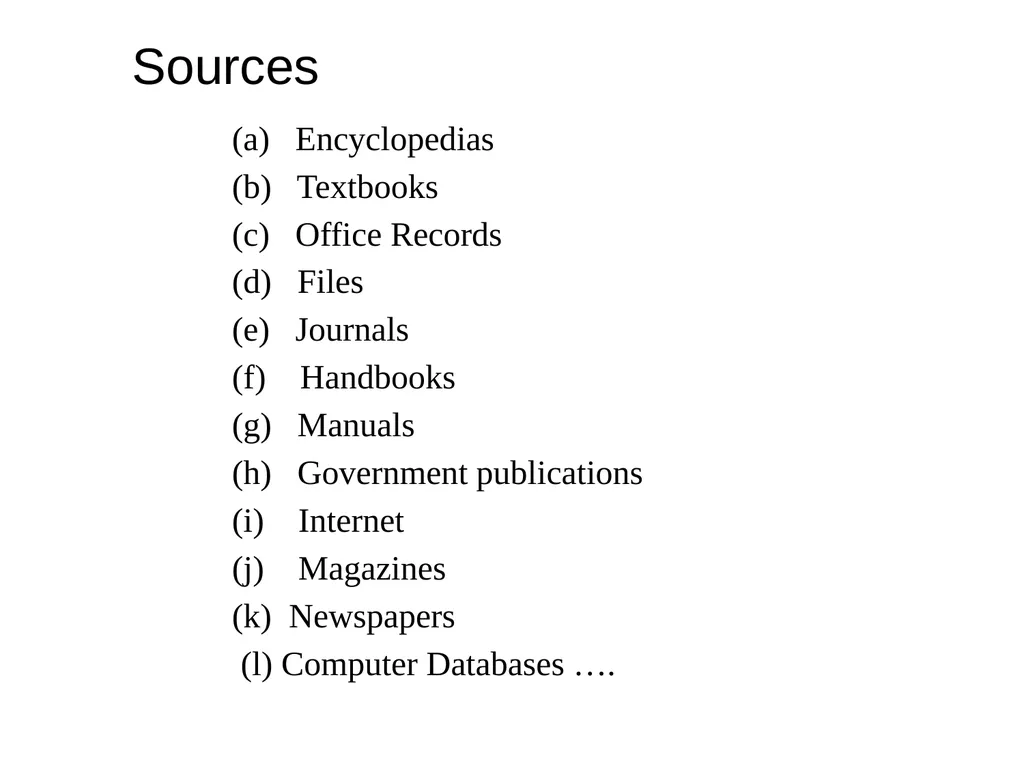
Sources (a) Encyclopedias
(b) Textbooks
(c) Office Records
(d) Files
(e) Journals
(f) Handbooks
(g) Manuals
(h) Government publications
(i) Internet
(j) Magazines
(k) Newspapers
(l) Computer Databases ….<br>
(b) Textbooks
(c) Office Records
(d) Files
(e) Journals
(f) Handbooks
(g) Manuals
(h) Government publications
(i) Internet
(j) Magazines
(k) Newspapers
(l) Computer Databases ….<br>
40
Methods of Data Collection • Personal observation
• Personal interview
• Telephonic interview
• Mail questionnaire<br>
• Personal interview
• Telephonic interview
• Mail questionnaire<br>
41
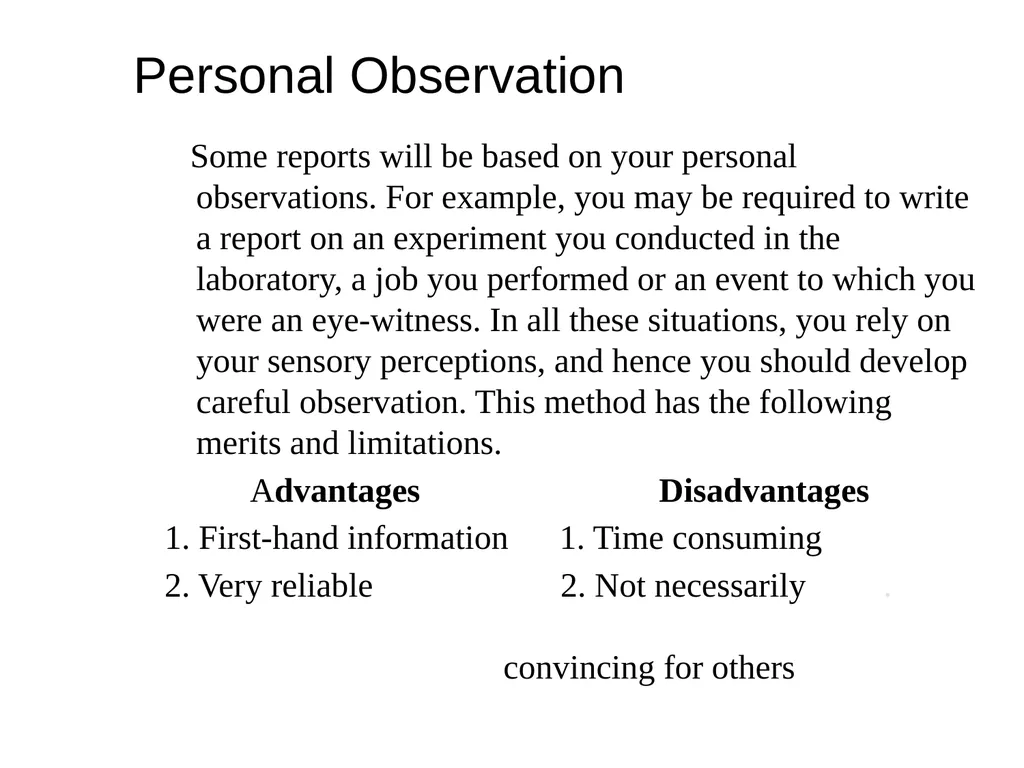
Personal Observation Some reports will be based on your personal observations. For example, you may be required to write a report on an experiment you conducted in the laboratory, a job you performed or an event to which you were an eye-witness. In all these situations, you rely on your sensory perceptions, and hence you should develop careful observation. This method has the following merits and limitations.
Advantages Disadvantages
1. First-hand information 1. Time consuming
2. Very reliable 2. Not necessarily . convincing for others<br>
Advantages Disadvantages
1. First-hand information 1. Time consuming
2. Very reliable 2. Not necessarily . convincing for others<br>
42
Telephonic Interview If the information you seek is of a routine nature and only brief answers are required from a small number of people, then you can contact them on telephone and save time on travelling. But often, you may not get as effective a feedback on the telephone as is possible through personal interviews.<br>
43
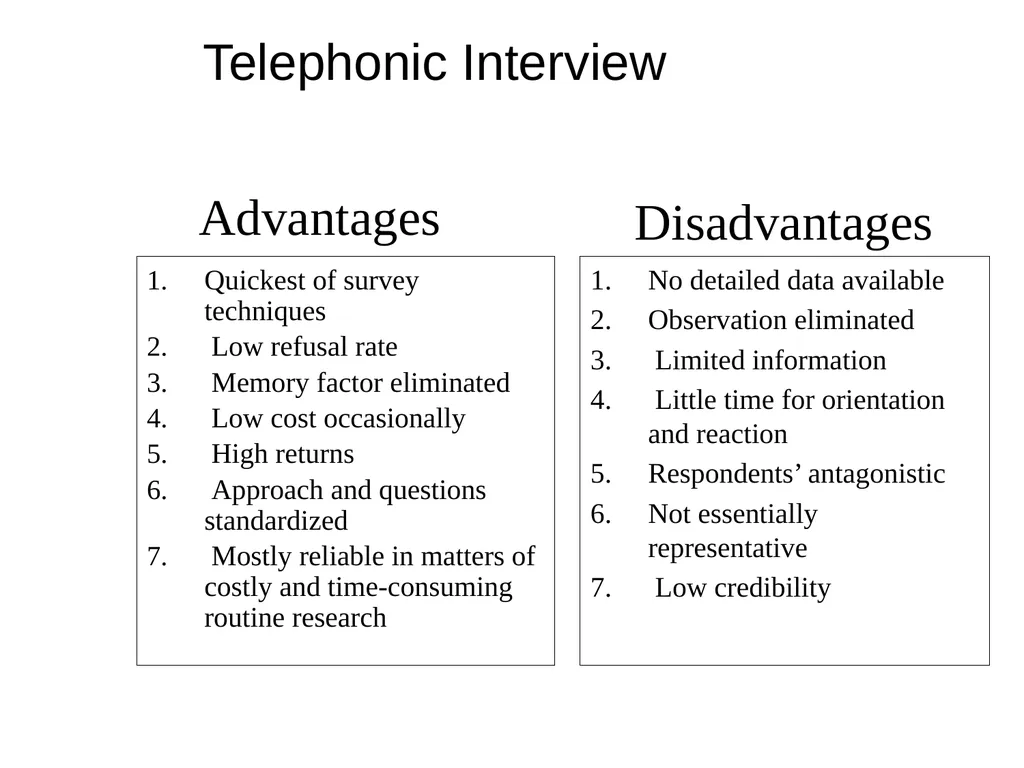
Telephonic Interview Quickest of survey techniques
Low refusal rate
Memory factor eliminated
Low cost occasionally
High returns
Approach and questions standardized
Mostly reliable in matters of costly and time-consuming routine research No detailed data available
Observation eliminated
Limited information
Little time for orientation and reaction
Respondents’ antagonistic
Not essentially representative
Low credibility Advantages Disadvantages<br>
Low refusal rate
Memory factor eliminated
Low cost occasionally
High returns
Approach and questions standardized
Mostly reliable in matters of costly and time-consuming routine research No detailed data available
Observation eliminated
Limited information
Little time for orientation and reaction
Respondents’ antagonistic
Not essentially representative
Low credibility Advantages Disadvantages<br>
44
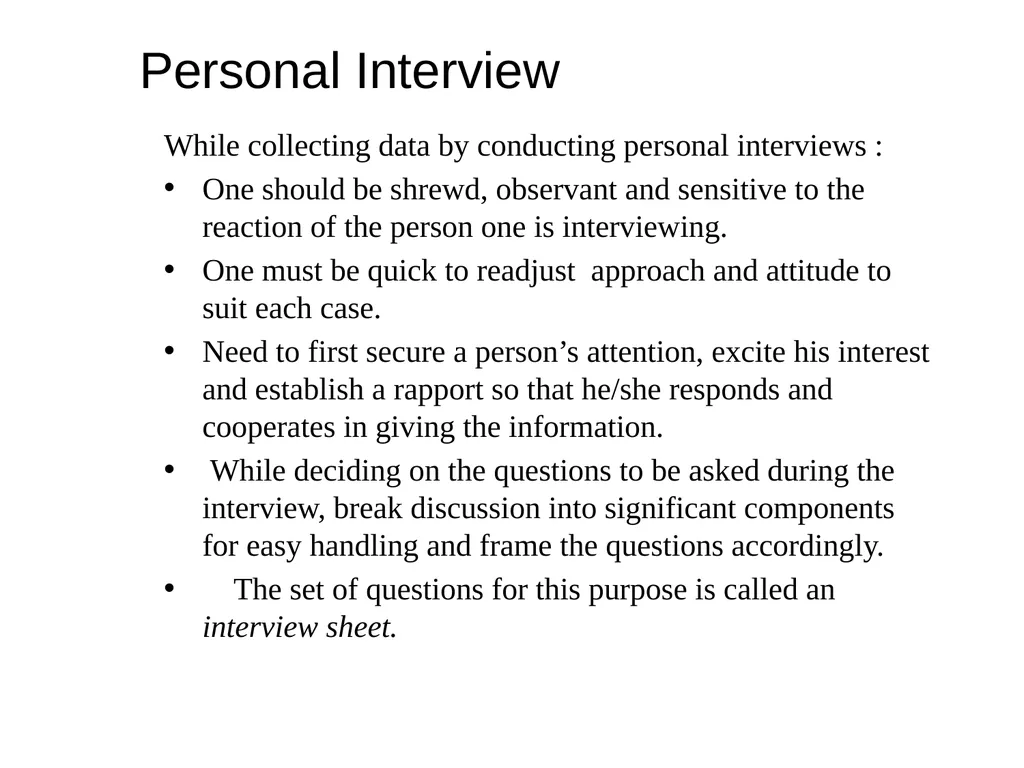
Personal Interview While collecting data by conducting personal interviews :
One should be shrewd, observant and sensitive to the reaction of the person one is interviewing.
One must be quick to readjust approach and attitude to suit each case.
Need to first secure a person’s attention, excite his interest and establish a rapport so that he/she responds and cooperates in giving the information.
While deciding on the questions to be asked during the interview, break discussion into significant components for easy handling and frame the questions accordingly.
The set of questions for this purpose is called an interview sheet.<br>
One should be shrewd, observant and sensitive to the reaction of the person one is interviewing.
One must be quick to readjust approach and attitude to suit each case.
Need to first secure a person’s attention, excite his interest and establish a rapport so that he/she responds and cooperates in giving the information.
While deciding on the questions to be asked during the interview, break discussion into significant components for easy handling and frame the questions accordingly.
The set of questions for this purpose is called an interview sheet.<br>
45
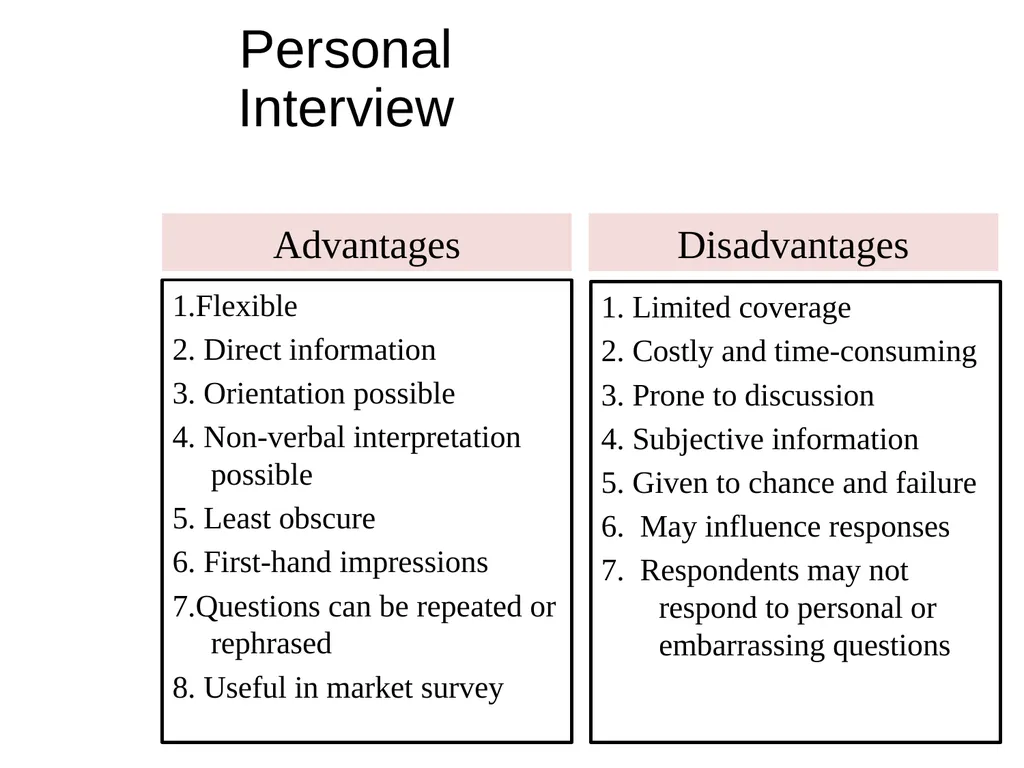
Personal Interview 1.Flexible
2. Direct information
3. Orientation possible
4. Non-verbal interpretation possible
5. Least obscure
6. First-hand impressions
7.Questions can be repeated or rephrased
8. Useful in market survey 1. Limited coverage
2. Costly and time-consuming
3. Prone to discussion
4. Subjective information
5. Given to chance and failure
6. May influence responses
7. Respondents may not respond to personal or embarrassing questions Advantages Disadvantages<br>
2. Direct information
3. Orientation possible
4. Non-verbal interpretation possible
5. Least obscure
6. First-hand impressions
7.Questions can be repeated or rephrased
8. Useful in market survey 1. Limited coverage
2. Costly and time-consuming
3. Prone to discussion
4. Subjective information
5. Given to chance and failure
6. May influence responses
7. Respondents may not respond to personal or embarrassing questions Advantages Disadvantages<br>
46
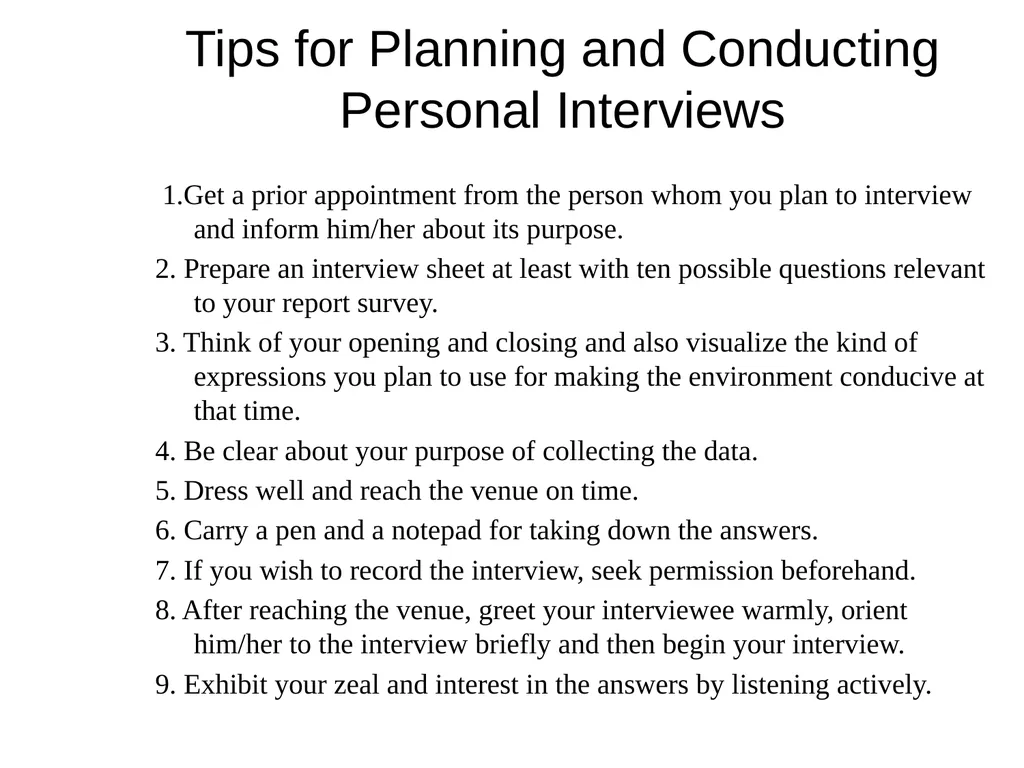
Tips for Planning and Conducting Personal Interviews 1.Get a prior appointment from the person whom you plan to interview and inform him/her about its purpose.
2. Prepare an interview sheet at least with ten possible questions relevant to your report survey.
3. Think of your opening and closing and also visualize the kind of expressions you plan to use for making the environment conducive at that time.
4. Be clear about your purpose of collecting the data.
5. Dress well and reach the venue on time.
6. Carry a pen and a notepad for taking down the answers.
7. If you wish to record the interview, seek permission beforehand.
8. After reaching the venue, greet your interviewee warmly, orient him/her to the interview briefly and then begin your interview.
9. Exhibit your zeal and interest in the answers by listening actively.<br>
2. Prepare an interview sheet at least with ten possible questions relevant to your report survey.
3. Think of your opening and closing and also visualize the kind of expressions you plan to use for making the environment conducive at that time.
4. Be clear about your purpose of collecting the data.
5. Dress well and reach the venue on time.
6. Carry a pen and a notepad for taking down the answers.
7. If you wish to record the interview, seek permission beforehand.
8. After reaching the venue, greet your interviewee warmly, orient him/her to the interview briefly and then begin your interview.
9. Exhibit your zeal and interest in the answers by listening actively.<br>
47
Contd 10. At times of confusion, do not get annoyed; rather seek clarification in a strategic manner.
11. Do not digress, and bring the interviewee back to the topic if he/she gets digressed.
12. Avoid asking embarrassing or personal questions.
13. Do not get involved in unnecessary or heated arguments.
14. Since you are seeking a favour from the interviewee, always assume a subordinate position.
15. Do not interrupt your respondent unnecessarily.
16. Thank your interviewee for sparing time and always keep the lines of communication open as you may require some more information later.<br>
11. Do not digress, and bring the interviewee back to the topic if he/she gets digressed.
12. Avoid asking embarrassing or personal questions.
13. Do not get involved in unnecessary or heated arguments.
14. Since you are seeking a favour from the interviewee, always assume a subordinate position.
15. Do not interrupt your respondent unnecessarily.
16. Thank your interviewee for sparing time and always keep the lines of communication open as you may require some more information later.<br>
48
Mail Questionnaire Advantages
Cheapest method
Covers wide area
Specific, accurate, processable
Covers a large number of respondents
Most scientific and reliable Disadvantages
Reduces hesitation
No clarification possible
Not necessarily correct
Illiterates can’t answer
Unwilling souls won’t answer
Time consuming
Not face to face
High refusal rate When a wide geographical coverage is required to be covered and a large number of people have to be contacted, the most efficient and convenient method is to collect data through mail questionnaires.<br>
Cheapest method
Covers wide area
Specific, accurate, processable
Covers a large number of respondents
Most scientific and reliable Disadvantages
Reduces hesitation
No clarification possible
Not necessarily correct
Illiterates can’t answer
Unwilling souls won’t answer
Time consuming
Not face to face
High refusal rate When a wide geographical coverage is required to be covered and a large number of people have to be contacted, the most efficient and convenient method is to collect data through mail questionnaires.<br>
49
Tips for Preparing a Questionnaire 1. Basic requirements
(a) Good mailing list
(b) Good covering letter
(c) Interested respondents<br>
(a) Good mailing list
(b) Good covering letter
(c) Interested respondents<br>
50
Tips for Framing a Good Questionnaire Set objectives for every question you ask
Be pointed, short, and clear
Figure out possible answers
Phrase the questions clearly, let there be no room for ambiguity
Avoid leading questions
Avoid delicate questions
Avoid long and complicated questions
Arrange the questions logically
Don’t ask questions that require lengthy answers
Leave enough blank space for answering
Don’t repeat the questions
Additional tips
Enclose the covering letter with a self–addressed, stamped envelope
Assume confidentiality
Ensure action and be courteous<br>
Be pointed, short, and clear
Figure out possible answers
Phrase the questions clearly, let there be no room for ambiguity
Avoid leading questions
Avoid delicate questions
Avoid long and complicated questions
Arrange the questions logically
Don’t ask questions that require lengthy answers
Leave enough blank space for answering
Don’t repeat the questions
Additional tips
Enclose the covering letter with a self–addressed, stamped envelope
Assume confidentiality
Ensure action and be courteous<br>
51
Analysing and Organizing the Data Once data collection is done and notes have been taken, the next step for the report writer is to analyse the data
Revise your questions and data; add new items to it if necessary. If the information does not fit into your purpose, do not use it.
The next step is to organize the data collected. This can be conveniently divided into the more typically labeled parts as the introduction, body, and conclusion of a report.
A formal outline is necessary if your report is very long.
An outline is necessary in a formal written report because it finally helps us form the table of contents of a report.
While deciding on the sequence of ideas, save the most important statements for the first and last positions, as they receive more stress than anything else.<br>
Revise your questions and data; add new items to it if necessary. If the information does not fit into your purpose, do not use it.
The next step is to organize the data collected. This can be conveniently divided into the more typically labeled parts as the introduction, body, and conclusion of a report.
A formal outline is necessary if your report is very long.
An outline is necessary in a formal written report because it finally helps us form the table of contents of a report.
While deciding on the sequence of ideas, save the most important statements for the first and last positions, as they receive more stress than anything else.<br>
52
Writing and Revising Keep the audience in mind and prepare a rough draft with everything relevant. In the first review, concentrate on blocks of ideas. In the second review, concentrate on finer details, matters of syntax and diction, and write the final report in a specific form using a style sheet or manual.<br>
53
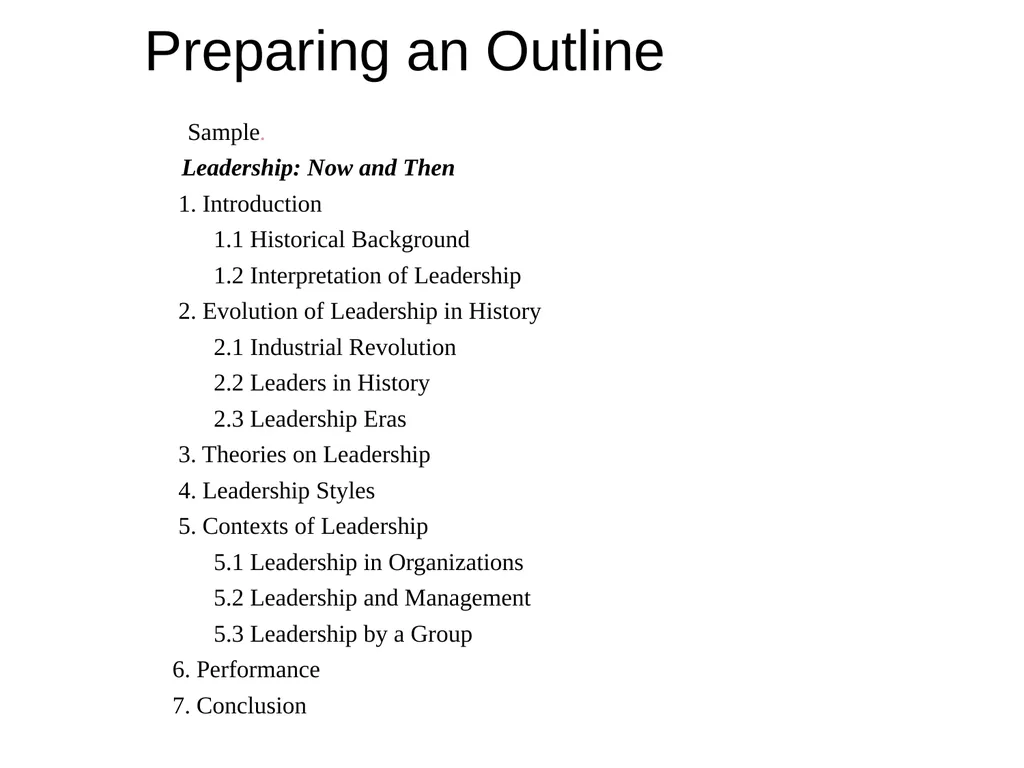
Preparing an Outline Sample.
Leadership: Now and Then
1. Introduction
1.1 Historical Background
1.2 Interpretation of Leadership
2. Evolution of Leadership in History
2.1 Industrial Revolution
2.2 Leaders in History
2.3 Leadership Eras
3. Theories on Leadership
4. Leadership Styles
5. Contexts of Leadership
5.1 Leadership in Organizations
5.2 Leadership and Management
5.3 Leadership by a Group
6. Performance
7. Conclusion<br>
Leadership: Now and Then
1. Introduction
1.1 Historical Background
1.2 Interpretation of Leadership
2. Evolution of Leadership in History
2.1 Industrial Revolution
2.2 Leaders in History
2.3 Leadership Eras
3. Theories on Leadership
4. Leadership Styles
5. Contexts of Leadership
5.1 Leadership in Organizations
5.2 Leadership and Management
5.3 Leadership by a Group
6. Performance
7. Conclusion<br>
54
Structure of Formal Reports 1.Front matter
2. Main body
3. Back matter<br>
2. Main body
3. Back matter<br>
55
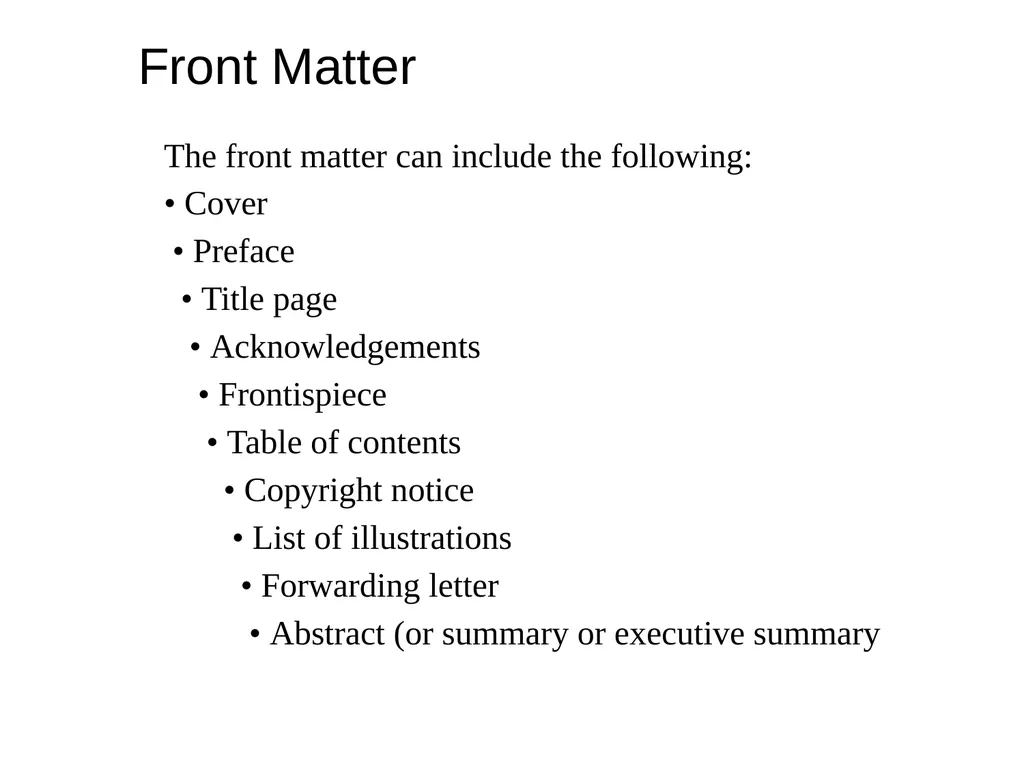
Front Matter The front matter can include the following:
• Cover
• Preface
• Title page
• Acknowledgements
• Frontispiece
• Table of contents
• Copyright notice
• List of illustrations
• Forwarding letter
• Abstract (or summary or executive summary<br>
• Cover
• Preface
• Title page
• Acknowledgements
• Frontispiece
• Table of contents
• Copyright notice
• List of illustrations
• Forwarding letter
• Abstract (or summary or executive summary<br>
56
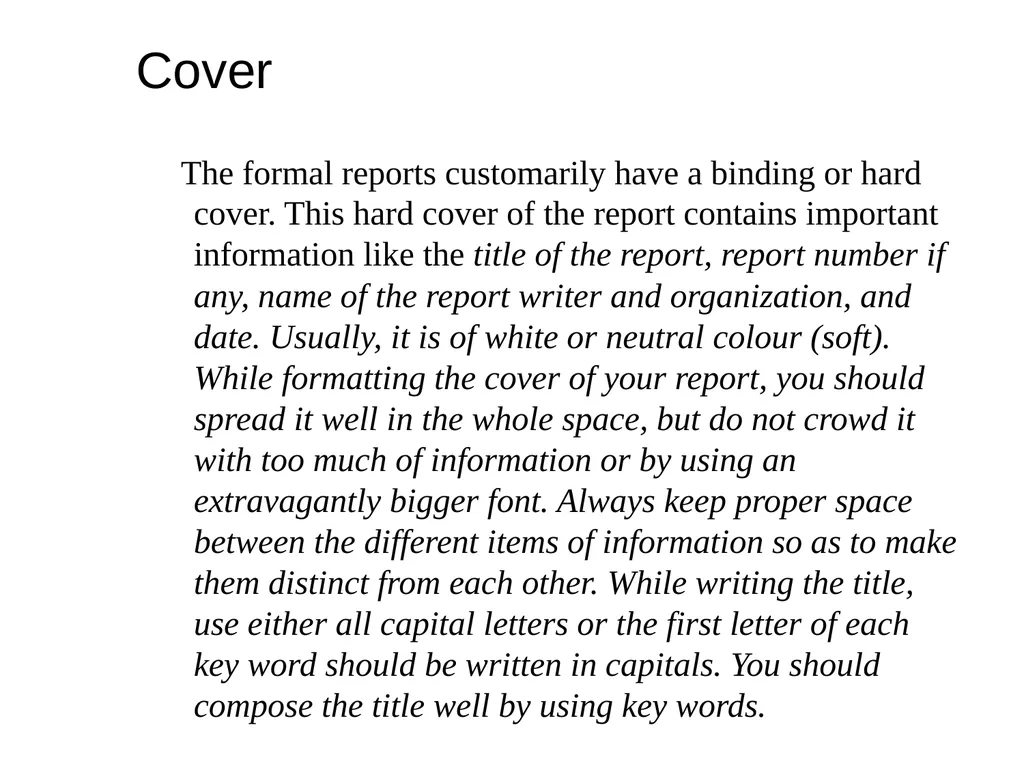
Cover The formal reports customarily have a binding or hard cover. This hard cover of the report contains important information like the title of the report, report number if any, name of the report writer and organization, and date. Usually, it is of white or neutral colour (soft). While formatting the cover of your report, you should spread it well in the whole space, but do not crowd it with too much of information or by using an extravagantly bigger font. Always keep proper space between the different items of information so as to make them distinct from each other. While writing the title, use either all capital letters or the first letter of each key word should be written in capitals. You should compose the title well by using key words.<br>
57
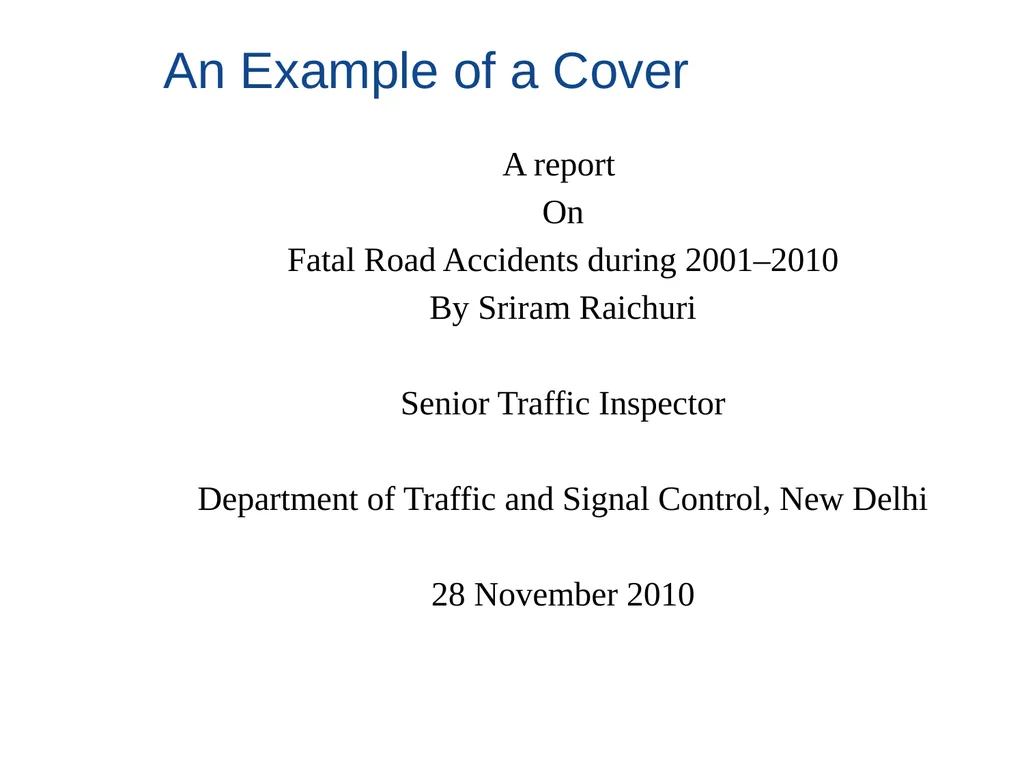
An Example of a Cover A report
On
Fatal Road Accidents during 2001–2010
By Sriram Raichuri
Senior Traffic Inspector
Department of Traffic and Signal Control, New Delhi
28 November 2010<br>
On
Fatal Road Accidents during 2001–2010
By Sriram Raichuri
Senior Traffic Inspector
Department of Traffic and Signal Control, New Delhi
28 November 2010<br>
58
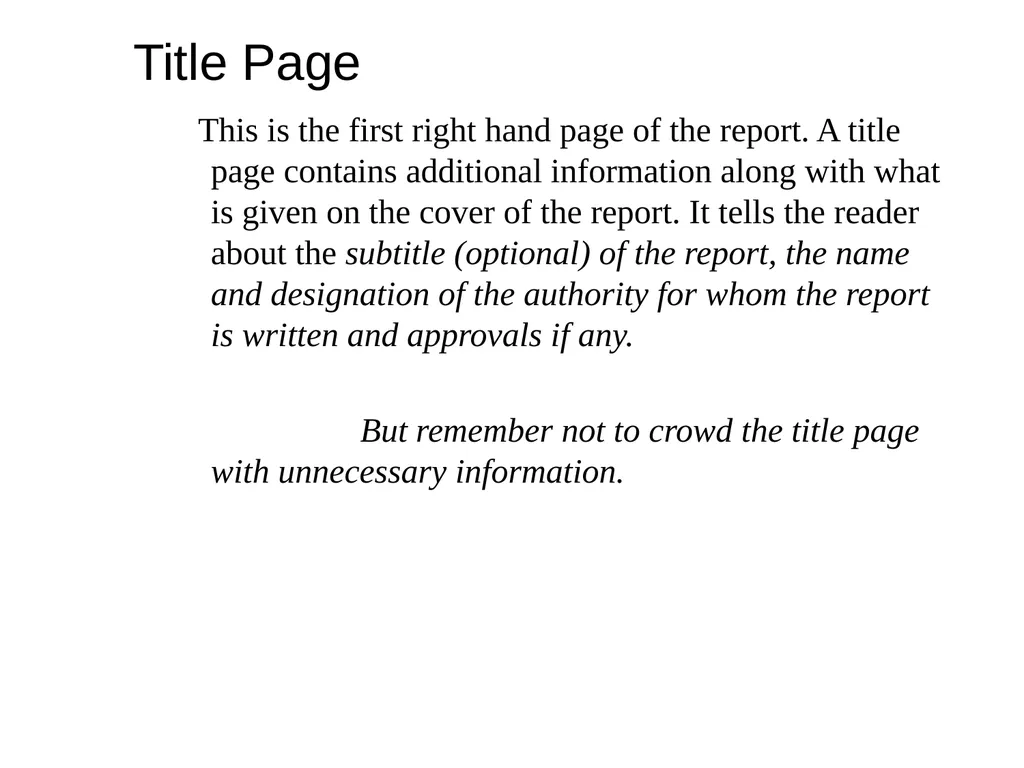
Title Page This is the first right hand page of the report. A title page contains additional information along with what is given on the cover of the report. It tells the reader about the subtitle (optional) of the report, the name and designation of the authority for whom the report is written and approvals if any.
But remember not to crowd the title page with unnecessary information.<br>
But remember not to crowd the title page with unnecessary information.<br>
59
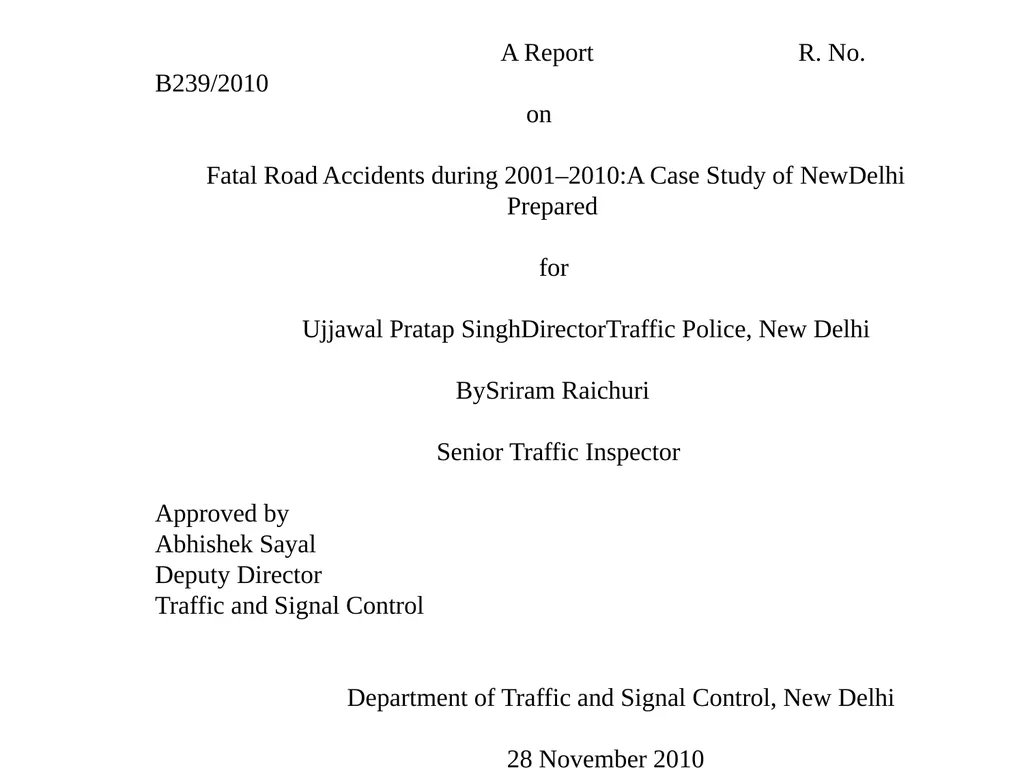
A Report R. No. B239/2010
on
Fatal Road Accidents during 2001–2010:A Case Study of NewDelhi
Prepared
for
Ujjawal Pratap SinghDirectorTraffic Police, New Delhi
BySriram Raichuri
Senior Traffic Inspector
Approved by
Abhishek Sayal
Deputy Director
Traffic and Signal Control
Department of Traffic and Signal Control, New Delhi
28 November 2010<br>
on
Fatal Road Accidents during 2001–2010:A Case Study of NewDelhi
Prepared
for
Ujjawal Pratap SinghDirectorTraffic Police, New Delhi
BySriram Raichuri
Senior Traffic Inspector
Approved by
Abhishek Sayal
Deputy Director
Traffic and Signal Control
Department of Traffic and Signal Control, New Delhi
28 November 2010<br>
60
Frontispiece The window display of the whole report as it consists of artistic drawings, pictures, photographs, or maps. The sole purpose of giving a frontispiece is to ignite curiosity among the readers about the contents of the report. However, these are not normally used in technical reports.<br>
61
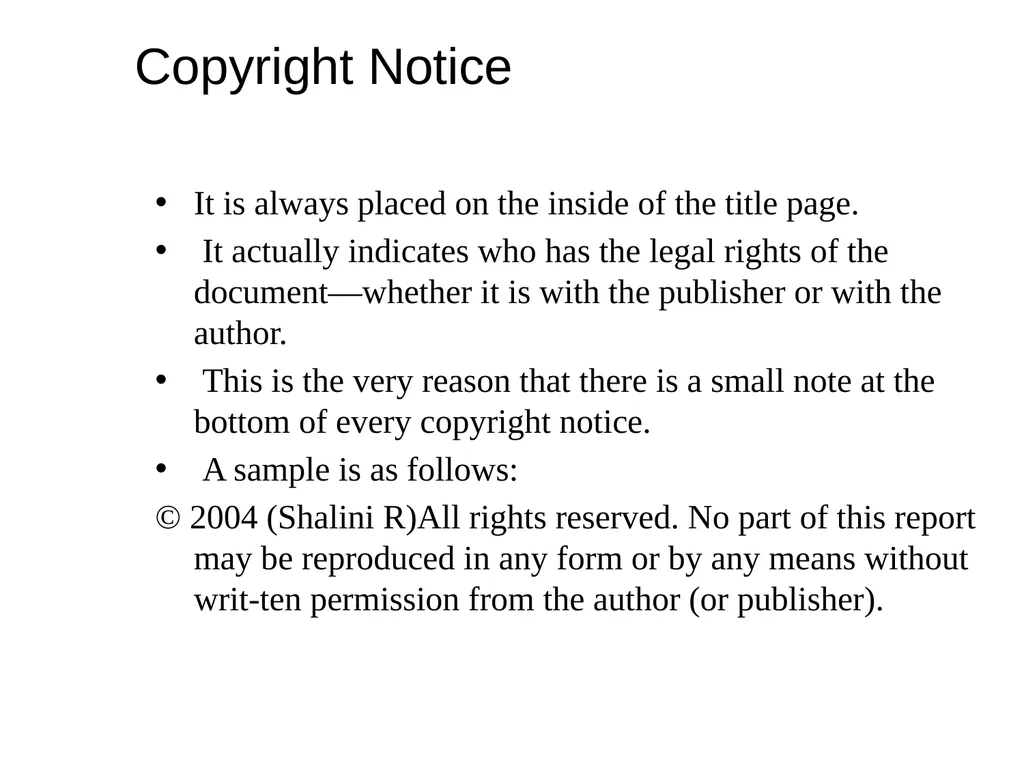
Copyright Notice It is always placed on the inside of the title page.
It actually indicates who has the legal rights of the document—whether it is with the publisher or with the author.
This is the very reason that there is a small note at the bottom of every copyright notice.
A sample is as follows:
© 2004 (Shalini R)All rights reserved. No part of this report may be reproduced in any form or by any means without writ-ten permission from the author (or publisher).<br>
It actually indicates who has the legal rights of the document—whether it is with the publisher or with the author.
This is the very reason that there is a small note at the bottom of every copyright notice.
A sample is as follows:
© 2004 (Shalini R)All rights reserved. No part of this report may be reproduced in any form or by any means without writ-ten permission from the author (or publisher).<br>
62
Forwarding Letter Forwarding letters can be ‘covering’ and ‘introductory’ type. The former serves as a record of transmission of the report. It is not bound with the report, as it does not contain any important information. Introductory covering letters often refer to specific parts of the report, and may repeat particularly important points such as purpose, scope, limitations, conclusions and recommendations. Since an introductory covering letter contains an appreciable amount of information, it is usually bound into the report, immediately after the title page.<br>
63
Preface The preface of the report introduces the report to its readers. In fact, the preface tells the readers broadly what the report is all about. Since the last paragraph of a preface includes acknowledgements, it is not necessary to have separate acknowledgements in the report.<br>
64
Acknowledgements This is an element of the report that appears before the abstract of the report. It mentions the names of those people and sources that have helped the report writer to accomplish the task. However, this is not a list. It is properly crafted since it not only includes the names of people but also informs the readers how those persons helped the writer to carry out his/her work within the stipulated time.
Few important tips for drafting good acknowledgements for a report:
1. First categorize the persons whom you want to acknowledge according to: courtesy sake, real help, emotional help, and technical help.
2. Bring variation in your expressions while expressing your gratitude.
3. Always mention the reason due to which you intend to express your gratitude for the person .<br>
Few important tips for drafting good acknowledgements for a report:
1. First categorize the persons whom you want to acknowledge according to: courtesy sake, real help, emotional help, and technical help.
2. Bring variation in your expressions while expressing your gratitude.
3. Always mention the reason due to which you intend to express your gratitude for the person .<br>
65
Table of Contents (ToC) ToC of a report includes the chapter headings and subheadings and their respective page numbers
It makes easy for the reader to locate specific information from a report
The discussion section of the report is normally broken down into 2 or 3 levels to give the reader a clear picture of the report’s contents
It serves as a guide to the report
It does not include a title page or table of contents.
The decimal numbering system (DNS) is used while preparing the ToC.<br>
It makes easy for the reader to locate specific information from a report
The discussion section of the report is normally broken down into 2 or 3 levels to give the reader a clear picture of the report’s contents
It serves as a guide to the report
It does not include a title page or table of contents.
The decimal numbering system (DNS) is used while preparing the ToC.<br>
66
List of Illustrations When more than twelve illustrations (maps, charts, graphs, etc.) are used in a report, a list of illustrations is prepared like ToC. In this list, page numbers are also provided so that a reader may quickly locate a specific illustration that he/she wishes to refer to.<br>
67
Abstract A brief write-up which tells the reader what the report is all about and its accomplishments. An abstract captures the essence of the entire report, based on which the reader decides whether to go ahead with reading the report or not. It is very short in length, not generally exceeding 250 words. The abstract should contain relevant information such as main purpose, main design point, methodology, and some eye-catching results to show the significance of the report.<br>
68
Sample Abstract This report is based on the profile study of ten top most business leaders. It analyses the various factors such as risk-taking abilities, inventiveness, adaptability, resilience, and business acumen among these leaders. It also suggests an existence of strong correlation between effective risk-taking with strategy-based innovation. The report serves as an effective introduction to cross-factor analysis of effective leadership. It has implication for HR in a situation when they are finding top leaders to lead a firm towards innovation, grow its revenues, or turn around the company in crisis.<br>
69
Executive Summary An executive summary presents the entire report in a nutshell telling the readers about what is to be expected in the report and what the report explores.
You can specify the following points in your executive summary:
Objectives of the report
Major findings
Overview of subject matter
Recommendations
Methods of analysis
An executive summary to the report is like a window to the building. It allows its readers to get to know how significant and relevant the study is for him/her. Since it includes major recommendations as well, it enables the authorities to take decisions to solve the problem under discussion.<br>
You can specify the following points in your executive summary:
Objectives of the report
Major findings
Overview of subject matter
Recommendations
Methods of analysis
An executive summary to the report is like a window to the building. It allows its readers to get to know how significant and relevant the study is for him/her. Since it includes major recommendations as well, it enables the authorities to take decisions to solve the problem under discussion.<br>
70
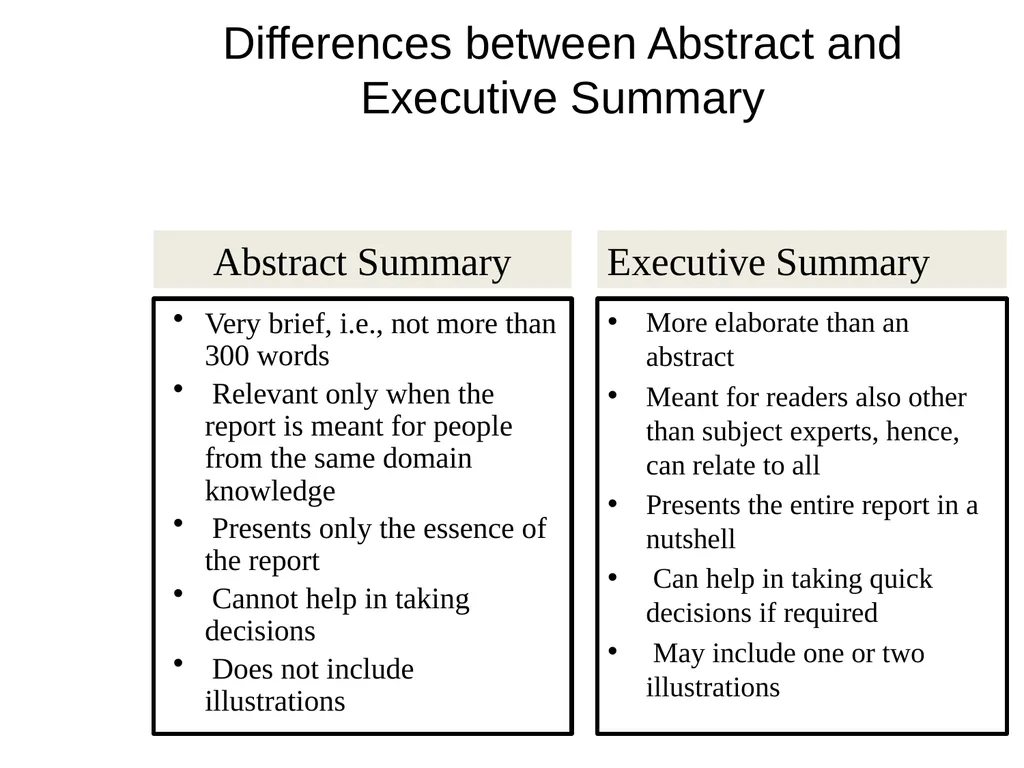
Differences between Abstract and Executive Summary Very brief, i.e., not more than 300 words
Relevant only when the report is meant for people from the same domain knowledge
Presents only the essence of the report
Cannot help in taking decisions
Does not include illustrations More elaborate than an abstract
Meant for readers also other than subject experts, hence, can relate to all
Presents the entire report in a nutshell
Can help in taking quick decisions if required
May include one or two illustrations Abstract Summary Executive Summary<br>
Relevant only when the report is meant for people from the same domain knowledge
Presents only the essence of the report
Cannot help in taking decisions
Does not include illustrations More elaborate than an abstract
Meant for readers also other than subject experts, hence, can relate to all
Presents the entire report in a nutshell
Can help in taking quick decisions if required
May include one or two illustrations Abstract Summary Executive Summary<br>
71
Main Body The main body consists of the following parts:
Introduction
Conclusion
Discussion
Recommendations<br>
Introduction
Conclusion
Discussion
Recommendations<br>
72
Introduction Should provide the following elements of information
Background information
Problem statement
Reference to authorization
Purpose and scope
Significance
Methodology
Basic principles or theories involved
Summary of findings
General plan of work<br>
Background information
Problem statement
Reference to authorization
Purpose and scope
Significance
Methodology
Basic principles or theories involved
Summary of findings
General plan of work<br>
73
Discussion Divide your text into several sections/chapters.
Organize the matter into topics and sub-topics.
Include substantial matter under each topic/sub-topic.
Provide detailed analysis/interpretation.
Do not insert recommendations in the discussion section.
Include illustrations for making the analysis clear to the reader.<br>
Organize the matter into topics and sub-topics.
Include substantial matter under each topic/sub-topic.
Provide detailed analysis/interpretation.
Do not insert recommendations in the discussion section.
Include illustrations for making the analysis clear to the reader.<br>
74
Conclusion 1. Brief recapitulation of the problem studied, the approach adopted, and the results based on the analysis done in the discussion.
2. It can be written either in points or developed in separate paragraphs.
3. Draws inferences in a crisp and tidy manner.<br>
2. It can be written either in points or developed in separate paragraphs.
3. Draws inferences in a crisp and tidy manner.<br>
75
Recommendations 1. State actions that according to the writer are required to be taken based on the findings and conclusions.
2. Solutions, ideas, or recommendations are suggested.
3. Include answers to all the 6 wh questions, i.e., What is to be done? Why? How? Where? When? etc.<br>
2. Solutions, ideas, or recommendations are suggested.
3. Include answers to all the 6 wh questions, i.e., What is to be done? Why? How? Where? When? etc.<br>
76
Back Matter • Appendices
• Bibliography
• Index
• List of references
• Glossary<br>
• Bibliography
• Index
• List of references
• Glossary<br>
77
Appendices The appendix should contain material closely related to the topic but not absolutely essential to the overall understanding of the report.
Provide a proper cross-reference in the text, e.g., ‘see Appendix A for the questionnaire sent to the respondents’ or for detailed calculation ‘see Appendix B’.
Experimental results, detailed calculations, statistical data, comparative analysis, sample questionnaires, sample pro forma, etc. can be included in the appendix<br>
Provide a proper cross-reference in the text, e.g., ‘see Appendix A for the questionnaire sent to the respondents’ or for detailed calculation ‘see Appendix B’.
Experimental results, detailed calculations, statistical data, comparative analysis, sample questionnaires, sample pro forma, etc. can be included in the appendix<br>
78
Documentation Indispensable part of any professional writing such as reports, proposals, and research papers.
It includes how the various sources such as books, anthologies, news papers, journals, etc., which have helped understanding of the problem or topic, are to be cited.
For this purpose, required to prepare references, bibliography, and sometimes footnotes.
There are four major documentation styles:
1. MLA (Modern Language Association) style
2. APA (American Psychological Association) style
3.Chicago style
4.IEEE style<br>
It includes how the various sources such as books, anthologies, news papers, journals, etc., which have helped understanding of the problem or topic, are to be cited.
For this purpose, required to prepare references, bibliography, and sometimes footnotes.
There are four major documentation styles:
1. MLA (Modern Language Association) style
2. APA (American Psychological Association) style
3.Chicago style
4.IEEE style<br>
79
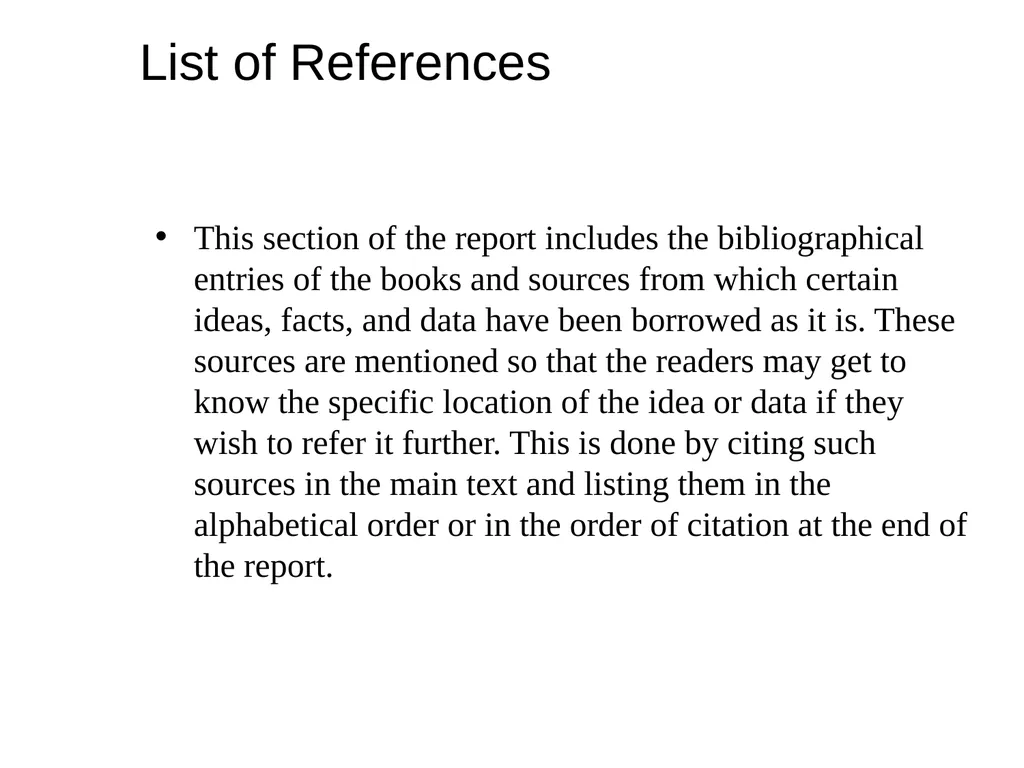
List of References This section of the report includes the bibliographical entries of the books and sources from which certain ideas, facts, and data have been borrowed as it is. These sources are mentioned so that the readers may get to know the specific location of the idea or data if they wish to refer it further. This is done by citing such sources in the main text and listing them in the alphabetical order or in the order of citation at the end of the report.<br>
80
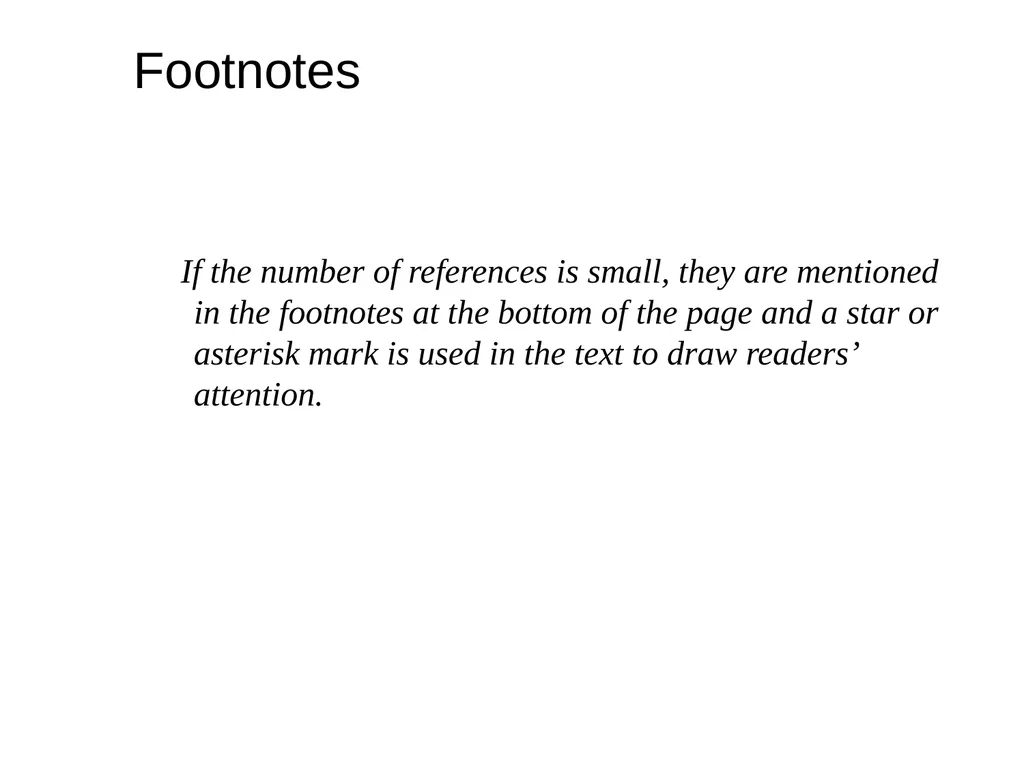
Footnotes If the number of references is small, they are mentioned in the footnotes at the bottom of the page and a star or asterisk mark is used in the text to draw readers’ attention.<br>
81
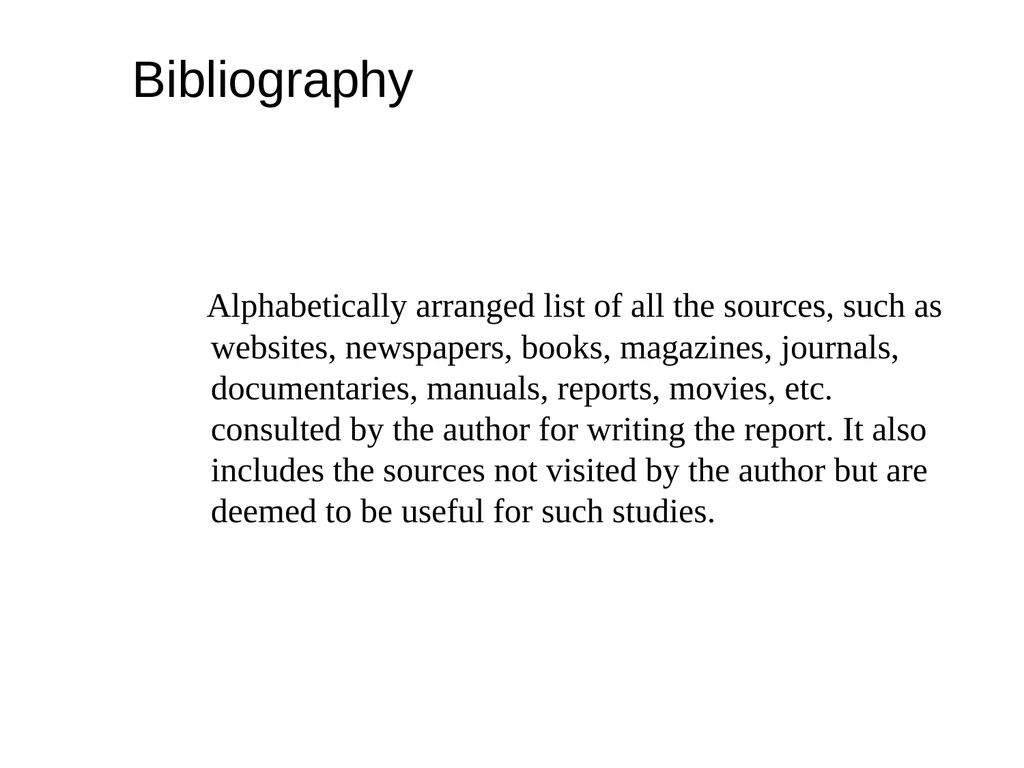
Bibliography Alphabetically arranged list of all the sources, such as websites, newspapers, books, magazines, journals, documentaries, manuals, reports, movies, etc. consulted by the author for writing the report. It also includes the sources not visited by the author but are deemed to be useful for such studies.<br>
82
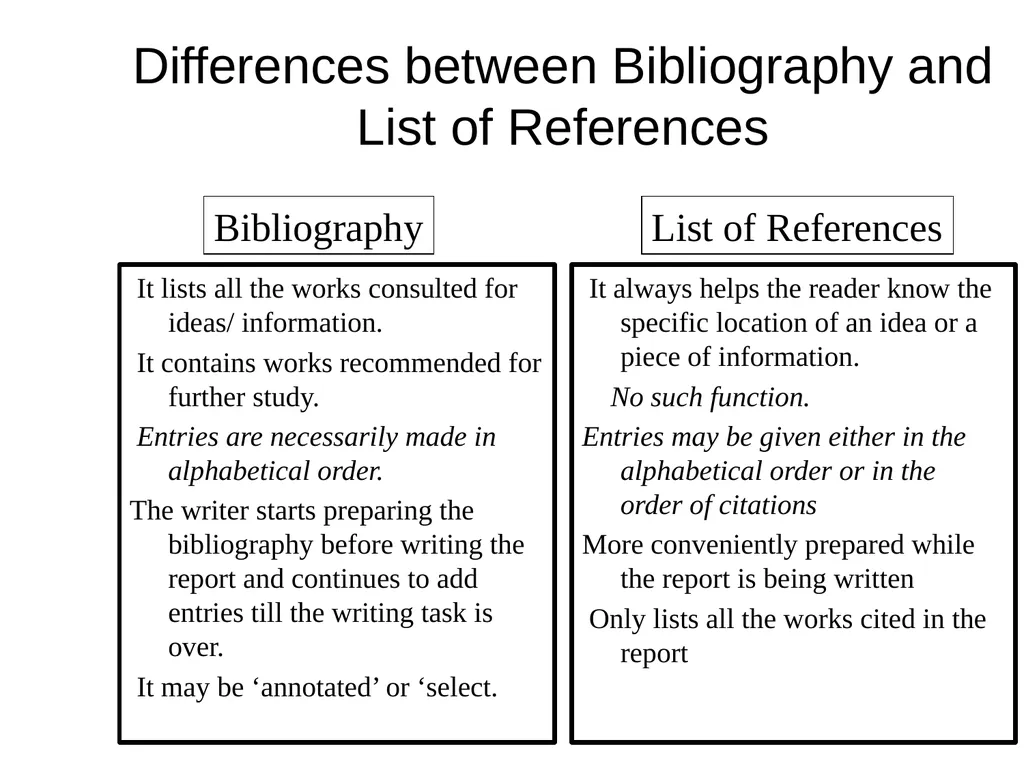
Differences between Bibliography and List of References It lists all the works consulted for ideas/ information.
It contains works recommended for further study.
Entries are necessarily made in alphabetical order.
The writer starts preparing the bibliography before writing the report and continues to add entries till the writing task is over.
It may be ‘annotated’ or ‘select. It always helps the reader know the specific location of an idea or a piece of information.
No such function.
Entries may be given either in the alphabetical order or in the order of citations
More conveniently prepared while the report is being written
Only lists all the works cited in the report Bibliography List of References<br>
It contains works recommended for further study.
Entries are necessarily made in alphabetical order.
The writer starts preparing the bibliography before writing the report and continues to add entries till the writing task is over.
It may be ‘annotated’ or ‘select. It always helps the reader know the specific location of an idea or a piece of information.
No such function.
Entries may be given either in the alphabetical order or in the order of citations
More conveniently prepared while the report is being written
Only lists all the works cited in the report Bibliography List of References<br>
83
Glossary A glossary is a list of technical words and terms which appear in the text of the report. In a glossary, these words and phrases are arranged alphabetically. Their meaning and explanation are also provided.<br>
84
Index This is the list of various topics, sub-topics and various other important aspects which have been discussed inside the main text but could not find a place in the table of contents. Thus, it serves as a quick guide for the reader to locate any specific idea or concept given in the main text somewhere.<br>
85
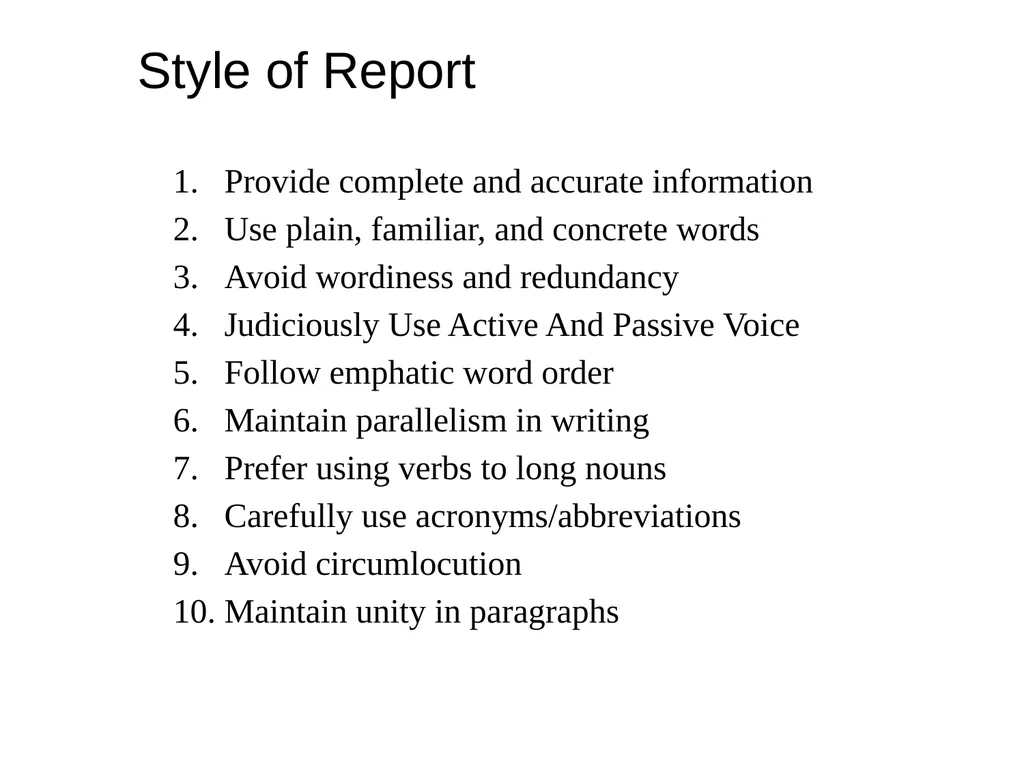
Style of Report Provide complete and accurate information
Use plain, familiar, and concrete words
Avoid wordiness and redundancy
Judiciously Use Active And Passive Voice
Follow emphatic word order
Maintain parallelism in writing
Prefer using verbs to long nouns
Carefully use acronyms/abbreviations
Avoid circumlocution
Maintain unity in paragraphs<br>
Use plain, familiar, and concrete words
Avoid wordiness and redundancy
Judiciously Use Active And Passive Voice
Follow emphatic word order
Maintain parallelism in writing
Prefer using verbs to long nouns
Carefully use acronyms/abbreviations
Avoid circumlocution
Maintain unity in paragraphs<br>
86
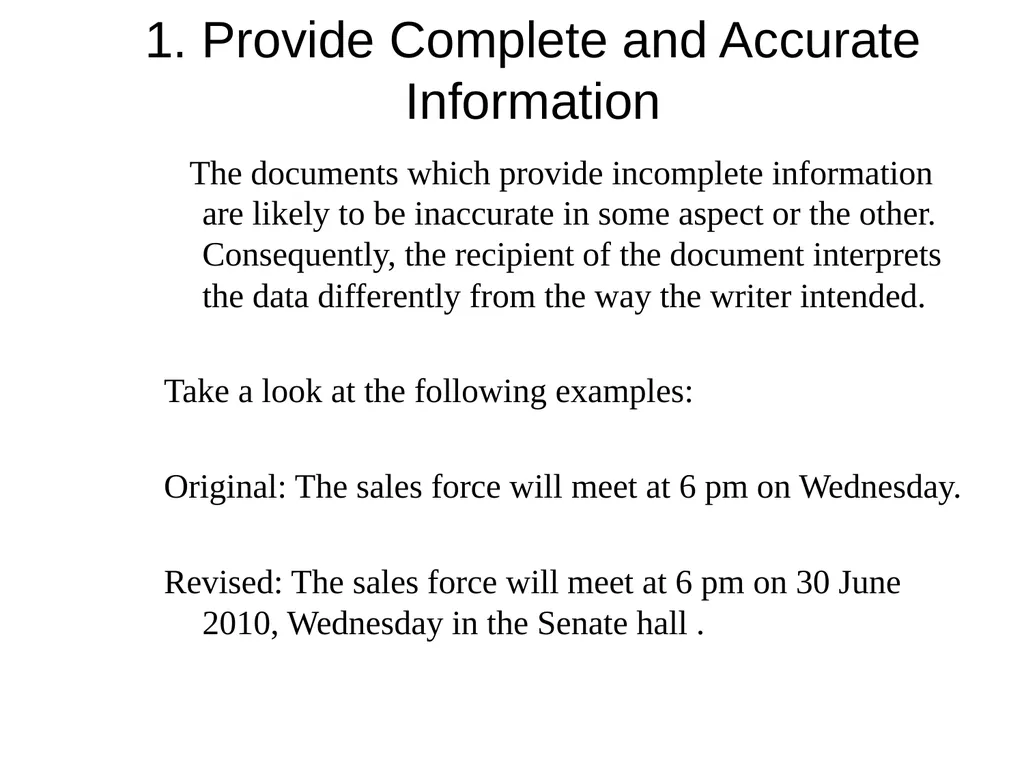
1. Provide Complete and Accurate Information The documents which provide incomplete information are likely to be inaccurate in some aspect or the other. Consequently, the recipient of the document interprets the data differently from the way the writer intended.
Take a look at the following examples:
Original: The sales force will meet at 6 pm on Wednesday.
Revised: The sales force will meet at 6 pm on 30 June 2010, Wednesday in the Senate hall .<br>
Take a look at the following examples:
Original: The sales force will meet at 6 pm on Wednesday.
Revised: The sales force will meet at 6 pm on 30 June 2010, Wednesday in the Senate hall .<br>
87
2. Use Plain, Familiar, and Concrete Words 1. Always use plain, familiar words while writing a report.
2. Avoid ostentation and flowery language as far as possible.
3. Also, prefer using concrete words rather than abstract words to maintain clarity and precision in the report.
See the following examples:
Original: In all probability, we are likely to launch a mobile set that is bound to have a resounding repercussion on the way mobiles are designed.
Revised: Our new mobile set is likely to change the existing mobile designs<br>
2. Avoid ostentation and flowery language as far as possible.
3. Also, prefer using concrete words rather than abstract words to maintain clarity and precision in the report.
See the following examples:
Original: In all probability, we are likely to launch a mobile set that is bound to have a resounding repercussion on the way mobiles are designed.
Revised: Our new mobile set is likely to change the existing mobile designs<br>
88
3. Avoid Wordiness and Redundancy Be brief, whenever possible.
Avoid wordiness and unnecessarily long words.
When you use more number of words to convey the same meaning, it is called redundancy. Strive for clarity in your writing and avoid vagueness.
Original: Tsunami had the effect of a destructive, disparaging and caustic impact on the manufacturing plant.
Revised: Tsunami destroyed the manufacturing plant.<br>
Avoid wordiness and unnecessarily long words.
When you use more number of words to convey the same meaning, it is called redundancy. Strive for clarity in your writing and avoid vagueness.
Original: Tsunami had the effect of a destructive, disparaging and caustic impact on the manufacturing plant.
Revised: Tsunami destroyed the manufacturing plant.<br>
89
4. Judiciously Use Active and Passive Voice Active voice is preferred to express ideas in reports.
The unnecessary use of passive voice sometimes makes us write more than required.
Passive voice is preferred in order to avoid curtness and give prominence to action rather than the agent.
Passive voice can be used to describe the mistake without directly placing blame on the person who made the error which led to the disaster.
Original: Because Mr Thareja, Accounts Officer, forgot to include the correct budget projections with the bid, we lost the client.
Revised: The correct budget was accidentally left out of the bid, which led to the loss of the client.<br>
The unnecessary use of passive voice sometimes makes us write more than required.
Passive voice is preferred in order to avoid curtness and give prominence to action rather than the agent.
Passive voice can be used to describe the mistake without directly placing blame on the person who made the error which led to the disaster.
Original: Because Mr Thareja, Accounts Officer, forgot to include the correct budget projections with the bid, we lost the client.
Revised: The correct budget was accidentally left out of the bid, which led to the loss of the client.<br>
90
5. Follow Emphatic Word Order Since a report is a concise presentation of facts, an emphatic word order is required to arrest the attention of the reader. For a reader, what comes in the beginning and at the end has an extra emphasis in meaning and idea. Therefore, try and supply the most important part of your message either in the beginning or at the end of a sentence and let it not be lost somewhere in the middle of a sentence.
Original: When he returned to the production unit, the Production Manager tried to implement the strategies he had learnt about in the training programme attended in the previous month.
Revised: On his return from the training programme, the Production Manager attempted to implement strategies recently learnt.<br>
Original: When he returned to the production unit, the Production Manager tried to implement the strategies he had learnt about in the training programme attended in the previous month.
Revised: On his return from the training programme, the Production Manager attempted to implement strategies recently learnt.<br>
91
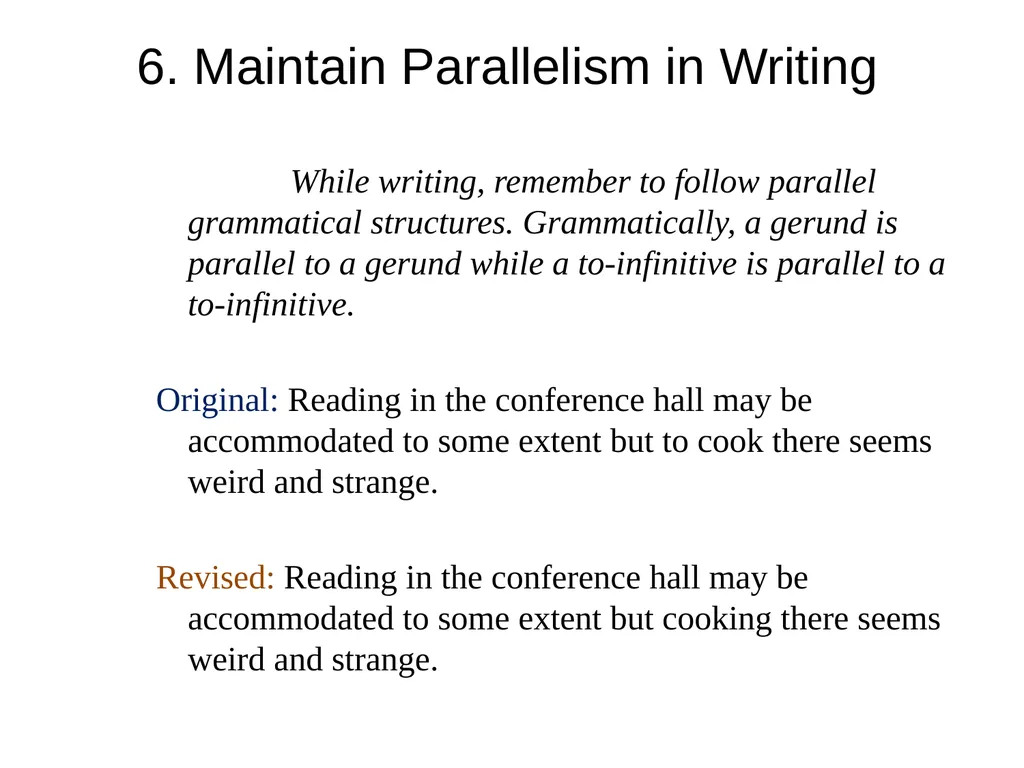
6. Maintain Parallelism in Writing While writing, remember to follow parallel grammatical structures. Grammatically, a gerund is parallel to a gerund while a to-infinitive is parallel to a to-infinitive.
Original: Reading in the conference hall may be accommodated to some extent but to cook there seems weird and strange.
Revised: Reading in the conference hall may be accommodated to some extent but cooking there seems weird and strange.<br>
Original: Reading in the conference hall may be accommodated to some extent but to cook there seems weird and strange.
Revised: Reading in the conference hall may be accommodated to some extent but cooking there seems weird and strange.<br>
92
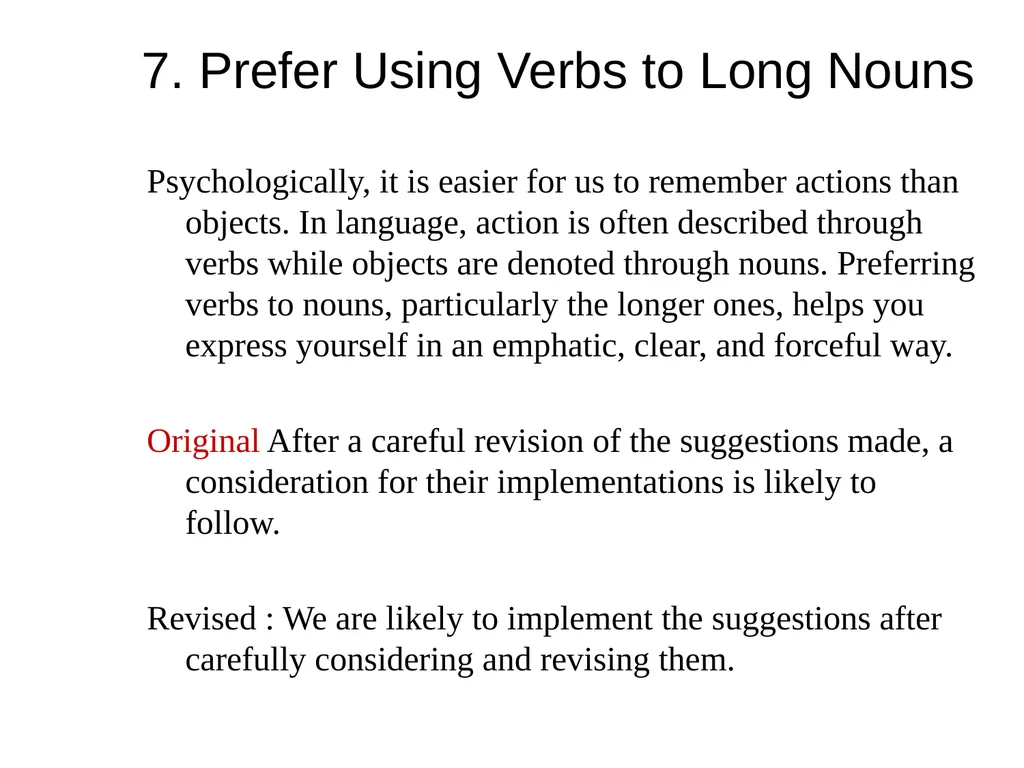
7. Prefer Using Verbs to Long Nouns Psychologically, it is easier for us to remember actions than objects. In language, action is often described through verbs while objects are denoted through nouns. Preferring verbs to nouns, particularly the longer ones, helps you express yourself in an emphatic, clear, and forceful way.
Original After a careful revision of the suggestions made, a consideration for their implementations is likely to follow.
Revised : We are likely to implement the suggestions after carefully considering and revising them.<br>
Original After a careful revision of the suggestions made, a consideration for their implementations is likely to follow.
Revised : We are likely to implement the suggestions after carefully considering and revising them.<br>
93
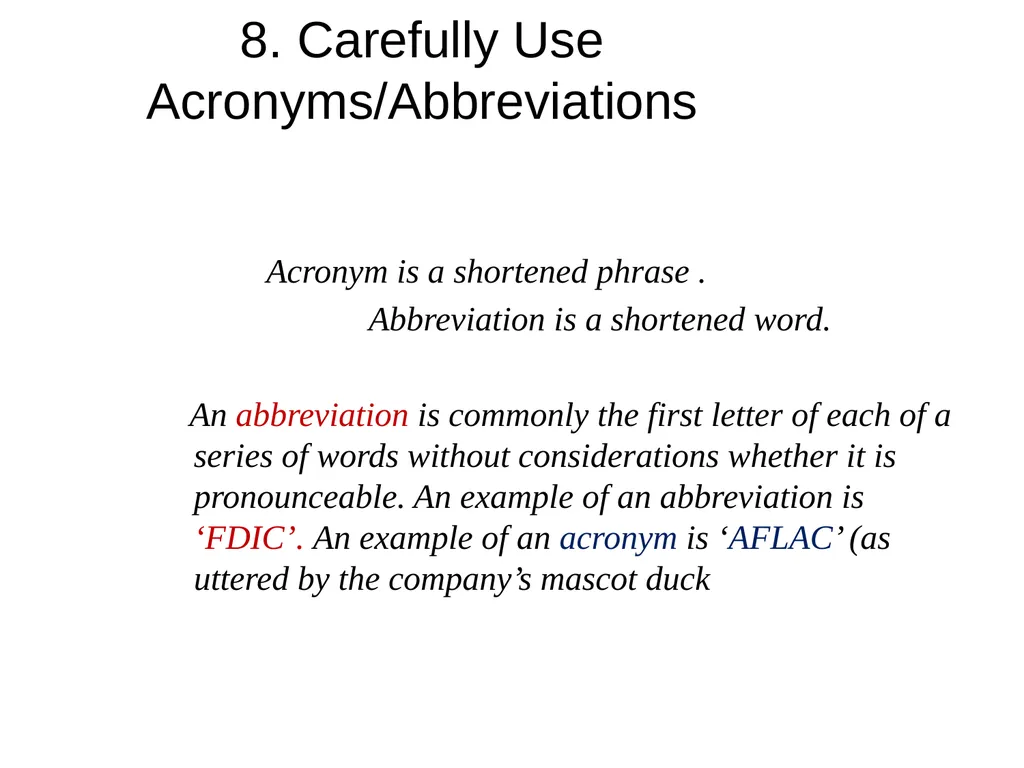
8. Carefully Use Acronyms/Abbreviations Acronym is a shortened phrase .
Abbreviation is a shortened word.
An abbreviation is commonly the first letter of each of a series of words without considerations whether it is pronounceable. An example of an abbreviation is ‘FDIC’. An example of an acronym is ‘AFLAC’ (as uttered by the company’s mascot duck<br>
Abbreviation is a shortened word.
An abbreviation is commonly the first letter of each of a series of words without considerations whether it is pronounceable. An example of an abbreviation is ‘FDIC’. An example of an acronym is ‘AFLAC’ (as uttered by the company’s mascot duck<br>
94
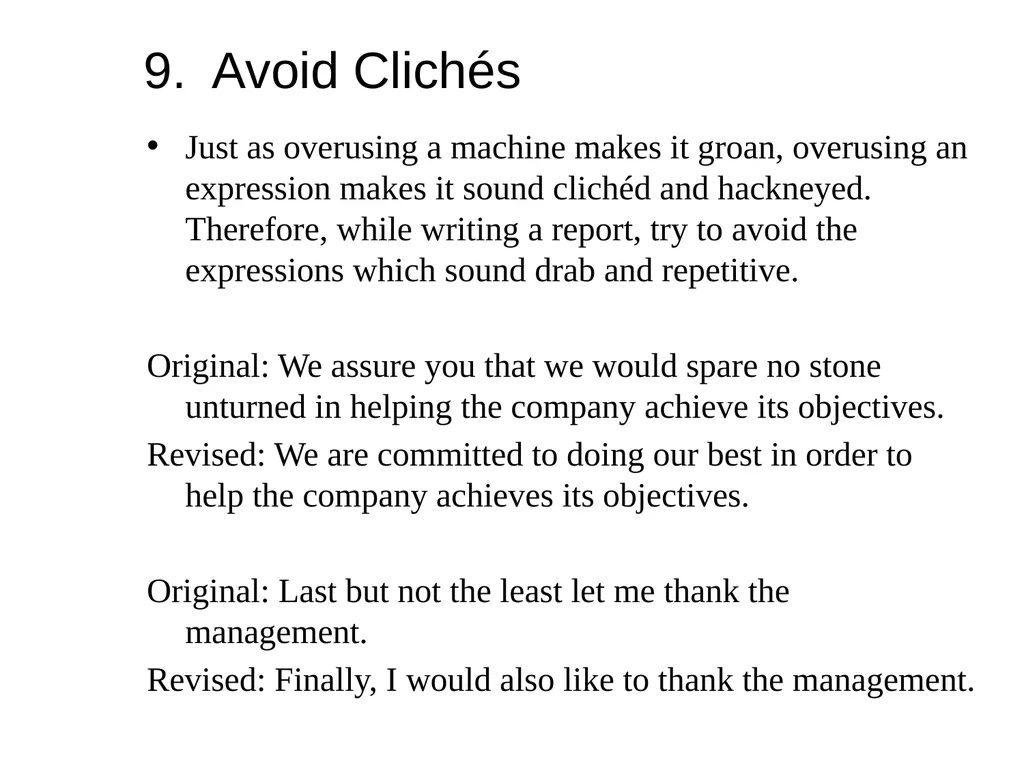
9. Avoid Clichés Just as overusing a machine makes it groan, overusing an expression makes it sound clichéd and hackneyed. Therefore, while writing a report, try to avoid the expressions which sound drab and repetitive.
Original: We assure you that we would spare no stone unturned in helping the company achieve its objectives.
Revised: We are committed to doing our best in order to help the company achieves its objectives.
Original: Last but not the least let me thank the management.
Revised: Finally, I would also like to thank the management.<br>
Original: We assure you that we would spare no stone unturned in helping the company achieve its objectives.
Revised: We are committed to doing our best in order to help the company achieves its objectives.
Original: Last but not the least let me thank the management.
Revised: Finally, I would also like to thank the management.<br>
95
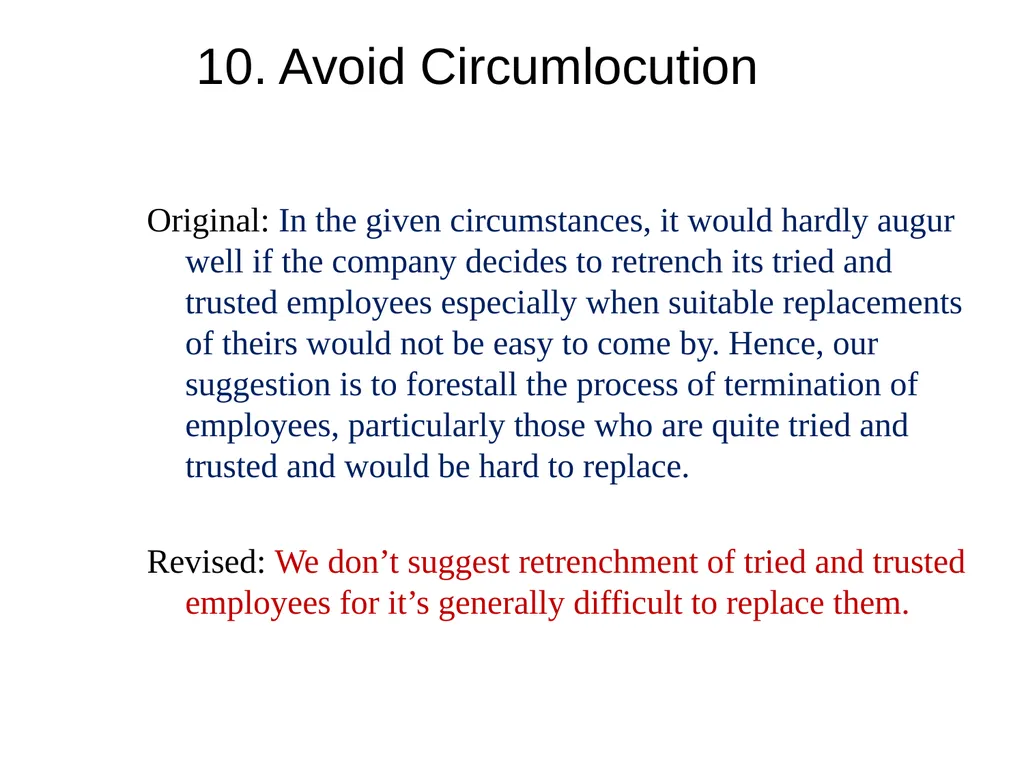
10. Avoid Circumlocution Original: In the given circumstances, it would hardly augur well if the company decides to retrench its tried and trusted employees especially when suitable replacements of theirs would not be easy to come by. Hence, our suggestion is to forestall the process of termination of employees, particularly those who are quite tried and trusted and would be hard to replace.
Revised: We don’t suggest retrenchment of tried and trusted employees for it’s generally difficult to replace them.<br>
Revised: We don’t suggest retrenchment of tried and trusted employees for it’s generally difficult to replace them.<br>
96
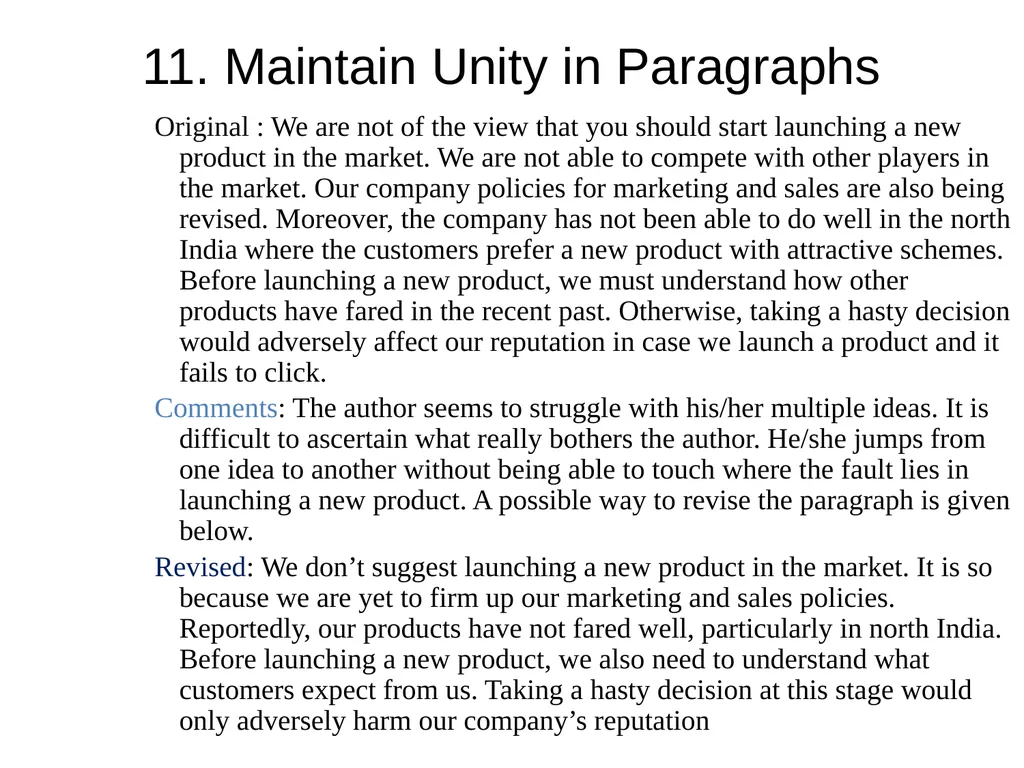
11. Maintain Unity in Paragraphs Original : We are not of the view that you should start launching a new product in the market. We are not able to compete with other players in the market. Our company policies for marketing and sales are also being revised. Moreover, the company has not been able to do well in the north India where the customers prefer a new product with attractive schemes. Before launching a new product, we must understand how other products have fared in the recent past. Otherwise, taking a hasty decision would adversely affect our reputation in case we launch a product and it fails to click.
Comments: The author seems to struggle with his/her multiple ideas. It is difficult to ascertain what really bothers the author. He/she jumps from one idea to another without being able to touch where the fault lies in launching a new product. A possible way to revise the paragraph is given below.
Revised: We don’t suggest launching a new product in the market. It is so because we are yet to firm up our marketing and sales policies. Reportedly, our products have not fared well, particularly in north India. Before launching a new product, we also need to understand what customers expect from us. Taking a hasty decision at this stage would only adversely harm our company’s reputation<br>
Comments: The author seems to struggle with his/her multiple ideas. It is difficult to ascertain what really bothers the author. He/she jumps from one idea to another without being able to touch where the fault lies in launching a new product. A possible way to revise the paragraph is given below.
Revised: We don’t suggest launching a new product in the market. It is so because we are yet to firm up our marketing and sales policies. Reportedly, our products have not fared well, particularly in north India. Before launching a new product, we also need to understand what customers expect from us. Taking a hasty decision at this stage would only adversely harm our company’s reputation<br>
97
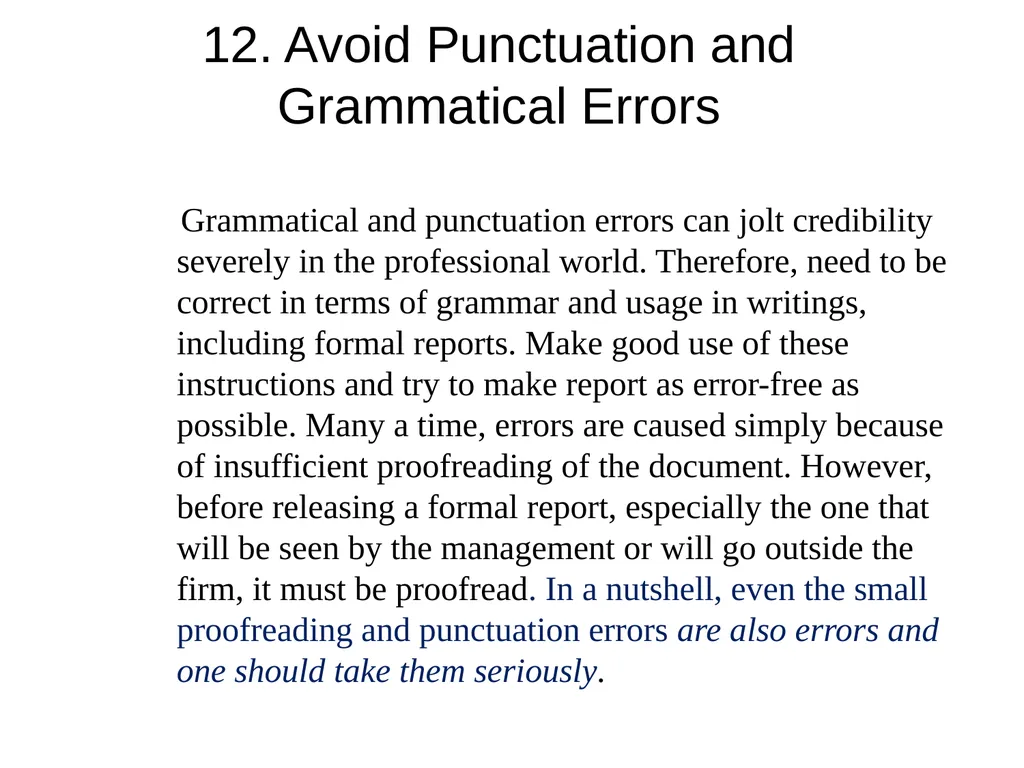
12. Avoid Punctuation and Grammatical Errors Grammatical and punctuation errors can jolt credibility severely in the professional world. Therefore, need to be correct in terms of grammar and usage in writings, including formal reports. Make good use of these instructions and try to make report as error-free as possible. Many a time, errors are caused simply because of insufficient proofreading of the document. However, before releasing a formal report, especially the one that will be seen by the management or will go outside the firm, it must be proofread. In a nutshell, even the small proofreading and punctuation errors are also errors and one should take them seriously.<br>
98
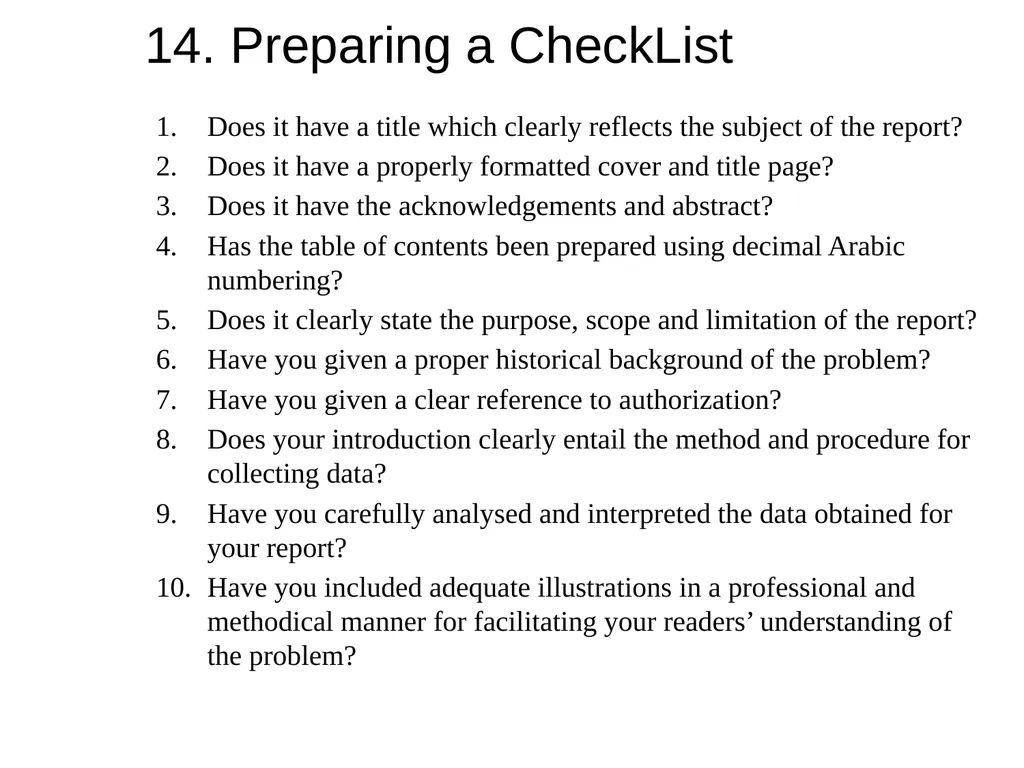
14. Preparing a CheckList Does it have a title which clearly reflects the subject of the report?
Does it have a properly formatted cover and title page?
Does it have the acknowledgements and abstract?
Has the table of contents been prepared using decimal Arabic numbering?
Does it clearly state the purpose, scope and limitation of the report?
Have you given a proper historical background of the problem?
Have you given a clear reference to authorization?
Does your introduction clearly entail the method and procedure for collecting data?
Have you carefully analysed and interpreted the data obtained for your report?
Have you included adequate illustrations in a professional and methodical manner for facilitating your readers’ understanding of the problem?<br>
Does it have a properly formatted cover and title page?
Does it have the acknowledgements and abstract?
Has the table of contents been prepared using decimal Arabic numbering?
Does it clearly state the purpose, scope and limitation of the report?
Have you given a proper historical background of the problem?
Have you given a clear reference to authorization?
Does your introduction clearly entail the method and procedure for collecting data?
Have you carefully analysed and interpreted the data obtained for your report?
Have you included adequate illustrations in a professional and methodical manner for facilitating your readers’ understanding of the problem?<br>
99
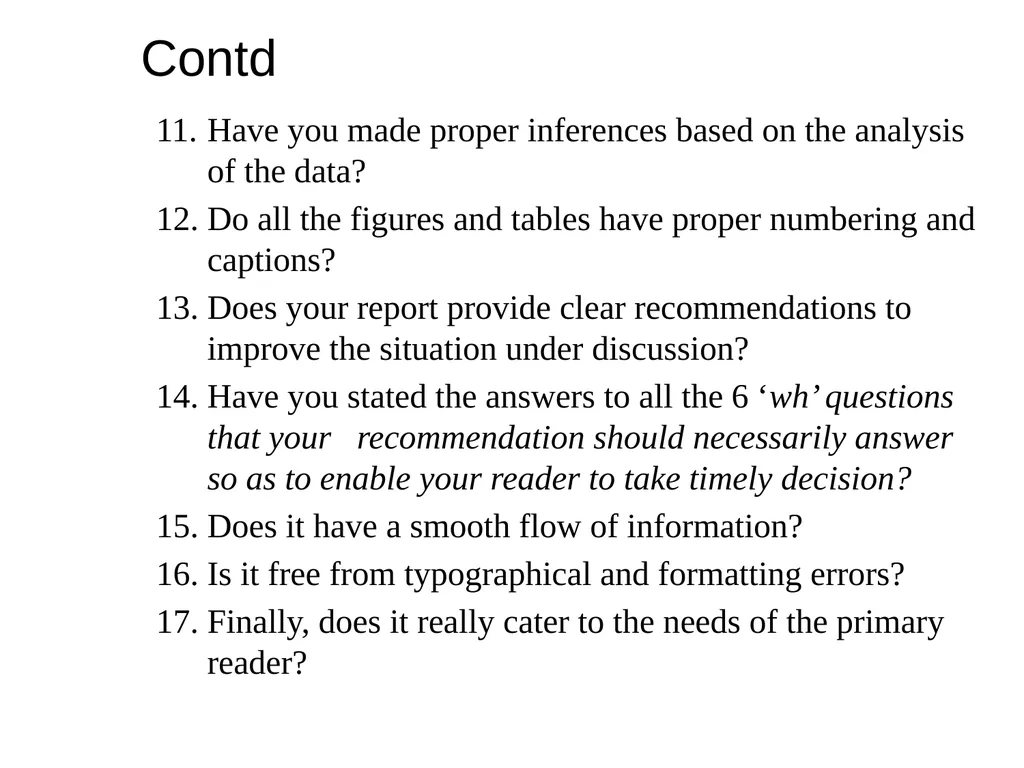
Contd Have you made proper inferences based on the analysis of the data?
Do all the figures and tables have proper numbering and captions?
Does your report provide clear recommendations to improve the situation under discussion?
Have you stated the answers to all the 6 ‘wh’ questions that your recommendation should necessarily answer so as to enable your reader to take timely decision?
Does it have a smooth flow of information?
Is it free from typographical and formatting errors?
Finally, does it really cater to the needs of the primary reader?<br>
Do all the figures and tables have proper numbering and captions?
Does your report provide clear recommendations to improve the situation under discussion?
Have you stated the answers to all the 6 ‘wh’ questions that your recommendation should necessarily answer so as to enable your reader to take timely decision?
Does it have a smooth flow of information?
Is it free from typographical and formatting errors?
Finally, does it really cater to the needs of the primary reader?<br>
100
Thank You<br>