Businesses create jobs. To do so they need an easy
Description: Businesses create jobs. To do so they need an easy regulatory environment that fosters productivity and competitiveness. BIAC at OECD seeks to contribute to OECD work on Employment, Labour and Social Affairs (ELSA) to promote sustainable
Related Topics
Download Presentation
"Businesses create jobs. To do so they need an easy" is the property of its rightful owner. Permission is granted to download and print the materials on this website for personal, non-commercial use only, and to display it on your personal computer provided you do not modify the materials and that you retain all copyright notices contained in the materials. By downloading content from our website, you accept the terms of this agreement.
Presentation Transcript
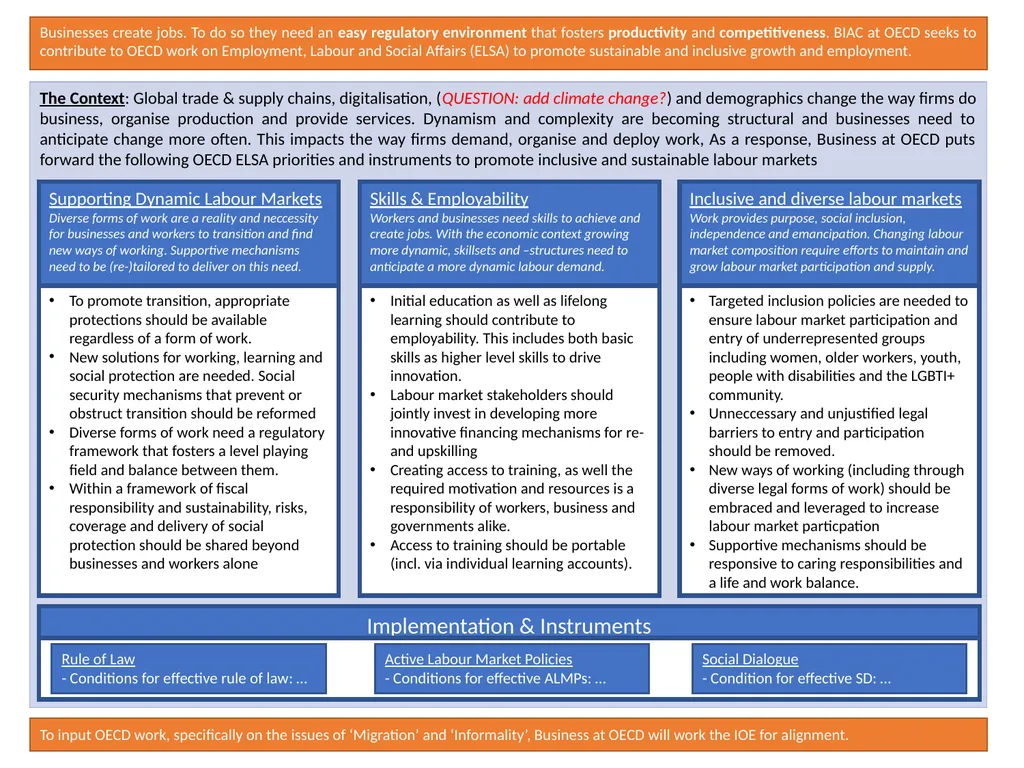
slide1. Businesses create jobs. To do so they need an easy regulatory environment that fosters productivity and competitiveness. BIAC at OECD seeks to contribute to OECD work on Employment, Labour and Social Affairs (ELSA) to promote sustainable and inclusive growth and employment. The Context: Global trade & supply chains, digitalisation, (QUESTION: add climate change?) and demographics change the way firms do business, organise production and provide services. Dynamism and complexity are becoming structural and businesses need to anticipate change more often. This impacts the way firms demand, organise and deploy work, As a response, Business at OECD puts forward the following OECD ELSA priorities and instruments to promote inclusive and sustainable labour markets Supporting Dynamic Labour Markets
Diverse forms of work are a reality and neccessity for businesses and workers to transition and find new ways of working. Supportive mechanisms need to be (re-)tailored to deliver on this need. Skills & Employability
Workers and businesses need skills to achieve and create jobs. With the economic context growing more dynamic, skillsets and –structures need to anticipate a more dynamic labour demand. Inclusive and diverse labour markets
Work provides purpose, social inclusion, independence and emancipation. Changing labour market composition require efforts to maintain and grow labour market participation and supply. To promote transition, appropriate protections should be available regardless of a form of work.
New solutions for working, learning and social protection are needed. Social security mechanisms that prevent or obstruct transition should be reformed
Diverse forms of work need a regulatory framework that fosters a level playing field and balance between them.
Within a framework of fiscal responsibility and sustainability, risks, coverage and delivery of social protection should be shared beyond businesses and workers alone Targeted inclusion policies are needed to ensure labour market participation and entry of underrepresented groups including women, older workers, youth, people with disabilities and the LGBTI+ community.
Unneccessary and unjustified legal barriers to entry and participation should be removed.
New ways of working (including through diverse legal forms of work) should be embraced and leveraged to increase labour market particpation
Supportive mechanisms should be responsive to caring responsibilities and a life and work balance. Initial education as well as lifelong learning should contribute to employability. This includes both basic skills as higher level skills to drive innovation.
Labour market stakeholders should jointly invest in developing more innovative financing mechanisms for re- and upskilling
Creating access to training, as well the required motivation and resources is a responsibility of workers, business and governments alike.
Access to training should be portable (incl. via individual learning accounts). Implementation & Instruments Social Dialogue
- Condition for effective SD: … Active Labour Market Policies
- Conditions for effective ALMPs: … Rule of Law
- Conditions for effective rule of law: … To input OECD work, specifically on the issues of ‘Migration’ and ‘Informality’, Business at OECD will work the IOE for alignment.<br>
Diverse forms of work are a reality and neccessity for businesses and workers to transition and find new ways of working. Supportive mechanisms need to be (re-)tailored to deliver on this need. Skills & Employability
Workers and businesses need skills to achieve and create jobs. With the economic context growing more dynamic, skillsets and –structures need to anticipate a more dynamic labour demand. Inclusive and diverse labour markets
Work provides purpose, social inclusion, independence and emancipation. Changing labour market composition require efforts to maintain and grow labour market participation and supply. To promote transition, appropriate protections should be available regardless of a form of work.
New solutions for working, learning and social protection are needed. Social security mechanisms that prevent or obstruct transition should be reformed
Diverse forms of work need a regulatory framework that fosters a level playing field and balance between them.
Within a framework of fiscal responsibility and sustainability, risks, coverage and delivery of social protection should be shared beyond businesses and workers alone Targeted inclusion policies are needed to ensure labour market participation and entry of underrepresented groups including women, older workers, youth, people with disabilities and the LGBTI+ community.
Unneccessary and unjustified legal barriers to entry and participation should be removed.
New ways of working (including through diverse legal forms of work) should be embraced and leveraged to increase labour market particpation
Supportive mechanisms should be responsive to caring responsibilities and a life and work balance. Initial education as well as lifelong learning should contribute to employability. This includes both basic skills as higher level skills to drive innovation.
Labour market stakeholders should jointly invest in developing more innovative financing mechanisms for re- and upskilling
Creating access to training, as well the required motivation and resources is a responsibility of workers, business and governments alike.
Access to training should be portable (incl. via individual learning accounts). Implementation & Instruments Social Dialogue
- Condition for effective SD: … Active Labour Market Policies
- Conditions for effective ALMPs: … Rule of Law
- Conditions for effective rule of law: … To input OECD work, specifically on the issues of ‘Migration’ and ‘Informality’, Business at OECD will work the IOE for alignment.<br>