By Dr. Salah Abdulhussein Assistant instructor: Tagreed Abdulsalam Syntax The term syntax comes originally from Greek and literally means putting together or arrangement. It refers to the structure and ordering of components within a
"By Dr. Salah Abdulhussein Assistant instructor:" is the property of its rightful owner. Permission is granted to
download and print the materials on this website for personal, non-commercial use only, and to display it
on your personal computer provided you do not modify the materials and that you retain all copyright
notices contained in the materials. By downloading content from our website, you accept the terms of this
agreement.
Presentation Transcript
01
By
Dr. Salah Abdulhussein
Assistant instructor: Tagreed Abdulsalam Syntax<br>
02
The term syntax comes originally from Greek and literally means “putting together” or “arrangement.” It refers to the structure and ordering of components within a sentence in a language, i.e. the sequence or ordering “arrangement” of elements in the linear structure of the sentence.<br>
03
In syntactic analysis, we adhere to the “all and only” criterion. This means that our analysis must account for all the phrases and sentences and only those grammatically correct phrases and sentences in a language.
- In other words, if we write rules for the creation of well-formed structures, we have to check that those rules, when applied logically, won’t also lead to ill-formed structures. For example, in English the combination Pre+ N (near London) is a well- formed structure while others combinations are ill-formed. Syntactic rules<br>
04
Generative Grammar (initiated by Chomsky) refers to the grammar that is able to generate unlimited number of sentences out of limited number of rules.
Deep and Surface Structure
- If we examine the following sentences:
1. Charlie broke the window.
2. The window was broken by Charlie.,
we find that the first is an active sentence while the second is passive. The distinction between them is a difference in their surface structure, that is, the different syntactic forms they have as individual English sentences.
However, these two sentences nearly have the same meaning; these two sentences share the same deep structure. Generative Grammar<br>
05
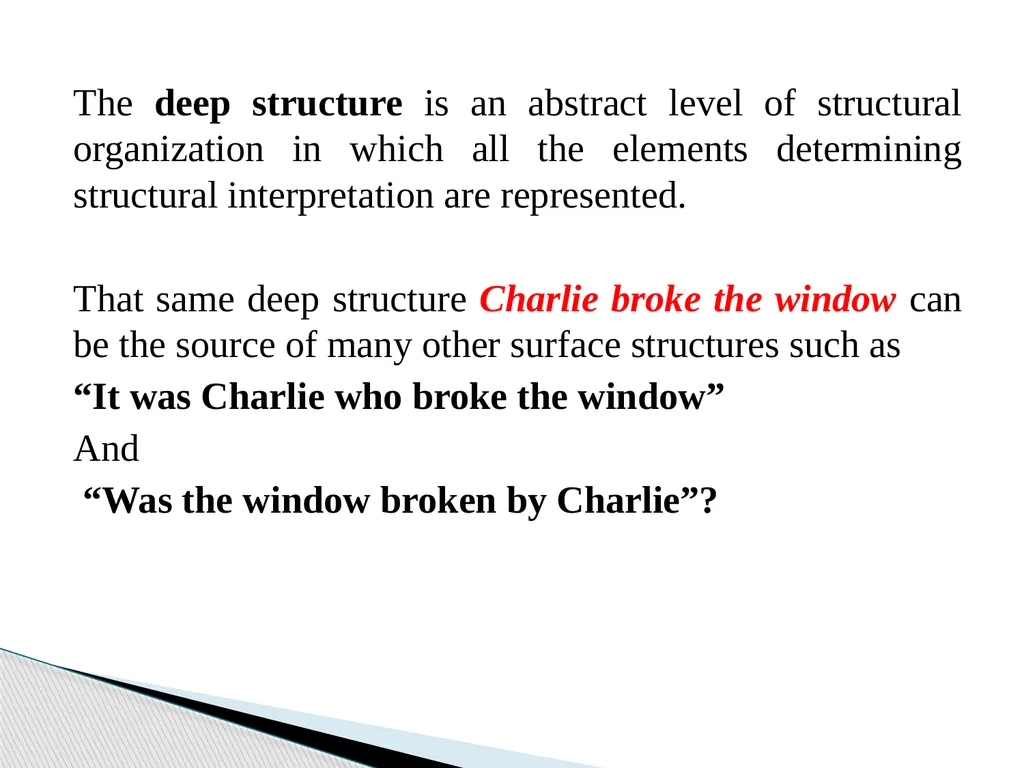
The deep structure is an abstract level of structural organization in which all the elements determining structural interpretation are represented.
That same deep structure Charlie broke the window can be the source of many other surface structures such as
“It was Charlie who broke the window”
And
“Was the window broken by Charlie”?<br>
06
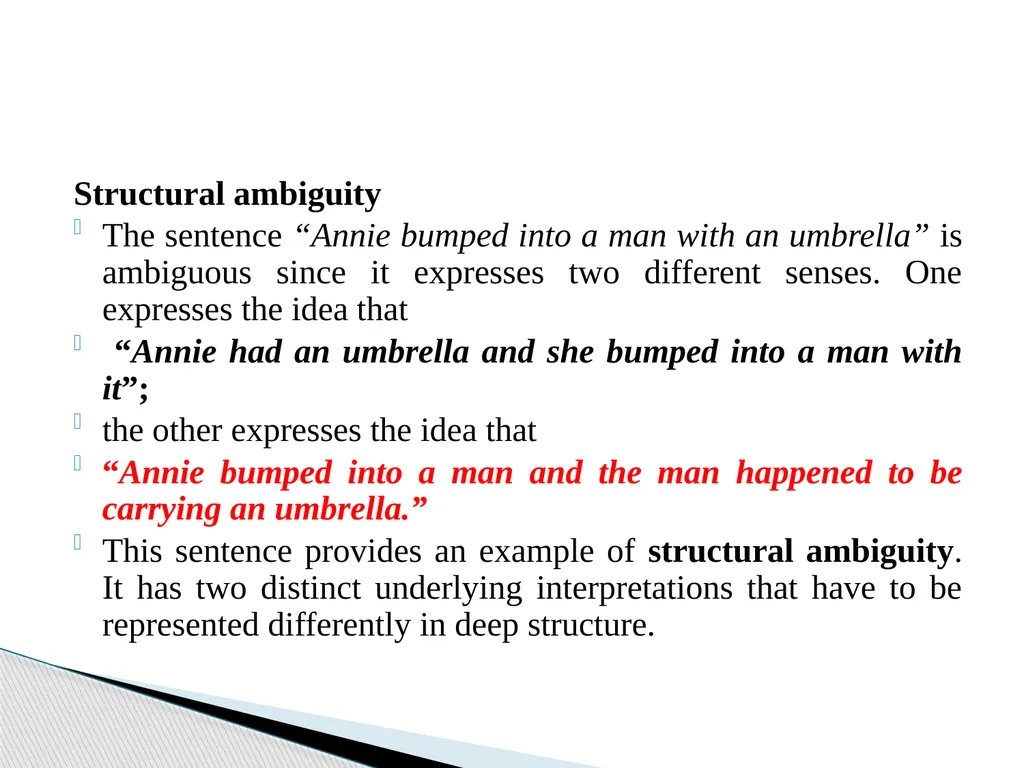
Structural ambiguity
The sentence “Annie bumped into a man with an umbrella” is ambiguous since it expresses two different senses. One expresses the idea that
“Annie had an umbrella and she bumped into a man with it”;
the other expresses the idea that
“Annie bumped into a man and the man happened to be carrying an umbrella.”
This sentence provides an example of structural ambiguity. It has two distinct underlying interpretations that have to be represented differently in deep structure.<br>
07
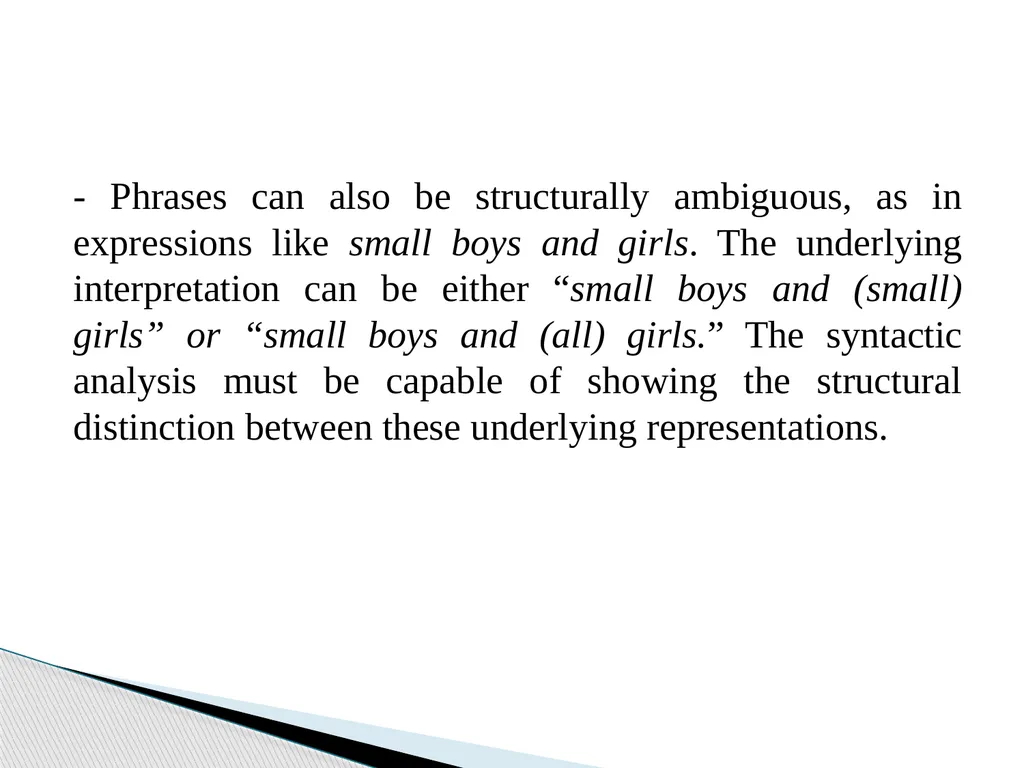
- Phrases can also be structurally ambiguous, as in expressions like small boys and girls. The underlying interpretation can be either “small boys and (small) girls” or “small boys and (all) girls.” The syntactic analysis must be capable of showing the structural distinction between these underlying representations.<br>
08
Syntactic Analysis
In Chapter 7, we used constituent analysis to show how English sentences can be constructed from a fixed set of constituents in a particular order. In syntactic analysis, we use some conventional abbreviations for those constituents as syntactic categories (parts of speech). Examples are
N (= noun), Art (= article),
Adj (= adjective) and V (= verb).
We also use abbreviations for phrases, such as
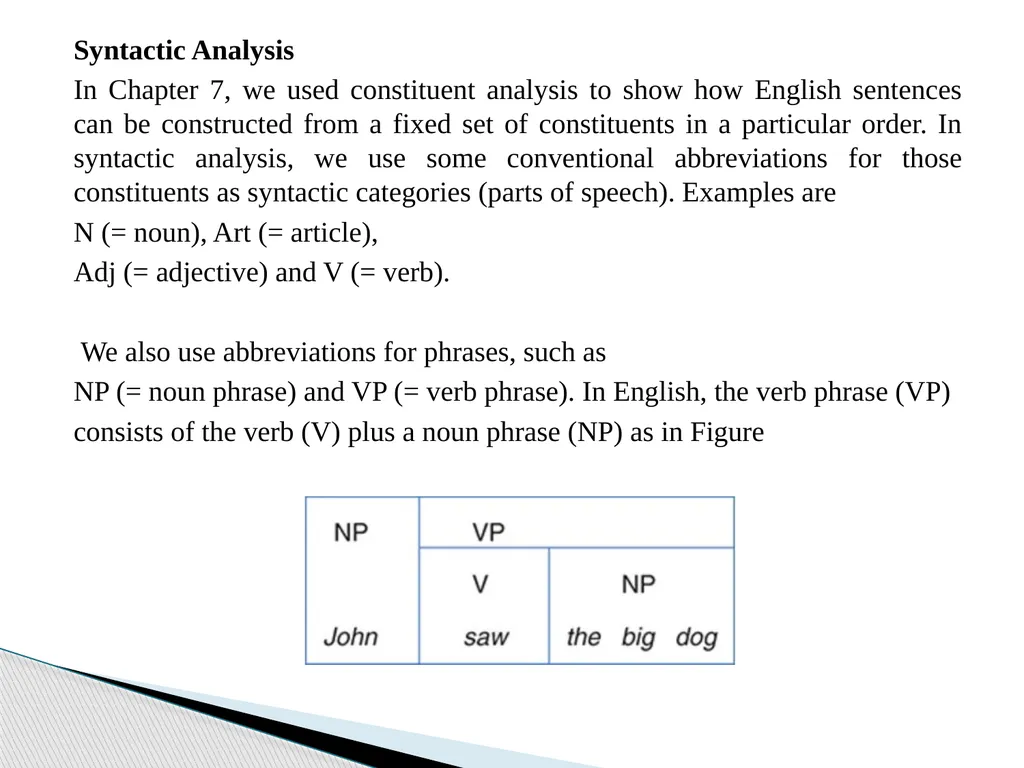
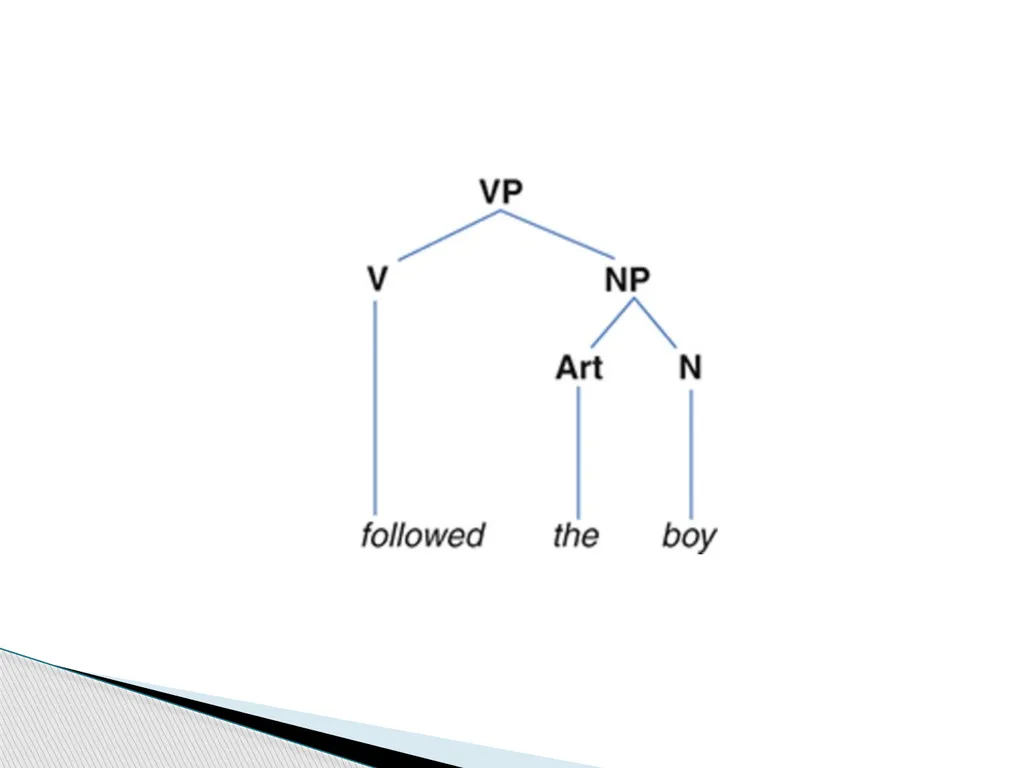
NP (= noun phrase) and VP (= verb phrase). In English, the verb phrase (VP)
consists of the verb (V) plus a noun phrase (NP) as in Figure<br>
09
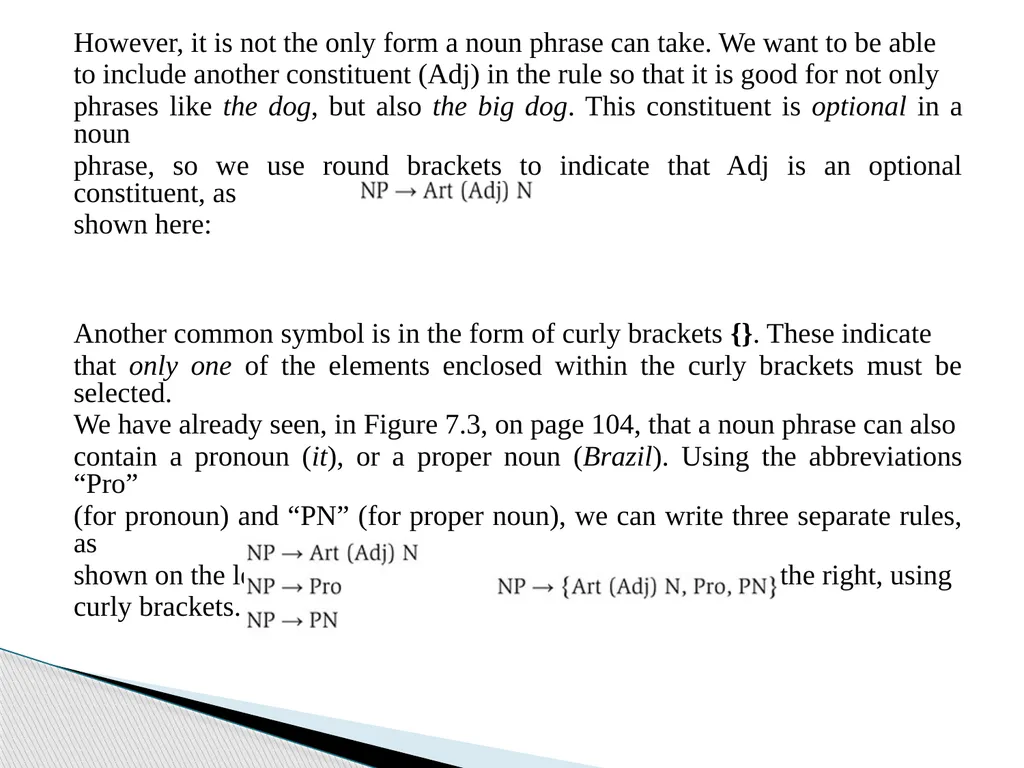
However, it is not the only form a noun phrase can take. We want to be able
to include another constituent (Adj) in the rule so that it is good for not only
phrases like the dog, but also the big dog. This constituent is optional in a noun
phrase, so we use round brackets to indicate that Adj is an optional constituent, as
shown here:
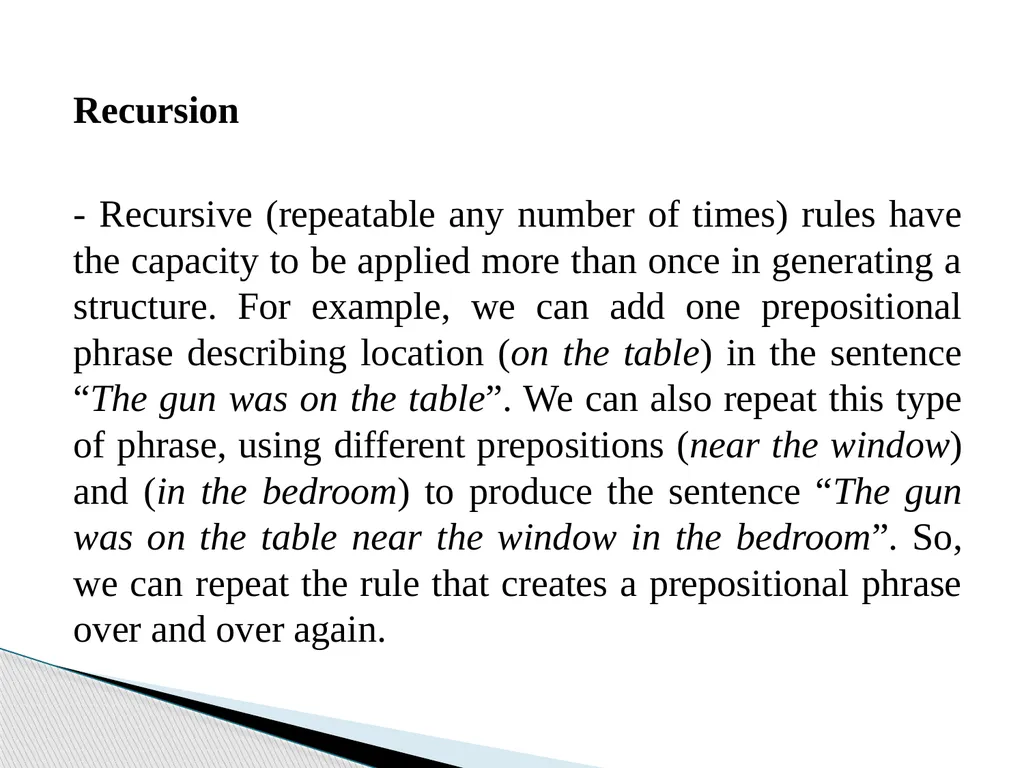
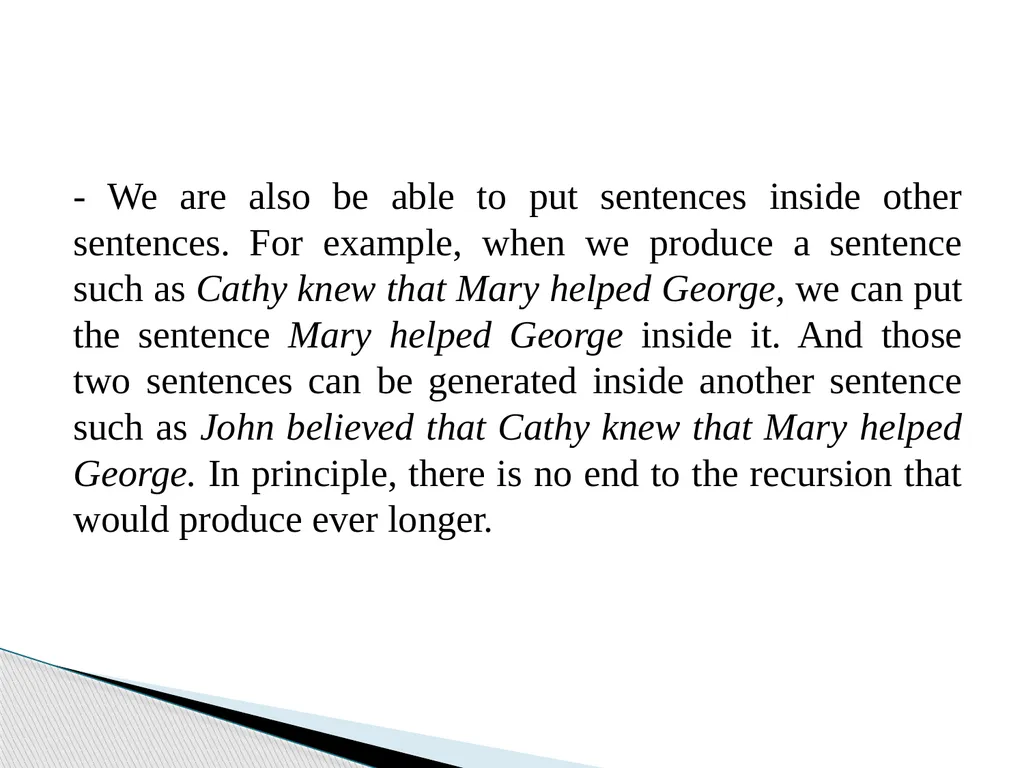
Another common symbol is in the form of curly brackets {}. These indicate
that only one of the elements enclosed within the curly brackets must be selected.
We have already seen, in Figure 7.3, on page 104, that a noun phrase can also
contain a pronoun (it), or a proper noun (Brazil). Using the abbreviations “Pro”
(for pronoun) and “PN” (for proper noun), we can write three separate rules, as
shown on the left, but it is more succinct to write one rule, on the right, using
curly brackets.<br>
10
Recursion
- Recursive (repeatable any number of times) rules have the capacity to be applied more than once in generating a structure. For example, we can add one prepositional phrase describing location (on the table) in the sentence “The gun was on the table”. We can also repeat this type of phrase, using different prepositions (near the window) and (in the bedroom) to produce the sentence “The gun was on the table near the window in the bedroom”. So, we can repeat the rule that creates a prepositional phrase over and over again.<br>
11
- We are also be able to put sentences inside other sentences. For example, when we produce a sentence such as Cathy knew that Mary helped George, we can put the sentence Mary helped George inside it. And those two sentences can be generated inside another sentence such as John believed that Cathy knew that Mary helped George. In principle, there is no end to the recursion that would produce ever longer.<br>
12
Tree diagram
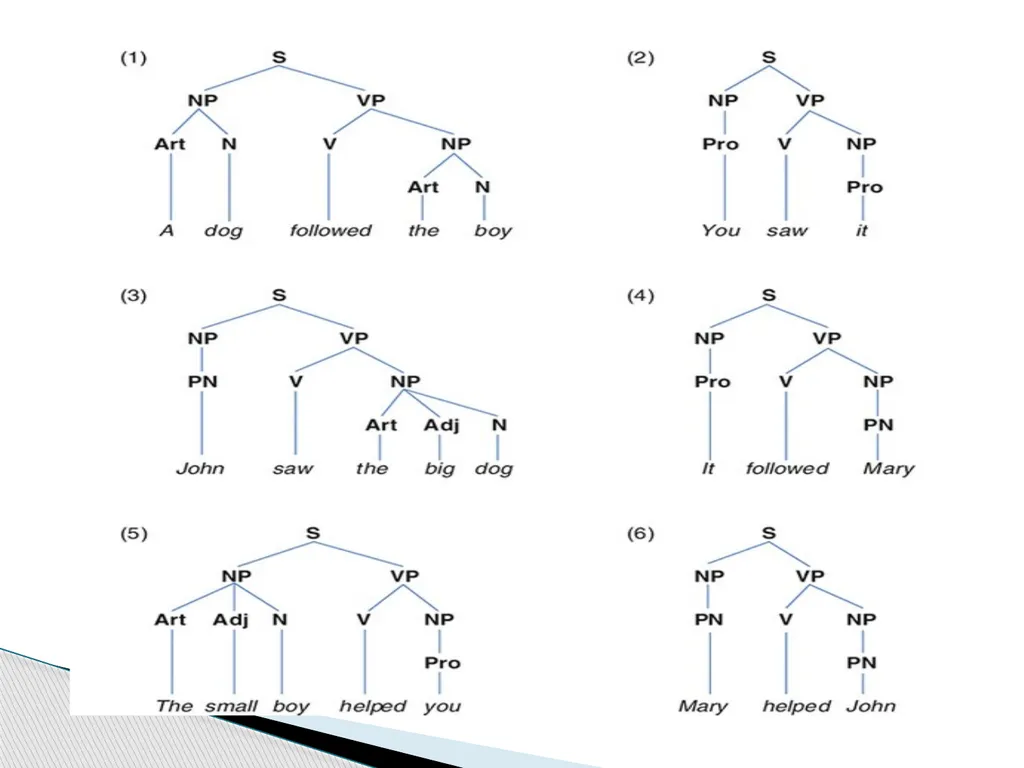
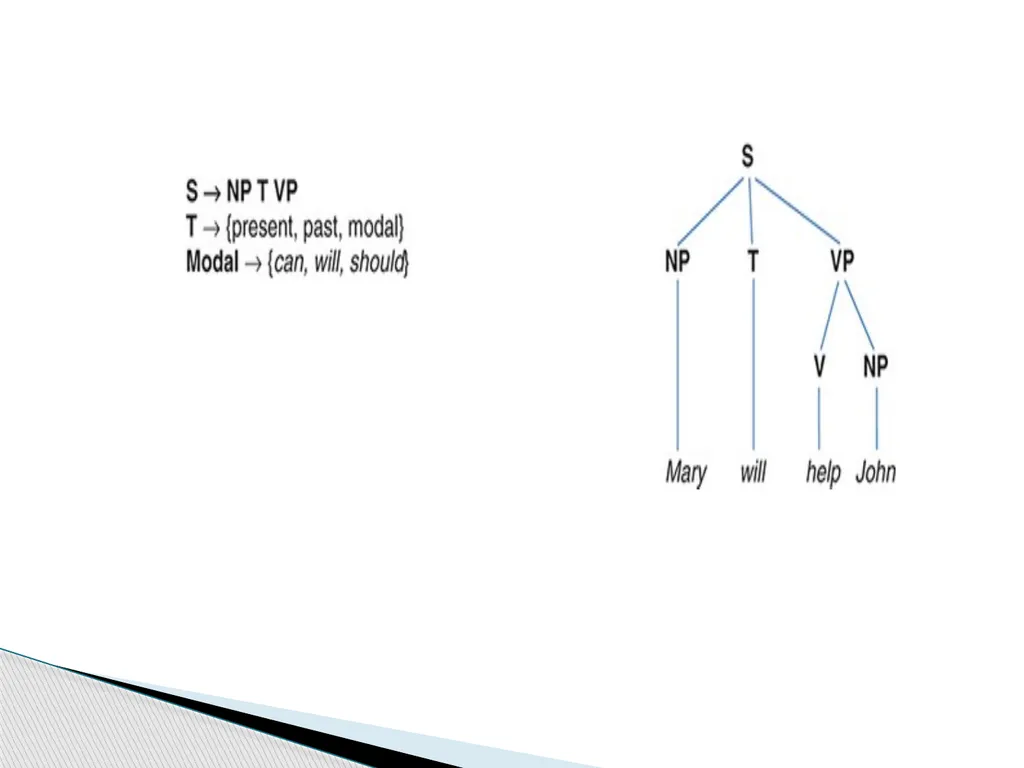
- Tree diagram is one of the most common ways to create a visual representation of syntactic structure through tree. By tree diagram, we try to capture the hierarchical organization of those parts in the underlying structure of phrases and sentences.
- A tree diagram functions as representing all the grammatical information found in a sentence. It also shows very explicitly that there are different levels in the analysis.<br>
13
Phrase Structure Rules
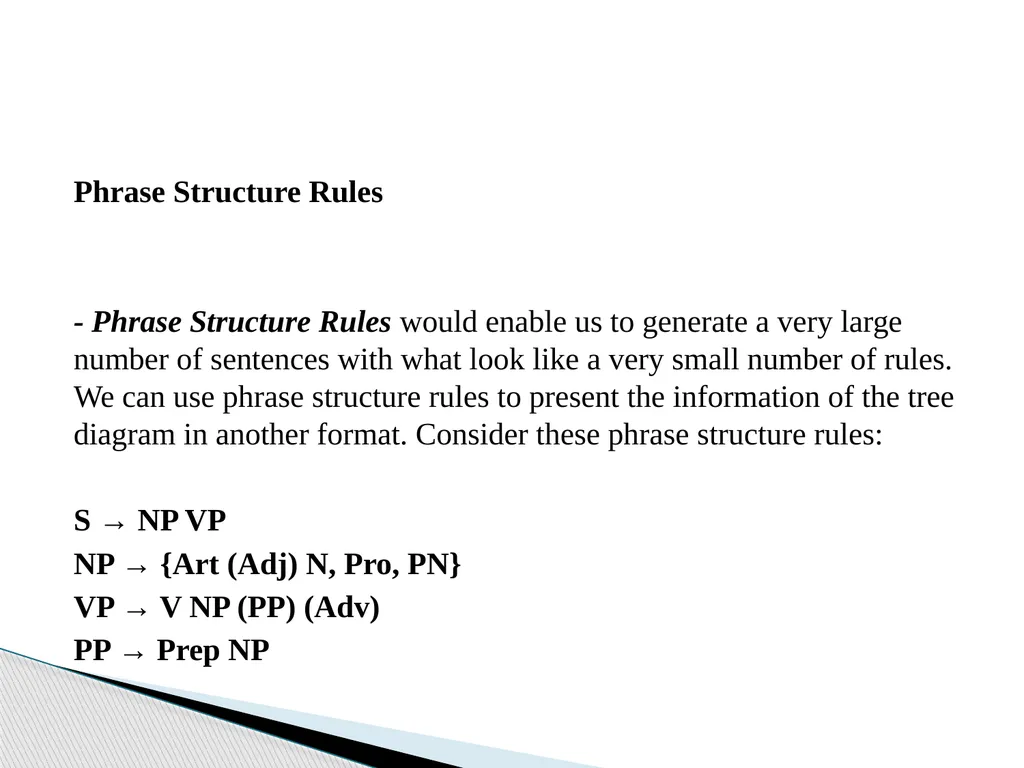
- Phrase Structure Rules would enable us to generate a very large number of sentences with what look like a very small number of rules. We can use phrase structure rules to present the information of the tree diagram in another format. Consider these phrase structure rules:
S → NP VP
NP → {Art (Adj) N, Pro, PN}
VP → V NP (PP) (Adv)
PP → Prep NP<br>
14
Lexical Rules
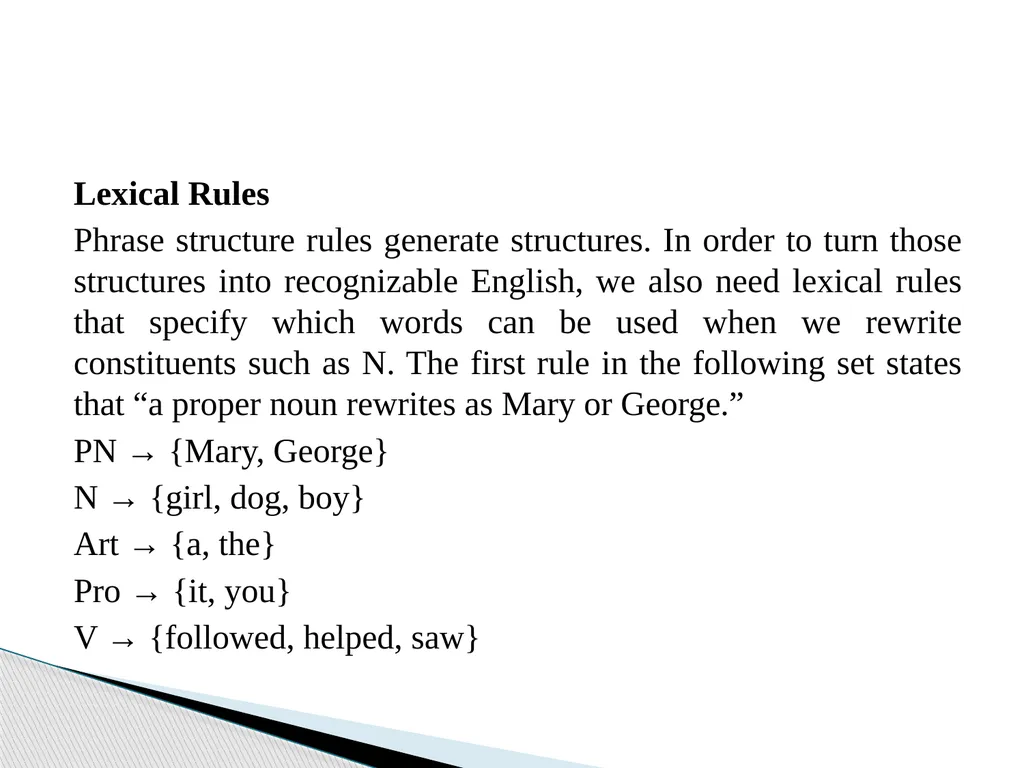
Phrase structure rules generate structures. In order to turn those structures into recognizable English, we also need lexical rules that specify which words can be used when we rewrite constituents such as N. The first rule in the following set states that “a proper noun rewrites as Mary or George.”
PN → {Mary, George}
N → {girl, dog, boy}
Art → {a, the}
Pro → {it, you}
V → {followed, helped, saw}<br>
15
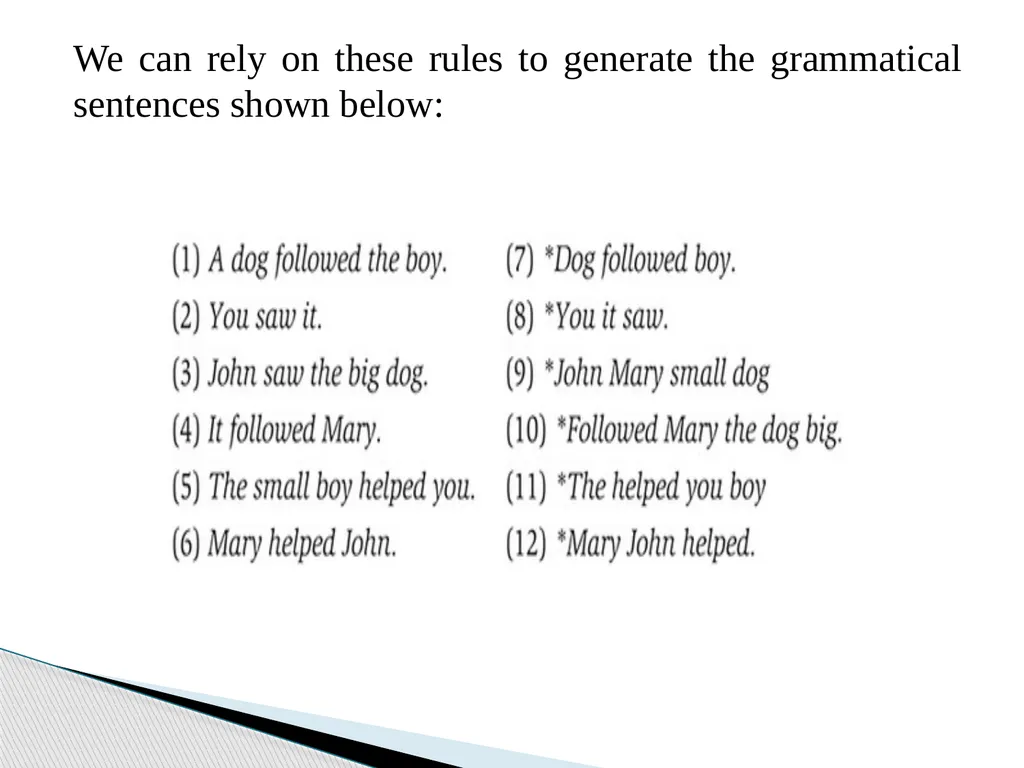
We can rely on these rules to generate the grammatical sentences shown below:<br>
16
Movement Rules
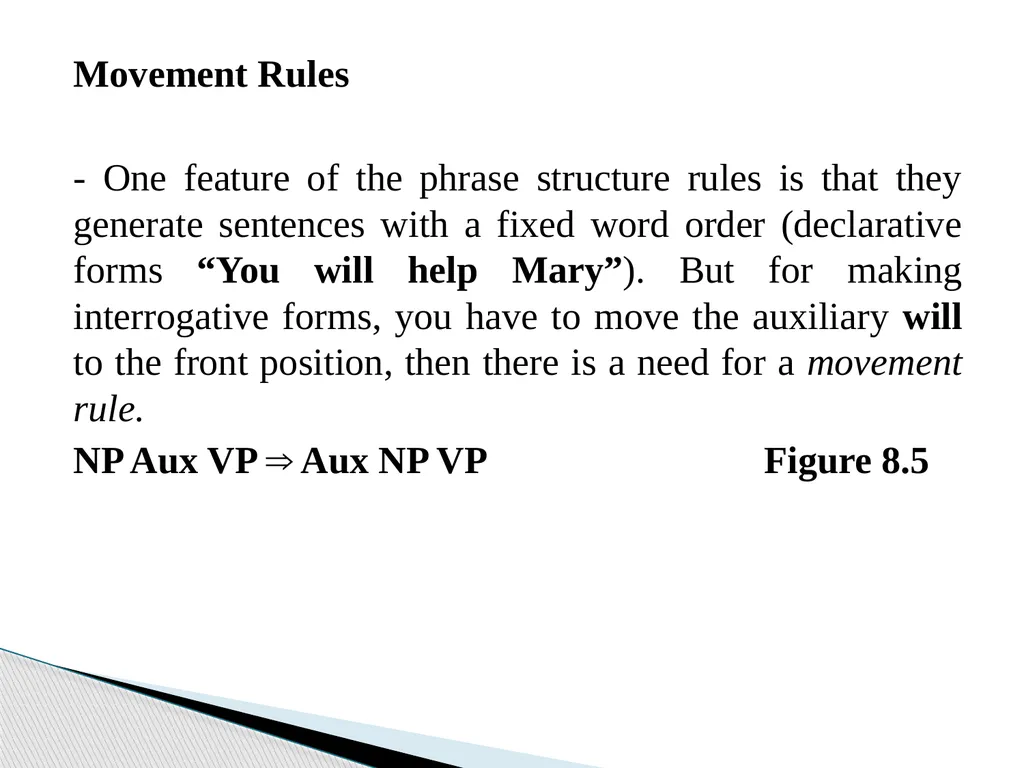
- One feature of the phrase structure rules is that they generate sentences with a fixed word order (declarative forms “You will help Mary”). But for making interrogative forms, you have to move the auxiliary will to the front position, then there is a need for a movement rule.
NP Aux VP ⇒ Aux NP VP Figure 8.5<br>
17
Complement Phrases
The word that in
John believed that Cathy knew that Mary helped George
is called a complementizer (C) as it introduces a complement phrase (CP).<br>