By Dr. Subir Kumar Roy Associate Professor, Department of Law Registrar (Addl. Charge) Bankura University Research Design A research design is the arrangement of conditions for collection and analysis of data in a manner that aims to
"By Dr. Subir Kumar Roy Associate Professor," is the property of its rightful owner. Permission is granted to
download and print the materials on this website for personal, non-commercial use only, and to display it
on your personal computer provided you do not modify the materials and that you retain all copyright
notices contained in the materials. By downloading content from our website, you accept the terms of this
agreement.
Presentation Transcript
01
By Dr. Subir Kumar Roy Associate Professor, Department of Law & Registrar (Addl. Charge) Bankura University Research Design<br>
02
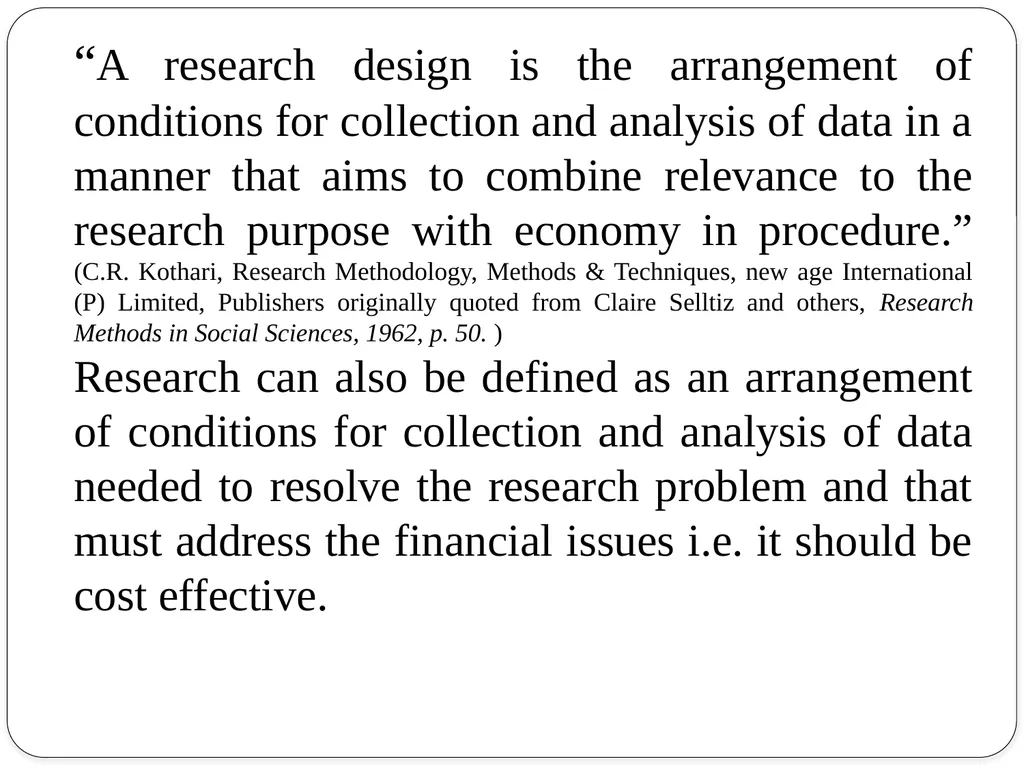
“A research design is the arrangement of conditions for collection and analysis of data in a manner that aims to combine relevance to the research purpose with economy in procedure.” (C.R. Kothari, Research Methodology, Methods & Techniques, new age International (P) Limited, Publishers originally quoted from Claire Selltiz and others, Research Methods in Social Sciences, 1962, p. 50. )
Research can also be defined as an arrangement of conditions for collection and analysis of data needed to resolve the research problem and that must address the financial issues i.e. it should be cost effective.<br>
03
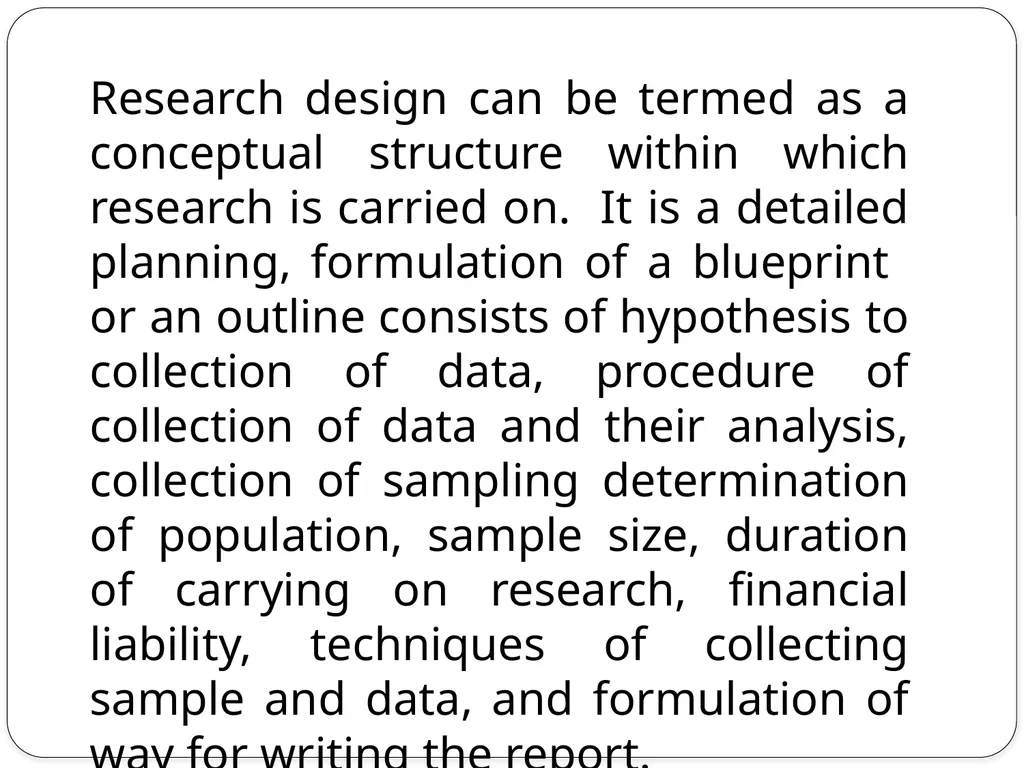
Research design can be termed as a conceptual structure within which research is carried on. It is a detailed planning, formulation of a blueprint or an outline consists of hypothesis to collection of data, procedure of collection of data and their analysis, collection of sampling determination of population, sample size, duration of carrying on research, financial liability, techniques of collecting sample and data, and formulation of way for writing the report.<br>
04
So research design broadly deals with the areas as mentioned below:
specifications of the information relevant to research problem
formulation of statistical and operational methods
Determination of strategy to collect data
Determination of size of population and sampling unit to collect sample
Decision as to duration of the research
Determination of financial involvement
Strategy to make it cost effective
Style of writing report<br>
05
The requirements to formulate a proper Research Design
Clear and precise selection of research problem
specifications and determination of information relevant to research problem
Proper review of Literature
Formulation of specific Hypothesis
Proper application of mind in selection of data to find out the solution of the problem and to test the hypothesis.
To make planning, how to collect such data.
Description of method of analysis<br>
06
IMPORTANCE OF RESEARCH DESIGN
Every research study has its own design in the form of either implicit or explicit. Research design is a comprehensive plan, a detail sketch to draw the whole process of research. Research design is very important for the following reasons:
It is a blueprint to answer specific research questions or testing hypothesis.
A scientifically formulated research help the researcher to strengthen the validity of their study
It deals with the process of data collection
It specifies the instrument development process
It explicitly describes the sampling process
Beside fixing the procedure, techniques and tools of data collection it also plans for analysis of the collected data.<br>
07
5. It provides procedural alternative choices to researcher which researcher considers in tune with the process and limitations of his/ her research
6. It works as a guiding principal to the researcher to opt for the methodology, techniques etc. to carry on the research.
7. It helps the researcher to decide what information are relevant for his/ her research, how much time and duration the researcher has to dedicate for carrying on the research and the cost the researcher has to incur for the same. Actually it helps the researcher to be very practical while doing research in terms of money, time, collection of data and sampling.
8. It also helps the researcher to apply his/ her mind for opting the techniques or style to write the research report.
9. Research designs are both logical and logistics plans.<br>
08
Different Research Design: Depending on the purpose of the research it can be classified into exploratory, descriptive and Experimental research and accordingly the research designs are formulated.
Exploratory Research:
In exploratory research the researcher nurtures in a new area s of enquiry with an aim to explore that area and to enhance the cognitive faculty accordingly. The aims and goals of such research are:
to explore the magnitude or extent of a particular phenomenon, problem , attitude or behaviour
to generate some primary ideas about that phenomenon or events
To determine whether it is feasible to undertake more study about that phenomenon
In exploratory research a flexible design is incorporated to enable the researcher to consider the different aspects of the problem. Here the researcher goes for purposive sampling and with flexible operational procedure and unstructured instrument for collection of data.<br>
09
Descriptive Research Descriptive research studies are those studies which describes the characteristics of a particular individual, or of a group. It is directed at making careful observation and detailed documentation of an event or the eventual fact. Studies which make specific prediction or describes incidents or facts or specifies characteristics of an individual, group or situation are comes within the gamut of descriptive research. Most of the social science research comes under the preview of descriptive research studies.
In this type of research the researcher has to formulate strict research design with minimal bias and maximum reliability. In this type of research the researcher goes for random sampling, structured planning for collection of data as well as its analysis and advanced decisions about operational procedures.<br>
10
Experimental Research In experimental research the researcher tests the hypothesis of causal relationship among the variables . In this type of research the independent variable (s) are manipulated and applied on the dependent variable to measure its impact on the other i.e. to find out the causal relationship.
The experimental research design is formulated in such a way so that the inference can be drawn legitimately of having causal relationship in between the independent and dependent variable. The method of selecting the control group, the time for measuring the dependent variable, pattern of control groups etc. are all important in experimental design.<br>
11
References:
C.R. Kothari, Research Methodology, Methods & Techniques, new age International (P) Limited, Publishers, New Delhi
Bhattacherjee, Anol, "Social Science Research: Principles, Methods, and Practices" (2012). Textbooks Collection. Book 3.
http://scholarcommons.usf.edu/oa_textbooks/3
\https://epgp.inflibnet.ac.in/
Dr. Chattopadhyay & Dr. Sen, (2013), Levant Books, Kolkata
Rattan Singh, (2016) ,Legal Research Methodology, Lexis Nexis<br>