By, Sucheta Vijay Limaye. M.Sc. Health Science
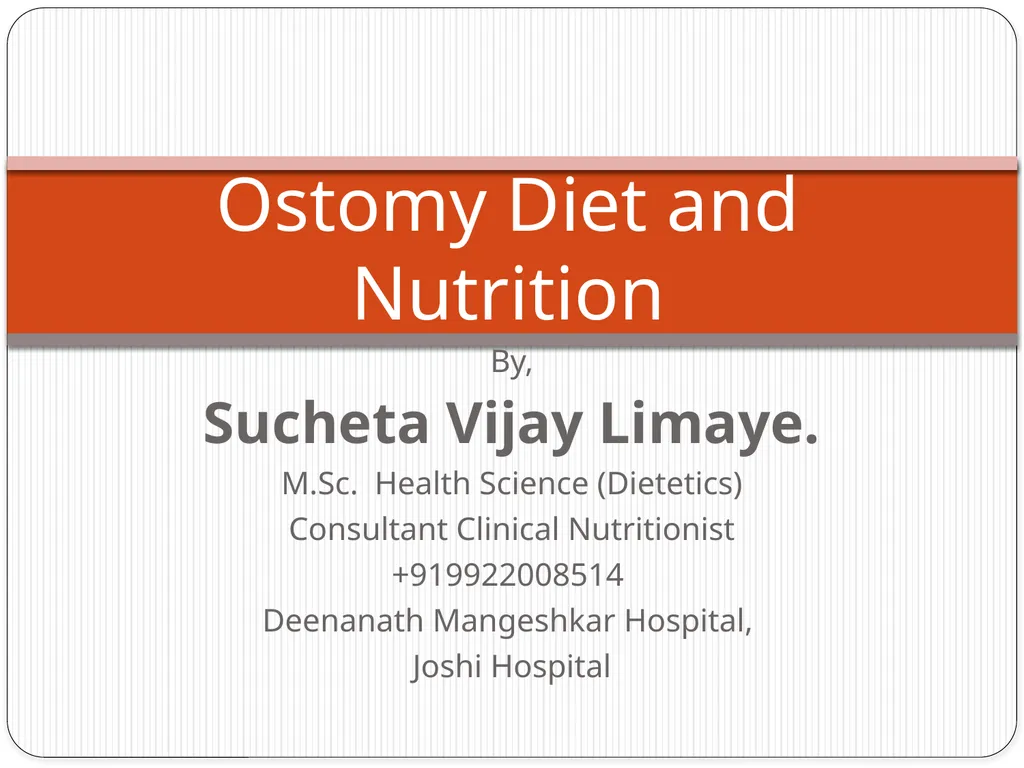
Description: By, Sucheta Vijay Limaye. M.Sc. Health Science (Dietetics) Consultant Clinical Nutritionist 919922008514 Deenanath Mangeshkar Hospital, Joshi Hospital Ostomy Diet and Nutrition The digestive tract is much more than simply a food processing
Related Topics
Download Presentation
"By, Sucheta Vijay Limaye. M.Sc. Health Science" is the property of its rightful owner. Permission is granted to download and print the materials on this website for personal, non-commercial use only, and to display it on your personal computer provided you do not modify the materials and that you retain all copyright notices contained in the materials. By downloading content from our website, you accept the terms of this agreement.
Presentation Transcript
slide1. By,
Sucheta Vijay Limaye.
M.Sc. Health Science (Dietetics)
Consultant Clinical Nutritionist
+919922008514
Deenanath Mangeshkar Hospital,
Joshi Hospital Ostomy Diet and Nutrition<br>
slide2. The digestive tract is much more than simply a food processing system. ... Westernization of our lifestyle has led us to increased incidences of GI disorders Sucheta Vijay Limaye, Clinical Dietitian. 9922008514.<br>
slide3. Nutrients absorbed in our digestive system Sucheta Vijay Limaye, Clinical Dietitian. 9922008514.<br>
slide4. Sucheta Vijay Limaye, Clinical Dietitian. 9922008514.<br>
slide5. The first few weeks to a month after surgery, you'll likely be advised to eat a diet that is low in roughage. Limiting roughage allows the intestine time to heal and prevents blockage due to swelling. Sucheta Vijay Limaye, Clinical Dietitian. 9922008514.<br>
slide6. Short bowel syndrome (S B S) A condition where section of small intestine is removed or by-passed due to disease, surgical complication or injury.
The shortened length of intestine can create problems with digestion, absorption and stomy management. Sucheta Vijay Limaye, Clinical Dietitian. 9922008514.<br>
slide7. Sucheta Vijay Limaye, Clinical Dietitian. 9922008514.<br>
slide8. ESPEN Guidelines for SBS Sucheta Vijay Limaye, Clinical Dietitian. 9922008514. Energy requirement : 30 - 35 Kcal/kg / day.
Protein requirement : 1- 1.5 gm /kg / day.
Patients with preserved colon should consume diet high in complex Carbohydrates and low in fats.
Essential fatty acids and fat soluble vitamins need to be supplimented.
DO NOT restrict milk if intolerance is not documented.
Add soluble fiber.
Use salt liberally.
Limit use of tea, coffee, cola, alcohol, etc.
In enteral tube feeds polymeric, isotonic formulas are recommended.<br>
slide9. Colostomy or Colectomy Diet After Surgery Sucheta Vijay Limaye, Clinical Dietitian. 9922008514.<br>
slide10. The amount of food, its form, the frequency of feeding, and the composition of diet each have important effects on GI function and may be used to help ameliorate signs of GI disease. ... The appropriate diet may have a profound effect on intestinal recovery and successful management of chronic or severe GI disease. Sucheta Vijay Limaye, Clinical Dietitian. 9922008514.<br>
slide11. Need for a Special Colostomy or Colectomy Diet After Surgery IV fluids for two to three days, to give the colon time to heal.
Clear liquids, such as soup broth and juice,
followed by easy-to-digest foods, such as rice, toast and oatmeal.
Normal diet
Avoid certain foods that cause odors or gas
As these foods can over-inflate the colostomy bag and make it more difficult to manage. Sucheta Vijay Limaye, Clinical Dietitian. 9922008514.<br>
slide12. Achievement of optimum calorie and protein needs Nutritional supplement
Complete balanced nutrition
Macro & micronutrient profile
Can be used as supplemental or sole source of nutrition
Approx 1 kcal/ml
Low residue
Lactose and Gluten free Sucheta Vijay Limaye, Clinical Dietitian. 9922008514.<br>
slide13. Supplements that help Sucheta Vijay Limaye, Clinical Dietitian. 9922008514.<br>
slide14. Low fiber , low residue diet Sucheta Vijay Limaye, Clinical Dietitian. 9922008514. First 6-8 weeks of post colonostomy .
Easier to digest
Will not over work the bowel during recovery
Need to follow till swelling in bowel is reduced.
Add a new food gradually, may be one food at a time.<br>
slide15. Foods to Watch With a Colostomy Raw vegetables
Skins and peels of fruit (fruit flesh is OK)
Dairy products
Very high fiber food such as wheat bran cereals and bread
Beans, peas, and lentils
Corn and popcorn
Brown and wild rice
Nuts and seeds
Cakes, pies, cookies, and other sweets
High fat and fried food such as fries , fried snacks, fried chicken, sausage, and other fatty meats, etc . Sucheta Vijay Limaye, Clinical Dietitian. 9922008514.<br>
slide16. Foods That Help a Colostomy Yogurt (with live and active cultures)
Cranberry juice
Bananas
Applesauce
Well-cooked, sticky white rice
Buttermilk
Tapioca
White toast Sucheta Vijay Limaye, Clinical Dietitian. 9922008514.<br>
slide17. Why Chewing Is so Important After Colostomy Surgery Sucheta Vijay Limaye, Clinical Dietitian. 9922008514. Thoroughly chew everything you eat.
Chewing is an important part of the digestive process and we all chew our food to some degree.
Make a special effort to chew food very well, it helps to manage colostomy more easily.
Try to chew everything until it's liquid in your mouth.<br>
slide18. Making right food choices is very important Nourishing foods and eat Food that is well tolerated
Consistency of food. Sucheta Vijay Limaye, Clinical Dietitian. 9922008514.<br>
slide19. Key Tips Sucheta Vijay Limaye, Clinical Dietitian. 9922008514. For first 1 year of recovery you may need to take multi-vitamin supplement.
Eat variety of foods & try to introduce different foods.
Eat at regular intervals & avoid fasting or skipping meals.
6-8 weeks after surgery begin to choose foods with dietary fiber.
Lactose intolerance is common.
Include all unsaturated fat & limit saturated fats, consult doctor if fat intolerance is present.
Maintain adequate hydration.<br>
slide20. Key Tips Sucheta Vijay Limaye, Clinical Dietitian. 9922008514. Eat regularly – don’t skip meals. Empty bowels produce gas.
When adding new foods, try a little bit with other foods.
Small frequent feeds are best – always chew thoroughly.
Rice, potatoes /pasta once daily may reduce frequency & irritation.
High potassium foods will help offset the effects of diarrhea.
Drink 6-8 glasses of liquid but not with the meal..
Avoid anal irritants : 1. Chinese/ oriental veg. 2. Coconut
3. Raw fruits ( orange, apple ) 4. Raw vegetables 5.Dry fruits (raisins, figs ) 6. Spicy foods 7. Foods with seeds & nuts<br>
slide21. Sucheta Vijay Limaye. Clinical Dietitian<br>
Sucheta Vijay Limaye.
M.Sc. Health Science (Dietetics)
Consultant Clinical Nutritionist
+919922008514
Deenanath Mangeshkar Hospital,
Joshi Hospital Ostomy Diet and Nutrition<br>
slide2. The digestive tract is much more than simply a food processing system. ... Westernization of our lifestyle has led us to increased incidences of GI disorders Sucheta Vijay Limaye, Clinical Dietitian. 9922008514.<br>
slide3. Nutrients absorbed in our digestive system Sucheta Vijay Limaye, Clinical Dietitian. 9922008514.<br>
slide4. Sucheta Vijay Limaye, Clinical Dietitian. 9922008514.<br>
slide5. The first few weeks to a month after surgery, you'll likely be advised to eat a diet that is low in roughage. Limiting roughage allows the intestine time to heal and prevents blockage due to swelling. Sucheta Vijay Limaye, Clinical Dietitian. 9922008514.<br>
slide6. Short bowel syndrome (S B S) A condition where section of small intestine is removed or by-passed due to disease, surgical complication or injury.
The shortened length of intestine can create problems with digestion, absorption and stomy management. Sucheta Vijay Limaye, Clinical Dietitian. 9922008514.<br>
slide7. Sucheta Vijay Limaye, Clinical Dietitian. 9922008514.<br>
slide8. ESPEN Guidelines for SBS Sucheta Vijay Limaye, Clinical Dietitian. 9922008514. Energy requirement : 30 - 35 Kcal/kg / day.
Protein requirement : 1- 1.5 gm /kg / day.
Patients with preserved colon should consume diet high in complex Carbohydrates and low in fats.
Essential fatty acids and fat soluble vitamins need to be supplimented.
DO NOT restrict milk if intolerance is not documented.
Add soluble fiber.
Use salt liberally.
Limit use of tea, coffee, cola, alcohol, etc.
In enteral tube feeds polymeric, isotonic formulas are recommended.<br>
slide9. Colostomy or Colectomy Diet After Surgery Sucheta Vijay Limaye, Clinical Dietitian. 9922008514.<br>
slide10. The amount of food, its form, the frequency of feeding, and the composition of diet each have important effects on GI function and may be used to help ameliorate signs of GI disease. ... The appropriate diet may have a profound effect on intestinal recovery and successful management of chronic or severe GI disease. Sucheta Vijay Limaye, Clinical Dietitian. 9922008514.<br>
slide11. Need for a Special Colostomy or Colectomy Diet After Surgery IV fluids for two to three days, to give the colon time to heal.
Clear liquids, such as soup broth and juice,
followed by easy-to-digest foods, such as rice, toast and oatmeal.
Normal diet
Avoid certain foods that cause odors or gas
As these foods can over-inflate the colostomy bag and make it more difficult to manage. Sucheta Vijay Limaye, Clinical Dietitian. 9922008514.<br>
slide12. Achievement of optimum calorie and protein needs Nutritional supplement
Complete balanced nutrition
Macro & micronutrient profile
Can be used as supplemental or sole source of nutrition
Approx 1 kcal/ml
Low residue
Lactose and Gluten free Sucheta Vijay Limaye, Clinical Dietitian. 9922008514.<br>
slide13. Supplements that help Sucheta Vijay Limaye, Clinical Dietitian. 9922008514.<br>
slide14. Low fiber , low residue diet Sucheta Vijay Limaye, Clinical Dietitian. 9922008514. First 6-8 weeks of post colonostomy .
Easier to digest
Will not over work the bowel during recovery
Need to follow till swelling in bowel is reduced.
Add a new food gradually, may be one food at a time.<br>
slide15. Foods to Watch With a Colostomy Raw vegetables
Skins and peels of fruit (fruit flesh is OK)
Dairy products
Very high fiber food such as wheat bran cereals and bread
Beans, peas, and lentils
Corn and popcorn
Brown and wild rice
Nuts and seeds
Cakes, pies, cookies, and other sweets
High fat and fried food such as fries , fried snacks, fried chicken, sausage, and other fatty meats, etc . Sucheta Vijay Limaye, Clinical Dietitian. 9922008514.<br>
slide16. Foods That Help a Colostomy Yogurt (with live and active cultures)
Cranberry juice
Bananas
Applesauce
Well-cooked, sticky white rice
Buttermilk
Tapioca
White toast Sucheta Vijay Limaye, Clinical Dietitian. 9922008514.<br>
slide17. Why Chewing Is so Important After Colostomy Surgery Sucheta Vijay Limaye, Clinical Dietitian. 9922008514. Thoroughly chew everything you eat.
Chewing is an important part of the digestive process and we all chew our food to some degree.
Make a special effort to chew food very well, it helps to manage colostomy more easily.
Try to chew everything until it's liquid in your mouth.<br>
slide18. Making right food choices is very important Nourishing foods and eat Food that is well tolerated
Consistency of food. Sucheta Vijay Limaye, Clinical Dietitian. 9922008514.<br>
slide19. Key Tips Sucheta Vijay Limaye, Clinical Dietitian. 9922008514. For first 1 year of recovery you may need to take multi-vitamin supplement.
Eat variety of foods & try to introduce different foods.
Eat at regular intervals & avoid fasting or skipping meals.
6-8 weeks after surgery begin to choose foods with dietary fiber.
Lactose intolerance is common.
Include all unsaturated fat & limit saturated fats, consult doctor if fat intolerance is present.
Maintain adequate hydration.<br>
slide20. Key Tips Sucheta Vijay Limaye, Clinical Dietitian. 9922008514. Eat regularly – don’t skip meals. Empty bowels produce gas.
When adding new foods, try a little bit with other foods.
Small frequent feeds are best – always chew thoroughly.
Rice, potatoes /pasta once daily may reduce frequency & irritation.
High potassium foods will help offset the effects of diarrhea.
Drink 6-8 glasses of liquid but not with the meal..
Avoid anal irritants : 1. Chinese/ oriental veg. 2. Coconut
3. Raw fruits ( orange, apple ) 4. Raw vegetables 5.Dry fruits (raisins, figs ) 6. Spicy foods 7. Foods with seeds & nuts<br>
slide21. Sucheta Vijay Limaye. Clinical Dietitian<br>