04
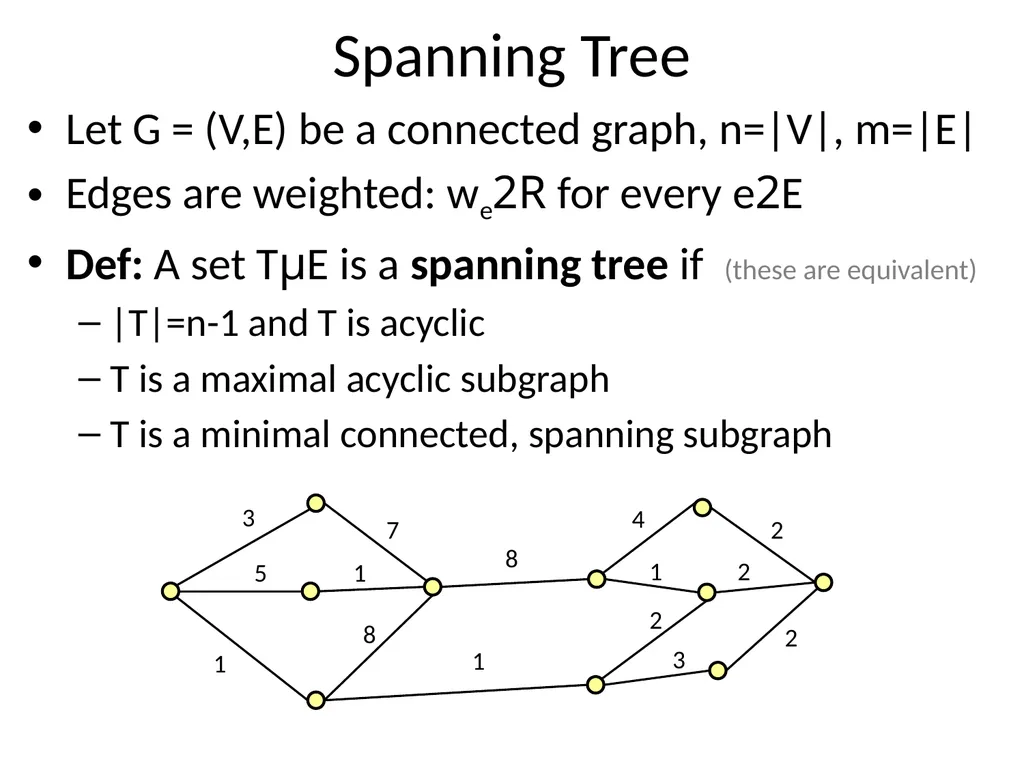
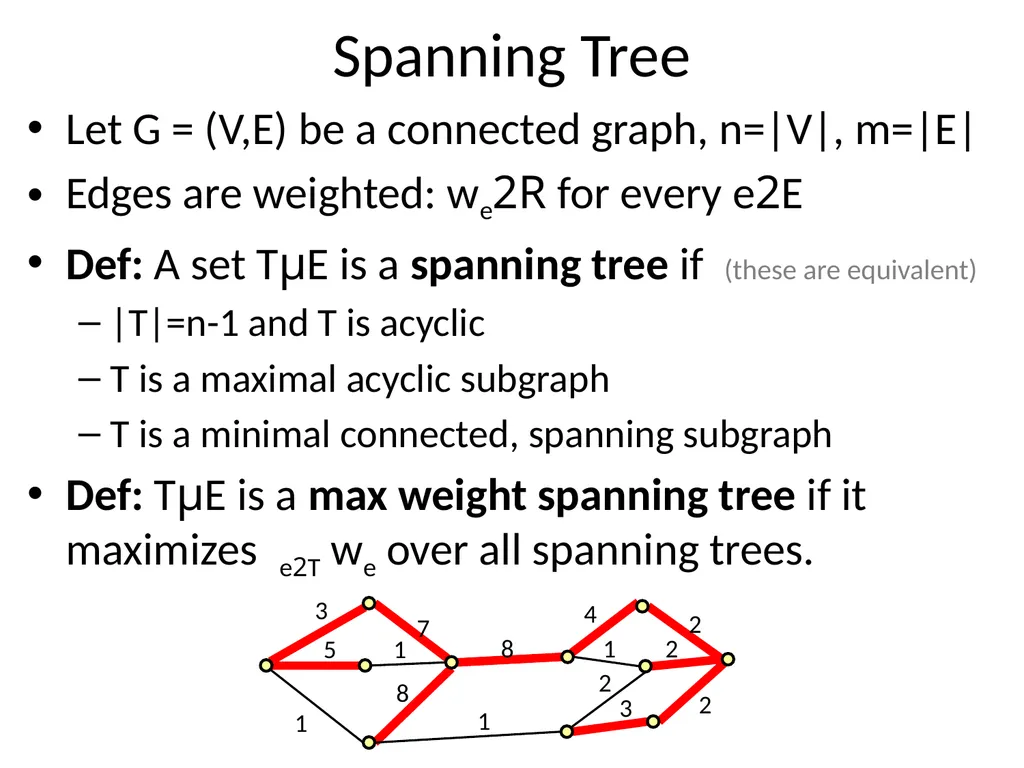
Spanning Tree Let G = (V,E) be a connected graph, n=|V|, m=|E|
Edges are weighted: we2R for every e2E
Def: A set TµE is a spanning tree if (these are equivalent)
|T|=n-1 and T is acyclic
T is a maximal acyclic subgraph
T is a minimal connected, spanning subgraph<br>
05
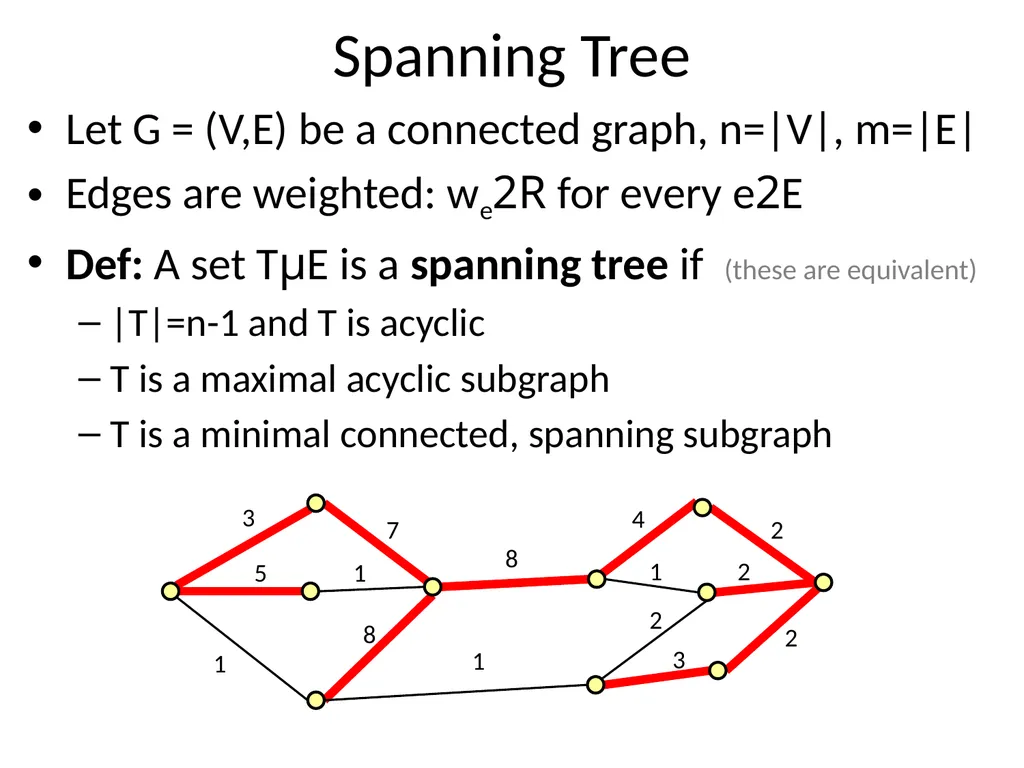
Spanning Tree Let G = (V,E) be a connected graph, n=|V|, m=|E|
Edges are weighted: we2R for every e2E
Def: A set TµE is a spanning tree if (these are equivalent)
|T|=n-1 and T is acyclic
T is a maximal acyclic subgraph
T is a minimal connected, spanning subgraph
Def: TµE is a max weight spanning tree if it maximizes e2T we over all spanning trees.<br>
06
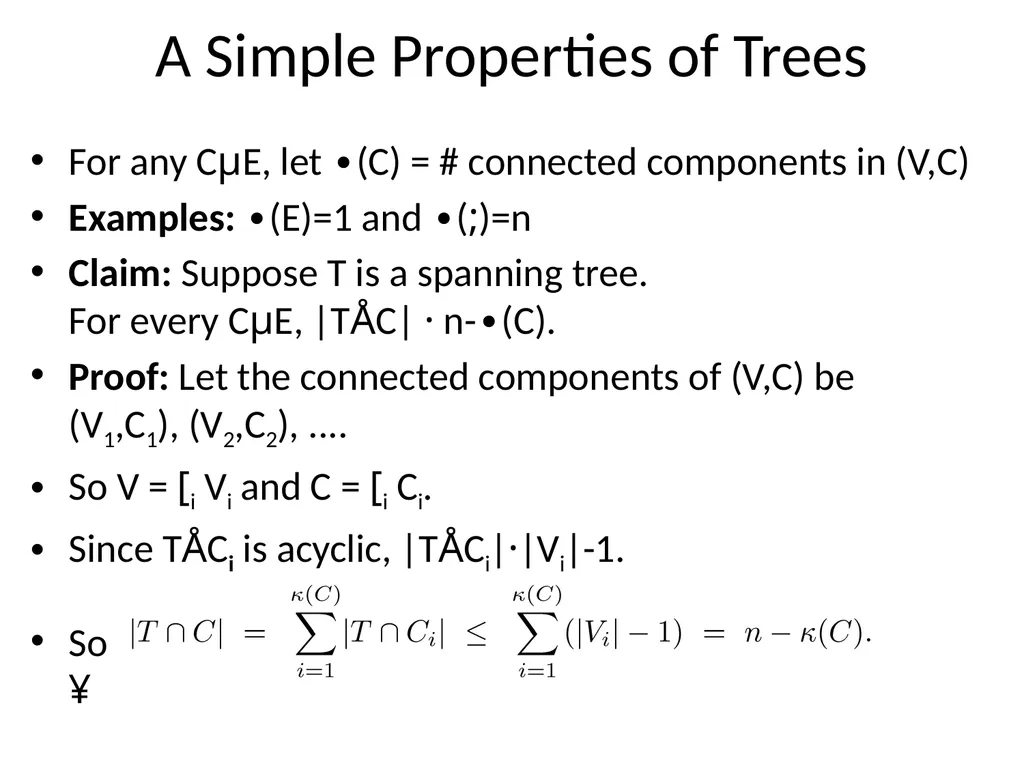
A Simple Properties of Trees For any CµE, let ∙(C) = # connected components in (V,C)
Examples: ∙(E)=1 and ∙(;)=n
Claim: Suppose T is a spanning tree.�For every CµE, |TÅC| · n-∙(C).
Proof: Let the connected components of (V,C) be�(V1,C1), (V2,C2), ....
So V = [i Vi and C = [i Ci.
Since TÅCi is acyclic, |TÅCi|·|Vi|-1.
So ¥<br>
07
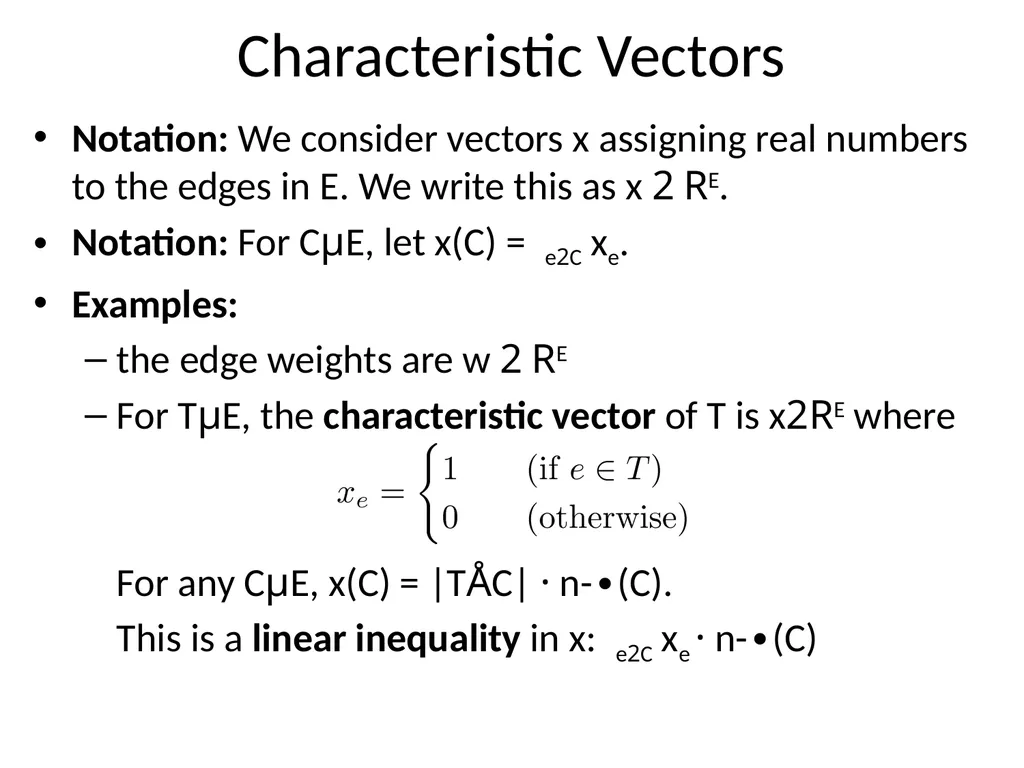
Characteristic Vectors Notation: We consider vectors x assigning real numbers�to the edges in E. We write this as x 2 RE.
Notation: For CµE, let x(C) = e2C xe.
Examples:
the edge weights are w 2 RE
For TµE, the characteristic vector of T is x2RE where
For any CµE, x(C) = |TÅC| · n-∙(C).
This is a linear inequality in x: e2C xe · n-∙(C)<br>
08
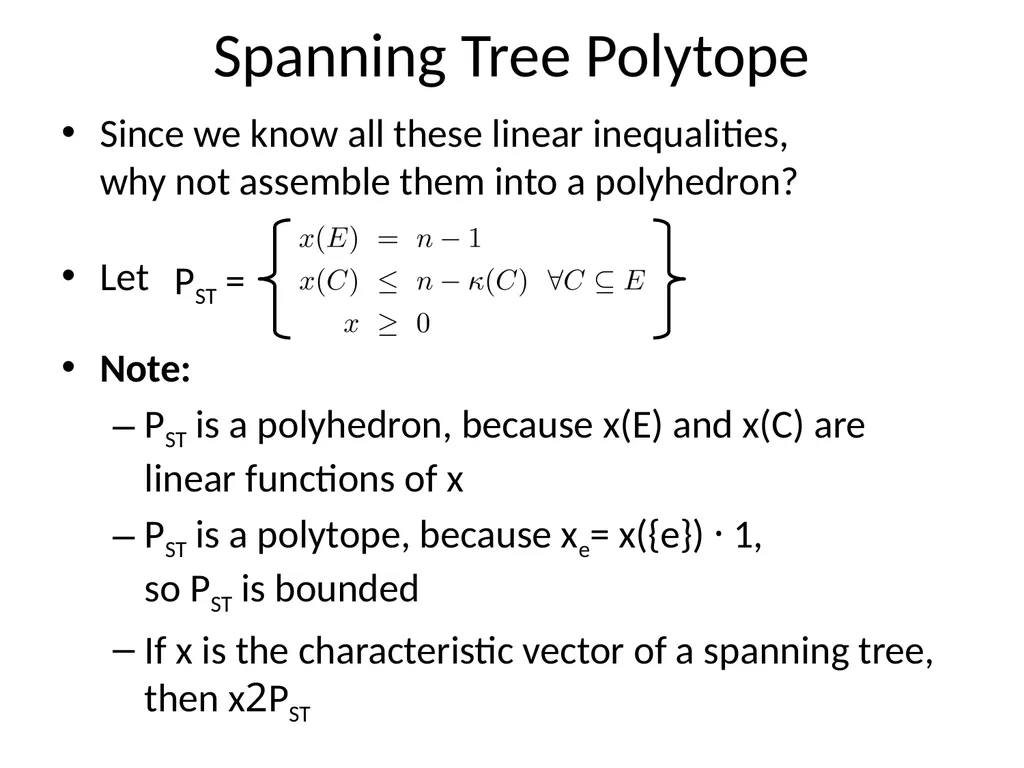
Spanning Tree Polytope Since we know all these linear inequalities,�why not assemble them into a polyhedron?
Let
Note:
PST is a polyhedron, because x(E) and x(C) are�linear functions of x
PST is a polytope, because xe= x({e}) · 1,�so PST is bounded
If x is the characteristic vector of a spanning tree, then x2PST PST =<br>
09
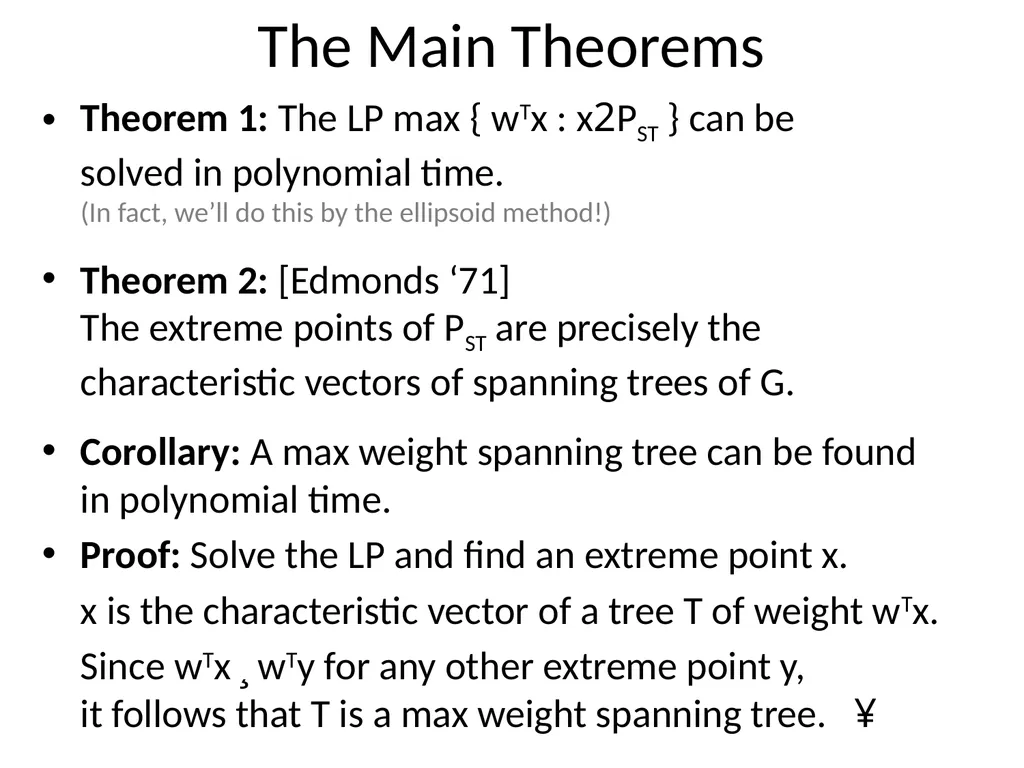
The Main Theorems Theorem 1: The LP max { wTx : x2PST } can be�solved in polynomial time.�(In fact, we’ll do this by the ellipsoid method!)
Theorem 2: [Edmonds ‘71]�The extreme points of PST are precisely the characteristic vectors of spanning trees of G.
Corollary: A max weight spanning tree can be found�in polynomial time.
Proof: Solve the LP and find an extreme point x.
x is the characteristic vector of a tree T of weight wTx.
Since wTx ¸ wTy for any other extreme point y,�it follows that T is a max weight spanning tree. ¥<br>
10
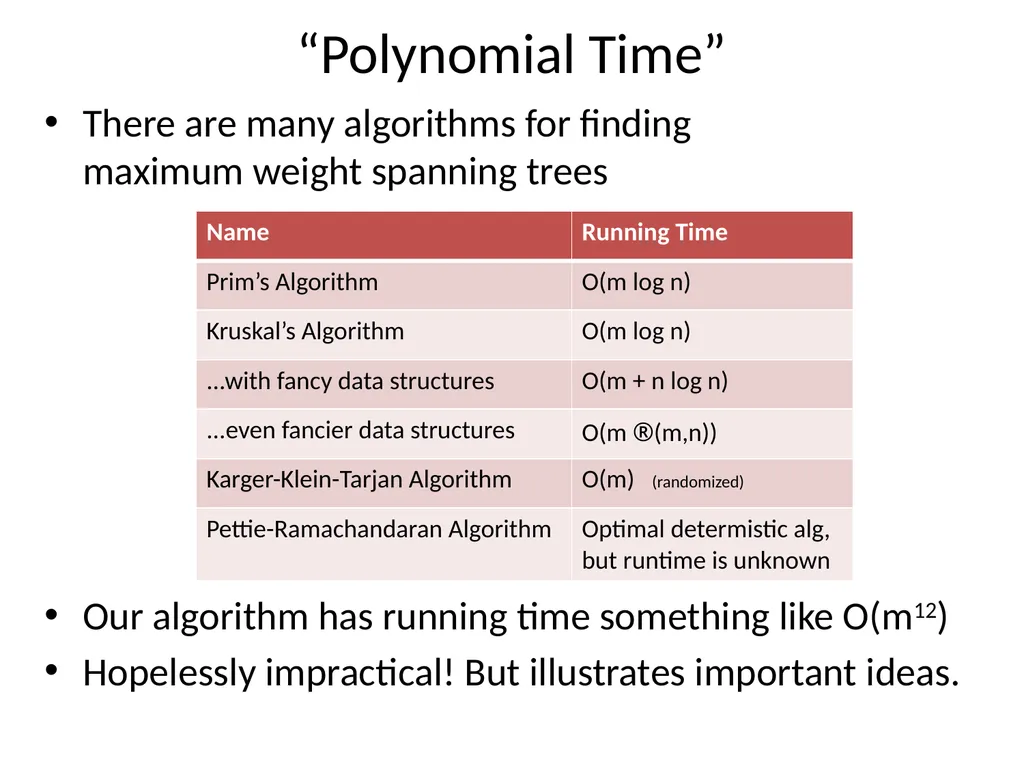
“Polynomial Time” There are many algorithms for finding�maximum weight spanning trees
Our algorithm has running time something like O(m12)
Hopelessly impractical! But illustrates important ideas.<br>
11
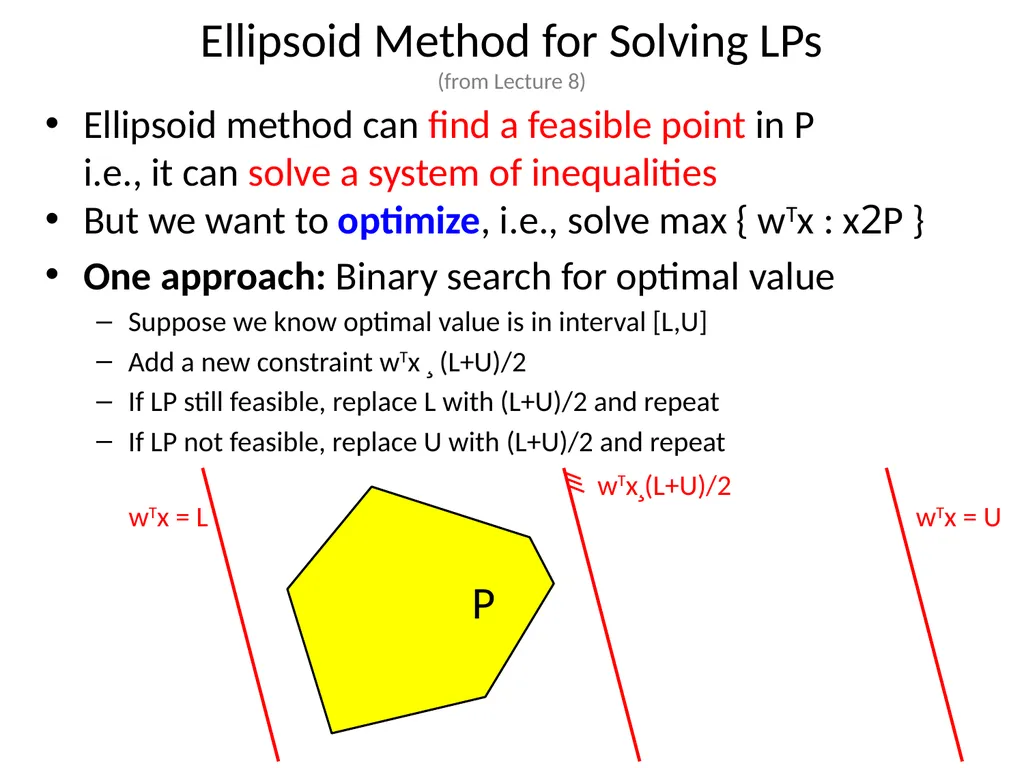
Ellipsoid Method for Solving LPs�(from Lecture 8) Ellipsoid method can find a feasible point in P�i.e., it can solve a system of inequalities
But we want to optimize, i.e., solve max { wTx : x2P }
One approach: Binary search for optimal value
Suppose we know optimal value is in interval [L,U]
Add a new constraint wTx ¸ (L+U)/2
If LP still feasible, replace L with (L+U)/2 and repeat
If LP not feasible, replace U with (L+U)/2 and repeat P wTx = L<br>
12
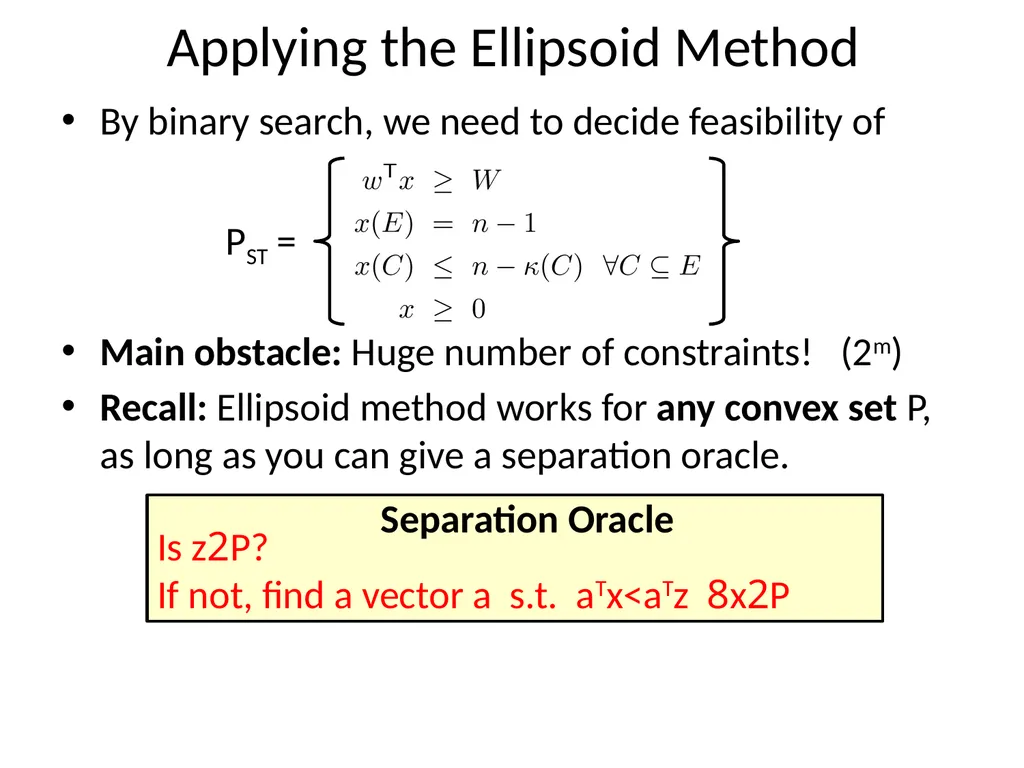
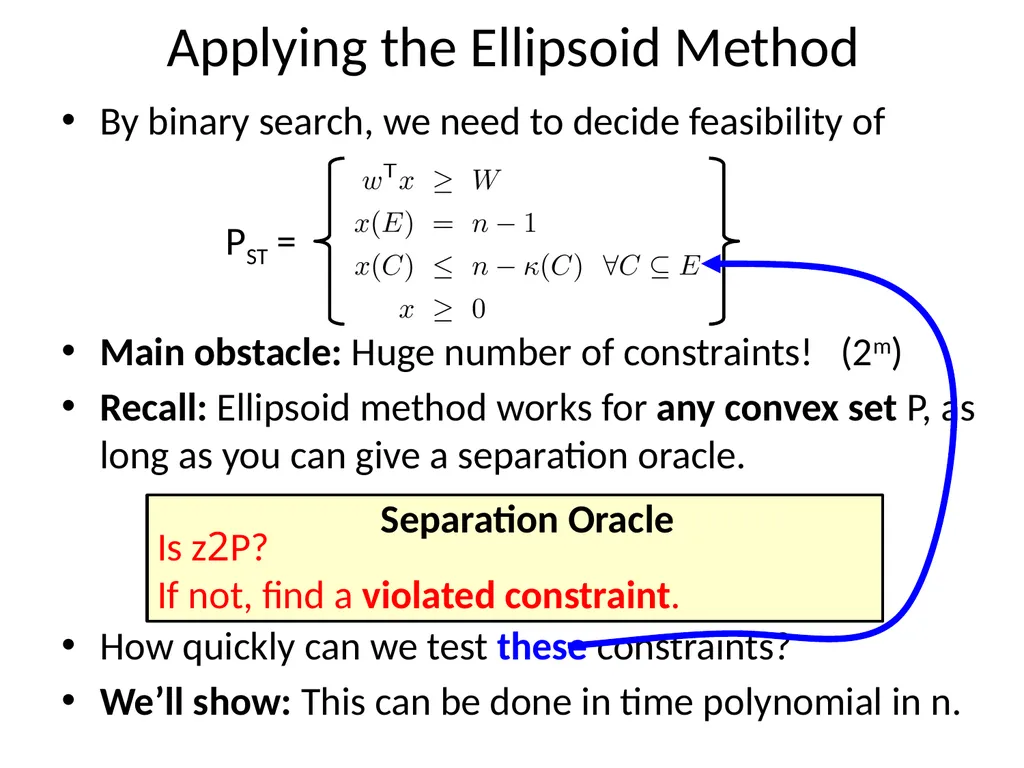
Applying the Ellipsoid Method By binary search, we need to decide feasibility of
Main obstacle: Huge number of constraints! (2m)
Recall: Ellipsoid method works for any convex set P, as long as you can give a separation oracle. PST =<br>
13
Applying the Ellipsoid Method By binary search, we need to decide feasibility of
Main obstacle: Huge number of constraints! (2m)
Recall: Ellipsoid method works for any convex set P, as long as you can give a separation oracle.
How quickly can we test these constraints?
We’ll show: This can be done in time polynomial in n. PST =<br>
14
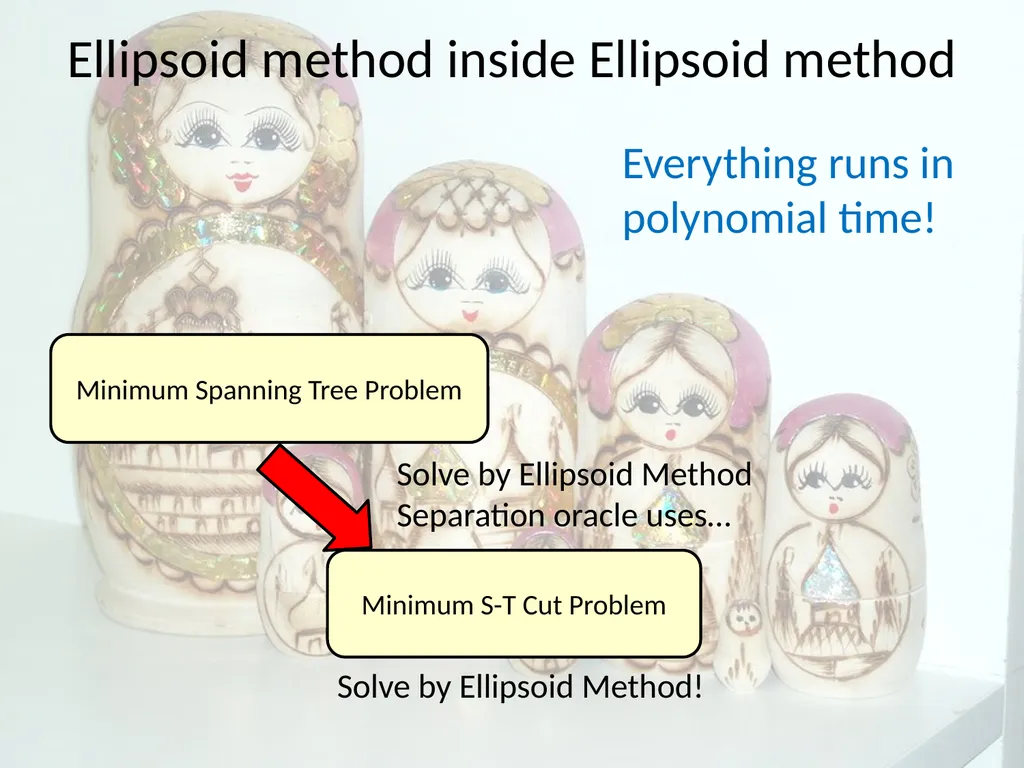
Ellipsoid method inside Ellipsoid method Minimum Spanning Tree Problem Minimum S-T Cut Problem Solve by Ellipsoid Method
Separation oracle uses… Solve by Ellipsoid Method! Everything runs in polynomial time!<br>
15
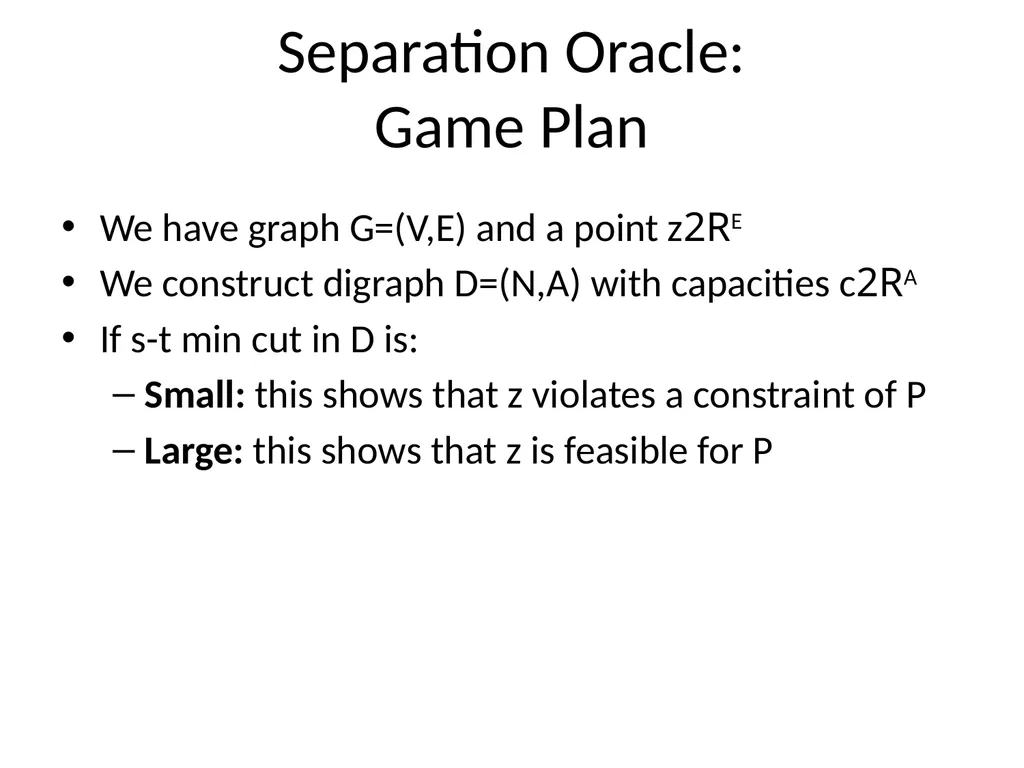
Separation Oracle:�Game Plan We have graph G=(V,E) and a point z2RE
We construct digraph D=(N,A) with capacities c2RA
If s-t min cut in D is:
Small: this shows that z violates a constraint of P
Large: this shows that z is feasible for P<br>
16
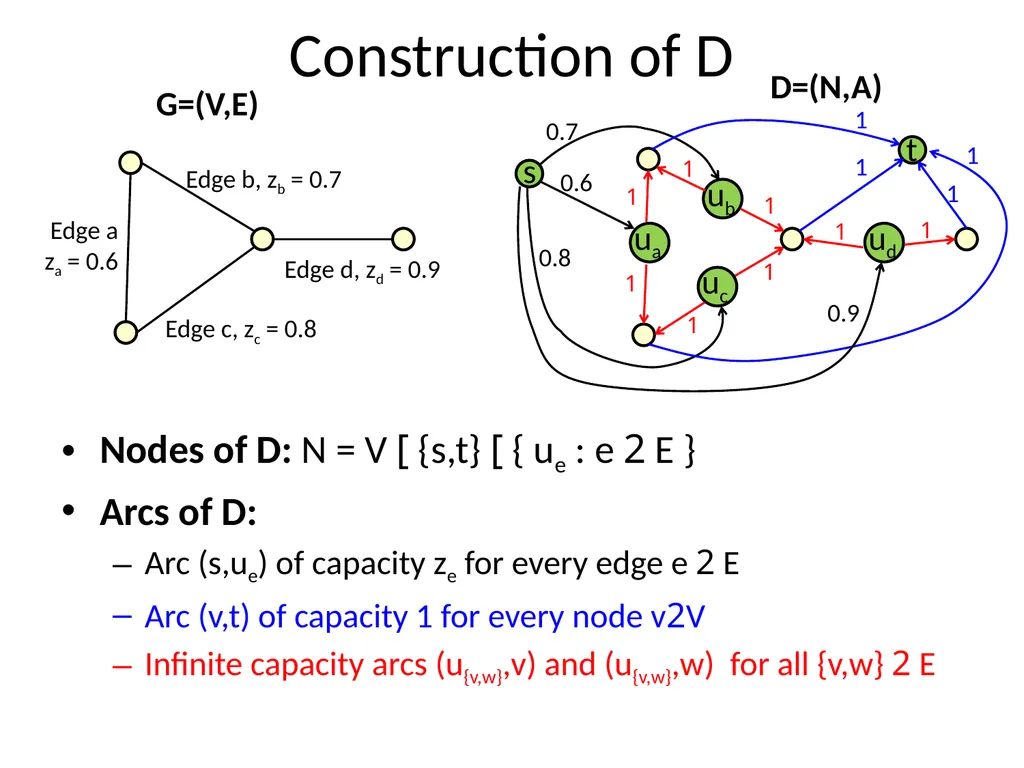
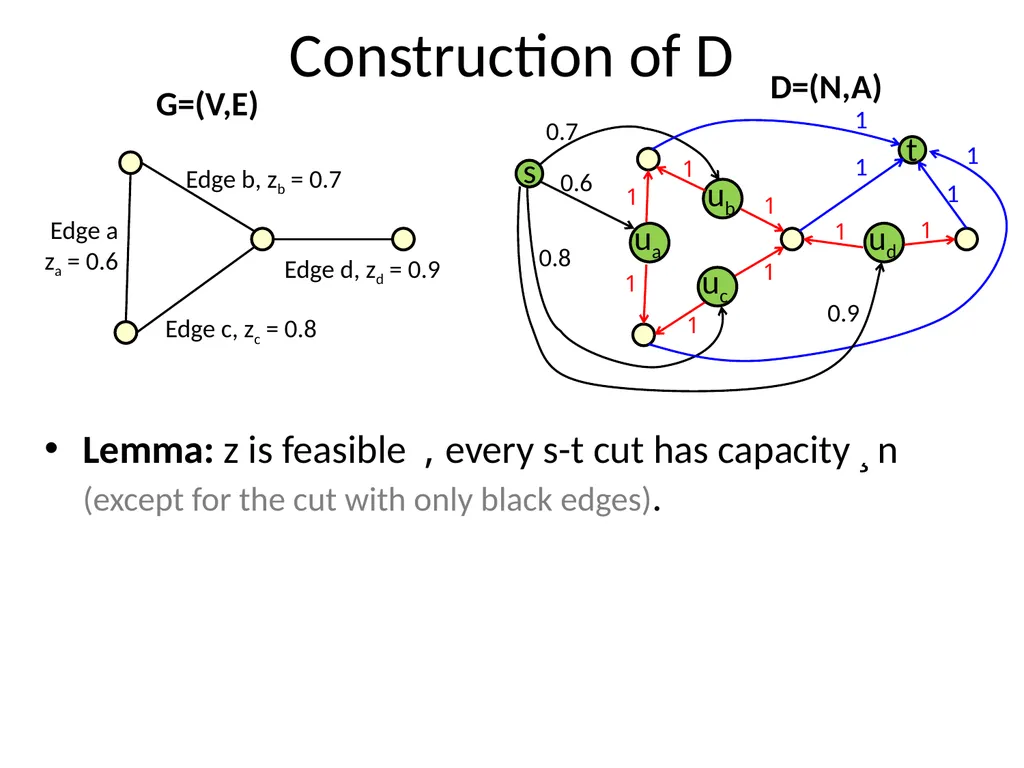
Construction of D Nodes of D: N = V [ {s,t} [ { ue : e 2 E }
Arcs of D:
Arc (s,ue) of capacity ze for every edge e 2 E
Arc (v,t) of capacity 1 for every node v2V
Infinite capacity arcs (u{v,w},v) and (u{v,w},w) for all {v,w} 2 E Edge a
za = 0.6 Edge c, zc = 0.8 Edge b, zb = 0.7 G=(V,E) s t ua ub uc 0.8 0.7 0.6 1 1 1 1 1 1 1 1 1 ud 1 1 Edge d, zd = 0.9 0.9 1 D=(N,A)<br>
17
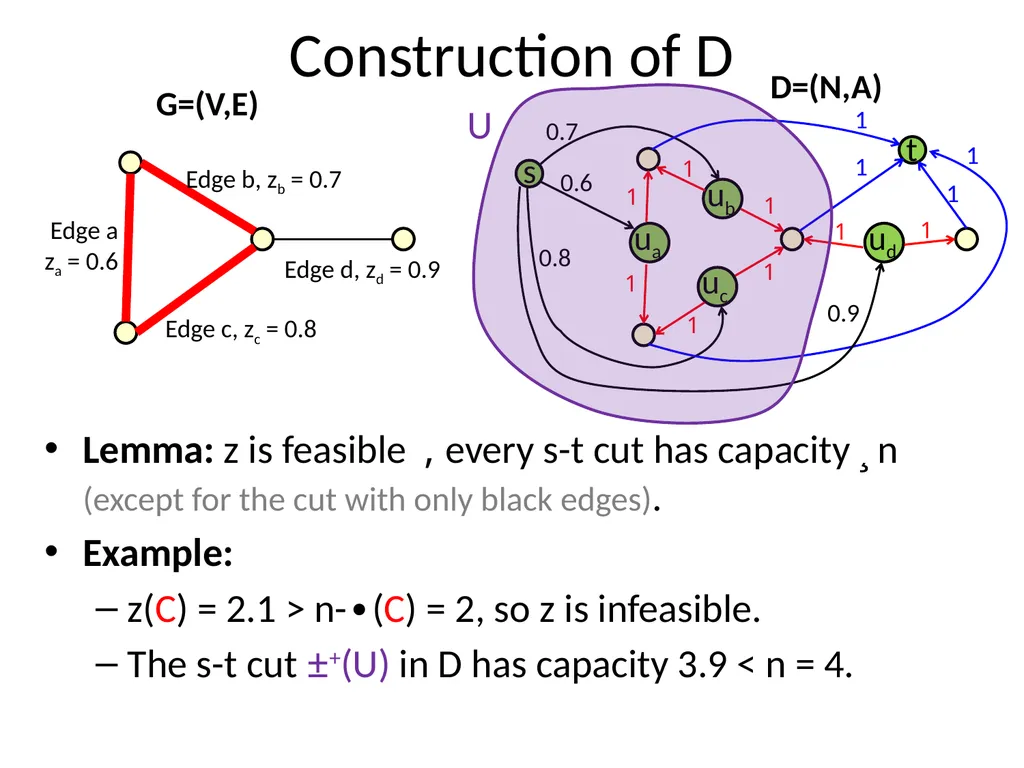
Construction of D Lemma: z is feasible , every s-t cut has capacity ¸ n (except for the cut with only black edges). Edge a
za = 0.6 Edge c, zc = 0.8 Edge b, zb = 0.7 G=(V,E) s t ua ub uc 0.8 0.7 0.6 1 1 1 1 1 1 1 1 1 ud 1 1 Edge d, zd = 0.9 0.9 1 D=(N,A)<br>
18
Construction of D Lemma: z is feasible , every s-t cut has capacity ¸ n (except for the cut with only black edges).
Example:
z(C) = 2.1 > n-∙(C) = 2, so z is infeasible.
The s-t cut ±+(U) in D has capacity 3.9 < n = 4. Edge a
za = 0.6 Edge c, zc = 0.8 Edge b, zb = 0.7 G=(V,E) s t ua ub uc 0.8 0.7 0.6 1 1 1 1 1 1 1 1 1 ud 1 1 Edge d, zd = 0.9 0.9 1 D=(N,A) U<br>
19
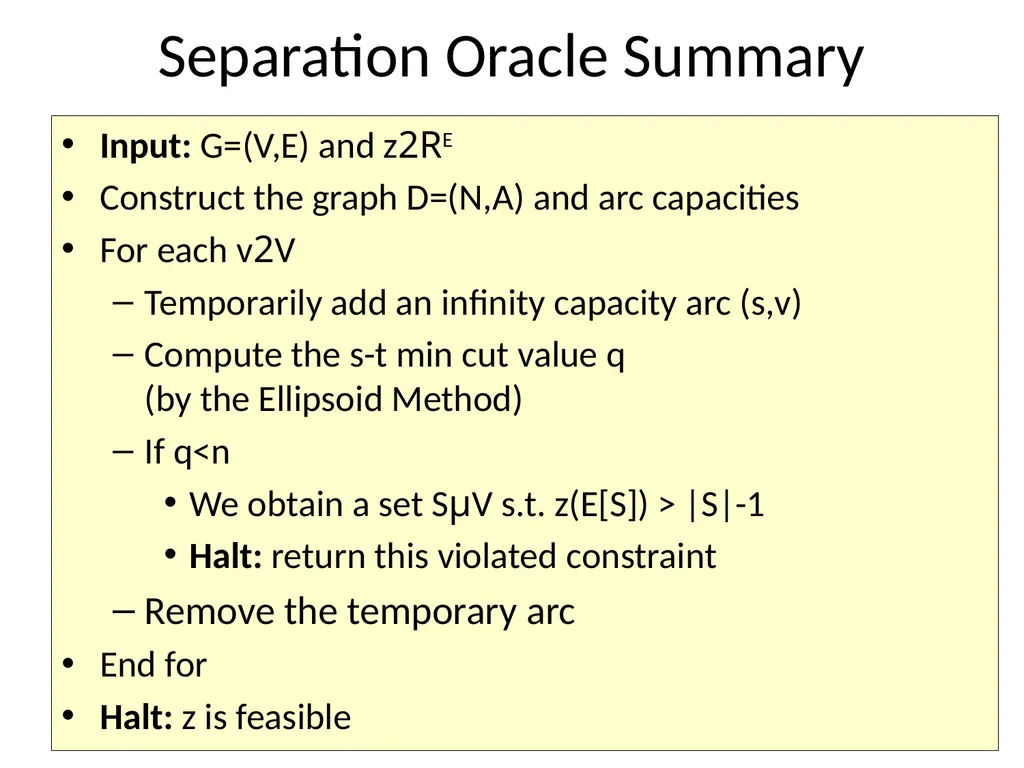
Separation Oracle Summary Input: G=(V,E) and z2RE
Construct the graph D=(N,A) and arc capacities
For each v2V
Temporarily add an infinity capacity arc (s,v)
Compute the s-t min cut value q�(by the Ellipsoid Method)
If q<n
We obtain a set SµV s.t. z(E[S]) > |S|-1
Halt: return this violated constraint
Remove the temporary arc
End for
Halt: z is feasible<br>
20
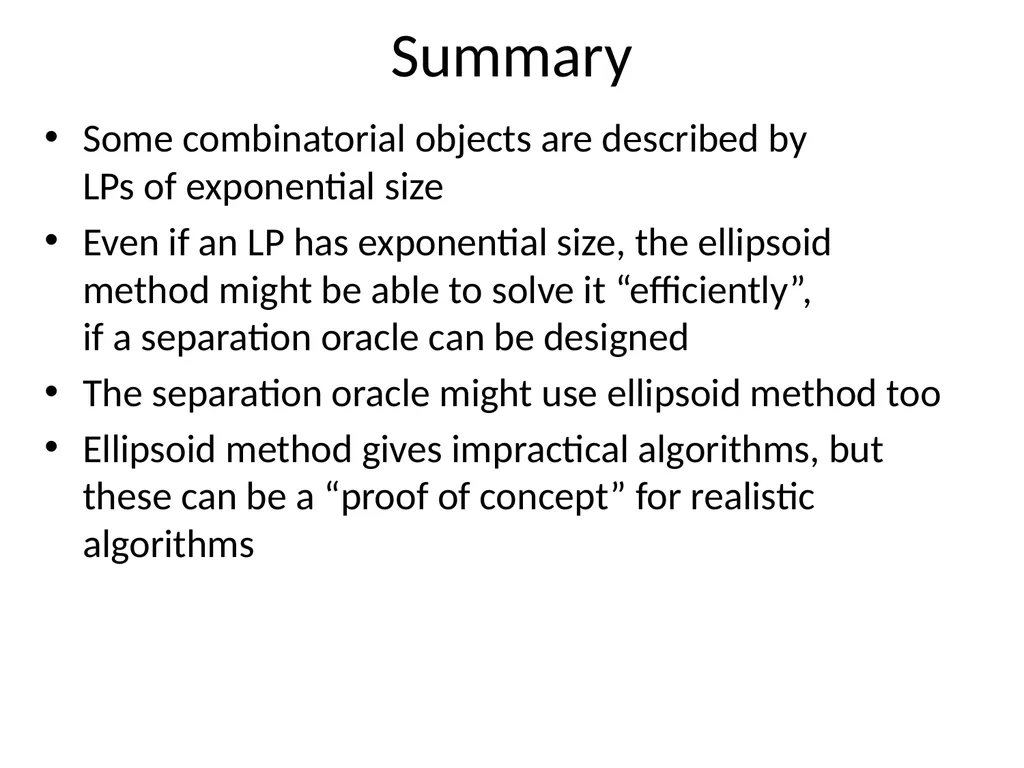
Summary Some combinatorial objects are described by�LPs of exponential size
Even if an LP has exponential size, the ellipsoid�method might be able to solve it “efficiently”,�if a separation oracle can be designed
The separation oracle might use ellipsoid method too
Ellipsoid method gives impractical algorithms, but these can be a “proof of concept” for realistic algorithms<br>