
CAEP Academic Symposium Funding Panel May 30, 2015
MS
Published · 43 slides · 0 views

1 / 1







Description
CAEP Academic Symposium Funding Panel May 30, 2015 Funding Panel Members Eddy Lang, Chair Jim Christenson, Leadership Working Group Chair Ian Stiell, Academic Section Executive Chair Claude Topping Francois Belanger Marc Afilalo Tia Renouf
Related Topics
Share
Embed code
Download this presentation From Below
"CAEP Academic Symposium Funding Panel May 30, 2015" is the property of its rightful owner. Permission is granted to download and print the materials on this website for personal, non-commercial use only, and to display it on your personal computer provided you do not modify the materials and that you retain all copyright notices contained in the materials. By downloading content from our website, you accept the terms of this agreement.
Presentation Transcript
01
CAEP Academic Symposium
Funding Panel May 30, 2015<br>
02
Funding Panel Members Eddy Lang, Chair
Jim Christenson, Leadership Working Group Chair
Ian Stiell, Academic Section Executive Chair
Claude Topping
Francois Belanger
Marc Afilalo
Tia Renouf
Anthony Crocco
Jennifer Artz
Kelly Wyatt
Ryan Wilkie<br>
Jim Christenson, Leadership Working Group Chair
Ian Stiell, Academic Section Executive Chair
Claude Topping
Francois Belanger
Marc Afilalo
Tia Renouf
Anthony Crocco
Jennifer Artz
Kelly Wyatt
Ryan Wilkie<br>
03
WHAT IS AN APPROPRIATE AMOUNT OF FUNDING AND HOW TO ACHIEVE IT? To report on funding for academic EM programs across Canada
To benchmark academic unit support against expectations in the areas of administration, undergraduate education, postgraduate education, and research
To determine best strategies to grow and establish sustainable funding across Canadian university EM departments/divisions<br>
To benchmark academic unit support against expectations in the areas of administration, undergraduate education, postgraduate education, and research
To determine best strategies to grow and establish sustainable funding across Canadian university EM departments/divisions<br>
04
Terms of Reference a) Researching their topic including environmental scans of Canada and U.S., literature review, and interviews of experts.
b) Creating recommendations for Canadian Academic EM units,
c) Presenting the recommendations at the CAEP 2015 Academic Symposium,
d) Publishing the recommendations in CJEM.<br>
b) Creating recommendations for Canadian Academic EM units,
c) Presenting the recommendations at the CAEP 2015 Academic Symposium,
d) Publishing the recommendations in CJEM.<br>
05
Recommendations<br>
06
1. Departments should develop strategic plans with missions, visions and goals ideally aligning with University, Hospital and Ministerial mandates<br>
07
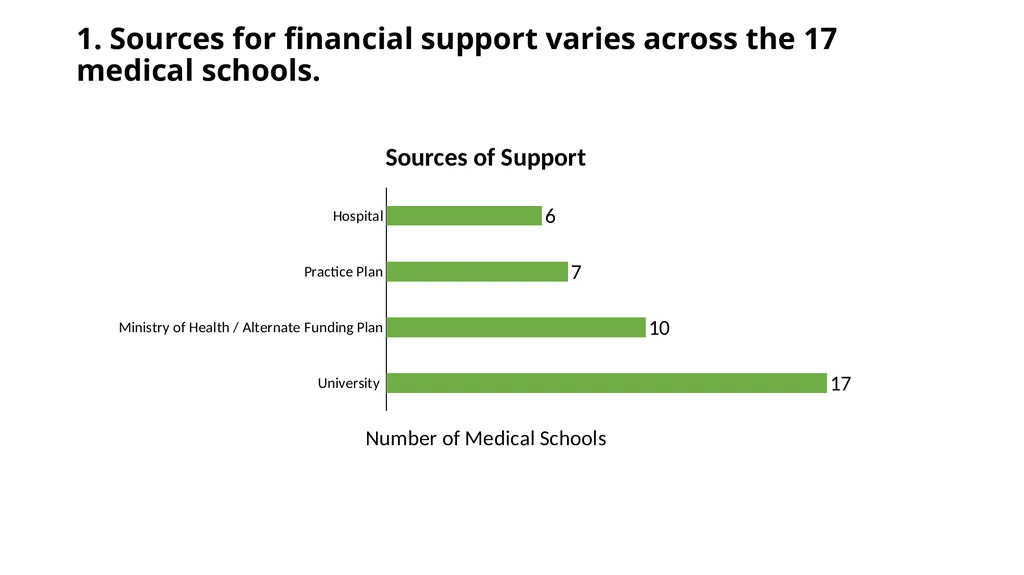
1. Sources for financial support varies across the 17 medical schools.<br>
08
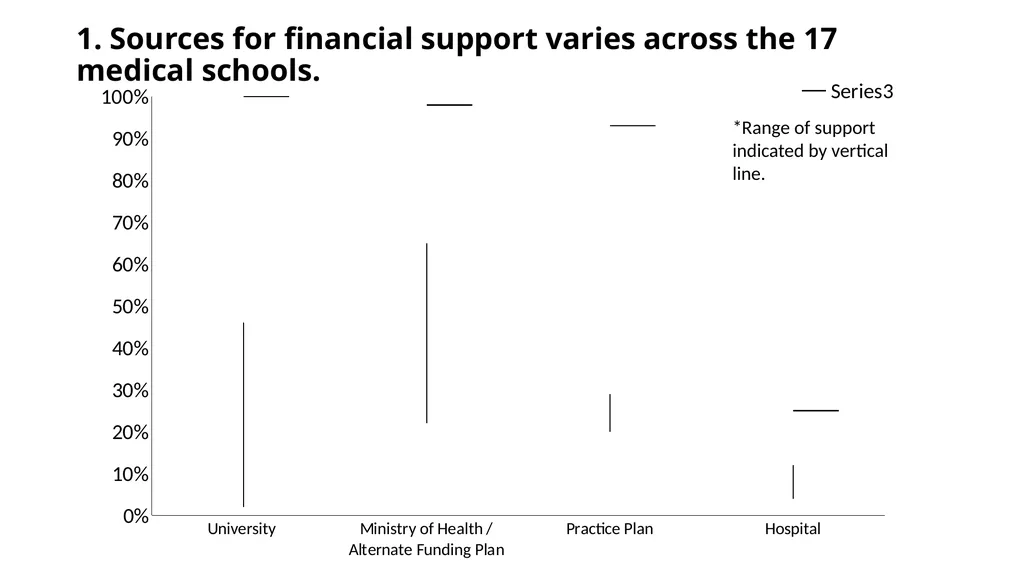
1. Sources for financial support varies across the 17 medical schools. *Range of support indicated by vertical line.<br>
09
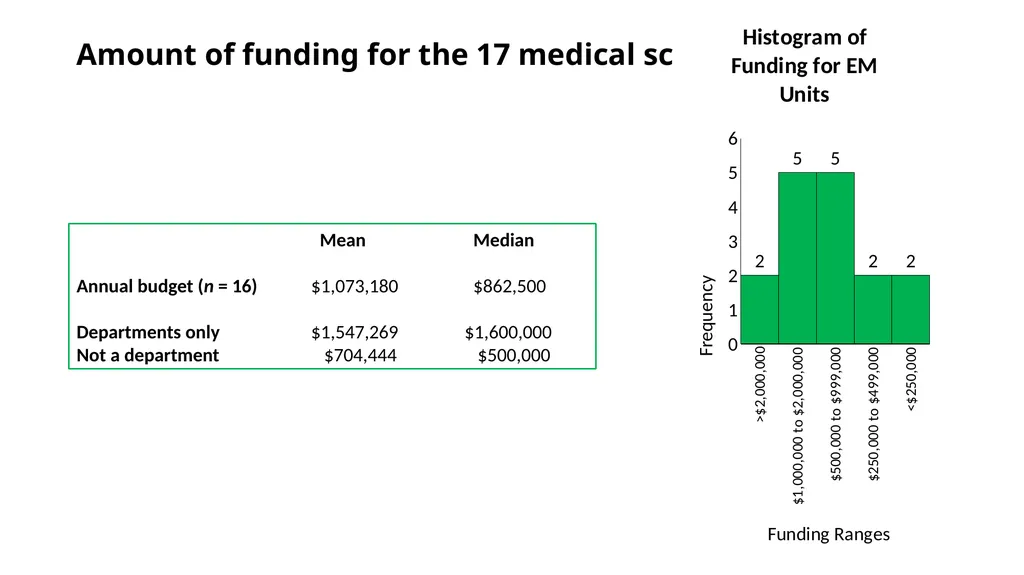
Amount of funding for the 17 medical schools Mean Median
Annual budget (n = 16) $1,073,180 $862,500
Departments only $1,547,269 $1,600,000
Not a department $704,444 $500,000<br>
Annual budget (n = 16) $1,073,180 $862,500
Departments only $1,547,269 $1,600,000
Not a department $704,444 $500,000<br>
10
2. These plans should address both the clinical and academic missions and be interwoven in a way that optimizes synergy and mutual benefit Avoid the creation of silos<br>
11
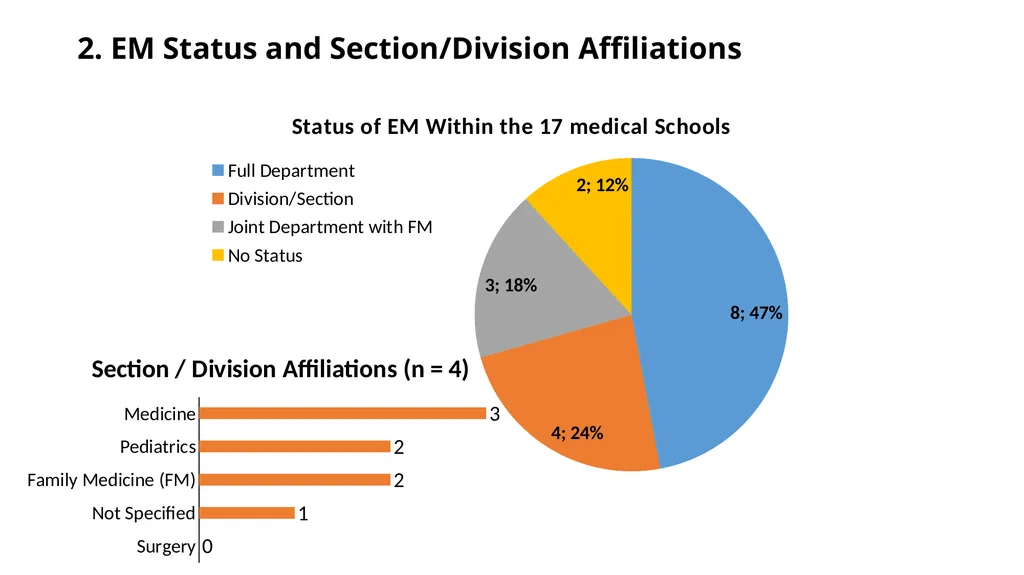
2. EM Status and Section/Division Affiliations<br>
12
2. Teaching Hospitals and Faculty<br>
13
3. Develop a Business Plan that clarifies the financial resources needed to achieve the mission and goals, what the sources of income should be, and how you would spend the resources most effectively<br>
14
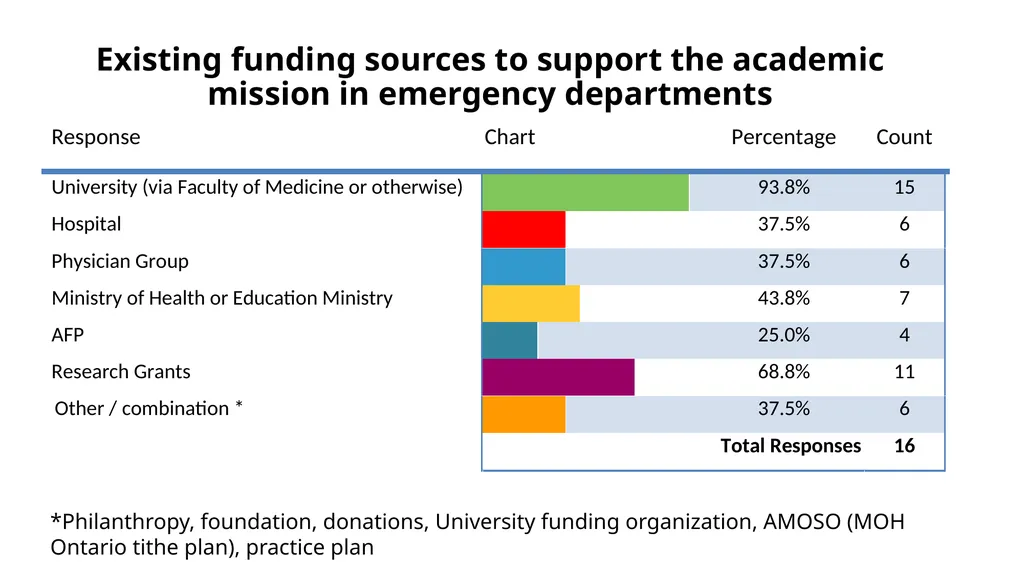
Existing funding sources to support the academic mission in emergency departments *Philanthropy, foundation, donations, University funding organization, AMOSO (MOH Ontario tithe plan), practice plan<br>
15
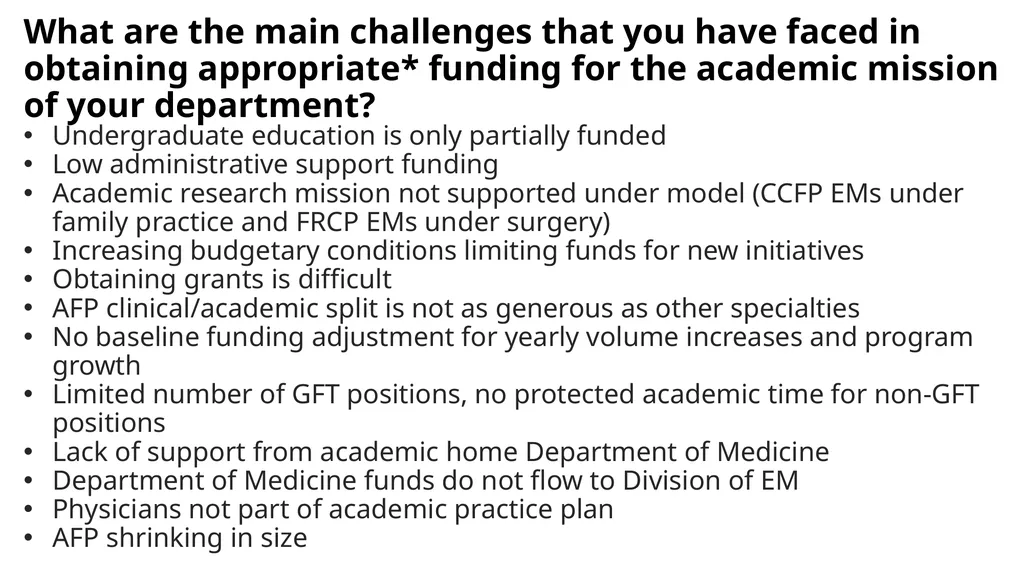
What are the main challenges that you have faced in obtaining appropriate* funding for the academic mission of your department? Undergraduate education is only partially funded
Low administrative support funding
Academic research mission not supported under model (CCFP EMs under family practice and FRCP EMs under surgery)
Increasing budgetary conditions limiting funds for new initiatives
Obtaining grants is difficult
AFP clinical/academic split is not as generous as other specialties
No baseline funding adjustment for yearly volume increases and program growth
Limited number of GFT positions, no protected academic time for non-GFT positions
Lack of support from academic home Department of Medicine
Department of Medicine funds do not flow to Division of EM
Physicians not part of academic practice plan
AFP shrinking in size<br>
Low administrative support funding
Academic research mission not supported under model (CCFP EMs under family practice and FRCP EMs under surgery)
Increasing budgetary conditions limiting funds for new initiatives
Obtaining grants is difficult
AFP clinical/academic split is not as generous as other specialties
No baseline funding adjustment for yearly volume increases and program growth
Limited number of GFT positions, no protected academic time for non-GFT positions
Lack of support from academic home Department of Medicine
Department of Medicine funds do not flow to Division of EM
Physicians not part of academic practice plan
AFP shrinking in size<br>
16
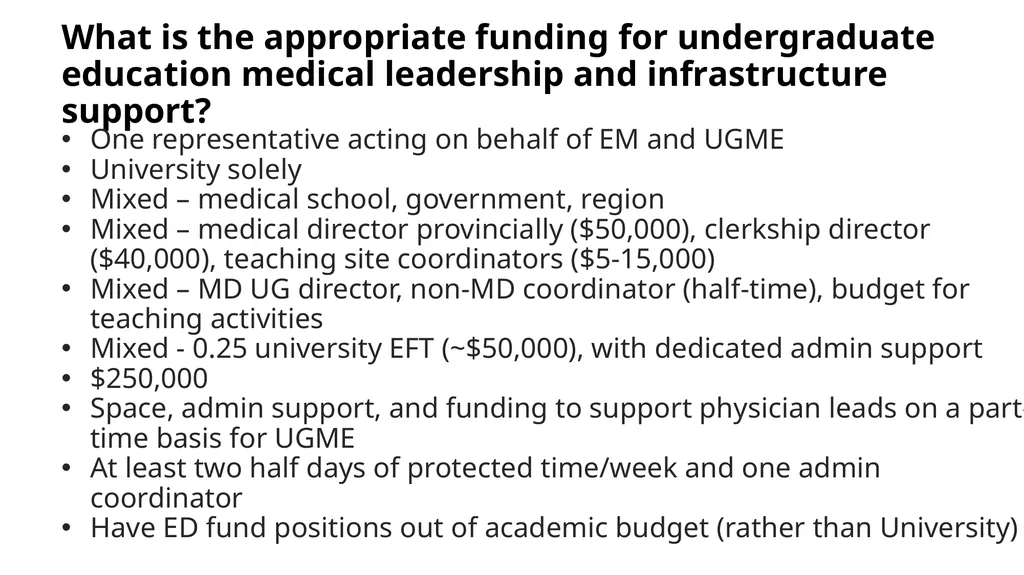
What is the appropriate funding for undergraduate education medical leadership and infrastructure support? One representative acting on behalf of EM and UGME
University solely
Mixed – medical school, government, region
Mixed – medical director provincially ($50,000), clerkship director ($40,000), teaching site coordinators ($5-15,000)
Mixed – MD UG director, non-MD coordinator (half-time), budget for teaching activities
Mixed - 0.25 university EFT (~$50,000), with dedicated admin support
$250,000
Space, admin support, and funding to support physician leads on a part-time basis for UGME
At least two half days of protected time/week and one admin coordinator
Have ED fund positions out of academic budget (rather than University)<br>
University solely
Mixed – medical school, government, region
Mixed – medical director provincially ($50,000), clerkship director ($40,000), teaching site coordinators ($5-15,000)
Mixed – MD UG director, non-MD coordinator (half-time), budget for teaching activities
Mixed - 0.25 university EFT (~$50,000), with dedicated admin support
$250,000
Space, admin support, and funding to support physician leads on a part-time basis for UGME
At least two half days of protected time/week and one admin coordinator
Have ED fund positions out of academic budget (rather than University)<br>
17
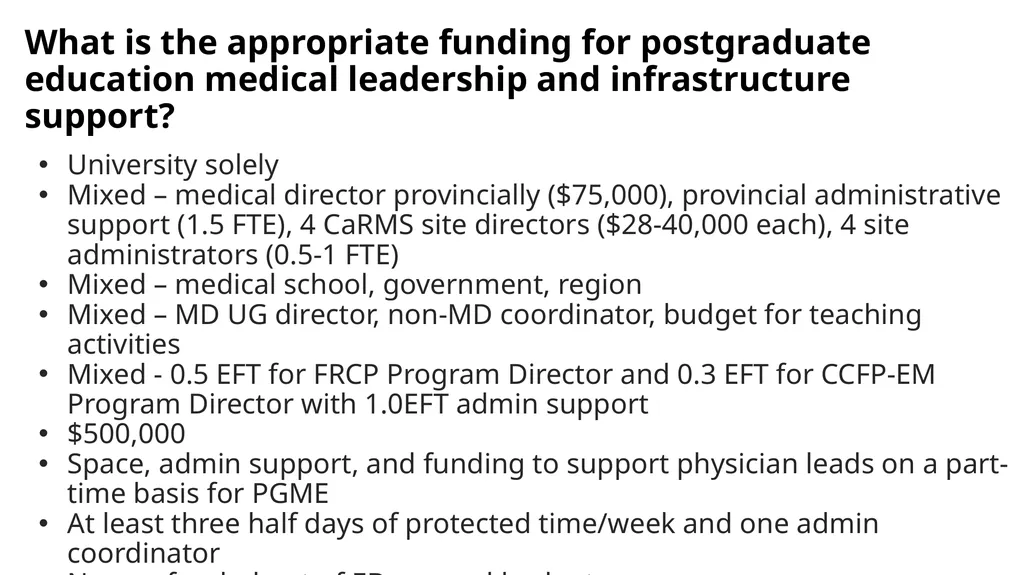
What is the appropriate funding for postgraduate education medical leadership and infrastructure support? University solely
Mixed – medical director provincially ($75,000), provincial administrative support (1.5 FTE), 4 CaRMS site directors ($28-40,000 each), 4 site administrators (0.5-1 FTE)
Mixed – medical school, government, region
Mixed – MD UG director, non-MD coordinator, budget for teaching activities
Mixed - 0.5 EFT for FRCP Program Director and 0.3 EFT for CCFP-EM Program Director with 1.0EFT admin support
$500,000
Space, admin support, and funding to support physician leads on a part-time basis for PGME
At least three half days of protected time/week and one admin coordinator
None – funded out of ED general budget
One APA in the city, several APAs rurally<br>
Mixed – medical director provincially ($75,000), provincial administrative support (1.5 FTE), 4 CaRMS site directors ($28-40,000 each), 4 site administrators (0.5-1 FTE)
Mixed – medical school, government, region
Mixed – MD UG director, non-MD coordinator, budget for teaching activities
Mixed - 0.5 EFT for FRCP Program Director and 0.3 EFT for CCFP-EM Program Director with 1.0EFT admin support
$500,000
Space, admin support, and funding to support physician leads on a part-time basis for PGME
At least three half days of protected time/week and one admin coordinator
None – funded out of ED general budget
One APA in the city, several APAs rurally<br>
18
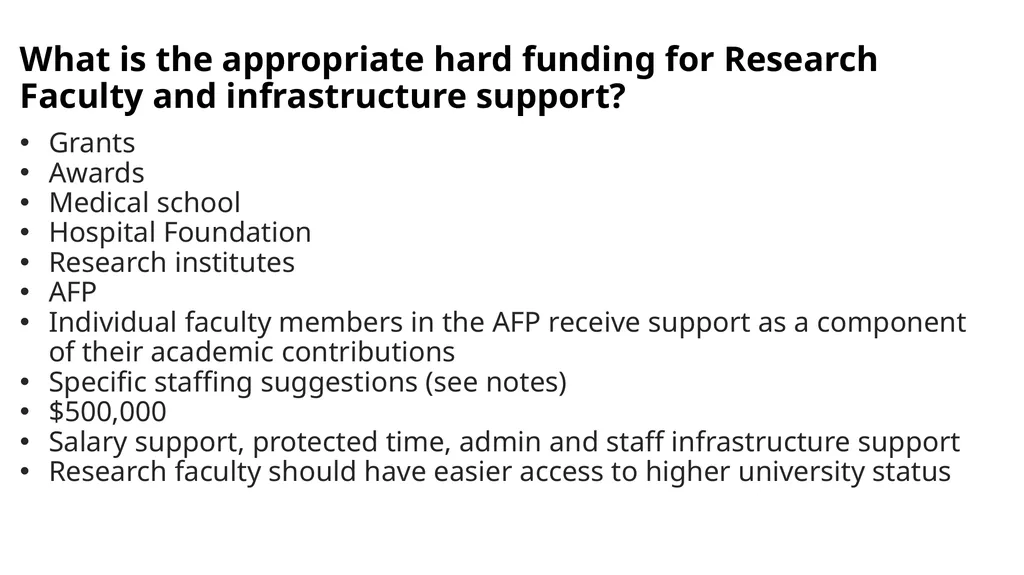
What is the appropriate hard funding for Research Faculty and infrastructure support? Grants
Awards
Medical school
Hospital Foundation
Research institutes
AFP
Individual faculty members in the AFP receive support as a component of their academic contributions
Specific staffing suggestions (see notes)
$500,000
Salary support, protected time, admin and staff infrastructure support
Research faculty should have easier access to higher university status<br>
Awards
Medical school
Hospital Foundation
Research institutes
AFP
Individual faculty members in the AFP receive support as a component of their academic contributions
Specific staffing suggestions (see notes)
$500,000
Salary support, protected time, admin and staff infrastructure support
Research faculty should have easier access to higher university status<br>
19
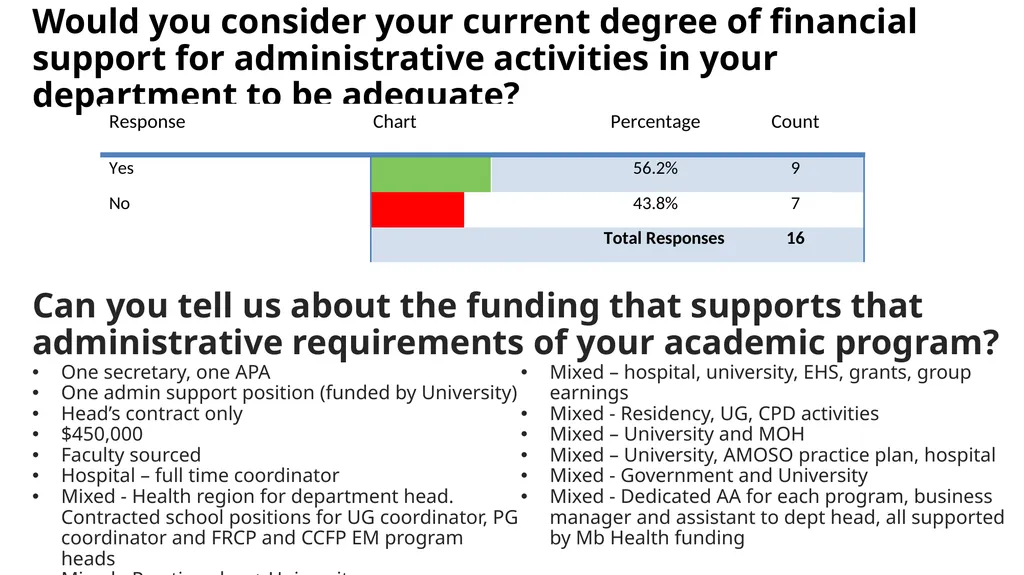
Would you consider your current degree of financial support for administrative activities in your department to be adequate? Can you tell us about the funding that supports that administrative requirements of your academic program? One secretary, one APA
One admin support position (funded by University)
Head’s contract only
$450,000
Faculty sourced
Hospital – full time coordinator
Mixed - Health region for department head. Contracted school positions for UG coordinator, PG coordinator and FRCP and CCFP EM program heads
Mixed - Practice plan + University
Mixed – hospital, university, EHS, grants, group earnings
Mixed - Residency, UG, CPD activities
Mixed – University and MOH
Mixed – University, AMOSO practice plan, hospital
Mixed - Government and University
Mixed - Dedicated AA for each program, business manager and assistant to dept head, all supported by Mb Health funding<br>
One admin support position (funded by University)
Head’s contract only
$450,000
Faculty sourced
Hospital – full time coordinator
Mixed - Health region for department head. Contracted school positions for UG coordinator, PG coordinator and FRCP and CCFP EM program heads
Mixed - Practice plan + University
Mixed – hospital, university, EHS, grants, group earnings
Mixed - Residency, UG, CPD activities
Mixed – University and MOH
Mixed – University, AMOSO practice plan, hospital
Mixed - Government and University
Mixed - Dedicated AA for each program, business manager and assistant to dept head, all supported by Mb Health funding<br>
20
What strategies have you undertaken to achieve current levels and are you seeking means of bolstering it? Working closer with PhD educators to develop graduate student capacity and tri-council funding
Allotting funds from multiple sources of funding for academic activities
University negotiating
Negotiating for increased number of academic positions
Accreditation negotiating
Practice plan negotiating
Regional CMO negotiating for additional medical positons
Attempted bypass of AFA to have OMA investigate on behalf of departments (OMA recommendations challenged but dismissed by MOH)
Department recognition
Using CPD programs to generate further funds
Appealing to clinical groups to fund non-core expenses, eg food for grand rounds and journal club<br>
Allotting funds from multiple sources of funding for academic activities
University negotiating
Negotiating for increased number of academic positions
Accreditation negotiating
Practice plan negotiating
Regional CMO negotiating for additional medical positons
Attempted bypass of AFA to have OMA investigate on behalf of departments (OMA recommendations challenged but dismissed by MOH)
Department recognition
Using CPD programs to generate further funds
Appealing to clinical groups to fund non-core expenses, eg food for grand rounds and journal club<br>
21
4. Philanthropic support for the academic mission of the Emergency Department should be actively pursued primarily through hospital and/or university fund development Departmental strategic plans should serve as the basis through which philanthropic resources be engaged and pursued<br>
22
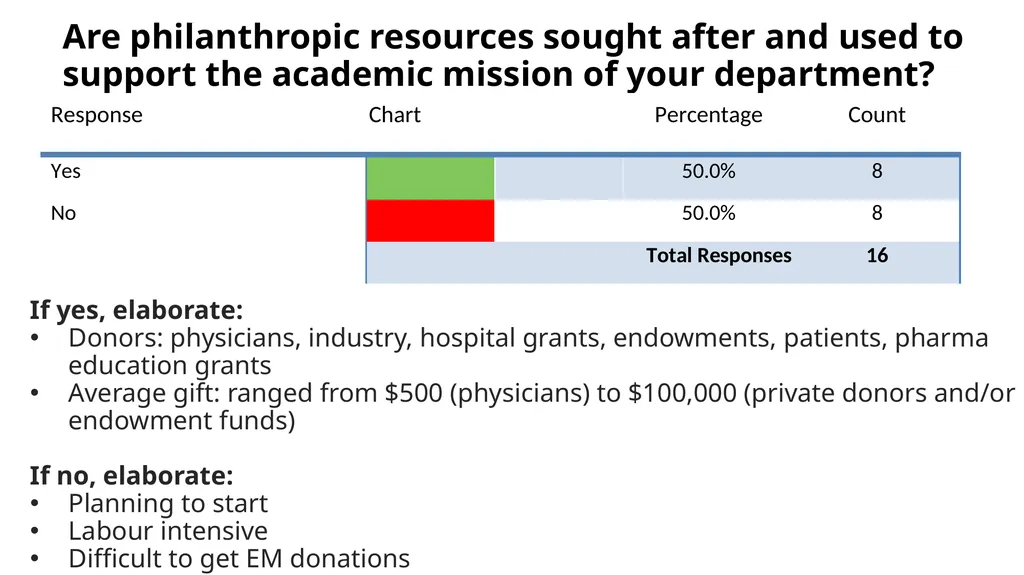
Are philanthropic resources sought after and used to support the academic mission of your department? If yes, elaborate:
Donors: physicians, industry, hospital grants, endowments, patients, pharma education grants
Average gift: ranged from $500 (physicians) to $100,000 (private donors and/or endowment funds)
If no, elaborate:
Planning to start
Labour intensive
Difficult to get EM donations
Not on the radar<br>
Donors: physicians, industry, hospital grants, endowments, patients, pharma education grants
Average gift: ranged from $500 (physicians) to $100,000 (private donors and/or endowment funds)
If no, elaborate:
Planning to start
Labour intensive
Difficult to get EM donations
Not on the radar<br>
23
5. Encourage and incentivize clinician involvement in both clinical and academic affairs as a prerequisite to effective partnering with fund development offices in hospitals and at the university.<br>
24
6. Partners sharing a common vision with EM can by myriad and include graduating residents, grateful patients or wealthy givers.<br>
25
7. Academic Departments of EM need to develop guiding financial policies that address these two areas: The practical relative value of academic time to clinical remuneration should be discussed and agreed on by faculty and developed into policy
The expectations for donating clinical earnings to the academic mission should be clear and agreed to by clinical groups<br>
The expectations for donating clinical earnings to the academic mission should be clear and agreed to by clinical groups<br>
26
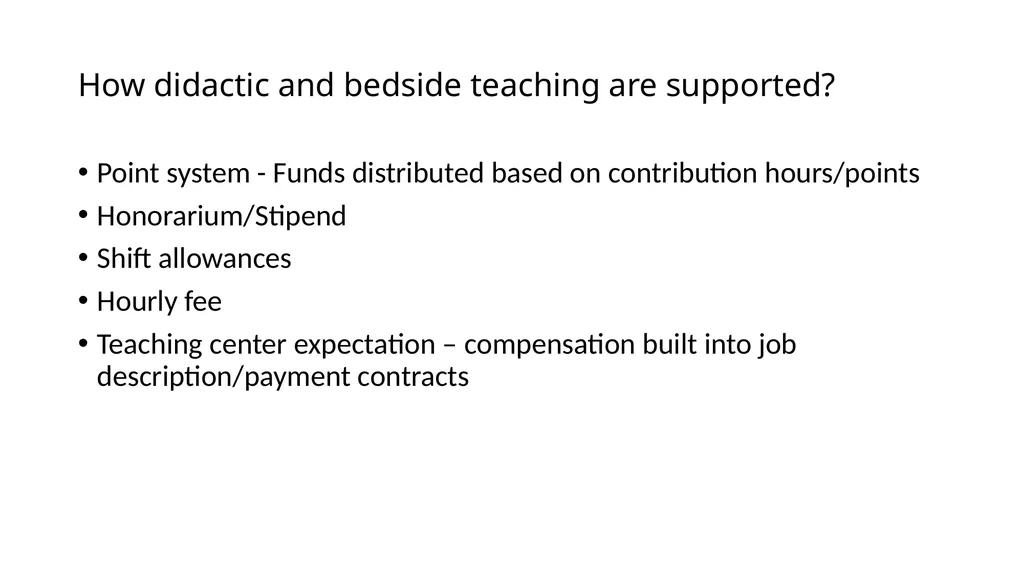
How didactic and bedside teaching are supported? Point system - Funds distributed based on contribution hours/points
Honorarium/Stipend
Shift allowances
Hourly fee
Teaching center expectation – compensation built into job description/payment contracts<br>
Honorarium/Stipend
Shift allowances
Hourly fee
Teaching center expectation – compensation built into job description/payment contracts<br>
27
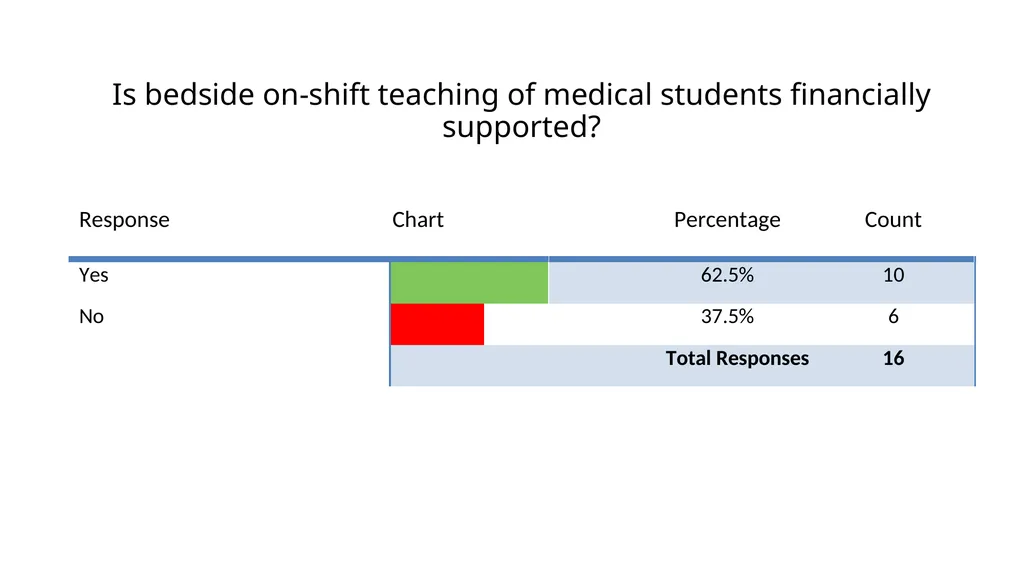
Is bedside on-shift teaching of medical students financially supported?<br>
28
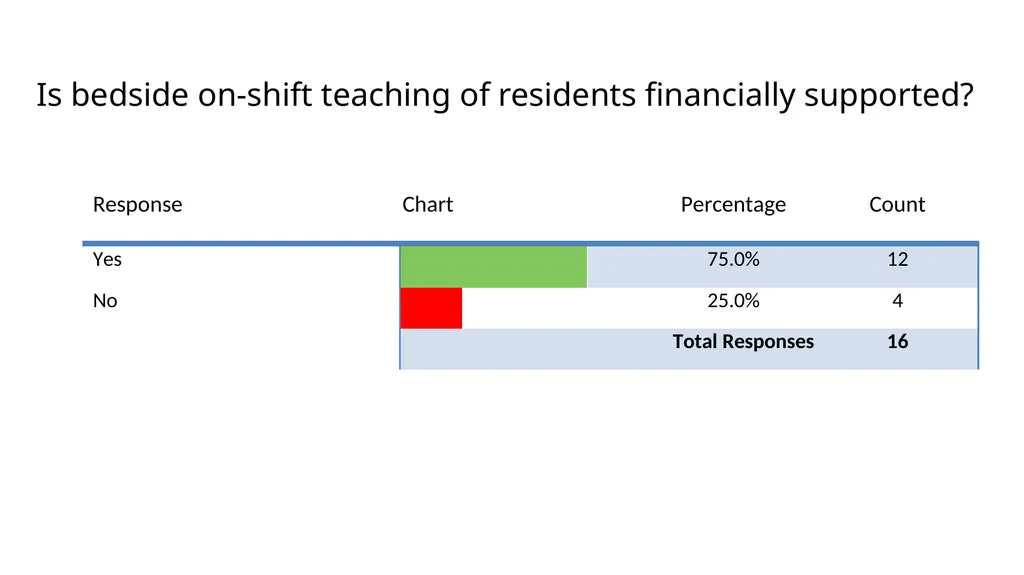
Is bedside on-shift teaching of residents financially supported?<br>
29
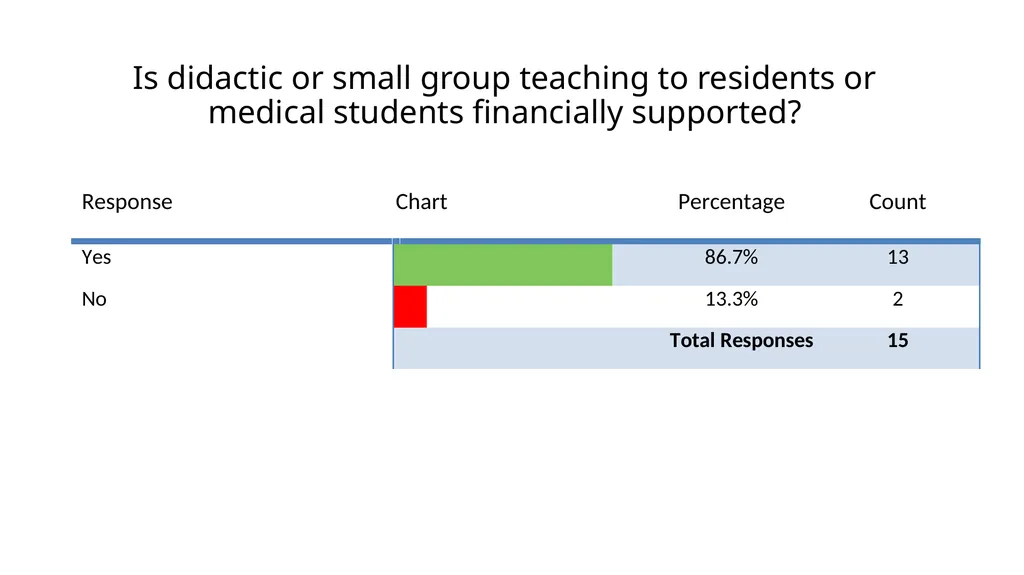
Is didactic or small group teaching to residents or medical students financially supported?<br>
30
University
Government funding - Department of Health, Minister of Health, Minster of Advanced Education for Medical Students.
AFP money
RAMQ (régie de l'assurance maladie du Québec)
PUPSR program (real and standardisez patients universitary program) Academic Funding Plan
PGME funds
AMOSO (MOH Ontario tithe plan)
RVG (Relative Value Guide – Manitoba) Source of funding for medical students and residents bed-side, didactic and/or small groups teaching<br>
Government funding - Department of Health, Minister of Health, Minster of Advanced Education for Medical Students.
AFP money
RAMQ (régie de l'assurance maladie du Québec)
PUPSR program (real and standardisez patients universitary program) Academic Funding Plan
PGME funds
AMOSO (MOH Ontario tithe plan)
RVG (Relative Value Guide – Manitoba) Source of funding for medical students and residents bed-side, didactic and/or small groups teaching<br>
31
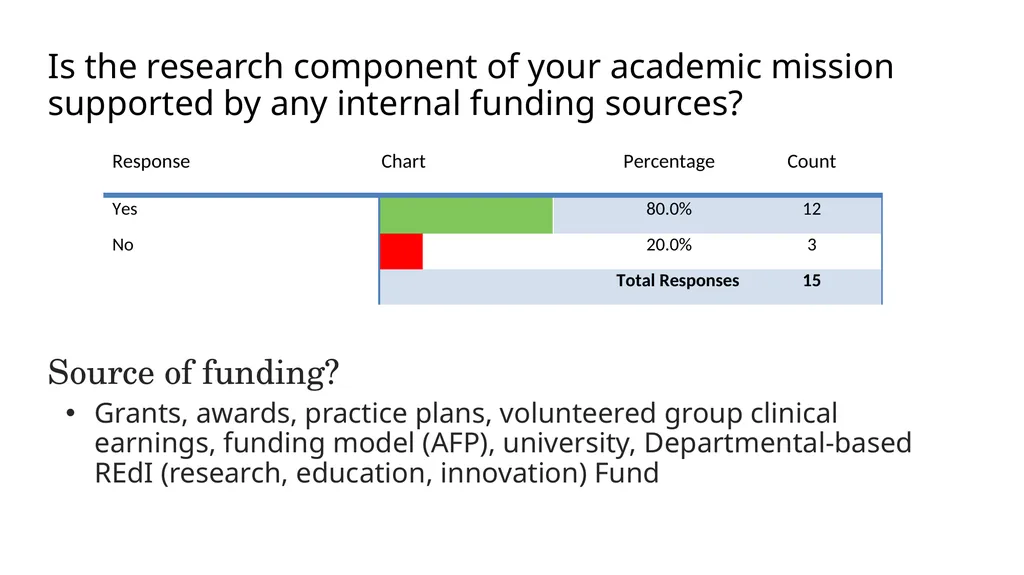
Is the research component of your academic mission supported by any internal funding sources? Source of funding? Grants, awards, practice plans, volunteered group clinical earnings, funding model (AFP), university, Departmental-based REdI (research, education, innovation) Fund<br>
32
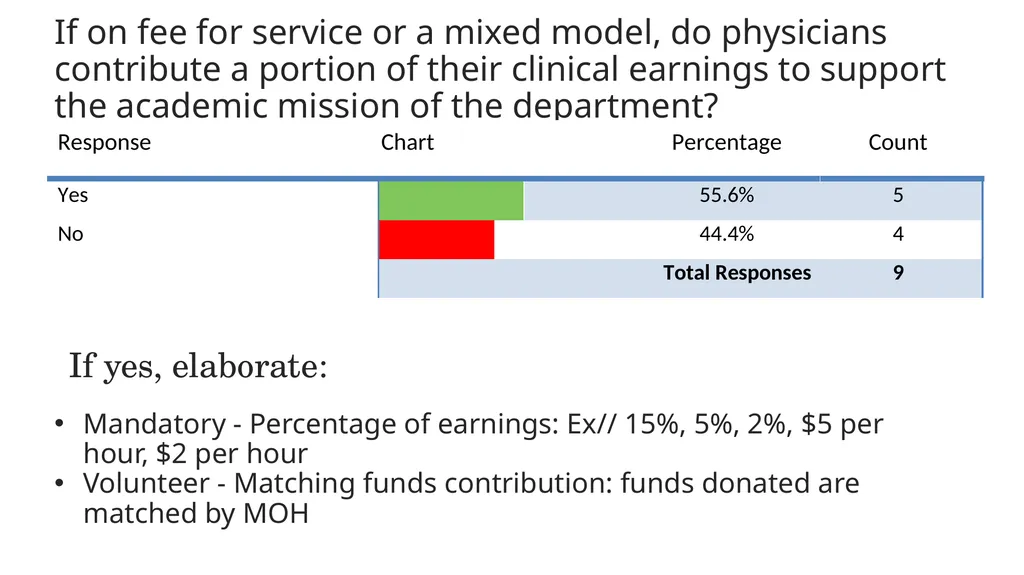
If yes, elaborate: If on fee for service or a mixed model, do physicians contribute a portion of their clinical earnings to support the academic mission of the department? Mandatory - Percentage of earnings: Ex// 15%, 5%, 2%, $5 per hour, $2 per hour
Volunteer - Matching funds contribution: funds donated are matched by MOH<br>
Volunteer - Matching funds contribution: funds donated are matched by MOH<br>
33
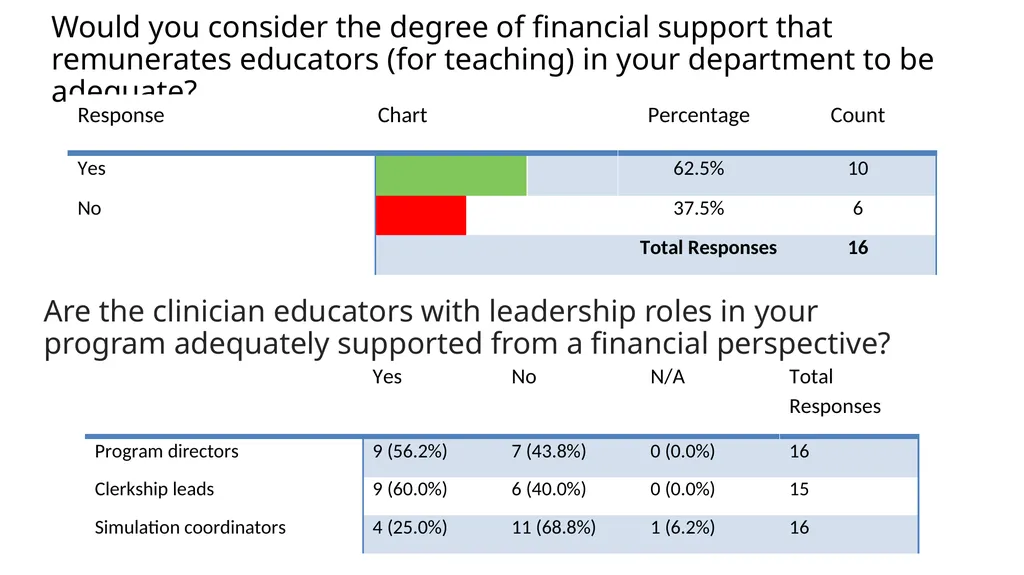
Would you consider the degree of financial support that remunerates educators (for teaching) in your department to be adequate? Are the clinician educators with leadership roles in your program adequately supported from a financial perspective?<br>
34
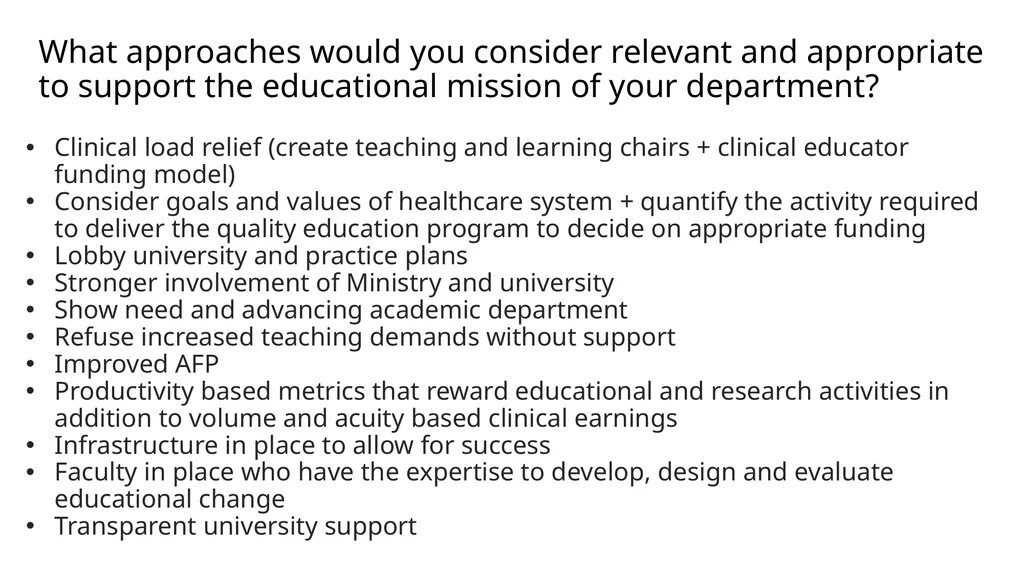
What approaches would you consider relevant and appropriate to support the educational mission of your department? Clinical load relief (create teaching and learning chairs + clinical educator funding model)
Consider goals and values of healthcare system + quantify the activity required to deliver the quality education program to decide on appropriate funding
Lobby university and practice plans
Stronger involvement of Ministry and university
Show need and advancing academic department
Refuse increased teaching demands without support
Improved AFP
Productivity based metrics that reward educational and research activities in addition to volume and acuity based clinical earnings
Infrastructure in place to allow for success
Faculty in place who have the expertise to develop, design and evaluate educational change
Transparent university support<br>
Consider goals and values of healthcare system + quantify the activity required to deliver the quality education program to decide on appropriate funding
Lobby university and practice plans
Stronger involvement of Ministry and university
Show need and advancing academic department
Refuse increased teaching demands without support
Improved AFP
Productivity based metrics that reward educational and research activities in addition to volume and acuity based clinical earnings
Infrastructure in place to allow for success
Faculty in place who have the expertise to develop, design and evaluate educational change
Transparent university support<br>
35
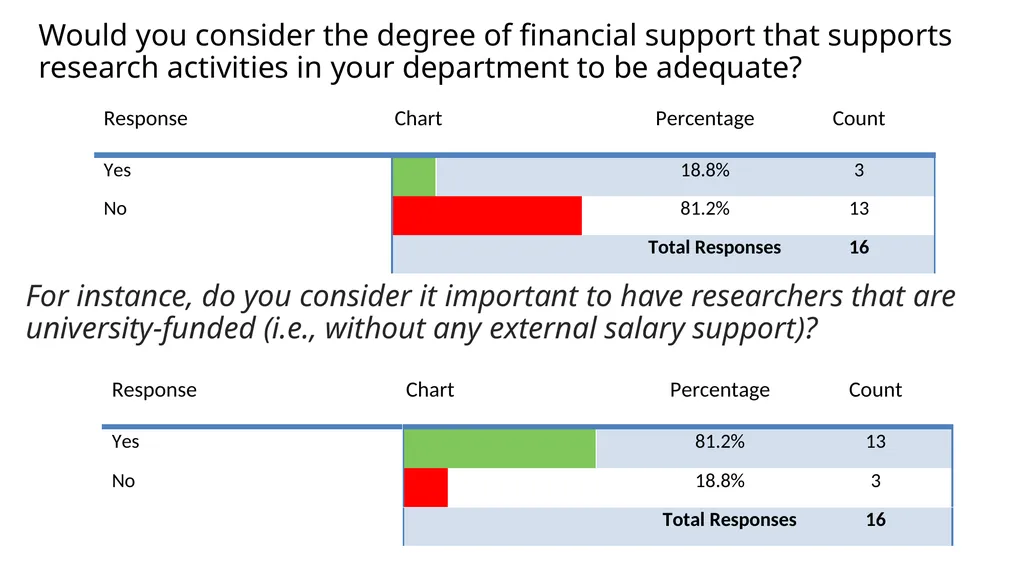
Would you consider the degree of financial support that supports research activities in your department to be adequate? For instance, do you consider it important to have researchers that are university-funded (i.e., without any external salary support)?<br>
36
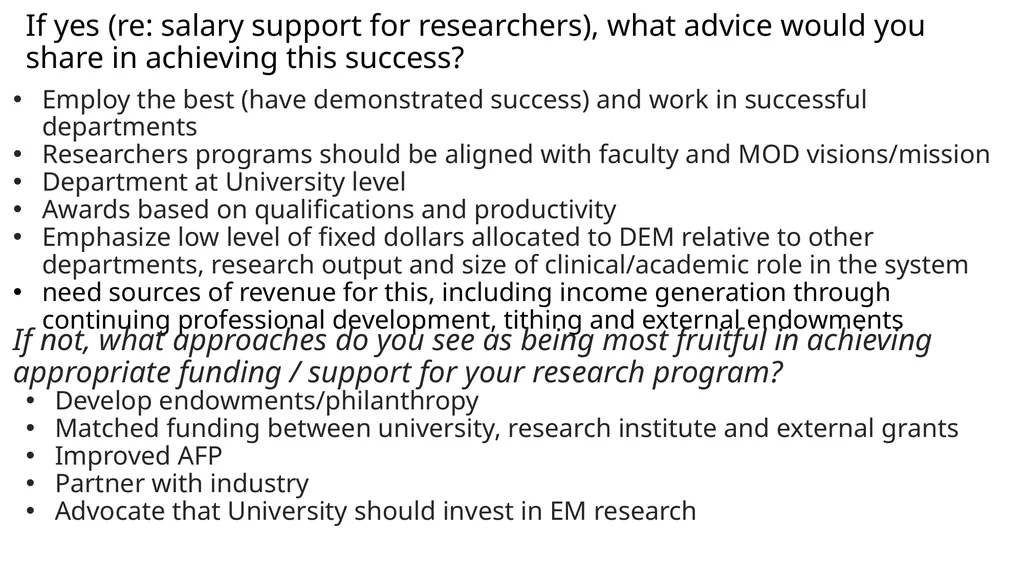
If yes (re: salary support for researchers), what advice would you share in achieving this success? Employ the best (have demonstrated success) and work in successful departments
Researchers programs should be aligned with faculty and MOD visions/mission
Department at University level
Awards based on qualifications and productivity
Emphasize low level of fixed dollars allocated to DEM relative to other departments, research output and size of clinical/academic role in the system
need sources of revenue for this, including income generation through continuing professional development, tithing and external endowments If not, what approaches do you see as being most fruitful in achieving appropriate funding / support for your research program? Develop endowments/philanthropy
Matched funding between university, research institute and external grants
Improved AFP
Partner with industry
Advocate that University should invest in EM research<br>
Researchers programs should be aligned with faculty and MOD visions/mission
Department at University level
Awards based on qualifications and productivity
Emphasize low level of fixed dollars allocated to DEM relative to other departments, research output and size of clinical/academic role in the system
need sources of revenue for this, including income generation through continuing professional development, tithing and external endowments If not, what approaches do you see as being most fruitful in achieving appropriate funding / support for your research program? Develop endowments/philanthropy
Matched funding between university, research institute and external grants
Improved AFP
Partner with industry
Advocate that University should invest in EM research<br>
37
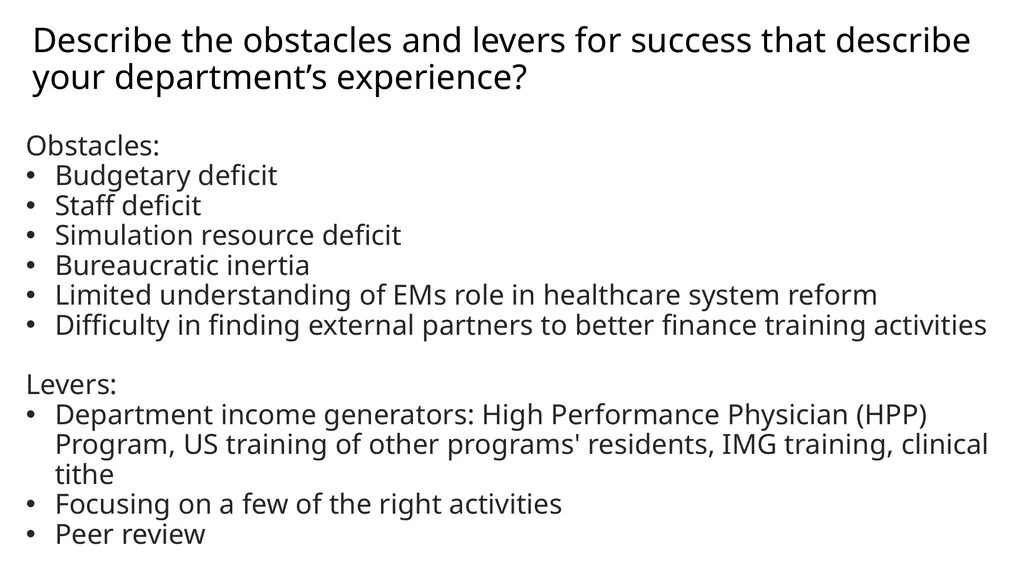
Describe the obstacles and levers for success that describe your department’s experience? Obstacles:
Budgetary deficit
Staff deficit
Simulation resource deficit
Bureaucratic inertia
Limited understanding of EMs role in healthcare system reform
Difficulty in finding external partners to better finance training activities
Levers:
Department income generators: High Performance Physician (HPP) Program, US training of other programs' residents, IMG training, clinical tithe
Focusing on a few of the right activities
Peer review<br>
Budgetary deficit
Staff deficit
Simulation resource deficit
Bureaucratic inertia
Limited understanding of EMs role in healthcare system reform
Difficulty in finding external partners to better finance training activities
Levers:
Department income generators: High Performance Physician (HPP) Program, US training of other programs' residents, IMG training, clinical tithe
Focusing on a few of the right activities
Peer review<br>
38
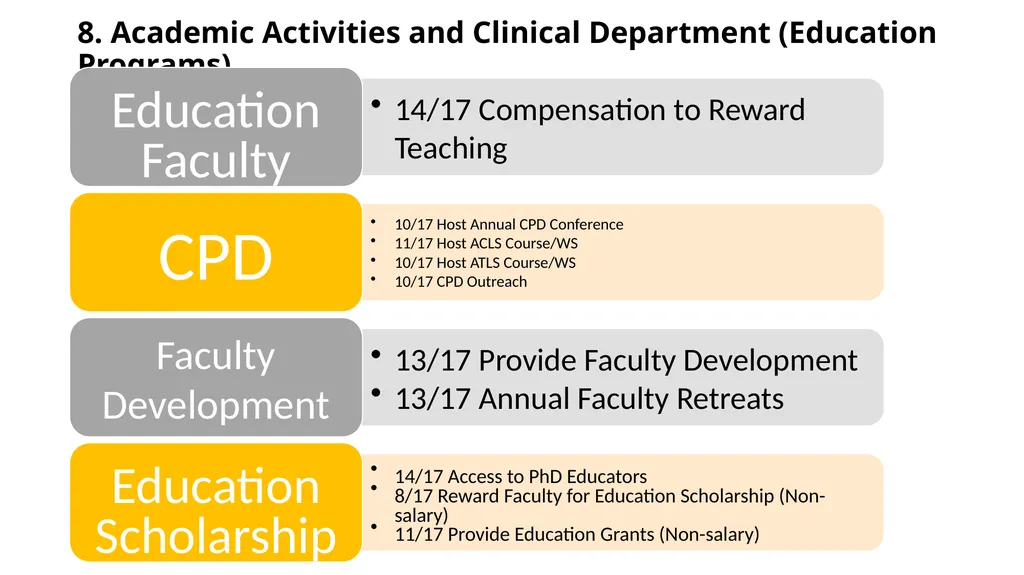
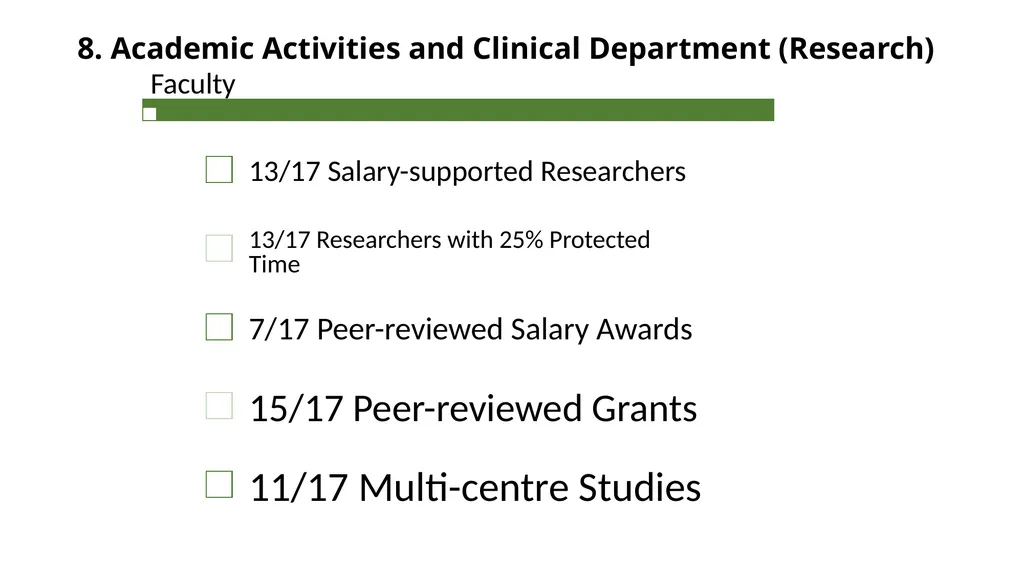
8. Academic activities need to bring value to the clinical department either through continuing medical education, faculty development or research that addresses clinical concerns if clinical income is sought to support the academic mission.<br>
39
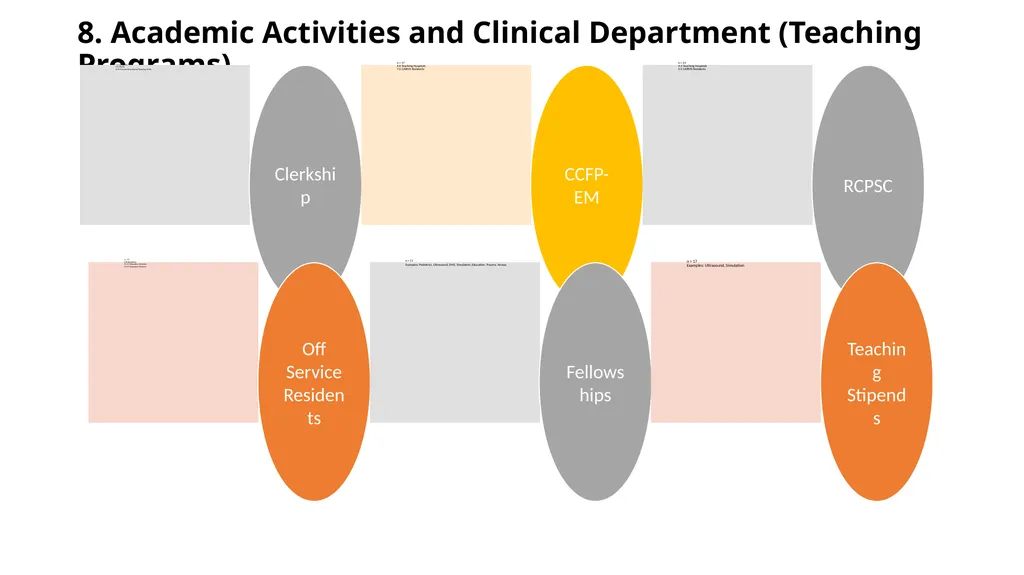
8. Academic Activities and Clinical Department (Teaching Programs)<br>
40
8. Academic Activities and Clinical Department (Education Programs)<br>
41
8. Academic Activities and Clinical Department (Research)<br>
42
9. Canadian Academic Department Heads should meet on an annual basis to share, network and grow. We found it useful
Other specialties in Canada do it
AACEM seems to be thriving – Canadian chapter?
Support staff / business managers involved as well<br>
Other specialties in Canada do it
AACEM seems to be thriving – Canadian chapter?
Support staff / business managers involved as well<br>
43
10. The CAEP annual meeting should offer a leadership track annually covering key funding-related topics that could include negotiating with the university, hospital and ministry, leveraging philanthropy, practice plans, entreprenership etc. Topic selection should be tied to a needs assessment drawn from engaged leaders and leaders in development.<br>