
CAMPBELL SHATLEY TITLE IX TRAINING Rules for the
GB
Published · 50 slides · 0 views

1 / 1




Description
CAMPBELL SHATLEY TITLE IX TRAINING Rules for the next two days Questions are encouraged! For the sake of argument questions help to challenge the group, consider other perspectives, and move the conversation forward. Be aware of your own
Related Topics
Share
Embed code
Download this presentation From Below
"CAMPBELL SHATLEY TITLE IX TRAINING Rules for the" is the property of its rightful owner. Permission is granted to download and print the materials on this website for personal, non-commercial use only, and to display it on your personal computer provided you do not modify the materials and that you retain all copyright notices contained in the materials. By downloading content from our website, you accept the terms of this agreement.
Presentation Transcript
01
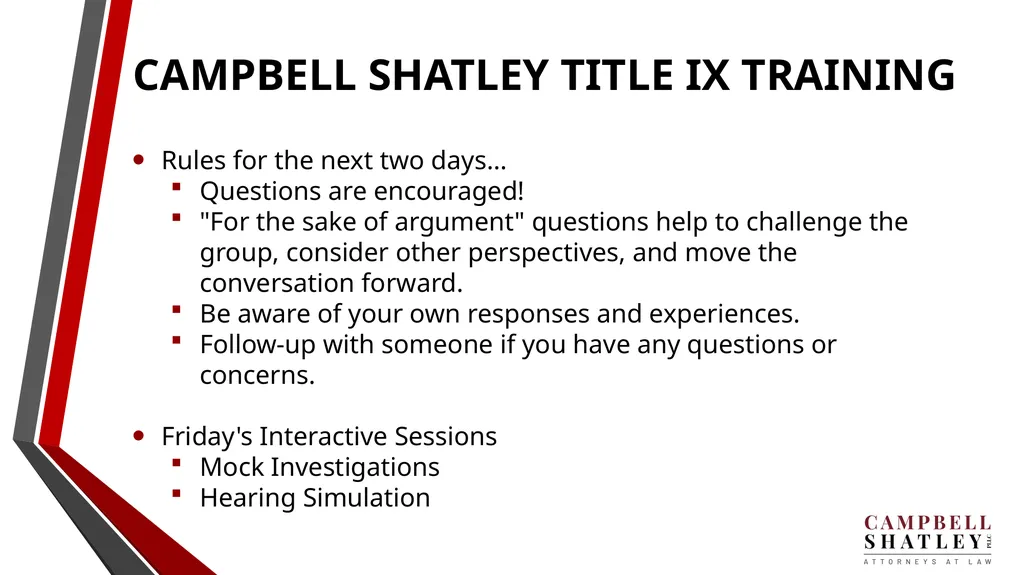
CAMPBELL SHATLEY TITLE IX TRAINING Rules for the next two days…
Questions are encouraged!
"For the sake of argument" questions help to challenge the group, consider other perspectives, and move the conversation forward.
Be aware of your own responses and experiences.
Follow-up with someone if you have any questions or concerns.
Friday's Interactive Sessions
Mock Investigations
Hearing Simulation<br>
Questions are encouraged!
"For the sake of argument" questions help to challenge the group, consider other perspectives, and move the conversation forward.
Be aware of your own responses and experiences.
Follow-up with someone if you have any questions or concerns.
Friday's Interactive Sessions
Mock Investigations
Hearing Simulation<br>
02
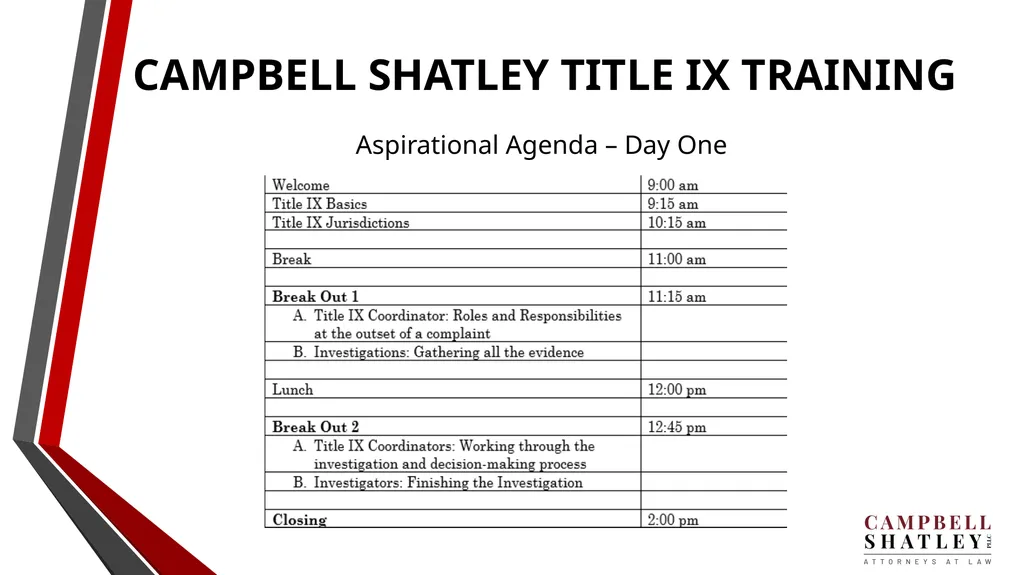
CAMPBELL SHATLEY TITLE IX TRAINING Aspirational Agenda – Day One<br>
03
COMMUNITY COLLEGE
TITLE IX TRAINING
FUNDAMENTALS AND JURISDICTION
November 30, 2023<br>
04
SECTION ONE TITLE IX
FUNDAMENTALS<br>
FUNDAMENTALS<br>
05
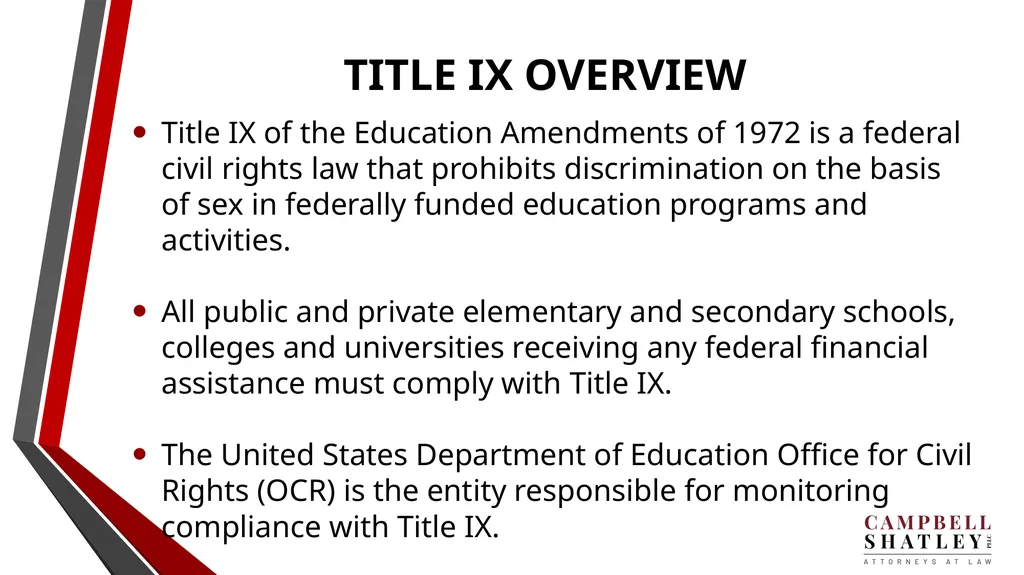
TITLE IX OVERVIEW Title IX of the Education Amendments of 1972 is a federal civil rights law that prohibits discrimination on the basis of sex in federally funded education programs and activities.
All public and private elementary and secondary schools, colleges and universities receiving any federal financial assistance must comply with Title IX.
The United States Department of Education Office for Civil Rights (OCR) is the entity responsible for monitoring compliance with Title IX.<br>
All public and private elementary and secondary schools, colleges and universities receiving any federal financial assistance must comply with Title IX.
The United States Department of Education Office for Civil Rights (OCR) is the entity responsible for monitoring compliance with Title IX.<br>
06
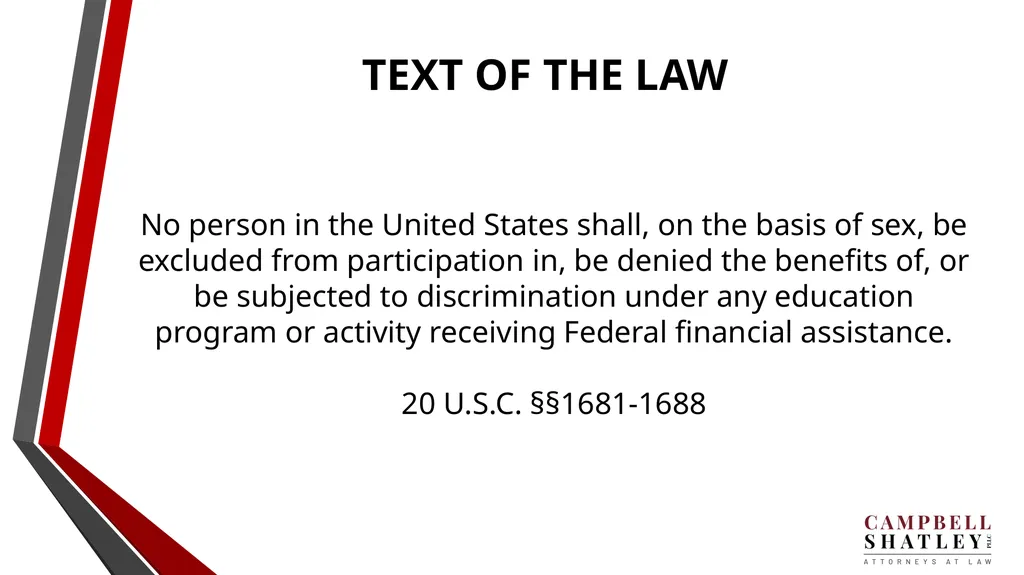
TEXT OF THE LAW No person in the United States shall, on the basis of sex, be excluded from participation in, be denied the benefits of, or be subjected to discrimination under any education program or activity receiving Federal financial assistance.
20 U.S.C. §§1681-1688<br>
20 U.S.C. §§1681-1688<br>
07
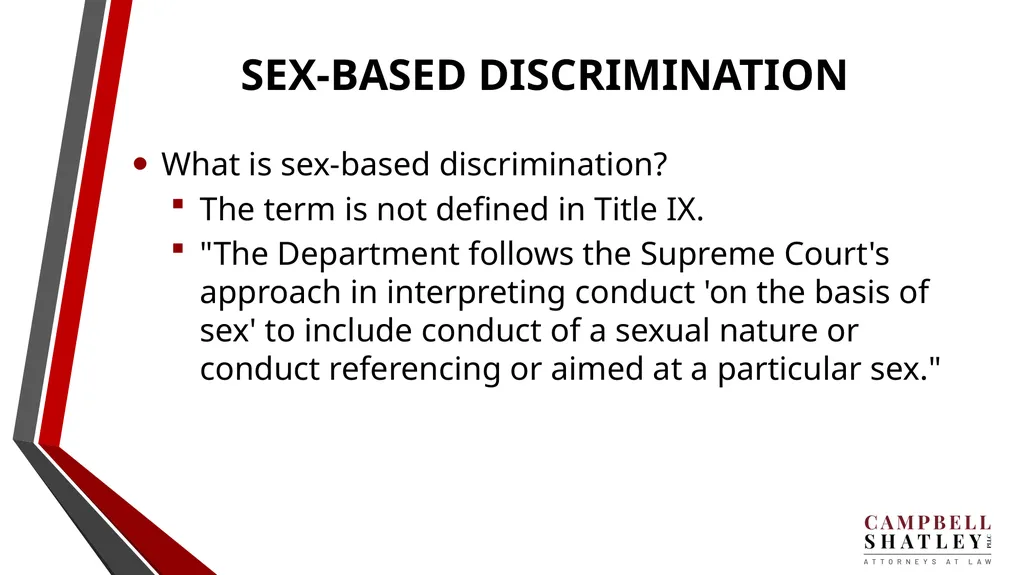
SEX-BASED DISCRIMINATION What is sex-based discrimination?
The term is not defined in Title IX.
"The Department follows the Supreme Court's approach in interpreting conduct 'on the basis of sex' to include conduct of a sexual nature or conduct referencing or aimed at a particular sex."<br>
The term is not defined in Title IX.
"The Department follows the Supreme Court's approach in interpreting conduct 'on the basis of sex' to include conduct of a sexual nature or conduct referencing or aimed at a particular sex."<br>
08
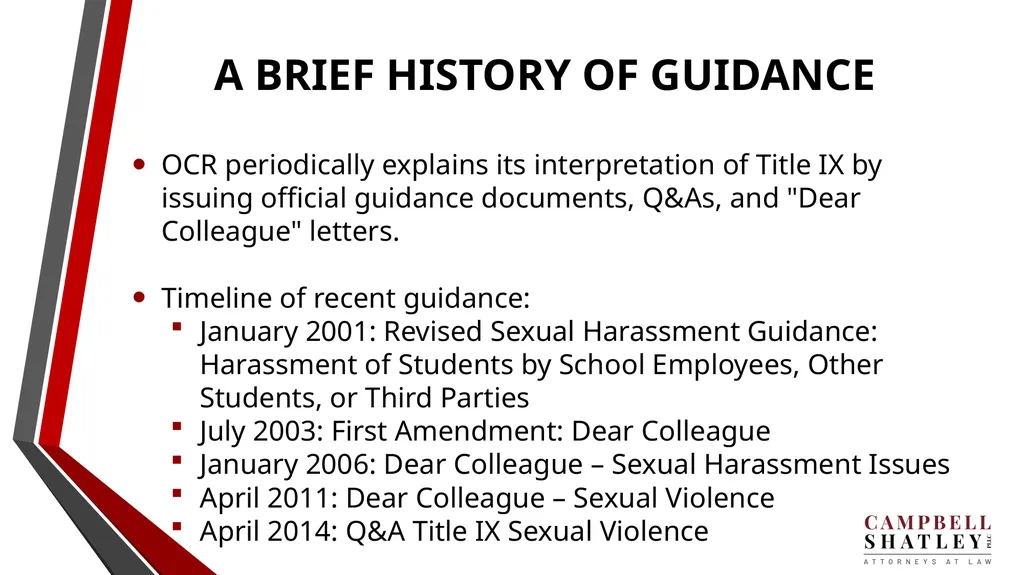
A BRIEF HISTORY OF GUIDANCE OCR periodically explains its interpretation of Title IX by issuing official guidance documents, Q&As, and "Dear Colleague" letters.
Timeline of recent guidance:
January 2001: Revised Sexual Harassment Guidance: Harassment of Students by School Employees, Other Students, or Third Parties
July 2003: First Amendment: Dear Colleague
January 2006: Dear Colleague – Sexual Harassment Issues
April 2011: Dear Colleague – Sexual Violence
April 2014: Q&A Title IX Sexual Violence<br>
Timeline of recent guidance:
January 2001: Revised Sexual Harassment Guidance: Harassment of Students by School Employees, Other Students, or Third Parties
July 2003: First Amendment: Dear Colleague
January 2006: Dear Colleague – Sexual Harassment Issues
April 2011: Dear Colleague – Sexual Violence
April 2014: Q&A Title IX Sexual Violence<br>
09
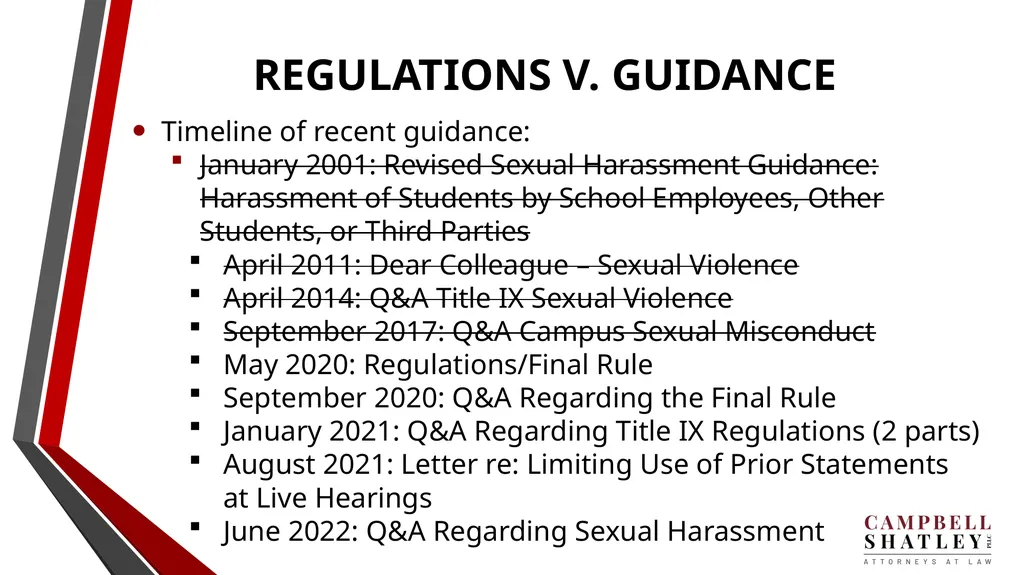
REGULATIONS V. GUIDANCE Timeline of recent guidance:
January 2001: Revised Sexual Harassment Guidance: Harassment of Students by School Employees, Other Students, or Third Parties
April 2011: Dear Colleague – Sexual Violence
April 2014: Q&A Title IX Sexual Violence
September 2017: Q&A Campus Sexual Misconduct
May 2020: Regulations/Final Rule
September 2020: Q&A Regarding the Final Rule
January 2021: Q&A Regarding Title IX Regulations (2 parts)
August 2021: Letter re: Limiting Use of Prior Statements at Live Hearings
June 2022: Q&A Regarding Sexual Harassment<br>
January 2001: Revised Sexual Harassment Guidance: Harassment of Students by School Employees, Other Students, or Third Parties
April 2011: Dear Colleague – Sexual Violence
April 2014: Q&A Title IX Sexual Violence
September 2017: Q&A Campus Sexual Misconduct
May 2020: Regulations/Final Rule
September 2020: Q&A Regarding the Final Rule
January 2021: Q&A Regarding Title IX Regulations (2 parts)
August 2021: Letter re: Limiting Use of Prior Statements at Live Hearings
June 2022: Q&A Regarding Sexual Harassment<br>
10
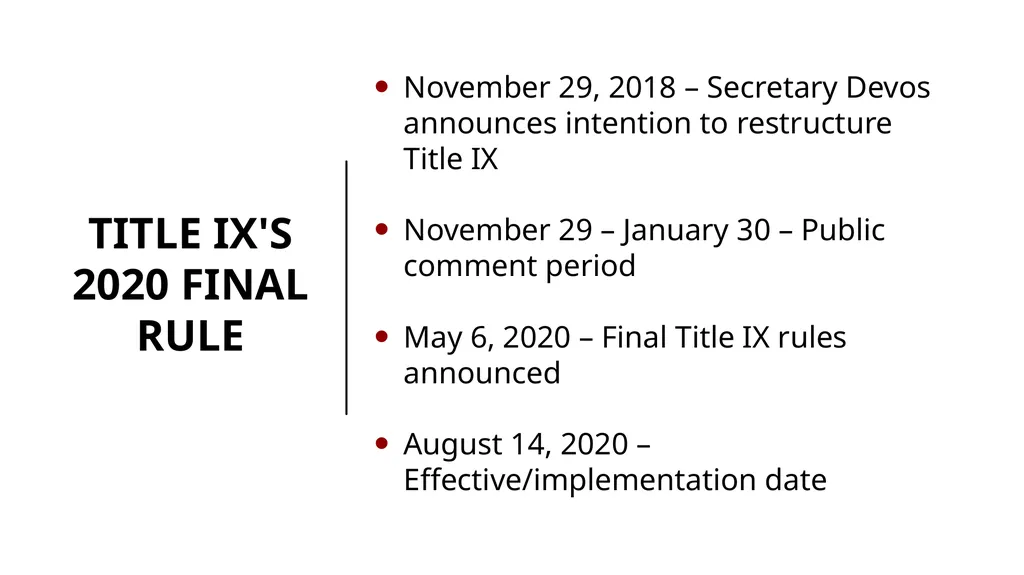
TITLE IX'S 2020 FINAL RULE November 29, 2018 – Secretary Devos announces intention to restructure
Title IX
November 29 – January 30 – Public comment period
May 6, 2020 – Final Title IX rules announced
August 14, 2020 – Effective/implementation date<br>
Title IX
November 29 – January 30 – Public comment period
May 6, 2020 – Final Title IX rules announced
August 14, 2020 – Effective/implementation date<br>
11
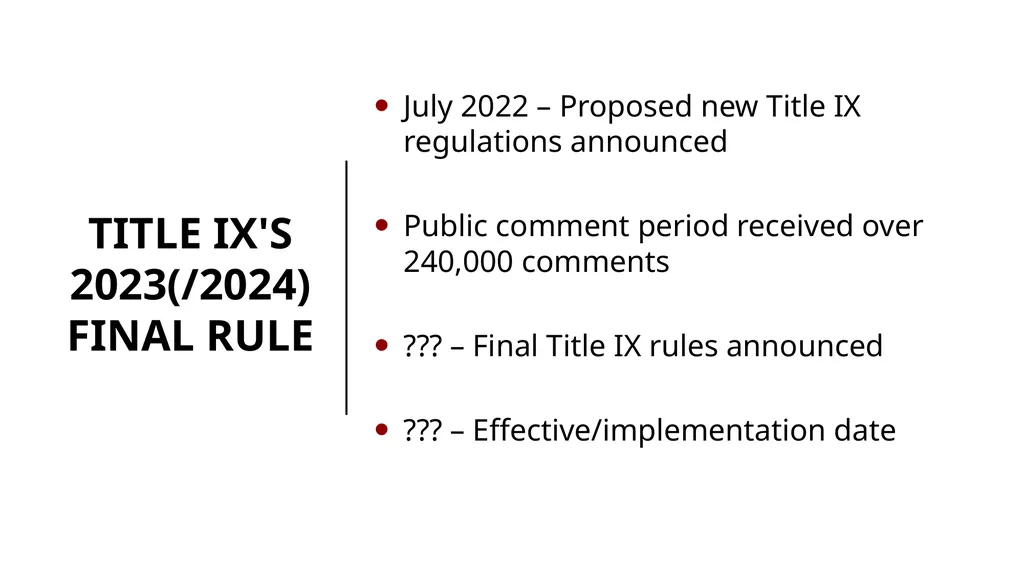
TITLE IX'S 2023(/2024) FINAL RULE July 2022 – Proposed new Title IX regulations announced
Public comment period received over 240,000 comments
??? – Final Title IX rules announced
??? – Effective/implementation date<br>
Public comment period received over 240,000 comments
??? – Final Title IX rules announced
??? – Effective/implementation date<br>
12
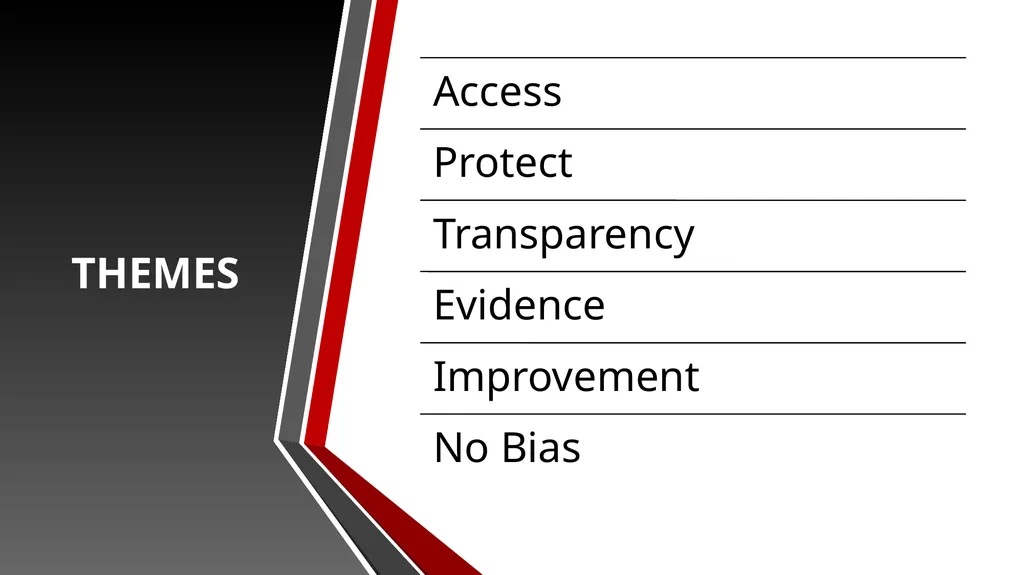
THEMES<br>
13
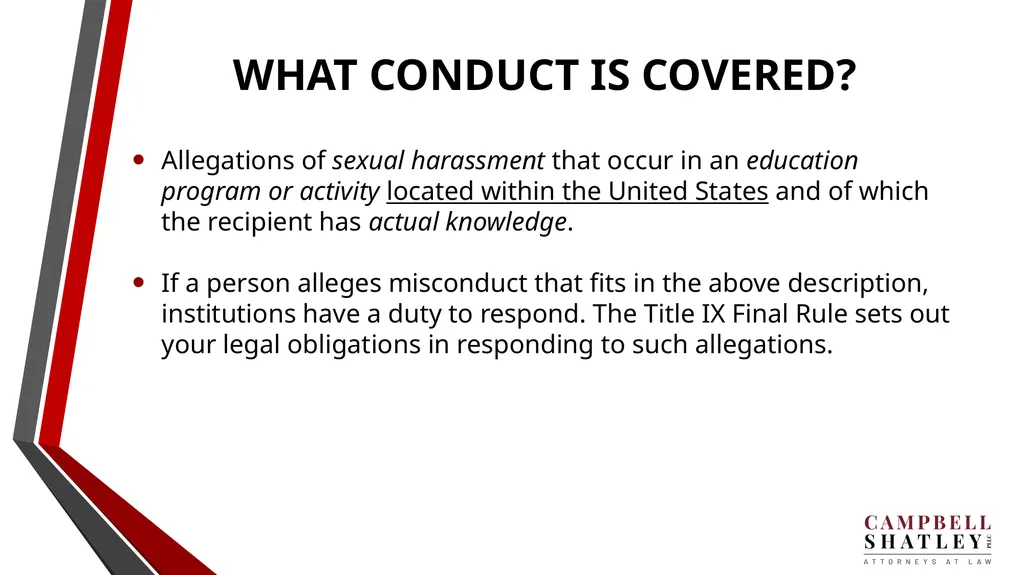
WHAT CONDUCT IS COVERED? Allegations of sexual harassment that occur in an education program or activity located within the United States and of which the recipient has actual knowledge.
If a person alleges misconduct that fits in the above description, institutions have a duty to respond. The Title IX Final Rule sets out your legal obligations in responding to such allegations.<br>
If a person alleges misconduct that fits in the above description, institutions have a duty to respond. The Title IX Final Rule sets out your legal obligations in responding to such allegations.<br>
14
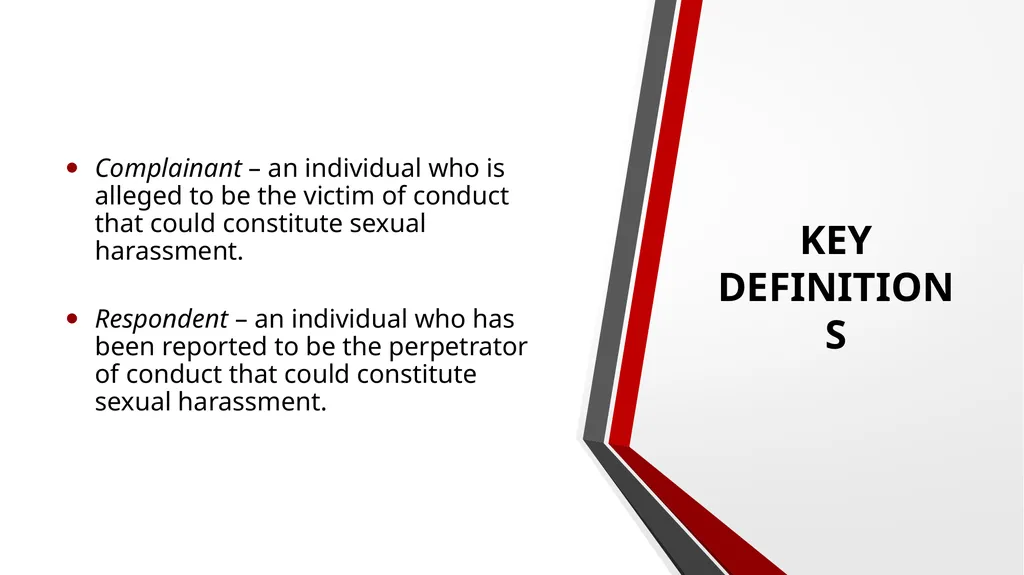
KEY DEFINITIONS Complainant – an individual who is alleged to be the victim of conduct that could constitute sexual harassment.
Respondent – an individual who has been reported to be the perpetrator of conduct that could constitute sexual harassment.<br>
Respondent – an individual who has been reported to be the perpetrator of conduct that could constitute sexual harassment.<br>
15
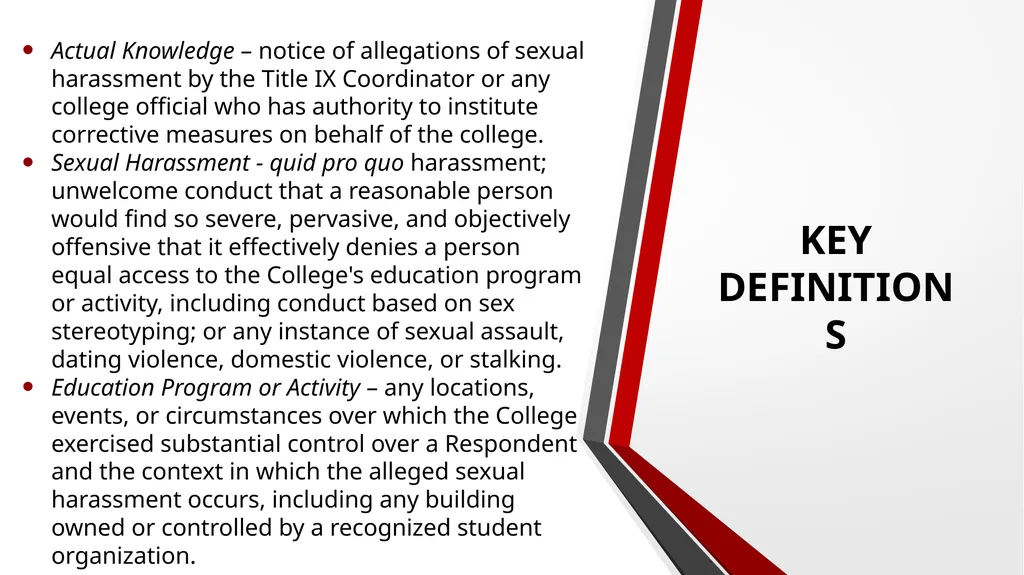
KEY DEFINITIONS Actual Knowledge – notice of allegations of sexual harassment by the Title IX Coordinator or any college official who has authority to institute corrective measures on behalf of the college.
Sexual Harassment - quid pro quo harassment; unwelcome conduct that a reasonable person would find so severe, pervasive, and objectively offensive that it effectively denies a person equal access to the College's education program or activity, including conduct based on sex stereotyping; or any instance of sexual assault, dating violence, domestic violence, or stalking.
Education Program or Activity – any locations, events, or circumstances over which the College exercised substantial control over a Respondent and the context in which the alleged sexual harassment occurs, including any building owned or controlled by a recognized student organization.<br>
Sexual Harassment - quid pro quo harassment; unwelcome conduct that a reasonable person would find so severe, pervasive, and objectively offensive that it effectively denies a person equal access to the College's education program or activity, including conduct based on sex stereotyping; or any instance of sexual assault, dating violence, domestic violence, or stalking.
Education Program or Activity – any locations, events, or circumstances over which the College exercised substantial control over a Respondent and the context in which the alleged sexual harassment occurs, including any building owned or controlled by a recognized student organization.<br>
16
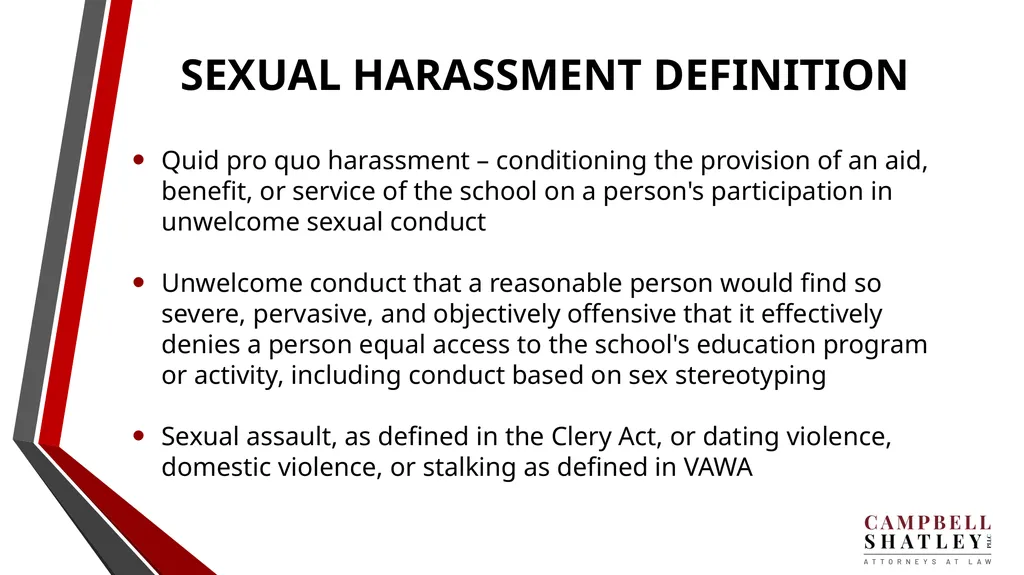
SEXUAL HARASSMENT DEFINITION Quid pro quo harassment – conditioning the provision of an aid, benefit, or service of the school on a person's participation in unwelcome sexual conduct
Unwelcome conduct that a reasonable person would find so severe, pervasive, and objectively offensive that it effectively denies a person equal access to the school's education program or activity, including conduct based on sex stereotyping
Sexual assault, as defined in the Clery Act, or dating violence, domestic violence, or stalking as defined in VAWA<br>
Unwelcome conduct that a reasonable person would find so severe, pervasive, and objectively offensive that it effectively denies a person equal access to the school's education program or activity, including conduct based on sex stereotyping
Sexual assault, as defined in the Clery Act, or dating violence, domestic violence, or stalking as defined in VAWA<br>
17
SEXUAL HARASSMENT: QUID PRO QUO<br>
18
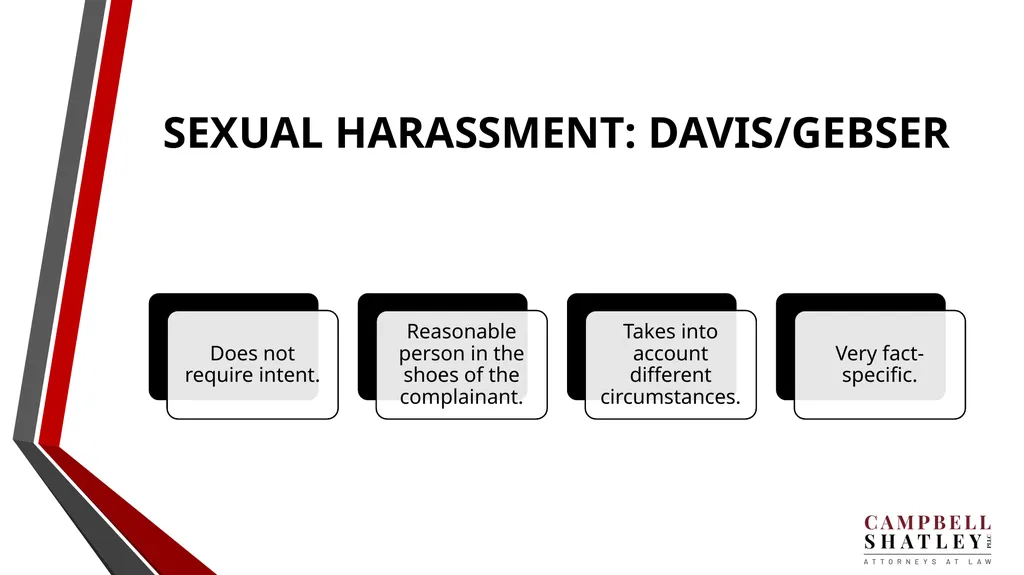
SEXUAL HARASSMENT: DAVIS/GEBSER<br>
19
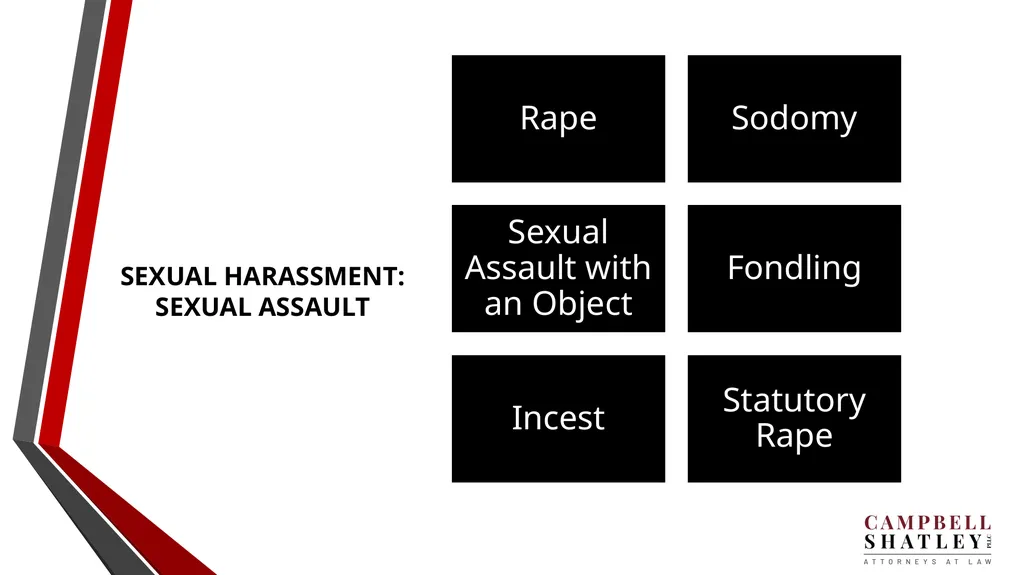
SEXUAL HARASSMENT: SEXUAL ASSAULT<br>
20
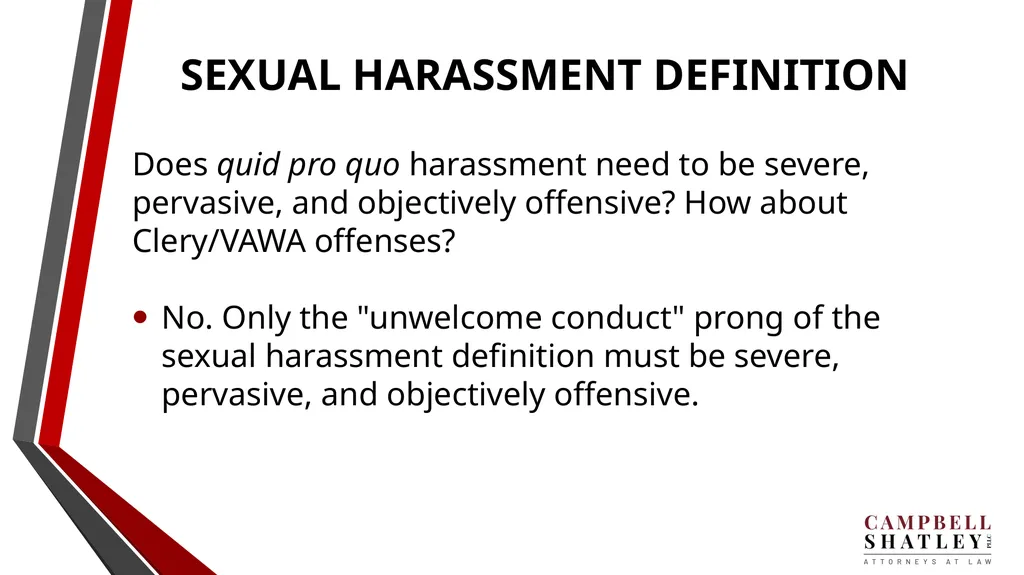
SEXUAL HARASSMENT DEFINITION Does quid pro quo harassment need to be severe, pervasive, and objectively offensive? How about Clery/VAWA offenses?
No. Only the "unwelcome conduct" prong of the sexual harassment definition must be severe, pervasive, and objectively offensive.<br>
No. Only the "unwelcome conduct" prong of the sexual harassment definition must be severe, pervasive, and objectively offensive.<br>
21
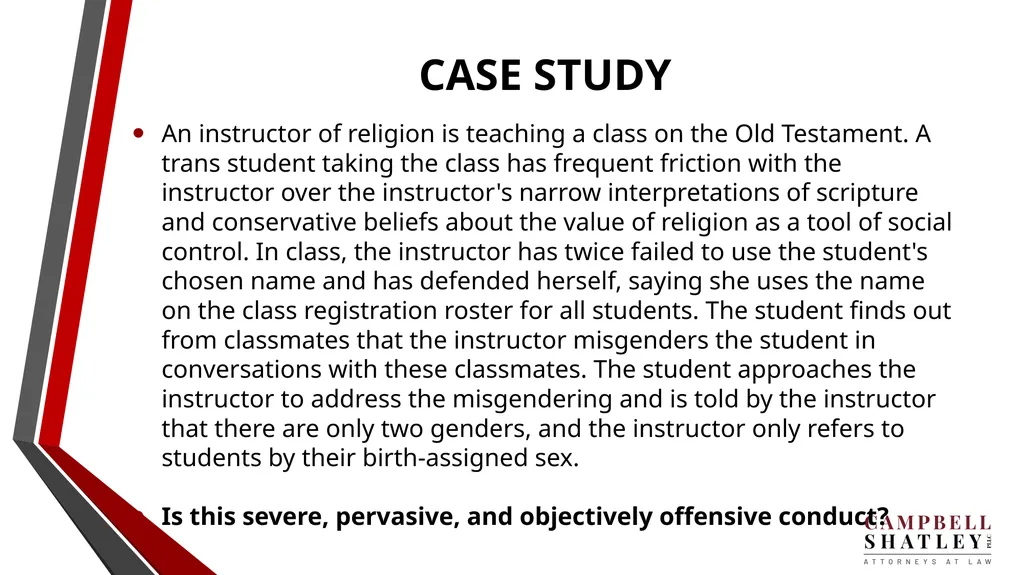
CASE STUDY An instructor of religion is teaching a class on the Old Testament. A trans student taking the class has frequent friction with the instructor over the instructor's narrow interpretations of scripture and conservative beliefs about the value of religion as a tool of social control. In class, the instructor has twice failed to use the student's chosen name and has defended herself, saying she uses the name on the class registration roster for all students. The student finds out from classmates that the instructor misgenders the student in conversations with these classmates. The student approaches the instructor to address the misgendering and is told by the instructor that there are only two genders, and the instructor only refers to students by their birth-assigned sex.
Is this severe, pervasive, and objectively offensive conduct?<br>
Is this severe, pervasive, and objectively offensive conduct?<br>
22
CASE STUDY Eleanor waited for the elevator on the third floor of the health building. As the elevator reached the third floor, the doors opened, revealing a flasher and his penis. The doors closed and Eleanor decided to take the stairs down. She has complained this exposure was sexual harassment. The flasher, a non-student, was arrested and barred from campus.
Is this severe, pervasive, and objectively offensive conduct?<br>
Is this severe, pervasive, and objectively offensive conduct?<br>
23
CASE STUDY An Early College student stated that a male college student approached her on campus, and they exchanged phone numbers because he was interested in study materials and outlines for a class. She said they texted a bit, he asked if she was single, and she told him she was interested in being just friends. They walked out of school together at the end of the day and when they got in their vehicles, she said he cornered her between his body and her car door and she said he "grabbed my face and shoved his tongue down my throat forcefully."
Is this severe, pervasive, and objectively offensive conduct?<br>
Is this severe, pervasive, and objectively offensive conduct?<br>
24
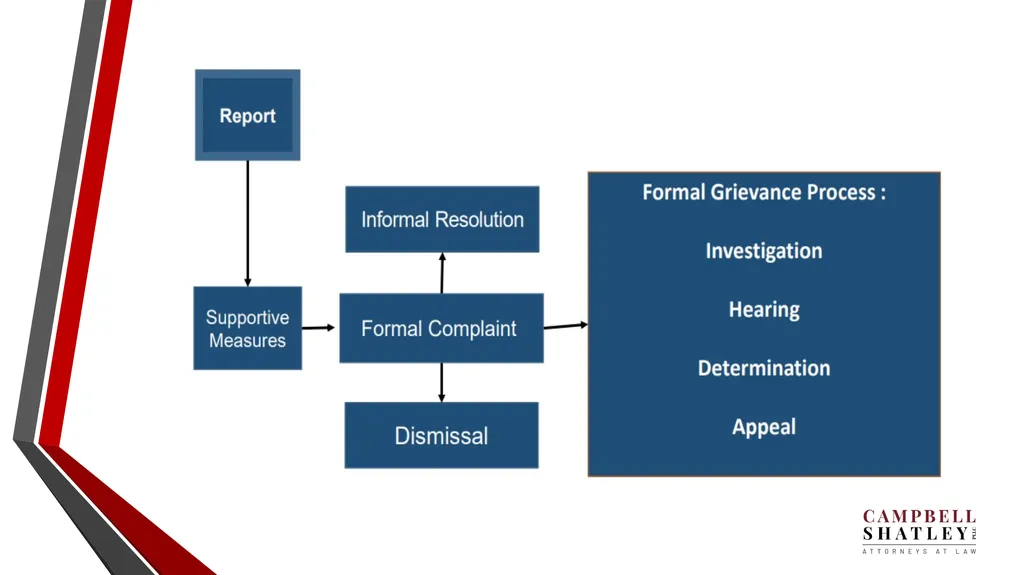
OVERVIEW OF THE PROCESS:
FORMAL COMPLAINT A document filed by a complainant or signed by the Title IX Coordinator alleging sexual harassment against a respondent and requesting the College investigate allegations of sexual harassment.
In response to a Formal Complaint, the College must follow a grievance process.<br>
In response to a Formal Complaint, the College must follow a grievance process.<br>
25
OVERVIEW OF THE PROCESS:
NOTICE OF ALLEGATIONS A document written by the Title IX Coordinator and sent to the complainant and respondent that provides notice of the sexual harassment allegations and the College's grievance process.
Must give the parties sufficient time to review the Notice before scheduling investigation interviews.
Must send an additional notification to the parties if new allegations arise during the investigation.<br>
Must give the parties sufficient time to review the Notice before scheduling investigation interviews.
Must send an additional notification to the parties if new allegations arise during the investigation.<br>
26
OVERVIEW OF THE PROCESS:
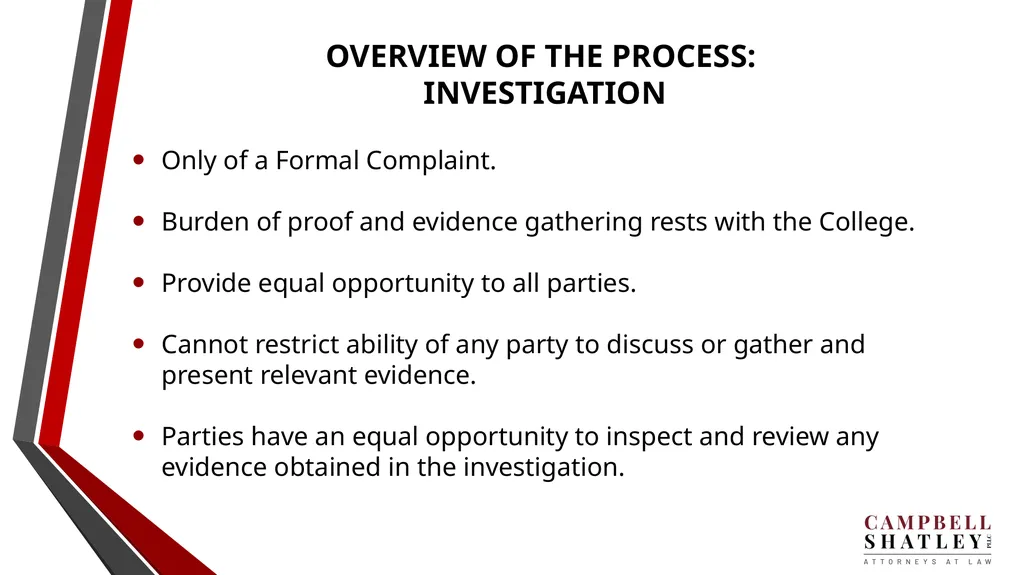
INVESTIGATION Only of a Formal Complaint.
Burden of proof and evidence gathering rests with the College.
Provide equal opportunity to all parties.
Cannot restrict ability of any party to discuss or gather and present relevant evidence.
Parties have an equal opportunity to inspect and review any evidence obtained in the investigation.<br>
Burden of proof and evidence gathering rests with the College.
Provide equal opportunity to all parties.
Cannot restrict ability of any party to discuss or gather and present relevant evidence.
Parties have an equal opportunity to inspect and review any evidence obtained in the investigation.<br>
27
OVERVIEW OF THE PROCESS:
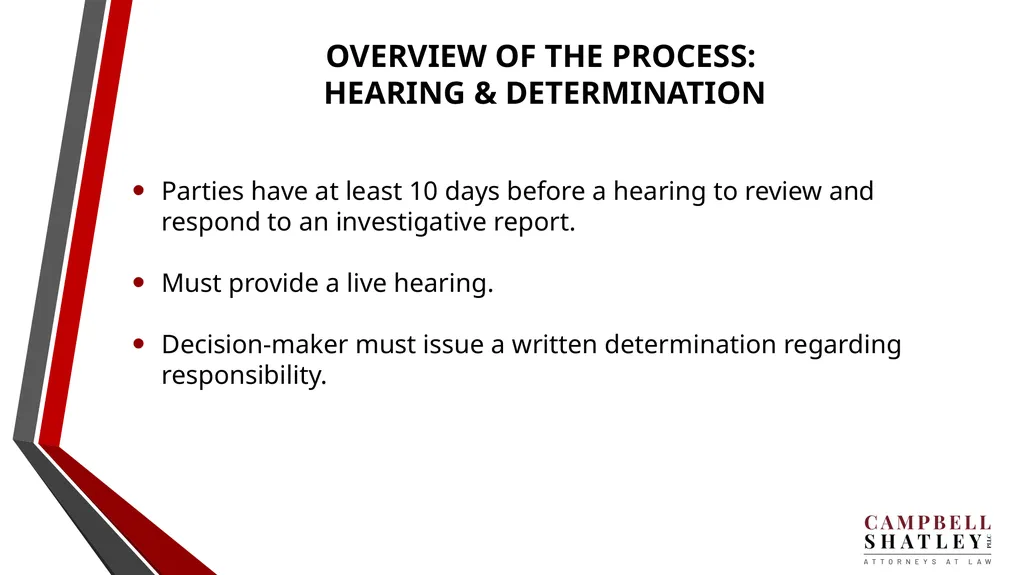
HEARING & DETERMINATION Parties have at least 10 days before a hearing to review and respond to an investigative report.
Must provide a live hearing.
Decision-maker must issue a written determination regarding responsibility.<br>
Must provide a live hearing.
Decision-maker must issue a written determination regarding responsibility.<br>
28
OVERVIEW OF THE PROCESS:
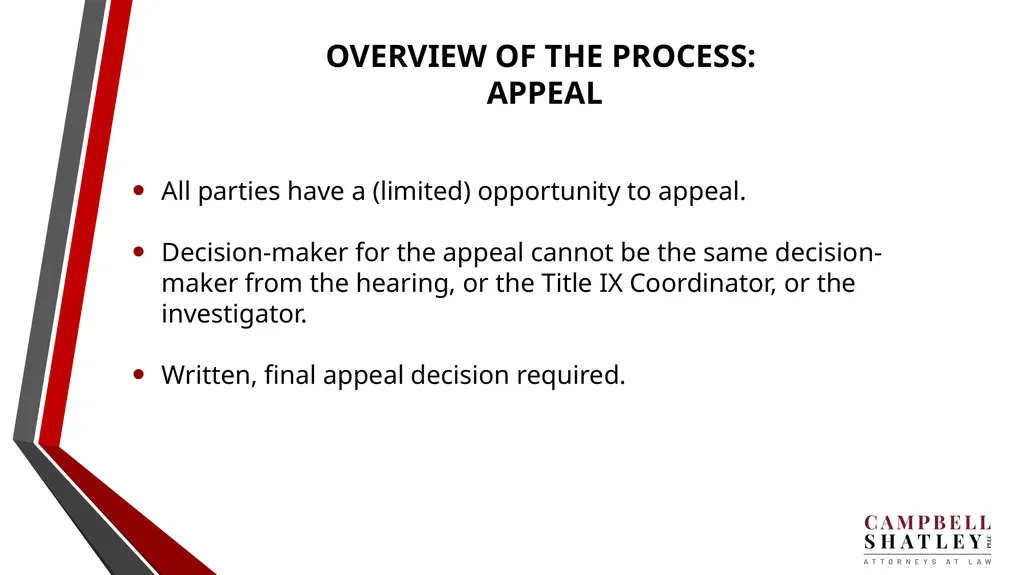
APPEAL All parties have a (limited) opportunity to appeal.
Decision-maker for the appeal cannot be the same decision-maker from the hearing, or the Title IX Coordinator, or the investigator.
Written, final appeal decision required.<br>
Decision-maker for the appeal cannot be the same decision-maker from the hearing, or the Title IX Coordinator, or the investigator.
Written, final appeal decision required.<br>
29
SECTION TWO TITLE IX
JURISDICTION<br>
JURISDICTION<br>
30
SCOPE: EDUCATION PROGRAM
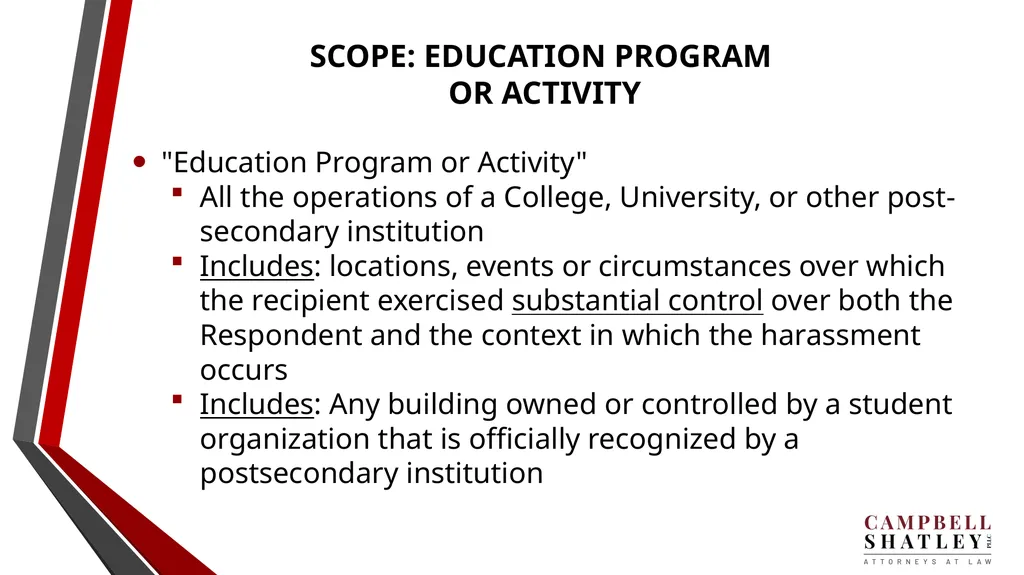
OR ACTIVITY "Education Program or Activity"
All the operations of a College, University, or other post-secondary institution
Includes: locations, events or circumstances over which the recipient exercised substantial control over both the Respondent and the context in which the harassment occurs
Includes: Any building owned or controlled by a student organization that is officially recognized by a postsecondary institution<br>
All the operations of a College, University, or other post-secondary institution
Includes: locations, events or circumstances over which the recipient exercised substantial control over both the Respondent and the context in which the harassment occurs
Includes: Any building owned or controlled by a student organization that is officially recognized by a postsecondary institution<br>
31
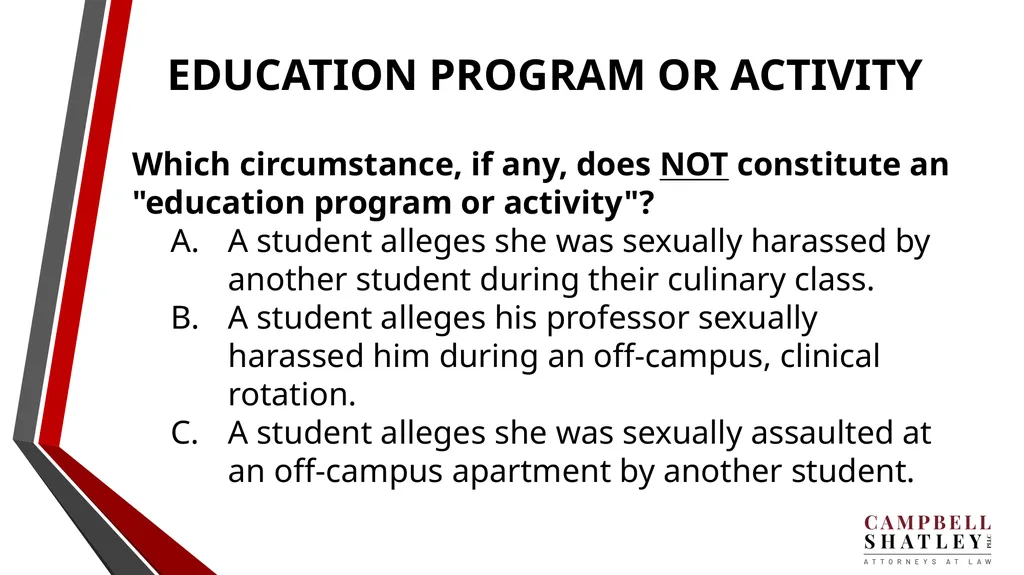
EDUCATION PROGRAM OR ACTIVITY Which circumstance, if any, does NOT constitute an "education program or activity"?
A. A student alleges she was sexually harassed by another student during their culinary class.
B. A student alleges his professor sexually harassed him during an off-campus, clinical rotation.
C. A student alleges she was sexually assaulted at an off-campus apartment by another student.<br>
A. A student alleges she was sexually harassed by another student during their culinary class.
B. A student alleges his professor sexually harassed him during an off-campus, clinical rotation.
C. A student alleges she was sexually assaulted at an off-campus apartment by another student.<br>
32
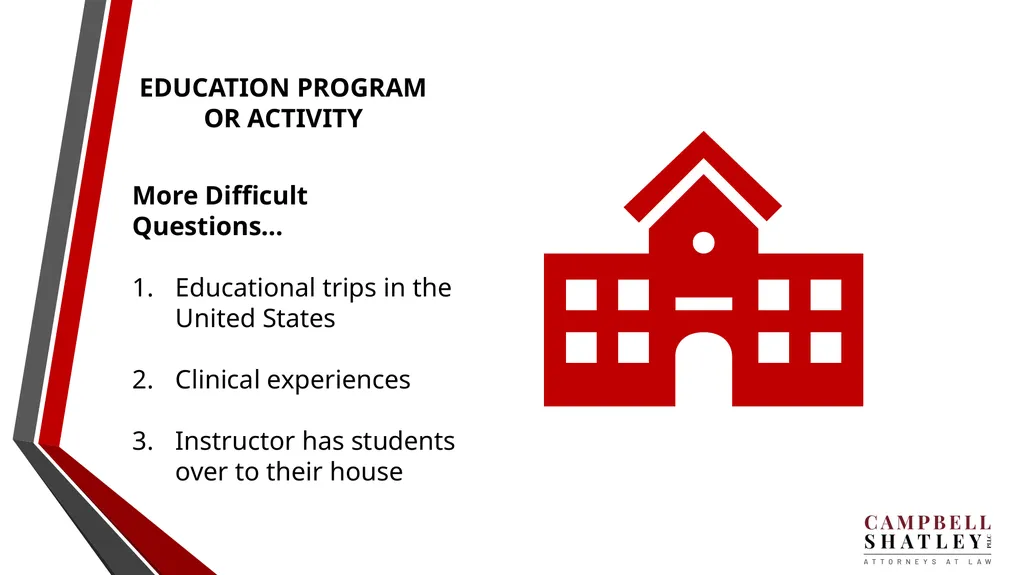
EDUCATION PROGRAM OR ACTIVITY More Difficult Questions…
Educational trips in the United States
Clinical experiences
Instructor has students over to their house<br>
Educational trips in the United States
Clinical experiences
Instructor has students over to their house<br>
33
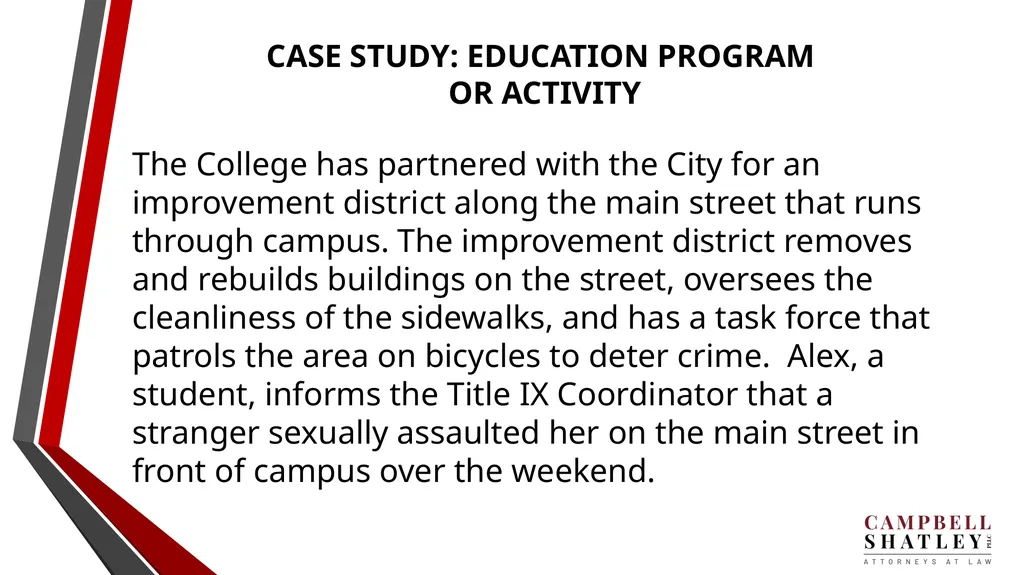
CASE STUDY: EDUCATION PROGRAM
OR ACTIVITY The College has partnered with the City for an improvement district along the main street that runs through campus. The improvement district removes and rebuilds buildings on the street, oversees the cleanliness of the sidewalks, and has a task force that patrols the area on bicycles to deter crime. Alex, a student, informs the Title IX Coordinator that a stranger sexually assaulted her on the main street in front of campus over the weekend.<br>
34
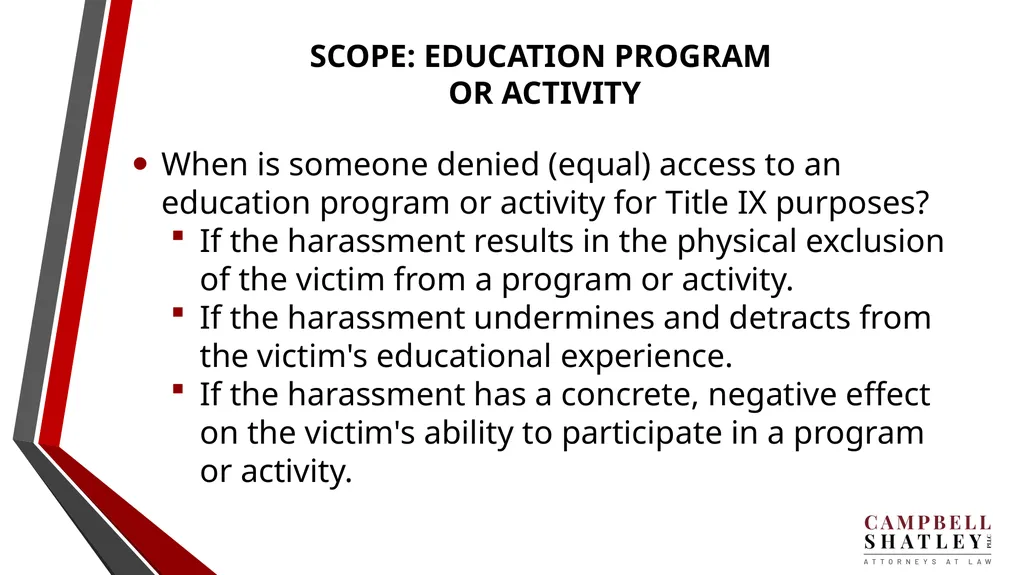
SCOPE: EDUCATION PROGRAM
OR ACTIVITY When is someone denied (equal) access to an education program or activity for Title IX purposes?
If the harassment results in the physical exclusion of the victim from a program or activity.
If the harassment undermines and detracts from the victim's educational experience.
If the harassment has a concrete, negative effect on the victim's ability to participate in a program or activity.<br>
If the harassment results in the physical exclusion of the victim from a program or activity.
If the harassment undermines and detracts from the victim's educational experience.
If the harassment has a concrete, negative effect on the victim's ability to participate in a program or activity.<br>
35
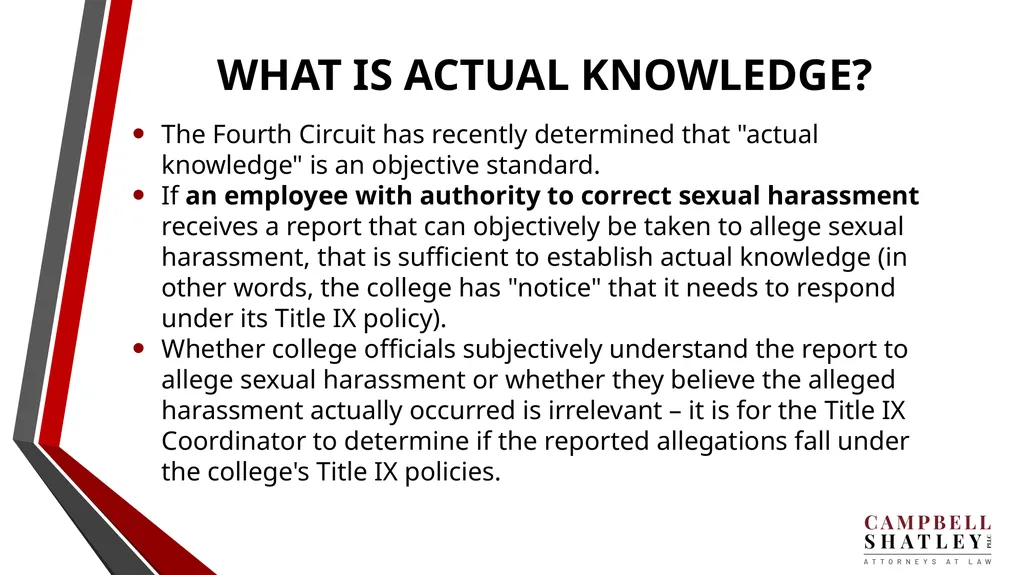
WHAT IS ACTUAL KNOWLEDGE? The Fourth Circuit has recently determined that "actual knowledge" is an objective standard.
If an employee with authority to correct sexual harassment receives a report that can objectively be taken to allege sexual harassment, that is sufficient to establish actual knowledge (in other words, the college has "notice" that it needs to respond under its Title IX policy).
Whether college officials subjectively understand the report to allege sexual harassment or whether they believe the alleged harassment actually occurred is irrelevant – it is for the Title IX Coordinator to determine if the reported allegations fall under the college's Title IX policies.<br>
If an employee with authority to correct sexual harassment receives a report that can objectively be taken to allege sexual harassment, that is sufficient to establish actual knowledge (in other words, the college has "notice" that it needs to respond under its Title IX policy).
Whether college officials subjectively understand the report to allege sexual harassment or whether they believe the alleged harassment actually occurred is irrelevant – it is for the Title IX Coordinator to determine if the reported allegations fall under the college's Title IX policies.<br>
36
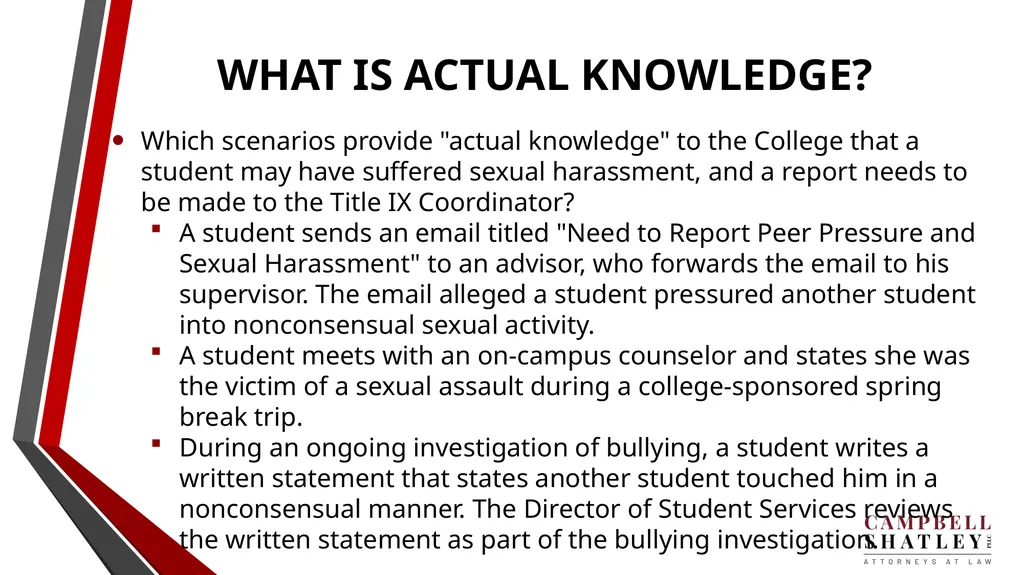
WHAT IS ACTUAL KNOWLEDGE? Which scenarios provide "actual knowledge" to the College that a student may have suffered sexual harassment, and a report needs to be made to the Title IX Coordinator?
A student sends an email titled "Need to Report Peer Pressure and Sexual Harassment" to an advisor, who forwards the email to his supervisor. The email alleged a student pressured another student into nonconsensual sexual activity.
A student meets with an on-campus counselor and states she was the victim of a sexual assault during a college-sponsored spring break trip.
During an ongoing investigation of bullying, a student writes a written statement that states another student touched him in a nonconsensual manner. The Director of Student Services reviews the written statement as part of the bullying investigation.<br>
A student sends an email titled "Need to Report Peer Pressure and Sexual Harassment" to an advisor, who forwards the email to his supervisor. The email alleged a student pressured another student into nonconsensual sexual activity.
A student meets with an on-campus counselor and states she was the victim of a sexual assault during a college-sponsored spring break trip.
During an ongoing investigation of bullying, a student writes a written statement that states another student touched him in a nonconsensual manner. The Director of Student Services reviews the written statement as part of the bullying investigation.<br>
37
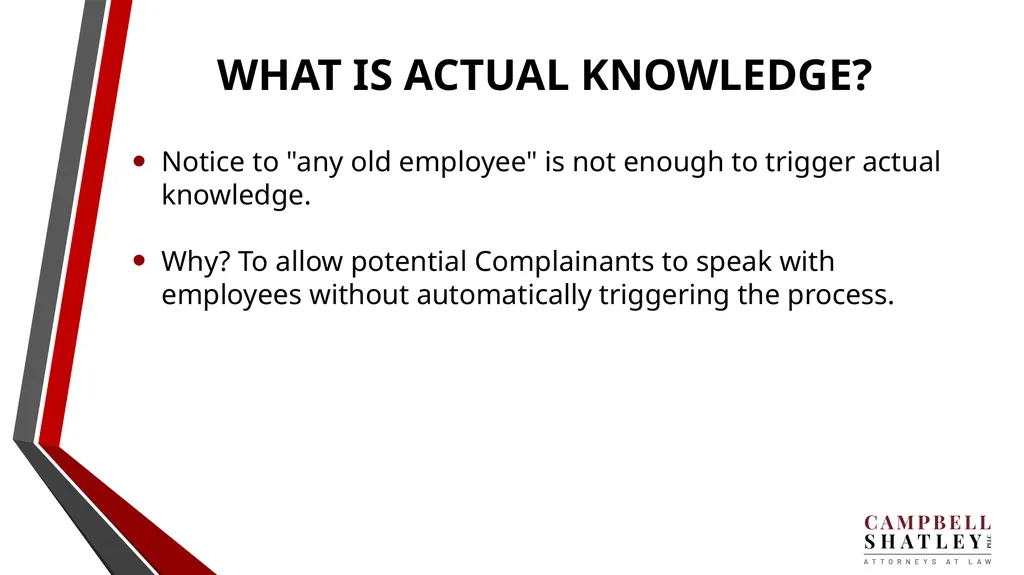
WHAT IS ACTUAL KNOWLEDGE? Notice to "any old employee" is not enough to trigger actual knowledge.
Why? To allow potential Complainants to speak with employees without automatically triggering the process.<br>
Why? To allow potential Complainants to speak with employees without automatically triggering the process.<br>
38
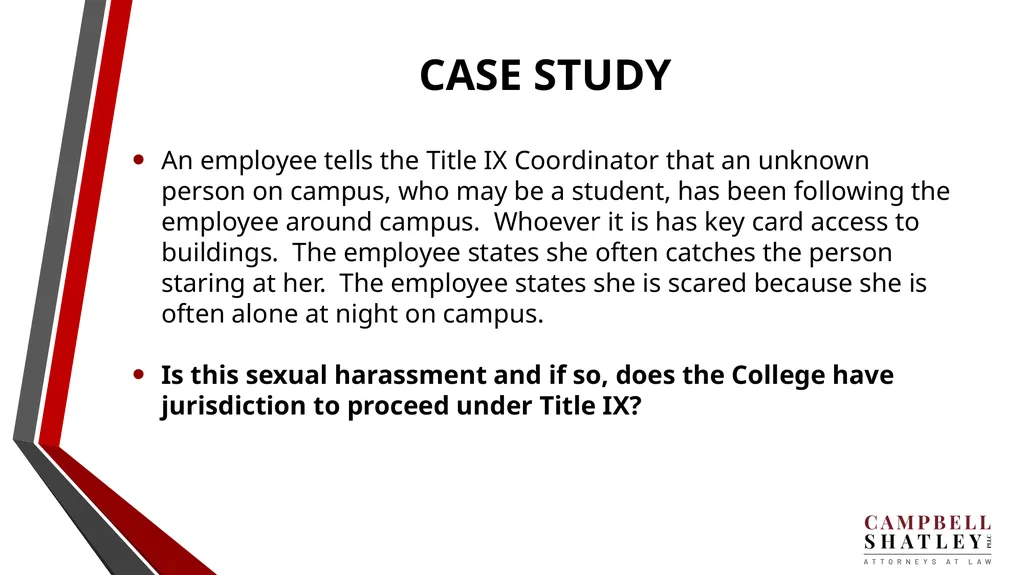
CASE STUDY An employee tells the Title IX Coordinator that an unknown person on campus, who may be a student, has been following the employee around campus. Whoever it is has key card access to buildings. The employee states she often catches the person staring at her. The employee states she is scared because she is often alone at night on campus.
Is this sexual harassment and if so, does the College have jurisdiction to proceed under Title IX?<br>
Is this sexual harassment and if so, does the College have jurisdiction to proceed under Title IX?<br>
39
CASE STUDY An anonymous letter to the Title IX Coordinator states that a video is circulating among students of a male student having sex with another male student, who appears to be unresponsive.
Is this sexual harassment and if so, does the College have jurisdiction to proceed under Title IX?<br>
Is this sexual harassment and if so, does the College have jurisdiction to proceed under Title IX?<br>
40
CONSENT: THANKS DOE! DOE left "consent" and terms that often negate consent to the discretion of higher education institutions to "reflect the unique values of a recipient's educational community."
No required definition in law, regulations, or guidance.
Policy language is critical to a College's analysis in consent situations.<br>
No required definition in law, regulations, or guidance.
Policy language is critical to a College's analysis in consent situations.<br>
41
WHAT RESPONSE IS NECESSARY?<br>
42
RETALIATION IS PROHIBITED Individuals, departments, and colleges may not intimidate, threaten, coerce, or discriminate against an individual
for the purpose of interfering with their Title IX rights; or
because the individual filed a complaint, testified, participated, or refused to participate in a Title IX proceeding.
The exercise of First Amendment rights does not constitute retaliation.<br>
for the purpose of interfering with their Title IX rights; or
because the individual filed a complaint, testified, participated, or refused to participate in a Title IX proceeding.
The exercise of First Amendment rights does not constitute retaliation.<br>
43
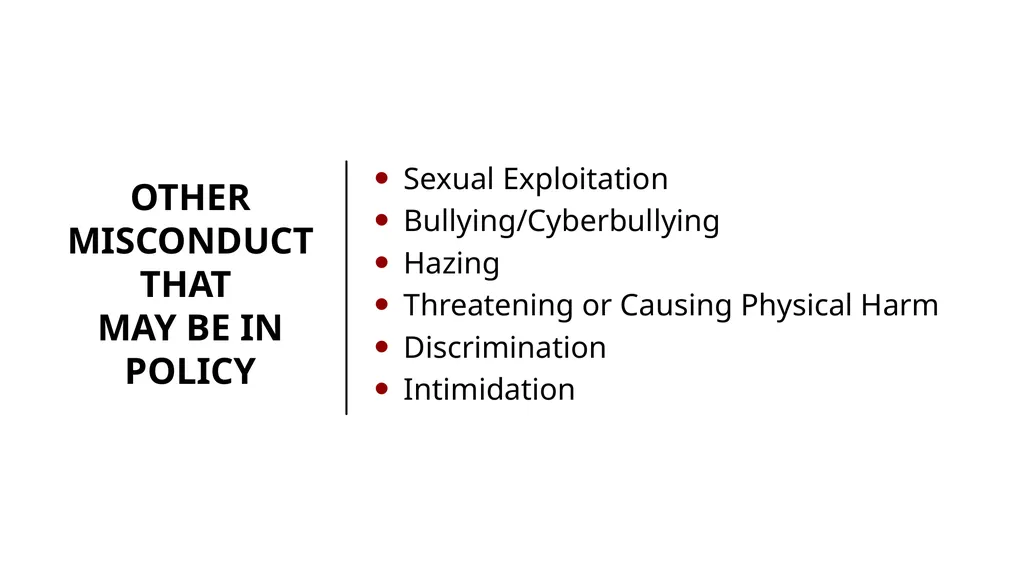
OTHER MISCONDUCT THAT
MAY BE IN POLICY Sexual Exploitation
Bullying/Cyberbullying
Hazing
Threatening or Causing Physical Harm
Discrimination
Intimidation<br>
Bullying/Cyberbullying
Hazing
Threatening or Causing Physical Harm
Discrimination
Intimidation<br>
44
WHAT ABOUT ONLINE CONDUCT? "Education program or activity" encompasses all of a recipient's operations, which may include internet networks, digital platforms, and computer equipment owned or controlled by the recipient. Sexually harassing conduct is not contingent on the method by which the conduct is perpetrated.<br>
45
SCENARIO – ONLINE CONDUCT A student uses a personal phone to perpetuate online sexual harassment during class time. Does the college exercise "substantial control" over –
The student?
The context in which the sexual harassment occurs?<br>
The student?
The context in which the sexual harassment occurs?<br>
46
COVERED GROUPS What groups are covered under Title IX?
Student-v-Student
Employee-v-Student
Employee-v-Employee
Applicants for admission and employment
Student organizations
Third parties participating in an education program or activity
A College's obligation to respond appropriately to Title IX complaints is the same irrespective of the sex of the parties involved.<br>
Student-v-Student
Employee-v-Student
Employee-v-Employee
Applicants for admission and employment
Student organizations
Third parties participating in an education program or activity
A College's obligation to respond appropriately to Title IX complaints is the same irrespective of the sex of the parties involved.<br>
47
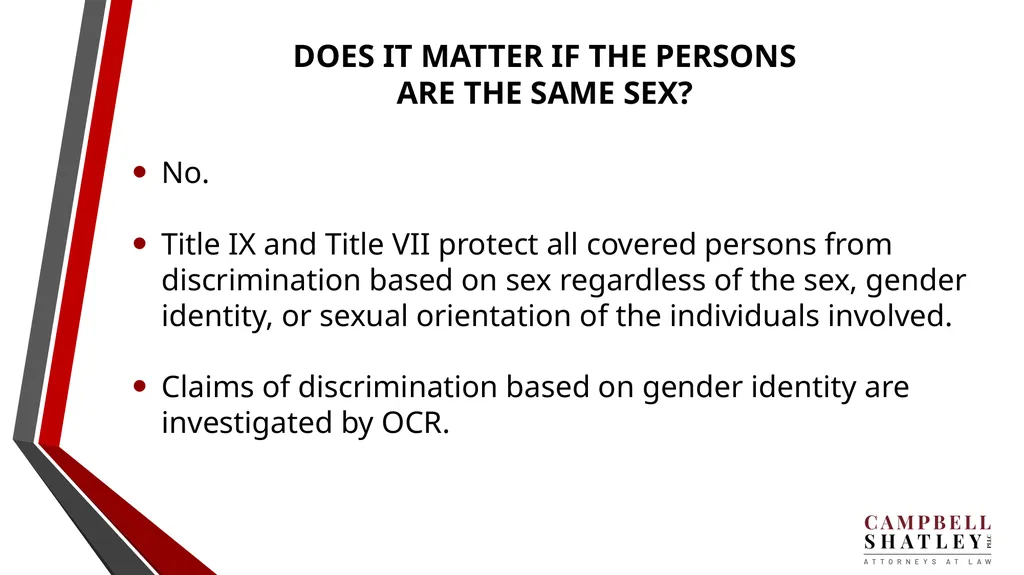
DOES IT MATTER IF THE PERSONS
ARE THE SAME SEX? No.
Title IX and Title VII protect all covered persons from discrimination based on sex regardless of the sex, gender identity, or sexual orientation of the individuals involved.
Claims of discrimination based on gender identity are investigated by OCR.<br>
Title IX and Title VII protect all covered persons from discrimination based on sex regardless of the sex, gender identity, or sexual orientation of the individuals involved.
Claims of discrimination based on gender identity are investigated by OCR.<br>
48
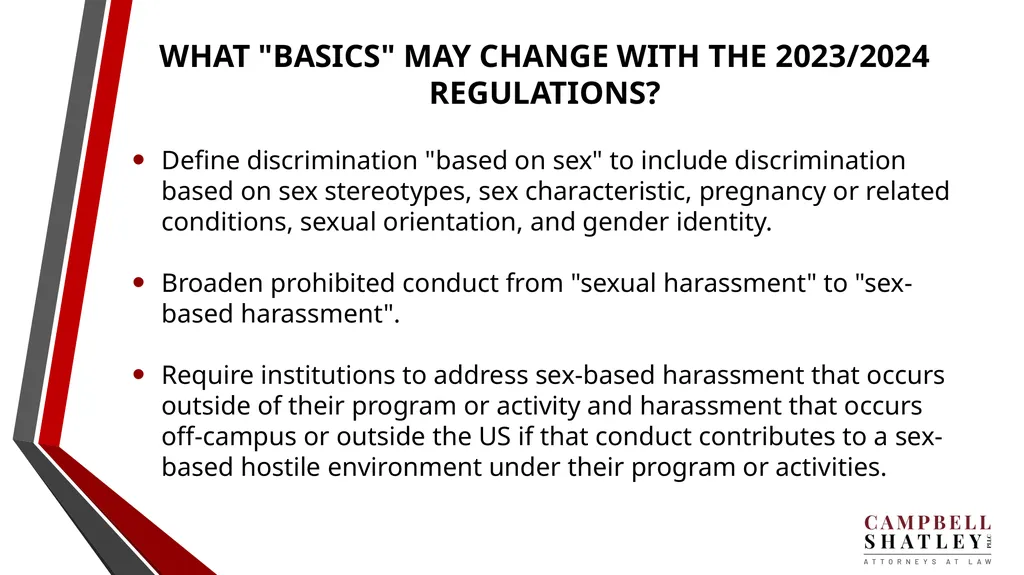
WHAT "BASICS" MAY CHANGE WITH THE 2023/2024 REGULATIONS? Define discrimination "based on sex" to include discrimination based on sex stereotypes, sex characteristic, pregnancy or related conditions, sexual orientation, and gender identity.
Broaden prohibited conduct from "sexual harassment" to "sex-based harassment".
Require institutions to address sex-based harassment that occurs outside of their program or activity and harassment that occurs off-campus or outside the US if that conduct contributes to a sex-based hostile environment under their program or activities.<br>
Broaden prohibited conduct from "sexual harassment" to "sex-based harassment".
Require institutions to address sex-based harassment that occurs outside of their program or activity and harassment that occurs off-campus or outside the US if that conduct contributes to a sex-based hostile environment under their program or activities.<br>
49
Campbell Shatley, PLLC
674 Merrimon Ave., Suite 210
Asheville, NC 28804
(828) 398-2776<br>