
Can electronic cigarettes (EC) help people stop
Description: Can electronic cigarettes (EC) help people stop smoking, and are they safe to use for this purpose? Findings from the most recent Cochrane review, September 2021 Key findings Findings across the main comparisons consistently favoured EC for
Related Topics
Download Presentation
"Can electronic cigarettes (EC) help people stop" is the property of its rightful owner. Permission is granted to download and print the materials on this website for personal, non-commercial use only, and to display it on your personal computer provided you do not modify the materials and that you retain all copyright notices contained in the materials. By downloading content from our website, you accept the terms of this agreement.
Presentation Transcript
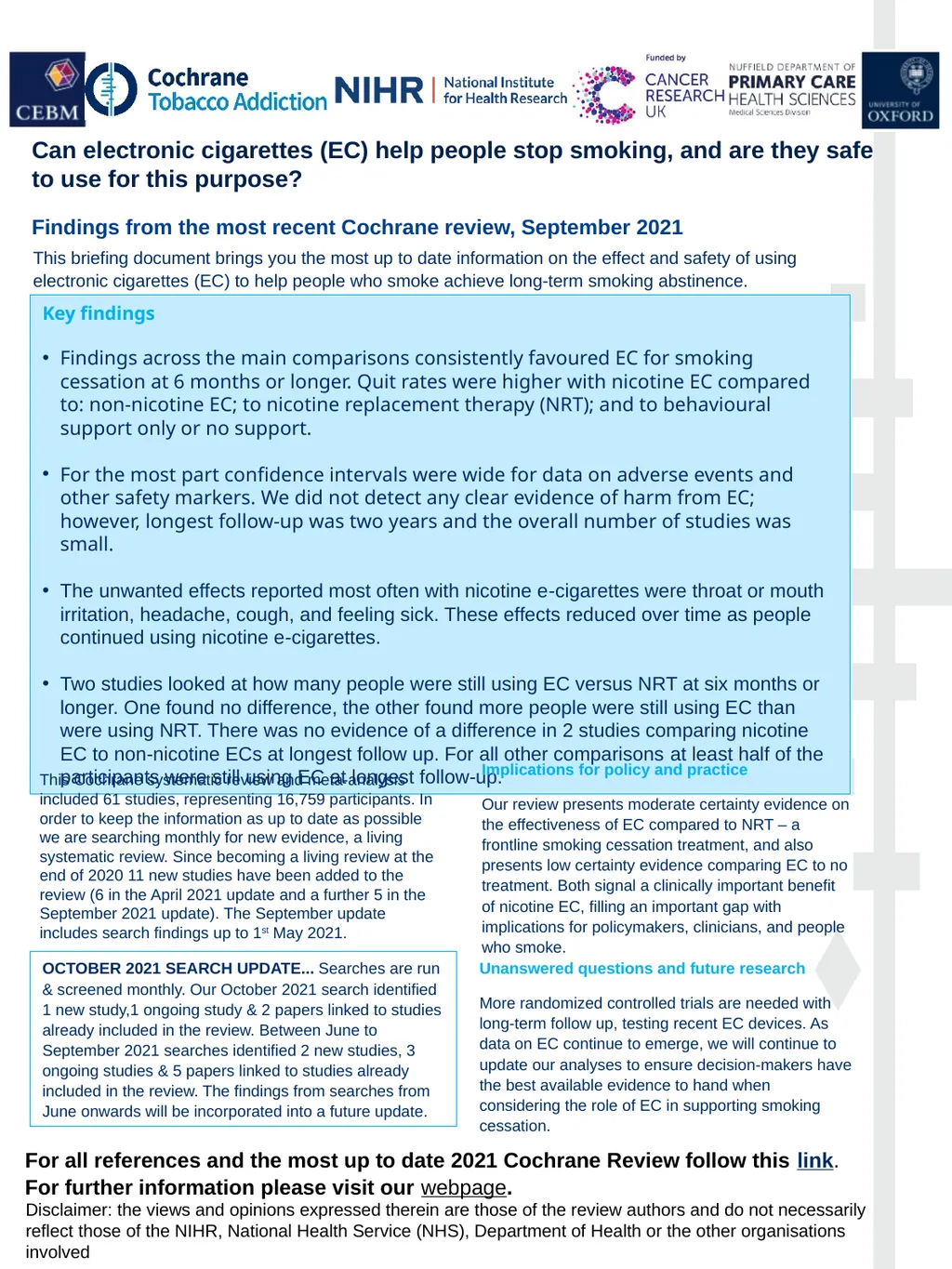
slide1. Can electronic cigarettes (EC) help people stop smoking, and are they safe to use for this purpose?
Findings from the most recent Cochrane review, September 2021 Key findings
Findings across the main comparisons consistently favoured EC for smoking cessation at 6 months or longer. Quit rates were higher with nicotine EC compared to: non-nicotine EC; to nicotine replacement therapy (NRT); and to behavioural support only or no support.
For the most part confidence intervals were wide for data on adverse events and other safety markers. We did not detect any clear evidence of harm from EC; however, longest follow-up was two years and the overall number of studies was small.
The unwanted effects reported most often with nicotine e‐cigarettes were throat or mouth irritation, headache, cough, and feeling sick. These effects reduced over time as people continued using nicotine e‐cigarettes.
Two studies looked at how many people were still using EC versus NRT at six months or longer. One found no difference, the other found more people were still using EC than were using NRT. There was no evidence of a difference in 2 studies comparing nicotine EC to non-nicotine ECs at longest follow up. For all other comparisons at least half of the participants were still using EC at longest follow-up. This briefing document brings you the most up to date information on the effect and safety of using electronic cigarettes (EC) to help people who smoke achieve long‐term smoking abstinence. This Cochrane systematic review and meta-analysis included 61 studies, representing 16,759 participants. In order to keep the information as up to date as possible we are searching monthly for new evidence, a living systematic review. Since becoming a living review at the end of 2020 11 new studies have been added to the review (6 in the April 2021 update and a further 5 in the September 2021 update). The September update includes search findings up to 1st May 2021. OCTOBER 2021 SEARCH UPDATE... Searches are run & screened monthly. Our October 2021 search identified 1 new study,1 ongoing study & 2 papers linked to studies already included in the review. Between June to September 2021 searches identified 2 new studies, 3 ongoing studies & 5 papers linked to studies already included in the review. The findings from searches from June onwards will be incorporated into a future update. Implications for policy and practice
Our review presents moderate certainty evidence on the effectiveness of EC compared to NRT – a frontline smoking cessation treatment, and also presents low certainty evidence comparing EC to no treatment. Both signal a clinically important benefit of nicotine EC, filling an important gap with implications for policymakers, clinicians, and people who smoke. Unanswered questions and future research
More randomized controlled trials are needed with long-term follow up, testing recent EC devices. As data on EC continue to emerge, we will continue to update our analyses to ensure decision-makers have the best available evidence to hand when considering the role of EC in supporting smoking cessation. For all references and the most up to date 2021 Cochrane Review follow this link.
For further information please visit our webpage. Disclaimer: the views and opinions expressed therein are those of the review authors and do not necessarily reflect those of the NIHR, National Health Service (NHS), Department of Health or the other organisations involved<br>
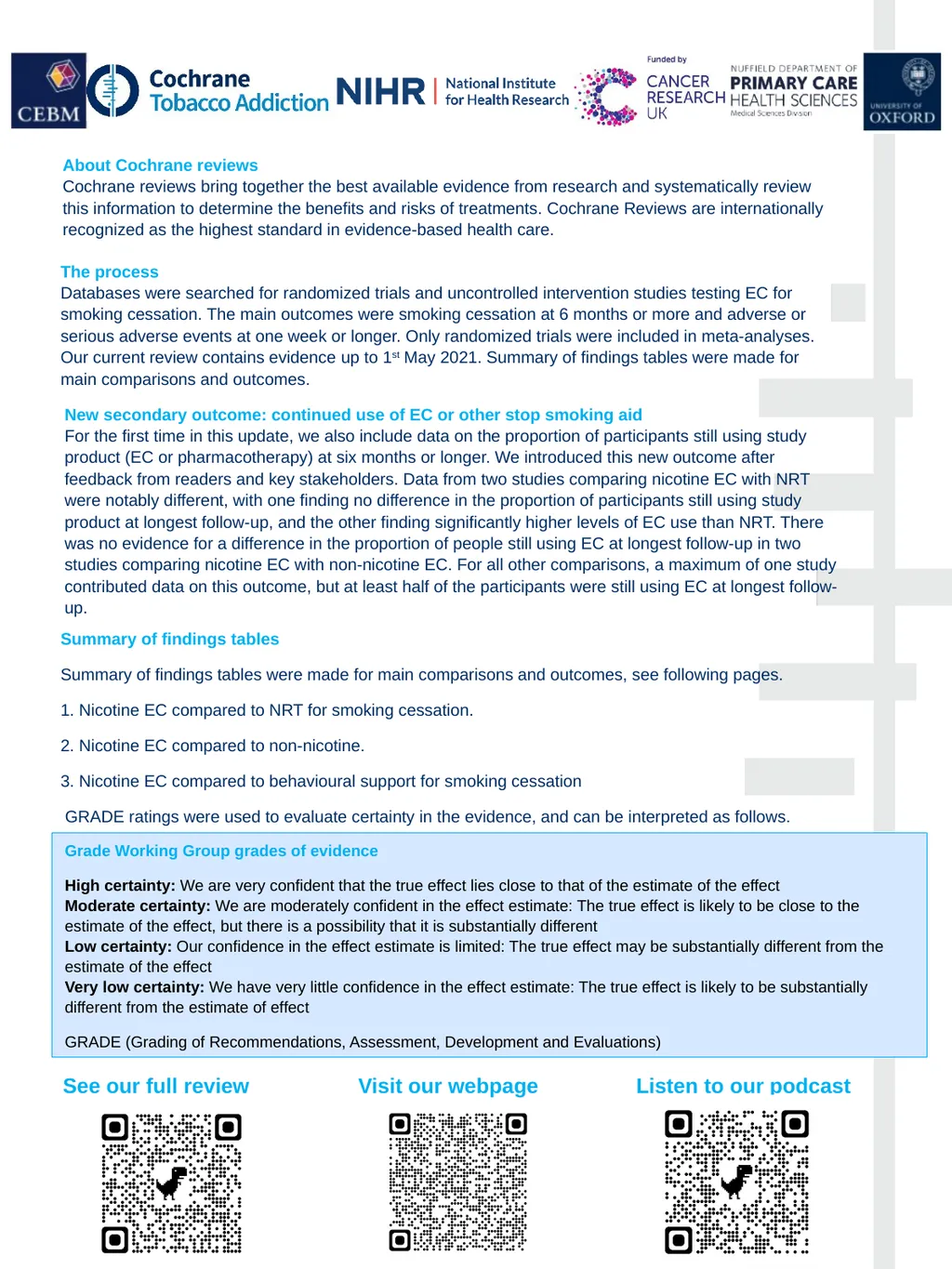
slide2. The process
Databases were searched for randomized trials and uncontrolled intervention studies testing EC for smoking cessation. The main outcomes were smoking cessation at 6 months or more and adverse or serious adverse events at one week or longer. Only randomized trials were included in meta-analyses. Our current review contains evidence up to 1st May 2021. Summary of findings tables were made for main comparisons and outcomes. About Cochrane reviews
Cochrane reviews bring together the best available evidence from research and systematically review this information to determine the benefits and risks of treatments. Cochrane Reviews are internationally recognized as the highest standard in evidence-based health care. Grade Working Group grades of evidence
High certainty: We are very confident that the true effect lies close to that of the estimate of the effect Moderate certainty: We are moderately confident in the effect estimate: The true effect is likely to be close to the estimate of the effect, but there is a possibility that it is substantially different Low certainty: Our confidence in the effect estimate is limited: The true effect may be substantially different from the estimate of the effect Very low certainty: We have very little confidence in the effect estimate: The true effect is likely to be substantially different from the estimate of effect
GRADE (Grading of Recommendations, Assessment, Development and Evaluations) Summary of findings tables
Summary of findings tables were made for main comparisons and outcomes, see following pages.
1. Nicotine EC compared to NRT for smoking cessation.
2. Nicotine EC compared to non-nicotine.
3. Nicotine EC compared to behavioural support for smoking cessation
GRADE ratings were used to evaluate certainty in the evidence, and can be interpreted as follows. New secondary outcome: continued use of EC or other stop smoking aid
For the first time in this update, we also include data on the proportion of participants still using study product (EC or pharmacotherapy) at six months or longer. We introduced this new outcome after feedback from readers and key stakeholders. Data from two studies comparing nicotine EC with NRT were notably different, with one finding no difference in the proportion of participants still using study product at longest follow-up, and the other finding significantly higher levels of EC use than NRT. There was no evidence for a difference in the proportion of people still using EC at longest follow-up in two studies comparing nicotine EC with non-nicotine EC. For all other comparisons, a maximum of one study contributed data on this outcome, but at least half of the participants were still using EC at longest follow-up. Listen to our podcast Visit our webpage See our full review<br>
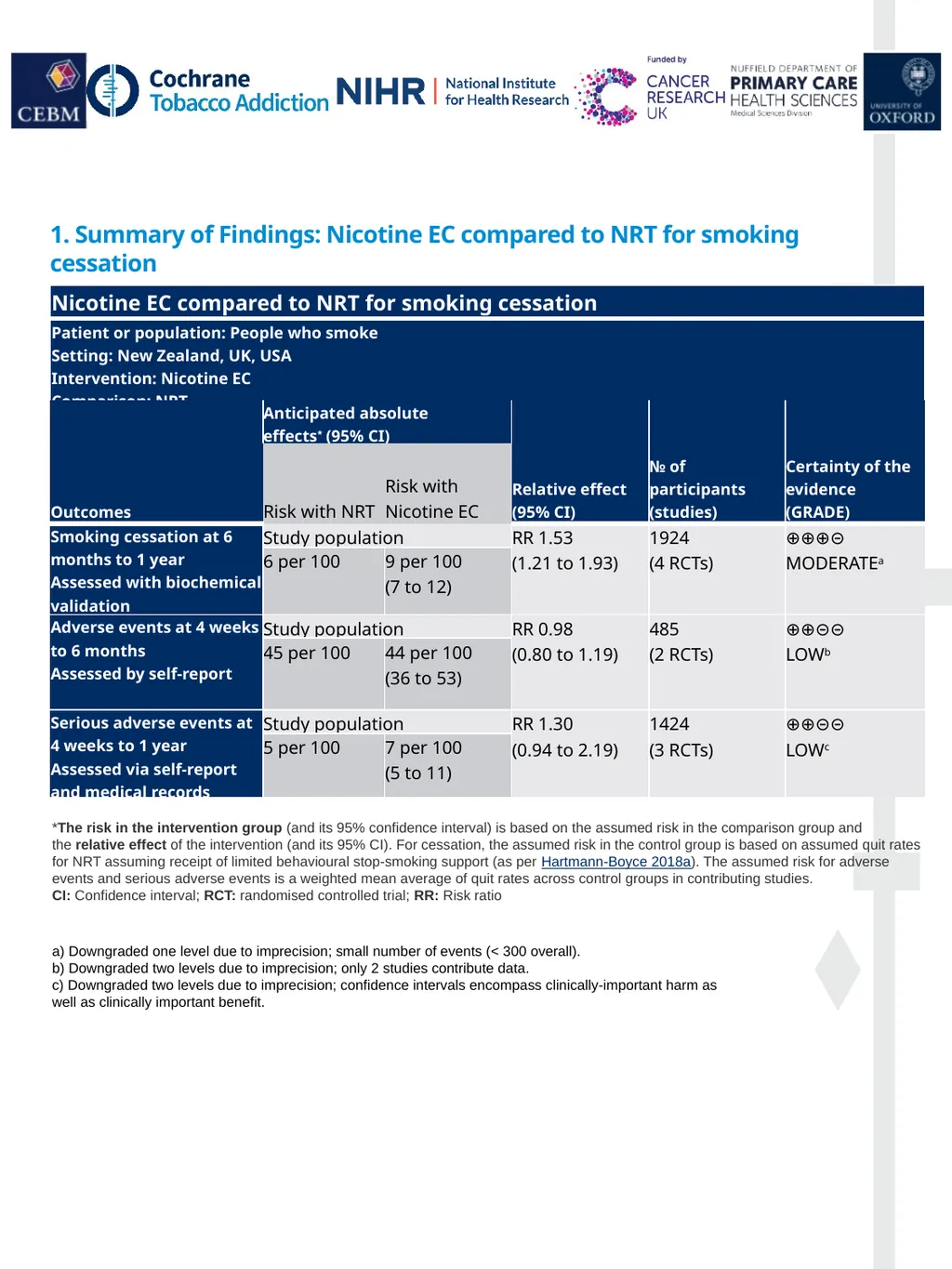
slide3. 1. Summary of Findings: Nicotine EC compared to NRT for smoking cessation *The risk in the intervention group (and its 95% confidence interval) is based on the assumed risk in the comparison group and the relative effect of the intervention (and its 95% CI). For cessation, the assumed risk in the control group is based on assumed quit rates for NRT assuming receipt of limited behavioural stop-smoking support (as per Hartmann-Boyce 2018a). The assumed risk for adverse events and serious adverse events is a weighted mean average of quit rates across control groups in contributing studies. CI: Confidence interval; RCT: randomised controlled trial; RR: Risk ratio a) Downgraded one level due to imprecision; small number of events (< 300 overall).
b) Downgraded two levels due to imprecision; only 2 studies contribute data.
c) Downgraded two levels due to imprecision; confidence intervals encompass clinically-important harm as well as clinically important benefit.<br>
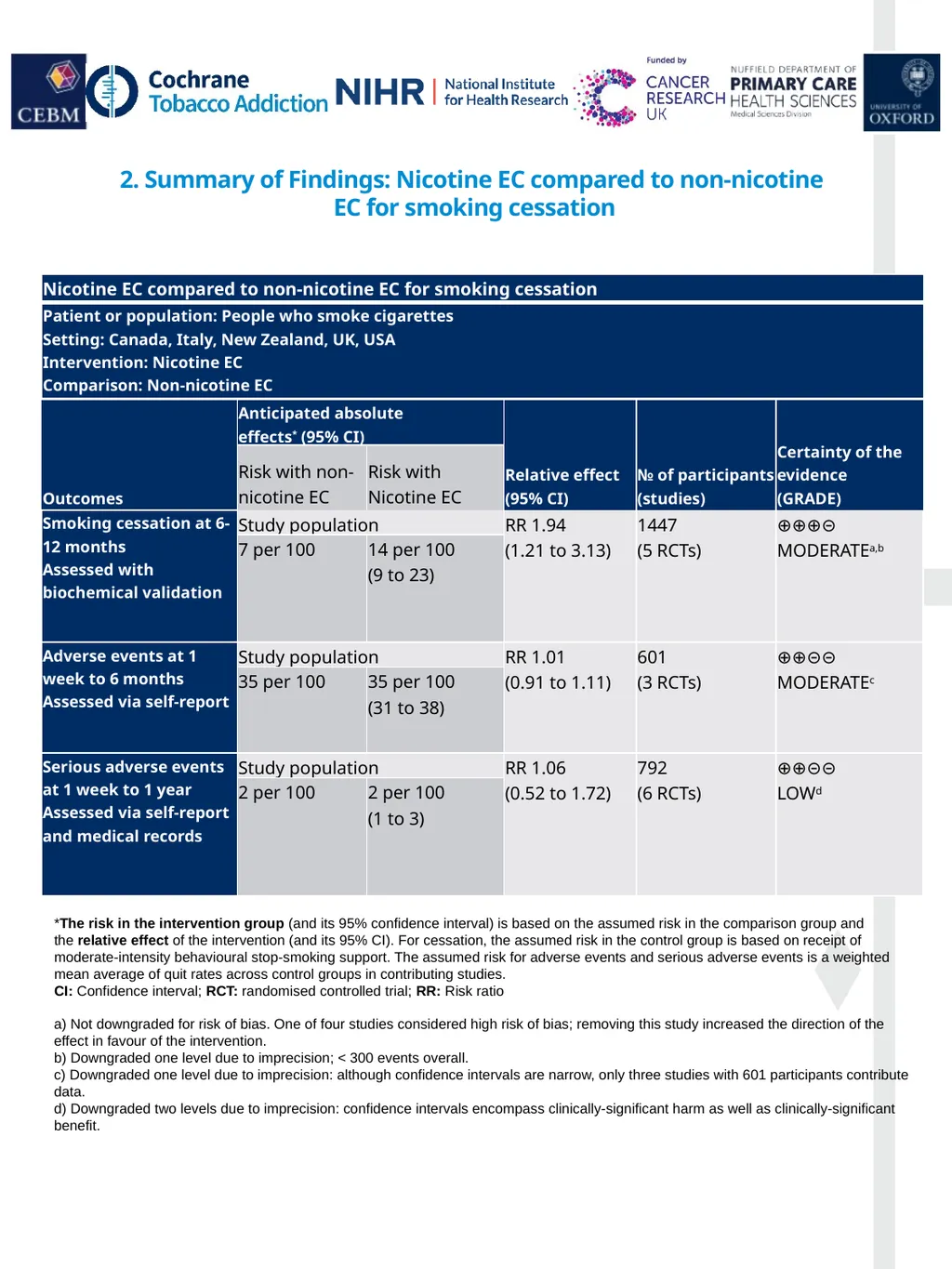
slide4. 2. Summary of Findings: Nicotine EC compared to non-nicotine EC for smoking cessation *The risk in the intervention group (and its 95% confidence interval) is based on the assumed risk in the comparison group and the relative effect of the intervention (and its 95% CI). For cessation, the assumed risk in the control group is based on receipt of moderate-intensity behavioural stop-smoking support. The assumed risk for adverse events and serious adverse events is a weighted mean average of quit rates across control groups in contributing studies. CI: Confidence interval; RCT: randomised controlled trial; RR: Risk ratio a) Not downgraded for risk of bias. One of four studies considered high risk of bias; removing this study increased the direction of the effect in favour of the intervention.
b) Downgraded one level due to imprecision; < 300 events overall.
c) Downgraded one level due to imprecision: although confidence intervals are narrow, only three studies with 601 participants contribute data.
d) Downgraded two levels due to imprecision: confidence intervals encompass clinically-significant harm as well as clinically-significant benefit.<br>
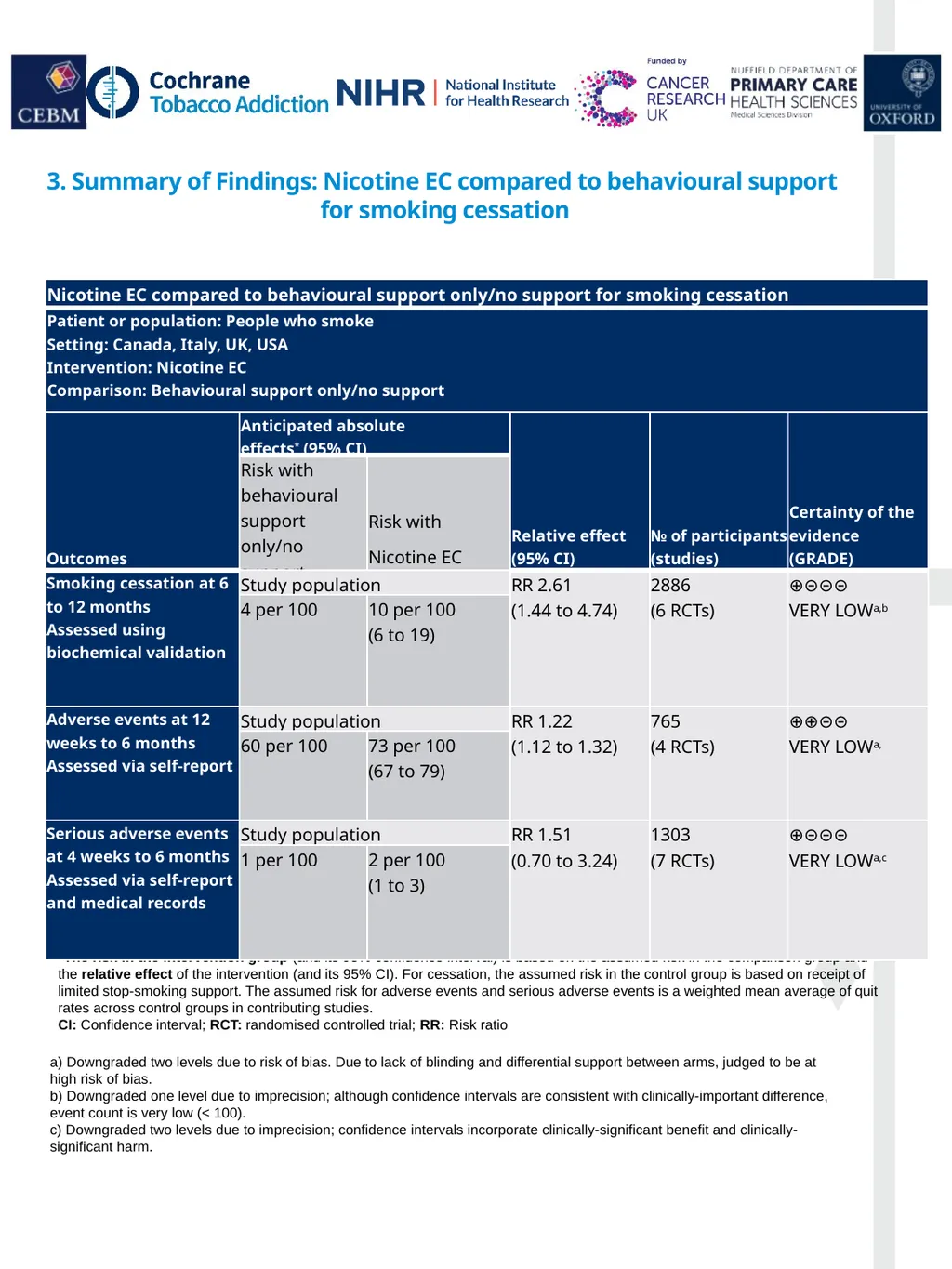
slide5. 3. Summary of Findings: Nicotine EC compared to behavioural support
for smoking cessation *The risk in the intervention group (and its 95% confidence interval) is based on the assumed risk in the comparison group and the relative effect of the intervention (and its 95% CI). For cessation, the assumed risk in the control group is based on receipt of limited stop-smoking support. The assumed risk for adverse events and serious adverse events is a weighted mean average of quit rates across control groups in contributing studies. CI: Confidence interval; RCT: randomised controlled trial; RR: Risk ratio a) Downgraded two levels due to risk of bias. Due to lack of blinding and differential support between arms, judged to be at high risk of bias.
b) Downgraded one level due to imprecision; although confidence intervals are consistent with clinically-important difference, event count is very low (< 100).
c) Downgraded two levels due to imprecision; confidence intervals incorporate clinically-significant benefit and clinically-significant harm.<br>
Findings from the most recent Cochrane review, September 2021 Key findings
Findings across the main comparisons consistently favoured EC for smoking cessation at 6 months or longer. Quit rates were higher with nicotine EC compared to: non-nicotine EC; to nicotine replacement therapy (NRT); and to behavioural support only or no support.
For the most part confidence intervals were wide for data on adverse events and other safety markers. We did not detect any clear evidence of harm from EC; however, longest follow-up was two years and the overall number of studies was small.
The unwanted effects reported most often with nicotine e‐cigarettes were throat or mouth irritation, headache, cough, and feeling sick. These effects reduced over time as people continued using nicotine e‐cigarettes.
Two studies looked at how many people were still using EC versus NRT at six months or longer. One found no difference, the other found more people were still using EC than were using NRT. There was no evidence of a difference in 2 studies comparing nicotine EC to non-nicotine ECs at longest follow up. For all other comparisons at least half of the participants were still using EC at longest follow-up. This briefing document brings you the most up to date information on the effect and safety of using electronic cigarettes (EC) to help people who smoke achieve long‐term smoking abstinence. This Cochrane systematic review and meta-analysis included 61 studies, representing 16,759 participants. In order to keep the information as up to date as possible we are searching monthly for new evidence, a living systematic review. Since becoming a living review at the end of 2020 11 new studies have been added to the review (6 in the April 2021 update and a further 5 in the September 2021 update). The September update includes search findings up to 1st May 2021. OCTOBER 2021 SEARCH UPDATE... Searches are run & screened monthly. Our October 2021 search identified 1 new study,1 ongoing study & 2 papers linked to studies already included in the review. Between June to September 2021 searches identified 2 new studies, 3 ongoing studies & 5 papers linked to studies already included in the review. The findings from searches from June onwards will be incorporated into a future update. Implications for policy and practice
Our review presents moderate certainty evidence on the effectiveness of EC compared to NRT – a frontline smoking cessation treatment, and also presents low certainty evidence comparing EC to no treatment. Both signal a clinically important benefit of nicotine EC, filling an important gap with implications for policymakers, clinicians, and people who smoke. Unanswered questions and future research
More randomized controlled trials are needed with long-term follow up, testing recent EC devices. As data on EC continue to emerge, we will continue to update our analyses to ensure decision-makers have the best available evidence to hand when considering the role of EC in supporting smoking cessation. For all references and the most up to date 2021 Cochrane Review follow this link.
For further information please visit our webpage. Disclaimer: the views and opinions expressed therein are those of the review authors and do not necessarily reflect those of the NIHR, National Health Service (NHS), Department of Health or the other organisations involved<br>
slide2. The process
Databases were searched for randomized trials and uncontrolled intervention studies testing EC for smoking cessation. The main outcomes were smoking cessation at 6 months or more and adverse or serious adverse events at one week or longer. Only randomized trials were included in meta-analyses. Our current review contains evidence up to 1st May 2021. Summary of findings tables were made for main comparisons and outcomes. About Cochrane reviews
Cochrane reviews bring together the best available evidence from research and systematically review this information to determine the benefits and risks of treatments. Cochrane Reviews are internationally recognized as the highest standard in evidence-based health care. Grade Working Group grades of evidence
High certainty: We are very confident that the true effect lies close to that of the estimate of the effect Moderate certainty: We are moderately confident in the effect estimate: The true effect is likely to be close to the estimate of the effect, but there is a possibility that it is substantially different Low certainty: Our confidence in the effect estimate is limited: The true effect may be substantially different from the estimate of the effect Very low certainty: We have very little confidence in the effect estimate: The true effect is likely to be substantially different from the estimate of effect
GRADE (Grading of Recommendations, Assessment, Development and Evaluations) Summary of findings tables
Summary of findings tables were made for main comparisons and outcomes, see following pages.
1. Nicotine EC compared to NRT for smoking cessation.
2. Nicotine EC compared to non-nicotine.
3. Nicotine EC compared to behavioural support for smoking cessation
GRADE ratings were used to evaluate certainty in the evidence, and can be interpreted as follows. New secondary outcome: continued use of EC or other stop smoking aid
For the first time in this update, we also include data on the proportion of participants still using study product (EC or pharmacotherapy) at six months or longer. We introduced this new outcome after feedback from readers and key stakeholders. Data from two studies comparing nicotine EC with NRT were notably different, with one finding no difference in the proportion of participants still using study product at longest follow-up, and the other finding significantly higher levels of EC use than NRT. There was no evidence for a difference in the proportion of people still using EC at longest follow-up in two studies comparing nicotine EC with non-nicotine EC. For all other comparisons, a maximum of one study contributed data on this outcome, but at least half of the participants were still using EC at longest follow-up. Listen to our podcast Visit our webpage See our full review<br>
slide3. 1. Summary of Findings: Nicotine EC compared to NRT for smoking cessation *The risk in the intervention group (and its 95% confidence interval) is based on the assumed risk in the comparison group and the relative effect of the intervention (and its 95% CI). For cessation, the assumed risk in the control group is based on assumed quit rates for NRT assuming receipt of limited behavioural stop-smoking support (as per Hartmann-Boyce 2018a). The assumed risk for adverse events and serious adverse events is a weighted mean average of quit rates across control groups in contributing studies. CI: Confidence interval; RCT: randomised controlled trial; RR: Risk ratio a) Downgraded one level due to imprecision; small number of events (< 300 overall).
b) Downgraded two levels due to imprecision; only 2 studies contribute data.
c) Downgraded two levels due to imprecision; confidence intervals encompass clinically-important harm as well as clinically important benefit.<br>
slide4. 2. Summary of Findings: Nicotine EC compared to non-nicotine EC for smoking cessation *The risk in the intervention group (and its 95% confidence interval) is based on the assumed risk in the comparison group and the relative effect of the intervention (and its 95% CI). For cessation, the assumed risk in the control group is based on receipt of moderate-intensity behavioural stop-smoking support. The assumed risk for adverse events and serious adverse events is a weighted mean average of quit rates across control groups in contributing studies. CI: Confidence interval; RCT: randomised controlled trial; RR: Risk ratio a) Not downgraded for risk of bias. One of four studies considered high risk of bias; removing this study increased the direction of the effect in favour of the intervention.
b) Downgraded one level due to imprecision; < 300 events overall.
c) Downgraded one level due to imprecision: although confidence intervals are narrow, only three studies with 601 participants contribute data.
d) Downgraded two levels due to imprecision: confidence intervals encompass clinically-significant harm as well as clinically-significant benefit.<br>
slide5. 3. Summary of Findings: Nicotine EC compared to behavioural support
for smoking cessation *The risk in the intervention group (and its 95% confidence interval) is based on the assumed risk in the comparison group and the relative effect of the intervention (and its 95% CI). For cessation, the assumed risk in the control group is based on receipt of limited stop-smoking support. The assumed risk for adverse events and serious adverse events is a weighted mean average of quit rates across control groups in contributing studies. CI: Confidence interval; RCT: randomised controlled trial; RR: Risk ratio a) Downgraded two levels due to risk of bias. Due to lack of blinding and differential support between arms, judged to be at high risk of bias.
b) Downgraded one level due to imprecision; although confidence intervals are consistent with clinically-important difference, event count is very low (< 100).
c) Downgraded two levels due to imprecision; confidence intervals incorporate clinically-significant benefit and clinically-significant harm.<br>