CAP Character Development Values for Living Series Fortitude vs. Fear By: Lt Col Ed Green 30 Oct 2020 Introduction The CAP Values for Living Series helps our members to explore a virtue from multiple angles and practice that virtue through
"CAP Character Development Values for Living Series" is the property of its rightful owner. Permission is granted to
download and print the materials on this website for personal, non-commercial use only, and to display it
on your personal computer provided you do not modify the materials and that you retain all copyright
notices contained in the materials. By downloading content from our website, you accept the terms of this
agreement.
Share
Embed code
Presentation Transcript
01
CAP Character Development Values for Living Series Fortitude vs. Fear By: Lt Col Ed Green
30 Oct 2020<br>
02
Introduction The CAP Values for Living Series helps our members to explore a virtue from multiple angles and practice that virtue through a hands-on activity. The combination of analysis and practice helps members internalize the virtue so it stays with them beyond the end of the squadron meeting.
Fear gets a bad rap. Most of us are familiar with fears that hold us back and prevent us from living with excellence. We rarely allow ourselves to appreciate our fears. Fear can improve our performance, reveal dangers, and show us what we value most.
By engaging and reflecting on our fears, we can develop the virtue of Fortitude which helps us to fear the right things in the right way at the right time.<br>
03
Attention Getter Option 1: Media, “5 Tricks For Overcoming Fear”: This video responds to a young viewer who shared his fear of learning how to drive with 5 tricks for overcoming fear. (5:17) https://www.youtube.com/watch?v=zIbPYzUltlw
Option 2: Media, “How Fear and Anxiety Drove Human Evolution | Nat Geo Explores”: This National Geographic video shows how fear contributes to human survival. Like the lesson on Temperance, this video asks how our brains affect our behavior. (4:39) https://www.youtube.com/watch?v=D6-HAPgVsv4
Option 3: Personal Story: Share a personal story about a fear that held you back. Tell the cadets how you faced your fear and how it changed your life. What lessons did you learn? How has your attitude toward fear changed?<br>
04
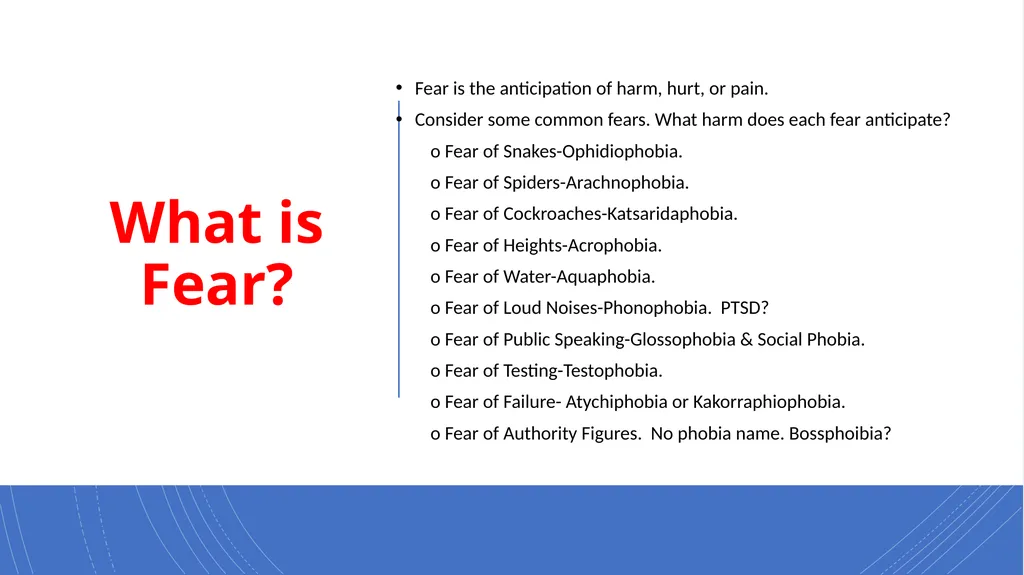
What is Fear? Fear is the anticipation of harm, hurt, or pain.
Consider some common fears. What harm does each fear anticipate?
o Fear of Snakes-Ophidiophobia.
o Fear of Spiders-Arachnophobia.
o Fear of Cockroaches-Katsaridaphobia.
o Fear of Heights-Acrophobia.
o Fear of Water-Aquaphobia.
o Fear of Loud Noises-Phonophobia. PTSD?
o Fear of Public Speaking-Glossophobia & Social Phobia.
o Fear of Testing-Testophobia.
o Fear of Failure- Atychiphobia or Kakorraphiophobia.
o Fear of Authority Figures. No phobia name. Bossphoibia?<br>
05
What Happens with Fear? What changes do you notice in your body or in your thinking when you are afraid?
Can you describe a time when fear became a hindrance to you?
Can you describe a time when fear helped you?
How can you tell the difference between a helpful fear and a hindering fear?
• How does fear affect the performance of teams?
• Can you describe a time when you confronted and conquered some fear? How did that experience change you?<br>
06
Fortitude Fears can be either helpful or harmful. Fortitude is the virtue of facing our fears effectively.
Some things we should be afraid of. Aristotle said, “We should be afraid of disgrace. One who fears disgrace is an honorable man with an appropriate sense of shame.”
How might someone act if they were not afraid of disgrace? Would you trust that person to wear our uniform? Besides disgrace, what else should we fear?
Which fears might motivate us to live according to the Core Values?
Fortitude is not the absence of fear. The absence of fear is called recklessness. What happens to people who are reckless?
Recklessness is an absence of fear; an excess of fear is cowardice. What happens to our lives when fears take over?
With Reason, we can use fears to improve our lives. Risk Management is an example.
Fortitude is about fearing the right things in the right way at the right time.
We fear what is harmful to things we love, value, or cherish.<br>
07
Combatting Fears Medieval philosopher Thomas Aquinas, “the brave man chooses to think beforehand of the dangers that may arise, in order to be able to withstand them, or to bear them more easily.”
Consider some common fears and the dangers they portend. Try to understand these fears and consider how to use them to our advantage.
Pick some common fears and ask the following questions:
What harm does this fear anticipate?
What do I value that this fear is trying to protect?
How could this fear keep me safe?
How could this fear hold me back?
How could I prevent the harm revealed by this fear?<br>
08
Fear of Authority Figures: 7 Tips on How to Talk to Authority Figures Stand Up Straight and Hold Your Ground.
Control Your Nervousness.
Mind Your Manners & Your Turn.
Understand Authority Figure Was in Your Shoes.
Cancel Your Defensiveness.
Focus on Positivity.
Do Not Personalize Your Relationship.<br>
09
Summary Fear is not the enemy.
~In moments of great danger, fear can be your friend.
~Fear can help you fight harder, run faster, and react quicker.
~Fear can save your life.
~Even when danger is not immediate, fear can help you avoid unnecessary risks and even reveal what is most important to you. THINK SAFETY RISK MANAGEMENT.
~Remember that your fears are trying to help you. Approach them gradually and patiently; accept their invitation to practice your responses.
Fortitude is using your fears effectively or fearing the right things in the right way at the right time.
By developing fortitude, you can become both more responsible and more daring. By engaging your fears, you can empower yourself to make the most of every opportunity.<br>
10
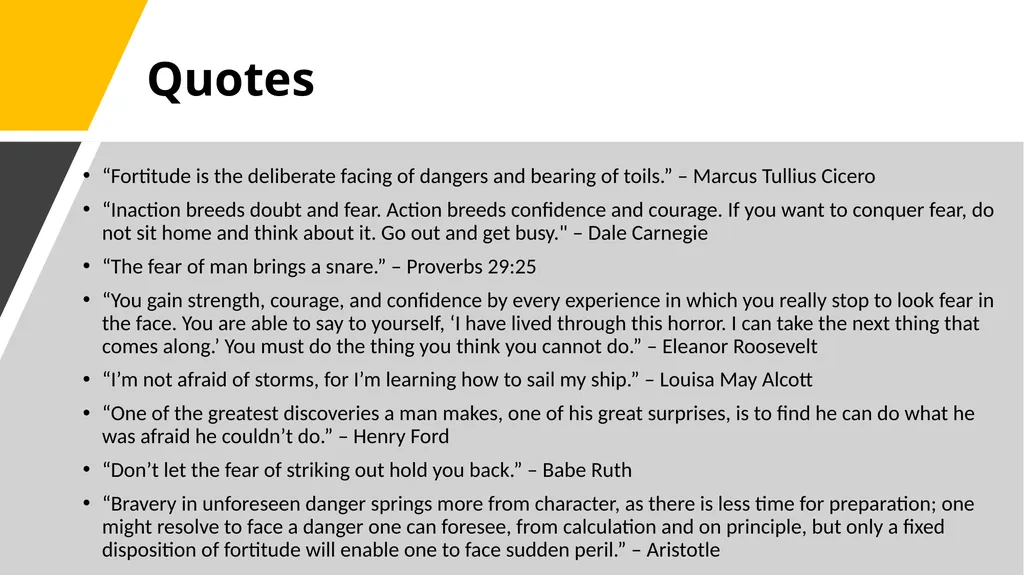
Quotes “Fortitude is the deliberate facing of dangers and bearing of toils.” – Marcus Tullius Cicero
“Inaction breeds doubt and fear. Action breeds confidence and courage. If you want to conquer fear, do not sit home and think about it. Go out and get busy." – Dale Carnegie
“The fear of man brings a snare.” – Proverbs 29:25
“You gain strength, courage, and confidence by every experience in which you really stop to look fear in the face. You are able to say to yourself, ‘I have lived through this horror. I can take the next thing that comes along.’ You must do the thing you think you cannot do.” – Eleanor Roosevelt
“I’m not afraid of storms, for I’m learning how to sail my ship.” – Louisa May Alcott
“One of the greatest discoveries a man makes, one of his great surprises, is to find he can do what he was afraid he couldn’t do.” – Henry Ford
“Don’t let the fear of striking out hold you back.” – Babe Ruth
“Bravery in unforeseen danger springs more from character, as there is less time for preparation; one might resolve to face a danger one can foresee, from calculation and on principle, but only a fixed disposition of fortitude will enable one to face sudden peril.” – Aristotle<br>