
CAP OWNED VEHICLE (COV) ORIENTATION Prepared MAY
OM
Published · 43 slides · 0 views

1 / 1

Description
CAP OWNED VEHICLE (COV) ORIENTATION Prepared MAY 2023 by New York Wing Introduction This presentation is designed to provide every CAP driver who will operate a Corporate Owned Vehicle (COV) with specific information for hisher successful
Related Topics
Share
Embed code
Download this presentation From Below
"CAP OWNED VEHICLE (COV) ORIENTATION Prepared MAY" is the property of its rightful owner. Permission is granted to download and print the materials on this website for personal, non-commercial use only, and to display it on your personal computer provided you do not modify the materials and that you retain all copyright notices contained in the materials. By downloading content from our website, you accept the terms of this agreement.
Presentation Transcript
01
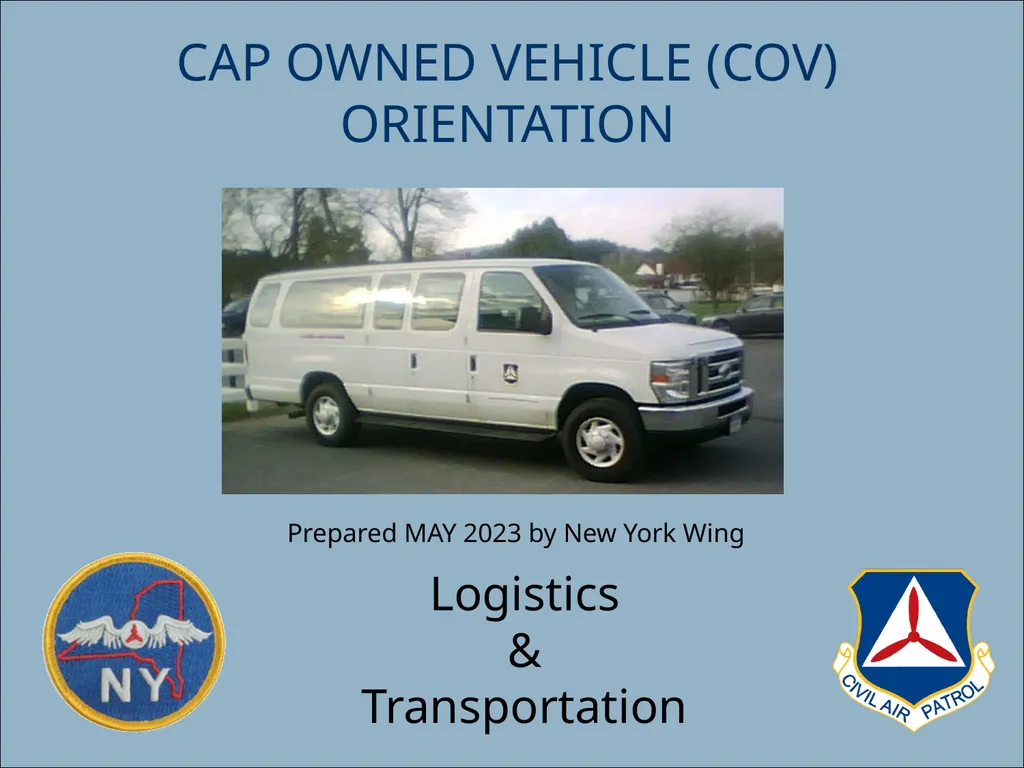
CAP OWNED VEHICLE (COV) ORIENTATION Prepared MAY 2023 by New York Wing<br>
02
Introduction This presentation is designed to provide every CAP driver who will operate a Corporate Owned Vehicle (COV) with specific information for his/her successful and safe use of the asset.
All CAP drivers are required to view this presentation as well as to read CAPR 77-1 and any NYWG CAPR 77-1 Supplement.
Drivers must review the COV Binder in the COV prior to usage.<br>
All CAP drivers are required to view this presentation as well as to read CAPR 77-1 and any NYWG CAPR 77-1 Supplement.
Drivers must review the COV Binder in the COV prior to usage.<br>
03
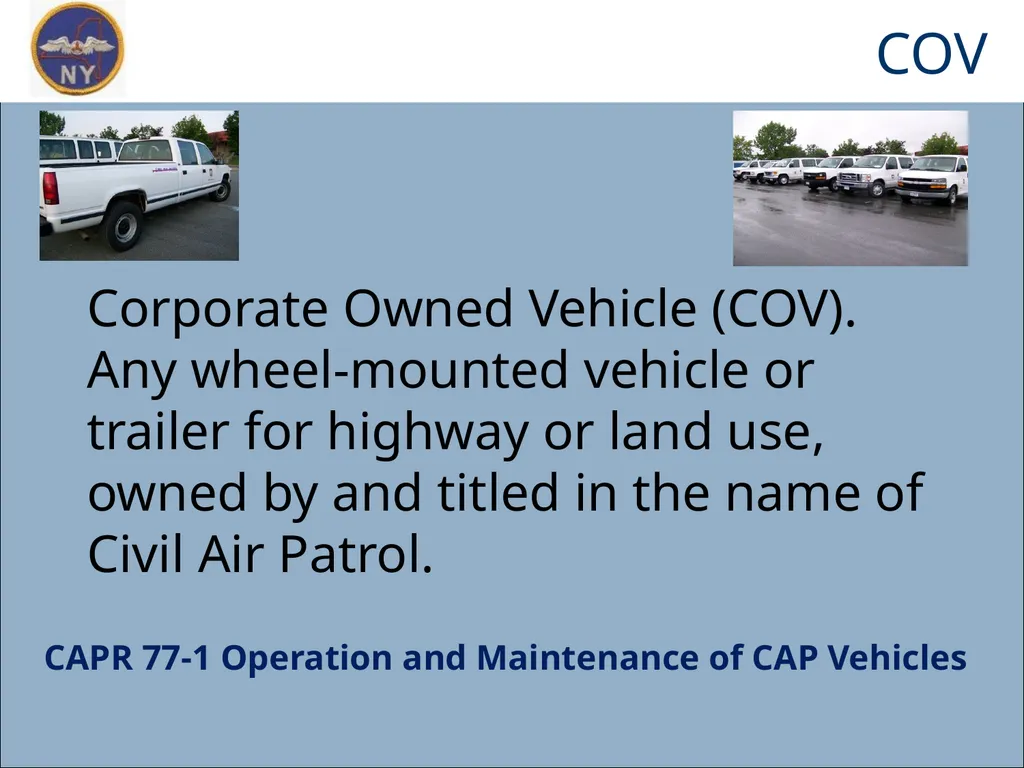
COV Corporate Owned Vehicle (COV). Any wheel-mounted vehicle or trailer for highway or land use, owned by and titled in the name of Civil Air Patrol. CAPR 77-1 Operation and Maintenance of CAP Vehicles<br>
04
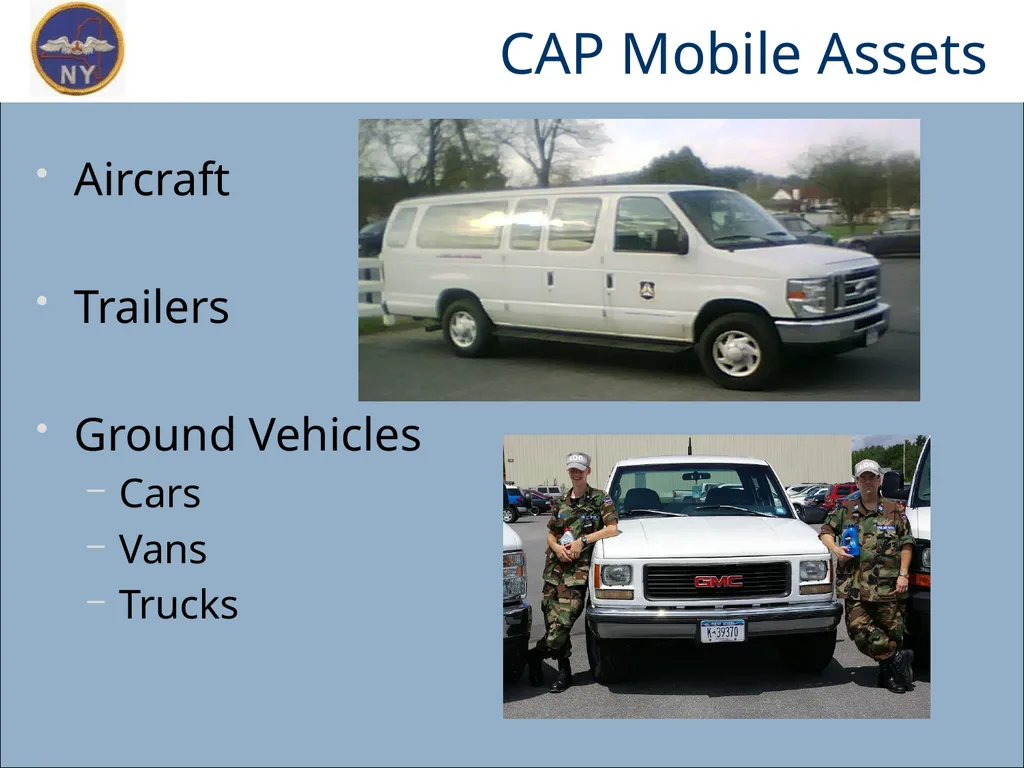
CAP Mobile Assets Aircraft
Trailers
Ground Vehicles
Cars
Vans
Trucks<br>
Trailers
Ground Vehicles
Cars
Vans
Trucks<br>
05
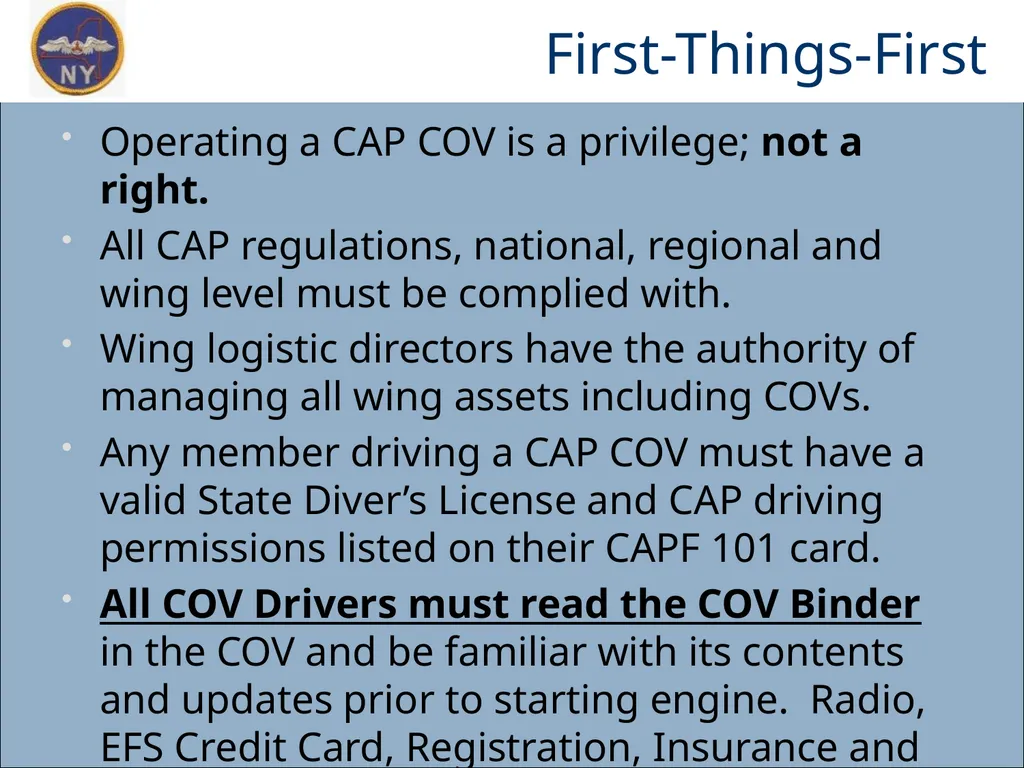
First-Things-First Operating a CAP COV is a privilege; not a right.
All CAP regulations, national, regional and wing level must be complied with.
Wing logistic directors have the authority of managing all wing assets including COVs.
Any member driving a CAP COV must have a valid State Diver’s License and CAP driving permissions listed on their CAPF 101 card.
All COV Drivers must read the COV Binder in the COV and be familiar with its contents and updates prior to starting engine. Radio, EFS Credit Card, Registration, Insurance and Safety Information are in the binder with CAPF 73s.<br>
All CAP regulations, national, regional and wing level must be complied with.
Wing logistic directors have the authority of managing all wing assets including COVs.
Any member driving a CAP COV must have a valid State Diver’s License and CAP driving permissions listed on their CAPF 101 card.
All COV Drivers must read the COV Binder in the COV and be familiar with its contents and updates prior to starting engine. Radio, EFS Credit Card, Registration, Insurance and Safety Information are in the binder with CAPF 73s.<br>
06
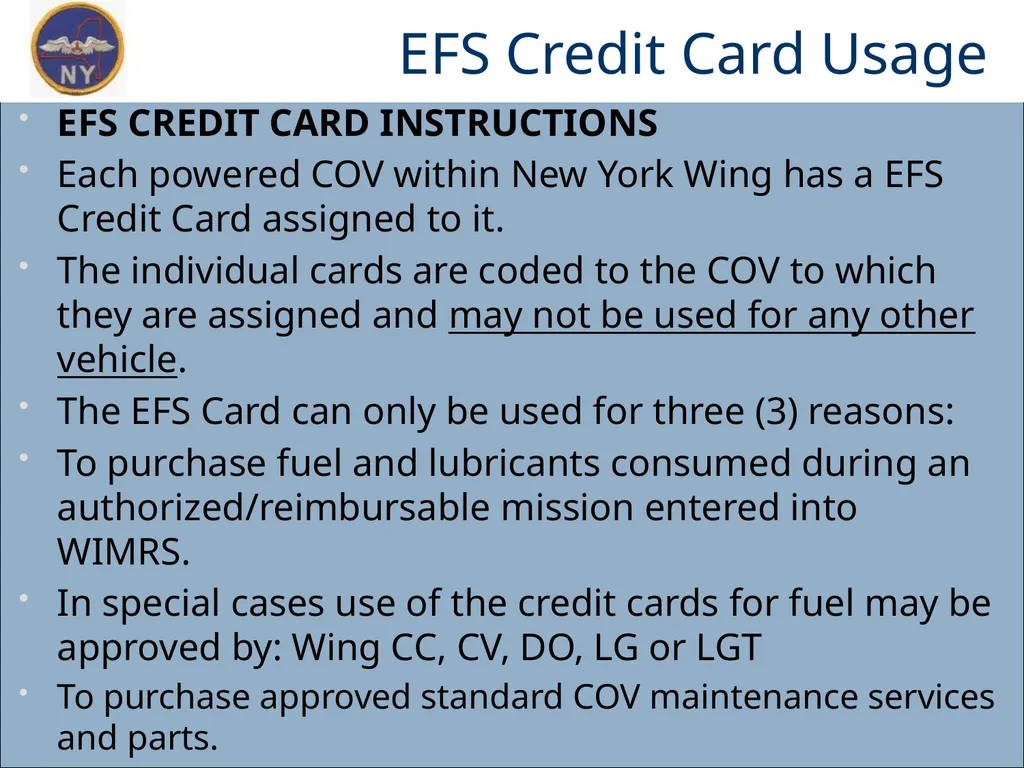
EFS Credit Card Usage EFS CREDIT CARD INSTRUCTIONS
Each powered COV within New York Wing has a EFS Credit Card assigned to it.
The individual cards are coded to the COV to which they are assigned and may not be used for any other vehicle.
The EFS Card can only be used for three (3) reasons:
To purchase fuel and lubricants consumed during an authorized/reimbursable mission entered into WIMRS.
In special cases use of the credit cards for fuel may be approved by: Wing CC, CV, DO, LG or LGT
To purchase approved standard COV maintenance services and parts.<br>
Each powered COV within New York Wing has a EFS Credit Card assigned to it.
The individual cards are coded to the COV to which they are assigned and may not be used for any other vehicle.
The EFS Card can only be used for three (3) reasons:
To purchase fuel and lubricants consumed during an authorized/reimbursable mission entered into WIMRS.
In special cases use of the credit cards for fuel may be approved by: Wing CC, CV, DO, LG or LGT
To purchase approved standard COV maintenance services and parts.<br>
07
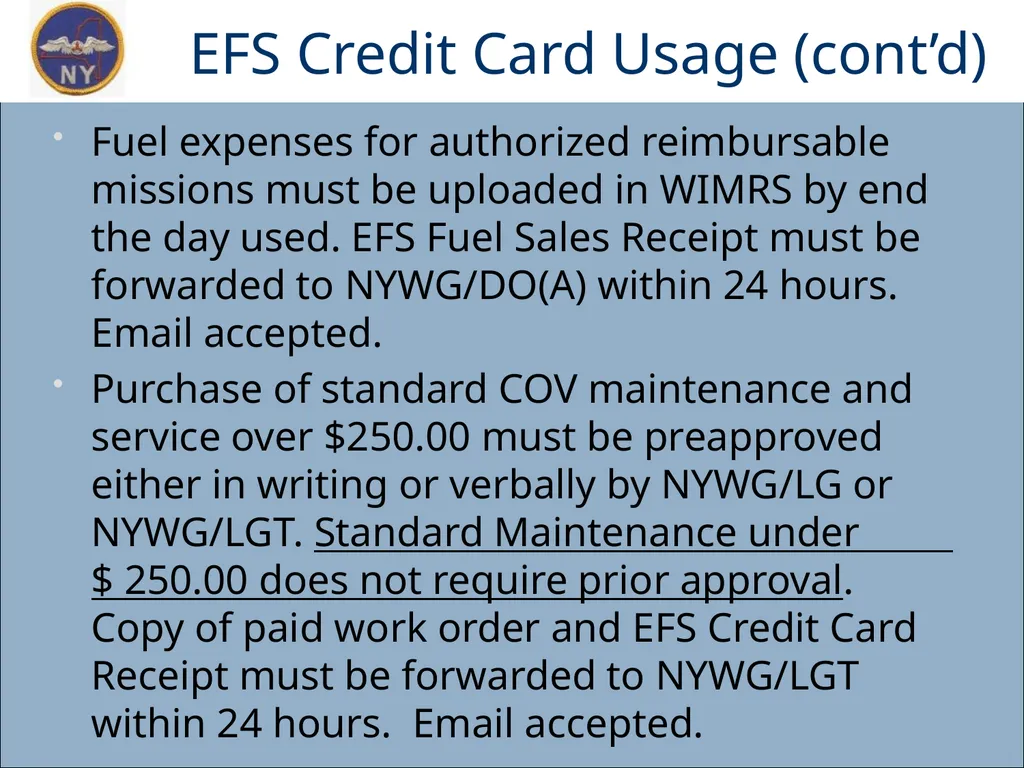
EFS Credit Card Usage (cont’d) Fuel expenses for authorized reimbursable missions must be uploaded in WIMRS by end the day used. EFS Fuel Sales Receipt must be forwarded to NYWG/DO(A) within 24 hours. Email accepted.
Purchase of standard COV maintenance and service over $250.00 must be preapproved either in writing or verbally by NYWG/LG or NYWG/LGT. Standard Maintenance under $ 250.00 does not require prior approval. Copy of paid work order and EFS Credit Card Receipt must be forwarded to NYWG/LGT within 24 hours. Email accepted.<br>
Purchase of standard COV maintenance and service over $250.00 must be preapproved either in writing or verbally by NYWG/LG or NYWG/LGT. Standard Maintenance under $ 250.00 does not require prior approval. Copy of paid work order and EFS Credit Card Receipt must be forwarded to NYWG/LGT within 24 hours. Email accepted.<br>
08
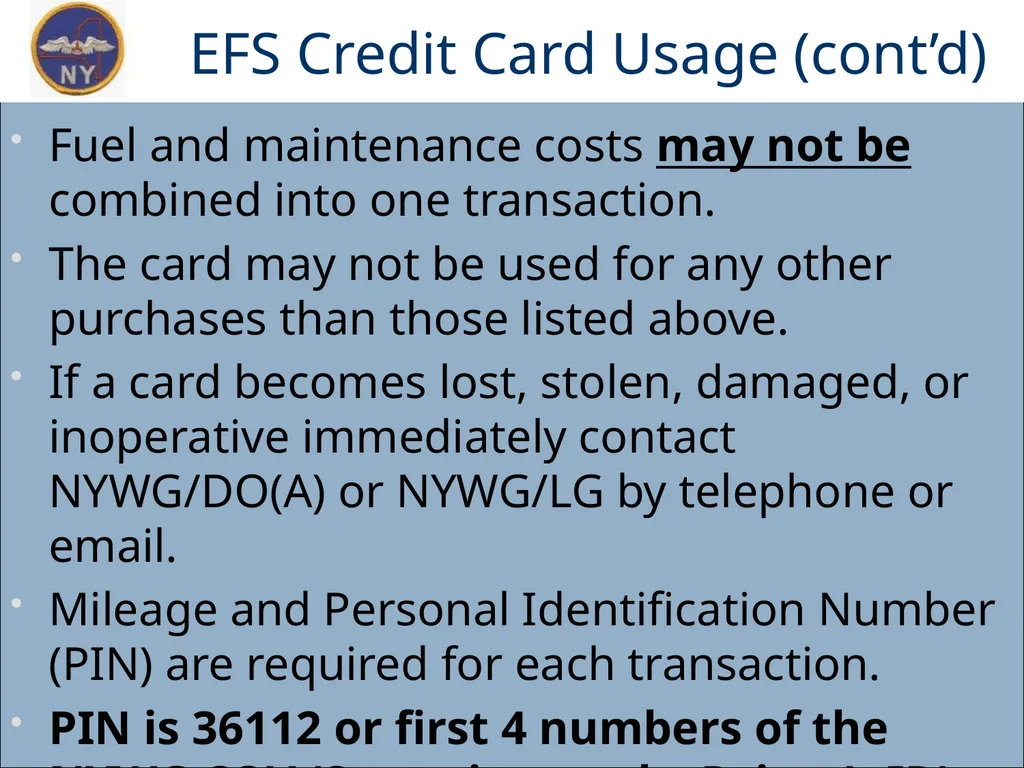
EFS Credit Card Usage (cont’d) Fuel and maintenance costs may not be combined into one transaction.
The card may not be used for any other purchases than those listed above.
If a card becomes lost, stolen, damaged, or inoperative immediately contact NYWG/DO(A) or NYWG/LG by telephone or email.
Mileage and Personal Identification Number (PIN) are required for each transaction.
PIN is 36112 or first 4 numbers of the NYWG COV (Sometimes asks Driver’s ID).<br>
The card may not be used for any other purchases than those listed above.
If a card becomes lost, stolen, damaged, or inoperative immediately contact NYWG/DO(A) or NYWG/LG by telephone or email.
Mileage and Personal Identification Number (PIN) are required for each transaction.
PIN is 36112 or first 4 numbers of the NYWG COV (Sometimes asks Driver’s ID).<br>
09
Operating A CAP COV Drivers must obey all federal, state, commonwealth, local laws, regulations, and ordinances governing the operation of motor vehicles.
While operating vehicles, both COV and Personal (POV), drivers must obey all military or governmental vehicle regulations especially speed and stop signs.
Headlights turned on in daylight hours.<br>
While operating vehicles, both COV and Personal (POV), drivers must obey all military or governmental vehicle regulations especially speed and stop signs.
Headlights turned on in daylight hours.<br>
10
Operating A CAP COV Cont’d Seat belts must be fastened for the driver and all passengers within up to the applicable max number of passengers allowable, i.e. 11 PAX, 7 PAX). Doors closed and locked.
No tobacco or e-Cig vapor products usage permitted in any CAP COV.
No hand-held cellular phones or texting devices by driver while operating COVs.
At the end of use, the driver is responsible for seeing that the vehicle is fully fueled, clean, and ready for the next user.<br>
No tobacco or e-Cig vapor products usage permitted in any CAP COV.
No hand-held cellular phones or texting devices by driver while operating COVs.
At the end of use, the driver is responsible for seeing that the vehicle is fully fueled, clean, and ready for the next user.<br>
11
How to Obtain CAP Driver Privileges 1. You must posses a valid state drivers license.
2. You must obtain your Driver’s License Abstract from your state’s Department of Motor Vehicles (DMV).<br>
2. You must obtain your Driver’s License Abstract from your state’s Department of Motor Vehicles (DMV).<br>
12
Obtaining CAP Driver Privileges Cont’d. 3. You must be 21 or older with three years driving experience.
4. You must be Safety Current. (See CAPSIS)
5. You must be a member in good standing and have completed Level I Training.<br>
4. You must be Safety Current. (See CAPSIS)
5. You must be a member in good standing and have completed Level I Training.<br>
13
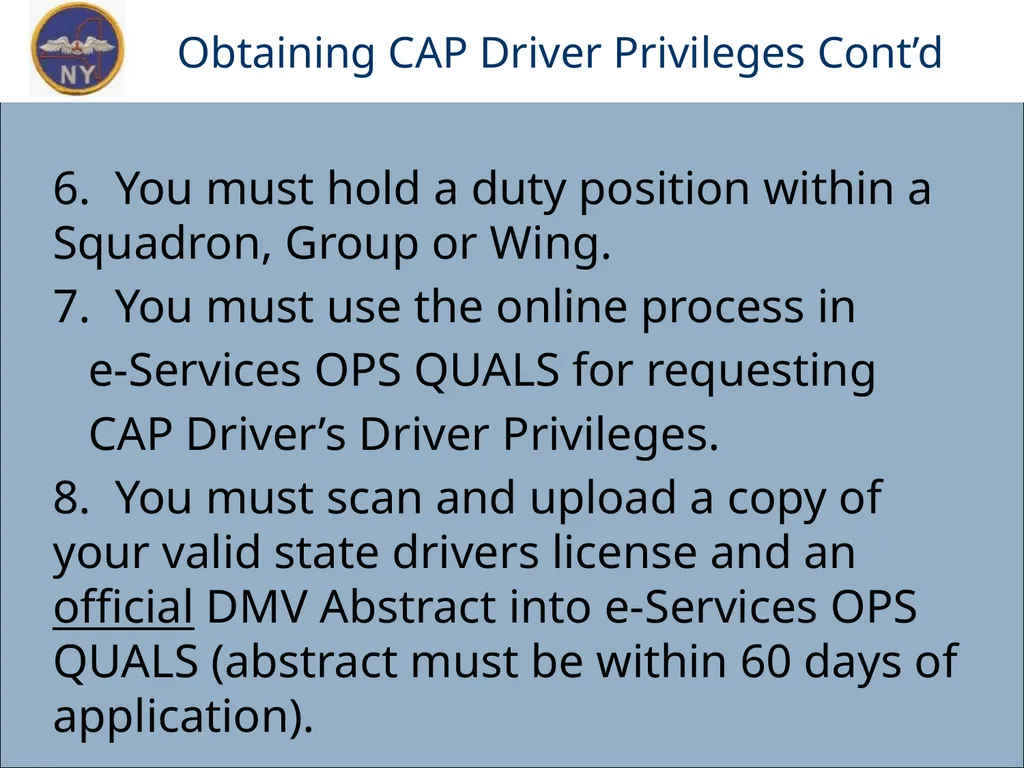
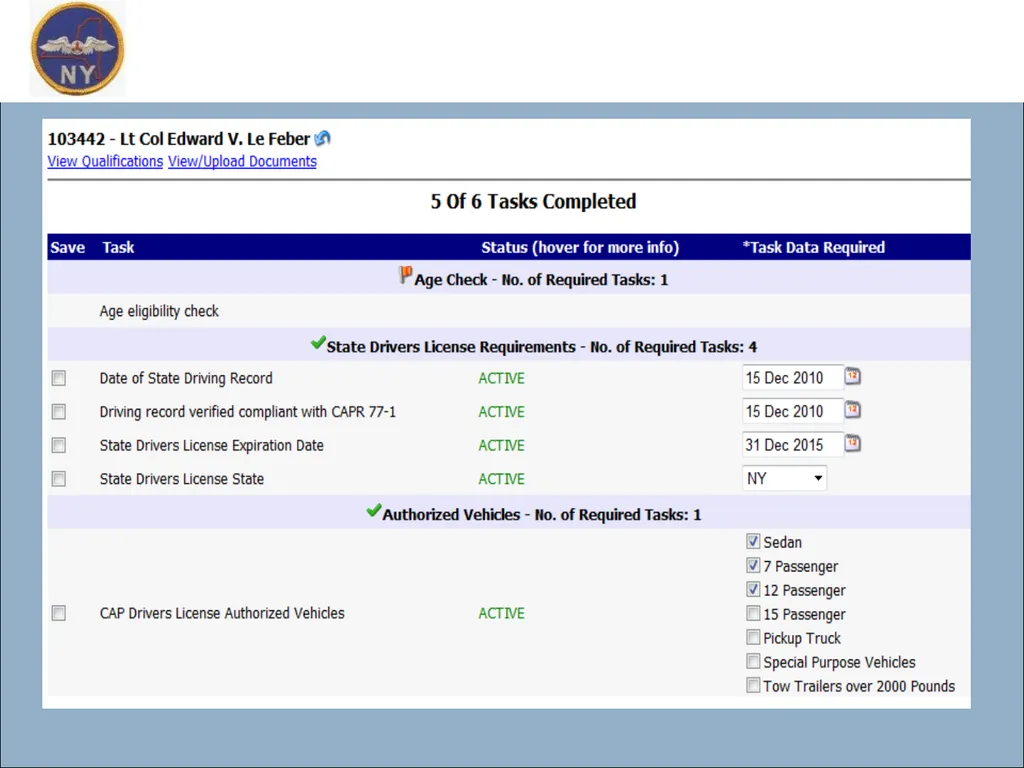
Obtaining CAP Driver Privileges Cont’d 6. You must hold a duty position within a Squadron, Group or Wing.
7. You must use the online process in
e-Services OPS QUALS for requesting
CAP Driver’s Driver Privileges.
8. You must scan and upload a copy of your valid state drivers license and an official DMV Abstract into e-Services OPS QUALS (abstract must be within 60 days of application).<br>
7. You must use the online process in
e-Services OPS QUALS for requesting
CAP Driver’s Driver Privileges.
8. You must scan and upload a copy of your valid state drivers license and an official DMV Abstract into e-Services OPS QUALS (abstract must be within 60 days of application).<br>
14
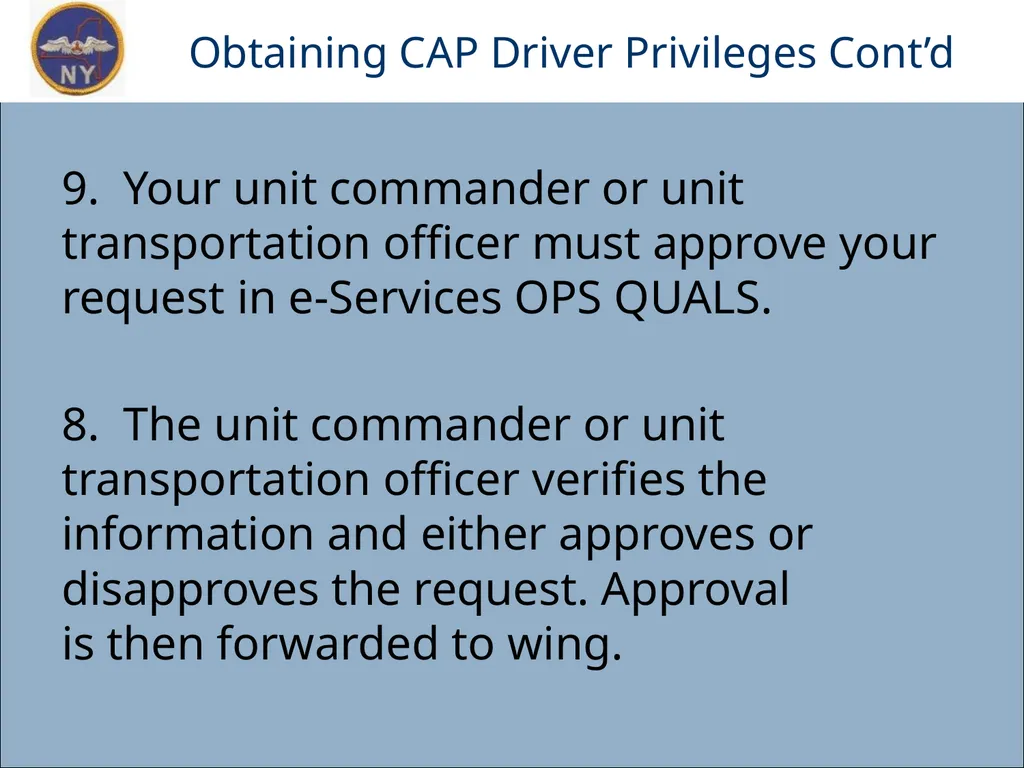
Obtaining CAP Driver Privileges Cont’d 9. Your unit commander or unit transportation officer must approve your request in e-Services OPS QUALS.
8. The unit commander or unit transportation officer verifies the information and either approves or disapproves the request. Approval is then forwarded to wing.<br>
8. The unit commander or unit transportation officer verifies the information and either approves or disapproves the request. Approval is then forwarded to wing.<br>
15
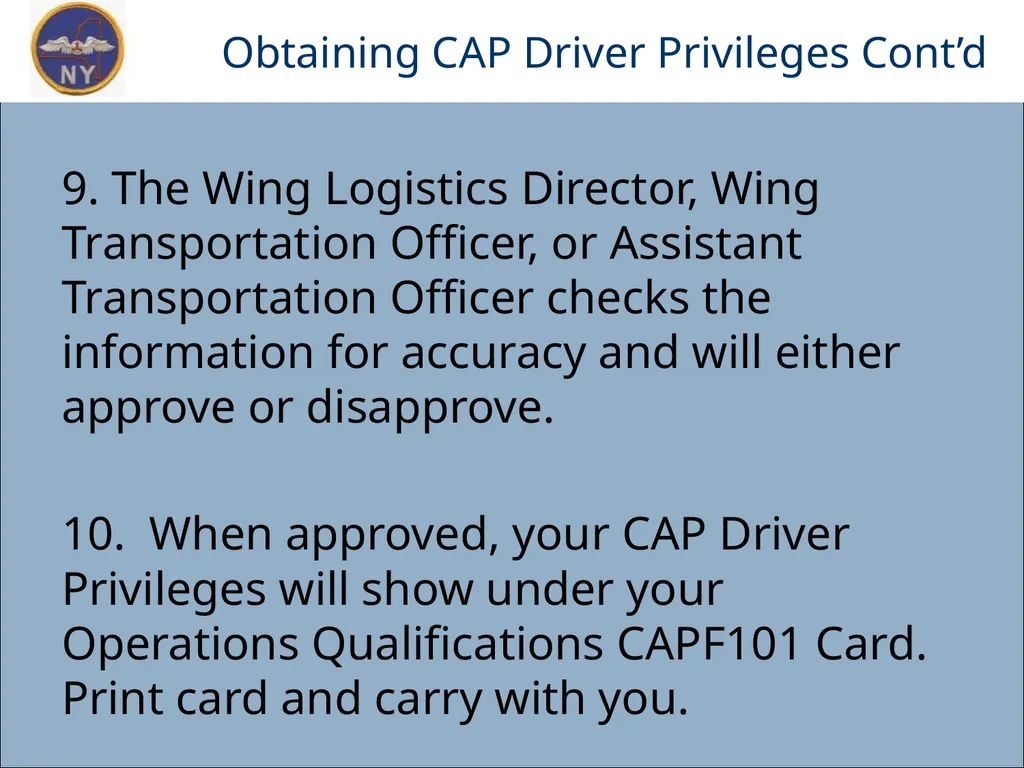
Obtaining CAP Driver Privileges Cont’d 9. The Wing Logistics Director, Wing Transportation Officer, or Assistant Transportation Officer checks the information for accuracy and will either approve or disapprove.
10. When approved, your CAP Driver Privileges will show under your Operations Qualifications CAPF101 Card. Print card and carry with you.<br>
10. When approved, your CAP Driver Privileges will show under your Operations Qualifications CAPF101 Card. Print card and carry with you.<br>
16
Obtaining a CAP Driver Privileges Cont’d. Securing Driver Privileges for Special Purpose Vehicles or Towing Privileges requires additional proof/documentation with possible testing to be presented to Wing Logistics Director, Transportation Officer, or Assistant Transportation Officer.
This is a separate request after basic privileges are granted.<br>
This is a separate request after basic privileges are granted.<br>
17
It is strongly recommended that you take an insurance points and premium reduction defensive driving course whether you have points
on your license or not.<br>
on your license or not.<br>
18
Use of Vehicles at Encampment NOTE: CAP members MAY NOT drive any federally owned vehicles: i.e. Bus, Jeep, Staff Car, Truck, etc.
Gain permission from Encampment Transportation Officer. What should you do if you need the use of a CAP vehicle<br>
Gain permission from Encampment Transportation Officer. What should you do if you need the use of a CAP vehicle<br>
19
Use of Vehicles at Encampment Cont’d Complete daily inspection per CAPF 73, (you must do so before vehicle use as per CAP regulations found in CAPR 77-1).
Report usage as 24 hours per day while at an encampment or any overnight CAP activity.<br>
Report usage as 24 hours per day while at an encampment or any overnight CAP activity.<br>
20
Safety Any items not in safe working order, must be replaced/repaired before vehicle is used.
Cargo netting must be used to secure items in rear cargo area of all CAP vans. Cargo may not to exceed top of rear seat nor 300 lbs. Vehicle Safety Inspection<br>
Cargo netting must be used to secure items in rear cargo area of all CAP vans. Cargo may not to exceed top of rear seat nor 300 lbs. Vehicle Safety Inspection<br>
21
Safety Cont’d Inspection of vehicle is conducted both inside and outside. Signature (CAPID) on CAPF 73 for daily usage indicates inspection completion.
All vehicle fluids are checked and brought to safe levels or replaced all together.*
Fluids: Oil, power steering, transmission,
coolant, washer fluid.
* Except in sealed transmission systems<br>
All vehicle fluids are checked and brought to safe levels or replaced all together.*
Fluids: Oil, power steering, transmission,
coolant, washer fluid.
* Except in sealed transmission systems<br>
22
CAP Vehicle Inspection Items Note all external/internal damage, no matter its size or severity.
Check: All engine belts, horn, back up alarm, lights (front and back) and directional indicators (emergency indicators as well); safety devices: seat belts.
First-aid Kits are optional. If installed must be noted on CAPF 73 “Additional Comments” as compliant.<br>
Check: All engine belts, horn, back up alarm, lights (front and back) and directional indicators (emergency indicators as well); safety devices: seat belts.
First-aid Kits are optional. If installed must be noted on CAPF 73 “Additional Comments” as compliant.<br>
23
CAP Vehicle Inspection Items Cont’d Tire pressure – ensure all tires are filled to specified pressure noted on wheel wells or on back door for spares mounted in rear or on driver side rocker panel if installed underneath center consol. Not all COV have spare tires.
Check: Brakes, all instruments, wind-shield wipers, steering, windows, battery condition, radio and antenna mounts.<br>
Check: Brakes, all instruments, wind-shield wipers, steering, windows, battery condition, radio and antenna mounts.<br>
24
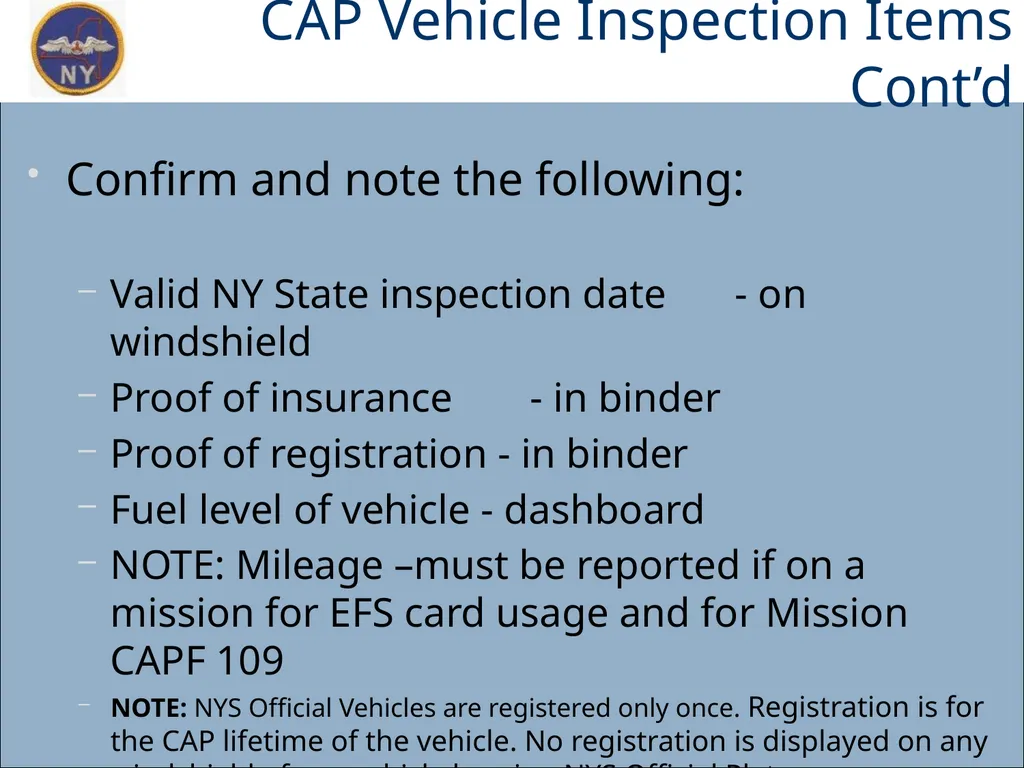
CAP Vehicle Inspection Items Cont’d Confirm and note the following:
Valid NY State inspection date - on windshield
Proof of insurance - in binder
Proof of registration - in binder
Fuel level of vehicle - dashboard
NOTE: Mileage –must be reported if on a mission for EFS card usage and for Mission CAPF 109
NOTE: NYS Official Vehicles are registered only once. Registration is for the CAP lifetime of the vehicle. No registration is displayed on any windshield of any vehicle bearing NYS Official Plates.<br>
Valid NY State inspection date - on windshield
Proof of insurance - in binder
Proof of registration - in binder
Fuel level of vehicle - dashboard
NOTE: Mileage –must be reported if on a mission for EFS card usage and for Mission CAPF 109
NOTE: NYS Official Vehicles are registered only once. Registration is for the CAP lifetime of the vehicle. No registration is displayed on any windshield of any vehicle bearing NYS Official Plates.<br>
25
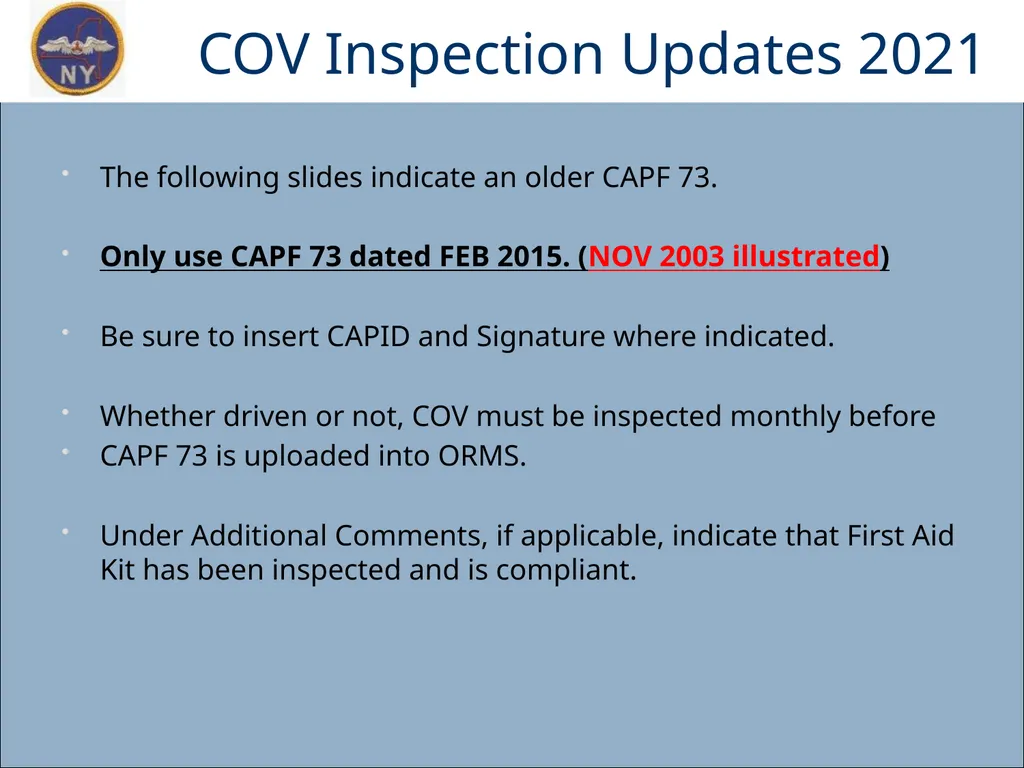
COV Inspection Updates 2021 The following slides indicate an older CAPF 73.
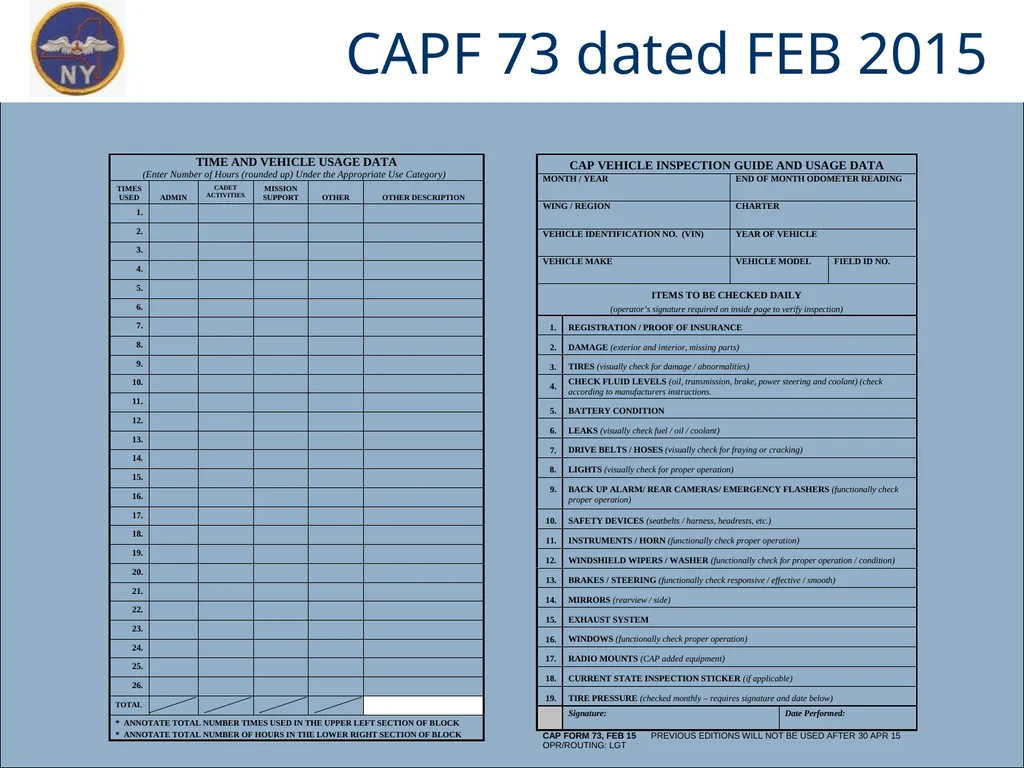
Only use CAPF 73 dated FEB 2015. (NOV 2003 illustrated)
Be sure to insert CAPID and Signature where indicated.
Whether driven or not, COV must be inspected monthly before
CAPF 73 is uploaded into ORMS.
Under Additional Comments, if applicable, indicate that First Aid Kit has been inspected and is compliant.<br>
Only use CAPF 73 dated FEB 2015. (NOV 2003 illustrated)
Be sure to insert CAPID and Signature where indicated.
Whether driven or not, COV must be inspected monthly before
CAPF 73 is uploaded into ORMS.
Under Additional Comments, if applicable, indicate that First Aid Kit has been inspected and is compliant.<br>
26
CAPF 73 dated FEB 2015<br>
27
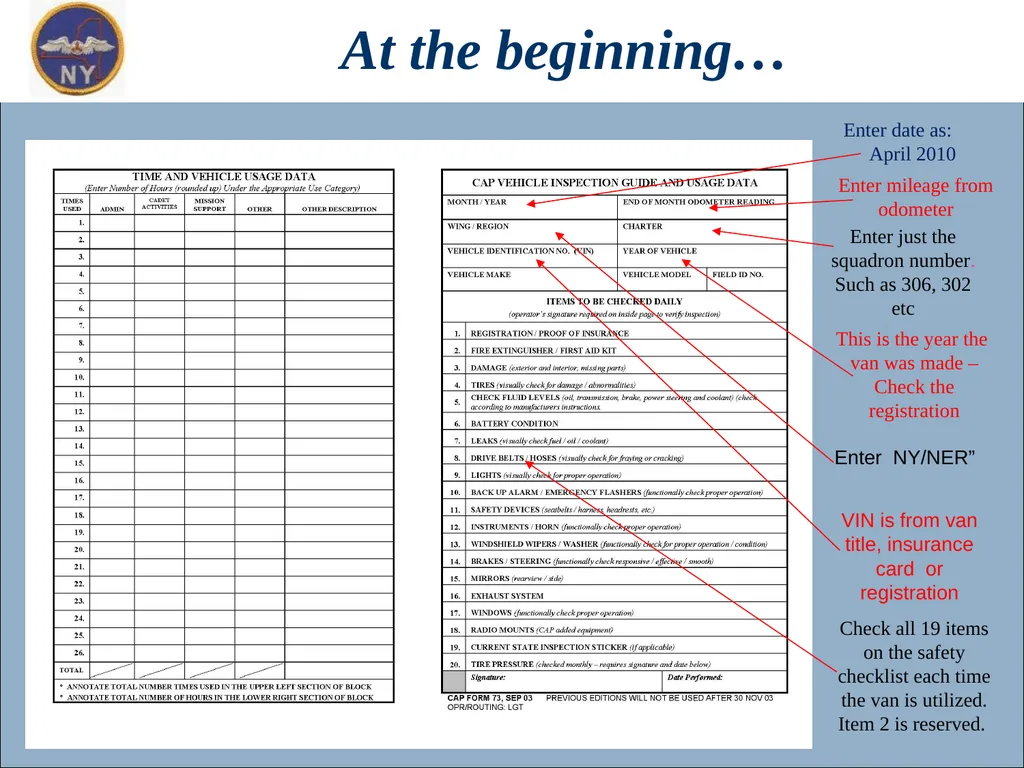
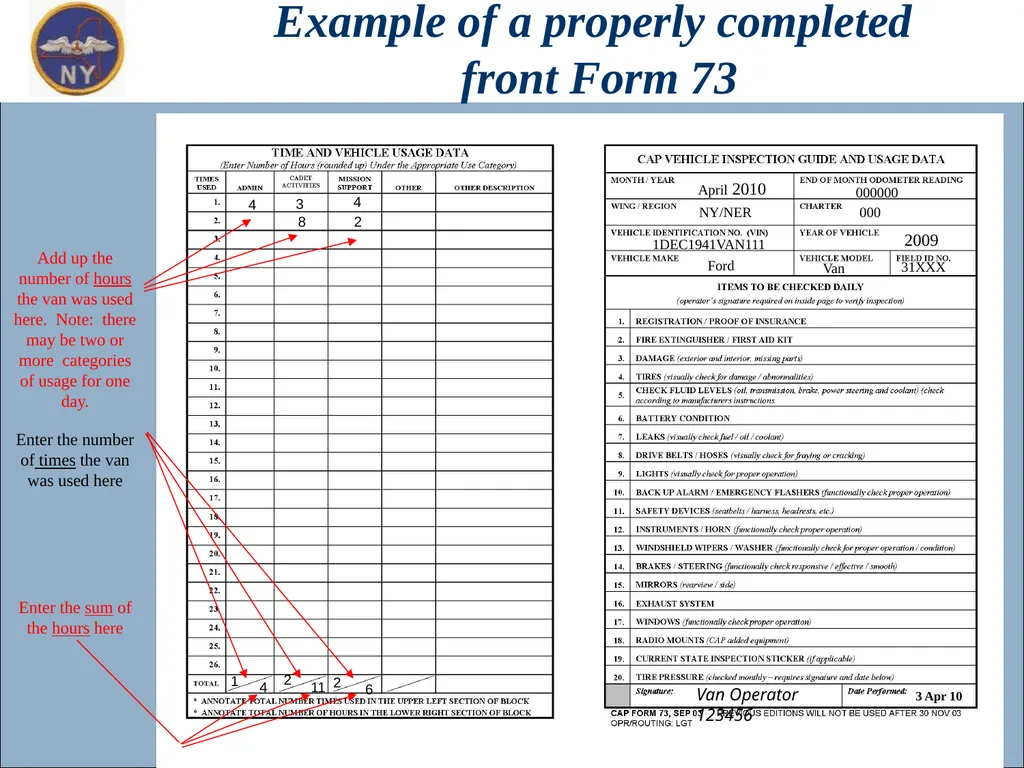
At the beginning… Enter date as: April 2010 Enter mileage from odometer Enter just the squadron number. Such as 306, 302 etc This is the year the van was made – Check the registration Check all 19 items on the safety checklist each time the van is utilized. Item 2 is reserved. VIN is from van title, insurance card or registration Enter NY/NER”<br>
28
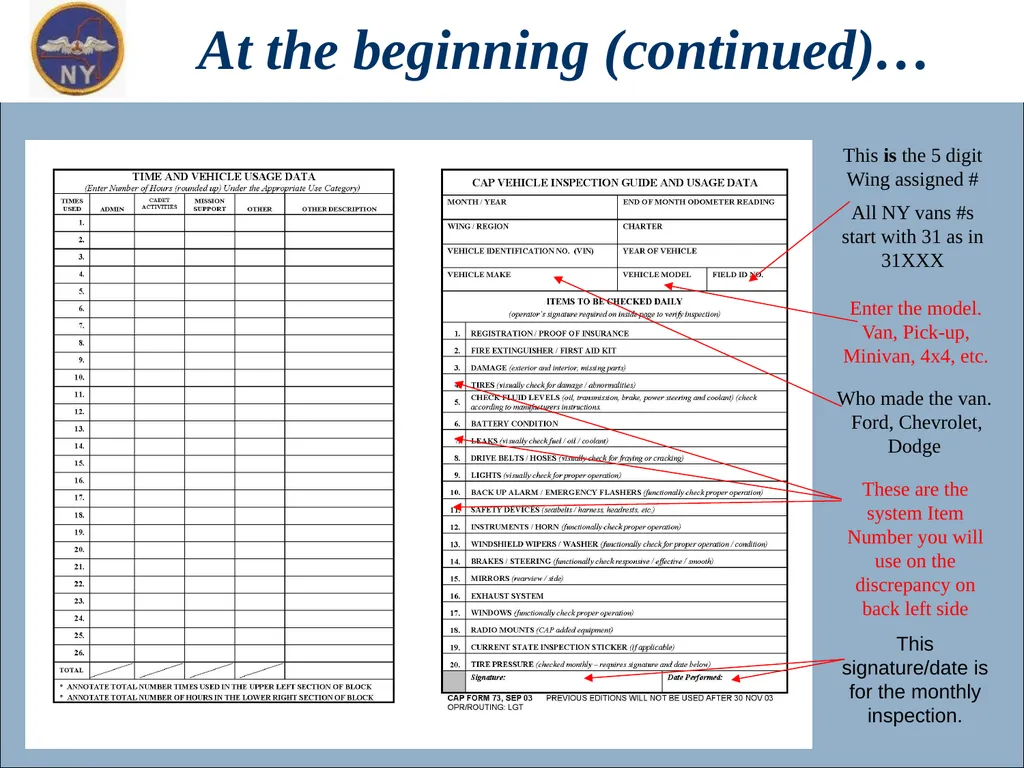
At the beginning (continued)… Enter the model. Van, Pick-up, Minivan, 4x4, etc. Who made the van. Ford, Chevrolet, Dodge This is the 5 digit Wing assigned #
All NY vans #s start with 31 as in 31XXX This signature/date is for the monthly inspection. These are the system Item Number you will use on the discrepancy on back left side<br>
All NY vans #s start with 31 as in 31XXX This signature/date is for the monthly inspection. These are the system Item Number you will use on the discrepancy on back left side<br>
29
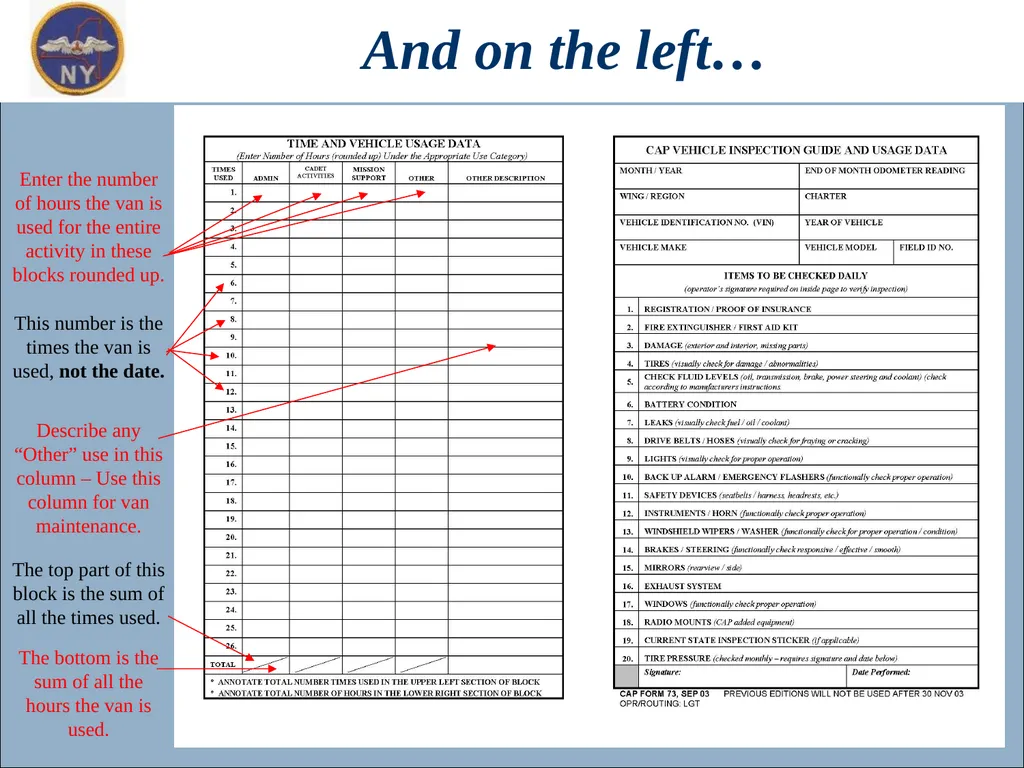
And on the left… This number is the times the van is used, not the date. Enter the number of hours the van is used for the entire activity in these blocks rounded up. The top part of this block is the sum of all the times used. The bottom is the sum of all the hours the van is used. Describe any “Other” use in this column – Use this column for van maintenance.<br>
30
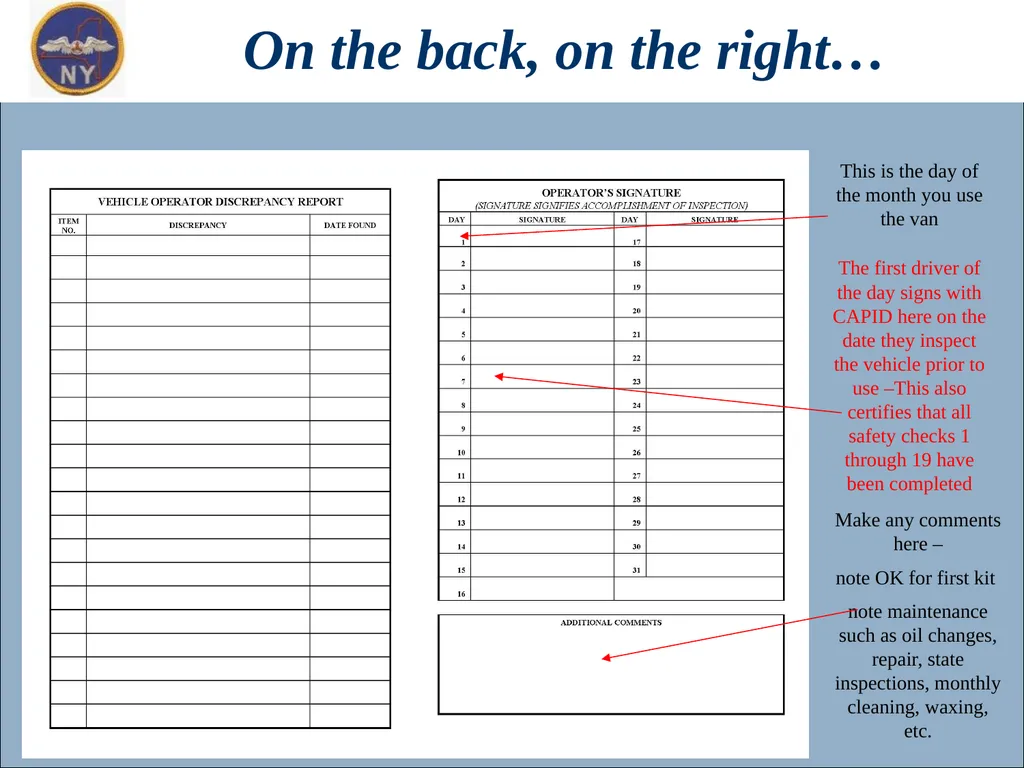
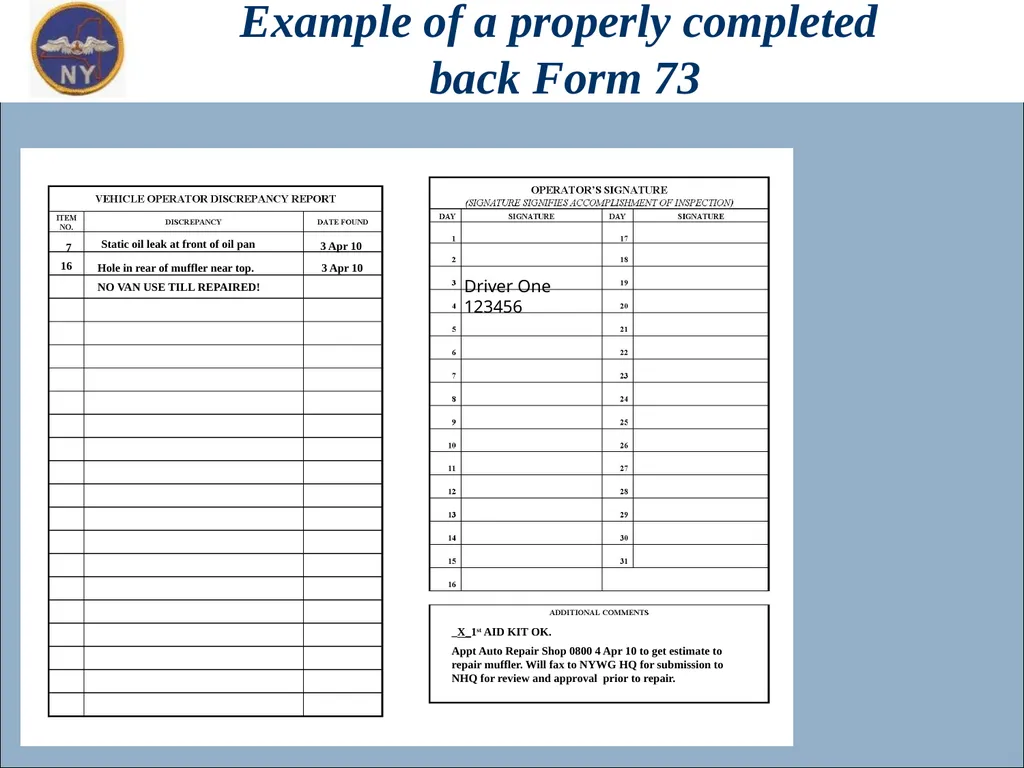
On the back, on the right… This is the day of the month you use the van The first driver of the day signs with CAPID here on the date they inspect the vehicle prior to use –This also certifies that all safety checks 1 through 19 have been completed Make any comments here –
note OK for first kit
note maintenance such as oil changes, repair, state inspections, monthly cleaning, waxing, etc.<br>
note OK for first kit
note maintenance such as oil changes, repair, state inspections, monthly cleaning, waxing, etc.<br>
31
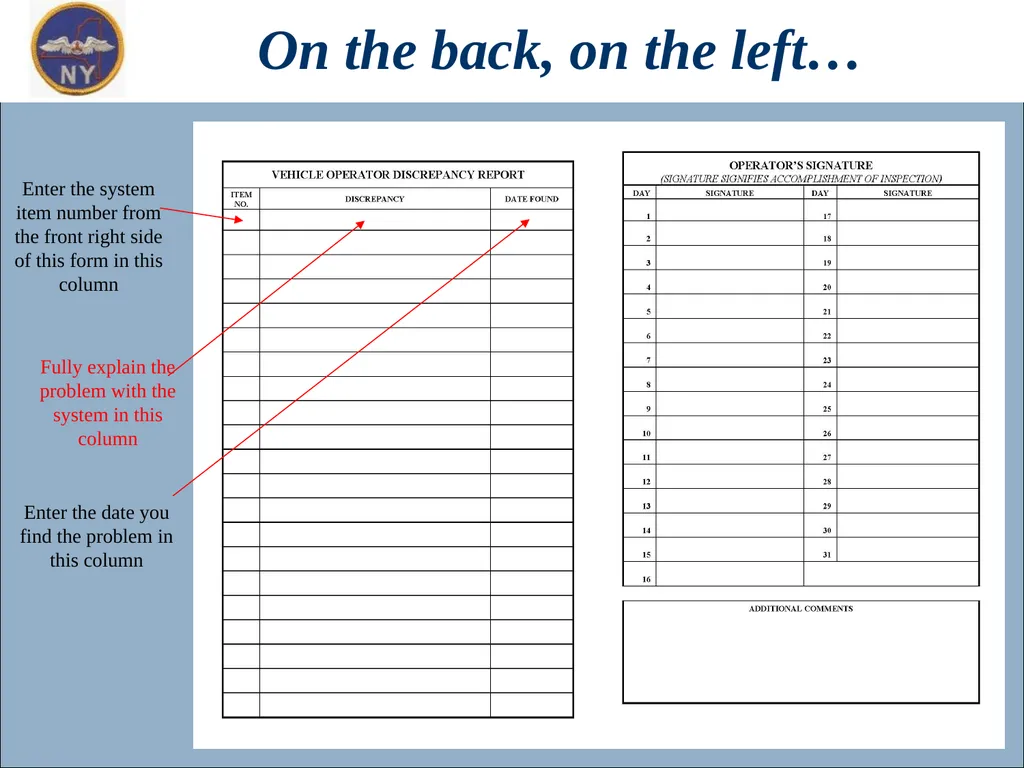
On the back, on the left… Enter the system item number from the front right side of this form in this column Fully explain the problem with the system in this column Enter the date you find the problem in this column<br>
32
Example of a properly completed
front Form 73 April 2010 000000 NY/NER 000 1DEC1941VAN111 2009 Ford Van 31XXX 4 3 4 8 2 4 1 2 11 2 6 Add up the number of hours the van was used here. Note: there may be two or more categories of usage for one day. Enter the number of times the van was used here Enter the sum of the hours here Van Operator 123456 3 Apr 10<br>
front Form 73 April 2010 000000 NY/NER 000 1DEC1941VAN111 2009 Ford Van 31XXX 4 3 4 8 2 4 1 2 11 2 6 Add up the number of hours the van was used here. Note: there may be two or more categories of usage for one day. Enter the number of times the van was used here Enter the sum of the hours here Van Operator 123456 3 Apr 10<br>
33
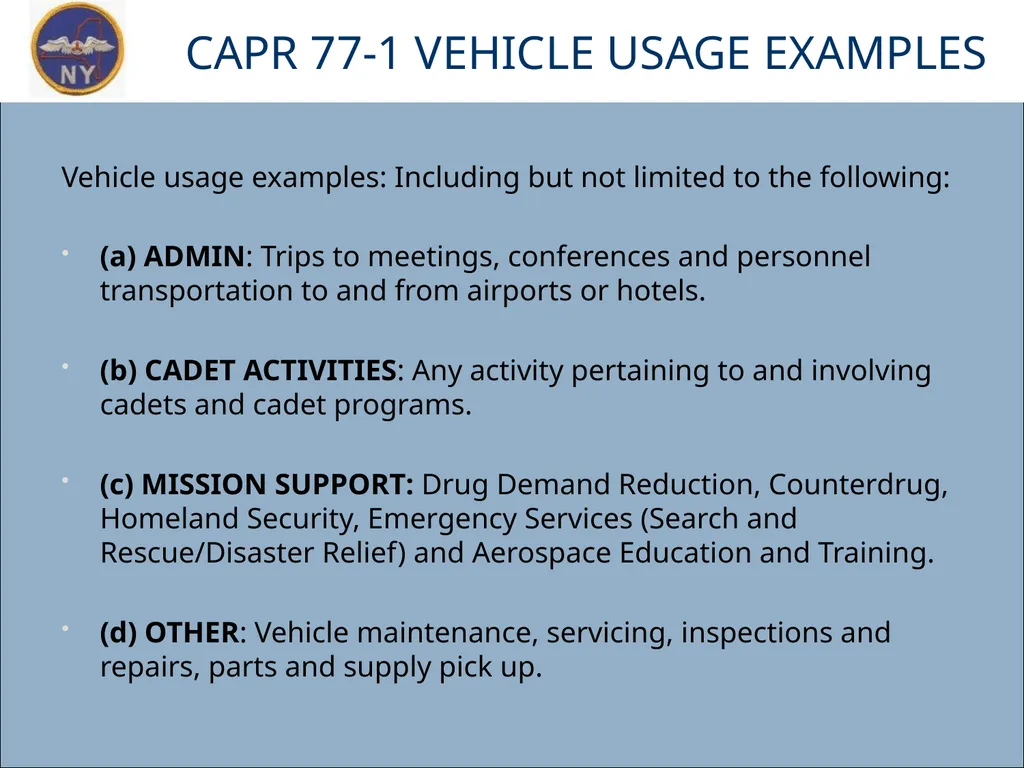
CAPR 77-1 VEHICLE USAGE EXAMPLES Vehicle usage examples: Including but not limited to the following:
(a) ADMIN: Trips to meetings, conferences and personnel transportation to and from airports or hotels.
(b) CADET ACTIVITIES: Any activity pertaining to and involving cadets and cadet programs.
(c) MISSION SUPPORT: Drug Demand Reduction, Counterdrug, Homeland Security, Emergency Services (Search and Rescue/Disaster Relief) and Aerospace Education and Training.
(d) OTHER: Vehicle maintenance, servicing, inspections and repairs, parts and supply pick up.<br>
(a) ADMIN: Trips to meetings, conferences and personnel transportation to and from airports or hotels.
(b) CADET ACTIVITIES: Any activity pertaining to and involving cadets and cadet programs.
(c) MISSION SUPPORT: Drug Demand Reduction, Counterdrug, Homeland Security, Emergency Services (Search and Rescue/Disaster Relief) and Aerospace Education and Training.
(d) OTHER: Vehicle maintenance, servicing, inspections and repairs, parts and supply pick up.<br>
34
Example of a properly completed
back Form 73 7 Static oil leak at front of oil pan 3 Apr 10 16 Hole in rear of muffler near top.
NO VAN USE TILL REPAIRED! 3 Apr 10 Driver One 123456 _X_1st AID KIT OK.
Appt Auto Repair Shop 0800 4 Apr 10 to get estimate to repair muffler. Will fax to NYWG HQ for submission to NHQ for review and approval prior to repair.<br>
back Form 73 7 Static oil leak at front of oil pan 3 Apr 10 16 Hole in rear of muffler near top.
NO VAN USE TILL REPAIRED! 3 Apr 10 Driver One 123456 _X_1st AID KIT OK.
Appt Auto Repair Shop 0800 4 Apr 10 to get estimate to repair muffler. Will fax to NYWG HQ for submission to NHQ for review and approval prior to repair.<br>
35
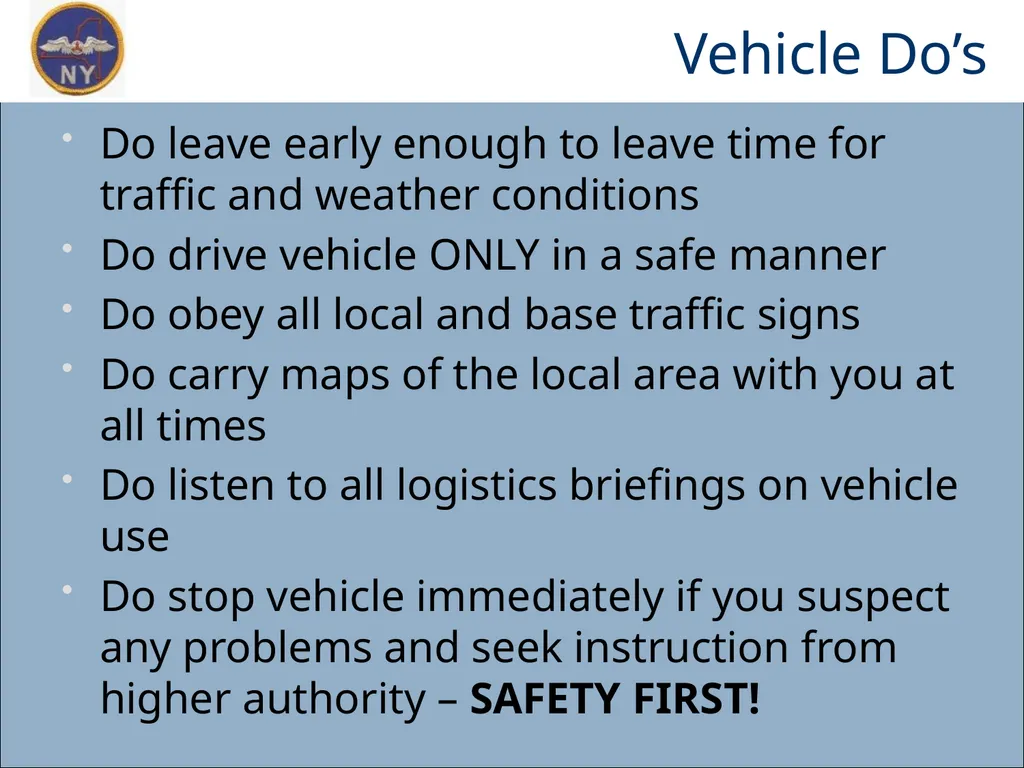
Vehicle Do’s Do leave early enough to leave time for traffic and weather conditions
Do drive vehicle ONLY in a safe manner
Do obey all local and base traffic signs
Do carry maps of the local area with you at all times
Do listen to all logistics briefings on vehicle use
Do stop vehicle immediately if you suspect any problems and seek instruction from higher authority – SAFETY FIRST!<br>
Do drive vehicle ONLY in a safe manner
Do obey all local and base traffic signs
Do carry maps of the local area with you at all times
Do listen to all logistics briefings on vehicle use
Do stop vehicle immediately if you suspect any problems and seek instruction from higher authority – SAFETY FIRST!<br>
36
More Vehicle Do’s When backing any COV, especially with
passengers on board, whenever possible,
have an officer stand outside to the rear of
the COV to act as a guide while backing.
Drive with all doors closed and locked.<br>
passengers on board, whenever possible,
have an officer stand outside to the rear of
the COV to act as a guide while backing.
Drive with all doors closed and locked.<br>
37
Vehicle Don’ts Do not pull away until the vehicle is inspected and all passengers including driver are wearing seat belts.
Do not pull away unless there is enough gas in the vehicle to get to destination with some to spare. COV will be topped off in order to be ready for next usage.
Do not go faster than the posted allowable speed limit.<br>
Do not pull away unless there is enough gas in the vehicle to get to destination with some to spare. COV will be topped off in order to be ready for next usage.
Do not go faster than the posted allowable speed limit.<br>
38
More Vehicle Don’ts Do Not apply decaling or signage other than that provided by NHQ.
Do not permit use of tobacco products of any sort within any COV per CAPR 77-1.
Do not use cell phone or text on cell phone when driving. This is a violation of CAPR 77-1 and New York Motor Vehicle Law.<br>
Do not permit use of tobacco products of any sort within any COV per CAPR 77-1.
Do not use cell phone or text on cell phone when driving. This is a violation of CAPR 77-1 and New York Motor Vehicle Law.<br>
39
What If? What if an accident occurs?
Pull off to the side of the road to a safe area.
Immediately contact the Wing Commander, or Vice Commander, and Wing Safety officer. A Mishap Notification must be filed online for all accidents.
Contact Police for accident report regardless of how minor the damage may appear.<br>
Pull off to the side of the road to a safe area.
Immediately contact the Wing Commander, or Vice Commander, and Wing Safety officer. A Mishap Notification must be filed online for all accidents.
Contact Police for accident report regardless of how minor the damage may appear.<br>
40
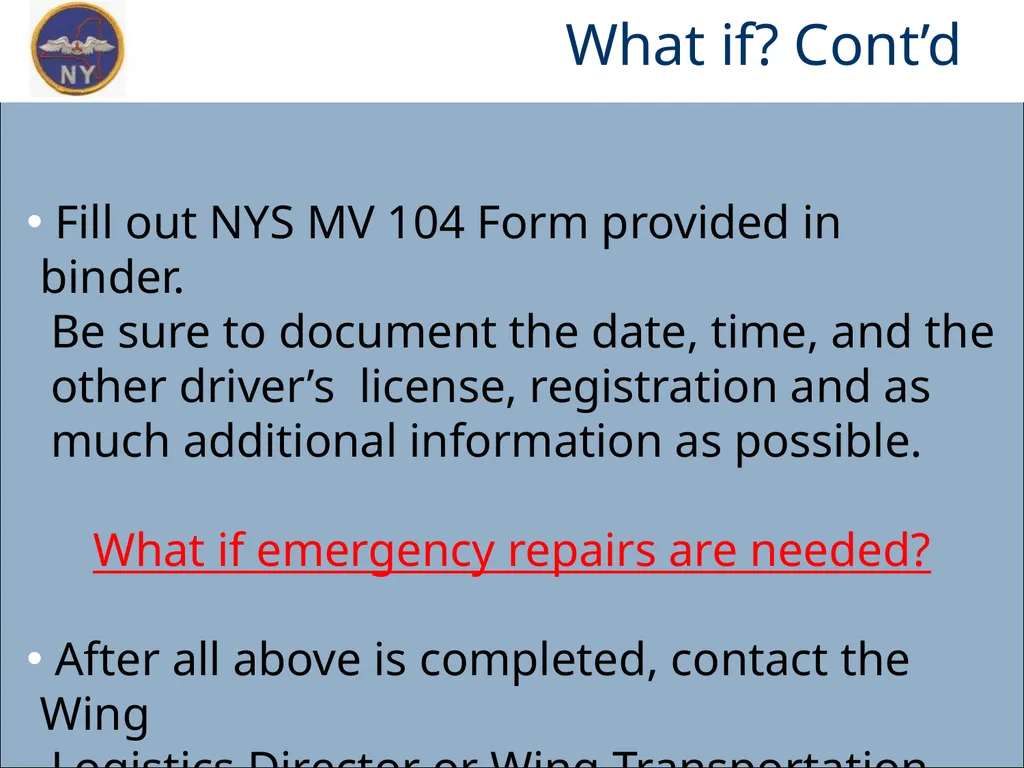
What if? Cont’d Fill out NYS MV 104 Form provided in binder.
Be sure to document the date, time, and the
other driver’s license, registration and as
much additional information as possible.
What if emergency repairs are needed?
After all above is completed, contact the Wing
Logistics Director or Wing Transportation
Officer for instructions.<br>
Be sure to document the date, time, and the
other driver’s license, registration and as
much additional information as possible.
What if emergency repairs are needed?
After all above is completed, contact the Wing
Logistics Director or Wing Transportation
Officer for instructions.<br>
41
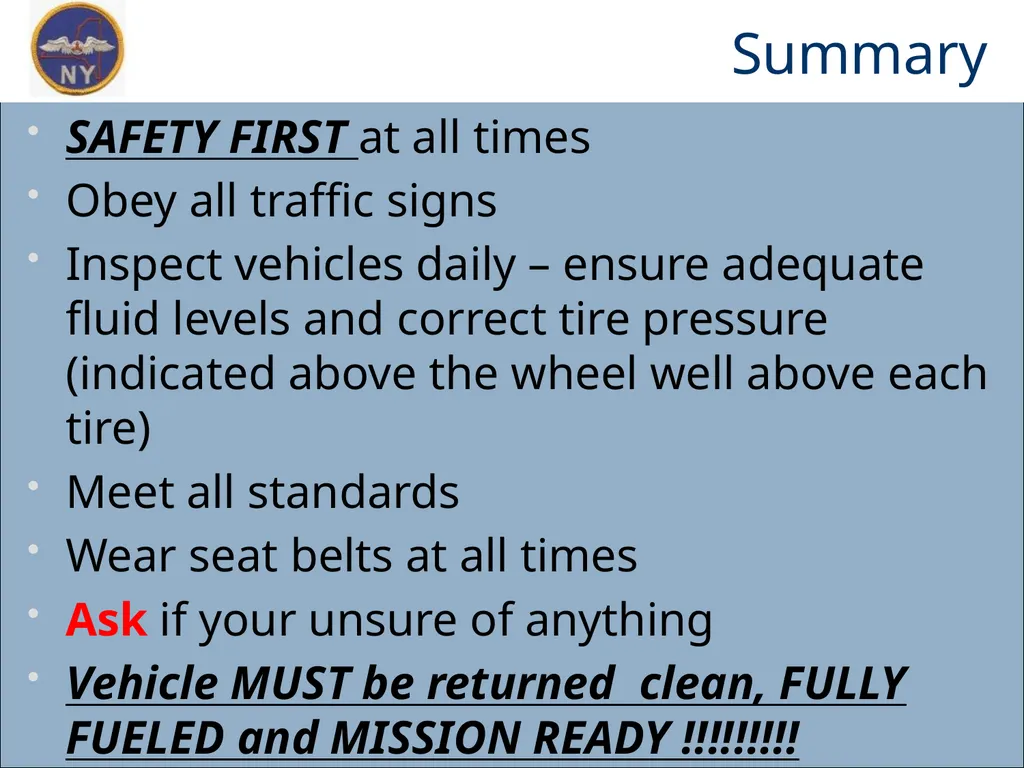
Summary SAFETY FIRST at all times
Obey all traffic signs
Inspect vehicles daily – ensure adequate fluid levels and correct tire pressure (indicated above the wheel well above each tire)
Meet all standards
Wear seat belts at all times
Ask if your unsure of anything
Vehicle MUST be returned clean, FULLY FUELED and MISSION READY !!!!!!!!!<br>
Obey all traffic signs
Inspect vehicles daily – ensure adequate fluid levels and correct tire pressure (indicated above the wheel well above each tire)
Meet all standards
Wear seat belts at all times
Ask if your unsure of anything
Vehicle MUST be returned clean, FULLY FUELED and MISSION READY !!!!!!!!!<br>
42
Questions<br>