
CAPITAL IMPROVEMENTS PLANNING Equipment Purchases



Description: CAPITAL IMPROVEMENTS PLANNING Equipment Purchases Patrick Callahan, Municipal Consultant August 24, 2022 CAPITAL IMPROVEMENTS PLANNING (CIP) CIP Definition - Written Document Long range plan (4-6 years) Planning, scheduling, financing
Related Topics
Download Presentation
"CAPITAL IMPROVEMENTS PLANNING Equipment Purchases" is the property of its rightful owner. Permission is granted to download and print the materials on this website for personal, non-commercial use only, and to display it on your personal computer provided you do not modify the materials and that you retain all copyright notices contained in the materials. By downloading content from our website, you accept the terms of this agreement.
Presentation Transcript
slide1. CAPITAL IMPROVEMENTS PLANNING
Equipment Purchases Patrick Callahan,
Municipal Consultant
August 24, 2022<br>
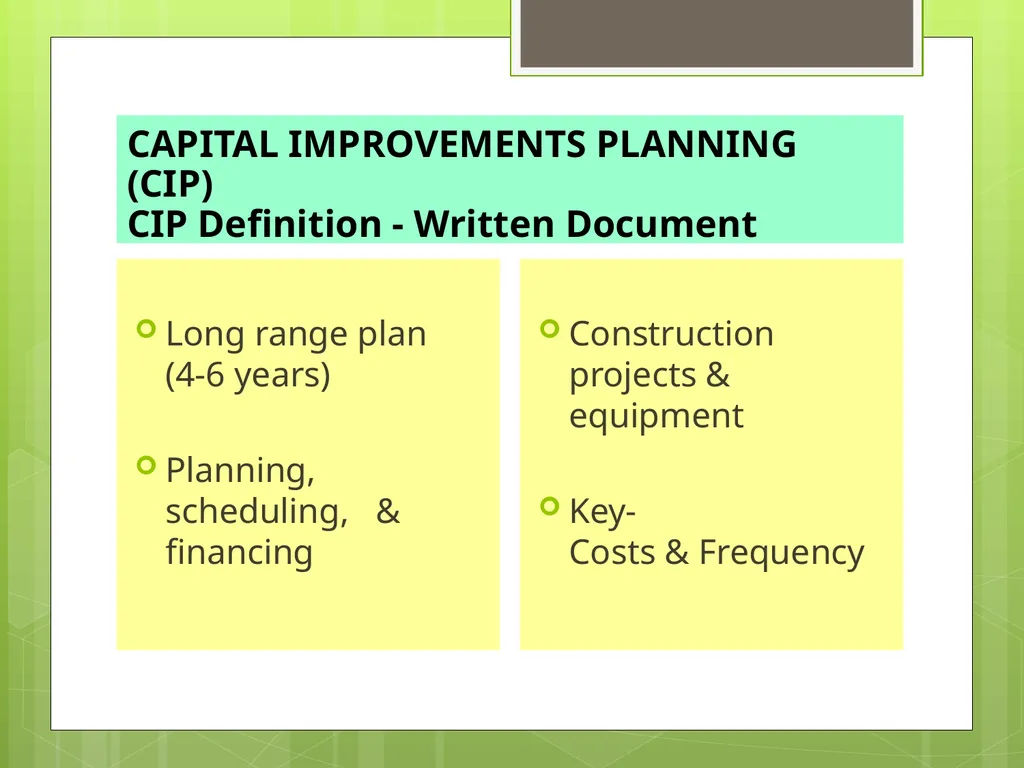
slide2. CAPITAL IMPROVEMENTS PLANNING (CIP) CIP Definition - Written Document Long range plan (4-6 years)
Planning, scheduling, & financing Construction projects & equipment
Key- Costs & Frequency<br>
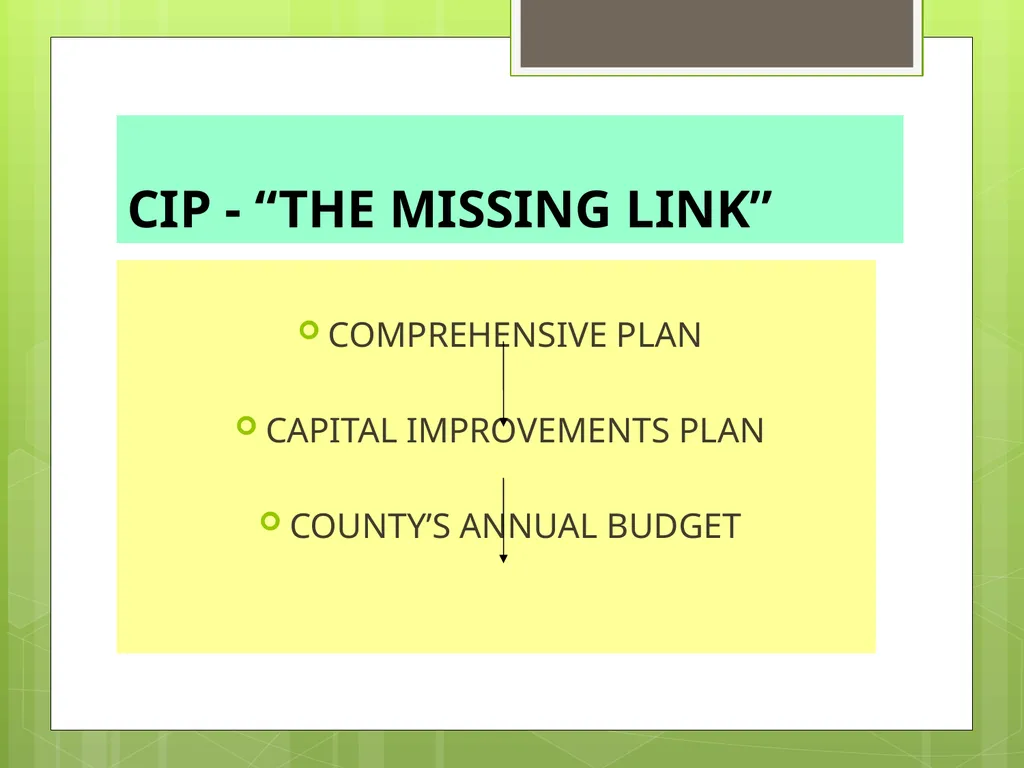
slide3. CIP - “THE MISSING LINK” COMPREHENSIVE PLAN
CAPITAL IMPROVEMENTS PLAN
COUNTY’S ANNUAL BUDGET<br>
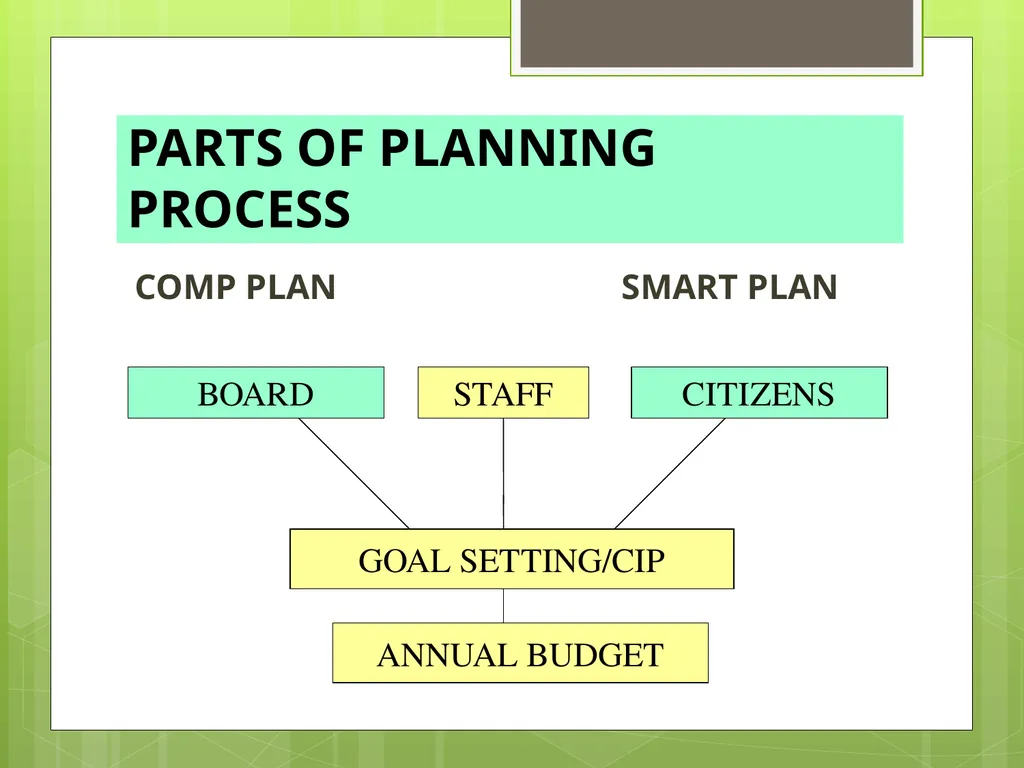
slide4. PARTS OF PLANNING PROCESS COMP PLAN SMART PLAN STAFF BOARD CITIZENS GOAL SETTING/CIP ANNUAL BUDGET<br>
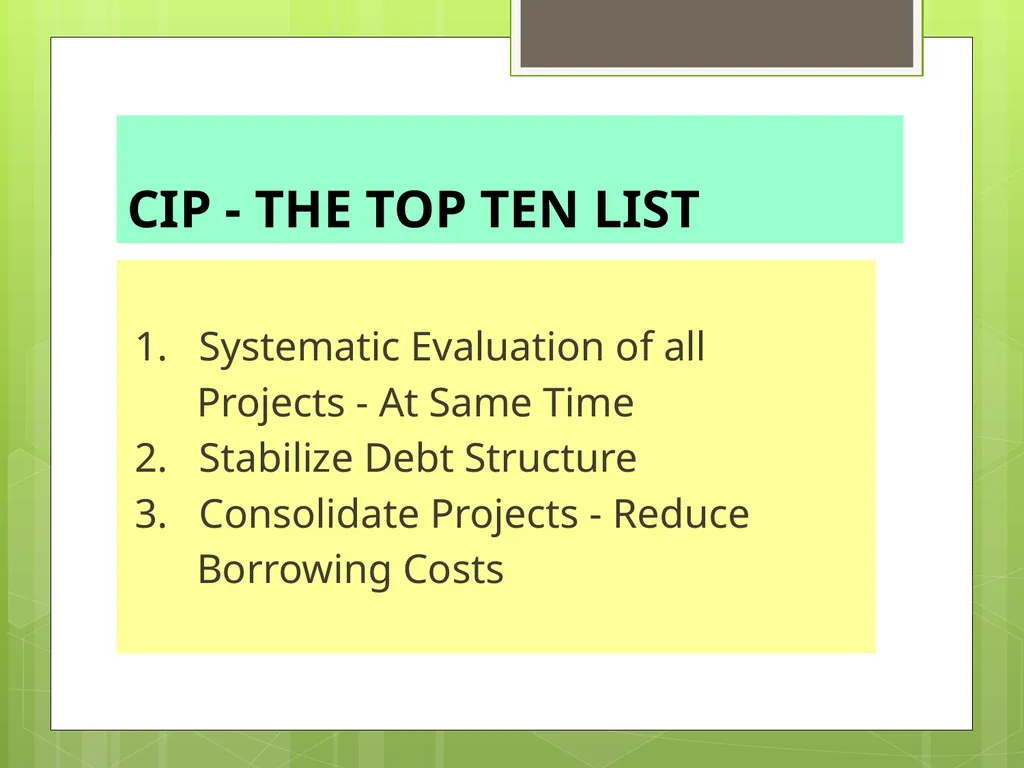
slide5. CIP - THE TOP TEN LIST 1. Systematic Evaluation of all
Projects - At Same Time
2. Stabilize Debt Structure
3. Consolidate Projects - Reduce
Borrowing Costs<br>
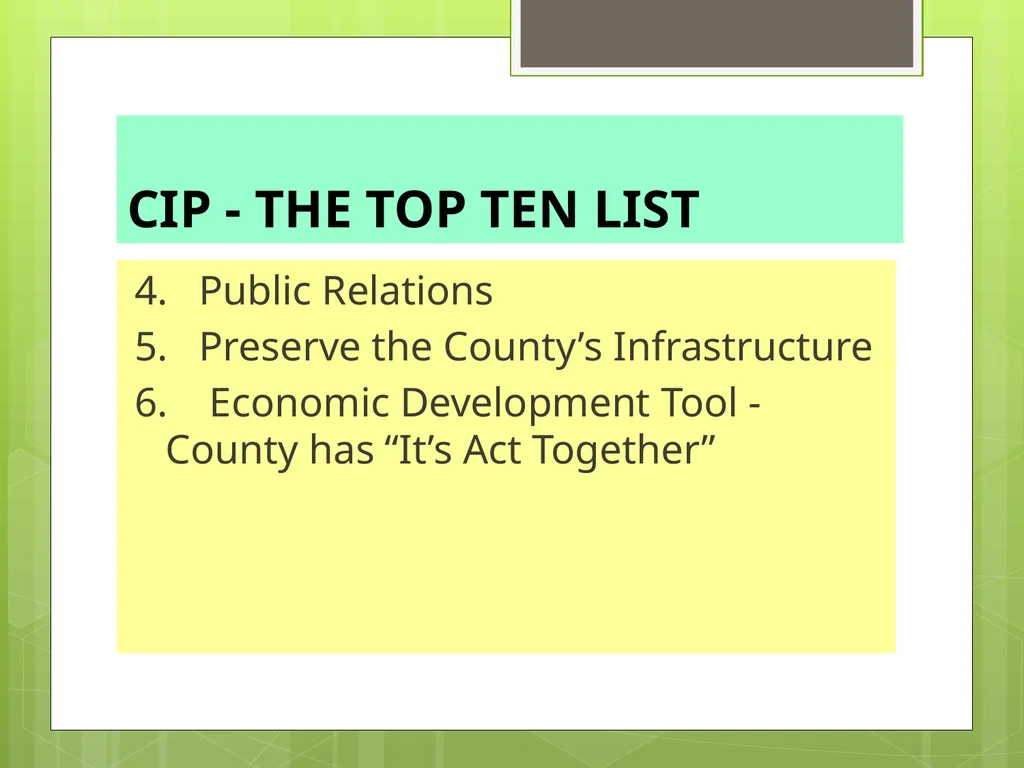
slide6. CIP - THE TOP TEN LIST 4. Public Relations
5. Preserve the County’s Infrastructure
6. Economic Development Tool - County has “It’s Act Together”<br>
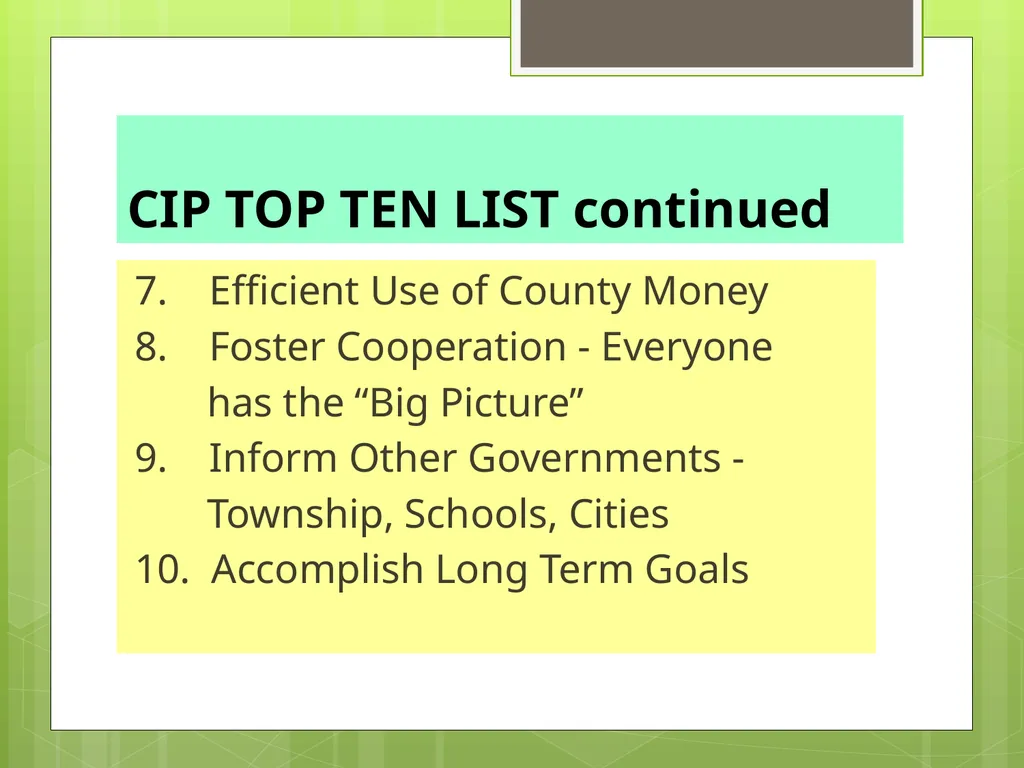
slide7. CIP TOP TEN LIST continued 7. Efficient Use of County Money
8. Foster Cooperation - Everyone
has the “Big Picture”
9. Inform Other Governments -
Township, Schools, Cities
10. Accomplish Long Term Goals<br>
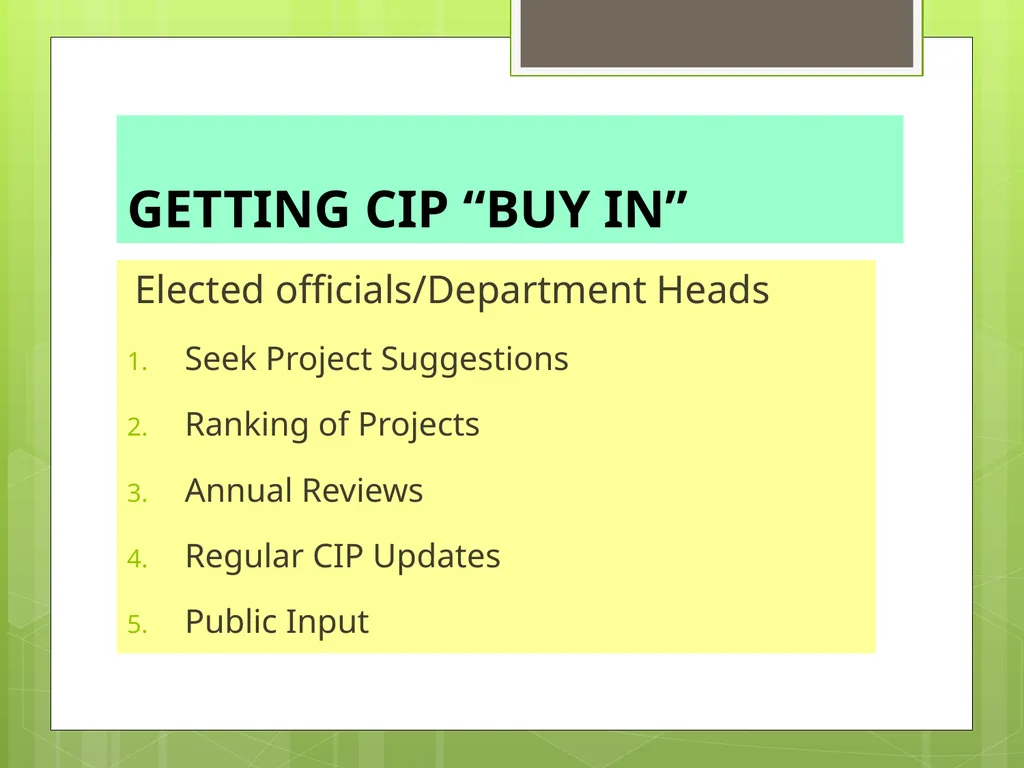
slide8. GETTING CIP “BUY IN” Elected officials/Department Heads
Seek Project Suggestions
Ranking of Projects
Annual Reviews
Regular CIP Updates
Public Input<br>
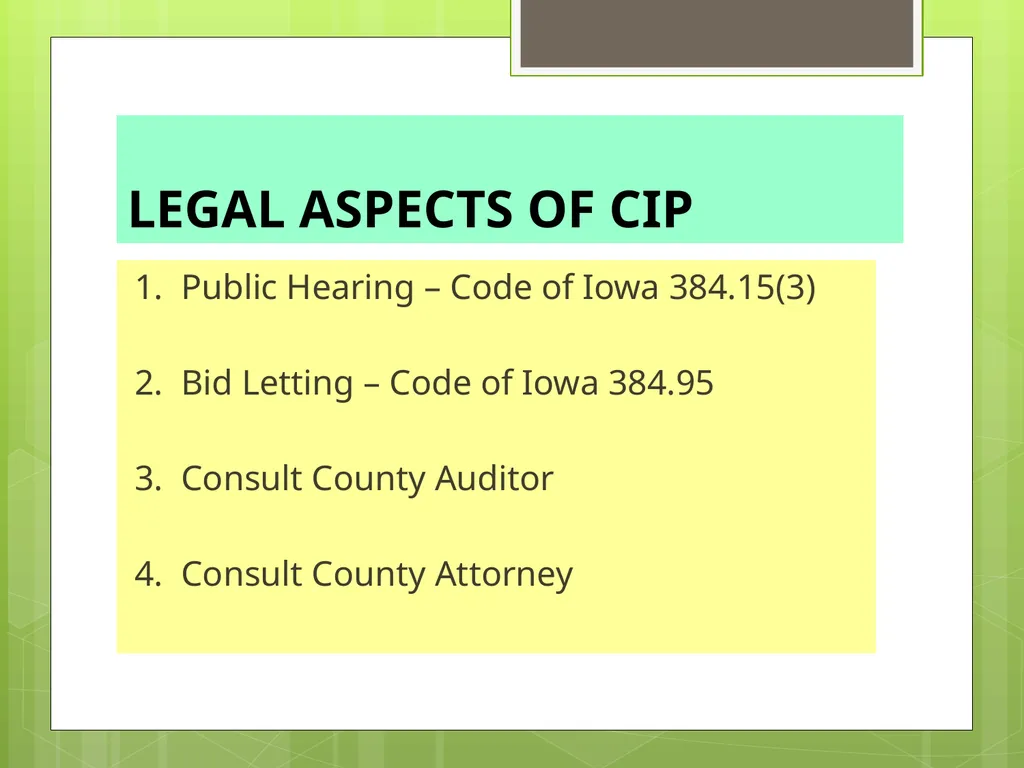
slide9. LEGAL ASPECTS OF CIP 1. Public Hearing – Code of Iowa 384.15(3)
2. Bid Letting – Code of Iowa 384.95
3. Consult County Auditor
4. Consult County Attorney<br>
slide10. CONSTITUTIONAL DEBT LIMIT Check State Law – 5% of Assessed Value
Applies to G.O., TIF, LOST Bonds
Not Apply to Revenue Bonds, RUT Bonds, or Special Assessment Bonds<br>
slide11. CIP PROCESS - Overview 1. Define the Criteria
2. Organize the Process
3. Develop Basic Policies<br>
slide12. CIP PROCESS (continued) 4. Forecast the Demand or Growth
5. Inventory Existing Facilities
6. Prepare Project Proposals<br>
slide13. CIP PROCESS (continued) 7. Seek Advice
8. Review County’s Finances
9. Prepare Scenarios - Schedules<br>
slide14. CIP PROCESS (continued) 10. Prepare CIP Draft
11. Public Hearing
12. Final Draft - Board Resolution<br>
slide15. Defining a Capital Project 1. Consider the frequency of occurrence
2. Determine minimum cost threshold
3. Consider the life expectancy of the project or equipment<br>
slide16. Organizing the Process for Capital Improvements Plan (CIP) 1. Board Committee of the Whole
2. Special CIP Committee
3. Designating the Coordinator or “Quarterback”<br>
slide17. Organizing the Process for Capital Improvements Plan (CIP)(continued) 4. Establishing a time table
5. Identifying expert assistance – department heads, engineers, financial consultant, contractors, vendors, employees, etc.
6. Develop Project Profile Form<br>
slide18. Develop the County’s Basic Polices on Infrastructure and Level of Service 1. Roads – surface, width and base
2. Storm Sewers – size, intakes, type, and locations
3. Parks – number, size, type and service lines
4. Water – treatment and storage capacity<br>
slide19. Develop the County’s Basic Polices on Infrastructure and Level of Service 5. Wastewater – DNR requirements, future needs and types of treatment
6. Sherriff – vehicles and equipment
7. Townships – Fire and Cemetery<br>
slide20. Forecast Demand for Services 1. Determine areas for growth
2. Identify areas that lack basic services<br>
slide21. Review Existing Documents for Potential Projects 1. Comprehensive Plan
2. Wastewater Inspection
Reports - IDNR
3. Water Inspection Reports - IDNR<br>
slide22. Review Existing Documents for Potential Projects (continued) 4. Previous Engineering Studies
5. Department Heads “Wish Lists”
6. Annual Reports – County Departments
7. Goal Setting Reports<br>
slide23. Conduct an Inventory of Existing Facilities and Equipment 1. Courthouse – roof, foundation, structure, size, & appearance
2. Secondary Boards Garages – roof, foundation, location &appearance
3. Law Enforcement Center – roof, foundation, siding and size<br>
slide24. Conduct an Inventory of Existing Facilities and Equipment (continued) 4. Water Towers – age, size, paint, & interior condition
5. Wastewater Plants – age, capacity, condition, & cost of operation
6. Parks – condition of facilities, appearance, & safety of equipment<br>
slide25. Conduct an Inventory of Existing Facilities and Equipment (continued) 7. Township Fire Equipment – age, use, & condition
8. Secondary Roads Equipment – age, use, & condition<br>
slide26. Prepare List of Potential Projects 1. Discuss the merits of each project
2. Review County’s financial capacity to fund
3. Determine the priority of projects<br>
slide27. Prepare List of Potential Projects (continued) 4. Conduct Board tour of projects
and buildings
5. Develop two lists – in CIP or
postpone<br>
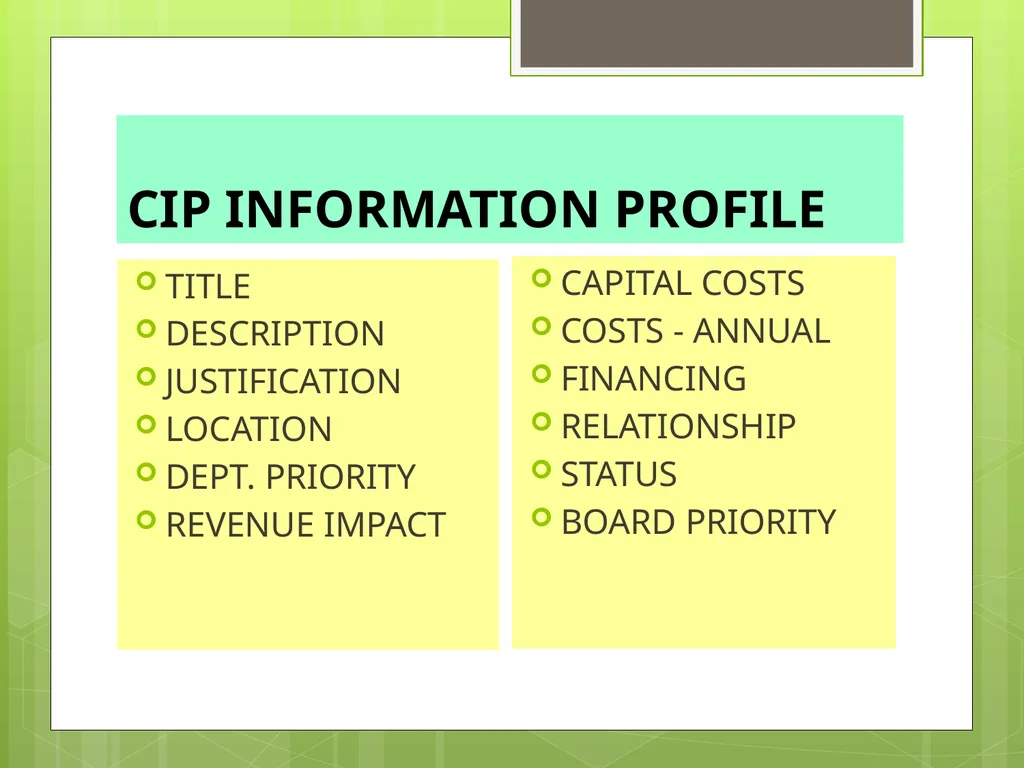
slide28. CIP INFORMATION PROFILE TITLE
DESCRIPTION
JUSTIFICATION
LOCATION
DEPT. PRIORITY
REVENUE IMPACT CAPITAL COSTS
COSTS - ANNUAL
FINANCING
RELATIONSHIP
STATUS
BOARD PRIORITY<br>
slide29. Prepare Project Profiles or Project Summaries for Each Project 1. Title or name
2. Brief description
3. Justification for the project<br>
slide30. Prepare Project Profiles or Project Summaries for Each Project (continued) 4. Cost estimate – construction, engineering, & legal
5. Possible completion date or timing
6. Priority or ranking by Departments and Board<br>
slide31. Prepare Project Profiles or Project Summaries for Each Project (continued) 7. Map, site plan, or picture
8. Potential funding sources
9. Annual impact on revenues and expenditures<br>
slide32. Review of Project Profiles 1. Department Head comments
2. Engineer comments
3. Financial Consultant review<br>
slide33. Conduct an Initial Ranking of Projections – Board of Supervisors 1. Assign a score – A, B, C, or D
2. Tabulate results and average score
3. Discuss the overall ranking<br>
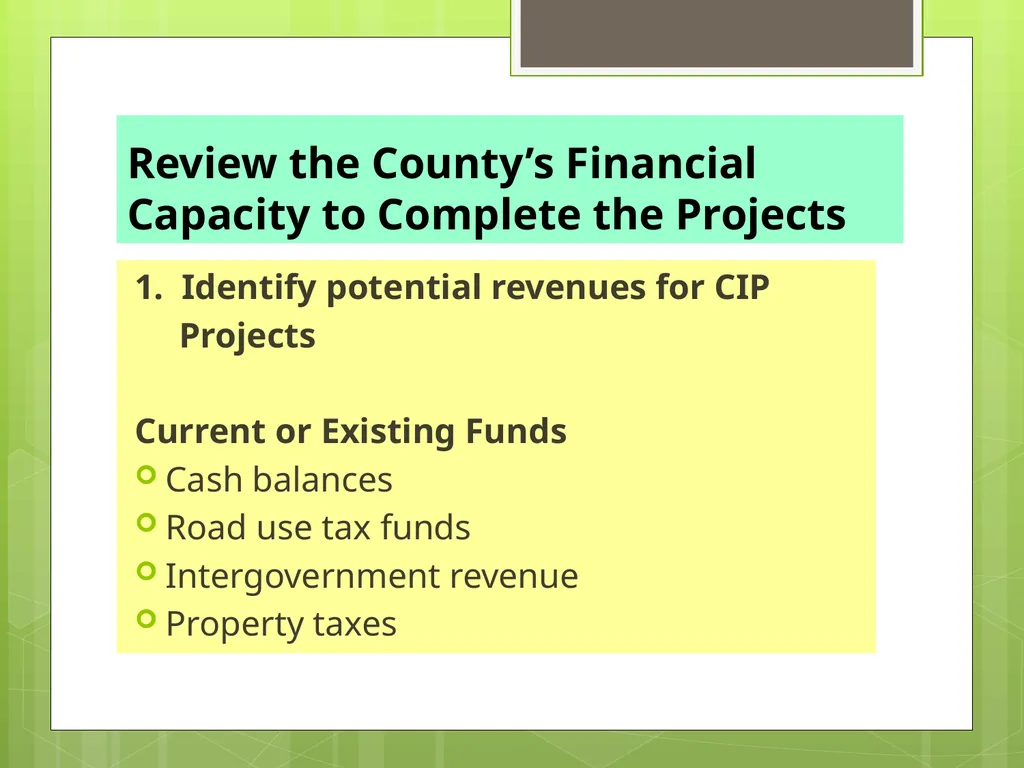
slide34. Review the County’s Financial Capacity to Complete the Projects 1. Identify potential revenues for CIP
Projects
Current or Existing Funds
Cash balances
Road use tax funds
Intergovernment revenue
Property taxes<br>
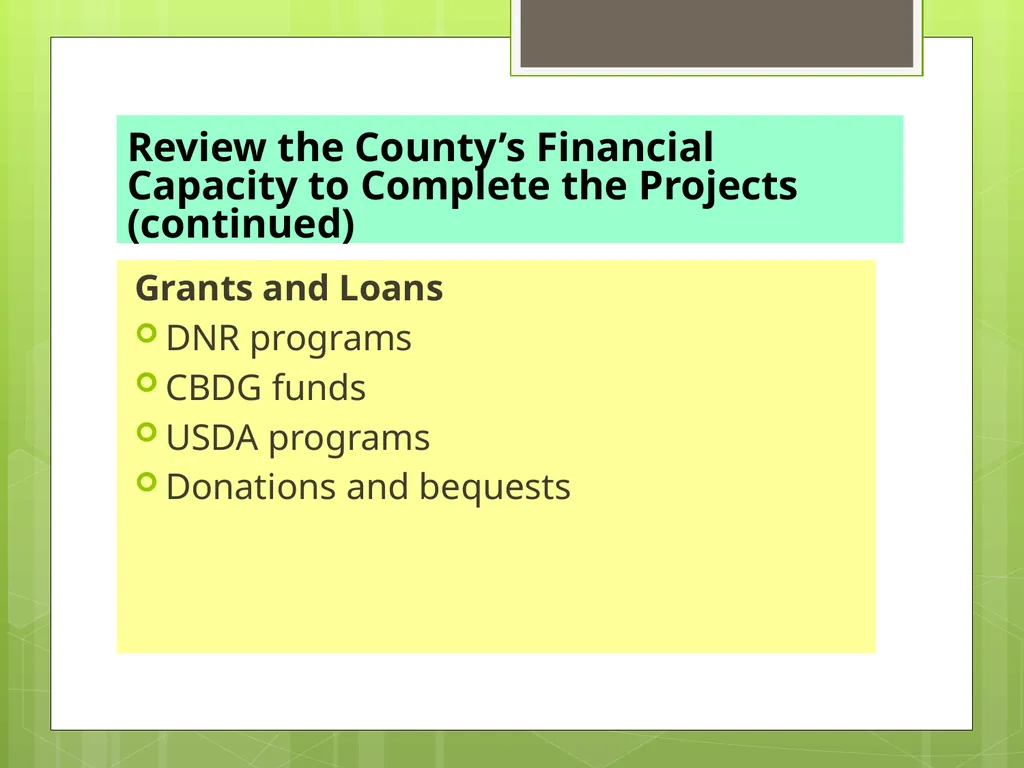
slide35. Review the County’s Financial Capacity to Complete the Projects (continued) Grants and Loans
DNR programs
CBDG funds
USDA programs
Donations and bequests<br>
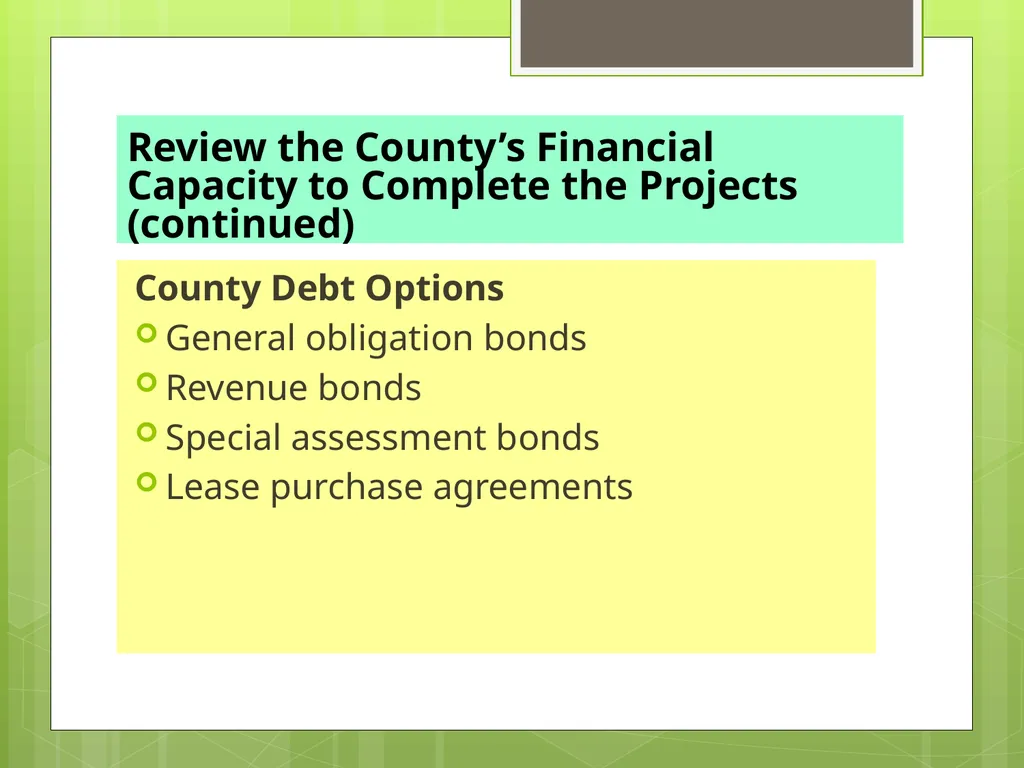
slide36. Review the County’s Financial Capacity to Complete the Projects (continued) County Debt Options
General obligation bonds
Revenue bonds
Special assessment bonds
Lease purchase agreements<br>
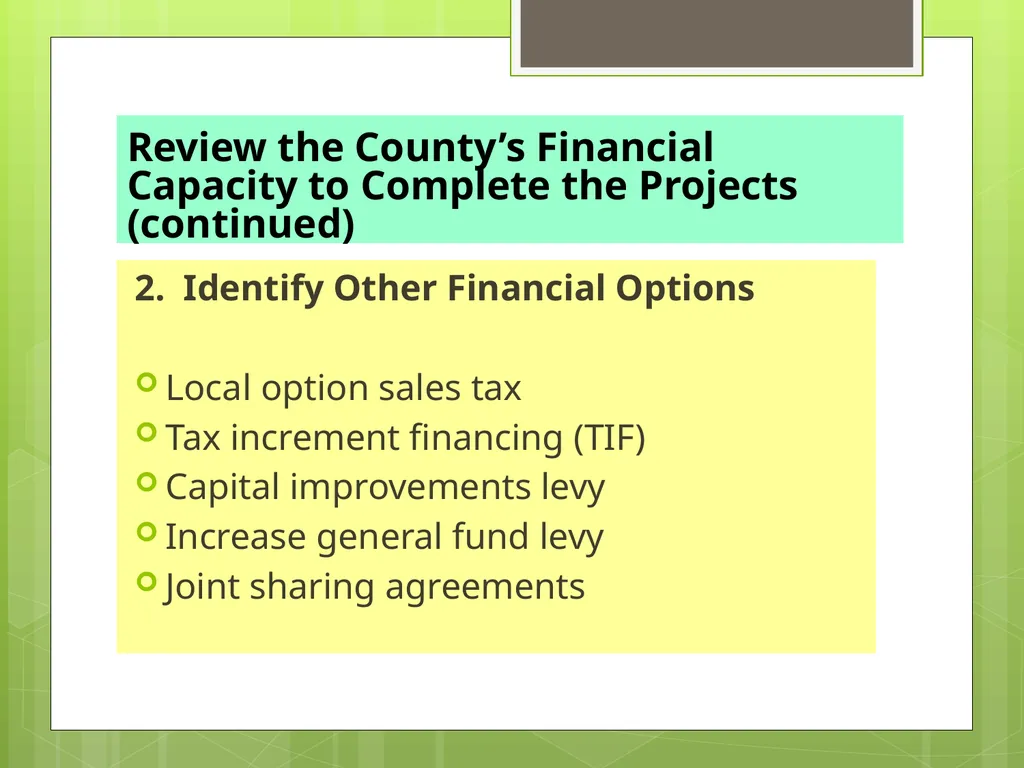
slide37. Review the County’s Financial Capacity to Complete the Projects (continued) 2. Identify Other Financial Options
Local option sales tax
Tax increment financing (TIF)
Capital improvements levy
Increase general fund levy
Joint sharing agreements<br>
slide38. Review the County’s Financial Capacity to Complete the Projects (continued) 3. Select best financial option for each project
Prepare department schedules
Identify financial impact on cash balances, user fees, and taxes<br>
slide39. Conduct a Second Ranking of Projects - Optional 1. Assign a score – A, B, C, or D
2. Tabulate the results
3. Discuss the overall ranking
4. Reach a consensus!<br>
slide40. Public Comments 1. Publish notice on CIP
2. Copies of CIP on file at Courthouse
3. Conduct public hearing<br>
slide41. Adoption of the CIP and Inclusion in Annual Budget 1. Adopt by Resolution
2. Conduct quarterly review
3. Include “Year 1” in Annual Budget<br>
slide42. Adoption of the CIP and Inclusion in Annual Budget (continued) 4. Conduct an annual review
5. Continue to refine the process<br>
slide43. Future Citizen Input on CIP Process 1. Copies of CIP available for public
2. Presentation to Service Clubs
3. Town Hall Meetings
4. “Open House” of County Facilities<br>
slide44. BEST PRACTICES FINAL COMMENTS Annual Reviews
Quarterly Updates
How to Get Started
Questions
Comments<br>
slide45. Contact Information Patrick Callahan
Callahan Municipal Consultants
417 Kaitlynn Ave
Anamosa, IA 52205
callahan.cmc@gmail.com
www.callahanmuicipalconsultants.com
Cell: (563) 599-3708<br>
Municipal Consultant
August 24, 2022<br>
slide2. CAPITAL IMPROVEMENTS PLANNING (CIP) CIP Definition - Written Document Long range plan (4-6 years)
Planning, scheduling, & financing Construction projects & equipment
Key- Costs & Frequency<br>
slide3. CIP - “THE MISSING LINK” COMPREHENSIVE PLAN
CAPITAL IMPROVEMENTS PLAN
COUNTY’S ANNUAL BUDGET<br>
slide4. PARTS OF PLANNING PROCESS COMP PLAN SMART PLAN STAFF BOARD CITIZENS GOAL SETTING/CIP ANNUAL BUDGET<br>
slide5. CIP - THE TOP TEN LIST 1. Systematic Evaluation of all
Projects - At Same Time
2. Stabilize Debt Structure
3. Consolidate Projects - Reduce
Borrowing Costs<br>
slide6. CIP - THE TOP TEN LIST 4. Public Relations
5. Preserve the County’s Infrastructure
6. Economic Development Tool - County has “It’s Act Together”<br>
slide7. CIP TOP TEN LIST continued 7. Efficient Use of County Money
8. Foster Cooperation - Everyone
has the “Big Picture”
9. Inform Other Governments -
Township, Schools, Cities
10. Accomplish Long Term Goals<br>
slide8. GETTING CIP “BUY IN” Elected officials/Department Heads
Seek Project Suggestions
Ranking of Projects
Annual Reviews
Regular CIP Updates
Public Input<br>
slide9. LEGAL ASPECTS OF CIP 1. Public Hearing – Code of Iowa 384.15(3)
2. Bid Letting – Code of Iowa 384.95
3. Consult County Auditor
4. Consult County Attorney<br>
slide10. CONSTITUTIONAL DEBT LIMIT Check State Law – 5% of Assessed Value
Applies to G.O., TIF, LOST Bonds
Not Apply to Revenue Bonds, RUT Bonds, or Special Assessment Bonds<br>
slide11. CIP PROCESS - Overview 1. Define the Criteria
2. Organize the Process
3. Develop Basic Policies<br>
slide12. CIP PROCESS (continued) 4. Forecast the Demand or Growth
5. Inventory Existing Facilities
6. Prepare Project Proposals<br>
slide13. CIP PROCESS (continued) 7. Seek Advice
8. Review County’s Finances
9. Prepare Scenarios - Schedules<br>
slide14. CIP PROCESS (continued) 10. Prepare CIP Draft
11. Public Hearing
12. Final Draft - Board Resolution<br>
slide15. Defining a Capital Project 1. Consider the frequency of occurrence
2. Determine minimum cost threshold
3. Consider the life expectancy of the project or equipment<br>
slide16. Organizing the Process for Capital Improvements Plan (CIP) 1. Board Committee of the Whole
2. Special CIP Committee
3. Designating the Coordinator or “Quarterback”<br>
slide17. Organizing the Process for Capital Improvements Plan (CIP)(continued) 4. Establishing a time table
5. Identifying expert assistance – department heads, engineers, financial consultant, contractors, vendors, employees, etc.
6. Develop Project Profile Form<br>
slide18. Develop the County’s Basic Polices on Infrastructure and Level of Service 1. Roads – surface, width and base
2. Storm Sewers – size, intakes, type, and locations
3. Parks – number, size, type and service lines
4. Water – treatment and storage capacity<br>
slide19. Develop the County’s Basic Polices on Infrastructure and Level of Service 5. Wastewater – DNR requirements, future needs and types of treatment
6. Sherriff – vehicles and equipment
7. Townships – Fire and Cemetery<br>
slide20. Forecast Demand for Services 1. Determine areas for growth
2. Identify areas that lack basic services<br>
slide21. Review Existing Documents for Potential Projects 1. Comprehensive Plan
2. Wastewater Inspection
Reports - IDNR
3. Water Inspection Reports - IDNR<br>
slide22. Review Existing Documents for Potential Projects (continued) 4. Previous Engineering Studies
5. Department Heads “Wish Lists”
6. Annual Reports – County Departments
7. Goal Setting Reports<br>
slide23. Conduct an Inventory of Existing Facilities and Equipment 1. Courthouse – roof, foundation, structure, size, & appearance
2. Secondary Boards Garages – roof, foundation, location &appearance
3. Law Enforcement Center – roof, foundation, siding and size<br>
slide24. Conduct an Inventory of Existing Facilities and Equipment (continued) 4. Water Towers – age, size, paint, & interior condition
5. Wastewater Plants – age, capacity, condition, & cost of operation
6. Parks – condition of facilities, appearance, & safety of equipment<br>
slide25. Conduct an Inventory of Existing Facilities and Equipment (continued) 7. Township Fire Equipment – age, use, & condition
8. Secondary Roads Equipment – age, use, & condition<br>
slide26. Prepare List of Potential Projects 1. Discuss the merits of each project
2. Review County’s financial capacity to fund
3. Determine the priority of projects<br>
slide27. Prepare List of Potential Projects (continued) 4. Conduct Board tour of projects
and buildings
5. Develop two lists – in CIP or
postpone<br>
slide28. CIP INFORMATION PROFILE TITLE
DESCRIPTION
JUSTIFICATION
LOCATION
DEPT. PRIORITY
REVENUE IMPACT CAPITAL COSTS
COSTS - ANNUAL
FINANCING
RELATIONSHIP
STATUS
BOARD PRIORITY<br>
slide29. Prepare Project Profiles or Project Summaries for Each Project 1. Title or name
2. Brief description
3. Justification for the project<br>
slide30. Prepare Project Profiles or Project Summaries for Each Project (continued) 4. Cost estimate – construction, engineering, & legal
5. Possible completion date or timing
6. Priority or ranking by Departments and Board<br>
slide31. Prepare Project Profiles or Project Summaries for Each Project (continued) 7. Map, site plan, or picture
8. Potential funding sources
9. Annual impact on revenues and expenditures<br>
slide32. Review of Project Profiles 1. Department Head comments
2. Engineer comments
3. Financial Consultant review<br>
slide33. Conduct an Initial Ranking of Projections – Board of Supervisors 1. Assign a score – A, B, C, or D
2. Tabulate results and average score
3. Discuss the overall ranking<br>
slide34. Review the County’s Financial Capacity to Complete the Projects 1. Identify potential revenues for CIP
Projects
Current or Existing Funds
Cash balances
Road use tax funds
Intergovernment revenue
Property taxes<br>
slide35. Review the County’s Financial Capacity to Complete the Projects (continued) Grants and Loans
DNR programs
CBDG funds
USDA programs
Donations and bequests<br>
slide36. Review the County’s Financial Capacity to Complete the Projects (continued) County Debt Options
General obligation bonds
Revenue bonds
Special assessment bonds
Lease purchase agreements<br>
slide37. Review the County’s Financial Capacity to Complete the Projects (continued) 2. Identify Other Financial Options
Local option sales tax
Tax increment financing (TIF)
Capital improvements levy
Increase general fund levy
Joint sharing agreements<br>
slide38. Review the County’s Financial Capacity to Complete the Projects (continued) 3. Select best financial option for each project
Prepare department schedules
Identify financial impact on cash balances, user fees, and taxes<br>
slide39. Conduct a Second Ranking of Projects - Optional 1. Assign a score – A, B, C, or D
2. Tabulate the results
3. Discuss the overall ranking
4. Reach a consensus!<br>
slide40. Public Comments 1. Publish notice on CIP
2. Copies of CIP on file at Courthouse
3. Conduct public hearing<br>
slide41. Adoption of the CIP and Inclusion in Annual Budget 1. Adopt by Resolution
2. Conduct quarterly review
3. Include “Year 1” in Annual Budget<br>
slide42. Adoption of the CIP and Inclusion in Annual Budget (continued) 4. Conduct an annual review
5. Continue to refine the process<br>
slide43. Future Citizen Input on CIP Process 1. Copies of CIP available for public
2. Presentation to Service Clubs
3. Town Hall Meetings
4. “Open House” of County Facilities<br>
slide44. BEST PRACTICES FINAL COMMENTS Annual Reviews
Quarterly Updates
How to Get Started
Questions
Comments<br>
slide45. Contact Information Patrick Callahan
Callahan Municipal Consultants
417 Kaitlynn Ave
Anamosa, IA 52205
callahan.cmc@gmail.com
www.callahanmuicipalconsultants.com
Cell: (563) 599-3708<br>