Care Act policy principles: We will meet our duties We will promote a whole family approach We will act fairly We will be clear and open We will put people at the centre of what we do We will behave proportionately We will work together
"Care Act policy principles: We will meet our" is the property of its rightful owner. Permission is granted to
download and print the materials on this website for personal, non-commercial use only, and to display it
on your personal computer provided you do not modify the materials and that you retain all copyright
notices contained in the materials. By downloading content from our website, you accept the terms of this
agreement.
Presentation Transcript
01
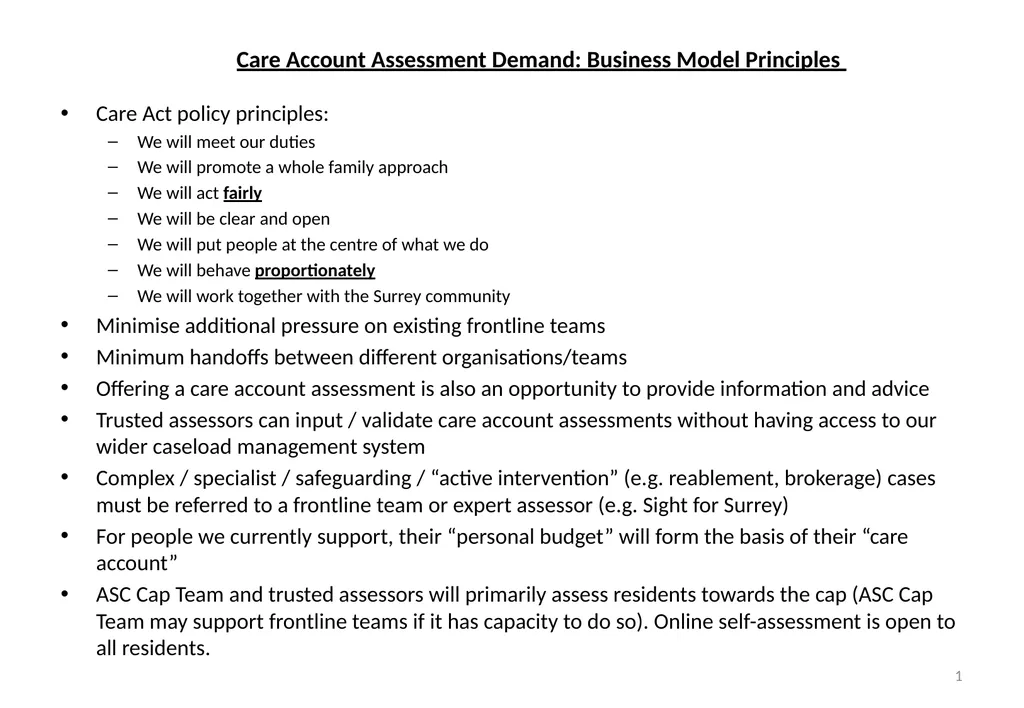
Care Act policy principles:
We will meet our duties
We will promote a whole family approach
We will act fairly
We will be clear and open
We will put people at the centre of what we do
We will behave proportionately
We will work together with the Surrey community
Minimise additional pressure on existing frontline teams
Minimum handoffs between different organisations/teams
Offering a care account assessment is also an opportunity to provide information and advice
Trusted assessors can input / validate care account assessments without having access to our wider caseload management system
Complex / specialist / safeguarding / “active intervention” (e.g. reablement, brokerage) cases must be referred to a frontline team or expert assessor (e.g. Sight for Surrey)
For people we currently support, their “personal budget” will form the basis of their “care account”
ASC Cap Team and trusted assessors will primarily assess residents towards the cap (ASC Cap Team may support frontline teams if it has capacity to do so). Online self-assessment is open to all residents. Care Account Assessment Demand: Business Model Principles 1<br>
02
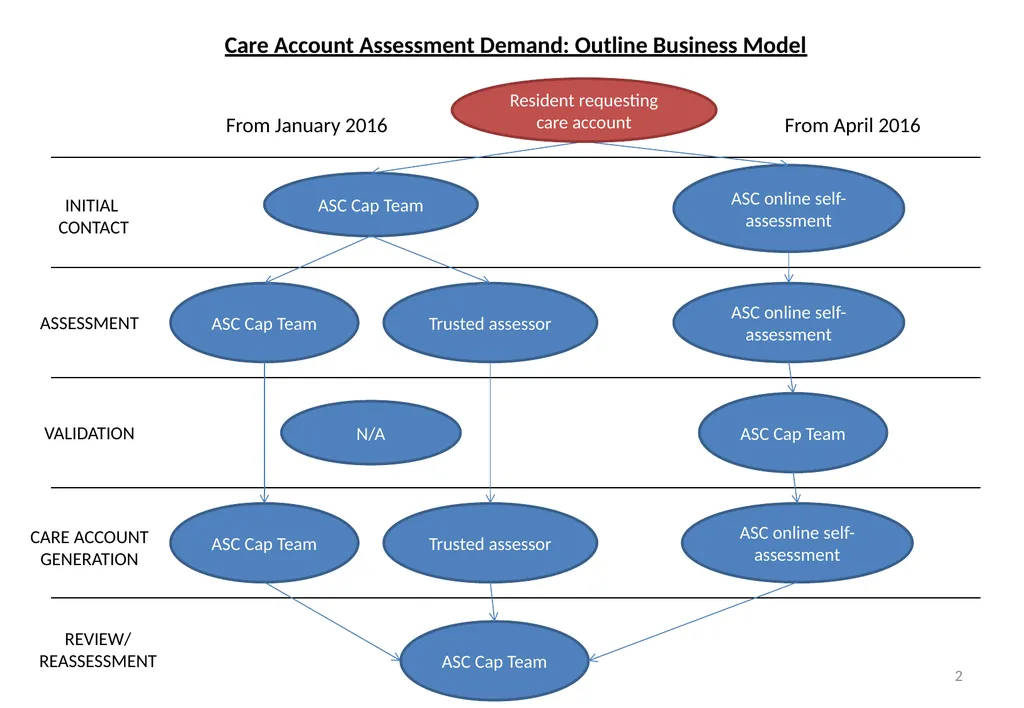
Care Account Assessment Demand: Outline Business Model ASC Cap Team ASC online self-assessment ASC Cap Team Trusted assessor ASC online self-assessment INITIAL
CONTACT ASSESSMENT VALIDATION N/A CARE ACCOUNT GENERATION ASC Cap Team REVIEW/
REASSESSMENT ASC online self-assessment ASC Cap Team Trusted assessor ASC Cap Team Resident requesting care account From January 2016 From April 2016 2<br>
03
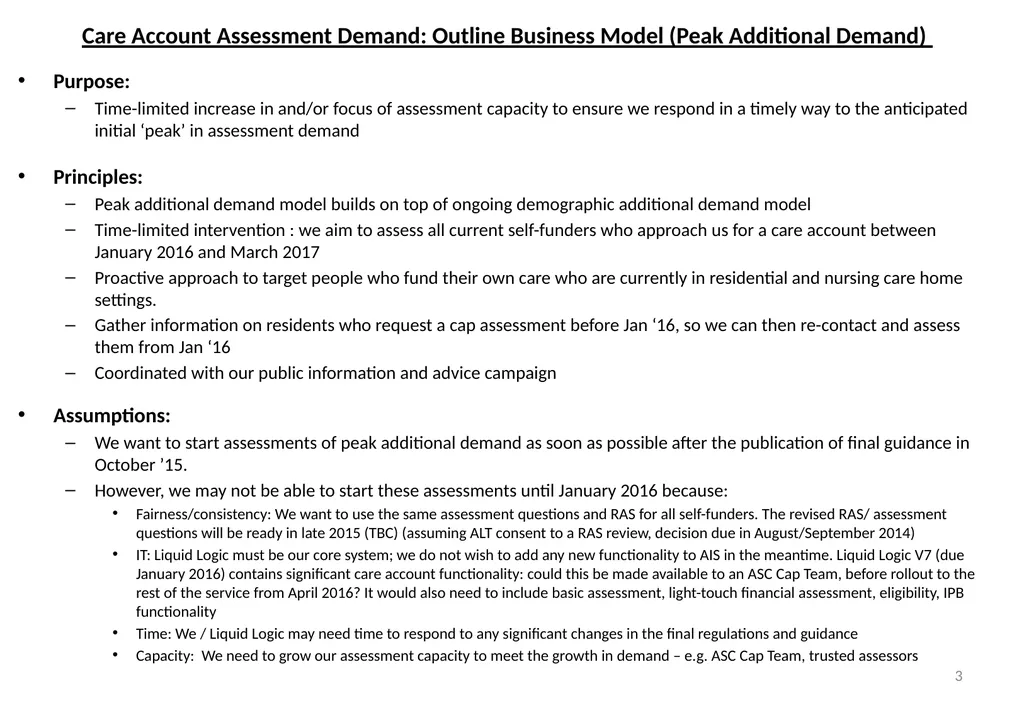
Care Account Assessment Demand: Outline Business Model (Peak Additional Demand) Purpose:
Time-limited increase in and/or focus of assessment capacity to ensure we respond in a timely way to the anticipated initial ‘peak’ in assessment demand
Principles:
Peak additional demand model builds on top of ongoing demographic additional demand model
Time-limited intervention : we aim to assess all current self-funders who approach us for a care account between January 2016 and March 2017
Proactive approach to target people who fund their own care who are currently in residential and nursing care home settings.
Gather information on residents who request a cap assessment before Jan ‘16, so we can then re-contact and assess them from Jan ‘16
Coordinated with our public information and advice campaign
Assumptions:
We want to start assessments of peak additional demand as soon as possible after the publication of final guidance in October ’15.
However, we may not be able to start these assessments until January 2016 because:
Fairness/consistency: We want to use the same assessment questions and RAS for all self-funders. The revised RAS/ assessment questions will be ready in late 2015 (TBC) (assuming ALT consent to a RAS review, decision due in August/September 2014)
IT: Liquid Logic must be our core system; we do not wish to add any new functionality to AIS in the meantime. Liquid Logic V7 (due January 2016) contains significant care account functionality: could this be made available to an ASC Cap Team, before rollout to the rest of the service from April 2016? It would also need to include basic assessment, light-touch financial assessment, eligibility, IPB functionality
Time: We / Liquid Logic may need time to respond to any significant changes in the final regulations and guidance
Capacity: We need to grow our assessment capacity to meet the growth in demand – e.g. ASC Cap Team, trusted assessors 3<br>
04
Care Account Assessment Demand: Outline Business Model (Peak Additional Demand) Dependencies:
Willingness of residential and nursing care home providers to let us carry out cap assessments in their properties
Ability of our systems to collect key information on self-funders before January 2016
Liquid Logic project enables ASC Cap Team to carry out cap assessments, record eligibility , light-touch financial assessments and generate care accounts from January 2016
Review of RAS enables us to generate IPBs from January 2016
Grow and train assessment capacity to undertake peak additional demand assessments from January 2016
Final regulations and guidance are published in October 2015 and are not significantly different from Government’s direction of travel to date
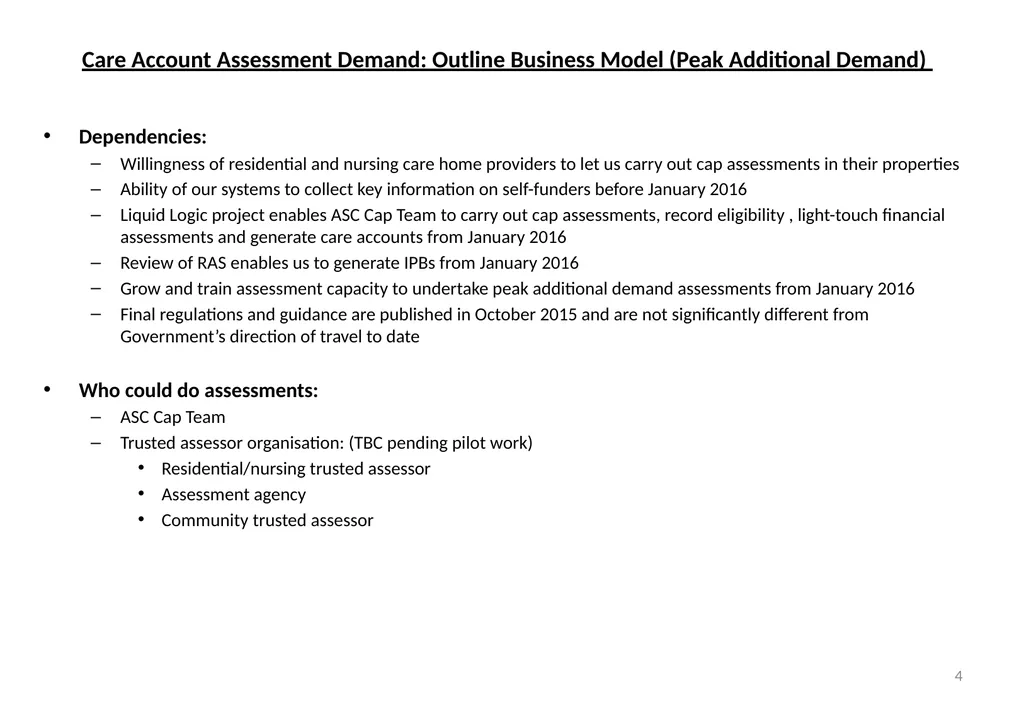
Who could do assessments:
ASC Cap Team
Trusted assessor organisation: (TBC pending pilot work)
Residential/nursing trusted assessor
Assessment agency
Community trusted assessor 4<br>
05
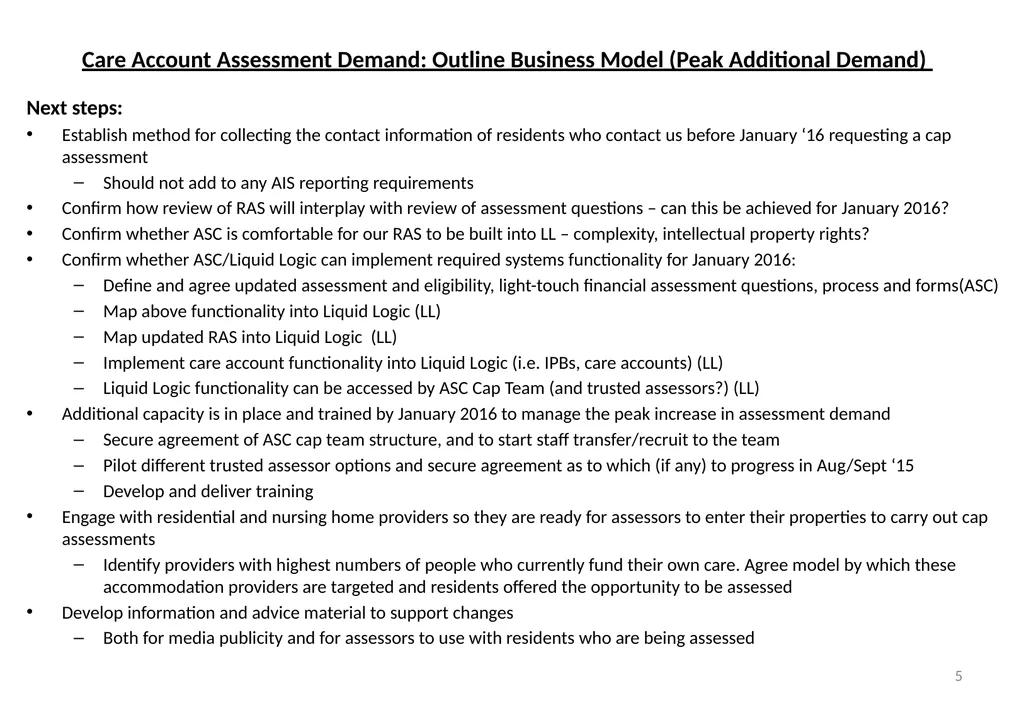
Care Account Assessment Demand: Outline Business Model (Peak Additional Demand) Next steps:
Establish method for collecting the contact information of residents who contact us before January ‘16 requesting a cap assessment
Should not add to any AIS reporting requirements
Confirm how review of RAS will interplay with review of assessment questions – can this be achieved for January 2016?
Confirm whether ASC is comfortable for our RAS to be built into LL – complexity, intellectual property rights?
Confirm whether ASC/Liquid Logic can implement required systems functionality for January 2016:
Define and agree updated assessment and eligibility, light-touch financial assessment questions, process and forms(ASC)
Map above functionality into Liquid Logic (LL)
Map updated RAS into Liquid Logic (LL)
Implement care account functionality into Liquid Logic (i.e. IPBs, care accounts) (LL)
Liquid Logic functionality can be accessed by ASC Cap Team (and trusted assessors?) (LL)
Additional capacity is in place and trained by January 2016 to manage the peak increase in assessment demand
Secure agreement of ASC cap team structure, and to start staff transfer/recruit to the team
Pilot different trusted assessor options and secure agreement as to which (if any) to progress in Aug/Sept ‘15
Develop and deliver training
Engage with residential and nursing home providers so they are ready for assessors to enter their properties to carry out cap assessments
Identify providers with highest numbers of people who currently fund their own care. Agree model by which these accommodation providers are targeted and residents offered the opportunity to be assessed
Develop information and advice material to support changes
Both for media publicity and for assessors to use with residents who are being assessed 5<br>