
Carnap’s Contexts Nietzsche’s Lying Truth,
SB
Published · 104 slides · 0 views

1 / 1





Description
Carnaps Contexts Nietzsches Lying Truth, Heideggers Speaking Language, And Philosophy --Barry Allen 1 Essential backgrounds Auguste Comte (17981857) provides context for understanding Rudolf Carnap (1891-1970) because Comte practically
Related Topics
Share
Embed code
Download this presentation From Below
"Carnap’s Contexts Nietzsche’s Lying Truth," is the property of its rightful owner. Permission is granted to download and print the materials on this website for personal, non-commercial use only, and to display it on your personal computer provided you do not modify the materials and that you retain all copyright notices contained in the materials. By downloading content from our website, you accept the terms of this agreement.
Presentation Transcript
01
Carnap’s Contexts Nietzsche’s Lying Truth,
Heidegger’s Speaking Language,
And Philosophy
--Barry Allen 1<br>
Heidegger’s Speaking Language,
And Philosophy
--Barry Allen 1<br>
02
Essential backgrounds Auguste Comte (1798–1857) provides context for understanding Rudolf Carnap (1891-1970)
because Comte practically invented “philosophy of science”
which is essential background for Carnap’s “logical positivism”
which is essential background for the development of analytical philosophy
Carnap does not mention Comte, but does critique both Heidegger and Nietzsche
=two further contexts for understanding Carnap
and hence, analytical philosophy 2<br>
because Comte practically invented “philosophy of science”
which is essential background for Carnap’s “logical positivism”
which is essential background for the development of analytical philosophy
Carnap does not mention Comte, but does critique both Heidegger and Nietzsche
=two further contexts for understanding Carnap
and hence, analytical philosophy 2<br>
03
Metaphilosophical myths Carnap’s Uberwinding der Metaphysik durch Logische Analyse der Sprache. “Elimination [Overcoming] of Metaphysics through the Logical Analysis of Language” (1931)
foundational metaphilosophical text for analytic philosophy
Carnap’s misreadings of Heidegger and Nietzsche
the metaphilosophical myth of a wooly “Continental” tradition
opposed to the austere precision of “analysis” which is better, more serious, intellectually clearer and cleaner
D.M. Armstrong: it is a matter of “intellectual hygiene” not to read Derrida or Foucault (cites Rorty) 3<br>
foundational metaphilosophical text for analytic philosophy
Carnap’s misreadings of Heidegger and Nietzsche
the metaphilosophical myth of a wooly “Continental” tradition
opposed to the austere precision of “analysis” which is better, more serious, intellectually clearer and cleaner
D.M. Armstrong: it is a matter of “intellectual hygiene” not to read Derrida or Foucault (cites Rorty) 3<br>
04
Philosophy that refuses to be philosophical It’s not odd to refuse to be philosophical
Most people do this
But it is odd to refuse to be philosophical
while calling this refusal the only really justified method in philosophy
as Wittgenstein argues, followed by Rorty [!]
But Carnap says the same thing:
the best philosophy is no philosophy at all 4<br>
Most people do this
But it is odd to refuse to be philosophical
while calling this refusal the only really justified method in philosophy
as Wittgenstein argues, followed by Rorty [!]
But Carnap says the same thing:
the best philosophy is no philosophy at all 4<br>
05
Philosophy science “All philosophical problems are questions of the syntax of the language of science….
All theorems of philosophy take on an exact, discussable form only when we formulate them as assertions or proposals of the syntax of the language of science.” (Carnap, 1934) 5<br>
All theorems of philosophy take on an exact, discussable form only when we formulate them as assertions or proposals of the syntax of the language of science.” (Carnap, 1934) 5<br>
06
Say only what can be said Wittgenstein (Tractatus Logico-Philosophicus, 1921): “The correct method in philosophy would really be the following: To say nothing except what can be said, that is, propositions of natural science—that is, something that has nothing to do with philosophy—and then, whenever someone else wanted to say something metaphysical, to demonstrate to him that he had failed to give a meaning to certain signs in his propositions. Although it would not be satisfying to the other person—he would not have the feeling that we were teaching him philosophy—this method would be the only strictly correct one.” 6<br>
07
Philosophy as therapy
to cure one of philosophy The later Wittgenstein of the Philosophical Investigations (1953) continues this line of thought
arguing the true philosophy is therapy for pseudo-philosophy
clearing up grammatical confusions
“language gone on holiday”
words that seem to make sense but we have no clear idea of how to use them
E.g., “space is infinite,” “there are simples” 7<br>
arguing the true philosophy is therapy for pseudo-philosophy
clearing up grammatical confusions
“language gone on holiday”
words that seem to make sense but we have no clear idea of how to use them
E.g., “space is infinite,” “there are simples” 7<br>
08
Wittgenstein’s followers: Carnap and Rorty The phases of Wittgenstein’s thought are essentially the same:
Only one method or purpose or discourse has the right to be called philosophy
Carnap takes his “metaphilosophy” from the first Wittgenstein
Rorty from the second Wittgenstein 8<br>
Only one method or purpose or discourse has the right to be called philosophy
Carnap takes his “metaphilosophy” from the first Wittgenstein
Rorty from the second Wittgenstein 8<br>
09
Why does Carnap care about this issue? Why care about this issue of metaphilosophy?
Why does Carnap struggle over the fact that an unverifiable metaphysics continues to be written and discussed?
Perhaps this is not his thing, but neither is travel literature
Why not simply say that there are two ways of doing philosophy
Philosophy1: involving the logical syntax of science
Philosophy2: everything else
Because something is seriously wrong about Philosophy2
i.e., all philosophy before Carnap 9<br>
Why does Carnap struggle over the fact that an unverifiable metaphysics continues to be written and discussed?
Perhaps this is not his thing, but neither is travel literature
Why not simply say that there are two ways of doing philosophy
Philosophy1: involving the logical syntax of science
Philosophy2: everything else
Because something is seriously wrong about Philosophy2
i.e., all philosophy before Carnap 9<br>
10
Carnap’s foundationalism Carnap is not a foundationalist
in the sense that there is an a priori ground of rational knowledge
E.g., epistemology as the foundation for science
[as in Kant]
Carnap is a foundationalist
in taking science as the foundational for philosophy
What has the right to be called philosophy is what is strictly adjusted to science 10<br>
in the sense that there is an a priori ground of rational knowledge
E.g., epistemology as the foundation for science
[as in Kant]
Carnap is a foundationalist
in taking science as the foundational for philosophy
What has the right to be called philosophy is what is strictly adjusted to science 10<br>
11
How is philosophy different from poetry? Poetry is ok, even though it does not adjust to science
Metaphysics is bad poetry
“Metaphysicians are musicians without musical ability”
Philosophers are really poets
But they think they have a cognitive goal
when they are really only expressing their feelings about life, as poets do
True poets don’t make this mistake
They do not confuse art with theory
or expression with cognition 11<br>
Metaphysics is bad poetry
“Metaphysicians are musicians without musical ability”
Philosophers are really poets
But they think they have a cognitive goal
when they are really only expressing their feelings about life, as poets do
True poets don’t make this mistake
They do not confuse art with theory
or expression with cognition 11<br>
12
Philosophy injures truth That is the sin of traditional philosophy
Not just that it is cognitively meaningless (like poetry)
But that it is confused and deluded about itself
And so it does injury to truth
which it purports to cherish 12<br>
Not just that it is cognitively meaningless (like poetry)
But that it is confused and deluded about itself
And so it does injury to truth
which it purports to cherish 12<br>
13
The great task at present There ought to be laws against this use of language
And there will be once a clear logical syntax has been developed, “the great task… that at present occupies the logicians.”
In a properly planned language
it would be impossible to make a metaphysical statement 13<br>
And there will be once a clear logical syntax has been developed, “the great task… that at present occupies the logicians.”
In a properly planned language
it would be impossible to make a metaphysical statement 13<br>
14
The purpose of Newspeak Such “language planning” resembles Orwell’s 1984
“in Newspeak it was seldom possible to follow a heretical thought further than the perception that it was heretical: beyond that point the necessary words were nonexistent….
It would have been possible, for example to say ‘Big Brother is ungood.’ But this statement, which to an orthodox ear merely conveyed a self-evident absurdity, could not have been sustained by reasoned argument because the necessary words were not available.” 14<br>
“in Newspeak it was seldom possible to follow a heretical thought further than the perception that it was heretical: beyond that point the necessary words were nonexistent….
It would have been possible, for example to say ‘Big Brother is ungood.’ But this statement, which to an orthodox ear merely conveyed a self-evident absurdity, could not have been sustained by reasoned argument because the necessary words were not available.” 14<br>
15
The problem with our language as it is Right-thinking Ingsoc [Newspeak for English Socialist] party members were as offended as Carnap by the unruliness of language
allowing for “It is the right of the people to alter or abolish Government” (Jefferson)
Or, “Das Nichts nichtet” (“The nothing nothings”)—Heidegger
Language as it is (historical-grammatical syntax) makes no objections to such statements
“metaphysics could not even be expressed in a logically constructed language. This is the great philosophical importance of the task, which at present occupies the logicians, of building a logical syntax.”
To institute this new regime in discourse ought to be the great work and goal of philosophy
This project is the only one that is serious about truth 15<br>
allowing for “It is the right of the people to alter or abolish Government” (Jefferson)
Or, “Das Nichts nichtet” (“The nothing nothings”)—Heidegger
Language as it is (historical-grammatical syntax) makes no objections to such statements
“metaphysics could not even be expressed in a logically constructed language. This is the great philosophical importance of the task, which at present occupies the logicians, of building a logical syntax.”
To institute this new regime in discourse ought to be the great work and goal of philosophy
This project is the only one that is serious about truth 15<br>
16
Positivism From Comte to Carnap 16<br>
17
Elements of Comte’s positivism 1) Phenomenalism
No difference between phenomena and essence
We are entitled to record only what is manifest in experience
Neurath thinks this consists of physical things
2) Nominalism
The abstractions and generalizations of science are not mirrors of objective reality
but tools, methods of ordering, calculating, recording
justified pragmatically 17<br>
No difference between phenomena and essence
We are entitled to record only what is manifest in experience
Neurath thinks this consists of physical things
2) Nominalism
The abstractions and generalizations of science are not mirrors of objective reality
but tools, methods of ordering, calculating, recording
justified pragmatically 17<br>
18
Value judgments are meaningless 3) Noncognitivism re value judgments
Values cannot be known
“It is altogether impossible to make a statement that expresses a value judgment.” (Carnap)
4) Unity of Science
The method of acquiring knowledge is the same in all sciences
Present differences among the sciences will be eliminated
And there will be only one science speaking a unified language 18<br>
Values cannot be known
“It is altogether impossible to make a statement that expresses a value judgment.” (Carnap)
4) Unity of Science
The method of acquiring knowledge is the same in all sciences
Present differences among the sciences will be eliminated
And there will be only one science speaking a unified language 18<br>
19
The basis of science: utility, not evidence What is peculiar to 20th c. logical positivists
Carnap, Neurath, Feigl, Reichenbach, Hempel
comes from technical ideas of scientific thinkers in the later 19th c.
Poincare, Duhem, and Mach
1) Propositions of science are accepted through convenience, usefulness, or aesthetic appeal
not compelling evidence
2) There is no pure experience or facts or knowledge that is independent of theoretical propositions 19<br>
Carnap, Neurath, Feigl, Reichenbach, Hempel
comes from technical ideas of scientific thinkers in the later 19th c.
Poincare, Duhem, and Mach
1) Propositions of science are accepted through convenience, usefulness, or aesthetic appeal
not compelling evidence
2) There is no pure experience or facts or knowledge that is independent of theoretical propositions 19<br>
20
Scientific statements are verified by agreement with other scientific statements Hypotheses are verified by other hypotheses
“Statements are always compared with statements, certainly not with some ‘reality,’ nor with ‘things.’” (Neurath)
Theory choices in science are not determined by experiments or induction
but by convention, coherence, convenience
“If a statement is made it is to be confronted with the totality of existing statements. If it agrees with them, it is joined to them. … There can be no other concept of ‘truth’ for science.” (Neurath) 20<br>
“Statements are always compared with statements, certainly not with some ‘reality,’ nor with ‘things.’” (Neurath)
Theory choices in science are not determined by experiments or induction
but by convention, coherence, convenience
“If a statement is made it is to be confronted with the totality of existing statements. If it agrees with them, it is joined to them. … There can be no other concept of ‘truth’ for science.” (Neurath) 20<br>
21
Corporate rationality Comte is enthusiastic about ideas that are presupposed or taken for granted in the later thinkers
Not experimental individualism
Not what knowledge does for individuals
E.g., happiness, enlightenment, empowerment
But corporate rationality:
Knowledge is a corporate enterprise producing a corporate product
governed by rules that can and should be corporately instituted and enforced
for the corporate good (progress, unity of science)
To know is to reduce something to already known parts (Schlick, Neurath) 21<br>
Not experimental individualism
Not what knowledge does for individuals
E.g., happiness, enlightenment, empowerment
But corporate rationality:
Knowledge is a corporate enterprise producing a corporate product
governed by rules that can and should be corporately instituted and enforced
for the corporate good (progress, unity of science)
To know is to reduce something to already known parts (Schlick, Neurath) 21<br>
22
Ontological relativity A theory of knowledge can only be the logic of science
“in the Vienna Circle mathematics and the empirical sciences were taken as models representing knowledge at its best, most systematized form, toward which all philosophical work on problems of knowledge should be oriented.” (Carnap)
“To be is to be the value of a variable.” (Quine)
To be, to exist = to be posited by the language of a unified science
i.e. to be counted (“quantified over”) in a “rational reconstruction” of science
=Quine’s “ontological relativity” thesis 22<br>
“in the Vienna Circle mathematics and the empirical sciences were taken as models representing knowledge at its best, most systematized form, toward which all philosophical work on problems of knowledge should be oriented.” (Carnap)
“To be is to be the value of a variable.” (Quine)
To be, to exist = to be posited by the language of a unified science
i.e. to be counted (“quantified over”) in a “rational reconstruction” of science
=Quine’s “ontological relativity” thesis 22<br>
23
Not truth but order is the goal The criterion of what is, of being, is a regimented theoretical corpus
“Everything is relative; this is the only absolute principle.” (Comte)
Going from the absolute to the relative is the best way “of attaining to political conceptions that can gradually secure a unanimous and permanent assent.”
The most important fruit of science
Not technology or truth
But order without the threat of violence
i.e., the positive state, a state of “entire intellectual consistency”
=Orwell’s Ingsoc 23<br>
“Everything is relative; this is the only absolute principle.” (Comte)
Going from the absolute to the relative is the best way “of attaining to political conceptions that can gradually secure a unanimous and permanent assent.”
The most important fruit of science
Not technology or truth
But order without the threat of violence
i.e., the positive state, a state of “entire intellectual consistency”
=Orwell’s Ingsoc 23<br>
24
Science replaces theology The supreme purpose of a positivist philosophy:
to bring science and its order to problems of social government
“reconstructing society” in a better, scientific order
Positivism combines
Truth with usefulness
Certainty with precision,
Relativity (no absolute principles) with social purpose
“To supercede theology in the spiritual direction of the human race.”
Comte places sociology at the top of the hierarchy of the sciences 24<br>
to bring science and its order to problems of social government
“reconstructing society” in a better, scientific order
Positivism combines
Truth with usefulness
Certainty with precision,
Relativity (no absolute principles) with social purpose
“To supercede theology in the spiritual direction of the human race.”
Comte places sociology at the top of the hierarchy of the sciences 24<br>
25
One unified constructional system Carnap’s “Logical Construction of the World”
The culmination of the “constructional system of concepts” is a “logical syntax of science”
“By placing the objects of science in one unified constructional system, the different ‘sciences’ are at the same time recognized as branches of the one science and are themselves brought into a system.” 25<br>
The culmination of the “constructional system of concepts” is a “logical syntax of science”
“By placing the objects of science in one unified constructional system, the different ‘sciences’ are at the same time recognized as branches of the one science and are themselves brought into a system.” 25<br>
26
Why is this important? To destroy capitalism! But why is proving the a priori unity of the sciences important?
Carnap is reticent, but Neurath is outspoken:
“The fight against metaphysics and theology [means] the destruction of the bourgeois world-order.”
“Scientific attitude and solidarity go together”
“Whoever joins the proletariat can say with justification that he joins love and reason.” 26<br>
Carnap is reticent, but Neurath is outspoken:
“The fight against metaphysics and theology [means] the destruction of the bourgeois world-order.”
“Scientific attitude and solidarity go together”
“Whoever joins the proletariat can say with justification that he joins love and reason.” 26<br>
27
For a more rational social order Carnap is more modest:
“The acceptance of a physicalistic language might possibly have a positive correlation with social progress”
“Neurath and I have criticized the existing order of society as unreasonable and have demanded that it should be reformed on the basis of scientific insights and careful planning.”
Although “the theoretical theses of logical empiricism” are “neutral with respect to possible forms of the organization of society and economics”
“these theoretical theses have an indirect social effect”—progress toward “the development of more reasonable forms of social order.” 27<br>
“The acceptance of a physicalistic language might possibly have a positive correlation with social progress”
“Neurath and I have criticized the existing order of society as unreasonable and have demanded that it should be reformed on the basis of scientific insights and careful planning.”
Although “the theoretical theses of logical empiricism” are “neutral with respect to possible forms of the organization of society and economics”
“these theoretical theses have an indirect social effect”—progress toward “the development of more reasonable forms of social order.” 27<br>
28
They overlook the most important part of science Positivists pretend to respect science
from Bacon to Bentham to Condorcet and Comte
to Carnap and Quine
What they really respect is order
which science advances
under their good book-keeping
They overlook the most important part of science
how it actually works
What they fix on turns out to be sterile
semantics, logic, methodology 28<br>
from Bacon to Bentham to Condorcet and Comte
to Carnap and Quine
What they really respect is order
which science advances
under their good book-keeping
They overlook the most important part of science
how it actually works
What they fix on turns out to be sterile
semantics, logic, methodology 28<br>
29
Comment: Kant and Hegel In Rorty and Allen 29<br>
30
Rorty: The sequence Descartes to Kant Skipping Hegel means stopping with Kant
with Kant’s idea that there are permanent structures of thought
or consciousness, or rationality, or language, or something
which philosophers can reveal
And about which the vulgar can be confused
Hence, for analyticals, proper philosophy is
the sequence Descartes-to-Kant
The sequence Hegel-Nietzsche-Heidegger is an unfortunate departure from the true path
and can be safely neglected<br>
with Kant’s idea that there are permanent structures of thought
or consciousness, or rationality, or language, or something
which philosophers can reveal
And about which the vulgar can be confused
Hence, for analyticals, proper philosophy is
the sequence Descartes-to-Kant
The sequence Hegel-Nietzsche-Heidegger is an unfortunate departure from the true path
and can be safely neglected<br>
31
Rorty: The sequence Hegel to Nietzsche to Heidegger Philosophers who spend a lot of time with this sequence are sympathetic to Hegel’s idea:
“philosophy is its time held in thought”
[i.e., “historicism”: philosophy is embedded in history, not independent of it—i.e., it does not transcend history]
They are sympathetic to the idea that philosophy makes progress
not by solving problems: i.e., getting it right, finally
but by replacing old problems with new ones<br>
“philosophy is its time held in thought”
[i.e., “historicism”: philosophy is embedded in history, not independent of it—i.e., it does not transcend history]
They are sympathetic to the idea that philosophy makes progress
not by solving problems: i.e., getting it right, finally
but by replacing old problems with new ones<br>
32
Kant and Hegel Kant: All human beings, at all times, understand the world in certain ways
i.e., in accord with certain fundamental categories of thought
E.g., substance and property, time and space, cause and effect
Hegel: Kant’s idea incorporates a fundamental way of thinking of the early modern world—i.e., a focus on subjectivity
It is a stage in the evolution of human history, that Hegel is now going beyond or transcending
Our ways of understanding the world are not fixed once and for all but evolve historically
According to concepts that are more comprehensive and profound
Human history thus has a deep conceptual structure which develops in a way that philosophy can comprehend. 32<br>
i.e., in accord with certain fundamental categories of thought
E.g., substance and property, time and space, cause and effect
Hegel: Kant’s idea incorporates a fundamental way of thinking of the early modern world—i.e., a focus on subjectivity
It is a stage in the evolution of human history, that Hegel is now going beyond or transcending
Our ways of understanding the world are not fixed once and for all but evolve historically
According to concepts that are more comprehensive and profound
Human history thus has a deep conceptual structure which develops in a way that philosophy can comprehend. 32<br>
33
Rorty’s interpretation of analytic/Continental Analytical philosophers stop with Kant, because they see the task of philosophy solve problems that have been with philosophy from the beginning
I.e., for them philosophy is ahistorical
They aim to “get it right” finally
Continental philosophers are sympathetic to Hegel’s historicism
There are no ultimate, historically transcendent objects for philosophers to consider
But philosophy is a series of conversations, based on particular events of history, like the American and French revolutions
Philosophy therefore does not transcend history, but is “its time held in thought” 33<br>
I.e., for them philosophy is ahistorical
They aim to “get it right” finally
Continental philosophers are sympathetic to Hegel’s historicism
There are no ultimate, historically transcendent objects for philosophers to consider
But philosophy is a series of conversations, based on particular events of history, like the American and French revolutions
Philosophy therefore does not transcend history, but is “its time held in thought” 33<br>
34
Allen’s interpretation of analytic philosophy Analytic philosophy is a further development of 19th century positivism, through 20th c. logical positivism
Key philosophers: Comte, Carnap, Quine (see Matthews: Heidegger and Quine, but also Rorty on Quine)
Positivism: science is not about objective truth about the world
But about empirical data
Organized in terms of theories
The theories are accepted by other scientists, who are the authorities in their particular areas
Recall Rorty on expert cultures: other scientists in the field know what their objects are and how to solve problems 34<br>
Key philosophers: Comte, Carnap, Quine (see Matthews: Heidegger and Quine, but also Rorty on Quine)
Positivism: science is not about objective truth about the world
But about empirical data
Organized in terms of theories
The theories are accepted by other scientists, who are the authorities in their particular areas
Recall Rorty on expert cultures: other scientists in the field know what their objects are and how to solve problems 34<br>
35
Neo-Kantian, neo-Hegelianism There is thus an a priori component in science, as in Kant,
because all phenomenal data must be incorporated into the existing theoretical framework
which is accepted by other scientists
But this a priori component is fluid, not fixed once and for all
It changes with changes in the history of the science
neo-Kantian neo-Hegelianism
Kant’s a priori
Hegel’s historical orientation 35<br>
because all phenomenal data must be incorporated into the existing theoretical framework
which is accepted by other scientists
But this a priori component is fluid, not fixed once and for all
It changes with changes in the history of the science
neo-Kantian neo-Hegelianism
Kant’s a priori
Hegel’s historical orientation 35<br>
36
A problem for Rorty’s interpretation The issue for Rorty’s neo-Hegelians
Does the sequence of ideas that summarize historical periods constitute philosophical and historical progress?
Is philosophy, and human history, going somewhere?
As Hegel argued
Or does history, and philosophy, lurch from one set of ideas to another?
Not only without getting it right, but without getting anything more right than anyone before them
It’s just a series of different ideas (Derrida’s differance)
The term “historicism” rather than “historical” implies the latter understanding 36<br>
Does the sequence of ideas that summarize historical periods constitute philosophical and historical progress?
Is philosophy, and human history, going somewhere?
As Hegel argued
Or does history, and philosophy, lurch from one set of ideas to another?
Not only without getting it right, but without getting anything more right than anyone before them
It’s just a series of different ideas (Derrida’s differance)
The term “historicism” rather than “historical” implies the latter understanding 36<br>
37
Allen on Rorty Allen considers Rorty to be an analytic philosopher
Rorty holds ideas similar to that of the positivists
Philosophical knowledge does not solve problems once and for all
But changes historically as the culture (of science) changes
Rorty says this about philosophers, not scientists with their “expert cultures”
But what he says about philosophers can also be said about scientists
The ideas accepted by a certain group of authorities (including philosophers) change from time to time in relation to events in the world
This is true for analytic philosophers too, but they don’t know this
Although some of them do: Wittgenstein, Quine, Rorty, Bramdon … 37<br>
Rorty holds ideas similar to that of the positivists
Philosophical knowledge does not solve problems once and for all
But changes historically as the culture (of science) changes
Rorty says this about philosophers, not scientists with their “expert cultures”
But what he says about philosophers can also be said about scientists
The ideas accepted by a certain group of authorities (including philosophers) change from time to time in relation to events in the world
This is true for analytic philosophers too, but they don’t know this
Although some of them do: Wittgenstein, Quine, Rorty, Bramdon … 37<br>
38
Recall Rorty: Was Wittgenstein right? Was Wittgenstein right?
to give up on a systematic theory of meaning which he defended in his early work
Was Quine right?
to hold that the notion of “meaning” is a holdover from Aristotelian essentialism
If they were right
and there is no such thing as a meaning different from the uses of words
how preserve the notion that “intellectual clarity” can be the goal of philosophy?<br>
to give up on a systematic theory of meaning which he defended in his early work
Was Quine right?
to hold that the notion of “meaning” is a holdover from Aristotelian essentialism
If they were right
and there is no such thing as a meaning different from the uses of words
how preserve the notion that “intellectual clarity” can be the goal of philosophy?<br>
39
Eliminating Metaphysics Carnap and Heidegger 39<br>
40
Heidegger too is against metaphysics Both Comte and Carnap are opponents of metaphysics
But so is Heidegger, whom Carnap takes to be the arch metaphysician
Carnap’s Uberwinding der Metaphysik (1931) parallels Heidegger’s The End of Metaphysics, which dates from 1934.
Heidegger seems to be responding to Carnap’s “overcoming” and positivism more generally
as an example of both Russian Communism and the “type of thinking in America” (in his “Introduction to Metaphysics” lectures of 1935)
suppressed from the published version in 1953 to play down Heidegger’s pro-Nazi ideas
Allen: Heidegger’s unverifiable discourse was a more insightful and effective criticism of metaphysics
than that of any positivist 40<br>
But so is Heidegger, whom Carnap takes to be the arch metaphysician
Carnap’s Uberwinding der Metaphysik (1931) parallels Heidegger’s The End of Metaphysics, which dates from 1934.
Heidegger seems to be responding to Carnap’s “overcoming” and positivism more generally
as an example of both Russian Communism and the “type of thinking in America” (in his “Introduction to Metaphysics” lectures of 1935)
suppressed from the published version in 1953 to play down Heidegger’s pro-Nazi ideas
Allen: Heidegger’s unverifiable discourse was a more insightful and effective criticism of metaphysics
than that of any positivist 40<br>
41
The danger of language Comte writes the obituary of metaphysics
With his law of the stages of history:
Theology Metaphysics Science
Carnap and the logical positivists see metaphysics as a danger inherent in language
where the possibility of meaningless confusions must be guarded against
Traditional philosophy is rife with this confusion
But the logical positivists didn’t read much philosophy at all
Wittgenstein joked that he was a professor of philosophy who never read Aristotle 41<br>
With his law of the stages of history:
Theology Metaphysics Science
Carnap and the logical positivists see metaphysics as a danger inherent in language
where the possibility of meaningless confusions must be guarded against
Traditional philosophy is rife with this confusion
But the logical positivists didn’t read much philosophy at all
Wittgenstein joked that he was a professor of philosophy who never read Aristotle 41<br>
42
Confusion about being In his Uberwindung, Carnap discusses the “dangerous” circumstance that
“our language expresses existence by a verb (‘to be’ or ‘to exist’)”
Metaphysicians (not named) confuse to be in predication and in existence
Only modern logicians (Frege, Russell) expose the ambiguity and thereby take down most if not all traditional ontology 42<br>
“our language expresses existence by a verb (‘to be’ or ‘to exist’)”
Metaphysicians (not named) confuse to be in predication and in existence
Only modern logicians (Frege, Russell) expose the ambiguity and thereby take down most if not all traditional ontology 42<br>
43
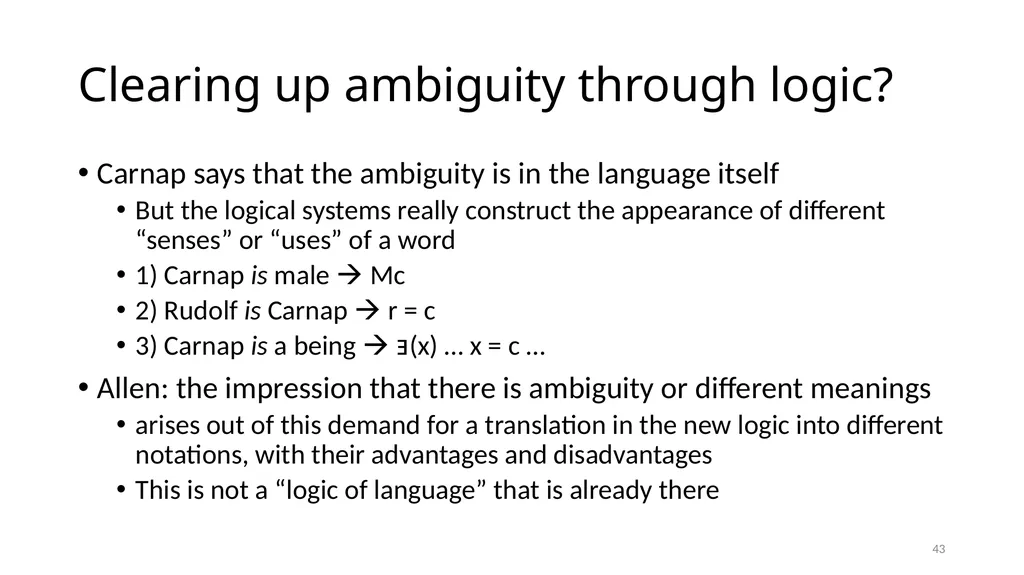
Clearing up ambiguity through logic? Carnap says that the ambiguity is in the language itself
But the logical systems really construct the appearance of different “senses” or “uses” of a word
1) Carnap is male Mc
2) Rudolf is Carnap r = c
3) Carnap is a being ⱻ(x) … x = c …
Allen: the impression that there is ambiguity or different meanings
arises out of this demand for a translation in the new logic into different notations, with their advantages and disadvantages
This is not a “logic of language” that is already there 43<br>
But the logical systems really construct the appearance of different “senses” or “uses” of a word
1) Carnap is male Mc
2) Rudolf is Carnap r = c
3) Carnap is a being ⱻ(x) … x = c …
Allen: the impression that there is ambiguity or different meanings
arises out of this demand for a translation in the new logic into different notations, with their advantages and disadvantages
This is not a “logic of language” that is already there 43<br>
44
All that is required are rules of syntax,
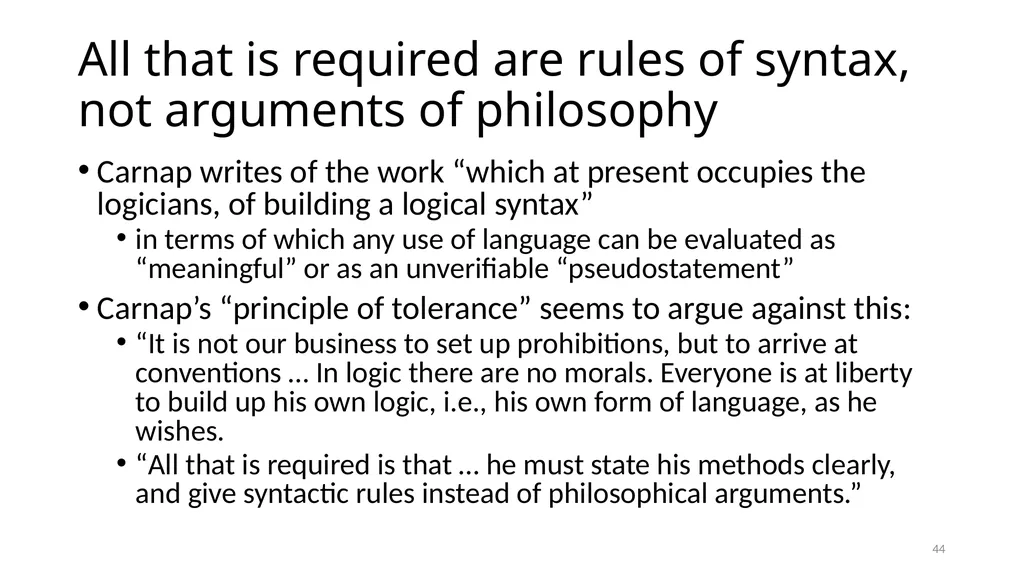
not arguments of philosophy Carnap writes of the work “which at present occupies the logicians, of building a logical syntax”
in terms of which any use of language can be evaluated as “meaningful” or as an unverifiable “pseudostatement”
Carnap’s “principle of tolerance” seems to argue against this:
“It is not our business to set up prohibitions, but to arrive at conventions … In logic there are no morals. Everyone is at liberty to build up his own logic, i.e., his own form of language, as he wishes.
“All that is required is that … he must state his methods clearly, and give syntactic rules instead of philosophical arguments.” 44<br>
in terms of which any use of language can be evaluated as “meaningful” or as an unverifiable “pseudostatement”
Carnap’s “principle of tolerance” seems to argue against this:
“It is not our business to set up prohibitions, but to arrive at conventions … In logic there are no morals. Everyone is at liberty to build up his own logic, i.e., his own form of language, as he wishes.
“All that is required is that … he must state his methods clearly, and give syntactic rules instead of philosophical arguments.” 44<br>
45
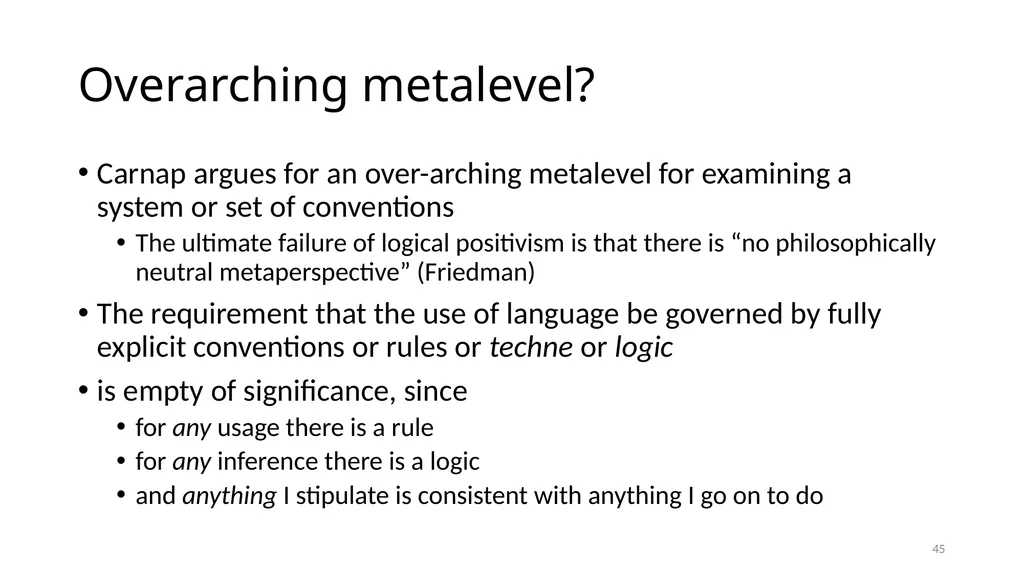
Overarching metalevel? Carnap argues for an over-arching metalevel for examining a system or set of conventions
The ultimate failure of logical positivism is that there is “no philosophically neutral metaperspective” (Friedman)
The requirement that the use of language be governed by fully explicit conventions or rules or techne or logic
is empty of significance, since
for any usage there is a rule
for any inference there is a logic
and anything I stipulate is consistent with anything I go on to do 45<br>
The ultimate failure of logical positivism is that there is “no philosophically neutral metaperspective” (Friedman)
The requirement that the use of language be governed by fully explicit conventions or rules or techne or logic
is empty of significance, since
for any usage there is a rule
for any inference there is a logic
and anything I stipulate is consistent with anything I go on to do 45<br>
46
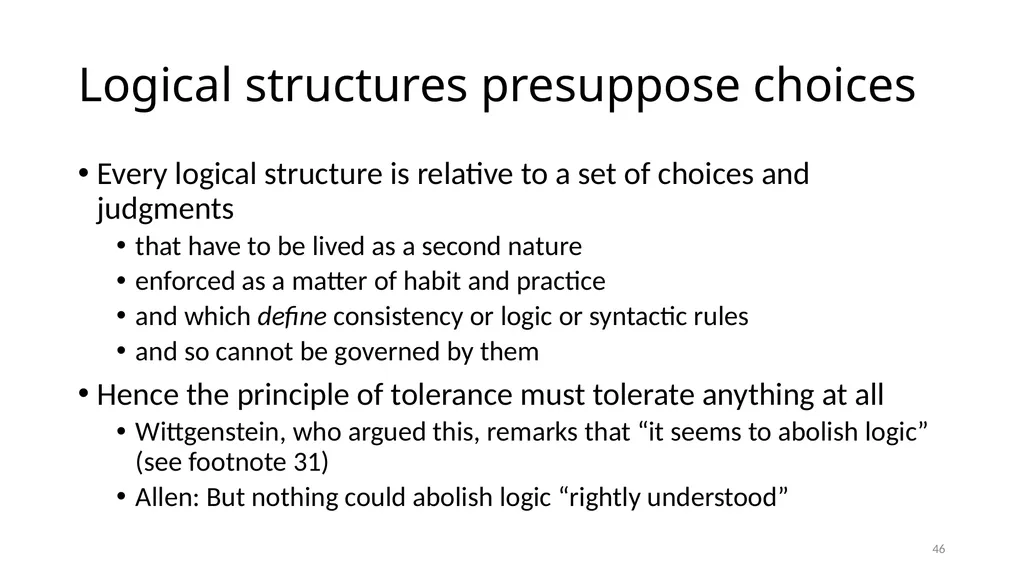
Logical structures presuppose choices Every logical structure is relative to a set of choices and judgments
that have to be lived as a second nature
enforced as a matter of habit and practice
and which define consistency or logic or syntactic rules
and so cannot be governed by them
Hence the principle of tolerance must tolerate anything at all
Wittgenstein, who argued this, remarks that “it seems to abolish logic” (see footnote 31)
Allen: But nothing could abolish logic “rightly understood” 46<br>
that have to be lived as a second nature
enforced as a matter of habit and practice
and which define consistency or logic or syntactic rules
and so cannot be governed by them
Hence the principle of tolerance must tolerate anything at all
Wittgenstein, who argued this, remarks that “it seems to abolish logic” (see footnote 31)
Allen: But nothing could abolish logic “rightly understood” 46<br>
47
The myth of Continental philosophy The logical positivists invented the myth of “Continental philosophy”
this wooly, confused way of thinking
that has to be discredited before science rules philosophy
They invented this “tradition”
which takes seriously one or more of these Germans:
Hegel, Nietzsche, or Heidegger
disliked for their style and politics
as much as for their philosophical ideas 47<br>
this wooly, confused way of thinking
that has to be discredited before science rules philosophy
They invented this “tradition”
which takes seriously one or more of these Germans:
Hegel, Nietzsche, or Heidegger
disliked for their style and politics
as much as for their philosophical ideas 47<br>
48
Carnap’s threefold attack In his paper, “Elimination of Metaphysics”
Carnap swipes at Hegel,
ironically commends Nietzsche for abandoning philosophy for poetry
but focuses on Heidegger’s alleged confusions about language
Carnap does not understand Heidegger
Allen: Making this clear does not mean that he, Allen, himself supports Heidegger 48<br>
Carnap swipes at Hegel,
ironically commends Nietzsche for abandoning philosophy for poetry
but focuses on Heidegger’s alleged confusions about language
Carnap does not understand Heidegger
Allen: Making this clear does not mean that he, Allen, himself supports Heidegger 48<br>
49
“Gross logical errors” Carnap cites Heidegger’s paper “What is Metaphysics?” (1929)
“The nothing is prior to the not and negation”
“The nothing itself nots” (Das Nichts selbst nichtet)
He wants to expose “the gross logical errors,”
especially “the mistake of employing the word ‘nothing’ as a noun.” 49<br>
“The nothing is prior to the not and negation”
“The nothing itself nots” (Das Nichts selbst nichtet)
He wants to expose “the gross logical errors,”
especially “the mistake of employing the word ‘nothing’ as a noun.” 49<br>
50
The ontological difference Heidegger is playing on words
“nothing” is what he also calls “being”
He distinguishes “being” from “beings”
= “the ontological difference”
Being (das Sein) is not a being, not “something that is”
Not an entity
Not the value of a variable
It is the be-ing, the to be, of whatever is
The not-a-thing or no-thing
that distinguishes what is and what is not 50<br>
“nothing” is what he also calls “being”
He distinguishes “being” from “beings”
= “the ontological difference”
Being (das Sein) is not a being, not “something that is”
Not an entity
Not the value of a variable
It is the be-ing, the to be, of whatever is
The not-a-thing or no-thing
that distinguishes what is and what is not 50<br>
51
Presencing This be-ing or to be is not a what, an entity
Aquinas: existence is not essence
Kant: existence is not a real predicate
Das Nichts – the not-a-being becomes a word for the to-be of what is
Finding words for the ontological difference drives Heidegger’s strongest poetry: the world worlds, the nothing nothings, etc
Turning a noun into a verb and jamming them together:
a poetic way of addressing something that is neither a thing (noun) nor an event (verb)
in which both participate as presencing or happening to be there 51<br>
Aquinas: existence is not essence
Kant: existence is not a real predicate
Das Nichts – the not-a-being becomes a word for the to-be of what is
Finding words for the ontological difference drives Heidegger’s strongest poetry: the world worlds, the nothing nothings, etc
Turning a noun into a verb and jamming them together:
a poetic way of addressing something that is neither a thing (noun) nor an event (verb)
in which both participate as presencing or happening to be there 51<br>
52
Being as a clearing in which things show up Hence “the nothing nots” or “the nothing is prior to negation”
1) there is an ontological difference between being and beings
2) “being” in its difference from “beings” is prior to beings in the sense of the “lighting” or “clearing” where beings show up (or fail to do so) and have their being
“The Nothing” (being as ontologically different), not a being, “nots,” i.e., opens the ground for all that is not-a-being
granting the presence of what is and the absence of what is not 52<br>
1) there is an ontological difference between being and beings
2) “being” in its difference from “beings” is prior to beings in the sense of the “lighting” or “clearing” where beings show up (or fail to do so) and have their being
“The Nothing” (being as ontologically different), not a being, “nots,” i.e., opens the ground for all that is not-a-being
granting the presence of what is and the absence of what is not 52<br>
53
Grammar conceals the ontological difference Heidegger is aware of his unusual expressions:
“With regard to the awkwardness and inelegance of expression in the following analyses, we may remark that it is one thing to report narratively about beings, and another to grasp beings in their being. For the latter task not only most of the words are lacking but above all the ‘grammar.’” (Heidegger, Being and Time)
= Grammar or syntax above all fails to reflect, or conceals, the ontological difference
Carnap’s argument that Heidegger does not respect grammar therefore misses the main thrust of Heidegger’s position 53<br>
“With regard to the awkwardness and inelegance of expression in the following analyses, we may remark that it is one thing to report narratively about beings, and another to grasp beings in their being. For the latter task not only most of the words are lacking but above all the ‘grammar.’” (Heidegger, Being and Time)
= Grammar or syntax above all fails to reflect, or conceals, the ontological difference
Carnap’s argument that Heidegger does not respect grammar therefore misses the main thrust of Heidegger’s position 53<br>
54
Heidegger’s main idea is ignored Carnap has no idea of the basic issue here: the ontological difference
which Heidegger in the essay Carnap reads presupposes as understood by the reader
Whatever one may think of this issue, it has nothing to do with the “gross error” of using “nothing” as a noun 54<br>
which Heidegger in the essay Carnap reads presupposes as understood by the reader
Whatever one may think of this issue, it has nothing to do with the “gross error” of using “nothing” as a noun 54<br>
55
Carnap is clueless about Heidegger’s thought Because “being” is not an entity, not a being
Heidegger refers to it as the no-being, the not-a-thing that is different from beings
This cannot be defended by the logical syntax of science
Or even by standards of decent prose
But this is what Heidegger is doing
And of this Carnap has no clue
If he did, he wouldn’t say that Heidegger treats “nothing” as a noun 55<br>
Heidegger refers to it as the no-being, the not-a-thing that is different from beings
This cannot be defended by the logical syntax of science
Or even by standards of decent prose
But this is what Heidegger is doing
And of this Carnap has no clue
If he did, he wouldn’t say that Heidegger treats “nothing” as a noun 55<br>
56
The motif of Western philosophy: the ever deepening oblivion of Being There are two sources of the anti-metaphysical strain in 20th century philosophy
Heidegger
The source of philosophical hermeneutics
And logical positivism
The source of much of analytical philosophy 56<br>
Heidegger
The source of philosophical hermeneutics
And logical positivism
The source of much of analytical philosophy 56<br>
57
The sequence Plato to Hegel to Nietzsche Heidegger sees the motif of western philosophy from Plato to Hegel and Nietzsche
as an ever-deepening oblivion of the ontological difference
expressed in the quintessentially metaphysical project
of deriving all being from the presence of the highest being, that which most truly is
called by different names: Ousia or substance (Aristotle), Idea (Plato), God (Aquinas), Perception (Hume), Spirit (Hegel), Will (Nietzsche)
[Also Matter (Hobbes), Matter and Spirit (Descartes, Locke), Spirit (Leibniz, Hegel), and also the unknowable Thing in Itself or Noumenon (Kant)] 57<br>
as an ever-deepening oblivion of the ontological difference
expressed in the quintessentially metaphysical project
of deriving all being from the presence of the highest being, that which most truly is
called by different names: Ousia or substance (Aristotle), Idea (Plato), God (Aquinas), Perception (Hume), Spirit (Hegel), Will (Nietzsche)
[Also Matter (Hobbes), Matter and Spirit (Descartes, Locke), Spirit (Leibniz, Hegel), and also the unknowable Thing in Itself or Noumenon (Kant)] 57<br>
58
Truthfulness Carnap and Nietzsche 58<br>
59
The new religion of positivism Comte said that the positivist is the priest of a new religion,
the Church of Humanity.
Carnap and Quine are more discrete but remain priestly
In teaching that people are naïve and wrong in thinking that their experience counts for something
And that scholars manipulating formalisms have the last word on reality, meaning, and truth
logical positivism evades “the death of God” (Nietzsche) 59<br>
the Church of Humanity.
Carnap and Quine are more discrete but remain priestly
In teaching that people are naïve and wrong in thinking that their experience counts for something
And that scholars manipulating formalisms have the last word on reality, meaning, and truth
logical positivism evades “the death of God” (Nietzsche) 59<br>
60
“The pale atheist” In the Genealogy of Morals Nietzsche describes “the pale atheist”
focused on “intellectual cleanliness”
“hard, obstinate, heroic spirits,”
“the last idealists of knowledge, in whom alone the intellectual conscience dwells and is incarnate today”
I.e., he is talking about the positivists and logical positivists
These idealists of truth have brought about the death of God
But they fail to understand what they have done 60<br>
focused on “intellectual cleanliness”
“hard, obstinate, heroic spirits,”
“the last idealists of knowledge, in whom alone the intellectual conscience dwells and is incarnate today”
I.e., he is talking about the positivists and logical positivists
These idealists of truth have brought about the death of God
But they fail to understand what they have done 60<br>
61
Why sacrifice yourself for the truth? One of Nietzche’s best ideas: he sees the same mentality and the same game in
the acetic, priestly theist,
the “poor in spirit”
and the modern, Enlightenment atheist
also other-worldly, self-denying
Philosophers love the truth more than themselves for the same reason priests are celibate
because it makes people take them seriously 61<br>
the acetic, priestly theist,
the “poor in spirit”
and the modern, Enlightenment atheist
also other-worldly, self-denying
Philosophers love the truth more than themselves for the same reason priests are celibate
because it makes people take them seriously 61<br>
62
Why do they attack belief in God? What constrains these atheists with their “unconditional will to truth”
“faith in a metaphysical value...
a faith millennia old, the Christian faith, which was also Plato’s, that God is truth, and that truth is divine”
Nietzsche’s historical sequence:
Plato Christianity Positivism
If they attack belief in God
it is because, they believe, it is not true
Any value it might have for life
must be sacrificed on the altar of truth 62<br>
“faith in a metaphysical value...
a faith millennia old, the Christian faith, which was also Plato’s, that God is truth, and that truth is divine”
Nietzsche’s historical sequence:
Plato Christianity Positivism
If they attack belief in God
it is because, they believe, it is not true
Any value it might have for life
must be sacrificed on the altar of truth 62<br>
63
The will to truth as a problem “Christianity as a dogma was destroyed by its own morality.”
The dogma of God
V. the morality of the unconditional duty to truth
This dutiful asceticism of truth
= remnant Christianity
= abiding Platonism
The next step is to ask: “what is the meaning of all will to truth?”
= the will to truth becomes a problem 63<br>
The dogma of God
V. the morality of the unconditional duty to truth
This dutiful asceticism of truth
= remnant Christianity
= abiding Platonism
The next step is to ask: “what is the meaning of all will to truth?”
= the will to truth becomes a problem 63<br>
64
Every philosophy has a hole in it Nietzsche cares for truth more than Carnap does
For all Carnap’s work goes against any effort to frame a philosophical question about the value of truth
Carnap avoids asking what good does all this serve?
[Recall Allen’s answer, citing Orwell’s 1984: it establishes order in society, based on the authority of experts]
This is the dogmatism behind the idealism of the idealists of knowledge
“both the early and the latest philosophers” fail to see “how much the will to truth … requires justification.”
= “the lacuna in every philosophy”
Truth “is not permitted to be a problem at all.” 64<br>
For all Carnap’s work goes against any effort to frame a philosophical question about the value of truth
Carnap avoids asking what good does all this serve?
[Recall Allen’s answer, citing Orwell’s 1984: it establishes order in society, based on the authority of experts]
This is the dogmatism behind the idealism of the idealists of knowledge
“both the early and the latest philosophers” fail to see “how much the will to truth … requires justification.”
= “the lacuna in every philosophy”
Truth “is not permitted to be a problem at all.” 64<br>
65
Why not eliminate poetry too? Consider the unproblematic value of truth in Carnap’s polemic against metaphysics
Q: Why does he want to “eliminate” it?
A: Its language is unverifiable
But so is the language of poetry
And Carnap doesn’t want to eliminate that 65<br>
Q: Why does he want to “eliminate” it?
A: Its language is unverifiable
But so is the language of poetry
And Carnap doesn’t want to eliminate that 65<br>
66
Metaphysics only expresses feelings Carnap: “The metaphysician believes he travels in territory in which truth and falsehood are at stake. In reality, however, he has not asserted anything, but only expressed something, like an artist.”
I.e., metaphysics is like poetry or art
It expresses feelings, but does not assert truth
But metaphysicians claim to be asserting truth, not expressing feelings
whereas poets do not make this claim 66<br>
I.e., metaphysics is like poetry or art
It expresses feelings, but does not assert truth
But metaphysicians claim to be asserting truth, not expressing feelings
whereas poets do not make this claim 66<br>
67
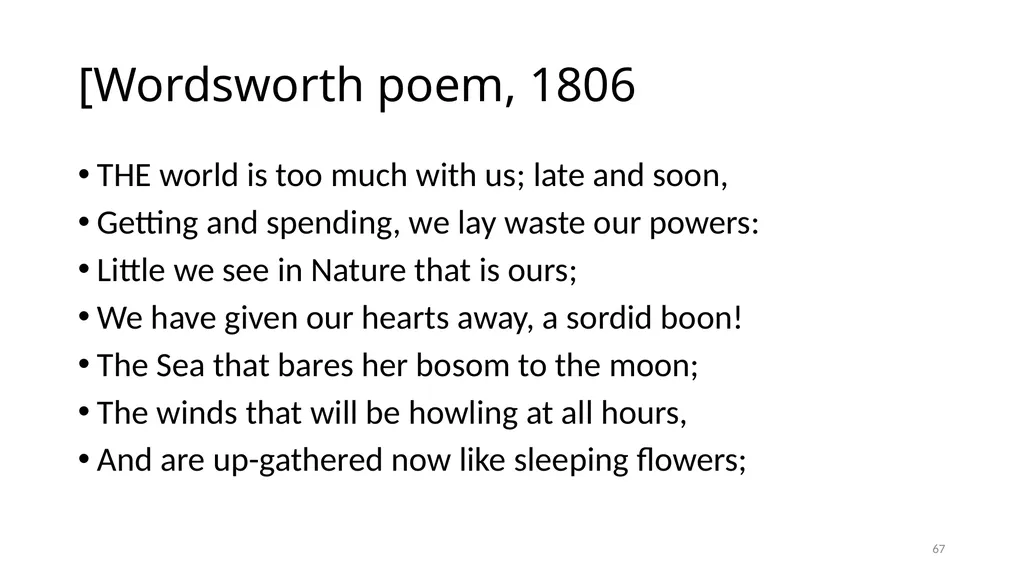
[Wordsworth poem, 1806 THE world is too much with us; late and soon,
Getting and spending, we lay waste our powers:
Little we see in Nature that is ours;
We have given our hearts away, a sordid boon!
The Sea that bares her bosom to the moon;
The winds that will be howling at all hours,
And are up-gathered now like sleeping flowers; 67<br>
Getting and spending, we lay waste our powers:
Little we see in Nature that is ours;
We have given our hearts away, a sordid boon!
The Sea that bares her bosom to the moon;
The winds that will be howling at all hours,
And are up-gathered now like sleeping flowers; 67<br>
68
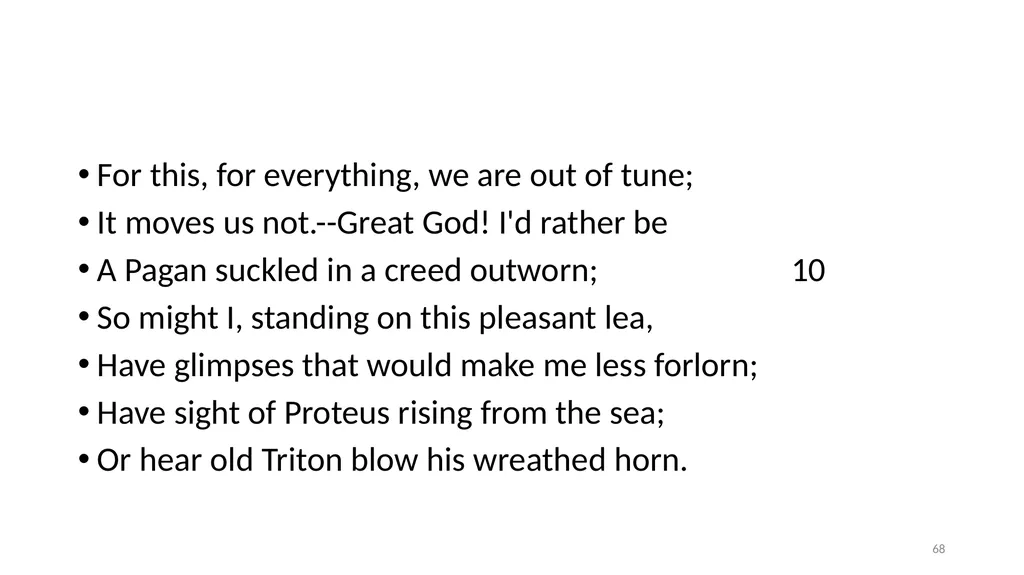
For this, for everything, we are out of tune;
It moves us not.--Great God! I'd rather be
A Pagan suckled in a creed outworn; 10
So might I, standing on this pleasant lea,
Have glimpses that would make me less forlorn;
Have sight of Proteus rising from the sea;
Or hear old Triton blow his wreathed horn. 68<br>
It moves us not.--Great God! I'd rather be
A Pagan suckled in a creed outworn; 10
So might I, standing on this pleasant lea,
Have glimpses that would make me less forlorn;
Have sight of Proteus rising from the sea;
Or hear old Triton blow his wreathed horn. 68<br>
69
[Meaning and feeling] Meaning of poem
We are alienated from Nature due to our commercial, industrial society
The Greeks with their Gods of Nature were in tune with the natural world
= “historicism”!
A feeling is expressed: regret, anger, forlornness
But in relation to what is supposed to be a truth
The poet’s feelings are secondary to the truth expressed 69<br>
We are alienated from Nature due to our commercial, industrial society
The Greeks with their Gods of Nature were in tune with the natural world
= “historicism”!
A feeling is expressed: regret, anger, forlornness
But in relation to what is supposed to be a truth
The poet’s feelings are secondary to the truth expressed 69<br>
70
Poets honestly tell lies Plato condemns poetry for taking their images as truth
Carnap reverses this judgment:
poets are wiser than philosophers
because they do not claim that their poetry is true
Everyone knows that poets lie
But metaphysical lies claim to be true
Philosophers argue, they refute one another, as if truth were at stake
But one poet does not try to refute another one 70<br>
Carnap reverses this judgment:
poets are wiser than philosophers
because they do not claim that their poetry is true
Everyone knows that poets lie
But metaphysical lies claim to be true
Philosophers argue, they refute one another, as if truth were at stake
But one poet does not try to refute another one 70<br>
71
Metaphysics = Complicated blurts Metaphysical pseudostatements (= poetry that pretends to have cognitive value)
Heidegger says “the nothing nots”
Kant says morality is pure practical reason
Aristotle says that the primary meaning of to be is substance
There is no right or wrong here
just complicated verbal blurts
= personal, emotional expressions of a feeling or attitude to life 71<br>
Heidegger says “the nothing nots”
Kant says morality is pure practical reason
Aristotle says that the primary meaning of to be is substance
There is no right or wrong here
just complicated verbal blurts
= personal, emotional expressions of a feeling or attitude to life 71<br>
72
Nietzsche’s open poetry But Carnap says that Nietzsche at least admits this
Thus Spoke Zarathustra is openly, obviously poetry
It is Nietzsche’s expression of his own feelings about life
And so there is no question about whether it is true or not
You like it or you don’t—it’s a private feeling
Allen: Let’s look at Nietzsche’s “poetry” 72<br>
Thus Spoke Zarathustra is openly, obviously poetry
It is Nietzsche’s expression of his own feelings about life
And so there is no question about whether it is true or not
You like it or you don’t—it’s a private feeling
Allen: Let’s look at Nietzsche’s “poetry” 72<br>
73
Filthy waters of truth The Three Transformations of the spirit (in Zarthustra)
Camel lion child
The spirit becomes a camel when it goes into the desert to prove itself, imposing difficulties on itself
i.e., Western asceticism the pursuit of knowledge
“What is most difficult? Is it this: feeding on the acorns and grass of knowledge and, for the sake of the truth, suffering hunger in one’s soul?
“Or is it this: stepping into filthy waters when they are the waters of truth, and not repulsing cold frogs and hot toads” 73<br>
Camel lion child
The spirit becomes a camel when it goes into the desert to prove itself, imposing difficulties on itself
i.e., Western asceticism the pursuit of knowledge
“What is most difficult? Is it this: feeding on the acorns and grass of knowledge and, for the sake of the truth, suffering hunger in one’s soul?
“Or is it this: stepping into filthy waters when they are the waters of truth, and not repulsing cold frogs and hot toads” 73<br>
74
Quine accuses Carnap of vice Speaking of dealing with repulsive reptiles in the cold waters of truth,
Quine criticizes Carnap “for flirting with modal logic”
Modal logic is too worldly for Quine, too close to the ordinary world that an ascetic love of truth compels us to renounce
Carnap replies: “I do not indulge in this vice generally and thoroughly … Although we do not like to apply intensional languages, nevertheless I think we cannot help analyzing them. What would you think of an entomologist who refuses to investigate fleas and lice because he dislikes them?”
[Clarifications: “modal logic,” “intensional languages”: 74<br>
Quine criticizes Carnap “for flirting with modal logic”
Modal logic is too worldly for Quine, too close to the ordinary world that an ascetic love of truth compels us to renounce
Carnap replies: “I do not indulge in this vice generally and thoroughly … Although we do not like to apply intensional languages, nevertheless I think we cannot help analyzing them. What would you think of an entomologist who refuses to investigate fleas and lice because he dislikes them?”
[Clarifications: “modal logic,” “intensional languages”: 74<br>
75
Modal logic and classical logic “Classic logic is great for mathematics, but for the analysis of daily language and arguments, it lacks certain operators. There are many sentences that you can't express in classic logic that can be expressed in modal logic. Example: "I may get burned if I lie in the sun for too long". In classic logic, you can say: "I get burned if I lie in the sun for too long", but you can't express the possibility of getting burned. In classic logic, it's either true or false. In modal logic, you can also express the possibility or impossibility of a proposition being true or false.”
https://philosophy.stackexchange.com/questions/5929/what-is-modal-logic-for 75<br>
https://philosophy.stackexchange.com/questions/5929/what-is-modal-logic-for 75<br>
76
Intension and extension “If you are not skilled in colloquial astronomy, and I tell you that the morning star is the evening star, I have given you information—your knowledge has changed. If I tell you the morning star is the morning star, you might feel I was wasting your time. Yet in both cases I have told you the planet Venus was self-identical. There must be more to it than this. Naively, we might say the morning star and the evening star are the same in one way, and not the same in another. The two phrases, “morning star” and “evening star” may designate the same object, but they do not have the same meaning. Meanings, in this sense, are often called intensions, and things designated, extensions.”
https://plato.stanford.edu/entries/logic-intensional/#WhaAbo 76<br>
https://plato.stanford.edu/entries/logic-intensional/#WhaAbo 76<br>
77
The creative No The camel, carrying this burden of truth, goes into the desert
And transforms into a lion stalking a dragon
The plates of the dragon are gold and each is inscribed with “Thou shalt …”
The triumph of spirit at this stage: the lion slays the dragon, uttering a creative No
to what the world calls wisdom (what everybody knows) and morality (what everybody does)
creating the freedom for freedom 77<br>
And transforms into a lion stalking a dragon
The plates of the dragon are gold and each is inscribed with “Thou shalt …”
The triumph of spirit at this stage: the lion slays the dragon, uttering a creative No
to what the world calls wisdom (what everybody knows) and morality (what everybody does)
creating the freedom for freedom 77<br>
78
The creation of new values The lion’s creative No gives birth to the child’s creative Yes
Only then does it become possible to create new values
new standards of accomplishment in art, knowledge, ethics, politics, life
This is not about the expression of feelings but the creation of new values
For this, the traditional forms of poetry and philosophy are no longer serviceable 78<br>
Only then does it become possible to create new values
new standards of accomplishment in art, knowledge, ethics, politics, life
This is not about the expression of feelings but the creation of new values
For this, the traditional forms of poetry and philosophy are no longer serviceable 78<br>
79
Following the death of God After the death of God and traditional morality based on belief in God
brought about by the Enlightenment priests the intellect
there are various forms of resentment that must be unmasked
Utilitarianism
Democracy
Socialism
Feminism, etc 79<br>
brought about by the Enlightenment priests the intellect
there are various forms of resentment that must be unmasked
Utilitarianism
Democracy
Socialism
Feminism, etc 79<br>
80
[The lamb’s Ressentiment ] (T)he problem with the other origin of the “good,” of the good man, as the person of ressentiment has thought it out for himself, demands some conclusion. It is not surprising that the lambs should bear a grudge against the great birds of prey, but that is no reason for blaming the great birds of prey for taking the little lambs. And when the lambs say among themselves, "These birds of prey are evil, and he who least resembles a bird of prey, who is rather its opposite, a lamb,—should he not be good?" then there is nothing to carp with in this ideal's establishment, though the birds of prey may regard it a little mockingly, and maybe say to themselves, "We bear no grudge against them, these good lambs, we even love them: nothing is tastier than a tender lamb.“
—Friedrich Nietzsche, On the Genealogy of Morality 80<br>
81
Carnap cannot slay the dragon Both Carnap and Nietzsche attack Metaphysics
But Carnap never gets past the camel stage
He is one of the atheists who laughs at the Madman who brings news of the death of God
but fails to understand what he has done as a result of his devotion to truth
Carnap wanders through the desert of self-imposed asceticism
tilting at windmills (metaphysics and traditional philosophy) like Don Quixote
But cannot find his way to the dragon: the question of the value of truth 81<br>
But Carnap never gets past the camel stage
He is one of the atheists who laughs at the Madman who brings news of the death of God
but fails to understand what he has done as a result of his devotion to truth
Carnap wanders through the desert of self-imposed asceticism
tilting at windmills (metaphysics and traditional philosophy) like Don Quixote
But cannot find his way to the dragon: the question of the value of truth 81<br>
82
Calling truth into question Nietzsche used the freedom he won (in philosophy/poetry) to say No to truth as a duty
No doubt Carnap would be horrified at such freedom
Logical positivism cannot create anything
because it celebrates the totalitarianism of order and progress
Nietzsche is the camel, the priest of truth, who finally said No to the supposed duty to truth:
“The will to truth requires a critique—let us thus define our own task—the value of truth must for once be experimentally called into question.” 82<br>
No doubt Carnap would be horrified at such freedom
Logical positivism cannot create anything
because it celebrates the totalitarianism of order and progress
Nietzsche is the camel, the priest of truth, who finally said No to the supposed duty to truth:
“The will to truth requires a critique—let us thus define our own task—the value of truth must for once be experimentally called into question.” 82<br>
83
What is the basis of science? How question truth experimentally?
Through hypotheses regarding the genealogy of truth as a moral value
“And science itself, our science—indeed, what is the significance of all science, viewed as a symptom of life? For what—worse, whence—all science? How now? Is the resolve to be so scientific about everything perhaps a kind of fear of, an escape from, pessimism? A subtle last resort against—truth? And, morally speaking, a sort of cowardice and falseness?” (Nietzsche) 83<br>
Through hypotheses regarding the genealogy of truth as a moral value
“And science itself, our science—indeed, what is the significance of all science, viewed as a symptom of life? For what—worse, whence—all science? How now? Is the resolve to be so scientific about everything perhaps a kind of fear of, an escape from, pessimism? A subtle last resort against—truth? And, morally speaking, a sort of cowardice and falseness?” (Nietzsche) 83<br>
84
Nietzsche’s hypothesis re the slave morality Nietzsche’s hypotheses about the history of truth
That they arose out of resentment of the slave against the master:
The master exercizes mere power; we slaves are devoted to truth.
But this belief is a subtle, indirect form of the exercise of power on the part of the slave!
This is the deeper truth, that the priests of truth avoid with their scientific truths
i.e., the truths of lambs rather than the truths of eagles
The truths of slaves rather than the truths of masters 84<br>
That they arose out of resentment of the slave against the master:
The master exercizes mere power; we slaves are devoted to truth.
But this belief is a subtle, indirect form of the exercise of power on the part of the slave!
This is the deeper truth, that the priests of truth avoid with their scientific truths
i.e., the truths of lambs rather than the truths of eagles
The truths of slaves rather than the truths of masters 84<br>
85
Fact and value = truth as a cold logic of fact v. truth as life value
Carnap however couldn’t even argue this
because his position doesn’t allow him to talk about values
“the objective validity of a value or norm is … not empirically verifiable, nor deducible from empirical statements; hence it cannot be asserted (in a meaningful statement) at all”
In his devotion to truth, he cannot then ask: what is the value of truth
All such concerns are abandoned for an austere, rigorous, technically true philosophy 85<br>
Carnap however couldn’t even argue this
because his position doesn’t allow him to talk about values
“the objective validity of a value or norm is … not empirically verifiable, nor deducible from empirical statements; hence it cannot be asserted (in a meaningful statement) at all”
In his devotion to truth, he cannot then ask: what is the value of truth
All such concerns are abandoned for an austere, rigorous, technically true philosophy 85<br>
86
Existential philosophy For Carnap philosophy is the logical syntax of science
For Nietzsche the philosophy of science belongs to an existential philosophy of knowledge and truth
which situates science in relation to culture, history, ethics, aesthetics,
asking
What does science do for culture?
What form of cultural life does it serve?
Such questions are unthinkable for Carnap 86<br>
For Nietzsche the philosophy of science belongs to an existential philosophy of knowledge and truth
which situates science in relation to culture, history, ethics, aesthetics,
asking
What does science do for culture?
What form of cultural life does it serve?
Such questions are unthinkable for Carnap 86<br>
87
Disengaging meaning from individuality Carnap conceives of scientific objectivity as disengaging objective meaning entirely from “ostension”
“Science wants to speak about what is objective,
and whatever does not belong to structure but to the material
(i.e., anything that can be pointed out in a concrete ostensive definition)
is, in the final analysis, subjective.”
i.e., anything that is irreducibly individual, that only an individual can accomplish
rather than a corporation, a system, a formalism 87<br>
“Science wants to speak about what is objective,
and whatever does not belong to structure but to the material
(i.e., anything that can be pointed out in a concrete ostensive definition)
is, in the final analysis, subjective.”
i.e., anything that is irreducibly individual, that only an individual can accomplish
rather than a corporation, a system, a formalism 87<br>
88
Objectivity Objectivity flows
not from individuals or their achievement,
but from the position of a sentence or set of sentences in a logical corporation
“The formation of a constructional system is the first [highest] aim of science”
Ontological questions about “what there really is” are meaningless
The scientific worker is a humble unit in a vast, impersonal enterprise where all are equal, each more or less the same. 88<br>
not from individuals or their achievement,
but from the position of a sentence or set of sentences in a logical corporation
“The formation of a constructional system is the first [highest] aim of science”
Ontological questions about “what there really is” are meaningless
The scientific worker is a humble unit in a vast, impersonal enterprise where all are equal, each more or less the same. 88<br>
89
The Last Man = philosophy of science for Nietzsche’s Last Man
“What is love? What is creation? What is longing? What is a star?” thus asks the last man, and he blinks … The earth has become small, and on it hops the last man, who makes everything small … ‘We have invented happiness,’ say the last men, and they blink. They have left the regions where it was hard to live, for one needs warmth. One still loves one’s neighbor and rubs against him, for one needs warmth … No shepherd and one herd! Everybody wants the same, everybody is the same; whoever feels different goes voluntarily into a madhouse.” 89<br>
“What is love? What is creation? What is longing? What is a star?” thus asks the last man, and he blinks … The earth has become small, and on it hops the last man, who makes everything small … ‘We have invented happiness,’ say the last men, and they blink. They have left the regions where it was hard to live, for one needs warmth. One still loves one’s neighbor and rubs against him, for one needs warmth … No shepherd and one herd! Everybody wants the same, everybody is the same; whoever feels different goes voluntarily into a madhouse.” 89<br>
90
The positivist utopia =the positivist utopia
Order reigns
And individuals count for nothing
Nothing grand is envisioned, nothing unruly tolerated
Individuality, singularity, personality—
contribute nothing to knowledge
and are harmful to order and progress 90<br>
Order reigns
And individuals count for nothing
Nothing grand is envisioned, nothing unruly tolerated
Individuality, singularity, personality—
contribute nothing to knowledge
and are harmful to order and progress 90<br>
91
The first positivist: Plato Plato as the first positivist with his passion for order
Right order in the soul is the key to right order in the state
Get order right (the right ideas or forms) and beauty, truth, justice will follow
Plato is thinking of techne, the recipe for order
technical philosophy
technical philosophy of science
Technical aesthetics, technical moral theory:
reduce judgments of taste or duty to their rules of production 91<br>
Right order in the soul is the key to right order in the state
Get order right (the right ideas or forms) and beauty, truth, justice will follow
Plato is thinking of techne, the recipe for order
technical philosophy
technical philosophy of science
Technical aesthetics, technical moral theory:
reduce judgments of taste or duty to their rules of production 91<br>
92
The hidden meaning of the pursuit of truth: order Progress in science
requires order: the rule, ideally, of one unified logical syntax
Progress in philosophy
requires order, reducing unruly questions to silence
Truth has no verifiable meaning apart from order
i.e. coherence within a system of science
Carnap’s “unity of science” = Plato’s Form of the Good
the ultimate system that produces the objectivity and truth of ideas 92<br>
requires order: the rule, ideally, of one unified logical syntax
Progress in philosophy
requires order, reducing unruly questions to silence
Truth has no verifiable meaning apart from order
i.e. coherence within a system of science
Carnap’s “unity of science” = Plato’s Form of the Good
the ultimate system that produces the objectivity and truth of ideas 92<br>
93
[Is Plato a philosopher of techne?] Is this valid re Plato?
Recall Socrates and Phaedrus, Rorty slides 48-50
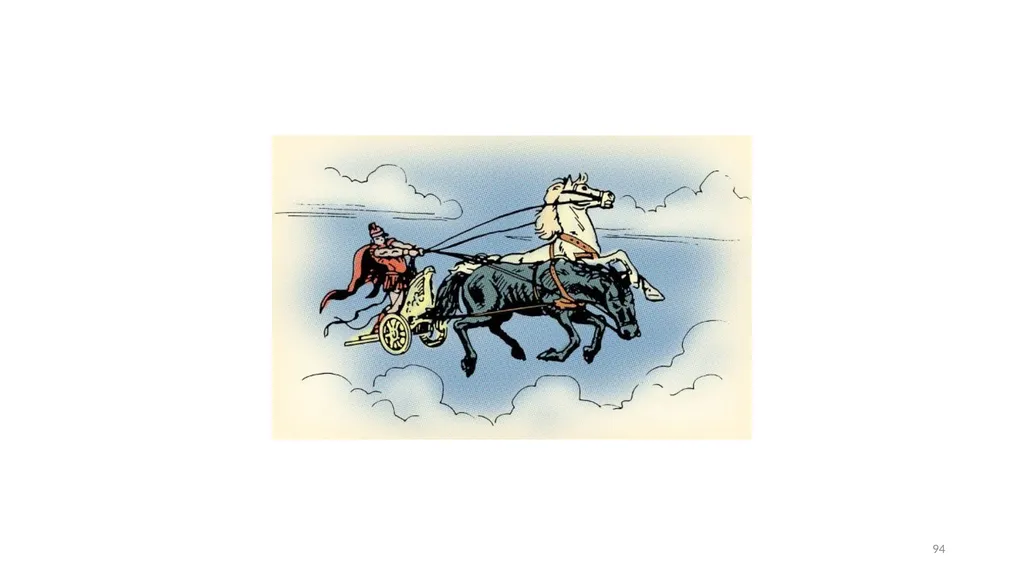
Two principles: uniting similar objects under one definition; dividing objects by their “natural joints”
= analysis and synthesis!
See Phaedrus on the Chariot analogy
Order involves a struggle against disorder 93<br>
Recall Socrates and Phaedrus, Rorty slides 48-50
Two principles: uniting similar objects under one definition; dividing objects by their “natural joints”
= analysis and synthesis!
See Phaedrus on the Chariot analogy
Order involves a struggle against disorder 93<br>
94
94<br>
95
Carnap and Hegel “The reality of anything is nothing else than the possibility of its being placed in a certain system.”
That’s Carnap, but Hegel could have said the same thing
[Recall Prado on analysis and synthesis. Logical positivists, like Hegel, are synthetical, not analytical, philosophers]
Logic is ontology
To be is to be the value of a variable
[Recall Heidegger on the forgetting of the ontological difference]
There is no order but Order
Comte: “a fanatic on the score of searching for a definitive, once and for all order.”
Neurath: “it is essential that one kind of order is the foundation for all the laws, whichever science is concerned, geology, chemistry or sociology.” 95<br>
That’s Carnap, but Hegel could have said the same thing
[Recall Prado on analysis and synthesis. Logical positivists, like Hegel, are synthetical, not analytical, philosophers]
Logic is ontology
To be is to be the value of a variable
[Recall Heidegger on the forgetting of the ontological difference]
There is no order but Order
Comte: “a fanatic on the score of searching for a definitive, once and for all order.”
Neurath: “it is essential that one kind of order is the foundation for all the laws, whichever science is concerned, geology, chemistry or sociology.” 95<br>
96
Genealogy subverts the will to order But historical-philosophical research,
Called “genealogy” by Nietzsche and Foucault
subverts this rationalist “will to order”
discrediting the notion that there is one right order
Foucault: Genealogy should undermine assumptions (like those of positivism)
that “inscribe knowledge in the hierarchical order of power associated with science.”
“A genealogy should be seen as a kind of attempt to emancipate historical [knowings] from that subjugation, to render them, that is, capable of opposition and of struggle against the coercion of a theoretical, unitary, formal, and scientific discourse.” (#58) 96<br>
Called “genealogy” by Nietzsche and Foucault
subverts this rationalist “will to order”
discrediting the notion that there is one right order
Foucault: Genealogy should undermine assumptions (like those of positivism)
that “inscribe knowledge in the hierarchical order of power associated with science.”
“A genealogy should be seen as a kind of attempt to emancipate historical [knowings] from that subjugation, to render them, that is, capable of opposition and of struggle against the coercion of a theoretical, unitary, formal, and scientific discourse.” (#58) 96<br>
97
Don’t we need order to live? Order, control, and predictability
by-products of knowledge
contribute to the practicality of its pursuit
But they are not what drives knowledge forward
especially where it is experimental and inventive
We need some level of order to live
But there are many working orders
And new ones are invented all the time 97<br>
by-products of knowledge
contribute to the practicality of its pursuit
But they are not what drives knowledge forward
especially where it is experimental and inventive
We need some level of order to live
But there are many working orders
And new ones are invented all the time 97<br>
98
Action can’t be ordered Nor must all we do be work
Something worthwhile need not be something that works
We need some degree of order to act
But action cannot be ordered
It is not action as soon as it is ordered,
as soon as order, however perfect, is imposed rather than chosen 98<br>
Something worthwhile need not be something that works
We need some degree of order to act
But action cannot be ordered
It is not action as soon as it is ordered,
as soon as order, however perfect, is imposed rather than chosen 98<br>
99
What is thinking? Do we need order to think?
Thinking is different from work, from action, from problem solving,
And closer to art, poetry
Don’t thinking and poetry require the order of language?
But poetry creates new language
does things with language that were not foretold in the underlying rules
invents new possibilities of expression and meaning 99<br>
Thinking is different from work, from action, from problem solving,
And closer to art, poetry
Don’t thinking and poetry require the order of language?
But poetry creates new language
does things with language that were not foretold in the underlying rules
invents new possibilities of expression and meaning 99<br>
100
Does language even have an order? Contrary to Carnap and early Wittgenstein
language has no compulsive, closed, formal, total, rule-bound order
“There is no such thing as a language, not if language is anything like what many philosophers and linguists have supposed … [no] clearly defined shared structure which language-users acquire and then apply to cases.” (Donald Davidson)
[NB: Allen cites Davidson as the anti-logical positivist, and so anti-analytical.
But for others in our text, Davidson is the representative analytical philosopher]
Thought may have an unseen order of its own
but it is not that of language (if language even has an order) 100<br>
language has no compulsive, closed, formal, total, rule-bound order
“There is no such thing as a language, not if language is anything like what many philosophers and linguists have supposed … [no] clearly defined shared structure which language-users acquire and then apply to cases.” (Donald Davidson)
[NB: Allen cites Davidson as the anti-logical positivist, and so anti-analytical.
But for others in our text, Davidson is the representative analytical philosopher]
Thought may have an unseen order of its own
but it is not that of language (if language even has an order) 100<br>
101
Thought and preconceived order To subordinate thought to any preconceived order
e.g., “the verification theory of meaning”
is to subvert it
to replace it with something else
with the virtues of the Last Men,
not those of philosophers (or should it be poets?) 101<br>
e.g., “the verification theory of meaning”
is to subvert it
to replace it with something else
with the virtues of the Last Men,
not those of philosophers (or should it be poets?) 101<br>
102
Nietzsche’s poetry Carnap was right to call Nietzsche’s philosophy poetry
not because it expresses a private feeling
But because he thinks creatively (poiesis)
Thanks to the freedom gained by saying No to the Platonic/Christian subordination of thought to a “duty to truth”
Heidegger’s thought becomes “poetic”
In refusing to subordinate its concerns to beings, the ontic truth about beings
And dwelling (experimentally, poetically) on the to be of what there is 102<br>
not because it expresses a private feeling
But because he thinks creatively (poiesis)
Thanks to the freedom gained by saying No to the Platonic/Christian subordination of thought to a “duty to truth”
Heidegger’s thought becomes “poetic”
In refusing to subordinate its concerns to beings, the ontic truth about beings
And dwelling (experimentally, poetically) on the to be of what there is 102<br>
103
Are we thinking now? Such poiesis is experimental
not because it tests a carefully framed hypothesis
but because no one can say where it might lead
Like art, thought is something we can do
because we have done it in the past
But whether art or thinking is happening now is seldom easy to say 103<br>
not because it tests a carefully framed hypothesis
but because no one can say where it might lead
Like art, thought is something we can do
because we have done it in the past
But whether art or thinking is happening now is seldom easy to say 103<br>
104
Allen’s purpose: did he succeed? And so Allen sets Carnap in context in relation to
Comte’s positivism
Carnap’s “appalling” polemic against Heidegger
and Carnap’s inept attempt to say something intelligent about Nietzsche
in order to expose the intellectual limitations
of his approach to philosophy
as the “ur-form” of the whole “analytic” movement 104<br>
Comte’s positivism
Carnap’s “appalling” polemic against Heidegger
and Carnap’s inept attempt to say something intelligent about Nietzsche
in order to expose the intellectual limitations
of his approach to philosophy
as the “ur-form” of the whole “analytic” movement 104<br>