
CASC 2024 Legislative Update For Virginia Law
SB
Published · 106 slides · 0 views

1 / 1









Description
CASC 2024 Legislative Update For Virginia Law Enforcement This document is provided for Law Enforcement by the Virginia Commonwealths Attorneys Services Council pursuant to Va. Code 2.2-3705.7(29) for the training of state prosecutors
Related Topics
Share
Embed code
Download this presentation From Below
"CASC 2024 Legislative Update For Virginia Law" is the property of its rightful owner. Permission is granted to download and print the materials on this website for personal, non-commercial use only, and to display it on your personal computer provided you do not modify the materials and that you retain all copyright notices contained in the materials. By downloading content from our website, you accept the terms of this agreement.
Presentation Transcript
01
CASC 2024
Legislative Update
For Virginia
Law Enforcement This document is provided for Law Enforcement by the Virginia Commonwealth’s Attorneys’ Services Council
pursuant to Va. Code § 2.2-3705.7(29) for the training of state prosecutors and law-enforcement personnel.<br>
pursuant to Va. Code § 2.2-3705.7(29) for the training of state prosecutors and law-enforcement personnel.<br>
02
Materials This PowerPoint attempts to identify the legislation from the 2024 General Assembly Regular Session that has the greatest impact on law enforcement and public safety.
Consult the 2024 Legislative Update Master List outline for full listing of bills of interest.
This presentation will NOT cover every bill.<br>
Consult the 2024 Legislative Update Master List outline for full listing of bills of interest.
This presentation will NOT cover every bill.<br>
03
Materials You must rely only upon the final language of the bill after passage.
Slides summarize each bill, but you should read the actual law before acting.
You can find the bill on the LIS website at: http://lis.virginia.gov/lis.htm.<br>
Slides summarize each bill, but you should read the actual law before acting.
You can find the bill on the LIS website at: http://lis.virginia.gov/lis.htm.<br>
04
Topics for this Presentation Criminal Investigations
Criminal Procedure
New and Amended Crimes and Offenses
Liquid Nicotine
Traffic Offenses FOIA
ECO and TDO Procedure
Law Enforcement Regulatory & Reporting Requirements
Law Enforcement Procedural Guarantees and Requirements<br>
Criminal Procedure
New and Amended Crimes and Offenses
Liquid Nicotine
Traffic Offenses FOIA
ECO and TDO Procedure
Law Enforcement Regulatory & Reporting Requirements
Law Enforcement Procedural Guarantees and Requirements<br>
05
Criminal Investigations<br>
06
Ch. 33: Drug Court release for PMP Amends § 54.1-2523 to require the Director of the Department of Health Professions to release otherwise confidential information from the Prescription Monitoring Program when such information is relevant to a specific investigation, supervision, or monitoring of a specific recipient for purposes of the administration of criminal justice to drug court administrators and behavioral health docket administrators who have completed the Virginia State Police Drug Diversion School designated by the Director of the Department of Corrections or his designee.
Bill requires release of the information upon receiving a request for information in accordance with the Department of Health Profession's regulations and in compliance with applicable federal law and regulations.<br>
Bill requires release of the information upon receiving a request for information in accordance with the Department of Health Profession's regulations and in compliance with applicable federal law and regulations.<br>
07
Ch. 25/130: Drug Court is Now “Recovery Court “ Amends §§ 18.2-251.02 and 18.2-254.1
Renames the Drug Treatment Court Act as the Recovery Court Act.
The bill also directs the Supreme Court of Virginia to rename the state Drug Treatment Court Advisory Committee as the Recovery Court Advisory Committee.<br>
Renames the Drug Treatment Court Act as the Recovery Court Act.
The bill also directs the Supreme Court of Virginia to rename the state Drug Treatment Court Advisory Committee as the Recovery Court Advisory Committee.<br>
08
Ch. 325: Cell phone records; missing persons. Provides that a court shall issue an order for disclosure of records or other information pertaining to a subscriber to or customer of a provider of electronic communication service or remote computing service, including a foreign corporation that provides such services, only if the investigative or law-enforcement officer shows that there is reason to believe the records or other information sought are relevant and material to the investigation of any critically missing person, as defined in relevant law.
Does so by amending 19.2-70.3 to allow a court order for records regarding “any critically missing adult as defined in § 15.2-1718.2. “<br>
Does so by amending 19.2-70.3 to allow a court order for records regarding “any critically missing adult as defined in § 15.2-1718.2. “<br>
09
CRIMINAL PROCEDURE<br>
10
Ch. 74 Pretrial violation sent to CWA Amends § 19.2-123 to require that any report of a violation of any pretrial condition of release provided to the court shall be sent by the pretrial services agency to the attorney for the Commonwealth and the counsel of record for the accused or juvenile, or directly to the accused or juvenile if such person is not represented by counsel.<br>
11
Ch. 243 Admission to bail; act of violence. Amends § 19.2-120 to provide that a judicial officer who admits a person to bail who is charged with an act of violence shall notify the attorney for the Commonwealth for the jurisdiction in which such person's case is filed contemporaneously with such person's grant of bail or release.
The bill provides that such notice may be made by facsimile or other electronic means.<br>
The bill provides that such notice may be made by facsimile or other electronic means.<br>
12
Ch. 145: Dangerous dog;
extending the time for adjudication. Amends §§ 3.2-6540 and 3.2-6540.03 to require the court, unless good cause is determined by the court, to hold the evidentiary hearing pursuant to the dangerous dog summons within 30 days or as soon as practicable from the issuance of the summons.
Under current law, the court is required to hold such hearing not more than 30 days from the issuance of the summons.<br>
Under current law, the court is required to hold such hearing not more than 30 days from the issuance of the summons.<br>
13
Ch. 190: LEO exposure to bodily fluids Amends § 32.1-45.1 to allow a local attorney for the Commonwealth in the county or city in which such exposure occurred to file a petition for an order requiring testing and disclosure of test results on behalf of a law-enforcement officer when a law-enforcement officer is directly exposed to the bodily fluid of a person in a manner that may, according to the then-current guidelines of the Centers for Disease Control and Prevention, transmit human immunodeficiency virus or hepatitis B or C viruses and such person refuses to submit to testing.
Current law limits who may file a petition to the exposed law-enforcement officer or his employer.<br>
Current law limits who may file a petition to the exposed law-enforcement officer or his employer.<br>
14
Ch. 397:
Multi-jurisdiction grand jury & elder abuse crimes. Amends § 19.2-215.1 to add the following to the list of crimes that a multi-jurisdiction grand jury may investigate:
Financial exploitation of a vulnerable adult
Financial exploitation of a vulnerable adult by an agent, and
Abuse and neglect of a vulnerable adult.
This bill is a recommendation of the Virginia Criminal Justice Conference.<br>
Financial exploitation of a vulnerable adult
Financial exploitation of a vulnerable adult by an agent, and
Abuse and neglect of a vulnerable adult.
This bill is a recommendation of the Virginia Criminal Justice Conference.<br>
15
Ch. 475: Larceny offenses; venue. Amends §§ 18.2-95 and 18.2-111 to allow grand larceny and embezzlement offenses to be prosecuted in any county or city where the victim of the larceny or embezzlement resides.<br>
16
Ch. 523 / 571: Search warrants, subpoenas, court orders, etc. & menstrual health data. Amends § 19.2-53 and adds § 19.2-60.2 to prohibit the issuance of a search warrant, subpoena, court order, or other process for the purpose of the search and seizure or production of menstrual health data, as defined in the bill, including data stored on a computer, computer network, or other device containing electronic or digital information.<br>
17
New Language: § 19.2-60.2 No search warrant, subpoena, court order, or other process shall be issued, executed, or served for the purpose of the search and seizure or production of menstrual health data, including data stored on a computer, computer network, or other device containing electronic or digital information.
For the purposes of this section, "menstrual health data" means any information, recorded in any form or medium, that is created or received by an entity that relates to or is used to determine, predict, or estimate the past, present, or future menstrual health or menstrual status of an individual.<br>
For the purposes of this section, "menstrual health data" means any information, recorded in any form or medium, that is created or received by an entity that relates to or is used to determine, predict, or estimate the past, present, or future menstrual health or menstrual status of an individual.<br>
18
Ch. 530 / 578 Financial institutions:
Reporting financial exploitation of elderly or vulnerable adults. Adds § 6.2-103.2 which permits a financial institution to allow an elderly or vulnerable adult, as defined in the bill, to submit and periodically update a list of trusted persons whom such financial institution or financial institution staff, as defined in the bill, may contact in the case of the suspected financial exploitation of such adult.
The bill also permits a financial institution to conduct a training to instruct its staff on how to identify and report the suspected financial exploitation of an elderly or vulnerable adult internally at such financial institution, to a designated trusted contact, and to various other authorities.<br>
The bill also permits a financial institution to conduct a training to instruct its staff on how to identify and report the suspected financial exploitation of an elderly or vulnerable adult internally at such financial institution, to a designated trusted contact, and to various other authorities.<br>
19
Safe Harbor The bill provides that no financial institution staff that have received training on this requirement shall be liable in any civil or administrative proceeding for disclosing the suspected financial exploitation of an elderly or vulnerable adult pursuant to the bill's provisions if such disclosure was made in good faith and with reasonable care.<br>
20
Ch. 594: Protective Orders –
Change of Address Requires the respondent against whom a protective order has been issued to notify the court in writing within seven days of any change of residence while such order is in effect, provided that such order has been properly served upon the respondent.
In a proceeding involving a preliminary protective order, the bill provides that the court may require the respondent to notify the court in writing within seven days of any change of residence while such preliminary protective order is in effect.
The bill also provides that any failure of a respondent to make such required notification shall be punishable by contempt.<br>
In a proceeding involving a preliminary protective order, the bill provides that the court may require the respondent to notify the court in writing within seven days of any change of residence while such preliminary protective order is in effect.
The bill also provides that any failure of a respondent to make such required notification shall be punishable by contempt.<br>
21
Ch. 658 / 667 Alert for missing or endangered children;
Virginia Critical Operation for a Disappeared Child Initiative (Codi) Alert. Creates a program for local, regional, or statewide notification of a missing or endangered child, adding §§ 52-34.3:1, 52-34.3:2, and 52-34.3:3.
The bill defines a missing or endangered child as a child
who is 17 years of age or younger or is currently enrolled in a secondary school in the Commonwealth, regardless of age;
whose whereabouts are unknown; and
whose disappearance is under suspicious circumstances or poses a credible threat as determined by law enforcement to the safety and health of the child and under such other circumstances as deemed appropriate by the Virginia State Police.<br>
The bill defines a missing or endangered child as a child
who is 17 years of age or younger or is currently enrolled in a secondary school in the Commonwealth, regardless of age;
whose whereabouts are unknown; and
whose disappearance is under suspicious circumstances or poses a credible threat as determined by law enforcement to the safety and health of the child and under such other circumstances as deemed appropriate by the Virginia State Police.<br>
22
Process Initiated The bill requires the Virginia State Police to develop, in consultation with representatives of local law-enforcement agencies, including representatives from the Virginia Sheriffs' Association and the Virginia Association of Chiefs of Police, policies for the establishment of uniform standards for the creation of Codi Alert Programs throughout the Commonwealth.
“The Codi Alert shall include such information as the law-enforcement agency deems appropriate that will assist in the safe recovery of the missing or endangered child.”
Bill requires that VSP shall ensure the Codi Alert Program is available and operational no later than July 1, 2025.<br>
“The Codi Alert shall include such information as the law-enforcement agency deems appropriate that will assist in the safe recovery of the missing or endangered child.”
Bill requires that VSP shall ensure the Codi Alert Program is available and operational no later than July 1, 2025.<br>
23
Ch. 712 / 758 Local animal cruelty registries. Amends § 3.2-6573.1. Allows any locality to establish an animal cruelty registry for public access on the website of such locality or its local police department.
The bill provides that such registry may include the names and relevant information of persons convicted of certain felony offenses for animal cruelty and that a person on such registry may request removal of his name after 15 years, provided that he has no additional felony convictions of an animal cruelty offense.
The bill directs that all costs relating to a locality's animal cruelty registry shall be borne by such locality.<br>
The bill provides that such registry may include the names and relevant information of persons convicted of certain felony offenses for animal cruelty and that a person on such registry may request removal of his name after 15 years, provided that he has no additional felony convictions of an animal cruelty offense.
The bill directs that all costs relating to a locality's animal cruelty registry shall be borne by such locality.<br>
24
Ch. 719 Custodial interrogation of a child. Amends § 16.1-247.1 to provide that if a law-enforcement officer knowingly fails to comply with existing law regarding parental notification and contact prior to a custodial interrogation of a child, any statements made by such child shall be inadmissible in any delinquency proceeding or criminal proceeding against such child, unless the attorney for the Commonwealth proves by a preponderance of the evidence that the statement was made knowingly, intelligently, and voluntarily.<br>
25
§ 16.1-247.1: Existing Language A. Prior to any custodial interrogation of a child by a law-enforcement officer who has arrested such child pursuant to subsection C, C1, or D of § 16.1-246, the child's parent, guardian, or legal custodian shall be notified of his arrest and the child shall have contact with his parent, guardian, or legal custodian.
The notification and contact required by this subsection may be in person, electronically, by telephone, or by video conference.<br>
The notification and contact required by this subsection may be in person, electronically, by telephone, or by video conference.<br>
26
§ 16.1-247.1 Existing Language B. Notwithstanding the provisions of subsection A, a custodial interrogation may be conducted if
if the child's parent, guardian, or legal custodian is a codefendant in the alleged offense;
if the child's parent, guardian, or legal custodian has been arrested for, has been charged with, or is being investigated for a crime against the child;
if, after every reasonable effort has been made to comply with subsection A, the child's parent, guardian, or legal custodian cannot be located or refuses contact with the child; or
if the law-enforcement officer conducting the custodial interrogation reasonably believes the information sought is necessary to protect life, limb, or property from an imminent danger and the law-enforcement officer's questions are limited to those that are reasonably necessary to obtain such information.<br>
if the child's parent, guardian, or legal custodian is a codefendant in the alleged offense;
if the child's parent, guardian, or legal custodian has been arrested for, has been charged with, or is being investigated for a crime against the child;
if, after every reasonable effort has been made to comply with subsection A, the child's parent, guardian, or legal custodian cannot be located or refuses contact with the child; or
if the law-enforcement officer conducting the custodial interrogation reasonably believes the information sought is necessary to protect life, limb, or property from an imminent danger and the law-enforcement officer's questions are limited to those that are reasonably necessary to obtain such information.<br>
27
§ 16.1-247.1 New Language C. Except as provided in subsection B, if a law-enforcement officer knowingly violates the provisions of subsection A, any statements made by such child shall be inadmissible in any delinquency proceeding or criminal proceeding against such child, unless the attorney for the Commonwealth proves by a preponderance of the evidence that the statement was made knowingly, intelligently, and voluntarily.<br>
28
Ch. 759 - PBT: failure to advise person of rights. Amends § 18.2-267.
Provides that if a police officer or a member of any sheriff's department fails to advise a person of his rights to refuse a preliminary breath test, any preliminary breath test sample shall not be admissible by the Commonwealth in any motion to suppress for the purpose of determining probable cause.<br>
Provides that if a police officer or a member of any sheriff's department fails to advise a person of his rights to refuse a preliminary breath test, any preliminary breath test sample shall not be admissible by the Commonwealth in any motion to suppress for the purpose of determining probable cause.<br>
29
§ 18.2-267 New Language F. Police officers or members of any sheriff's department shall, upon stopping any person suspected of having committed an offense listed in subsection A, advise the person of his rights under the provisions of this section.
If a police officer or a member of any sheriff's department fails to advise a person of his rights under the provisions of this section, any breath sample obtained pursuant to this section shall not be admissible by the Commonwealth in any motion to suppress for the purpose of determining probable cause.<br>
If a police officer or a member of any sheriff's department fails to advise a person of his rights under the provisions of this section, any breath sample obtained pursuant to this section shall not be admissible by the Commonwealth in any motion to suppress for the purpose of determining probable cause.<br>
30
Ch. 809 - Written complaints; felony offenses. Amends § 19.2-72.
Provides that a written complaint is required for a felony offense, regardless of whether the complainant is a law-enforcement officer.
Current law only requires a written complaint for any offense if the complainant is not a law-enforcement officer.<br>
Provides that a written complaint is required for a felony offense, regardless of whether the complainant is a law-enforcement officer.
Current law only requires a written complaint for any offense if the complainant is not a law-enforcement officer.<br>
31
NEW AND AMENDED
CRIMES AND OFFENSES<br>
32
Ch. 62 / Ch. 228
Adds new chemicals to Drug Control Act Adds certain chemicals to Schedules I, II, IV, and V of the Drug Control Act. The Board of Pharmacy has added these substances in an expedited regulatory process.
A substance added via this process is removed from the schedule after 18 months unless a general law is enacted adding the substance to the schedule.<br>
A substance added via this process is removed from the schedule after 18 months unless a general law is enacted adding the substance to the schedule.<br>
33
Ch. 89: Obtaining documents
from the DMV when not entitled Amends § 46.2-105.2.
Provides that the venue for a violation of the offense of obtaining documents from the Department of Motor Vehicles (the Department) when not entitled thereto may be in the jurisdiction
from which any person obtained any document issued by the Department,
where any person received or created any counterfeit, forged, or altered document used to obtain a document issued by the Department, or
where any counterfeit, forged, or altered document has been filed with the Department.<br>
Provides that the venue for a violation of the offense of obtaining documents from the Department of Motor Vehicles (the Department) when not entitled thereto may be in the jurisdiction
from which any person obtained any document issued by the Department,
where any person received or created any counterfeit, forged, or altered document used to obtain a document issued by the Department, or
where any counterfeit, forged, or altered document has been filed with the Department.<br>
34
Ch. 108 / 118: Violation of protective orders; venue. Amends §§ 16.1-253.2 and 18.2-60.4.
Allows a person to be prosecuted for a violation of a protective order charge in the jurisdiction where the party protected by the protective order resided at the time of such violation.<br>
Allows a person to be prosecuted for a violation of a protective order charge in the jurisdiction where the party protected by the protective order resided at the time of such violation.<br>
35
Ch. 161 / 162 Abuse and neglect of children:
Causing or enabling child to gain possession of a firearm. Amends §§ 18.2-371.1 and 53.1-202.3 to create a Class 5 felony for any parent, guardian, or other person who is 18 years of age or older and is responsible for the care of a child under the age of 18 whose willful act or omission causes or enables that child to gain possession of a firearm
after having received notice of a preliminary determination, pursuant to relevant law, that such child poses a threat of violence or physical harm to self or others or
when such parent, guardian, or other person responsible for the care of the child knows or reasonably should know that such child has been charged with, either by warrant or petition, convicted of, or adjudicated delinquent of a violent juvenile felony.<br>
after having received notice of a preliminary determination, pursuant to relevant law, that such child poses a threat of violence or physical harm to self or others or
when such parent, guardian, or other person responsible for the care of the child knows or reasonably should know that such child has been charged with, either by warrant or petition, convicted of, or adjudicated delinquent of a violent juvenile felony.<br>
36
Ch. 161 / 162 Con’d The bill provides that no person shall be subject to arrest or prosecution regarding knowledge of a preliminary threat determination if such person received notice that the threat assessment team concluded that the child does not indicate a threat of violence or physical harm to self or others or that any case or review opened or conducted by that threat assessment team as a result of such preliminary determination has been closed.<br>
37
Ch. 161 / 162 Con’d The bill also provides that no person shall be subject to arrest or prosecution if such person has received notice that any pending charge for a violent juvenile felony has been dismissed or a nolle prosequi has been entered.
The bill provides an affirmative defense to prosecution if the parent, guardian, or other person responsible for the care of a child caused or enabled such child to gain possession of a firearm while in a dwelling because of a reasonable belief that he or such child was in imminent danger of bodily injury.
Lastly, the bill provides that the new offense is eligible for the enhanced earned sentence credits.<br>
The bill provides an affirmative defense to prosecution if the parent, guardian, or other person responsible for the care of a child caused or enabled such child to gain possession of a firearm while in a dwelling because of a reasonable belief that he or such child was in imminent danger of bodily injury.
Lastly, the bill provides that the new offense is eligible for the enhanced earned sentence credits.<br>
38
Ch. 163 / 164: Auto Sears. Amends §§ 18.2-308.5:1 and 19.2-386.28.
Prohibits the manufacture, importation, sale or offer to sell, possession, transfer, or transportation of an auto sear, defined in the bill as a device, other than a trigger activator, for use in converting a semi-automatic firearm to shoot automatically more than one shot, without manual reloading, by a single function of the trigger.
A violation is punishable as a Class 6 felony.
The bill also provides for the forfeiture of any auto sear concealed, possessed, transported, or carried in violation of the prohibition.<br>
Prohibits the manufacture, importation, sale or offer to sell, possession, transfer, or transportation of an auto sear, defined in the bill as a device, other than a trigger activator, for use in converting a semi-automatic firearm to shoot automatically more than one shot, without manual reloading, by a single function of the trigger.
A violation is punishable as a Class 6 felony.
The bill also provides for the forfeiture of any auto sear concealed, possessed, transported, or carried in violation of the prohibition.<br>
39
§ 18.2-308.5:1 New Language It is unlawful for any person to manufacture, import, sell, offer for sale, possess, transfer, or transport an auto sear or trigger activator in the Commonwealth.
"Auto sear" means a device, other than a trigger activator, designed for use in converting a semi-automatic firearm to shoot automatically more than one shot, without manual reloading, by a single function of the trigger.<br>
"Auto sear" means a device, other than a trigger activator, designed for use in converting a semi-automatic firearm to shoot automatically more than one shot, without manual reloading, by a single function of the trigger.<br>
40
Ch. 179 / 489 Cruelty to animals; possession and ownership of animals. Amends § 3.2-6570 to provide that any person convicted of felony cruelty to animals may be prohibited by the court from possession or ownership of companion or equine animals for life and any person convicted of misdemeanor cruelty to animals may be prohibited by the court from possession or ownership of such animals for a period of up to five years.
Under current law, such prohibition is limited to companion animals and a period equal to the statutory maximum period of incarceration.
The bill also specifies that a court may order that any animal possessed or owned by such person may be disposed of by a local governing body or delivered to another person with a right of property in the animal.<br>
Under current law, such prohibition is limited to companion animals and a period equal to the statutory maximum period of incarceration.
The bill also specifies that a court may order that any animal possessed or owned by such person may be disposed of by a local governing body or delivered to another person with a right of property in the animal.<br>
41
Ch. 179 / 489 Con’d. The bill further provides that any person who has his rights to possession or ownership of companion or equine animals prohibited pursuant to a felony conviction may petition the court where such conviction occurred for a restoration of his rights after five years from the date of conviction.<br>
42
Ch. 262: Production, publication, sale, financing, etc., of child abuse materials. Amends § 18.2-374.1.
Amends the definition of "child pornography" to include sexually explicit visual material that depicts a minor in a state of nudity or engaged in sexual conduct where such depiction is obscene and specifies that such minor does not have to actually exist.<br>
Amends the definition of "child pornography" to include sexually explicit visual material that depicts a minor in a state of nudity or engaged in sexual conduct where such depiction is obscene and specifies that such minor does not have to actually exist.<br>
43
§ 18.2-374.1 New Definition A. For purposes of this article and Article 4 (§ 18.2-362 et seq.) of this chapter, "child pornography" means sexually explicit visual material which that
utilizes or has as a subject an identifiable minor or
depicts a minor in a state of nudity or engaged in sexual conduct, as those terms are defined in § 18.2-390, where such depiction is obscene as defined in § 18.2-372.
An identifiable minor is a person who was a minor at the time the visual depiction was created, adapted, or modified; or whose image as a minor was used in creating, adapting or modifying the visual depiction; and who is recognizable as an actual person by the person's face, likeness, or other distinguishing characteristic, such as a unique birthmark or other recognizable feature; and shall not be construed to require proof of the actual identity of the identifiable minor.
For the purposes of clause (ii), the minor depicted does not have to actually exist.<br>
utilizes or has as a subject an identifiable minor or
depicts a minor in a state of nudity or engaged in sexual conduct, as those terms are defined in § 18.2-390, where such depiction is obscene as defined in § 18.2-372.
An identifiable minor is a person who was a minor at the time the visual depiction was created, adapted, or modified; or whose image as a minor was used in creating, adapting or modifying the visual depiction; and who is recognizable as an actual person by the person's face, likeness, or other distinguishing characteristic, such as a unique birthmark or other recognizable feature; and shall not be construed to require proof of the actual identity of the identifiable minor.
For the purposes of clause (ii), the minor depicted does not have to actually exist.<br>
44
Ch. 266 / 334:
Hate crimes and discrimination; Ethnic animosity. Amends §§ 2.2-3900, 2.2-3902, 2.2-3904, 2.2-3905, 8.01-49.1, 18.2-57, and 18.2-121.
The bill adds victims who are intentionally selected because of their ethnic origin to the categories of victims whose intentional selection for a hate crime involving assault, assault and battery, or trespass for the purpose of damaging another's property results in a higher criminal penalty for the offense.<br>
The bill adds victims who are intentionally selected because of their ethnic origin to the categories of victims whose intentional selection for a hate crime involving assault, assault and battery, or trespass for the purpose of damaging another's property results in a higher criminal penalty for the offense.<br>
45
Ch. 337: Tow truck drivers and towing and recovery operators;
Certain solicitation and offering of services. Amends § 46.2-118.
Prohibits tow truck drivers and towing and recovery operators from causing any other person to solicit or offer towing services in any manner, directly or indirectly, at the scene of any wrecked or disabled motor vehicle upon a highway when such wrecked or disabled motor vehicle reasonably necessitates removal by a tow truck.
The bill provides that a violation of such prohibition constitutes a Class 3 misdemeanor for the first offense and a Class 2 misdemeanor for any subsequent offense.<br>
Prohibits tow truck drivers and towing and recovery operators from causing any other person to solicit or offer towing services in any manner, directly or indirectly, at the scene of any wrecked or disabled motor vehicle upon a highway when such wrecked or disabled motor vehicle reasonably necessitates removal by a tow truck.
The bill provides that a violation of such prohibition constitutes a Class 3 misdemeanor for the first offense and a Class 2 misdemeanor for any subsequent offense.<br>
46
Ch. 368: Forced labor or service; penalties. Amends §§ 2.2-3703, 2.2-3705.7, 2.2-3711, and 9.1-102, and adds § 15.2-1627.6.
Expands the offense of abduction to penalize any person who, by force, intimidation or deception, and without legal justification or excuse, obtains the labor or services of another, or seizes, takes, transports, detains or secretes another person or threatens to do so.
The bill also expands the offense of receiving money for procuring a person to penalize any person who causes another to engage in forced labor or services or provides or obtains labor or services by any act as described in the offense of abduction.
Lastly, the bill allows any person injured as a result of an abduction for the purposes of forced labor or services to commence a civil action for recovery of compensatory damages, punitive damages, and reasonable attorney fees and costs.<br>
Expands the offense of abduction to penalize any person who, by force, intimidation or deception, and without legal justification or excuse, obtains the labor or services of another, or seizes, takes, transports, detains or secretes another person or threatens to do so.
The bill also expands the offense of receiving money for procuring a person to penalize any person who causes another to engage in forced labor or services or provides or obtains labor or services by any act as described in the offense of abduction.
Lastly, the bill allows any person injured as a result of an abduction for the purposes of forced labor or services to commence a civil action for recovery of compensatory damages, punitive damages, and reasonable attorney fees and costs.<br>
47
Ch. 371: Controlled substances; manufacturing, selling, giving, distributing, etc.; adulterated or misbranded drugs. Amends §§ 18.2-248.02 and 54.1-3458 and adds §18.2-248.05
Makes it a Class 6 felony for any person, except for permitted manufacturers, to possess, purchase, sell, give, distribute, or possess with intent to sell, give, or distribute an encapsulating machine or a tableting machine that manufactures, compounds, converts, produces, processes, prepares, or otherwise introduces into the human body a controlled substance.
The bill makes it a Class 5 felony if such person knows, intends, or has reasonable cause to believe that such action will result in the unlawful manufacture of a controlled substance or counterfeit controlled substance that contains
a controlled substance classified in Schedule I or Schedule II of the Drug Control Act or
a controlled substance analog as defined in relevant law.<br>
Makes it a Class 6 felony for any person, except for permitted manufacturers, to possess, purchase, sell, give, distribute, or possess with intent to sell, give, or distribute an encapsulating machine or a tableting machine that manufactures, compounds, converts, produces, processes, prepares, or otherwise introduces into the human body a controlled substance.
The bill makes it a Class 5 felony if such person knows, intends, or has reasonable cause to believe that such action will result in the unlawful manufacture of a controlled substance or counterfeit controlled substance that contains
a controlled substance classified in Schedule I or Schedule II of the Drug Control Act or
a controlled substance analog as defined in relevant law.<br>
48
Ch. 371 Con’d The bill also makes it a felony punishable by imprisonment for not less than 10 nor more than 40 years for any person 18 years of age or older to knowingly allow a minor or a mentally incapacitated or physically helpless person of any age to be present during the manufacture or attempted manufacture of any substance containing a detectable amount of fentanyl.
The bill also increases from a Class 2 misdemeanor to a Class 6 felony the penalty for violations related to adulterated or misbranded drugs and cosmetics.<br>
The bill also increases from a Class 2 misdemeanor to a Class 6 felony the penalty for violations related to adulterated or misbranded drugs and cosmetics.<br>
49
Ch. 472 / 516: Xylazine; manufacturing; selling; giving; distributing; possessing Adds § 18.2-251.5.
Provides that any person who knowingly manufactures, sells, gives, distributes, or possesses with the intent to manufacture, sell, give, or distribute the substance xylazine, when intended for human consumption, is guilty of a Class 5 felony.
Under the bill, any person who knowingly possesses xylazine, when intended for human consumption, is guilty of a Class 1 misdemeanor.<br>
Provides that any person who knowingly manufactures, sells, gives, distributes, or possesses with the intent to manufacture, sell, give, or distribute the substance xylazine, when intended for human consumption, is guilty of a Class 5 felony.
Under the bill, any person who knowingly possesses xylazine, when intended for human consumption, is guilty of a Class 1 misdemeanor.<br>
50
Ch. 472 / 516: veterinary use exemption Under the bill, it is not an offense to:
manufacture xylazine for legitimate veterinary use;
distribute or sell xylazine for authorized veterinary use;
possess, administer, prescribe, or dispense xylazine in good faith for use by animals within the course of legitimate veterinary practice; or
possess or administer xylazine pursuant to a valid prescription from a licensed veterinarian.<br>
manufacture xylazine for legitimate veterinary use;
distribute or sell xylazine for authorized veterinary use;
possess, administer, prescribe, or dispense xylazine in good faith for use by animals within the course of legitimate veterinary practice; or
possess or administer xylazine pursuant to a valid prescription from a licensed veterinarian.<br>
51
Ch. 561 - Trial by jury:
Contact with jurors after trial prohibited Adds § 18.2-465.2.
Creates a Class 1 misdemeanor for any defendant who knowingly and intentionally contacts, with the intent to harass, intimidate, or threaten, a juror regarding such juror's service as a juror after a jury trial.<br>
Creates a Class 1 misdemeanor for any defendant who knowingly and intentionally contacts, with the intent to harass, intimidate, or threaten, a juror regarding such juror's service as a juror after a jury trial.<br>
52
Ch. 574: Towing without consent of vehicle owner. Amends § 46.2-118.
Prohibits towing and recovery operators from requiring an individual who appears to retrieve a vehicle towed to provide to the towing and recovery operator, in addition to payment of fees, any document not otherwise required by law before releasing the vehicle to the individual.<br>
Prohibits towing and recovery operators from requiring an individual who appears to retrieve a vehicle towed to provide to the towing and recovery operator, in addition to payment of fees, any document not otherwise required by law before releasing the vehicle to the individual.<br>
53
Ch. 697
Unlawful dissemination or sale of images of another. Amends §§ 18.2-386.2 and 19.2-8.
Expands the current categories of images that are unlawful to disseminate or sell to include any videographic or still image that depicts another person whose genitals, pubic area, buttocks, or female breast are not exposed but such videographic or still image is obscene, as defined in the bill.<br>
Expands the current categories of images that are unlawful to disseminate or sell to include any videographic or still image that depicts another person whose genitals, pubic area, buttocks, or female breast are not exposed but such videographic or still image is obscene, as defined in the bill.<br>
54
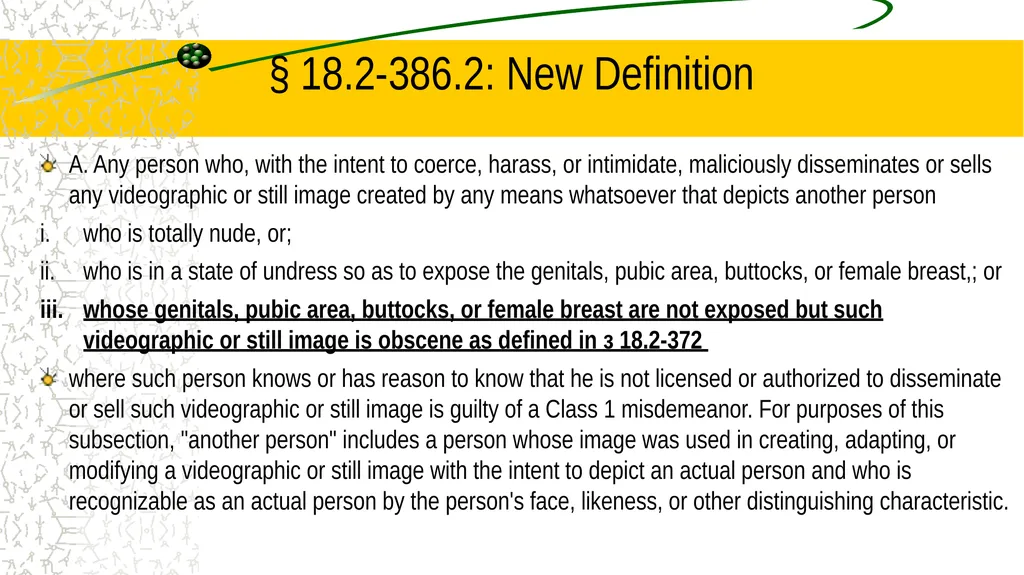
§ 18.2-386.2: New Definition A. Any person who, with the intent to coerce, harass, or intimidate, maliciously disseminates or sells any videographic or still image created by any means whatsoever that depicts another person
who is totally nude, or;
who is in a state of undress so as to expose the genitals, pubic area, buttocks, or female breast,; or
whose genitals, pubic area, buttocks, or female breast are not exposed but such videographic or still image is obscene as defined in з 18.2-372
where such person knows or has reason to know that he is not licensed or authorized to disseminate or sell such videographic or still image is guilty of a Class 1 misdemeanor. For purposes of this subsection, "another person" includes a person whose image was used in creating, adapting, or modifying a videographic or still image with the intent to depict an actual person and who is recognizable as an actual person by the person's face, likeness, or other distinguishing characteristic.<br>
who is totally nude, or;
who is in a state of undress so as to expose the genitals, pubic area, buttocks, or female breast,; or
whose genitals, pubic area, buttocks, or female breast are not exposed but such videographic or still image is obscene as defined in з 18.2-372
where such person knows or has reason to know that he is not licensed or authorized to disseminate or sell such videographic or still image is guilty of a Class 1 misdemeanor. For purposes of this subsection, "another person" includes a person whose image was used in creating, adapting, or modifying a videographic or still image with the intent to depict an actual person and who is recognizable as an actual person by the person's face, likeness, or other distinguishing characteristic.<br>
55
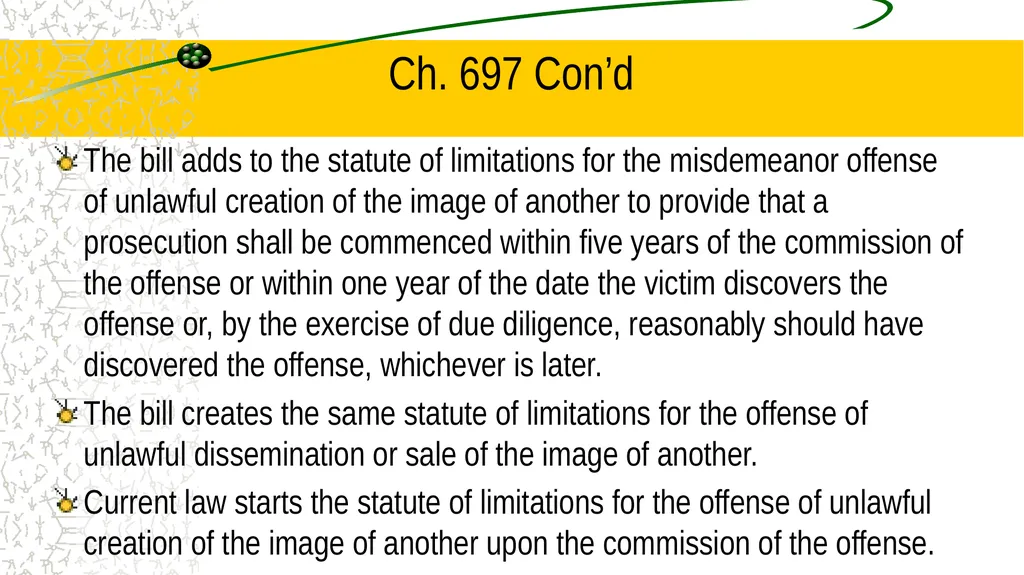
Ch. 697 Con’d The bill adds to the statute of limitations for the misdemeanor offense of unlawful creation of the image of another to provide that a prosecution shall be commenced within five years of the commission of the offense or within one year of the date the victim discovers the offense or, by the exercise of due diligence, reasonably should have discovered the offense, whichever is later.
The bill creates the same statute of limitations for the offense of unlawful dissemination or sale of the image of another.
Current law starts the statute of limitations for the offense of unlawful creation of the image of another upon the commission of the offense.<br>
The bill creates the same statute of limitations for the offense of unlawful dissemination or sale of the image of another.
Current law starts the statute of limitations for the offense of unlawful creation of the image of another upon the commission of the offense.<br>
56
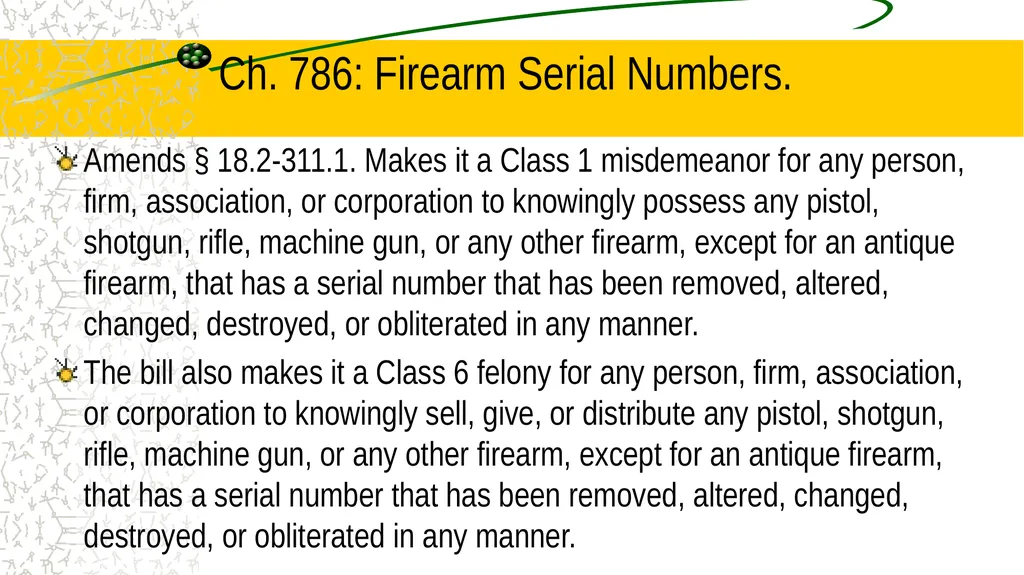
Ch. 786: Firearm Serial Numbers. Amends § 18.2-311.1. Makes it a Class 1 misdemeanor for any person, firm, association, or corporation to knowingly possess any pistol, shotgun, rifle, machine gun, or any other firearm, except for an antique firearm, that has a serial number that has been removed, altered, changed, destroyed, or obliterated in any manner.
The bill also makes it a Class 6 felony for any person, firm, association, or corporation to knowingly sell, give, or distribute any pistol, shotgun, rifle, machine gun, or any other firearm, except for an antique firearm, that has a serial number that has been removed, altered, changed, destroyed, or obliterated in any manner.<br>
The bill also makes it a Class 6 felony for any person, firm, association, or corporation to knowingly sell, give, or distribute any pistol, shotgun, rifle, machine gun, or any other firearm, except for an antique firearm, that has a serial number that has been removed, altered, changed, destroyed, or obliterated in any manner.<br>
57
LIQUID NICOTINE<br>
58
Ch. 793 / 828 Liquid nicotine and nicotine vapor products; certification and directory. Amends §§ 59.1-200 and 59.1-293.10 and adds §§ 59.1-293.12 through 59.1-293.19. Requires every manufacturer of liquid nicotine or nicotine vapor products that are sold for retail sale in the Commonwealth to certify to the Attorney General that
The manufacturer has received a marketing authorization or similar order for the liquid nicotine or nicotine vapor product from the U.S. Food and Drug Administration (FDA) or
(a) the liquid nicotine or nicotine vapor product was marketed in the United States as of August 8, 2016, or (b) the manufacturer submitted a premarket tobacco product application for the liquid nicotine or nicotine vapor product to the FDA on or before September 9, 2020, and such application either remains under review by the FDA or a final decision on the application has not otherwise taken effect.<br>
The manufacturer has received a marketing authorization or similar order for the liquid nicotine or nicotine vapor product from the U.S. Food and Drug Administration (FDA) or
(a) the liquid nicotine or nicotine vapor product was marketed in the United States as of August 8, 2016, or (b) the manufacturer submitted a premarket tobacco product application for the liquid nicotine or nicotine vapor product to the FDA on or before September 9, 2020, and such application either remains under review by the FDA or a final decision on the application has not otherwise taken effect.<br>
59
Ch. 793 / 828 Con’d The bill allows a 10-business-day period for a manufacturer to establish compliance.
The bill requires that any such products that are removed from the list be sold or removed from retail sale within 30 days or become subject to seizure.
The bill prohibits the sale, distribution, importation, or offer for sale of any liquid nicotine or nicotine vapor product that is not listed in the directory.
The bill provides for a civil penalty of $1,000 per day for each product offered for sale in violation of the bill's provisions until the offending product is removed from the market or until the offending product is properly listed on the directory.<br>
The bill requires that any such products that are removed from the list be sold or removed from retail sale within 30 days or become subject to seizure.
The bill prohibits the sale, distribution, importation, or offer for sale of any liquid nicotine or nicotine vapor product that is not listed in the directory.
The bill provides for a civil penalty of $1,000 per day for each product offered for sale in violation of the bill's provisions until the offending product is removed from the market or until the offending product is properly listed on the directory.<br>
60
Ch. 793 / 828 Con’d The bill requires any person that receives, stores, sells, handles, or transports liquid nicotine or nicotine vapor products to preserve all records relating to the purchase, sale, exchange, receipt, or transportation of all liquid nicotine or nicotine vapor products for a period of three years.
The bill provides that all such records are subject to audit or inspection at any time by any duly authorized representative of the Attorney General.
Any person who violates the recordkeeping provisions of the bill is guilty of a Class 2 misdemeanor.<br>
The bill provides that all such records are subject to audit or inspection at any time by any duly authorized representative of the Attorney General.
Any person who violates the recordkeeping provisions of the bill is guilty of a Class 2 misdemeanor.<br>
61
Ch. 793 / 828 Con’d Additionally, the bill provides that the Department of Taxation, the Attorney General, any other law-enforcement agency of the Commonwealth, or any federal law-enforcement agency conducting a criminal investigation involving the trafficking of liquid nicotine or nicotine vapor products may access at any time such records.
The bill requires the Department of Taxation to impose a penalty of $1,000 for each day that a person fails or refuses to allow or cooperate with an audit, inspection, or investigation of such records.<br>
The bill requires the Department of Taxation to impose a penalty of $1,000 for each day that a person fails or refuses to allow or cooperate with an audit, inspection, or investigation of such records.<br>
62
Ch. 793 / 828 Con’d The bill authorizes the Attorney General and, with the concurrence of the Attorney General, any attorney for the Commonwealth, or the attorney for any city, county, or town to cause an action to enjoin any violation of the provisions of the bill.
The circuit courts are authorized by the bill to (a) issue temporary or permanent injunctions to restrain and prevent violations of the provisions of the bill and (b) order forfeiture of any property seized for such a violation.
The bill authorizes the Attorney General to issue a civil investigative demand.
The provisions of this act shall become effective on July 1, 2025.<br>
The circuit courts are authorized by the bill to (a) issue temporary or permanent injunctions to restrain and prevent violations of the provisions of the bill and (b) order forfeiture of any property seized for such a violation.
The bill authorizes the Attorney General to issue a civil investigative demand.
The provisions of this act shall become effective on July 1, 2025.<br>
63
Ch. 796 / 821 Sales of retail tobacco products and liquid nicotine. Amends §§ 18.2-246.8, 18.2-371.2, 22.1-79.5, 22.1-206, 22.1-279.6, 58.1-1021.01, 58.1-1021.02, 58.1-1021.04:1, 58.1-1021.04:5, 59.1-293.10, and 59.1-293.11 and adds §§ 58.1-1021.06 through 58.1-1021.09 and adds §§ 59.1-293.12, 59.1-293.13, and 59.1-293.14.
Prohibits Internet sales of liquid nicotine or nicotine vapor products, except to a retail dealer, and prohibits the sale of retail tobacco products from vending machines.
The bill updates, for the purpose of the crime of selling or distributing tobacco products to a person younger than 21 years of age, the definition of "retail tobacco products" by including in such definition products currently defined as "nicotine vapor products" or "alternative nicotine vapor products."
The bill also removes provisions prohibiting the attempt to purchase, the purchase, or the possession of tobacco products by persons younger than 21 years of age.<br>
Prohibits Internet sales of liquid nicotine or nicotine vapor products, except to a retail dealer, and prohibits the sale of retail tobacco products from vending machines.
The bill updates, for the purpose of the crime of selling or distributing tobacco products to a person younger than 21 years of age, the definition of "retail tobacco products" by including in such definition products currently defined as "nicotine vapor products" or "alternative nicotine vapor products."
The bill also removes provisions prohibiting the attempt to purchase, the purchase, or the possession of tobacco products by persons younger than 21 years of age.<br>
64
Ch. 796 / 821 Con’d The bill provides that the punishment of a retail dealer that sells, gives, or furnishes a tobacco product to a person younger than 21 years of age or to a person who does not demonstrate that such person is at least 21 years of age is subject to:
a civil penalty of $1,000 for a first offense within a 36-month period,
a civil penalty of $5,000 for a second offense within a 36-month period such retail dealer shall become subject to specific age-verification requirements,
a civil penalty of $10,000 and a 30-day suspension of such retail dealer's distributor's license for a third offense within a 36-month period<br>
a civil penalty of $1,000 for a first offense within a 36-month period,
a civil penalty of $5,000 for a second offense within a 36-month period such retail dealer shall become subject to specific age-verification requirements,
a civil penalty of $10,000 and a 30-day suspension of such retail dealer's distributor's license for a third offense within a 36-month period<br>
65
Ch. 796 / 821 Con’d The bill provides that the punishment of a retail dealer that sells, gives, or furnishes a tobacco product to a person younger than 21 years of age or to a person who does not demonstrate that such person is at least 21 years of age is subject to
(iv) revocation of such license and such retail dealer shall be ineligible to hold a license for a period of three years following the most recent violation for a fourth offense within a 36-month period. The bill requires the Department of Taxation, in collaboration with the Virginia Alcoholic Beverage Control Authority and local law enforcement, to conduct a compliance check every 24 months on any retail dealer selling retail tobacco products and to use a person younger than 21 years of age to conduct such checks.<br>
(iv) revocation of such license and such retail dealer shall be ineligible to hold a license for a period of three years following the most recent violation for a fourth offense within a 36-month period. The bill requires the Department of Taxation, in collaboration with the Virginia Alcoholic Beverage Control Authority and local law enforcement, to conduct a compliance check every 24 months on any retail dealer selling retail tobacco products and to use a person younger than 21 years of age to conduct such checks.<br>
66
Ch. 796 / 821 Con’d The bill also imposes a tax upon liquid nicotine in closed systems, as defined in the bill, at the rate of $0.066 per milliliter and upon liquid nicotine in open systems, as defined in the bill, at the rate of 20 percent of the wholesale price for purchases on and after July 1, 2024.
The bill applies licensing requirements to manufacturers, distributors, and retail dealers of liquid nicotine and creates new safety requirements related to the advertising, marketing, and labeling of liquid nicotine and nicotine vapor products.<br>
The bill applies licensing requirements to manufacturers, distributors, and retail dealers of liquid nicotine and creates new safety requirements related to the advertising, marketing, and labeling of liquid nicotine and nicotine vapor products.<br>
67
TRAFFIC<br>
68
Ch. 76 / Ch. 77: Certain warning light units. Amends § 46.2-1024.
Increases from two to four the number of flashing or steady-burning red or red and white combination warning light units with which a member of a fire department, volunteer fire company, or volunteer emergency medical services agency and any police chaplain may equip one vehicle owned by him.<br>
Increases from two to four the number of flashing or steady-burning red or red and white combination warning light units with which a member of a fire department, volunteer fire company, or volunteer emergency medical services agency and any police chaplain may equip one vehicle owned by him.<br>
69
Ch. 95: Amber warning lights;
certain hunting vehicles. Adds § 46.2-1025. Authorizes road whips who are operating vehicles during certain fox hunts to display flashing amber warning lights when such vehicles are not in motion for the purpose of warning other vehicles of such hunt happening in the area.
A "road whip" is a vehicle operator guiding or assisting with a hunt under the direction of a hunt master.
The bill requires such vehicles to also display a sign reading "Horse Crossing With Rider."<br>
A "road whip" is a vehicle operator guiding or assisting with a hunt under the direction of a hunt master.
The bill requires such vehicles to also display a sign reading "Horse Crossing With Rider."<br>
70
Review: 2022 Changes to Farm Use Tags Amended §§ 46.2-665, 46.2-666, 46.2-670, 46.2-672, and 46.2-673 and adds § 46.2-684.2
Change would have required an owner or lessee of a vehicle claiming a farm use exemption from the registration, licensing, and decal requirements for a motor vehicle, trailer, or semitrailer to obtain a nontransferable permanent farm use placard from the Department of Motor Vehicles and to display the farm use placard on the vehicle at all times.
Law required the applicant to provide specified information about the vehicle and its usage, pay a $15 fee, and certify that the vehicle is insured.
Provisions of the bill requiring the owner or lessee of a farm vehicle to obtain and display a farm use placard had a delayed effective date of July 1, 2023.<br>
Change would have required an owner or lessee of a vehicle claiming a farm use exemption from the registration, licensing, and decal requirements for a motor vehicle, trailer, or semitrailer to obtain a nontransferable permanent farm use placard from the Department of Motor Vehicles and to display the farm use placard on the vehicle at all times.
Law required the applicant to provide specified information about the vehicle and its usage, pay a $15 fee, and certify that the vehicle is insured.
Provisions of the bill requiring the owner or lessee of a farm vehicle to obtain and display a farm use placard had a delayed effective date of July 1, 2023.<br>
71
Ch. 85/86: ”Farm Use” Placards - 2023 Changes Delayed from July 1, 2023, to July 1, 2024, the date by which vehicles claiming a farm use exemption are required to obtain a farm use placard from the Department of Motor Vehicles and display such placard at all times.
The bill provides that the requirement to display a permanent ”Farm Use” placard only applies to pickup or panel trucks and sport utility vehicles.
Does not apply to “Farm Use” vehicles having a gross vehicle weight rating greater than 7,500 pounds or “Farm Use” trailers and semi-trailers.
Does not apply to farm machinery or tractors.
The bill adds to the authorized uses the use of “Farm Use” vehicle for disposing of incidental household refuse.<br>
The bill provides that the requirement to display a permanent ”Farm Use” placard only applies to pickup or panel trucks and sport utility vehicles.
Does not apply to “Farm Use” vehicles having a gross vehicle weight rating greater than 7,500 pounds or “Farm Use” trailers and semi-trailers.
Does not apply to farm machinery or tractors.
The bill adds to the authorized uses the use of “Farm Use” vehicle for disposing of incidental household refuse.<br>
72
2023 Ch. 85/86:
Other “Farm Use” Changes Going into Effect The bill removes certain requirements on the application for a farm use placard, prohibits requesting additional information on such application, and prohibits disclosure of application information.
The bill authorizes the use of a seasonal transportation vehicle for driving to a storage house, packing plant, or market regardless of distance.
The bill clarifies that the exemption for transporting back to a farm essential food includes procuring a meal for a farmer or his employees and that such exemption applies while engaged in authorized farm vehicle uses. (A permanent placard may still be required.)
The bill exempts vehicles required to obtain a farm use placard from the motor vehicle sales and use tax and authorizes localities to exempt such vehicles from personal property tax.<br>
The bill authorizes the use of a seasonal transportation vehicle for driving to a storage house, packing plant, or market regardless of distance.
The bill clarifies that the exemption for transporting back to a farm essential food includes procuring a meal for a farmer or his employees and that such exemption applies while engaged in authorized farm vehicle uses. (A permanent placard may still be required.)
The bill exempts vehicles required to obtain a farm use placard from the motor vehicle sales and use tax and authorizes localities to exempt such vehicles from personal property tax.<br>
73
FOIA<br>
74
Ch. 64: Exemption for
Complainant Personal Contact Information. Amends existing exemption from mandatory disclosure in § 2.2-3705.3, the Virginia Freedom of Information Act, for names, addresses, and phone numbers of complainants furnished in confidence with respect to an investigation of individual zoning enforcement complaints or complaints relating to the Uniform Statewide Building Code or the Statewide Fire Prevention Code made to a local governing body to exempt personal contact information of such complainants as defined in the bill.<br>
75
Ch. 580: Virginia Freedom of Information Act; release of criminal investigative files exception. Amends § 2.2-3706.1.
Exempts a victim's insurance company and attorney from the prohibition on releasing photographic, audio, video, or other records depicting such victim.
The bill also permits a victim, a victim's immediate family members if the victim is deceased, a victim's parent or guardian, the victim's insurance company, or the victim's attorney to waive the 14-day period for a public body to respond to a request for criminal investigative files.<br>
Exempts a victim's insurance company and attorney from the prohibition on releasing photographic, audio, video, or other records depicting such victim.
The bill also permits a victim, a victim's immediate family members if the victim is deceased, a victim's parent or guardian, the victim's insurance company, or the victim's attorney to waive the 14-day period for a public body to respond to a request for criminal investigative files.<br>
76
Ch. 582: Removal of Virginia residency requirement for access to certain criminal investigation files. Amends §§ 2.2-3706.1 and 8.01-622.2.
Removes the requirement that persons to whom non-ongoing criminal investigation files shall otherwise be disclosed be citizens of the Commonwealth.
Current law limits disclosure of public records to individuals who are citizens of the Commonwealth unless a clear exception applies.<br>
Removes the requirement that persons to whom non-ongoing criminal investigation files shall otherwise be disclosed be citizens of the Commonwealth.
Current law limits disclosure of public records to individuals who are citizens of the Commonwealth unless a clear exception applies.<br>
77
Ch. 669 Charges for production of public records. Amends § 2.2-3704 to prohibit a public body from charging a requester for any costs incurred during the first hour spent accessing, duplicating, supplying, or searching for records requested in conjunction with the requester's first request.
The bill provides that for any additional time spent accessing, duplicating, supplying, or searching for such records, or for any additional record requests, the public body shall not charge an hourly rate for accessing, duplicating, supplying, or searching for the records exceeding the lesser of the hourly rate of pay of the lowest-paid individual capable of fulfilling the request or $40 per hour.<br>
The bill provides that for any additional time spent accessing, duplicating, supplying, or searching for such records, or for any additional record requests, the public body shall not charge an hourly rate for accessing, duplicating, supplying, or searching for the records exceeding the lesser of the hourly rate of pay of the lowest-paid individual capable of fulfilling the request or $40 per hour.<br>
78
Ch. 669 Con’d The bill allows a public body to petition the appropriate court for relief from the $40-per-hour fee cap upon showing by a preponderance of the evidence that there is no qualified individual capable of fulfilling the request for $40 per hour or less and requires such petition to be heard within seven days of when the petition is made, provided that the public body has sent and the requester has received a copy of the petition at least three working days prior to filing.
The bill also provides that in certain instances a hearing on any petition shall be given precedence on a circuit court's docket over all cases that are not otherwise given precedence by law and that the time period the public body has to respond to a record request shall be tolled between the requester's receipt of the petition and the final disposition of the court.<br>
The bill also provides that in certain instances a hearing on any petition shall be given precedence on a circuit court's docket over all cases that are not otherwise given precedence by law and that the time period the public body has to respond to a record request shall be tolled between the requester's receipt of the petition and the final disposition of the court.<br>
79
Ch. 669 Con’d The bill prohibits a public body from charging a requester for any court costs or fees resulting from a petition.
The bill directs the Virginia Freedom of Information Advisory Council to study whether public bodies should charge requesters pursuant to the bill and report on its findings by December 2024.
The provisions of the bill amending the Code of Virginia do not become effective unless reenacted by the 2025 Session of the General Assembly.<br>
The bill directs the Virginia Freedom of Information Advisory Council to study whether public bodies should charge requesters pursuant to the bill and report on its findings by December 2024.
The provisions of the bill amending the Code of Virginia do not become effective unless reenacted by the 2025 Session of the General Assembly.<br>
80
ECO and TDO Procedure<br>
81
Ch. 643 / 680 TDO alternative transportation. Amends § 37.2-810 to provide that when a magistrate is determining whether an alternative transportation provider is available for the purposes of designating a transportation provider for the transportation of a person who is the subject of a temporary detention order, an alternative transportation provider shall be deemed available if the provider states that it is available to take custody of the person from law enforcement within six hours of issuance of the temporary detention order or an order changing the transportation provider.<br>
82
Ch. 643 / 680 Con’d The bill also provides that if (i) no alternative transportation provider is available to provide transportation, willing to provide transportation, and able to provide transportation in a safe manner or (ii) the law-enforcement agency elects to provide transportation, the magistrate shall designate the primary law-enforcement agency and jurisdiction designated to execute the temporary detention order to provide transportation of the person.<br>
83
Law Enforcement Regulatory &
Reporting Requirements<br>
84
Ch. 614: Surveillance technology Adds § 9.1-116.10 which requires all state and local law-enforcement agencies and sheriff's departments to provide to the Department of Criminal Justice Services (the Department) a list of surveillance technologies, defined in the bill, procured by such agencies and departments on an annual basis by November 1 of each year.
The bill requires the Department to provide such information to the Virginia State Crime Commission and the Joint Commission on Technology and Science.<br>
The bill requires the Department to provide such information to the Virginia State Crime Commission and the Joint Commission on Technology and Science.<br>
85
Ch. 614: Con’d For purposes of this section, "surveillance technology" means any electronic surveillance device, hardware, or software that is capable of collecting, capturing, recording, retaining, processing, intercepting, analyzing, monitoring, or sharing audio, visual, digital, location, thermal, biometric, behavioral, or similar information or communications specifically associated with, or capable of being associated with, any specific individual, group, or place or any system, device, or vehicle that is equipped with an electronic surveillance device, hardware, or software.<br>
86
Surveillance technology" includes international mobile subscriber identity (IMSI) catchers and other cell site simulators;
automatic license plate readers;
electronic toll readers;
closed-circuit television cameras;
biometric surveillance technology, including facial, voice, iris, and gait-recognition software and databases;
mobile DNA capture technology; gunshot detection and location hardware and services;
x-ray vans;
video and audio monitoring or recording technology, such as surveillance cameras, wide-angle cameras, and wearable body cameras;
surveillance enabled or capable lightbulbs or light fixtures;<br>
automatic license plate readers;
electronic toll readers;
closed-circuit television cameras;
biometric surveillance technology, including facial, voice, iris, and gait-recognition software and databases;
mobile DNA capture technology; gunshot detection and location hardware and services;
x-ray vans;
video and audio monitoring or recording technology, such as surveillance cameras, wide-angle cameras, and wearable body cameras;
surveillance enabled or capable lightbulbs or light fixtures;<br>
87
Surveillance technology" includes tools, including software and hardware, used to gain unauthorized access to a computer, computer service, or computer network;
social media monitoring software;
through-the-wall radar or similar imaging technology;
passive scanners of radio networks; long-range Bluetooth and other wireless-scanning devices;
radio-frequency I.D. (RFID) scanners; and
software designed to integrate or analyze data from surveillance technology, including surveillance target tracking and predictive policing software.<br>
social media monitoring software;
through-the-wall radar or similar imaging technology;
passive scanners of radio networks; long-range Bluetooth and other wireless-scanning devices;
radio-frequency I.D. (RFID) scanners; and
software designed to integrate or analyze data from surveillance technology, including surveillance target tracking and predictive policing software.<br>
88
"Surveillance technology" does not include the following devices or hardware, unless they have been equipped with, or are modified to become or include, surveillance technology as defined above routine office hardware, such as televisions, computers, and printers, that is in widespread use and will not be used for any surveillance-related functions;
parking ticket devices;
manually operated, non-wearable, handheld digital cameras, audio recorders, and video recorders that are not designed to be used surreptitiously and whose functionality is limited to manually capturing and manually downloading video and/or audio recordings;
surveillance devices that cannot record or transmit audio or video or be remotely accessed, such as image stabilizing binoculars or night vision goggles;
databases not intended to store or compile surveillance data; and
manually operated technological devices used primarily for internal communications and not designed to surreptitiously collect surveillance data, such as radios and email systems.<br>
parking ticket devices;
manually operated, non-wearable, handheld digital cameras, audio recorders, and video recorders that are not designed to be used surreptitiously and whose functionality is limited to manually capturing and manually downloading video and/or audio recordings;
surveillance devices that cannot record or transmit audio or video or be remotely accessed, such as image stabilizing binoculars or night vision goggles;
databases not intended to store or compile surveillance data; and
manually operated technological devices used primarily for internal communications and not designed to surreptitiously collect surveillance data, such as radios and email systems.<br>
89
Law Enforcement Procedural Guarantees and Regulations<br>
90
Ch. 187: License tax; retired police or military dogs. Amends § 3.2-6528.
Allows a locality by ordinance to exempt any dog that served as a police or law-enforcement dog or military working dog from the license tax on the ownership of dogs.
Such ordinance must include a verification process for the vaccination records of such a dog.<br>
Allows a locality by ordinance to exempt any dog that served as a police or law-enforcement dog or military working dog from the license tax on the ownership of dogs.
Such ordinance must include a verification process for the vaccination records of such a dog.<br>
91
Ch. 267 / Ch. 353: VRS plan credits and accounts. Amends §§ 51.1-142.2 and 55.1-2544.
Allows members of the Virginia Retirement System to purchase service credit for prior full-time active duty military service of at least 180 consecutive days in any federally established branch of the armed services.
Under current law, such purchases are restricted to prior full-time active duty military service of at least 180 consecutive days in the United States Army, Navy, Air Force, Marines, or Coast Guard.<br>
Allows members of the Virginia Retirement System to purchase service credit for prior full-time active duty military service of at least 180 consecutive days in any federally established branch of the armed services.
Under current law, such purchases are restricted to prior full-time active duty military service of at least 180 consecutive days in the United States Army, Navy, Air Force, Marines, or Coast Guard.<br>
92
Ch. 380 / 381: Line of Duty Act; payment of benefits. Amends § 9.1-402.
Increases from $25,000 to $75,000 the death benefit payout under the Virginia Line of Duty Act for a death caused by occupational cancer, respiratory disease, or hypertension or heart disease for those deaths that will occur on or after January 1, 2025.<br>
Increases from $25,000 to $75,000 the death benefit payout under the Virginia Line of Duty Act for a death caused by occupational cancer, respiratory disease, or hypertension or heart disease for those deaths that will occur on or after January 1, 2025.<br>
93
Ch. 494: Decertification. Amends §§ 2.2-3711, 9.1-102, 15.2-1707, 15.2-1708, and 19.2-83.7.
Bill provides that the Department of Criminal Justice Services may conduct decertification review hearings in accordance with the provisions of the Administrative Process Act.
The bill provides that the findings and decision of the Department may be appealed to the Board and that the final administrative decision of the Board may be then appealed and reviewed by a court.<br>
Bill provides that the Department of Criminal Justice Services may conduct decertification review hearings in accordance with the provisions of the Administrative Process Act.
The bill provides that the findings and decision of the Department may be appealed to the Board and that the final administrative decision of the Board may be then appealed and reviewed by a court.<br>
94
Ch. 494: Decertification (Con’d) The bill also provides that records provided to the Board or Department for the purposes of decertification of an identifiable law-enforcement officer or jail officer may be withheld from the public in accordance with the Virginia Freedom of Information Act and those meetings concerning the decertification of an identifiable law-enforcement or jail officer may be closed.<br>
95
Ch. 494: Decertification (Con’d) The bill also allows the Department to grant a continuance of any informal fact-finding conference or formal hearing upon motion by the decertified officer or his counsel or the Attorney General for good cause shown.<br>
96
Ch. 494: Decertification (Con’d) The bill requires an officer to remain decertified during a period of continuance of any informal fact-finding conference or formal hearing for a pending criminal charge unless the Department finds the officer's continued decertification may cause circumstances that constitute a manifest injustice to the officer, in which case the officer's certification may be reinstated during the period of continuance until the conviction becomes final.<br>
97
Ch. 494: Decertification (Con’d) Current law allows the Board, when an officer's conviction has not become final, to decline to decertify such officer after considering the likelihood of irreparable damage to the officer if such officer is decertified during the pendency of an ultimately successful appeal, the likelihood of injury or damage to the public if the officer is not decertified, and the seriousness of the offense.<br>
98
Ch. 494: Decertification (Con’d) Additionally, the bill allows for the decertification of an officer who is terminated or resigns for an act committed while in the performance of his duties that compromises an officer's credibility, integrity, or honesty or that constitutes exculpatory or impeachment evidence in a criminal case.
The bill also provides that persons who are currently in a recruit or field training status and have committed an act that would be any basis for decertification are ineligible for certification<br>
The bill also provides that persons who are currently in a recruit or field training status and have committed an act that would be any basis for decertification are ineligible for certification<br>
99
Ch. 494: Decertification (Con’d) The bill also specifies that the required notification to the Department related to an officer being terminated or resigning
for engaging in serious misconduct;
while such officer is the subject of a pending internal investigation involving serious misconduct; or
for an act committed while in the performance of his duties that compromises an officer's credibility, integrity, or honesty or constitutes exculpatory or impeachment evidence in a criminal case shall be within 48 hours of completion of an internal investigation.
Under current law, such notification is required to be within 48 hours of the termination or resignation.<br>
for engaging in serious misconduct;
while such officer is the subject of a pending internal investigation involving serious misconduct; or
for an act committed while in the performance of his duties that compromises an officer's credibility, integrity, or honesty or constitutes exculpatory or impeachment evidence in a criminal case shall be within 48 hours of completion of an internal investigation.
Under current law, such notification is required to be within 48 hours of the termination or resignation.<br>
100
Ch. 494: Decertification (Con’d) The bill also requires the Department to establish standards and procedures for when the Department may grant a petition for reinstatement of certification of a decertified officer.
The bill directs the Department to adopt emergency regulations to implement the provisions of the bill.<br>
The bill directs the Department to adopt emergency regulations to implement the provisions of the bill.<br>
101
Ch. 542 / 581: Universal certification for
certain law-enforcement officers. Adds § 9.1-116.01, which provides that any sworn law-enforcement officer with at least one year of experience
whose training qualifications meet or exceed current training standards established by the Board of Criminal Justice Services and who is in compliance with the minimum qualifications,
who has not had a break in service of more than 24 months, and
who is leaving the transferring agency in good standing with no pending investigations or disciplinary actions shall be eligible for employment at any law-enforcement agency within the Commonwealth or its political subdivisions.<br>
whose training qualifications meet or exceed current training standards established by the Board of Criminal Justice Services and who is in compliance with the minimum qualifications,
who has not had a break in service of more than 24 months, and
who is leaving the transferring agency in good standing with no pending investigations or disciplinary actions shall be eligible for employment at any law-enforcement agency within the Commonwealth or its political subdivisions.<br>
102
Ch. 542 / 581 Con’d Prior to any conditional offer of employment, the bill requires the hiring law-enforcement agency to request certain specified information from all prior law-enforcement agencies and to employ all reasonable means to obtain personnel records for law-enforcement officers transferring from an out-of-state or federal law-enforcement agency.
The bill requires that upon the receipt of all requested information by the hiring law-enforcement agency, the applicant law-enforcement officer shall complete a sworn declaration that the provided information or records are, to the best of the applicant's knowledge, a true, correct, and complete response to such request.<br>
The bill requires that upon the receipt of all requested information by the hiring law-enforcement agency, the applicant law-enforcement officer shall complete a sworn declaration that the provided information or records are, to the best of the applicant's knowledge, a true, correct, and complete response to such request.<br>
103
Ch. 522: Firearm safety device tax credit Amends § 58.1-339.14 to expand the definition of "firearm safety device" as it relates to the firearm safety device tax credit to include any device that, when installed on a firearm, is designed to prevent the firearm from being operated without first deactivating the device.
The provisions of the bill are effective for taxable years beginning on and after January 1, 2024.<br>
The provisions of the bill are effective for taxable years beginning on and after January 1, 2024.<br>
104
Ch. 632 / 674 Employee protections;
medicinal use of cannabis oil. Amends the provision in § 40.1-27.4 that prohibits an employer from discriminating against an employee for such employee's lawful use of medical cannabis oil, with certain exceptions, by specifying that such use must conform to the laws of the Commonwealth and by including the employees, other than law-enforcement officers, of the Commonwealth and other public bodies in such protections.
New Language: "Employee" means the same as that term is defined in § 40.1-2, except that for the purposes of this section, "employee" does not include any law-enforcement officer, as defined in § 9.1-101.<br>
New Language: "Employee" means the same as that term is defined in § 40.1-2, except that for the purposes of this section, "employee" does not include any law-enforcement officer, as defined in § 9.1-101.<br>
105
§ 40.1-27.4 New Language: "Employee" means the same as that term is defined in § 40.1-2, except that for the purposes of this section, "employee" does not include any law-enforcement officer, as defined in § 9.1-101.
"Employer" means the same as that term is defined in § 40.1-2, except that for the purposes of this section, "employer" also includes the Commonwealth, any county, city, town, or other political subdivision thereof, and any agency of the Commonwealth or such county, city, town, or political subdivision.
B. No employer shall discharge, discipline, or discriminate against an employee for such employee's lawful use of cannabis oil under the laws of the Commonwealth pursuant to a valid written certification issued by a practitioner for the treatment or to eliminate the symptoms of the employee's diagnosed condition or disease pursuant to § 4.1-1601.<br>
"Employer" means the same as that term is defined in § 40.1-2, except that for the purposes of this section, "employer" also includes the Commonwealth, any county, city, town, or other political subdivision thereof, and any agency of the Commonwealth or such county, city, town, or political subdivision.
B. No employer shall discharge, discipline, or discriminate against an employee for such employee's lawful use of cannabis oil under the laws of the Commonwealth pursuant to a valid written certification issued by a practitioner for the treatment or to eliminate the symptoms of the employee's diagnosed condition or disease pursuant to § 4.1-1601.<br>
106
Questions? Elliott Casey
Staff Attorney
Commonwealth’s Attorneys’ Services Council
William and Mary Law School, Room 220
613 South Henry Street
P.O.Box 3549
Williamsburg, Virginia 23187
757.585.4370
ejcasey@wm.edu<br>
Staff Attorney
Commonwealth’s Attorneys’ Services Council
William and Mary Law School, Room 220
613 South Henry Street
P.O.Box 3549
Williamsburg, Virginia 23187
757.585.4370
ejcasey@wm.edu<br>