
Case Management Managing Gender-Based Violence
MY
Published · 73 slides · 0 views
1 / 1




Description
Case Management Managing Gender-Based Violence Programmes in Emergencies 1 Objectives Understand the case management process for support of survivors of GBV Understand how case management services can be tailored to survivors of different
Related Topics
Share
Embed code
Download this presentation From Below
"Case Management Managing Gender-Based Violence" is the property of its rightful owner. Permission is granted to download and print the materials on this website for personal, non-commercial use only, and to display it on your personal computer provided you do not modify the materials and that you retain all copyright notices contained in the materials. By downloading content from our website, you accept the terms of this agreement.
Presentation Transcript
01
Case Management Managing Gender-Based Violence Programmes in Emergencies 1<br>
02
Objectives Understand the case management process for support of survivors of GBV
Understand how case management services can be tailored to survivors of different ages and to address different forms of GBV
Understand the responsibilities of a GBV Programme Manager regarding case management supervision
Consider ways to improve service coordination and to effectively advocate for appropriate response to GBV<br>
Understand how case management services can be tailored to survivors of different ages and to address different forms of GBV
Understand the responsibilities of a GBV Programme Manager regarding case management supervision
Consider ways to improve service coordination and to effectively advocate for appropriate response to GBV<br>
03
What is GBV Case Management? A structured method for providing help to a survivor. It involves one organization, usually a psychosocial support or social services actor, taking responsibility for making sure that survivors are informed of all the options available to them and that issues and problems facing a survivor and her/his family are identified and followed up in a coordinated way, and providing the survivor with emotional support throughout the process.<br>
04
Principles of Case Management The survivor is the primary actor
The case management process should empower the survivor and ensure s/he leads
Plans must reflect a survivor’s wishes and choices
This requires…
Individualized service delivery based on an
Assessment of needs that is used to
Develop a case plan that ensures
Good coordination of service delivery<br>
The case management process should empower the survivor and ensure s/he leads
Plans must reflect a survivor’s wishes and choices
This requires…
Individualized service delivery based on an
Assessment of needs that is used to
Develop a case plan that ensures
Good coordination of service delivery<br>
05
Case Management Process Steps of Service Delivery<br>
06
1. Introduction & Engagement Have you put the survivor at ease, introduced yourself and the services you offer?
Greet and comfort the survivor.
Establish rapport and obtain informed consent to proceed with CM services.<br>
Greet and comfort the survivor.
Establish rapport and obtain informed consent to proceed with CM services.<br>
07
Informed consent The voluntary agreement of an individual who has the legal capacity to give consent.
The survivor must:
Have the capacity and maturity to know about and
Understand the services being offered, and
Be legally able to give her consent<br>
The survivor must:
Have the capacity and maturity to know about and
Understand the services being offered, and
Be legally able to give her consent<br>
08
When do we obtain informed consent? Before case management services begin= before listening to a story or gathering information
Throughout the case management process
When making referrals
Before sharing any information on a case or meeting with other service providers<br>
Throughout the case management process
When making referrals
Before sharing any information on a case or meeting with other service providers<br>
09
Confidentiality “Informed” consent includes information on confidentiality practices
Limitations on confidentiality must be disclosed during Step 1.
Limitations might include:
Mandatory reporting laws
SEA policy
Fear of imminent security risks
Fear of self harm or harm to others
Information sharing among GBV team<br>
Limitations on confidentiality must be disclosed during Step 1.
Limitations might include:
Mandatory reporting laws
SEA policy
Fear of imminent security risks
Fear of self harm or harm to others
Information sharing among GBV team<br>
10
2. Assessment Why is the individual seeking assistance?
Collect information using a survivor-centred approach
What problems is she facing? How does she see her situation? What supports does she have? What assistance does she want?
Listen. And help a survivor identify her problems and needs.<br>
Collect information using a survivor-centred approach
What problems is she facing? How does she see her situation? What supports does she have? What assistance does she want?
Listen. And help a survivor identify her problems and needs.<br>
11
3. Case Action Planning What does the survivor want to happen next?
Develop a case plan based on the assessment
Ask questions about what a survivor wants
This may include personal goals related to return to normal activities, seeking support from friends, etc.
Provide information on service options
Provide information on processes, and likely outcomes, of different available services
Obtain consent for referrals and documentation<br>
Develop a case plan based on the assessment
Ask questions about what a survivor wants
This may include personal goals related to return to normal activities, seeking support from friends, etc.
Provide information on service options
Provide information on processes, and likely outcomes, of different available services
Obtain consent for referrals and documentation<br>
12
4. Implementing the plan How can we help a survivor achieve her goals?
Provide services within scope of work (PSS support)
Refer to other services, as requested
Advocate for services, support
Lead case coordination<br>
Provide services within scope of work (PSS support)
Refer to other services, as requested
Advocate for services, support
Lead case coordination<br>
13
5. Case Follow Up Is the survivor reaching her goals? Is she recovering?
Monitor outcomes with survivor
Identify any barriers to achieving goals
Adapt plan as needed<br>
Monitor outcomes with survivor
Identify any barriers to achieving goals
Adapt plan as needed<br>
14
6. Case Closure How do we know when the work is finished?
Assess with survivor if her goals are met
Assess with survivor if her own (normal or new normal) support systems are functioning
Ensure any ongoing services are in place
Ensure survivor has means of contact for any future needs<br>
Assess with survivor if her goals are met
Assess with survivor if her own (normal or new normal) support systems are functioning
Ensure any ongoing services are in place
Ensure survivor has means of contact for any future needs<br>
15
Service Evaluation at Case Closure What was the quality of the service?
Determine if the client feel satisfied with the service
Reflect on the service provided and any challenges that arose
Assess whether best practices were followed<br>
Determine if the client feel satisfied with the service
Reflect on the service provided and any challenges that arose
Assess whether best practices were followed<br>
16
Case Management & Individualized Psychosocial Support<br>
17
Benefits of GBV Case Management Approach Holistic
Survivor-centered
Restores some measure of control to the person affected
Attentive to specific needs, risks related to GBV
Skills not credentials: caseworker profile can vary, is adaptable<br>
Survivor-centered
Restores some measure of control to the person affected
Attentive to specific needs, risks related to GBV
Skills not credentials: caseworker profile can vary, is adaptable<br>
18
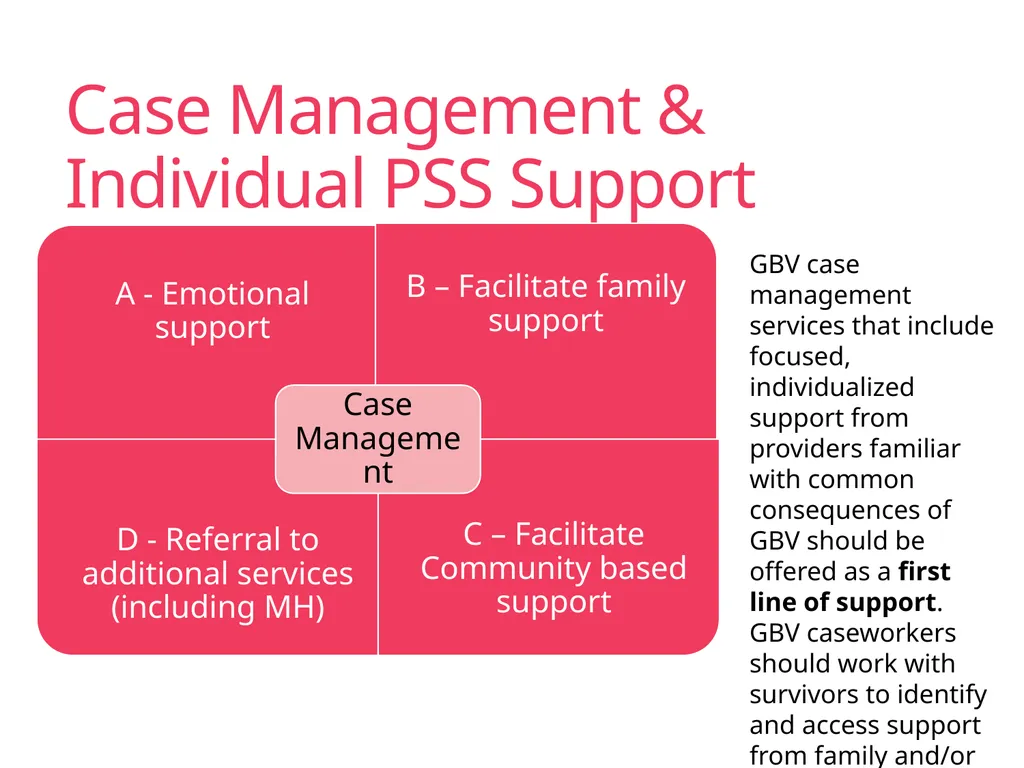
Case Management & Individual PSS Support GBV case management services that include focused, individualized support from providers familiar with common consequences of GBV should be offered as a first line of support. GBV caseworkers should work with survivors to identify and access support from family and/or social networks.<br>
19
Time for Practice!<br>
20
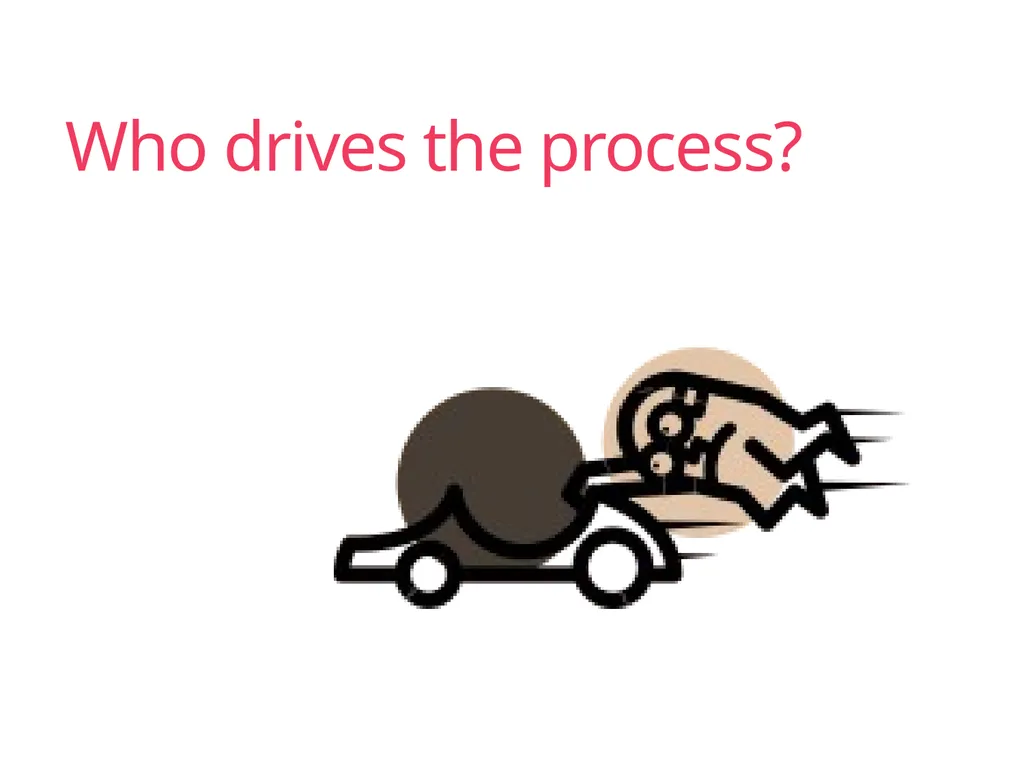
Who drives the process?<br>
21
Case Management Intimate Partner Violence<br>
22
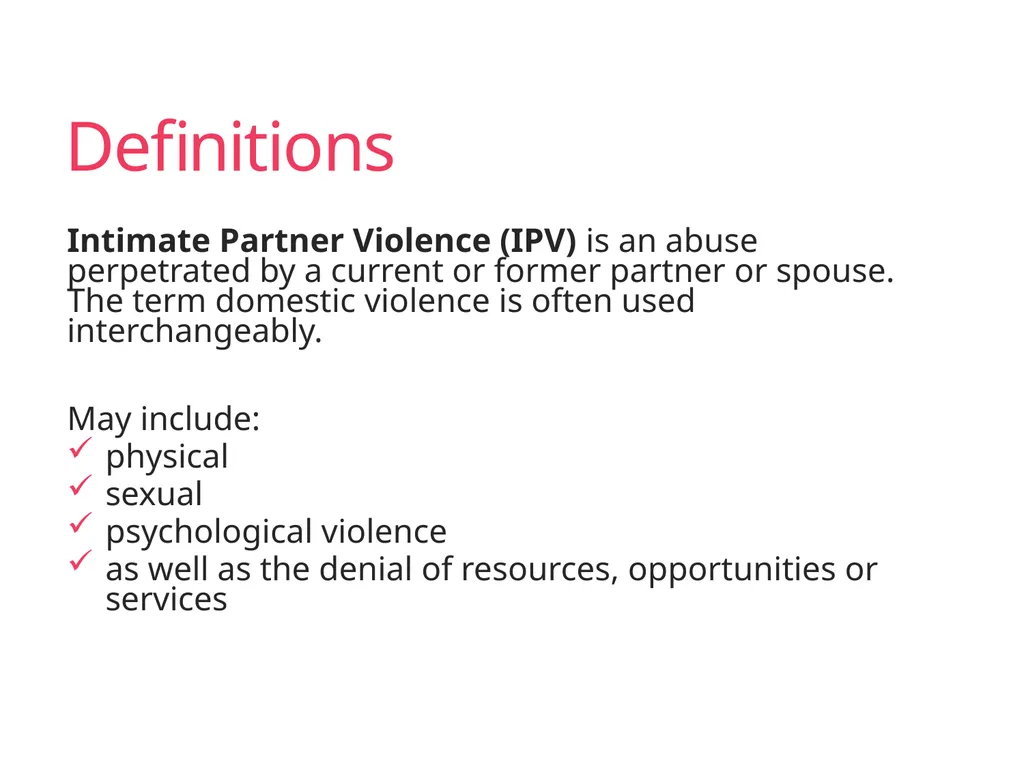
Definitions Intimate Partner Violence (IPV) is an abuse perpetrated by a current or former partner or spouse. The term domestic violence is often used interchangeably.
May include:
physical
sexual
psychological violence
as well as the denial of resources, opportunities or services<br>
May include:
physical
sexual
psychological violence
as well as the denial of resources, opportunities or services<br>
23
IPV<br>
24
IPV Consequences<br>
25
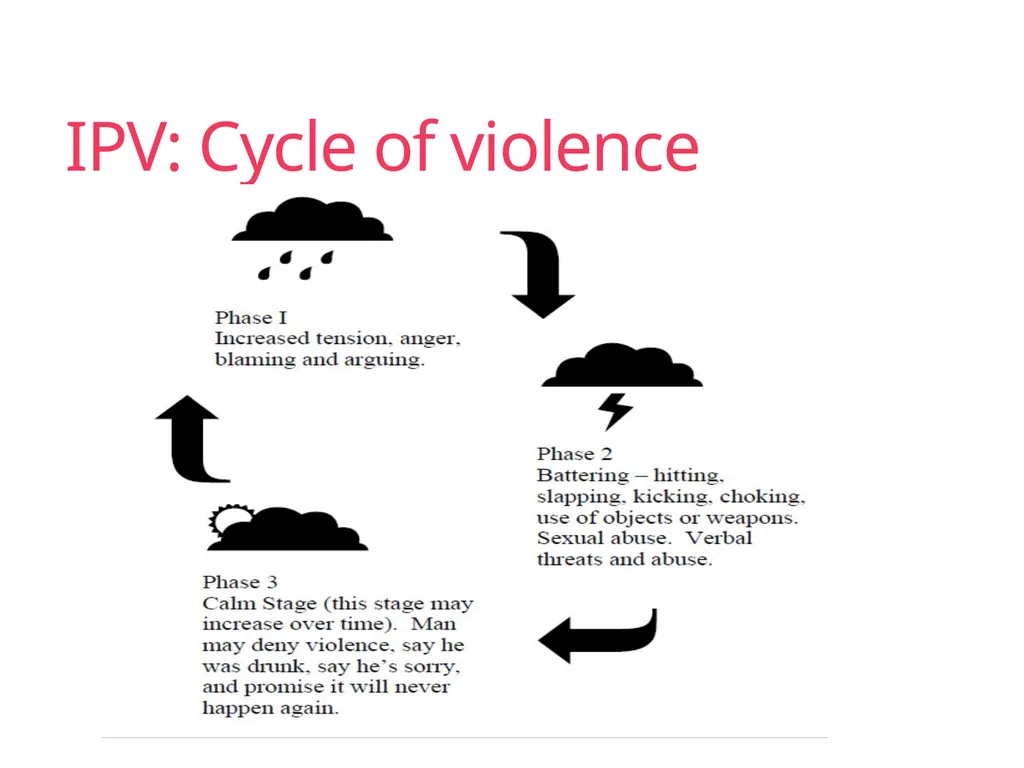
IPV: Cycle of violence<br>
26
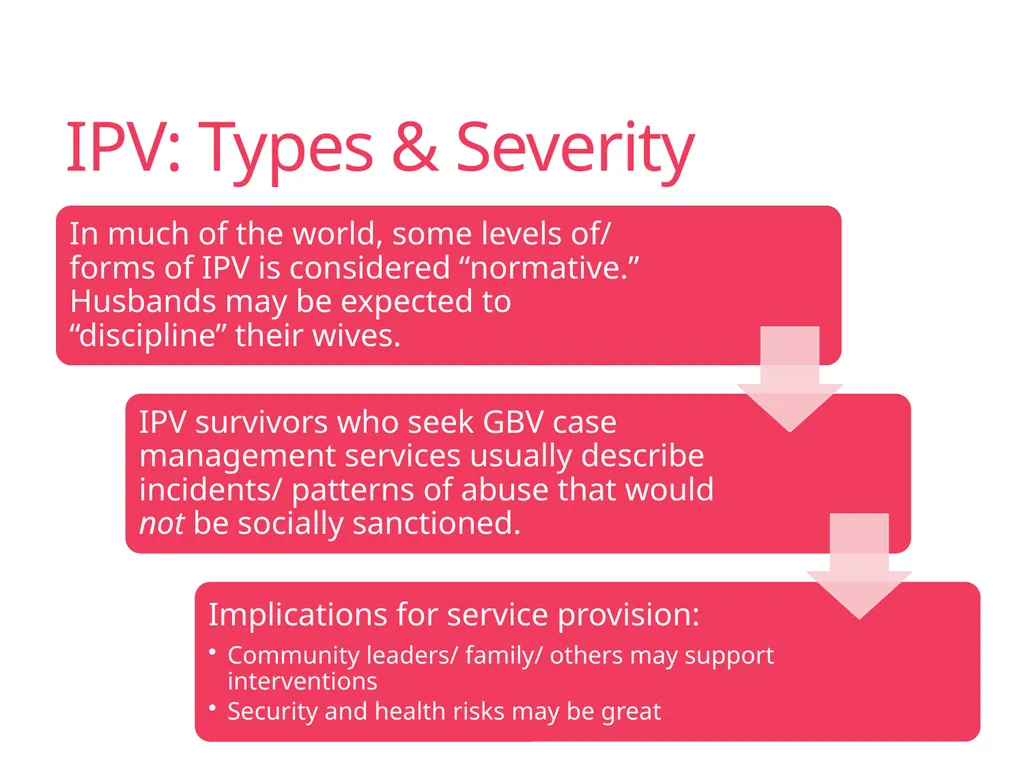
IPV: Types & Severity<br>
27
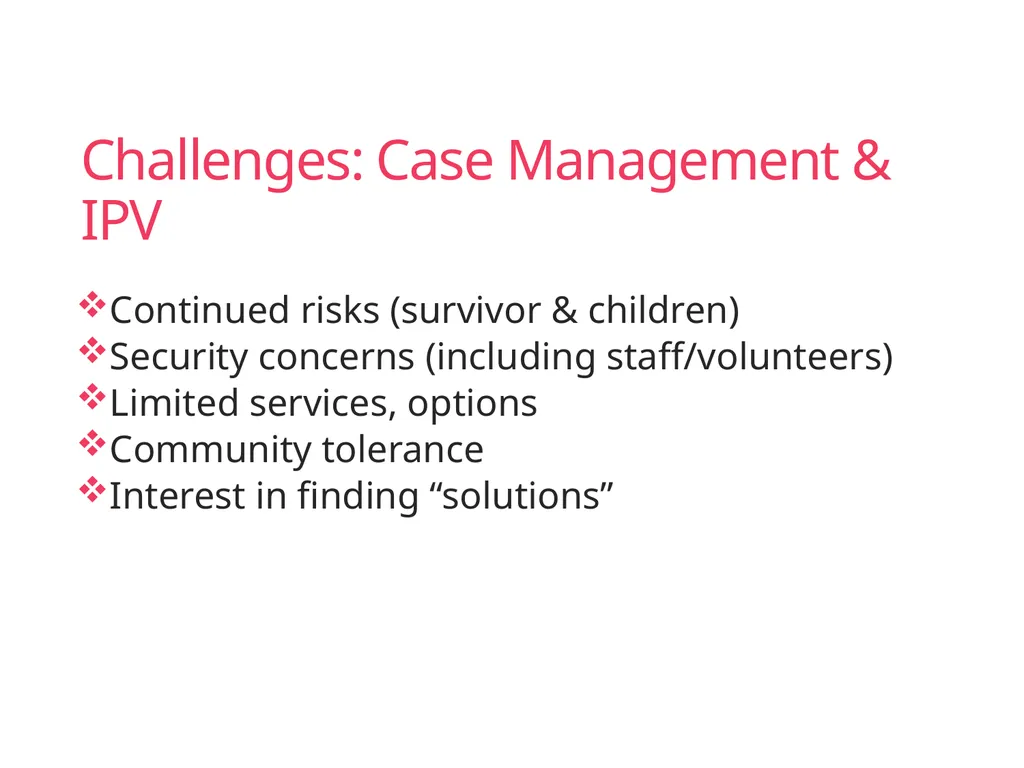
Challenges: Case Management & IPV Continued risks (survivor & children)
Security concerns (including staff/volunteers)
Limited services, options
Community tolerance
Interest in finding “solutions”<br>
Security concerns (including staff/volunteers)
Limited services, options
Community tolerance
Interest in finding “solutions”<br>
28
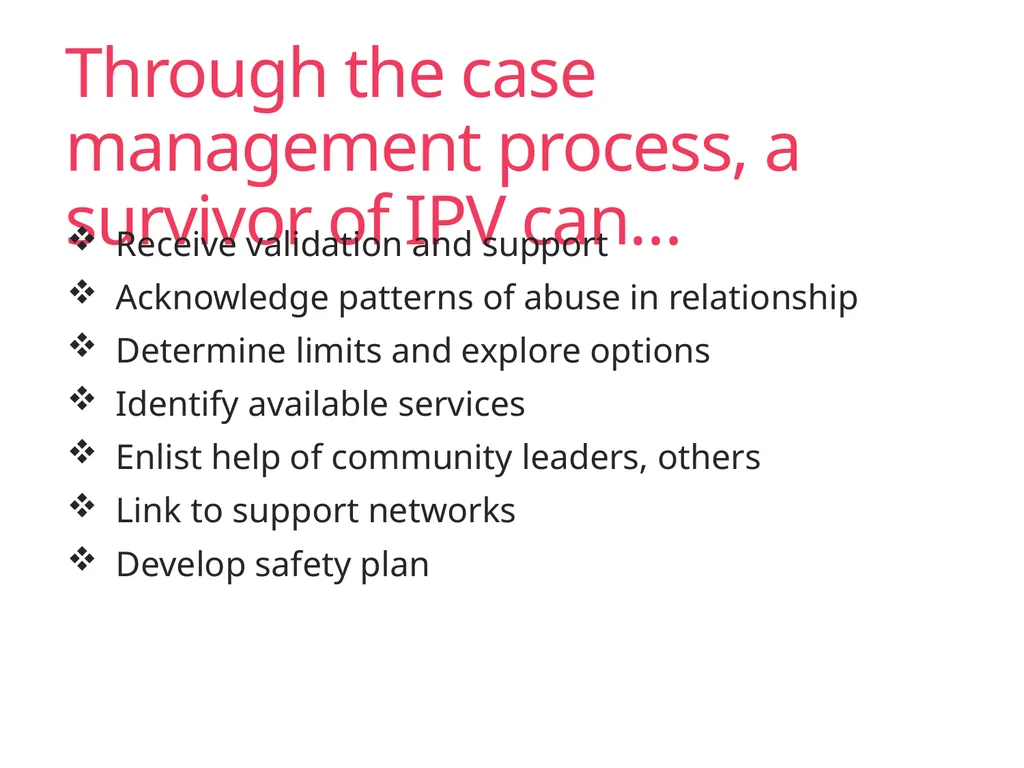
Through the case management process, a survivor of IPV can… Receive validation and support
Acknowledge patterns of abuse in relationship
Determine limits and explore options
Identify available services
Enlist help of community leaders, others
Link to support networks
Develop safety plan<br>
Acknowledge patterns of abuse in relationship
Determine limits and explore options
Identify available services
Enlist help of community leaders, others
Link to support networks
Develop safety plan<br>
29
Safety Plan Safety plan is a specialised type of case plan aimed at reducing an individual’s risk of future incidents of GBV. An IPV safety plan is developed with a survivor to help keep her (and her children) safe from an abusive partner.<br>
30
Through a Safety Plan a survivor of IPV can… Identify behaviors that precede a partner’s violent episodes
Identify safest spaces in home
Identify a person to tell, way to seek assistance
Identify a safe space to go<br>
Identify safest spaces in home
Identify a person to tell, way to seek assistance
Identify a safe space to go<br>
31
Mediation Mediation is a voluntary process in which two or more parties involved in a dispute work with an impartial party, the mediator, to generate their own solutions in settling their conflict.
Unlike a judge or an arbitrator whose decisions subject one party to win and the other party to lose, mediation is about finding a solution that works for both parties.<br>
Unlike a judge or an arbitrator whose decisions subject one party to win and the other party to lose, mediation is about finding a solution that works for both parties.<br>
32
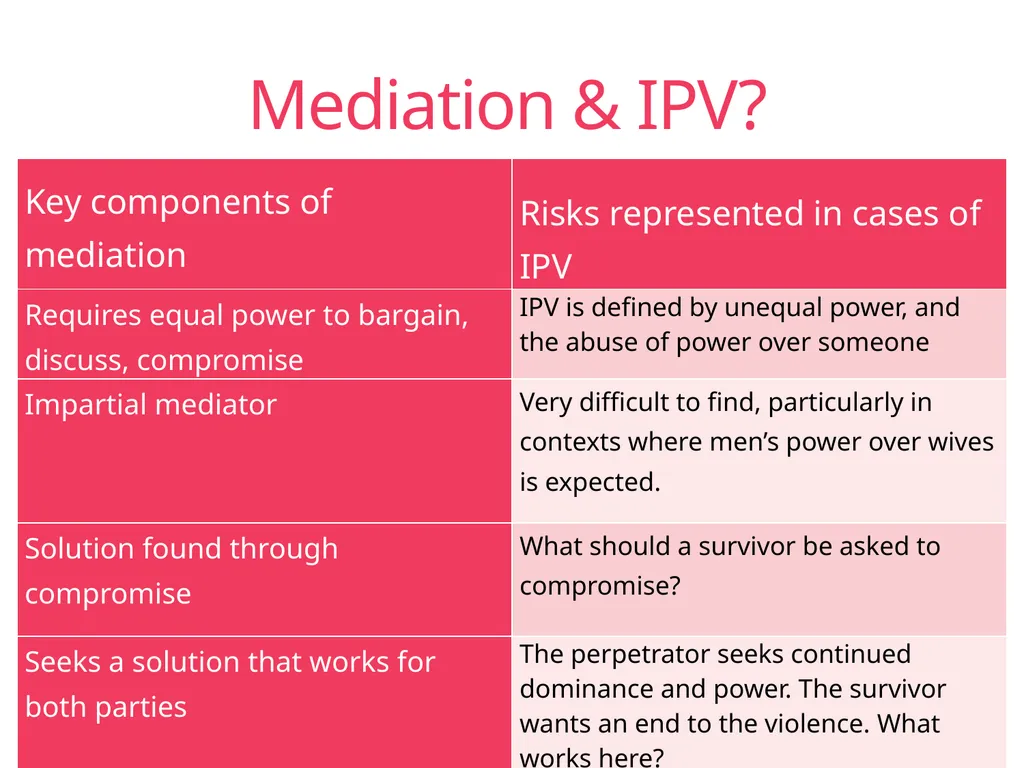
Mediation & IPV?<br>
33
Why mediation is not recommended for IPV Violence is ongoing but cyclical. Perpetrators may stop for long periods of time, where mediators will consider the issue “solved.”
Safety risks heightened during/after process- for survivor and caseworker
Process often blames the survivor for “causing” episodes. Survivor might be asked to adapt her behavious as condition to stop violence.
Caseworkers involved risk losing trust of survivors, being perceived as siding with perpetrators.
Involvement of GBV programmes can validate mediation as an appropriate intervention for IPV.<br>
Safety risks heightened during/after process- for survivor and caseworker
Process often blames the survivor for “causing” episodes. Survivor might be asked to adapt her behavious as condition to stop violence.
Caseworkers involved risk losing trust of survivors, being perceived as siding with perpetrators.
Involvement of GBV programmes can validate mediation as an appropriate intervention for IPV.<br>
34
What if a survivor asks for mediation? Caseworkers should never mediate themselves.
Caseworkers can act as advocates and support survivors before, during and after the mediation (depending on survivors’ interests, Caseworker’s comfort, safety, and organizational policies)
Programmes can seek to influence mediators or mediation mechanisms, to improve process for survivors<br>
Caseworkers can act as advocates and support survivors before, during and after the mediation (depending on survivors’ interests, Caseworker’s comfort, safety, and organizational policies)
Programmes can seek to influence mediators or mediation mechanisms, to improve process for survivors<br>
35
More practice!<br>
36
Case Management Child Sexual Abuse<br>
37
Child Survivors of Sexual Violence Children experience different consequences to sexual violence than adults
Children often express suffering differently than adults
Reactions may be influenced by:
Type of violence
Duration
Relationship to perpetrator
Stage of development
Support received<br>
Children often express suffering differently than adults
Reactions may be influenced by:
Type of violence
Duration
Relationship to perpetrator
Stage of development
Support received<br>
38
Definitions Child sexual abuse (CSA) is any form of sexual activity with a child by an adult or other child who has power over the child. Child sexual abuses often, but not always, involves bodily contact.
Early/forced marriage (EFM) is a form of GBV that is linked to CSA (marital rape).
Female genital cutting (FGC) is another form of GBV (and sexual violence) that is mainly perpetrated against children.<br>
Early/forced marriage (EFM) is a form of GBV that is linked to CSA (marital rape).
Female genital cutting (FGC) is another form of GBV (and sexual violence) that is mainly perpetrated against children.<br>
39
Child Sexual Abuse: Key Points Children face particular risks to GBV, due to their dependence, limited power, and vulnerability to exploitation, tricks, and coercion.
Most CSA is perpetrated by people close to children
Globally, girls are up to three times more likely to be victims of CSA
Incidents involving survivors under 18 constitute roughly half the caseload of GBV programmes in humanitarian settings<br>
Most CSA is perpetrated by people close to children
Globally, girls are up to three times more likely to be victims of CSA
Incidents involving survivors under 18 constitute roughly half the caseload of GBV programmes in humanitarian settings<br>
40
Guiding Principles for Working with Child Survivors Promote the Child’s Best Interest
Ensure the Safety of the Child
Comfort the Child
Ensure Appropriate Confidentiality
Involve the Child in Decision- Making
Treat Every Child Fairly and Equally
Strengthen Children’s Resiliencies<br>
Ensure the Safety of the Child
Comfort the Child
Ensure Appropriate Confidentiality
Involve the Child in Decision- Making
Treat Every Child Fairly and Equally
Strengthen Children’s Resiliencies<br>
41
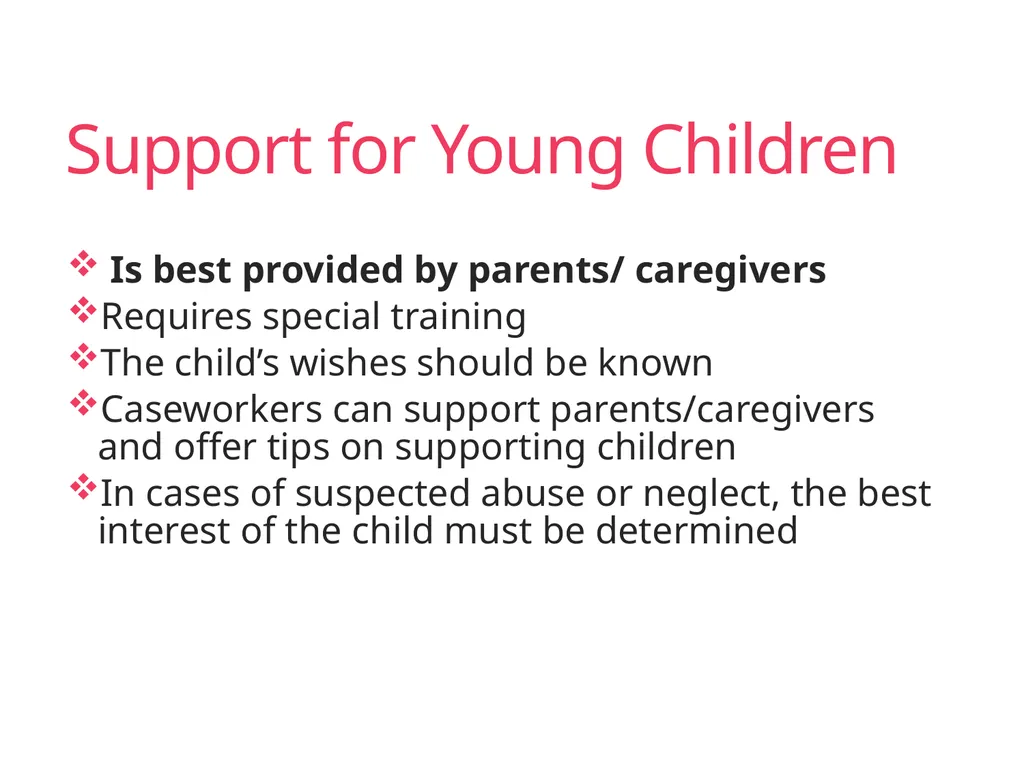
Support for Young Children Is best provided by parents/ caregivers
Requires special training
The child’s wishes should be known
Caseworkers can support parents/caregivers and offer tips on supporting children
In cases of suspected abuse or neglect, the best interest of the child must be determined<br>
Requires special training
The child’s wishes should be known
Caseworkers can support parents/caregivers and offer tips on supporting children
In cases of suspected abuse or neglect, the best interest of the child must be determined<br>
42
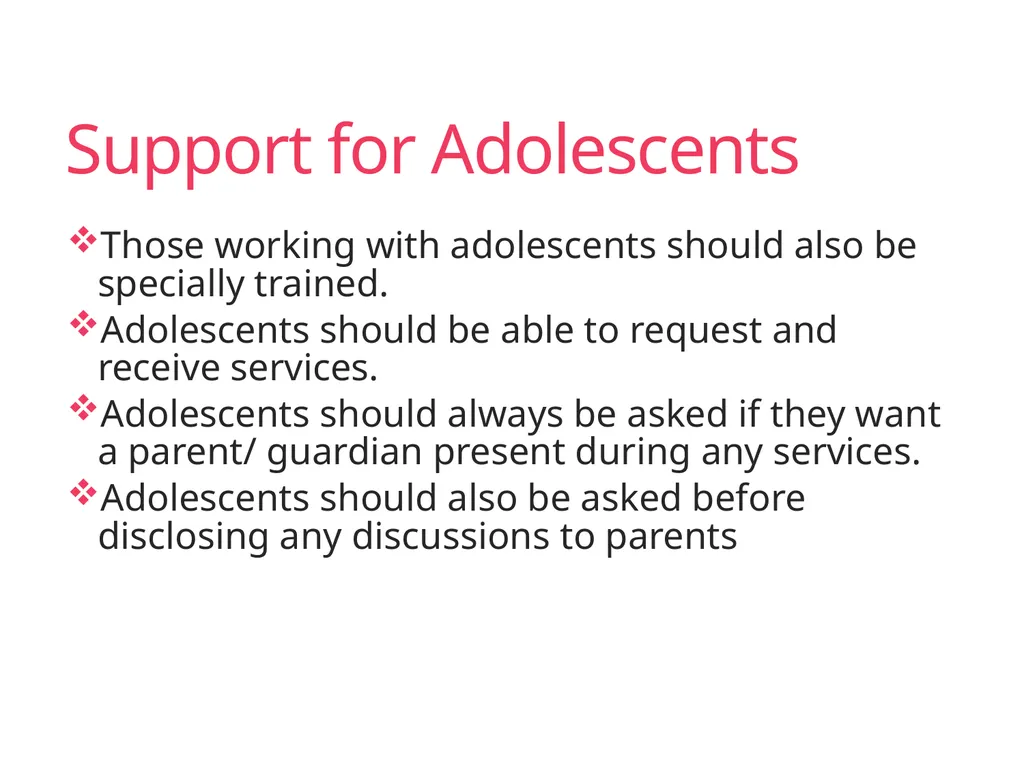
Support for Adolescents Those working with adolescents should also be specially trained.
Adolescents should be able to request and receive services.
Adolescents should always be asked if they want a parent/ guardian present during any services.
Adolescents should also be asked before disclosing any discussions to parents<br>
Adolescents should be able to request and receive services.
Adolescents should always be asked if they want a parent/ guardian present during any services.
Adolescents should also be asked before disclosing any discussions to parents<br>
43
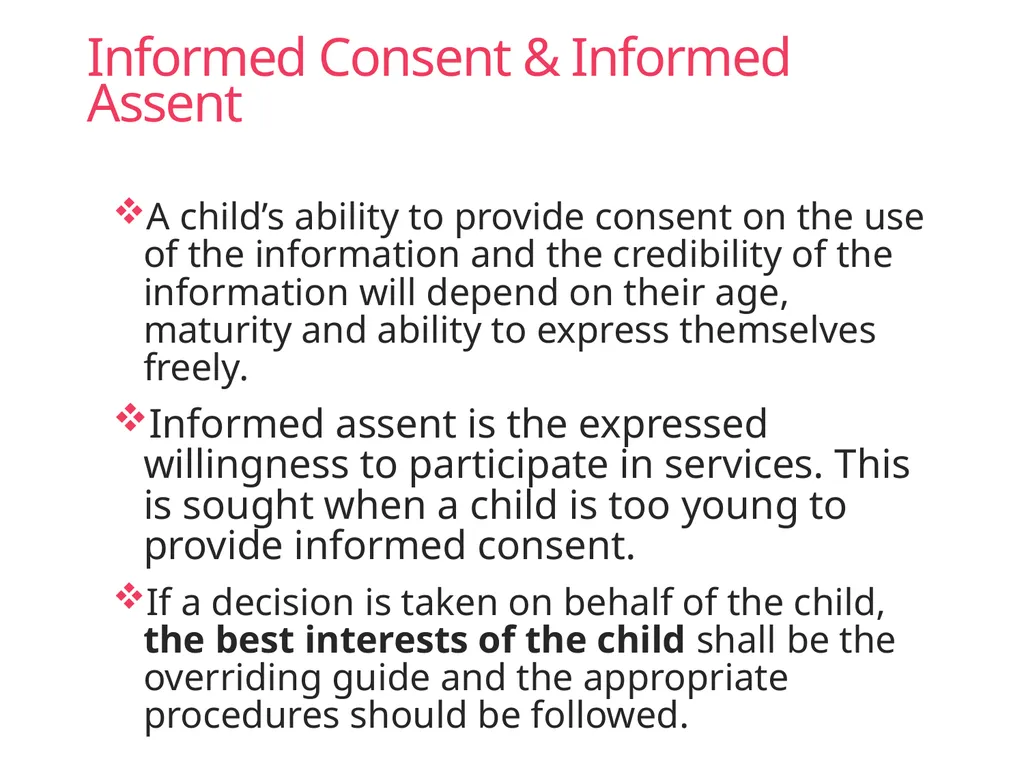
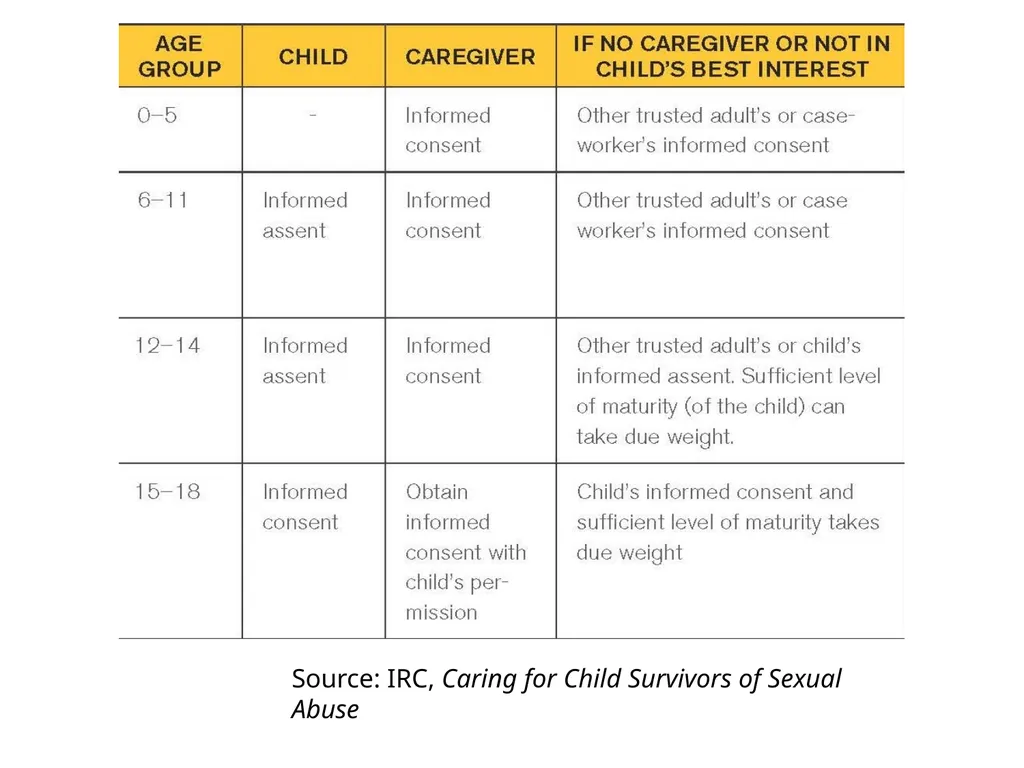
Informed Consent & Informed Assent A child’s ability to provide consent on the use of the information and the credibility of the information will depend on their age, maturity and ability to express themselves freely.
Informed assent is the expressed willingness to participate in services. This is sought when a child is too young to provide informed consent.
If a decision is taken on behalf of the child, the best interests of the child shall be the overriding guide and the appropriate procedures should be followed.<br>
Informed assent is the expressed willingness to participate in services. This is sought when a child is too young to provide informed consent.
If a decision is taken on behalf of the child, the best interests of the child shall be the overriding guide and the appropriate procedures should be followed.<br>
44
Source: IRC, Caring for Child Survivors of Sexual Abuse<br>
45
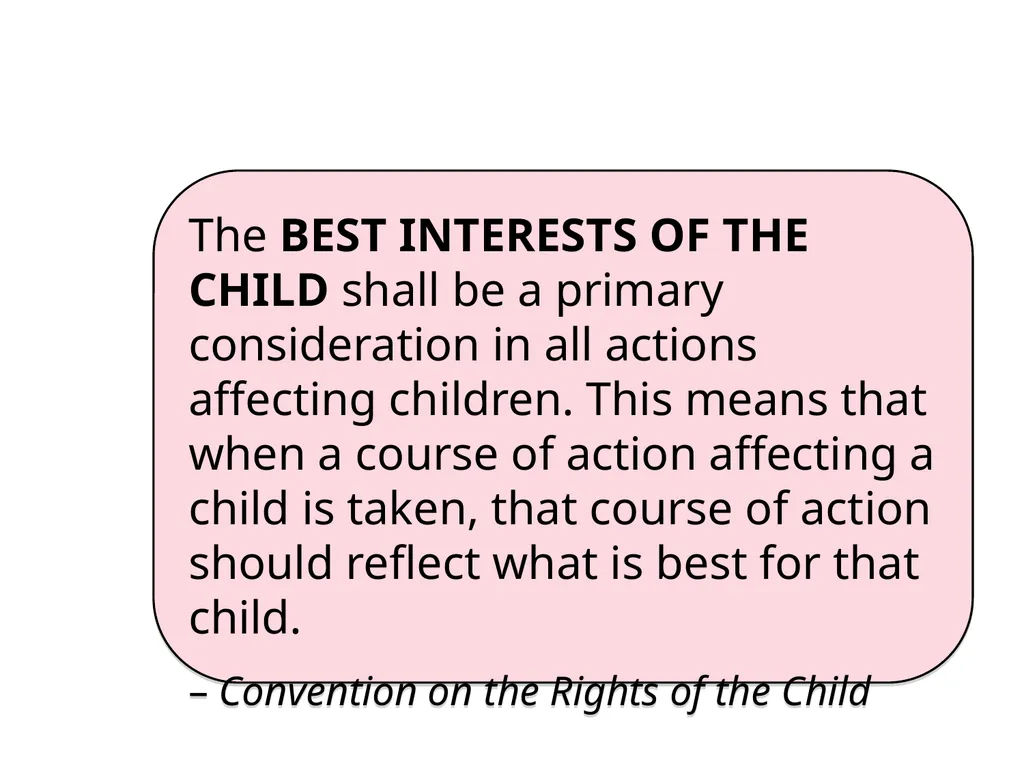
The BEST INTERESTS OF THE CHILD shall be a primary consideration in all actions affecting children. This means that when a course of action affecting a child is taken, that course of action should reflect what is best for that child.
– Convention on the Rights of the Child<br>
– Convention on the Rights of the Child<br>
46
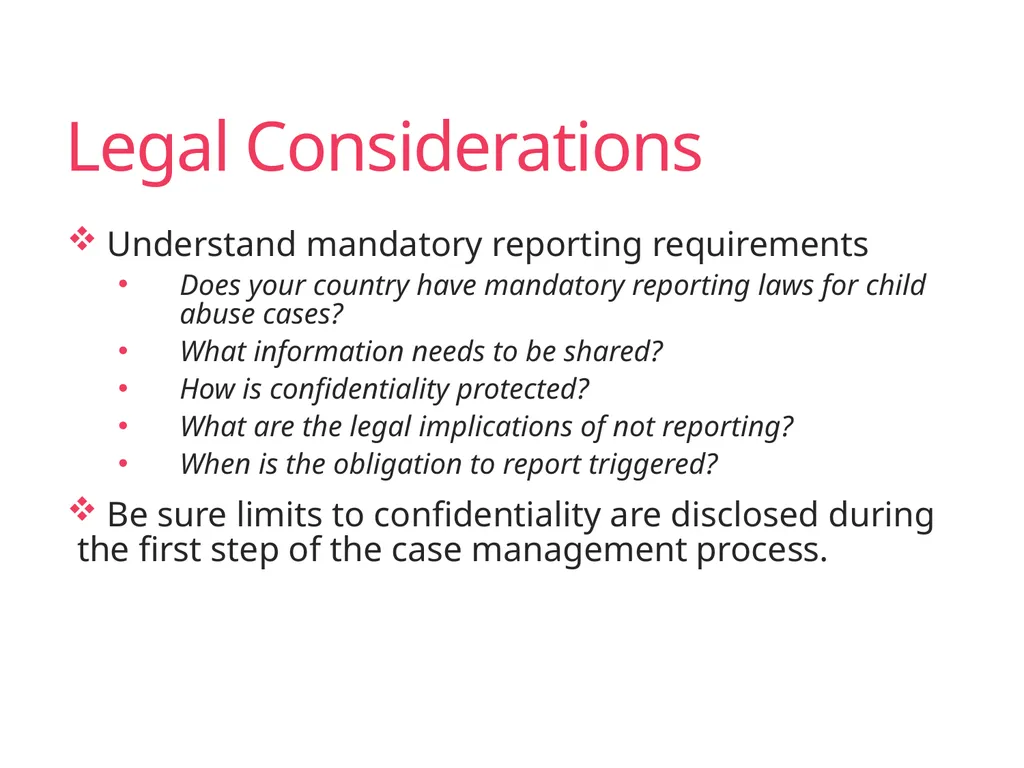
Legal Considerations Understand mandatory reporting requirements
Does your country have mandatory reporting laws for child abuse cases?
What information needs to be shared?
How is confidentiality protected?
What are the legal implications of not reporting?
When is the obligation to report triggered?
Be sure limits to confidentiality are disclosed during the first step of the case management process.<br>
Does your country have mandatory reporting laws for child abuse cases?
What information needs to be shared?
How is confidentiality protected?
What are the legal implications of not reporting?
When is the obligation to report triggered?
Be sure limits to confidentiality are disclosed during the first step of the case management process.<br>
47
More practice!<br>
48
Case Management Early/ Forced Marriage<br>
49
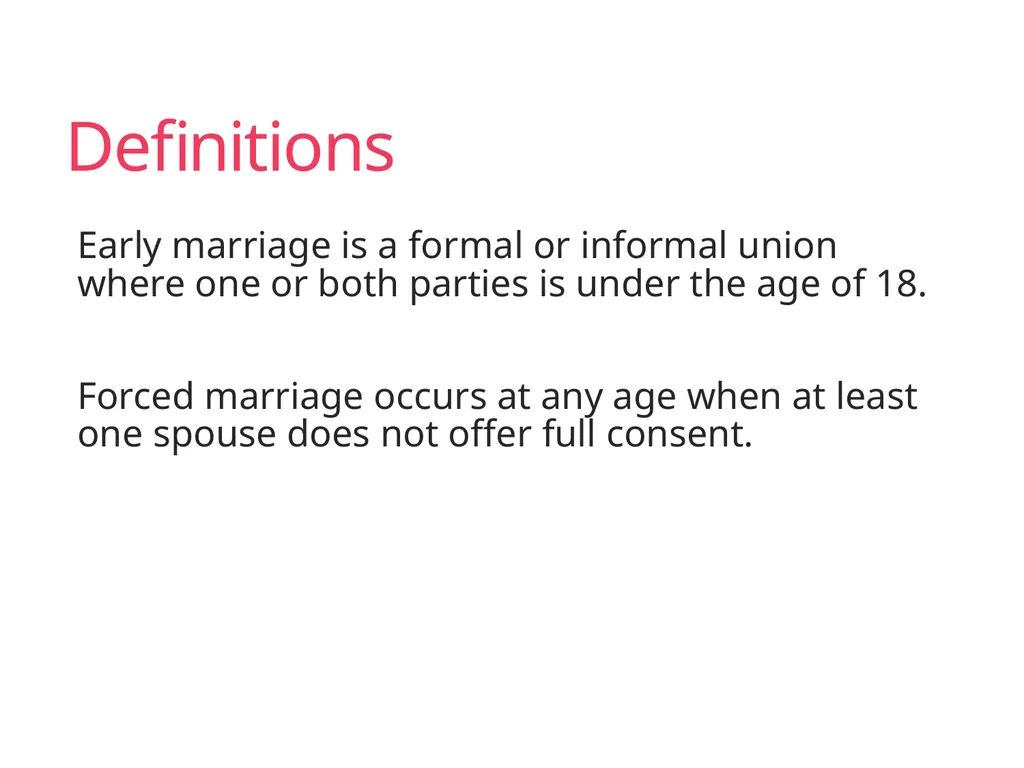
Definitions Early marriage is a formal or informal union where one or both parties is under the age of 18.
Forced marriage occurs at any age when at least one spouse does not offer full consent.<br>
Forced marriage occurs at any age when at least one spouse does not offer full consent.<br>
50
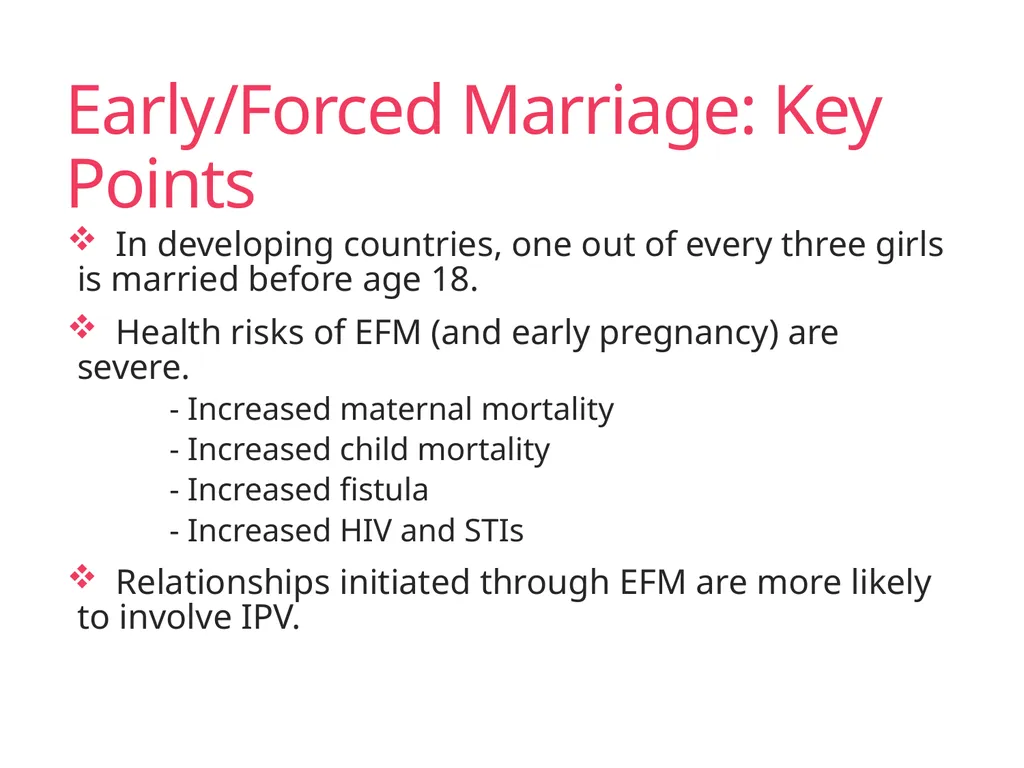
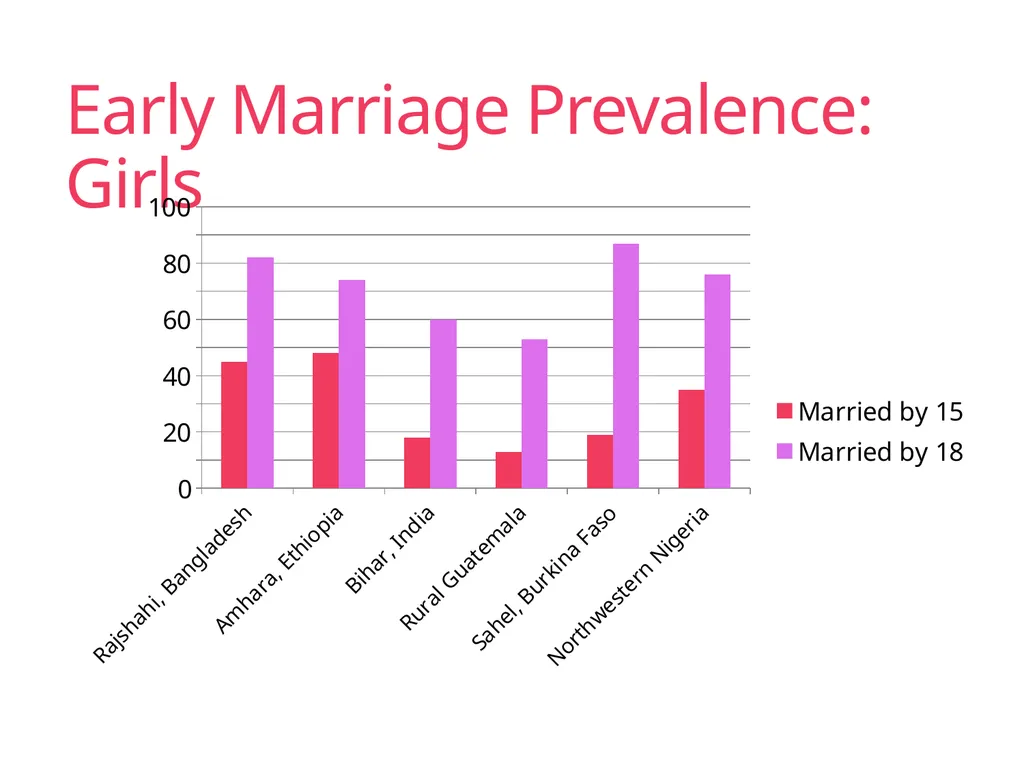
Early/Forced Marriage: Key Points In developing countries, one out of every three girls is married before age 18.
Health risks of EFM (and early pregnancy) are severe.
- Increased maternal mortality
- Increased child mortality
- Increased fistula
- Increased HIV and STIs
Relationships initiated through EFM are more likely to involve IPV.<br>
Health risks of EFM (and early pregnancy) are severe.
- Increased maternal mortality
- Increased child mortality
- Increased fistula
- Increased HIV and STIs
Relationships initiated through EFM are more likely to involve IPV.<br>
51
Early Marriage Prevalence: Girls<br>
52
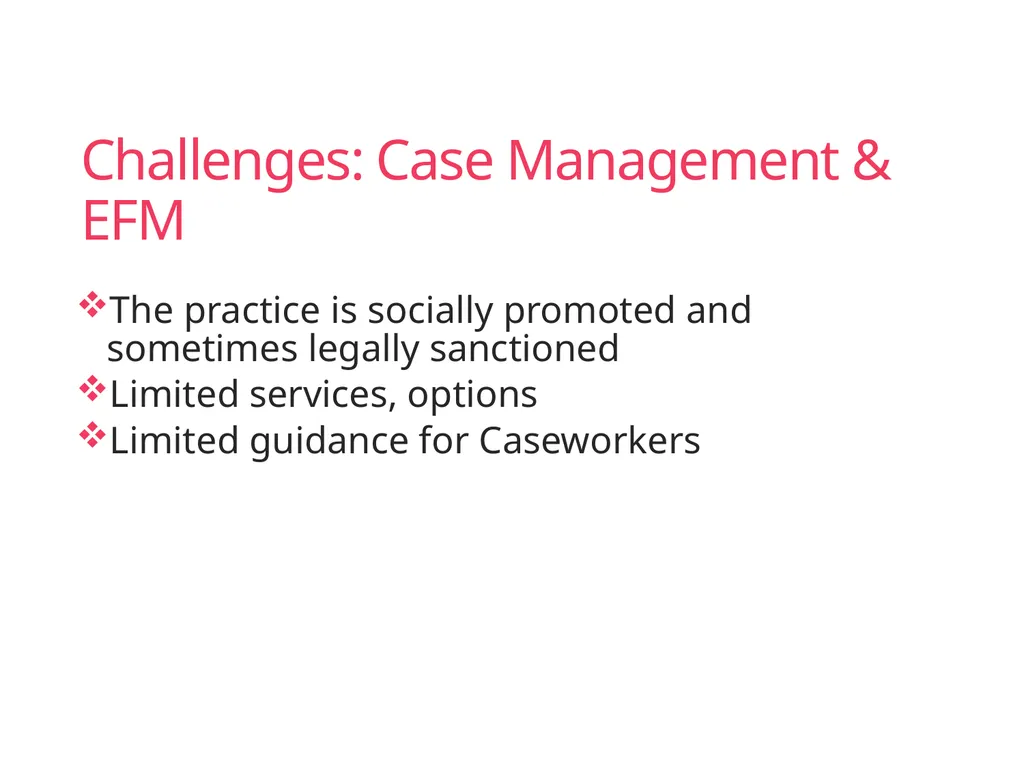
Challenges: Case Management & EFM The practice is socially promoted and sometimes legally sanctioned
Limited services, options
Limited guidance for Caseworkers<br>
Limited services, options
Limited guidance for Caseworkers<br>
53
Case Management: Imminent risk of EFM Apply appropriate informed consent procedures
Assess
Feelings about marriage
Knowledge of possible consequences
Family situation
Engage supportive caregiver, if possible
Approach in non-judgmental manner
Provide information
Link to other services, where relevant<br>
Assess
Feelings about marriage
Knowledge of possible consequences
Family situation
Engage supportive caregiver, if possible
Approach in non-judgmental manner
Provide information
Link to other services, where relevant<br>
54
Case Management: EFM Proceeding Maintain relationship with survivor
Engage survivor to assess potential risks
Develop safety plan
Share SRH information, referrals
Help to identify supportive person
Help to develop coping strategies
Help to maintain routines, connections– school, family, etc.<br>
Engage survivor to assess potential risks
Develop safety plan
Share SRH information, referrals
Help to identify supportive person
Help to develop coping strategies
Help to maintain routines, connections– school, family, etc.<br>
55
Case Management: EFM Has Occurred Assess situation and specific risks
Develop safety plan
Share information on consequences of early marriage, including SRH information and referrals
Help survivor identify supportive person
Help survivor develop coping strategies
Link survivor to services, including group PSS activities<br>
Develop safety plan
Share information on consequences of early marriage, including SRH information and referrals
Help survivor identify supportive person
Help survivor develop coping strategies
Link survivor to services, including group PSS activities<br>
56
EFM: Additional programme options Target likely survivors of EFM through group activities
Address risks of EFM through community prevention work
Engage community leaders as allies
Partner with SRH (ASRHR) programmes for prevention & response
Partner with legal/advocacy actors to address laws/procedures<br>
Address risks of EFM through community prevention work
Engage community leaders as allies
Partner with SRH (ASRHR) programmes for prevention & response
Partner with legal/advocacy actors to address laws/procedures<br>
57
Case Management Service Coordination<br>
58
Establishing Referral Systems Map and collect information on services
Identify lead service providers per sector
Establish focal points
Establish agreements, SOPs
Train and inform
Collect feedback, review, and update systems<br>
Identify lead service providers per sector
Establish focal points
Establish agreements, SOPs
Train and inform
Collect feedback, review, and update systems<br>
59
Service Referrals Caseworkers must understand the services available from other providers
Programmes can ask other providers (focal points) to share brief points on services to relay to survivors
Caseworkers must offer all options to survivors and help them weigh benefits and drawbacks, then respect their choices
Caseworkers can coordinate with chosen service providers to support a client’s action plan, also according to a survivor’s wishes<br>
Programmes can ask other providers (focal points) to share brief points on services to relay to survivors
Caseworkers must offer all options to survivors and help them weigh benefits and drawbacks, then respect their choices
Caseworkers can coordinate with chosen service providers to support a client’s action plan, also according to a survivor’s wishes<br>
60
Spaces for Coordination Protection Cluster/WG
GBV Sub-Cluster/WG
Referral pathway working groups (focal points)
Case management meetings (ad hoc)
Bilateral meetings between service providers<br>
GBV Sub-Cluster/WG
Referral pathway working groups (focal points)
Case management meetings (ad hoc)
Bilateral meetings between service providers<br>
61
The GOAL of GBV Coordination To provide accessible, prompt, confidential and appropriate services to survivors according to a basic set of guiding principles and put in place mechanisms to prevent GBV.
– GBV AoR Coordination Handbook<br>
– GBV AoR Coordination Handbook<br>
62
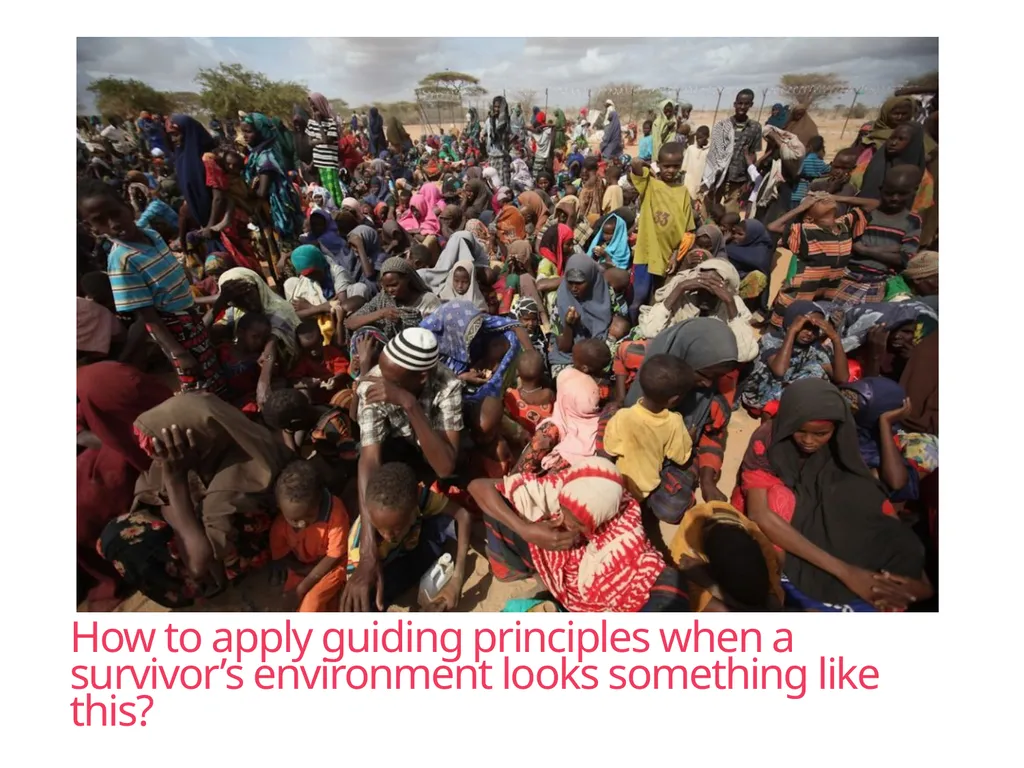
How to apply guiding principles when a survivor’s environment looks something like this?<br>
63
More practice!<br>
64
Case Management Supervision<br>
65
To whom are GBV Programme Managers accountable? To whom are GBV Caseworkers
accountable?<br>
accountable?<br>
66
The core of GBV case management supervision is ensuring the physical and emotional safety of survivors, as well as caseworkers.<br>
67
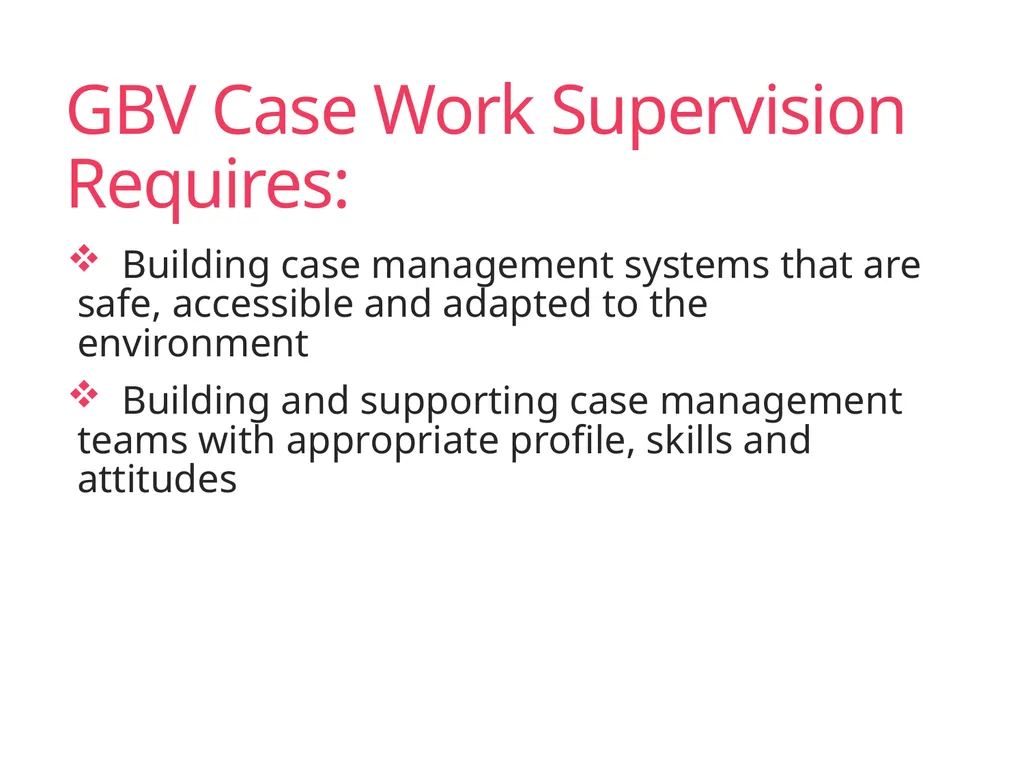
GBV Case Work Supervision Requires: Building case management systems that are safe, accessible and adapted to the environment
Building and supporting case management teams with appropriate profile, skills and attitudes<br>
Building and supporting case management teams with appropriate profile, skills and attitudes<br>
68
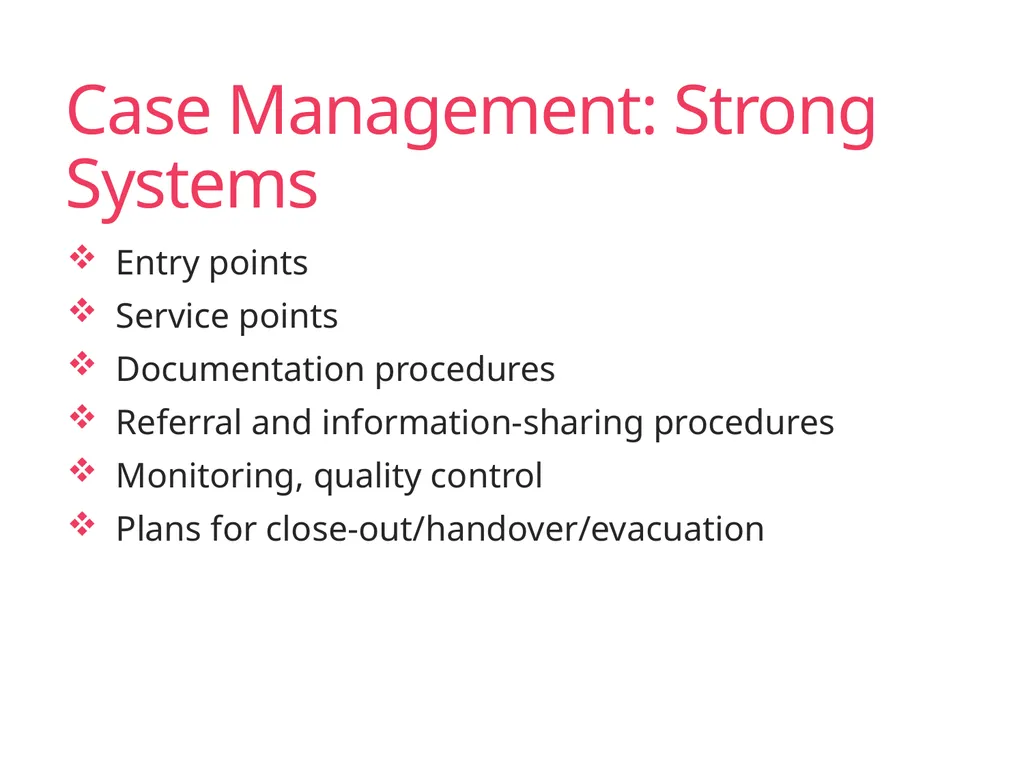
Case Management: Strong Systems Entry points
Service points
Documentation procedures
Referral and information-sharing procedures
Monitoring, quality control
Plans for close-out/handover/evacuation<br>
Service points
Documentation procedures
Referral and information-sharing procedures
Monitoring, quality control
Plans for close-out/handover/evacuation<br>
69
Case Management: Strong Teams Recruitment
Initial Training
Continued learning and coaching
Dedicated supervision
Monitoring, quality control
Team support and self-care<br>
Initial Training
Continued learning and coaching
Dedicated supervision
Monitoring, quality control
Team support and self-care<br>
70
Review<br>
71
Objectives Understand the case management process for support of survivors of GBV
Understand how case management services can be tailored to survivors of different ages and to address different forms of GBV
Understand the responsibilities of a GBV Programme Manager regarding case management supervision
Consider ways to improve service coordination and to effectively advocate for appropriate response to GBV<br>
Understand how case management services can be tailored to survivors of different ages and to address different forms of GBV
Understand the responsibilities of a GBV Programme Manager regarding case management supervision
Consider ways to improve service coordination and to effectively advocate for appropriate response to GBV<br>