
Case Study #2 - Ethnobotany in Kenya Rebecca
SB
Published · 8 slides · 0 views
1 / 1
Description
Case Study 2 - Ethnobotany in Kenya Rebecca Daugherty, Alex Dragon, Kimberly Safran Plants Uses As of October 2023, this slideshow is a starting point. We plan to continue adding to and refining this work. We will present 5-6 plant
Related Topics
Share
Embed code
Download this presentation From Below
"Case Study #2 - Ethnobotany in Kenya Rebecca" is the property of its rightful owner. Permission is granted to download and print the materials on this website for personal, non-commercial use only, and to display it on your personal computer provided you do not modify the materials and that you retain all copyright notices contained in the materials. By downloading content from our website, you accept the terms of this agreement.
Presentation Transcript
01
Case Study #2 - Ethnobotany in Kenya Rebecca Daugherty, Alex Dragon, & Kimberly Safran<br>
02
Plants & Uses As of October 2023, this slideshow is a starting point. We plan to continue adding to and refining this work.
We will present 5-6 plant species of interest to begin a comparative study of traditional uses of plants and their uses in Kenya with students’ home regions.
The binomial names and biological descriptions we present here are based on Western scientific sources. The knowledge of traditional uses in Kenya may come from a few different sources, primarily from Kikuyu and Luhya communities. Some personal communications were used as a starting point for further research. Western scientific research is at time cited to complement and expand on our sources of traditional knowledge and serve as a starting point for student research.
Special thanks to:
Julius Mwania Peter Ngila, who shared information with the authors at the Kiambethu Tea Farm
Solomon Kita Atswenje, Kenya Wildlife Services, who shared information in Kakamega Forest
Key Print Reference: Gachathi, M. (2007). Kikuyu Botanical Dictionary, Revised Second Edition: A Guide to Plant Names, Uses and Cultural Values. Tropical Botany<br>
We will present 5-6 plant species of interest to begin a comparative study of traditional uses of plants and their uses in Kenya with students’ home regions.
The binomial names and biological descriptions we present here are based on Western scientific sources. The knowledge of traditional uses in Kenya may come from a few different sources, primarily from Kikuyu and Luhya communities. Some personal communications were used as a starting point for further research. Western scientific research is at time cited to complement and expand on our sources of traditional knowledge and serve as a starting point for student research.
Special thanks to:
Julius Mwania Peter Ngila, who shared information with the authors at the Kiambethu Tea Farm
Solomon Kita Atswenje, Kenya Wildlife Services, who shared information in Kakamega Forest
Key Print Reference: Gachathi, M. (2007). Kikuyu Botanical Dictionary, Revised Second Edition: A Guide to Plant Names, Uses and Cultural Values. Tropical Botany<br>
03
Plants and Uses - Muiri Name in Kikuyu Language: Mũiri
Scientific name: Prunus africana, synonym Pygeum africanum
English common names: Red Stinkwood, African cherry
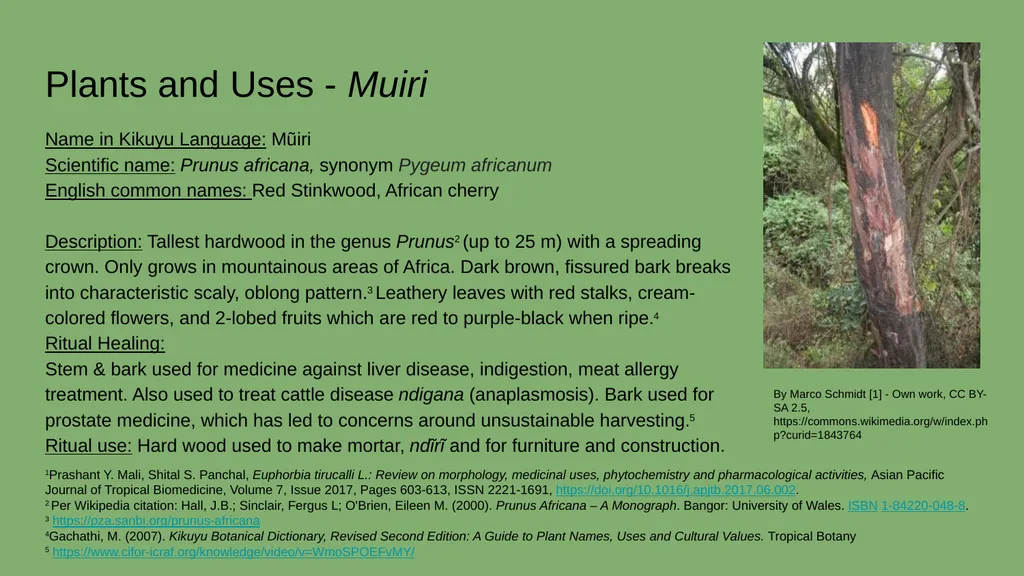
Description: Tallest hardwood in the genus Prunus2 (up to 25 m) with a spreading crown. Only grows in mountainous areas of Africa. Dark brown, fissured bark breaks into characteristic scaly, oblong pattern.3 Leathery leaves with red stalks, cream-colored flowers, and 2-lobed fruits which are red to purple-black when ripe.4
Ritual Healing:
Stem & bark used for medicine against liver disease, indigestion, meat allergy treatment. Also used to treat cattle disease ndigana (anaplasmosis). Bark used for prostate medicine, which has led to concerns around unsustainable harvesting.5
Ritual use: Hard wood used to make mortar, ndĩrĩ and for furniture and construction. 1Prashant Y. Mali, Shital S. Panchal, Euphorbia tirucalli L.: Review on morphology, medicinal uses, phytochemistry and pharmacological activities, Asian Pacific Journal of Tropical Biomedicine, Volume 7, Issue 2017, Pages 603-613, ISSN 2221-1691, https://doi.org/10.1016/j.apjtb.2017.06.002.
2 Per Wikipedia citation: Hall, J.B.; Sinclair, Fergus L; O'Brien, Eileen M. (2000). Prunus Africana – A Monograph. Bangor: University of Wales. ISBN 1-84220-048-8.
3 https://pza.sanbi.org/prunus-africana
4Gachathi, M. (2007). Kikuyu Botanical Dictionary, Revised Second Edition: A Guide to Plant Names, Uses and Cultural Values. Tropical Botany
5 https://www.cifor-icraf.org/knowledge/video/v=WmoSPOEFvMY/ By Marco Schmidt [1] - Own work, CC BY-SA 2.5, https://commons.wikimedia.org/w/index.php?curid=1843764<br>
Scientific name: Prunus africana, synonym Pygeum africanum
English common names: Red Stinkwood, African cherry
Description: Tallest hardwood in the genus Prunus2 (up to 25 m) with a spreading crown. Only grows in mountainous areas of Africa. Dark brown, fissured bark breaks into characteristic scaly, oblong pattern.3 Leathery leaves with red stalks, cream-colored flowers, and 2-lobed fruits which are red to purple-black when ripe.4
Ritual Healing:
Stem & bark used for medicine against liver disease, indigestion, meat allergy treatment. Also used to treat cattle disease ndigana (anaplasmosis). Bark used for prostate medicine, which has led to concerns around unsustainable harvesting.5
Ritual use: Hard wood used to make mortar, ndĩrĩ and for furniture and construction. 1Prashant Y. Mali, Shital S. Panchal, Euphorbia tirucalli L.: Review on morphology, medicinal uses, phytochemistry and pharmacological activities, Asian Pacific Journal of Tropical Biomedicine, Volume 7, Issue 2017, Pages 603-613, ISSN 2221-1691, https://doi.org/10.1016/j.apjtb.2017.06.002.
2 Per Wikipedia citation: Hall, J.B.; Sinclair, Fergus L; O'Brien, Eileen M. (2000). Prunus Africana – A Monograph. Bangor: University of Wales. ISBN 1-84220-048-8.
3 https://pza.sanbi.org/prunus-africana
4Gachathi, M. (2007). Kikuyu Botanical Dictionary, Revised Second Edition: A Guide to Plant Names, Uses and Cultural Values. Tropical Botany
5 https://www.cifor-icraf.org/knowledge/video/v=WmoSPOEFvMY/ By Marco Schmidt [1] - Own work, CC BY-SA 2.5, https://commons.wikimedia.org/w/index.php?curid=1843764<br>
04
Plants and Uses - Pencil Cactus Name in Kikuyu Language: Kariaria
Scientific name: Euphorbia tirucalli
English common name: Pencil Cactus
Description:
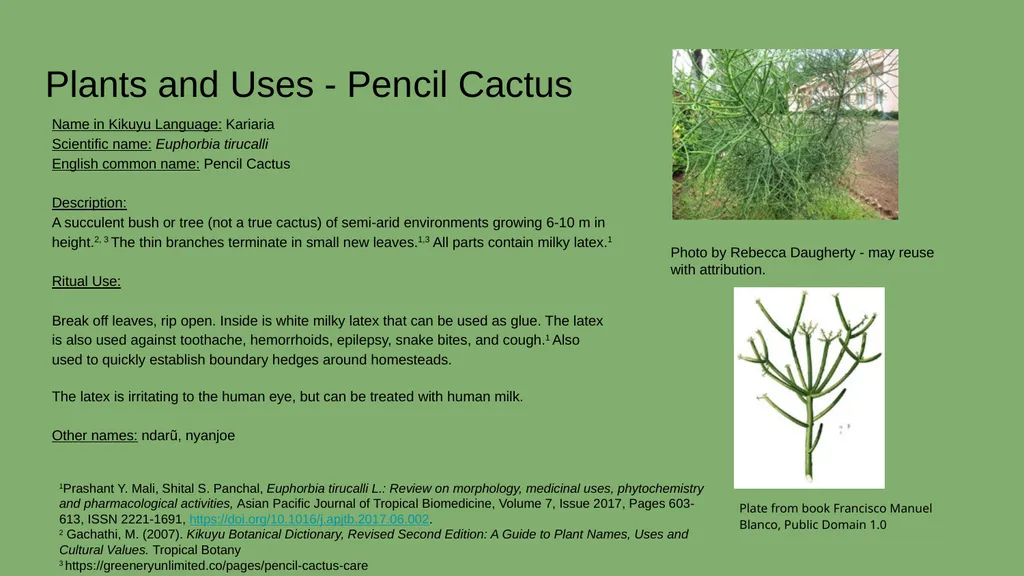
A succulent bush or tree (not a true cactus) of semi-arid environments growing 6-10 m in height.2, 3 The thin branches terminate in small new leaves.1,3 All parts contain milky latex.1
Ritual Use:
Break off leaves, rip open. Inside is white milky latex that can be used as glue. The latex is also used against toothache, hemorrhoids, epilepsy, snake bites, and cough.1 Also used to quickly establish boundary hedges around homesteads.
The latex is irritating to the human eye, but can be treated with human milk.
Other names: ndarũ, nyanjoe 1Prashant Y. Mali, Shital S. Panchal, Euphorbia tirucalli L.: Review on morphology, medicinal uses, phytochemistry and pharmacological activities, Asian Pacific Journal of Tropical Biomedicine, Volume 7, Issue 2017, Pages 603-613, ISSN 2221-1691, https://doi.org/10.1016/j.apjtb.2017.06.002.
2 Gachathi, M. (2007). Kikuyu Botanical Dictionary, Revised Second Edition: A Guide to Plant Names, Uses and Cultural Values. Tropical Botany
3 https://greeneryunlimited.co/pages/pencil-cactus-care Photo by Rebecca Daugherty - may reuse with attribution. Plate from book Francisco Manuel Blanco, Public Domain 1.0<br>
Scientific name: Euphorbia tirucalli
English common name: Pencil Cactus
Description:
A succulent bush or tree (not a true cactus) of semi-arid environments growing 6-10 m in height.2, 3 The thin branches terminate in small new leaves.1,3 All parts contain milky latex.1
Ritual Use:
Break off leaves, rip open. Inside is white milky latex that can be used as glue. The latex is also used against toothache, hemorrhoids, epilepsy, snake bites, and cough.1 Also used to quickly establish boundary hedges around homesteads.
The latex is irritating to the human eye, but can be treated with human milk.
Other names: ndarũ, nyanjoe 1Prashant Y. Mali, Shital S. Panchal, Euphorbia tirucalli L.: Review on morphology, medicinal uses, phytochemistry and pharmacological activities, Asian Pacific Journal of Tropical Biomedicine, Volume 7, Issue 2017, Pages 603-613, ISSN 2221-1691, https://doi.org/10.1016/j.apjtb.2017.06.002.
2 Gachathi, M. (2007). Kikuyu Botanical Dictionary, Revised Second Edition: A Guide to Plant Names, Uses and Cultural Values. Tropical Botany
3 https://greeneryunlimited.co/pages/pencil-cactus-care Photo by Rebecca Daugherty - may reuse with attribution. Plate from book Francisco Manuel Blanco, Public Domain 1.0<br>
05
Plants and Uses - Neem Tree Name in Kikuyu Language: Mũarubaini
Scientific name: Azadirachta indica
English common name: Neem, Margosa, Indian Lilac
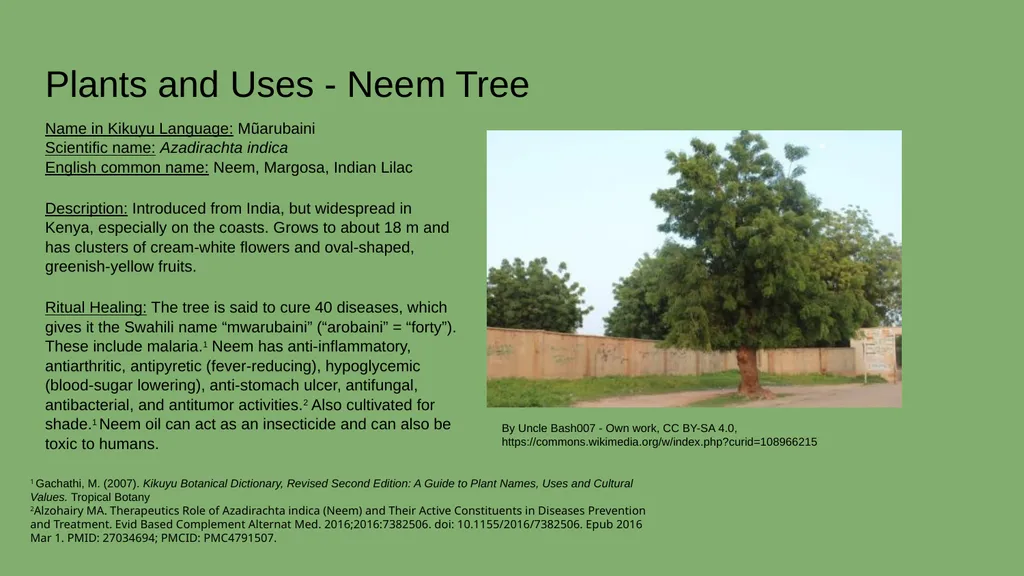
Description: Introduced from India, but widespread in Kenya, especially on the coasts. Grows to about 18 m and has clusters of cream-white flowers and oval-shaped, greenish-yellow fruits.
Ritual Healing: The tree is said to cure 40 diseases, which gives it the Swahili name “mwarubaini” (“arobaini” = “forty”). These include malaria.1 Neem has anti-inflammatory, antiarthritic, antipyretic (fever-reducing), hypoglycemic (blood-sugar lowering), anti-stomach ulcer, antifungal, antibacterial, and antitumor activities.2 Also cultivated for shade.1 Neem oil can act as an insecticide and can also be toxic to humans. 1 Gachathi, M. (2007). Kikuyu Botanical Dictionary, Revised Second Edition: A Guide to Plant Names, Uses and Cultural Values. Tropical Botany
2Alzohairy MA. Therapeutics Role of Azadirachta indica (Neem) and Their Active Constituents in Diseases Prevention and Treatment. Evid Based Complement Alternat Med. 2016;2016:7382506. doi: 10.1155/2016/7382506. Epub 2016 Mar 1. PMID: 27034694; PMCID: PMC4791507. By Uncle Bash007 - Own work, CC BY-SA 4.0, https://commons.wikimedia.org/w/index.php?curid=108966215<br>
Scientific name: Azadirachta indica
English common name: Neem, Margosa, Indian Lilac
Description: Introduced from India, but widespread in Kenya, especially on the coasts. Grows to about 18 m and has clusters of cream-white flowers and oval-shaped, greenish-yellow fruits.
Ritual Healing: The tree is said to cure 40 diseases, which gives it the Swahili name “mwarubaini” (“arobaini” = “forty”). These include malaria.1 Neem has anti-inflammatory, antiarthritic, antipyretic (fever-reducing), hypoglycemic (blood-sugar lowering), anti-stomach ulcer, antifungal, antibacterial, and antitumor activities.2 Also cultivated for shade.1 Neem oil can act as an insecticide and can also be toxic to humans. 1 Gachathi, M. (2007). Kikuyu Botanical Dictionary, Revised Second Edition: A Guide to Plant Names, Uses and Cultural Values. Tropical Botany
2Alzohairy MA. Therapeutics Role of Azadirachta indica (Neem) and Their Active Constituents in Diseases Prevention and Treatment. Evid Based Complement Alternat Med. 2016;2016:7382506. doi: 10.1155/2016/7382506. Epub 2016 Mar 1. PMID: 27034694; PMCID: PMC4791507. By Uncle Bash007 - Own work, CC BY-SA 4.0, https://commons.wikimedia.org/w/index.php?curid=108966215<br>
06
1 Gachathi, M. (2007). Kikuyu Botanical Dictionary, Revised Second Edition: A Guide to Plant Names, Uses and Cultural Values. Tropical Botany
2 Mohammad Amzad Hossain. A review on Ficus sycomorus: A potential indigenous medicinal plant in Oman. Journal of King Saud University - Science, Volume 31, Issue 4, 2019, Pages 961-965, ISSN 1018-3647, https://doi.org/10.1016/j.jksus.2018.07.002.
3 Shinkafi, S. A. and Abdullah, H. (2018). Antifungal activity and phyotchemical analysis of Ficus Sycomorous leaf extract on malassezia glubosa. Advances in Plants & Agricultural Research. eISSN: 2373-6402. https://medcraveonline.com/APAR/antifungal-activity-and-phytochemical-analysis-of-ficus-sycomorus-leaf-extract-on-malassezia-glubosa.html#:~:text=The%20bark%20of%20Ficus%20sycomorus,management%20of%20high%20blood%20pressure. Plants and Uses - Mũkũyũ Name in Kikuyu Language: Mũkũyũ
Scientific name: Ficus sycomorous
English common name: Sycamore fig, fig-mulberry
Description:
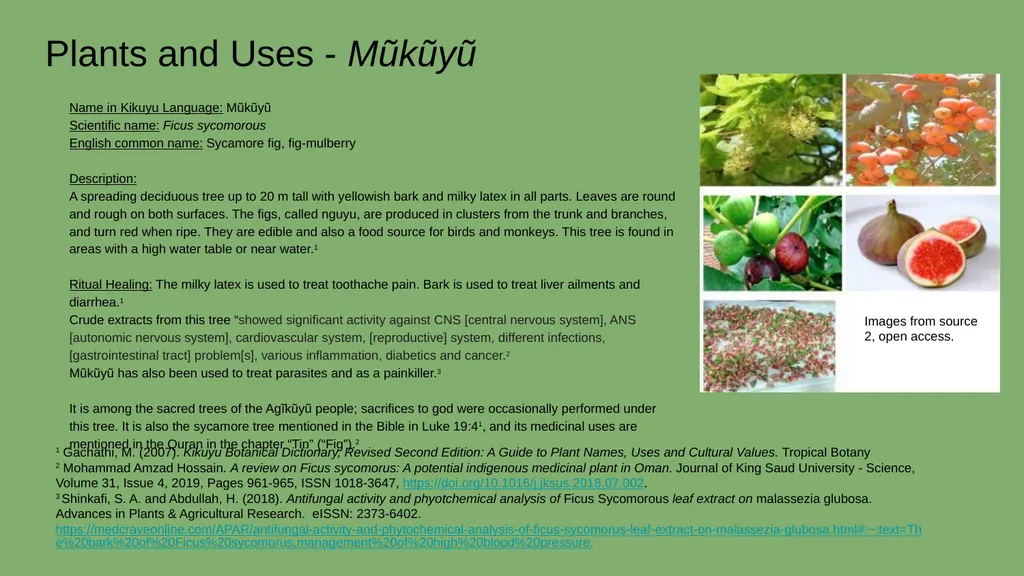
A spreading deciduous tree up to 20 m tall with yellowish bark and milky latex in all parts. Leaves are round and rough on both surfaces. The figs, called nguyu, are produced in clusters from the trunk and branches, and turn red when ripe. They are edible and also a food source for birds and monkeys. This tree is found in areas with a high water table or near water.1
Ritual Healing: The milky latex is used to treat toothache pain. Bark is used to treat liver ailments and diarrhea.1
Crude extracts from this tree “showed significant activity against CNS [central nervous system], ANS [autonomic nervous system], cardiovascular system, [reproductive] system, different infections, [gastrointestinal tract] problem[s], various inflammation, diabetics and cancer.2
Mũkũyũ has also been used to treat parasites and as a painkiller.3
It is among the sacred trees of the Agĩkũyũ people; sacrifices to god were occasionally performed under this tree. It is also the sycamore tree mentioned in the Bible in Luke 19:41, and its medicinal uses are mentioned in the Quran in the chapter “Tin” (“Fig”).2 Images from source 2, open access.<br>
2 Mohammad Amzad Hossain. A review on Ficus sycomorus: A potential indigenous medicinal plant in Oman. Journal of King Saud University - Science, Volume 31, Issue 4, 2019, Pages 961-965, ISSN 1018-3647, https://doi.org/10.1016/j.jksus.2018.07.002.
3 Shinkafi, S. A. and Abdullah, H. (2018). Antifungal activity and phyotchemical analysis of Ficus Sycomorous leaf extract on malassezia glubosa. Advances in Plants & Agricultural Research. eISSN: 2373-6402. https://medcraveonline.com/APAR/antifungal-activity-and-phytochemical-analysis-of-ficus-sycomorus-leaf-extract-on-malassezia-glubosa.html#:~:text=The%20bark%20of%20Ficus%20sycomorus,management%20of%20high%20blood%20pressure. Plants and Uses - Mũkũyũ Name in Kikuyu Language: Mũkũyũ
Scientific name: Ficus sycomorous
English common name: Sycamore fig, fig-mulberry
Description:
A spreading deciduous tree up to 20 m tall with yellowish bark and milky latex in all parts. Leaves are round and rough on both surfaces. The figs, called nguyu, are produced in clusters from the trunk and branches, and turn red when ripe. They are edible and also a food source for birds and monkeys. This tree is found in areas with a high water table or near water.1
Ritual Healing: The milky latex is used to treat toothache pain. Bark is used to treat liver ailments and diarrhea.1
Crude extracts from this tree “showed significant activity against CNS [central nervous system], ANS [autonomic nervous system], cardiovascular system, [reproductive] system, different infections, [gastrointestinal tract] problem[s], various inflammation, diabetics and cancer.2
Mũkũyũ has also been used to treat parasites and as a painkiller.3
It is among the sacred trees of the Agĩkũyũ people; sacrifices to god were occasionally performed under this tree. It is also the sycamore tree mentioned in the Bible in Luke 19:41, and its medicinal uses are mentioned in the Quran in the chapter “Tin” (“Fig”).2 Images from source 2, open access.<br>
07
Plants and Uses - Mũgumo Name in Kikuyu Language: Mũgumo
Scientific name: Ficus thonningii
English common name: wild fig, strangler fig
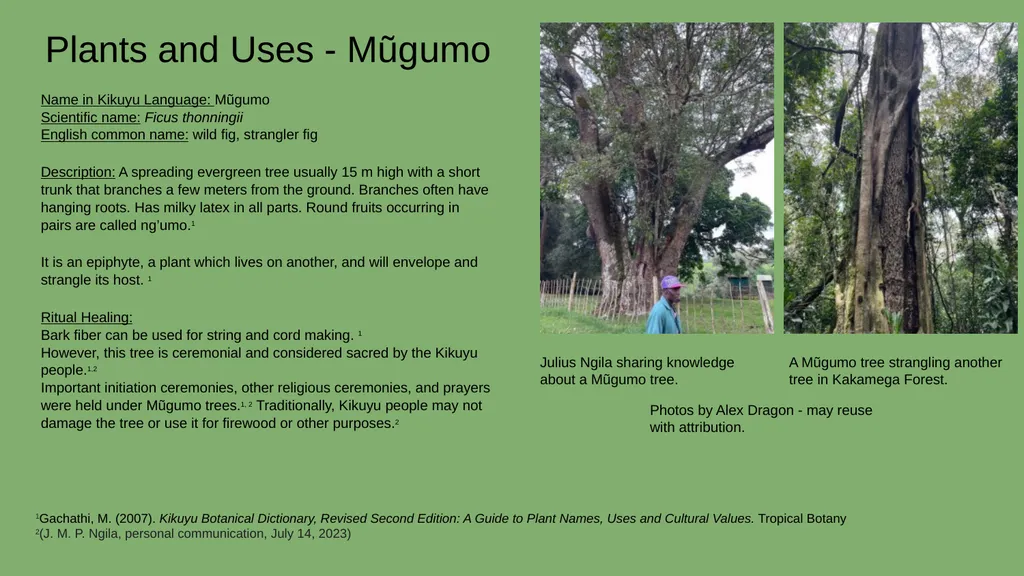
Description: A spreading evergreen tree usually 15 m high with a short trunk that branches a few meters from the ground. Branches often have hanging roots. Has milky latex in all parts. Round fruits occurring in pairs are called ng’umo.1
It is an epiphyte, a plant which lives on another, and will envelope and strangle its host. 1
Ritual Healing:
Bark fiber can be used for string and cord making. 1
However, this tree is ceremonial and considered sacred by the Kikuyu people.1,2
Important initiation ceremonies, other religious ceremonies, and prayers were held under Mũgumo trees.1, 2 Traditionally, Kikuyu people may not damage the tree or use it for firewood or other purposes.2 Julius Ngila sharing knowledge about a Mũgumo tree. A Mũgumo tree strangling another tree in Kakamega Forest. Photos by Alex Dragon - may reuse with attribution. 1Gachathi, M. (2007). Kikuyu Botanical Dictionary, Revised Second Edition: A Guide to Plant Names, Uses and Cultural Values. Tropical Botany
2(J. M. P. Ngila, personal communication, July 14, 2023)<br>
Scientific name: Ficus thonningii
English common name: wild fig, strangler fig
Description: A spreading evergreen tree usually 15 m high with a short trunk that branches a few meters from the ground. Branches often have hanging roots. Has milky latex in all parts. Round fruits occurring in pairs are called ng’umo.1
It is an epiphyte, a plant which lives on another, and will envelope and strangle its host. 1
Ritual Healing:
Bark fiber can be used for string and cord making. 1
However, this tree is ceremonial and considered sacred by the Kikuyu people.1,2
Important initiation ceremonies, other religious ceremonies, and prayers were held under Mũgumo trees.1, 2 Traditionally, Kikuyu people may not damage the tree or use it for firewood or other purposes.2 Julius Ngila sharing knowledge about a Mũgumo tree. A Mũgumo tree strangling another tree in Kakamega Forest. Photos by Alex Dragon - may reuse with attribution. 1Gachathi, M. (2007). Kikuyu Botanical Dictionary, Revised Second Edition: A Guide to Plant Names, Uses and Cultural Values. Tropical Botany
2(J. M. P. Ngila, personal communication, July 14, 2023)<br>
08
Discussion questions Where do you get most of the medicine that you use?
Where do you think its ingredients come from/how is it made?
How is this similar or different to the medicinal uses mentioned about these plants?
Does your family or community use any plants in similar ways to the ones presented here?
If yes, discuss and share some of those plants and uses.
If no, why do you think we do not have similar knowledge about our local plant species?
Where would you go to find out more about traditional and medicinal uses of plants in your region? What sources and people would you consult?
Biology & chemistry connections: Why do you think plants produce substances that can have healing effects on humans?
Do you see importance in preserving and passing on knowledge about the traditional uses of plants? Explain why you think this way.<br>
Where do you think its ingredients come from/how is it made?
How is this similar or different to the medicinal uses mentioned about these plants?
Does your family or community use any plants in similar ways to the ones presented here?
If yes, discuss and share some of those plants and uses.
If no, why do you think we do not have similar knowledge about our local plant species?
Where would you go to find out more about traditional and medicinal uses of plants in your region? What sources and people would you consult?
Biology & chemistry connections: Why do you think plants produce substances that can have healing effects on humans?
Do you see importance in preserving and passing on knowledge about the traditional uses of plants? Explain why you think this way.<br>