CASE STUDY: IRAN SANCTIONS (Islamic Republic of Iran) Zachary Zwald, Ph.D. University of Houston May 2023 OVERVIEW Overview of JCPOA Terms of Agreement JCPOA Strengths JCPOA Weaknesses JCPOA in the Trump Era Going Forward 2 16 June 2023
"CASE STUDY: IRAN SANCTIONS (Islamic Republic of" is the property of its rightful owner. Permission is granted to
download and print the materials on this website for personal, non-commercial use only, and to display it
on your personal computer provided you do not modify the materials and that you retain all copyright
notices contained in the materials. By downloading content from our website, you accept the terms of this
agreement.
Presentation Transcript
01
CASE STUDY: IRAN SANCTIONS
(Islamic Republic of Iran) Zachary Zwald, Ph.D.
University of Houston
May 2023<br>
02
OVERVIEW Overview of JCPOA
Terms of Agreement
JCPOA Strengths
JCPOA Weaknesses
JCPOA in the Trump Era
Going Forward 2 16 June 2023 Security and Strategic Trade Management Academy<br>
03
LEARNING OBJECTIVES Learning Objectives:
Understand the provisions of the JCPOA:
Iranian obligations specified (and not specified) in the agreement.
P5+1 obligations specified in the agreement.
Understand each side’s interests in pursuing the JCPOA:
Iran’s economic and political interests.
P5+1 political and national security interests.
Explain why the Trump Administration withdrew from the JCPOA 3 16 June 2023 Security and Strategic Trade Management Academy<br>
04
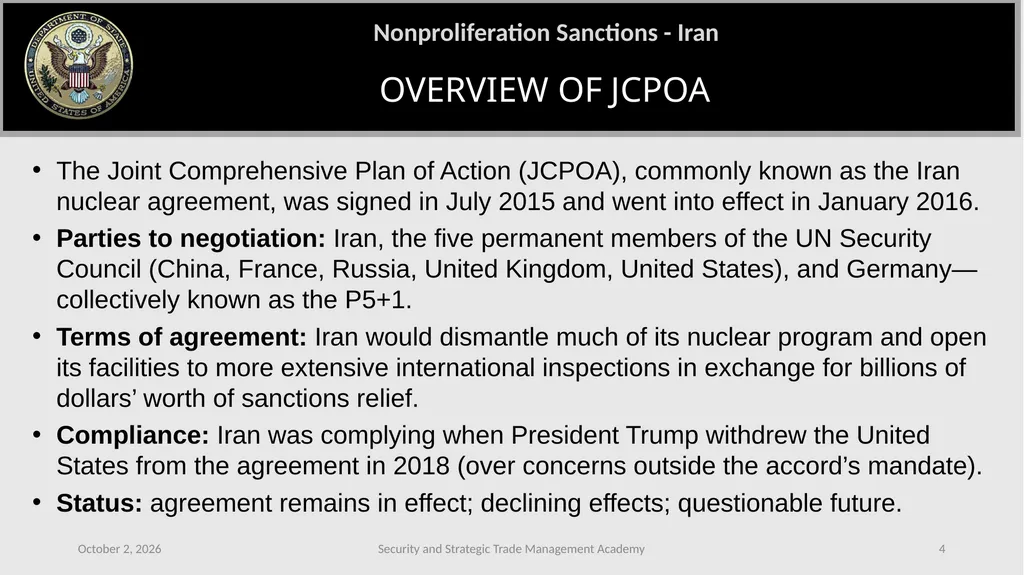
OVERVIEW OF JCPOA 4 16 June 2023 Security and Strategic Trade Management Academy The Joint Comprehensive Plan of Action (JCPOA), commonly known as the Iran nuclear agreement, was signed in July 2015 and went into effect in January 2016.
Parties to negotiation: Iran, the five permanent members of the UN Security Council (China, France, Russia, United Kingdom, United States), and Germany—collectively known as the P5+1.
Terms of agreement: Iran would dismantle much of its nuclear program and open its facilities to more extensive international inspections in exchange for billions of dollars’ worth of sanctions relief.
Compliance: Iran was complying when President Trump withdrew the United States from the agreement in 2018 (over concerns outside the accord’s mandate).
Status: agreement remains in effect; declining effects; questionable future.<br>
05
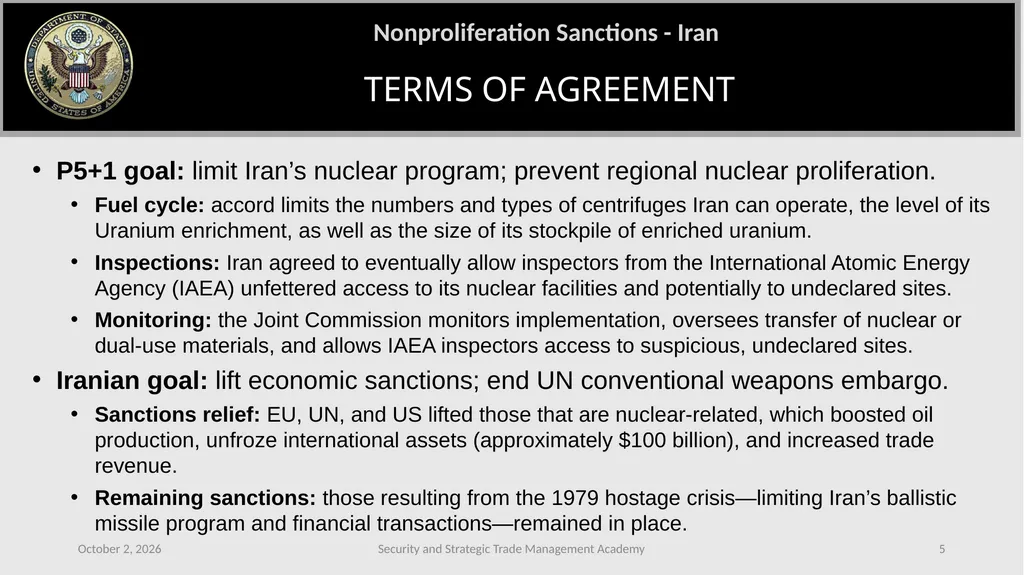
TERMS OF AGREEMENT 5 16 June 2023 Security and Strategic Trade Management Academy P5+1 goal: limit Iran’s nuclear program; prevent regional nuclear proliferation.
Fuel cycle: accord limits the numbers and types of centrifuges Iran can operate, the level of its Uranium enrichment, as well as the size of its stockpile of enriched uranium.
Inspections: Iran agreed to eventually allow inspectors from the International Atomic Energy Agency (IAEA) unfettered access to its nuclear facilities and potentially to undeclared sites.
Monitoring: the Joint Commission monitors implementation, oversees transfer of nuclear or dual-use materials, and allows IAEA inspectors access to suspicious, undeclared sites.
Iranian goal: lift economic sanctions; end UN conventional weapons embargo.
Sanctions relief: EU, UN, and US lifted those that are nuclear-related, which boosted oil production, unfroze international assets (approximately $100 billion), and increased trade revenue.
Remaining sanctions: those resulting from the 1979 hostage crisis—limiting Iran’s ballistic missile program and financial transactions—remained in place.<br>
06
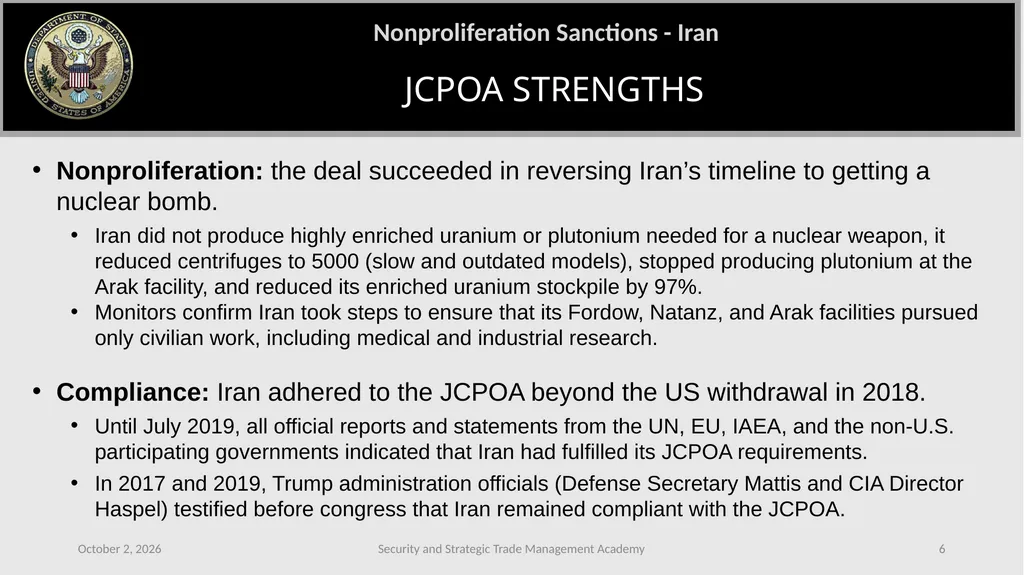
6 16 June 2023 Security and Strategic Trade Management Academy JCPOA STRENGTHS Nonproliferation: the deal succeeded in reversing Iran’s timeline to getting a nuclear bomb.
Iran did not produce highly enriched uranium or plutonium needed for a nuclear weapon, it reduced centrifuges to 5000 (slow and outdated models), stopped producing plutonium at the Arak facility, and reduced its enriched uranium stockpile by 97%.
Monitors confirm Iran took steps to ensure that its Fordow, Natanz, and Arak facilities pursued only civilian work, including medical and industrial research.
Compliance: Iran adhered to the JCPOA beyond the US withdrawal in 2018.
Until July 2019, all official reports and statements from the UN, EU, IAEA, and the non-U.S. participating governments indicated that Iran had fulfilled its JCPOA requirements.
In 2017 and 2019, Trump administration officials (Defense Secretary Mattis and CIA Director Haspel) testified before congress that Iran remained compliant with the JCPOA.<br>
07
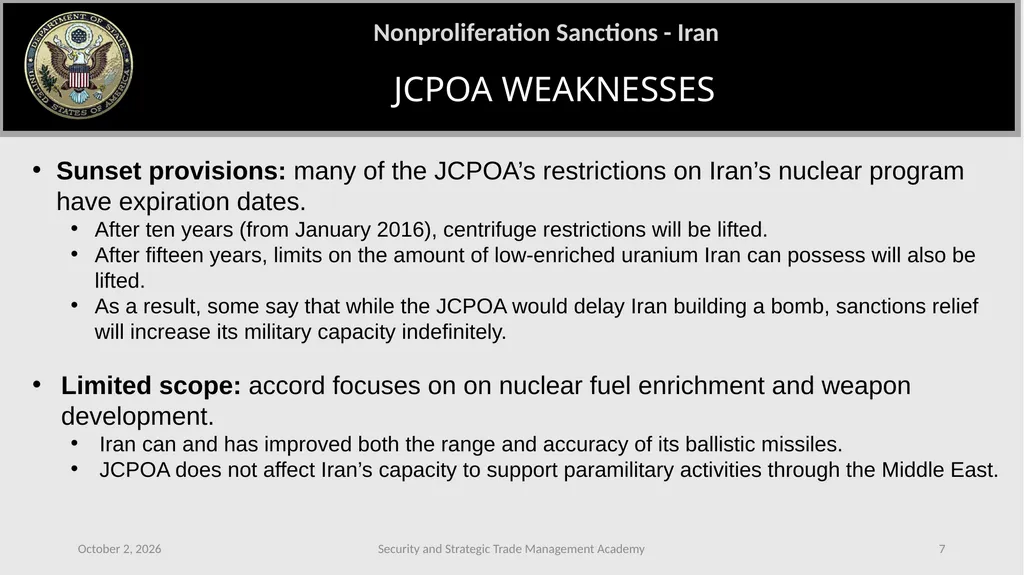
7 16 June 2023 Security and Strategic Trade Management Academy JCPOA WEAKNESSES Sunset provisions: many of the JCPOA’s restrictions on Iran’s nuclear program have expiration dates.
After ten years (from January 2016), centrifuge restrictions will be lifted.
After fifteen years, limits on the amount of low-enriched uranium Iran can possess will also be lifted.
As a result, some say that while the JCPOA would delay Iran building a bomb, sanctions relief will increase its military capacity indefinitely.
Limited scope: accord focuses on on nuclear fuel enrichment and weapon development.
Iran can and has improved both the range and accuracy of its ballistic missiles.
JCPOA does not affect Iran’s capacity to support paramilitary activities through the Middle East.<br>
08
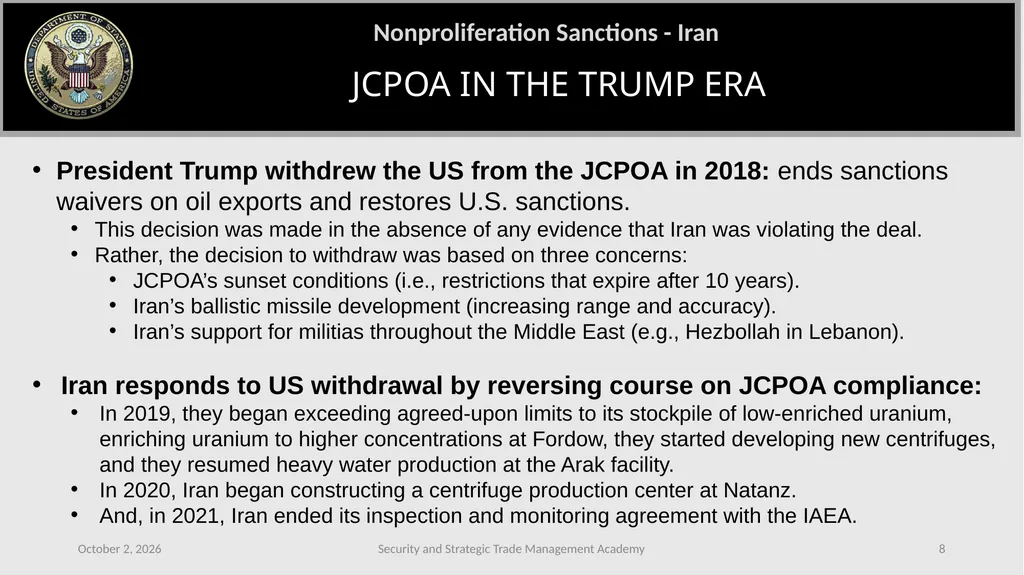
JCPOA IN THE TRUMP ERA 8 16 June 2023 Security and Strategic Trade Management Academy President Trump withdrew the US from the JCPOA in 2018: ends sanctions waivers on oil exports and restores U.S. sanctions.
This decision was made in the absence of any evidence that Iran was violating the deal.
Rather, the decision to withdraw was based on three concerns:
JCPOA’s sunset conditions (i.e., restrictions that expire after 10 years).
Iran’s ballistic missile development (increasing range and accuracy).
Iran’s support for militias throughout the Middle East (e.g., Hezbollah in Lebanon).
Iran responds to US withdrawal by reversing course on JCPOA compliance:
In 2019, they began exceeding agreed-upon limits to its stockpile of low-enriched uranium, enriching uranium to higher concentrations at Fordow, they started developing new centrifuges, and they resumed heavy water production at the Arak facility.
In 2020, Iran began constructing a centrifuge production center at Natanz.
And, in 2021, Iran ended its inspection and monitoring agreement with the IAEA.<br>
09
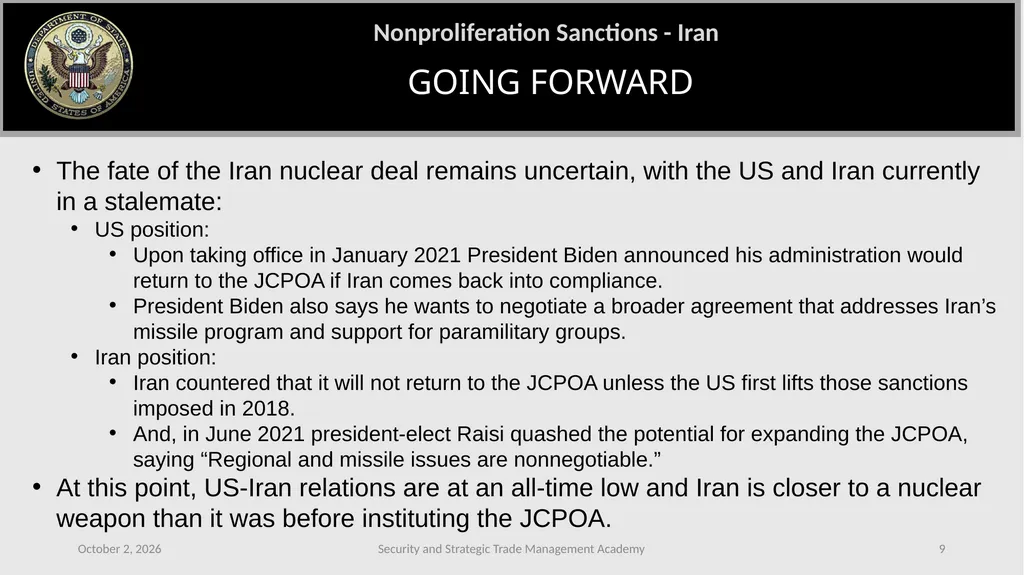
GOING FORWARD 9 16 June 2023 Security and Strategic Trade Management Academy The fate of the Iran nuclear deal remains uncertain, with the US and Iran currently in a stalemate:
US position:
Upon taking office in January 2021 President Biden announced his administration would return to the JCPOA if Iran comes back into compliance.
President Biden also says he wants to negotiate a broader agreement that addresses Iran’s missile program and support for paramilitary groups.
Iran position:
Iran countered that it will not return to the JCPOA unless the US first lifts those sanctions imposed in 2018.
And, in June 2021 president-elect Raisi quashed the potential for expanding the JCPOA, saying “Regional and missile issues are nonnegotiable.”
At this point, US-Iran relations are at an all-time low and Iran is closer to a nuclear weapon than it was before instituting the JCPOA.<br>
10
QUESTIONS? 10 16 June 2023 Security and Strategic Trade Management Academy<br>