
Case Study: The Management of Population Change in
MT
Published · 24 slides · 0 views

1 / 1

Description
Case Study: The Management of Population Change in China Chinas Anti-Natalist Policies to Alter the Natural Increase Rate Difficulties Faced Implementing the One-Child Policy Changes to the One-Child Policy Over Time Overall Evaluation of
Related Topics
Share
Embed code
Download this presentation From Below
"Case Study: The Management of Population Change in" is the property of its rightful owner. Permission is granted to download and print the materials on this website for personal, non-commercial use only, and to display it on your personal computer provided you do not modify the materials and that you retain all copyright notices contained in the materials. By downloading content from our website, you accept the terms of this agreement.
Presentation Transcript
01
Case Study: The Management of Population Change in China China’s Anti-Natalist Policies to Alter the Natural Increase Rate
Difficulties Faced Implementing the One-Child Policy
Changes to the One-Child Policy Over Time
Overall Evaluation of China’s One-Child Policy
Attempts to Manage the Next Demographic Time-Bomb (Rapidly Ageing & Declining Population)<br>
Difficulties Faced Implementing the One-Child Policy
Changes to the One-Child Policy Over Time
Overall Evaluation of China’s One-Child Policy
Attempts to Manage the Next Demographic Time-Bomb (Rapidly Ageing & Declining Population)<br>
02
The Need for a One-Child Per Family Policy:
Introduced in 1979, the policy was seen as essential in order to control poverty, and prevent mass starvation. These were problems that China had experienced during the rule of Mao Zedong (1949-1976). Under his leadership, China’s population had grown from 550 million to more than 900 million.
Mao Zedong saw China’s large population in terms of economic strength (raising workers for the collective economy) and military strength (providing recruits for the People’s Liberation Army). In reality, China was a poor country with a peasant economy unsuited to rapid population growth.
The Great Chinese Famine of 1959-1961 officially killed 15 million people, and possibly up to 40 million. Drought, poor weather and the failure of agricultural collectivisation as part of ‘The Great Leap Forward’ policy of the Communist Party of China contributed to the famine. The term ‘Three Bitter Years’ is often used by Chinese peasants to refer to this period.
To what extent does the above support the neo-Malthusian view of the population-resource balance?<br>
03
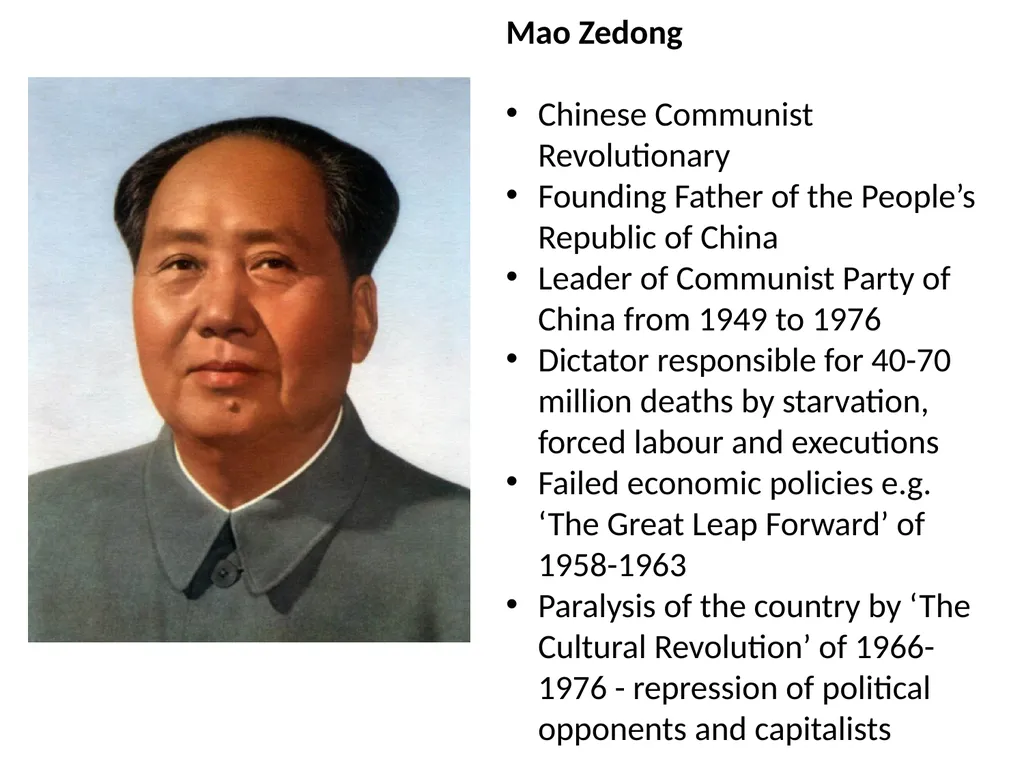
Mao Zedong
Chinese Communist Revolutionary
Founding Father of the People’s Republic of China
Leader of Communist Party of China from 1949 to 1976
Dictator responsible for 40-70 million deaths by starvation, forced labour and executions
Failed economic policies e.g. ‘The Great Leap Forward’ of 1958-1963
Paralysis of the country by ‘The Cultural Revolution’ of 1966-1976 - repression of political opponents and capitalists<br>
04
The Need for a One-Child Per Family Policy:
China’s population size is the country’s most important resource, and a major factor in its recent industrialisation, but overpopulation is a threat to sustainable economic growth. Chinese demographer, Liu Zeng, calculated in the 1980s that China’s optimum population would be around 700 million** in the 21st century. This is the population size which is most favourable for the level of resources and technology in the area.
Overpopulation creates problems, such as the growth of urban slums, unemployment, lower living standards, pressure on schools and hospitals, more air pollution, water shortages & contaminated water supplies, deforestation, soil erosion, food shortages and much more. Without the one-child policy, the benefits of China’s economic growth would have been spread too thinly.
** this figure is likely to be far higher today – can you think why China’s optimum population may have increased?<br>
05
The One-Child Policy and its Predecessor:
The early 1970s saw the first effective birth control campaigns, with the aim of limiting couples to no more than two children. The Chinese government used the slogan ‘wan-xi-shao’ (‘later, longer, fewer’) to try to reduce the population growth rate. People were encouraged to have their children later, to leave longer gaps between each child, and to have fewer children.
The policy helped to reduce fertility rates by almost half - from 5.7 per woman in 1970 to 2.9 in 1979. More than two-thirds of Chinese couples were using contraception. This reduction in the fertility rate was an important step towards sustainable population growth, but the population was still growing fast due to the momentum caused by having a youthful population. It reached the symbolically important 1 billion mark in 1979.
The one-child policy that was introduced in 1979 was a desperate attempt to accelerate the reduction in population growth, and keep the total population below 1.5 billion, rather than it surging towards 2 billion. The intention was for the policy to last for 100 years.<br>
06
Deng Xiaoping
A reformer who fell out of favour with Mao Zedong after 1966
Considered the ‘Paramount Leader’ of China from 1978 to 1992
Allowed China to be open to foreign investment, the global market and a degree of private competition
Oversaw China’s emergence as a fast-growing economy with export-led growth
Controversy of the one-child policy<br>
07
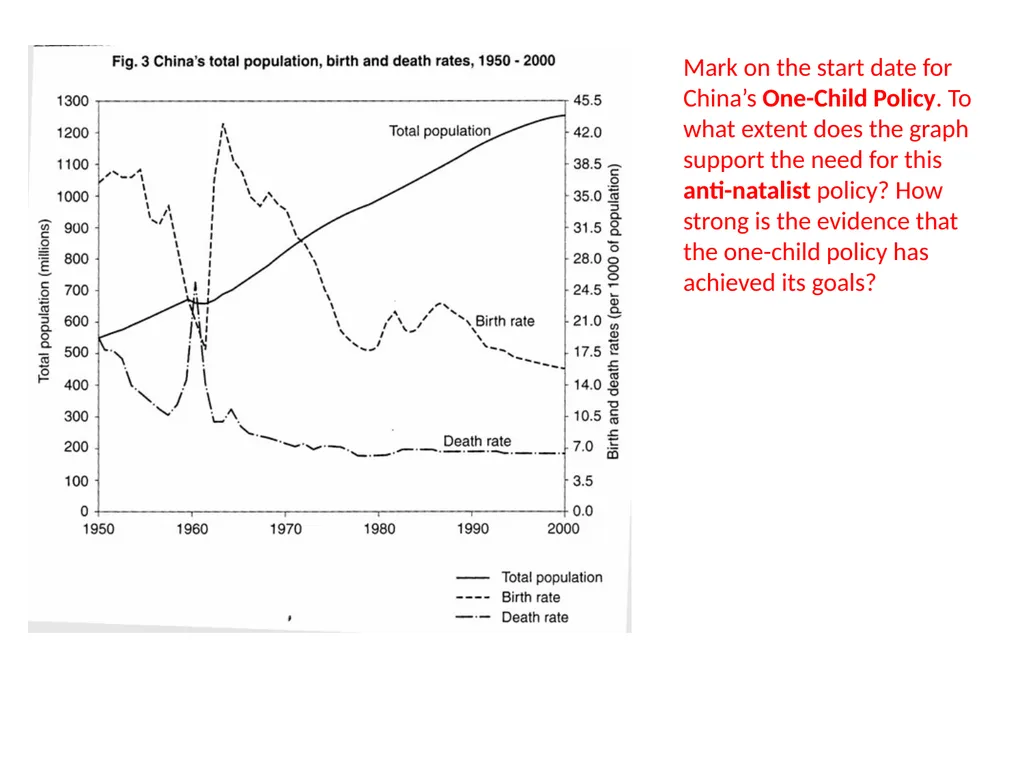
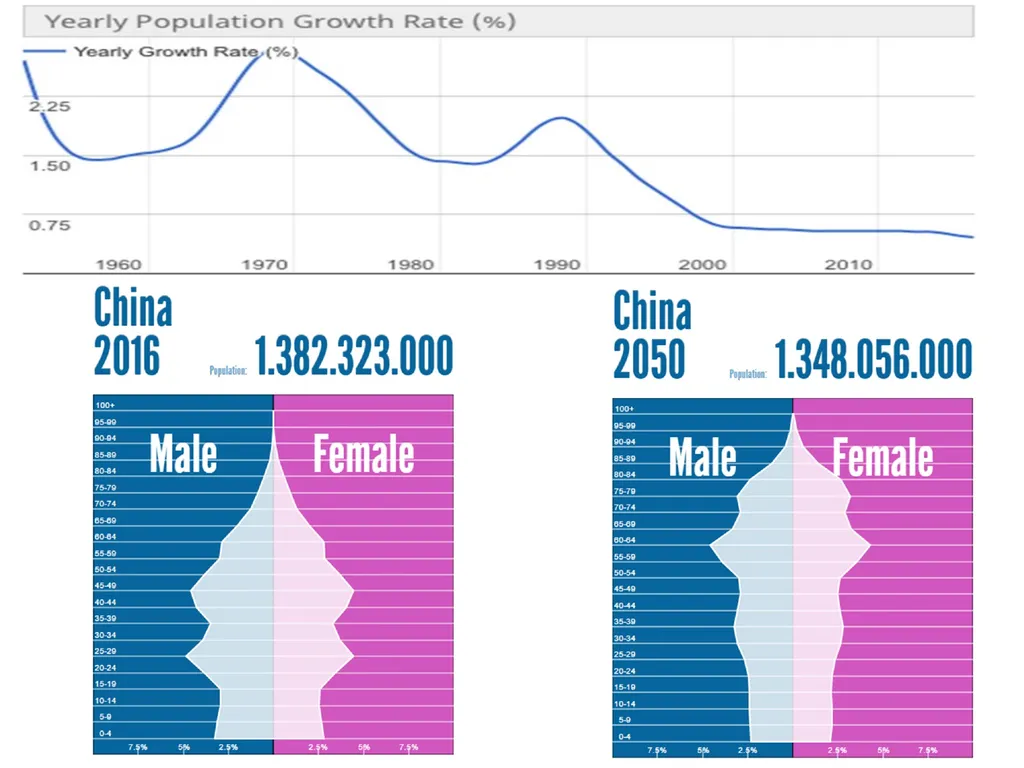
Mark on the start date for China’s One-Child Policy. To what extent does the graph support the need for this anti-natalist policy? How strong is the evidence that the one-child policy has achieved its goals?<br>
08
The Features of the One-Child Policy:
China’s new leader, the reformer Deng Xiaoping, was behind the introduction of the one-child policy in 1979. The policy involved a series of rules, monitoring methods, rewards and penalties (which varied by region and over time). The one-child policy only applied to China’s main ethnic group – the Han Chinese. Ethnic minorities (including foreigners) were exempt.
Rules & Procedures
Minimum age introduced for marriage (22 for men, 20 for women)
No child to be born outside marriage
Permission slip needed to allow a couple to try for a child (with strict quotas in place to ensure the fertility rate was kept low)
Monitoring Methods
Spies or ‘tell-tales’ based in the state-owned factories, who reported to the authorities on their fellow workers if they became pregnant
Spies or ‘granny-police’ who were essentially the ‘eyes’ of the authorities on the street, who watched couples carefully for signs that they might be tempted to break the one-child policy<br>
09
The Features of the One-Child Policy:
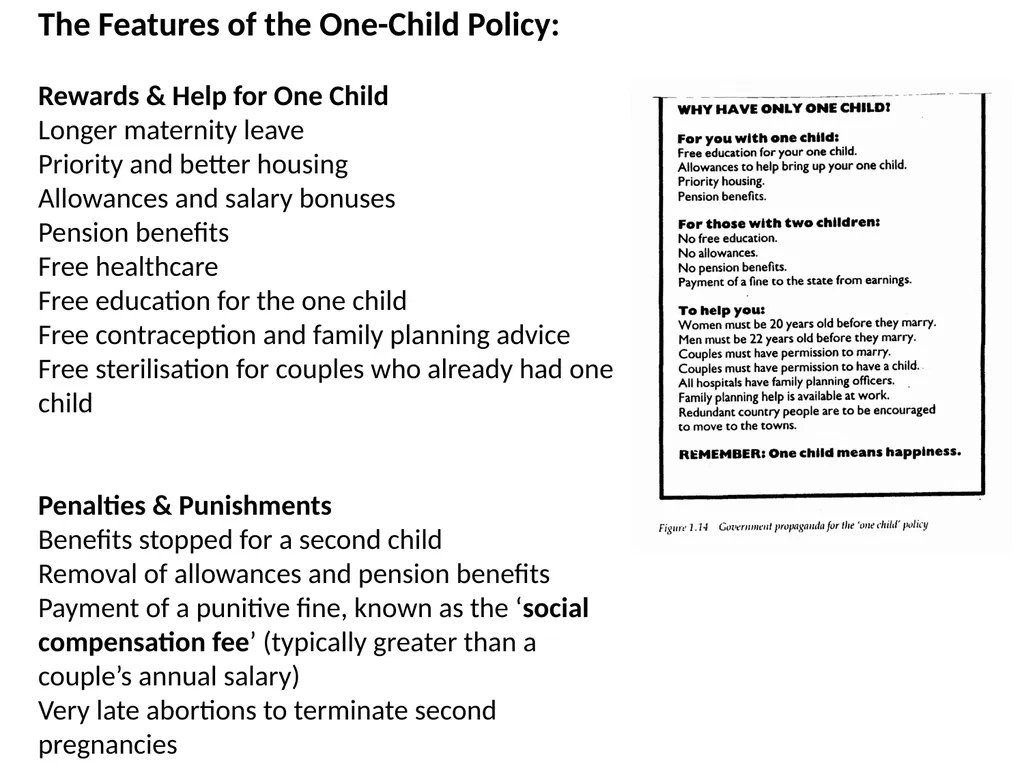
Rewards & Help for One Child
Longer maternity leave
Priority and better housing
Allowances and salary bonuses
Pension benefits
Free healthcare
Free education for the one child
Free contraception and family planning advice
Free sterilisation for couples who already had one child
Penalties & Punishments
Benefits stopped for a second child
Removal of allowances and pension benefits
Payment of a punitive fine, known as the ‘social compensation fee’ (typically greater than a couple’s annual salary)
Very late abortions to terminate second pregnancies<br>
10
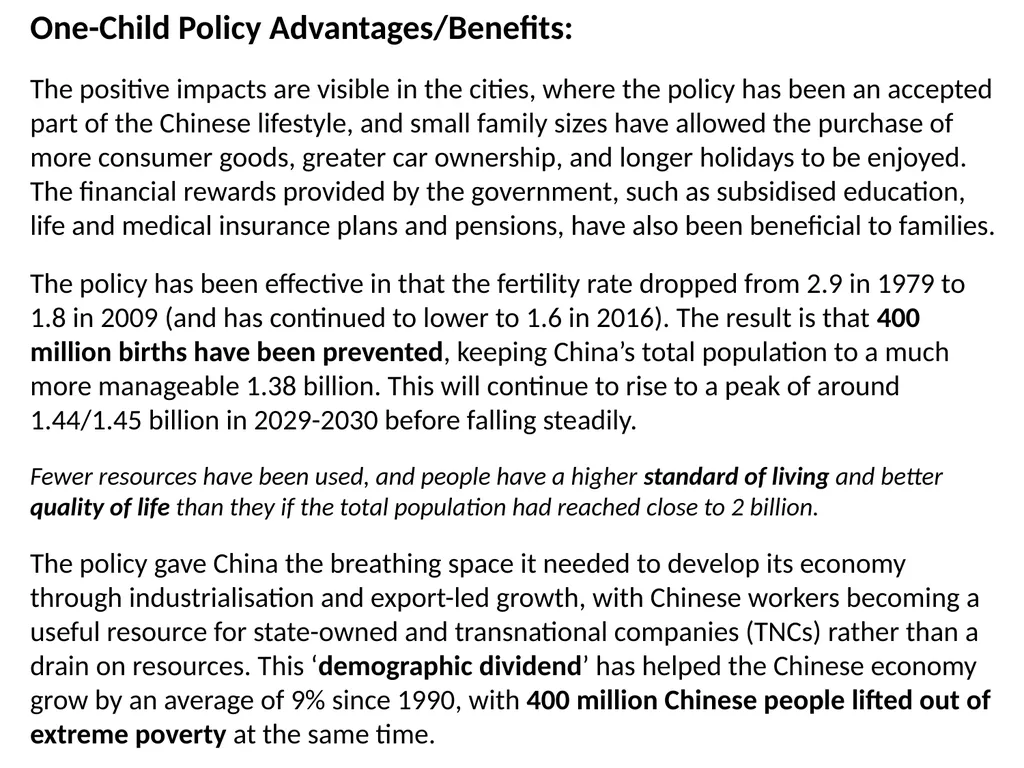
One-Child Policy Advantages/Benefits:
The positive impacts are visible in the cities, where the policy has been an accepted part of the Chinese lifestyle, and small family sizes have allowed the purchase of more consumer goods, greater car ownership, and longer holidays to be enjoyed. The financial rewards provided by the government, such as subsidised education, life and medical insurance plans and pensions, have also been beneficial to families.
The policy has been effective in that the fertility rate dropped from 2.9 in 1979 to 1.8 in 2009 (and has continued to lower to 1.6 in 2016). The result is that 400 million births have been prevented, keeping China’s total population to a much more manageable 1.38 billion. This will continue to rise to a peak of around 1.44/1.45 billion in 2029-2030 before falling steadily.
Fewer resources have been used, and people have a higher standard of living and better quality of life than they if the total population had reached close to 2 billion.
The policy gave China the breathing space it needed to develop its economy through industrialisation and export-led growth, with Chinese workers becoming a useful resource for state-owned and transnational companies (TNCs) rather than a drain on resources. This ‘demographic dividend’ has helped the Chinese economy grow by an average of 9% since 1990, with 400 million Chinese people lifted out of extreme poverty at the same time.<br>
11
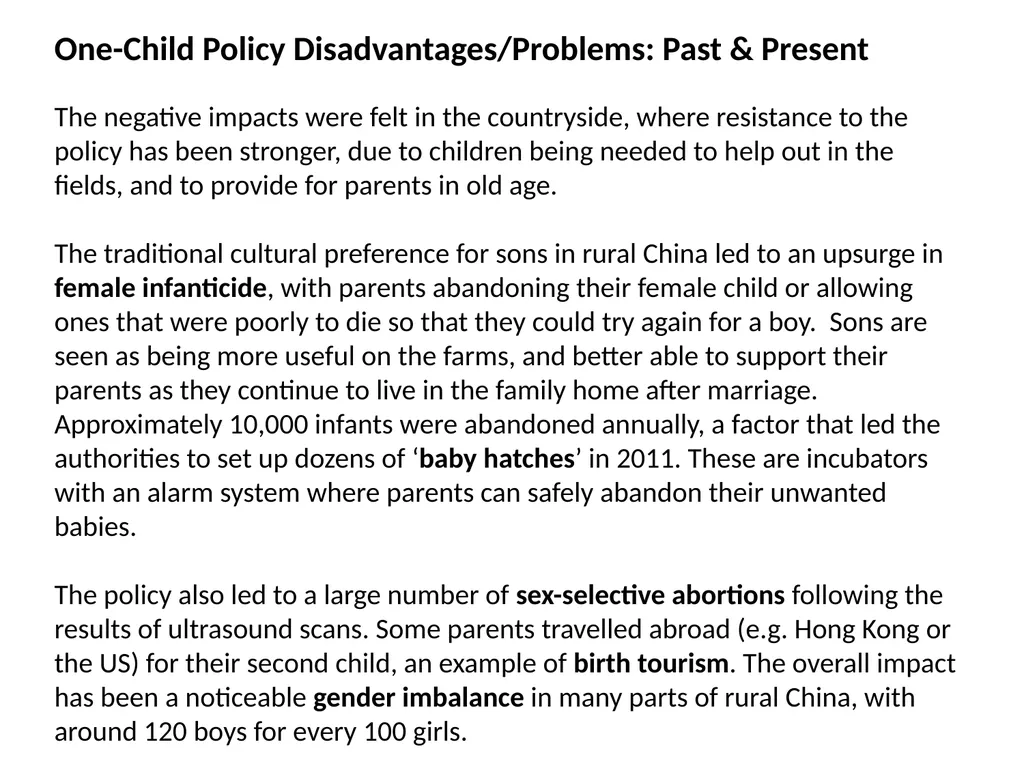
One-Child Policy Disadvantages/Problems: Past & Present
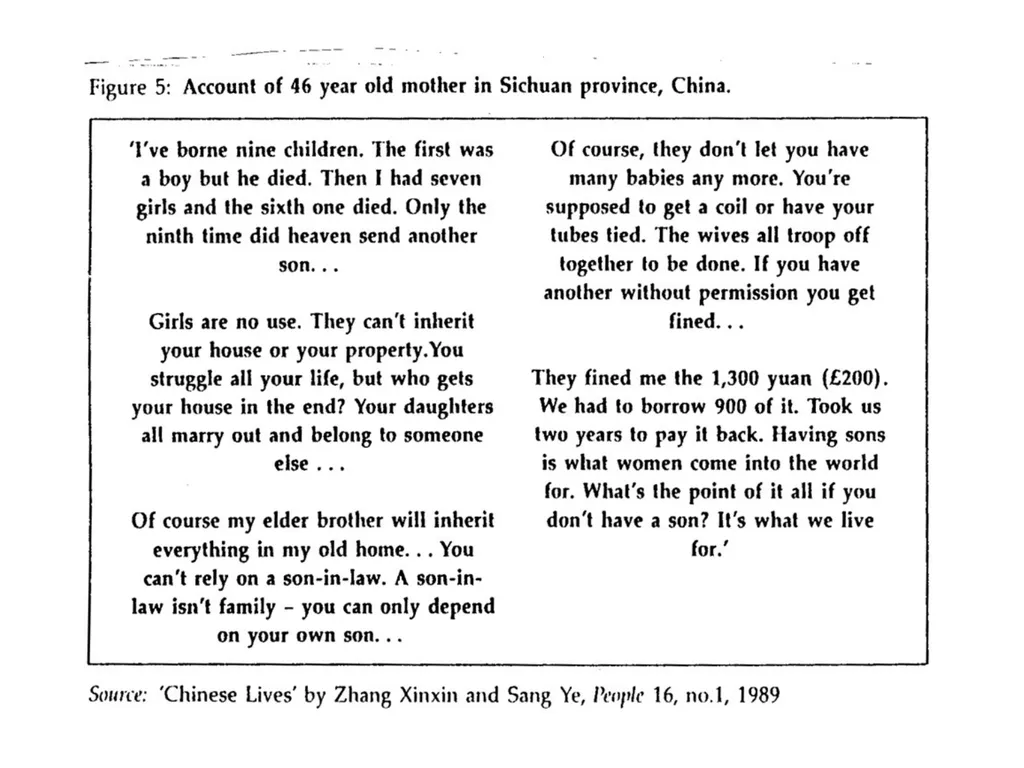
The negative impacts were felt in the countryside, where resistance to the policy has been stronger, due to children being needed to help out in the fields, and to provide for parents in old age.
The traditional cultural preference for sons in rural China led to an upsurge in female infanticide, with parents abandoning their female child or allowing ones that were poorly to die so that they could try again for a boy. Sons are seen as being more useful on the farms, and better able to support their parents as they continue to live in the family home after marriage. Approximately 10,000 infants were abandoned annually, a factor that led the authorities to set up dozens of ‘baby hatches’ in 2011. These are incubators with an alarm system where parents can safely abandon their unwanted babies.
The policy also led to a large number of sex-selective abortions following the results of ultrasound scans. Some parents travelled abroad (e.g. Hong Kong or the US) for their second child, an example of birth tourism. The overall impact has been a noticeable gender imbalance in many parts of rural China, with around 120 boys for every 100 girls.<br>
12
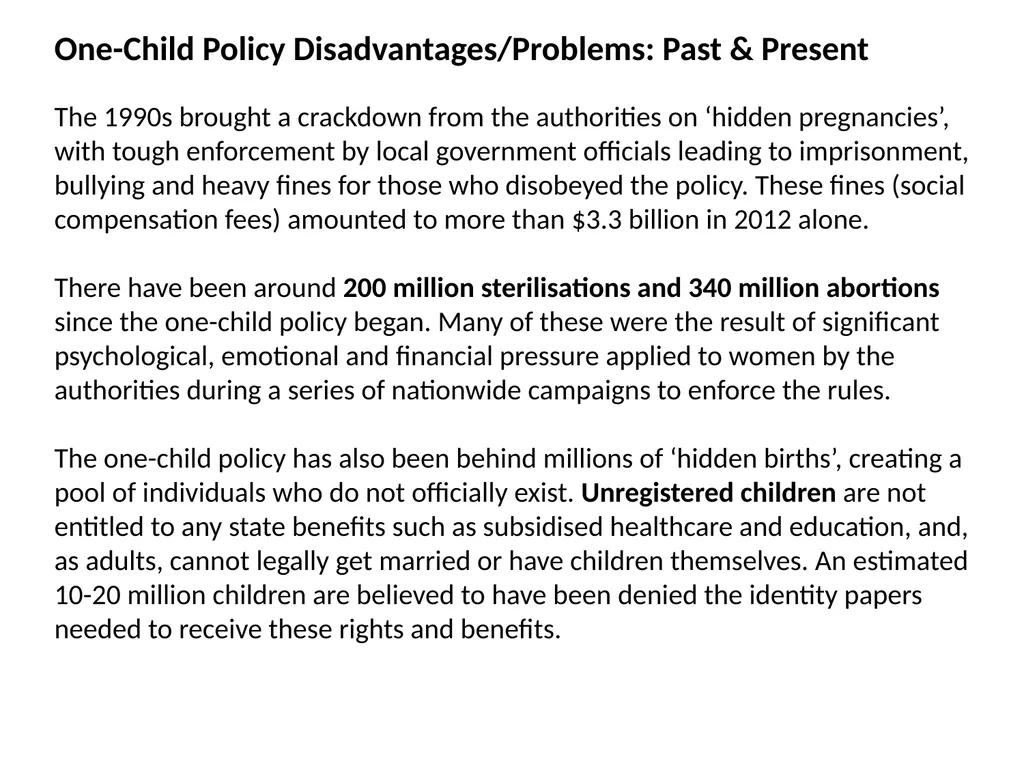
One-Child Policy Disadvantages/Problems: Past & Present
The 1990s brought a crackdown from the authorities on ‘hidden pregnancies’, with tough enforcement by local government officials leading to imprisonment, bullying and heavy fines for those who disobeyed the policy. These fines (social compensation fees) amounted to more than $3.3 billion in 2012 alone.
There have been around 200 million sterilisations and 340 million abortions since the one-child policy began. Many of these were the result of significant psychological, emotional and financial pressure applied to women by the authorities during a series of nationwide campaigns to enforce the rules.
The one-child policy has also been behind millions of ‘hidden births’, creating a pool of individuals who do not officially exist. Unregistered children are not entitled to any state benefits such as subsidised healthcare and education, and, as adults, cannot legally get married or have children themselves. An estimated 10-20 million children are believed to have been denied the identity papers needed to receive these rights and benefits.<br>
13
One-Child Policy Disadvantages/Problems: Present & Future
Improved healthcare and diets mean the death rate in China is now only 7.7 per 1000, and life expectancy is averaging 75.5. A consequence is the ‘4-2-1 problem’, where a generation of ‘only’ (single) children have to support their parents (2) as well as two sets of elderly grandparents (4). This can be a huge financial and emotional burden on just one person, and is made more demanding by the migration of young adults to work in the cities.
Single children struggle to meet their ‘filial piety’ duties (providing care for their elderly parents). In 2013, the government passed a law called the ‘Protection of the Rights and Interests of Elderly People’, which has made it possible for parents to sue their children for ‘neglect’ if they want to do so.
A young only child is more likely to be over-indulged and spoilt. This is referred to as the ‘little emperor or empress’ syndrome. They also tend to show more fragility with relationships and set-backs. The concern is that they may not be able to work effectively with others when they grow up. There has also been a dramatic increase in childhood obesity levels.<br>
14
One-Child Policy Disadvantages/Problems: Present & Future
The preference for sons rather than daughters means that there are now 30 million more young men than young women in China. Many men will struggle to find female partners for marriage. This is known as the ‘bachelor crisis’ or ‘spare branch’ problem, and could lead to loneliness, anti-social behaviour and other social problems.
Longer life expectancy and the falling fertility rate are adding to the concerns over the ageing of China’s population. In 2012 the number of people over 60 was 200 million (15% of the population), and that total is predicted to rise to 300 million in 2025 and 480 million by 2050.
In response to this situation, the government has tried to sort out the pension situation. The number of people in a pension scheme almost doubled between 2009 and 2012. Currently about 60% of the elderly receive a regular monthly pension, a figure that needs to reach 100% to protect the living standards of all of China’s elderly.<br>
15
Changes to the One-Child Policy:
Relaxations were applied during the 1980s and 1990s in many rural areas, with two children being allowed if the first child was a girl. This helped to reduce peasant opposition to the policy, and the amount of female infanticide taking place.
Two children allowed if the first child was disabled. Two children allowed if both their parents were from one-child families. Following the 2008 Sichuan Earthquake, parents who had lost children were allowed another child.
Couples have been allowed since 2014 to have two children if either parent is a single child.
With population growth remaining low, China officially ended the one-child policy in 2016.
In its place, the government has introduced a two-child policy, recognising the need to increase the fertility rate in order to tackle the problem of a demographic time-bomb / demographic crunch resulting from China’s rapidly ageing population and a shrinking workforce. This marks a gradual shift towards a pro-natalist policy, after 37 years of the extremely anti-natalist one-child policy.<br>
16
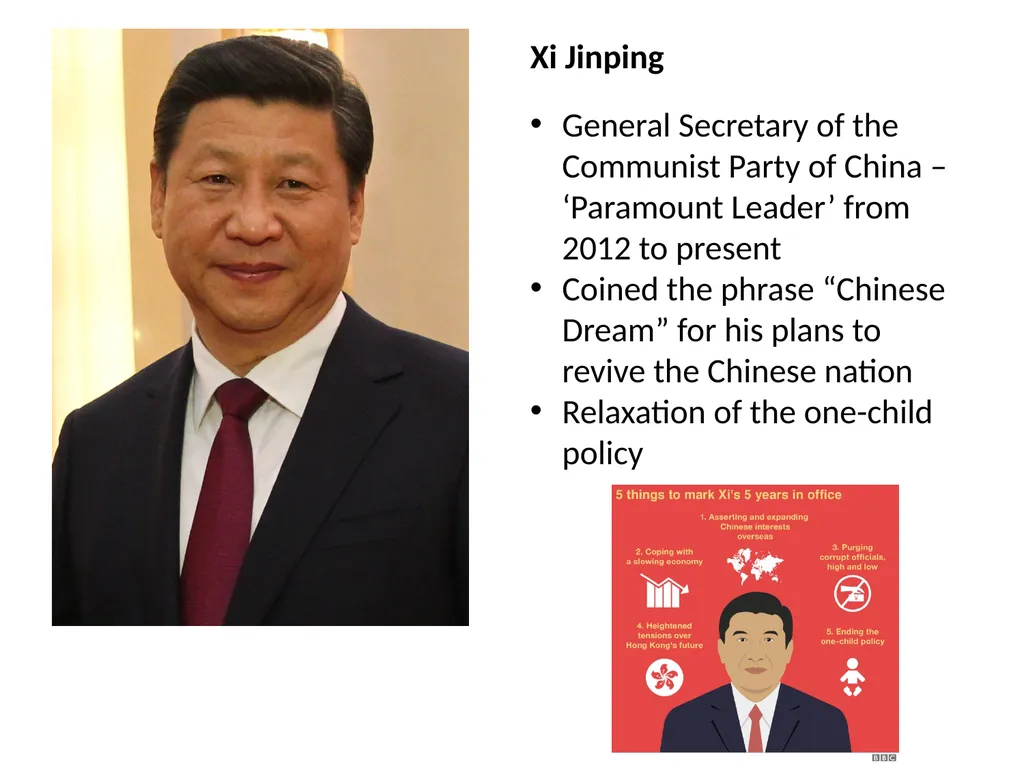
Xi Jinping
General Secretary of the Communist Party of China – ‘Paramount Leader’ from 2012 to present
Coined the phrase “Chinese Dream” for his plans to revive the Chinese nation
Relaxation of the one-child policy<br>
General Secretary of the Communist Party of China – ‘Paramount Leader’ from 2012 to present
Coined the phrase “Chinese Dream” for his plans to revive the Chinese nation
Relaxation of the one-child policy<br>
17
Evaluating the One-Child Policy:
As early as 1990, the authorities were forced to admit the one-child policy had failed to slow down growth sufficiently, and China’s population would overshoot the planned total of 1.2 billion in 2000. The reasons for this failure were found in the countryside, where the policy had never been applied effectively. Resistance to the policy was also stronger in the rural areas where most Chinese lived.
China’s fertility rate was already declining fast before the one-child policy was introduced in 1979. It is therefore debateable whether the one-child policy was ever needed as the main driver of fertility has been socio-economic change rather than the one-child policy itself. Increasing affluence, urbanisation and modernisation have played a major role in reducing the fertility rate to today’s level of 1.6 children per woman. Rocketing housing and education costs have lead many parents to conclude that they can only afford a single child and material aspirations take increasing precedence.<br>
18
Evaluating the One-Child Policy:
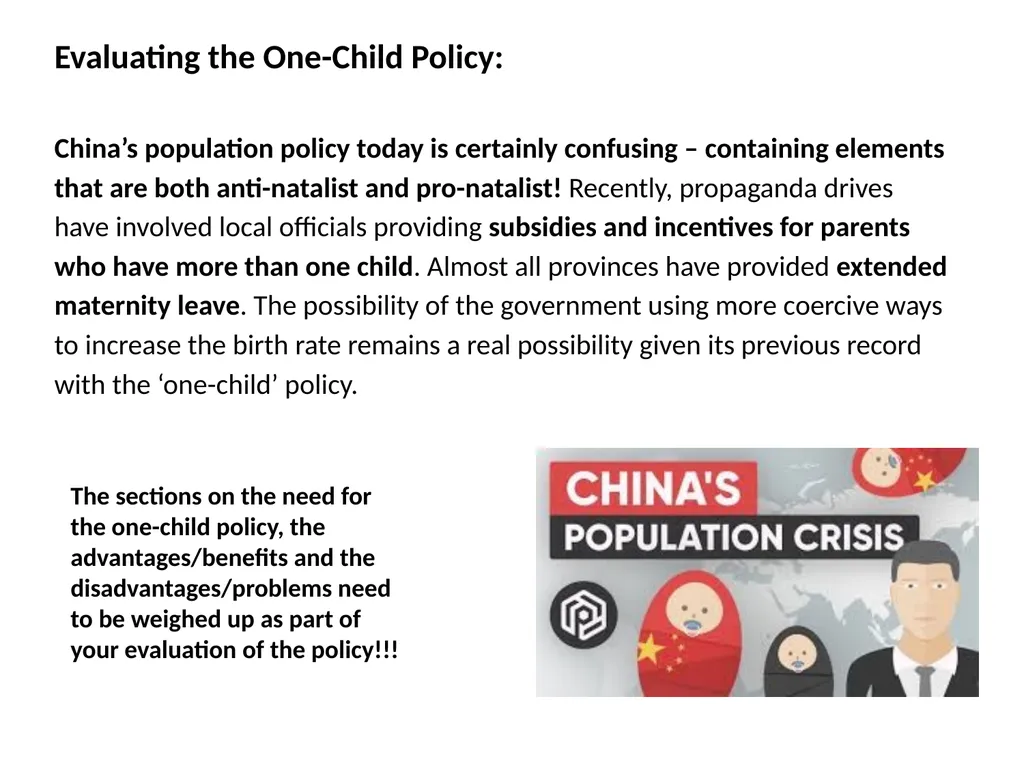
China’s population policy today is certainly confusing – containing elements that are both anti-natalist and pro-natalist! Recently, propaganda drives have involved local officials providing subsidies and incentives for parents who have more than one child. Almost all provinces have provided extended maternity leave. The possibility of the government using more coercive ways to increase the birth rate remains a real possibility given its previous record with the ‘one-child’ policy. The sections on the need for the one-child policy, the advantages/benefits and the disadvantages/problems need to be weighed up as part of your evaluation of the policy!!!<br>
China’s population policy today is certainly confusing – containing elements that are both anti-natalist and pro-natalist! Recently, propaganda drives have involved local officials providing subsidies and incentives for parents who have more than one child. Almost all provinces have provided extended maternity leave. The possibility of the government using more coercive ways to increase the birth rate remains a real possibility given its previous record with the ‘one-child’ policy. The sections on the need for the one-child policy, the advantages/benefits and the disadvantages/problems need to be weighed up as part of your evaluation of the policy!!!<br>
19
China Population Statistics: 2018…
Total Population: 1.39 billion
Birth Rate: 12.1 per 1000
Fertility Rate: 1.6 children per woman
Death Rate: 8.0 per 1000
Net Migration Rate: -0.4 per 1000
Population Growth Rate: 0.37%
Median Age: 37.7 years
Dependency Ratio: 38%
Life Expectancy at Birth: 75.8 years
Future…?
Total Population to Peak at 1.44/1.45 billion in 2029-2030 before steadily declining
Sometime between 2040-2050, 330 million Chinese (more than 25% of the population) will be aged over 65
Number of Chinese aged 15-59 will fall by 170 million at the same time<br>
20
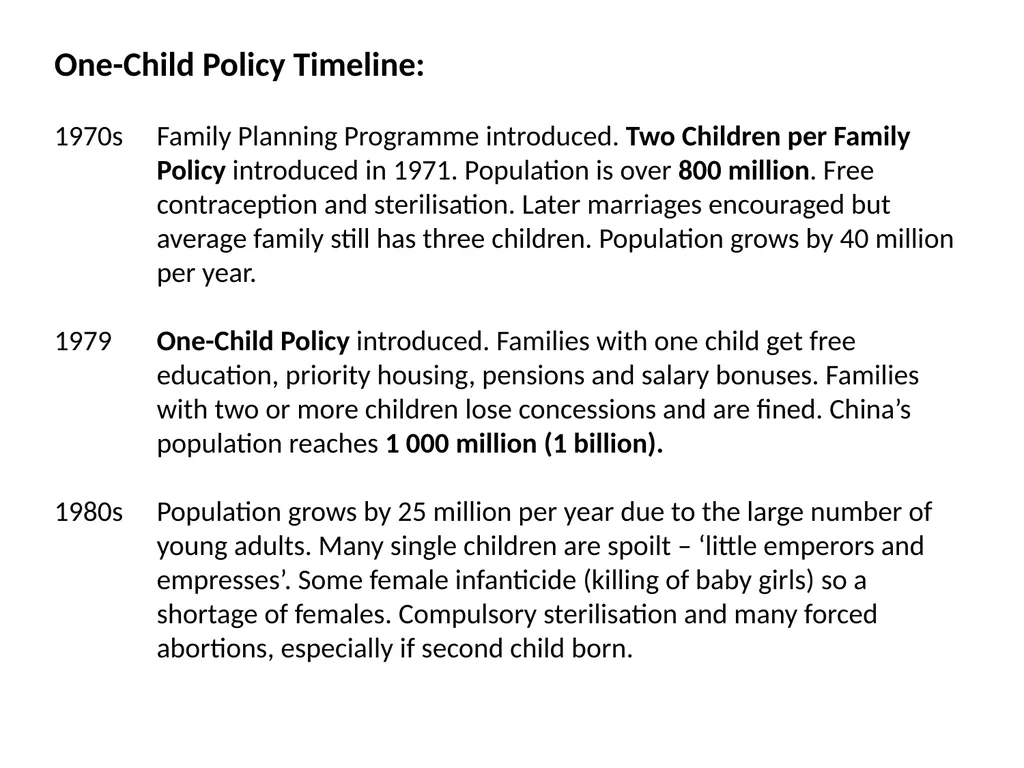
One-Child Policy Timeline:
1970s Family Planning Programme introduced. Two Children per Family Policy introduced in 1971. Population is over 800 million. Free contraception and sterilisation. Later marriages encouraged but average family still has three children. Population grows by 40 million per year.
1979 One-Child Policy introduced. Families with one child get free education, priority housing, pensions and salary bonuses. Families with two or more children lose concessions and are fined. China’s population reaches 1 000 million (1 billion).
1980s Population grows by 25 million per year due to the large number of young adults. Many single children are spoilt – ‘little emperors and empresses’. Some female infanticide (killing of baby girls) so a shortage of females. Compulsory sterilisation and many forced abortions, especially if second child born.<br>
21
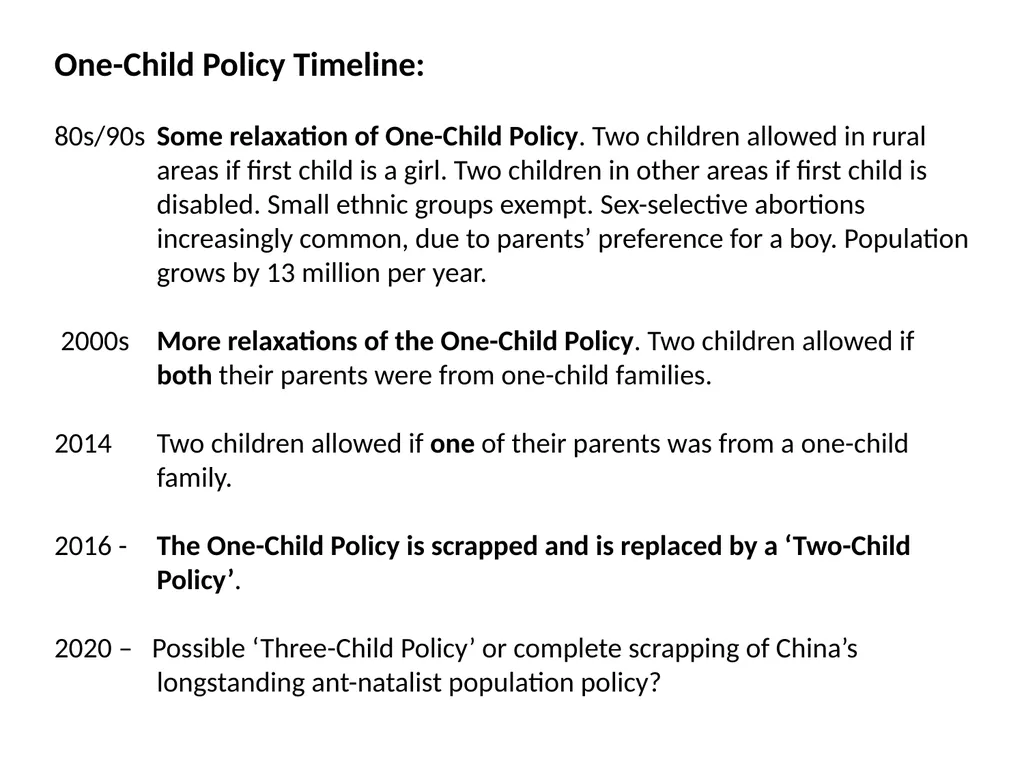
One-Child Policy Timeline:
80s/90s Some relaxation of One-Child Policy. Two children allowed in rural areas if first child is a girl. Two children in other areas if first child is disabled. Small ethnic groups exempt. Sex-selective abortions increasingly common, due to parents’ preference for a boy. Population grows by 13 million per year.
2000s More relaxations of the One-Child Policy. Two children allowed if both their parents were from one-child families.
2014 Two children allowed if one of their parents was from a one-child family.
2016 - The One-Child Policy is scrapped and is replaced by a ‘Two-Child Policy’.
2020 – Possible ‘Three-Child Policy’ or complete scrapping of China’s longstanding ant-natalist population policy?<br>
22
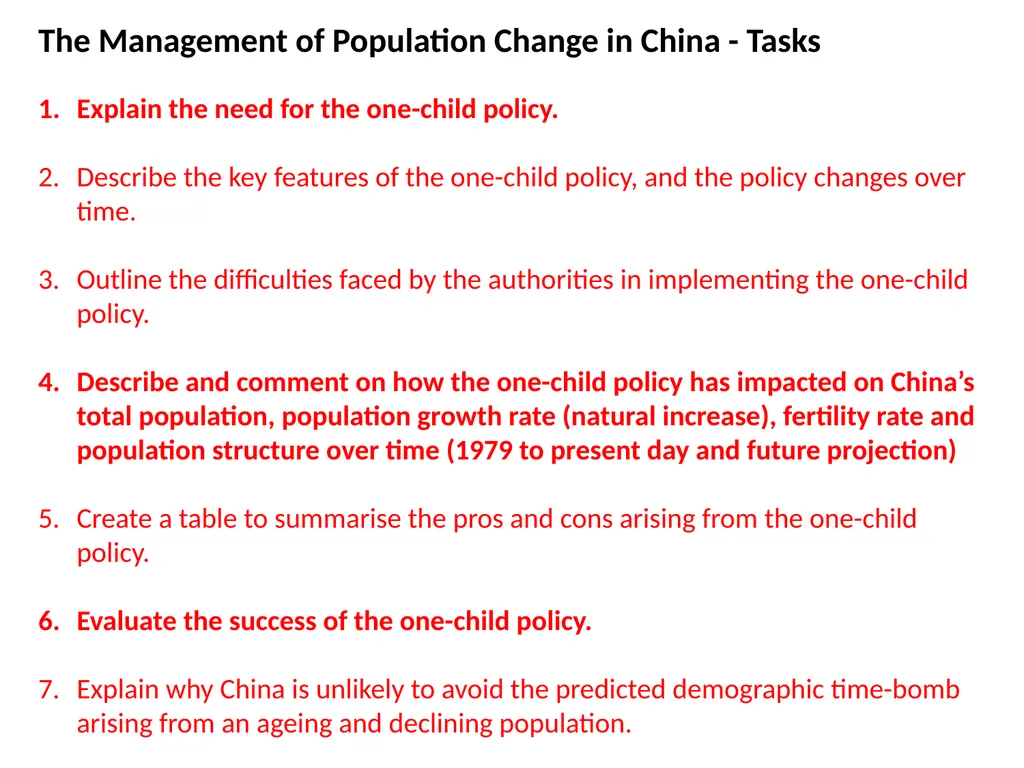
The Management of Population Change in China - Tasks
Explain the need for the one-child policy.
Describe the key features of the one-child policy, and the policy changes over time.
Outline the difficulties faced by the authorities in implementing the one-child policy.
Describe and comment on how the one-child policy has impacted on China’s total population, population growth rate (natural increase), fertility rate and population structure over time (1979 to present day and future projection)
Create a table to summarise the pros and cons arising from the one-child policy.
Evaluate the success of the one-child policy.
Explain why China is unlikely to avoid the predicted demographic time-bomb arising from an ageing and declining population.<br>