CC 2007, 2011 attribution R.B. Allen Overture Recent Headlines AA files lawsuit against Google over trademark words Katrina People Finder Interchange Format Data Standards Discussion Latest Genealogy Tools Create a Need to Know
"CC 2007, 2011 attribution – R.B. Allen Overture" is the property of its rightful owner. Permission is granted to
download and print the materials on this website for personal, non-commercial use only, and to display it
on your personal computer provided you do not modify the materials and that you retain all copyright
notices contained in the materials. By downloading content from our website, you accept the terms of this
agreement.
Presentation Transcript
01
CC 2007, 2011 attribution – R.B. Allen Overture<br>
02
Recent Headlines “AA files lawsuit against Google over trademark words”
“Katrina People Finder Interchange Format Data Standards Discussion”
“Latest Genealogy Tools Create a Need to Know”
“Bots Hammer Estonia In Cyber Vendetta”
“UPS slashed the time it takes to determine the least-expensive route from months and wants to make that information available in real time”
“XM & MySpace launch music talent search”
“Seeing Corporate Fingerprints in Wikipedia Edits” CC 2007, 2011 attribution – R.B. Allen<br>
03
What is Information? We define information as:
Observers develop models of their environment. Information makes those models more accurate.
However, this means that information is difficult to measure. An alternate definition focuses on “information as a thing”
Information is what’s captured in a book, web
page, or other resource.
We propose that this captured information is better thought of as potential information CC 2007, 2011 attribution – R.B. Allen<br>
04
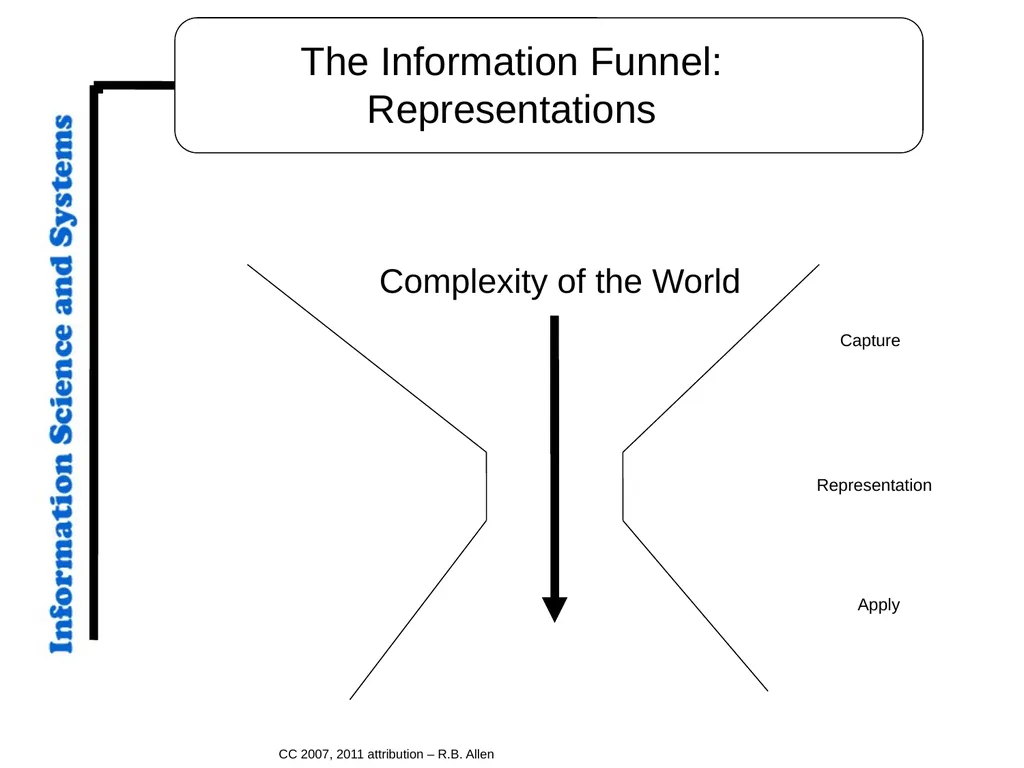
The Information Funnel: Representations Complexity of the World CC 2007, 2011 attribution – R.B. Allen Representation Capture Apply<br>
05
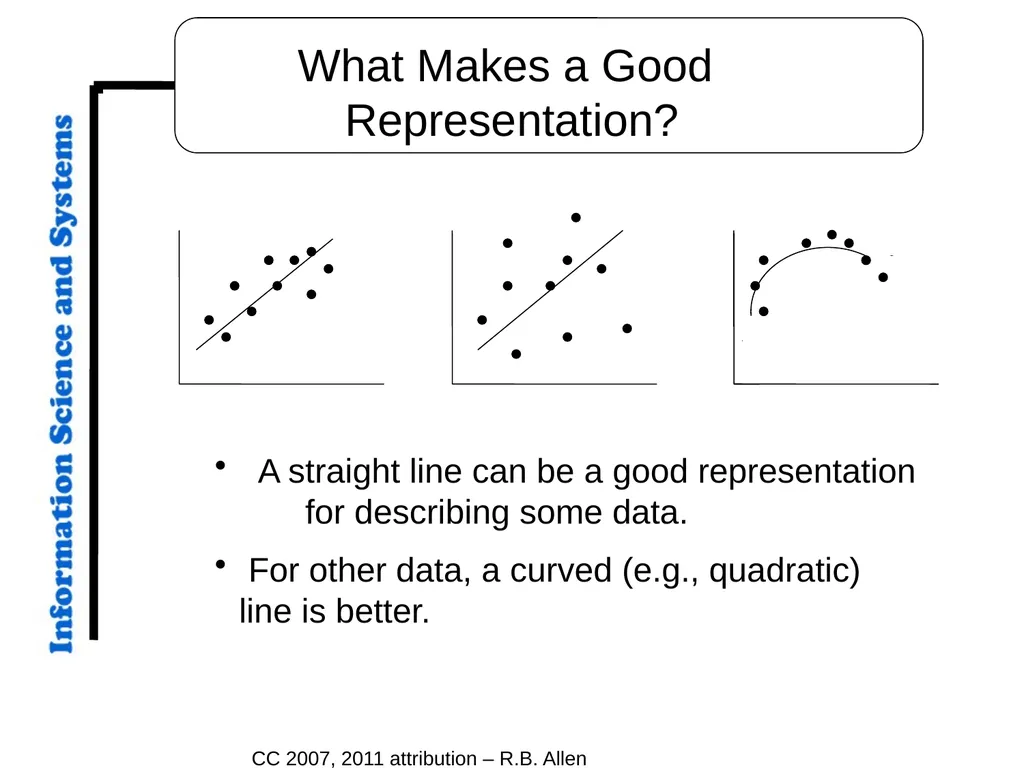
What Makes a Good Representation? CC 2007, 2011 attribution – R.B. Allen A straight line can be a good representation for describing some data.
For other data, a curved (e.g., quadratic) line is better.<br>
06
Many Types of Representations Categories
Equations
Neural networks
Natural language statements
Logic statements
Images
Mental models CC 2007, 2011 attribution – R.B. Allen<br>
07
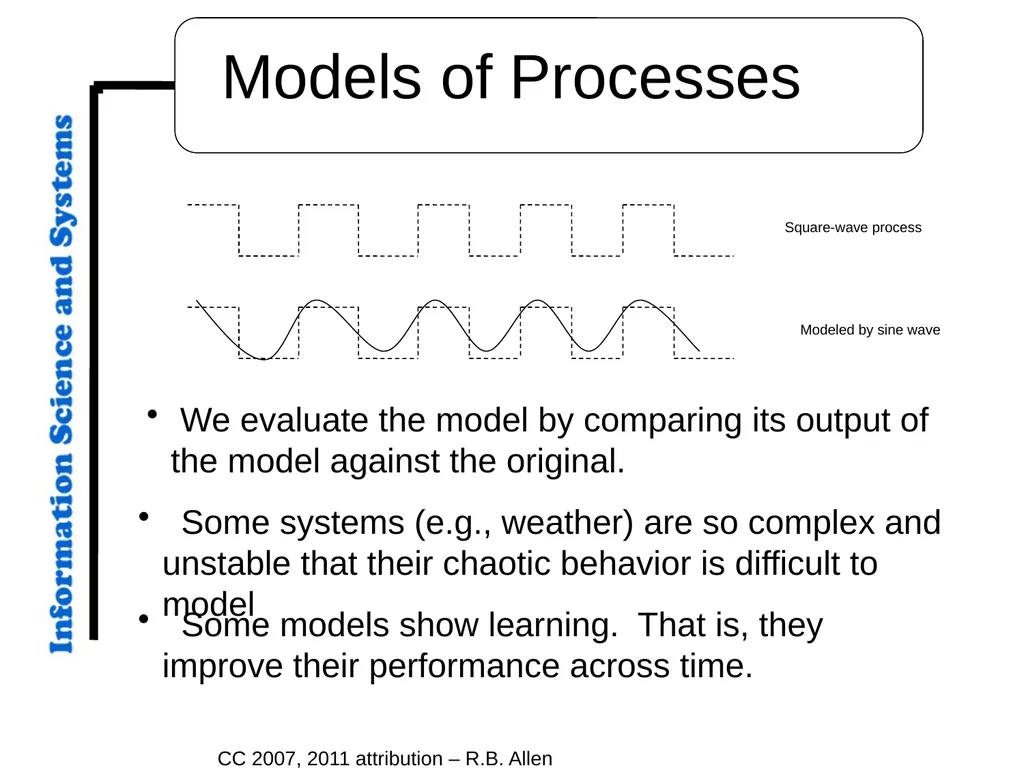
Models of Processes CC 2007, 2011 attribution – R.B. Allen Square-wave process Modeled by sine wave We evaluate the model by comparing its output of the model against the original. Some models show learning. That is, they improve their performance across time. Some systems (e.g., weather) are so complex and unstable that their chaotic behavior is difficult to model<br>
08
Information Processing There are many ways to apply the information stored in representations.
Retrieval
Finding useful information
Recognition
Identifying an instance
Inference
Extend stored information to a new situation CC 2007, 2011 attribution – R.B. Allen<br>
09
Context One of the hardest problems for information processing is determining the context in which the information is applied.
This may lead to incorrect inferences. CC 2007, 2011 attribution – R.B. Allen<br>
10
Information Structure Most representations are part of a system for representations.
Bibliographic metadata is a clear example
Natural language is also a representation system with structure
Diagrams, such as maps, are also highly structured representations. CC 2007, 2011 attribution – R.B. Allen<br>
11
Information Resources People create information resources such as documents, books and movies.
These information resources help hold and transmit information for future use by ourselves and others.
Information resources develop structures which form “genres”. CC 2007, 2011 attribution – R.B. Allen<br>
12
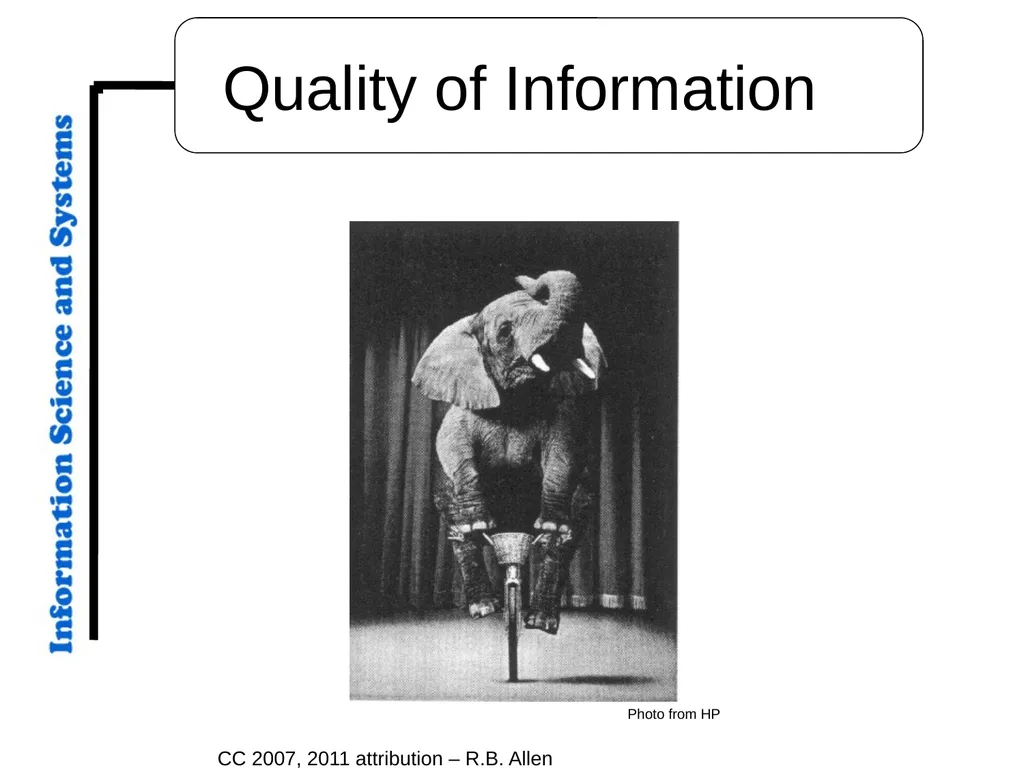
Quality of Information CC 2007, 2011 attribution – R.B. Allen Photo from HP<br>
13
Information Systems Information systems are created to capture, store, and support access of information representations.
The information may be descriptions of entities in a database or a collection of documents.
Information systems include the Web, databases, libraries, archives, and enterprise content management systems CC 2007, 2011 attribution – R.B. Allen<br>
14
Information and Complex Systems Rich information facilitates the development of complex systems.
For example, rich information facilitates the complexity of human society. We can think of society as a “self-organizing system”. CC 2007, 2011 attribution – R.B. Allen<br>
15
People and Information Systems People process information based on their experience and context.
Human information processing is also affected by knowledge, culture, and beliefs.
People use information systems so designers need to match content and the system interface to the user’s needs. CC 2007, 2011 attribution – R.B. Allen<br>
16
Human Communication Two models for communication
Transplanting ideas from one person’s head directly to the another person.
A speaker provides an imperfect representation of what the speaker intends and which the recipient interprets based on their own experience.
The first is often assumed, but the second is more realistic
The effectiveness of communication in the second can be enhanced by common experience and education between speaker and recipient CC 2007, 2011 attribution – R.B. Allen<br>
17
Tasks and Group Interaction Information is particularly helpful for completing tasks.
For groups completing tasks, the entire group can be thought of as an information processing unit.
Some information systems are developed to support group task activities. CC 2007, 2011 attribution – R.B. Allen<br>
18
Information Institutions Information is so important that we have developed institutions specifically for managing it.
Libraries
Archives
Also many other related institutions
Universities
Museums
Scientific societies CC 2007, 2011 attribution – R.B. Allen<br>
19
Entertainments Entertainment provides both information and affect.
Entertainments have structure and interactivity. CC 2007, 2011 attribution - R.B. Allen<br>
20
Discussion Questions Can information be inaccurate? Can you measure it?
How do you define:
Intelligence
Objectivity
Learning
rationality.
Is entertainment information? Are music and games information resources?
What is a “fact”? Can it exist without a context? CC 2007, 2011 attribution – R.B. Allen<br>