
CCS (Pension) Rules, 1972 GENERAL PROVISIONS These
OM
Published · 28 slides · 0 views

1 / 1





Description
CCS (Pension) Rules, 1972 GENERAL PROVISIONS These rules may be called the Central Civil Services (Pension) Rules, 1972. They shall come into force on the 1st June, 1972. The age prescribed for retirement on superannuation is 60 years for
Related Topics
Share
Embed code
Download this presentation From Below
"CCS (Pension) Rules, 1972 GENERAL PROVISIONS These" is the property of its rightful owner. Permission is granted to download and print the materials on this website for personal, non-commercial use only, and to display it on your personal computer provided you do not modify the materials and that you retain all copyright notices contained in the materials. By downloading content from our website, you accept the terms of this agreement.
Presentation Transcript
01
CCS (Pension) Rules, 1972<br>
02
GENERAL PROVISIONS
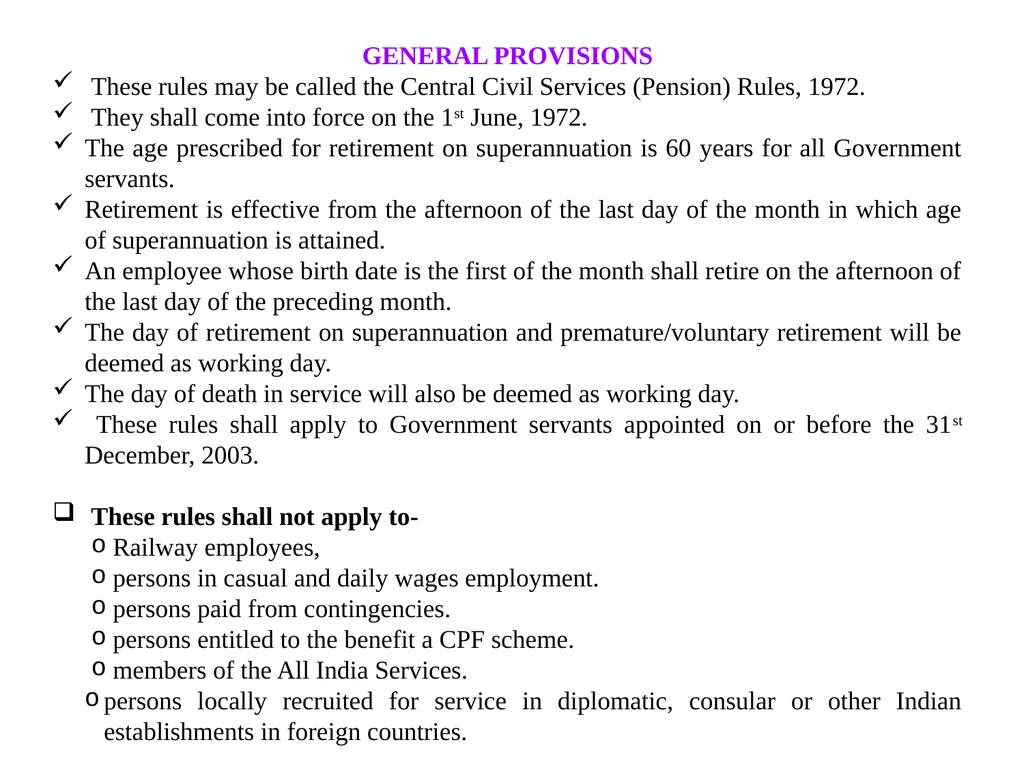
These rules may be called the Central Civil Services (Pension) Rules, 1972.
They shall come into force on the 1st June, 1972.
The age prescribed for retirement on superannuation is 60 years for all Government servants.
Retirement is effective from the afternoon of the last day of the month in which age of superannuation is attained.
An employee whose birth date is the first of the month shall retire on the afternoon of the last day of the preceding month.
The day of retirement on superannuation and premature/voluntary retirement will be deemed as working day.
The day of death in service will also be deemed as working day.
These rules shall apply to Government servants appointed on or before the 31st December, 2003.
These rules shall not apply to-
Railway employees,
persons in casual and daily wages employment.
persons paid from contingencies.
persons entitled to the benefit a CPF scheme.
members of the All India Services.
persons locally recruited for service in diplomatic, consular or other Indian establishments in foreign countries.<br>
These rules may be called the Central Civil Services (Pension) Rules, 1972.
They shall come into force on the 1st June, 1972.
The age prescribed for retirement on superannuation is 60 years for all Government servants.
Retirement is effective from the afternoon of the last day of the month in which age of superannuation is attained.
An employee whose birth date is the first of the month shall retire on the afternoon of the last day of the preceding month.
The day of retirement on superannuation and premature/voluntary retirement will be deemed as working day.
The day of death in service will also be deemed as working day.
These rules shall apply to Government servants appointed on or before the 31st December, 2003.
These rules shall not apply to-
Railway employees,
persons in casual and daily wages employment.
persons paid from contingencies.
persons entitled to the benefit a CPF scheme.
members of the All India Services.
persons locally recruited for service in diplomatic, consular or other Indian establishments in foreign countries.<br>
03
PENSION –ITS VALUE IN LIFE
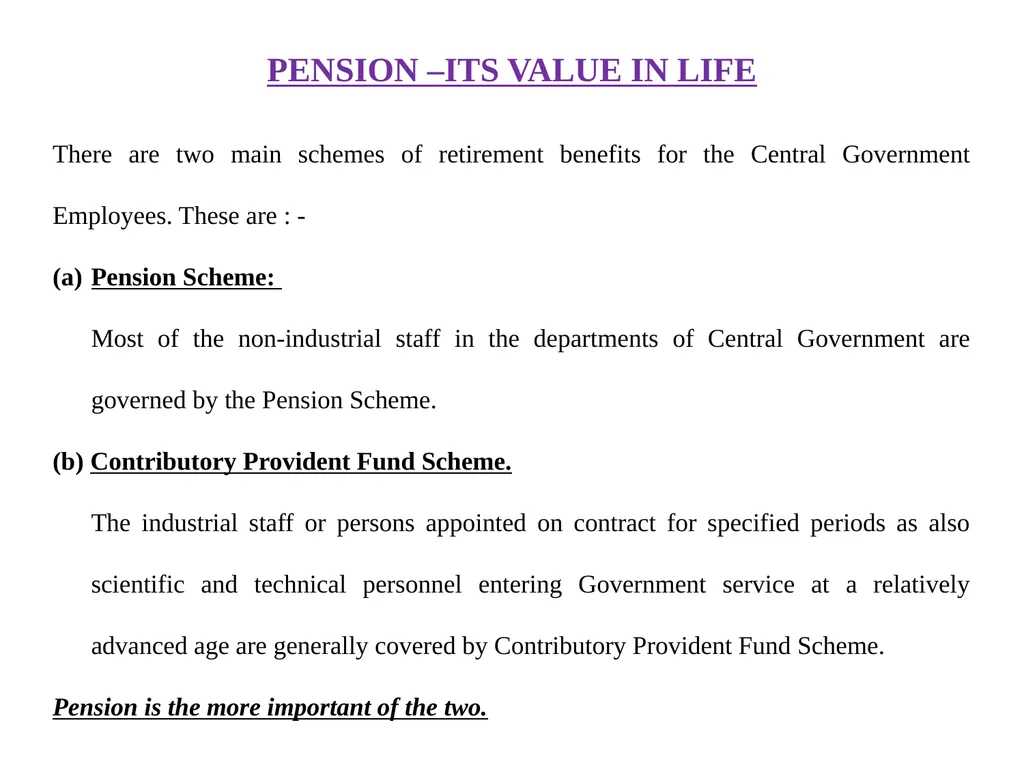
There are two main schemes of retirement benefits for the Central Government Employees. These are : -
Pension Scheme:
Most of the non-industrial staff in the departments of Central Government are governed by the Pension Scheme.
(b) Contributory Provident Fund Scheme.
The industrial staff or persons appointed on contract for specified periods as also scientific and technical personnel entering Government service at a relatively advanced age are generally covered by Contributory Provident Fund Scheme.
Pension is the more important of the two.<br>
There are two main schemes of retirement benefits for the Central Government Employees. These are : -
Pension Scheme:
Most of the non-industrial staff in the departments of Central Government are governed by the Pension Scheme.
(b) Contributory Provident Fund Scheme.
The industrial staff or persons appointed on contract for specified periods as also scientific and technical personnel entering Government service at a relatively advanced age are generally covered by Contributory Provident Fund Scheme.
Pension is the more important of the two.<br>
04
PENSION SCHEME
An employee governed by the pension scheme gets a recurring monthly payment for life and a lumpsum gratuity at the time of his retirement, both determined with reference to the length of his service and the pay drawn by him.
The term has been judicially defined as “Pension is an allowance or stipend made in consideration of past service or a surrender of rights or emoluments to one retired from service.”
Thus the pension payable to a Government employee is earned by rendering long and efficient service. In the event of his death, his spouse gets a monthly payment for life. Other beneficiaries get such payment for limited periods of for life subject to certain conditions.
Once a man has earned his pension after hard labour of several years, he can afford to relax and start enjoying the fruit as long as he is gifted to live.<br>
An employee governed by the pension scheme gets a recurring monthly payment for life and a lumpsum gratuity at the time of his retirement, both determined with reference to the length of his service and the pay drawn by him.
The term has been judicially defined as “Pension is an allowance or stipend made in consideration of past service or a surrender of rights or emoluments to one retired from service.”
Thus the pension payable to a Government employee is earned by rendering long and efficient service. In the event of his death, his spouse gets a monthly payment for life. Other beneficiaries get such payment for limited periods of for life subject to certain conditions.
Once a man has earned his pension after hard labour of several years, he can afford to relax and start enjoying the fruit as long as he is gifted to live.<br>
05
Retirement Benefits
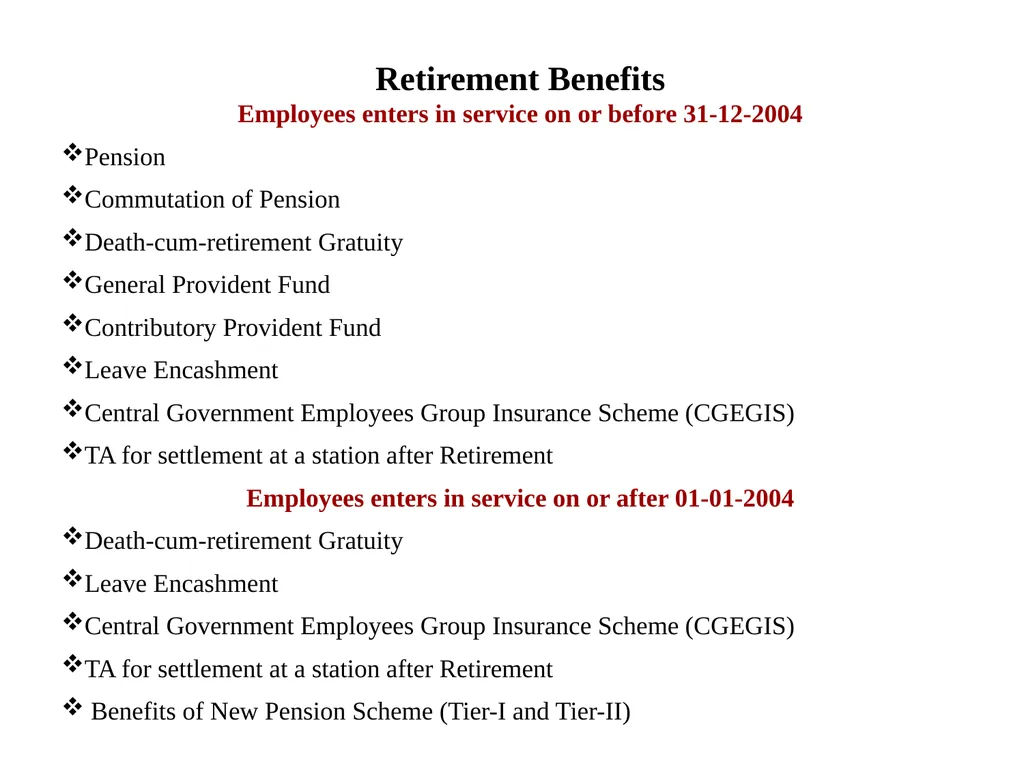
Employees enters in service on or before 31-12-2004
Pension
Commutation of Pension
Death-cum-retirement Gratuity
General Provident Fund
Contributory Provident Fund
Leave Encashment
Central Government Employees Group Insurance Scheme (CGEGIS)
TA for settlement at a station after Retirement
Employees enters in service on or after 01-01-2004
Death-cum-retirement Gratuity
Leave Encashment
Central Government Employees Group Insurance Scheme (CGEGIS)
TA for settlement at a station after Retirement
Benefits of New Pension Scheme (Tier-I and Tier-II)<br>
Employees enters in service on or before 31-12-2004
Pension
Commutation of Pension
Death-cum-retirement Gratuity
General Provident Fund
Contributory Provident Fund
Leave Encashment
Central Government Employees Group Insurance Scheme (CGEGIS)
TA for settlement at a station after Retirement
Employees enters in service on or after 01-01-2004
Death-cum-retirement Gratuity
Leave Encashment
Central Government Employees Group Insurance Scheme (CGEGIS)
TA for settlement at a station after Retirement
Benefits of New Pension Scheme (Tier-I and Tier-II)<br>
06
Classes of Pension<br>
07
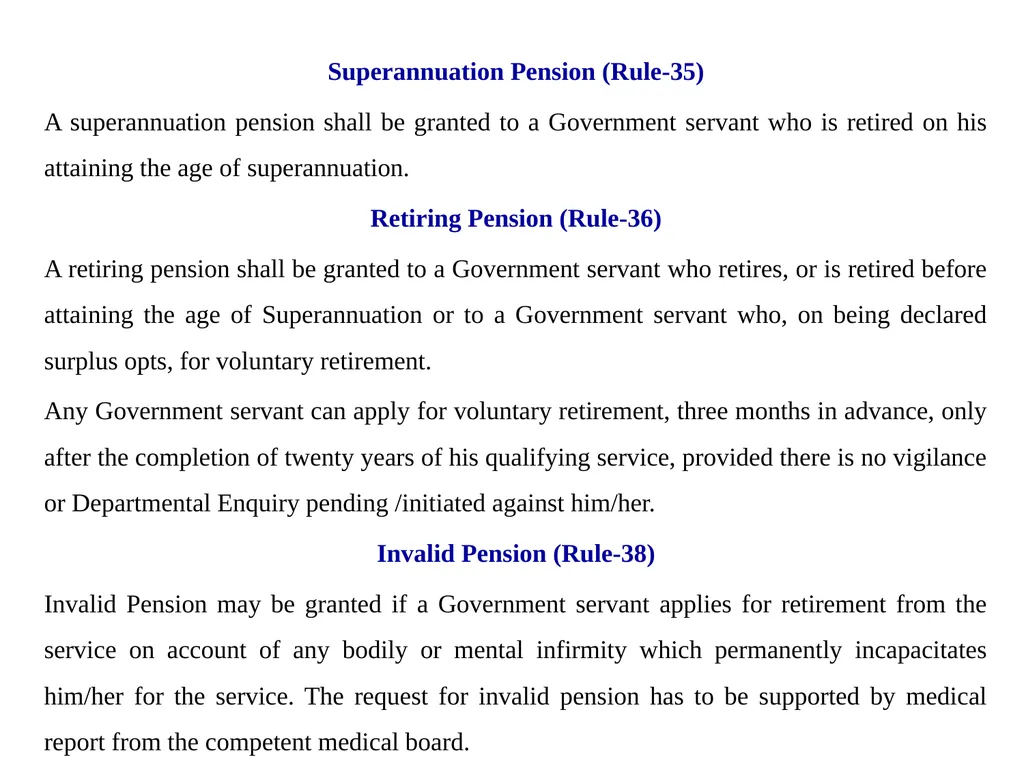
Superannuation Pension (Rule-35)
A superannuation pension shall be granted to a Government servant who is retired on his attaining the age of superannuation.
Retiring Pension (Rule-36)
A retiring pension shall be granted to a Government servant who retires, or is retired before attaining the age of Superannuation or to a Government servant who, on being declared surplus opts, for voluntary retirement.
Any Government servant can apply for voluntary retirement, three months in advance, only after the completion of twenty years of his qualifying service, provided there is no vigilance or Departmental Enquiry pending /initiated against him/her.
Invalid Pension (Rule-38)
Invalid Pension may be granted if a Government servant applies for retirement from the service on account of any bodily or mental infirmity which permanently incapacitates him/her for the service. The request for invalid pension has to be supported by medical report from the competent medical board.<br>
A superannuation pension shall be granted to a Government servant who is retired on his attaining the age of superannuation.
Retiring Pension (Rule-36)
A retiring pension shall be granted to a Government servant who retires, or is retired before attaining the age of Superannuation or to a Government servant who, on being declared surplus opts, for voluntary retirement.
Any Government servant can apply for voluntary retirement, three months in advance, only after the completion of twenty years of his qualifying service, provided there is no vigilance or Departmental Enquiry pending /initiated against him/her.
Invalid Pension (Rule-38)
Invalid Pension may be granted if a Government servant applies for retirement from the service on account of any bodily or mental infirmity which permanently incapacitates him/her for the service. The request for invalid pension has to be supported by medical report from the competent medical board.<br>
08
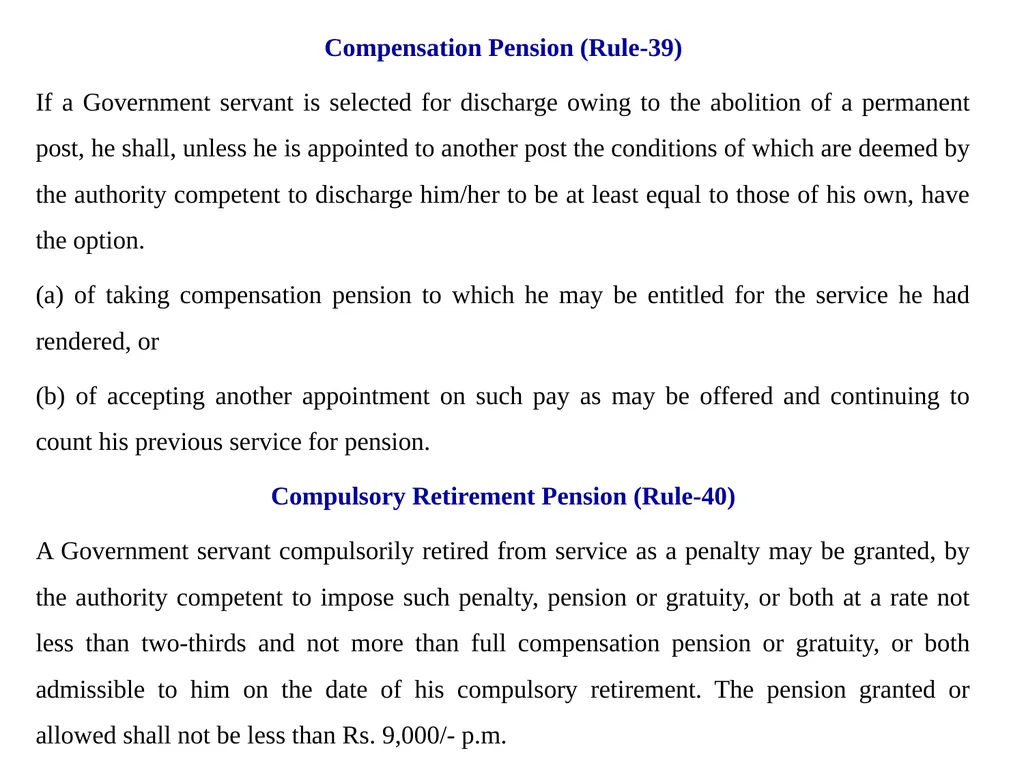
Compensation Pension (Rule-39)
If a Government servant is selected for discharge owing to the abolition of a permanent post, he shall, unless he is appointed to another post the conditions of which are deemed by the authority competent to discharge him/her to be at least equal to those of his own, have the option.
(a) of taking compensation pension to which he may be entitled for the service he had rendered, or
(b) of accepting another appointment on such pay as may be offered and continuing to count his previous service for pension.
Compulsory Retirement Pension (Rule-40)
A Government servant compulsorily retired from service as a penalty may be granted, by the authority competent to impose such penalty, pension or gratuity, or both at a rate not less than two-thirds and not more than full compensation pension or gratuity, or both admissible to him on the date of his compulsory retirement. The pension granted or allowed shall not be less than Rs. 9,000/- p.m.<br>
If a Government servant is selected for discharge owing to the abolition of a permanent post, he shall, unless he is appointed to another post the conditions of which are deemed by the authority competent to discharge him/her to be at least equal to those of his own, have the option.
(a) of taking compensation pension to which he may be entitled for the service he had rendered, or
(b) of accepting another appointment on such pay as may be offered and continuing to count his previous service for pension.
Compulsory Retirement Pension (Rule-40)
A Government servant compulsorily retired from service as a penalty may be granted, by the authority competent to impose such penalty, pension or gratuity, or both at a rate not less than two-thirds and not more than full compensation pension or gratuity, or both admissible to him on the date of his compulsory retirement. The pension granted or allowed shall not be less than Rs. 9,000/- p.m.<br>
09
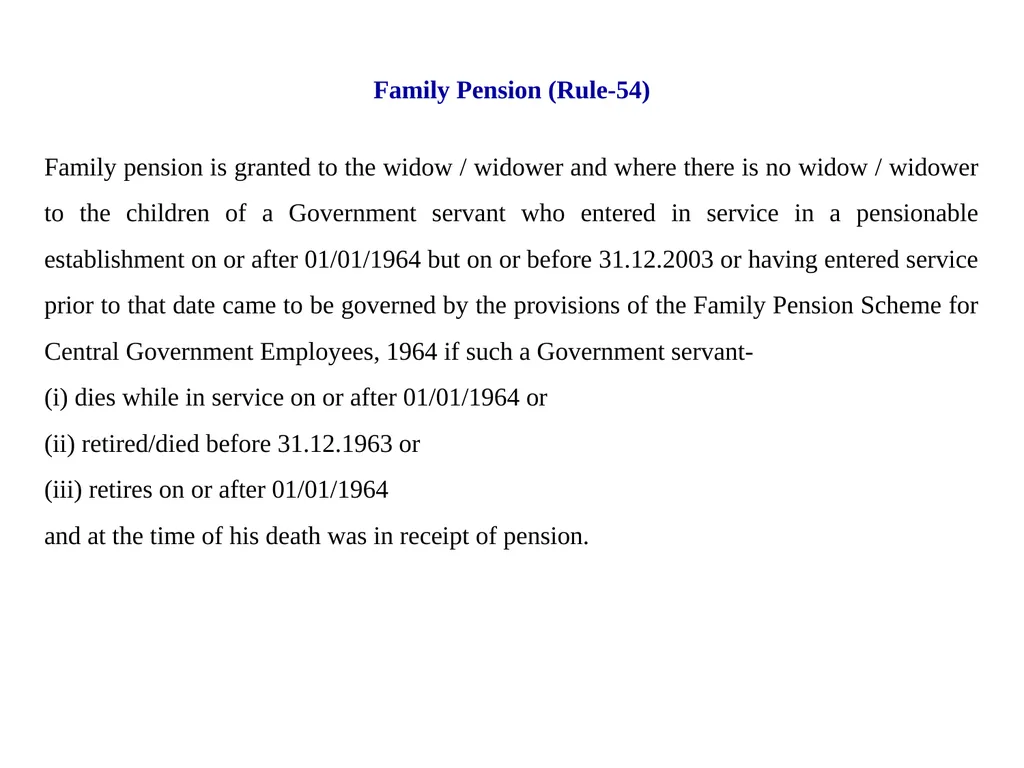
Family Pension (Rule-54)
Family pension is granted to the widow / widower and where there is no widow / widower to the children of a Government servant who entered in service in a pensionable establishment on or after 01/01/1964 but on or before 31.12.2003 or having entered service prior to that date came to be governed by the provisions of the Family Pension Scheme for Central Government Employees, 1964 if such a Government servant-
(i) dies while in service on or after 01/01/1964 or
(ii) retired/died before 31.12.1963 or
(iii) retires on or after 01/01/1964
and at the time of his death was in receipt of pension.<br>
Family pension is granted to the widow / widower and where there is no widow / widower to the children of a Government servant who entered in service in a pensionable establishment on or after 01/01/1964 but on or before 31.12.2003 or having entered service prior to that date came to be governed by the provisions of the Family Pension Scheme for Central Government Employees, 1964 if such a Government servant-
(i) dies while in service on or after 01/01/1964 or
(ii) retired/died before 31.12.1963 or
(iii) retires on or after 01/01/1964
and at the time of his death was in receipt of pension.<br>
10
Pension Rules
A Retrospect<br>
A Retrospect<br>
11
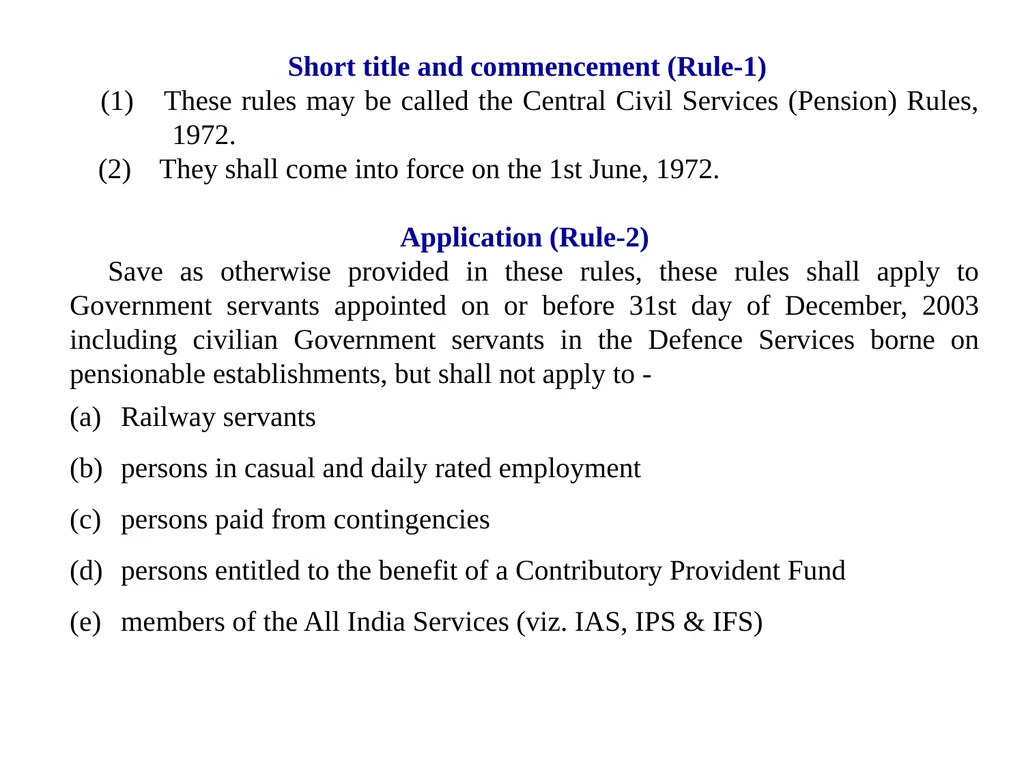
Short title and commencement (Rule-1)
(1) These rules may be called the Central Civil Services (Pension) Rules, 1972.
(2) They shall come into force on the 1st June, 1972.
Application (Rule-2)
Save as otherwise provided in these rules, these rules shall apply to Government servants appointed on or before 31st day of December, 2003 including civilian Government servants in the Defence Services borne on pensionable establishments, but shall not apply to -
Railway servants
persons in casual and daily rated employment
persons paid from contingencies
persons entitled to the benefit of a Contributory Provident Fund
members of the All India Services (viz. IAS, IPS & IFS)<br>
(1) These rules may be called the Central Civil Services (Pension) Rules, 1972.
(2) They shall come into force on the 1st June, 1972.
Application (Rule-2)
Save as otherwise provided in these rules, these rules shall apply to Government servants appointed on or before 31st day of December, 2003 including civilian Government servants in the Defence Services borne on pensionable establishments, but shall not apply to -
Railway servants
persons in casual and daily rated employment
persons paid from contingencies
persons entitled to the benefit of a Contributory Provident Fund
members of the All India Services (viz. IAS, IPS & IFS)<br>
12
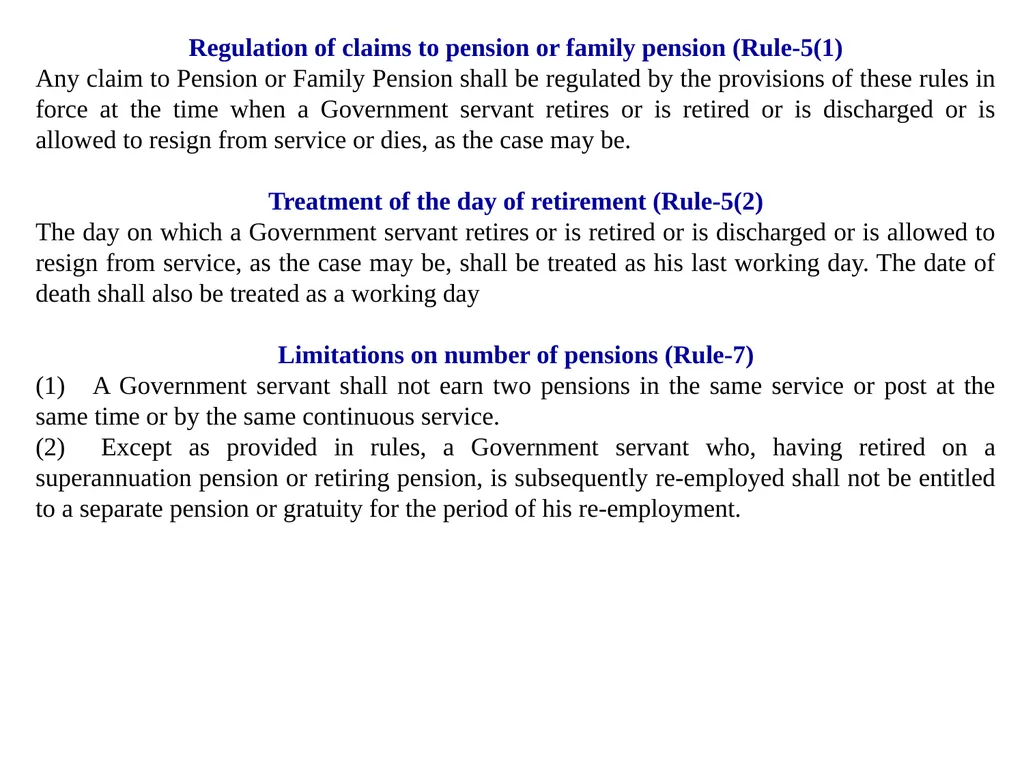
Regulation of claims to pension or family pension (Rule-5(1)
Any claim to Pension or Family Pension shall be regulated by the provisions of these rules in force at the time when a Government servant retires or is retired or is discharged or is allowed to resign from service or dies, as the case may be.
Treatment of the day of retirement (Rule-5(2)
The day on which a Government servant retires or is retired or is discharged or is allowed to resign from service, as the case may be, shall be treated as his last working day. The date of death shall also be treated as a working day
Limitations on number of pensions (Rule-7)
(1) A Government servant shall not earn two pensions in the same service or post at the same time or by the same continuous service.
(2) Except as provided in rules, a Government servant who, having retired on a superannuation pension or retiring pension, is subsequently re-employed shall not be entitled to a separate pension or gratuity for the period of his re-employment.<br>
Any claim to Pension or Family Pension shall be regulated by the provisions of these rules in force at the time when a Government servant retires or is retired or is discharged or is allowed to resign from service or dies, as the case may be.
Treatment of the day of retirement (Rule-5(2)
The day on which a Government servant retires or is retired or is discharged or is allowed to resign from service, as the case may be, shall be treated as his last working day. The date of death shall also be treated as a working day
Limitations on number of pensions (Rule-7)
(1) A Government servant shall not earn two pensions in the same service or post at the same time or by the same continuous service.
(2) Except as provided in rules, a Government servant who, having retired on a superannuation pension or retiring pension, is subsequently re-employed shall not be entitled to a separate pension or gratuity for the period of his re-employment.<br>
13
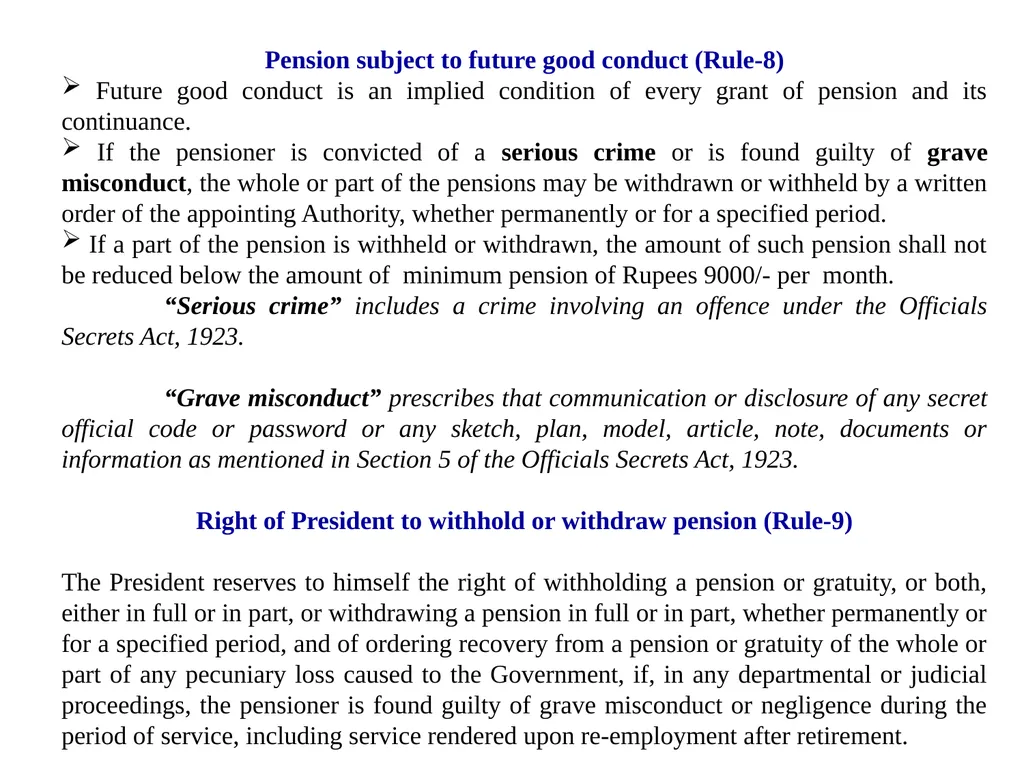
Pension subject to future good conduct (Rule-8)
Future good conduct is an implied condition of every grant of pension and its continuance.
If the pensioner is convicted of a serious crime or is found guilty of grave misconduct, the whole or part of the pensions may be withdrawn or withheld by a written order of the appointing Authority, whether permanently or for a specified period.
If a part of the pension is withheld or withdrawn, the amount of such pension shall not be reduced below the amount of minimum pension of Rupees 9000/- per month.
“Serious crime” includes a crime involving an offence under the Officials Secrets Act, 1923.
“Grave misconduct” prescribes that communication or disclosure of any secret official code or password or any sketch, plan, model, article, note, documents or information as mentioned in Section 5 of the Officials Secrets Act, 1923.
Right of President to withhold or withdraw pension (Rule-9)
The President reserves to himself the right of withholding a pension or gratuity, or both, either in full or in part, or withdrawing a pension in full or in part, whether permanently or for a specified period, and of ordering recovery from a pension or gratuity of the whole or part of any pecuniary loss caused to the Government, if, in any departmental or judicial proceedings, the pensioner is found guilty of grave misconduct or negligence during the period of service, including service rendered upon re-employment after retirement.<br>
Future good conduct is an implied condition of every grant of pension and its continuance.
If the pensioner is convicted of a serious crime or is found guilty of grave misconduct, the whole or part of the pensions may be withdrawn or withheld by a written order of the appointing Authority, whether permanently or for a specified period.
If a part of the pension is withheld or withdrawn, the amount of such pension shall not be reduced below the amount of minimum pension of Rupees 9000/- per month.
“Serious crime” includes a crime involving an offence under the Officials Secrets Act, 1923.
“Grave misconduct” prescribes that communication or disclosure of any secret official code or password or any sketch, plan, model, article, note, documents or information as mentioned in Section 5 of the Officials Secrets Act, 1923.
Right of President to withhold or withdraw pension (Rule-9)
The President reserves to himself the right of withholding a pension or gratuity, or both, either in full or in part, or withdrawing a pension in full or in part, whether permanently or for a specified period, and of ordering recovery from a pension or gratuity of the whole or part of any pecuniary loss caused to the Government, if, in any departmental or judicial proceedings, the pensioner is found guilty of grave misconduct or negligence during the period of service, including service rendered upon re-employment after retirement.<br>
14
Commercial employment after retirement (Rule-10)
If a pensioner, who immediately before his retirement was a member of Central Service, Group `A', wishes to accept any commercial employment within one year from the date of his retirement, he shall obtain the previous permission of the Central Government.
No pension shall be payable to a pensioner who accepts such an employment without proper permission in respect of any period for which he is so employed or such longer period as the Government may direct.
If a pensioner, who immediately before his retirement was a member of Central Service, Group `B', takes up any commercial employment within one year from the date of his retirement, he should give an intimation to the Ministry/Department in/or under which he last served.
Commercial employment after retirement outside India (Rule-12)
If a pensioner, who retired from Central Service, Group `A', should obtain prior permission of the Central government for accepting any employment under any Government outside India. No pension shall be payable to a pensioner who accepts such an employment without proper permission in respect of any period for which he is so employed or such longer period as the Government may direct.
EXPLANATION. - For the purposes of this rule, the expression "employment under any Government outside India" includes employment under a local authority or corporation or any other institution or organization which functions under the supervision or control of a Government outside India, or an employment, under an International Organization of which the Government of India is not a member.<br>
If a pensioner, who immediately before his retirement was a member of Central Service, Group `A', wishes to accept any commercial employment within one year from the date of his retirement, he shall obtain the previous permission of the Central Government.
No pension shall be payable to a pensioner who accepts such an employment without proper permission in respect of any period for which he is so employed or such longer period as the Government may direct.
If a pensioner, who immediately before his retirement was a member of Central Service, Group `B', takes up any commercial employment within one year from the date of his retirement, he should give an intimation to the Ministry/Department in/or under which he last served.
Commercial employment after retirement outside India (Rule-12)
If a pensioner, who retired from Central Service, Group `A', should obtain prior permission of the Central government for accepting any employment under any Government outside India. No pension shall be payable to a pensioner who accepts such an employment without proper permission in respect of any period for which he is so employed or such longer period as the Government may direct.
EXPLANATION. - For the purposes of this rule, the expression "employment under any Government outside India" includes employment under a local authority or corporation or any other institution or organization which functions under the supervision or control of a Government outside India, or an employment, under an International Organization of which the Government of India is not a member.<br>
15
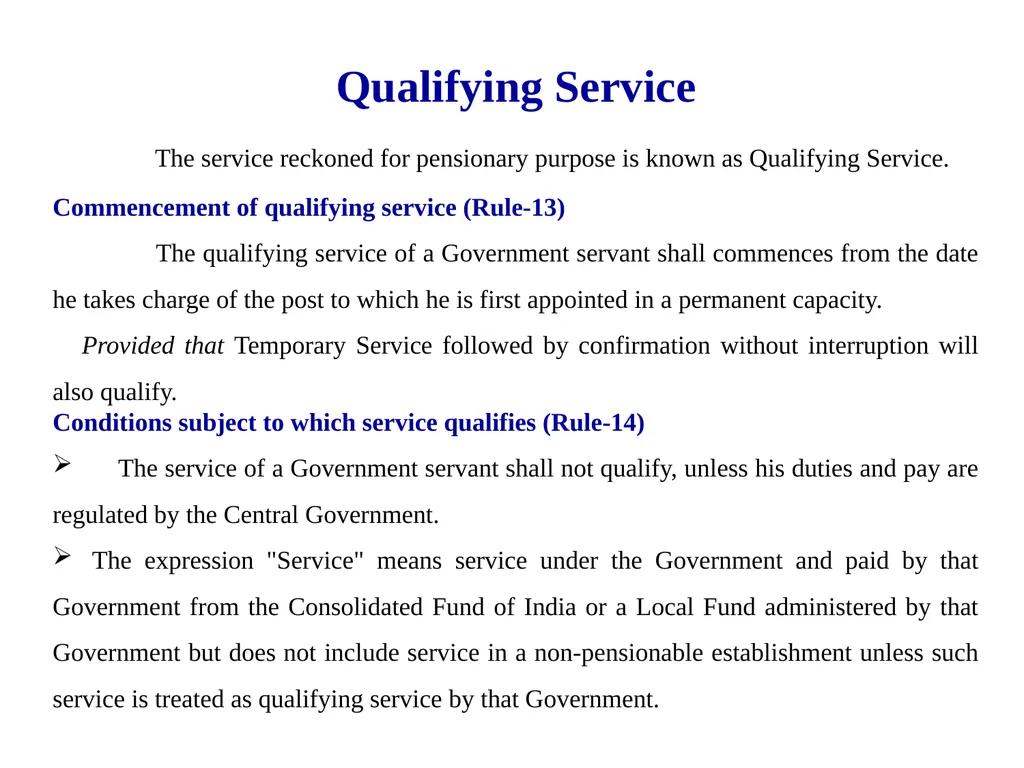
Qualifying Service
The service reckoned for pensionary purpose is known as Qualifying Service.
Commencement of qualifying service (Rule-13)
The qualifying service of a Government servant shall commences from the date he takes charge of the post to which he is first appointed in a permanent capacity.
Provided that Temporary Service followed by confirmation without interruption will also qualify.
Conditions subject to which service qualifies (Rule-14)
The service of a Government servant shall not qualify, unless his duties and pay are regulated by the Central Government.
The expression "Service" means service under the Government and paid by that Government from the Consolidated Fund of India or a Local Fund administered by that Government but does not include service in a non-pensionable establishment unless such service is treated as qualifying service by that Government.<br>
The service reckoned for pensionary purpose is known as Qualifying Service.
Commencement of qualifying service (Rule-13)
The qualifying service of a Government servant shall commences from the date he takes charge of the post to which he is first appointed in a permanent capacity.
Provided that Temporary Service followed by confirmation without interruption will also qualify.
Conditions subject to which service qualifies (Rule-14)
The service of a Government servant shall not qualify, unless his duties and pay are regulated by the Central Government.
The expression "Service" means service under the Government and paid by that Government from the Consolidated Fund of India or a Local Fund administered by that Government but does not include service in a non-pensionable establishment unless such service is treated as qualifying service by that Government.<br>
16
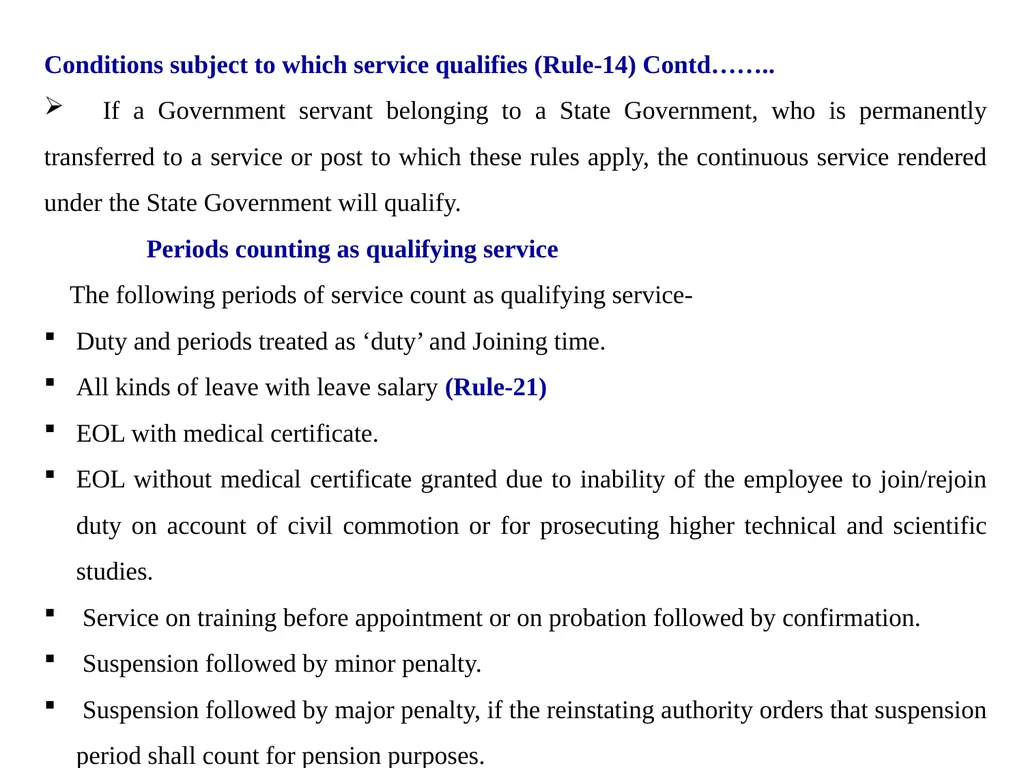
Conditions subject to which service qualifies (Rule-14) Contd……..
If a Government servant belonging to a State Government, who is permanently transferred to a service or post to which these rules apply, the continuous service rendered under the State Government will qualify.
Periods counting as qualifying service
The following periods of service count as qualifying service-
Duty and periods treated as ‘duty’ and Joining time.
All kinds of leave with leave salary (Rule-21)
EOL with medical certificate.
EOL without medical certificate granted due to inability of the employee to join/rejoin duty on account of civil commotion or for prosecuting higher technical and scientific studies.
Service on training before appointment or on probation followed by confirmation.
Suspension followed by minor penalty.
Suspension followed by major penalty, if the reinstating authority orders that suspension period shall count for pension purposes.<br>
If a Government servant belonging to a State Government, who is permanently transferred to a service or post to which these rules apply, the continuous service rendered under the State Government will qualify.
Periods counting as qualifying service
The following periods of service count as qualifying service-
Duty and periods treated as ‘duty’ and Joining time.
All kinds of leave with leave salary (Rule-21)
EOL with medical certificate.
EOL without medical certificate granted due to inability of the employee to join/rejoin duty on account of civil commotion or for prosecuting higher technical and scientific studies.
Service on training before appointment or on probation followed by confirmation.
Suspension followed by minor penalty.
Suspension followed by major penalty, if the reinstating authority orders that suspension period shall count for pension purposes.<br>
17
Periods not counting as qualifying service
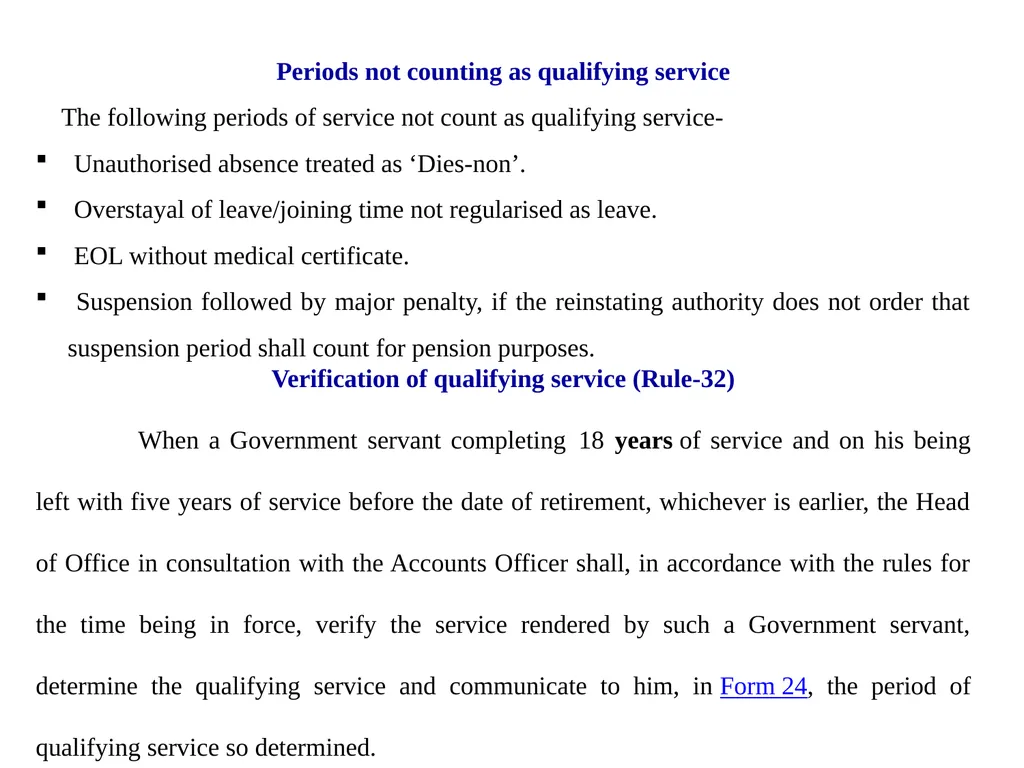
The following periods of service not count as qualifying service-
Unauthorised absence treated as ‘Dies-non’.
Overstayal of leave/joining time not regularised as leave.
EOL without medical certificate.
Suspension followed by major penalty, if the reinstating authority does not order that suspension period shall count for pension purposes.
Verification of qualifying service (Rule-32)
When a Government servant completing 18 years of service and on his being left with five years of service before the date of retirement, whichever is earlier, the Head of Office in consultation with the Accounts Officer shall, in accordance with the rules for the time being in force, verify the service rendered by such a Government servant, determine the qualifying service and communicate to him, in Form 24, the period of qualifying service so determined.<br>
The following periods of service not count as qualifying service-
Unauthorised absence treated as ‘Dies-non’.
Overstayal of leave/joining time not regularised as leave.
EOL without medical certificate.
Suspension followed by major penalty, if the reinstating authority does not order that suspension period shall count for pension purposes.
Verification of qualifying service (Rule-32)
When a Government servant completing 18 years of service and on his being left with five years of service before the date of retirement, whichever is earlier, the Head of Office in consultation with the Accounts Officer shall, in accordance with the rules for the time being in force, verify the service rendered by such a Government servant, determine the qualifying service and communicate to him, in Form 24, the period of qualifying service so determined.<br>
18
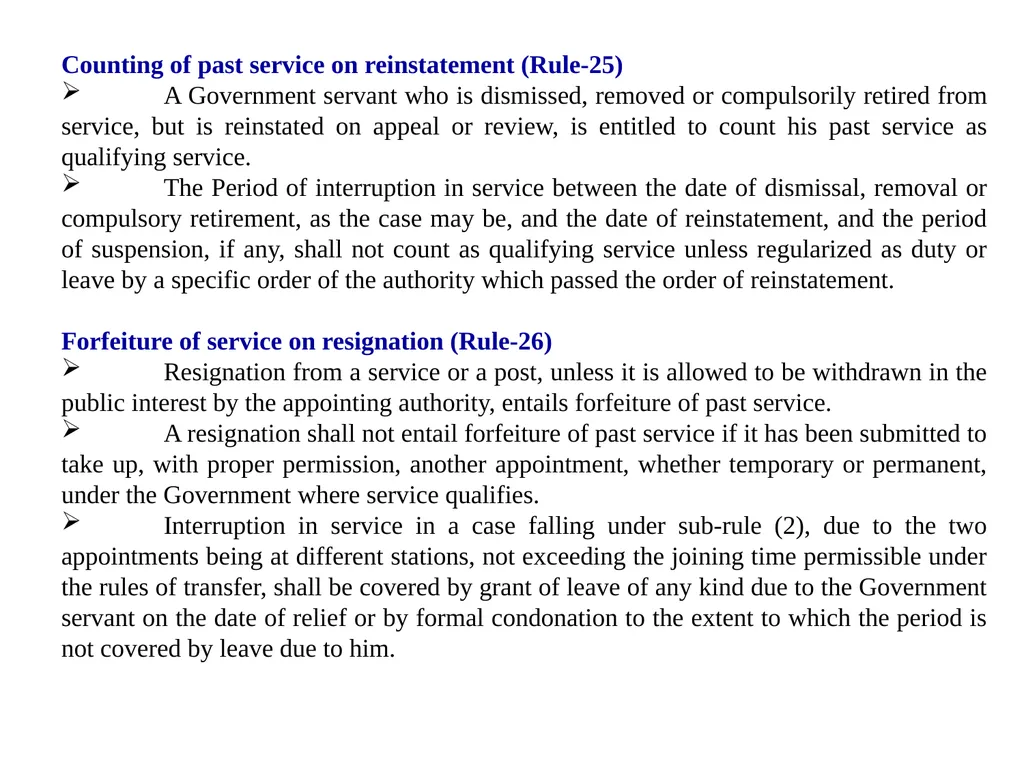
Counting of past service on reinstatement (Rule-25)
A Government servant who is dismissed, removed or compulsorily retired from service, but is reinstated on appeal or review, is entitled to count his past service as qualifying service.
The Period of interruption in service between the date of dismissal, removal or compulsory retirement, as the case may be, and the date of reinstatement, and the period of suspension, if any, shall not count as qualifying service unless regularized as duty or leave by a specific order of the authority which passed the order of reinstatement.
Forfeiture of service on resignation (Rule-26)
Resignation from a service or a post, unless it is allowed to be withdrawn in the public interest by the appointing authority, entails forfeiture of past service.
A resignation shall not entail forfeiture of past service if it has been submitted to take up, with proper permission, another appointment, whether temporary or permanent, under the Government where service qualifies.
Interruption in service in a case falling under sub-rule (2), due to the two appointments being at different stations, not exceeding the joining time permissible under the rules of transfer, shall be covered by grant of leave of any kind due to the Government servant on the date of relief or by formal condonation to the extent to which the period is not covered by leave due to him.<br>
A Government servant who is dismissed, removed or compulsorily retired from service, but is reinstated on appeal or review, is entitled to count his past service as qualifying service.
The Period of interruption in service between the date of dismissal, removal or compulsory retirement, as the case may be, and the date of reinstatement, and the period of suspension, if any, shall not count as qualifying service unless regularized as duty or leave by a specific order of the authority which passed the order of reinstatement.
Forfeiture of service on resignation (Rule-26)
Resignation from a service or a post, unless it is allowed to be withdrawn in the public interest by the appointing authority, entails forfeiture of past service.
A resignation shall not entail forfeiture of past service if it has been submitted to take up, with proper permission, another appointment, whether temporary or permanent, under the Government where service qualifies.
Interruption in service in a case falling under sub-rule (2), due to the two appointments being at different stations, not exceeding the joining time permissible under the rules of transfer, shall be covered by grant of leave of any kind due to the Government servant on the date of relief or by formal condonation to the extent to which the period is not covered by leave due to him.<br>
19
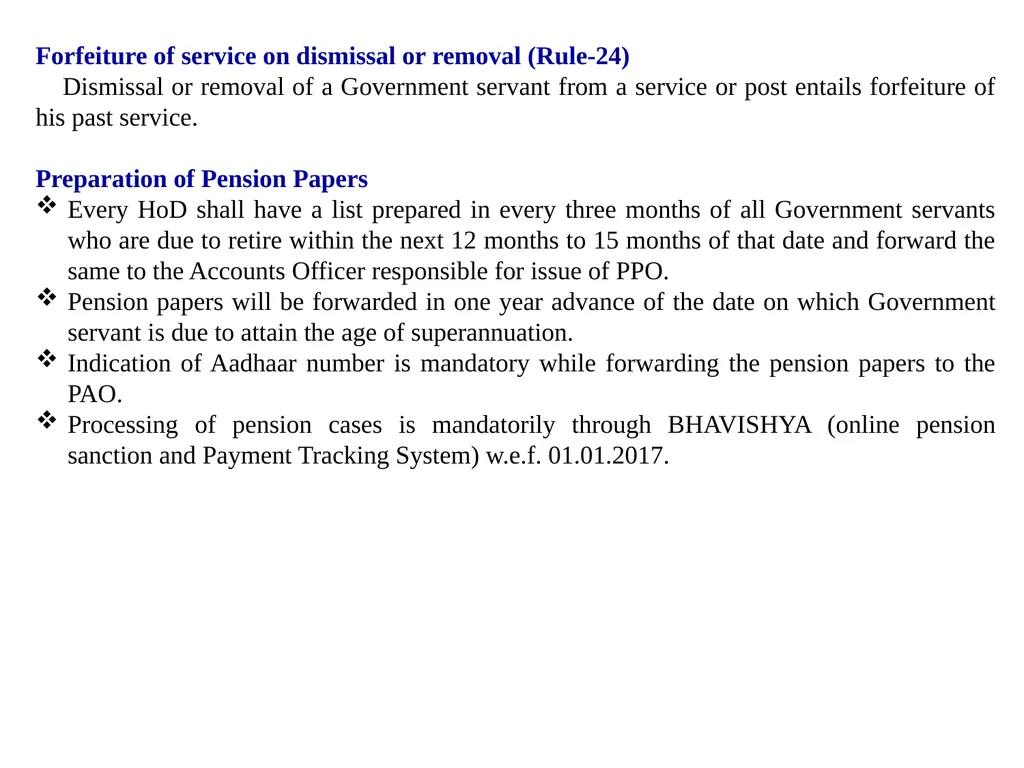
Forfeiture of service on dismissal or removal (Rule-24)
Dismissal or removal of a Government servant from a service or post entails forfeiture of his past service.
Preparation of Pension Papers
Every HoD shall have a list prepared in every three months of all Government servants who are due to retire within the next 12 months to 15 months of that date and forward the same to the Accounts Officer responsible for issue of PPO.
Pension papers will be forwarded in one year advance of the date on which Government servant is due to attain the age of superannuation.
Indication of Aadhaar number is mandatory while forwarding the pension papers to the PAO.
Processing of pension cases is mandatorily through BHAVISHYA (online pension sanction and Payment Tracking System) w.e.f. 01.01.2017.<br>
Dismissal or removal of a Government servant from a service or post entails forfeiture of his past service.
Preparation of Pension Papers
Every HoD shall have a list prepared in every three months of all Government servants who are due to retire within the next 12 months to 15 months of that date and forward the same to the Accounts Officer responsible for issue of PPO.
Pension papers will be forwarded in one year advance of the date on which Government servant is due to attain the age of superannuation.
Indication of Aadhaar number is mandatory while forwarding the pension papers to the PAO.
Processing of pension cases is mandatorily through BHAVISHYA (online pension sanction and Payment Tracking System) w.e.f. 01.01.2017.<br>
20
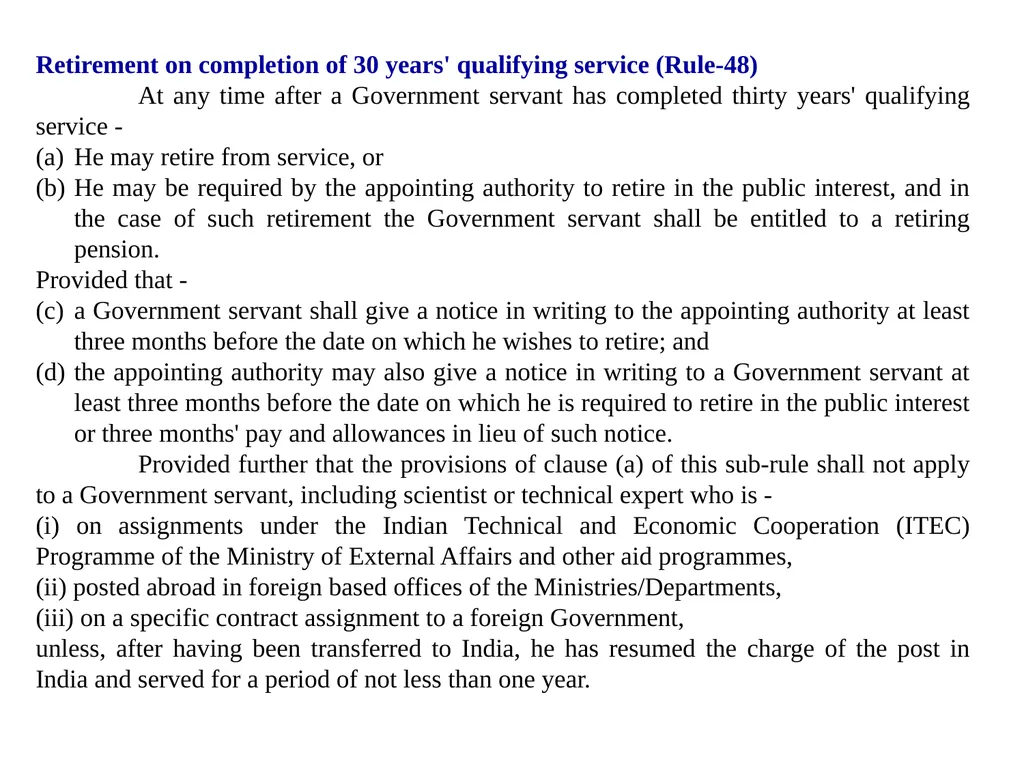
Retirement on completion of 30 years' qualifying service (Rule-48)
At any time after a Government servant has completed thirty years' qualifying service -
He may retire from service, or
He may be required by the appointing authority to retire in the public interest, and in the case of such retirement the Government servant shall be entitled to a retiring pension.
Provided that -
a Government servant shall give a notice in writing to the appointing authority at least three months before the date on which he wishes to retire; and
the appointing authority may also give a notice in writing to a Government servant at least three months before the date on which he is required to retire in the public interest or three months' pay and allowances in lieu of such notice.
Provided further that the provisions of clause (a) of this sub-rule shall not apply to a Government servant, including scientist or technical expert who is -
(i) on assignments under the Indian Technical and Economic Cooperation (ITEC) Programme of the Ministry of External Affairs and other aid programmes,
(ii) posted abroad in foreign based offices of the Ministries/Departments,
(iii) on a specific contract assignment to a foreign Government,
unless, after having been transferred to India, he has resumed the charge of the post in India and served for a period of not less than one year.<br>
At any time after a Government servant has completed thirty years' qualifying service -
He may retire from service, or
He may be required by the appointing authority to retire in the public interest, and in the case of such retirement the Government servant shall be entitled to a retiring pension.
Provided that -
a Government servant shall give a notice in writing to the appointing authority at least three months before the date on which he wishes to retire; and
the appointing authority may also give a notice in writing to a Government servant at least three months before the date on which he is required to retire in the public interest or three months' pay and allowances in lieu of such notice.
Provided further that the provisions of clause (a) of this sub-rule shall not apply to a Government servant, including scientist or technical expert who is -
(i) on assignments under the Indian Technical and Economic Cooperation (ITEC) Programme of the Ministry of External Affairs and other aid programmes,
(ii) posted abroad in foreign based offices of the Ministries/Departments,
(iii) on a specific contract assignment to a foreign Government,
unless, after having been transferred to India, he has resumed the charge of the post in India and served for a period of not less than one year.<br>
21
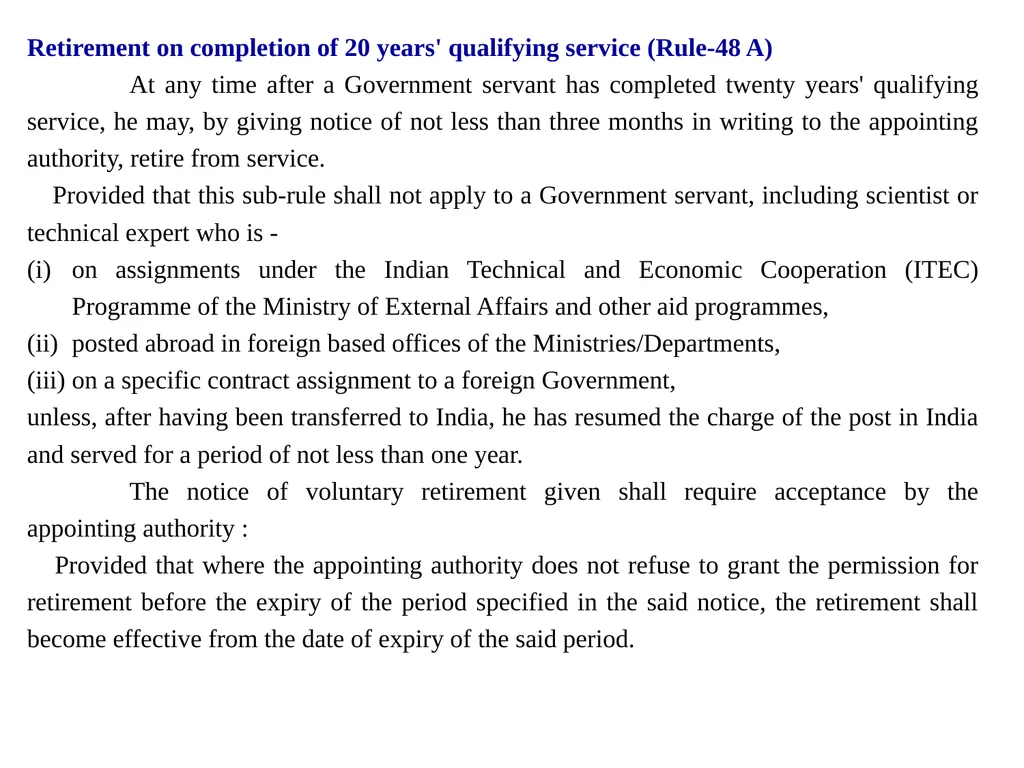
Retirement on completion of 20 years' qualifying service (Rule-48 A)
At any time after a Government servant has completed twenty years' qualifying service, he may, by giving notice of not less than three months in writing to the appointing authority, retire from service.
Provided that this sub-rule shall not apply to a Government servant, including scientist or technical expert who is -
on assignments under the Indian Technical and Economic Cooperation (ITEC) Programme of the Ministry of External Affairs and other aid programmes,
posted abroad in foreign based offices of the Ministries/Departments,
on a specific contract assignment to a foreign Government,
unless, after having been transferred to India, he has resumed the charge of the post in India and served for a period of not less than one year.
The notice of voluntary retirement given shall require acceptance by the appointing authority :
Provided that where the appointing authority does not refuse to grant the permission for retirement before the expiry of the period specified in the said notice, the retirement shall become effective from the date of expiry of the said period.<br>
At any time after a Government servant has completed twenty years' qualifying service, he may, by giving notice of not less than three months in writing to the appointing authority, retire from service.
Provided that this sub-rule shall not apply to a Government servant, including scientist or technical expert who is -
on assignments under the Indian Technical and Economic Cooperation (ITEC) Programme of the Ministry of External Affairs and other aid programmes,
posted abroad in foreign based offices of the Ministries/Departments,
on a specific contract assignment to a foreign Government,
unless, after having been transferred to India, he has resumed the charge of the post in India and served for a period of not less than one year.
The notice of voluntary retirement given shall require acceptance by the appointing authority :
Provided that where the appointing authority does not refuse to grant the permission for retirement before the expiry of the period specified in the said notice, the retirement shall become effective from the date of expiry of the said period.<br>
22
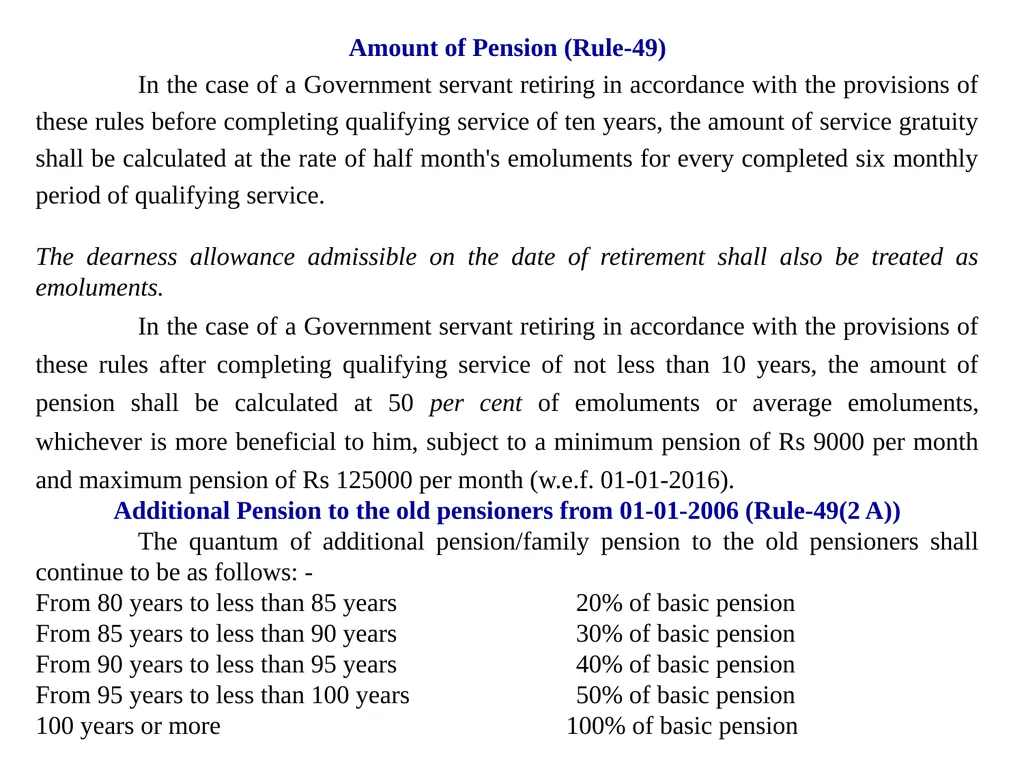
Amount of Pension (Rule-49)
In the case of a Government servant retiring in accordance with the provisions of these rules before completing qualifying service of ten years, the amount of service gratuity shall be calculated at the rate of half month's emoluments for every completed six monthly period of qualifying service.
The dearness allowance admissible on the date of retirement shall also be treated as emoluments.
In the case of a Government servant retiring in accordance with the provisions of these rules after completing qualifying service of not less than 10 years, the amount of pension shall be calculated at 50 per cent of emoluments or average emoluments, whichever is more beneficial to him, subject to a minimum pension of Rs 9000 per month and maximum pension of Rs 125000 per month (w.e.f. 01-01-2016).
Additional Pension to the old pensioners from 01-01-2006 (Rule-49(2 A))
The quantum of additional pension/family pension to the old pensioners shall continue to be as follows: -
From 80 years to less than 85 years 20% of basic pension
From 85 years to less than 90 years 30% of basic pension
From 90 years to less than 95 years 40% of basic pension
From 95 years to less than 100 years 50% of basic pension
100 years or more 100% of basic pension<br>
In the case of a Government servant retiring in accordance with the provisions of these rules before completing qualifying service of ten years, the amount of service gratuity shall be calculated at the rate of half month's emoluments for every completed six monthly period of qualifying service.
The dearness allowance admissible on the date of retirement shall also be treated as emoluments.
In the case of a Government servant retiring in accordance with the provisions of these rules after completing qualifying service of not less than 10 years, the amount of pension shall be calculated at 50 per cent of emoluments or average emoluments, whichever is more beneficial to him, subject to a minimum pension of Rs 9000 per month and maximum pension of Rs 125000 per month (w.e.f. 01-01-2016).
Additional Pension to the old pensioners from 01-01-2006 (Rule-49(2 A))
The quantum of additional pension/family pension to the old pensioners shall continue to be as follows: -
From 80 years to less than 85 years 20% of basic pension
From 85 years to less than 90 years 30% of basic pension
From 90 years to less than 95 years 40% of basic pension
From 95 years to less than 100 years 50% of basic pension
100 years or more 100% of basic pension<br>
23
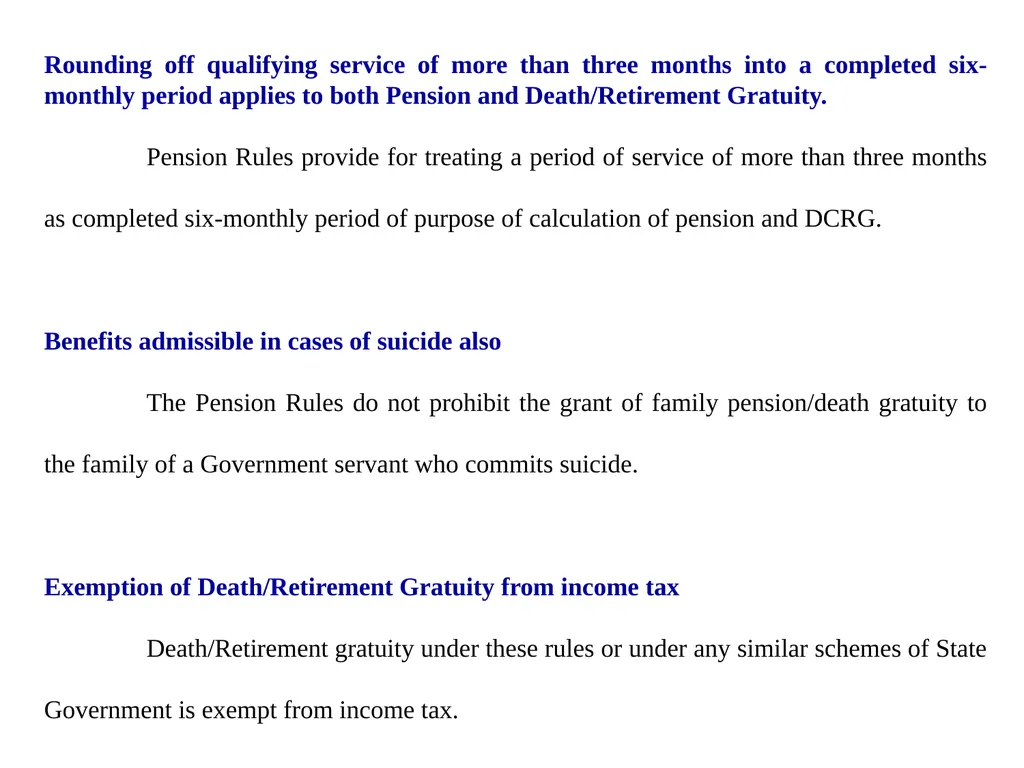
Rounding off qualifying service of more than three months into a completed six-monthly period applies to both Pension and Death/Retirement Gratuity.
Pension Rules provide for treating a period of service of more than three months as completed six-monthly period of purpose of calculation of pension and DCRG.
Benefits admissible in cases of suicide also
The Pension Rules do not prohibit the grant of family pension/death gratuity to the family of a Government servant who commits suicide.
Exemption of Death/Retirement Gratuity from income tax
Death/Retirement gratuity under these rules or under any similar schemes of State Government is exempt from income tax.<br>
Pension Rules provide for treating a period of service of more than three months as completed six-monthly period of purpose of calculation of pension and DCRG.
Benefits admissible in cases of suicide also
The Pension Rules do not prohibit the grant of family pension/death gratuity to the family of a Government servant who commits suicide.
Exemption of Death/Retirement Gratuity from income tax
Death/Retirement gratuity under these rules or under any similar schemes of State Government is exempt from income tax.<br>
24
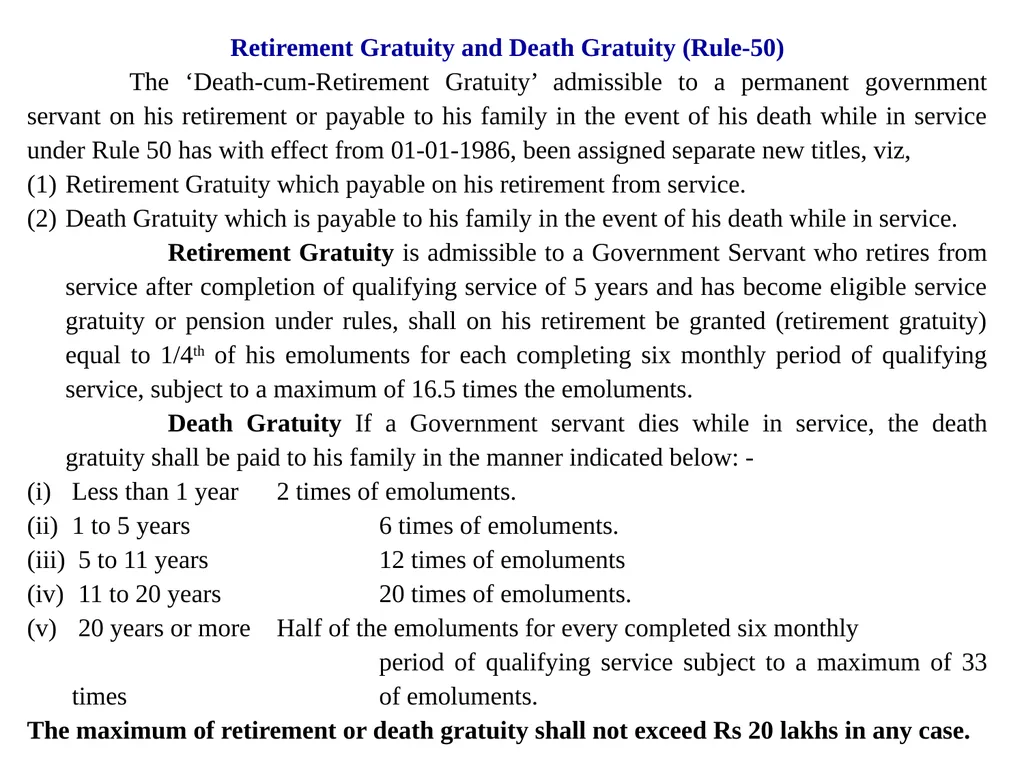
Retirement Gratuity and Death Gratuity (Rule-50)
The ‘Death-cum-Retirement Gratuity’ admissible to a permanent government servant on his retirement or payable to his family in the event of his death while in service under Rule 50 has with effect from 01-01-1986, been assigned separate new titles, viz,
Retirement Gratuity which payable on his retirement from service.
Death Gratuity which is payable to his family in the event of his death while in service.
Retirement Gratuity is admissible to a Government Servant who retires from service after completion of qualifying service of 5 years and has become eligible service gratuity or pension under rules, shall on his retirement be granted (retirement gratuity) equal to 1/4th of his emoluments for each completing six monthly period of qualifying service, subject to a maximum of 16.5 times the emoluments.
Death Gratuity If a Government servant dies while in service, the death gratuity shall be paid to his family in the manner indicated below: -
Less than 1 year 2 times of emoluments.
1 to 5 years 6 times of emoluments.
5 to 11 years 12 times of emoluments
11 to 20 years 20 times of emoluments.
20 years or more Half of the emoluments for every completed six monthly
period of qualifying service subject to a maximum of 33 times of emoluments.
The maximum of retirement or death gratuity shall not exceed Rs 20 lakhs in any case.<br>
The ‘Death-cum-Retirement Gratuity’ admissible to a permanent government servant on his retirement or payable to his family in the event of his death while in service under Rule 50 has with effect from 01-01-1986, been assigned separate new titles, viz,
Retirement Gratuity which payable on his retirement from service.
Death Gratuity which is payable to his family in the event of his death while in service.
Retirement Gratuity is admissible to a Government Servant who retires from service after completion of qualifying service of 5 years and has become eligible service gratuity or pension under rules, shall on his retirement be granted (retirement gratuity) equal to 1/4th of his emoluments for each completing six monthly period of qualifying service, subject to a maximum of 16.5 times the emoluments.
Death Gratuity If a Government servant dies while in service, the death gratuity shall be paid to his family in the manner indicated below: -
Less than 1 year 2 times of emoluments.
1 to 5 years 6 times of emoluments.
5 to 11 years 12 times of emoluments
11 to 20 years 20 times of emoluments.
20 years or more Half of the emoluments for every completed six monthly
period of qualifying service subject to a maximum of 33 times of emoluments.
The maximum of retirement or death gratuity shall not exceed Rs 20 lakhs in any case.<br>
25
Nominations (Rule-53)
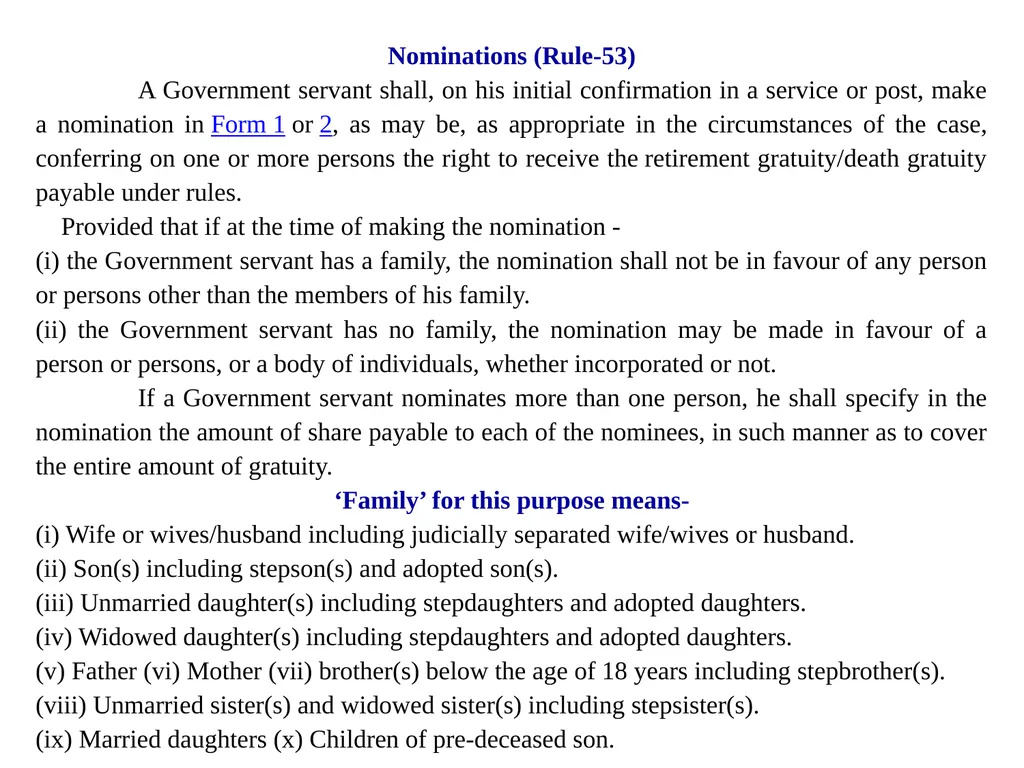
A Government servant shall, on his initial confirmation in a service or post, make a nomination in Form 1 or 2, as may be, as appropriate in the circumstances of the case, conferring on one or more persons the right to receive the retirement gratuity/death gratuity payable under rules.
Provided that if at the time of making the nomination -
(i) the Government servant has a family, the nomination shall not be in favour of any person or persons other than the members of his family.
(ii) the Government servant has no family, the nomination may be made in favour of a person or persons, or a body of individuals, whether incorporated or not.
If a Government servant nominates more than one person, he shall specify in the nomination the amount of share payable to each of the nominees, in such manner as to cover the entire amount of gratuity.
‘Family’ for this purpose means-
(i) Wife or wives/husband including judicially separated wife/wives or husband.
(ii) Son(s) including stepson(s) and adopted son(s).
(iii) Unmarried daughter(s) including stepdaughters and adopted daughters.
(iv) Widowed daughter(s) including stepdaughters and adopted daughters.
(v) Father (vi) Mother (vii) brother(s) below the age of 18 years including stepbrother(s).
(viii) Unmarried sister(s) and widowed sister(s) including stepsister(s).
(ix) Married daughters (x) Children of pre-deceased son.<br>
A Government servant shall, on his initial confirmation in a service or post, make a nomination in Form 1 or 2, as may be, as appropriate in the circumstances of the case, conferring on one or more persons the right to receive the retirement gratuity/death gratuity payable under rules.
Provided that if at the time of making the nomination -
(i) the Government servant has a family, the nomination shall not be in favour of any person or persons other than the members of his family.
(ii) the Government servant has no family, the nomination may be made in favour of a person or persons, or a body of individuals, whether incorporated or not.
If a Government servant nominates more than one person, he shall specify in the nomination the amount of share payable to each of the nominees, in such manner as to cover the entire amount of gratuity.
‘Family’ for this purpose means-
(i) Wife or wives/husband including judicially separated wife/wives or husband.
(ii) Son(s) including stepson(s) and adopted son(s).
(iii) Unmarried daughter(s) including stepdaughters and adopted daughters.
(iv) Widowed daughter(s) including stepdaughters and adopted daughters.
(v) Father (vi) Mother (vii) brother(s) below the age of 18 years including stepbrother(s).
(viii) Unmarried sister(s) and widowed sister(s) including stepsister(s).
(ix) Married daughters (x) Children of pre-deceased son.<br>
26
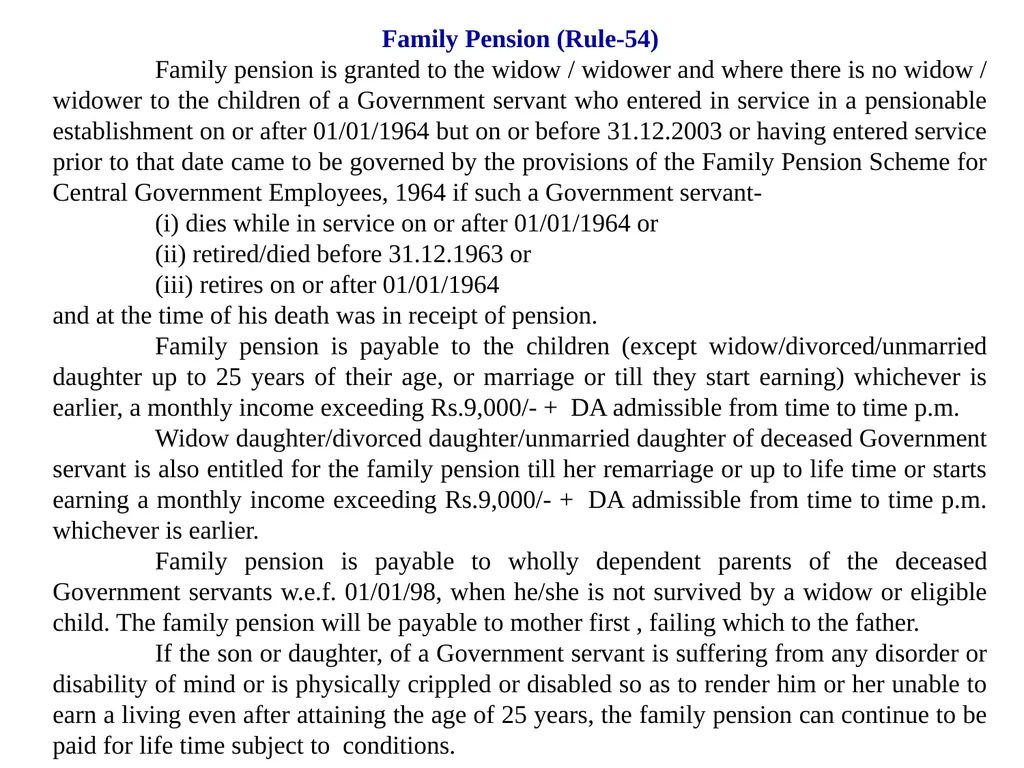
Family Pension (Rule-54)
Family pension is granted to the widow / widower and where there is no widow / widower to the children of a Government servant who entered in service in a pensionable establishment on or after 01/01/1964 but on or before 31.12.2003 or having entered service prior to that date came to be governed by the provisions of the Family Pension Scheme for Central Government Employees, 1964 if such a Government servant-
(i) dies while in service on or after 01/01/1964 or
(ii) retired/died before 31.12.1963 or
(iii) retires on or after 01/01/1964
and at the time of his death was in receipt of pension.
Family pension is payable to the children (except widow/divorced/unmarried daughter up to 25 years of their age, or marriage or till they start earning) whichever is earlier, a monthly income exceeding Rs.9,000/- + DA admissible from time to time p.m.
Widow daughter/divorced daughter/unmarried daughter of deceased Government servant is also entitled for the family pension till her remarriage or up to life time or starts earning a monthly income exceeding Rs.9,000/- + DA admissible from time to time p.m. whichever is earlier.
Family pension is payable to wholly dependent parents of the deceased Government servants w.e.f. 01/01/98, when he/she is not survived by a widow or eligible child. The family pension will be payable to mother first , failing which to the father.
If the son or daughter, of a Government servant is suffering from any disorder or disability of mind or is physically crippled or disabled so as to render him or her unable to earn a living even after attaining the age of 25 years, the family pension can continue to be paid for life time subject to conditions.<br>
Family pension is granted to the widow / widower and where there is no widow / widower to the children of a Government servant who entered in service in a pensionable establishment on or after 01/01/1964 but on or before 31.12.2003 or having entered service prior to that date came to be governed by the provisions of the Family Pension Scheme for Central Government Employees, 1964 if such a Government servant-
(i) dies while in service on or after 01/01/1964 or
(ii) retired/died before 31.12.1963 or
(iii) retires on or after 01/01/1964
and at the time of his death was in receipt of pension.
Family pension is payable to the children (except widow/divorced/unmarried daughter up to 25 years of their age, or marriage or till they start earning) whichever is earlier, a monthly income exceeding Rs.9,000/- + DA admissible from time to time p.m.
Widow daughter/divorced daughter/unmarried daughter of deceased Government servant is also entitled for the family pension till her remarriage or up to life time or starts earning a monthly income exceeding Rs.9,000/- + DA admissible from time to time p.m. whichever is earlier.
Family pension is payable to wholly dependent parents of the deceased Government servants w.e.f. 01/01/98, when he/she is not survived by a widow or eligible child. The family pension will be payable to mother first , failing which to the father.
If the son or daughter, of a Government servant is suffering from any disorder or disability of mind or is physically crippled or disabled so as to render him or her unable to earn a living even after attaining the age of 25 years, the family pension can continue to be paid for life time subject to conditions.<br>
27
Commutation of Pension
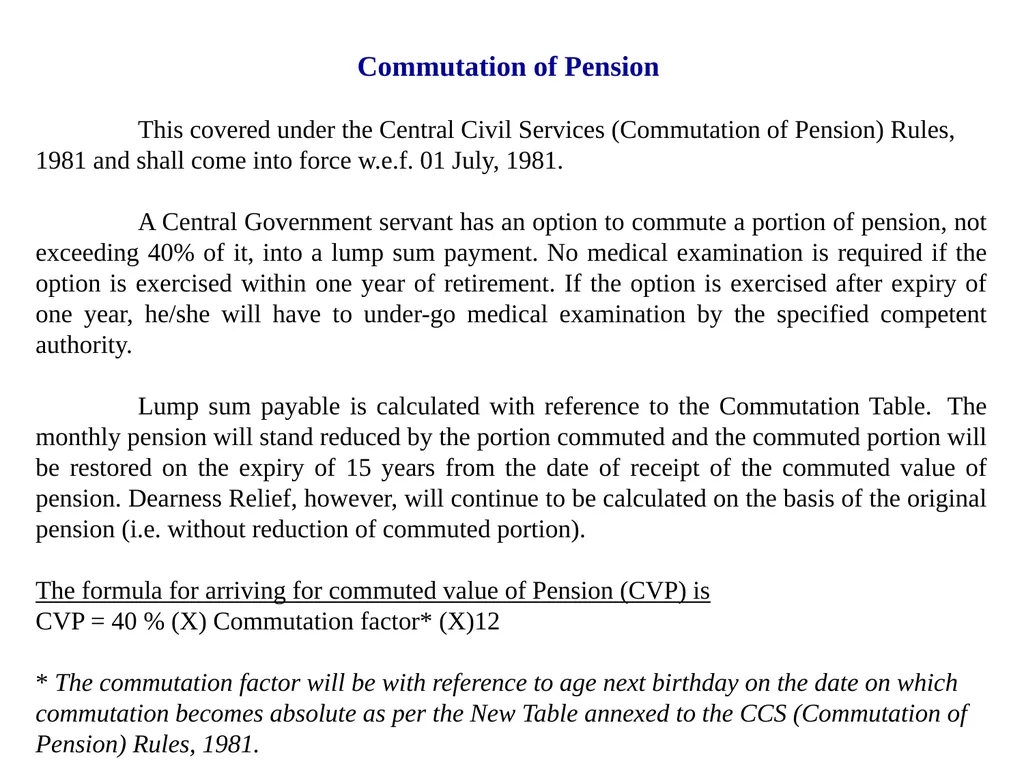
This covered under the Central Civil Services (Commutation of Pension) Rules, 1981 and shall come into force w.e.f. 01 July, 1981.
A Central Government servant has an option to commute a portion of pension, not exceeding 40% of it, into a lump sum payment. No medical examination is required if the option is exercised within one year of retirement. If the option is exercised after expiry of one year, he/she will have to under-go medical examination by the specified competent authority.
Lump sum payable is calculated with reference to the Commutation Table. The monthly pension will stand reduced by the portion commuted and the commuted portion will be restored on the expiry of 15 years from the date of receipt of the commuted value of pension. Dearness Relief, however, will continue to be calculated on the basis of the original pension (i.e. without reduction of commuted portion).
The formula for arriving for commuted value of Pension (CVP) is CVP = 40 % (X) Commutation factor* (X)12 * The commutation factor will be with reference to age next birthday on the date on which commutation becomes absolute as per the New Table annexed to the CCS (Commutation of Pension) Rules, 1981.<br>
This covered under the Central Civil Services (Commutation of Pension) Rules, 1981 and shall come into force w.e.f. 01 July, 1981.
A Central Government servant has an option to commute a portion of pension, not exceeding 40% of it, into a lump sum payment. No medical examination is required if the option is exercised within one year of retirement. If the option is exercised after expiry of one year, he/she will have to under-go medical examination by the specified competent authority.
Lump sum payable is calculated with reference to the Commutation Table. The monthly pension will stand reduced by the portion commuted and the commuted portion will be restored on the expiry of 15 years from the date of receipt of the commuted value of pension. Dearness Relief, however, will continue to be calculated on the basis of the original pension (i.e. without reduction of commuted portion).
The formula for arriving for commuted value of Pension (CVP) is CVP = 40 % (X) Commutation factor* (X)12 * The commutation factor will be with reference to age next birthday on the date on which commutation becomes absolute as per the New Table annexed to the CCS (Commutation of Pension) Rules, 1981.<br>
28
Thanks<br>