
CELL AUTONOMY AND CELL POLARITY CELL AUTONOMY
PT
Published · 17 slides · 0 views

1 / 1



Description
CELL AUTONOMY AND CELL POLARITY CELL AUTONOMY Plant development is critically dependent on the interactions between clonally unrelated cell layers. The cross-talk between layers can be addressed by studies of cell autonomy. Cell autonomy is
Related Topics
Share
Embed code
Download this presentation From Below
"CELL AUTONOMY AND CELL POLARITY CELL AUTONOMY" is the property of its rightful owner. Permission is granted to download and print the materials on this website for personal, non-commercial use only, and to display it on your personal computer provided you do not modify the materials and that you retain all copyright notices contained in the materials. By downloading content from our website, you accept the terms of this agreement.
Presentation Transcript
01
CELL AUTONOMY AND CELL POLARITY<br>
02
CELL AUTONOMY
Plant development is critically dependent on the interactions between clonally unrelated cell layers.
The cross-talk between layers can be addressed by studies of cell autonomy.
Cell autonomy is a property of genetic mosaics composed of cells of differing genotypes.
Broadly, if the phenotype of a mutant tissue reflects only its genotype and is unaffected by the presence of wild-type tissue, the trait is cell-autonomous.
Conversely, if the phenotype of a mutant tissue reflects that of wild-type tissue in the mosaic, the trait is non-autonomous.
Plant growth and development is a plastic process involving coordination between organs, primordia, cell layers, tissues and meristems.
This coordination must involve static elements and mobile signals to pass information from one place to another.
Studies of cell autonomy seek to address questions on the mobility and site of action of gene products (and signals downstream of them) by using genetic mosaics or chimeras to assess where genes need to be present to result in a given phenotype (wild-type or mutant).<br>
Plant development is critically dependent on the interactions between clonally unrelated cell layers.
The cross-talk between layers can be addressed by studies of cell autonomy.
Cell autonomy is a property of genetic mosaics composed of cells of differing genotypes.
Broadly, if the phenotype of a mutant tissue reflects only its genotype and is unaffected by the presence of wild-type tissue, the trait is cell-autonomous.
Conversely, if the phenotype of a mutant tissue reflects that of wild-type tissue in the mosaic, the trait is non-autonomous.
Plant growth and development is a plastic process involving coordination between organs, primordia, cell layers, tissues and meristems.
This coordination must involve static elements and mobile signals to pass information from one place to another.
Studies of cell autonomy seek to address questions on the mobility and site of action of gene products (and signals downstream of them) by using genetic mosaics or chimeras to assess where genes need to be present to result in a given phenotype (wild-type or mutant).<br>
03
A mutant trait can be considered autonomous if the phenotype is not suppressed by wild-type tissue, and non-autonomous if the trait is not seen in plants containing wild-type tissue.
For example, most chlorophyll deficiencies behave in a cell-autonomous way, and sectors of mutant tissue typically have a mutant (yellow or albino) phenotype irrespective of the presence of adjacent wild-type (green) tissue.
Developmental mutants often show more complex patterns of autonomy and non-autonomy.
Patterns have been reported with mutant tissue influencing wild-type tissue in a nonautonomous manner and the converse.
Part of this apparent complexity is the real complexity of development and crosstalk between cells in developing plants, and part is due to the experimental methods used to make the chimeras.
For many methods of making chimeras, genetic events are induced (often by irradiation), resulting in marked sectors of tissue of known genotype in the mature plant<br>
For example, most chlorophyll deficiencies behave in a cell-autonomous way, and sectors of mutant tissue typically have a mutant (yellow or albino) phenotype irrespective of the presence of adjacent wild-type (green) tissue.
Developmental mutants often show more complex patterns of autonomy and non-autonomy.
Patterns have been reported with mutant tissue influencing wild-type tissue in a nonautonomous manner and the converse.
Part of this apparent complexity is the real complexity of development and crosstalk between cells in developing plants, and part is due to the experimental methods used to make the chimeras.
For many methods of making chimeras, genetic events are induced (often by irradiation), resulting in marked sectors of tissue of known genotype in the mature plant<br>
04
Chimeras induced in this way are a product of the interactions between the genotype of the tissue and the underlying pattern of cell fate of the marked tissue.
Cell autonomy cannot be separated from an understanding of cell fate and its consequences for marked cell lineages.
General methods of generating mosaic plants for studies of cell autonomy
For many years, investigations of cell autonomy and cell fate have been carried out in maize.
The richness and depth of maize genetics makes the work both more subtle and in some ways technically easier than in Arabidopsis.
X-ray-induced loss of the wild-type allele of colour marker genes in heterozygous plants has been used to study cell fate in maize.
Chlorophyll deficiency has also been used to mark lineages of genetically different tissues in X-ray-induced chimeras.
In these experiments, loss of a dominant mutation in heterozygotes or loss of the wild-type allele in heterozygotes is monitored by the use of a recessive colour marker in trans.
The former method gives genetically wild-type tissue in otherwise mutant plants, and the second arrangement does the reverse.
These studies are comparatively simple in maize as there are many colour markers available at many different chromosome locations.<br>
Cell autonomy cannot be separated from an understanding of cell fate and its consequences for marked cell lineages.
General methods of generating mosaic plants for studies of cell autonomy
For many years, investigations of cell autonomy and cell fate have been carried out in maize.
The richness and depth of maize genetics makes the work both more subtle and in some ways technically easier than in Arabidopsis.
X-ray-induced loss of the wild-type allele of colour marker genes in heterozygous plants has been used to study cell fate in maize.
Chlorophyll deficiency has also been used to mark lineages of genetically different tissues in X-ray-induced chimeras.
In these experiments, loss of a dominant mutation in heterozygotes or loss of the wild-type allele in heterozygotes is monitored by the use of a recessive colour marker in trans.
The former method gives genetically wild-type tissue in otherwise mutant plants, and the second arrangement does the reverse.
These studies are comparatively simple in maize as there are many colour markers available at many different chromosome locations.<br>
05
Radiation-induced loss of genetic information is not the only means to investigate cell autonomy.
For example, graft chimeras between plants of differing genotypes have the potential to answer broad questions of autonomy and long-range signaling between stock and scion.
The strength of the approach depends rather on the types of grafts that can be prepared.
In most plants, it is possible to address questions concerning signals passing from root to shoot and vice versa.
Plants can be produced with two shoots on a single stock using the ‘Y graft’ technique, and such plants can be used to assess signals passing between shoots.
In pea and petunia, complex grafts have been created involving multiple root stocks and/or sections of stem.
In tomato, it is possible to synthesize plants with different layers of the SAM of different genotypes.
This allows a very detailed analysis of the roles of the individual meristem layers in the specification of developmental phenotypes.
The older literature reports a variety of interspecies periclinal graft chimeras among the solanacae and citrus species.
Transposon excision has the potential to generate genetic mosaics with wild-type sectors in a mutant background, and this has been exploited using reversion of Tam3 mutants in Antirrhinum.
There is no specific marker associated with the reversion events, and the layer genotypes had to be deduced from the phenotypes and in situ hybridization.<br>
For example, graft chimeras between plants of differing genotypes have the potential to answer broad questions of autonomy and long-range signaling between stock and scion.
The strength of the approach depends rather on the types of grafts that can be prepared.
In most plants, it is possible to address questions concerning signals passing from root to shoot and vice versa.
Plants can be produced with two shoots on a single stock using the ‘Y graft’ technique, and such plants can be used to assess signals passing between shoots.
In pea and petunia, complex grafts have been created involving multiple root stocks and/or sections of stem.
In tomato, it is possible to synthesize plants with different layers of the SAM of different genotypes.
This allows a very detailed analysis of the roles of the individual meristem layers in the specification of developmental phenotypes.
The older literature reports a variety of interspecies periclinal graft chimeras among the solanacae and citrus species.
Transposon excision has the potential to generate genetic mosaics with wild-type sectors in a mutant background, and this has been exploited using reversion of Tam3 mutants in Antirrhinum.
There is no specific marker associated with the reversion events, and the layer genotypes had to be deduced from the phenotypes and in situ hybridization.<br>
06
Cell Polarity
Cell polarity plays an important role in a wide range of biological processes in plant growth and development. Cell polarity is manifested as the asymmetric distribution of molecules, for example, proteins and lipids, at the plasma membrane and/or inside of a cell.
Cell polarity is one of the fundamental aspects of development.
In unicellular organisms polarized molecules provide spatial cues for cell division and expansion whereas in multi-cellular organisms they provide developmental guidelines as early as upon fertilization of the egg.
Polarized epithelial cells provide a model experimental system for analyzing cell polarity in mammals. They possess apical and basolateral plasma membrane domains those are physically separated by tight junction diffusion barriers.
Plant cells posses up to four distinct plasma membrane domains inferred from differential localization of plasma membrane proteins at four distinct cell sides.
In addition, plant cells lack physically indefinable tight junctions that separate plasma membrane domains by creating diffusion barriers.
Furthermore, a single Golgi compartment is localized near the nucleus in mammalian cells, whilst plant cells possess several individual Golgi compartments that are distributed throughout the cell and display significant dynamicity.
Finally, plant cells are encased in cellulose-containing cell wall compartments and bear high turgor pressure that can influence membrane composition and trafficking.<br>
Cell polarity plays an important role in a wide range of biological processes in plant growth and development. Cell polarity is manifested as the asymmetric distribution of molecules, for example, proteins and lipids, at the plasma membrane and/or inside of a cell.
Cell polarity is one of the fundamental aspects of development.
In unicellular organisms polarized molecules provide spatial cues for cell division and expansion whereas in multi-cellular organisms they provide developmental guidelines as early as upon fertilization of the egg.
Polarized epithelial cells provide a model experimental system for analyzing cell polarity in mammals. They possess apical and basolateral plasma membrane domains those are physically separated by tight junction diffusion barriers.
Plant cells posses up to four distinct plasma membrane domains inferred from differential localization of plasma membrane proteins at four distinct cell sides.
In addition, plant cells lack physically indefinable tight junctions that separate plasma membrane domains by creating diffusion barriers.
Furthermore, a single Golgi compartment is localized near the nucleus in mammalian cells, whilst plant cells possess several individual Golgi compartments that are distributed throughout the cell and display significant dynamicity.
Finally, plant cells are encased in cellulose-containing cell wall compartments and bear high turgor pressure that can influence membrane composition and trafficking.<br>
07
At the cellular level, polarity can be described as an asymmetrical distribution of molecules, proteins, organelles or cytoskeletal strands along a particular axis.
Such organization of intracellular structures plays a crucial role during cell differentiation, proliferation, morphogenesis, intercellular communication and cell signalling.
Cell polarity is of crucial importance in unicellular organisms that, thanks to asymmetrically distributed molecules inside the cells, are able not only to proliferate and move, but also to specify distinct cell sites to fulfil a different function.
In most animal cells polarity, once established, is retained throughout the lifespan, whereas in plants, owing to their sessile lifestyle, relocation of the plasma membrane (PM)-localized proteins between different polar domains plays an additional role in responding to the ever-changing environmental stimuli and in developmental plasticity.
The mechanism that allows plants to align along the gravity vector involves the relocation of the PIN-FORMED3 (PIN3) auxin efflux carriers in columella root cells and endodermal hypocotyl cells to redirect the auxin flow.
Different life strategies between plants and animals are reflected in their distinctive development: although most animals shape their adult body plan already during embryogenesis, plants continue to develop their body architecture post-embryonically and are able to rearrange it in response to environmental conditions.<br>
Such organization of intracellular structures plays a crucial role during cell differentiation, proliferation, morphogenesis, intercellular communication and cell signalling.
Cell polarity is of crucial importance in unicellular organisms that, thanks to asymmetrically distributed molecules inside the cells, are able not only to proliferate and move, but also to specify distinct cell sites to fulfil a different function.
In most animal cells polarity, once established, is retained throughout the lifespan, whereas in plants, owing to their sessile lifestyle, relocation of the plasma membrane (PM)-localized proteins between different polar domains plays an additional role in responding to the ever-changing environmental stimuli and in developmental plasticity.
The mechanism that allows plants to align along the gravity vector involves the relocation of the PIN-FORMED3 (PIN3) auxin efflux carriers in columella root cells and endodermal hypocotyl cells to redirect the auxin flow.
Different life strategies between plants and animals are reflected in their distinctive development: although most animals shape their adult body plan already during embryogenesis, plants continue to develop their body architecture post-embryonically and are able to rearrange it in response to environmental conditions.<br>
08
In plants, virtually all developmental processes, such as embryogenesis, organogenesis, vascular tissue formation or regeneration, require the establishment or rearrangement of the polarity.
Many aspects of this developmental flexibility are mediated by the plant hormone auxin that acts as a polarizing cue.
Through an asymmetric distribution between cells and the formation of local maxima and minima, auxin controls many developmental processes, such as embryogenesis, organogenesis, tropic growth, vascular tissue formation, root meristem maintenance and apical hook formation.
An auxin concentration gradient in a tissue can be created by its localized synthesis or metabolism, but predominantly by polar auxin transport (PAT).
PAT depends on polarly localized auxin influx and efflux carriers that guide the auxin flow direction.
Auxin efflux is carried out by a family of PIN proteins, most of which (PIN1, PIN2, PIN3, PIN4 and PIN7) are polarly localized on the PM, depending on PIN protein, cell type and developmental stage.
Already during embryogenesis, the localization of PIN1, PIN4 and PIN7 directs the auxin accumulation towards distinct parts of the developing embryo and results in the specification of the main apical–basal plant axis.
After the first division of the zygote, auxin accumulates in the pro-embryo, which specifies the apical pole.
At the globular stage, auxin starts to accumulate in the hypophysis where the future root pole will be established.
Besides PIN proteins, auxin transport is also facilitated by other components, such as AUXIN-RESISTANT1/LIKE AUX1 (AUX1/LAX) and MULTIDRUG RESISTANCE/PHOSPHOGLYCOPROTEIN/ATP-BINDING CASSETTE OF B-TYPE (MDR/PGP/ABCB), which are influx and efflux carriers, respectively.<br>
Many aspects of this developmental flexibility are mediated by the plant hormone auxin that acts as a polarizing cue.
Through an asymmetric distribution between cells and the formation of local maxima and minima, auxin controls many developmental processes, such as embryogenesis, organogenesis, tropic growth, vascular tissue formation, root meristem maintenance and apical hook formation.
An auxin concentration gradient in a tissue can be created by its localized synthesis or metabolism, but predominantly by polar auxin transport (PAT).
PAT depends on polarly localized auxin influx and efflux carriers that guide the auxin flow direction.
Auxin efflux is carried out by a family of PIN proteins, most of which (PIN1, PIN2, PIN3, PIN4 and PIN7) are polarly localized on the PM, depending on PIN protein, cell type and developmental stage.
Already during embryogenesis, the localization of PIN1, PIN4 and PIN7 directs the auxin accumulation towards distinct parts of the developing embryo and results in the specification of the main apical–basal plant axis.
After the first division of the zygote, auxin accumulates in the pro-embryo, which specifies the apical pole.
At the globular stage, auxin starts to accumulate in the hypophysis where the future root pole will be established.
Besides PIN proteins, auxin transport is also facilitated by other components, such as AUXIN-RESISTANT1/LIKE AUX1 (AUX1/LAX) and MULTIDRUG RESISTANCE/PHOSPHOGLYCOPROTEIN/ATP-BINDING CASSETTE OF B-TYPE (MDR/PGP/ABCB), which are influx and efflux carriers, respectively.<br>
09
The localization of these proteins depends on the cell type in which they are expressed; for example, in the protophloem, AUX1/LAX proteins are located on the apical part of the cells, whereas in the shoot apical meristem, they localize similarly to the PIN1 proteins on the basal part of the cells.
The ABCB auxin transporters, ABCB1/PGP1, ABCB4/PGP4 and ABCB19/PGP19, are mainly distributed equally at the PM; however, in root epidermal cells, ABCB4/PGP4 displays a more polarized basal or apical localization.
Unravelling the mechanisms of the polarization process at the cellular level is crucial for understanding how single cells are able to organize themselves in a polarized manner to form the tissues and organs of living organisms.
The localization of these proteins depends on the cell type in which they are expressed; for example, in the protophloem, AUX1/LAX proteins are located on the apical part of the cells, whereas in the shoot apical meristem, they localize similarly to the PIN1 proteins on the basal part of the cells.
The ABCB auxin transporters, ABCB1/PGP1, ABCB4/PGP4 and ABCB19/PGP19, are mainly distributed equally at the PM; however, in root epidermal cells, ABCB4/PGP4 displays a more polarized basal or apical localization.
Unravelling the mechanisms of the polarization process at the cellular level is crucial for understanding how single cells are able to organize themselves in a polarized manner to form the tissues and organs of living organisms.<br>
The ABCB auxin transporters, ABCB1/PGP1, ABCB4/PGP4 and ABCB19/PGP19, are mainly distributed equally at the PM; however, in root epidermal cells, ABCB4/PGP4 displays a more polarized basal or apical localization.
Unravelling the mechanisms of the polarization process at the cellular level is crucial for understanding how single cells are able to organize themselves in a polarized manner to form the tissues and organs of living organisms.
The localization of these proteins depends on the cell type in which they are expressed; for example, in the protophloem, AUX1/LAX proteins are located on the apical part of the cells, whereas in the shoot apical meristem, they localize similarly to the PIN1 proteins on the basal part of the cells.
The ABCB auxin transporters, ABCB1/PGP1, ABCB4/PGP4 and ABCB19/PGP19, are mainly distributed equally at the PM; however, in root epidermal cells, ABCB4/PGP4 displays a more polarized basal or apical localization.
Unravelling the mechanisms of the polarization process at the cellular level is crucial for understanding how single cells are able to organize themselves in a polarized manner to form the tissues and organs of living organisms.<br>
10
Cell polarity plays essential roles in mammalian development as perturbations in cell polarity regulators directly influence patterning and development.
The intimate relationship between cell polarity and development is perhaps even more prominent in plants as individual plant cell positions are fixed by their surrounding neighbors.
Therefore, generation and perception of cell polarity is translated into oriented cell divisions, which fix tissue structure and thus determine plant architecture.
In mammalian neurons the first manifestation of polarity is acquisition of axonal characteristics followed by remaining processes leading towards dendrite formation. However, in certain in vitro experimental conditions the axonal characteristics could be retained by altering the dendrite polarity characteristics back to axons.
Whereas, the motile fibroblast apparently alter the front-rear polarity axis to change their crawling direction.
Strikingly, plant cells often alter their polarities during development in response to internal cues and external stimuli without drastically altering fates or positions indicating existence of plant-specific polarity mechanisms.
In order to better understand plant developmental programs or responses to the environment, it is crucial to understand the mechanistic basis of cell polarity generation and regulation in plants and to compare and contrast it with the established mechanisms in non-plant systems.
Here, first I briefly review polarization mechanisms that have been established in mammalian cells to then propose mechanisms for cell polarity generation and regulation in plants in the light of recently published manuscripts on this topic.<br>
The intimate relationship between cell polarity and development is perhaps even more prominent in plants as individual plant cell positions are fixed by their surrounding neighbors.
Therefore, generation and perception of cell polarity is translated into oriented cell divisions, which fix tissue structure and thus determine plant architecture.
In mammalian neurons the first manifestation of polarity is acquisition of axonal characteristics followed by remaining processes leading towards dendrite formation. However, in certain in vitro experimental conditions the axonal characteristics could be retained by altering the dendrite polarity characteristics back to axons.
Whereas, the motile fibroblast apparently alter the front-rear polarity axis to change their crawling direction.
Strikingly, plant cells often alter their polarities during development in response to internal cues and external stimuli without drastically altering fates or positions indicating existence of plant-specific polarity mechanisms.
In order to better understand plant developmental programs or responses to the environment, it is crucial to understand the mechanistic basis of cell polarity generation and regulation in plants and to compare and contrast it with the established mechanisms in non-plant systems.
Here, first I briefly review polarization mechanisms that have been established in mammalian cells to then propose mechanisms for cell polarity generation and regulation in plants in the light of recently published manuscripts on this topic.<br>
11
Schematic of polar domains in the plant epidermal and animal epithelial cells. Plant epidermal cells exhibit four polar domains, apical, basal, inner lateral and outer lateral, and are surrounded by cell walls. Animal epithelial cells exhibit apical and basolateral domains separated by tight junctions.<br>
12
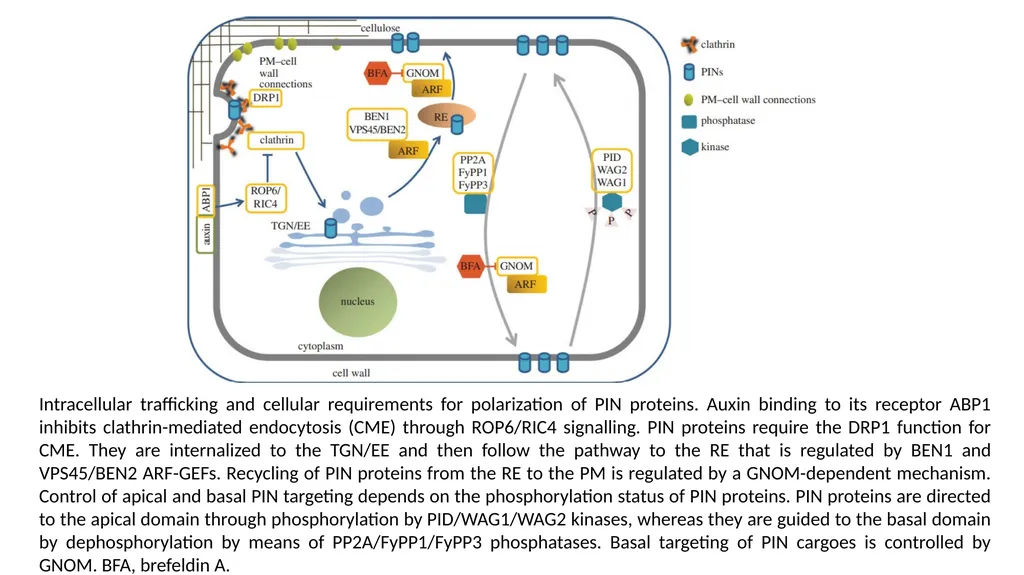
Intracellular trafficking and cellular requirements for polarization of PIN proteins. Auxin binding to its receptor ABP1 inhibits clathrin-mediated endocytosis (CME) through ROP6/RIC4 signalling. PIN proteins require the DRP1 function for CME. They are internalized to the TGN/EE and then follow the pathway to the RE that is regulated by BEN1 and VPS45/BEN2 ARF-GEFs. Recycling of PIN proteins from the RE to the PM is regulated by a GNOM-dependent mechanism. Control of apical and basal PIN targeting depends on the phosphorylation status of PIN proteins. PIN proteins are directed to the apical domain through phosphorylation by PID/WAG1/WAG2 kinases, whereas they are guided to the basal domain by dephosphorylation by means of PP2A/FyPP1/FyPP3 phosphatases. Basal targeting of PIN cargoes is controlled by GNOM. BFA, brefeldin A.<br>
13
Cell Polarity in Plants: PIN Proteins as Polarity Readouts or Polarity Regulators
Auxin efflux carrier PIN proteins are the first identified cell polarity markers in plants.
Based on their polar localization they guide the cell to cell transport of signaling molecule auxin.
PINs are the transmembrane proteins that show the ability of endocytic recycling.
Under certain developmental or environmental-response situations they can alter their localization from one cell side to another thus they provide molecular tools for investigating cell polarity in plants.
In contrast to mammalian cells where plasma membrane identity generators such as PAR, Crumbs and Scribble define cell polarity, no proteins that define cell polarity in plants have been described yet; neither do the sequenced plant genomes possess direct homologues of PAR, Crumbs and Scribble.
Therefore, an important question is whether PIN trafficking machinery read out unidentified cell polarity cues for targeting PINs to appropriate cell side or whether PIN trafficking machinery itself define the default targeting of PINs to one particular side irrespective of influence of other cues and thus mark different plasma membrane domains in plant cells and then modify it by feedback regulating with other cues?
The first option would require identification of the missing polarity factors that would be the dictators for docking of PIN to one defined cell side.
To address the second ‘intrinsic PIN trafficking machinery itself in command’ option it first needs to be resolved whether intrinsic vesicle trafficking components can deliver PINs at proper plasma membrane domains by a trial and error based kinetic mechanism and whether manipulation of the intrinsic vesicle trafficking affect the polar localization of PINs.<br>
Auxin efflux carrier PIN proteins are the first identified cell polarity markers in plants.
Based on their polar localization they guide the cell to cell transport of signaling molecule auxin.
PINs are the transmembrane proteins that show the ability of endocytic recycling.
Under certain developmental or environmental-response situations they can alter their localization from one cell side to another thus they provide molecular tools for investigating cell polarity in plants.
In contrast to mammalian cells where plasma membrane identity generators such as PAR, Crumbs and Scribble define cell polarity, no proteins that define cell polarity in plants have been described yet; neither do the sequenced plant genomes possess direct homologues of PAR, Crumbs and Scribble.
Therefore, an important question is whether PIN trafficking machinery read out unidentified cell polarity cues for targeting PINs to appropriate cell side or whether PIN trafficking machinery itself define the default targeting of PINs to one particular side irrespective of influence of other cues and thus mark different plasma membrane domains in plant cells and then modify it by feedback regulating with other cues?
The first option would require identification of the missing polarity factors that would be the dictators for docking of PIN to one defined cell side.
To address the second ‘intrinsic PIN trafficking machinery itself in command’ option it first needs to be resolved whether intrinsic vesicle trafficking components can deliver PINs at proper plasma membrane domains by a trial and error based kinetic mechanism and whether manipulation of the intrinsic vesicle trafficking affect the polar localization of PINs.<br>
14
A Two Step PIN Trafficking-Based Mechanism for PIN Polarity Generation
Recently the vesicle trafficking mechanism by which PIN polarity is generated in plant cells has been investigated by a real time microscopy applied to single polar cells in intact plants involving a two-pronged approach:
(i) analysis of recovery of freshly synthesized Yellow fluorescent protein (YFP)-tagged PIN1 at the plasma membrane after its complete photo bleaching within entire cell and
(ii) analysis of initial targeting of freshly synthesized PIN1 after its induced expression in cells in which PIN1 is generally not expressed.
This analysis revealed that after synthesis PINs are first targeted to the plasma membrane in a random manner
Then are subsequently endocytosed and recycled to the side of preference.
Taking into account that PINs display little lateral diffusion and rapid endocytosis (as indirectly inferred from BFA treatment polarized endocytic recycling towards the side of preference (that may either involve a polarized docking/retaining factor for attracting recycling PIN vesicles or may involve polarized recycling pathway) can explain PIN polarity generation.
When PIN internalization is impaired either by a short term increment in auxin (that has previously been shown to impair endocytosis) or by interference with the Rab5-mediated endocytic pathway, PINs remain largely non-polar suggesting an important role for endocytosis in PIN polarity generation.15<br>
Recently the vesicle trafficking mechanism by which PIN polarity is generated in plant cells has been investigated by a real time microscopy applied to single polar cells in intact plants involving a two-pronged approach:
(i) analysis of recovery of freshly synthesized Yellow fluorescent protein (YFP)-tagged PIN1 at the plasma membrane after its complete photo bleaching within entire cell and
(ii) analysis of initial targeting of freshly synthesized PIN1 after its induced expression in cells in which PIN1 is generally not expressed.
This analysis revealed that after synthesis PINs are first targeted to the plasma membrane in a random manner
Then are subsequently endocytosed and recycled to the side of preference.
Taking into account that PINs display little lateral diffusion and rapid endocytosis (as indirectly inferred from BFA treatment polarized endocytic recycling towards the side of preference (that may either involve a polarized docking/retaining factor for attracting recycling PIN vesicles or may involve polarized recycling pathway) can explain PIN polarity generation.
When PIN internalization is impaired either by a short term increment in auxin (that has previously been shown to impair endocytosis) or by interference with the Rab5-mediated endocytic pathway, PINs remain largely non-polar suggesting an important role for endocytosis in PIN polarity generation.15<br>
15
As BFA sensitive ARF-GEF GNOM has been established as a key regulator for polarized recycling in plants the two step model of PIN polarity generation brings GNOM into a new perspective by placing it at the second postendocytic step.
In gnom mutants or upon BFA treatment coordinated polar localization of PIN1 is strongly affected stressing that polarized recycling is as important as endocytosis for acquiring PIN polarity.
In case of short term BFA treatment (presumably immediately locking GNOM functionality) PIN1 displays a less polar localization even before PIN-labeled BFA compartments attain their normal enlarged size, which may suggest that default non-polar secretion still occurs at early stages of BFA treatment.
For this a BFA resistant intact secretary pathway must operate. In accordance BFA resistant ARF-GEF GNL1 operates at the Golgi for BFA-resistant secretion.
Another previous study investigating relation between cell fate and PIN polarity during organ regeneration in plants also supports the initial default non-polar targeting as in case of cell fate alteration-mediated renewed expression, PIN molecules first arrive at the plasma membrane in a non-polar manner and then later on attains polar localization.<br>
In gnom mutants or upon BFA treatment coordinated polar localization of PIN1 is strongly affected stressing that polarized recycling is as important as endocytosis for acquiring PIN polarity.
In case of short term BFA treatment (presumably immediately locking GNOM functionality) PIN1 displays a less polar localization even before PIN-labeled BFA compartments attain their normal enlarged size, which may suggest that default non-polar secretion still occurs at early stages of BFA treatment.
For this a BFA resistant intact secretary pathway must operate. In accordance BFA resistant ARF-GEF GNL1 operates at the Golgi for BFA-resistant secretion.
Another previous study investigating relation between cell fate and PIN polarity during organ regeneration in plants also supports the initial default non-polar targeting as in case of cell fate alteration-mediated renewed expression, PIN molecules first arrive at the plasma membrane in a non-polar manner and then later on attains polar localization.<br>
16
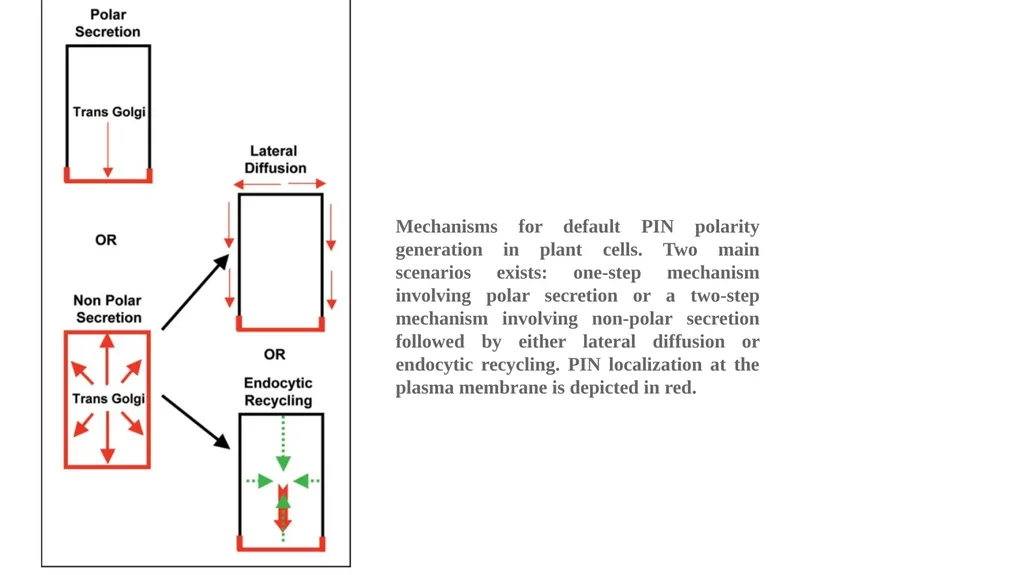
Mechanisms for default PIN polarity generation in plant cells. Two main scenarios exists: one-step mechanism involving polar secretion or a two-step mechanism involving non-polar secretion followed by either lateral diffusion or endocytic recycling. PIN localization at the plasma membrane is depicted in red.<br>
17
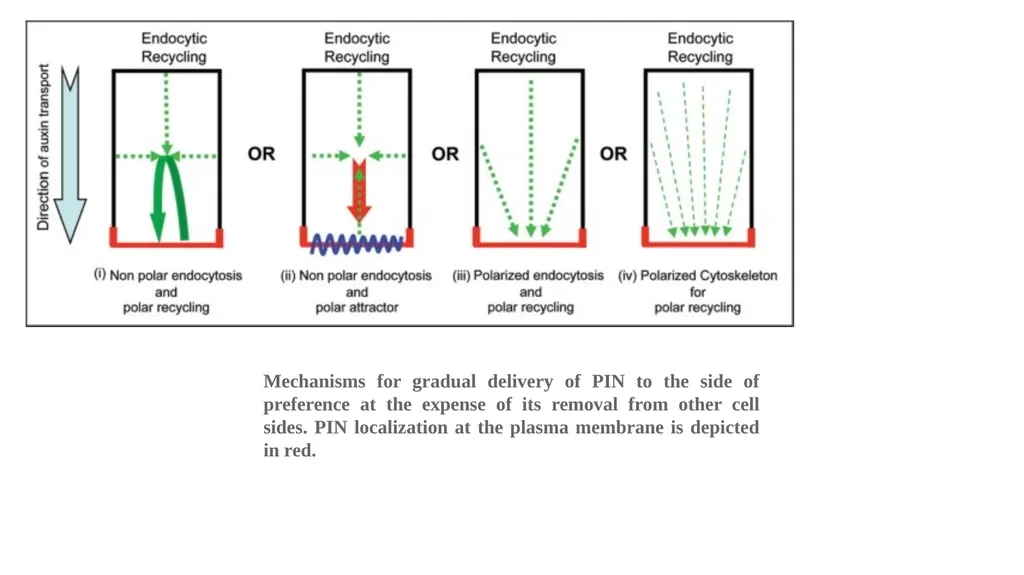
Mechanisms for gradual delivery of PIN to the side of preference at the expense of its removal from other cell sides. PIN localization at the plasma membrane is depicted in red.<br>