
Center for Army Analysis Wargame Analysis Model

Description: Center for Army Analysis Wargame Analysis Model (C-WAM) Presentation for the MORS Wargame CoP 20 APR 16 Daniel Mahoney (703) 806-5645 Daniel.p.mahoney4.civmail.mil UNCLASSIFIED UNCLASSIFIED C-WAM development grew from the requirement for
Related Topics
Download Presentation
"Center for Army Analysis Wargame Analysis Model" is the property of its rightful owner. Permission is granted to download and print the materials on this website for personal, non-commercial use only, and to display it on your personal computer provided you do not modify the materials and that you retain all copyright notices contained in the materials. By downloading content from our website, you accept the terms of this agreement.
Presentation Transcript
slide1. Center for Army Analysis Wargame Analysis Model (C-WAM) Presentation for the MORS Wargame CoP 20 APR 16 Daniel Mahoney
(703) 806-5645
Daniel.p.mahoney4.civ@mail.mil UNCLASSIFIED UNCLASSIFIED<br>
slide2. C-WAM development grew from the requirement for campaign analysts to more fully understand the theater backdrop, engaged forces and concept of the operation (CONOP) of a new theater campaign before coding it into CAA’s high-resolution theater model: JICM
The original C-WAM was very ground-centric and based on the wargame process used by the 1st Cavalry Division Plans shop
Engagement with a variety of joint and sister service HQs over the years (USPACOM, USEUCOME, COMPCFLT, USEUCOM, PACAF, USAFE, SOCPAC, etc.) has greatly enhanced C-WAM’s representation of joint capabilities
All C-WAM updates and enhancements are vetted by the CAA Campaign Analysis (CA) division wargame team members before they are included
After ten years of development, C-WAM is likely the most complete joint, operational-level wargaming system in the DoD C-WAM Background 6 Aug 2015 2<br>
slide3. The C-WAM is manual, computer aided, time-step, man-in-the-loop, force-on-force simulation methodology (C-WAM Battle Tracker System has become a necessity)
The C-WAM features two (or more) opposing teams simulating combat on a map-based playing surface regulated by game controllers
The Process uses aggregated tactical outcomes to drive operational level insights
The Process is completely free play within the constraints of a the rules and each team’s approved course of action
The competing teams control assets from across the full spectrum of joint and combined forces
The simulation focuses on the Phase II (Seize the Initiative) and Phase III (Dominate) portions of operational campaigns.
The simulation is currently designed to execute 24 or 72 hour time steps (Nine-day and twenty-seven day time step procedures are under development). C-WAM Basics 6 Aug 2015 3 UNCLASSIFIED UNCLASSIFIED<br>
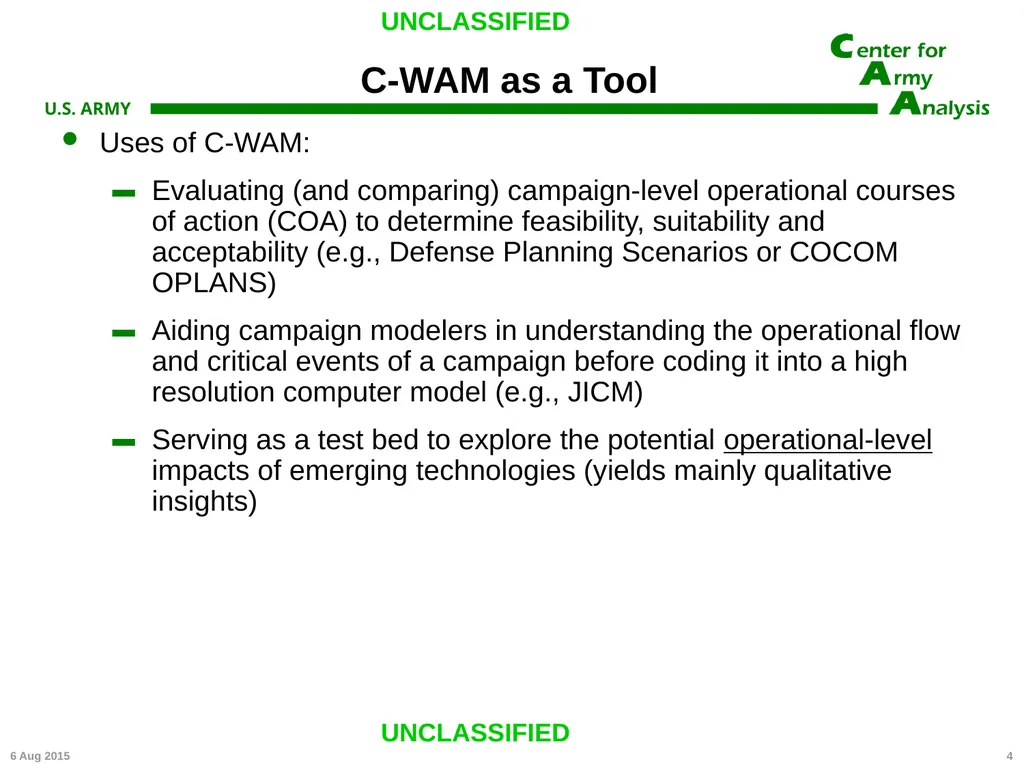
slide4. Uses of C-WAM:
Evaluating (and comparing) campaign-level operational courses of action (COA) to determine feasibility, suitability and acceptability (e.g., Defense Planning Scenarios or COCOM OPLANS)
Aiding campaign modelers in understanding the operational flow and critical events of a campaign before coding it into a high resolution computer model (e.g., JICM)
Serving as a test bed to explore the potential operational-level impacts of emerging technologies (yields mainly qualitative insights) C-WAM as a Tool 6 Aug 2015 4 UNCLASSIFIED UNCLASSIFIED<br>
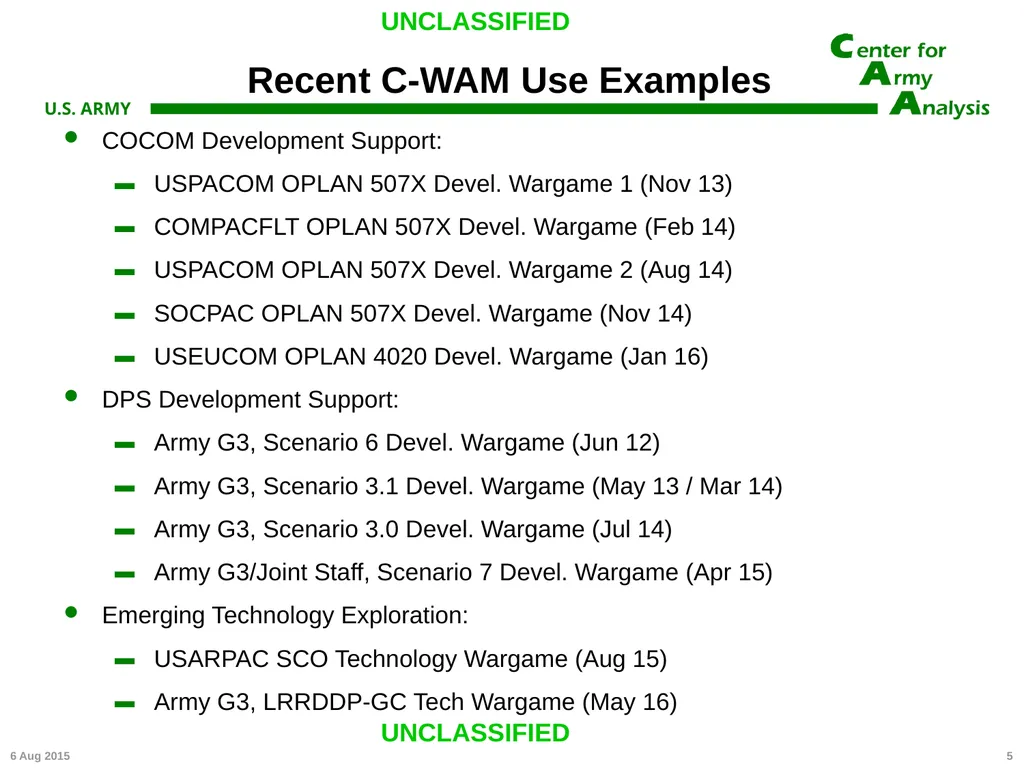
slide5. COCOM Development Support:
USPACOM OPLAN 507X Devel. Wargame 1 (Nov 13)
COMPACFLT OPLAN 507X Devel. Wargame (Feb 14)
USPACOM OPLAN 507X Devel. Wargame 2 (Aug 14)
SOCPAC OPLAN 507X Devel. Wargame (Nov 14)
USEUCOM OPLAN 4020 Devel. Wargame (Jan 16)
DPS Development Support:
Army G3, Scenario 6 Devel. Wargame (Jun 12)
Army G3, Scenario 3.1 Devel. Wargame (May 13 / Mar 14)
Army G3, Scenario 3.0 Devel. Wargame (Jul 14)
Army G3/Joint Staff, Scenario 7 Devel. Wargame (Apr 15)
Emerging Technology Exploration:
USARPAC SCO Technology Wargame (Aug 15)
Army G3, LRRDDP-GC Tech Wargame (May 16) Recent C-WAM Use Examples 6 Aug 2015 5 UNCLASSIFIED UNCLASSIFIED<br>
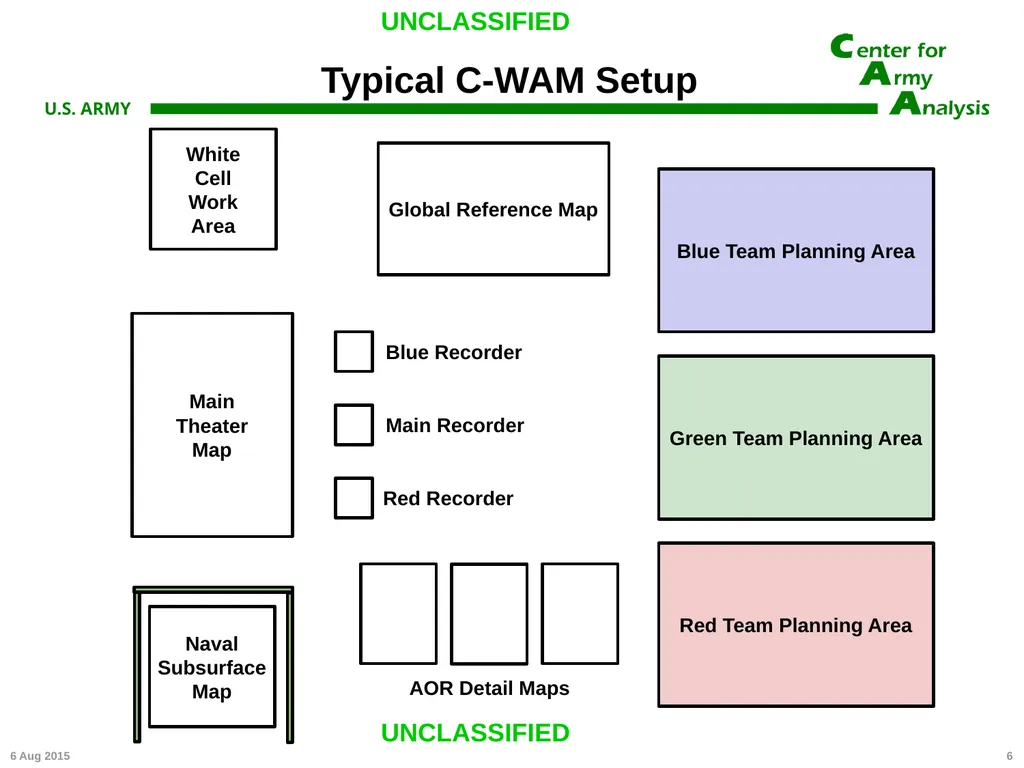
slide6. Typical C-WAM Setup 6 Aug 2015 6 Main Recorder Blue Recorder Red Recorder Naval
Subsurface
Map White
Cell
Work
Area Blue Team Planning Area Green Team Planning Area Red Team Planning Area Global Reference Map UNCLASSIFIED UNCLASSIFIED<br>
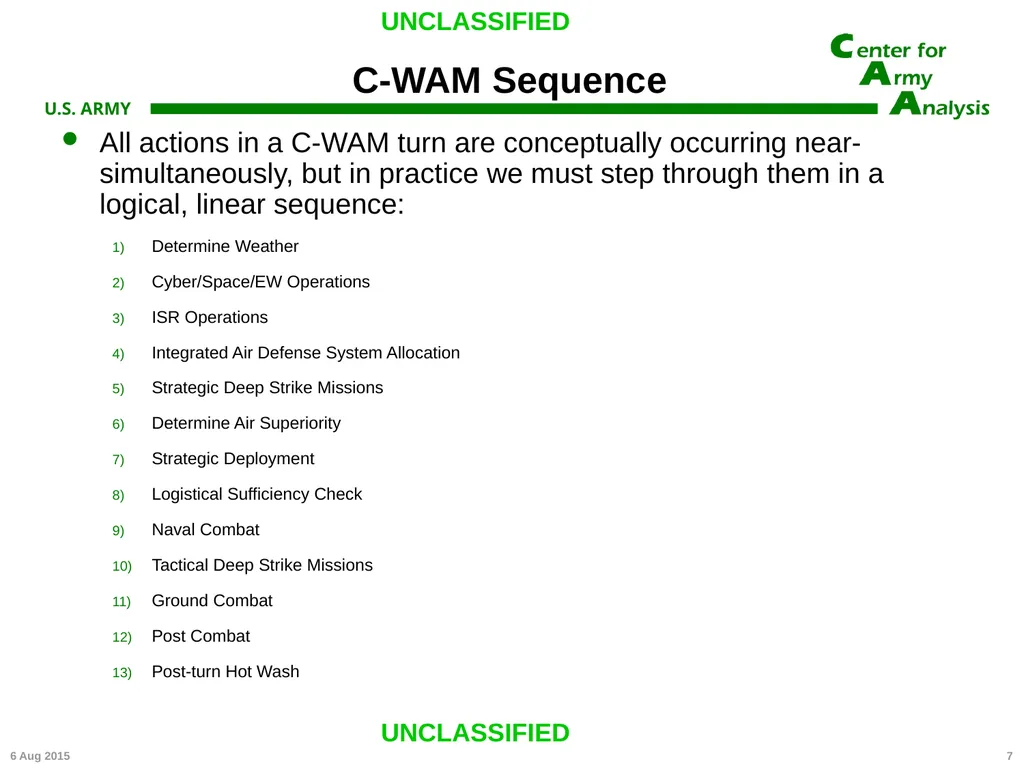
slide7. All actions in a C-WAM turn are conceptually occurring near-simultaneously, but in practice we must step through them in a logical, linear sequence:
Determine Weather
Cyber/Space/EW Operations
ISR Operations
Integrated Air Defense System Allocation
Strategic Deep Strike Missions
Determine Air Superiority
Strategic Deployment
Logistical Sufficiency Check
Naval Combat
Tactical Deep Strike Missions
Ground Combat
Post Combat
Post-turn Hot Wash C-WAM Sequence 6 Aug 2015 7 UNCLASSIFIED UNCLASSIFIED<br>
slide8. Purpose: to estimate the impact of an AOR’s natural weather patterns on a campaign
There are three climate types available: Dry, Moderate, Rainy
There are three weather states available: Clear, Cloudy, Storm
The climate type governs the distribution of weather states
The weather state effects:
ISR System effectiveness
Ground and Naval unit movement speed
Air sortie generation (fixed wing and helo)
Naval surface combat
Air to ground weapons delivery
Chemical weapons Step 1 – Determine Weather 6 Aug 2015 8 UNCLASSIFIED UNCLASSIFIED<br>
slide9. Purpose: to provide an estimate of the effects of successful cyber, space and electronic warfare (EW) operations on a campaign
The process assumes that the impacts of myriad tactical level operations across the electronic domains can be aggregated into point estimates of the theater-wide effect
A successful operation is defined as a disruption of the opposition’s efforts in a domain (cyber, space or EW)
The methodology assumes that a force is minimally effected by a disruption in any one electronic domain but that the impact grows rapidly as additional domains are effected:
Disruption in any one domain produces a tactical effect; in any two an operational effect and in all three a strategic effect
Study leads must consult with experts to determine the correct disruption probability estimates on each side
In force-on-force situations (e.g., ground combat) the overall impact of electronic domain degrades is determined by the net of the two side’s degrade levels Step 2 – Cyber/Space/EW Operations 6 Aug 2015 9 UNCLASSIFIED UNCLASSIFIED<br>
slide10. Purpose: to generate an acceptable estimate of each side’s ability to develop targeting level data on the opponents forces and critical installations
The ISR methodology is a compromise between the perfect knowledge (single map) and zero-base knowledge (multiple map) wargaming systems
The base ISR assumption is that a single, point-estimate can be made for the effectiveness of the ISR system across the ISR
Can have a unique detection probability for the ground, maritime and air domains
The detection probabilities can change each game turn as ISR capacity increases or decreases
The base detection probabilities are effected by the weather state
The umpire can override the system detection routine to account for special situations (e.g., EMCON operations, localized detection arrays)
Players can see all forces deployed in the AOR (except subs) but can only act on those targeted by the ISR system
All units in contact are automatically targeted
Partisans and SOF strategic reconnaissance (SR) teams can provide real-time targeting data
Fixed facilities are assumed to be known and pre-targeted Step 3 – Theater ISR Operations 6 Aug 2015 10 UNCLASSIFIED UNCLASSIFIED<br>
slide11. Purpose: to provide a means of pre-assigning strategic SAM coverage within the Battle Tracker system to expedite deep strike operations
Strategic air defense systems are a critical enabler of all theater operations and as such are also primary targets
Many nations (e.g., Russia and China) have extensive IADS
The proliferation of threat AD systems provides for complex coverage which must be realistically assigned
Working through the coverage dynamically each turn bogs down the wargame flow unacceptably
Making IADS allocation a formal turn sequence step allows it to be done in detail once up front, and then adjusted at the margin thereafter
Detailed IADs coverage assignment is limited to long range and key medium range SAM systems and includes:
Mutual support between AD units
Area coverage of ground units at the division and corps level
Coverage of airbases and key installations Step 4 – Integrated Air Defense System (IADS) Allocation 6 Aug 2015 11 UNCLASSIFIED UNCLASSIFIED<br>
slide12. Purpose: to provide an estimate of the impact of deep strikes against key strategic systems and infrastructure on a campaign
Deep strike operations are segregated into two categories based on entity targeted: strategic and tactical
Strategic targets have theater-wide influence (e.g. APODS, SPODS, Strat IADS, fuel depots)
Tactical targets are typically ground units, ships and individual aircraft
Deep strikes on strategic targets are executed early in the turn because they can effect multiple aspects of the joint fight
Deep strikes are typically made with a variety of penetrators including tactical ballistic missiles, cruise missiles, stand-off weapons, fixed wing aircraft and rocket artillery
Deep strike penetrators must potentially pass through combat air patrol (CAP) and IADS “gates” enroute to their targets. These gates have the ability to reduce the effectiveness of the deep strikes
The effects of deep strikes are adjudicated using the C-WAM Deep Strike Table
Targeting latency impacts strike effectiveness (real-time vs. lag-time)
Munition precision impacts strike effectiveness (precision vs non-precision) Step 5 – Strategic Deep Strike Operations 6 Aug 2015 12 UNCLASSIFIED UNCLASSIFIED<br>
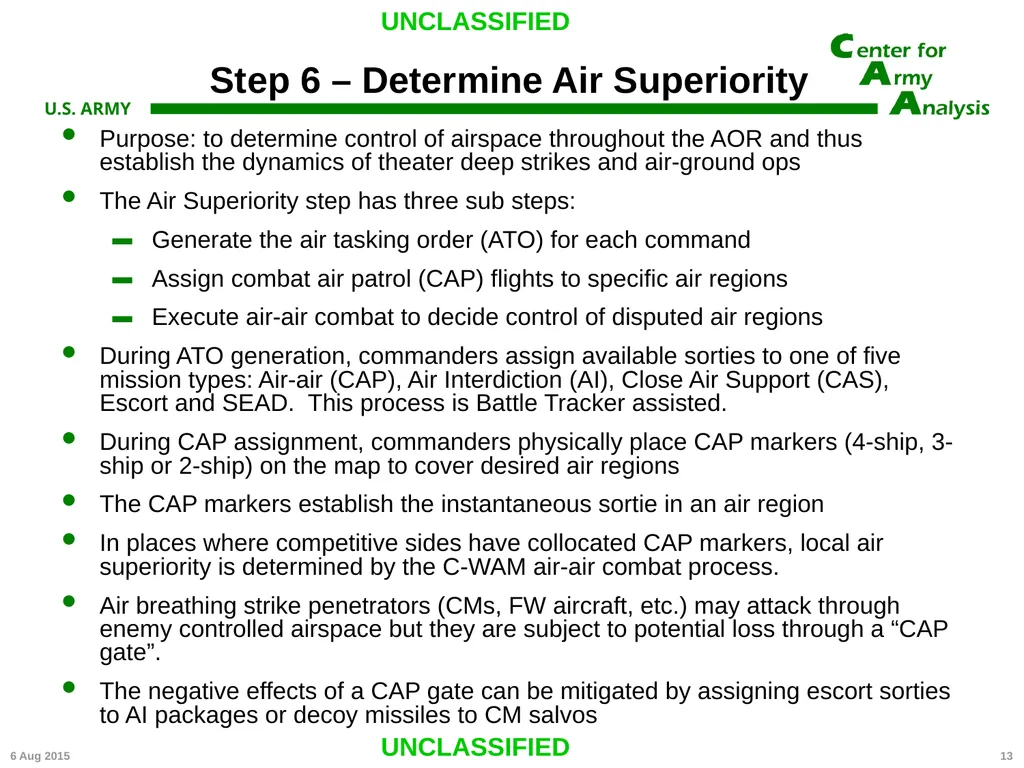
slide13. Purpose: to determine control of airspace throughout the AOR and thus establish the dynamics of theater deep strikes and air-ground ops
The Air Superiority step has three sub steps:
Generate the air tasking order (ATO) for each command
Assign combat air patrol (CAP) flights to specific air regions
Execute air-air combat to decide control of disputed air regions
During ATO generation, commanders assign available sorties to one of five mission types: Air-air (CAP), Air Interdiction (AI), Close Air Support (CAS), Escort and SEAD. This process is Battle Tracker assisted.
During CAP assignment, commanders physically place CAP markers (4-ship, 3-ship or 2-ship) on the map to cover desired air regions
The CAP markers establish the instantaneous sortie in an air region
In places where competitive sides have collocated CAP markers, local air superiority is determined by the C-WAM air-air combat process.
Air breathing strike penetrators (CMs, FW aircraft, etc.) may attack through enemy controlled airspace but they are subject to potential loss through a “CAP gate”.
The negative effects of a CAP gate can be mitigated by assigning escort sorties to AI packages or decoy missiles to CM salvos Step 6 – Determine Air Superiority 6 Aug 2015 13 UNCLASSIFIED UNCLASSIFIED<br>
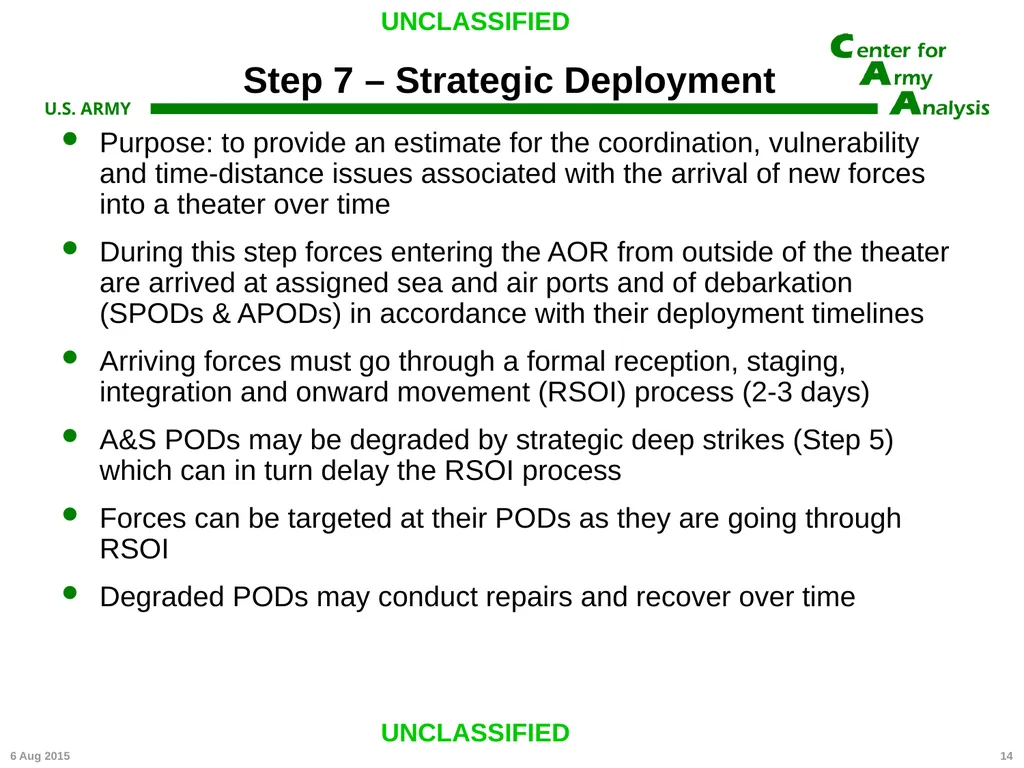
slide14. Purpose: to provide an estimate for the coordination, vulnerability and time-distance issues associated with the arrival of new forces into a theater over time
During this step forces entering the AOR from outside of the theater are arrived at assigned sea and air ports and of debarkation (SPODs & APODs) in accordance with their deployment timelines
Arriving forces must go through a formal reception, staging, integration and onward movement (RSOI) process (2-3 days)
A&S PODs may be degraded by strategic deep strikes (Step 5) which can in turn delay the RSOI process
Forces can be targeted at their PODs as they are going through RSOI
Degraded PODs may conduct repairs and recover over time Step 7 – Strategic Deployment 6 Aug 2015 14 UNCLASSIFIED UNCLASSIFIED<br>
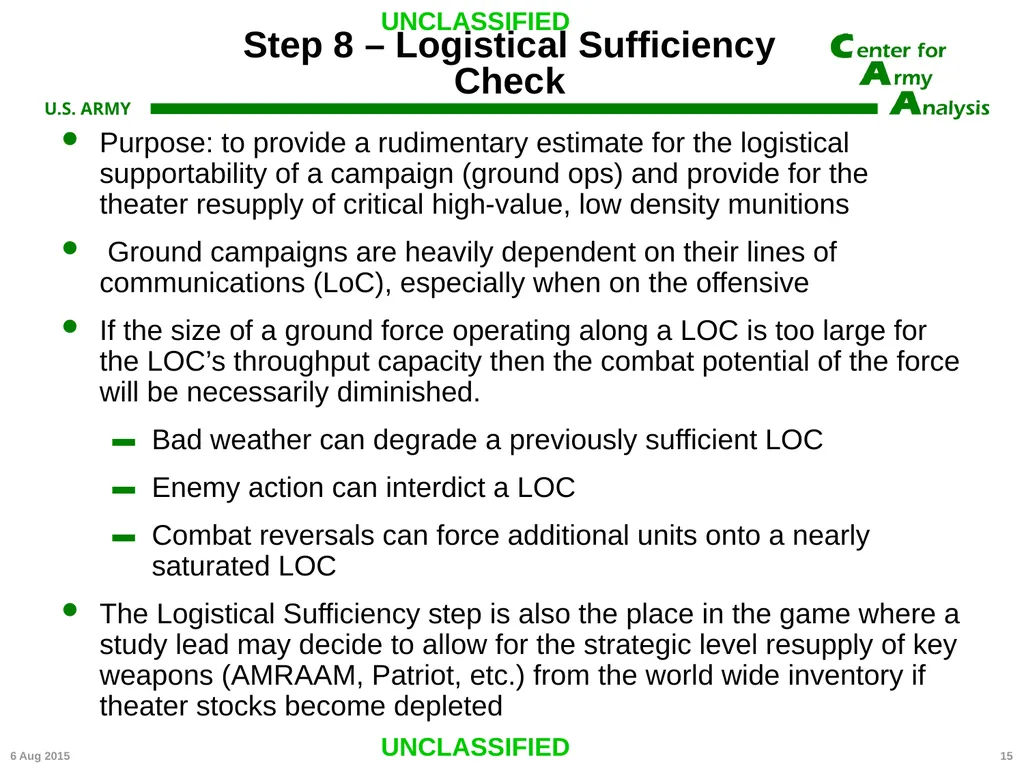
slide15. Purpose: to provide a rudimentary estimate for the logistical supportability of a campaign (ground ops) and provide for the theater resupply of critical high-value, low density munitions
Ground campaigns are heavily dependent on their lines of communications (LoC), especially when on the offensive
If the size of a ground force operating along a LOC is too large for the LOC’s throughput capacity then the combat potential of the force will be necessarily diminished.
Bad weather can degrade a previously sufficient LOC
Enemy action can interdict a LOC
Combat reversals can force additional units onto a nearly saturated LOC
The Logistical Sufficiency step is also the place in the game where a study lead may decide to allow for the strategic level resupply of key weapons (AMRAAM, Patriot, etc.) from the world wide inventory if theater stocks become depleted Step 8 – Logistical Sufficiency Check 6 Aug 2015 15 UNCLASSIFIED UNCLASSIFIED<br>
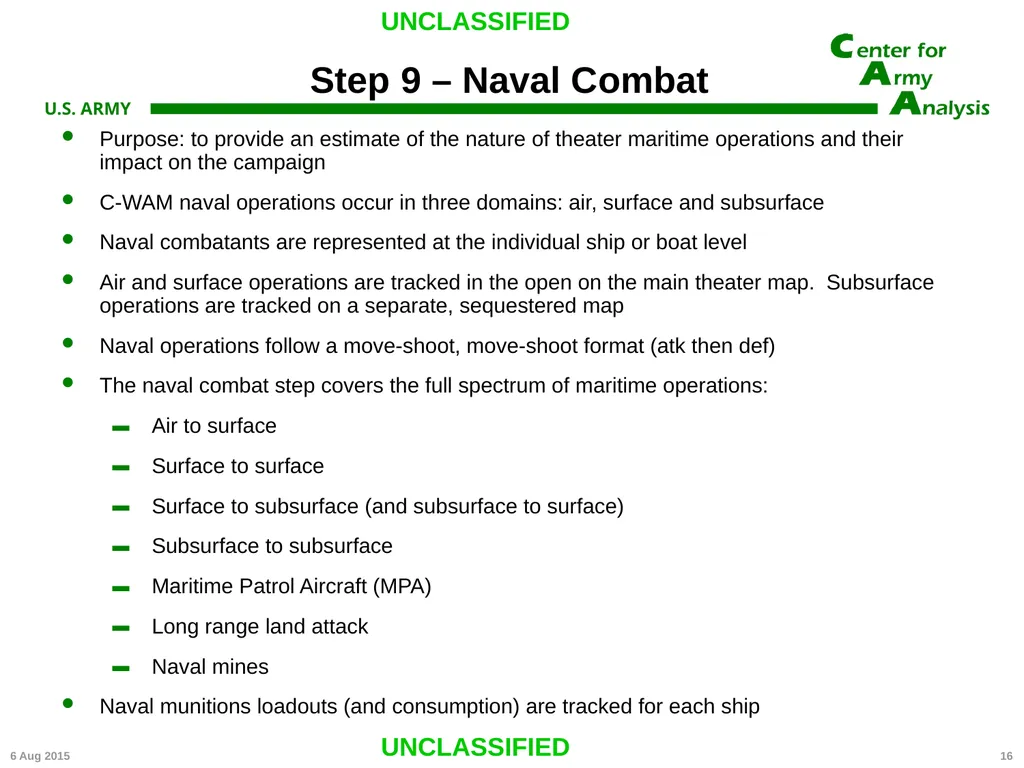
slide16. Purpose: to provide an estimate of the nature of theater maritime operations and their impact on the campaign
C-WAM naval operations occur in three domains: air, surface and subsurface
Naval combatants are represented at the individual ship or boat level
Air and surface operations are tracked in the open on the main theater map. Subsurface operations are tracked on a separate, sequestered map
Naval operations follow a move-shoot, move-shoot format (atk then def)
The naval combat step covers the full spectrum of maritime operations:
Air to surface
Surface to surface
Surface to subsurface (and subsurface to surface)
Subsurface to subsurface
Maritime Patrol Aircraft (MPA)
Long range land attack
Naval mines
Naval munitions loadouts (and consumption) are tracked for each ship Step 9 – Naval Combat 6 Aug 2015 16 UNCLASSIFIED UNCLASSIFIED<br>
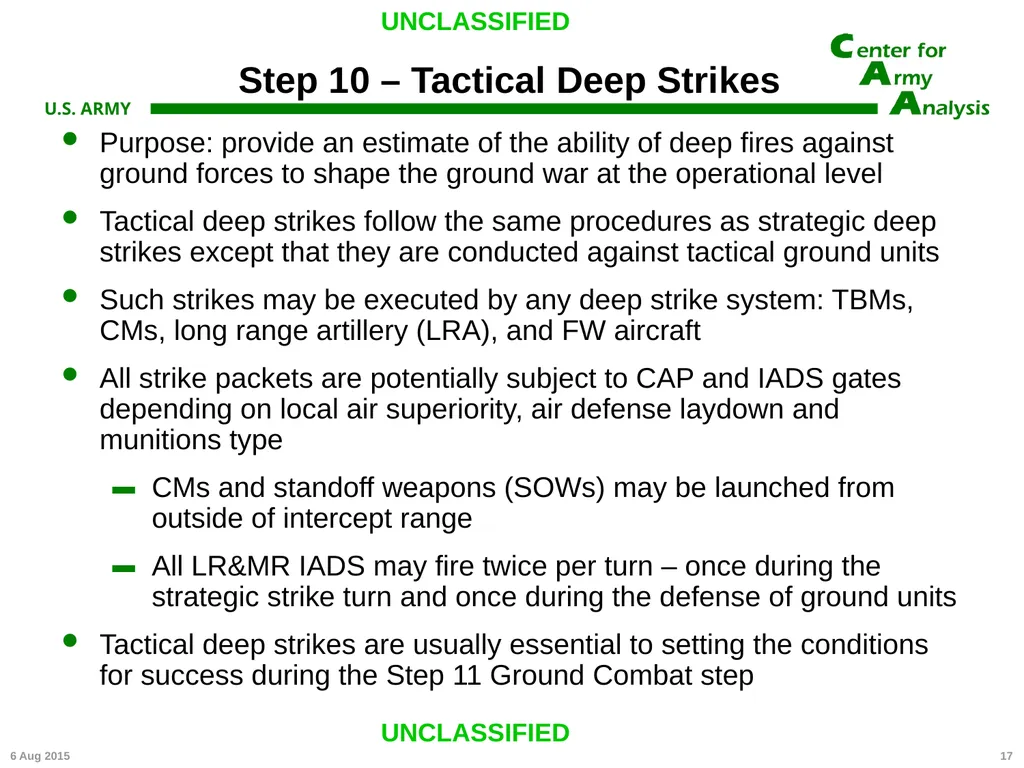
slide17. Purpose: provide an estimate of the ability of deep fires against ground forces to shape the ground war at the operational level
Tactical deep strikes follow the same procedures as strategic deep strikes except that they are conducted against tactical ground units
Such strikes may be executed by any deep strike system: TBMs, CMs, long range artillery (LRA), and FW aircraft
All strike packets are potentially subject to CAP and IADS gates depending on local air superiority, air defense laydown and munitions type
CMs and standoff weapons (SOWs) may be launched from outside of intercept range
All LR&MR IADS may fire twice per turn – once during the strategic strike turn and once during the defense of ground units
Tactical deep strikes are usually essential to setting the conditions for success during the Step 11 Ground Combat step Step 10 – Tactical Deep Strikes 6 Aug 2015 17 UNCLASSIFIED UNCLASSIFIED<br>
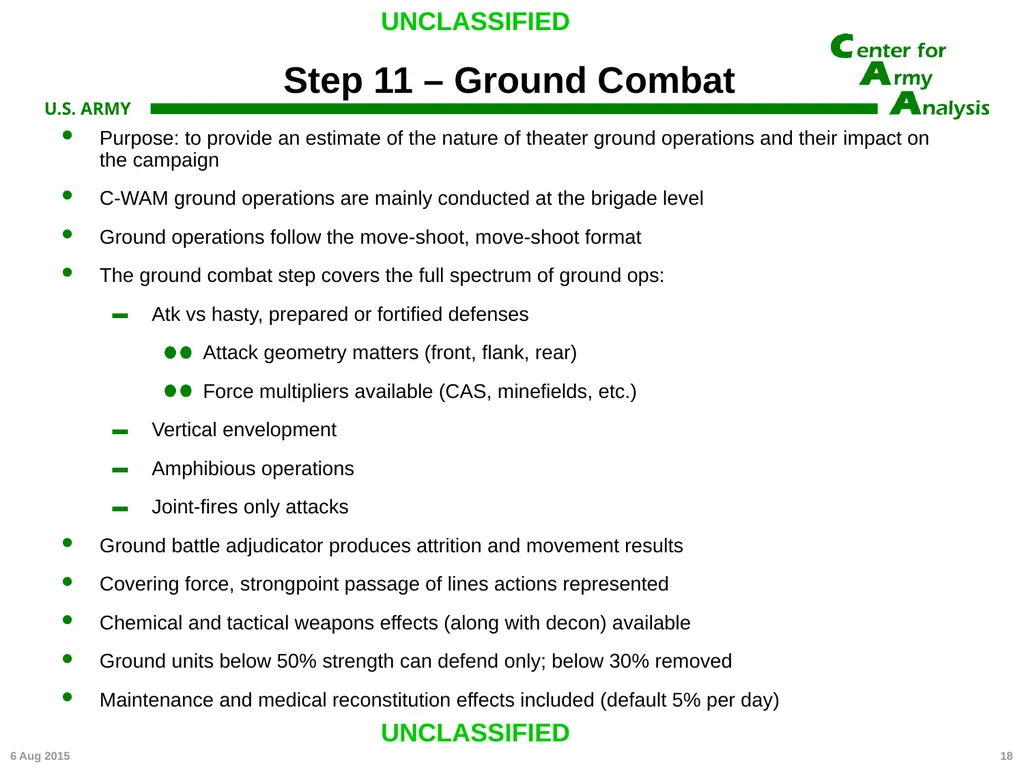
slide18. Purpose: to provide an estimate of the nature of theater ground operations and their impact on the campaign
C-WAM ground operations are mainly conducted at the brigade level
Ground operations follow the move-shoot, move-shoot format
The ground combat step covers the full spectrum of ground ops:
Atk vs hasty, prepared or fortified defenses
Attack geometry matters (front, flank, rear)
Force multipliers available (CAS, minefields, etc.)
Vertical envelopment
Amphibious operations
Joint-fires only attacks
Ground battle adjudicator produces attrition and movement results
Covering force, strongpoint passage of lines actions represented
Chemical and tactical weapons effects (along with decon) available
Ground units below 50% strength can defend only; below 30% removed
Maintenance and medical reconstitution effects included (default 5% per day) Step 11 – Ground Combat 6 Aug 2015 18 UNCLASSIFIED UNCLASSIFIED<br>
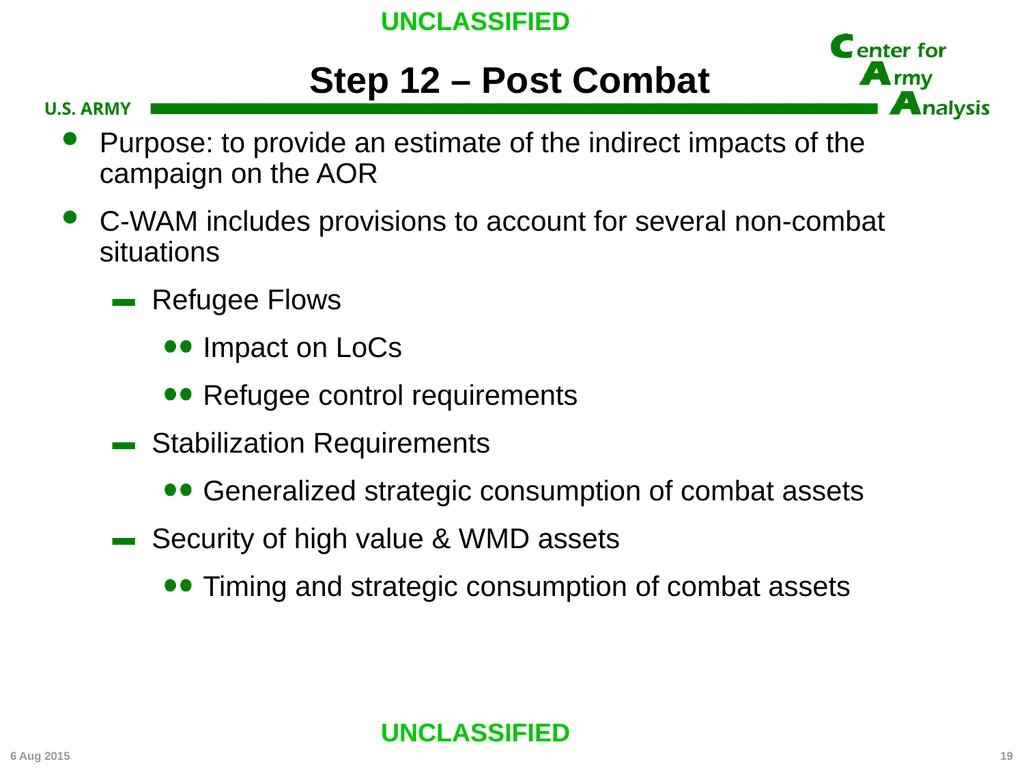
slide19. Purpose: to provide an estimate of the indirect impacts of the campaign on the AOR
C-WAM includes provisions to account for several non-combat situations
Refugee Flows
Impact on LoCs
Refugee control requirements
Stabilization Requirements
Generalized strategic consumption of combat assets
Security of high value & WMD assets
Timing and strategic consumption of combat assets Step 12 – Post Combat 6 Aug 2015 19 UNCLASSIFIED UNCLASSIFIED<br>
slide20. Purpose: to capture critical events and insights uncovered during the current game turn
Quick review of the turn
Typically conducted by the Study Director
Beginning of the analytic process Step 13 – Post Turn Hot Wash 6 Aug 2015 20 UNCLASSIFIED UNCLASSIFIED<br>
(703) 806-5645
Daniel.p.mahoney4.civ@mail.mil UNCLASSIFIED UNCLASSIFIED<br>
slide2. C-WAM development grew from the requirement for campaign analysts to more fully understand the theater backdrop, engaged forces and concept of the operation (CONOP) of a new theater campaign before coding it into CAA’s high-resolution theater model: JICM
The original C-WAM was very ground-centric and based on the wargame process used by the 1st Cavalry Division Plans shop
Engagement with a variety of joint and sister service HQs over the years (USPACOM, USEUCOME, COMPCFLT, USEUCOM, PACAF, USAFE, SOCPAC, etc.) has greatly enhanced C-WAM’s representation of joint capabilities
All C-WAM updates and enhancements are vetted by the CAA Campaign Analysis (CA) division wargame team members before they are included
After ten years of development, C-WAM is likely the most complete joint, operational-level wargaming system in the DoD C-WAM Background 6 Aug 2015 2<br>
slide3. The C-WAM is manual, computer aided, time-step, man-in-the-loop, force-on-force simulation methodology (C-WAM Battle Tracker System has become a necessity)
The C-WAM features two (or more) opposing teams simulating combat on a map-based playing surface regulated by game controllers
The Process uses aggregated tactical outcomes to drive operational level insights
The Process is completely free play within the constraints of a the rules and each team’s approved course of action
The competing teams control assets from across the full spectrum of joint and combined forces
The simulation focuses on the Phase II (Seize the Initiative) and Phase III (Dominate) portions of operational campaigns.
The simulation is currently designed to execute 24 or 72 hour time steps (Nine-day and twenty-seven day time step procedures are under development). C-WAM Basics 6 Aug 2015 3 UNCLASSIFIED UNCLASSIFIED<br>
slide4. Uses of C-WAM:
Evaluating (and comparing) campaign-level operational courses of action (COA) to determine feasibility, suitability and acceptability (e.g., Defense Planning Scenarios or COCOM OPLANS)
Aiding campaign modelers in understanding the operational flow and critical events of a campaign before coding it into a high resolution computer model (e.g., JICM)
Serving as a test bed to explore the potential operational-level impacts of emerging technologies (yields mainly qualitative insights) C-WAM as a Tool 6 Aug 2015 4 UNCLASSIFIED UNCLASSIFIED<br>
slide5. COCOM Development Support:
USPACOM OPLAN 507X Devel. Wargame 1 (Nov 13)
COMPACFLT OPLAN 507X Devel. Wargame (Feb 14)
USPACOM OPLAN 507X Devel. Wargame 2 (Aug 14)
SOCPAC OPLAN 507X Devel. Wargame (Nov 14)
USEUCOM OPLAN 4020 Devel. Wargame (Jan 16)
DPS Development Support:
Army G3, Scenario 6 Devel. Wargame (Jun 12)
Army G3, Scenario 3.1 Devel. Wargame (May 13 / Mar 14)
Army G3, Scenario 3.0 Devel. Wargame (Jul 14)
Army G3/Joint Staff, Scenario 7 Devel. Wargame (Apr 15)
Emerging Technology Exploration:
USARPAC SCO Technology Wargame (Aug 15)
Army G3, LRRDDP-GC Tech Wargame (May 16) Recent C-WAM Use Examples 6 Aug 2015 5 UNCLASSIFIED UNCLASSIFIED<br>
slide6. Typical C-WAM Setup 6 Aug 2015 6 Main Recorder Blue Recorder Red Recorder Naval
Subsurface
Map White
Cell
Work
Area Blue Team Planning Area Green Team Planning Area Red Team Planning Area Global Reference Map UNCLASSIFIED UNCLASSIFIED<br>
slide7. All actions in a C-WAM turn are conceptually occurring near-simultaneously, but in practice we must step through them in a logical, linear sequence:
Determine Weather
Cyber/Space/EW Operations
ISR Operations
Integrated Air Defense System Allocation
Strategic Deep Strike Missions
Determine Air Superiority
Strategic Deployment
Logistical Sufficiency Check
Naval Combat
Tactical Deep Strike Missions
Ground Combat
Post Combat
Post-turn Hot Wash C-WAM Sequence 6 Aug 2015 7 UNCLASSIFIED UNCLASSIFIED<br>
slide8. Purpose: to estimate the impact of an AOR’s natural weather patterns on a campaign
There are three climate types available: Dry, Moderate, Rainy
There are three weather states available: Clear, Cloudy, Storm
The climate type governs the distribution of weather states
The weather state effects:
ISR System effectiveness
Ground and Naval unit movement speed
Air sortie generation (fixed wing and helo)
Naval surface combat
Air to ground weapons delivery
Chemical weapons Step 1 – Determine Weather 6 Aug 2015 8 UNCLASSIFIED UNCLASSIFIED<br>
slide9. Purpose: to provide an estimate of the effects of successful cyber, space and electronic warfare (EW) operations on a campaign
The process assumes that the impacts of myriad tactical level operations across the electronic domains can be aggregated into point estimates of the theater-wide effect
A successful operation is defined as a disruption of the opposition’s efforts in a domain (cyber, space or EW)
The methodology assumes that a force is minimally effected by a disruption in any one electronic domain but that the impact grows rapidly as additional domains are effected:
Disruption in any one domain produces a tactical effect; in any two an operational effect and in all three a strategic effect
Study leads must consult with experts to determine the correct disruption probability estimates on each side
In force-on-force situations (e.g., ground combat) the overall impact of electronic domain degrades is determined by the net of the two side’s degrade levels Step 2 – Cyber/Space/EW Operations 6 Aug 2015 9 UNCLASSIFIED UNCLASSIFIED<br>
slide10. Purpose: to generate an acceptable estimate of each side’s ability to develop targeting level data on the opponents forces and critical installations
The ISR methodology is a compromise between the perfect knowledge (single map) and zero-base knowledge (multiple map) wargaming systems
The base ISR assumption is that a single, point-estimate can be made for the effectiveness of the ISR system across the ISR
Can have a unique detection probability for the ground, maritime and air domains
The detection probabilities can change each game turn as ISR capacity increases or decreases
The base detection probabilities are effected by the weather state
The umpire can override the system detection routine to account for special situations (e.g., EMCON operations, localized detection arrays)
Players can see all forces deployed in the AOR (except subs) but can only act on those targeted by the ISR system
All units in contact are automatically targeted
Partisans and SOF strategic reconnaissance (SR) teams can provide real-time targeting data
Fixed facilities are assumed to be known and pre-targeted Step 3 – Theater ISR Operations 6 Aug 2015 10 UNCLASSIFIED UNCLASSIFIED<br>
slide11. Purpose: to provide a means of pre-assigning strategic SAM coverage within the Battle Tracker system to expedite deep strike operations
Strategic air defense systems are a critical enabler of all theater operations and as such are also primary targets
Many nations (e.g., Russia and China) have extensive IADS
The proliferation of threat AD systems provides for complex coverage which must be realistically assigned
Working through the coverage dynamically each turn bogs down the wargame flow unacceptably
Making IADS allocation a formal turn sequence step allows it to be done in detail once up front, and then adjusted at the margin thereafter
Detailed IADs coverage assignment is limited to long range and key medium range SAM systems and includes:
Mutual support between AD units
Area coverage of ground units at the division and corps level
Coverage of airbases and key installations Step 4 – Integrated Air Defense System (IADS) Allocation 6 Aug 2015 11 UNCLASSIFIED UNCLASSIFIED<br>
slide12. Purpose: to provide an estimate of the impact of deep strikes against key strategic systems and infrastructure on a campaign
Deep strike operations are segregated into two categories based on entity targeted: strategic and tactical
Strategic targets have theater-wide influence (e.g. APODS, SPODS, Strat IADS, fuel depots)
Tactical targets are typically ground units, ships and individual aircraft
Deep strikes on strategic targets are executed early in the turn because they can effect multiple aspects of the joint fight
Deep strikes are typically made with a variety of penetrators including tactical ballistic missiles, cruise missiles, stand-off weapons, fixed wing aircraft and rocket artillery
Deep strike penetrators must potentially pass through combat air patrol (CAP) and IADS “gates” enroute to their targets. These gates have the ability to reduce the effectiveness of the deep strikes
The effects of deep strikes are adjudicated using the C-WAM Deep Strike Table
Targeting latency impacts strike effectiveness (real-time vs. lag-time)
Munition precision impacts strike effectiveness (precision vs non-precision) Step 5 – Strategic Deep Strike Operations 6 Aug 2015 12 UNCLASSIFIED UNCLASSIFIED<br>
slide13. Purpose: to determine control of airspace throughout the AOR and thus establish the dynamics of theater deep strikes and air-ground ops
The Air Superiority step has three sub steps:
Generate the air tasking order (ATO) for each command
Assign combat air patrol (CAP) flights to specific air regions
Execute air-air combat to decide control of disputed air regions
During ATO generation, commanders assign available sorties to one of five mission types: Air-air (CAP), Air Interdiction (AI), Close Air Support (CAS), Escort and SEAD. This process is Battle Tracker assisted.
During CAP assignment, commanders physically place CAP markers (4-ship, 3-ship or 2-ship) on the map to cover desired air regions
The CAP markers establish the instantaneous sortie in an air region
In places where competitive sides have collocated CAP markers, local air superiority is determined by the C-WAM air-air combat process.
Air breathing strike penetrators (CMs, FW aircraft, etc.) may attack through enemy controlled airspace but they are subject to potential loss through a “CAP gate”.
The negative effects of a CAP gate can be mitigated by assigning escort sorties to AI packages or decoy missiles to CM salvos Step 6 – Determine Air Superiority 6 Aug 2015 13 UNCLASSIFIED UNCLASSIFIED<br>
slide14. Purpose: to provide an estimate for the coordination, vulnerability and time-distance issues associated with the arrival of new forces into a theater over time
During this step forces entering the AOR from outside of the theater are arrived at assigned sea and air ports and of debarkation (SPODs & APODs) in accordance with their deployment timelines
Arriving forces must go through a formal reception, staging, integration and onward movement (RSOI) process (2-3 days)
A&S PODs may be degraded by strategic deep strikes (Step 5) which can in turn delay the RSOI process
Forces can be targeted at their PODs as they are going through RSOI
Degraded PODs may conduct repairs and recover over time Step 7 – Strategic Deployment 6 Aug 2015 14 UNCLASSIFIED UNCLASSIFIED<br>
slide15. Purpose: to provide a rudimentary estimate for the logistical supportability of a campaign (ground ops) and provide for the theater resupply of critical high-value, low density munitions
Ground campaigns are heavily dependent on their lines of communications (LoC), especially when on the offensive
If the size of a ground force operating along a LOC is too large for the LOC’s throughput capacity then the combat potential of the force will be necessarily diminished.
Bad weather can degrade a previously sufficient LOC
Enemy action can interdict a LOC
Combat reversals can force additional units onto a nearly saturated LOC
The Logistical Sufficiency step is also the place in the game where a study lead may decide to allow for the strategic level resupply of key weapons (AMRAAM, Patriot, etc.) from the world wide inventory if theater stocks become depleted Step 8 – Logistical Sufficiency Check 6 Aug 2015 15 UNCLASSIFIED UNCLASSIFIED<br>
slide16. Purpose: to provide an estimate of the nature of theater maritime operations and their impact on the campaign
C-WAM naval operations occur in three domains: air, surface and subsurface
Naval combatants are represented at the individual ship or boat level
Air and surface operations are tracked in the open on the main theater map. Subsurface operations are tracked on a separate, sequestered map
Naval operations follow a move-shoot, move-shoot format (atk then def)
The naval combat step covers the full spectrum of maritime operations:
Air to surface
Surface to surface
Surface to subsurface (and subsurface to surface)
Subsurface to subsurface
Maritime Patrol Aircraft (MPA)
Long range land attack
Naval mines
Naval munitions loadouts (and consumption) are tracked for each ship Step 9 – Naval Combat 6 Aug 2015 16 UNCLASSIFIED UNCLASSIFIED<br>
slide17. Purpose: provide an estimate of the ability of deep fires against ground forces to shape the ground war at the operational level
Tactical deep strikes follow the same procedures as strategic deep strikes except that they are conducted against tactical ground units
Such strikes may be executed by any deep strike system: TBMs, CMs, long range artillery (LRA), and FW aircraft
All strike packets are potentially subject to CAP and IADS gates depending on local air superiority, air defense laydown and munitions type
CMs and standoff weapons (SOWs) may be launched from outside of intercept range
All LR&MR IADS may fire twice per turn – once during the strategic strike turn and once during the defense of ground units
Tactical deep strikes are usually essential to setting the conditions for success during the Step 11 Ground Combat step Step 10 – Tactical Deep Strikes 6 Aug 2015 17 UNCLASSIFIED UNCLASSIFIED<br>
slide18. Purpose: to provide an estimate of the nature of theater ground operations and their impact on the campaign
C-WAM ground operations are mainly conducted at the brigade level
Ground operations follow the move-shoot, move-shoot format
The ground combat step covers the full spectrum of ground ops:
Atk vs hasty, prepared or fortified defenses
Attack geometry matters (front, flank, rear)
Force multipliers available (CAS, minefields, etc.)
Vertical envelopment
Amphibious operations
Joint-fires only attacks
Ground battle adjudicator produces attrition and movement results
Covering force, strongpoint passage of lines actions represented
Chemical and tactical weapons effects (along with decon) available
Ground units below 50% strength can defend only; below 30% removed
Maintenance and medical reconstitution effects included (default 5% per day) Step 11 – Ground Combat 6 Aug 2015 18 UNCLASSIFIED UNCLASSIFIED<br>
slide19. Purpose: to provide an estimate of the indirect impacts of the campaign on the AOR
C-WAM includes provisions to account for several non-combat situations
Refugee Flows
Impact on LoCs
Refugee control requirements
Stabilization Requirements
Generalized strategic consumption of combat assets
Security of high value & WMD assets
Timing and strategic consumption of combat assets Step 12 – Post Combat 6 Aug 2015 19 UNCLASSIFIED UNCLASSIFIED<br>
slide20. Purpose: to capture critical events and insights uncovered during the current game turn
Quick review of the turn
Typically conducted by the Study Director
Beginning of the analytic process Step 13 – Post Turn Hot Wash 6 Aug 2015 20 UNCLASSIFIED UNCLASSIFIED<br>