
Central Application Service for Post-School


Description: Central Application Service for Post-School Education Training Sector Regional Communication Visit Welcome Apologies 20160627 2 Agenda Opening Welcome Apologies 15 min Confirm Meeting Objectives 5 min Review of Consolidated CAS
Related Topics
Download Presentation
"Central Application Service for Post-School" is the property of its rightful owner. Permission is granted to download and print the materials on this website for personal, non-commercial use only, and to display it on your personal computer provided you do not modify the materials and that you retain all copyright notices contained in the materials. By downloading content from our website, you accept the terms of this agreement.
Presentation Transcript
slide1. Central Application Service
for Post-School Education & Training Sector Regional Communication Visit<br>
slide2. Welcome & Apologies 2016/06/27 2<br>
slide3. Agenda Opening Welcome & Apologies 15 min
Confirm Meeting Objectives 5 min
Review of Consolidated CAS Enterprise Architecture 120 min
Detailed review of CAS Enterprise Architecture deliverable 75 min
Chapter 1 – Overview
Chapter 2 – Service Model
Chapter 3 – Governance
Chapter 4 – Standard Operating Procedures
Chapter 5 – ICT Architecture
Chapter 6 – Human Resource Management
Chapter 7 – Advocacy & Communication
Chapter 8 – Stakeholder Engagement
Chapter 9 – Monitoring & Evaluation
Legislative Process for enacting CAS 15 min
Review of CAS Implementation Plan and Financial Model 30 min
Chapter 10 – Implementation Plan
Chapter 11 – Financial Model
Key Recommendations
Lunch 45 min
Discussion Sessions 105 min
Standardisation Process
Application Form and Statuses
Way Forward 15 min 2016/06/27 3<br>
slide4. Confirm Objectives 2016/06/27 4<br>
slide5. Confirm Objectives Provide an Overview of the CAS Enterprise Architecture
Enable questions by participants
Enable raising of comments and issues by participants
Address comments, questions and issues where possible
Gather Input on key topics
Agree Way Forward and obtain nominations to user groups 2016/06/27 5 To cover the Agenda we have to implement strict time-keeping on reviewing the detail of the Enterprise Architecture deliverables<br>
slide6. Review of Consolidated CAS Enterprise Architecture 2016/06/27 6<br>
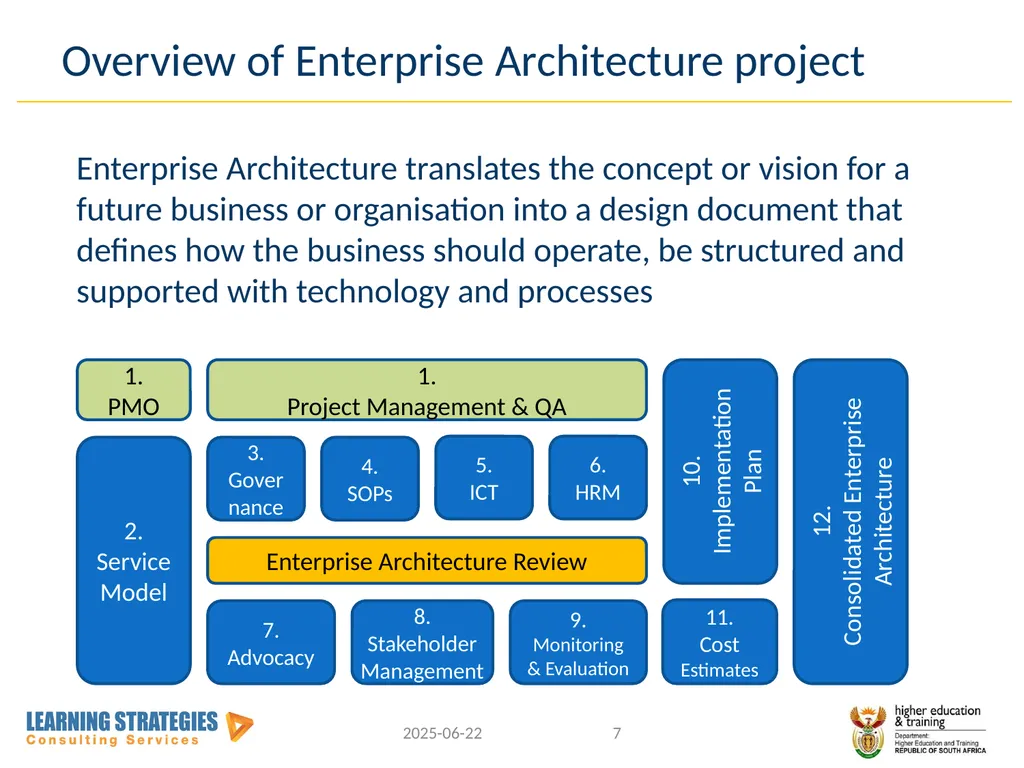
slide7. Overview of Enterprise Architecture project Enterprise Architecture translates the concept or vision for a future business or organisation into a design document that defines how the business should operate, be structured and supported with technology and processes 2016/06/27 7<br>
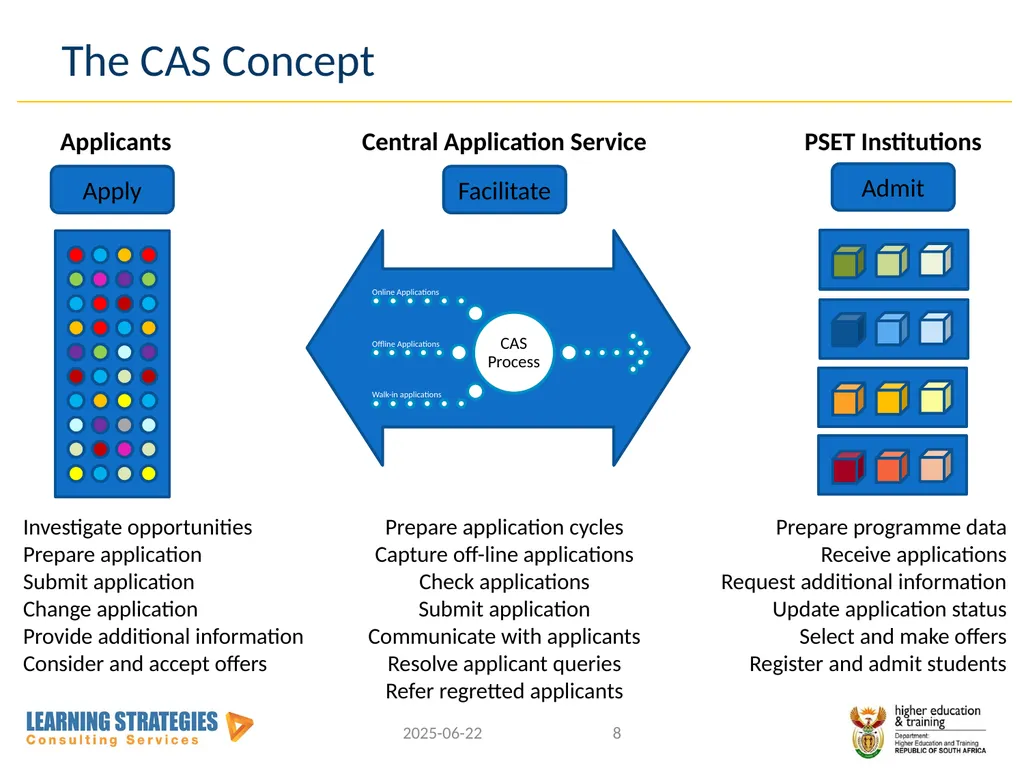
slide8. The CAS Concept 2016/06/27 8 Applicants Central Application Service PSET Institutions Apply Facilitate Admit Investigate opportunities
Prepare application
Submit application
Change application
Provide additional information
Consider and accept offers Prepare application cycles
Capture off-line applications
Check applications
Submit application
Communicate with applicants
Resolve applicant queries
Refer regretted applicants Prepare programme data
Receive applications
Request additional information
Update application status
Select and make offers
Register and admit students<br>
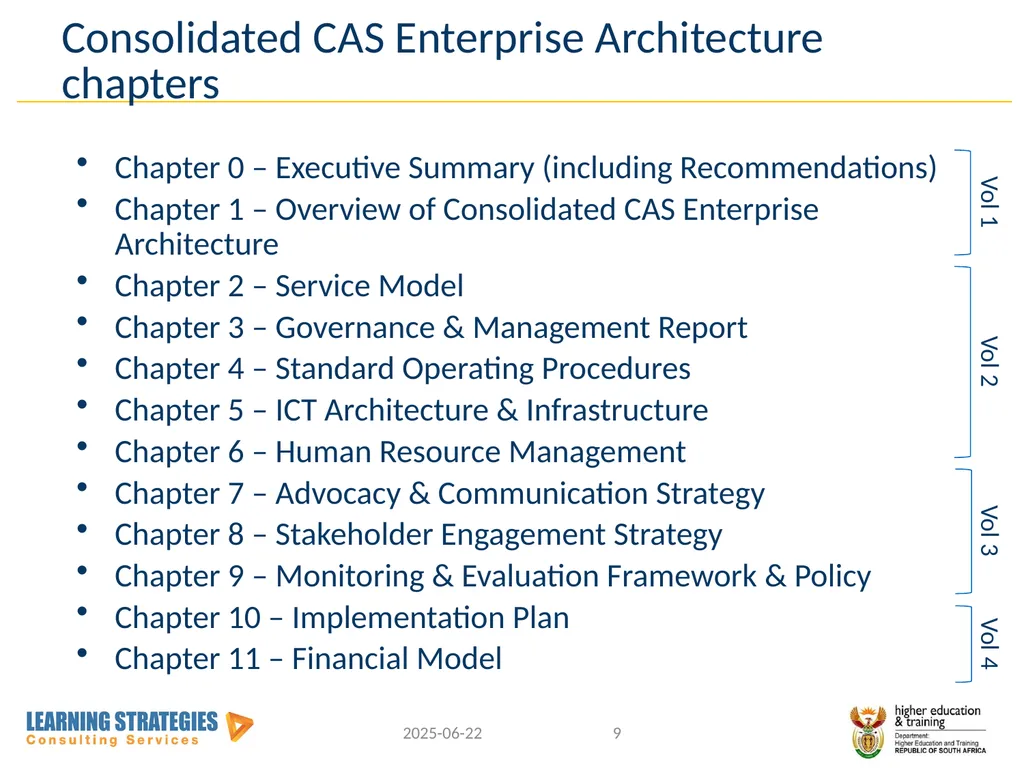
slide9. Consolidated CAS Enterprise Architecture chapters Chapter 0 – Executive Summary (including Recommendations)
Chapter 1 – Overview of Consolidated CAS Enterprise Architecture
Chapter 2 – Service Model
Chapter 3 – Governance & Management Report
Chapter 4 – Standard Operating Procedures
Chapter 5 – ICT Architecture & Infrastructure
Chapter 6 – Human Resource Management
Chapter 7 – Advocacy & Communication Strategy
Chapter 8 – Stakeholder Engagement Strategy
Chapter 9 – Monitoring & Evaluation Framework & Policy
Chapter 10 – Implementation Plan
Chapter 11 – Financial Model 2016/06/27 9 Vol 1 Vol 2 Vol 3 Vol 4<br>
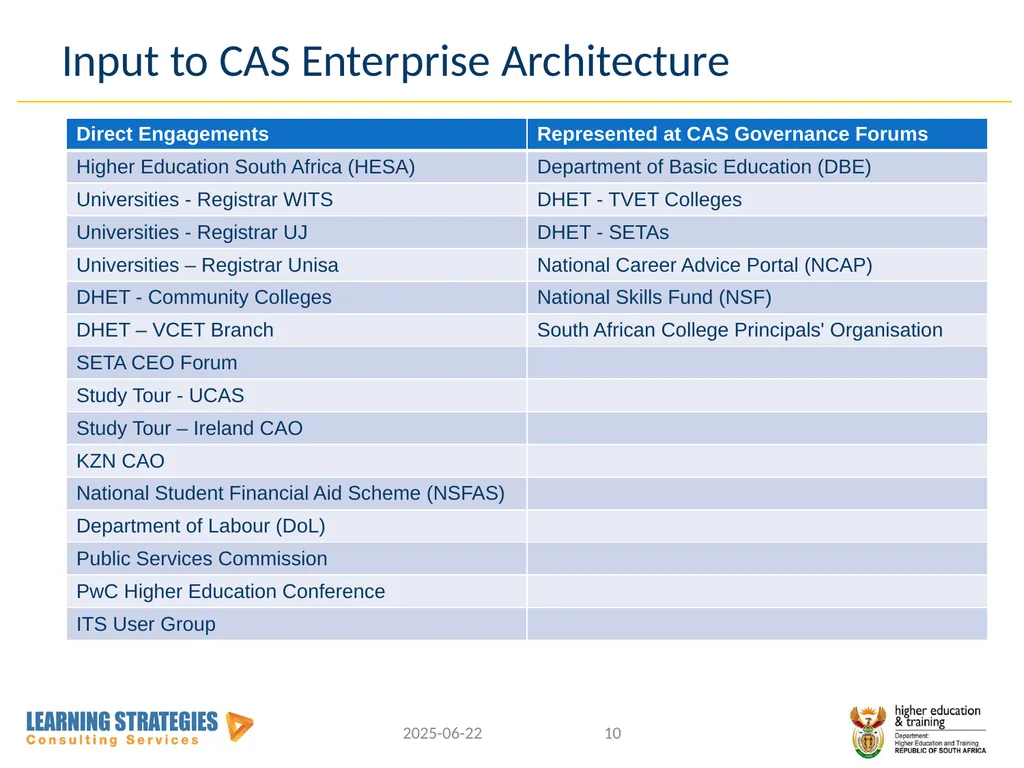
slide10. Input to CAS Enterprise Architecture 2016/06/27 10<br>
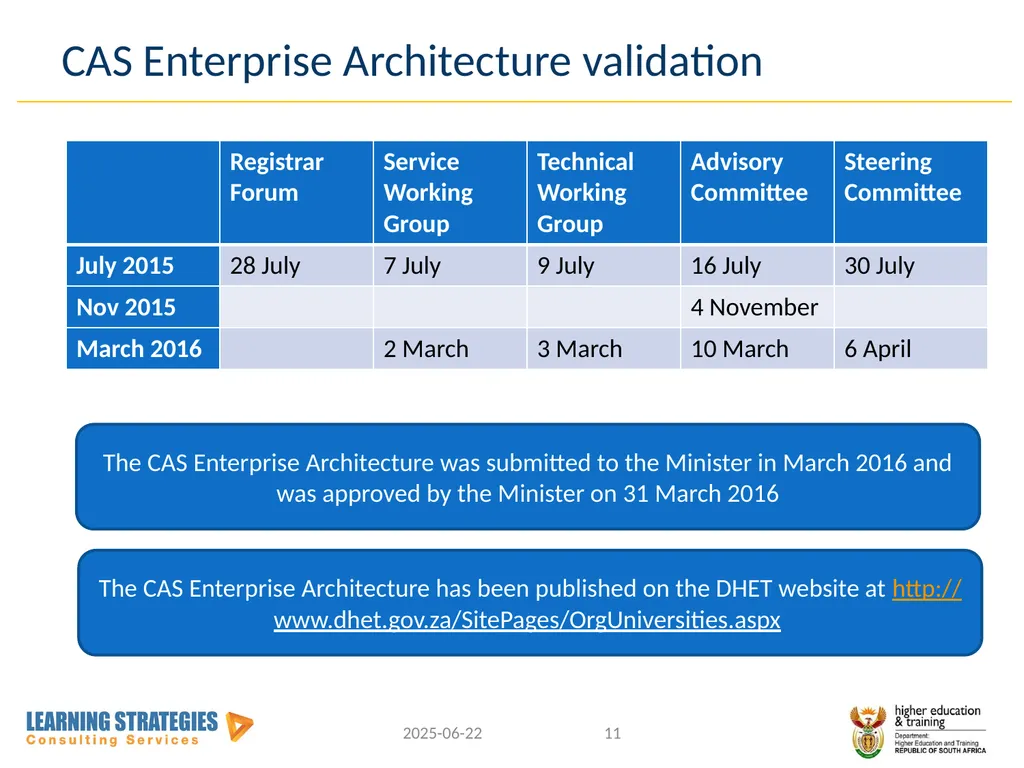
slide11. CAS Enterprise Architecture validation 2016/06/27 11 The CAS Enterprise Architecture was submitted to the Minister in March 2016 and was approved by the Minister on 31 March 2016 The CAS Enterprise Architecture has been published on the DHET website at http://www.dhet.gov.za/SitePages/OrgUniversities.aspx<br>
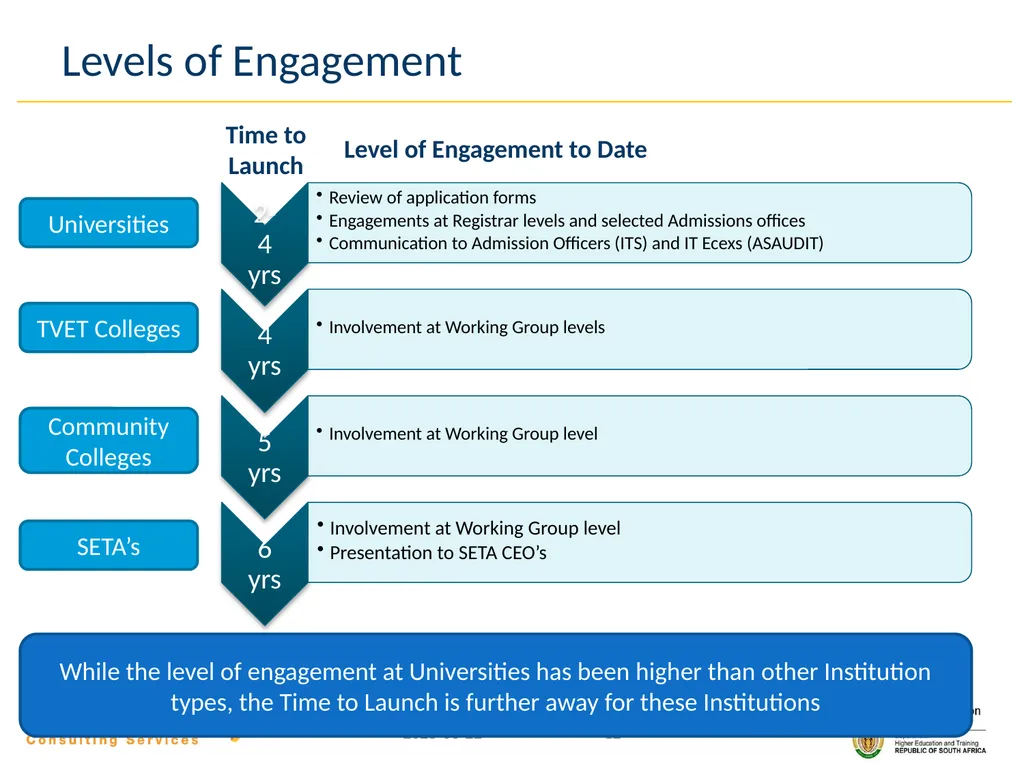
slide12. Levels of Engagement 2016/06/27 12 Universities TVET Colleges Community Colleges Time to Launch Level of Engagement to Date SETA’s While the level of engagement at Universities has been higher than other Institution types, the Time to Launch is further away for these Institutions<br>
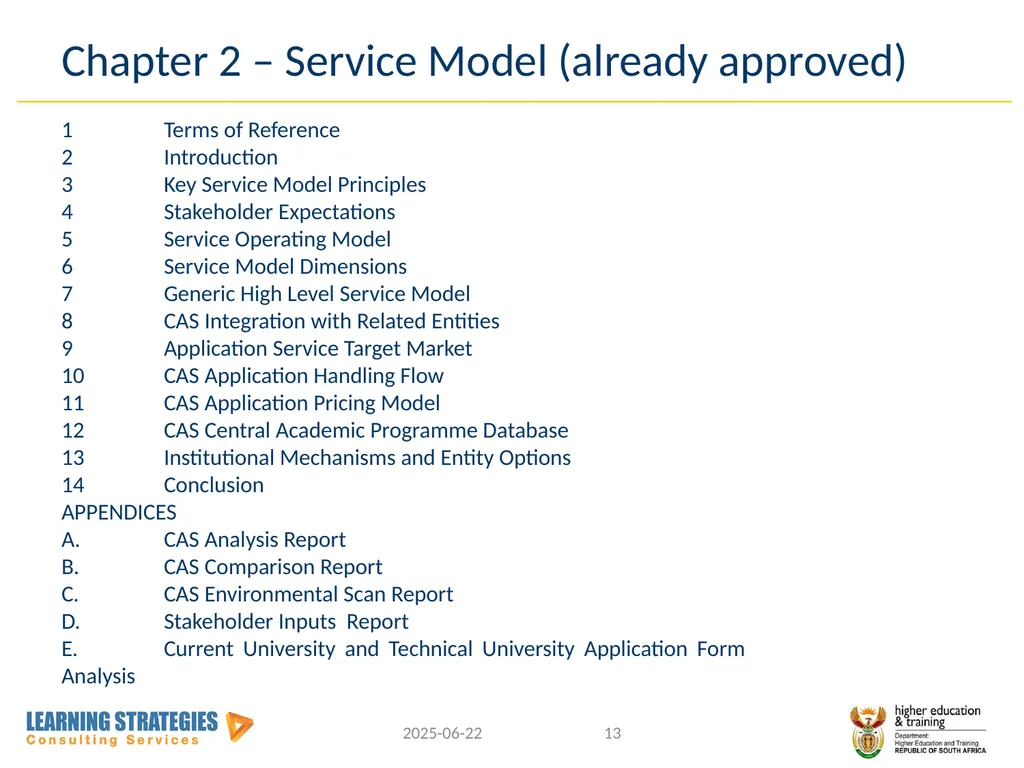
slide13. Chapter 2 – Service Model (already approved) 2016/06/27 13 1 Terms of Reference
2 Introduction
3 Key Service Model Principles
4 Stakeholder Expectations
5 Service Operating Model
6 Service Model Dimensions
7 Generic High Level Service Model
8 CAS Integration with Related Entities
9 Application Service Target Market
10 CAS Application Handling Flow
11 CAS Application Pricing Model
12 CAS Central Academic Programme Database
13 Institutional Mechanisms and Entity Options
14 Conclusion
APPENDICES
A. CAS Analysis Report
B. CAS Comparison Report
C. CAS Environmental Scan Report
D. Stakeholder Inputs Report
E. Current University and Technical University Application Form Analysis<br>
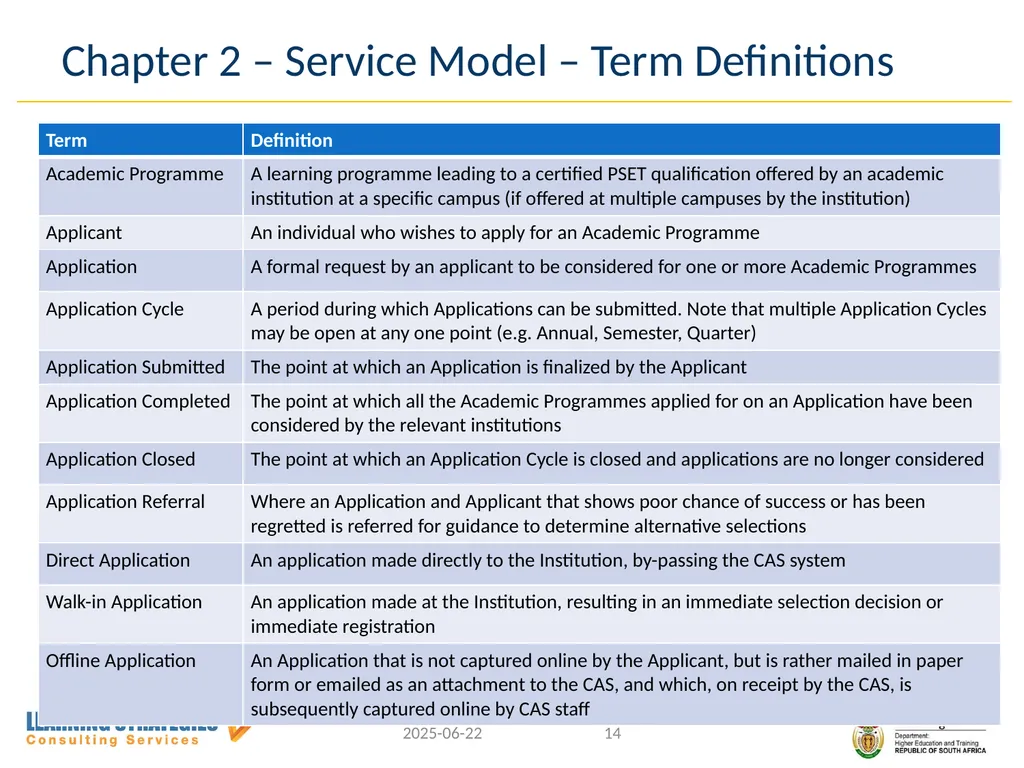
slide14. Chapter 2 – Service Model – Term Definitions 2016/06/27 14<br>
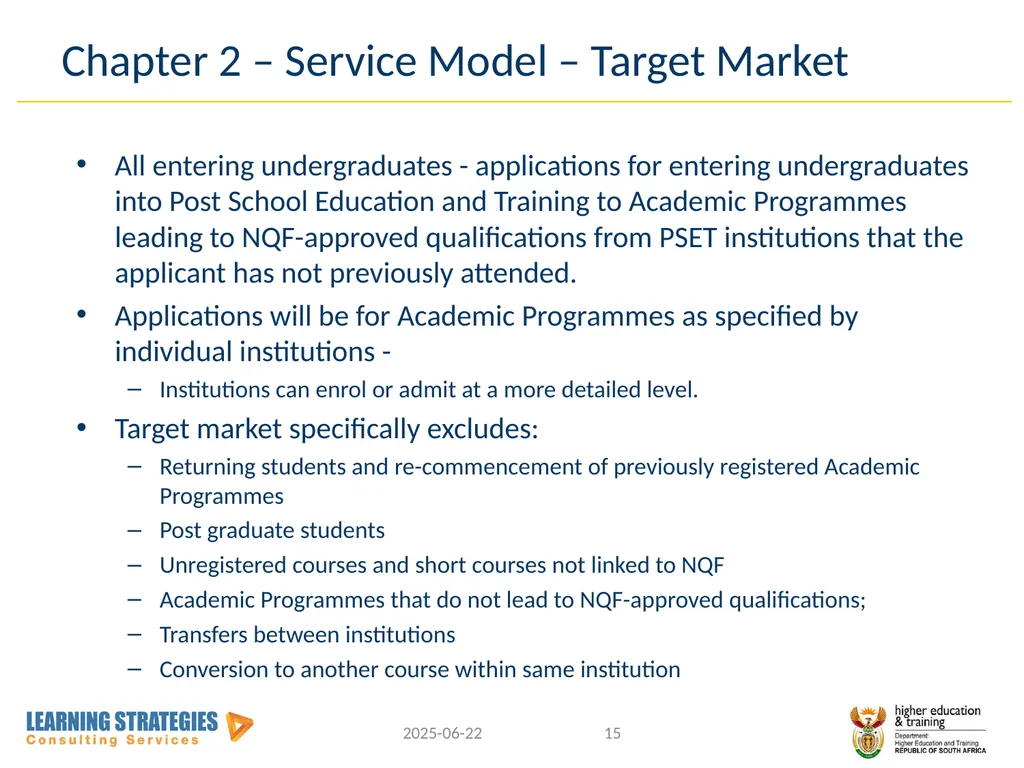
slide15. Chapter 2 – Service Model – Target Market All entering undergraduates - applications for entering undergraduates into Post School Education and Training to Academic Programmes leading to NQF-approved qualifications from PSET institutions that the applicant has not previously attended.
Applications will be for Academic Programmes as specified by individual institutions -
Institutions can enrol or admit at a more detailed level.
Target market specifically excludes:
Returning students and re-commencement of previously registered Academic Programmes
Post graduate students
Unregistered courses and short courses not linked to NQF
Academic Programmes that do not lead to NQF-approved qualifications;
Transfers between institutions
Conversion to another course within same institution 2016/06/27 15<br>
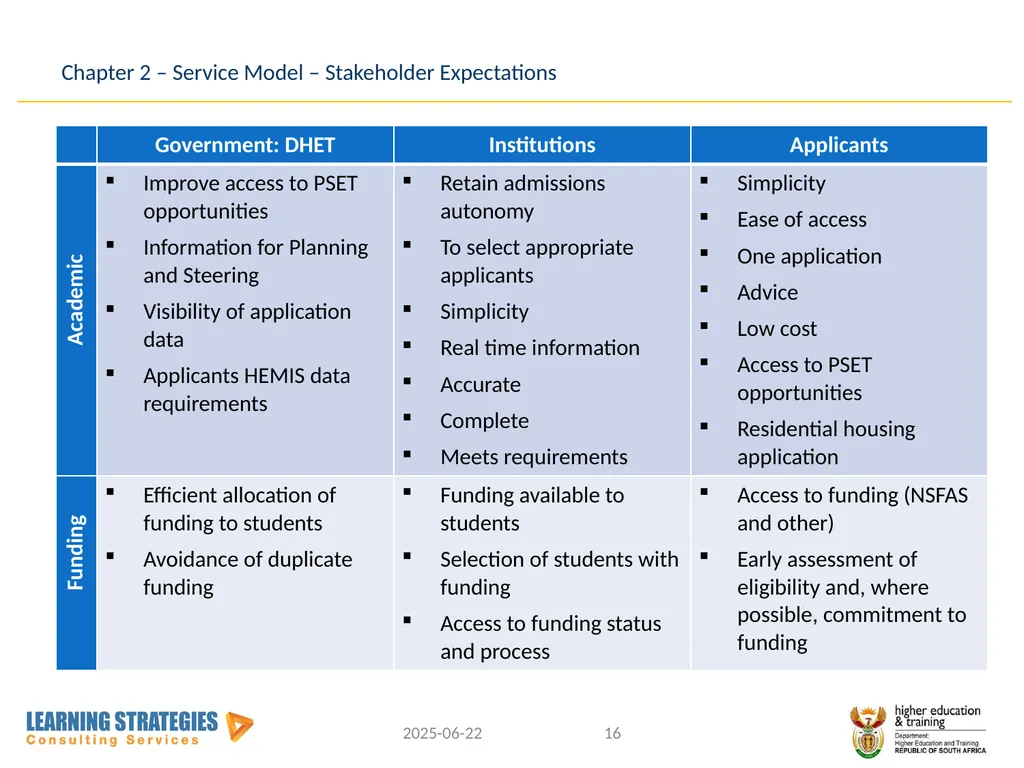
slide16. Chapter 2 – Service Model – Stakeholder Expectations 2016/06/27 16<br>
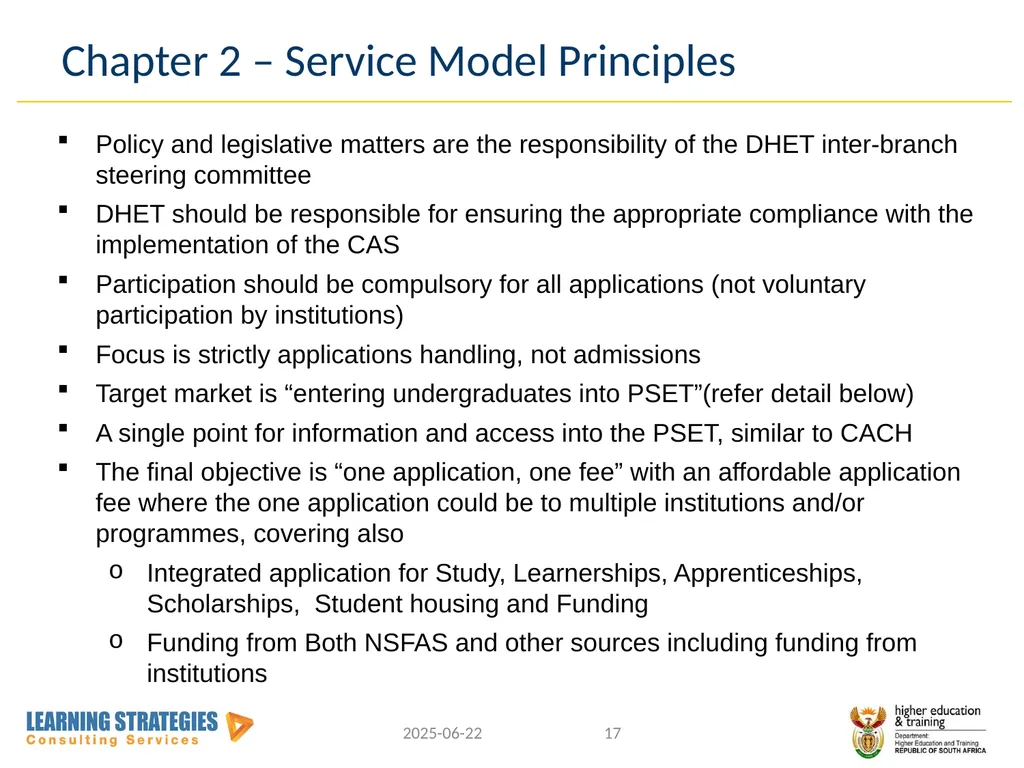
slide17. Chapter 2 – Service Model Principles 2016/06/27 17 Policy and legislative matters are the responsibility of the DHET inter-branch steering committee
DHET should be responsible for ensuring the appropriate compliance with the implementation of the CAS
Participation should be compulsory for all applications (not voluntary participation by institutions)
Focus is strictly applications handling, not admissions
Target market is “entering undergraduates into PSET”(refer detail below)
A single point for information and access into the PSET, similar to CACH
The final objective is “one application, one fee” with an affordable application fee where the one application could be to multiple institutions and/or programmes, covering also
Integrated application for Study, Learnerships, Apprenticeships, Scholarships, Student housing and Funding
Funding from Both NSFAS and other sources including funding from institutions<br>
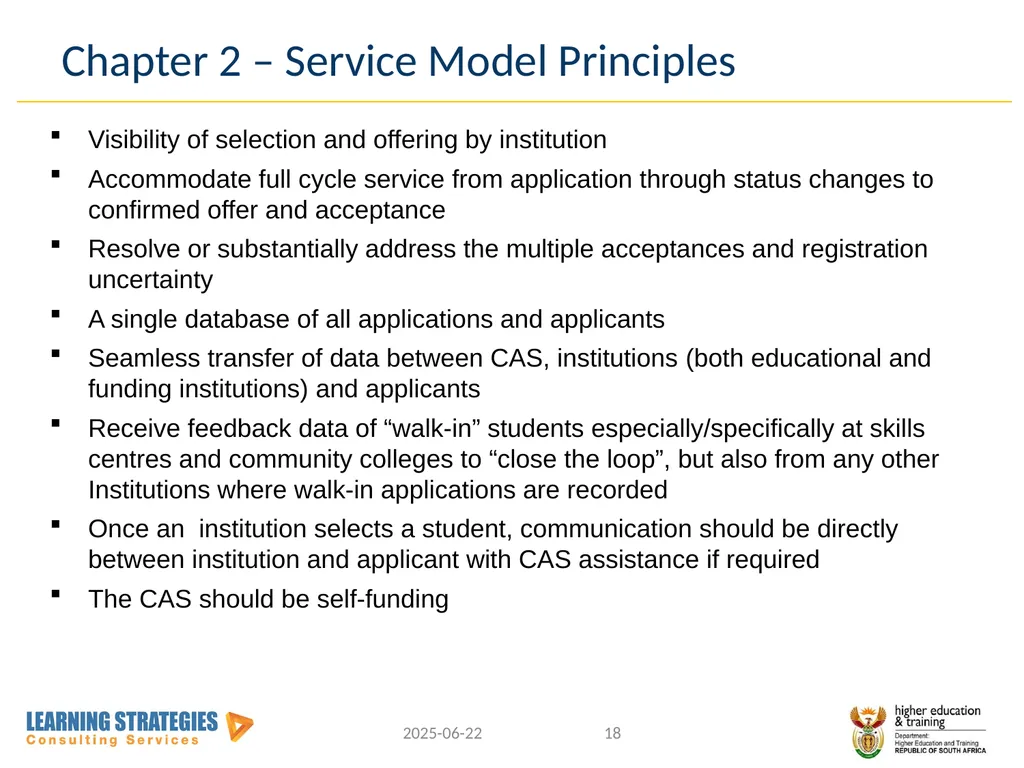
slide18. Chapter 2 – Service Model Principles 2016/06/27 18 Visibility of selection and offering by institution
Accommodate full cycle service from application through status changes to confirmed offer and acceptance
Resolve or substantially address the multiple acceptances and registration uncertainty
A single database of all applications and applicants
Seamless transfer of data between CAS, institutions (both educational and funding institutions) and applicants
Receive feedback data of “walk-in” students especially/specifically at skills centres and community colleges to “close the loop”, but also from any other Institutions where walk-in applications are recorded
Once an institution selects a student, communication should be directly between institution and applicant with CAS assistance if required
The CAS should be self-funding<br>
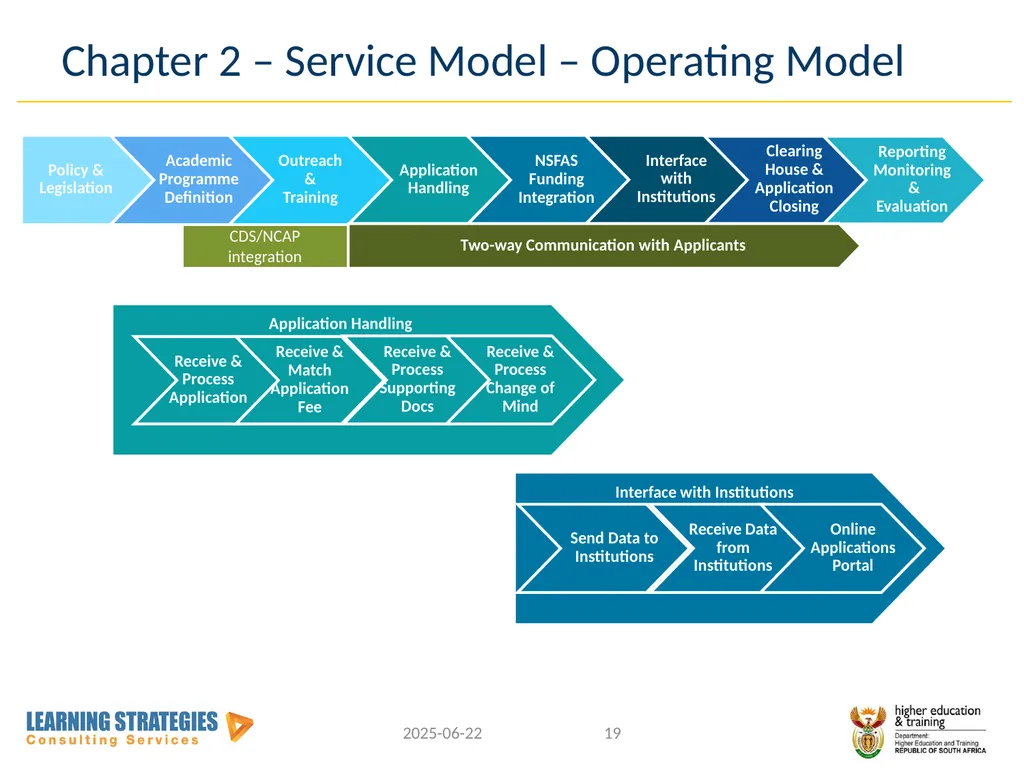
slide19. Chapter 2 – Service Model – Operating Model 2016/06/27 19<br>
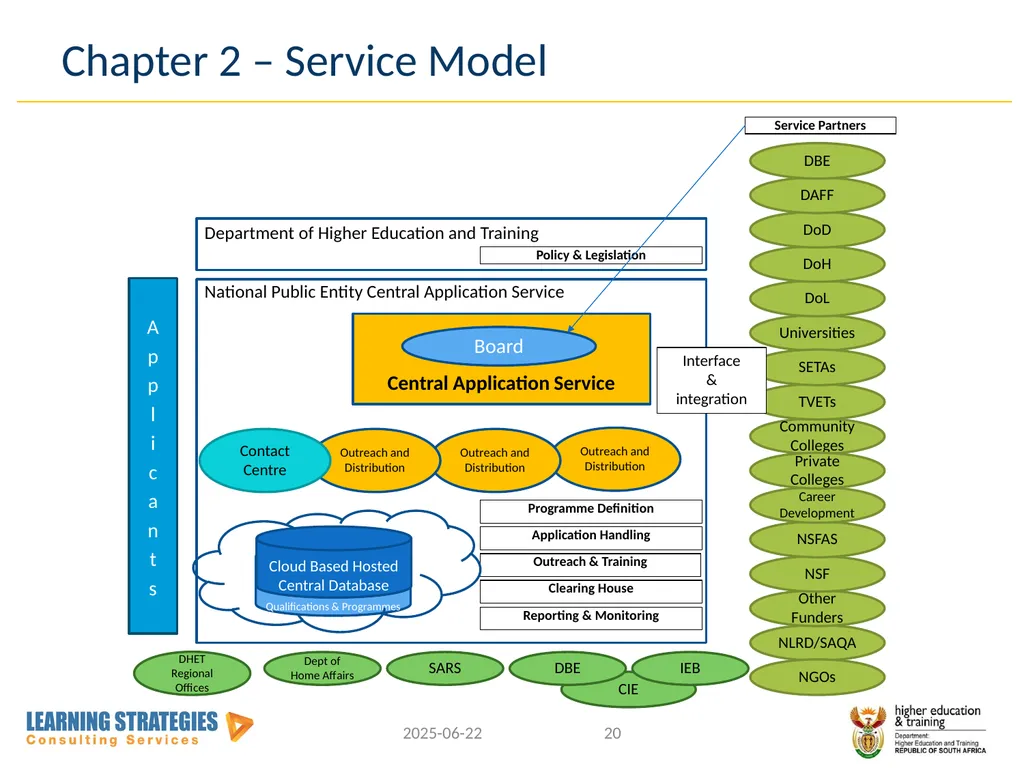
slide20. Chapter 2 – Service Model 2016/06/27 20<br>
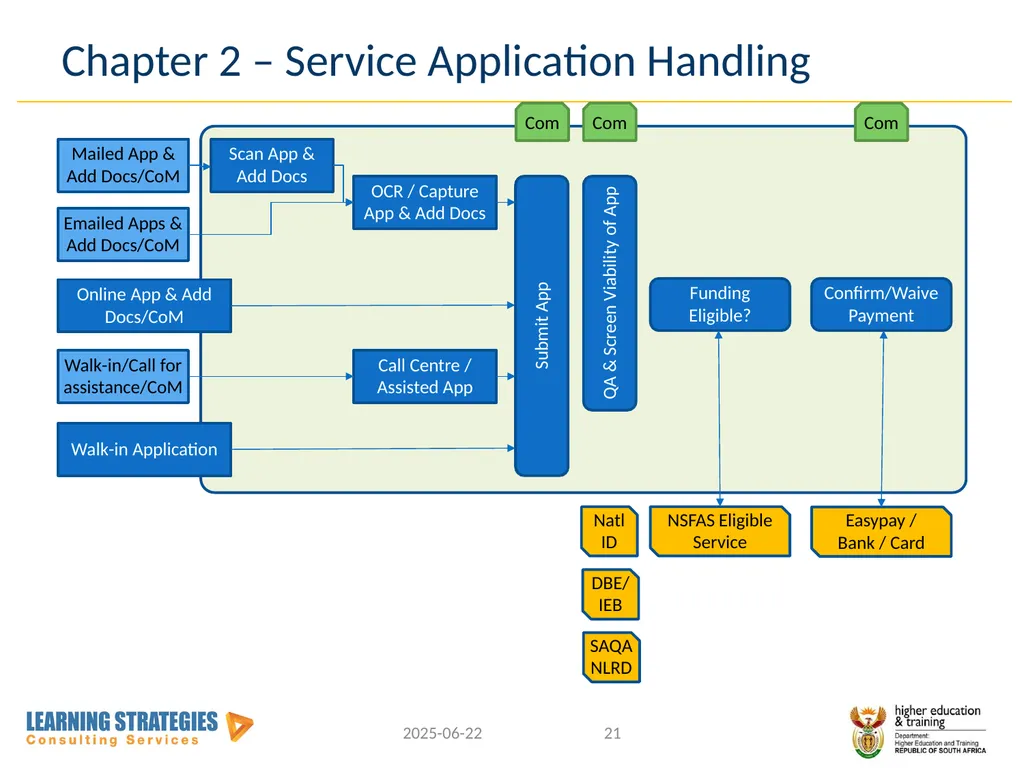
slide21. Chapter 2 – Service Application Handling 2016/06/27 21<br>
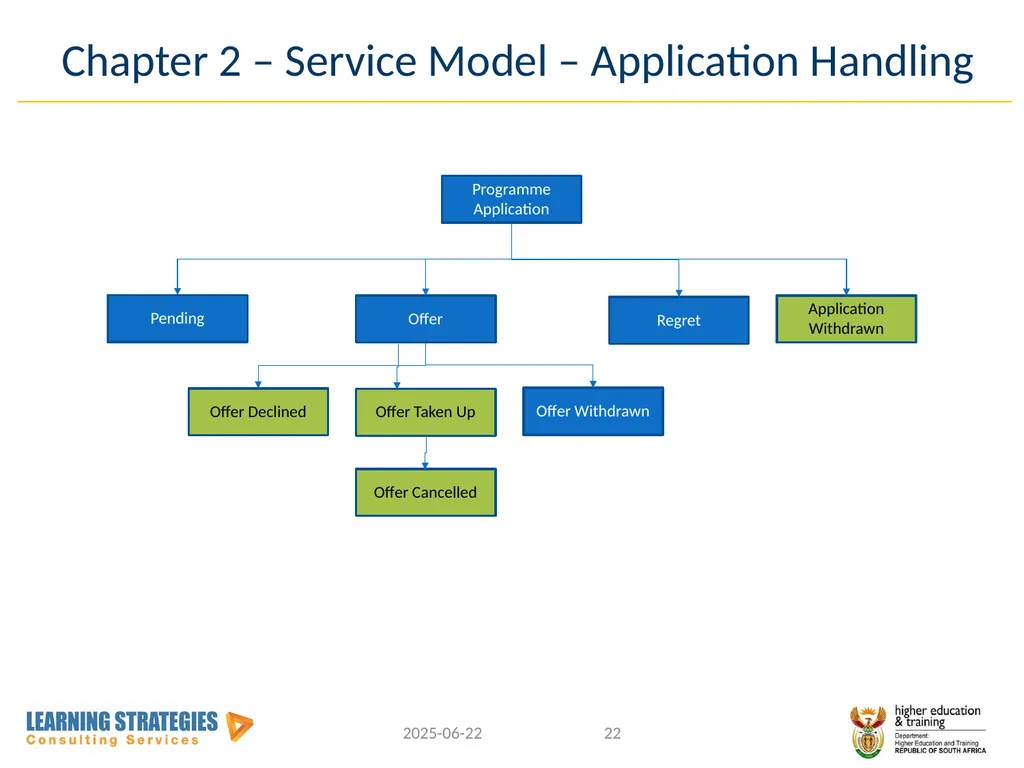
slide22. Chapter 2 – Service Model – Application Handling 2016/06/27 22<br>
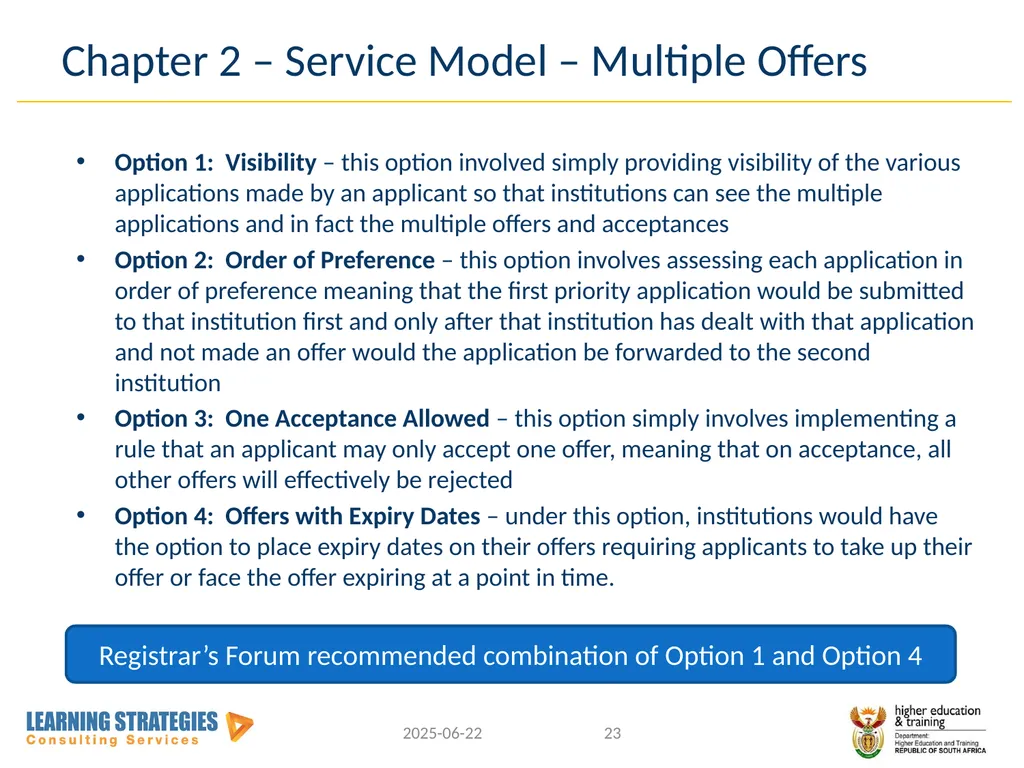
slide23. Chapter 2 – Service Model – Multiple Offers Option 1: Visibility – this option involved simply providing visibility of the various applications made by an applicant so that institutions can see the multiple applications and in fact the multiple offers and acceptances
Option 2: Order of Preference – this option involves assessing each application in order of preference meaning that the first priority application would be submitted to that institution first and only after that institution has dealt with that application and not made an offer would the application be forwarded to the second institution
Option 3: One Acceptance Allowed – this option simply involves implementing a rule that an applicant may only accept one offer, meaning that on acceptance, all other offers will effectively be rejected
Option 4: Offers with Expiry Dates – under this option, institutions would have the option to place expiry dates on their offers requiring applicants to take up their offer or face the offer expiring at a point in time. 2016/06/27 23 Registrar’s Forum recommended combination of Option 1 and Option 4<br>
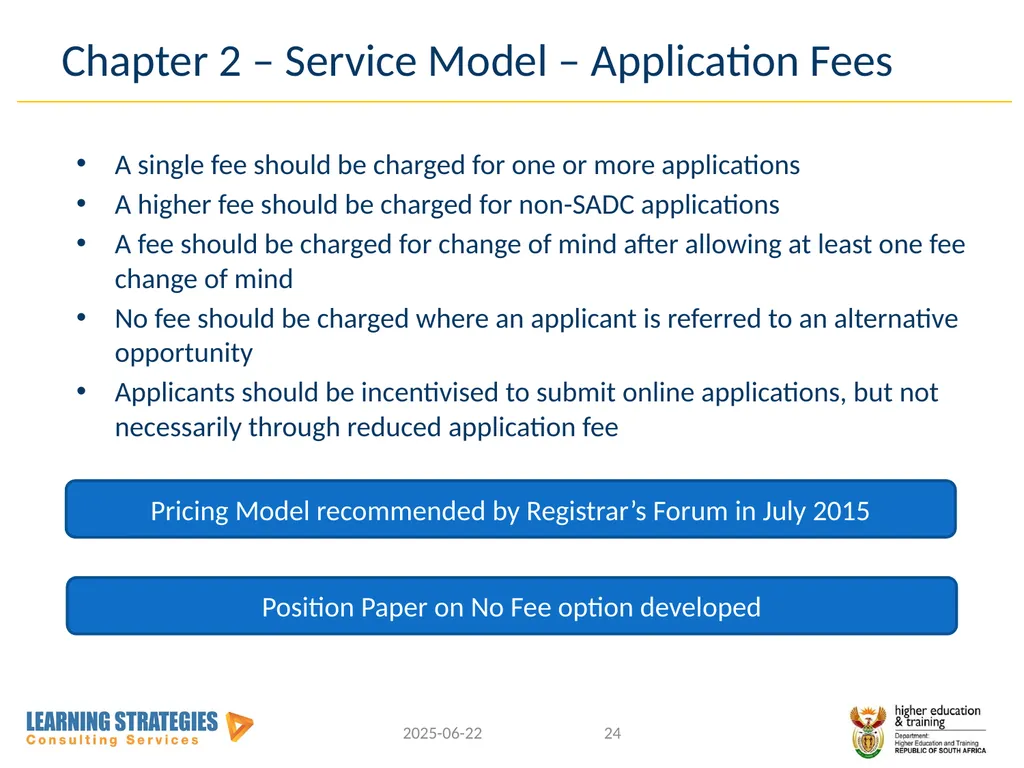
slide24. Chapter 2 – Service Model – Application Fees A single fee should be charged for one or more applications
A higher fee should be charged for non-SADC applications
A fee should be charged for change of mind after allowing at least one fee change of mind
No fee should be charged where an applicant is referred to an alternative opportunity
Applicants should be incentivised to submit online applications, but not necessarily through reduced application fee 2016/06/27 24 Pricing Model recommended by Registrar’s Forum in July 2015 Position Paper on No Fee option developed<br>
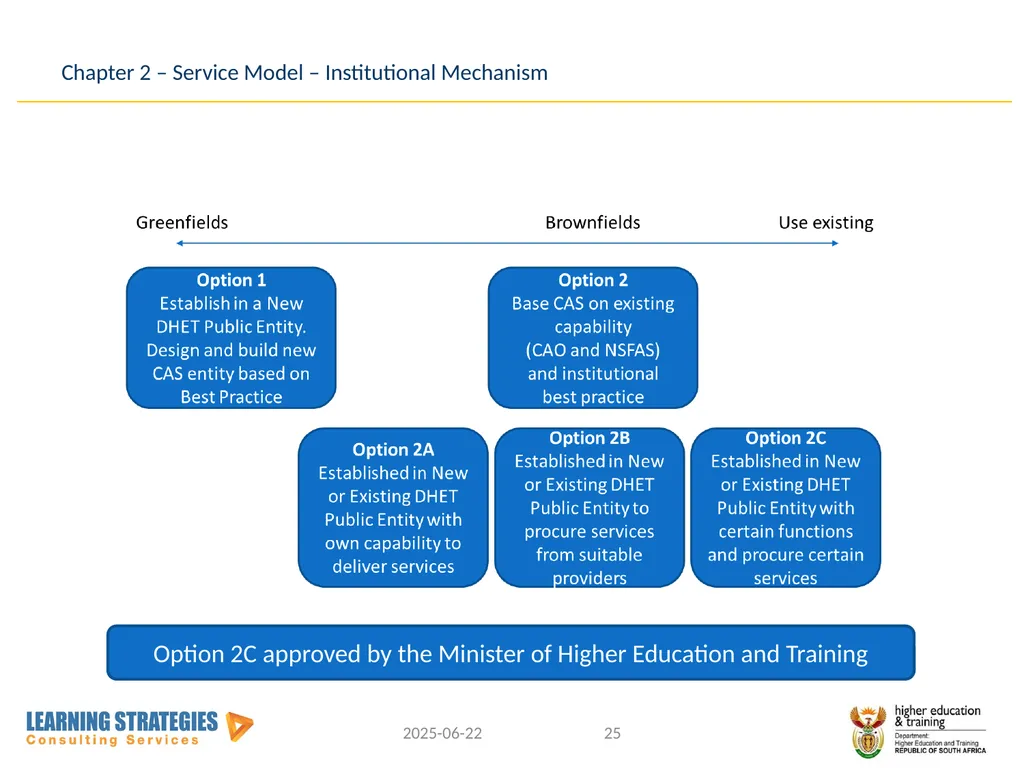
slide25. Chapter 2 – Service Model – Institutional Mechanism 2016/06/27 25 Option 2C approved by the Minister of Higher Education and Training<br>
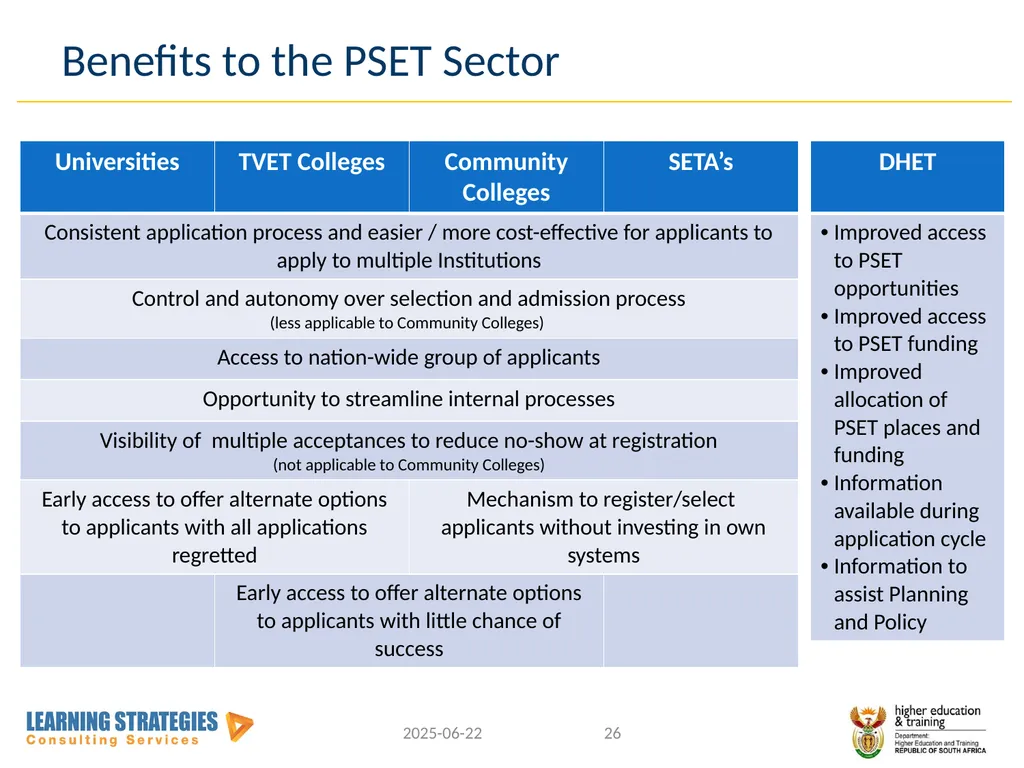
slide26. Benefits to the PSET Sector 2016/06/27 26<br>
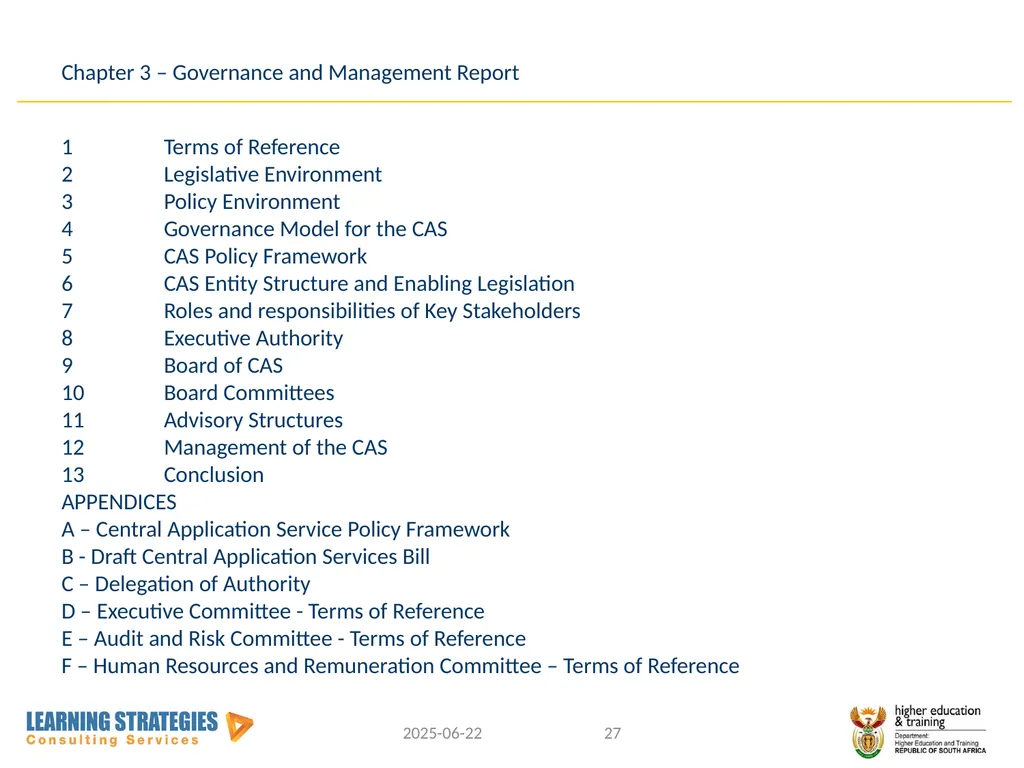
slide27. Chapter 3 – Governance and Management Report 2016/06/27 27 1 Terms of Reference
2 Legislative Environment
3 Policy Environment
4 Governance Model for the CAS
5 CAS Policy Framework
6 CAS Entity Structure and Enabling Legislation
7 Roles and responsibilities of Key Stakeholders
8 Executive Authority
9 Board of CAS
10 Board Committees
11 Advisory Structures
12 Management of the CAS
13 Conclusion
APPENDICES
A – Central Application Service Policy Framework
B - Draft Central Application Services Bill
C – Delegation of Authority
D – Executive Committee - Terms of Reference
E – Audit and Risk Committee - Terms of Reference
F – Human Resources and Remuneration Committee – Terms of Reference<br>
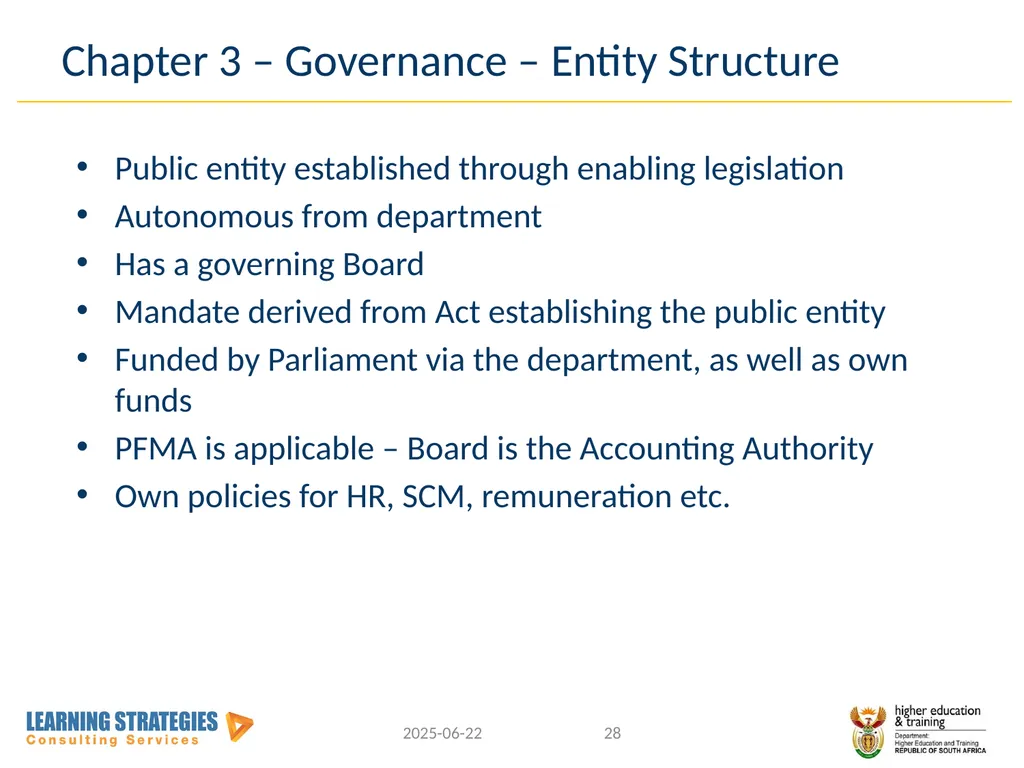
slide28. Chapter 3 – Governance – Entity Structure Public entity established through enabling legislation
Autonomous from department
Has a governing Board
Mandate derived from Act establishing the public entity
Funded by Parliament via the department, as well as own funds
PFMA is applicable – Board is the Accounting Authority
Own policies for HR, SCM, remuneration etc. 2016/06/27 28<br>
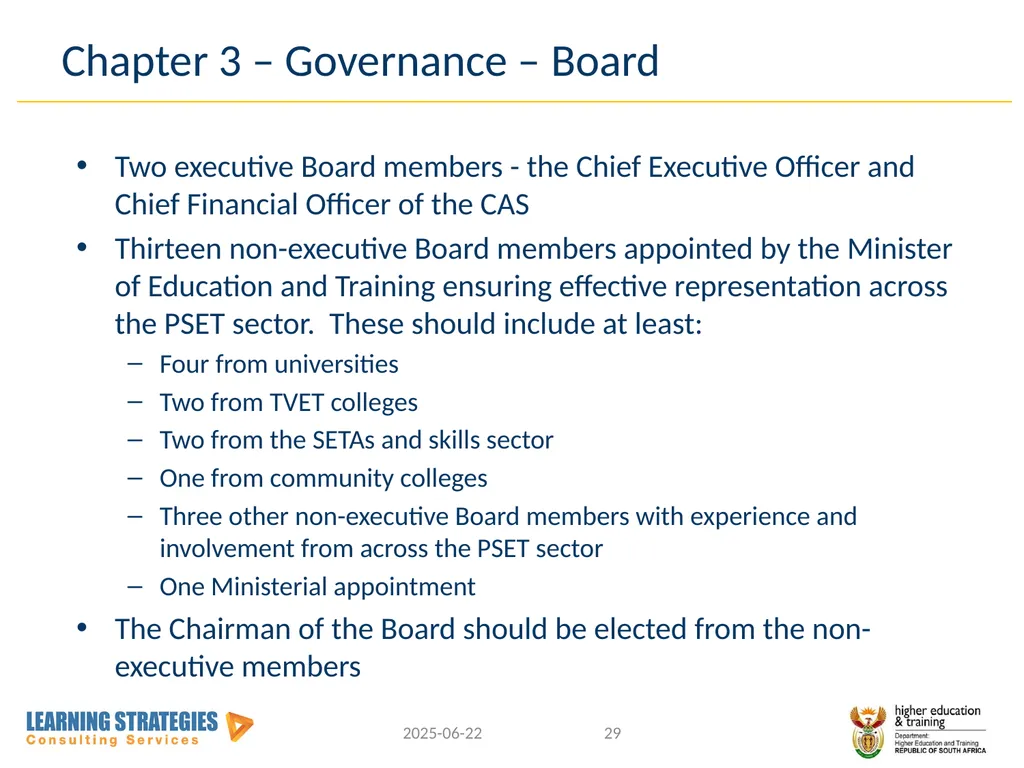
slide29. Chapter 3 – Governance – Board Two executive Board members - the Chief Executive Officer and Chief Financial Officer of the CAS
Thirteen non-executive Board members appointed by the Minister of Education and Training ensuring effective representation across the PSET sector. These should include at least:
Four from universities
Two from TVET colleges
Two from the SETAs and skills sector
One from community colleges
Three other non-executive Board members with experience and involvement from across the PSET sector
One Ministerial appointment
The Chairman of the Board should be elected from the non-executive members 2016/06/27 29<br>
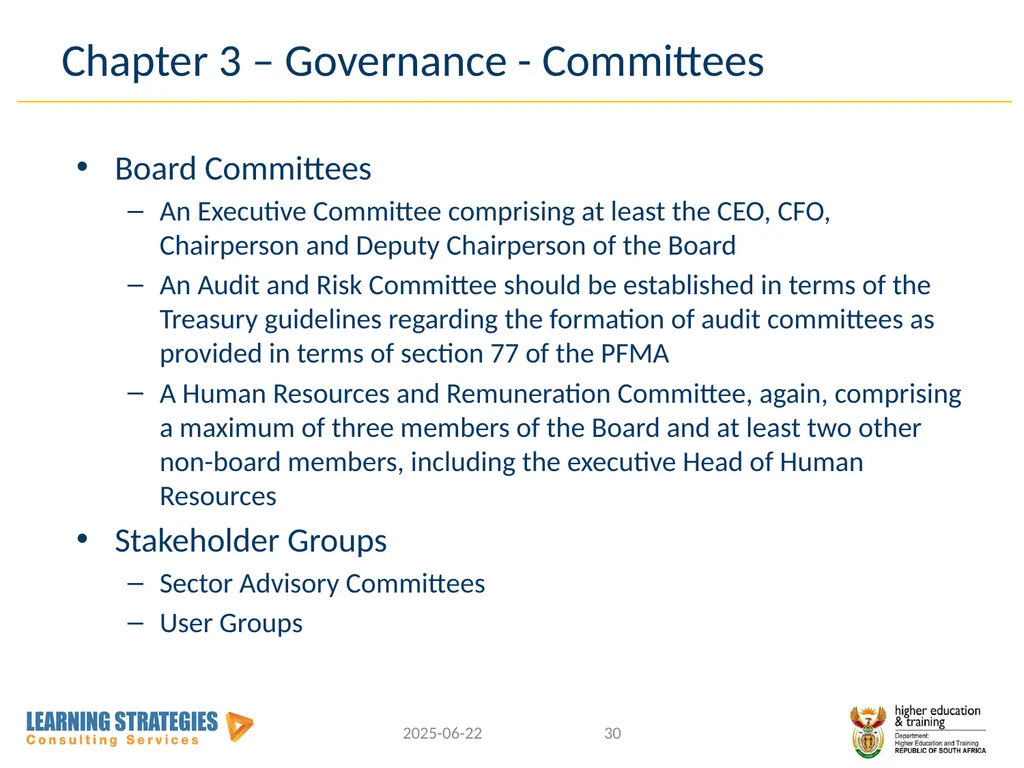
slide30. Chapter 3 – Governance - Committees Board Committees
An Executive Committee comprising at least the CEO, CFO, Chairperson and Deputy Chairperson of the Board
An Audit and Risk Committee should be established in terms of the Treasury guidelines regarding the formation of audit committees as provided in terms of section 77 of the PFMA
A Human Resources and Remuneration Committee, again, comprising a maximum of three members of the Board and at least two other non-board members, including the executive Head of Human Resources
Stakeholder Groups
Sector Advisory Committees
User Groups 2016/06/27 30<br>
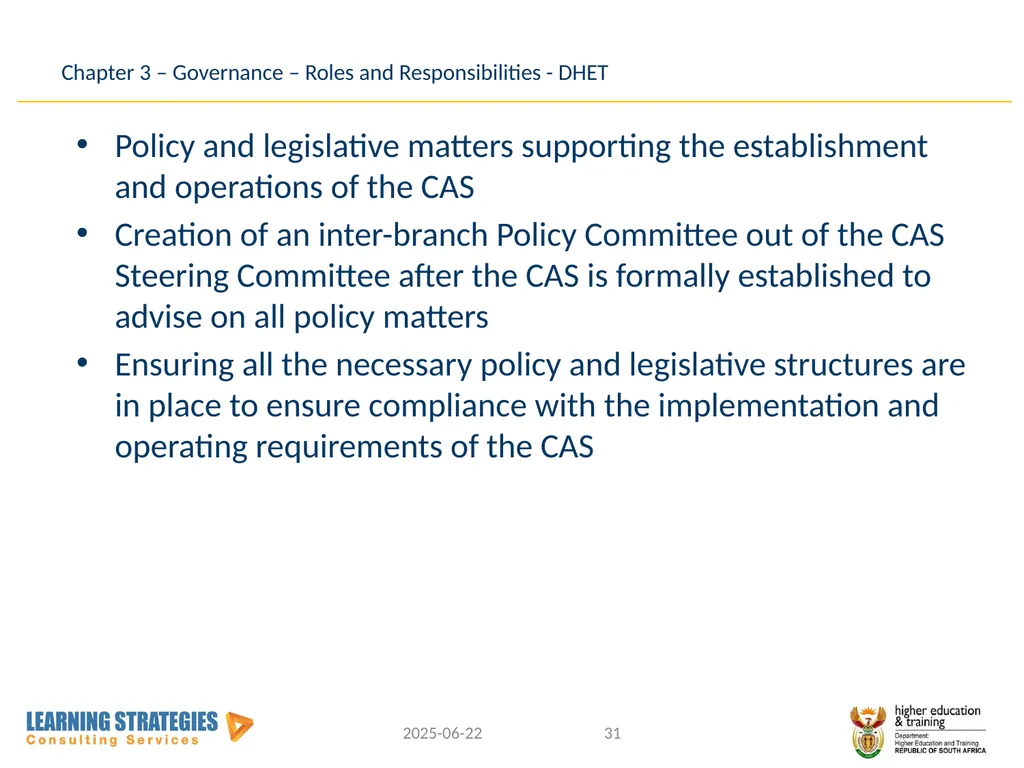
slide31. Chapter 3 – Governance – Roles and Responsibilities - DHET Policy and legislative matters supporting the establishment and operations of the CAS
Creation of an inter-branch Policy Committee out of the CAS Steering Committee after the CAS is formally established to advise on all policy matters
Ensuring all the necessary policy and legislative structures are in place to ensure compliance with the implementation and operating requirements of the CAS 2016/06/27 31<br>
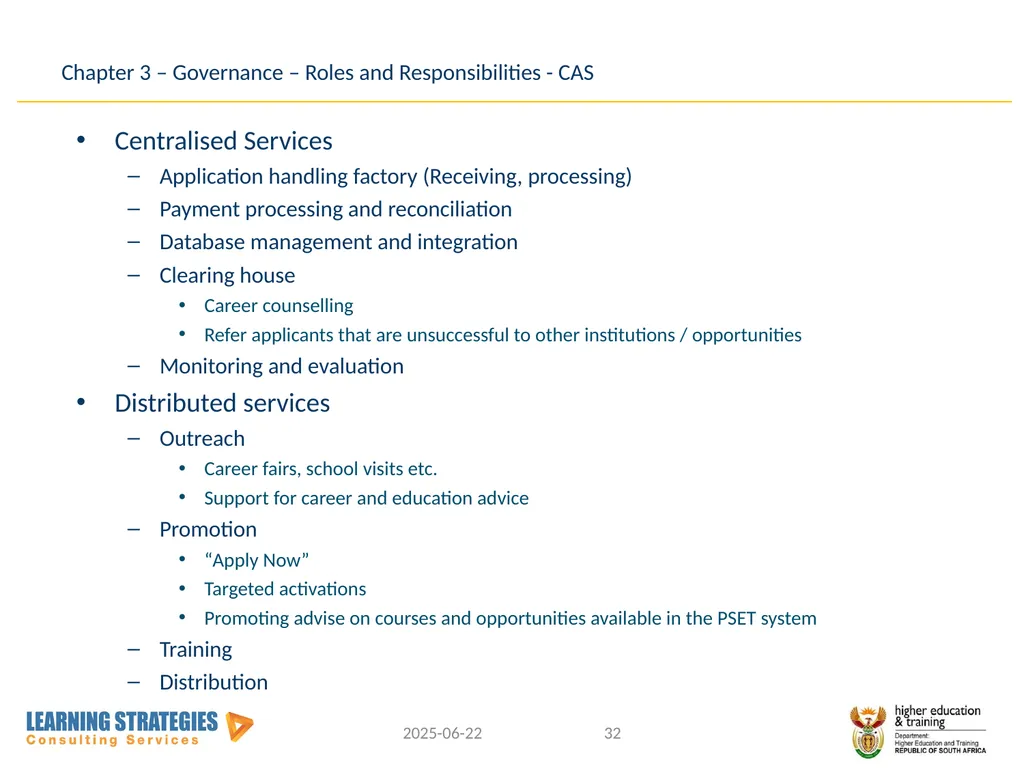
slide32. Chapter 3 – Governance – Roles and Responsibilities - CAS Centralised Services
Application handling factory (Receiving, processing)
Payment processing and reconciliation
Database management and integration
Clearing house
Career counselling
Refer applicants that are unsuccessful to other institutions / opportunities
Monitoring and evaluation
Distributed services
Outreach
Career fairs, school visits etc.
Support for career and education advice
Promotion
“Apply Now”
Targeted activations
Promoting advise on courses and opportunities available in the PSET system
Training
Distribution 2016/06/27 32<br>
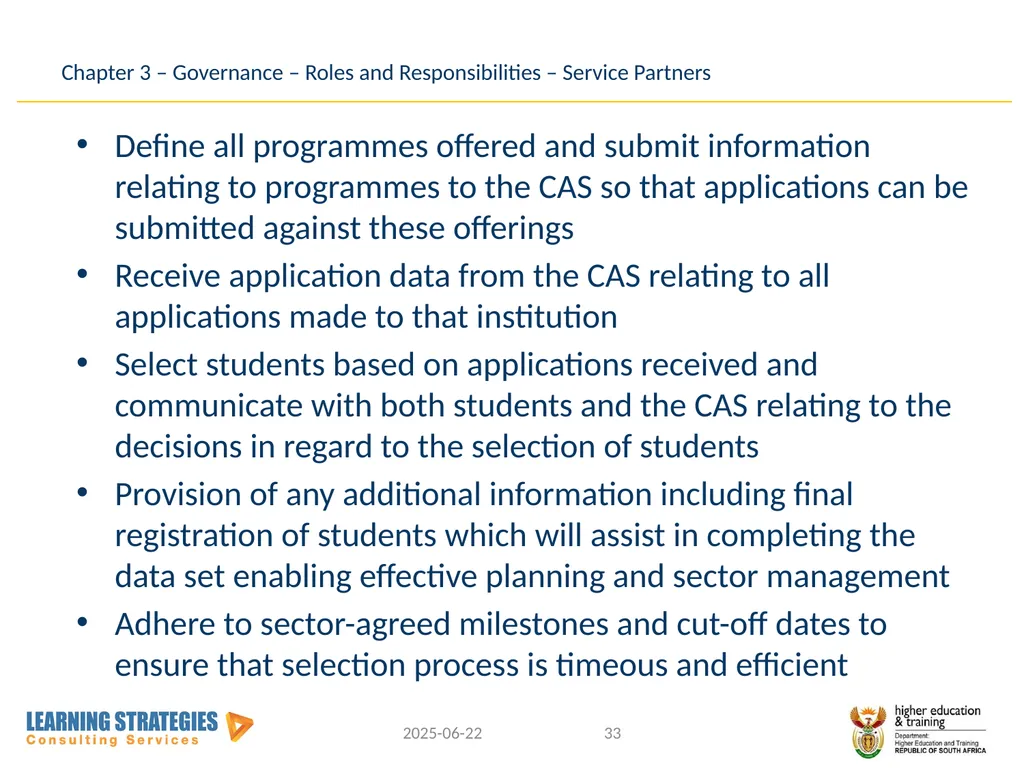
slide33. Chapter 3 – Governance – Roles and Responsibilities – Service Partners Define all programmes offered and submit information relating to programmes to the CAS so that applications can be submitted against these offerings
Receive application data from the CAS relating to all applications made to that institution
Select students based on applications received and communicate with both students and the CAS relating to the decisions in regard to the selection of students
Provision of any additional information including final registration of students which will assist in completing the data set enabling effective planning and sector management
Adhere to sector-agreed milestones and cut-off dates to ensure that selection process is timeous and efficient 2016/06/27 33<br>
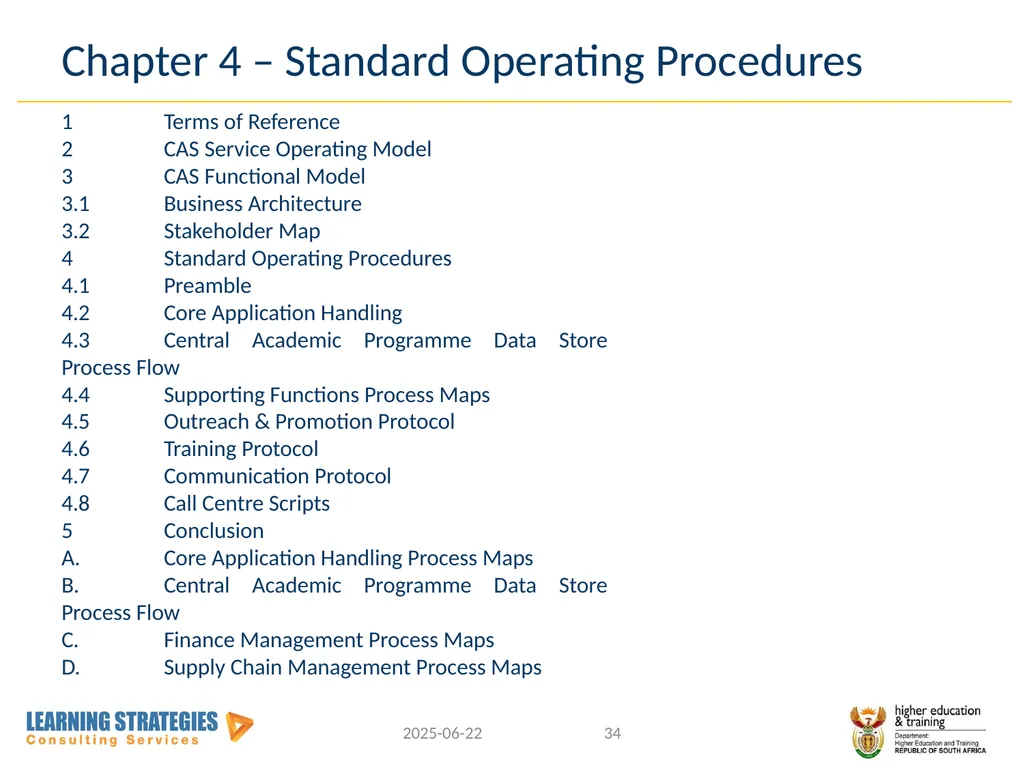
slide34. Chapter 4 – Standard Operating Procedures 2016/06/27 34 1 Terms of Reference
2 CAS Service Operating Model
3 CAS Functional Model
3.1 Business Architecture
3.2 Stakeholder Map
4 Standard Operating Procedures
4.1 Preamble
4.2 Core Application Handling
4.3 Central Academic Programme Data Store Process Flow
4.4 Supporting Functions Process Maps
4.5 Outreach & Promotion Protocol
4.6 Training Protocol
4.7 Communication Protocol
4.8 Call Centre Scripts
5 Conclusion
A. Core Application Handling Process Maps
B. Central Academic Programme Data Store Process Flow
C. Finance Management Process Maps
D. Supply Chain Management Process Maps<br>
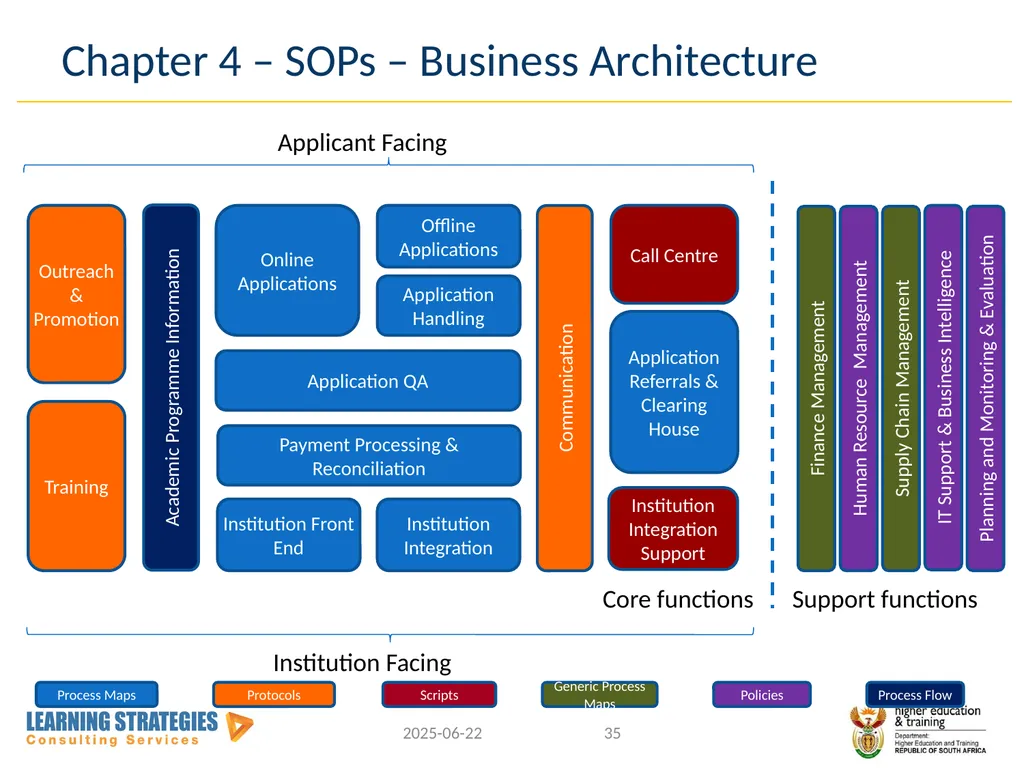
slide35. Chapter 4 – SOPs – Business Architecture 2016/06/27 35<br>
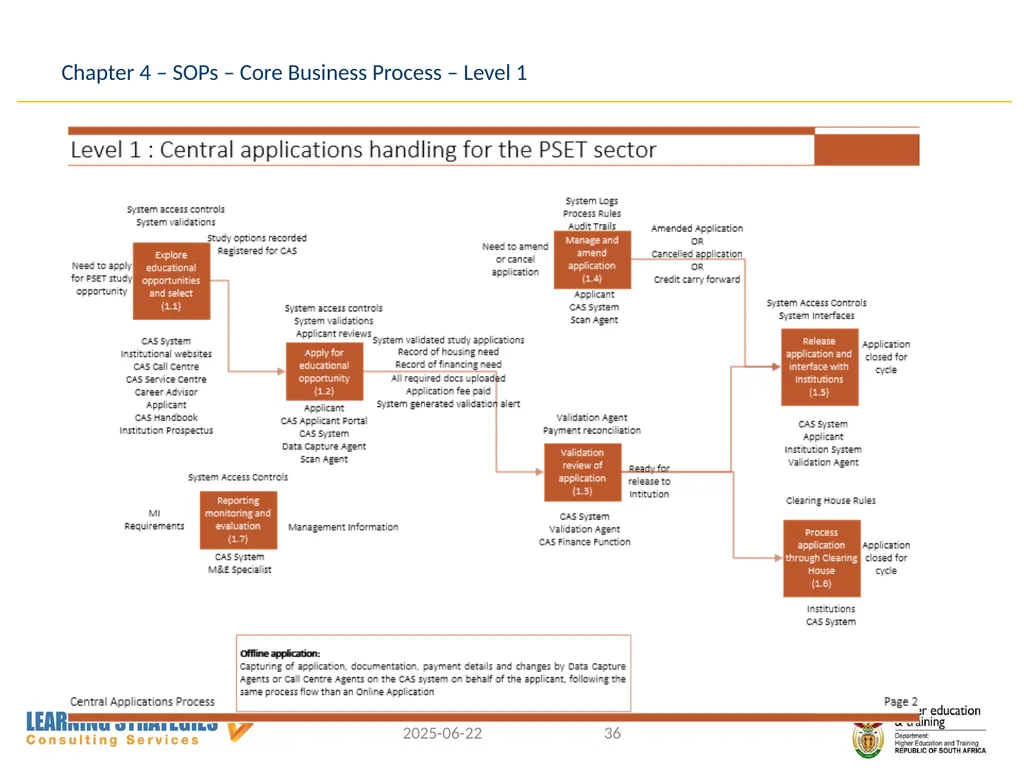
slide36. Chapter 4 – SOPs – Core Business Process – Level 1 2016/06/27 36<br>
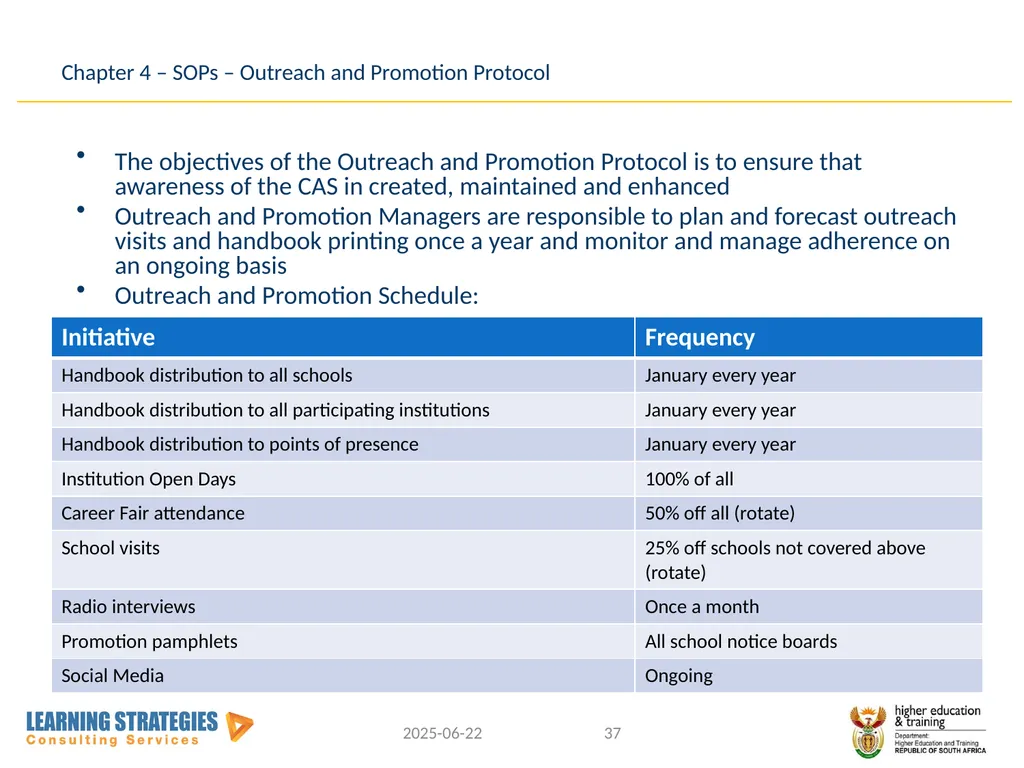
slide37. Chapter 4 – SOPs – Outreach and Promotion Protocol 2016/06/27 37 The objectives of the Outreach and Promotion Protocol is to ensure that awareness of the CAS in created, maintained and enhanced
Outreach and Promotion Managers are responsible to plan and forecast outreach visits and handbook printing once a year and monitor and manage adherence on an ongoing basis
Outreach and Promotion Schedule:<br>
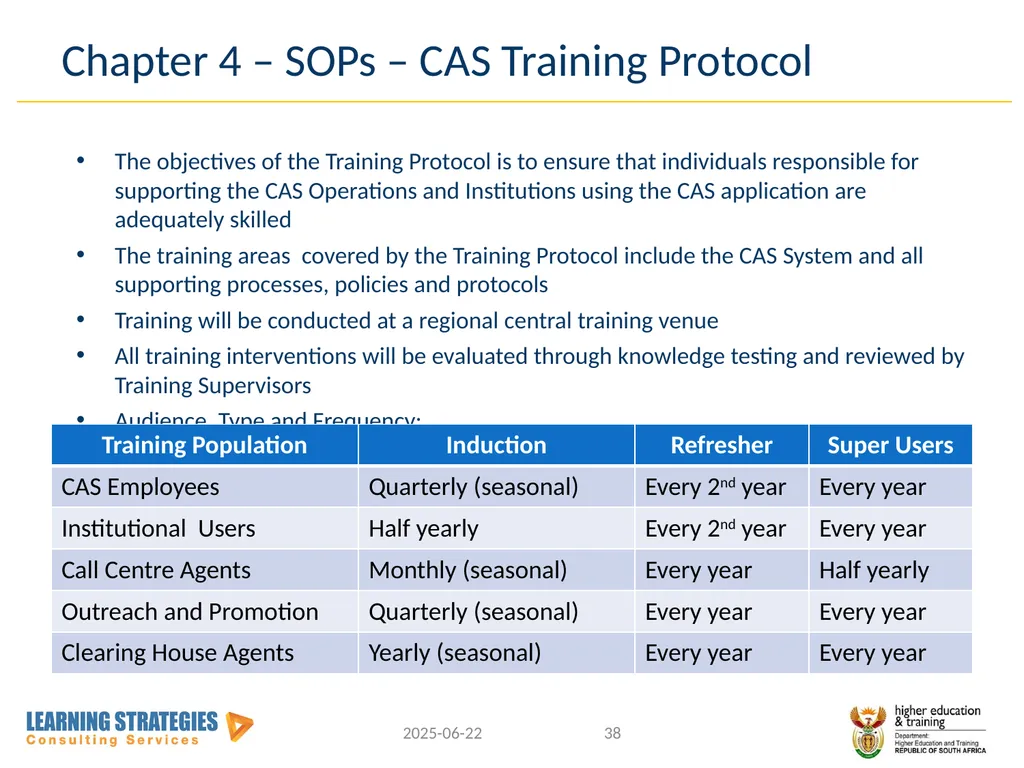
slide38. Chapter 4 – SOPs – CAS Training Protocol The objectives of the Training Protocol is to ensure that individuals responsible for supporting the CAS Operations and Institutions using the CAS application are adequately skilled
The training areas covered by the Training Protocol include the CAS System and all supporting processes, policies and protocols
Training will be conducted at a regional central training venue
All training interventions will be evaluated through knowledge testing and reviewed by Training Supervisors
Audience, Type and Frequency: 2016/06/27 38<br>
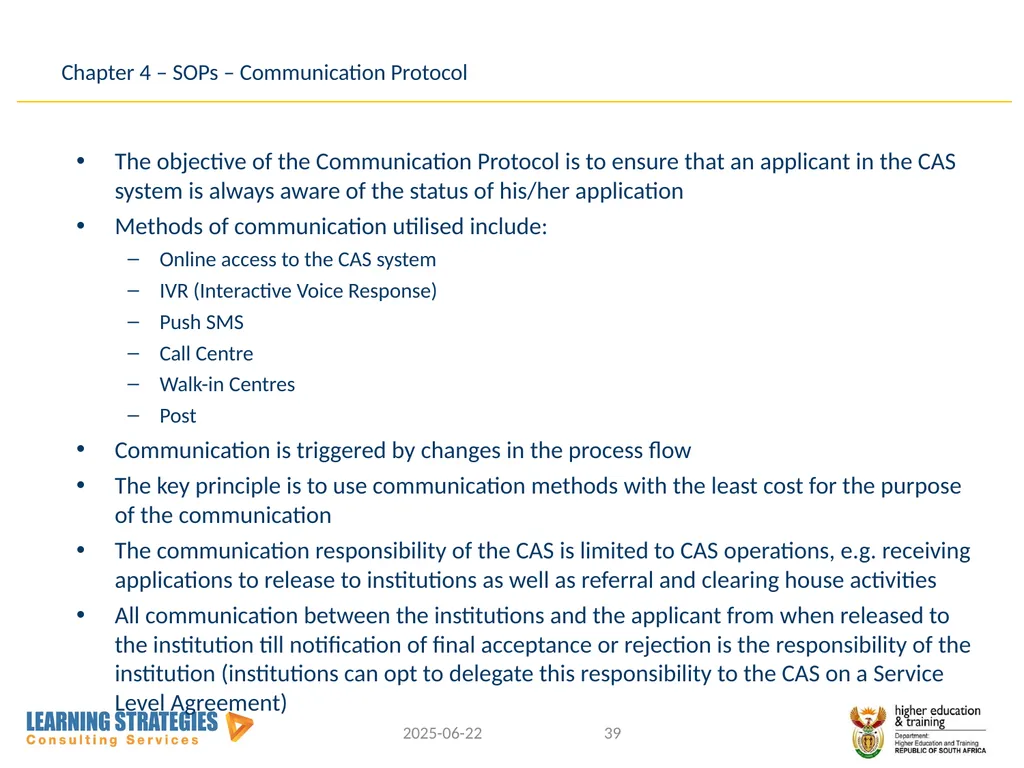
slide39. Chapter 4 – SOPs – Communication Protocol The objective of the Communication Protocol is to ensure that an applicant in the CAS system is always aware of the status of his/her application
Methods of communication utilised include:
Online access to the CAS system
IVR (Interactive Voice Response)
Push SMS
Call Centre
Walk-in Centres
Post
Communication is triggered by changes in the process flow
The key principle is to use communication methods with the least cost for the purpose of the communication
The communication responsibility of the CAS is limited to CAS operations, e.g. receiving applications to release to institutions as well as referral and clearing house activities
All communication between the institutions and the applicant from when released to the institution till notification of final acceptance or rejection is the responsibility of the institution (institutions can opt to delegate this responsibility to the CAS on a Service Level Agreement) 2016/06/27 39<br>
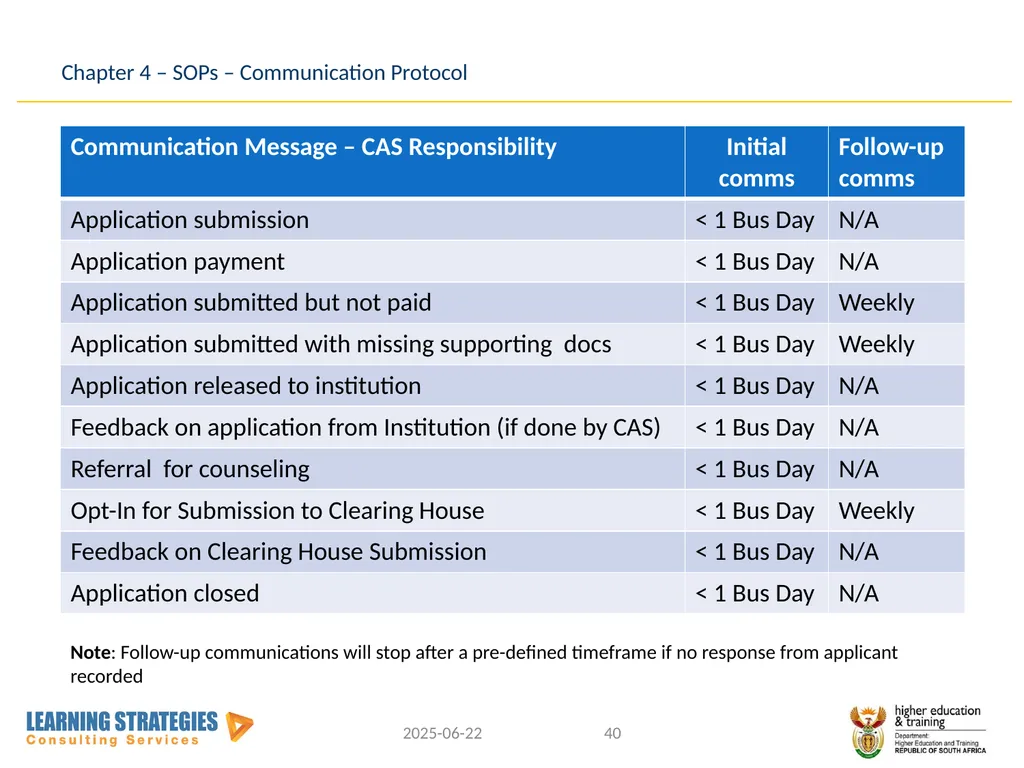
slide40. Chapter 4 – SOPs – Communication Protocol 2016/06/27 40 Note: Follow-up communications will stop after a pre-defined timeframe if no response from applicant recorded<br>
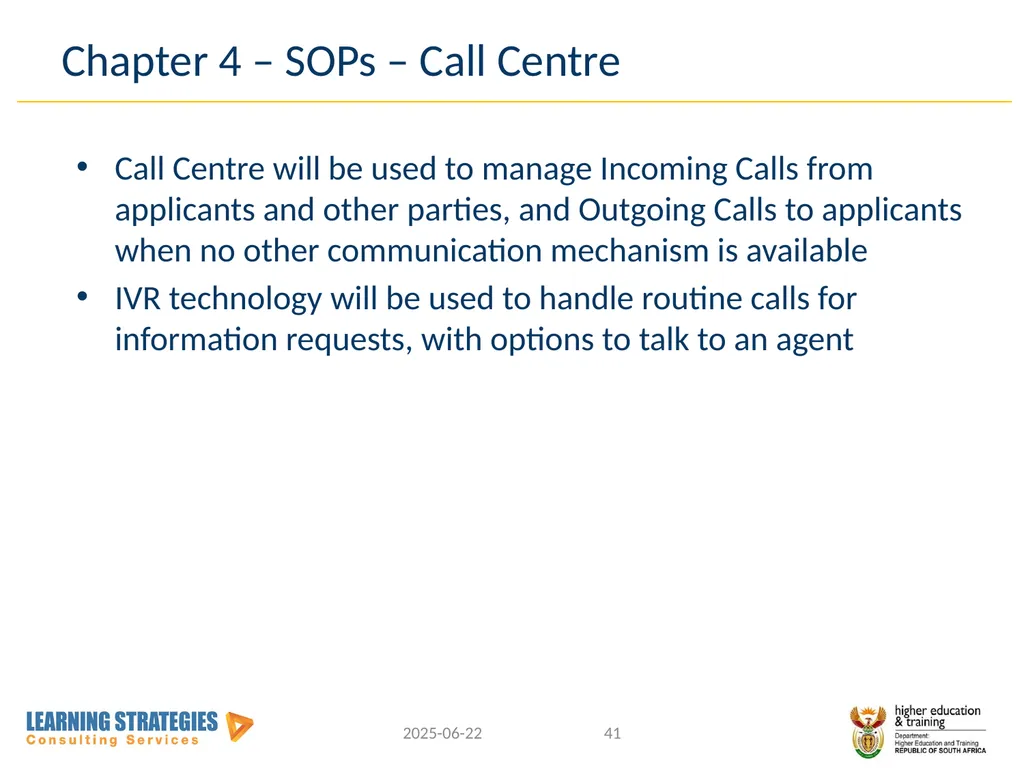
slide41. Chapter 4 – SOPs – Call Centre Call Centre will be used to manage Incoming Calls from applicants and other parties, and Outgoing Calls to applicants when no other communication mechanism is available
IVR technology will be used to handle routine calls for information requests, with options to talk to an agent 2016/06/27 41<br>
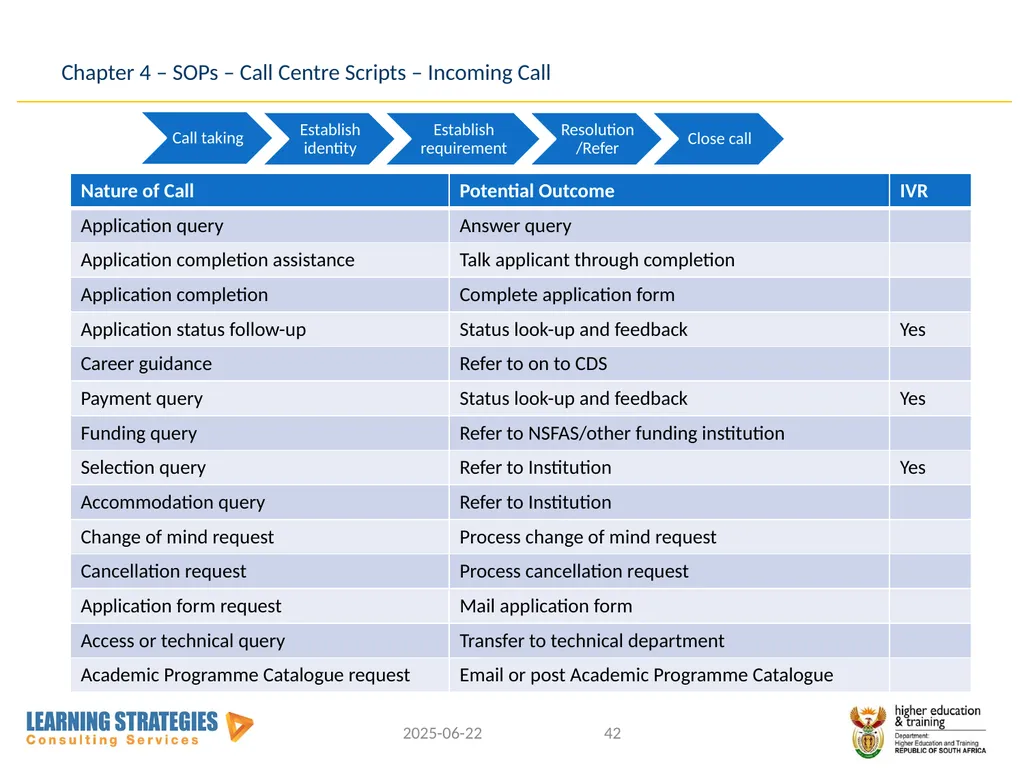
slide42. Chapter 4 – SOPs – Call Centre Scripts – Incoming Call 2016/06/27 42<br>
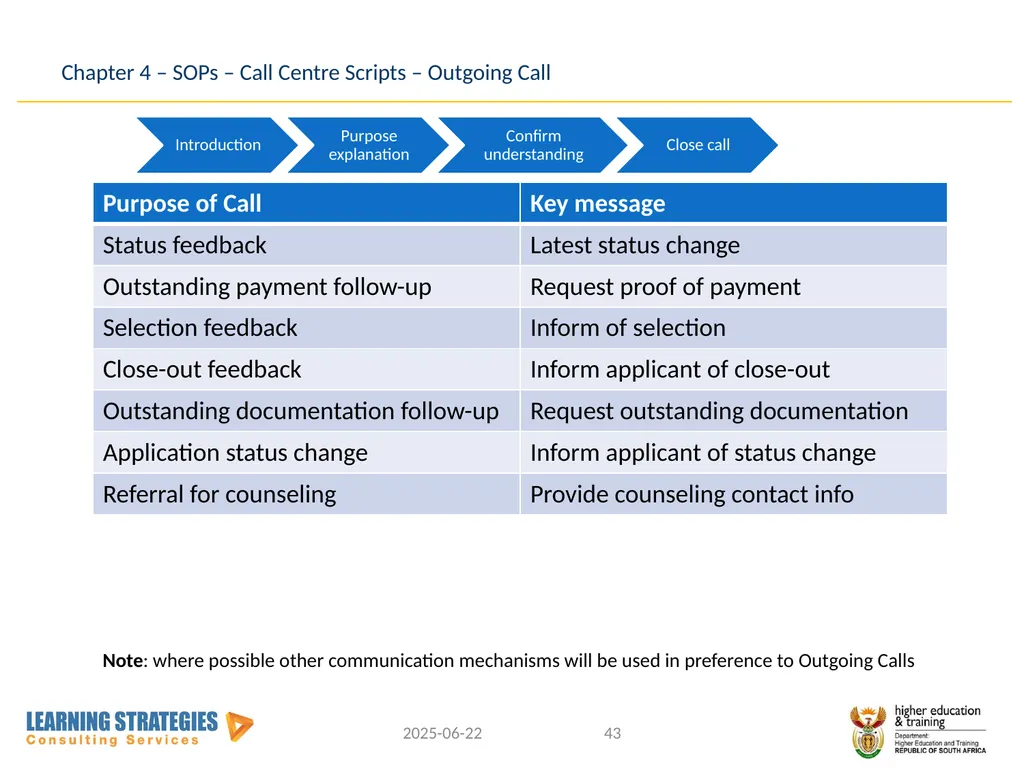
slide43. Chapter 4 – SOPs – Call Centre Scripts – Outgoing Call 2016/06/27 43 Note: where possible other communication mechanisms will be used in preference to Outgoing Calls<br>
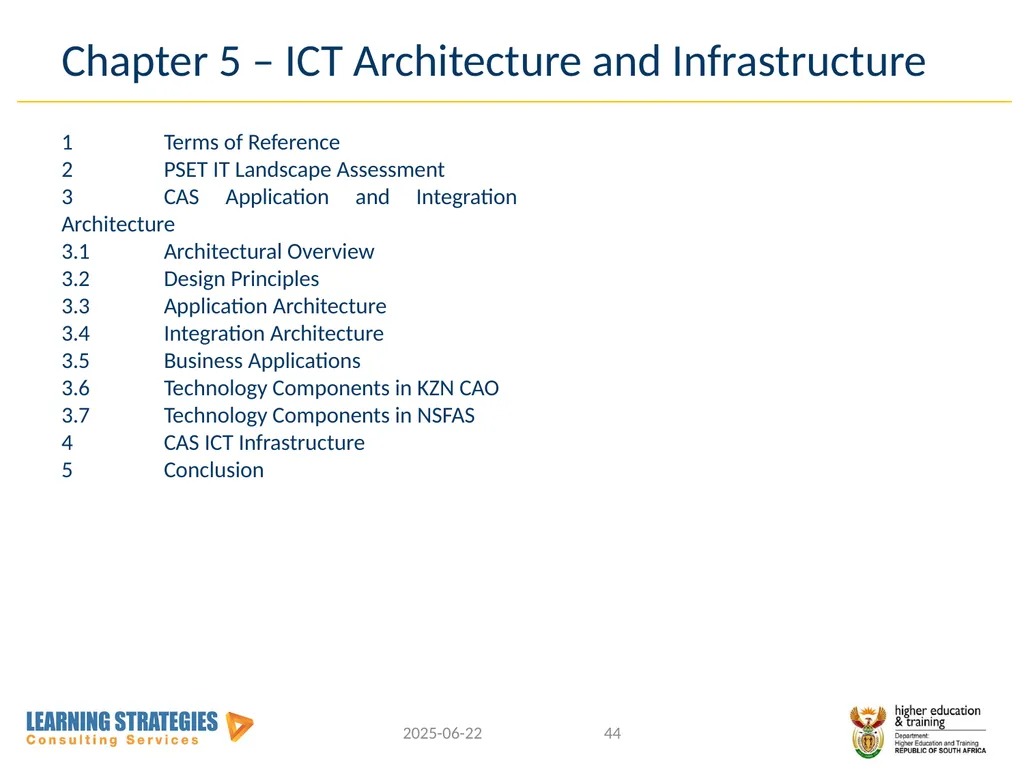
slide44. Chapter 5 – ICT Architecture and Infrastructure 2016/06/27 44 1 Terms of Reference
2 PSET IT Landscape Assessment
3 CAS Application and Integration Architecture
3.1 Architectural Overview
3.2 Design Principles
3.3 Application Architecture
3.4 Integration Architecture
3.5 Business Applications
3.6 Technology Components in KZN CAO
3.7 Technology Components in NSFAS
4 CAS ICT Infrastructure
5 Conclusion<br>
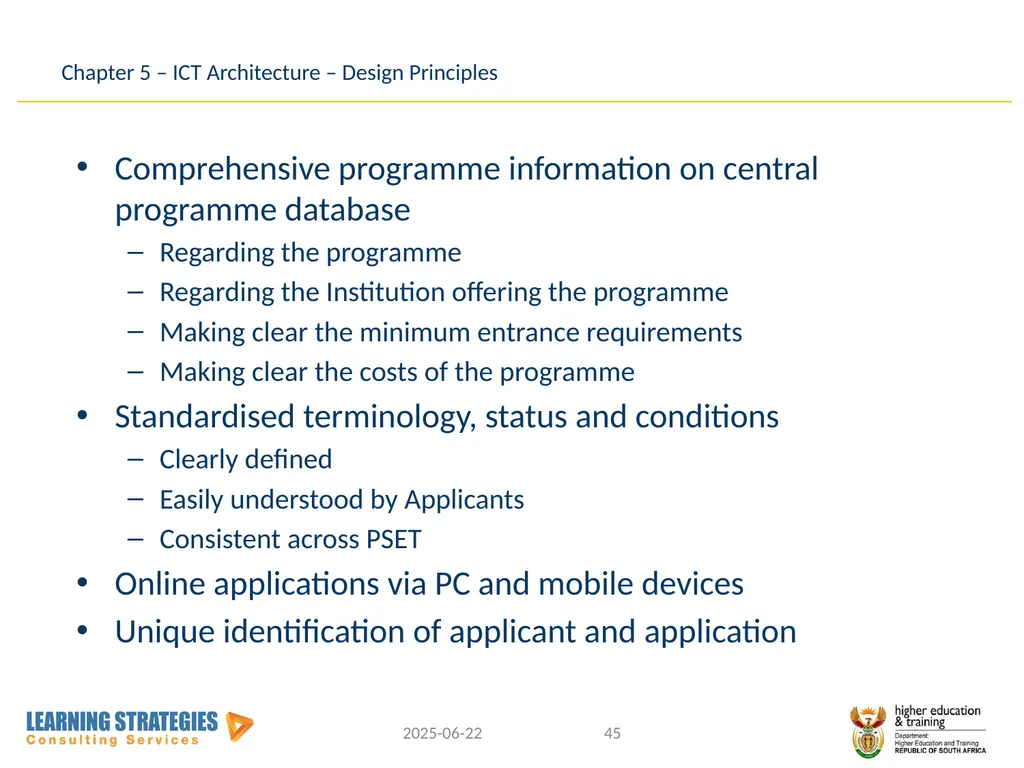
slide45. Chapter 5 – ICT Architecture – Design Principles Comprehensive programme information on central programme database
Regarding the programme
Regarding the Institution offering the programme
Making clear the minimum entrance requirements
Making clear the costs of the programme
Standardised terminology, status and conditions
Clearly defined
Easily understood by Applicants
Consistent across PSET
Online applications via PC and mobile devices
Unique identification of applicant and application 2016/06/27 45<br>
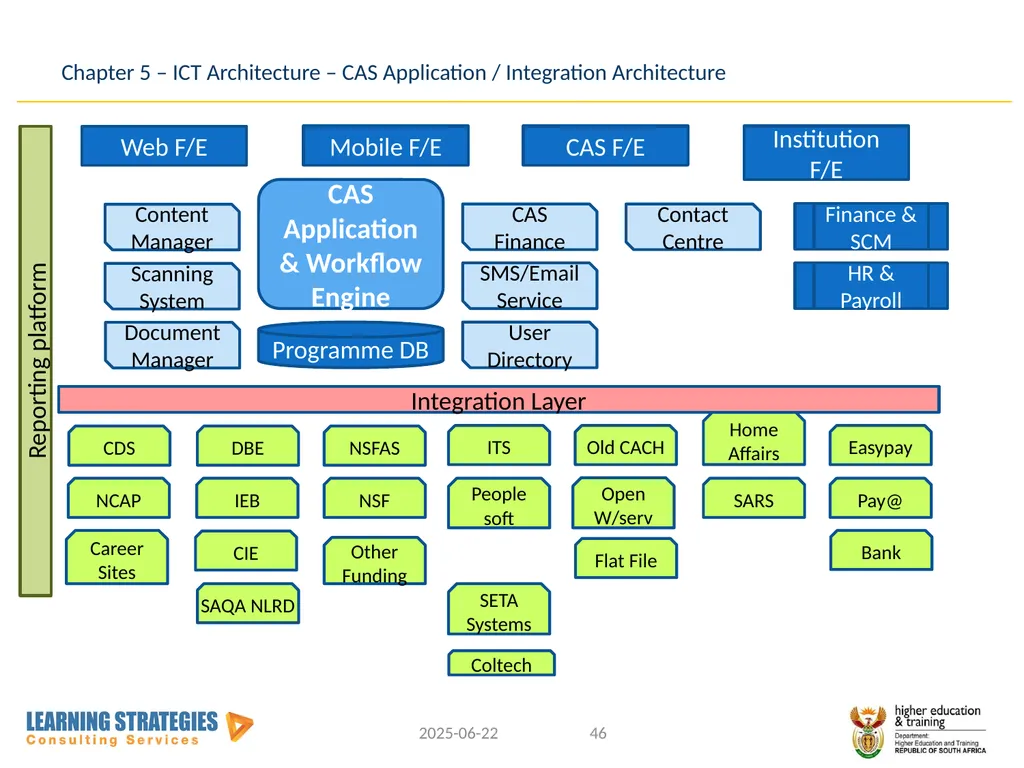
slide46. Chapter 5 – ICT Architecture – CAS Application / Integration Architecture 2016/06/27 46 Coltech<br>
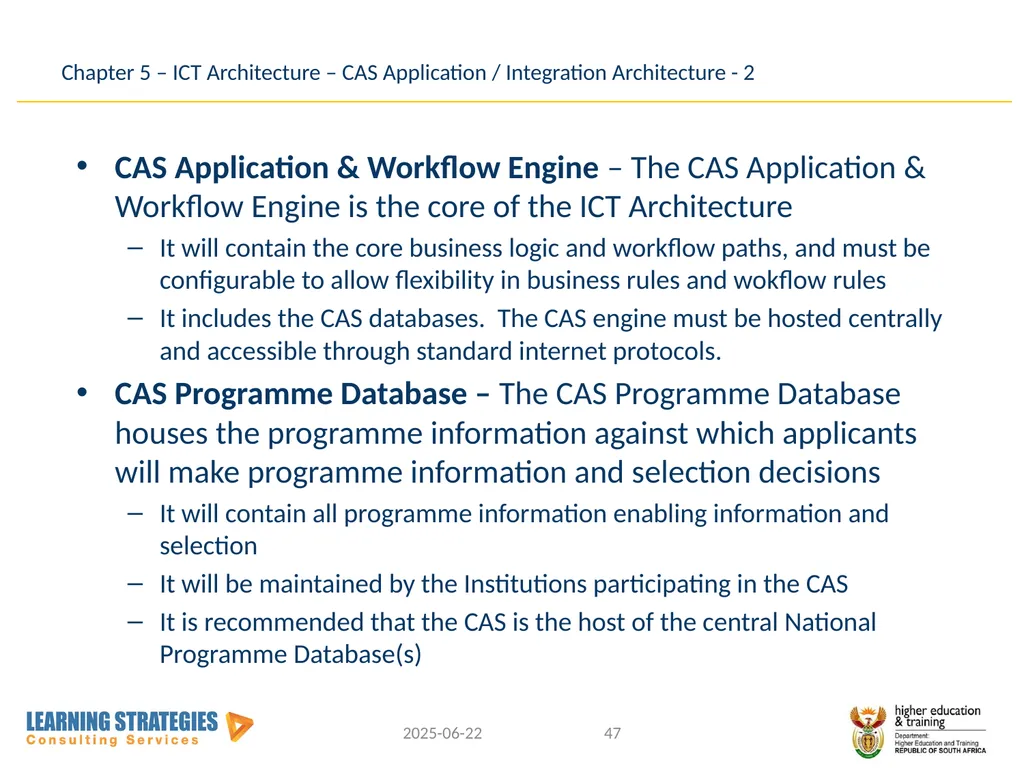
slide47. Chapter 5 – ICT Architecture – CAS Application / Integration Architecture - 2 CAS Application & Workflow Engine – The CAS Application & Workflow Engine is the core of the ICT Architecture
It will contain the core business logic and workflow paths, and must be configurable to allow flexibility in business rules and wokflow rules
It includes the CAS databases. The CAS engine must be hosted centrally and accessible through standard internet protocols.
CAS Programme Database – The CAS Programme Database houses the programme information against which applicants will make programme information and selection decisions
It will contain all programme information enabling information and selection
It will be maintained by the Institutions participating in the CAS
It is recommended that the CAS is the host of the central National Programme Database(s) 2016/06/27 47<br>
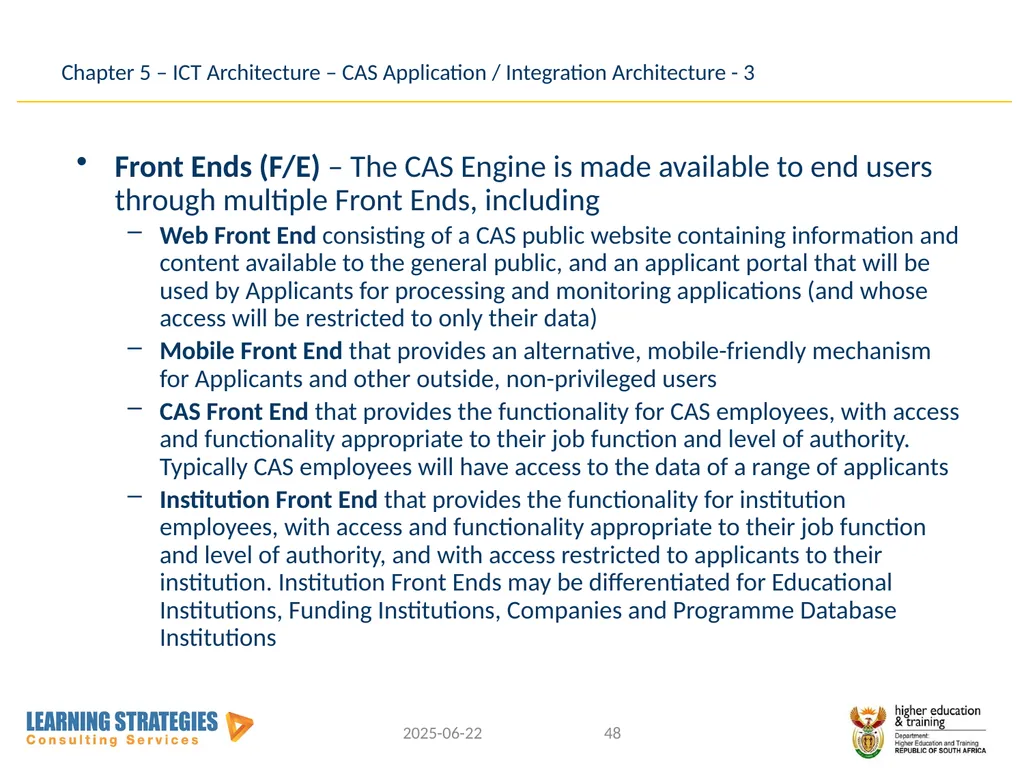
slide48. Chapter 5 – ICT Architecture – CAS Application / Integration Architecture - 3 Front Ends (F/E) – The CAS Engine is made available to end users through multiple Front Ends, including
Web Front End consisting of a CAS public website containing information and content available to the general public, and an applicant portal that will be used by Applicants for processing and monitoring applications (and whose access will be restricted to only their data)
Mobile Front End that provides an alternative, mobile-friendly mechanism for Applicants and other outside, non-privileged users
CAS Front End that provides the functionality for CAS employees, with access and functionality appropriate to their job function and level of authority. Typically CAS employees will have access to the data of a range of applicants
Institution Front End that provides the functionality for institution employees, with access and functionality appropriate to their job function and level of authority, and with access restricted to applicants to their institution. Institution Front Ends may be differentiated for Educational Institutions, Funding Institutions, Companies and Programme Database Institutions 2016/06/27 48<br>
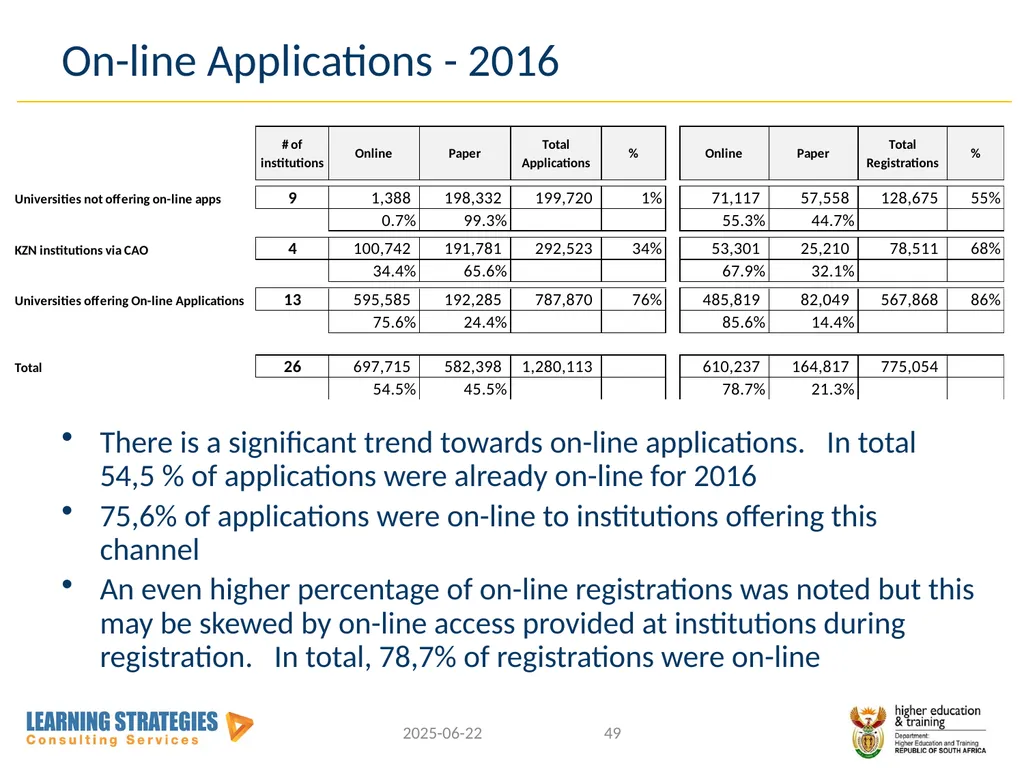
slide49. On-line Applications - 2016 There is a significant trend towards on-line applications. In total 54,5 % of applications were already on-line for 2016
75,6% of applications were on-line to institutions offering this channel
An even higher percentage of on-line registrations was noted but this may be skewed by on-line access provided at institutions during registration. In total, 78,7% of registrations were on-line 2016/06/27 49<br>
slide50. Chapter 5 – ICT Architecture – CAS Application / Integration Architecture - 4 CAS Supporting Applications – The CAS Supporting Application provide peripheral functionality used by the core engine, and including
Content Manager to enable content required by the CAS Application and the Front Ends to be stored and maintained
Scanning Functionality to enable documents received by the CAS in paper format to be scanned and the stored in the Document Manager
Document Manager to manage the documents received with applications, either from the Scanning Functionality, or with the online application system (Web F/E and Mobile F/E) or submitted in digital form via email or other form. The Document Manager will need functionality to transform documents to a common format (expected to be PDF) and to split submitted PDFs into multiple documents.
CAS Finance to manage the financial transaction associated with applications and control that where applicants are expected to pay an application fee, this fee is received, and where application fees are funded by other entities as capitation fees, the correct reconciliation is produced to support claims for such fees.
SMS/Email Service to manage the communications triggered by the application workflow
User Directory to manage the user access and authentication
Contact Centre functionality to enable agents to capture call information associated with an enquiry about an application or general enquiry 2016/06/27 50<br>
slide51. Chapter 5 – ICT Architecture – CAS Application / Integration Architecture - 5 Integration Layer – the Integration Layer will manage the integration between the CAS Application & Workflow Engine and surrounding system. The integration will use predominantly
web services for online integration (e.g. web service between CAS and NSFAS to determine funding eligibility)
file based integration for bulk data interchanges (e.g. DBE results)
It is expected that for the institutions, there will be multiple integration types, depending on the systems at the institution 2016/06/27 51<br>
slide52. Chapter 5 – ICT Architecture – CAS Application / Integration Architecture - 6 CAS Business Applications – the CAS business applications will provide functionality to manage the business of CAS
Finance and Supply Chain Management for financial accounting and purchase order management
Human Resource and Payroll for human resource management and payroll management
Based on the expected size of the operation and required level of business control, we believe that a mid-size ERP package such as Sage ERP will be appropriate
Effectively this is the old Accpac and VIP Payroll 2016/06/27 52<br>
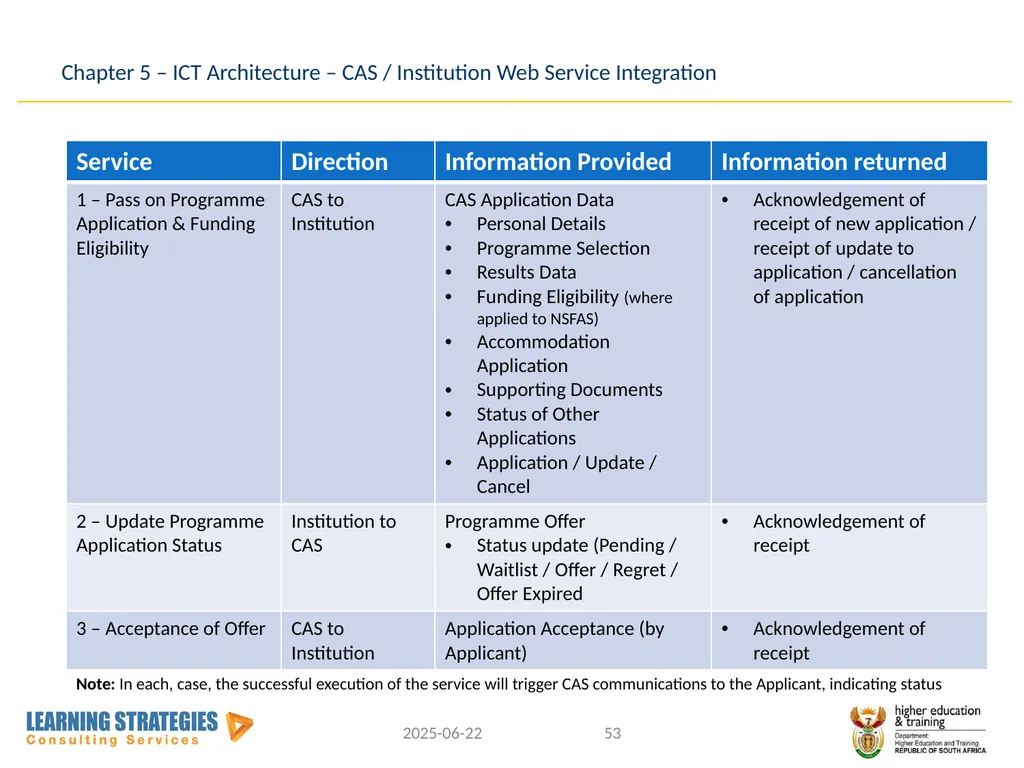
slide53. Chapter 5 – ICT Architecture – CAS / Institution Web Service Integration 2016/06/27 53 Note: In each, case, the successful execution of the service will trigger CAS communications to the Applicant, indicating status<br>
slide54. Chapter 5 – ICT Architecture – CAS / NSFAS Web Service Integration 2016/06/27 54 Note: In each, case, the successful execution of the service will trigger CAS communications to the Applicant, indicating status<br>
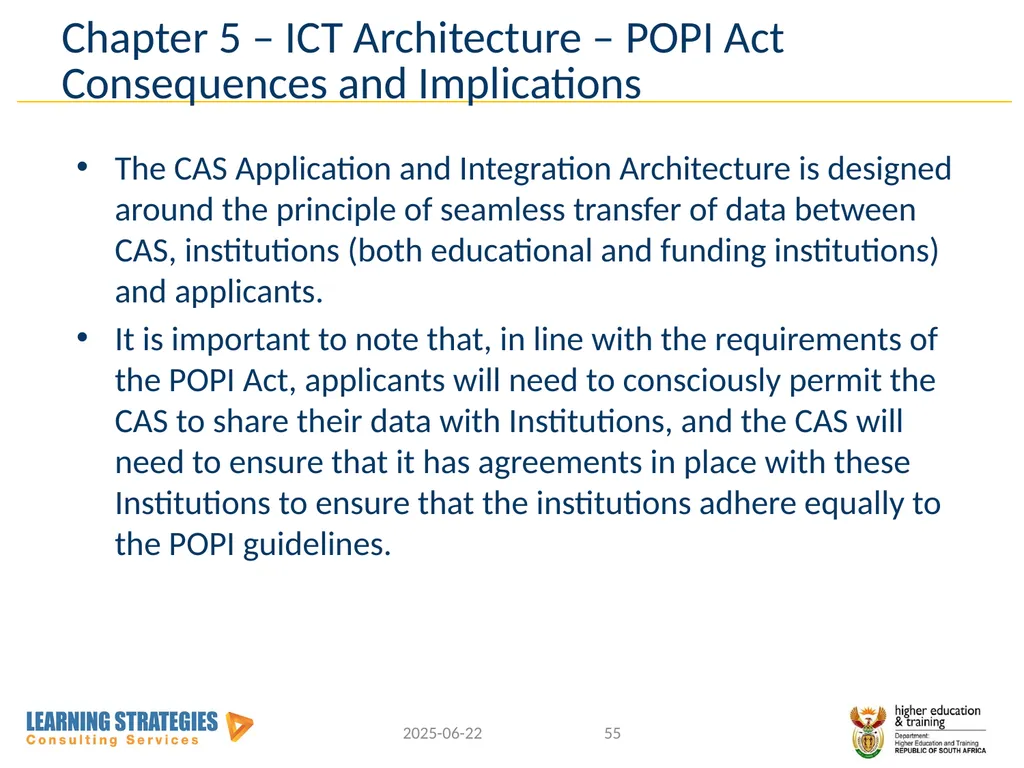
slide55. Chapter 5 – ICT Architecture – POPI Act Consequences and Implications The CAS Application and Integration Architecture is designed around the principle of seamless transfer of data between CAS, institutions (both educational and funding institutions) and applicants.
It is important to note that, in line with the requirements of the POPI Act, applicants will need to consciously permit the CAS to share their data with Institutions, and the CAS will need to ensure that it has agreements in place with these Institutions to ensure that the institutions adhere equally to the POPI guidelines. 2016/06/27 55<br>
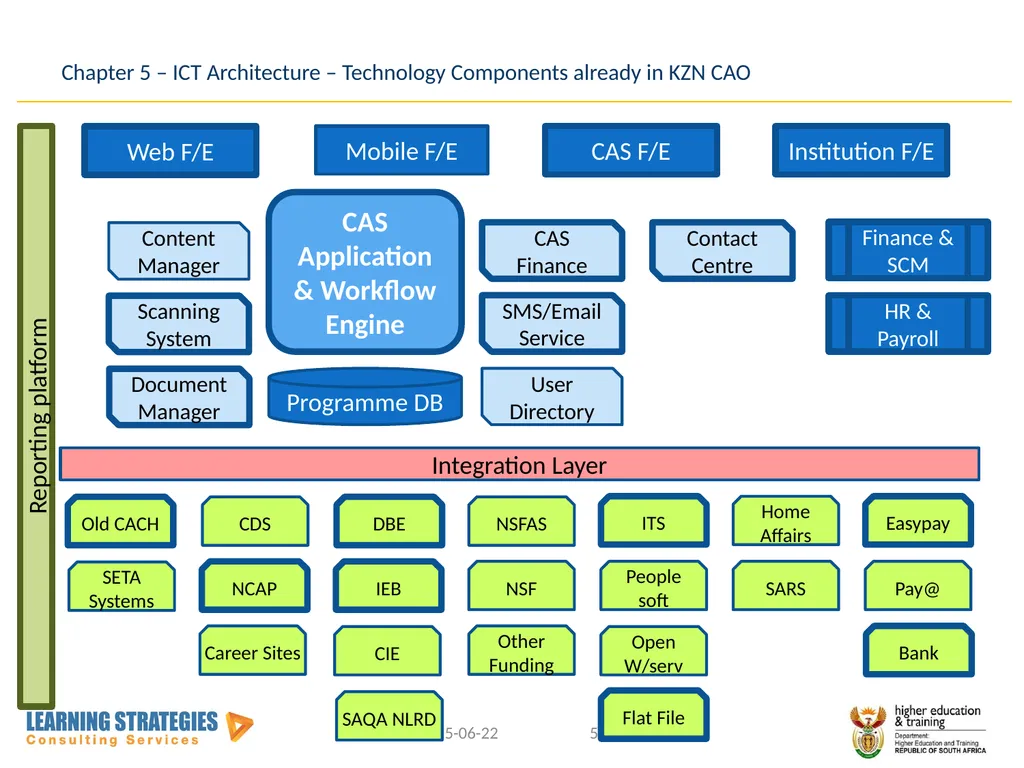
slide56. Chapter 5 – ICT Architecture – Technology Components already in KZN CAO 2016/06/27 56 Web F/E CAS F/E Institution F/E CAS Application & Workflow Engine Old CACH CDS NCAP Career Sites NSFAS NSF Other Funding ITS People soft Open W/serv Flat File Easypay Pay@ Bank SMS/Email Service Contact Centre Scanning System Content Manager Integration Layer Mobile F/E User Directory Document Manager CAS Finance Reporting platform Finance & SCM HR & Payroll Programme DB DBE SAQA NLRD IEB CIE Home Affairs SARS SETA Systems<br>
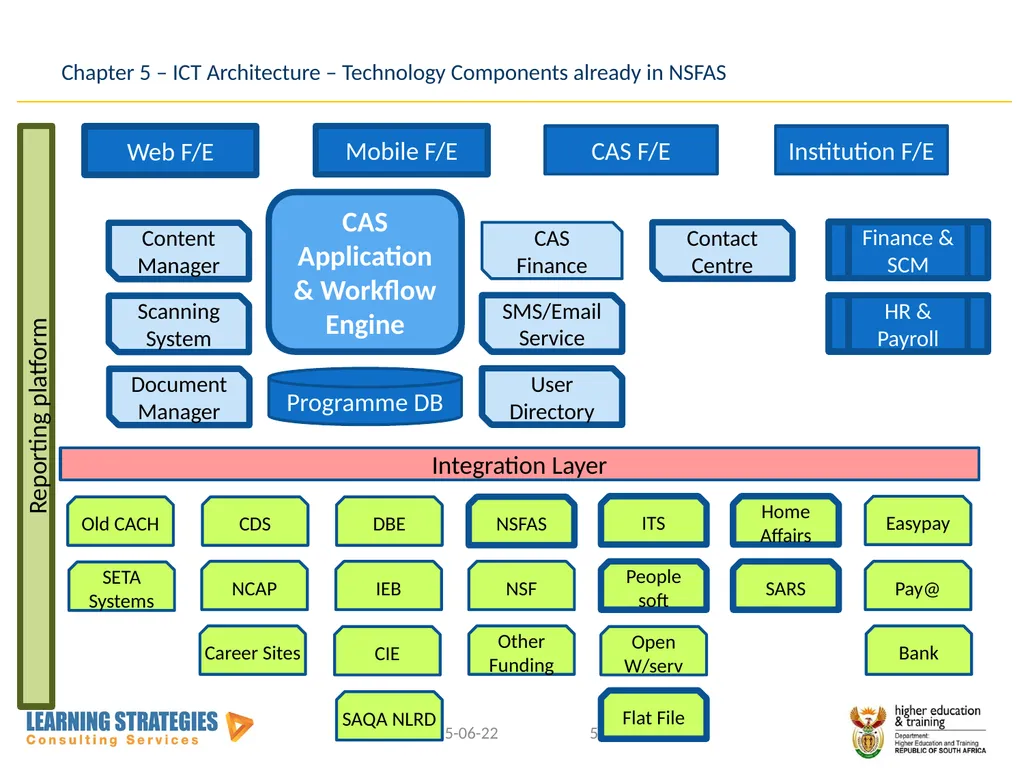
slide57. Chapter 5 – ICT Architecture – Technology Components already in NSFAS 2016/06/27 57 Web F/E CAS F/E Institution F/E CAS Application & Workflow Engine Old CACH CDS NCAP Career Sites NSFAS NSF Other Funding ITS People soft Open W/serv Flat File Easypay Pay@ Bank SMS/Email Service Contact Centre Scanning System Content Manager Integration Layer Mobile F/E User Directory Document Manager CAS Finance Reporting platform Finance & SCM HR & Payroll Programme DB DBE SAQA NLRD IEB CIE Home Affairs SARS SETA Systems<br>
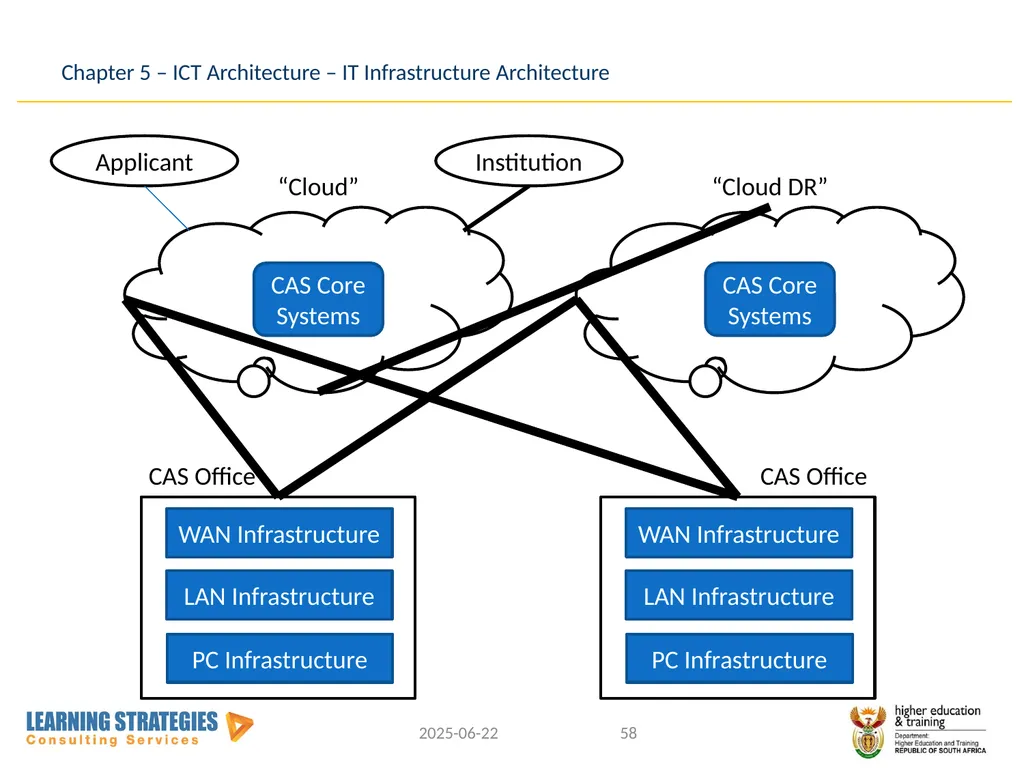
slide58. Chapter 5 – ICT Architecture – IT Infrastructure Architecture 2016/06/27 58 CAS Core Systems CAS Core Systems “Cloud” “Cloud DR” CAS Office Applicant Institution PC Infrastructure LAN Infrastructure WAN Infrastructure CAS Office PC Infrastructure LAN Infrastructure WAN Infrastructure<br>
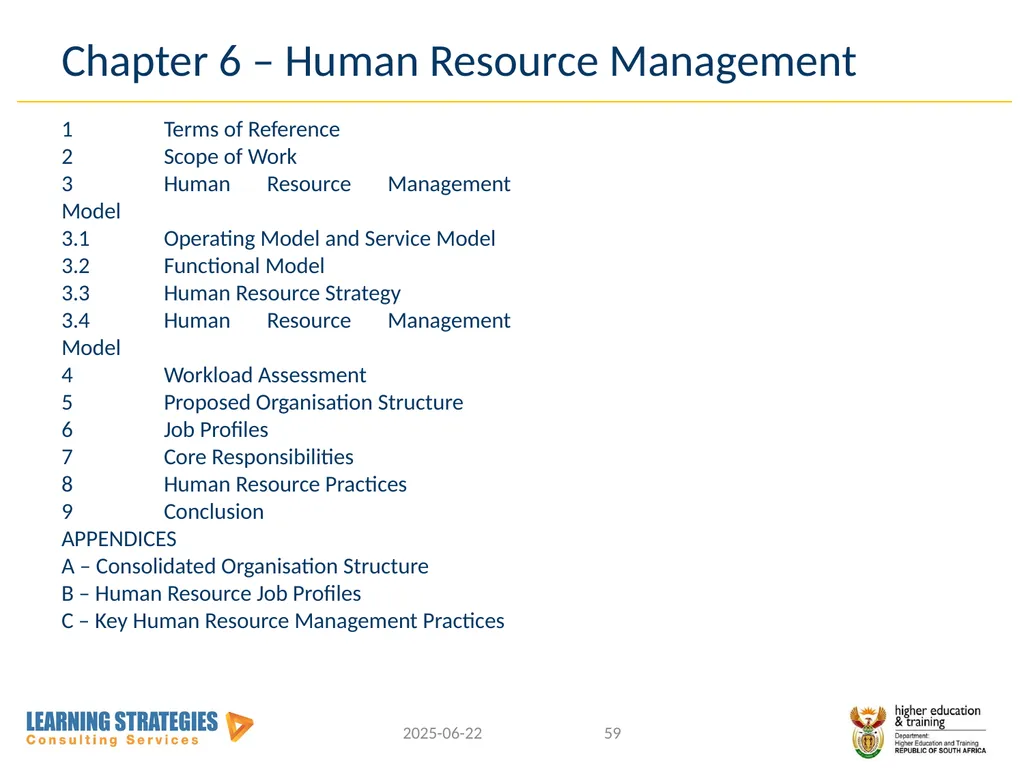
slide59. Chapter 6 – Human Resource Management 2016/06/27 59 1 Terms of Reference
2 Scope of Work
3 Human Resource Management Model
3.1 Operating Model and Service Model
3.2 Functional Model
3.3 Human Resource Strategy
3.4 Human Resource Management Model
4 Workload Assessment
5 Proposed Organisation Structure
6 Job Profiles
7 Core Responsibilities
8 Human Resource Practices
9 Conclusion
APPENDICES
A – Consolidated Organisation Structure
B – Human Resource Job Profiles
C – Key Human Resource Management Practices<br>
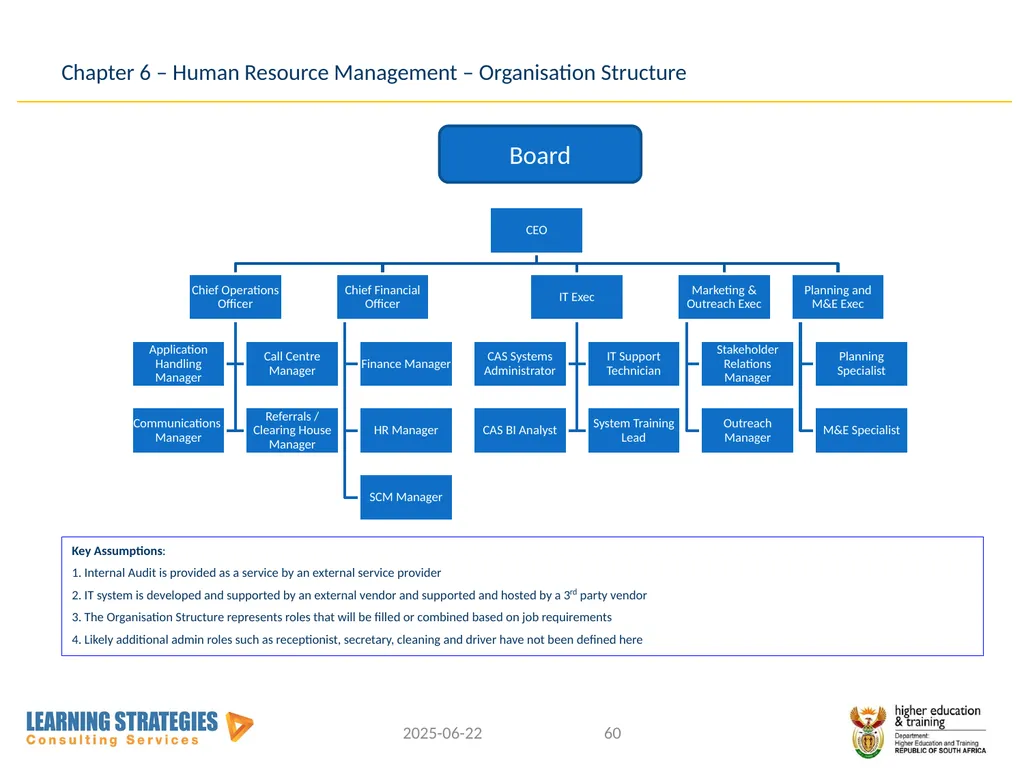
slide60. Chapter 6 – Human Resource Management – Organisation Structure 2016/06/27 60 Board Key Assumptions:
1. Internal Audit is provided as a service by an external service provider
2. IT system is developed and supported by an external vendor and supported and hosted by a 3rd party vendor
3. The Organisation Structure represents roles that will be filled or combined based on job requirements
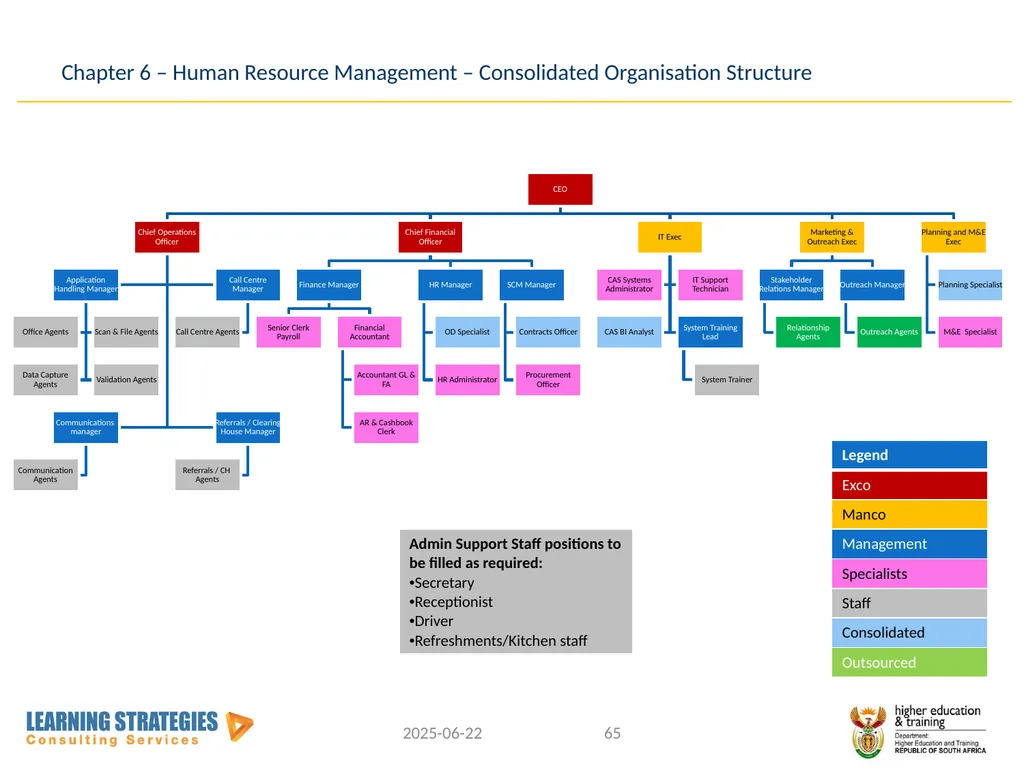
4. Likely additional admin roles such as receptionist, secretary, cleaning and driver have not been defined here<br>
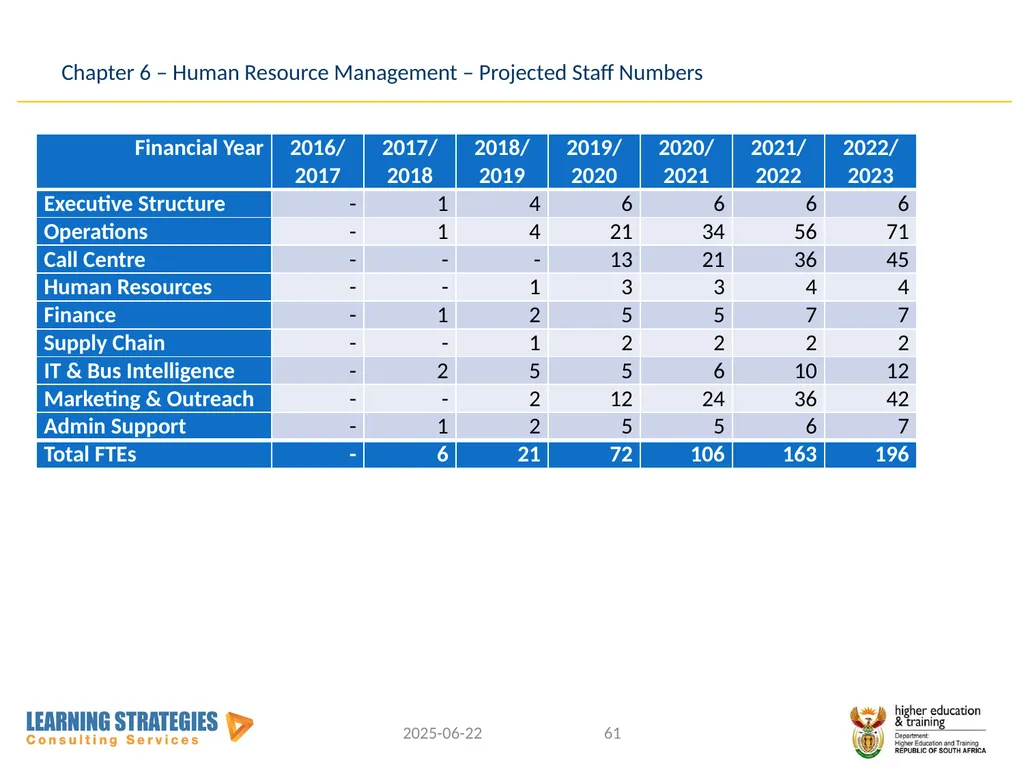
slide61. Chapter 6 – Human Resource Management – Projected Staff Numbers 2016/06/27 61<br>
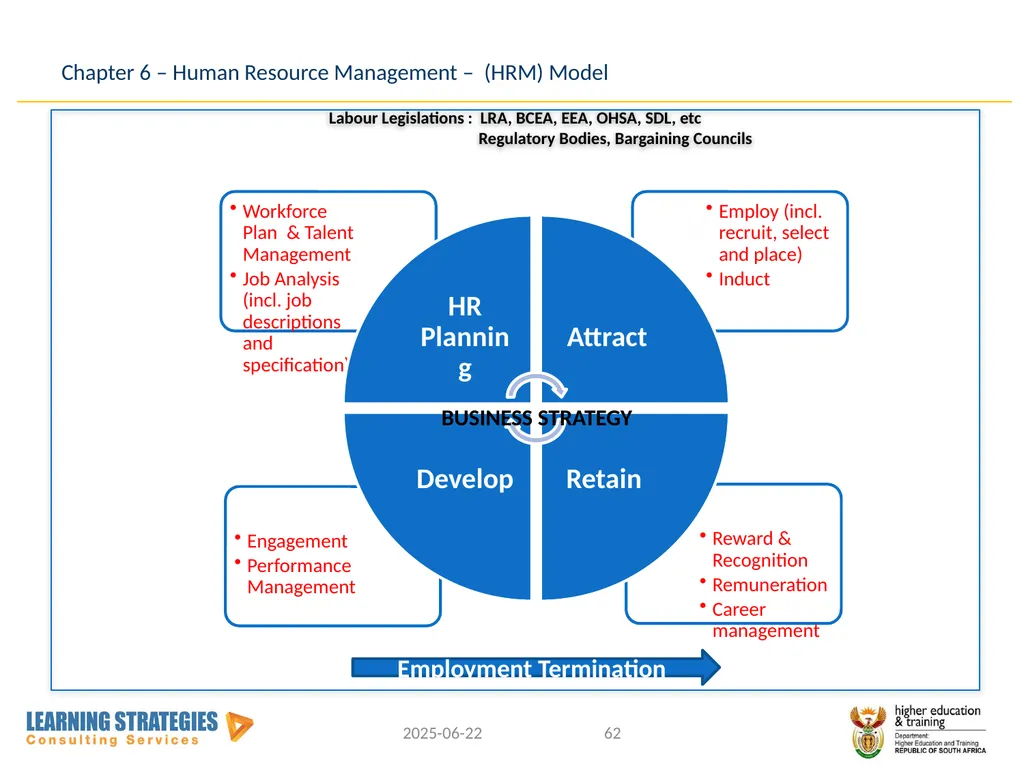
slide62. Chapter 6 – Human Resource Management – (HRM) Model 2016/06/27 62 Labour Legislations : LRA, BCEA, EEA, OHSA, SDL, etc
Regulatory Bodies, Bargaining Councils BUSINESS STRATEGY Employment Termination<br>
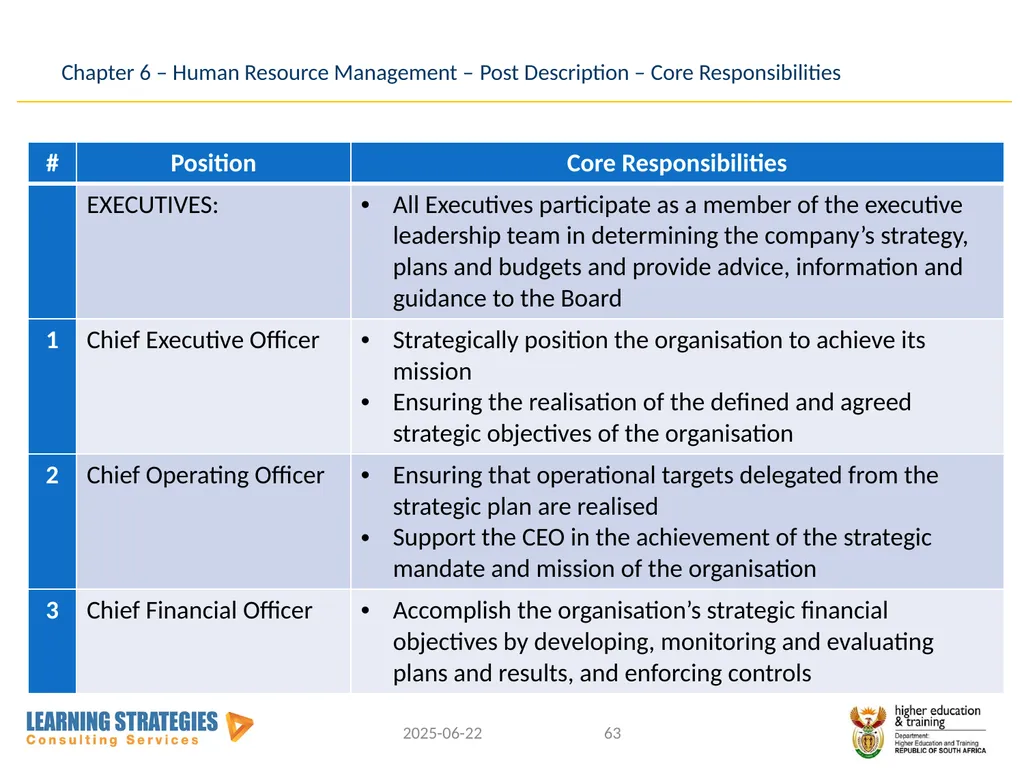
slide63. Chapter 6 – Human Resource Management – Post Description – Core Responsibilities 2016/06/27 63<br>
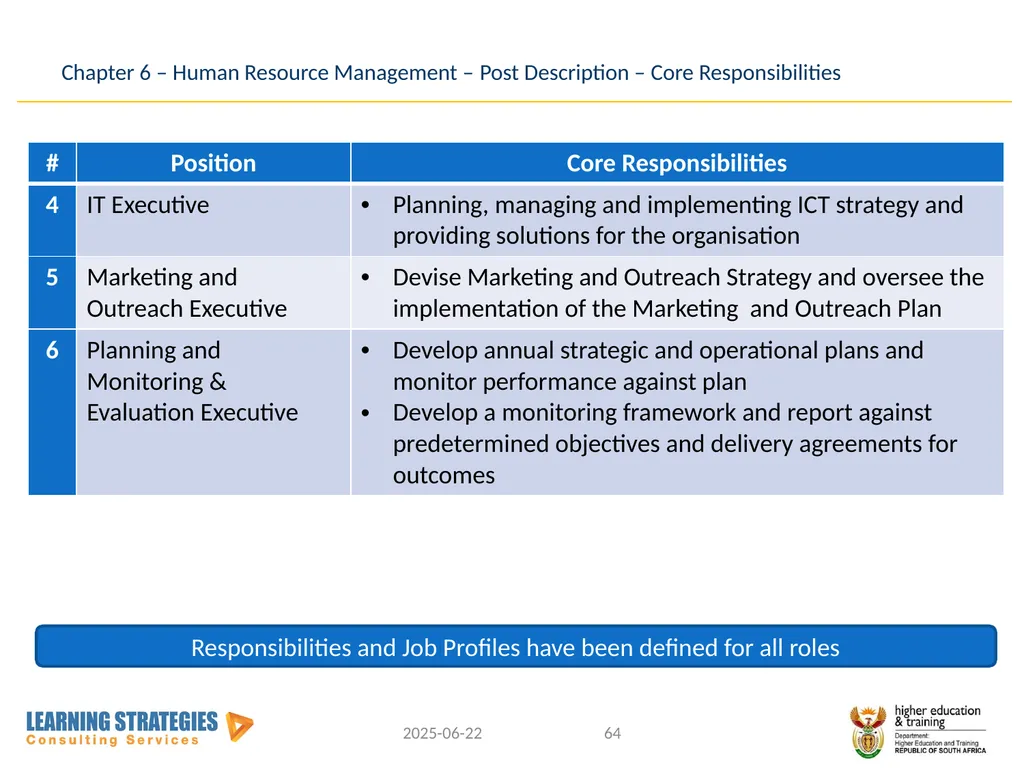
slide64. Chapter 6 – Human Resource Management – Post Description – Core Responsibilities 2016/06/27 64 Responsibilities and Job Profiles have been defined for all roles<br>
slide65. Chapter 6 – Human Resource Management – Consolidated Organisation Structure 2016/06/27 65<br>
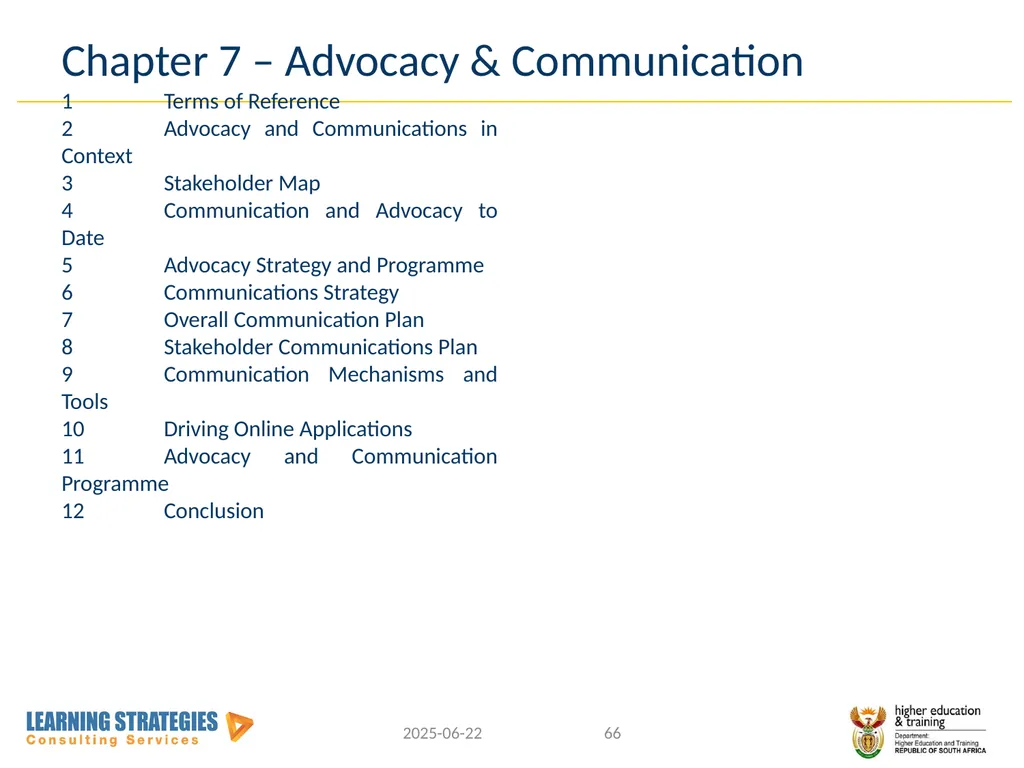
slide66. Chapter 7 – Advocacy & Communication 2016/06/27 66 1 Terms of Reference
2 Advocacy and Communications in Context
3 Stakeholder Map
4 Communication and Advocacy to Date
5 Advocacy Strategy and Programme
6 Communications Strategy
7 Overall Communication Plan
8 Stakeholder Communications Plan
9 Communication Mechanisms and Tools
10 Driving Online Applications
11 Advocacy and Communication Programme
12 Conclusion<br>
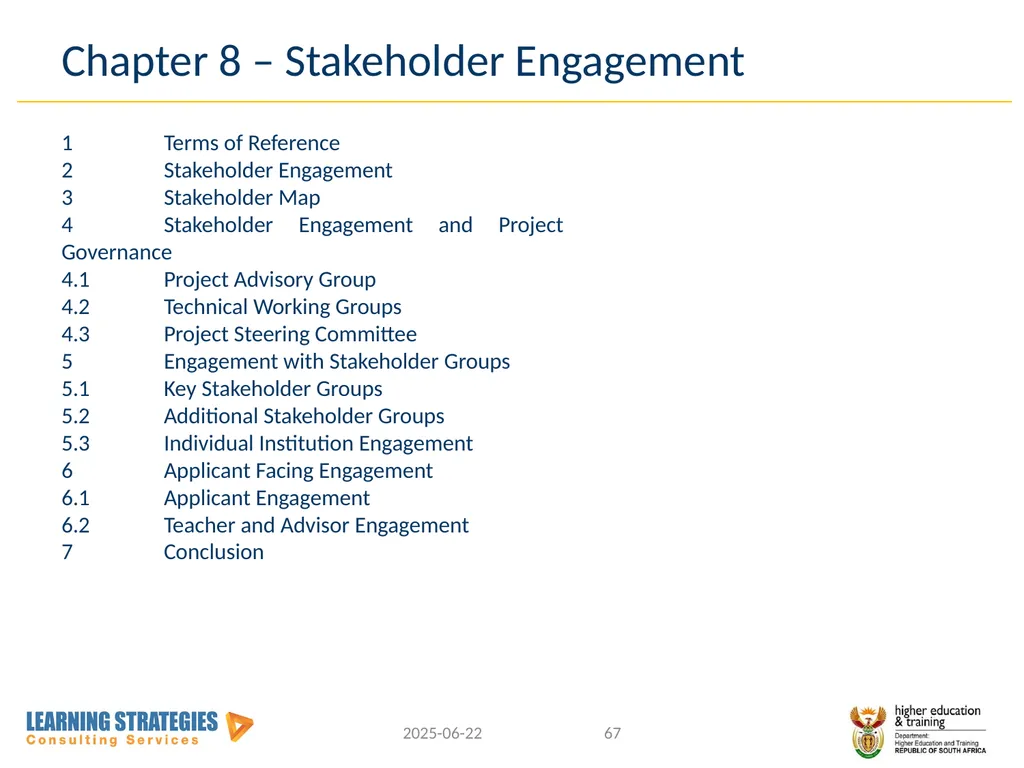
slide67. Chapter 8 – Stakeholder Engagement 2016/06/27 67 1 Terms of Reference
2 Stakeholder Engagement
3 Stakeholder Map
4 Stakeholder Engagement and Project Governance
4.1 Project Advisory Group
4.2 Technical Working Groups
4.3 Project Steering Committee
5 Engagement with Stakeholder Groups
5.1 Key Stakeholder Groups
5.2 Additional Stakeholder Groups
5.3 Individual Institution Engagement
6 Applicant Facing Engagement
6.1 Applicant Engagement
6.2 Teacher and Advisor Engagement
7 Conclusion<br>
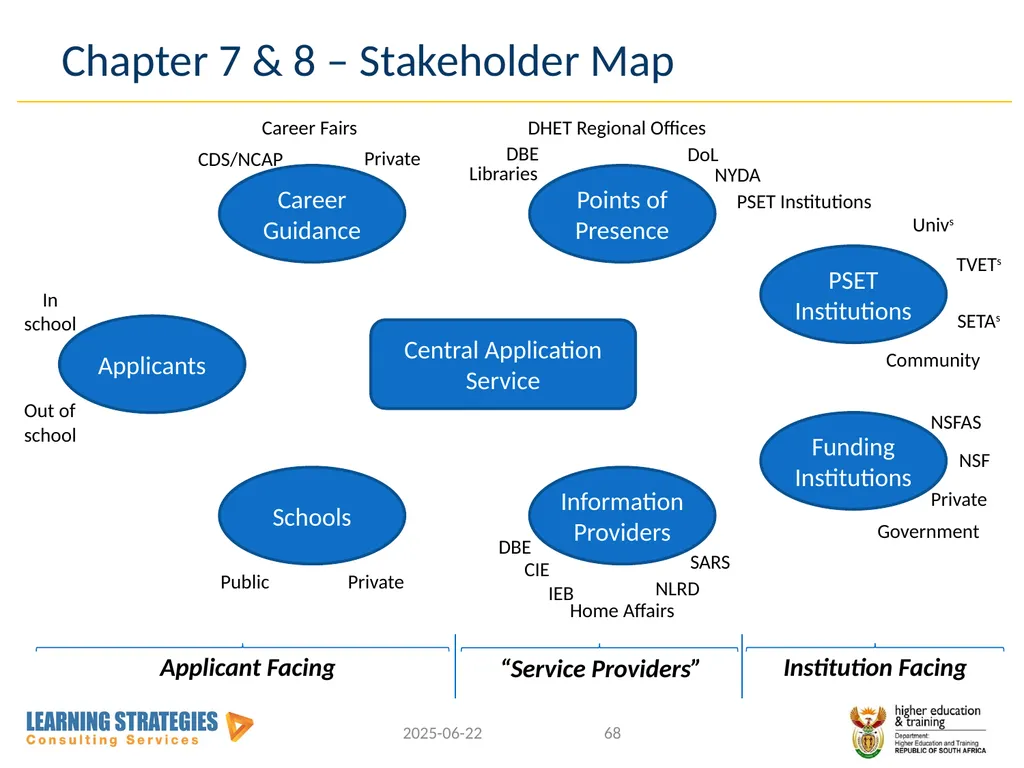
slide68. Chapter 7 & 8 – Stakeholder Map 2016/06/27 68 Applicants Schools Career Guidance Points of Presence PSET Institutions Funding Institutions Information Providers Central Application Service Public Private In school Out of school CDS/NCAP Private DoL Univs TVETs Community SETAs NSFAS NSF DBE IEB Home Affairs SARS NLRD Career Fairs Applicant Facing “Service Providers” Institution Facing Libraries NYDA Private CIE Government DHET Regional Offices DBE PSET Institutions<br>
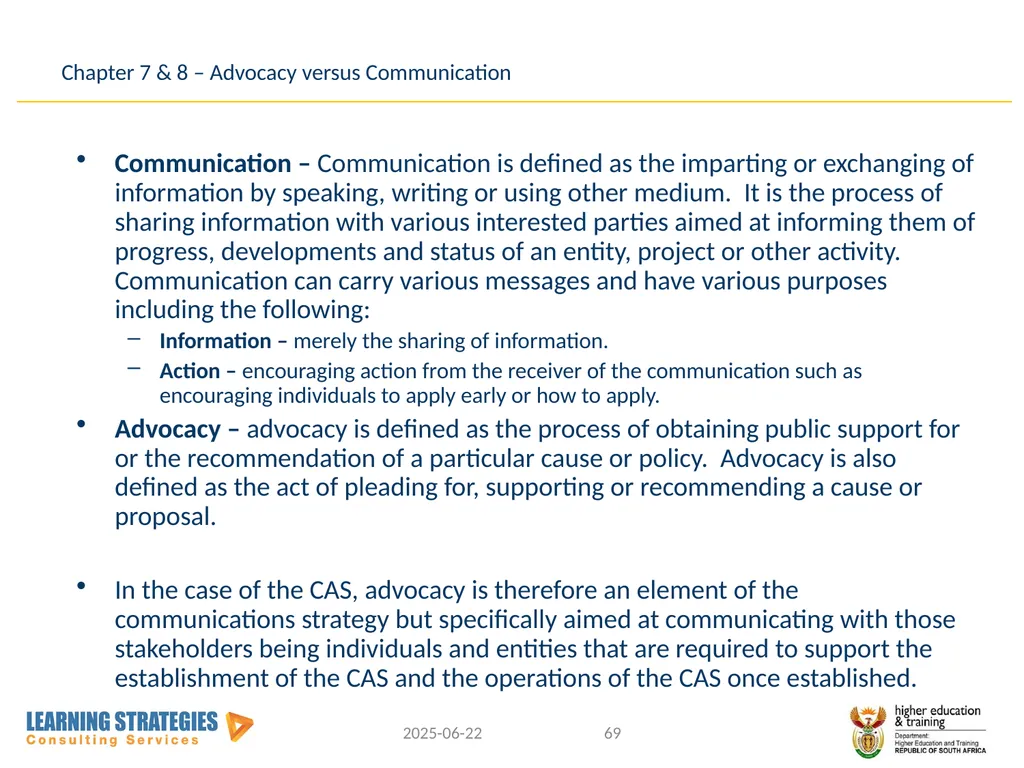
slide69. Chapter 7 & 8 – Advocacy versus Communication Communication – Communication is defined as the imparting or exchanging of information by speaking, writing or using other medium. It is the process of sharing information with various interested parties aimed at informing them of progress, developments and status of an entity, project or other activity. Communication can carry various messages and have various purposes including the following:
Information – merely the sharing of information.
Action – encouraging action from the receiver of the communication such as encouraging individuals to apply early or how to apply.
Advocacy – advocacy is defined as the process of obtaining public support for or the recommendation of a particular cause or policy. Advocacy is also defined as the act of pleading for, supporting or recommending a cause or proposal.
In the case of the CAS, advocacy is therefore an element of the communications strategy but specifically aimed at communicating with those stakeholders being individuals and entities that are required to support the establishment of the CAS and the operations of the CAS once established. 2016/06/27 69<br>
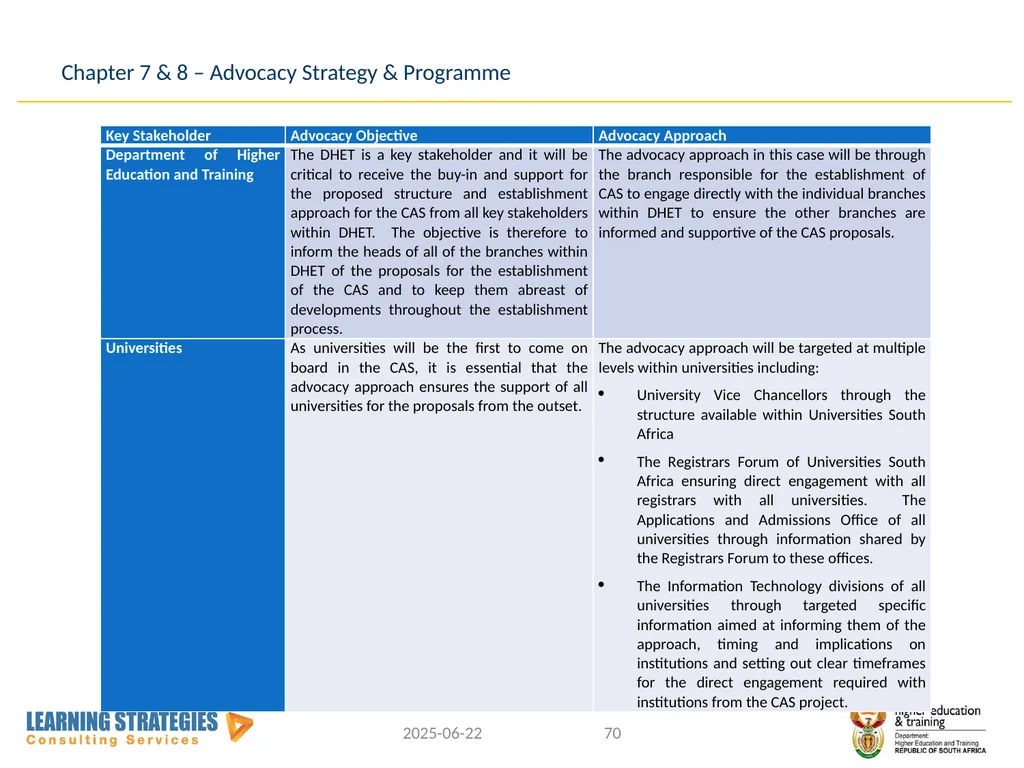
slide70. Chapter 7 & 8 – Advocacy Strategy & Programme 2016/06/27 70<br>
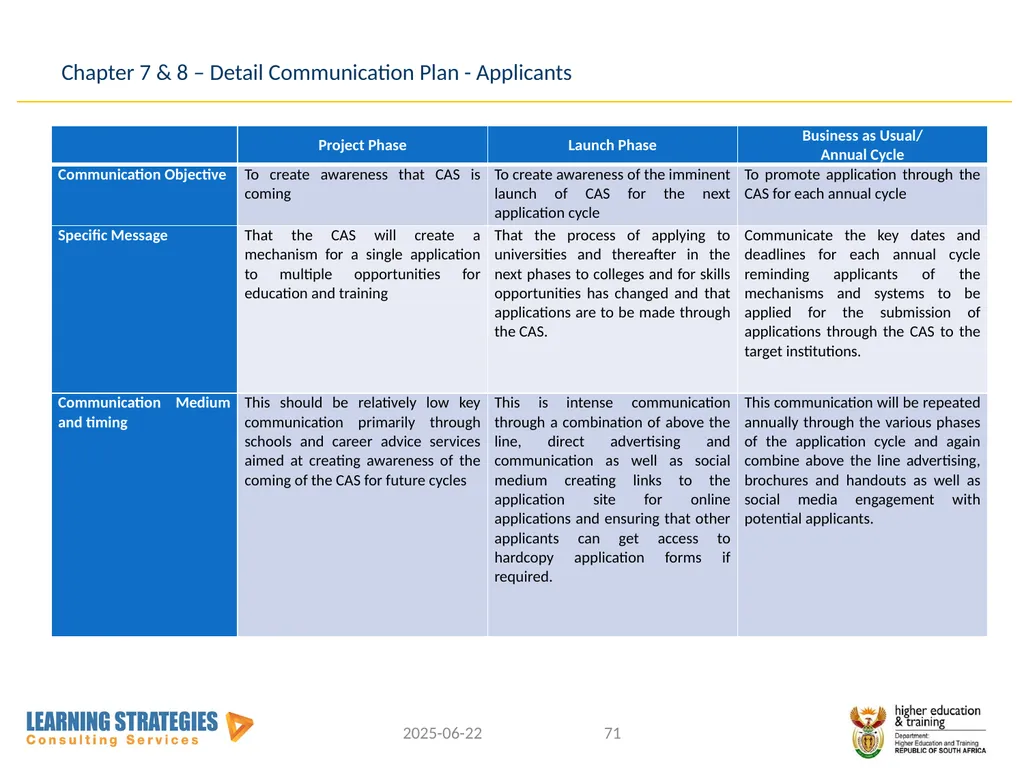
slide71. Chapter 7 & 8 – Detail Communication Plan - Applicants 2016/06/27 71<br>
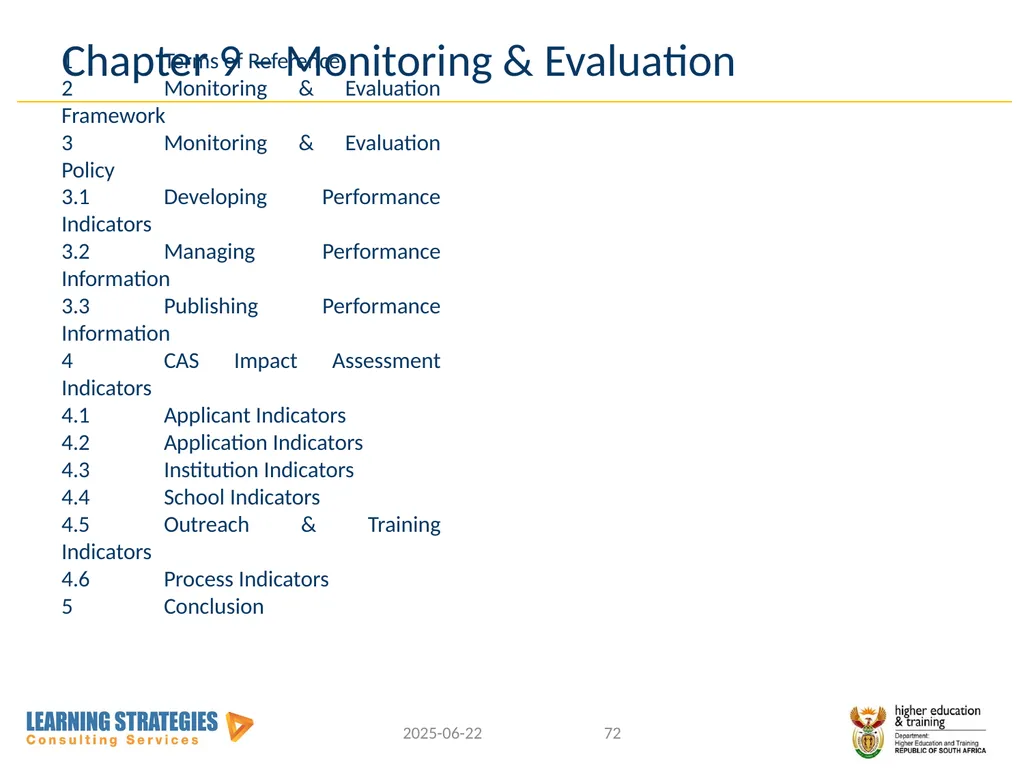
slide72. Chapter 9 – Monitoring & Evaluation 2016/06/27 72 1 Terms of Reference
2 Monitoring & Evaluation Framework
3 Monitoring & Evaluation Policy
3.1 Developing Performance Indicators
3.2 Managing Performance Information
3.3 Publishing Performance Information
4 CAS Impact Assessment Indicators
4.1 Applicant Indicators
4.2 Application Indicators
4.3 Institution Indicators
4.4 School Indicators
4.5 Outreach & Training Indicators
4.6 Process Indicators
5 Conclusion<br>
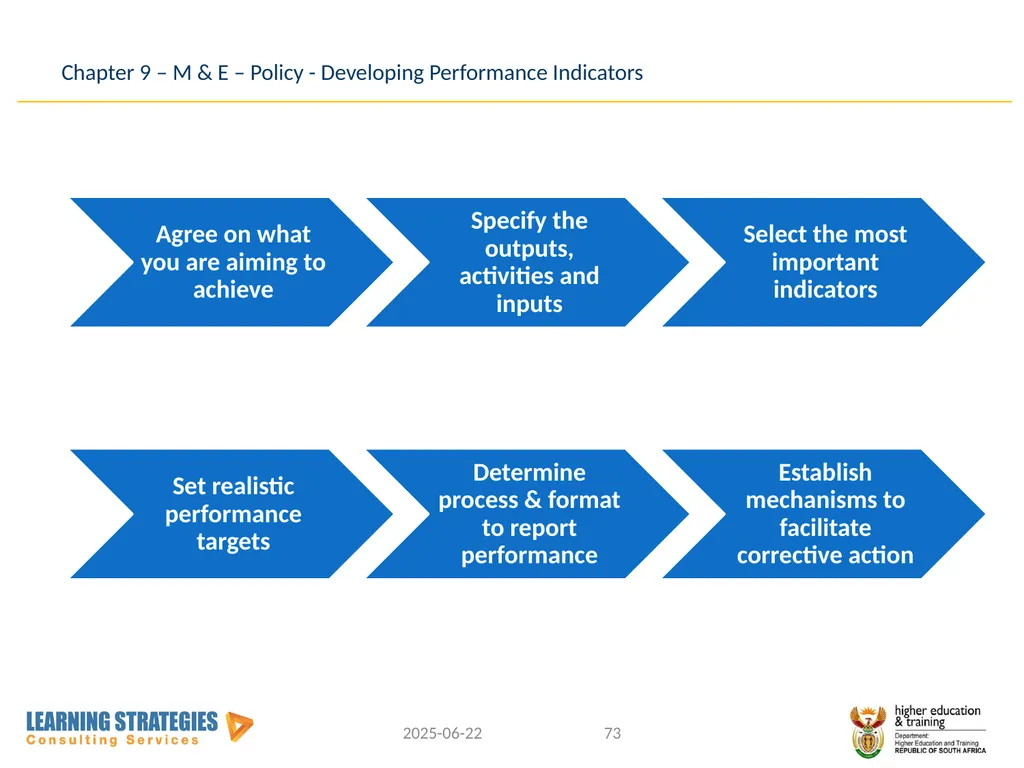
slide73. Chapter 9 – M & E – Policy - Developing Performance Indicators 2016/06/27 73<br>
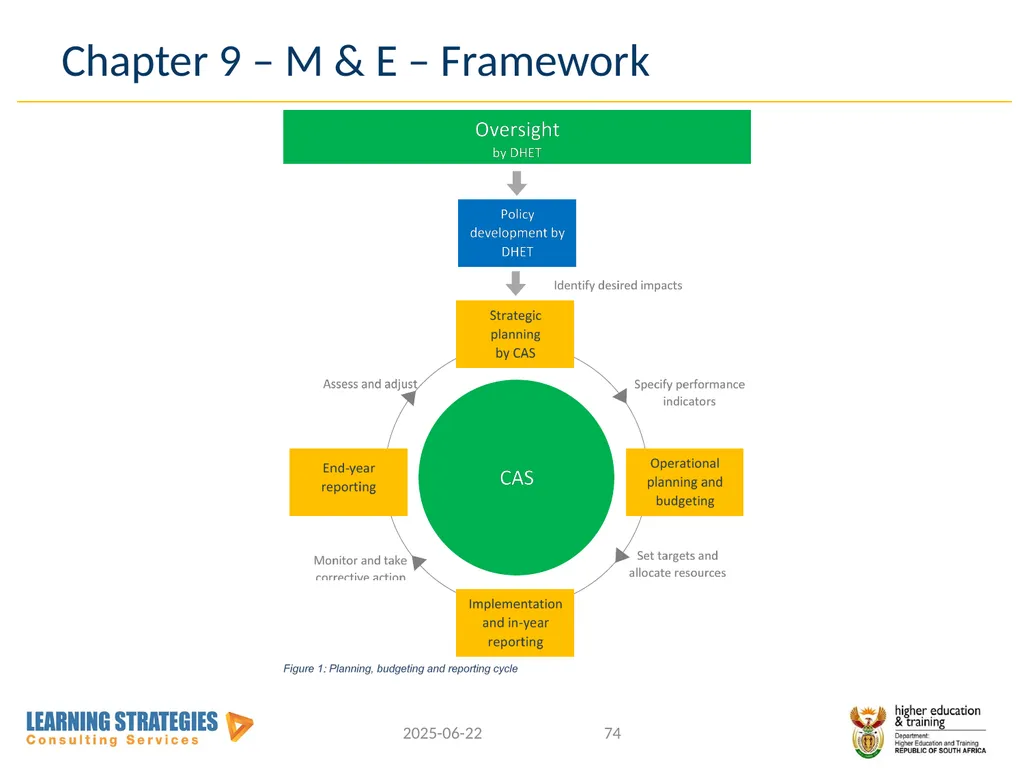
slide74. Chapter 9 – M & E – Framework 2016/06/27 74<br>
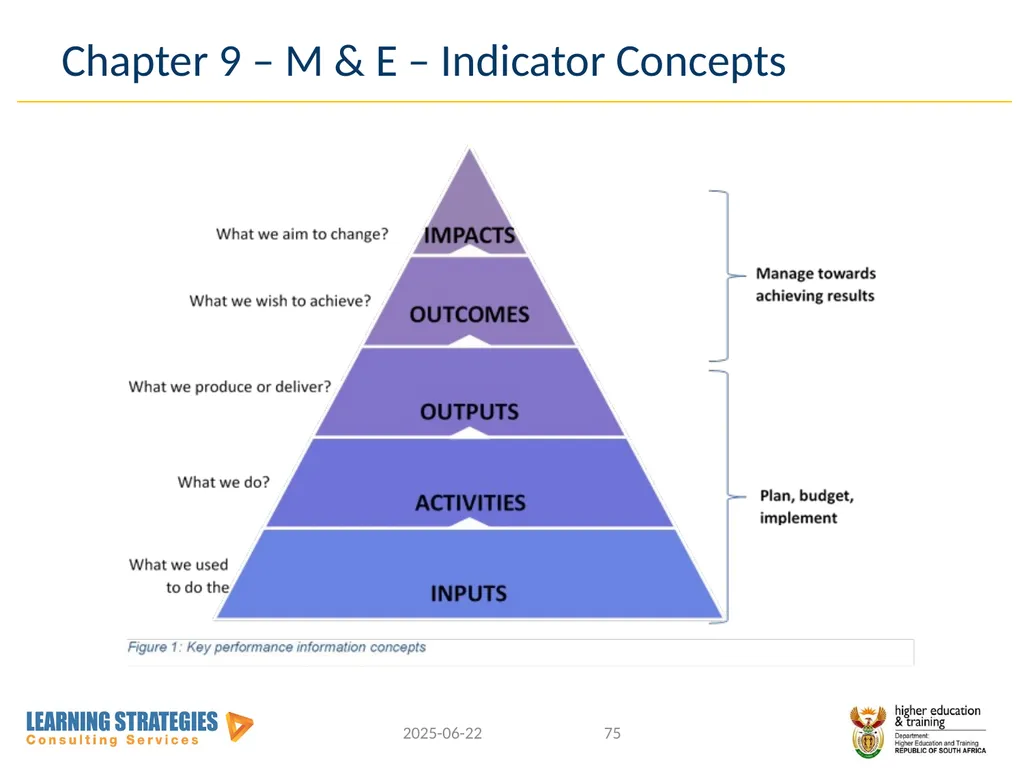
slide75. Chapter 9 – M & E – Indicator Concepts 2016/06/27 75<br>
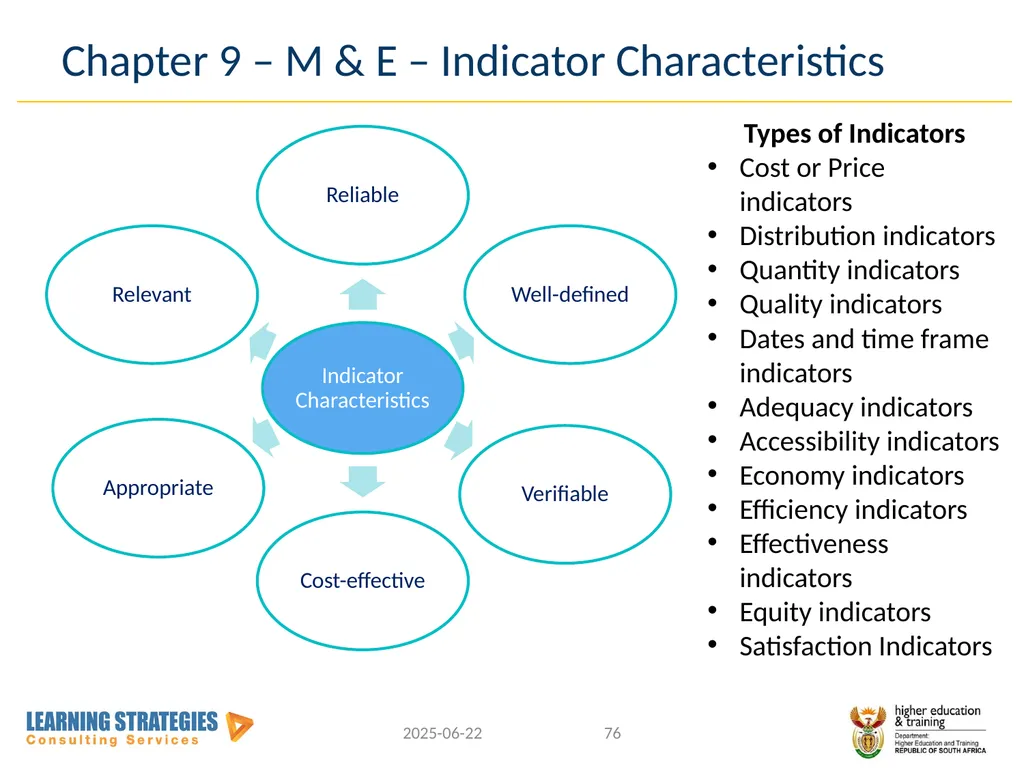
slide76. Chapter 9 – M & E – Indicator Characteristics 2016/06/27 76 Types of Indicators
Cost or Price indicators
Distribution indicators
Quantity indicators
Quality indicators
Dates and time frame indicators
Adequacy indicators
Accessibility indicators
Economy indicators
Efficiency indicators
Effectiveness indicators
Equity indicators
Satisfaction Indicators<br>
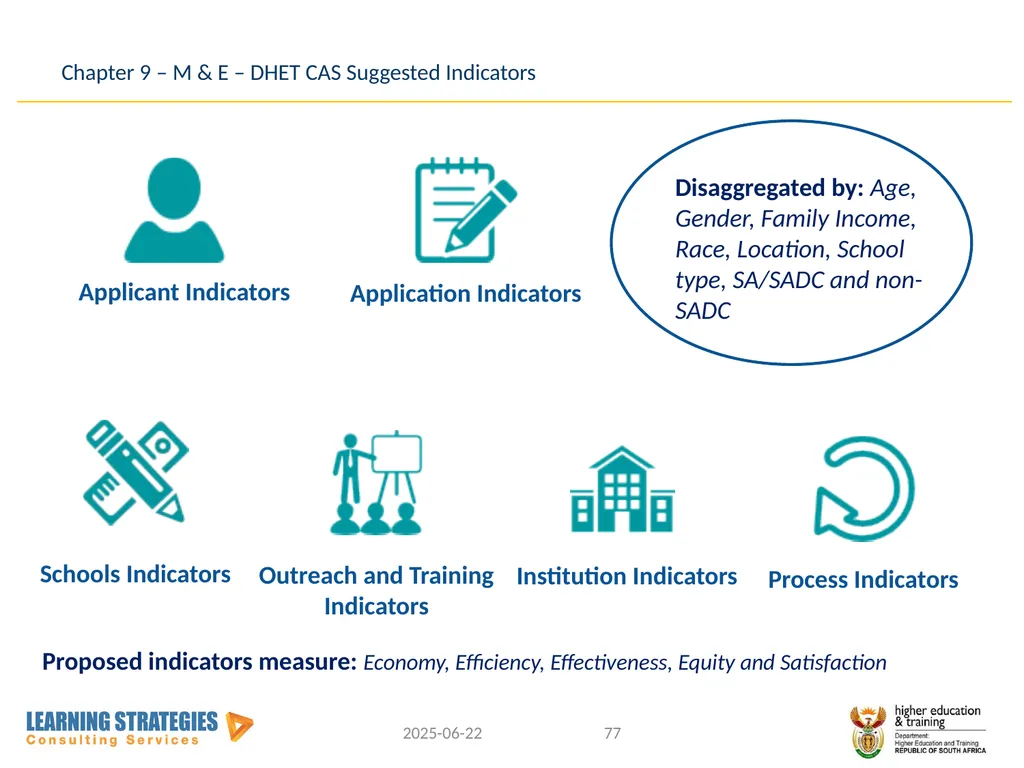
slide77. Chapter 9 – M & E – DHET CAS Suggested Indicators 2016/06/27 77 Applicant Indicators Application Indicators Process Indicators Disaggregated by: Age, Gender, Family Income, Race, Location, School type, SA/SADC and non-SADC Proposed indicators measure: Economy, Efficiency, Effectiveness, Equity and Satisfaction<br>
slide78. Legislative Process for Enacting CAS 2016/06/27 78<br>
slide79. Review of CAS Implementation Plan and Financial Model 2016/06/27 79<br>
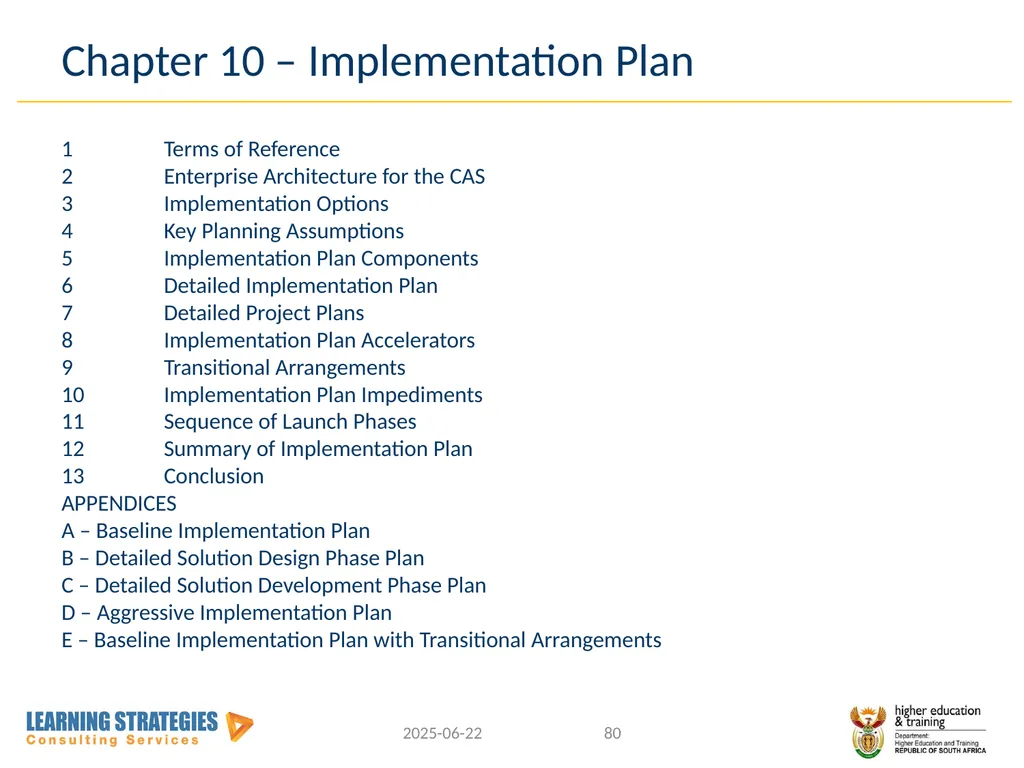
slide80. Chapter 10 – Implementation Plan 2016/06/27 80 1 Terms of Reference
2 Enterprise Architecture for the CAS
3 Implementation Options
4 Key Planning Assumptions
5 Implementation Plan Components
6 Detailed Implementation Plan
7 Detailed Project Plans
8 Implementation Plan Accelerators
9 Transitional Arrangements
10 Implementation Plan Impediments
11 Sequence of Launch Phases
12 Summary of Implementation Plan
13 Conclusion
APPENDICES
A – Baseline Implementation Plan
B – Detailed Solution Design Phase Plan
C – Detailed Solution Development Phase Plan
D – Aggressive Implementation Plan
E – Baseline Implementation Plan with Transitional Arrangements<br>
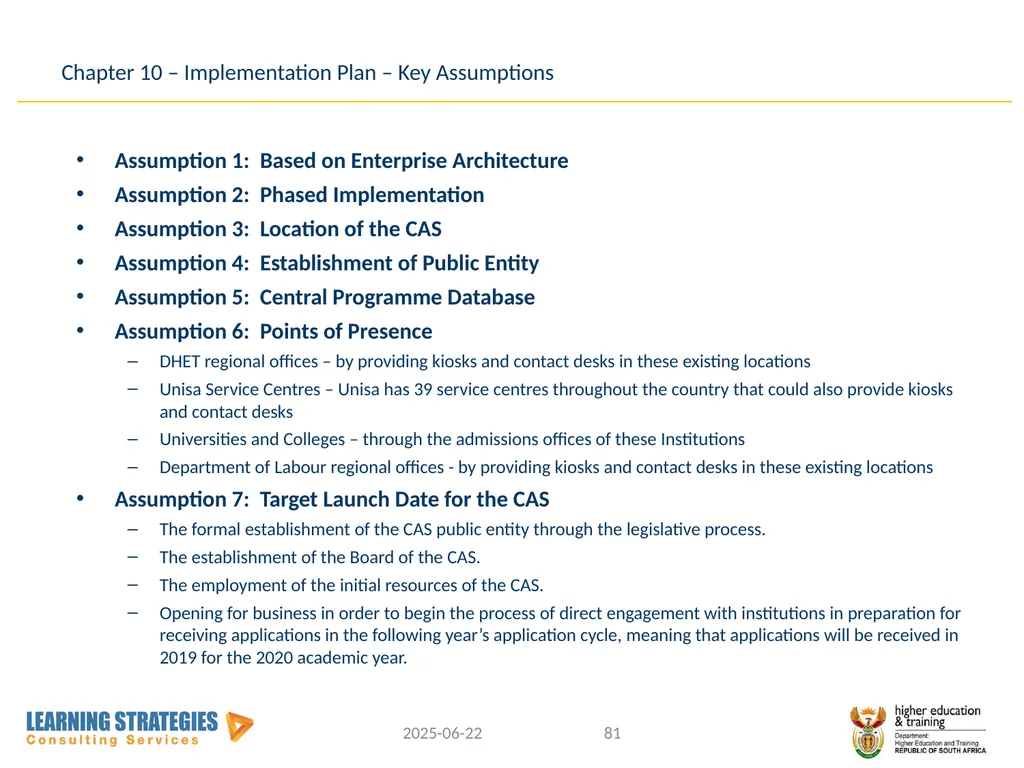
slide81. Chapter 10 – Implementation Plan – Key Assumptions Assumption 1: Based on Enterprise Architecture
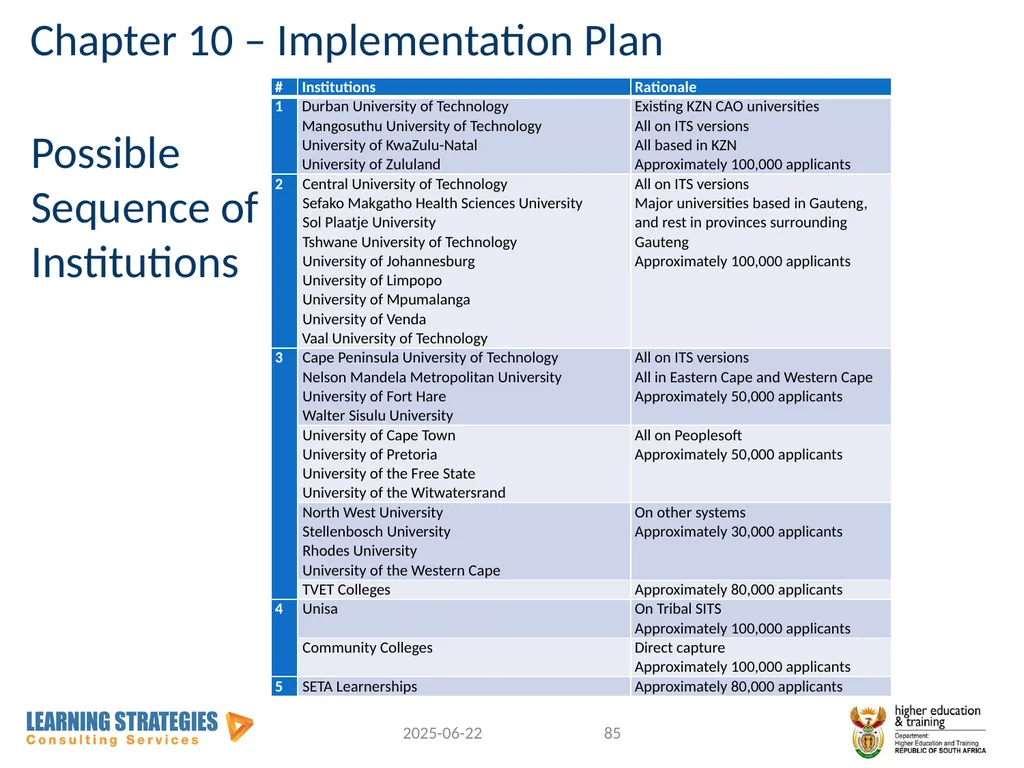
Assumption 2: Phased Implementation
Assumption 3: Location of the CAS
Assumption 4: Establishment of Public Entity
Assumption 5: Central Programme Database
Assumption 6: Points of Presence
DHET regional offices – by providing kiosks and contact desks in these existing locations
Unisa Service Centres – Unisa has 39 service centres throughout the country that could also provide kiosks and contact desks
Universities and Colleges – through the admissions offices of these Institutions
Department of Labour regional offices - by providing kiosks and contact desks in these existing locations
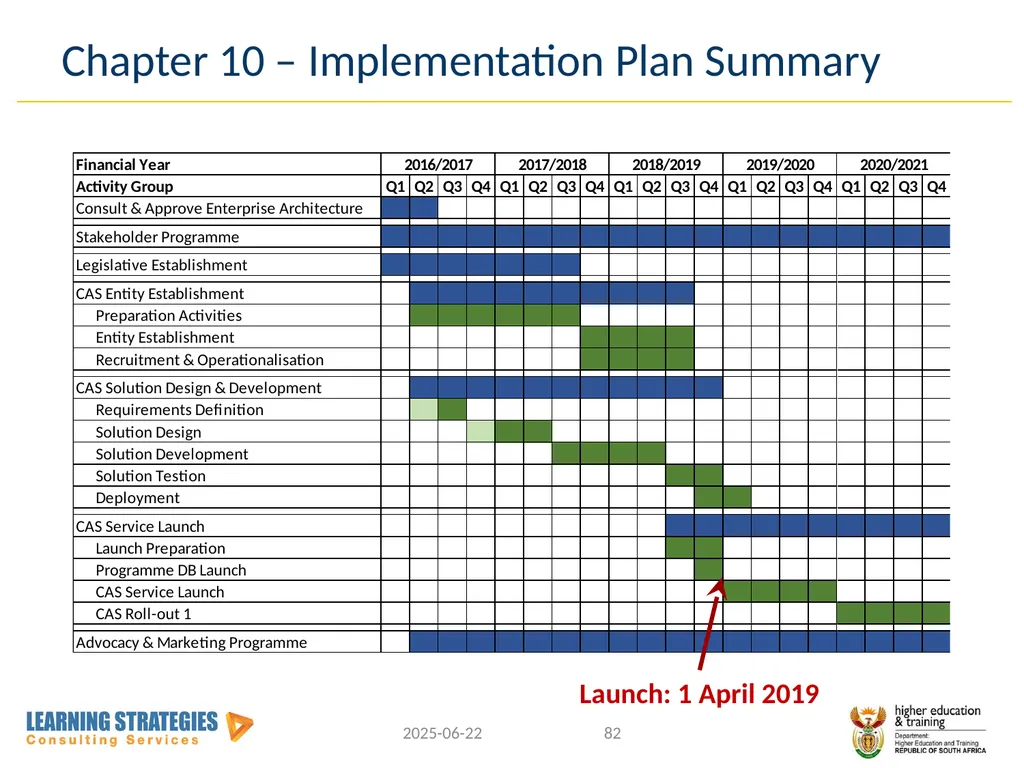
Assumption 7: Target Launch Date for the CAS
The formal establishment of the CAS public entity through the legislative process.
The establishment of the Board of the CAS.
The employment of the initial resources of the CAS.
Opening for business in order to begin the process of direct engagement with institutions in preparation for receiving applications in the following year’s application cycle, meaning that applications will be received in 2019 for the 2020 academic year. 2016/06/27 81<br>
slide82. Chapter 10 – Implementation Plan Summary 2016/06/27 82<br>
slide83. Chapter 10 – Implementation Plan Accelerators & Impediments Potential Accelerators
NSFAS Platform Collaboration
Leverage KZN CAO Capabilities
Procurement Process
Impediments
Delayed Decision Making
Legislation Process
Service Partner Collaboration 2016/06/27 83<br>
slide84. Chapter 10 – Implementation Plan – Alternative Scenarios Aggressive Plan to enable Operational launch by 1 April 2018
Relies on all accelerators
Fast-tracks almost all activities resulting in shorter timeframes
Not considered feasible
Baseline Implementation Plan with Transitional Arrangement
The Transitional Arrangement involves reaching an agreement with the four KZN Universities that currently process applications through the KZN CAO that involves incorporating the KZN application process into the PSET CAS for an interim, transitional period, leveraging the existing KZN CAO processes, platform and staffing during the transitional period and until the new CAS Solution is ready to be launched, after which the KZN application process would be transitioned onto the new CAS Solution.
It is important to note that these transitional arrangements have not yet been agreed with the parties involved. 2016/06/27 84<br>
slide85. Chapter 10 – Implementation Plan 2016/06/27 85 Possible Sequence of Institutions<br>
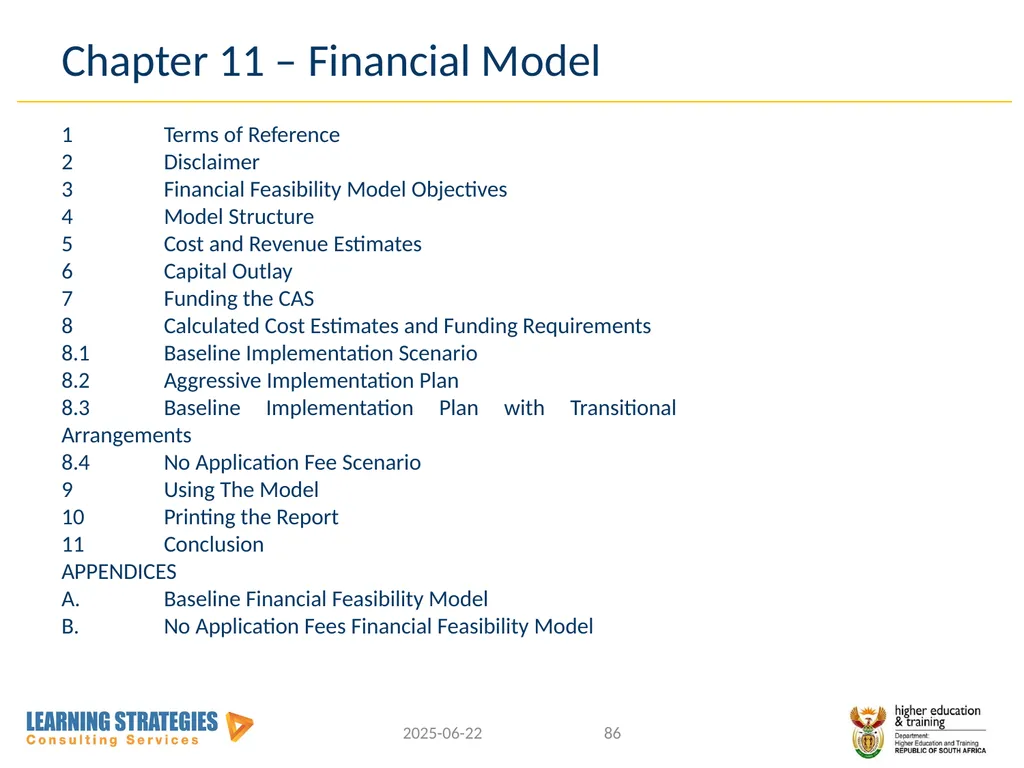
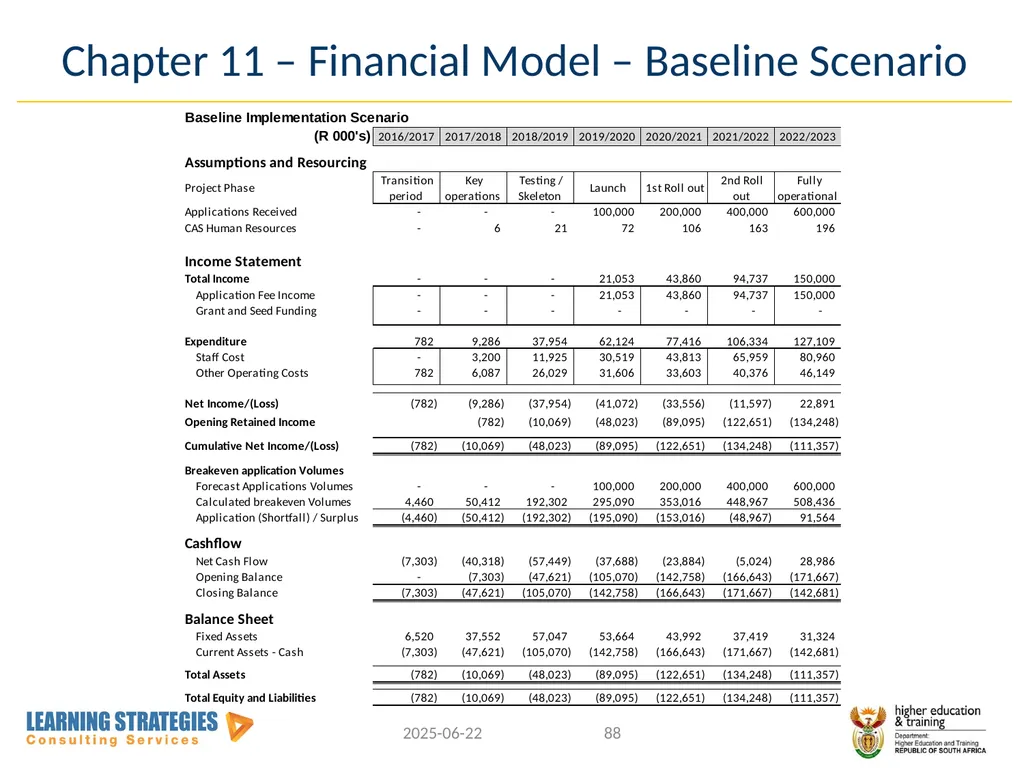
slide86. Chapter 11 – Financial Model 2016/06/27 86 1 Terms of Reference
2 Disclaimer
3 Financial Feasibility Model Objectives
4 Model Structure
5 Cost and Revenue Estimates
6 Capital Outlay
7 Funding the CAS
8 Calculated Cost Estimates and Funding Requirements
8.1 Baseline Implementation Scenario
8.2 Aggressive Implementation Plan
8.3 Baseline Implementation Plan with Transitional Arrangements
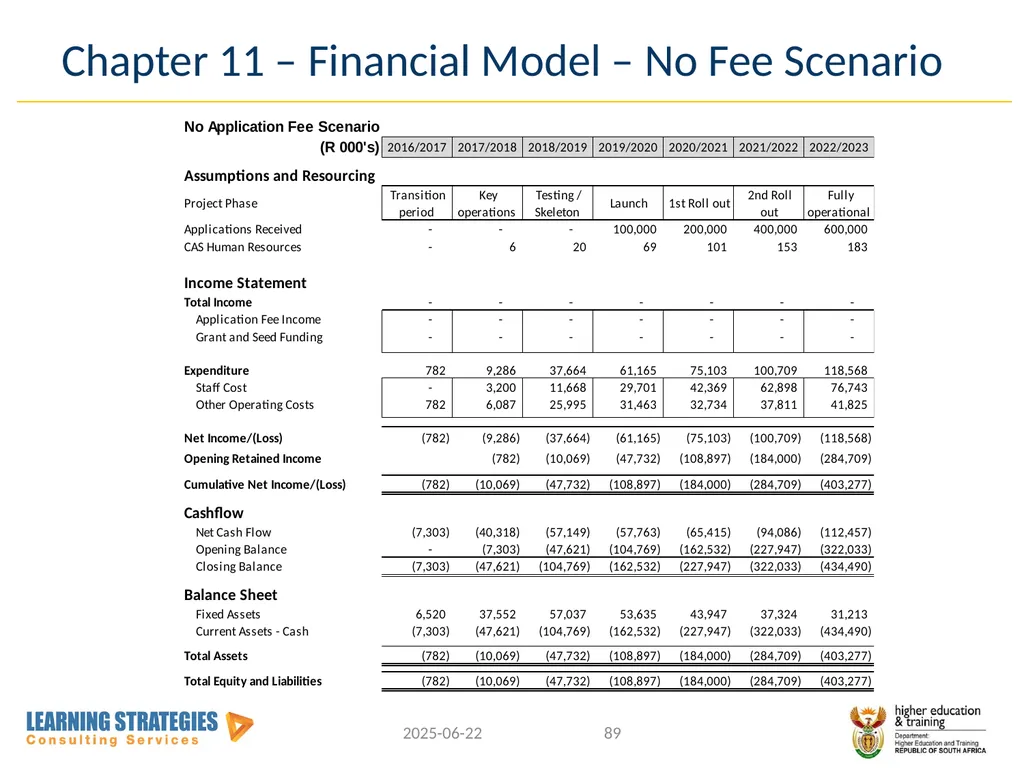
8.4 No Application Fee Scenario
9 Using The Model
10 Printing the Report
11 Conclusion
APPENDICES
A. Baseline Financial Feasibility Model
B. No Application Fees Financial Feasibility Model<br>
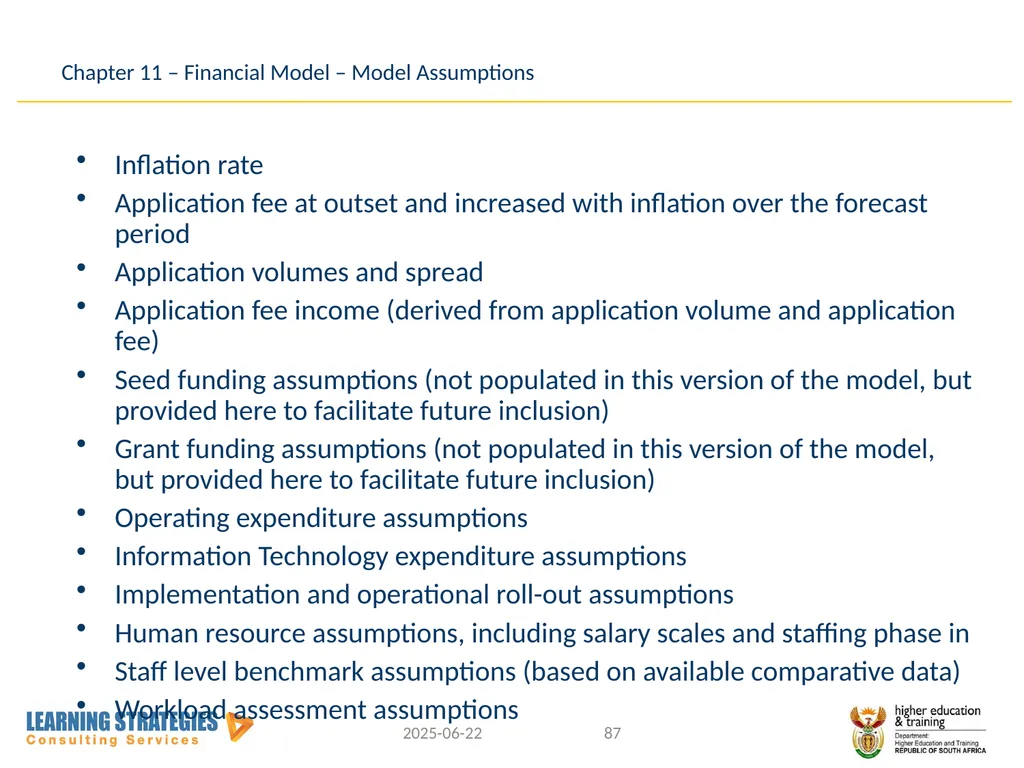
slide87. Chapter 11 – Financial Model – Model Assumptions Inflation rate
Application fee at outset and increased with inflation over the forecast period
Application volumes and spread
Application fee income (derived from application volume and application fee)
Seed funding assumptions (not populated in this version of the model, but provided here to facilitate future inclusion)
Grant funding assumptions (not populated in this version of the model, but provided here to facilitate future inclusion)
Operating expenditure assumptions
Information Technology expenditure assumptions
Implementation and operational roll-out assumptions
Human resource assumptions, including salary scales and staffing phase in
Staff level benchmark assumptions (based on available comparative data)
Workload assessment assumptions 2016/06/27 87<br>
slide88. Chapter 11 – Financial Model – Baseline Scenario 2016/06/27 88<br>
slide89. Chapter 11 – Financial Model – No Fee Scenario 2016/06/27 89<br>
slide90. Review of CAS Enterprise Architecture Recommendations 2016/06/27 90<br>
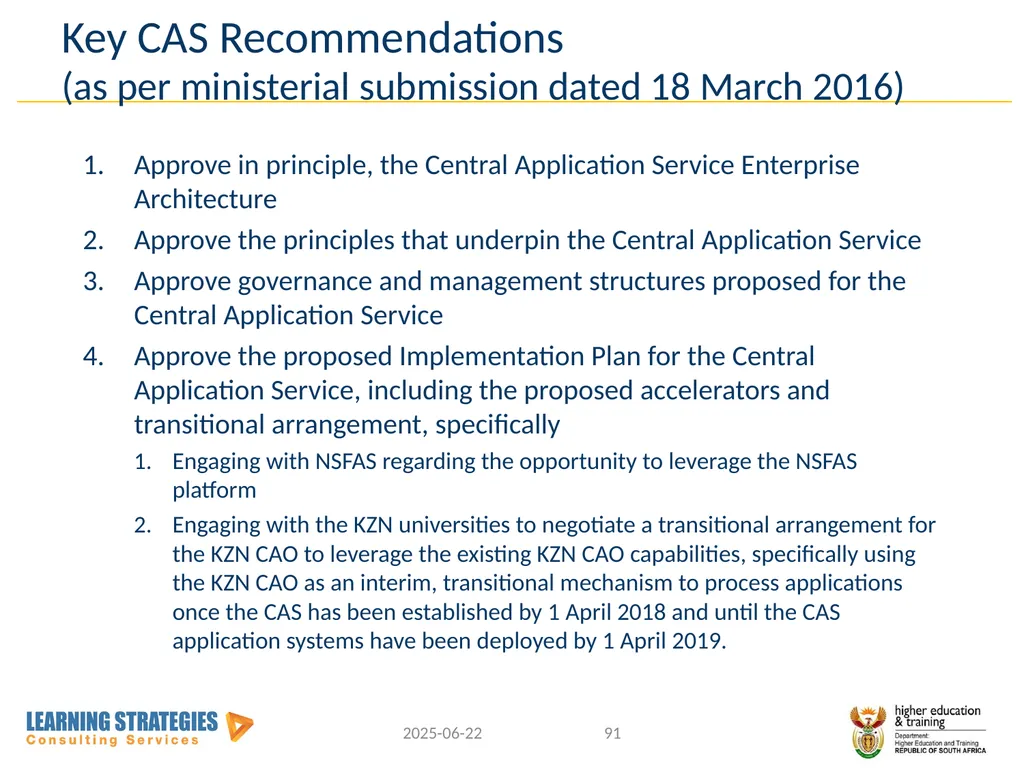
slide91. Key CAS Recommendations (as per ministerial submission dated 18 March 2016) Approve in principle, the Central Application Service Enterprise Architecture
Approve the principles that underpin the Central Application Service
Approve governance and management structures proposed for the Central Application Service
Approve the proposed Implementation Plan for the Central Application Service, including the proposed accelerators and transitional arrangement, specifically
Engaging with NSFAS regarding the opportunity to leverage the NSFAS platform
Engaging with the KZN universities to negotiate a transitional arrangement for the KZN CAO to leverage the existing KZN CAO capabilities, specifically using the KZN CAO as an interim, transitional mechanism to process applications once the CAS has been established by 1 April 2018 and until the CAS application systems have been deployed by 1 April 2019. 2016/06/27 91<br>
slide92. Key CAS Recommendations (as per ministerial submission dated 18 March 2016) Approve the proposed site of location for the Central Application Service to be in Gauteng
Approve the initiation of processes to secure regional points of presence by leveraging existing infrastructure with parties that currently operate the DBE schools, the DHET regional offices, the existing applications offices of universities and colleges, UNISA service centres and the Department of Labour regional offices
Approve the initiation of the process to seek seed funding of R175 million to fund the implementation costs (seed funding) and operational losses during roll-out
Consider the implications of a “no fee” application scenario at the cost of R120 million per annum, and provide guidance on whether to consider this at this point, and if so, to approve the initiation of the process to seek additional seed and operational funding 2016/06/27 92<br>
slide93. Key CAS Recommendations (as per ministerial submission dated 18 March 2016) Approve the initiation of the procurement of appropriate service providers for the technical specifications development and for the preparation of the requirements for the legislation and entity establishment.
Approve the retention of the CAS Project Steering Committee as the primary governance structure for the CAS project until the legislative establishment of the CAS entity is completed, with an appropriate mandate to govern the project until the Board of the CAS Public Entity is formally established
Approve the commencement of the stakeholder engagement, advocacy and communication strategy developed through the enterprise architecture process 2016/06/27 93<br>
slide94. Additional CAS Recommendation (not in ministerial submission) The CAS will require a central Academic Programme Database. A position paper has been developed to motivate for a National Academic Programme Data Store that consolidates all Academic Programme information into a single place and process.
An urgent decision to proceed or not to proceed with such a National Academic Programme Data Store is required.
In the absence of such a National Academic Programme Data Store, the CAS will have to design and implement yet another stand-alone programme database that will need to be kept up-to-date by Institutions and Education Providers
On formal establishment as a public entity in the educational space, the CAS entity should apply to be exempt from VAT 2016/06/27 94<br>
slide95. Way Forward 2016/06/27 95<br>
slide2. Welcome & Apologies 2016/06/27 2<br>
slide3. Agenda Opening Welcome & Apologies 15 min
Confirm Meeting Objectives 5 min
Review of Consolidated CAS Enterprise Architecture 120 min
Detailed review of CAS Enterprise Architecture deliverable 75 min
Chapter 1 – Overview
Chapter 2 – Service Model
Chapter 3 – Governance
Chapter 4 – Standard Operating Procedures
Chapter 5 – ICT Architecture
Chapter 6 – Human Resource Management
Chapter 7 – Advocacy & Communication
Chapter 8 – Stakeholder Engagement
Chapter 9 – Monitoring & Evaluation
Legislative Process for enacting CAS 15 min
Review of CAS Implementation Plan and Financial Model 30 min
Chapter 10 – Implementation Plan
Chapter 11 – Financial Model
Key Recommendations
Lunch 45 min
Discussion Sessions 105 min
Standardisation Process
Application Form and Statuses
Way Forward 15 min 2016/06/27 3<br>
slide4. Confirm Objectives 2016/06/27 4<br>
slide5. Confirm Objectives Provide an Overview of the CAS Enterprise Architecture
Enable questions by participants
Enable raising of comments and issues by participants
Address comments, questions and issues where possible
Gather Input on key topics
Agree Way Forward and obtain nominations to user groups 2016/06/27 5 To cover the Agenda we have to implement strict time-keeping on reviewing the detail of the Enterprise Architecture deliverables<br>
slide6. Review of Consolidated CAS Enterprise Architecture 2016/06/27 6<br>
slide7. Overview of Enterprise Architecture project Enterprise Architecture translates the concept or vision for a future business or organisation into a design document that defines how the business should operate, be structured and supported with technology and processes 2016/06/27 7<br>
slide8. The CAS Concept 2016/06/27 8 Applicants Central Application Service PSET Institutions Apply Facilitate Admit Investigate opportunities
Prepare application
Submit application
Change application
Provide additional information
Consider and accept offers Prepare application cycles
Capture off-line applications
Check applications
Submit application
Communicate with applicants
Resolve applicant queries
Refer regretted applicants Prepare programme data
Receive applications
Request additional information
Update application status
Select and make offers
Register and admit students<br>
slide9. Consolidated CAS Enterprise Architecture chapters Chapter 0 – Executive Summary (including Recommendations)
Chapter 1 – Overview of Consolidated CAS Enterprise Architecture
Chapter 2 – Service Model
Chapter 3 – Governance & Management Report
Chapter 4 – Standard Operating Procedures
Chapter 5 – ICT Architecture & Infrastructure
Chapter 6 – Human Resource Management
Chapter 7 – Advocacy & Communication Strategy
Chapter 8 – Stakeholder Engagement Strategy
Chapter 9 – Monitoring & Evaluation Framework & Policy
Chapter 10 – Implementation Plan
Chapter 11 – Financial Model 2016/06/27 9 Vol 1 Vol 2 Vol 3 Vol 4<br>
slide10. Input to CAS Enterprise Architecture 2016/06/27 10<br>
slide11. CAS Enterprise Architecture validation 2016/06/27 11 The CAS Enterprise Architecture was submitted to the Minister in March 2016 and was approved by the Minister on 31 March 2016 The CAS Enterprise Architecture has been published on the DHET website at http://www.dhet.gov.za/SitePages/OrgUniversities.aspx<br>
slide12. Levels of Engagement 2016/06/27 12 Universities TVET Colleges Community Colleges Time to Launch Level of Engagement to Date SETA’s While the level of engagement at Universities has been higher than other Institution types, the Time to Launch is further away for these Institutions<br>
slide13. Chapter 2 – Service Model (already approved) 2016/06/27 13 1 Terms of Reference
2 Introduction
3 Key Service Model Principles
4 Stakeholder Expectations
5 Service Operating Model
6 Service Model Dimensions
7 Generic High Level Service Model
8 CAS Integration with Related Entities
9 Application Service Target Market
10 CAS Application Handling Flow
11 CAS Application Pricing Model
12 CAS Central Academic Programme Database
13 Institutional Mechanisms and Entity Options
14 Conclusion
APPENDICES
A. CAS Analysis Report
B. CAS Comparison Report
C. CAS Environmental Scan Report
D. Stakeholder Inputs Report
E. Current University and Technical University Application Form Analysis<br>
slide14. Chapter 2 – Service Model – Term Definitions 2016/06/27 14<br>
slide15. Chapter 2 – Service Model – Target Market All entering undergraduates - applications for entering undergraduates into Post School Education and Training to Academic Programmes leading to NQF-approved qualifications from PSET institutions that the applicant has not previously attended.
Applications will be for Academic Programmes as specified by individual institutions -
Institutions can enrol or admit at a more detailed level.
Target market specifically excludes:
Returning students and re-commencement of previously registered Academic Programmes
Post graduate students
Unregistered courses and short courses not linked to NQF
Academic Programmes that do not lead to NQF-approved qualifications;
Transfers between institutions
Conversion to another course within same institution 2016/06/27 15<br>
slide16. Chapter 2 – Service Model – Stakeholder Expectations 2016/06/27 16<br>
slide17. Chapter 2 – Service Model Principles 2016/06/27 17 Policy and legislative matters are the responsibility of the DHET inter-branch steering committee
DHET should be responsible for ensuring the appropriate compliance with the implementation of the CAS
Participation should be compulsory for all applications (not voluntary participation by institutions)
Focus is strictly applications handling, not admissions
Target market is “entering undergraduates into PSET”(refer detail below)
A single point for information and access into the PSET, similar to CACH
The final objective is “one application, one fee” with an affordable application fee where the one application could be to multiple institutions and/or programmes, covering also
Integrated application for Study, Learnerships, Apprenticeships, Scholarships, Student housing and Funding
Funding from Both NSFAS and other sources including funding from institutions<br>
slide18. Chapter 2 – Service Model Principles 2016/06/27 18 Visibility of selection and offering by institution
Accommodate full cycle service from application through status changes to confirmed offer and acceptance
Resolve or substantially address the multiple acceptances and registration uncertainty
A single database of all applications and applicants
Seamless transfer of data between CAS, institutions (both educational and funding institutions) and applicants
Receive feedback data of “walk-in” students especially/specifically at skills centres and community colleges to “close the loop”, but also from any other Institutions where walk-in applications are recorded
Once an institution selects a student, communication should be directly between institution and applicant with CAS assistance if required
The CAS should be self-funding<br>
slide19. Chapter 2 – Service Model – Operating Model 2016/06/27 19<br>
slide20. Chapter 2 – Service Model 2016/06/27 20<br>
slide21. Chapter 2 – Service Application Handling 2016/06/27 21<br>
slide22. Chapter 2 – Service Model – Application Handling 2016/06/27 22<br>
slide23. Chapter 2 – Service Model – Multiple Offers Option 1: Visibility – this option involved simply providing visibility of the various applications made by an applicant so that institutions can see the multiple applications and in fact the multiple offers and acceptances
Option 2: Order of Preference – this option involves assessing each application in order of preference meaning that the first priority application would be submitted to that institution first and only after that institution has dealt with that application and not made an offer would the application be forwarded to the second institution
Option 3: One Acceptance Allowed – this option simply involves implementing a rule that an applicant may only accept one offer, meaning that on acceptance, all other offers will effectively be rejected
Option 4: Offers with Expiry Dates – under this option, institutions would have the option to place expiry dates on their offers requiring applicants to take up their offer or face the offer expiring at a point in time. 2016/06/27 23 Registrar’s Forum recommended combination of Option 1 and Option 4<br>
slide24. Chapter 2 – Service Model – Application Fees A single fee should be charged for one or more applications
A higher fee should be charged for non-SADC applications
A fee should be charged for change of mind after allowing at least one fee change of mind
No fee should be charged where an applicant is referred to an alternative opportunity
Applicants should be incentivised to submit online applications, but not necessarily through reduced application fee 2016/06/27 24 Pricing Model recommended by Registrar’s Forum in July 2015 Position Paper on No Fee option developed<br>
slide25. Chapter 2 – Service Model – Institutional Mechanism 2016/06/27 25 Option 2C approved by the Minister of Higher Education and Training<br>
slide26. Benefits to the PSET Sector 2016/06/27 26<br>
slide27. Chapter 3 – Governance and Management Report 2016/06/27 27 1 Terms of Reference
2 Legislative Environment
3 Policy Environment
4 Governance Model for the CAS
5 CAS Policy Framework
6 CAS Entity Structure and Enabling Legislation
7 Roles and responsibilities of Key Stakeholders
8 Executive Authority
9 Board of CAS
10 Board Committees
11 Advisory Structures
12 Management of the CAS
13 Conclusion
APPENDICES
A – Central Application Service Policy Framework
B - Draft Central Application Services Bill
C – Delegation of Authority
D – Executive Committee - Terms of Reference
E – Audit and Risk Committee - Terms of Reference
F – Human Resources and Remuneration Committee – Terms of Reference<br>
slide28. Chapter 3 – Governance – Entity Structure Public entity established through enabling legislation
Autonomous from department
Has a governing Board
Mandate derived from Act establishing the public entity
Funded by Parliament via the department, as well as own funds
PFMA is applicable – Board is the Accounting Authority
Own policies for HR, SCM, remuneration etc. 2016/06/27 28<br>
slide29. Chapter 3 – Governance – Board Two executive Board members - the Chief Executive Officer and Chief Financial Officer of the CAS
Thirteen non-executive Board members appointed by the Minister of Education and Training ensuring effective representation across the PSET sector. These should include at least:
Four from universities
Two from TVET colleges
Two from the SETAs and skills sector
One from community colleges
Three other non-executive Board members with experience and involvement from across the PSET sector
One Ministerial appointment
The Chairman of the Board should be elected from the non-executive members 2016/06/27 29<br>
slide30. Chapter 3 – Governance - Committees Board Committees
An Executive Committee comprising at least the CEO, CFO, Chairperson and Deputy Chairperson of the Board
An Audit and Risk Committee should be established in terms of the Treasury guidelines regarding the formation of audit committees as provided in terms of section 77 of the PFMA
A Human Resources and Remuneration Committee, again, comprising a maximum of three members of the Board and at least two other non-board members, including the executive Head of Human Resources
Stakeholder Groups
Sector Advisory Committees
User Groups 2016/06/27 30<br>
slide31. Chapter 3 – Governance – Roles and Responsibilities - DHET Policy and legislative matters supporting the establishment and operations of the CAS
Creation of an inter-branch Policy Committee out of the CAS Steering Committee after the CAS is formally established to advise on all policy matters
Ensuring all the necessary policy and legislative structures are in place to ensure compliance with the implementation and operating requirements of the CAS 2016/06/27 31<br>
slide32. Chapter 3 – Governance – Roles and Responsibilities - CAS Centralised Services
Application handling factory (Receiving, processing)
Payment processing and reconciliation
Database management and integration
Clearing house
Career counselling
Refer applicants that are unsuccessful to other institutions / opportunities
Monitoring and evaluation
Distributed services
Outreach
Career fairs, school visits etc.
Support for career and education advice
Promotion
“Apply Now”
Targeted activations
Promoting advise on courses and opportunities available in the PSET system
Training
Distribution 2016/06/27 32<br>
slide33. Chapter 3 – Governance – Roles and Responsibilities – Service Partners Define all programmes offered and submit information relating to programmes to the CAS so that applications can be submitted against these offerings
Receive application data from the CAS relating to all applications made to that institution
Select students based on applications received and communicate with both students and the CAS relating to the decisions in regard to the selection of students
Provision of any additional information including final registration of students which will assist in completing the data set enabling effective planning and sector management
Adhere to sector-agreed milestones and cut-off dates to ensure that selection process is timeous and efficient 2016/06/27 33<br>
slide34. Chapter 4 – Standard Operating Procedures 2016/06/27 34 1 Terms of Reference
2 CAS Service Operating Model
3 CAS Functional Model
3.1 Business Architecture
3.2 Stakeholder Map
4 Standard Operating Procedures
4.1 Preamble
4.2 Core Application Handling
4.3 Central Academic Programme Data Store Process Flow
4.4 Supporting Functions Process Maps
4.5 Outreach & Promotion Protocol
4.6 Training Protocol
4.7 Communication Protocol
4.8 Call Centre Scripts
5 Conclusion
A. Core Application Handling Process Maps
B. Central Academic Programme Data Store Process Flow
C. Finance Management Process Maps
D. Supply Chain Management Process Maps<br>
slide35. Chapter 4 – SOPs – Business Architecture 2016/06/27 35<br>
slide36. Chapter 4 – SOPs – Core Business Process – Level 1 2016/06/27 36<br>
slide37. Chapter 4 – SOPs – Outreach and Promotion Protocol 2016/06/27 37 The objectives of the Outreach and Promotion Protocol is to ensure that awareness of the CAS in created, maintained and enhanced
Outreach and Promotion Managers are responsible to plan and forecast outreach visits and handbook printing once a year and monitor and manage adherence on an ongoing basis
Outreach and Promotion Schedule:<br>
slide38. Chapter 4 – SOPs – CAS Training Protocol The objectives of the Training Protocol is to ensure that individuals responsible for supporting the CAS Operations and Institutions using the CAS application are adequately skilled
The training areas covered by the Training Protocol include the CAS System and all supporting processes, policies and protocols
Training will be conducted at a regional central training venue
All training interventions will be evaluated through knowledge testing and reviewed by Training Supervisors
Audience, Type and Frequency: 2016/06/27 38<br>
slide39. Chapter 4 – SOPs – Communication Protocol The objective of the Communication Protocol is to ensure that an applicant in the CAS system is always aware of the status of his/her application
Methods of communication utilised include:
Online access to the CAS system
IVR (Interactive Voice Response)
Push SMS
Call Centre
Walk-in Centres
Post
Communication is triggered by changes in the process flow
The key principle is to use communication methods with the least cost for the purpose of the communication
The communication responsibility of the CAS is limited to CAS operations, e.g. receiving applications to release to institutions as well as referral and clearing house activities
All communication between the institutions and the applicant from when released to the institution till notification of final acceptance or rejection is the responsibility of the institution (institutions can opt to delegate this responsibility to the CAS on a Service Level Agreement) 2016/06/27 39<br>
slide40. Chapter 4 – SOPs – Communication Protocol 2016/06/27 40 Note: Follow-up communications will stop after a pre-defined timeframe if no response from applicant recorded<br>
slide41. Chapter 4 – SOPs – Call Centre Call Centre will be used to manage Incoming Calls from applicants and other parties, and Outgoing Calls to applicants when no other communication mechanism is available
IVR technology will be used to handle routine calls for information requests, with options to talk to an agent 2016/06/27 41<br>
slide42. Chapter 4 – SOPs – Call Centre Scripts – Incoming Call 2016/06/27 42<br>
slide43. Chapter 4 – SOPs – Call Centre Scripts – Outgoing Call 2016/06/27 43 Note: where possible other communication mechanisms will be used in preference to Outgoing Calls<br>
slide44. Chapter 5 – ICT Architecture and Infrastructure 2016/06/27 44 1 Terms of Reference
2 PSET IT Landscape Assessment
3 CAS Application and Integration Architecture
3.1 Architectural Overview
3.2 Design Principles
3.3 Application Architecture
3.4 Integration Architecture
3.5 Business Applications
3.6 Technology Components in KZN CAO
3.7 Technology Components in NSFAS
4 CAS ICT Infrastructure
5 Conclusion<br>
slide45. Chapter 5 – ICT Architecture – Design Principles Comprehensive programme information on central programme database
Regarding the programme
Regarding the Institution offering the programme
Making clear the minimum entrance requirements
Making clear the costs of the programme
Standardised terminology, status and conditions
Clearly defined
Easily understood by Applicants
Consistent across PSET
Online applications via PC and mobile devices
Unique identification of applicant and application 2016/06/27 45<br>
slide46. Chapter 5 – ICT Architecture – CAS Application / Integration Architecture 2016/06/27 46 Coltech<br>
slide47. Chapter 5 – ICT Architecture – CAS Application / Integration Architecture - 2 CAS Application & Workflow Engine – The CAS Application & Workflow Engine is the core of the ICT Architecture
It will contain the core business logic and workflow paths, and must be configurable to allow flexibility in business rules and wokflow rules
It includes the CAS databases. The CAS engine must be hosted centrally and accessible through standard internet protocols.
CAS Programme Database – The CAS Programme Database houses the programme information against which applicants will make programme information and selection decisions
It will contain all programme information enabling information and selection
It will be maintained by the Institutions participating in the CAS
It is recommended that the CAS is the host of the central National Programme Database(s) 2016/06/27 47<br>
slide48. Chapter 5 – ICT Architecture – CAS Application / Integration Architecture - 3 Front Ends (F/E) – The CAS Engine is made available to end users through multiple Front Ends, including
Web Front End consisting of a CAS public website containing information and content available to the general public, and an applicant portal that will be used by Applicants for processing and monitoring applications (and whose access will be restricted to only their data)
Mobile Front End that provides an alternative, mobile-friendly mechanism for Applicants and other outside, non-privileged users
CAS Front End that provides the functionality for CAS employees, with access and functionality appropriate to their job function and level of authority. Typically CAS employees will have access to the data of a range of applicants
Institution Front End that provides the functionality for institution employees, with access and functionality appropriate to their job function and level of authority, and with access restricted to applicants to their institution. Institution Front Ends may be differentiated for Educational Institutions, Funding Institutions, Companies and Programme Database Institutions 2016/06/27 48<br>
slide49. On-line Applications - 2016 There is a significant trend towards on-line applications. In total 54,5 % of applications were already on-line for 2016
75,6% of applications were on-line to institutions offering this channel
An even higher percentage of on-line registrations was noted but this may be skewed by on-line access provided at institutions during registration. In total, 78,7% of registrations were on-line 2016/06/27 49<br>
slide50. Chapter 5 – ICT Architecture – CAS Application / Integration Architecture - 4 CAS Supporting Applications – The CAS Supporting Application provide peripheral functionality used by the core engine, and including
Content Manager to enable content required by the CAS Application and the Front Ends to be stored and maintained
Scanning Functionality to enable documents received by the CAS in paper format to be scanned and the stored in the Document Manager
Document Manager to manage the documents received with applications, either from the Scanning Functionality, or with the online application system (Web F/E and Mobile F/E) or submitted in digital form via email or other form. The Document Manager will need functionality to transform documents to a common format (expected to be PDF) and to split submitted PDFs into multiple documents.
CAS Finance to manage the financial transaction associated with applications and control that where applicants are expected to pay an application fee, this fee is received, and where application fees are funded by other entities as capitation fees, the correct reconciliation is produced to support claims for such fees.
SMS/Email Service to manage the communications triggered by the application workflow
User Directory to manage the user access and authentication
Contact Centre functionality to enable agents to capture call information associated with an enquiry about an application or general enquiry 2016/06/27 50<br>
slide51. Chapter 5 – ICT Architecture – CAS Application / Integration Architecture - 5 Integration Layer – the Integration Layer will manage the integration between the CAS Application & Workflow Engine and surrounding system. The integration will use predominantly
web services for online integration (e.g. web service between CAS and NSFAS to determine funding eligibility)
file based integration for bulk data interchanges (e.g. DBE results)
It is expected that for the institutions, there will be multiple integration types, depending on the systems at the institution 2016/06/27 51<br>
slide52. Chapter 5 – ICT Architecture – CAS Application / Integration Architecture - 6 CAS Business Applications – the CAS business applications will provide functionality to manage the business of CAS
Finance and Supply Chain Management for financial accounting and purchase order management
Human Resource and Payroll for human resource management and payroll management
Based on the expected size of the operation and required level of business control, we believe that a mid-size ERP package such as Sage ERP will be appropriate
Effectively this is the old Accpac and VIP Payroll 2016/06/27 52<br>
slide53. Chapter 5 – ICT Architecture – CAS / Institution Web Service Integration 2016/06/27 53 Note: In each, case, the successful execution of the service will trigger CAS communications to the Applicant, indicating status<br>
slide54. Chapter 5 – ICT Architecture – CAS / NSFAS Web Service Integration 2016/06/27 54 Note: In each, case, the successful execution of the service will trigger CAS communications to the Applicant, indicating status<br>
slide55. Chapter 5 – ICT Architecture – POPI Act Consequences and Implications The CAS Application and Integration Architecture is designed around the principle of seamless transfer of data between CAS, institutions (both educational and funding institutions) and applicants.
It is important to note that, in line with the requirements of the POPI Act, applicants will need to consciously permit the CAS to share their data with Institutions, and the CAS will need to ensure that it has agreements in place with these Institutions to ensure that the institutions adhere equally to the POPI guidelines. 2016/06/27 55<br>
slide56. Chapter 5 – ICT Architecture – Technology Components already in KZN CAO 2016/06/27 56 Web F/E CAS F/E Institution F/E CAS Application & Workflow Engine Old CACH CDS NCAP Career Sites NSFAS NSF Other Funding ITS People soft Open W/serv Flat File Easypay Pay@ Bank SMS/Email Service Contact Centre Scanning System Content Manager Integration Layer Mobile F/E User Directory Document Manager CAS Finance Reporting platform Finance & SCM HR & Payroll Programme DB DBE SAQA NLRD IEB CIE Home Affairs SARS SETA Systems<br>
slide57. Chapter 5 – ICT Architecture – Technology Components already in NSFAS 2016/06/27 57 Web F/E CAS F/E Institution F/E CAS Application & Workflow Engine Old CACH CDS NCAP Career Sites NSFAS NSF Other Funding ITS People soft Open W/serv Flat File Easypay Pay@ Bank SMS/Email Service Contact Centre Scanning System Content Manager Integration Layer Mobile F/E User Directory Document Manager CAS Finance Reporting platform Finance & SCM HR & Payroll Programme DB DBE SAQA NLRD IEB CIE Home Affairs SARS SETA Systems<br>
slide58. Chapter 5 – ICT Architecture – IT Infrastructure Architecture 2016/06/27 58 CAS Core Systems CAS Core Systems “Cloud” “Cloud DR” CAS Office Applicant Institution PC Infrastructure LAN Infrastructure WAN Infrastructure CAS Office PC Infrastructure LAN Infrastructure WAN Infrastructure<br>
slide59. Chapter 6 – Human Resource Management 2016/06/27 59 1 Terms of Reference
2 Scope of Work
3 Human Resource Management Model
3.1 Operating Model and Service Model
3.2 Functional Model
3.3 Human Resource Strategy
3.4 Human Resource Management Model
4 Workload Assessment
5 Proposed Organisation Structure
6 Job Profiles
7 Core Responsibilities
8 Human Resource Practices
9 Conclusion
APPENDICES
A – Consolidated Organisation Structure
B – Human Resource Job Profiles
C – Key Human Resource Management Practices<br>
slide60. Chapter 6 – Human Resource Management – Organisation Structure 2016/06/27 60 Board Key Assumptions:
1. Internal Audit is provided as a service by an external service provider
2. IT system is developed and supported by an external vendor and supported and hosted by a 3rd party vendor
3. The Organisation Structure represents roles that will be filled or combined based on job requirements
4. Likely additional admin roles such as receptionist, secretary, cleaning and driver have not been defined here<br>
slide61. Chapter 6 – Human Resource Management – Projected Staff Numbers 2016/06/27 61<br>
slide62. Chapter 6 – Human Resource Management – (HRM) Model 2016/06/27 62 Labour Legislations : LRA, BCEA, EEA, OHSA, SDL, etc
Regulatory Bodies, Bargaining Councils BUSINESS STRATEGY Employment Termination<br>
slide63. Chapter 6 – Human Resource Management – Post Description – Core Responsibilities 2016/06/27 63<br>
slide64. Chapter 6 – Human Resource Management – Post Description – Core Responsibilities 2016/06/27 64 Responsibilities and Job Profiles have been defined for all roles<br>
slide65. Chapter 6 – Human Resource Management – Consolidated Organisation Structure 2016/06/27 65<br>
slide66. Chapter 7 – Advocacy & Communication 2016/06/27 66 1 Terms of Reference
2 Advocacy and Communications in Context
3 Stakeholder Map
4 Communication and Advocacy to Date
5 Advocacy Strategy and Programme
6 Communications Strategy
7 Overall Communication Plan
8 Stakeholder Communications Plan
9 Communication Mechanisms and Tools
10 Driving Online Applications
11 Advocacy and Communication Programme
12 Conclusion<br>
slide67. Chapter 8 – Stakeholder Engagement 2016/06/27 67 1 Terms of Reference
2 Stakeholder Engagement
3 Stakeholder Map
4 Stakeholder Engagement and Project Governance
4.1 Project Advisory Group
4.2 Technical Working Groups
4.3 Project Steering Committee
5 Engagement with Stakeholder Groups
5.1 Key Stakeholder Groups
5.2 Additional Stakeholder Groups
5.3 Individual Institution Engagement
6 Applicant Facing Engagement
6.1 Applicant Engagement
6.2 Teacher and Advisor Engagement
7 Conclusion<br>
slide68. Chapter 7 & 8 – Stakeholder Map 2016/06/27 68 Applicants Schools Career Guidance Points of Presence PSET Institutions Funding Institutions Information Providers Central Application Service Public Private In school Out of school CDS/NCAP Private DoL Univs TVETs Community SETAs NSFAS NSF DBE IEB Home Affairs SARS NLRD Career Fairs Applicant Facing “Service Providers” Institution Facing Libraries NYDA Private CIE Government DHET Regional Offices DBE PSET Institutions<br>
slide69. Chapter 7 & 8 – Advocacy versus Communication Communication – Communication is defined as the imparting or exchanging of information by speaking, writing or using other medium. It is the process of sharing information with various interested parties aimed at informing them of progress, developments and status of an entity, project or other activity. Communication can carry various messages and have various purposes including the following:
Information – merely the sharing of information.
Action – encouraging action from the receiver of the communication such as encouraging individuals to apply early or how to apply.
Advocacy – advocacy is defined as the process of obtaining public support for or the recommendation of a particular cause or policy. Advocacy is also defined as the act of pleading for, supporting or recommending a cause or proposal.
In the case of the CAS, advocacy is therefore an element of the communications strategy but specifically aimed at communicating with those stakeholders being individuals and entities that are required to support the establishment of the CAS and the operations of the CAS once established. 2016/06/27 69<br>
slide70. Chapter 7 & 8 – Advocacy Strategy & Programme 2016/06/27 70<br>
slide71. Chapter 7 & 8 – Detail Communication Plan - Applicants 2016/06/27 71<br>
slide72. Chapter 9 – Monitoring & Evaluation 2016/06/27 72 1 Terms of Reference
2 Monitoring & Evaluation Framework
3 Monitoring & Evaluation Policy
3.1 Developing Performance Indicators
3.2 Managing Performance Information
3.3 Publishing Performance Information
4 CAS Impact Assessment Indicators
4.1 Applicant Indicators
4.2 Application Indicators
4.3 Institution Indicators
4.4 School Indicators
4.5 Outreach & Training Indicators
4.6 Process Indicators
5 Conclusion<br>
slide73. Chapter 9 – M & E – Policy - Developing Performance Indicators 2016/06/27 73<br>
slide74. Chapter 9 – M & E – Framework 2016/06/27 74<br>
slide75. Chapter 9 – M & E – Indicator Concepts 2016/06/27 75<br>
slide76. Chapter 9 – M & E – Indicator Characteristics 2016/06/27 76 Types of Indicators
Cost or Price indicators
Distribution indicators
Quantity indicators
Quality indicators
Dates and time frame indicators
Adequacy indicators
Accessibility indicators
Economy indicators
Efficiency indicators
Effectiveness indicators
Equity indicators
Satisfaction Indicators<br>
slide77. Chapter 9 – M & E – DHET CAS Suggested Indicators 2016/06/27 77 Applicant Indicators Application Indicators Process Indicators Disaggregated by: Age, Gender, Family Income, Race, Location, School type, SA/SADC and non-SADC Proposed indicators measure: Economy, Efficiency, Effectiveness, Equity and Satisfaction<br>
slide78. Legislative Process for Enacting CAS 2016/06/27 78<br>
slide79. Review of CAS Implementation Plan and Financial Model 2016/06/27 79<br>
slide80. Chapter 10 – Implementation Plan 2016/06/27 80 1 Terms of Reference
2 Enterprise Architecture for the CAS
3 Implementation Options
4 Key Planning Assumptions
5 Implementation Plan Components
6 Detailed Implementation Plan
7 Detailed Project Plans
8 Implementation Plan Accelerators
9 Transitional Arrangements
10 Implementation Plan Impediments
11 Sequence of Launch Phases
12 Summary of Implementation Plan
13 Conclusion
APPENDICES
A – Baseline Implementation Plan
B – Detailed Solution Design Phase Plan
C – Detailed Solution Development Phase Plan
D – Aggressive Implementation Plan
E – Baseline Implementation Plan with Transitional Arrangements<br>
slide81. Chapter 10 – Implementation Plan – Key Assumptions Assumption 1: Based on Enterprise Architecture
Assumption 2: Phased Implementation
Assumption 3: Location of the CAS
Assumption 4: Establishment of Public Entity
Assumption 5: Central Programme Database
Assumption 6: Points of Presence
DHET regional offices – by providing kiosks and contact desks in these existing locations
Unisa Service Centres – Unisa has 39 service centres throughout the country that could also provide kiosks and contact desks
Universities and Colleges – through the admissions offices of these Institutions
Department of Labour regional offices - by providing kiosks and contact desks in these existing locations
Assumption 7: Target Launch Date for the CAS
The formal establishment of the CAS public entity through the legislative process.
The establishment of the Board of the CAS.
The employment of the initial resources of the CAS.
Opening for business in order to begin the process of direct engagement with institutions in preparation for receiving applications in the following year’s application cycle, meaning that applications will be received in 2019 for the 2020 academic year. 2016/06/27 81<br>
slide82. Chapter 10 – Implementation Plan Summary 2016/06/27 82<br>
slide83. Chapter 10 – Implementation Plan Accelerators & Impediments Potential Accelerators
NSFAS Platform Collaboration
Leverage KZN CAO Capabilities
Procurement Process
Impediments
Delayed Decision Making
Legislation Process
Service Partner Collaboration 2016/06/27 83<br>
slide84. Chapter 10 – Implementation Plan – Alternative Scenarios Aggressive Plan to enable Operational launch by 1 April 2018
Relies on all accelerators
Fast-tracks almost all activities resulting in shorter timeframes
Not considered feasible
Baseline Implementation Plan with Transitional Arrangement
The Transitional Arrangement involves reaching an agreement with the four KZN Universities that currently process applications through the KZN CAO that involves incorporating the KZN application process into the PSET CAS for an interim, transitional period, leveraging the existing KZN CAO processes, platform and staffing during the transitional period and until the new CAS Solution is ready to be launched, after which the KZN application process would be transitioned onto the new CAS Solution.
It is important to note that these transitional arrangements have not yet been agreed with the parties involved. 2016/06/27 84<br>
slide85. Chapter 10 – Implementation Plan 2016/06/27 85 Possible Sequence of Institutions<br>
slide86. Chapter 11 – Financial Model 2016/06/27 86 1 Terms of Reference
2 Disclaimer
3 Financial Feasibility Model Objectives
4 Model Structure
5 Cost and Revenue Estimates
6 Capital Outlay
7 Funding the CAS
8 Calculated Cost Estimates and Funding Requirements
8.1 Baseline Implementation Scenario
8.2 Aggressive Implementation Plan
8.3 Baseline Implementation Plan with Transitional Arrangements
8.4 No Application Fee Scenario
9 Using The Model
10 Printing the Report
11 Conclusion
APPENDICES
A. Baseline Financial Feasibility Model
B. No Application Fees Financial Feasibility Model<br>
slide87. Chapter 11 – Financial Model – Model Assumptions Inflation rate
Application fee at outset and increased with inflation over the forecast period
Application volumes and spread
Application fee income (derived from application volume and application fee)
Seed funding assumptions (not populated in this version of the model, but provided here to facilitate future inclusion)
Grant funding assumptions (not populated in this version of the model, but provided here to facilitate future inclusion)
Operating expenditure assumptions
Information Technology expenditure assumptions
Implementation and operational roll-out assumptions
Human resource assumptions, including salary scales and staffing phase in
Staff level benchmark assumptions (based on available comparative data)
Workload assessment assumptions 2016/06/27 87<br>
slide88. Chapter 11 – Financial Model – Baseline Scenario 2016/06/27 88<br>
slide89. Chapter 11 – Financial Model – No Fee Scenario 2016/06/27 89<br>
slide90. Review of CAS Enterprise Architecture Recommendations 2016/06/27 90<br>
slide91. Key CAS Recommendations (as per ministerial submission dated 18 March 2016) Approve in principle, the Central Application Service Enterprise Architecture
Approve the principles that underpin the Central Application Service
Approve governance and management structures proposed for the Central Application Service
Approve the proposed Implementation Plan for the Central Application Service, including the proposed accelerators and transitional arrangement, specifically
Engaging with NSFAS regarding the opportunity to leverage the NSFAS platform
Engaging with the KZN universities to negotiate a transitional arrangement for the KZN CAO to leverage the existing KZN CAO capabilities, specifically using the KZN CAO as an interim, transitional mechanism to process applications once the CAS has been established by 1 April 2018 and until the CAS application systems have been deployed by 1 April 2019. 2016/06/27 91<br>
slide92. Key CAS Recommendations (as per ministerial submission dated 18 March 2016) Approve the proposed site of location for the Central Application Service to be in Gauteng
Approve the initiation of processes to secure regional points of presence by leveraging existing infrastructure with parties that currently operate the DBE schools, the DHET regional offices, the existing applications offices of universities and colleges, UNISA service centres and the Department of Labour regional offices
Approve the initiation of the process to seek seed funding of R175 million to fund the implementation costs (seed funding) and operational losses during roll-out
Consider the implications of a “no fee” application scenario at the cost of R120 million per annum, and provide guidance on whether to consider this at this point, and if so, to approve the initiation of the process to seek additional seed and operational funding 2016/06/27 92<br>
slide93. Key CAS Recommendations (as per ministerial submission dated 18 March 2016) Approve the initiation of the procurement of appropriate service providers for the technical specifications development and for the preparation of the requirements for the legislation and entity establishment.
Approve the retention of the CAS Project Steering Committee as the primary governance structure for the CAS project until the legislative establishment of the CAS entity is completed, with an appropriate mandate to govern the project until the Board of the CAS Public Entity is formally established
Approve the commencement of the stakeholder engagement, advocacy and communication strategy developed through the enterprise architecture process 2016/06/27 93<br>
slide94. Additional CAS Recommendation (not in ministerial submission) The CAS will require a central Academic Programme Database. A position paper has been developed to motivate for a National Academic Programme Data Store that consolidates all Academic Programme information into a single place and process.
An urgent decision to proceed or not to proceed with such a National Academic Programme Data Store is required.
In the absence of such a National Academic Programme Data Store, the CAS will have to design and implement yet another stand-alone programme database that will need to be kept up-to-date by Institutions and Education Providers
On formal establishment as a public entity in the educational space, the CAS entity should apply to be exempt from VAT 2016/06/27 94<br>
slide95. Way Forward 2016/06/27 95<br>