
CERN Accelerator School Erice (Sicilia) - 2013
SB
Published · 45 slides · 0 views

1 / 1

Description
CERN Accelerator School Erice (Sicilia) - 2013 Contact : Patxi DUTHIL duthilipno.in2p3.fr Basic thermodynamics Contents CERN Accelerator School 2013 Basic thermodynamics 2 Introduction Opened, closed, isolated systems Sign convention -
Related Topics
Share
Embed code
Download this presentation From Below
"CERN Accelerator School Erice (Sicilia) - 2013" is the property of its rightful owner. Permission is granted to download and print the materials on this website for personal, non-commercial use only, and to display it on your personal computer provided you do not modify the materials and that you retain all copyright notices contained in the materials. By downloading content from our website, you accept the terms of this agreement.
Presentation Transcript
01
CERN Accelerator School
Erice (Sicilia) - 2013 Contact : Patxi DUTHIL
duthil@ipno.in2p3.fr Basic thermodynamics<br>
Erice (Sicilia) - 2013 Contact : Patxi DUTHIL
duthil@ipno.in2p3.fr Basic thermodynamics<br>
02
Contents CERN Accelerator School – 2013
Basic thermodynamics 2 Introduction
Opened, closed, isolated systems
Sign convention - Intensive, extensive variables
Evolutions – Thermodynamic equilibrium
Laws of thermodynamics
Energy balance
Entropy - Temperature
Equations of state
Balances applied on thermodynamic evolutions
Heat machines
Principle
Efficiencies, coefficients of performance
Exergy
Free energies
Phase transitions
P-T diagram
1st and 2nd order transitions<br>
Basic thermodynamics 2 Introduction
Opened, closed, isolated systems
Sign convention - Intensive, extensive variables
Evolutions – Thermodynamic equilibrium
Laws of thermodynamics
Energy balance
Entropy - Temperature
Equations of state
Balances applied on thermodynamic evolutions
Heat machines
Principle
Efficiencies, coefficients of performance
Exergy
Free energies
Phase transitions
P-T diagram
1st and 2nd order transitions<br>
03
INTRODUCTION CERN Accelerator School – 2013
Basic thermodynamics 3 What do we consider in thermodynamics: the thermodynamic system
A thermodynamic system is a precisely specified macroscopic region of the universe.
It is limited by boundaries of particular natures, real or not and having specific properties.
All space in the universe outside the thermodynamic system is known as the surroundings, the environment, or a reservoir.
Processes that are allowed to affect the interior of the region are studied using the principles of thermodynamics.
Closed/opened system
In open systems, matter may flow in and out of the system boundaries
Not in closed systems. Boundaries are thus real: walls
Isolated system
Isolated systems are completely isolated from their environment: they do not exchange energy (heat, work) nor matter with their environment.
Sign convention:
Quantities going "into" the system are counted as positive (+)
Quantities going "out of" the system are counted as negative (-)<br>
Basic thermodynamics 3 What do we consider in thermodynamics: the thermodynamic system
A thermodynamic system is a precisely specified macroscopic region of the universe.
It is limited by boundaries of particular natures, real or not and having specific properties.
All space in the universe outside the thermodynamic system is known as the surroundings, the environment, or a reservoir.
Processes that are allowed to affect the interior of the region are studied using the principles of thermodynamics.
Closed/opened system
In open systems, matter may flow in and out of the system boundaries
Not in closed systems. Boundaries are thus real: walls
Isolated system
Isolated systems are completely isolated from their environment: they do not exchange energy (heat, work) nor matter with their environment.
Sign convention:
Quantities going "into" the system are counted as positive (+)
Quantities going "out of" the system are counted as negative (-)<br>
04
INTRODUCTION CERN Accelerator School – 2013
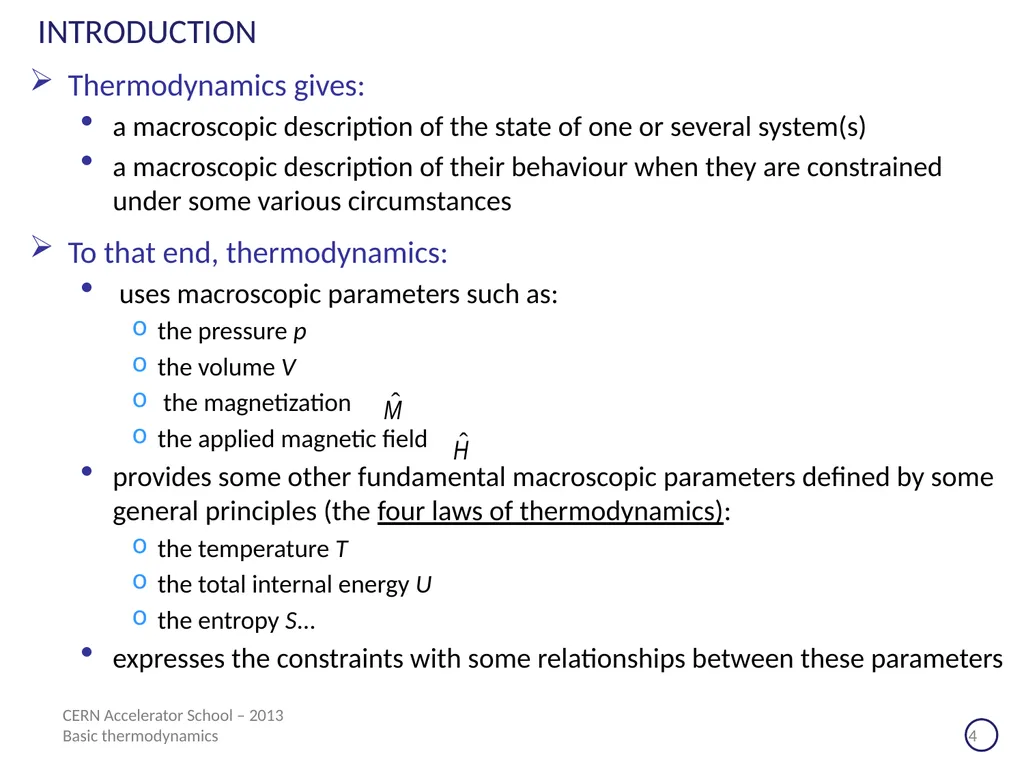
Basic thermodynamics 4 Thermodynamics gives:
a macroscopic description of the state of one or several system(s)
a macroscopic description of their behaviour when they are constrained under some various circumstances
To that end, thermodynamics:
uses macroscopic parameters such as:
the pressure p
the volume V
the magnetization
the applied magnetic field
provides some other fundamental macroscopic parameters defined by some general principles (the four laws of thermodynamics):
the temperature T
the total internal energy U
the entropy S...
expresses the constraints with some relationships between these parameters<br>
Basic thermodynamics 4 Thermodynamics gives:
a macroscopic description of the state of one or several system(s)
a macroscopic description of their behaviour when they are constrained under some various circumstances
To that end, thermodynamics:
uses macroscopic parameters such as:
the pressure p
the volume V
the magnetization
the applied magnetic field
provides some other fundamental macroscopic parameters defined by some general principles (the four laws of thermodynamics):
the temperature T
the total internal energy U
the entropy S...
expresses the constraints with some relationships between these parameters<br>
05
INTRODUCTION CERN Accelerator School – 2013
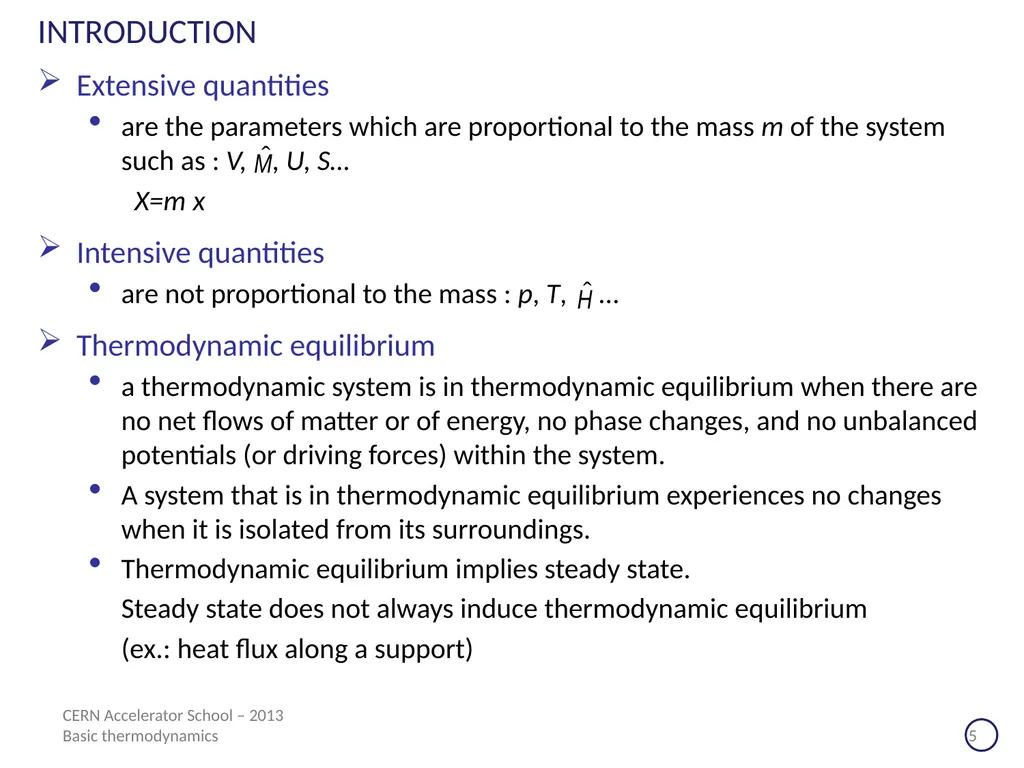
Basic thermodynamics 5 Extensive quantities
are the parameters which are proportional to the mass m of the system such as : V, , U, S…
X=mx
Intensive quantities
are not proportional to the mass : p, T, …
Thermodynamic equilibrium
a thermodynamic system is in thermodynamic equilibrium when there are no net flows of matter or of energy, no phase changes, and no unbalanced potentials (or driving forces) within the system.
A system that is in thermodynamic equilibrium experiences no changes when it is isolated from its surroundings.
Thermodynamic equilibrium implies steady state.
Steady state does not always induce thermodynamic equilibrium
(ex.: heat flux along a support)<br>
Basic thermodynamics 5 Extensive quantities
are the parameters which are proportional to the mass m of the system such as : V, , U, S…
X=mx
Intensive quantities
are not proportional to the mass : p, T, …
Thermodynamic equilibrium
a thermodynamic system is in thermodynamic equilibrium when there are no net flows of matter or of energy, no phase changes, and no unbalanced potentials (or driving forces) within the system.
A system that is in thermodynamic equilibrium experiences no changes when it is isolated from its surroundings.
Thermodynamic equilibrium implies steady state.
Steady state does not always induce thermodynamic equilibrium
(ex.: heat flux along a support)<br>
06
INTRODUCTION CERN Accelerator School – 2013
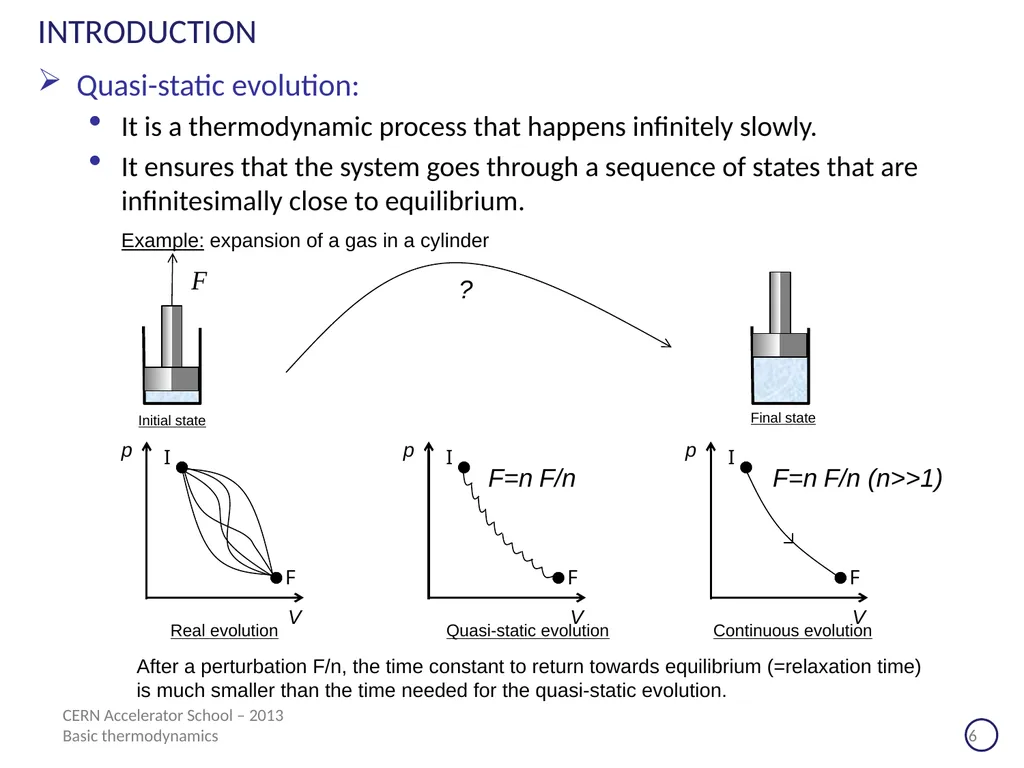
Basic thermodynamics 6 Quasi-static evolution:
It is a thermodynamic process that happens infinitely slowly.
It ensures that the system goes through a sequence of states that are infinitesimally close to equilibrium. Example: expansion of a gas in a cylinder Initial state Final state V p F I ? F=nF/n After a perturbation F/n, the time constant to return towards equilibrium (=relaxation time) is much smaller than the time needed for the quasi-static evolution. Real evolution Quasi-static evolution Continuous evolution F=nF/n (n>>1)<br>
Basic thermodynamics 6 Quasi-static evolution:
It is a thermodynamic process that happens infinitely slowly.
It ensures that the system goes through a sequence of states that are infinitesimally close to equilibrium. Example: expansion of a gas in a cylinder Initial state Final state V p F I ? F=nF/n After a perturbation F/n, the time constant to return towards equilibrium (=relaxation time) is much smaller than the time needed for the quasi-static evolution. Real evolution Quasi-static evolution Continuous evolution F=nF/n (n>>1)<br>
07
INTRODUCTION CERN Accelerator School – 2013
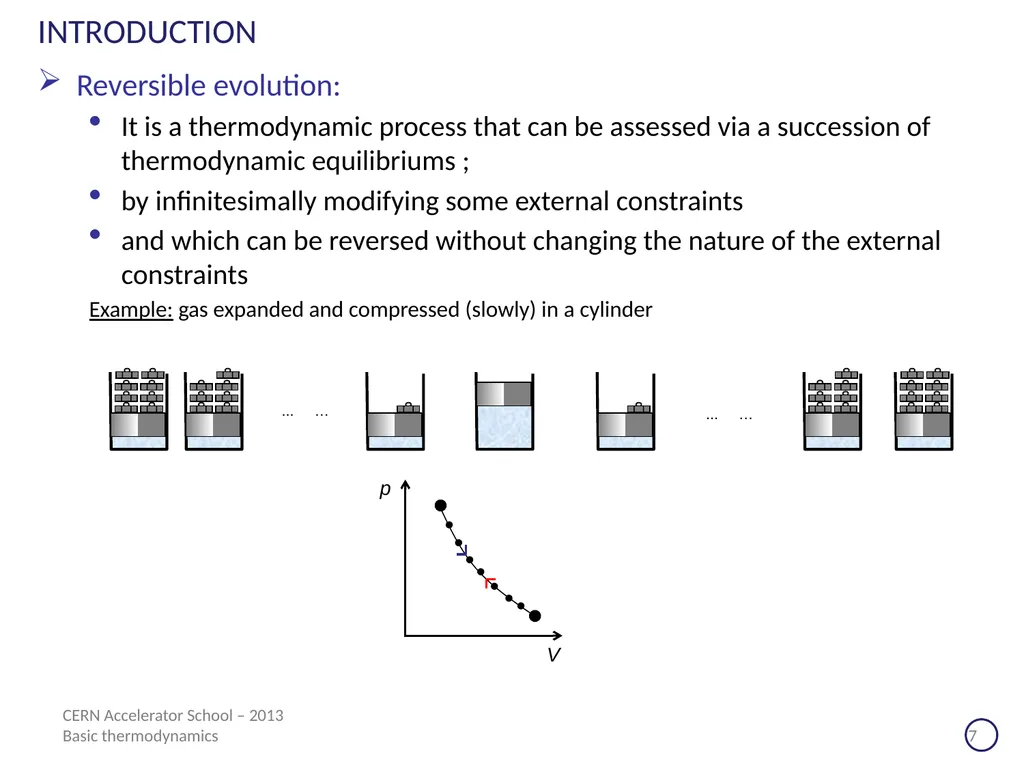
Basic thermodynamics 7 Reversible evolution:
It is a thermodynamic process that can be assessed via a succession of thermodynamic equilibriums ;
by infinitesimally modifying some external constraints
and which can be reversed without changing the nature of the external constraints
Example: gas expanded and compressed (slowly) in a cylinder ... … ... … <br>
Basic thermodynamics 7 Reversible evolution:
It is a thermodynamic process that can be assessed via a succession of thermodynamic equilibriums ;
by infinitesimally modifying some external constraints
and which can be reversed without changing the nature of the external constraints
Example: gas expanded and compressed (slowly) in a cylinder ... … ... … <br>
08
INTRODUCTION CERN Accelerator School – 2013
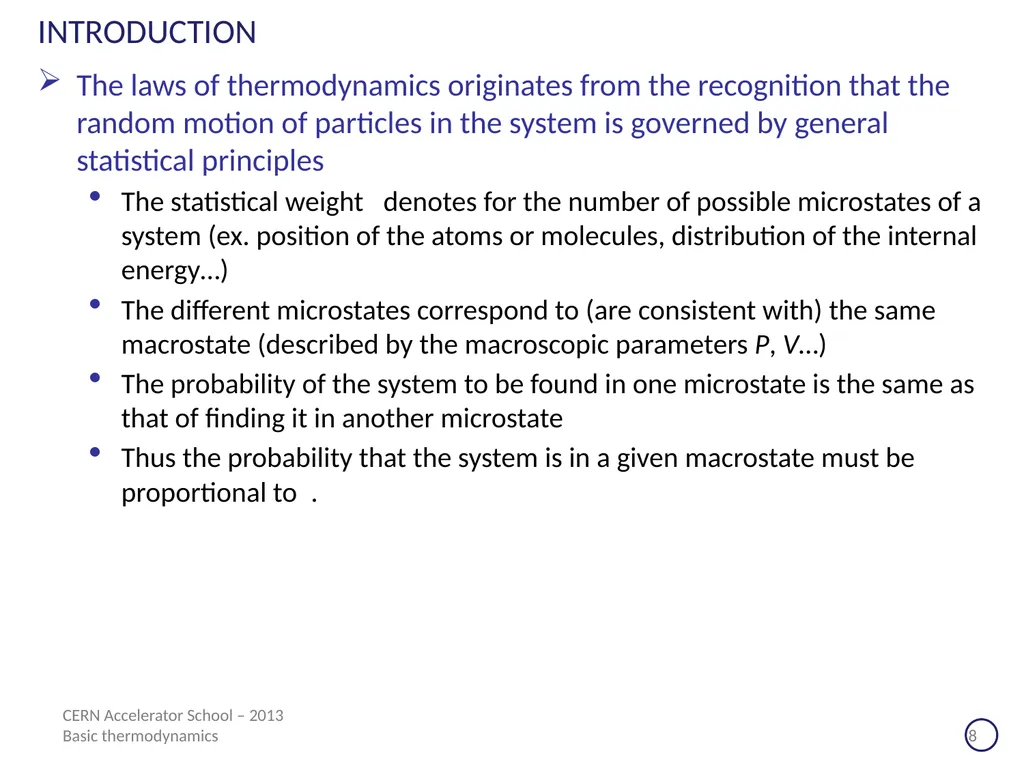
Basic thermodynamics 8 The laws of thermodynamics originates from the recognition that the random motion of particles in the system is governed by general statistical principles
The statistical weight denotes for the number of possible microstates of a system (ex. position of the atoms or molecules, distribution of the internal energy…)
The different microstates correspond to (are consistent with) the same macrostate (described by the macroscopic parameters P, V…)
The probability of the system to be found in one microstate is the same as that of finding it in another microstate
Thus the probability that the system is in a given macrostate must be proportional to .<br>
Basic thermodynamics 8 The laws of thermodynamics originates from the recognition that the random motion of particles in the system is governed by general statistical principles
The statistical weight denotes for the number of possible microstates of a system (ex. position of the atoms or molecules, distribution of the internal energy…)
The different microstates correspond to (are consistent with) the same macrostate (described by the macroscopic parameters P, V…)
The probability of the system to be found in one microstate is the same as that of finding it in another microstate
Thus the probability that the system is in a given macrostate must be proportional to .<br>
09
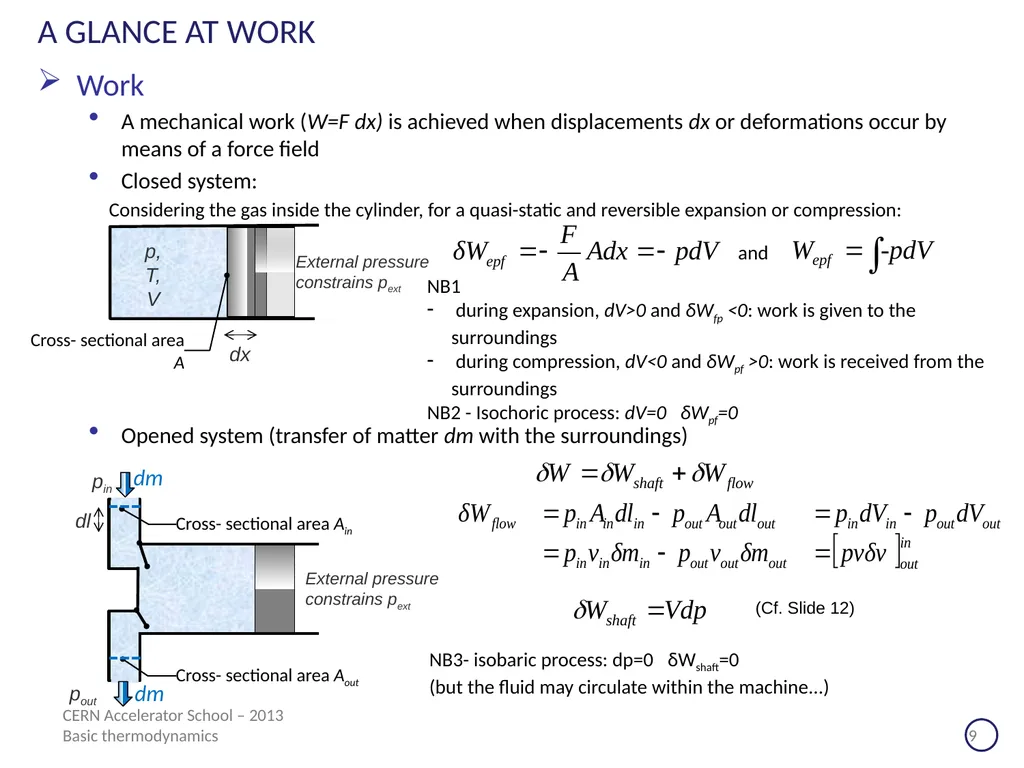
Work
A mechanical work (W=Fdx) is achieved when displacements dx or deformations occur by means of a force field
Closed system:
Opened system (transfer of matter dm with the surroundings) A GLANCE AT WORK CERN Accelerator School – 2013
Basic thermodynamics 9 Considering the gas inside the cylinder, for a quasi-static and reversible expansion or compression: NB1
during expansion, dV>0 and δWfp <0: work is given to the surroundings
during compression, dV<0 and δWpf >0: work is received from the surroundings
NB2 - Isochoric process: dV=0 δWpf=0 pin External pressure constrains pext dm Cross- sectional area
A Cross- sectional area Ain dl NB3- isobaric process: dp=0 δWshaft=0
(but the fluid may circulate within the machine...) pout dm (Cf. Slide 12) Cross- sectional area Aout<br>
A mechanical work (W=Fdx) is achieved when displacements dx or deformations occur by means of a force field
Closed system:
Opened system (transfer of matter dm with the surroundings) A GLANCE AT WORK CERN Accelerator School – 2013
Basic thermodynamics 9 Considering the gas inside the cylinder, for a quasi-static and reversible expansion or compression: NB1
during expansion, dV>0 and δWfp <0: work is given to the surroundings
during compression, dV<0 and δWpf >0: work is received from the surroundings
NB2 - Isochoric process: dV=0 δWpf=0 pin External pressure constrains pext dm Cross- sectional area
A Cross- sectional area Ain dl NB3- isobaric process: dp=0 δWshaft=0
(but the fluid may circulate within the machine...) pout dm (Cf. Slide 12) Cross- sectional area Aout<br>
10
FIRST LAW OF THERMODYNAMICS CERN Accelerator School – 2013
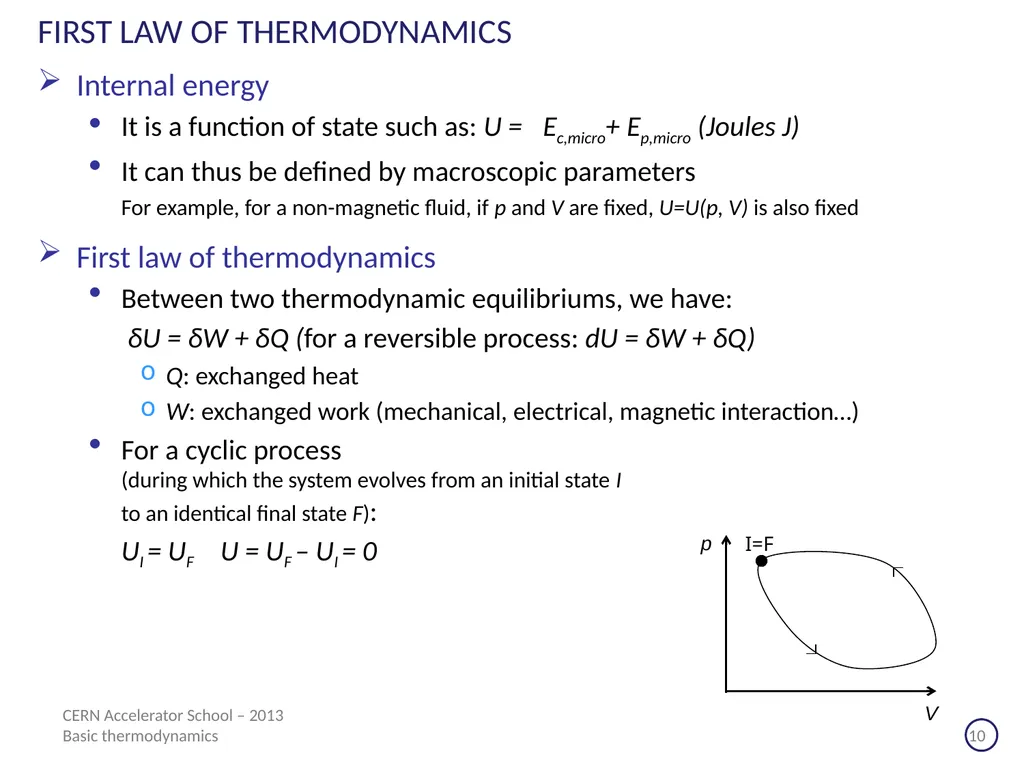
Basic thermodynamics 10 Internal energy
It is a function of state such as: U = Ec,micro+Ep,micro (Joules J)
It can thus be defined by macroscopic parameters
For example, for a non-magnetic fluid, if p and V are fixed, U=U(p, V) is also fixed
First law of thermodynamics
Between two thermodynamic equilibriums, we have:
δU = δW + δQ (for a reversible process: dU = δW + δQ)
Q: exchanged heat
W: exchanged work (mechanical, electrical, magnetic interaction…)
For a cyclic process
(during which the system evolves from an initial state I
to an identical final state F):
UI = UF U = UF – UI = 0<br>
Basic thermodynamics 10 Internal energy
It is a function of state such as: U = Ec,micro+Ep,micro (Joules J)
It can thus be defined by macroscopic parameters
For example, for a non-magnetic fluid, if p and V are fixed, U=U(p, V) is also fixed
First law of thermodynamics
Between two thermodynamic equilibriums, we have:
δU = δW + δQ (for a reversible process: dU = δW + δQ)
Q: exchanged heat
W: exchanged work (mechanical, electrical, magnetic interaction…)
For a cyclic process
(during which the system evolves from an initial state I
to an identical final state F):
UI = UF U = UF – UI = 0<br>
11
ENERGY BALANCE CERN Accelerator School – 2013
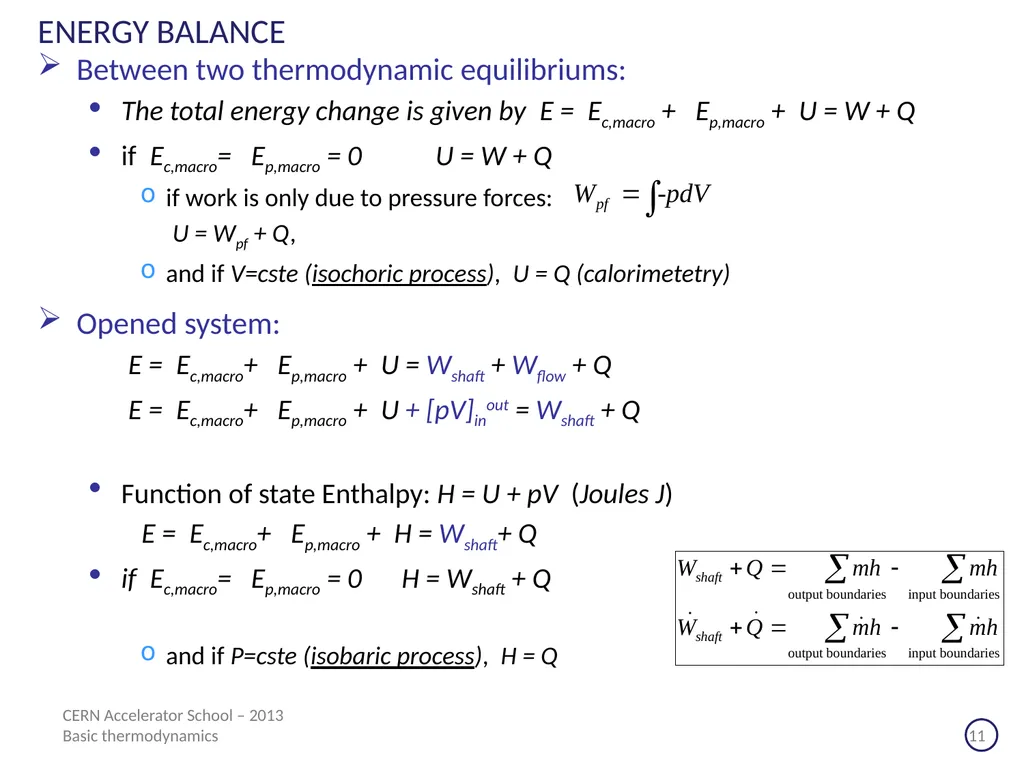
Basic thermodynamics 11 Between two thermodynamic equilibriums:
The total energy change is given by E = Ec,macro + Ep,macro + U = W + Q
if Ec,macro= Ep,macro = 0 U = W + Q
if work is only due to pressure forces:
U = Wpf + Q,
and if V=cste (isochoric process), U = Q (calorimetetry)
Opened system:
E = Ec,macro+ Ep,macro + U = Wshaft + Wflow + Q
E = Ec,macro+ Ep,macro + U + [pV]inout = Wshaft + Q
Function of state Enthalpy: H = U + pV (Joules J)
E = Ec,macro+ Ep,macro + H = Wshaft+ Q
if Ec,macro= Ep,macro = 0 H = Wshaft + Q
and if P=cste (isobaric process), H = Q<br>
Basic thermodynamics 11 Between two thermodynamic equilibriums:
The total energy change is given by E = Ec,macro + Ep,macro + U = W + Q
if Ec,macro= Ep,macro = 0 U = W + Q
if work is only due to pressure forces:
U = Wpf + Q,
and if V=cste (isochoric process), U = Q (calorimetetry)
Opened system:
E = Ec,macro+ Ep,macro + U = Wshaft + Wflow + Q
E = Ec,macro+ Ep,macro + U + [pV]inout = Wshaft + Q
Function of state Enthalpy: H = U + pV (Joules J)
E = Ec,macro+ Ep,macro + H = Wshaft+ Q
if Ec,macro= Ep,macro = 0 H = Wshaft + Q
and if P=cste (isobaric process), H = Q<br>
12
ENERGY BALANCE CERN Accelerator School – 2013
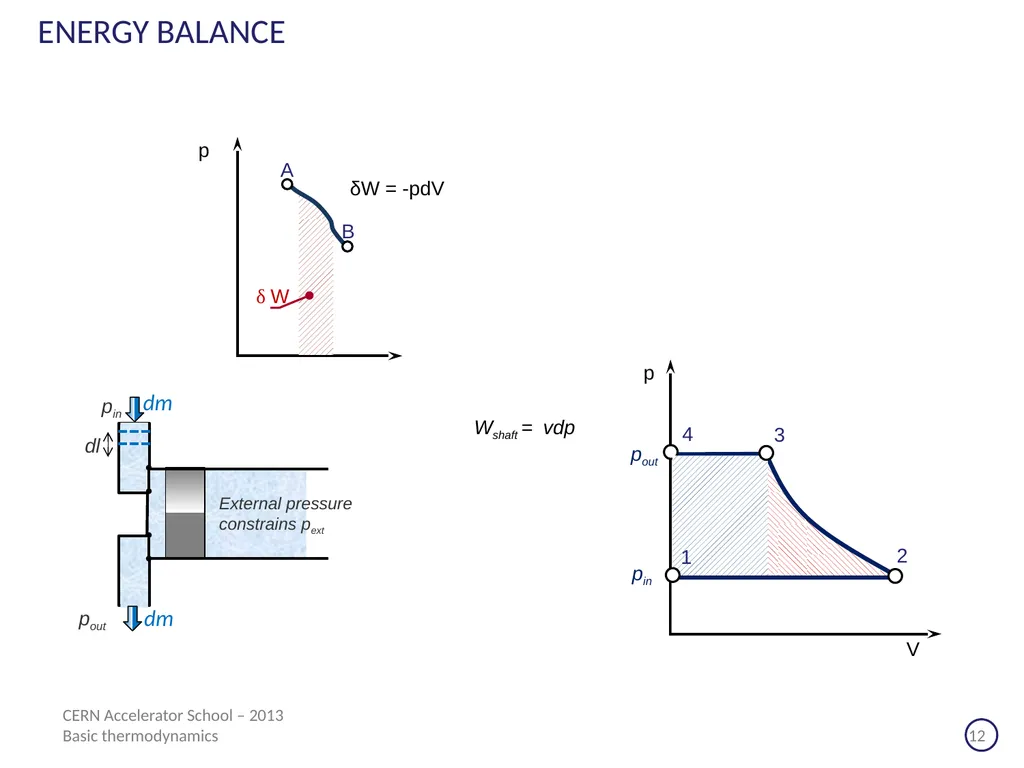
Basic thermodynamics 12 pin dm dl pout dm p V pin pout Wshaft = vdp<br>
Basic thermodynamics 12 pin dm dl pout dm p V pin pout Wshaft = vdp<br>
13
SECOND LAW OF THERMODYNAMICS CERN Accelerator School – 2013
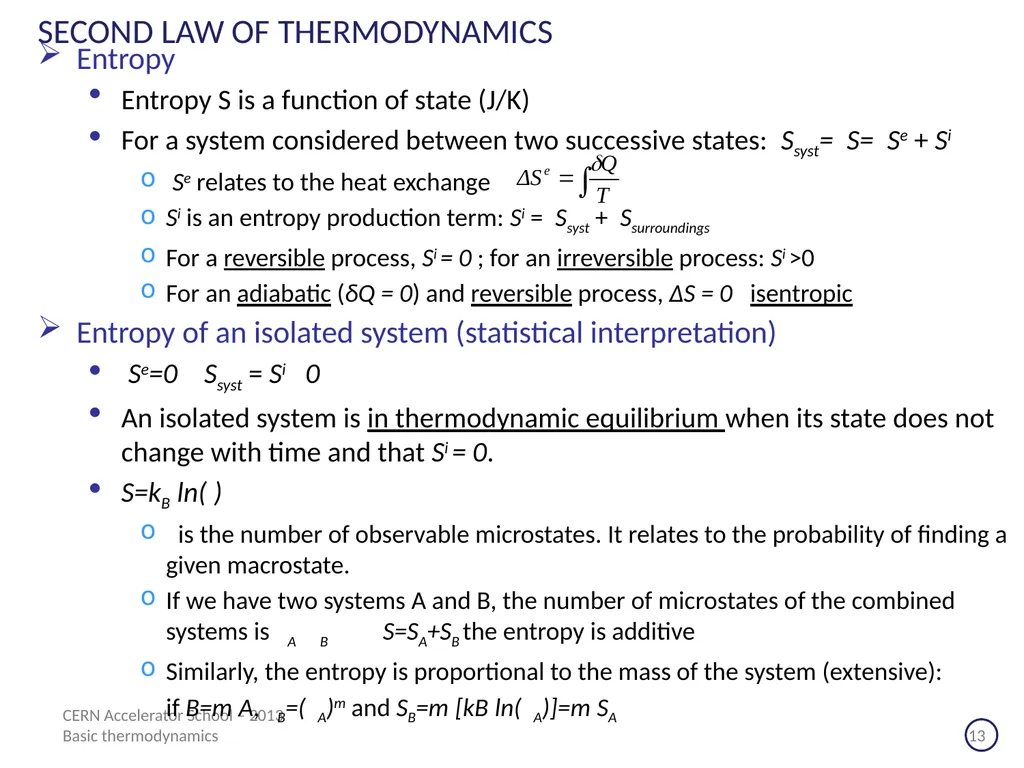
Basic thermodynamics 13 Entropy
Entropy S is a function of state (J/K)
For a system considered between two successive states: Ssyst= S= Se + Si
Se relates to the heat exchange
Si is an entropy production term: Si = Ssyst + Ssurroundings
For a reversible process, Si = 0 ; for an irreversible process: Si >0
For an adiabatic (δQ = 0) and reversible process, ΔS = 0 isentropic
Entropy of an isolated system (statistical interpretation)
Se=0 Ssyst = Si 0
An isolated system is in thermodynamic equilibrium when its state does not change with time and that Si = 0.
S=kBln()
is the number of observable microstates. It relates to the probability of finding a given macrostate.
If we have two systems A and B, the number of microstates of the combined systems is A B S=SA+SB the entropy is additive
Similarly, the entropy is proportional to the mass of the system (extensive):
if B=mA, B=( A)m and SB=m[kBln( A)]=mSA<br>
Basic thermodynamics 13 Entropy
Entropy S is a function of state (J/K)
For a system considered between two successive states: Ssyst= S= Se + Si
Se relates to the heat exchange
Si is an entropy production term: Si = Ssyst + Ssurroundings
For a reversible process, Si = 0 ; for an irreversible process: Si >0
For an adiabatic (δQ = 0) and reversible process, ΔS = 0 isentropic
Entropy of an isolated system (statistical interpretation)
Se=0 Ssyst = Si 0
An isolated system is in thermodynamic equilibrium when its state does not change with time and that Si = 0.
S=kBln()
is the number of observable microstates. It relates to the probability of finding a given macrostate.
If we have two systems A and B, the number of microstates of the combined systems is A B S=SA+SB the entropy is additive
Similarly, the entropy is proportional to the mass of the system (extensive):
if B=mA, B=( A)m and SB=m[kBln( A)]=mSA<br>
14
SECOND LAW OF THERMODYNAMICS CERN Accelerator School – 2013
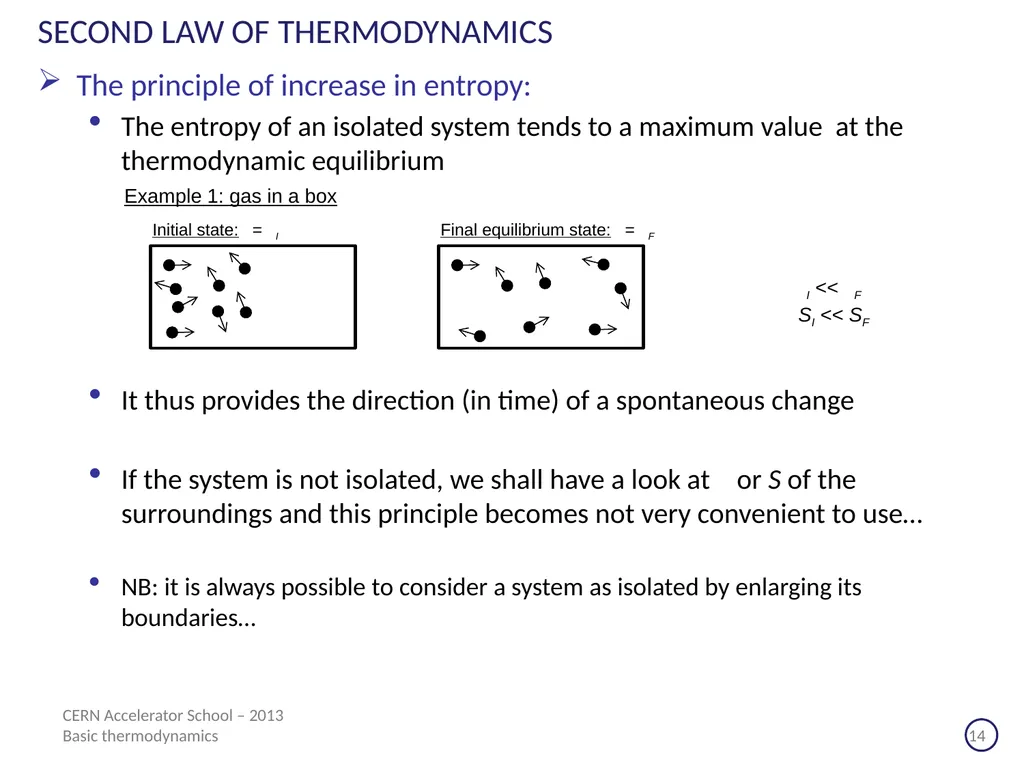
Basic thermodynamics 14 The principle of increase in entropy:
The entropy of an isolated system tends to a maximum value at the thermodynamic equilibrium
It thus provides the direction (in time) of a spontaneous change
If the system is not isolated, we shall have a look at or S of the surroundings and this principle becomes not very convenient to use…
NB: it is always possible to consider a system as isolated by enlarging its boundaries… Initial state: = I Final equilibrium state: = F I << F
SI << SF Example 1: gas in a box<br>
Basic thermodynamics 14 The principle of increase in entropy:
The entropy of an isolated system tends to a maximum value at the thermodynamic equilibrium
It thus provides the direction (in time) of a spontaneous change
If the system is not isolated, we shall have a look at or S of the surroundings and this principle becomes not very convenient to use…
NB: it is always possible to consider a system as isolated by enlarging its boundaries… Initial state: = I Final equilibrium state: = F I << F
SI << SF Example 1: gas in a box<br>
15
TEMPERATURE AND THE ZEROTH LAW OF THERMODYNAMICS CERN Accelerator School – 2013
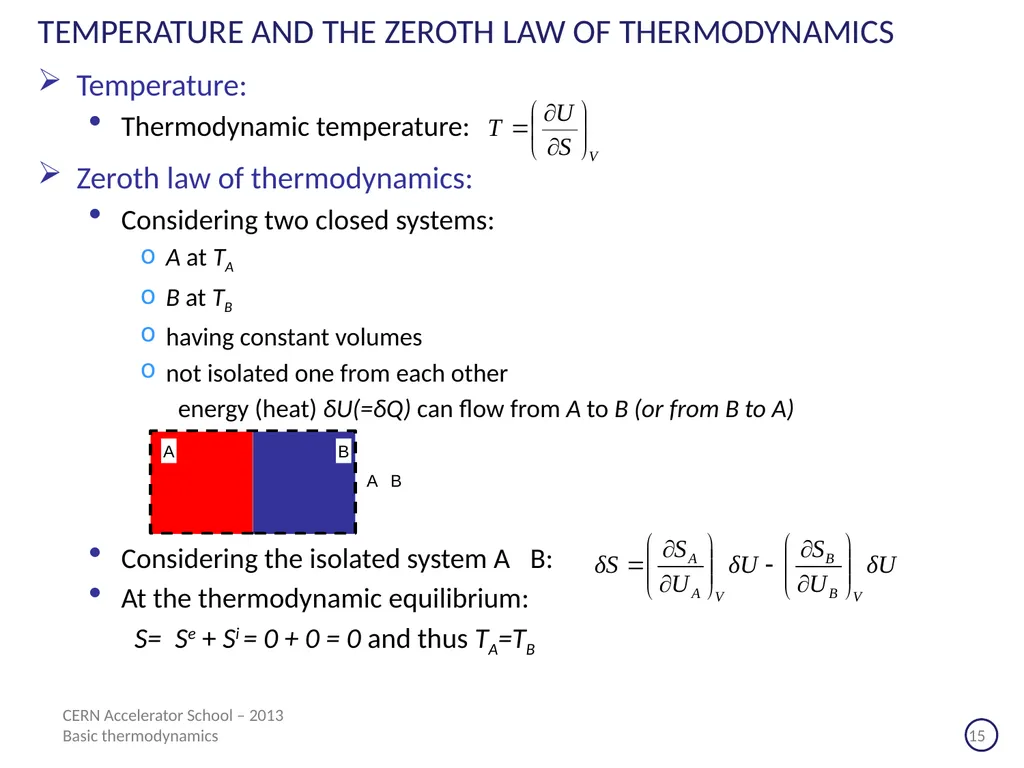
Basic thermodynamics 15 Temperature:
Thermodynamic temperature:
Zeroth law of thermodynamics:
Considering two closed systems:
A at TA
B at TB
having constant volumes
not isolated one from each other
energy (heat) δU(=δQ) can flow from A to B (or from B to A)
Considering the isolated system A B:
At the thermodynamic equilibrium:
S= Se + Si = 0 + 0 = 0 and thus TA=TB A B A B<br>
Basic thermodynamics 15 Temperature:
Thermodynamic temperature:
Zeroth law of thermodynamics:
Considering two closed systems:
A at TA
B at TB
having constant volumes
not isolated one from each other
energy (heat) δU(=δQ) can flow from A to B (or from B to A)
Considering the isolated system A B:
At the thermodynamic equilibrium:
S= Se + Si = 0 + 0 = 0 and thus TA=TB A B A B<br>
16
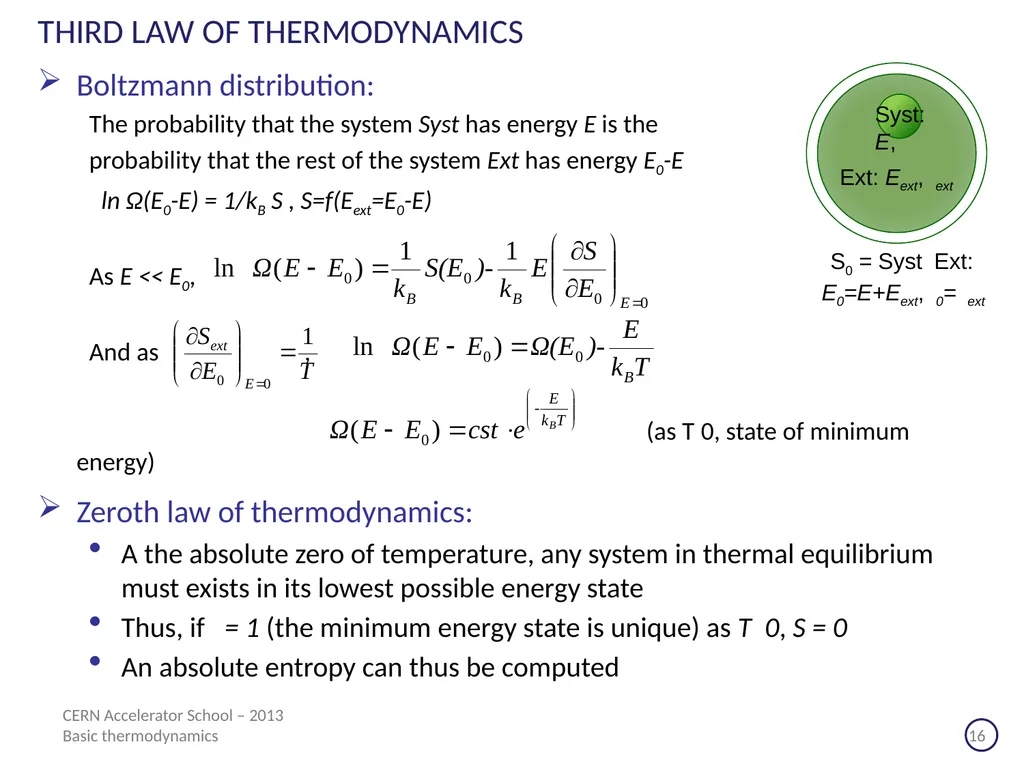
Boltzmann distribution:
The probability that the system Syst has energy E is the
probability that the rest of the system Ext has energy E0-E
ln Ω(E0-E) = 1/kB S , S=f(Eext=E0-E)
As E << E0,
And as ,
(as T0, state of minimum energy)
Zeroth law of thermodynamics:
A the absolute zero of temperature, any system in thermal equilibrium must exists in its lowest possible energy state
Thus, if = 1 (the minimum energy state is unique) as T 0, S = 0
An absolute entropy can thus be computed THIRD LAW OF THERMODYNAMICS CERN Accelerator School – 2013
Basic thermodynamics 16 Ext: Eext, ext Syst:
E, S0 = Syst Ext:
E0=E+Eext, 0=ext<br>
The probability that the system Syst has energy E is the
probability that the rest of the system Ext has energy E0-E
ln Ω(E0-E) = 1/kB S , S=f(Eext=E0-E)
As E << E0,
And as ,
(as T0, state of minimum energy)
Zeroth law of thermodynamics:
A the absolute zero of temperature, any system in thermal equilibrium must exists in its lowest possible energy state
Thus, if = 1 (the minimum energy state is unique) as T 0, S = 0
An absolute entropy can thus be computed THIRD LAW OF THERMODYNAMICS CERN Accelerator School – 2013
Basic thermodynamics 16 Ext: Eext, ext Syst:
E, S0 = Syst Ext:
E0=E+Eext, 0=ext<br>
17
EQUATIONS of STATE CERN Accelerator School – 2013
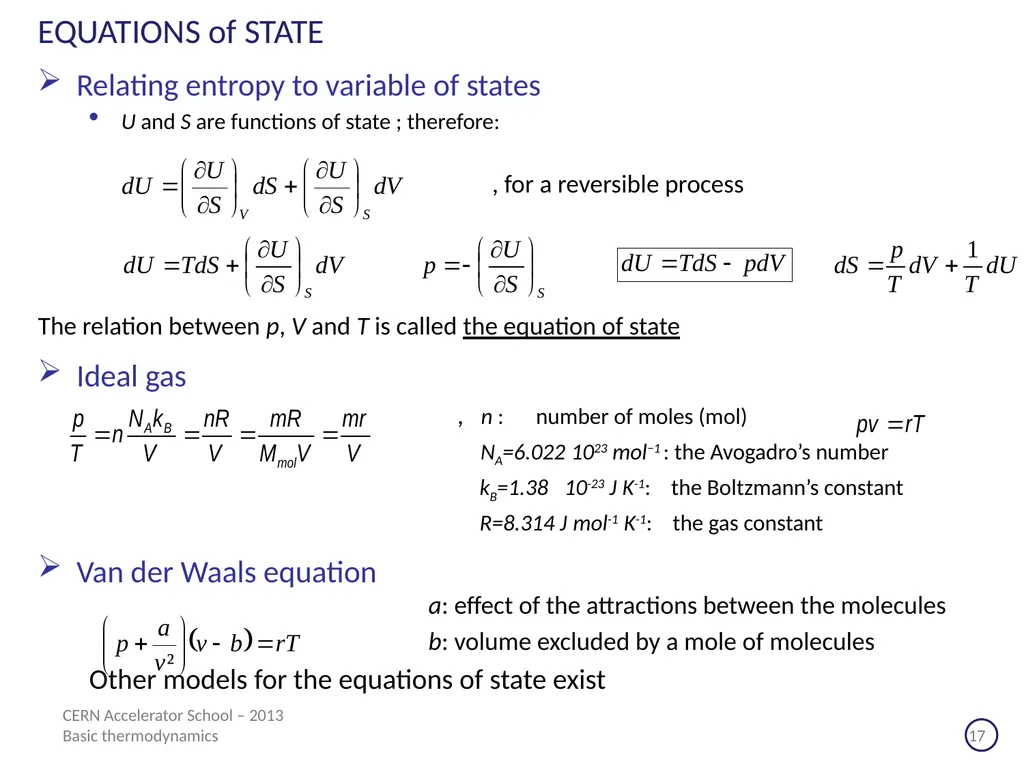
Basic thermodynamics 17 Relating entropy to variable of states
U and S are functions of state ; therefore:
, for a reversible process
The relation between p, V and T is called the equation of state
Ideal gas
, n : number of moles (mol)
NA=6.0221023 mol−1 : the Avogadro’s number
kB=1.38 10-23 JK-1: the Boltzmann’s constant
R=8.314 Jmol-1K-1: the gas constant
Van der Waals equation
a: effect of the attractions between the molecules
b: volume excluded by a mole of molecules
Other models for the equations of state exist<br>
Basic thermodynamics 17 Relating entropy to variable of states
U and S are functions of state ; therefore:
, for a reversible process
The relation between p, V and T is called the equation of state
Ideal gas
, n : number of moles (mol)
NA=6.0221023 mol−1 : the Avogadro’s number
kB=1.38 10-23 JK-1: the Boltzmann’s constant
R=8.314 Jmol-1K-1: the gas constant
Van der Waals equation
a: effect of the attractions between the molecules
b: volume excluded by a mole of molecules
Other models for the equations of state exist<br>
18
P, V DIAGRAM CERN Accelerator School – 2013
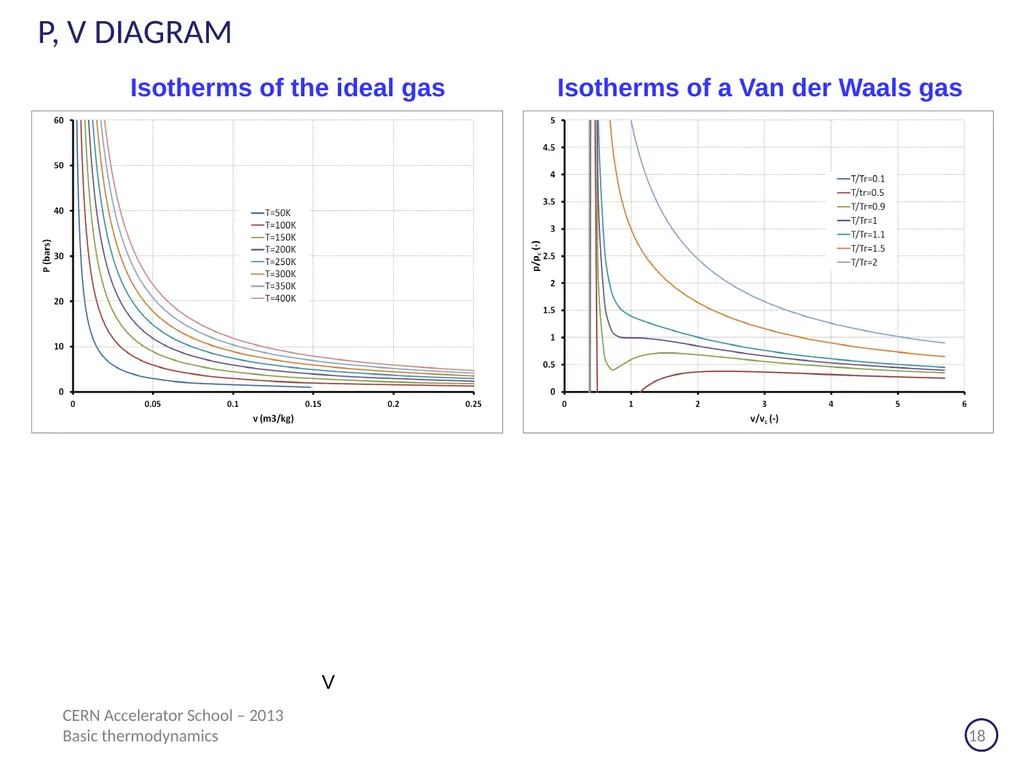
Basic thermodynamics 18 Isotherms of the ideal gas Isotherms of a Van der Waals gas V<br>
Basic thermodynamics 18 Isotherms of the ideal gas Isotherms of a Van der Waals gas V<br>
19
HEAT CAPACITIES CERN Accelerator School – 2013
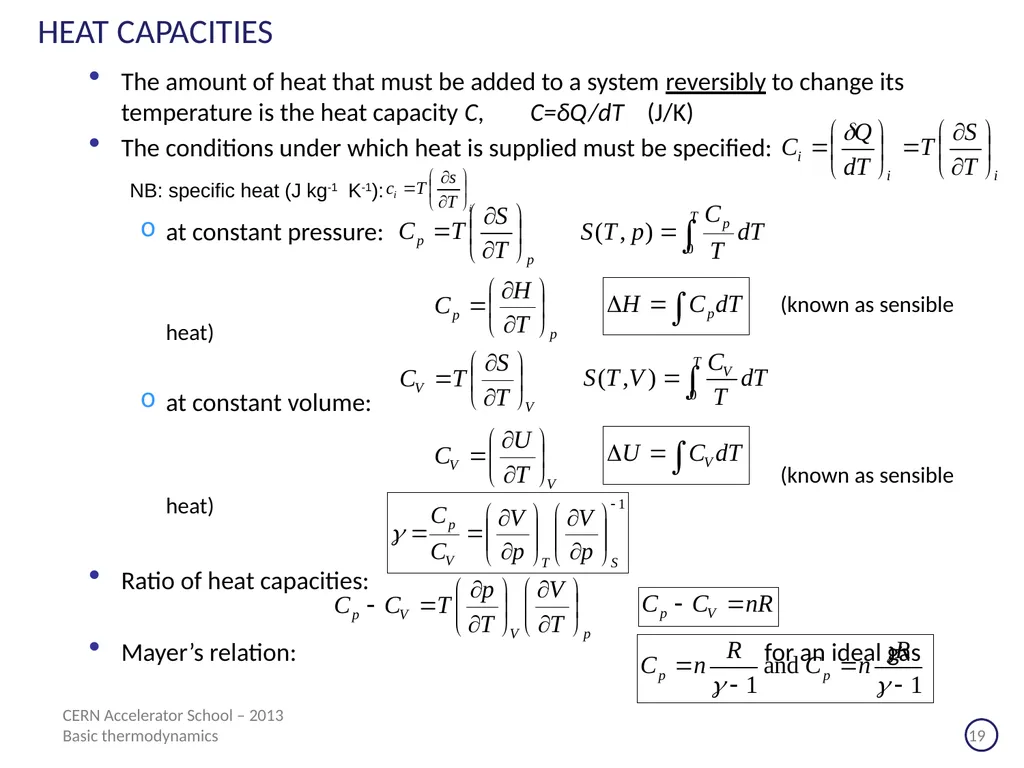
Basic thermodynamics 19 The amount of heat that must be added to a system reversibly to change its temperature is the heat capacity C, C=δQ/dT (J/K)
The conditions under which heat is supplied must be specified:
at constant pressure:
(known as sensible heat)
at constant volume:
(known as sensible heat)
Ratio of heat capacities:
Mayer’s relation: for an ideal gas<br>
Basic thermodynamics 19 The amount of heat that must be added to a system reversibly to change its temperature is the heat capacity C, C=δQ/dT (J/K)
The conditions under which heat is supplied must be specified:
at constant pressure:
(known as sensible heat)
at constant volume:
(known as sensible heat)
Ratio of heat capacities:
Mayer’s relation: for an ideal gas<br>
20
USE OF THERMODYNAMIC RELATIONS CERN Accelerator School – 2013
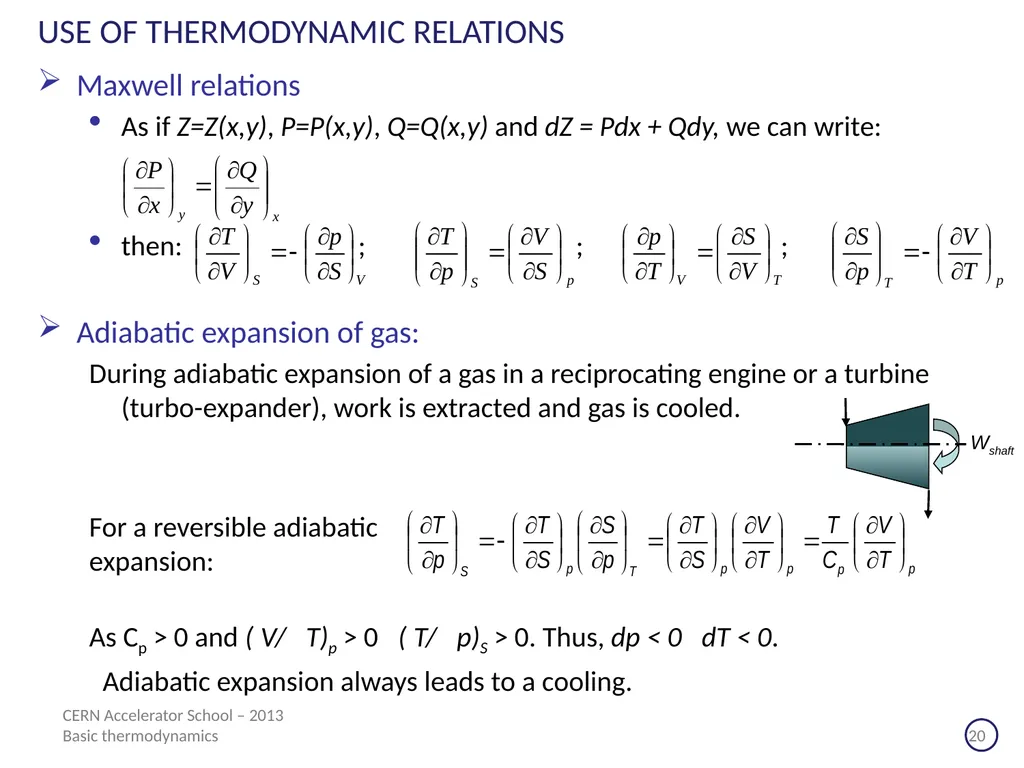
Basic thermodynamics 20 Maxwell relations
As if Z=Z(x,y), P=P(x,y), Q=Q(x,y) and dZ = Pdx + Qdy, we can write:
then: ; ; ;
Adiabatic expansion of gas:
During adiabatic expansion of a gas in a reciprocating engine or a turbine (turbo-expander), work is extracted and gas is cooled.
For a reversible adiabatic
expansion:
As Cp > 0 and (V/ T)p > 0 (T/ p)S > 0. Thus, dp < 0 dT < 0.
Adiabatic expansion always leads to a cooling. Wshaft<br>
Basic thermodynamics 20 Maxwell relations
As if Z=Z(x,y), P=P(x,y), Q=Q(x,y) and dZ = Pdx + Qdy, we can write:
then: ; ; ;
Adiabatic expansion of gas:
During adiabatic expansion of a gas in a reciprocating engine or a turbine (turbo-expander), work is extracted and gas is cooled.
For a reversible adiabatic
expansion:
As Cp > 0 and (V/ T)p > 0 (T/ p)S > 0. Thus, dp < 0 dT < 0.
Adiabatic expansion always leads to a cooling. Wshaft<br>
21
USE OF THERMODYNAMIC RELATIONS CERN Accelerator School – 2013
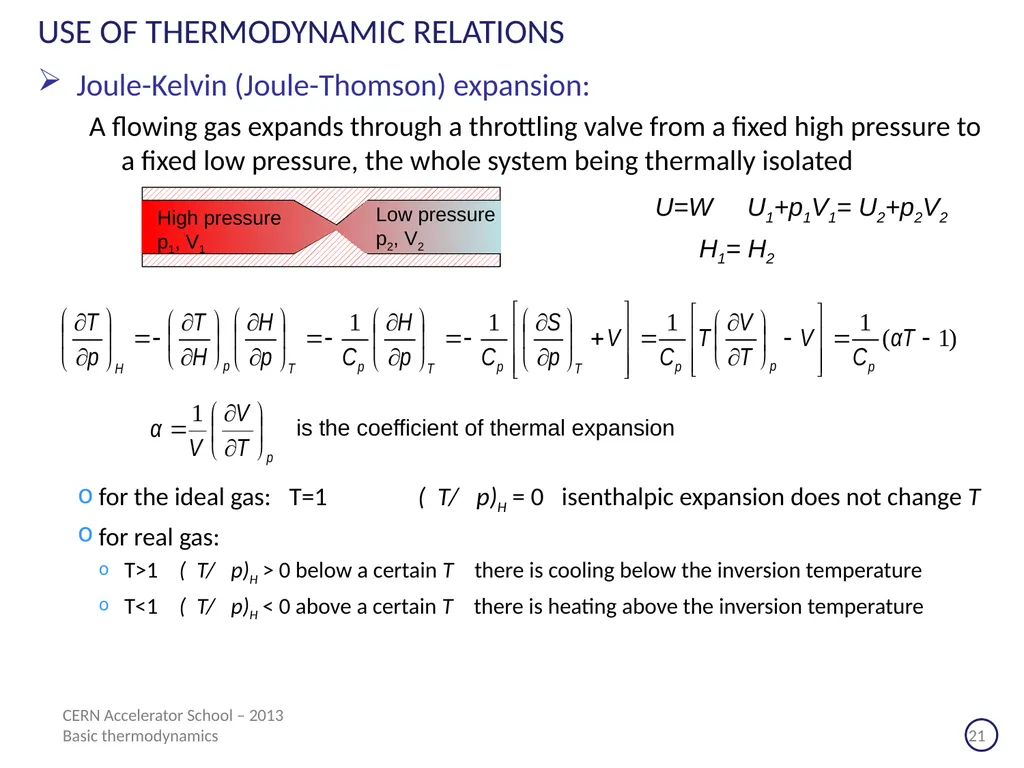
Basic thermodynamics 21 Joule-Kelvin (Joule-Thomson) expansion:
A flowing gas expands through a throttling valve from a fixed high pressure to a fixed low pressure, the whole system being thermally isolated
for the ideal gas: T=1 ( T/ p)H = 0 isenthalpic expansion does not change T
for real gas:
T>1 ( T/ p)H > 0 below a certain T there is cooling below the inversion temperature
T<1 ( T/ p)H < 0 above a certain T there is heating above the inversion temperature High pressure
p1, V1 Low pressure
p2, V2 U=W U1+p1V1= U2+p2V2 H1= H2 is the coefficient of thermal expansion<br>
Basic thermodynamics 21 Joule-Kelvin (Joule-Thomson) expansion:
A flowing gas expands through a throttling valve from a fixed high pressure to a fixed low pressure, the whole system being thermally isolated
for the ideal gas: T=1 ( T/ p)H = 0 isenthalpic expansion does not change T
for real gas:
T>1 ( T/ p)H > 0 below a certain T there is cooling below the inversion temperature
T<1 ( T/ p)H < 0 above a certain T there is heating above the inversion temperature High pressure
p1, V1 Low pressure
p2, V2 U=W U1+p1V1= U2+p2V2 H1= H2 is the coefficient of thermal expansion<br>
22
USE OF THERMODYNAMIC RELATIONS CERN Accelerator School – 2013
Basic thermodynamics 22 Joule-Kelvin (Joule-Thomson) expansion:
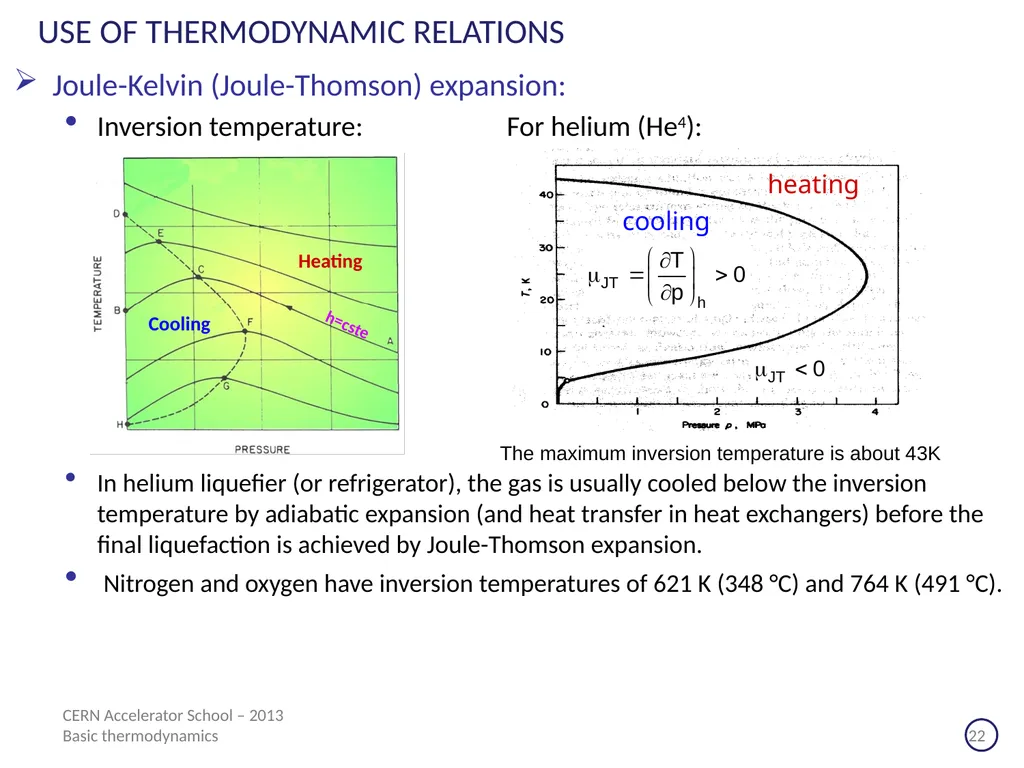
Inversion temperature: For helium (He4):
In helium liquefier (or refrigerator), the gas is usually cooled below the inversion temperature by adiabatic expansion (and heat transfer in heat exchangers) before the final liquefaction is achieved by Joule-Thomson expansion.
Nitrogen and oxygen have inversion temperatures of 621 K (348 °C) and 764 K (491 °C). The maximum inversion temperature is about 43K Cooling Heating h=cste<br>
Basic thermodynamics 22 Joule-Kelvin (Joule-Thomson) expansion:
Inversion temperature: For helium (He4):
In helium liquefier (or refrigerator), the gas is usually cooled below the inversion temperature by adiabatic expansion (and heat transfer in heat exchangers) before the final liquefaction is achieved by Joule-Thomson expansion.
Nitrogen and oxygen have inversion temperatures of 621 K (348 °C) and 764 K (491 °C). The maximum inversion temperature is about 43K Cooling Heating h=cste<br>
23
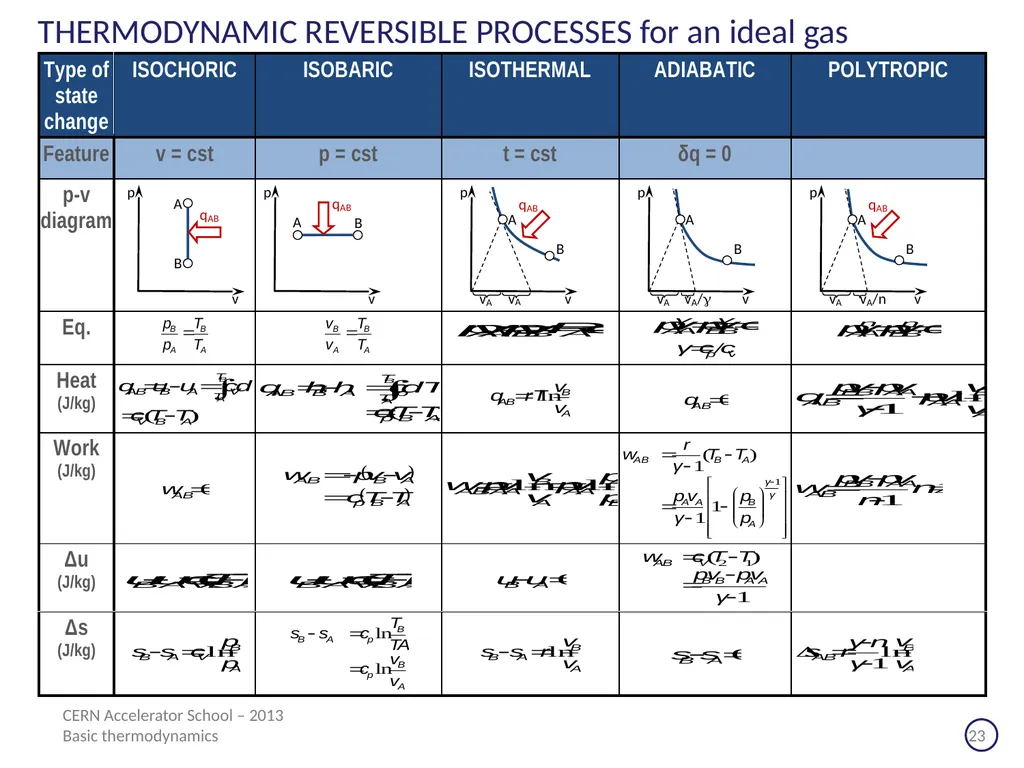
THERMODYNAMIC REVERSIBLE PROCESSES for an ideal gas CERN Accelerator School – 2013
Basic thermodynamics 23<br>
Basic thermodynamics 23<br>
24
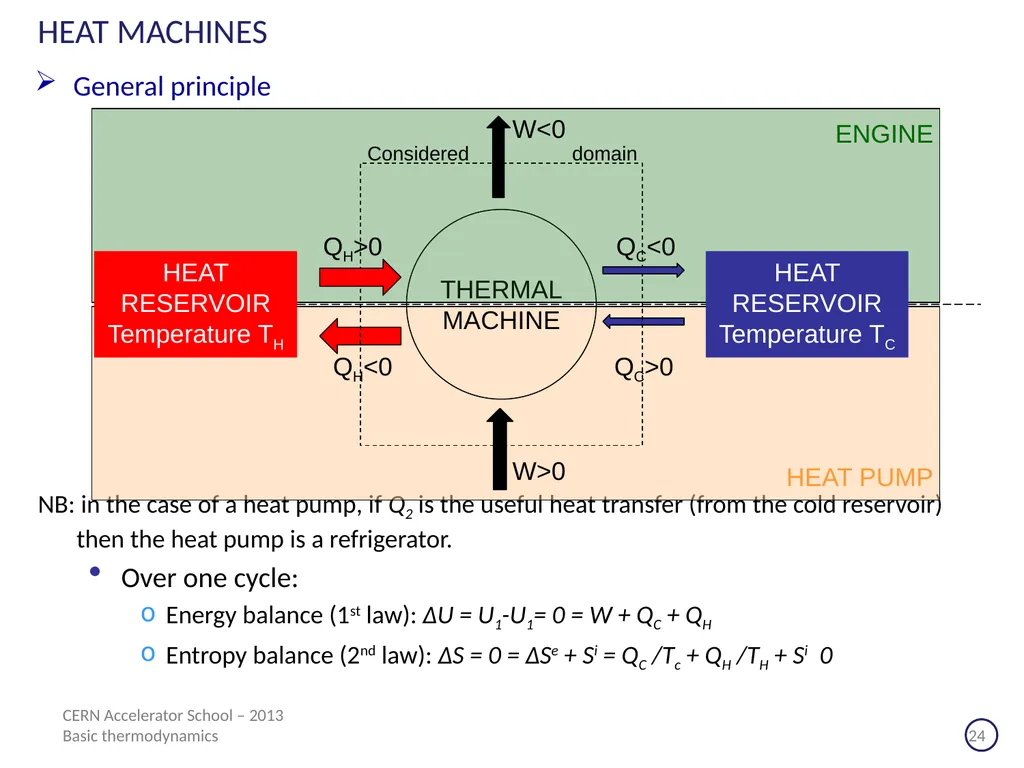
NB: in the case of a heat pump, if Q2 is the useful heat transfer (from the cold reservoir) then the heat pump is a refrigerator.
Over one cycle:
Energy balance (1st law): ΔU = U1-U1= 0 = W + QC + QH
Entropy balance (2nd law): ΔS = 0 = ΔSe + Si = QC /Tc + QH /TH + Si 0 HEAT MACHINES CERN Accelerator School – 2013
Basic thermodynamics 24 General principle<br>
Over one cycle:
Energy balance (1st law): ΔU = U1-U1= 0 = W + QC + QH
Entropy balance (2nd law): ΔS = 0 = ΔSe + Si = QC /Tc + QH /TH + Si 0 HEAT MACHINES CERN Accelerator School – 2013
Basic thermodynamics 24 General principle<br>
25
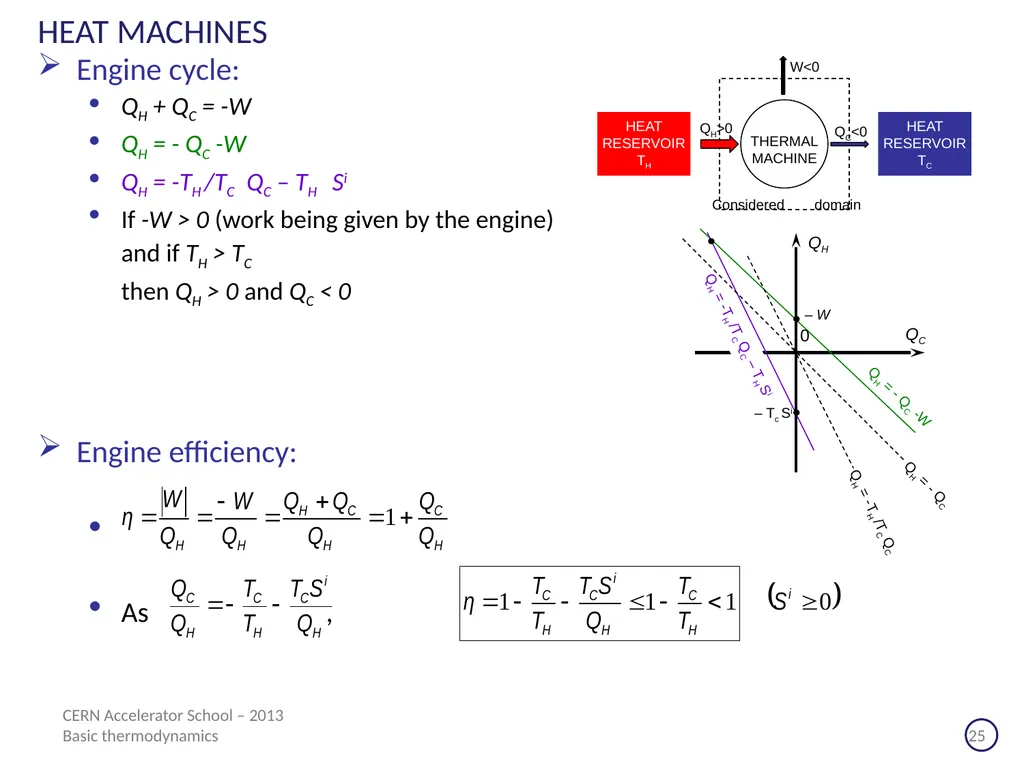
QH = -TH /TC QC HEAT MACHINES CERN Accelerator School – 2013
Basic thermodynamics 25 Engine cycle:
QH + QC = -W
QH = - QC -W
QH = -TH /TC QC – TH Si
If -W > 0 (work being given by the engine)
and if TH > TC
then QH > 0 and QC < 0
Engine efficiency:
As , QH QC 0 QH = - QC -W QH = -TH /TC QC – TH Si – Tc Si – W QH = - QC<br>
Basic thermodynamics 25 Engine cycle:
QH + QC = -W
QH = - QC -W
QH = -TH /TC QC – TH Si
If -W > 0 (work being given by the engine)
and if TH > TC
then QH > 0 and QC < 0
Engine efficiency:
As , QH QC 0 QH = - QC -W QH = -TH /TC QC – TH Si – Tc Si – W QH = - QC<br>
26
HEAT MACHINES CERN Accelerator School – 2013
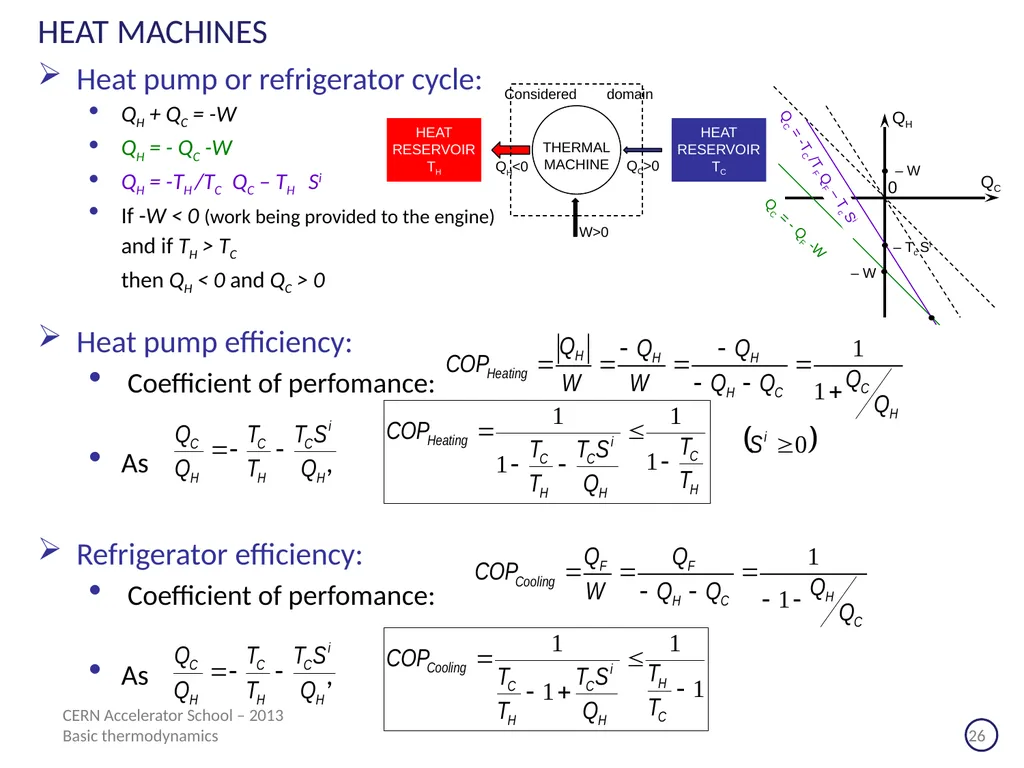
Basic thermodynamics 26 Heat pump or refrigerator cycle:
QH + QC = -W
QH = - QC -W
QH = -TH /TC QC – TH Si
If -W < 0 (work being provided to the engine)
and if TH > TC
then QH < 0 and QC > 0
Heat pump efficiency:
Coefficient of perfomance:
As ,
Refrigerator efficiency:
Coefficient of perfomance:
As , QH QC 0 QC = - QF -W QC = -TC /TF QF – Tc Si – Tc Si – W – W<br>
Basic thermodynamics 26 Heat pump or refrigerator cycle:
QH + QC = -W
QH = - QC -W
QH = -TH /TC QC – TH Si
If -W < 0 (work being provided to the engine)
and if TH > TC
then QH < 0 and QC > 0
Heat pump efficiency:
Coefficient of perfomance:
As ,
Refrigerator efficiency:
Coefficient of perfomance:
As , QH QC 0 QC = - QF -W QC = -TC /TF QF – Tc Si – Tc Si – W – W<br>
27
HEAT MACHINES CERN Accelerator School – 2013
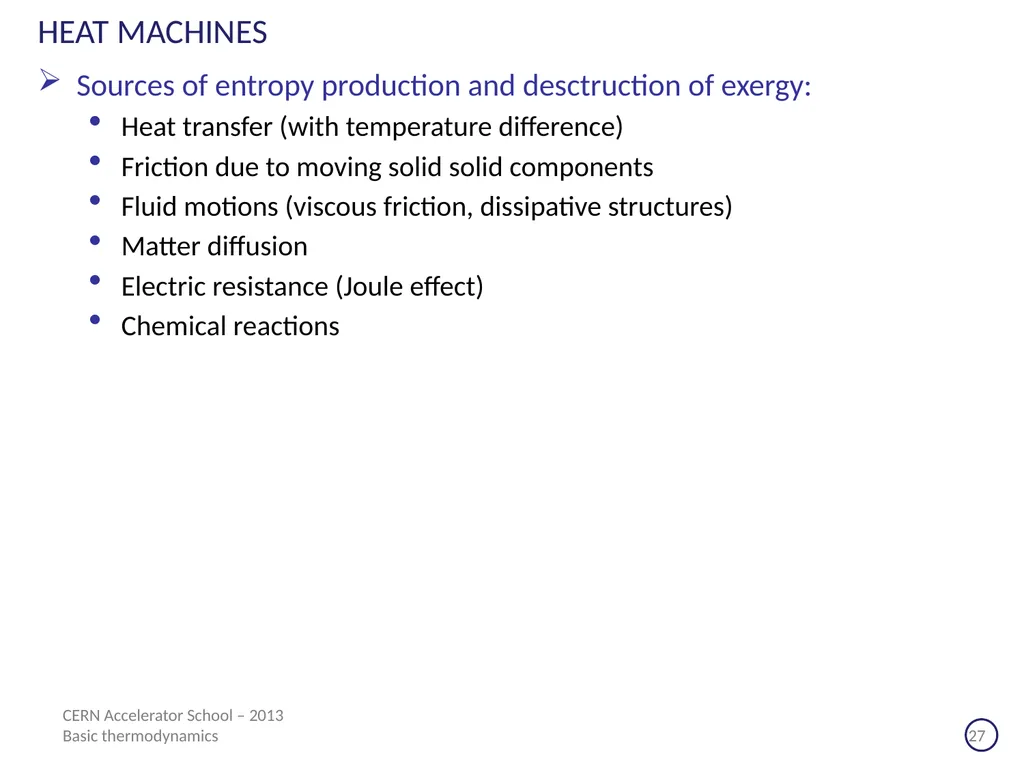
Basic thermodynamics 27 Sources of entropy production and desctruction of exergy:
Heat transfer (with temperature difference)
Friction due to moving solid solid components
Fluid motions (viscous friction, dissipative structures)
Matter diffusion
Electric resistance (Joule effect)
Chemical reactions<br>
Basic thermodynamics 27 Sources of entropy production and desctruction of exergy:
Heat transfer (with temperature difference)
Friction due to moving solid solid components
Fluid motions (viscous friction, dissipative structures)
Matter diffusion
Electric resistance (Joule effect)
Chemical reactions<br>
28
HEAT MACHINES CERN Accelerator School – 2013
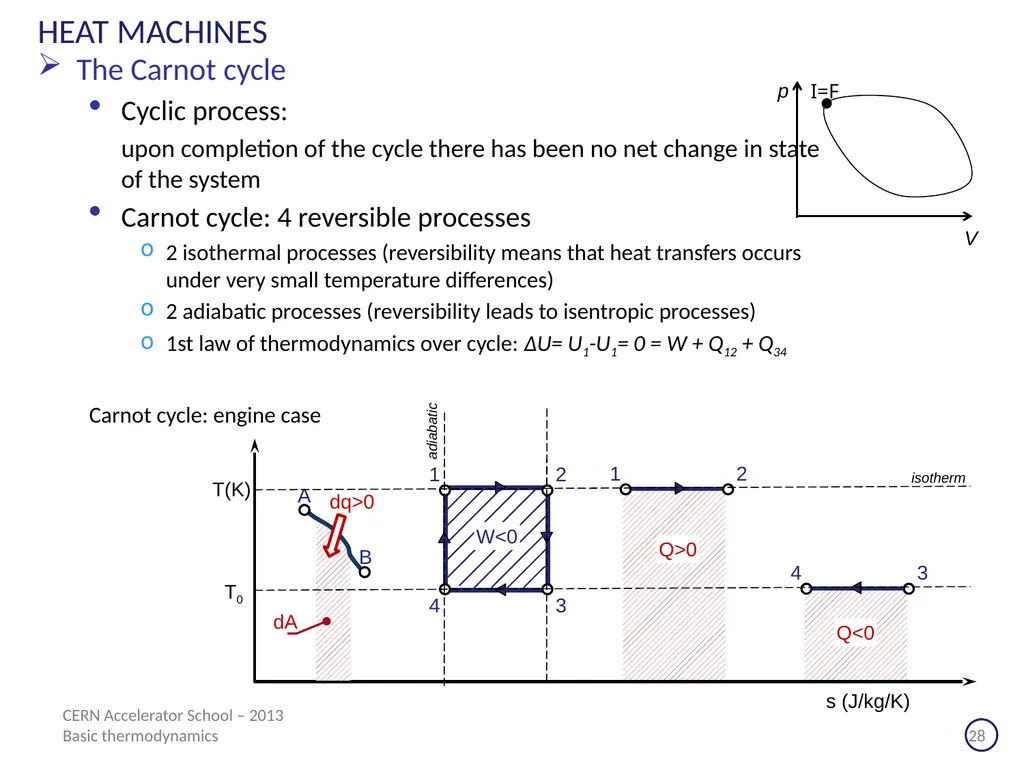
Basic thermodynamics 28 The Carnot cycle
Cyclic process:
upon completion of the cycle there has been no net change in state of the system
Carnot cycle: 4 reversible processes
2 isothermal processes (reversibility means that heat transfers occurs under very small temperature differences)
2 adiabatic processes (reversibility leads to isentropic processes)
1st law of thermodynamics over cycle: ΔU= U1-U1= 0 = W + Q12 + Q34
Carnot cycle: engine case<br>
Basic thermodynamics 28 The Carnot cycle
Cyclic process:
upon completion of the cycle there has been no net change in state of the system
Carnot cycle: 4 reversible processes
2 isothermal processes (reversibility means that heat transfers occurs under very small temperature differences)
2 adiabatic processes (reversibility leads to isentropic processes)
1st law of thermodynamics over cycle: ΔU= U1-U1= 0 = W + Q12 + Q34
Carnot cycle: engine case<br>
29
HEAT MACHINES CERN Accelerator School – 2013
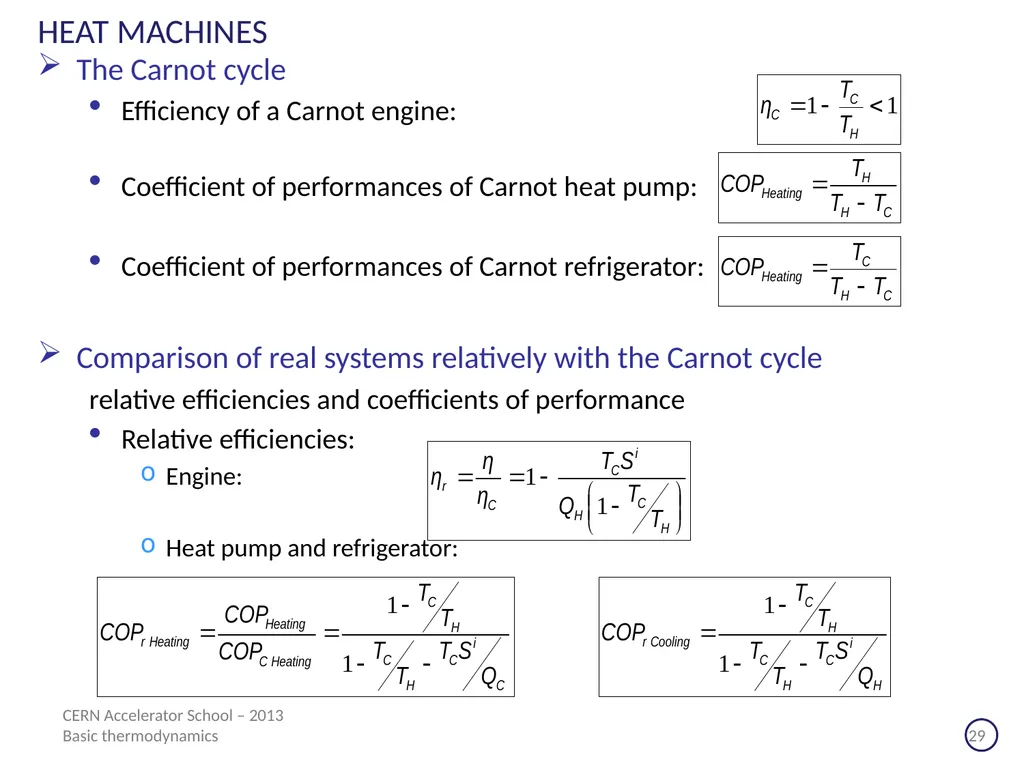
Basic thermodynamics 29 The Carnot cycle
Efficiency of a Carnot engine:
Coefficient of performances of Carnot heat pump:
Coefficient of performances of Carnot refrigerator:
Comparison of real systems relatively with the Carnot cycle
relative efficiencies and coefficients of performance
Relative efficiencies:
Engine:
Heat pump and refrigerator:<br>
Basic thermodynamics 29 The Carnot cycle
Efficiency of a Carnot engine:
Coefficient of performances of Carnot heat pump:
Coefficient of performances of Carnot refrigerator:
Comparison of real systems relatively with the Carnot cycle
relative efficiencies and coefficients of performance
Relative efficiencies:
Engine:
Heat pump and refrigerator:<br>
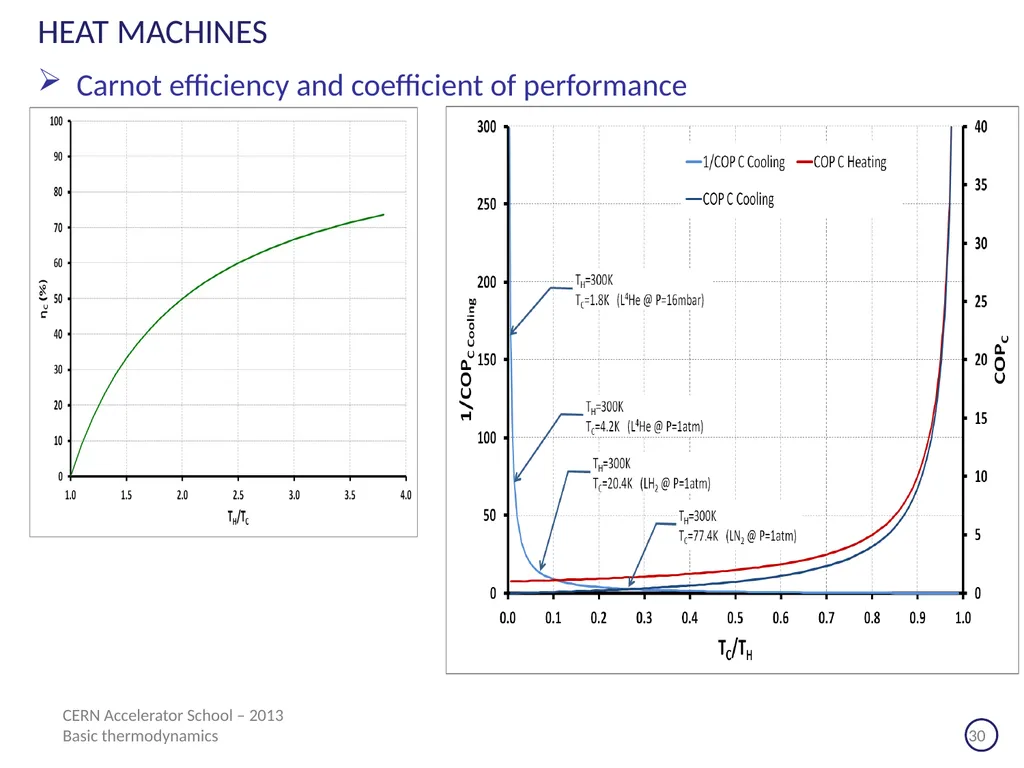
30
HEAT MACHINES CERN Accelerator School – 2013
Basic thermodynamics 30 Carnot efficiency and coefficient of performance<br>
Basic thermodynamics 30 Carnot efficiency and coefficient of performance<br>
31
HEAT MACHINES CERN Accelerator School – 2013
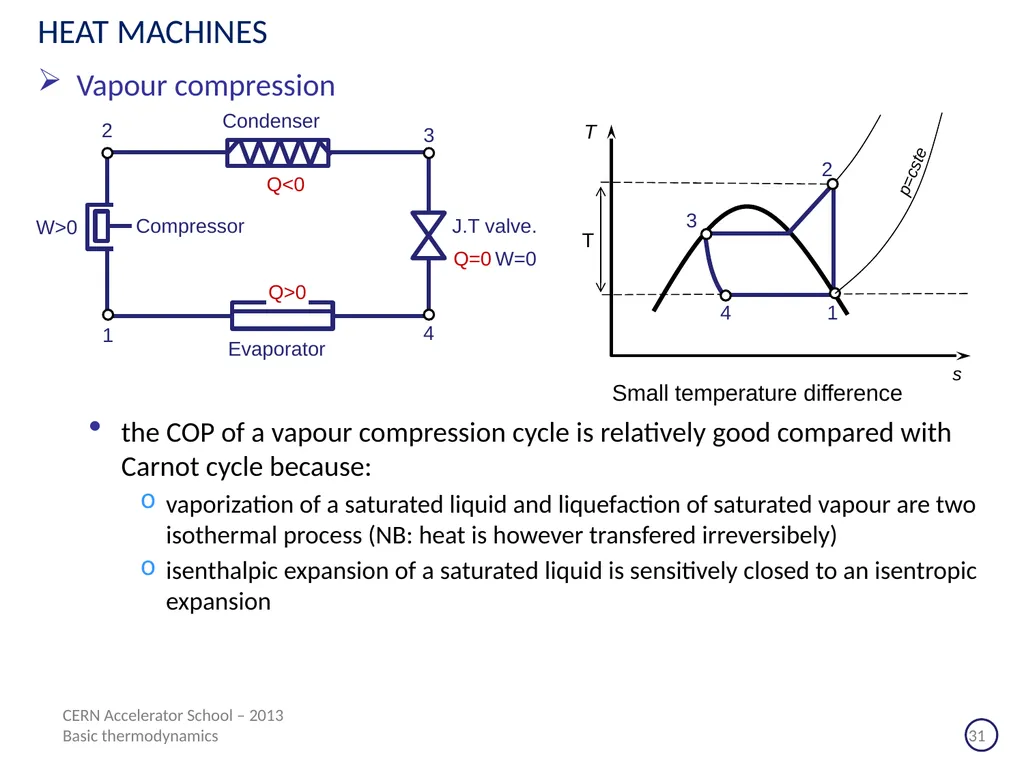
Basic thermodynamics 31 Vapour compression
the COP of a vapour compression cycle is relatively good compared with Carnot cycle because:
vaporization of a saturated liquid and liquefaction of saturated vapour are two isothermal process (NB: heat is however transfered irreversibely)
isenthalpic expansion of a saturated liquid is sensitively closed to an isentropic expansion Small temperature difference 1 2 3 4 Evaporator Condenser Compressor J.T valve. W>0 Q<0 W=0 Q=0 Q>0<br>
Basic thermodynamics 31 Vapour compression
the COP of a vapour compression cycle is relatively good compared with Carnot cycle because:
vaporization of a saturated liquid and liquefaction of saturated vapour are two isothermal process (NB: heat is however transfered irreversibely)
isenthalpic expansion of a saturated liquid is sensitively closed to an isentropic expansion Small temperature difference 1 2 3 4 Evaporator Condenser Compressor J.T valve. W>0 Q<0 W=0 Q=0 Q>0<br>
32
EXERGY CERN Accelerator School – 2013
Basic thermodynamics 32 Heat and work are not equivalent: they don’t have the same "thermodynamic grade” :
(Mechanical, electric…) work can be integrally converted into heat
Converting integrally heat into work is impossible (2nd law)
Energy transfers implies a direction of the evolutions:
Heat flows from hot to cold temperatures;
Electric work from high to low potentials;
Mass transfers from high to low pressures…
Transfers are generally irreversible.
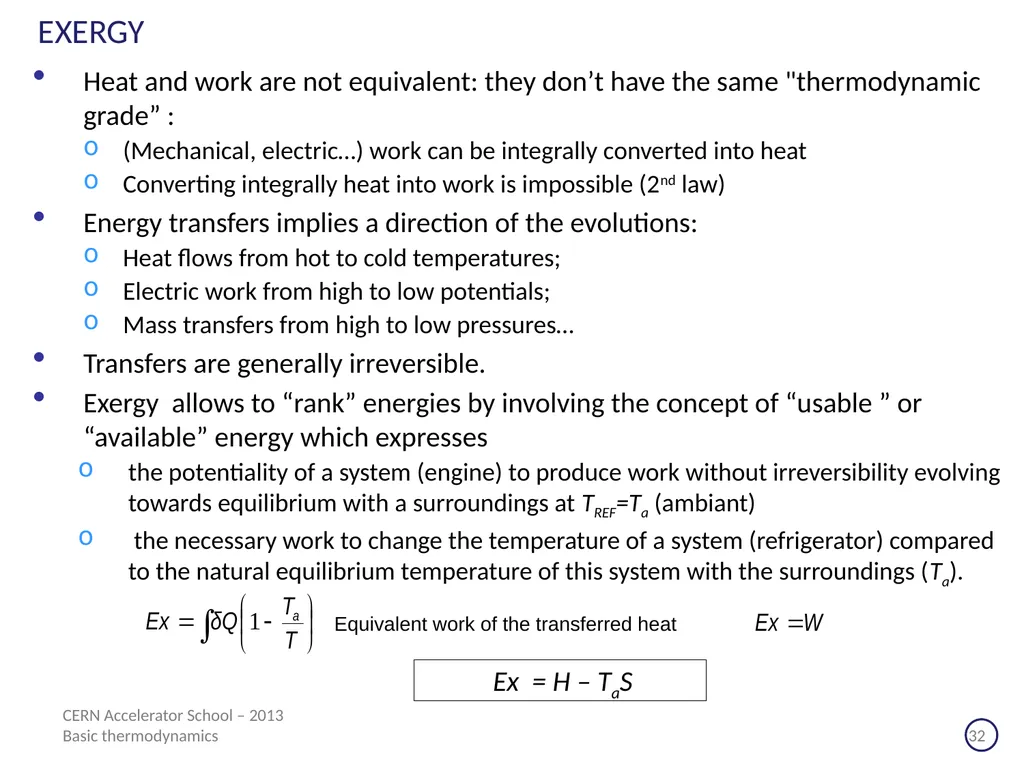
Exergy allows to “rank” energies by involving the concept of “usable ” or “available” energy which expresses
the potentiality of a system (engine) to produce work without irreversibility evolving towards equilibrium with a surroundings at TREF=Ta (ambiant)
the necessary work to change the temperature of a system (refrigerator) compared to the natural equilibrium temperature of this system with the surroundings (Ta).
Ex = H – TaS<br>
Basic thermodynamics 32 Heat and work are not equivalent: they don’t have the same "thermodynamic grade” :
(Mechanical, electric…) work can be integrally converted into heat
Converting integrally heat into work is impossible (2nd law)
Energy transfers implies a direction of the evolutions:
Heat flows from hot to cold temperatures;
Electric work from high to low potentials;
Mass transfers from high to low pressures…
Transfers are generally irreversible.
Exergy allows to “rank” energies by involving the concept of “usable ” or “available” energy which expresses
the potentiality of a system (engine) to produce work without irreversibility evolving towards equilibrium with a surroundings at TREF=Ta (ambiant)
the necessary work to change the temperature of a system (refrigerator) compared to the natural equilibrium temperature of this system with the surroundings (Ta).
Ex = H – TaS<br>
33
EXERGY CERN Accelerator School – 2013
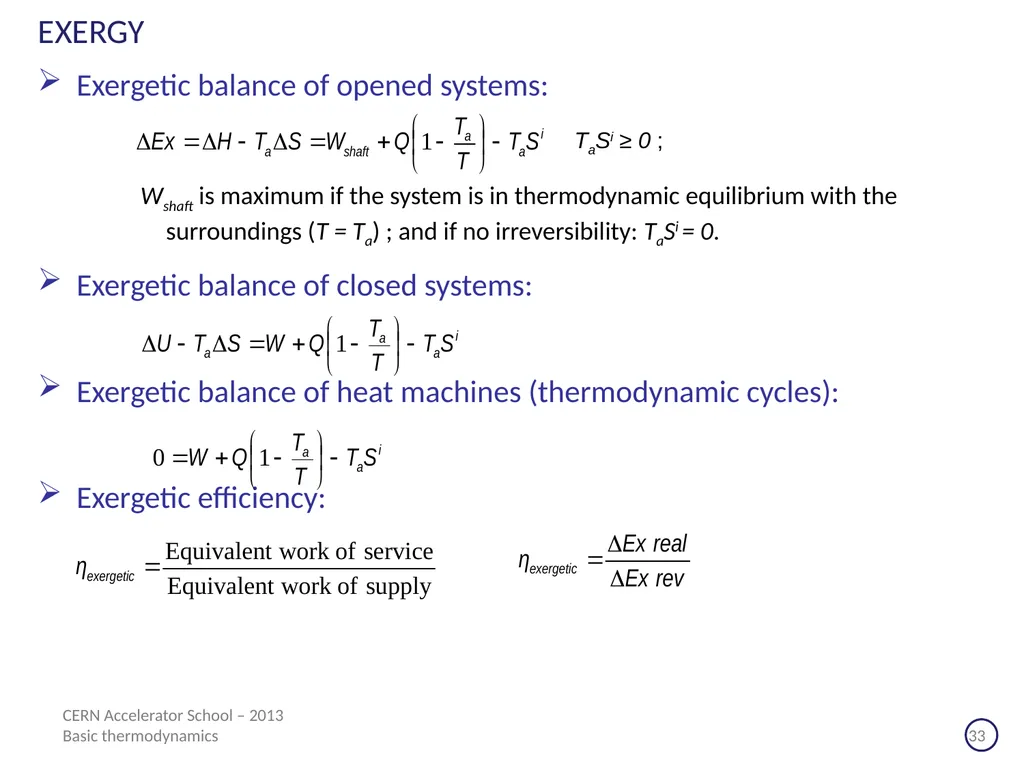
Basic thermodynamics 33 Exergetic balance of opened systems:
Wshaft is maximum if the system is in thermodynamic equilibrium with the surroundings (T = Ta) ; and if no irreversibility: TaSi = 0.
Exergetic balance of closed systems:
Exergetic balance of heat machines (thermodynamic cycles):
Exergetic efficiency: TaSi ≥ 0 ;<br>
Basic thermodynamics 33 Exergetic balance of opened systems:
Wshaft is maximum if the system is in thermodynamic equilibrium with the surroundings (T = Ta) ; and if no irreversibility: TaSi = 0.
Exergetic balance of closed systems:
Exergetic balance of heat machines (thermodynamic cycles):
Exergetic efficiency: TaSi ≥ 0 ;<br>
34
MAXWELL THERMODYNAMIC RELATIONS CERN Accelerator School – 2013
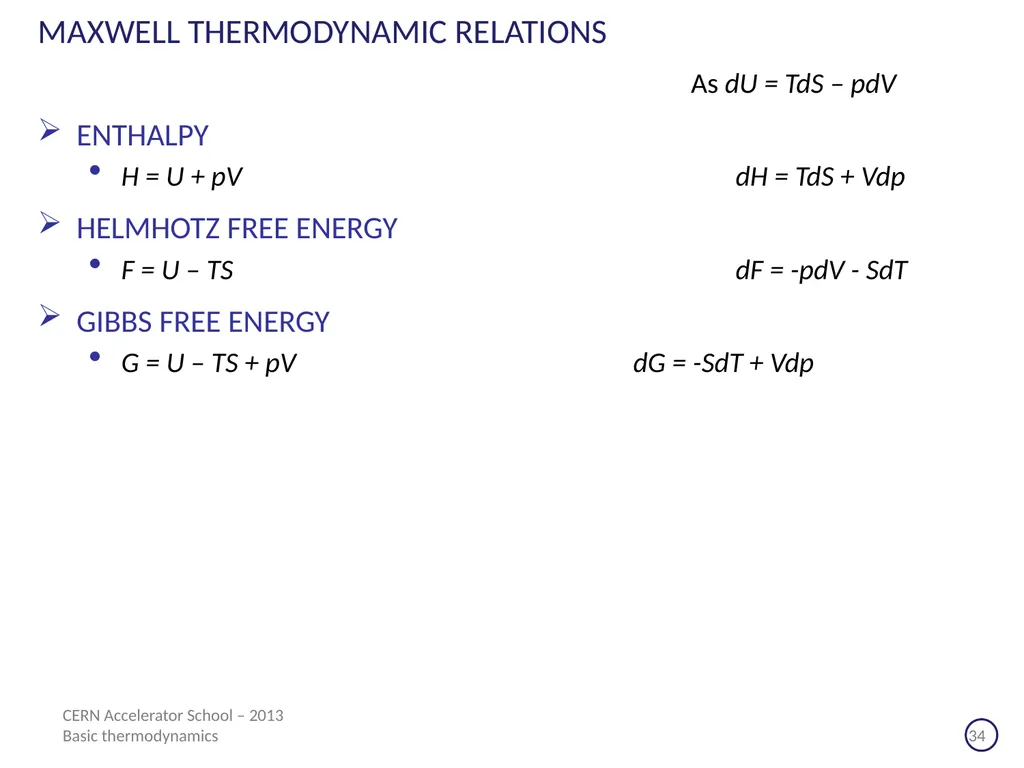
Basic thermodynamics 34 As dU = TdS – pdV
ENTHALPY
H = U + pV dH = TdS + Vdp
HELMHOTZ FREE ENERGY
F = U – TS dF = -pdV - SdT
GIBBS FREE ENERGY
G = U – TS + pV dG = -SdT + Vdp<br>
Basic thermodynamics 34 As dU = TdS – pdV
ENTHALPY
H = U + pV dH = TdS + Vdp
HELMHOTZ FREE ENERGY
F = U – TS dF = -pdV - SdT
GIBBS FREE ENERGY
G = U – TS + pV dG = -SdT + Vdp<br>
35
FREE ENERGY AND EXERGY CERN Accelerator School – 2013
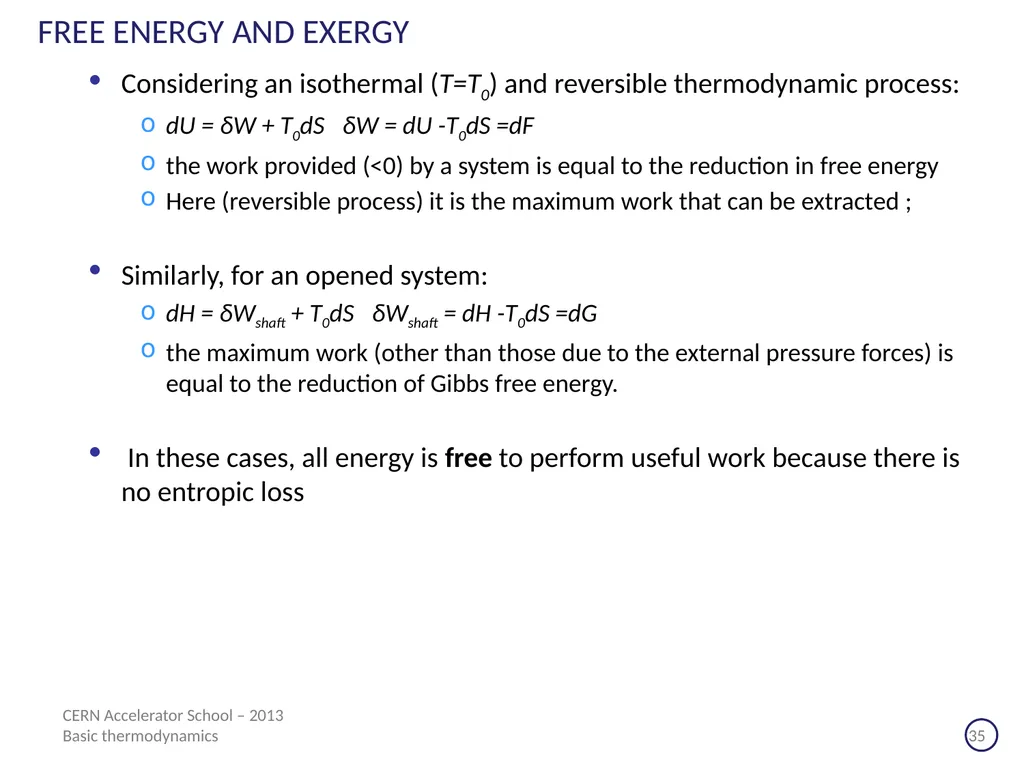
Basic thermodynamics 35 Considering an isothermal (T=T0) and reversible thermodynamic process:
dU = δW + T0dS δW = dU -T0dS =dF
the work provided (<0) by a system is equal to the reduction in free energy
Here (reversible process) it is the maximum work that can be extracted ;
Similarly, for an opened system:
dH = δWshaft + T0dS δWshaft = dH -T0dS =dG
the maximum work (other than those due to the external pressure forces) is equal to the reduction of Gibbs free energy.
In these cases, all energy is free to perform useful work because there is no entropic loss<br>
Basic thermodynamics 35 Considering an isothermal (T=T0) and reversible thermodynamic process:
dU = δW + T0dS δW = dU -T0dS =dF
the work provided (<0) by a system is equal to the reduction in free energy
Here (reversible process) it is the maximum work that can be extracted ;
Similarly, for an opened system:
dH = δWshaft + T0dS δWshaft = dH -T0dS =dG
the maximum work (other than those due to the external pressure forces) is equal to the reduction of Gibbs free energy.
In these cases, all energy is free to perform useful work because there is no entropic loss<br>
36
DIRECTION OF SPONTANEOUS CHANGE CERN Accelerator School – 2013
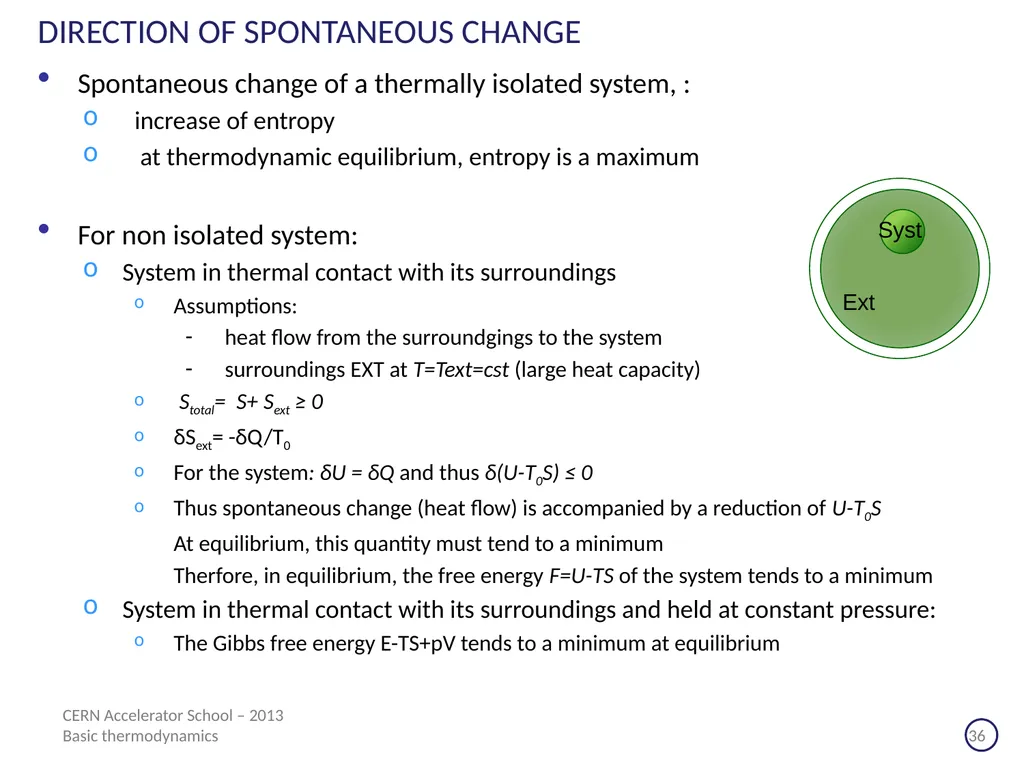
Basic thermodynamics 36 Spontaneous change of a thermally isolated system, :
increase of entropy
at thermodynamic equilibrium, entropy is a maximum
For non isolated system:
System in thermal contact with its surroundings
Assumptions:
heat flow from the surroundgings to the system
surroundings EXT at T=Text=cst (large heat capacity)
Stotal= S+Sext ≥ 0
δSext= -δQ/T0
For the system: δU = δQ and thus δ(U-T0S) ≤ 0
Thus spontaneous change (heat flow) is accompanied by a reduction of U-T0S
At equilibrium, this quantity must tend to a minimum
Therfore, in equilibrium, the free energy F=U-TS of the system tends to a minimum
System in thermal contact with its surroundings and held at constant pressure:
The Gibbs free energy E-TS+pV tends to a minimum at equilibrium Ext Syst<br>
Basic thermodynamics 36 Spontaneous change of a thermally isolated system, :
increase of entropy
at thermodynamic equilibrium, entropy is a maximum
For non isolated system:
System in thermal contact with its surroundings
Assumptions:
heat flow from the surroundgings to the system
surroundings EXT at T=Text=cst (large heat capacity)
Stotal= S+Sext ≥ 0
δSext= -δQ/T0
For the system: δU = δQ and thus δ(U-T0S) ≤ 0
Thus spontaneous change (heat flow) is accompanied by a reduction of U-T0S
At equilibrium, this quantity must tend to a minimum
Therfore, in equilibrium, the free energy F=U-TS of the system tends to a minimum
System in thermal contact with its surroundings and held at constant pressure:
The Gibbs free energy E-TS+pV tends to a minimum at equilibrium Ext Syst<br>
37
PHASE EQUILIBRIA CERN Accelerator School – 2013
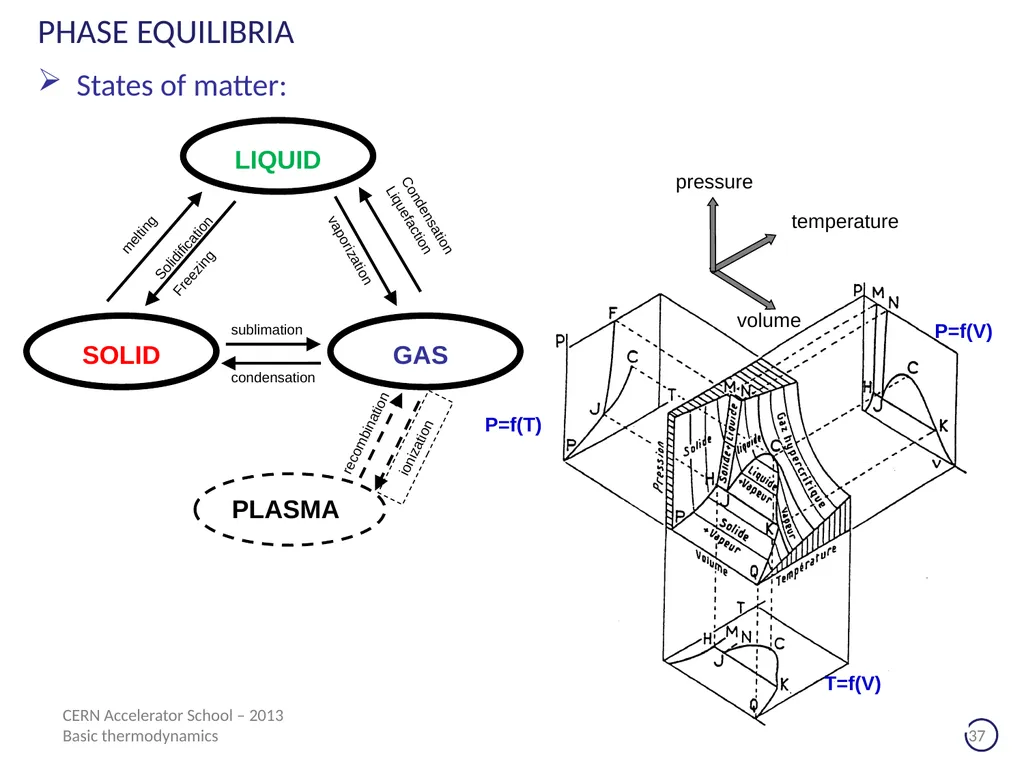
Basic thermodynamics 37 States of matter: P=f(T) P=f(V) T=f(V)<br>
Basic thermodynamics 37 States of matter: P=f(T) P=f(V) T=f(V)<br>
38
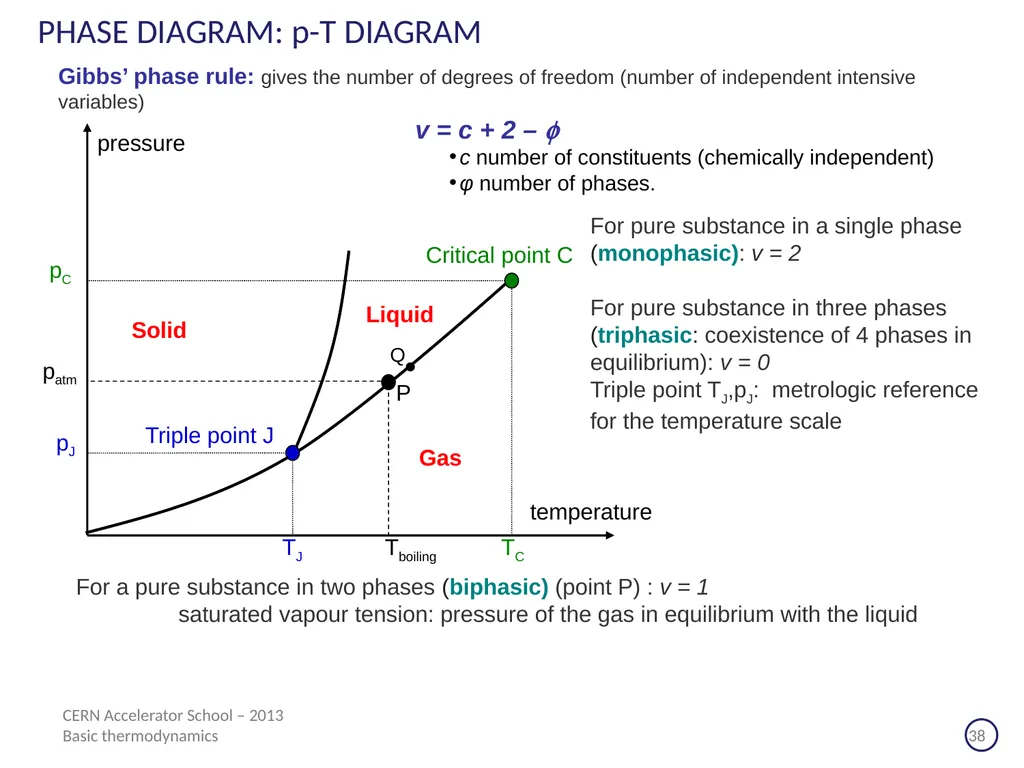
Gibbs’ phase rule: gives the number of degrees of freedom (number of independent intensive variables)
v = c + 2 – f
c number of constituents (chemically independent)
φ number of phases. PHASE DIAGRAM: p-T DIAGRAM CERN Accelerator School – 2013
Basic thermodynamics 38 Solid Liquid Gas pressure temperature Critical point C Triple point J pC TC TJ pJ patm Tboiling P For pure substance in a single phase (monophasic): v = 2
For pure substance in three phases (triphasic: coexistence of 4 phases in equilibrium): v = 0
Triple point TJ,pJ: metrologic reference for the temperature scale For a pure substance in two phases (biphasic) (point P) : v = 1
saturated vapour tension: pressure of the gas in equilibrium with the liquid Q<br>
v = c + 2 – f
c number of constituents (chemically independent)
φ number of phases. PHASE DIAGRAM: p-T DIAGRAM CERN Accelerator School – 2013
Basic thermodynamics 38 Solid Liquid Gas pressure temperature Critical point C Triple point J pC TC TJ pJ patm Tboiling P For pure substance in a single phase (monophasic): v = 2
For pure substance in three phases (triphasic: coexistence of 4 phases in equilibrium): v = 0
Triple point TJ,pJ: metrologic reference for the temperature scale For a pure substance in two phases (biphasic) (point P) : v = 1
saturated vapour tension: pressure of the gas in equilibrium with the liquid Q<br>
39
PHASE EQUILIBRIA CERN Accelerator School – 2013
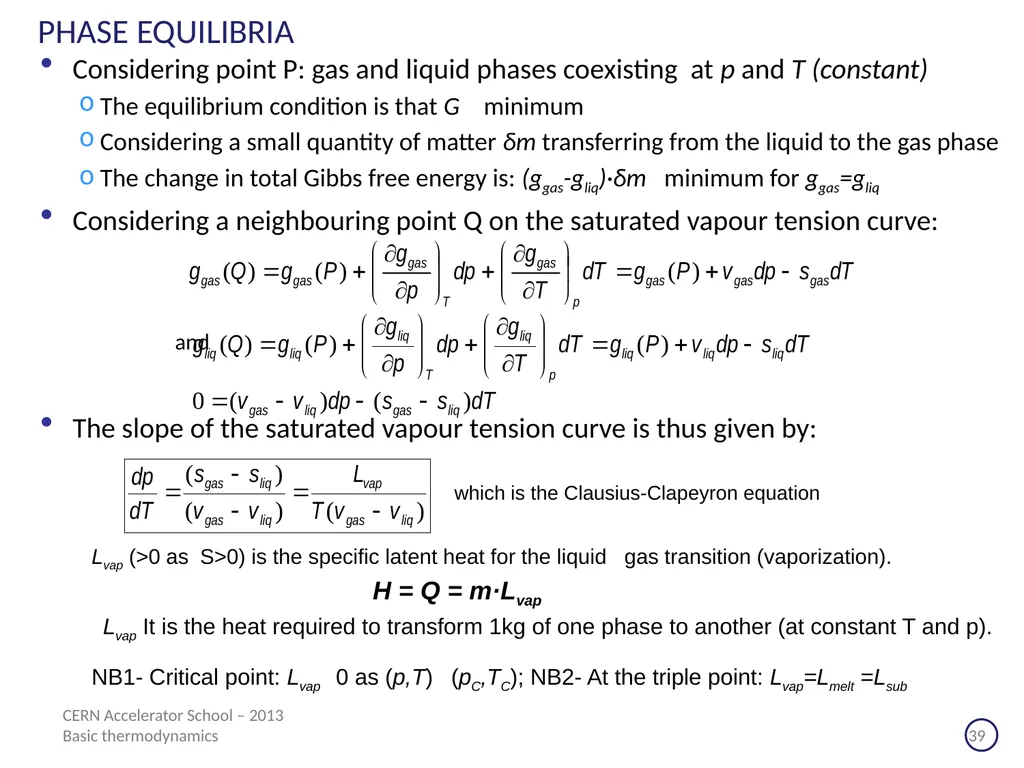
Basic thermodynamics 39 Considering point P: gas and liquid phases coexisting at p and T (constant)
The equilibrium condition is that G minimum
Considering a small quantity of matter δm transferring from the liquid to the gas phase
The change in total Gibbs free energy is: (ggas-gliq)·δm minimum for ggas=gliq
Considering a neighbouring point Q on the saturated vapour tension curve:
and
The slope of the saturated vapour tension curve is thus given by: Lvap (>0 as S>0) is the specific latent heat for the liquid gas transition (vaporization). Lvap It is the heat required to transform 1kg of one phase to another (at constant T and p). H = Q = m·Lvap NB1- Critical point: Lvap 0 as (p,T) (pC,TC); NB2- At the triple point: Lvap=Lmelt =Lsub<br>
Basic thermodynamics 39 Considering point P: gas and liquid phases coexisting at p and T (constant)
The equilibrium condition is that G minimum
Considering a small quantity of matter δm transferring from the liquid to the gas phase
The change in total Gibbs free energy is: (ggas-gliq)·δm minimum for ggas=gliq
Considering a neighbouring point Q on the saturated vapour tension curve:
and
The slope of the saturated vapour tension curve is thus given by: Lvap (>0 as S>0) is the specific latent heat for the liquid gas transition (vaporization). Lvap It is the heat required to transform 1kg of one phase to another (at constant T and p). H = Q = m·Lvap NB1- Critical point: Lvap 0 as (p,T) (pC,TC); NB2- At the triple point: Lvap=Lmelt =Lsub<br>
40
T-s DIAGRAM CERN Accelerator School – 2013
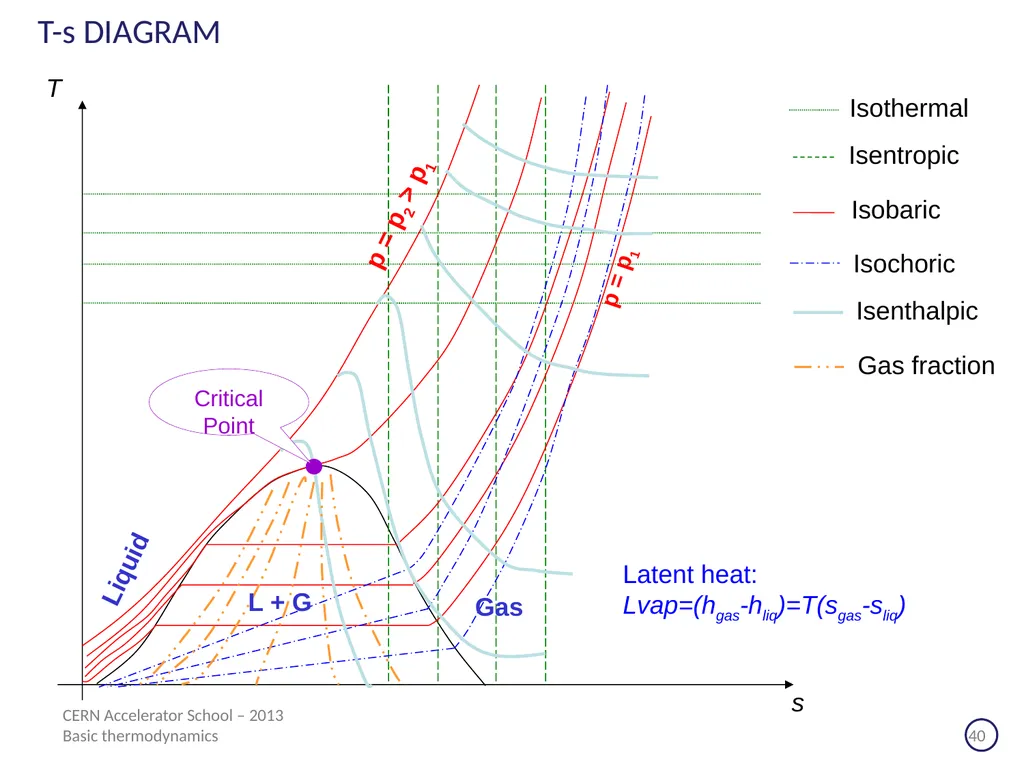
Basic thermodynamics 40 s T Isentropic Isobaric Isochoric Critical
Point Liquid Gas L + G p = p2 > p1 p = p1 Latent heat:
Lvap=(hgas-hliq)=T(sgas-sliq)<br>
Basic thermodynamics 40 s T Isentropic Isobaric Isochoric Critical
Point Liquid Gas L + G p = p2 > p1 p = p1 Latent heat:
Lvap=(hgas-hliq)=T(sgas-sliq)<br>
41
THERMODYNAMICS OF MAGNETIC MATERIALS CERN Accelerator School – 2013
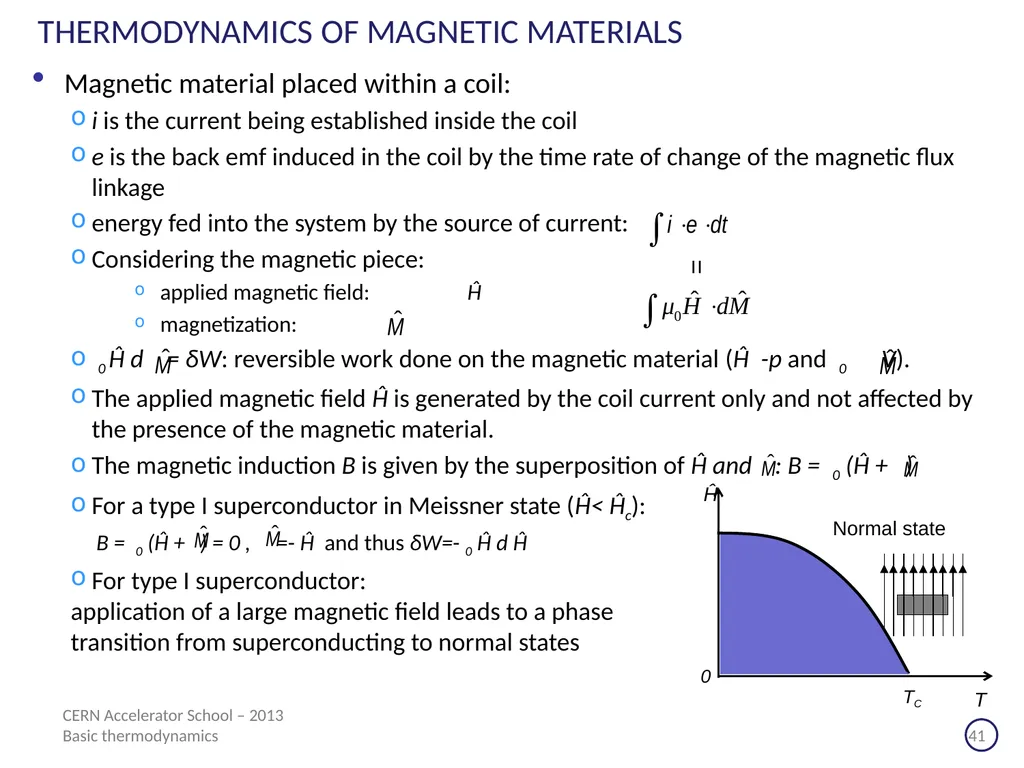
Basic thermodynamics 41 Magnetic material placed within a coil:
i is the current being established inside the coil
e is the back emf induced in the coil by the time rate of change of the magnetic flux linkage
energy fed into the system by the source of current:
Considering the magnetic piece:
applied magnetic field: Ĥ
magnetization:
0 Ĥ d = δW: reversible work done on the magnetic material (Ĥ -p and 0 V).
The applied magnetic field Ĥ is generated by the coil current only and not affected by the presence of the magnetic material.
The magnetic induction B is given by the superposition of Ĥ and : B = 0 (Ĥ + )
For a type I superconductor in Meissner state (Ĥ< Ĥc):
B = 0 (Ĥ + ) = 0 , =- Ĥ and thus δW=-0 Ĥ d Ĥ
For type I superconductor:
application of a large magnetic field leads to a phase
transition from superconducting to normal states Normal state Superconducting
(Meisner state)<br>
Basic thermodynamics 41 Magnetic material placed within a coil:
i is the current being established inside the coil
e is the back emf induced in the coil by the time rate of change of the magnetic flux linkage
energy fed into the system by the source of current:
Considering the magnetic piece:
applied magnetic field: Ĥ
magnetization:
0 Ĥ d = δW: reversible work done on the magnetic material (Ĥ -p and 0 V).
The applied magnetic field Ĥ is generated by the coil current only and not affected by the presence of the magnetic material.
The magnetic induction B is given by the superposition of Ĥ and : B = 0 (Ĥ + )
For a type I superconductor in Meissner state (Ĥ< Ĥc):
B = 0 (Ĥ + ) = 0 , =- Ĥ and thus δW=-0 Ĥ d Ĥ
For type I superconductor:
application of a large magnetic field leads to a phase
transition from superconducting to normal states Normal state Superconducting
(Meisner state)<br>
42
THERMODYNAMICS OF MAGNETIC MATERIALS CERN Accelerator School – 2013
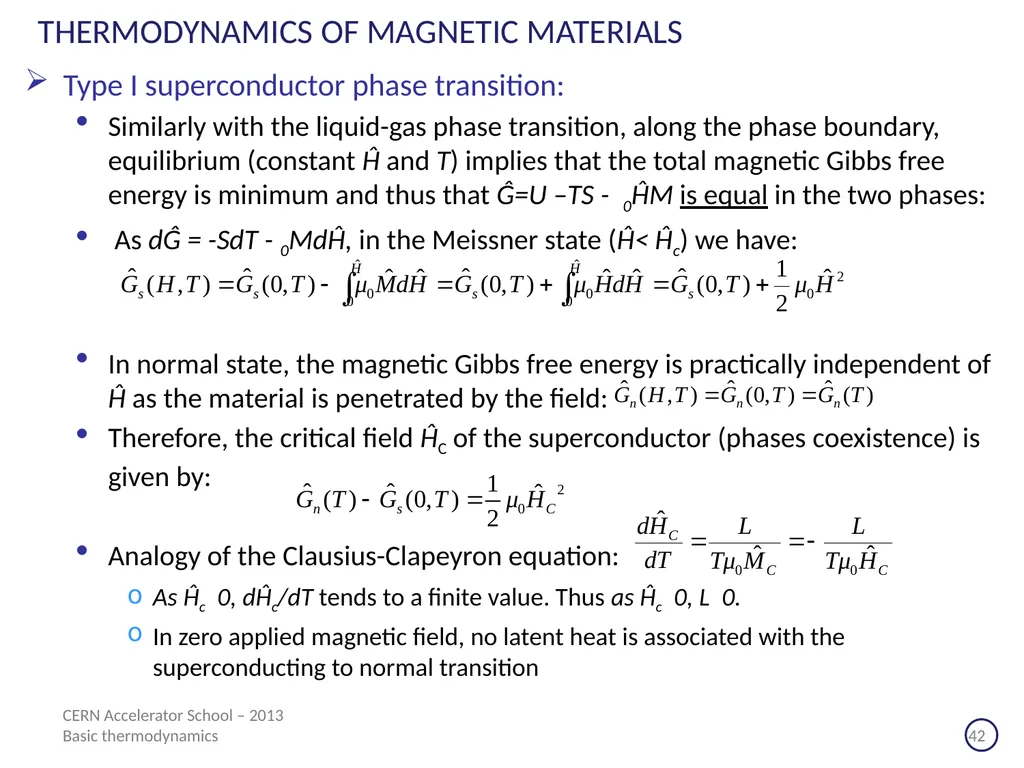
Basic thermodynamics 42 Type I superconductor phase transition:
Similarly with the liquid-gas phase transition, along the phase boundary, equilibrium (constant Ĥ and T) implies that the total magnetic Gibbs free energy is minimum and thus that Ĝ=U –TS - 0ĤM is equal in the two phases:
As dĜ = -SdT -0MdĤ, in the Meissner state (Ĥ< Ĥc) we have:
In normal state, the magnetic Gibbs free energy is practically independent of Ĥ as the material is penetrated by the field:
Therefore, the critical field ĤC of the superconductor (phases coexistence) is given by:
Analogy of the Clausius-Clapeyron equation:
As Ĥc 0, dĤc/dT tends to a finite value. Thus as Ĥc 0, L 0.
In zero applied magnetic field, no latent heat is associated with the superconducting to normal transition<br>
Basic thermodynamics 42 Type I superconductor phase transition:
Similarly with the liquid-gas phase transition, along the phase boundary, equilibrium (constant Ĥ and T) implies that the total magnetic Gibbs free energy is minimum and thus that Ĝ=U –TS - 0ĤM is equal in the two phases:
As dĜ = -SdT -0MdĤ, in the Meissner state (Ĥ< Ĥc) we have:
In normal state, the magnetic Gibbs free energy is practically independent of Ĥ as the material is penetrated by the field:
Therefore, the critical field ĤC of the superconductor (phases coexistence) is given by:
Analogy of the Clausius-Clapeyron equation:
As Ĥc 0, dĤc/dT tends to a finite value. Thus as Ĥc 0, L 0.
In zero applied magnetic field, no latent heat is associated with the superconducting to normal transition<br>
43
THERMODYNAMICS OF MAGNETIC MATERIALS CERN Accelerator School – 2013
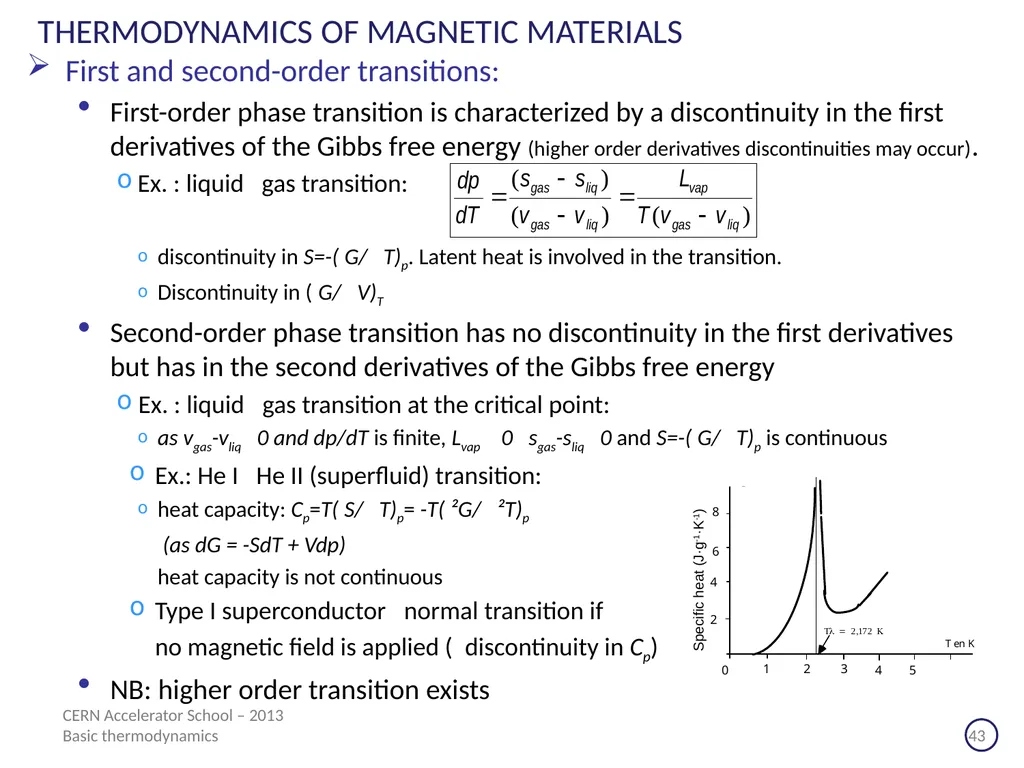
Basic thermodynamics 43 First and second-order transitions:
First-order phase transition is characterized by a discontinuity in the first derivatives of the Gibbs free energy (higher order derivatives discontinuities may occur).
Ex. : liquid gas transition:
discontinuity in S=-(G/ T)p. Latent heat is involved in the transition.
Discontinuity in (G/ V)T
Second-order phase transition has no discontinuity in the first derivatives but has in the second derivatives of the Gibbs free energy
Ex. : liquid gas transition at the critical point:
as vgas-vliq 0 and dp/dT is finite, Lvap 0 sgas-sliq 0 and S=-(G/ T)p is continuous
Ex.: He I He II (superfluid) transition:
heat capacity: Cp=T(S/ T)p= -T(²G/ ²T)p
(as dG = -SdT + Vdp)
heat capacity is not continuous
Type I superconductor normal transition if
no magnetic field is applied ( discontinuity in Cp)
NB: higher order transition exists<br>
Basic thermodynamics 43 First and second-order transitions:
First-order phase transition is characterized by a discontinuity in the first derivatives of the Gibbs free energy (higher order derivatives discontinuities may occur).
Ex. : liquid gas transition:
discontinuity in S=-(G/ T)p. Latent heat is involved in the transition.
Discontinuity in (G/ V)T
Second-order phase transition has no discontinuity in the first derivatives but has in the second derivatives of the Gibbs free energy
Ex. : liquid gas transition at the critical point:
as vgas-vliq 0 and dp/dT is finite, Lvap 0 sgas-sliq 0 and S=-(G/ T)p is continuous
Ex.: He I He II (superfluid) transition:
heat capacity: Cp=T(S/ T)p= -T(²G/ ²T)p
(as dG = -SdT + Vdp)
heat capacity is not continuous
Type I superconductor normal transition if
no magnetic field is applied ( discontinuity in Cp)
NB: higher order transition exists<br>
44
REFERENCES CERN Accelerator School – 2013
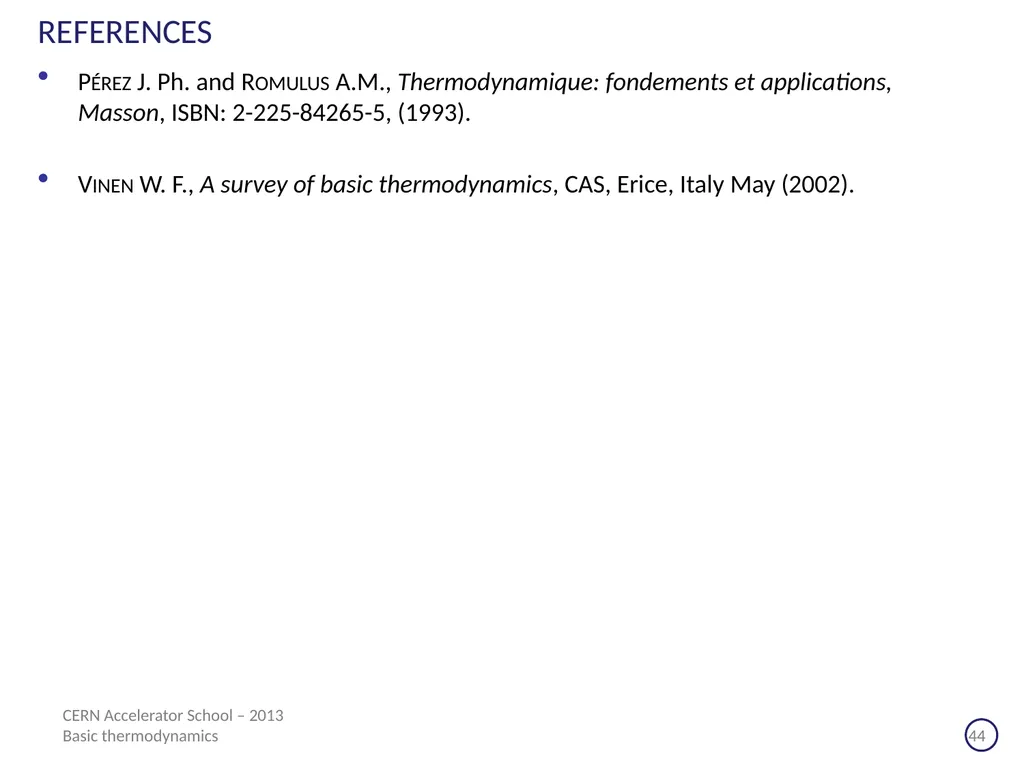
Basic thermodynamics 44 Pérez J. Ph. and Romulus A.M., Thermodynamique: fondements et applications, Masson, ISBN: 2-225-84265-5, (1993).
Vinen W. F., A survey of basic thermodynamics, CAS, Erice, Italy May (2002).<br>
Basic thermodynamics 44 Pérez J. Ph. and Romulus A.M., Thermodynamique: fondements et applications, Masson, ISBN: 2-225-84265-5, (1993).
Vinen W. F., A survey of basic thermodynamics, CAS, Erice, Italy May (2002).<br>
45
Thank you for your attention<br>