03
Introduction (Annex 12) Volcanoes produce a wide variety of hazards, including ash, lahars, toxic gases, and flashfloods of hot water and debris, that can kill people and destroy property
Large explosive eruptions can endanger people and property hundreds of miles away and can even affect the global climate PM VO-1 CERT Hazard Annex: Volcano VO-1<br>
04
Introduction (Annex 12) (continued) The United States has the third most active volcanoes of any country in the world, behind only Japan and Indonesia
The United States and its territories contain 169 geologically active volcanoes, of which 54 volcanoes pose a very high or high threat to public safety
Since 1980, there have been at least five eruptions in the United States every year PM VO-1 CERT Hazard Annex: Volcano VO-2<br>
05
Types of Volcanoes Snow-clad volcanoes (found in Alaska and the Pacific Northwest) bring substantial hazards from lahars
Explosive volcanoes (found in Alaska and the American West) bring risk of volcanic ash that can affect areas close by and hundreds to thousands of miles from the volcanic vent
Weakly explosive volcanoes (found in Hawaii) typically erupt gently with fluid lava flows and increased risk of vog PM VO-1 CERT Hazard Annex: Volcano VO-3<br>
06
Volcano Impacts Fatalities
Typically caused by ash asphyxiation, thermal injuries, and trauma
Pyroclastic flows have accounted for the majority of mortality in volcanic events
Disruptions
Interrupts transportation, power, and other services
Generates economic losses from damages to structures and roadways PM VO-1 CERT Hazard Annex: Volcano VO-4<br>
07
Volcanic Hazards Eruptions
Lava
Pyroclastic flows
Lahar (volcanic mudflow)
Volcanic gases
Tephra/Ash
Landslides
Volcanic smog (vog) PM VO-1 CERT Hazard Annex: Volcano VO-5<br>
08
Eruptions Eruptions can be relatively quiet, producing lava flows that creep across the land
Explosive eruptions can shoot columns of gases and rock fragments tens of miles into the atmosphere, spreading ash hundreds of miles downwind PM VO-2 CERT Hazard Annex: Volcano VO-6<br>
09
Lava Lava flows are streams of molten rock that either pour from a vent quietly or erupt explosively as lava fountains
Because of their intense heat, lava flows are also great fire hazards
Lava flows destroy everything in their path; do not attempt to divert
Most lava flows move slowly enough that people can move out of the way, but some can travel as fast as 40 miles per hour PM VO-2 CERT Hazard Annex: Volcano VO-7<br>
10
Pyroclastic Flows Contain a high-density mix of hot lava blocks, pumice, ash and volcanic gas
Move at very high speeds down volcanic slopes, typically following valleys and traveling at speeds greater than 50 mph
Destroy nearly all objects and structures in their path The extreme temperatures of rocks and gas inside pyroclastic flows—generally between 390°- 1300°F— can ignite fires and melt snow and ice PM VO-2 CERT Hazard Annex: Volcano VO-8<br>
11
Lahar Lahars are mudflows or debris flows composed mostly of volcanic materials on the sides of a volcano
Historically, lahars have been one of the deadliest volcano hazards
Can rush down valley and stream channels at speeds of 20 to 40 mph and can travel more than 50 miles PM VO-3 CERT Hazard Annex: Volcano VO-9<br>
12
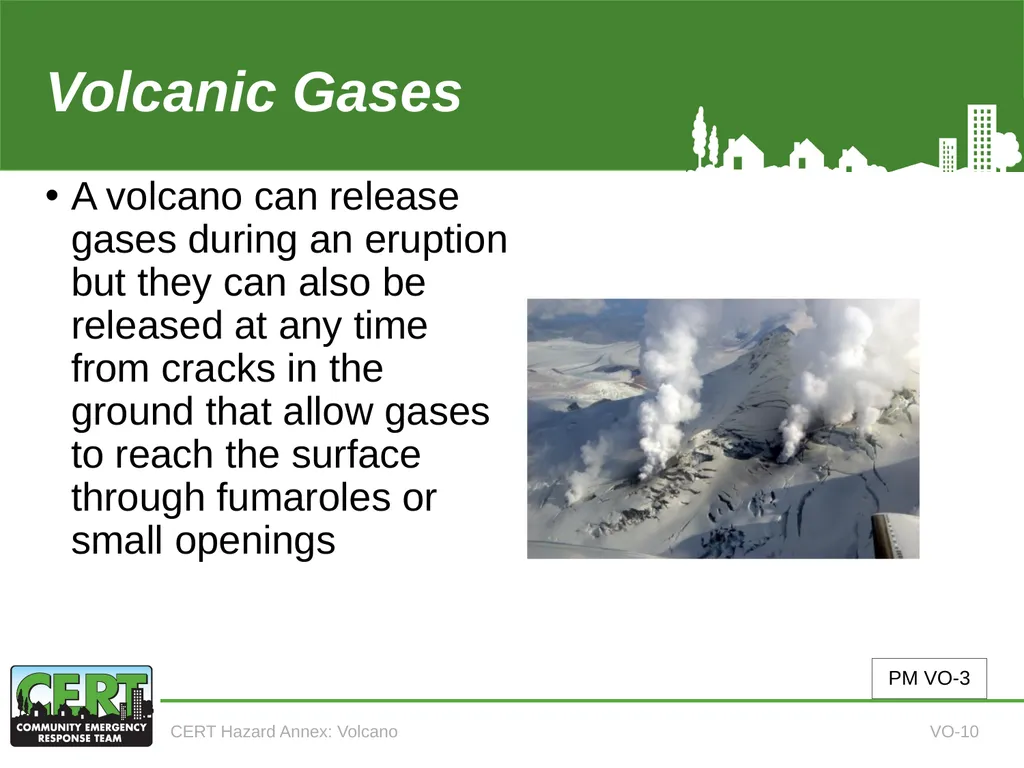
Volcanic Gases A volcano can release gases during an eruption but they can also be released at any time from cracks in the ground that allow gases to reach the surface through fumaroles or small openings PM VO-3 CERT Hazard Annex: Volcano VO-10<br>
13
Volcanic Ash/Tephra Tephra: Fragments of magma and rock which erupt into the atmosphere
Volcanic ash: Finer pieces of tephra smaller than 1/12 of an inch
Volcanic ash can affect people and equipment hundreds of miles away from the cone of the volcano, while tephra falls back to the ground on or near the volcano PM VO-3 CERT Hazard Annex: Volcano VO-11<br>
14
Volcanic Ash/Tephra (continued) Volcanic ash can:
Cause severe respiratory problems
Diminish visibility
Contaminate water supplies
Cause electrical storms
Disrupt the operation of all machinery and cause engine failure, which is particularly problematic for aircraft
Collapse roofs PM VO-3 CERT Hazard Annex: Volcano VO-12<br>
15
Landslides Range in size from small movements of loose debris on the surface of a volcano to massive collapses of the entire summit or sides of a volcano
Eruptions, heavy rainfall, or large earthquakes can cause landslides on volcano slopes that can trigger loose volcanic rock to break free and move downhill PM VO-3 CERT Hazard Annex: Volcano VO-13<br>
16
Volcanic Smog (Vog) A form of air pollution created when sulfur dioxide and other volcanic gases combine and interact chemically in the atmosphere with oxygen, moisture, dust, and sunlight
Sulfur dioxide is a poisonous gas that irritates skin and the tissues and mucous membranes of the eyes, nose, and throat
Can produce respiratory distress in some individuals PM VO-4 CERT Hazard Annex: Volcano VO-14<br>
17
Accompanying Hazards (continued) Volcanic eruptions can be accompanied by other natural hazards
Flash floods
Wildland fires
Tsunamis (under special conditions)
Earthquakes PM VO-4 CERT Hazard Annex: Volcano VO-15<br>
18
Volcanic Eruption Preparedness Understand the risk
Talk to your insurance agent
Prepare disaster supply kit
Develop communication plan
Develop evacuation plan
Develop shelter-in-place plan PM VO-4 CERT Hazard Annex: Volcano VO-16<br>
19
Alerts and Warnings Learn about your community’s volcanic eruption warning systems and emergency evacuation plans
Different communities have different ways of providing warnings and different responses
Many communities have sirens and other warning technologies, such as online activation colors (green, yellow, orange, red), to warn the public of a possible eruption PM VO-4 CERT Hazard Annex: Volcano VO-17<br>
20
Alerts and Warnings (continued) The United States Geological Survey (USGS) Volcano Hazards Program has adopted an alert notification system nationwide for characterizing the level of unrest and eruptive activity at volcanoes
The USGS Volcano Notification Service (VNS) is a free service that sends notification emails about volcanic activity in the United States PM VO-4 CERT Hazard Annex: Volcano VO-18<br>
21
During a Volcanic Eruption Monitor alert notification systems
Follow evacuation orders
Avoid areas downwind and river valleys downstream of the volcano
Shelter in building, if appropriate
If outside, protect yourself from ashfall
Be prepared for accompanying hazards
Driving in ash is hazardous
Avoid driving in heavy ashfall PM VO-5 CERT Hazard Annex: Volcano VO-19<br>
22
After a Volcanic Eruption The lava flow on the surface cools faster than the lava trapped inside the crust NEVER climb on a lava crust until the proper authorities deem it safe
Stay away from volcanic ashfall areas
If you have a respiratory ailment, avoid contact with any amount of ash
Avoid driving in heavy ashfall
Do not get on roof to remove ash unless it threatens collapse
Even then, exercise great caution PM VO-6 CERT Hazard Annex: Volcano VO-20<br>
23
Final Questions? (Annex 12) Additional questions, comments, or concerns, about volcanoes? CERT Hazard Annex: Volcano VO-21<br>