
Change Control in Pharmaceutical Industry What is
DP
Published · 14 slides · 0 views

1 / 1

Description
Change Control in Pharmaceutical Industry What is Change Control in Pharma? Change control in pharma is a thorough approach to managing all alterations that might influence the pharmaceutical products quality. Change control in
Related Topics
Share
Embed code
Download this presentation From Below
"Change Control in Pharmaceutical Industry What is" is the property of its rightful owner. Permission is granted to download and print the materials on this website for personal, non-commercial use only, and to display it on your personal computer provided you do not modify the materials and that you retain all copyright notices contained in the materials. By downloading content from our website, you accept the terms of this agreement.
Presentation Transcript
01
Change Control
in
Pharmaceutical Industry<br>
in
Pharmaceutical Industry<br>
02
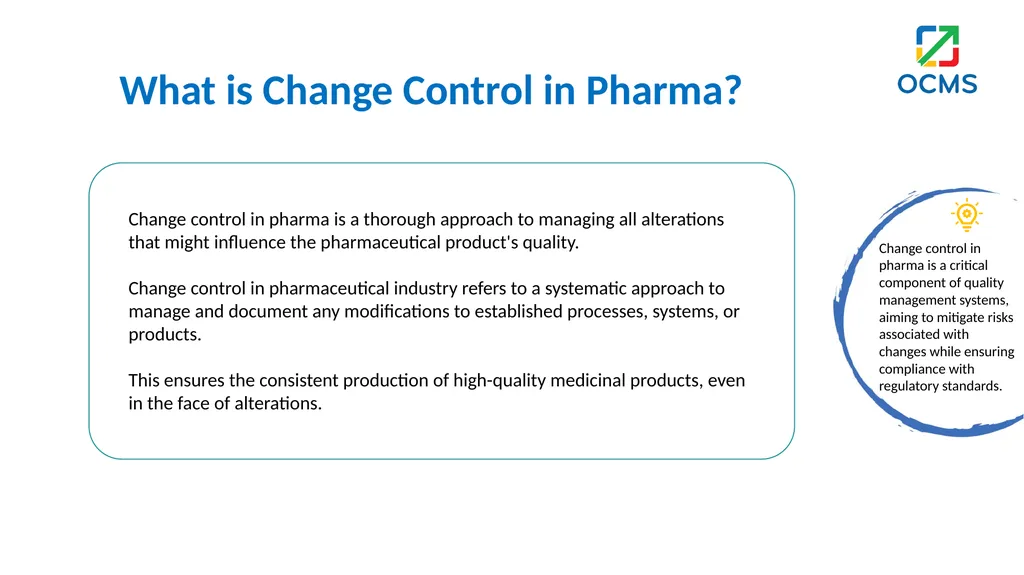
What is Change Control in Pharma? Change control in pharma is a thorough approach to managing all alterations that might influence the pharmaceutical product's quality.
Change control in pharmaceutical industry refers to a systematic approach to manage and document any modifications to established processes, systems, or products.
This ensures the consistent production of high-quality medicinal products, even in the face of alterations. Change control in pharma is a critical component of quality management systems, aiming to mitigate risks associated with changes while ensuring compliance with regulatory standards.<br>
Change control in pharmaceutical industry refers to a systematic approach to manage and document any modifications to established processes, systems, or products.
This ensures the consistent production of high-quality medicinal products, even in the face of alterations. Change control in pharma is a critical component of quality management systems, aiming to mitigate risks associated with changes while ensuring compliance with regulatory standards.<br>
03
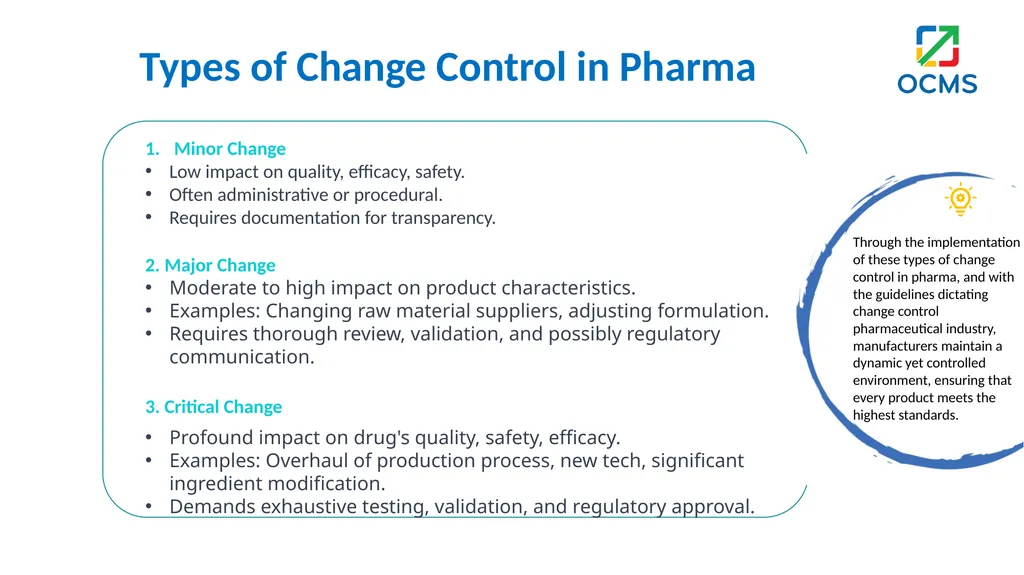
Types of Change Control in Pharma Minor Change
Low impact on quality, efficacy, safety.
Often administrative or procedural.
Requires documentation for transparency.
2. Major Change
Moderate to high impact on product characteristics.
Examples: Changing raw material suppliers, adjusting formulation.
Requires thorough review, validation, and possibly regulatory communication.
3. Critical Change
Profound impact on drug's quality, safety, efficacy.
Examples: Overhaul of production process, new tech, significant ingredient modification.
Demands exhaustive testing, validation, and regulatory approval. Through the implementation of these types of change control in pharma, and with the guidelines dictating change control pharmaceutical industry, manufacturers maintain a dynamic yet controlled environment, ensuring that every product meets the highest standards.<br>
Low impact on quality, efficacy, safety.
Often administrative or procedural.
Requires documentation for transparency.
2. Major Change
Moderate to high impact on product characteristics.
Examples: Changing raw material suppliers, adjusting formulation.
Requires thorough review, validation, and possibly regulatory communication.
3. Critical Change
Profound impact on drug's quality, safety, efficacy.
Examples: Overhaul of production process, new tech, significant ingredient modification.
Demands exhaustive testing, validation, and regulatory approval. Through the implementation of these types of change control in pharma, and with the guidelines dictating change control pharmaceutical industry, manufacturers maintain a dynamic yet controlled environment, ensuring that every product meets the highest standards.<br>
04
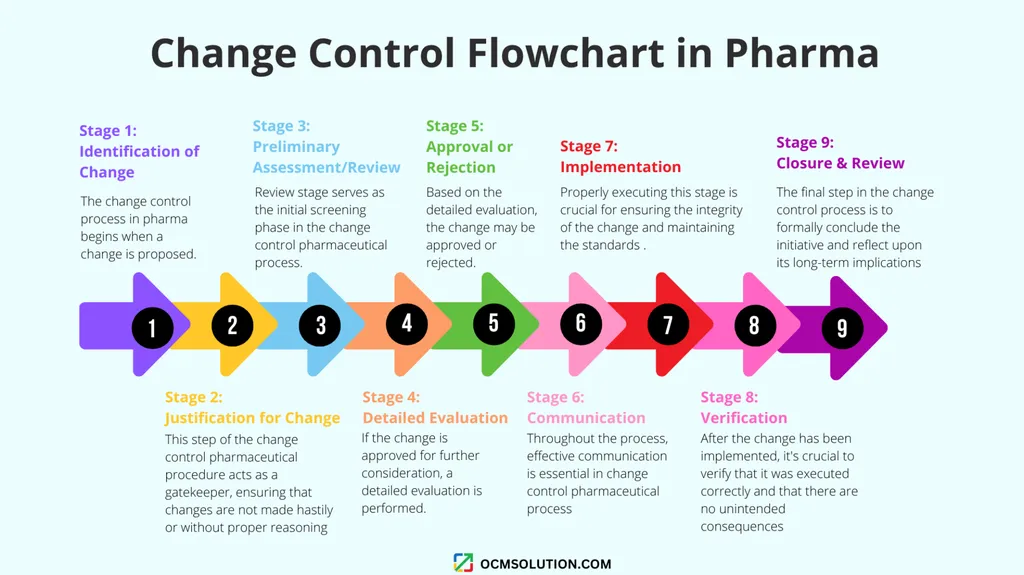
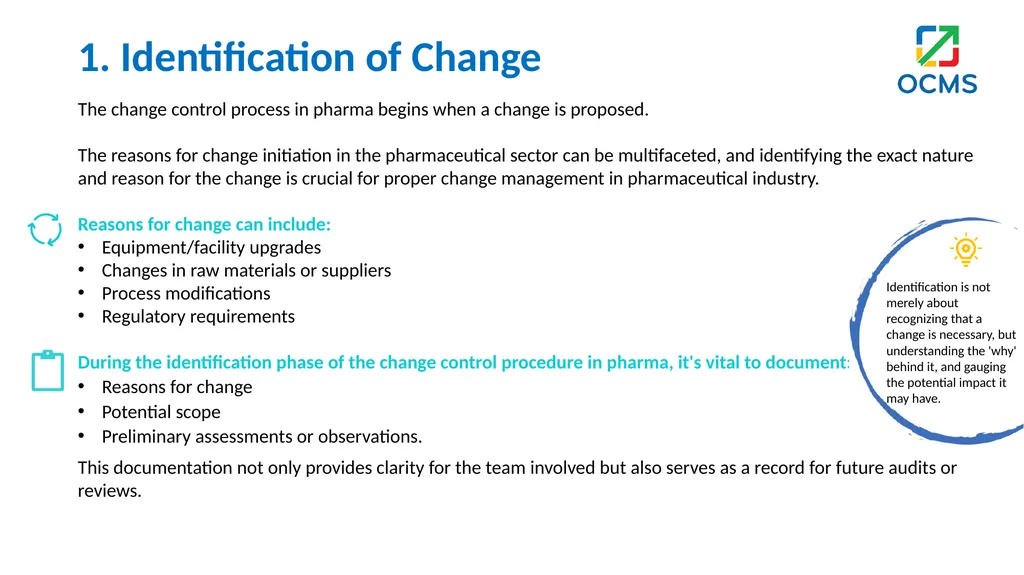
1. Identification of Change The change control process in pharma begins when a change is proposed.
The reasons for change initiation in the pharmaceutical sector can be multifaceted, and identifying the exact nature and reason for the change is crucial for proper change management in pharmaceutical industry.
Reasons for change can include:
Equipment/facility upgrades
Changes in raw materials or suppliers
Process modifications
Regulatory requirements
During the identification phase of the change control procedure in pharma, it's vital to document:
Reasons for change
Potential scope
Preliminary assessments or observations.
This documentation not only provides clarity for the team involved but also serves as a record for future audits or reviews. Identification is not merely about recognizing that a change is necessary, but understanding the 'why' behind it, and gauging the potential impact it may have.<br>
The reasons for change initiation in the pharmaceutical sector can be multifaceted, and identifying the exact nature and reason for the change is crucial for proper change management in pharmaceutical industry.
Reasons for change can include:
Equipment/facility upgrades
Changes in raw materials or suppliers
Process modifications
Regulatory requirements
During the identification phase of the change control procedure in pharma, it's vital to document:
Reasons for change
Potential scope
Preliminary assessments or observations.
This documentation not only provides clarity for the team involved but also serves as a record for future audits or reviews. Identification is not merely about recognizing that a change is necessary, but understanding the 'why' behind it, and gauging the potential impact it may have.<br>
05
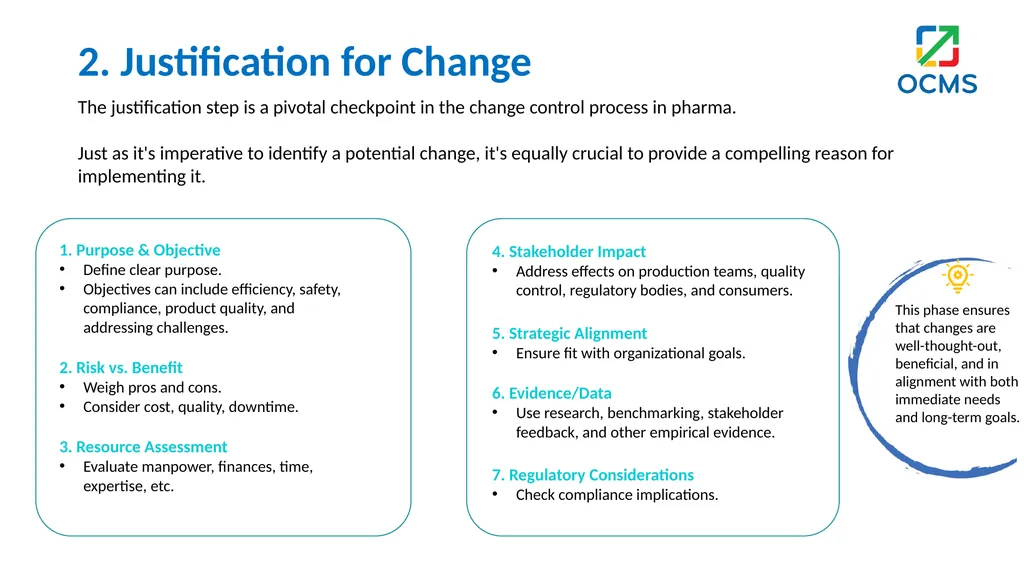
2. Justification for Change The justification step is a pivotal checkpoint in the change control process in pharma.
Just as it's imperative to identify a potential change, it's equally crucial to provide a compelling reason for implementing it. Hour 1 Main Dashboard & Toolkits Overview
The Change Management Workflow
Starting Projects
Templates & Reports
Adding Team Members
Customization
Importing & Exporting 1. Purpose & Objective
Define clear purpose.
Objectives can include efficiency, safety, compliance, product quality, and addressing challenges.
2. Risk vs. Benefit
Weigh pros and cons.
Consider cost, quality, downtime.
3. Resource Assessment
Evaluate manpower, finances, time, expertise, etc. This phase ensures that changes are well-thought-out, beneficial, and in alignment with both immediate needs and long-term goals.<br>
Just as it's imperative to identify a potential change, it's equally crucial to provide a compelling reason for implementing it. Hour 1 Main Dashboard & Toolkits Overview
The Change Management Workflow
Starting Projects
Templates & Reports
Adding Team Members
Customization
Importing & Exporting 1. Purpose & Objective
Define clear purpose.
Objectives can include efficiency, safety, compliance, product quality, and addressing challenges.
2. Risk vs. Benefit
Weigh pros and cons.
Consider cost, quality, downtime.
3. Resource Assessment
Evaluate manpower, finances, time, expertise, etc. This phase ensures that changes are well-thought-out, beneficial, and in alignment with both immediate needs and long-term goals.<br>
06
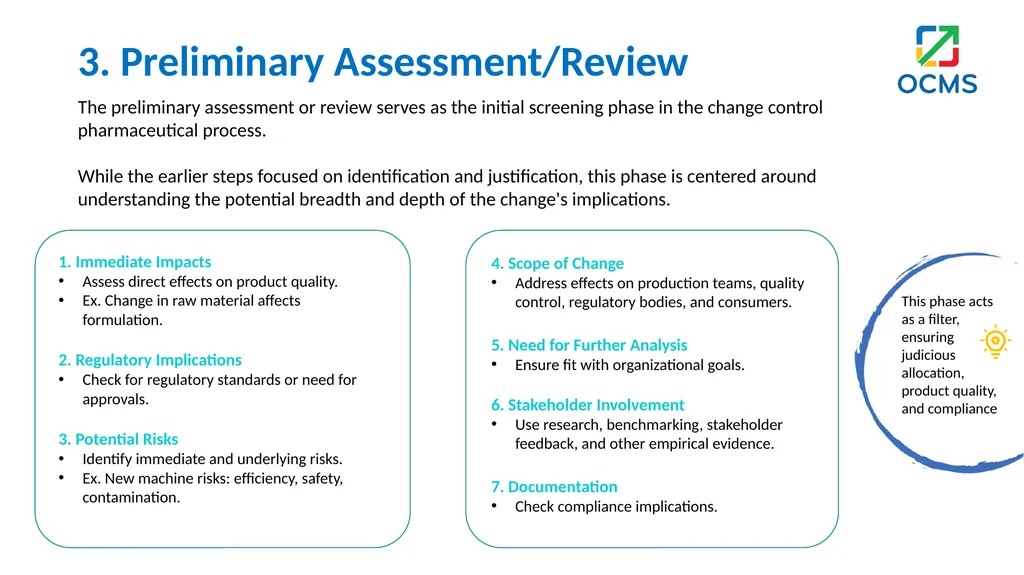
3. Preliminary Assessment/Review The preliminary assessment or review serves as the initial screening phase in the change control pharmaceutical process.
While the earlier steps focused on identification and justification, this phase is centered around understanding the potential breadth and depth of the change's implications. Hour 1 Main Dashboard & Toolkits Overview
The Change Management Workflow
Starting Projects
Templates & Reports
Adding Team Members
Customization
Importing & Exporting 1. Immediate Impacts
Assess direct effects on product quality.
Ex. Change in raw material affects formulation.
2. Regulatory Implications
Check for regulatory standards or need for approvals.
3. Potential Risks
Identify immediate and underlying risks.
Ex. New machine risks: efficiency, safety, contamination. This phase acts as a filter, ensuring judicious allocation, product quality, and compliance<br>
While the earlier steps focused on identification and justification, this phase is centered around understanding the potential breadth and depth of the change's implications. Hour 1 Main Dashboard & Toolkits Overview
The Change Management Workflow
Starting Projects
Templates & Reports
Adding Team Members
Customization
Importing & Exporting 1. Immediate Impacts
Assess direct effects on product quality.
Ex. Change in raw material affects formulation.
2. Regulatory Implications
Check for regulatory standards or need for approvals.
3. Potential Risks
Identify immediate and underlying risks.
Ex. New machine risks: efficiency, safety, contamination. This phase acts as a filter, ensuring judicious allocation, product quality, and compliance<br>
07
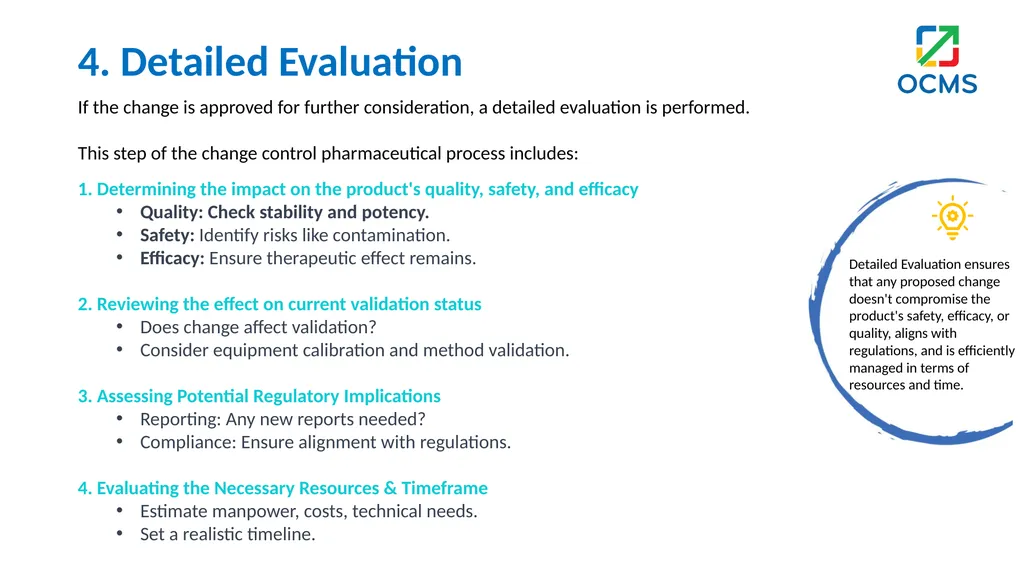
4. Detailed Evaluation If the change is approved for further consideration, a detailed evaluation is performed.
This step of the change control pharmaceutical process includes: Hour 1 Main Dashboard & Toolkits Overview
The Change Management Workflow
Starting Projects
Templates & Reports
Adding Team Members
Customization
Importing & Exporting Detailed Evaluation ensures that any proposed change doesn't compromise the product's safety, efficacy, or quality, aligns with regulations, and is efficiently managed in terms of resources and time. Determining the impact on the product's quality, safety, and efficacy
Quality: Check stability and potency.
Safety: Identify risks like contamination.
Efficacy: Ensure therapeutic effect remains.
Reviewing the effect on current validation status
Does change affect validation?
Consider equipment calibration and method validation.
Assessing Potential Regulatory Implications
Reporting: Any new reports needed?
Compliance: Ensure alignment with regulations.
Evaluating the Necessary Resources & Timeframe
Estimate manpower, costs, technical needs.
Set a realistic timeline.<br>
This step of the change control pharmaceutical process includes: Hour 1 Main Dashboard & Toolkits Overview
The Change Management Workflow
Starting Projects
Templates & Reports
Adding Team Members
Customization
Importing & Exporting Detailed Evaluation ensures that any proposed change doesn't compromise the product's safety, efficacy, or quality, aligns with regulations, and is efficiently managed in terms of resources and time. Determining the impact on the product's quality, safety, and efficacy
Quality: Check stability and potency.
Safety: Identify risks like contamination.
Efficacy: Ensure therapeutic effect remains.
Reviewing the effect on current validation status
Does change affect validation?
Consider equipment calibration and method validation.
Assessing Potential Regulatory Implications
Reporting: Any new reports needed?
Compliance: Ensure alignment with regulations.
Evaluating the Necessary Resources & Timeframe
Estimate manpower, costs, technical needs.
Set a realistic timeline.<br>
08
5. Approval or Rejection Hour 1 Main Dashboard & Toolkits Overview
The Change Management Workflow
Starting Projects
Templates & Reports
Adding Team Members
Customization
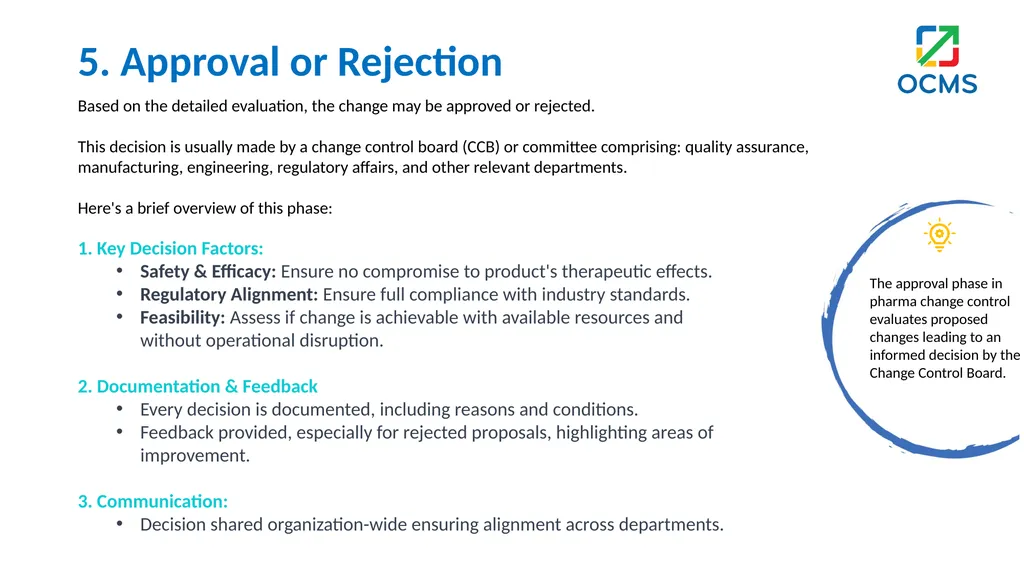
Importing & Exporting The approval phase in pharma change control evaluates proposed changes leading to an informed decision by the Change Control Board. Based on the detailed evaluation, the change may be approved or rejected.
This decision is usually made by a change control board (CCB) or committee comprising: quality assurance, manufacturing, engineering, regulatory affairs, and other relevant departments.
Here's a brief overview of this phase: Key Decision Factors:
Safety & Efficacy: Ensure no compromise to product's therapeutic effects.
Regulatory Alignment: Ensure full compliance with industry standards.
Feasibility: Assess if change is achievable with available resources and without operational disruption.
Documentation & Feedback
Every decision is documented, including reasons and conditions.
Feedback provided, especially for rejected proposals, highlighting areas of improvement.
Communication:
Decision shared organization-wide ensuring alignment across departments.<br>
The Change Management Workflow
Starting Projects
Templates & Reports
Adding Team Members
Customization
Importing & Exporting The approval phase in pharma change control evaluates proposed changes leading to an informed decision by the Change Control Board. Based on the detailed evaluation, the change may be approved or rejected.
This decision is usually made by a change control board (CCB) or committee comprising: quality assurance, manufacturing, engineering, regulatory affairs, and other relevant departments.
Here's a brief overview of this phase: Key Decision Factors:
Safety & Efficacy: Ensure no compromise to product's therapeutic effects.
Regulatory Alignment: Ensure full compliance with industry standards.
Feasibility: Assess if change is achievable with available resources and without operational disruption.
Documentation & Feedback
Every decision is documented, including reasons and conditions.
Feedback provided, especially for rejected proposals, highlighting areas of improvement.
Communication:
Decision shared organization-wide ensuring alignment across departments.<br>
09
6. Communication Hour 1 Main Dashboard & Toolkits Overview
The Change Management Workflow
Starting Projects
Templates & Reports
Adding Team Members
Customization
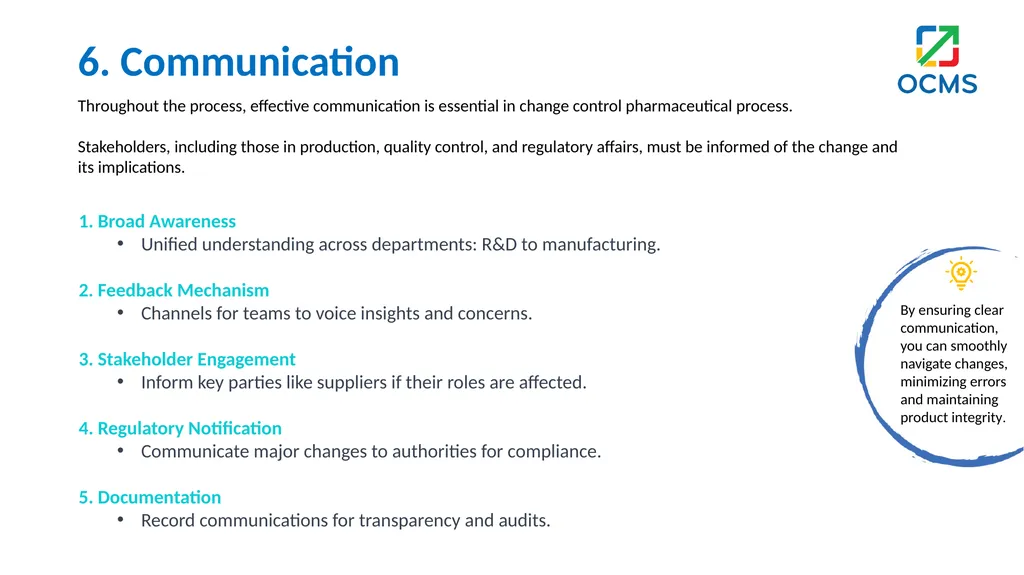
Importing & Exporting By ensuring clear communication, you can smoothly navigate changes, minimizing errors and maintaining product integrity. Throughout the process, effective communication is essential in change control pharmaceutical process.
Stakeholders, including those in production, quality control, and regulatory affairs, must be informed of the change and its implications. Broad Awareness
Unified understanding across departments: R&D to manufacturing.
Feedback Mechanism
Channels for teams to voice insights and concerns.
Stakeholder Engagement
Inform key parties like suppliers if their roles are affected.
Regulatory Notification
Communicate major changes to authorities for compliance.
Documentation
Record communications for transparency and audits.<br>
The Change Management Workflow
Starting Projects
Templates & Reports
Adding Team Members
Customization
Importing & Exporting By ensuring clear communication, you can smoothly navigate changes, minimizing errors and maintaining product integrity. Throughout the process, effective communication is essential in change control pharmaceutical process.
Stakeholders, including those in production, quality control, and regulatory affairs, must be informed of the change and its implications. Broad Awareness
Unified understanding across departments: R&D to manufacturing.
Feedback Mechanism
Channels for teams to voice insights and concerns.
Stakeholder Engagement
Inform key parties like suppliers if their roles are affected.
Regulatory Notification
Communicate major changes to authorities for compliance.
Documentation
Record communications for transparency and audits.<br>
10
7. Implementation Hour 1 Main Dashboard & Toolkits Overview
The Change Management Workflow
Starting Projects
Templates & Reports
Adding Team Members
Customization
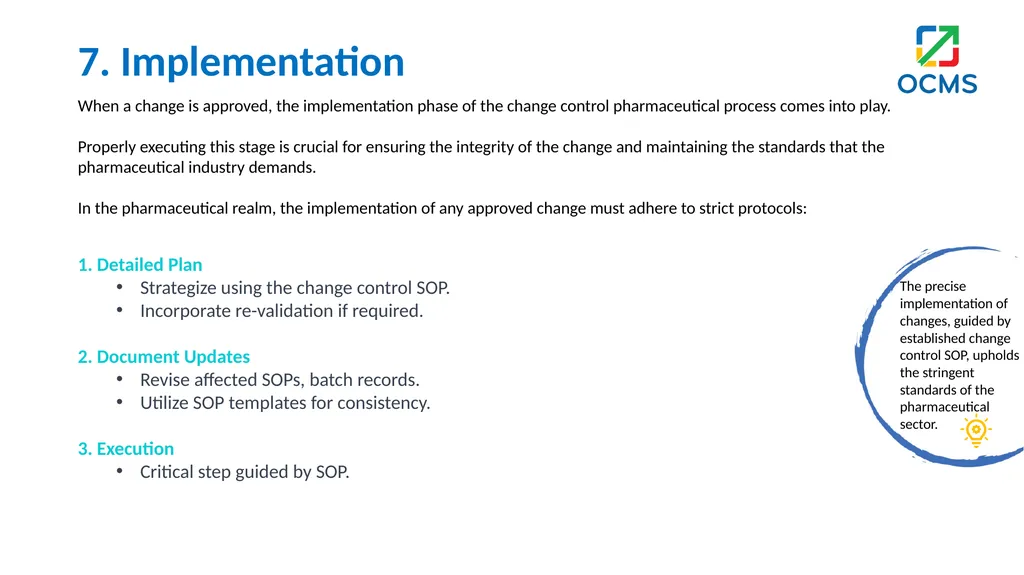
Importing & Exporting The precise implementation of changes, guided by established change control SOP, upholds the stringent standards of the pharmaceutical sector. When a change is approved, the implementation phase of the change control pharmaceutical process comes into play.
Properly executing this stage is crucial for ensuring the integrity of the change and maintaining the standards that the pharmaceutical industry demands.
In the pharmaceutical realm, the implementation of any approved change must adhere to strict protocols: Detailed Plan
Strategize using the change control SOP.
Incorporate re-validation if required.
Document Updates
Revise affected SOPs, batch records.
Utilize SOP templates for consistency.
Execution
Critical step guided by SOP.<br>
The Change Management Workflow
Starting Projects
Templates & Reports
Adding Team Members
Customization
Importing & Exporting The precise implementation of changes, guided by established change control SOP, upholds the stringent standards of the pharmaceutical sector. When a change is approved, the implementation phase of the change control pharmaceutical process comes into play.
Properly executing this stage is crucial for ensuring the integrity of the change and maintaining the standards that the pharmaceutical industry demands.
In the pharmaceutical realm, the implementation of any approved change must adhere to strict protocols: Detailed Plan
Strategize using the change control SOP.
Incorporate re-validation if required.
Document Updates
Revise affected SOPs, batch records.
Utilize SOP templates for consistency.
Execution
Critical step guided by SOP.<br>
11
8. Verification Hour 1 Main Dashboard & Toolkits Overview
The Change Management Workflow
Starting Projects
Templates & Reports
Adding Team Members
Customization
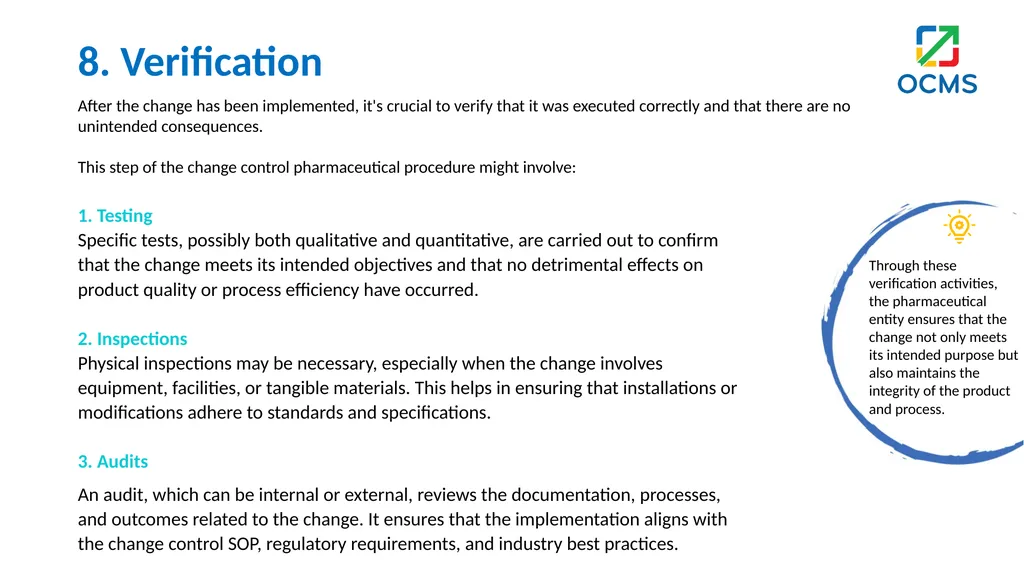
Importing & Exporting Through these verification activities, the pharmaceutical entity ensures that the change not only meets its intended purpose but also maintains the integrity of the product and process. After the change has been implemented, it's crucial to verify that it was executed correctly and that there are no unintended consequences.
This step of the change control pharmaceutical procedure might involve: 1. Testing
Specific tests, possibly both qualitative and quantitative, are carried out to confirm that the change meets its intended objectives and that no detrimental effects on product quality or process efficiency have occurred.
2. Inspections
Physical inspections may be necessary, especially when the change involves equipment, facilities, or tangible materials. This helps in ensuring that installations or modifications adhere to standards and specifications.
3. Audits
An audit, which can be internal or external, reviews the documentation, processes, and outcomes related to the change. It ensures that the implementation aligns with the change control SOP, regulatory requirements, and industry best practices.<br>
The Change Management Workflow
Starting Projects
Templates & Reports
Adding Team Members
Customization
Importing & Exporting Through these verification activities, the pharmaceutical entity ensures that the change not only meets its intended purpose but also maintains the integrity of the product and process. After the change has been implemented, it's crucial to verify that it was executed correctly and that there are no unintended consequences.
This step of the change control pharmaceutical procedure might involve: 1. Testing
Specific tests, possibly both qualitative and quantitative, are carried out to confirm that the change meets its intended objectives and that no detrimental effects on product quality or process efficiency have occurred.
2. Inspections
Physical inspections may be necessary, especially when the change involves equipment, facilities, or tangible materials. This helps in ensuring that installations or modifications adhere to standards and specifications.
3. Audits
An audit, which can be internal or external, reviews the documentation, processes, and outcomes related to the change. It ensures that the implementation aligns with the change control SOP, regulatory requirements, and industry best practices.<br>
12
9. Closure and Review Hour 1 Main Dashboard & Toolkits Overview
The Change Management Workflow
Starting Projects
Templates & Reports
Adding Team Members
Customization
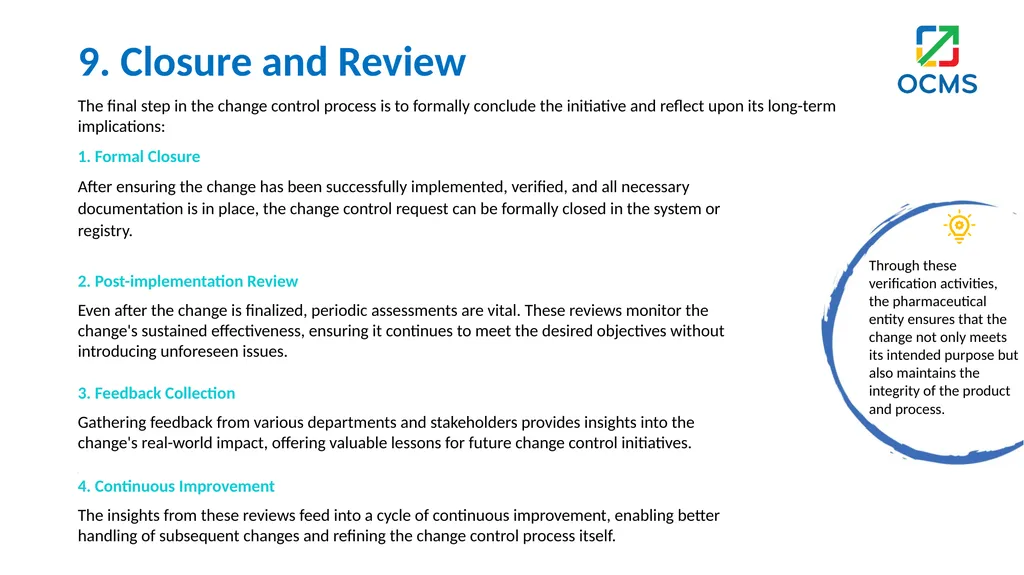
Importing & Exporting Through these verification activities, the pharmaceutical entity ensures that the change not only meets its intended purpose but also maintains the integrity of the product and process. The final step in the change control process is to formally conclude the initiative and reflect upon its long-term implications: 1. Formal Closure
After ensuring the change has been successfully implemented, verified, and all necessary documentation is in place, the change control request can be formally closed in the system or registry.
2. Post-implementation Review
Even after the change is finalized, periodic assessments are vital. These reviews monitor the change's sustained effectiveness, ensuring it continues to meet the desired objectives without introducing unforeseen issues.
3. Feedback Collection
Gathering feedback from various departments and stakeholders provides insights into the change's real-world impact, offering valuable lessons for future change control initiatives.
a
4. Continuous Improvement
The insights from these reviews feed into a cycle of continuous improvement, enabling better handling of subsequent changes and refining the change control process itself.<br>
The Change Management Workflow
Starting Projects
Templates & Reports
Adding Team Members
Customization
Importing & Exporting Through these verification activities, the pharmaceutical entity ensures that the change not only meets its intended purpose but also maintains the integrity of the product and process. The final step in the change control process is to formally conclude the initiative and reflect upon its long-term implications: 1. Formal Closure
After ensuring the change has been successfully implemented, verified, and all necessary documentation is in place, the change control request can be formally closed in the system or registry.
2. Post-implementation Review
Even after the change is finalized, periodic assessments are vital. These reviews monitor the change's sustained effectiveness, ensuring it continues to meet the desired objectives without introducing unforeseen issues.
3. Feedback Collection
Gathering feedback from various departments and stakeholders provides insights into the change's real-world impact, offering valuable lessons for future change control initiatives.
a
4. Continuous Improvement
The insights from these reviews feed into a cycle of continuous improvement, enabling better handling of subsequent changes and refining the change control process itself.<br>
13
Want to Learn More? Visit:
OCMSolution.com<br>
OCMSolution.com<br>