
CHANGE MANAGEMENT MODELS BY CHOOLS CONSULTING
LO
Published · 104 slides · 0 views

1 / 1




Description
CHANGE MANAGEMENT MODELS BY CHOOLS CONSULTING SERVICE www.chools.in AGENDA Change Management Models Classic Change Curve ACMP Standard for Change Management ADDIE Model Beckhards Change Model Bridges Transition Model Burke-Litwin Change
Related Topics
Share
Embed code
Download this presentation From Below
"CHANGE MANAGEMENT MODELS BY CHOOLS CONSULTING" is the property of its rightful owner. Permission is granted to download and print the materials on this website for personal, non-commercial use only, and to display it on your personal computer provided you do not modify the materials and that you retain all copyright notices contained in the materials. By downloading content from our website, you accept the terms of this agreement.
Presentation Transcript
01
CHANGE MANAGEMENT MODELS BY CHOOLS CONSULTING SERVICE www.chools.in<br>
02
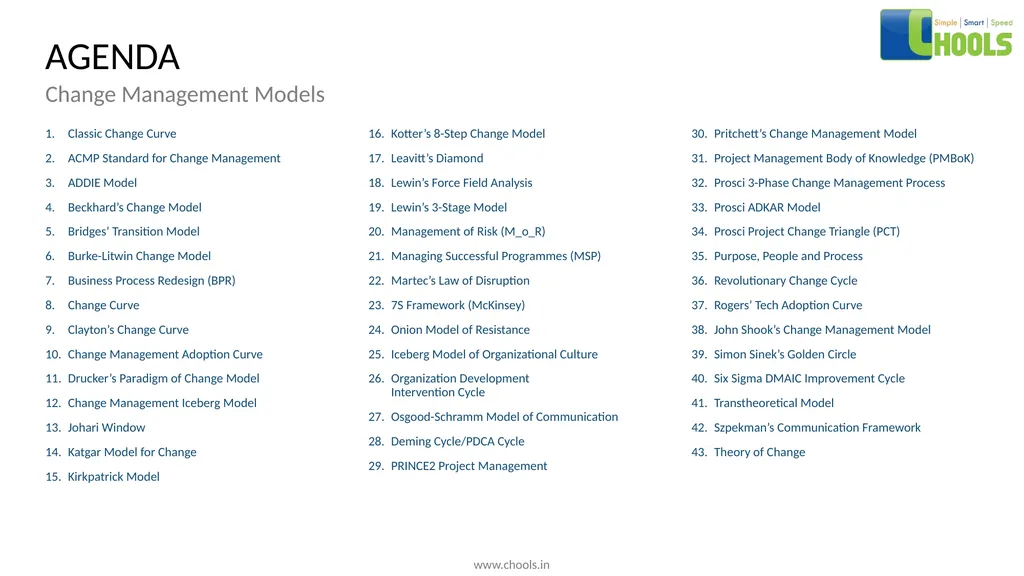
AGENDA Change Management Models Classic Change Curve
ACMP Standard for Change Management
ADDIE Model
Beckhard’s Change Model
Bridges’ Transition Model
Burke-Litwin Change Model
Business Process Redesign (BPR)
Change Curve
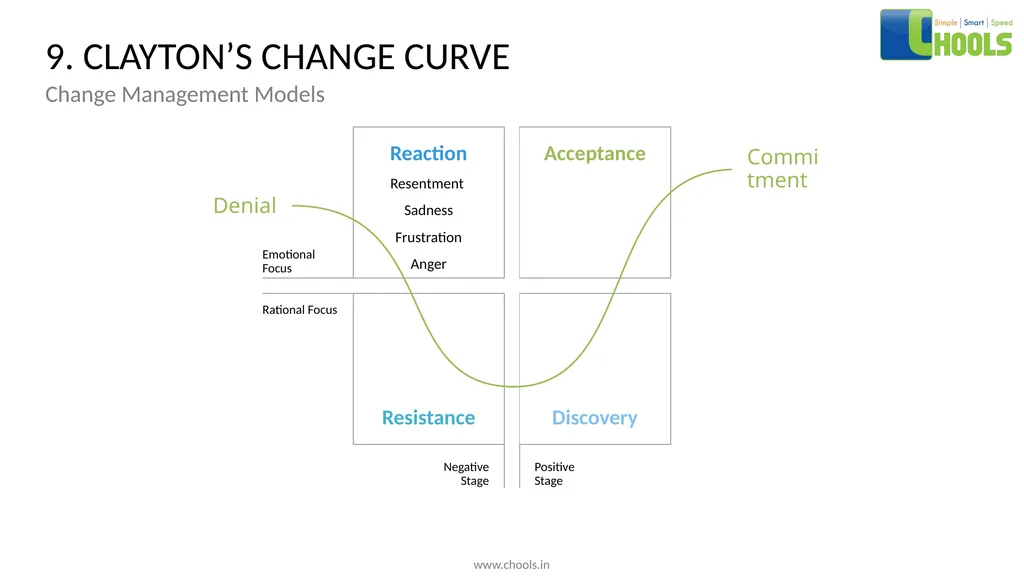
Clayton’s Change Curve
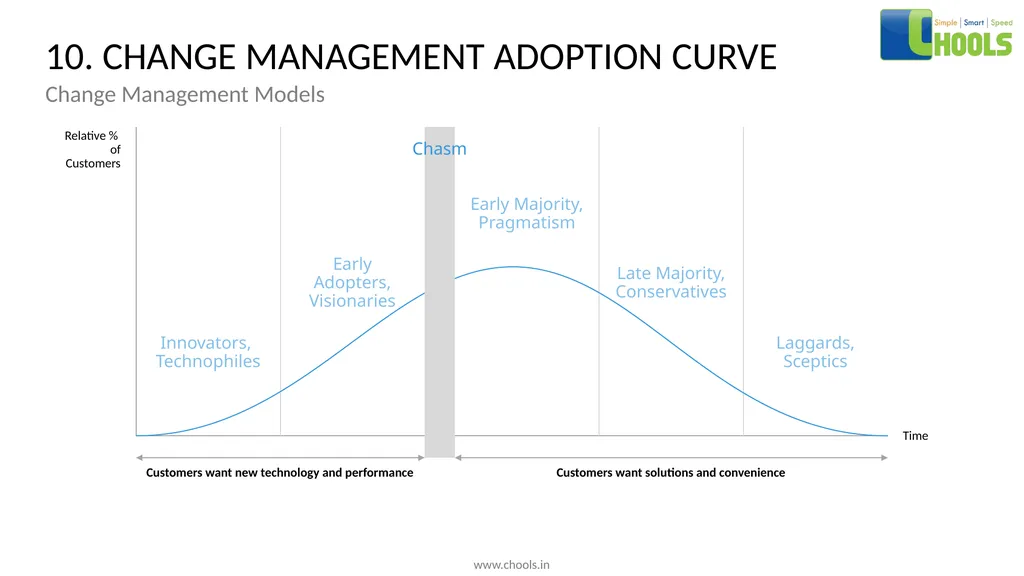
Change Management Adoption Curve
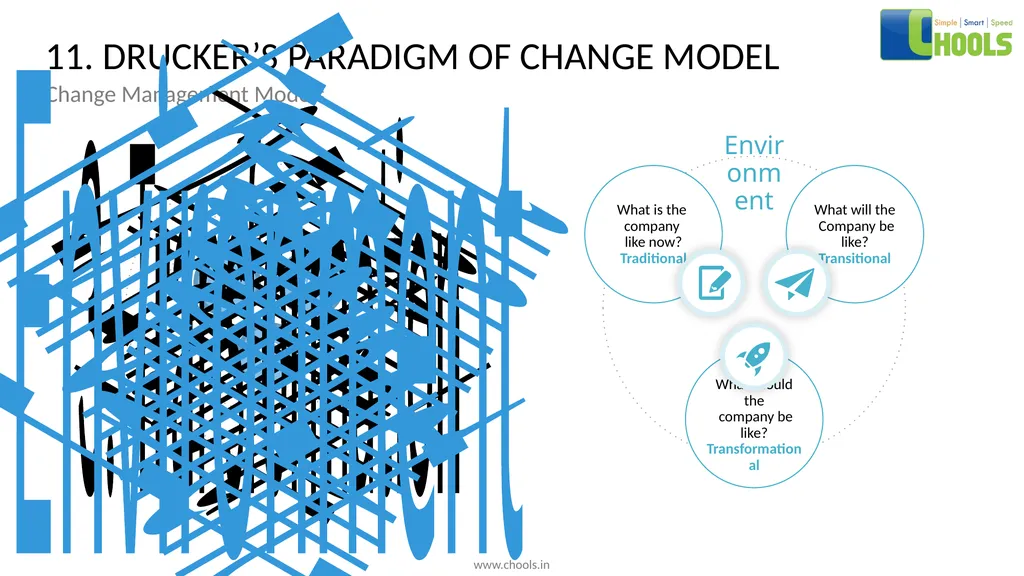
Drucker’s Paradigm of Change Model
Change Management Iceberg Model
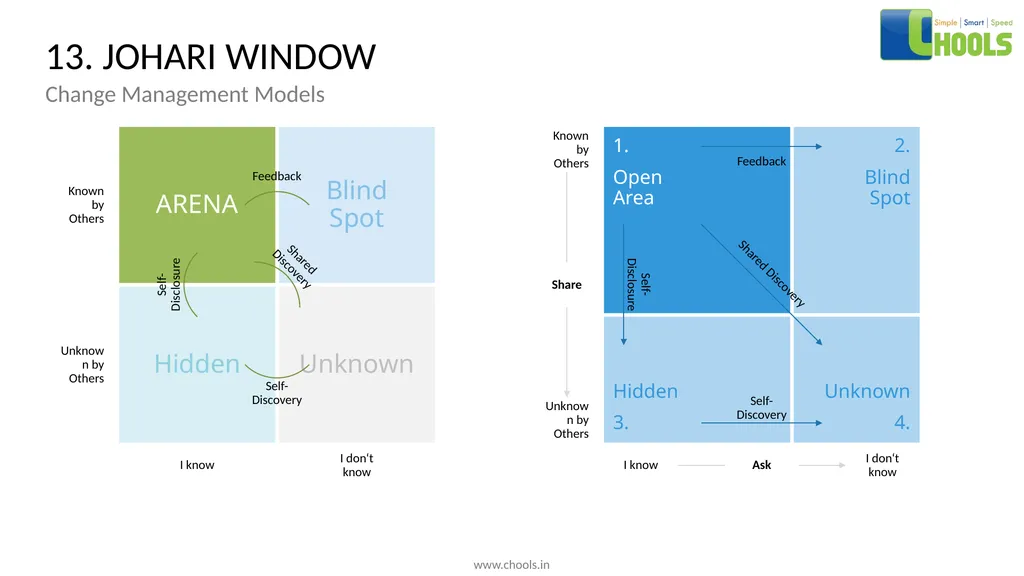
Johari Window
Katgar Model for Change
Kirkpatrick Model Kotter’s 8-Step Change Model
Leavitt’s Diamond
Lewin’s Force Field Analysis
Lewin’s 3-Stage Model
Management of Risk (M_o_R)
Managing Successful Programmes (MSP)
Martec’s Law of Disruption
7S Framework (McKinsey)
Onion Model of Resistance
Iceberg Model of Organizational Culture
Organization Development Intervention Cycle
Osgood-Schramm Model of Communication
Deming Cycle/PDCA Cycle
PRINCE2 Project Management Pritchett’s Change Management Model
Project Management Body of Knowledge (PMBoK)
Prosci 3-Phase Change Management Process
Prosci ADKAR Model
Prosci Project Change Triangle (PCT)
Purpose, People and Process
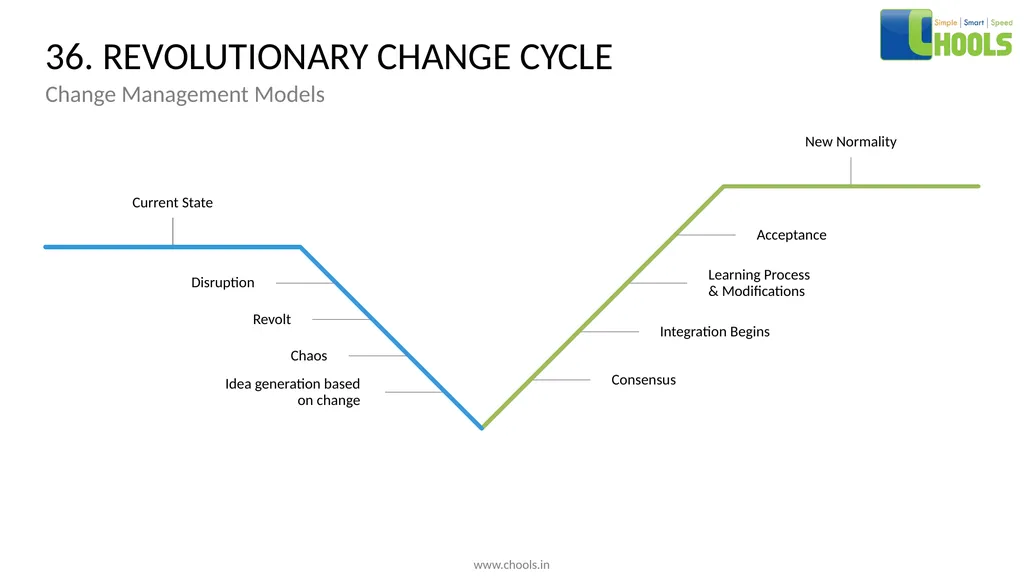
Revolutionary Change Cycle
Rogers’ Tech Adoption Curve
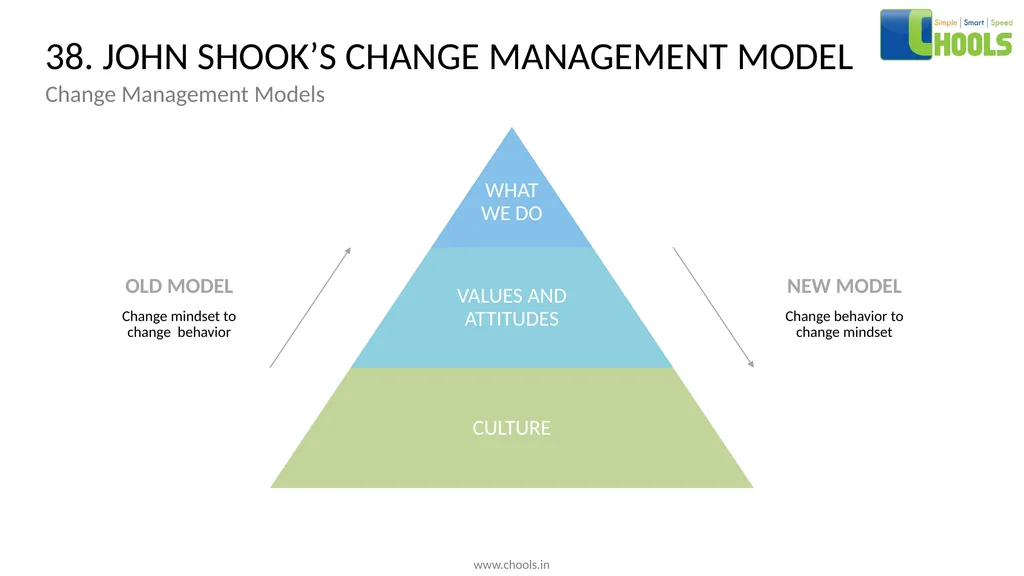
John Shook’s Change Management Model
Simon Sinek’s Golden Circle
Six Sigma DMAIC Improvement Cycle
Transtheoretical Model
Szpekman’s Communication Framework
Theory of Change www.chools.in<br>
ACMP Standard for Change Management
ADDIE Model
Beckhard’s Change Model
Bridges’ Transition Model
Burke-Litwin Change Model
Business Process Redesign (BPR)
Change Curve
Clayton’s Change Curve
Change Management Adoption Curve
Drucker’s Paradigm of Change Model
Change Management Iceberg Model
Johari Window
Katgar Model for Change
Kirkpatrick Model Kotter’s 8-Step Change Model
Leavitt’s Diamond
Lewin’s Force Field Analysis
Lewin’s 3-Stage Model
Management of Risk (M_o_R)
Managing Successful Programmes (MSP)
Martec’s Law of Disruption
7S Framework (McKinsey)
Onion Model of Resistance
Iceberg Model of Organizational Culture
Organization Development Intervention Cycle
Osgood-Schramm Model of Communication
Deming Cycle/PDCA Cycle
PRINCE2 Project Management Pritchett’s Change Management Model
Project Management Body of Knowledge (PMBoK)
Prosci 3-Phase Change Management Process
Prosci ADKAR Model
Prosci Project Change Triangle (PCT)
Purpose, People and Process
Revolutionary Change Cycle
Rogers’ Tech Adoption Curve
John Shook’s Change Management Model
Simon Sinek’s Golden Circle
Six Sigma DMAIC Improvement Cycle
Transtheoretical Model
Szpekman’s Communication Framework
Theory of Change www.chools.in<br>
03
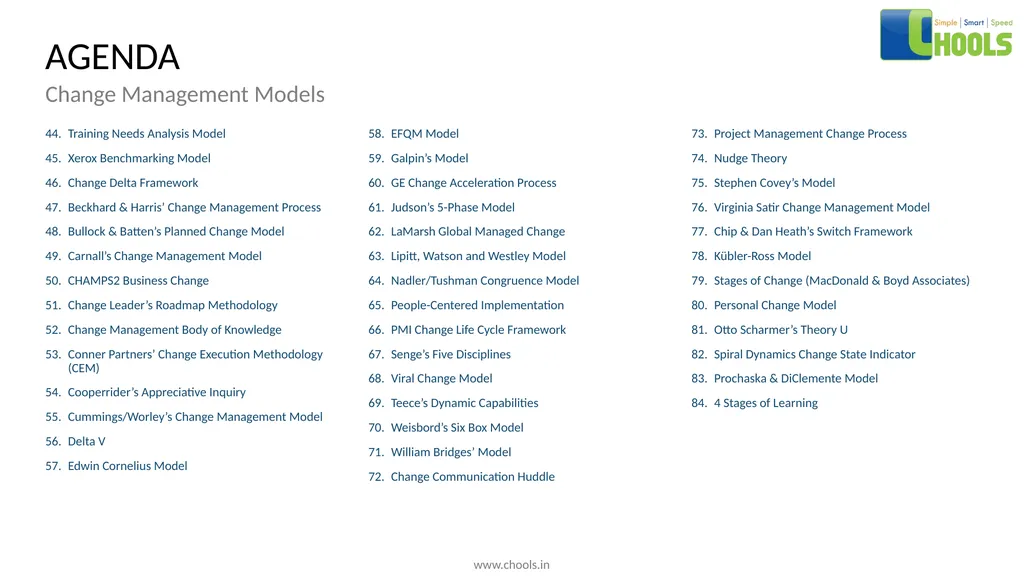
AGENDA Change Management Models Training Needs Analysis Model
Xerox Benchmarking Model
Change Delta Framework
Beckhard & Harris’ Change Management Process
Bullock & Batten’s Planned Change Model
Carnall’s Change Management Model
CHAMPS2 Business Change
Change Leader’s Roadmap Methodology
Change Management Body of Knowledge
Conner Partners’ Change Execution Methodology (CEM)
Cooperrider’s Appreciative Inquiry
Cummings/Worley’s Change Management Model
Delta V
Edwin Cornelius Model EFQM Model
Galpin’s Model
GE Change Acceleration Process
Judson’s 5-Phase Model
LaMarsh Global Managed Change
Lipitt, Watson and Westley Model
Nadler/Tushman Congruence Model
People-Centered Implementation
PMI Change Life Cycle Framework
Senge’s Five Disciplines
Viral Change Model
Teece’s Dynamic Capabilities
Weisbord’s Six Box Model
William Bridges’ Model
Change Communication Huddle Project Management Change Process
Nudge Theory
Stephen Covey’s Model
Virginia Satir Change Management Model
Chip & Dan Heath’s Switch Framework
Kübler-Ross Model
Stages of Change (MacDonald & Boyd Associates)
Personal Change Model
Otto Scharmer’s Theory U
Spiral Dynamics Change State Indicator
Prochaska & DiClemente Model
4 Stages of Learning www.chools.in<br>
Xerox Benchmarking Model
Change Delta Framework
Beckhard & Harris’ Change Management Process
Bullock & Batten’s Planned Change Model
Carnall’s Change Management Model
CHAMPS2 Business Change
Change Leader’s Roadmap Methodology
Change Management Body of Knowledge
Conner Partners’ Change Execution Methodology (CEM)
Cooperrider’s Appreciative Inquiry
Cummings/Worley’s Change Management Model
Delta V
Edwin Cornelius Model EFQM Model
Galpin’s Model
GE Change Acceleration Process
Judson’s 5-Phase Model
LaMarsh Global Managed Change
Lipitt, Watson and Westley Model
Nadler/Tushman Congruence Model
People-Centered Implementation
PMI Change Life Cycle Framework
Senge’s Five Disciplines
Viral Change Model
Teece’s Dynamic Capabilities
Weisbord’s Six Box Model
William Bridges’ Model
Change Communication Huddle Project Management Change Process
Nudge Theory
Stephen Covey’s Model
Virginia Satir Change Management Model
Chip & Dan Heath’s Switch Framework
Kübler-Ross Model
Stages of Change (MacDonald & Boyd Associates)
Personal Change Model
Otto Scharmer’s Theory U
Spiral Dynamics Change State Indicator
Prochaska & DiClemente Model
4 Stages of Learning www.chools.in<br>
04
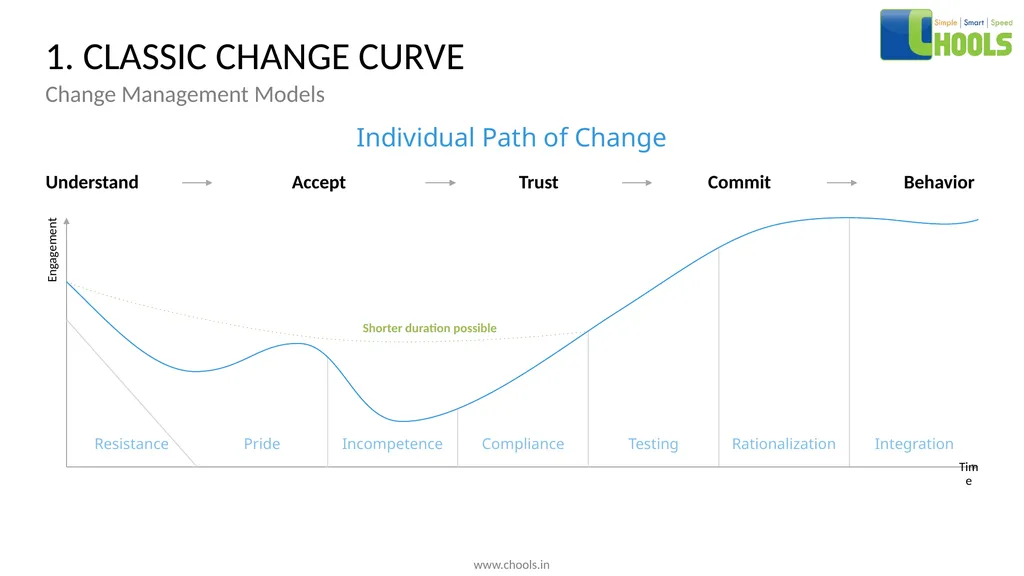
1. CLASSIC CHANGE CURVE Change Management Models www.chools.in<br>
05
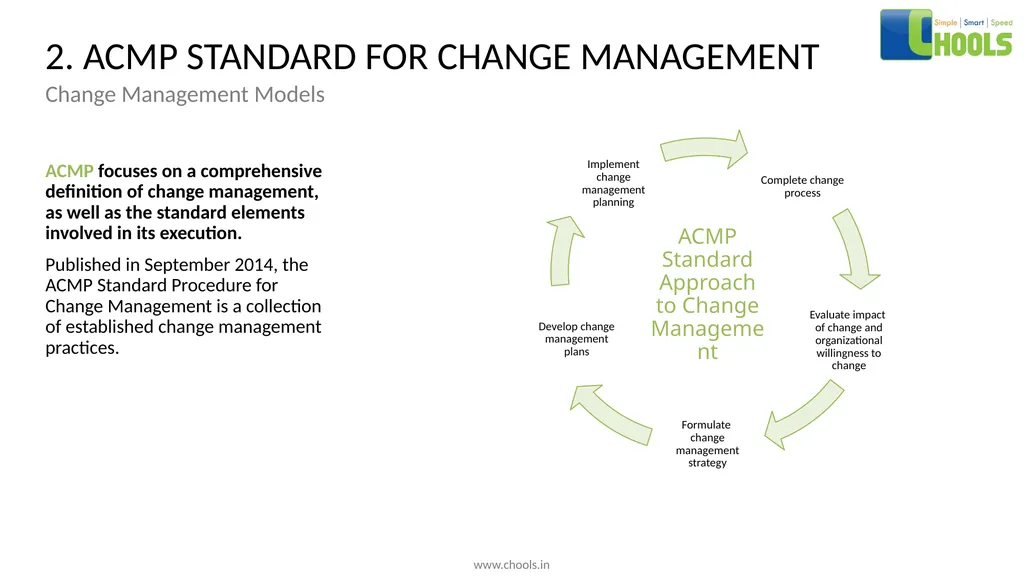
2. ACMP STANDARD FOR CHANGE MANAGEMENT Change Management Models ACMP focuses on a comprehensive definition of change management, as well as the standard elements involved in its execution.
Published in September 2014, the ACMP Standard Procedure for Change Management is a collection of established change management practices. ACMP Standard Approach to Change Management www.chools.in<br>
Published in September 2014, the ACMP Standard Procedure for Change Management is a collection of established change management practices. ACMP Standard Approach to Change Management www.chools.in<br>
06
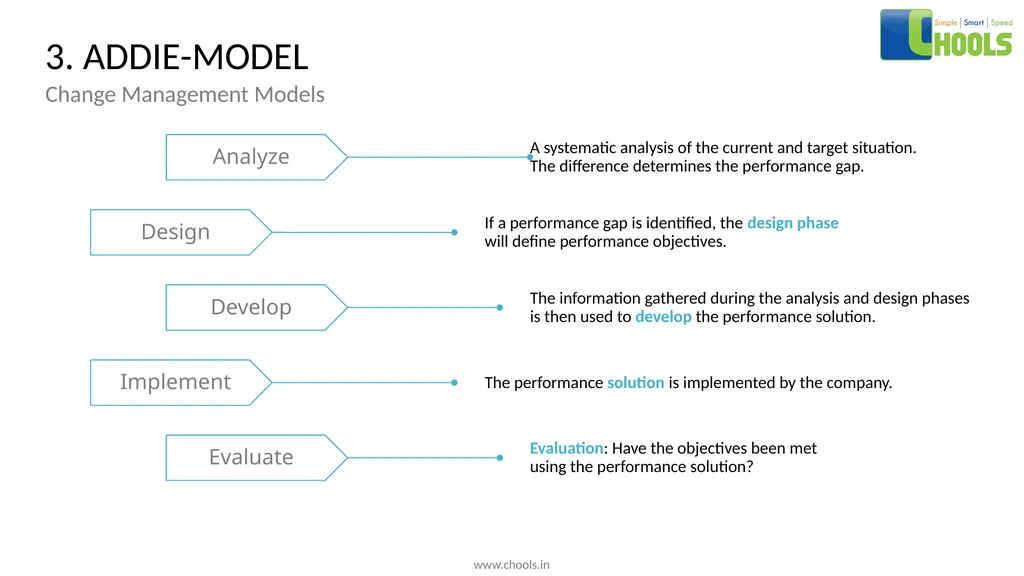
3. ADDIE-MODEL Change Management Models A systematic analysis of the current and target situation.
The difference determines the performance gap. If a performance gap is identified, the design phase
will define performance objectives. The information gathered during the analysis and design phases is then used to develop the performance solution. The performance solution is implemented by the company. Evaluation: Have the objectives been met
using the performance solution? www.chools.in<br>
07
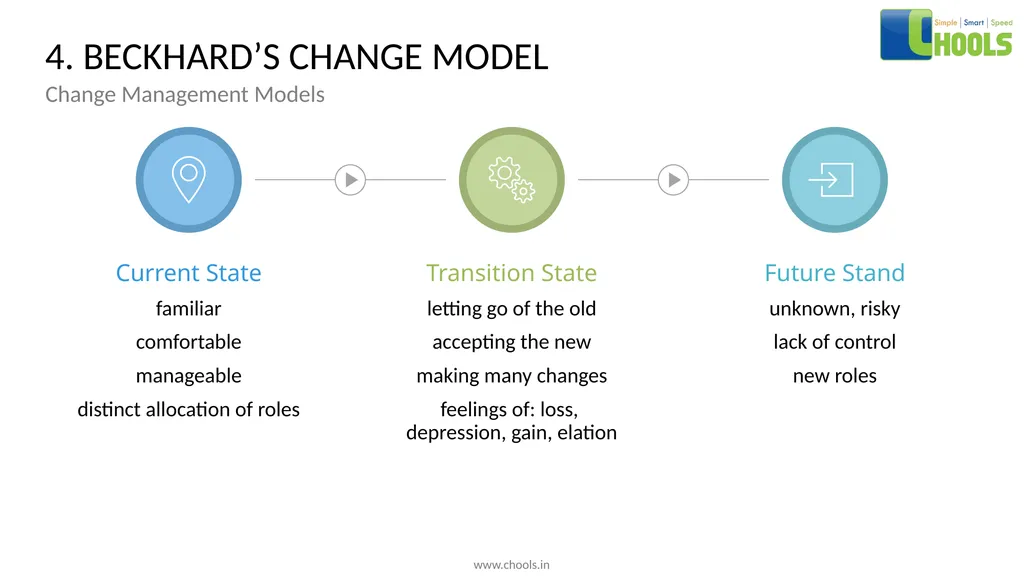
4. BECKHARD’S CHANGE MODEL Change Management Models Current State
familiar
comfortable
manageable
distinct allocation of roles Transition State
letting go of the old
accepting the new
making many changes
feelings of: loss, depression, gain, elation Future Stand
unknown, risky
lack of control
new roles www.chools.in<br>
familiar
comfortable
manageable
distinct allocation of roles Transition State
letting go of the old
accepting the new
making many changes
feelings of: loss, depression, gain, elation Future Stand
unknown, risky
lack of control
new roles www.chools.in<br>
08
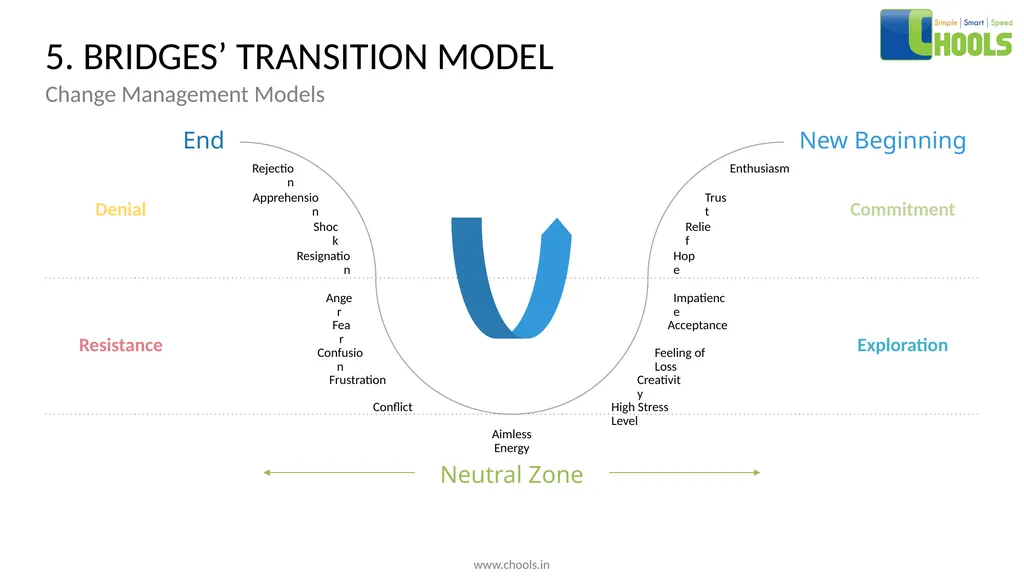
5. BRIDGES’ TRANSITION MODEL Change Management Models End New Beginning www.chools.in<br>
09
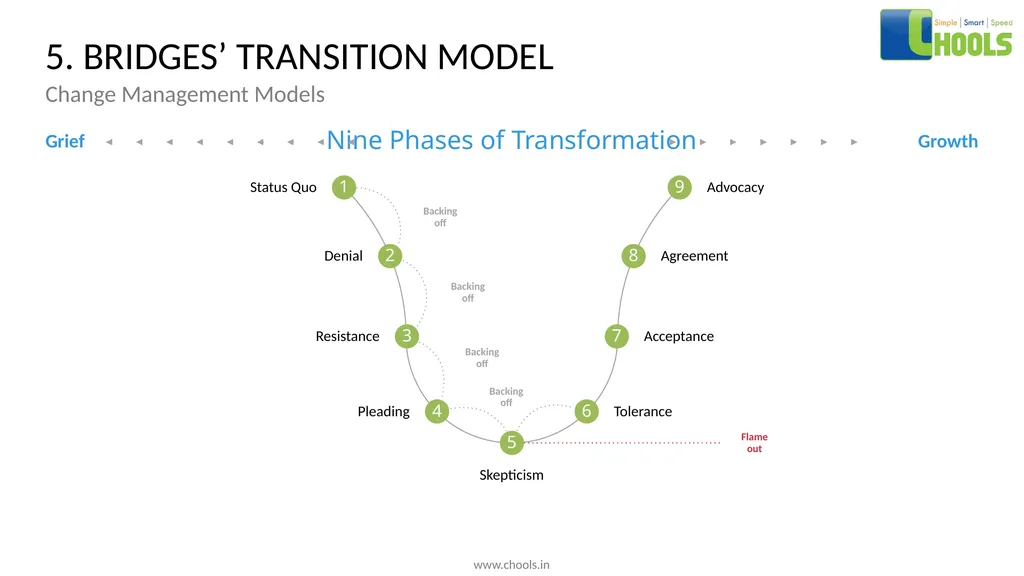
Nine Phases of Transformation 5. BRIDGES’ TRANSITION MODEL Change Management Models www.chools.in<br>
10
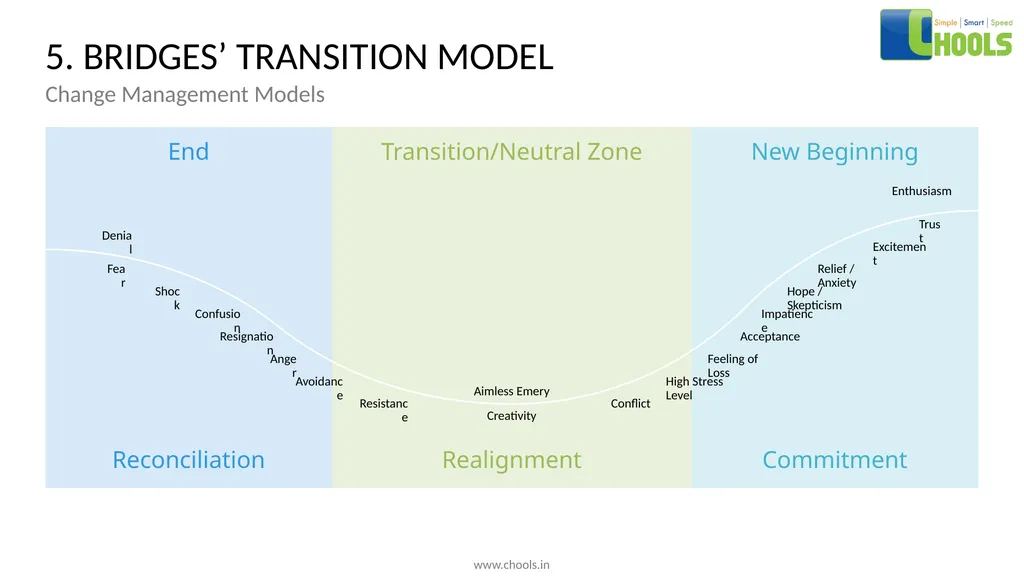
5. BRIDGES’ TRANSITION MODEL Change Management Models End Transition/Neutral Zone New Beginning Reconciliation Realignment Commitment Denial Fear Shock Confusion Resignation Anger Avoidance Resistance Aimless Emery
Creativity Conflict High Stress Level Feeling of Loss Acceptance Impatience Hope / Skepticism Relief / Anxiety Excitement Trust Enthusiasm www.chools.in<br>
Creativity Conflict High Stress Level Feeling of Loss Acceptance Impatience Hope / Skepticism Relief / Anxiety Excitement Trust Enthusiasm www.chools.in<br>
11
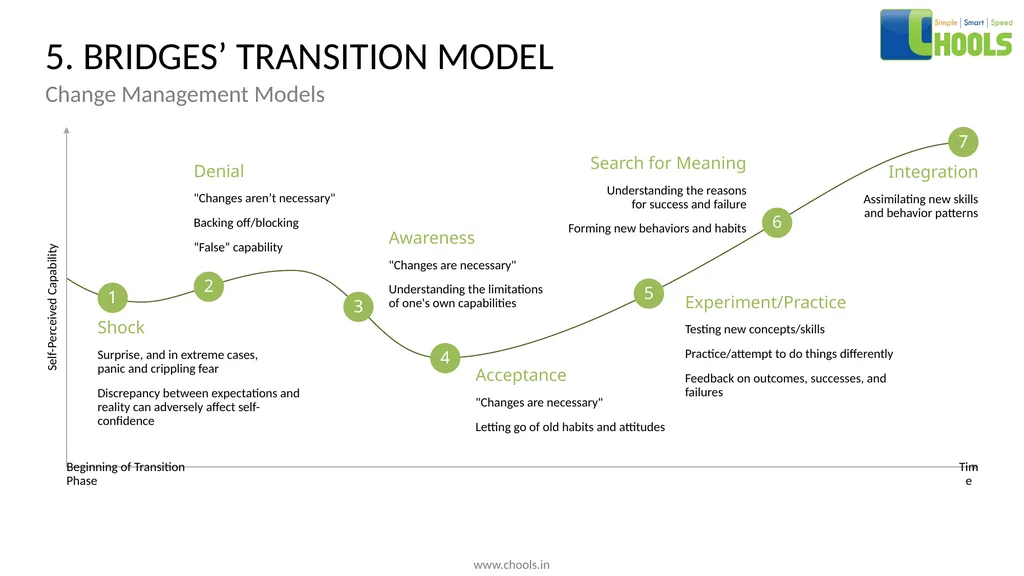
5. BRIDGES’ TRANSITION MODEL Change Management Models www.chools.in<br>
12
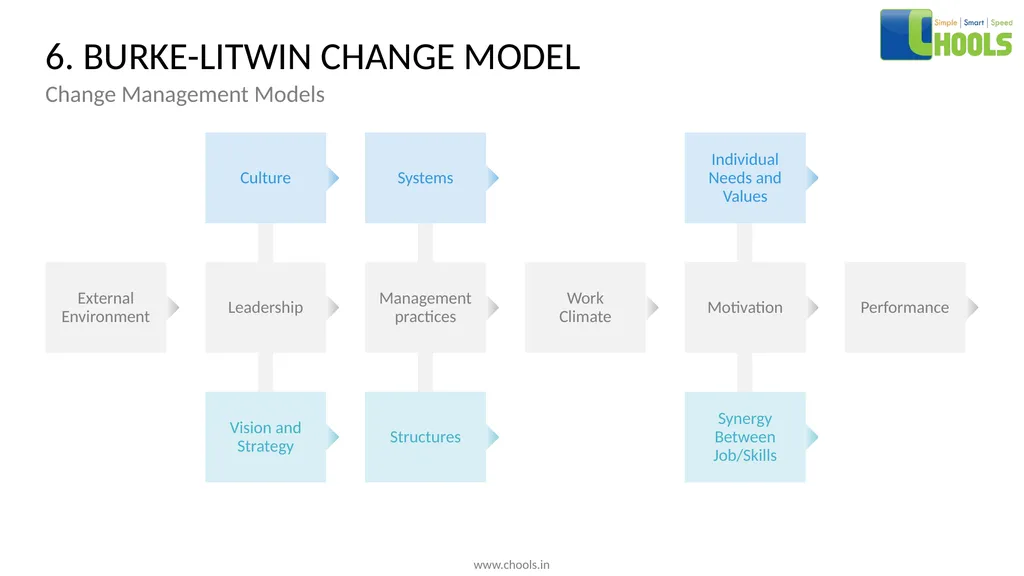
6. BURKE-LITWIN CHANGE MODEL Change Management Models www.chools.in<br>
13
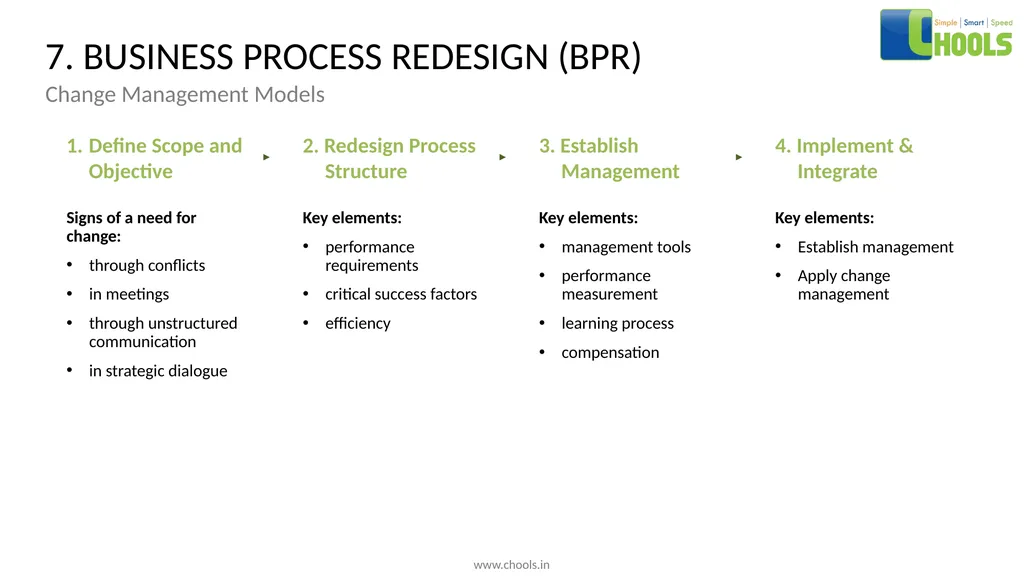
7. BUSINESS PROCESS REDESIGN (BPR) Change Management Models Signs of a need for change:
through conflicts
in meetings
through unstructured communication
in strategic dialogue Key elements:
performance requirements
critical success factors
efficiency Key elements:
management tools
performance measurement
learning process
compensation Key elements:
Establish management
Apply change management 1. Define Scope and Objective 2. Redesign Process Structure 3. Establish Management 4. Implement & Integrate www.chools.in<br>
through conflicts
in meetings
through unstructured communication
in strategic dialogue Key elements:
performance requirements
critical success factors
efficiency Key elements:
management tools
performance measurement
learning process
compensation Key elements:
Establish management
Apply change management 1. Define Scope and Objective 2. Redesign Process Structure 3. Establish Management 4. Implement & Integrate www.chools.in<br>
14
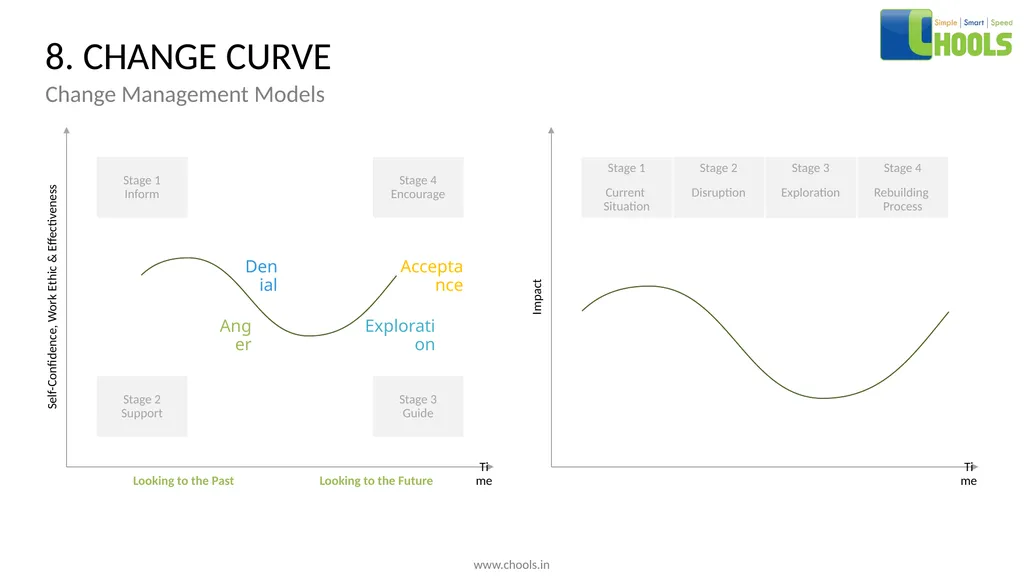
8. CHANGE CURVE Change Management Models www.chools.in<br>
15
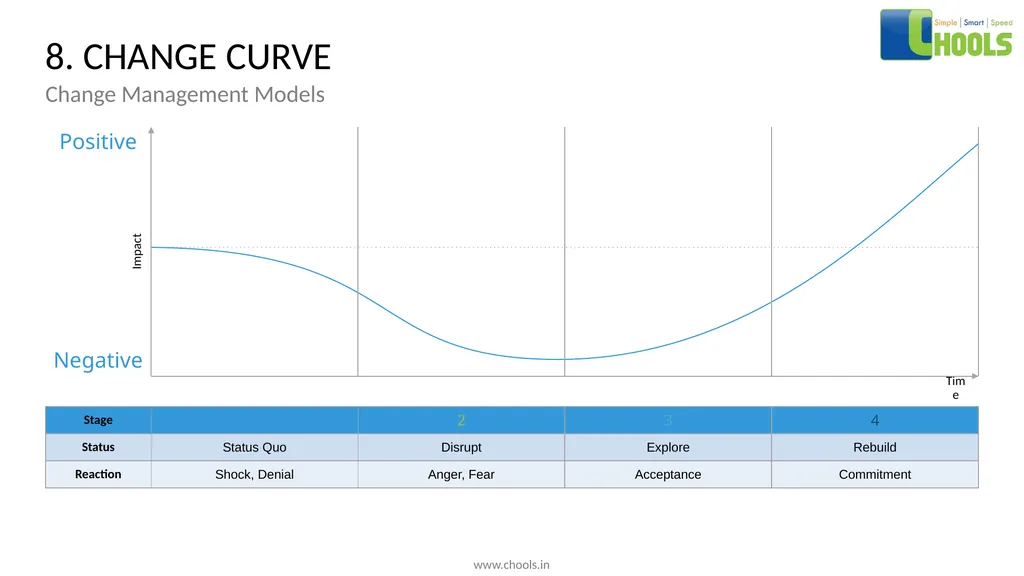
8. CHANGE CURVE Change Management Models www.chools.in<br>
16
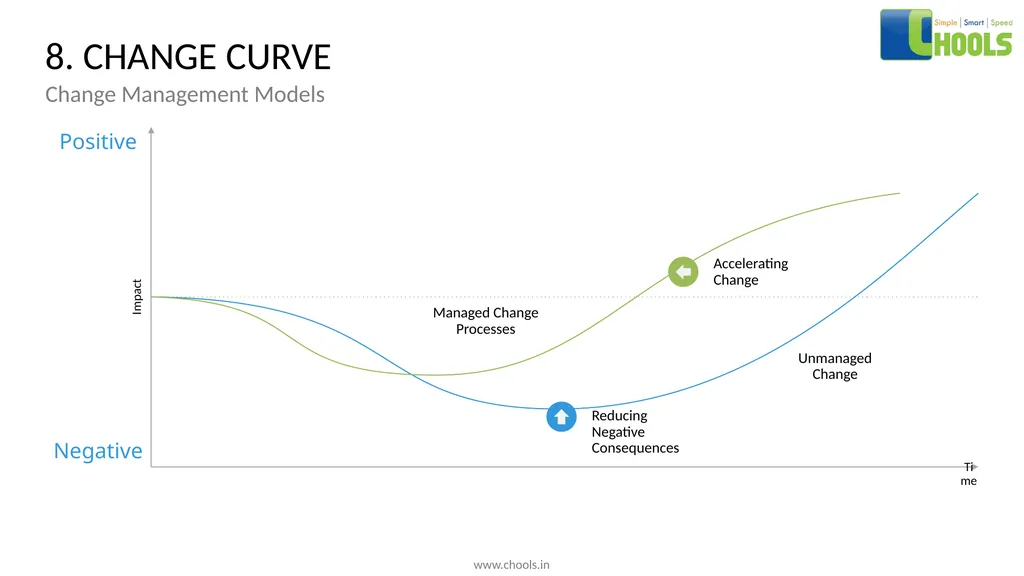
8. CHANGE CURVE Change Management Models Impact Time Positive Negative www.chools.in<br>
17
9. CLAYTON’S CHANGE CURVE Change Management Models www.chools.in<br>
18
10. CHANGE MANAGEMENT ADOPTION CURVE Change Management Models www.chools.in<br>
19
11. DRUCKER’S PARADIGM OF CHANGE MODEL Change Management Models www.chools.in<br>
20
12. CHANGE MANAGEMENT ICEBERG MODEL Change Management Models Logical Rational Aware Know-How
Essential External Facts Emotional Instinctive
Immaterial Internal
Social Skills www.chools.in<br>
Essential External Facts Emotional Instinctive
Immaterial Internal
Social Skills www.chools.in<br>
21
13. JOHARI WINDOW Change Management Models www.chools.in<br>
22
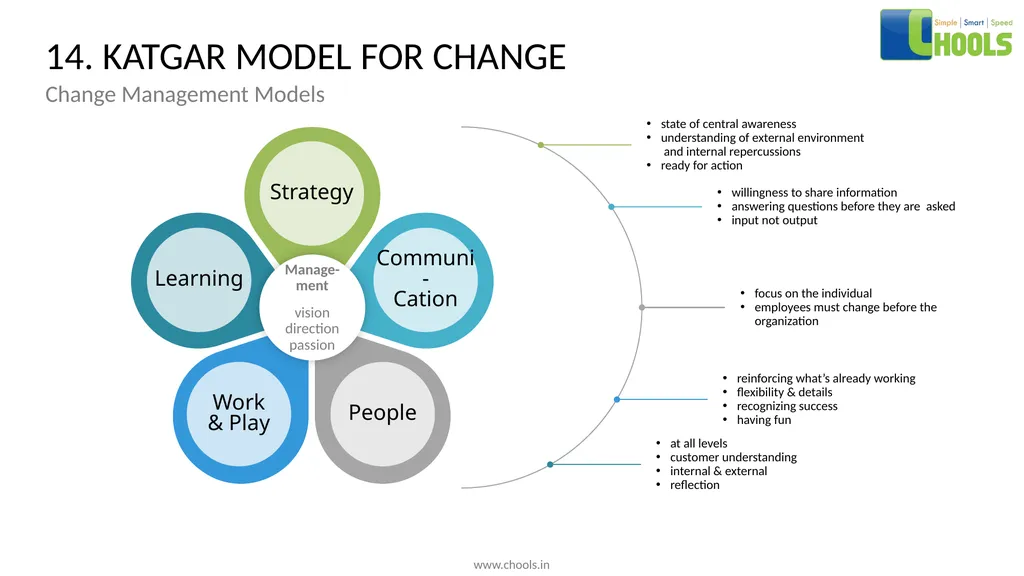
14. KATGAR MODEL FOR CHANGE Change Management Models www.chools.in<br>
23
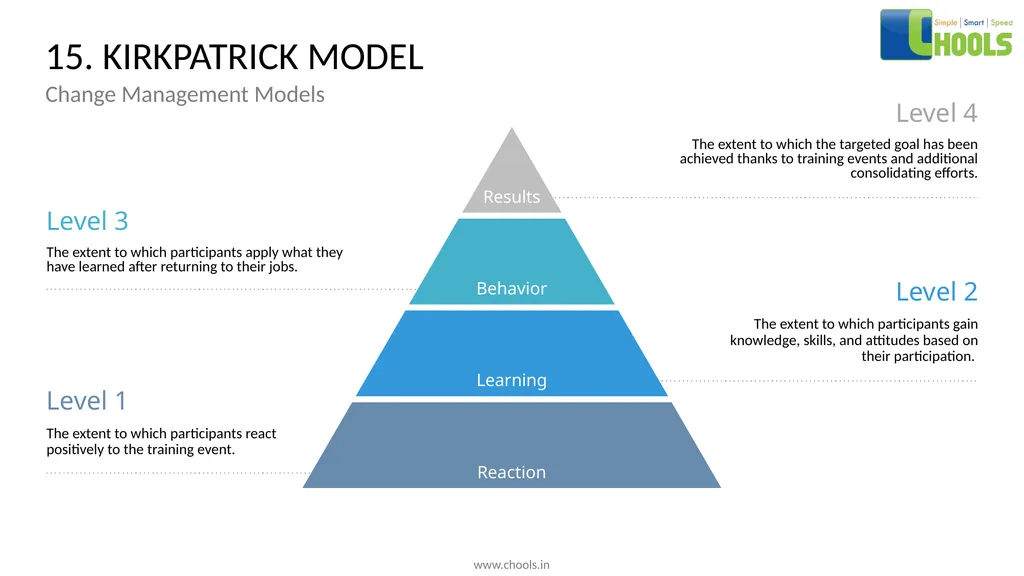
15. KIRKPATRICK MODEL Change Management Models www.chools.in<br>
24
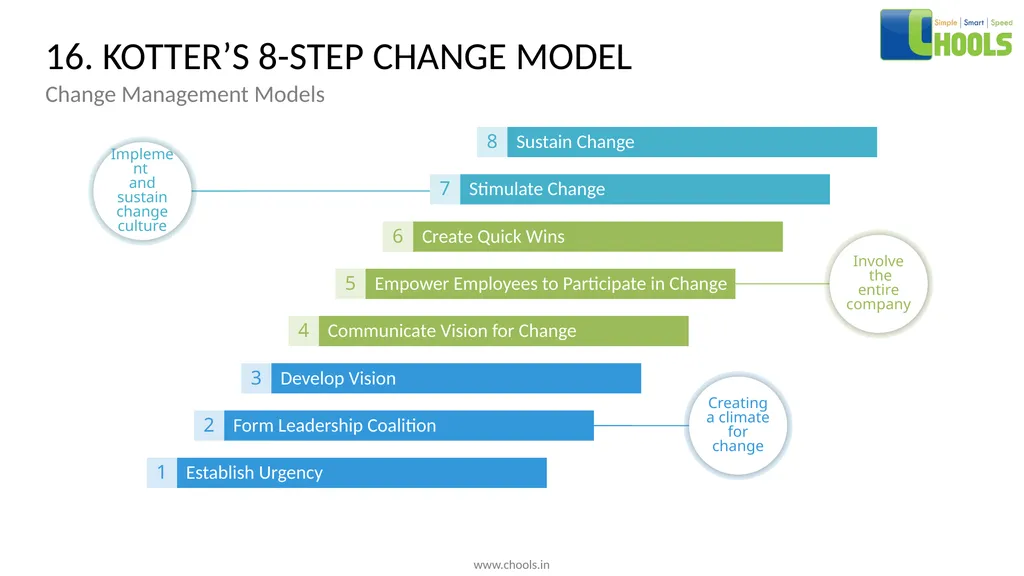
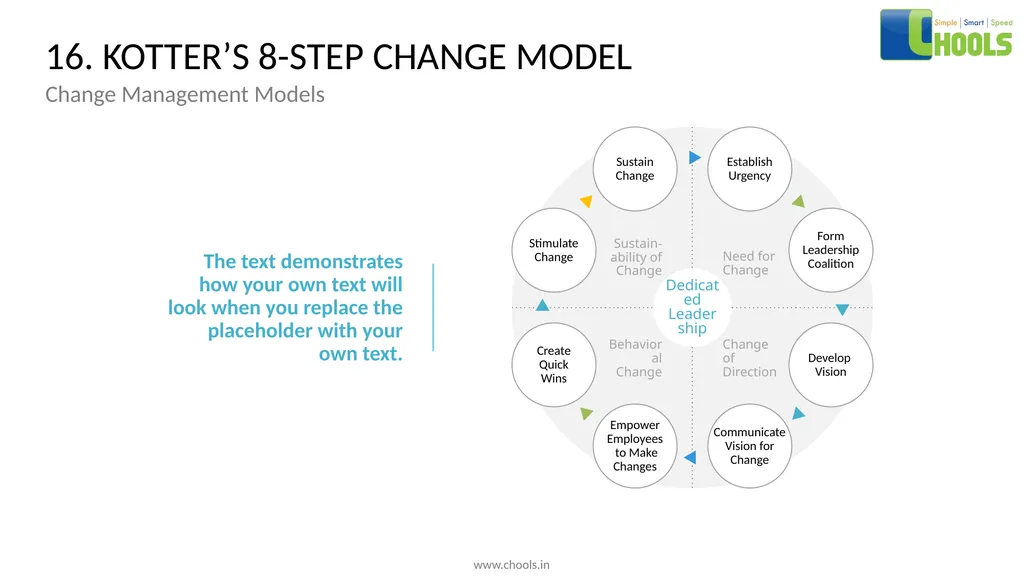
16. KOTTER’S 8-STEP CHANGE MODEL Change Management Models www.chools.in<br>
25
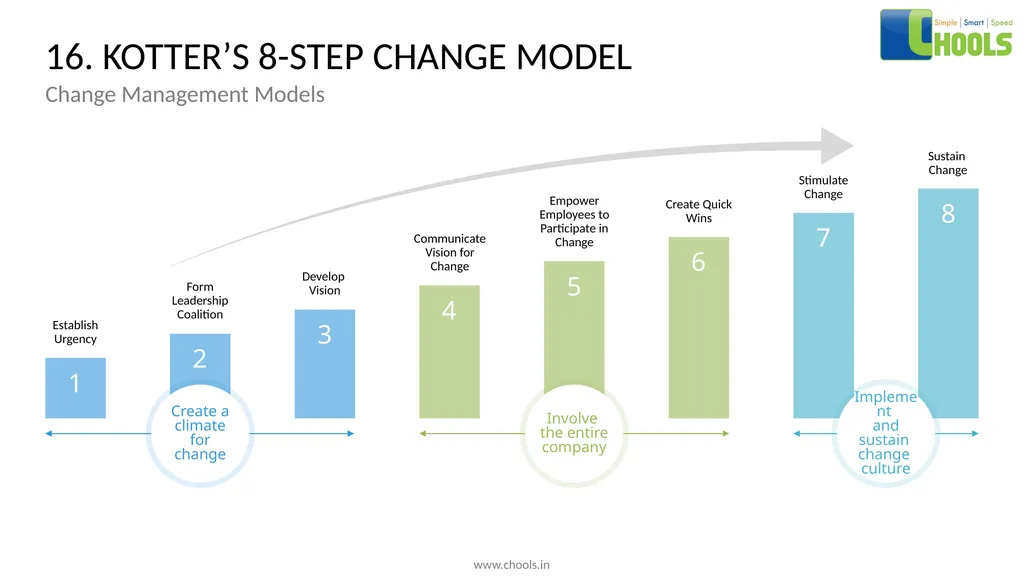
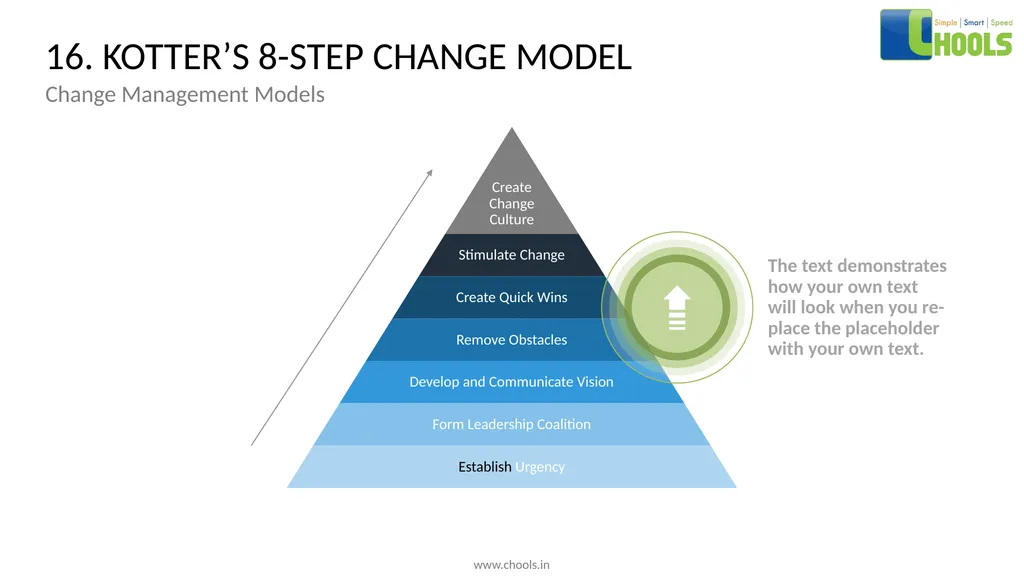
16. KOTTER’S 8-STEP CHANGE MODEL Change Management Models www.chools.in<br>
26
16. KOTTER’S 8-STEP CHANGE MODEL Change Management Models The text demonstrates how your own text will look when you replace the placeholder with your own text. www.chools.in<br>
27
16. KOTTER’S 8-STEP CHANGE MODEL Change Management Models The text demonstrates how your own text will look when you re-place the placeholder with your own text. www.chools.in<br>
28
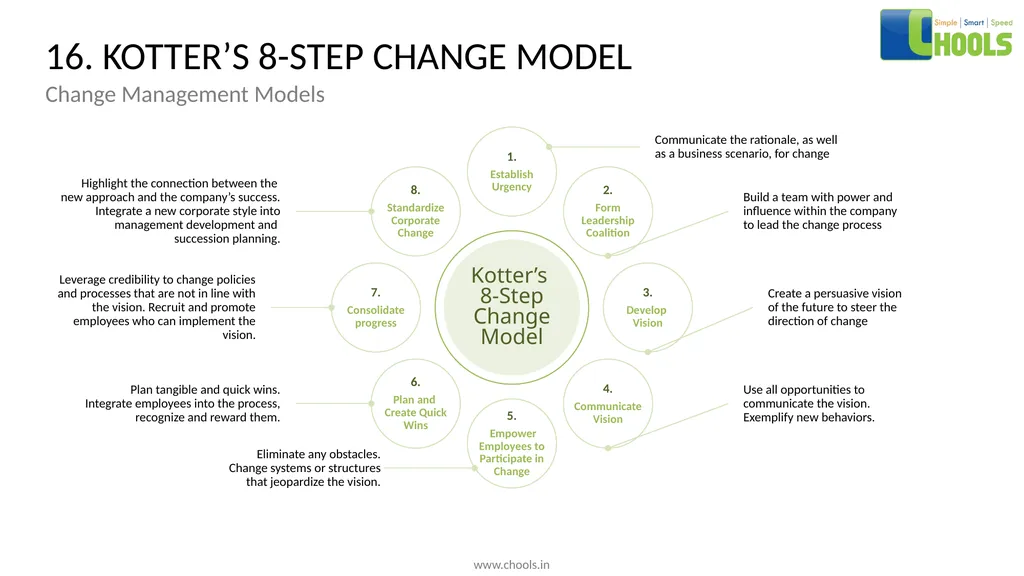
16. KOTTER’S 8-STEP CHANGE MODEL Change Management Models www.chools.in<br>
29
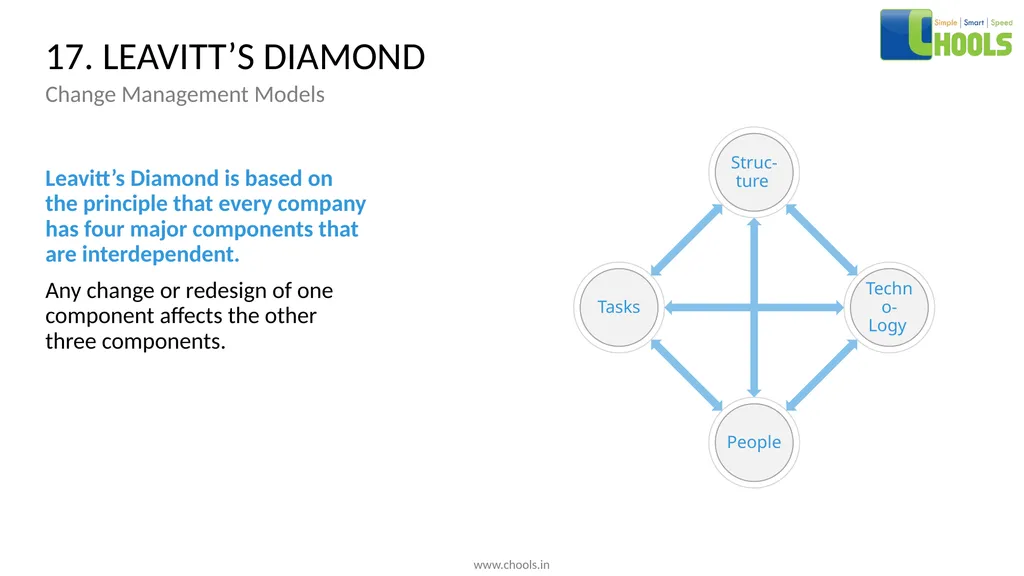
17. LEAVITT’S DIAMOND Change Management Models Leavitt’s Diamond is based on
the principle that every company
has four major components that
are interdependent.
Any change or redesign of one component affects the other three components. www.chools.in<br>
Any change or redesign of one component affects the other three components. www.chools.in<br>
30
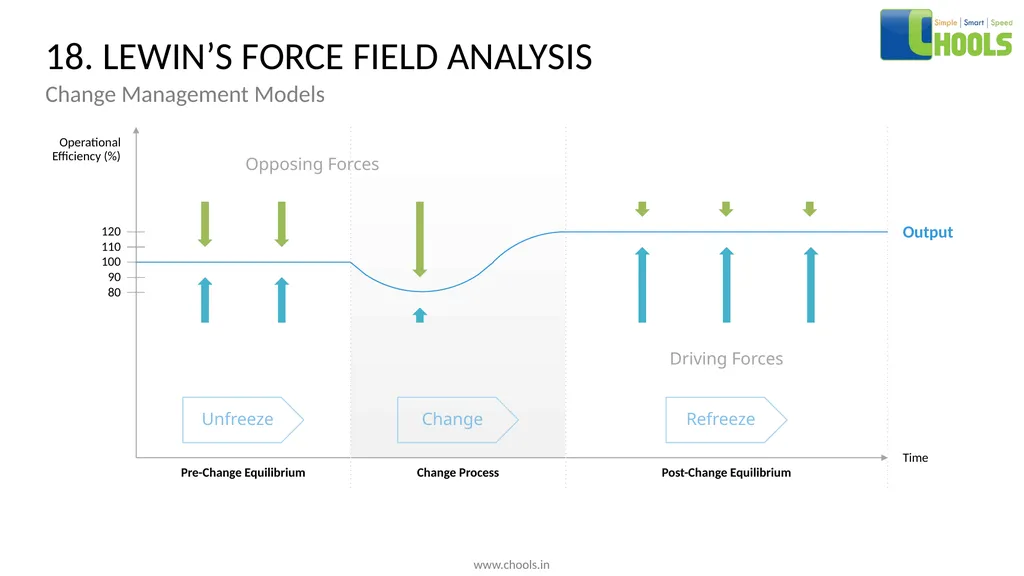
18. LEWIN’S FORCE FIELD ANALYSIS Change Management Models www.chools.in<br>
31
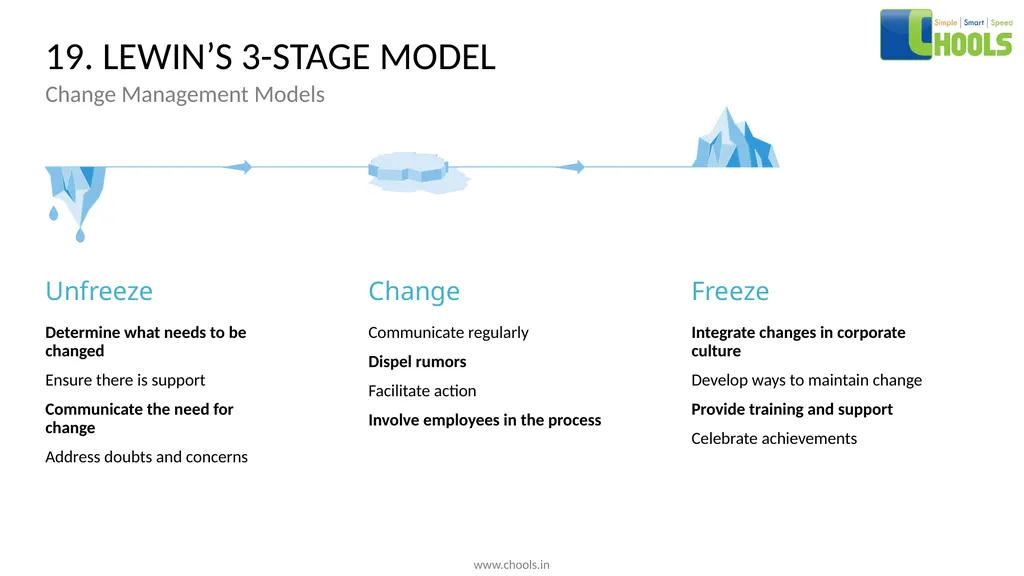
19. LEWIN’S 3-STAGE MODEL Change Management Models Determine what needs to be changed
Ensure there is support
Communicate the need for change
Address doubts and concerns Communicate regularly
Dispel rumors
Facilitate action
Involve employees in the process Integrate changes in corporate culture
Develop ways to maintain change
Provide training and support
Celebrate achievements Unfreeze Change Freeze www.chools.in<br>
Ensure there is support
Communicate the need for change
Address doubts and concerns Communicate regularly
Dispel rumors
Facilitate action
Involve employees in the process Integrate changes in corporate culture
Develop ways to maintain change
Provide training and support
Celebrate achievements Unfreeze Change Freeze www.chools.in<br>
32
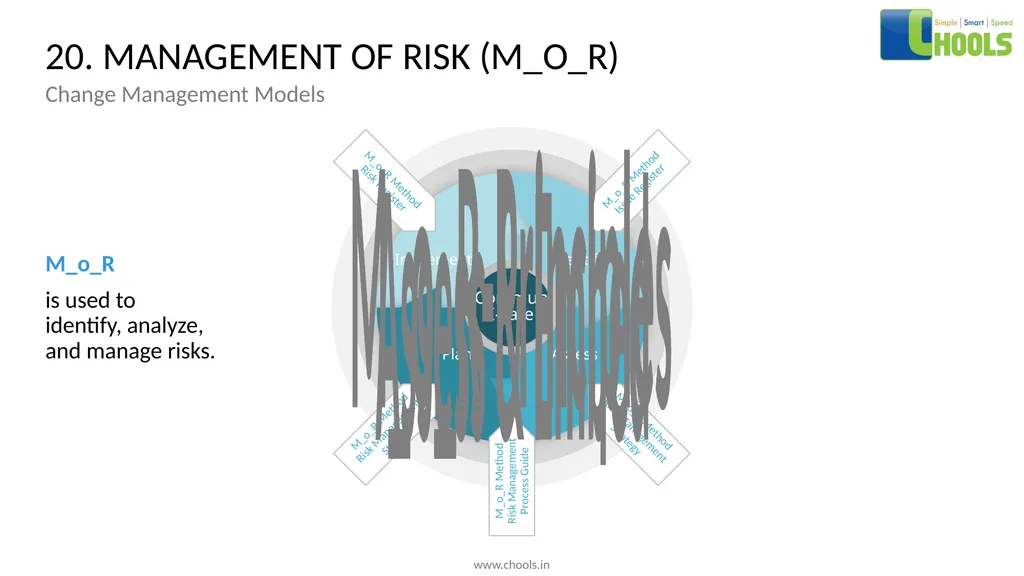
M_o_R
is used to identify, analyze, and manage risks. 20. MANAGEMENT OF RISK (M_O_R) Change Management Models www.chools.in<br>
is used to identify, analyze, and manage risks. 20. MANAGEMENT OF RISK (M_O_R) Change Management Models www.chools.in<br>
33
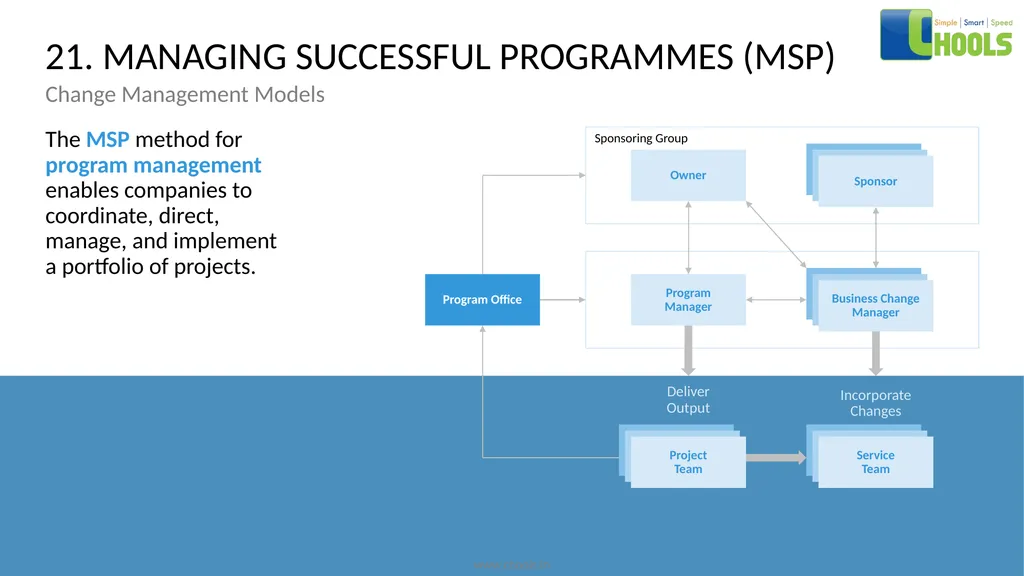
The MSP method for
program management enables companies to coordinate, direct,
manage, and implement
a portfolio of projects. 21. MANAGING SUCCESSFUL PROGRAMMES (MSP) Change Management Models www.chools.in<br>
34
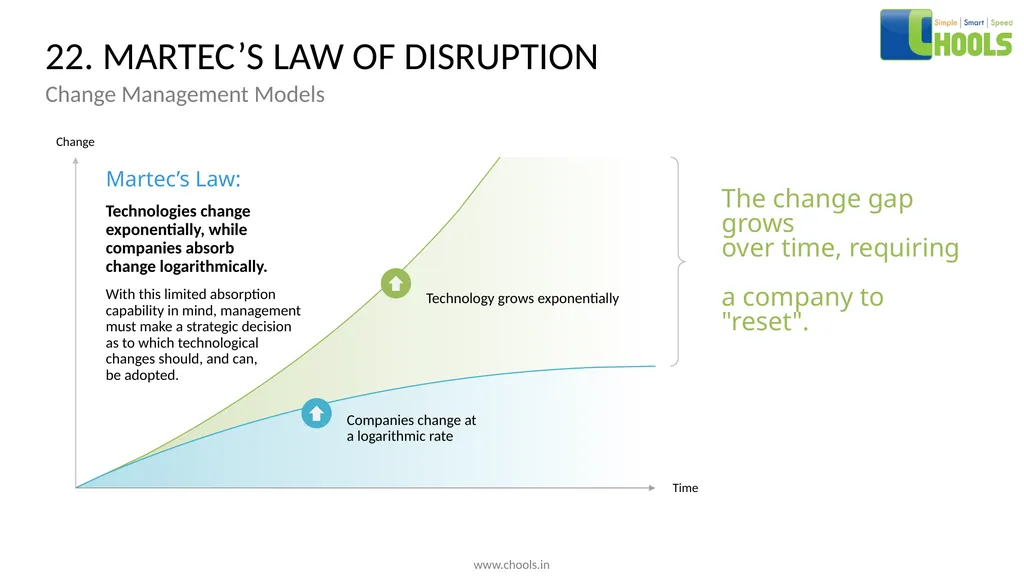
22. MARTEC’S LAW OF DISRUPTION Change Management Models Martec’s Law:
Technologies change exponentially, while companies absorb change logarithmically.
With this limited absorption capability in mind, management must make a strategic decision as to which technological changes should, and can, be adopted. The change gap grows over time, requiring a company to "reset". www.chools.in<br>
Technologies change exponentially, while companies absorb change logarithmically.
With this limited absorption capability in mind, management must make a strategic decision as to which technological changes should, and can, be adopted. The change gap grows over time, requiring a company to "reset". www.chools.in<br>
35
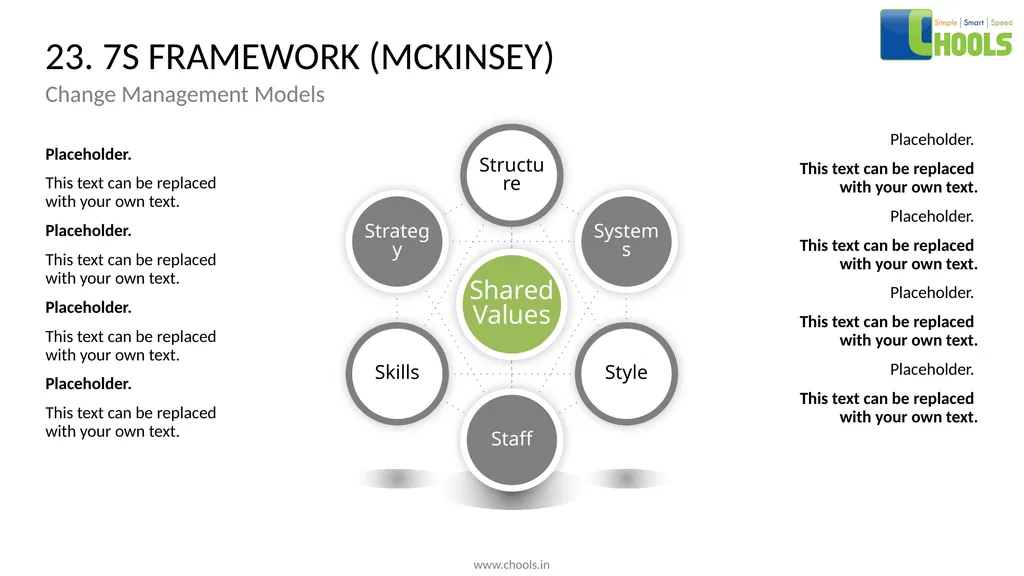
23. 7S FRAMEWORK (MCKINSEY) Change Management Models Placeholder.
This text can be replaced with your own text.
Placeholder.
This text can be replaced with your own text.
Placeholder.
This text can be replaced with your own text.
Placeholder.
This text can be replaced with your own text. Placeholder.
This text can be replaced with your own text.
Placeholder.
This text can be replaced with your own text.
Placeholder.
This text can be replaced with your own text.
Placeholder.
This text can be replaced with your own text. www.chools.in<br>
This text can be replaced with your own text.
Placeholder.
This text can be replaced with your own text.
Placeholder.
This text can be replaced with your own text.
Placeholder.
This text can be replaced with your own text. Placeholder.
This text can be replaced with your own text.
Placeholder.
This text can be replaced with your own text.
Placeholder.
This text can be replaced with your own text.
Placeholder.
This text can be replaced with your own text. www.chools.in<br>
36
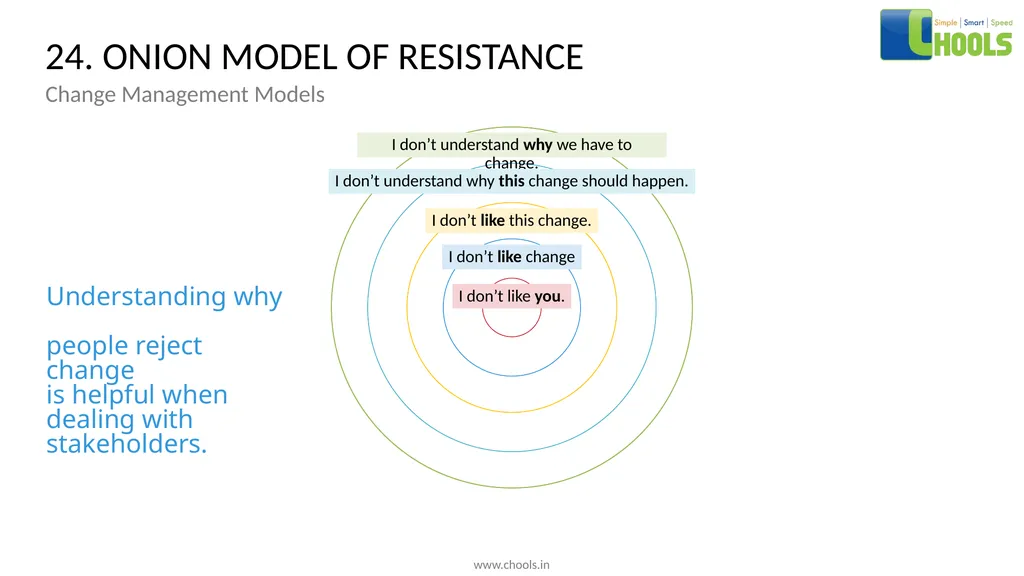
24. ONION MODEL OF RESISTANCE Change Management Models Understanding why
people reject change
is helpful when dealing with stakeholders. www.chools.in<br>
37
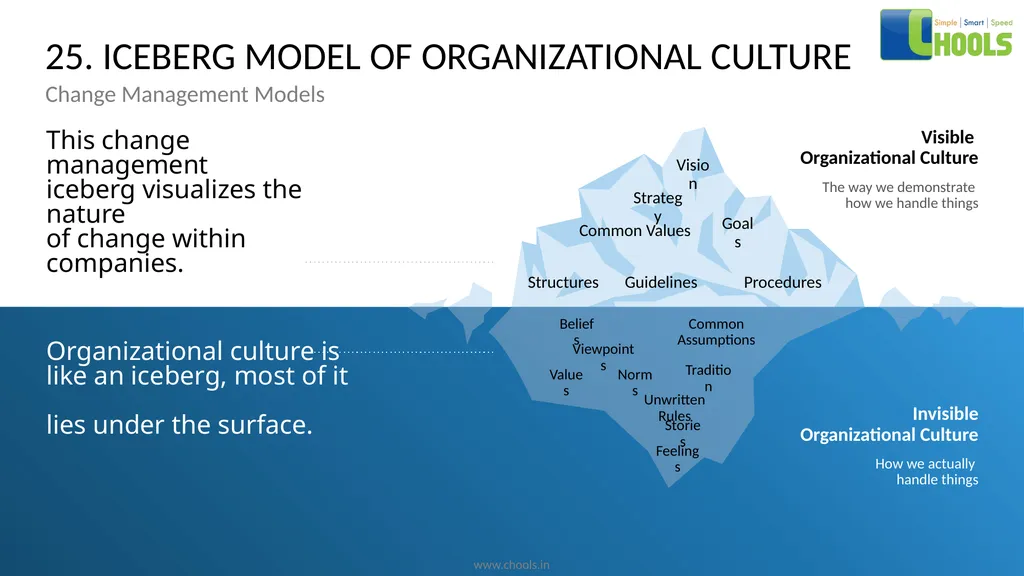
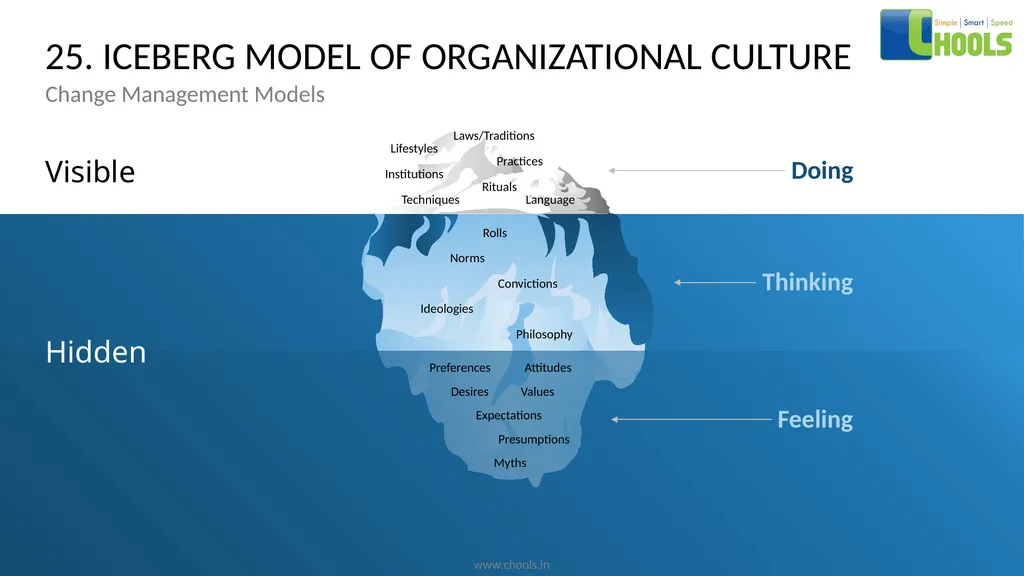
25. ICEBERG MODEL OF ORGANIZATIONAL CULTURE Change Management Models Organizational culture is
like an iceberg, most of it
lies under the surface. Invisible Organizational Culture
How we actually handle things This change management iceberg visualizes the nature of change within companies. Visible Organizational Culture
The way we demonstrate how we handle things www.chools.in<br>
How we actually handle things This change management iceberg visualizes the nature of change within companies. Visible Organizational Culture
The way we demonstrate how we handle things www.chools.in<br>
38
25. ICEBERG MODEL OF ORGANIZATIONAL CULTURE Change Management Models Visible Hidden Doing Thinking Feeling www.chools.in<br>
39
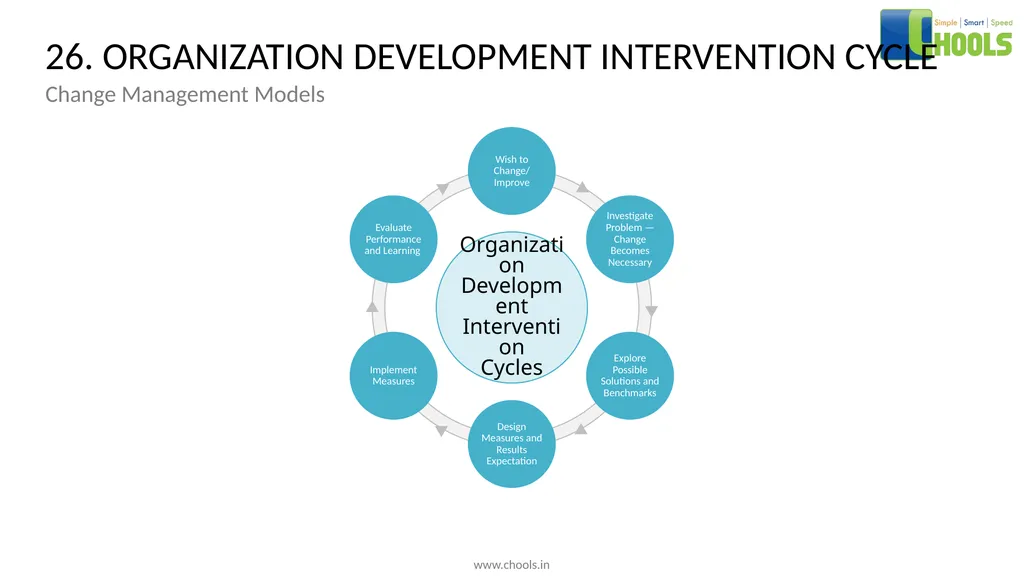
26. ORGANIZATION DEVELOPMENT INTERVENTION CYCLE Change Management Models www.chools.in<br>
40
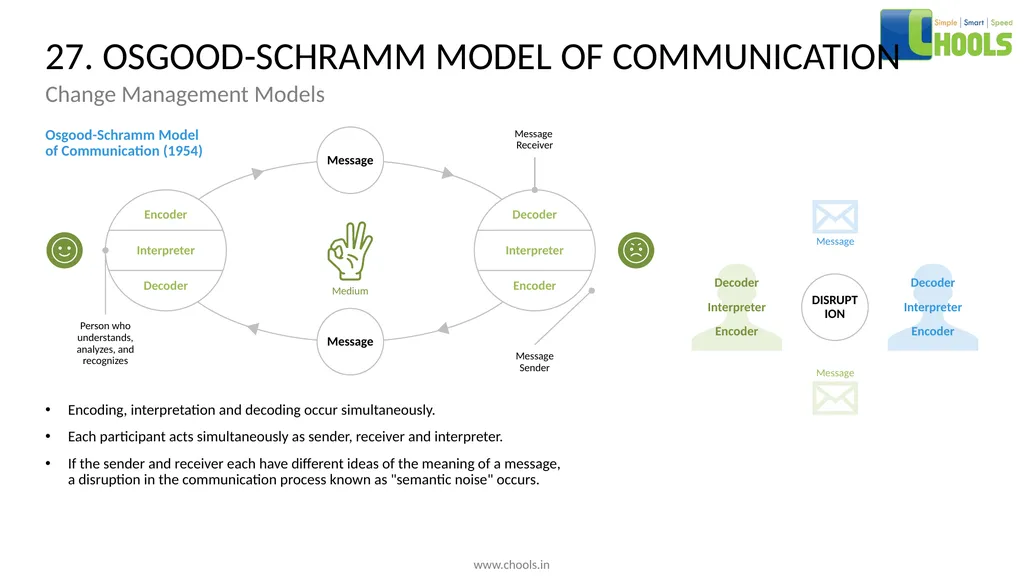
27. OSGOOD-SCHRAMM MODEL OF COMMUNICATION Change Management Models Osgood-Schramm Model
of Communication (1954) Encoding, interpretation and decoding occur simultaneously.
Each participant acts simultaneously as sender, receiver and interpreter.
If the sender and receiver each have different ideas of the meaning of a message, a disruption in the communication process known as "semantic noise" occurs. www.chools.in<br>
Each participant acts simultaneously as sender, receiver and interpreter.
If the sender and receiver each have different ideas of the meaning of a message, a disruption in the communication process known as "semantic noise" occurs. www.chools.in<br>
41
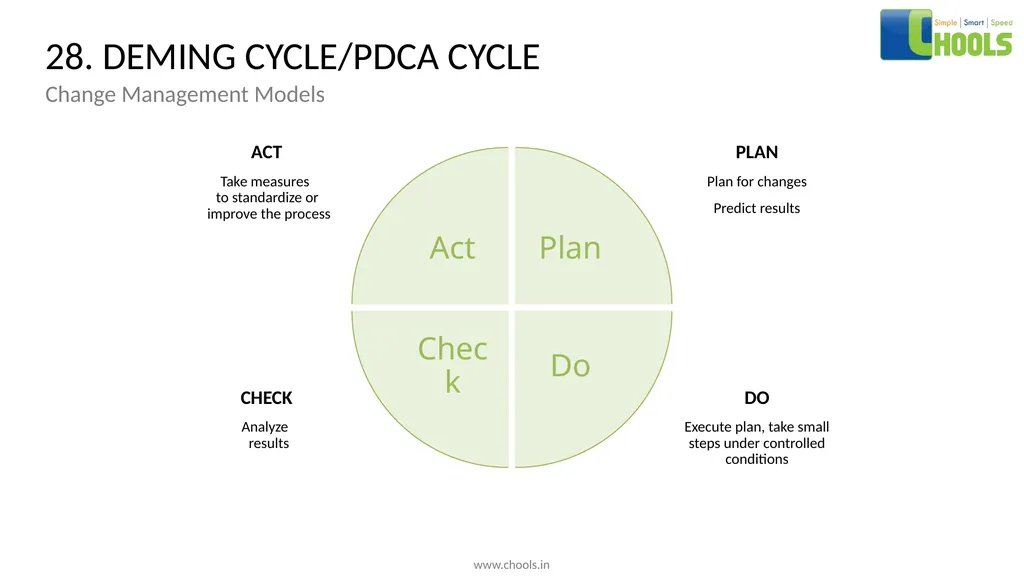
28. DEMING CYCLE/PDCA CYCLE Change Management Models www.chools.in<br>
42
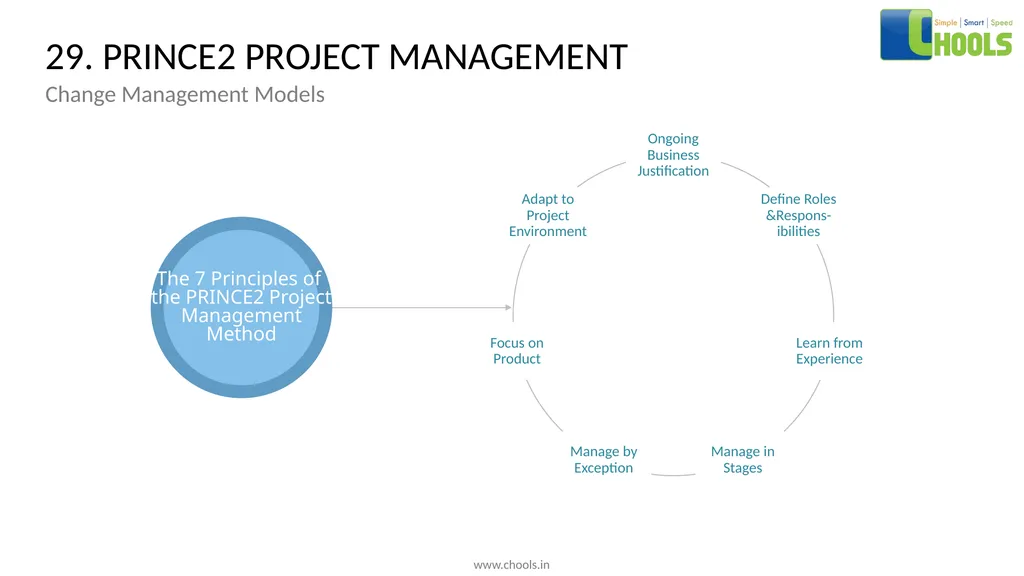
29. PRINCE2 PROJECT MANAGEMENT Change Management Models www.chools.in<br>
43
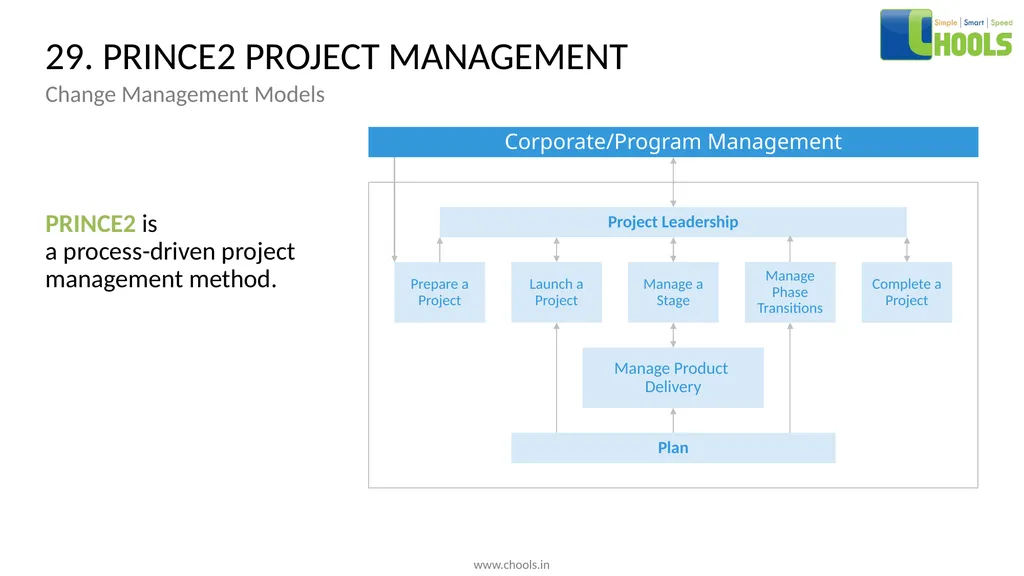
29. PRINCE2 PROJECT MANAGEMENT Change Management Models PRINCE2 is
a process-driven project
management method. www.chools.in<br>
44
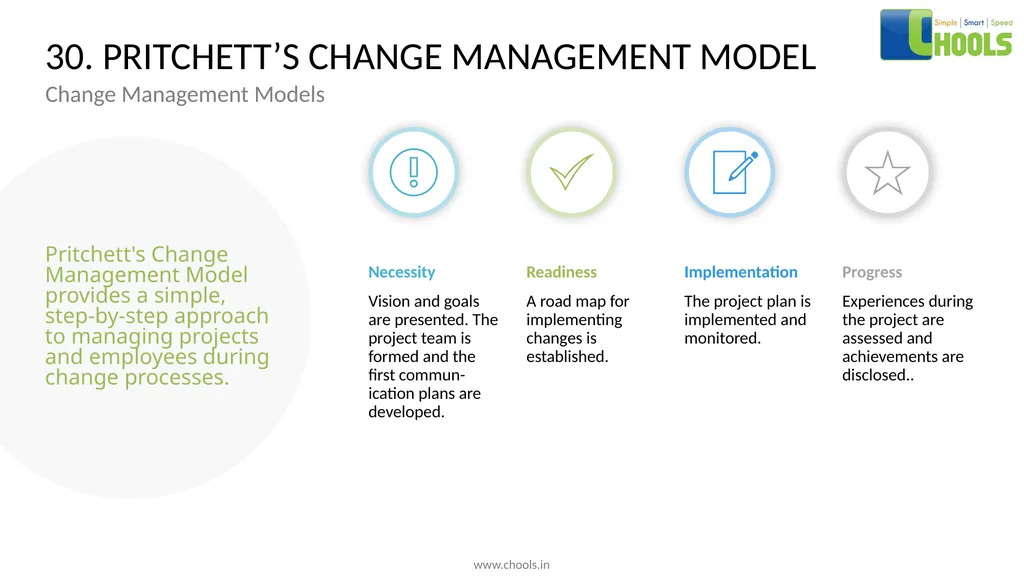
30. PRITCHETT’S CHANGE MANAGEMENT MODEL Change Management Models Pritchett's Change
Management Model
provides a simple,
step-by-step approach
to managing projects
and employees during
change processes. www.chools.in<br>
45
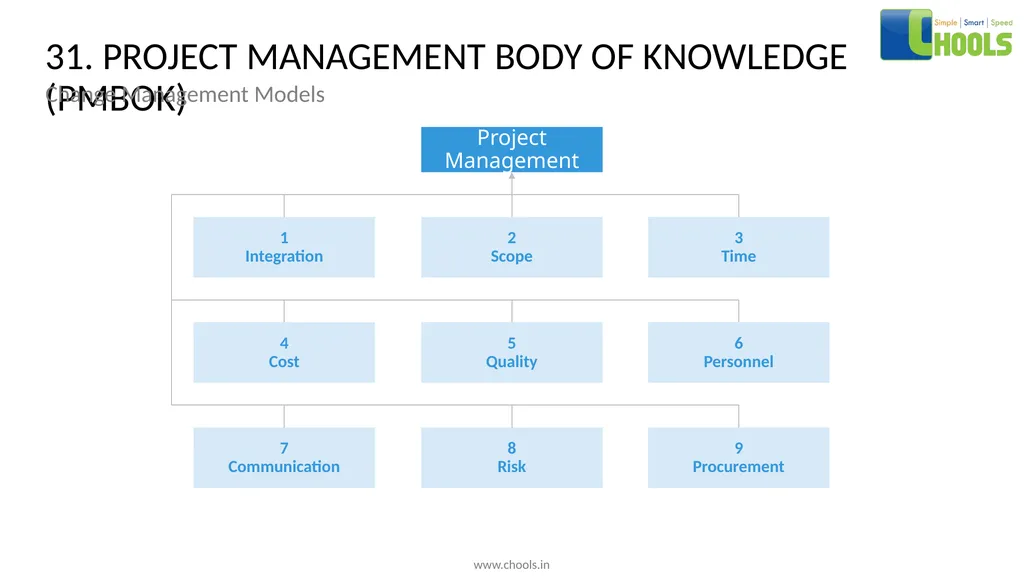
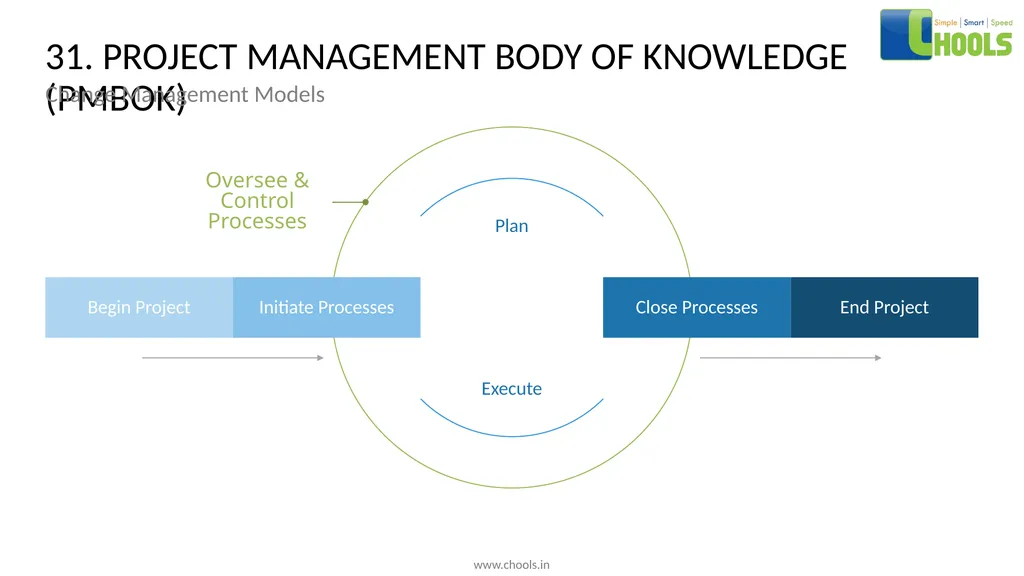
31. PROJECT MANAGEMENT BODY OF KNOWLEDGE (PMBOK) Change Management Models www.chools.in<br>
46
31. PROJECT MANAGEMENT BODY OF KNOWLEDGE (PMBOK) Change Management Models www.chools.in<br>
47
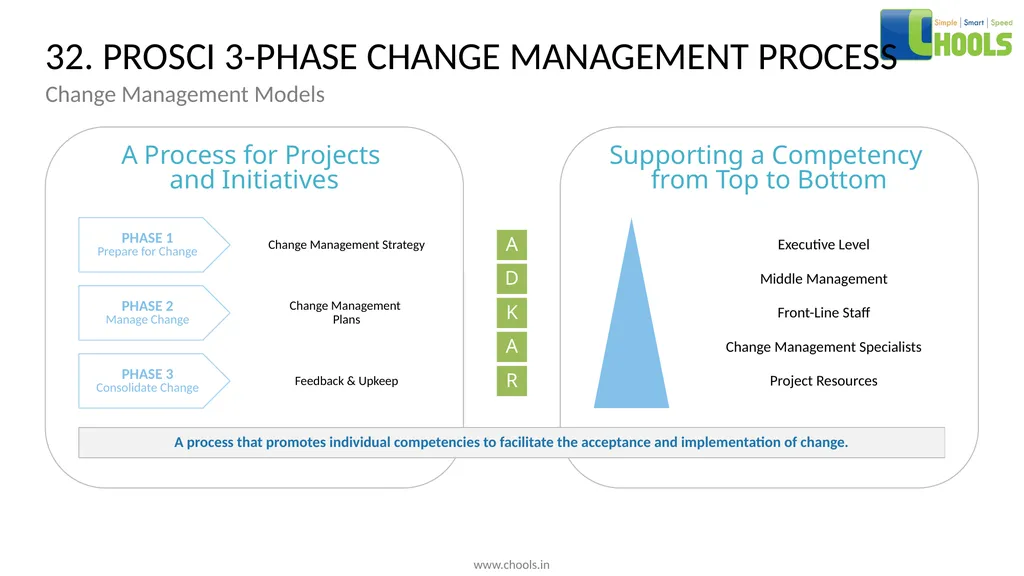
32. PROSCI 3-PHASE CHANGE MANAGEMENT PROCESS Change Management Models A Process for Projects
and Initiatives Supporting a Competency
from Top to Bottom A process that promotes individual competencies to facilitate the acceptance and implementation of change. www.chools.in<br>
48
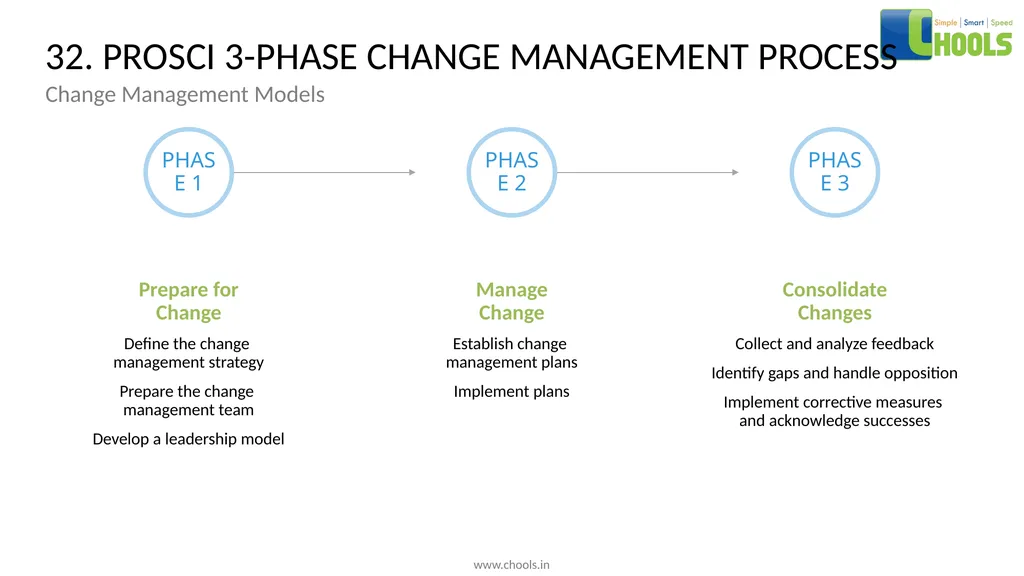
32. PROSCI 3-PHASE CHANGE MANAGEMENT PROCESS Change Management Models Prepare for
Change
Define the change management strategy
Prepare the change management team
Develop a leadership model Manage Change
Establish change management plans
Implement plans Consolidate Changes
Collect and analyze feedback
Identify gaps and handle opposition
Implement corrective measures and acknowledge successes www.chools.in<br>
Define the change management strategy
Prepare the change management team
Develop a leadership model Manage Change
Establish change management plans
Implement plans Consolidate Changes
Collect and analyze feedback
Identify gaps and handle opposition
Implement corrective measures and acknowledge successes www.chools.in<br>
49
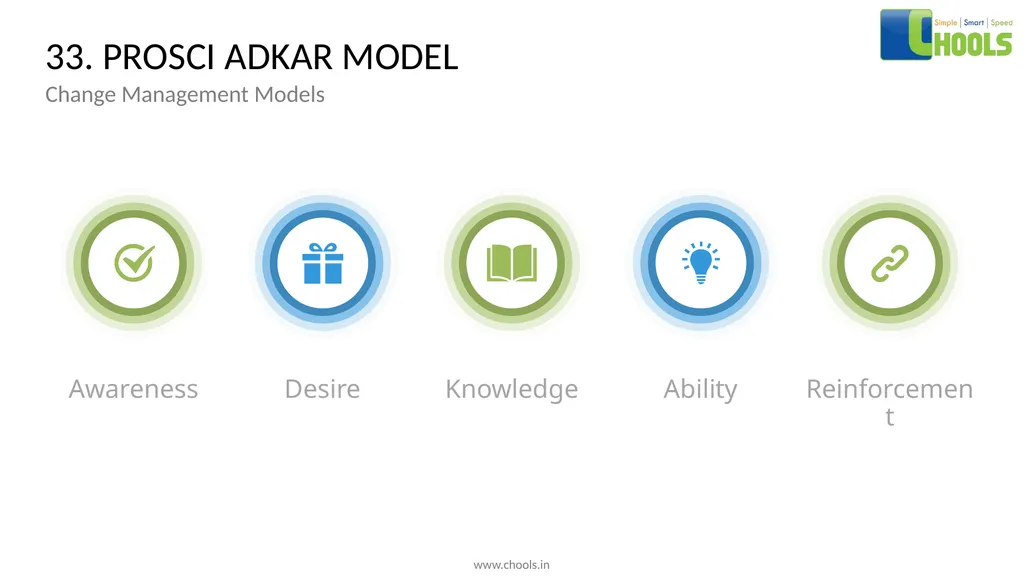
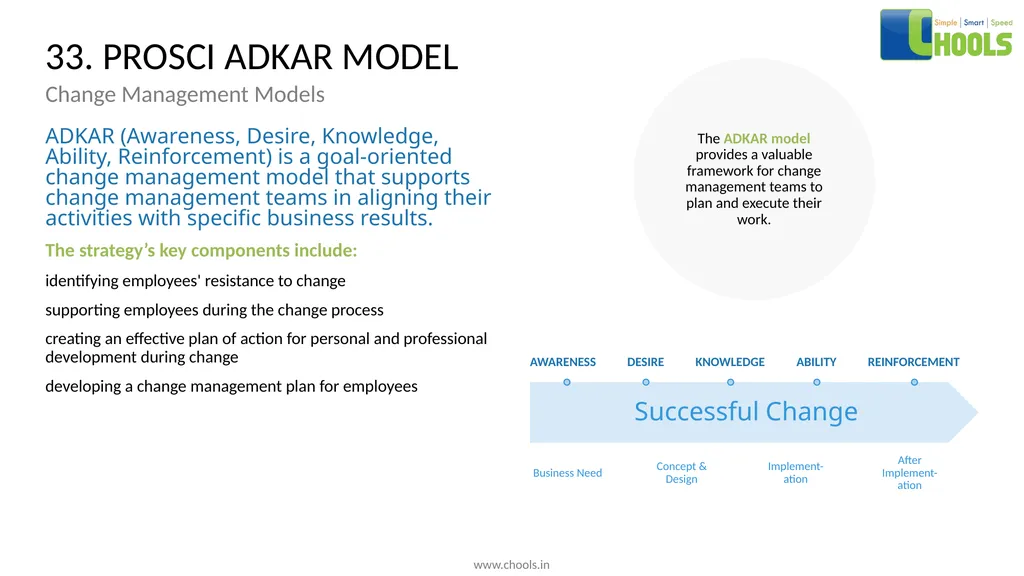
33. PROSCI ADKAR MODEL Change Management Models Awareness Desire Knowledge Ability Reinforcement www.chools.in<br>
50
The ADKAR model provides a valuable framework for change management teams to plan and execute their work. 33. PROSCI ADKAR MODEL Change Management Models ADKAR (Awareness, Desire, Knowledge, Ability, Reinforcement) is a goal-oriented change management model that supports change management teams in aligning their activities with specific business results.
The strategy’s key components include:
identifying employees' resistance to change
supporting employees during the change process
creating an effective plan of action for personal and professional development during change
developing a change management plan for employees www.chools.in<br>
The strategy’s key components include:
identifying employees' resistance to change
supporting employees during the change process
creating an effective plan of action for personal and professional development during change
developing a change management plan for employees www.chools.in<br>
51
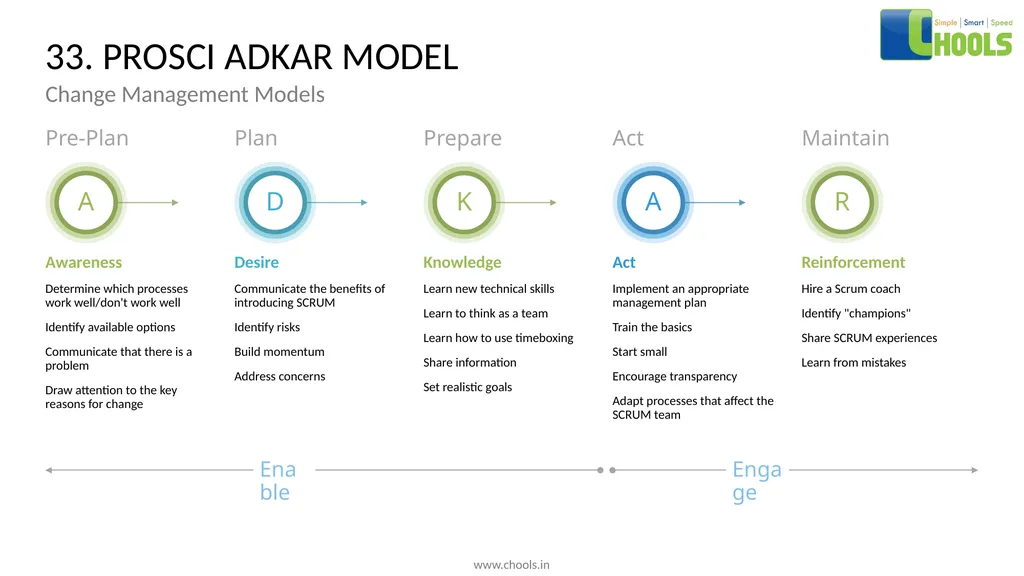
33. PROSCI ADKAR MODEL Change Management Models Pre-Plan Plan Prepare Act Maintain Awareness
Determine which processes work well/don't work well
Identify available options
Communicate that there is a problem
Draw attention to the key reasons for change Desire
Communicate the benefits of introducing SCRUM
Identify risks
Build momentum
Address concerns Knowledge
Learn new technical skills
Learn to think as a team
Learn how to use timeboxing
Share information
Set realistic goals Act
Implement an appropriate management plan
Train the basics
Start small
Encourage transparency
Adapt processes that affect the SCRUM team Reinforcement
Hire a Scrum coach
Identify "champions"
Share SCRUM experiences
Learn from mistakes www.chools.in<br>
Determine which processes work well/don't work well
Identify available options
Communicate that there is a problem
Draw attention to the key reasons for change Desire
Communicate the benefits of introducing SCRUM
Identify risks
Build momentum
Address concerns Knowledge
Learn new technical skills
Learn to think as a team
Learn how to use timeboxing
Share information
Set realistic goals Act
Implement an appropriate management plan
Train the basics
Start small
Encourage transparency
Adapt processes that affect the SCRUM team Reinforcement
Hire a Scrum coach
Identify "champions"
Share SCRUM experiences
Learn from mistakes www.chools.in<br>
52
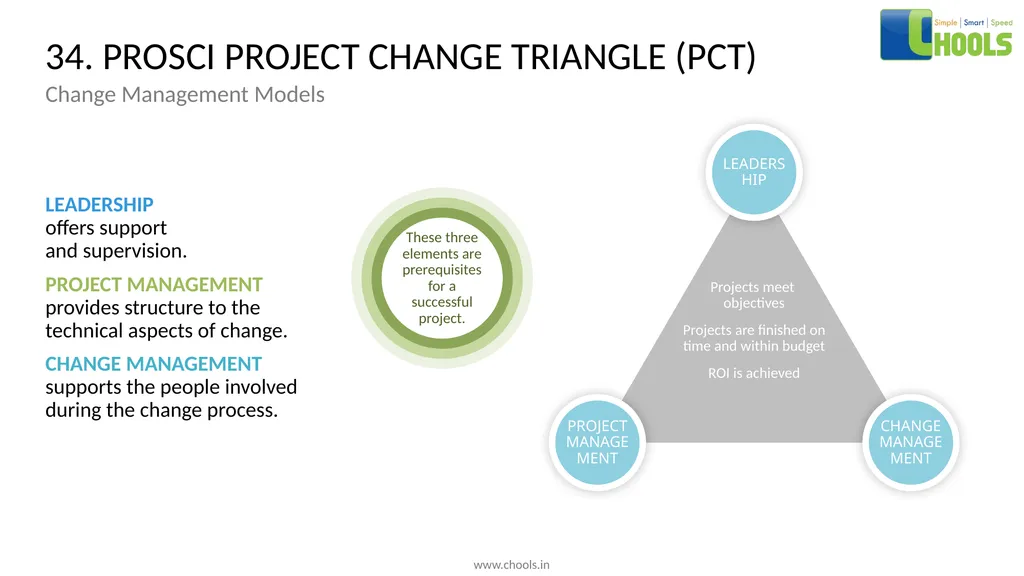
34. PROSCI PROJECT CHANGE TRIANGLE (PCT) Change Management Models LEADERSHIP
offers support
and supervision.
PROJECT MANAGEMENT provides structure to the technical aspects of change.
CHANGE MANAGEMENT supports the people involved during the change process. www.chools.in<br>
PROJECT MANAGEMENT provides structure to the technical aspects of change.
CHANGE MANAGEMENT supports the people involved during the change process. www.chools.in<br>
53
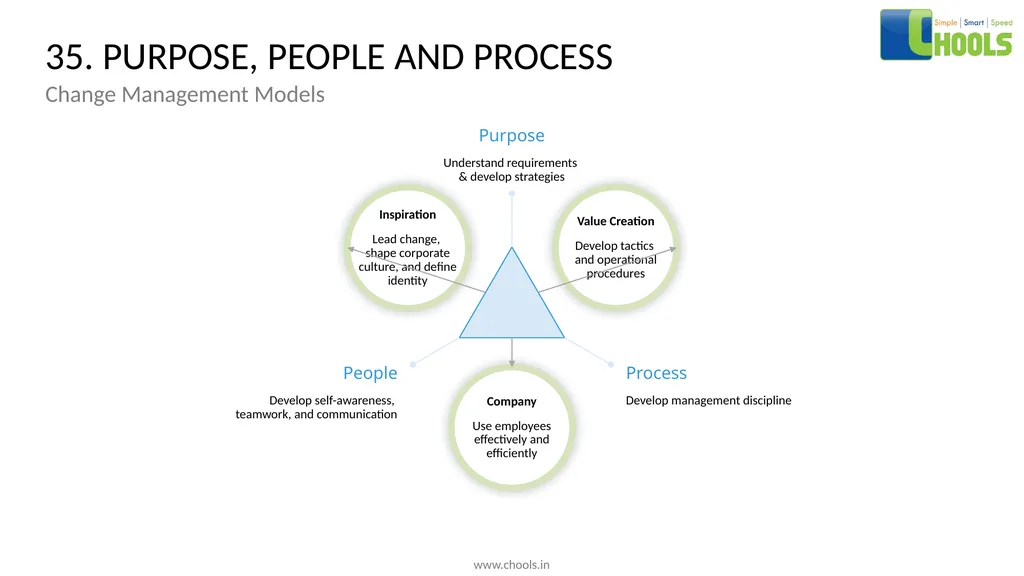
35. PURPOSE, PEOPLE AND PROCESS Change Management Models www.chools.in<br>
54
36. REVOLUTIONARY CHANGE CYCLE Change Management Models www.chools.in<br>
55
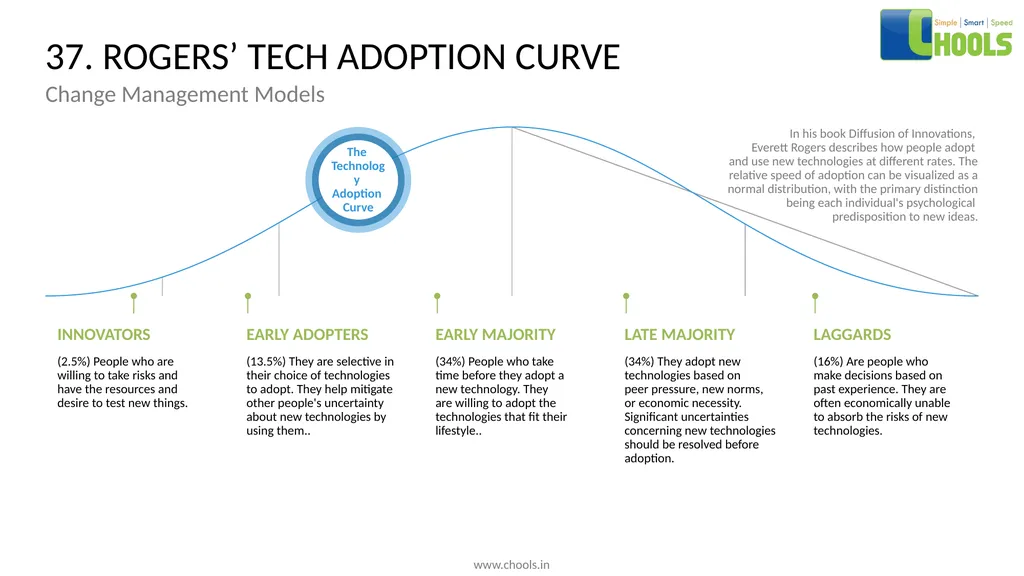
37. ROGERS’ TECH ADOPTION CURVE Change Management Models INNOVATORS
(2.5%) People who are willing to take risks and have the resources and desire to test new things. EARLY ADOPTERS
(13.5%) They are selective in their choice of technologies to adopt. They help mitigate other people's uncertainty about new technologies by using them.. EARLY MAJORITY
(34%) People who take time before they adopt a new technology. They are willing to adopt the technologies that fit their lifestyle.. LATE MAJORITY
(34%) They adopt new technologies based on peer pressure, new norms, or economic necessity. Significant uncertainties concerning new technologies should be resolved before adoption. LAGGARDS
(16%) Are people who make decisions based on past experience. They are often economically unable to absorb the risks of new technologies. In his book Diffusion of Innovations, Everett Rogers describes how people adopt and use new technologies at different rates. The relative speed of adoption can be visualized as a normal distribution, with the primary distinction being each individual's psychological predisposition to new ideas. www.chools.in<br>
(2.5%) People who are willing to take risks and have the resources and desire to test new things. EARLY ADOPTERS
(13.5%) They are selective in their choice of technologies to adopt. They help mitigate other people's uncertainty about new technologies by using them.. EARLY MAJORITY
(34%) People who take time before they adopt a new technology. They are willing to adopt the technologies that fit their lifestyle.. LATE MAJORITY
(34%) They adopt new technologies based on peer pressure, new norms, or economic necessity. Significant uncertainties concerning new technologies should be resolved before adoption. LAGGARDS
(16%) Are people who make decisions based on past experience. They are often economically unable to absorb the risks of new technologies. In his book Diffusion of Innovations, Everett Rogers describes how people adopt and use new technologies at different rates. The relative speed of adoption can be visualized as a normal distribution, with the primary distinction being each individual's psychological predisposition to new ideas. www.chools.in<br>
56
38. JOHN SHOOK’S CHANGE MANAGEMENT MODEL Change Management Models www.chools.in<br>
57
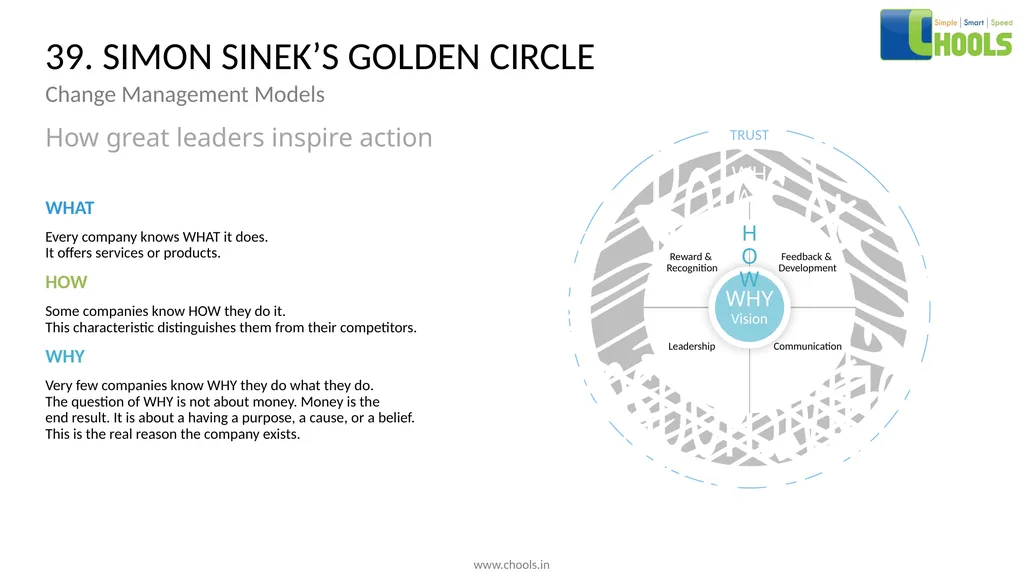
39. SIMON SINEK’S GOLDEN CIRCLE Change Management Models How great leaders inspire action
WHAT
Every company knows WHAT it does. It offers services or products.
HOW
Some companies know HOW they do it. This characteristic distinguishes them from their competitors.
WHY
Very few companies know WHY they do what they do. The question of WHY is not about money. Money is the end result. It is about a having a purpose, a cause, or a belief. This is the real reason the company exists. www.chools.in<br>
WHAT
Every company knows WHAT it does. It offers services or products.
HOW
Some companies know HOW they do it. This characteristic distinguishes them from their competitors.
WHY
Very few companies know WHY they do what they do. The question of WHY is not about money. Money is the end result. It is about a having a purpose, a cause, or a belief. This is the real reason the company exists. www.chools.in<br>
58
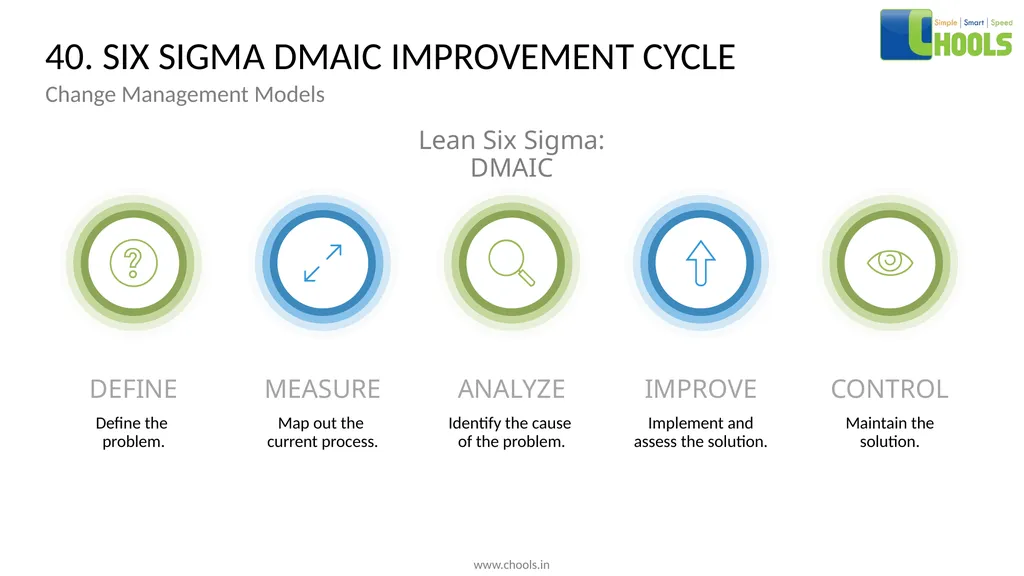
40. SIX SIGMA DMAIC IMPROVEMENT CYCLE Change Management Models DEFINE
Define the problem. MEASURE
Map out the current process. ANALYZE
Identify the cause of the problem. IMPROVE
Implement and assess the solution. CONTROL
Maintain the solution. Lean Six Sigma: DMAIC www.chools.in<br>
Define the problem. MEASURE
Map out the current process. ANALYZE
Identify the cause of the problem. IMPROVE
Implement and assess the solution. CONTROL
Maintain the solution. Lean Six Sigma: DMAIC www.chools.in<br>
59
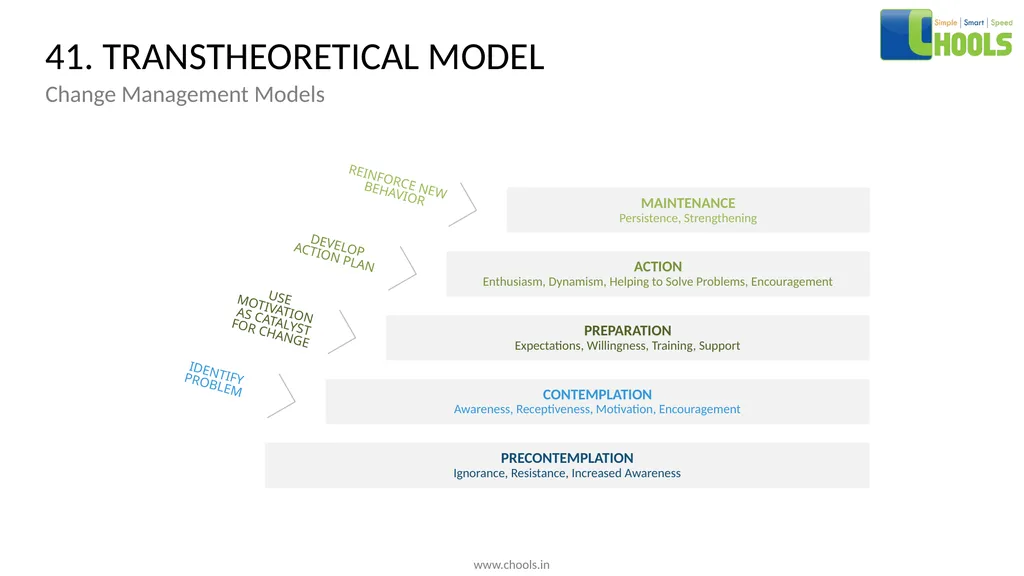
41. TRANSTHEORETICAL MODEL Change Management Models www.chools.in<br>
60
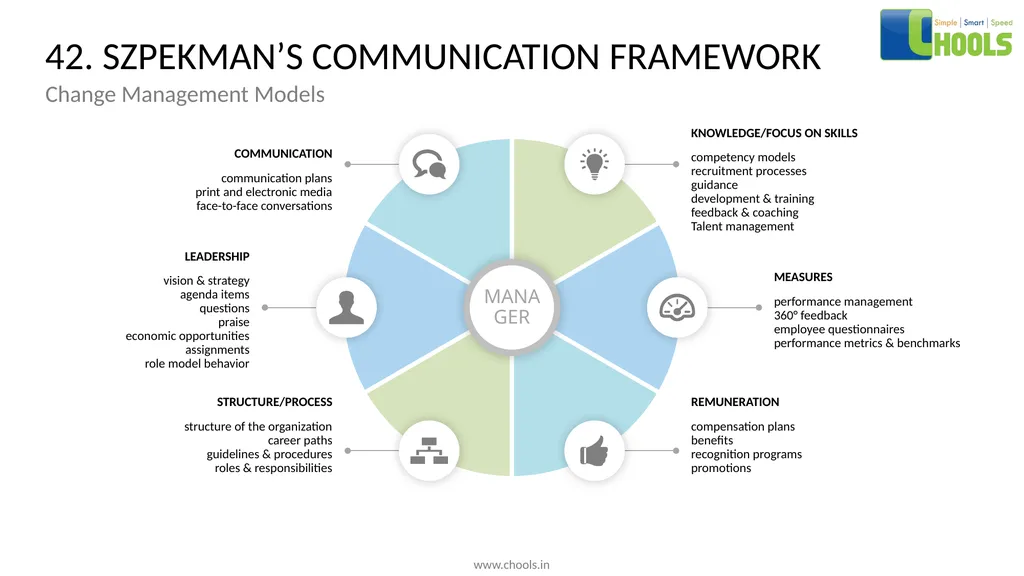
42. SZPEKMAN’S COMMUNICATION FRAMEWORK Change Management Models www.chools.in<br>
61
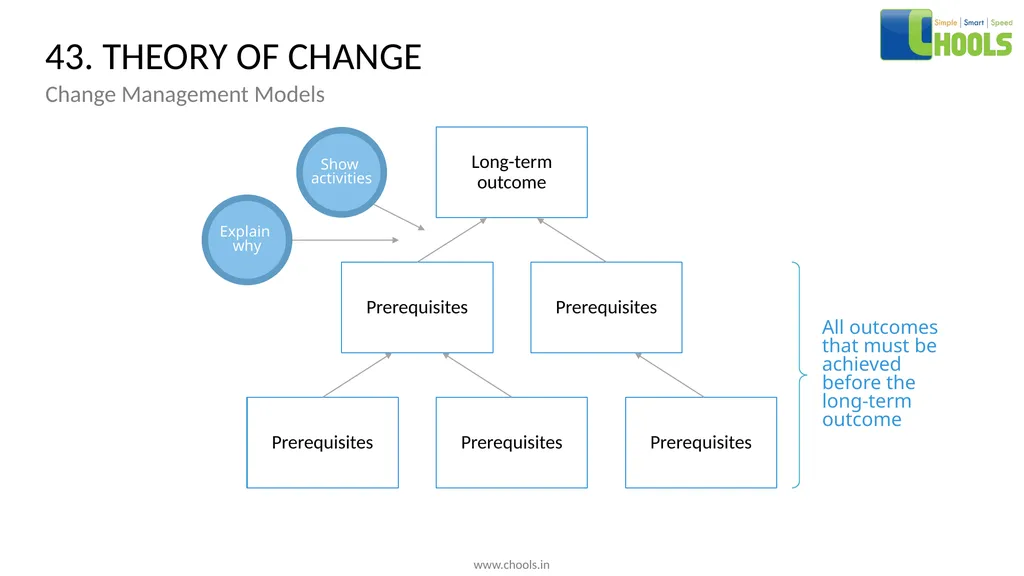
43. THEORY OF CHANGE Change Management Models www.chools.in<br>
62
44. TRAINING NEEDS ANALYSIS MODEL Change Management Models The Training Needs Analysis model offers a systematic approach to identifying employee training shortfalls and the need for change. www.chools.in<br>
63
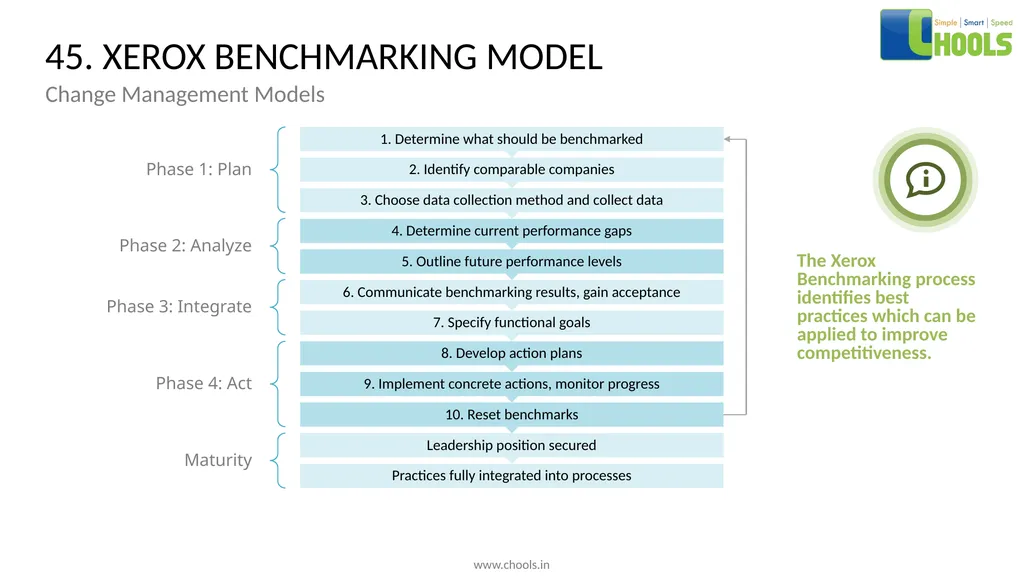
45. XEROX BENCHMARKING MODEL Change Management Models www.chools.in<br>
64
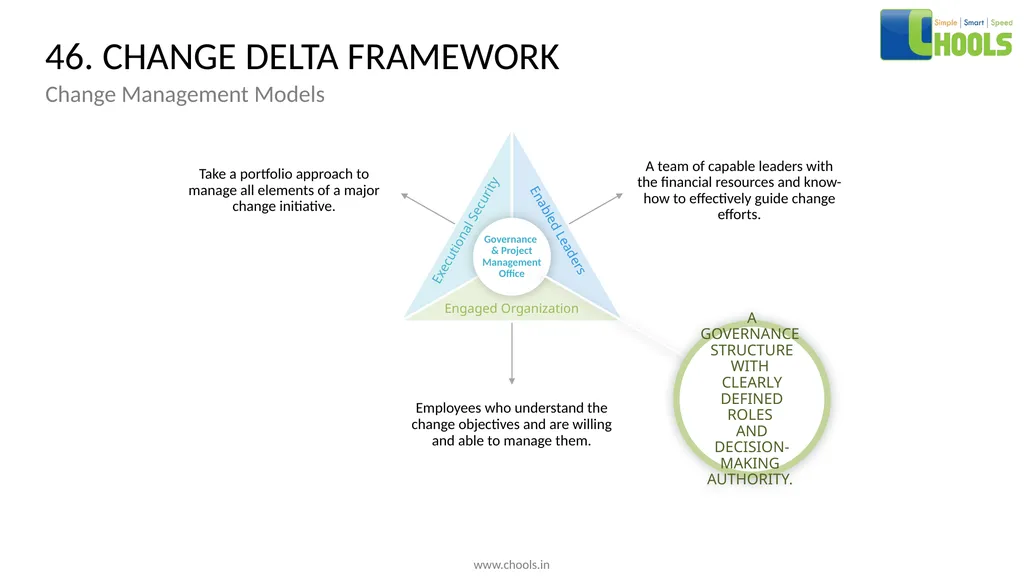
46. CHANGE DELTA FRAMEWORK Change Management Models www.chools.in<br>
65
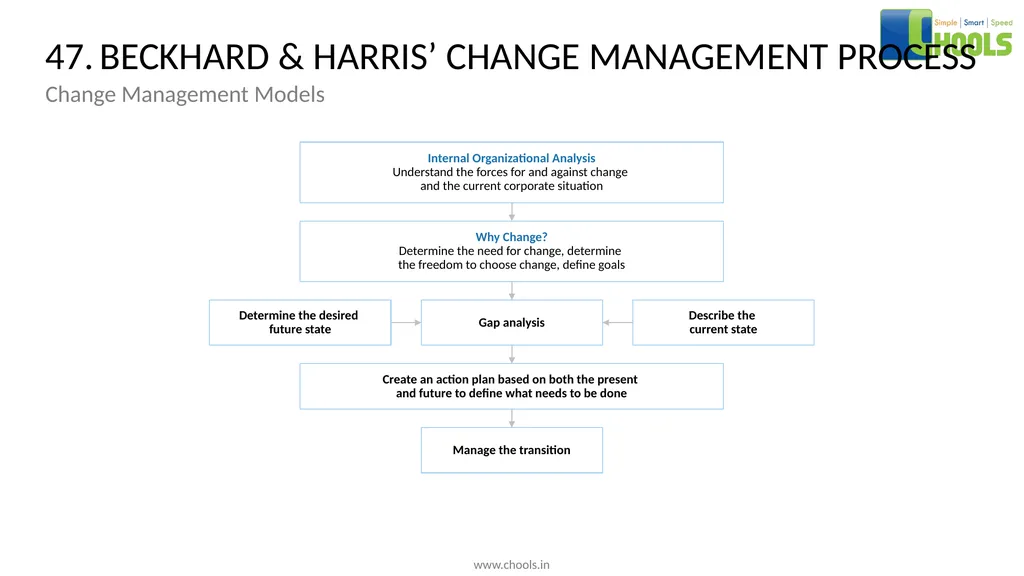
47. BECKHARD & HARRIS’ CHANGE MANAGEMENT PROCESS Change Management Models www.chools.in<br>
66
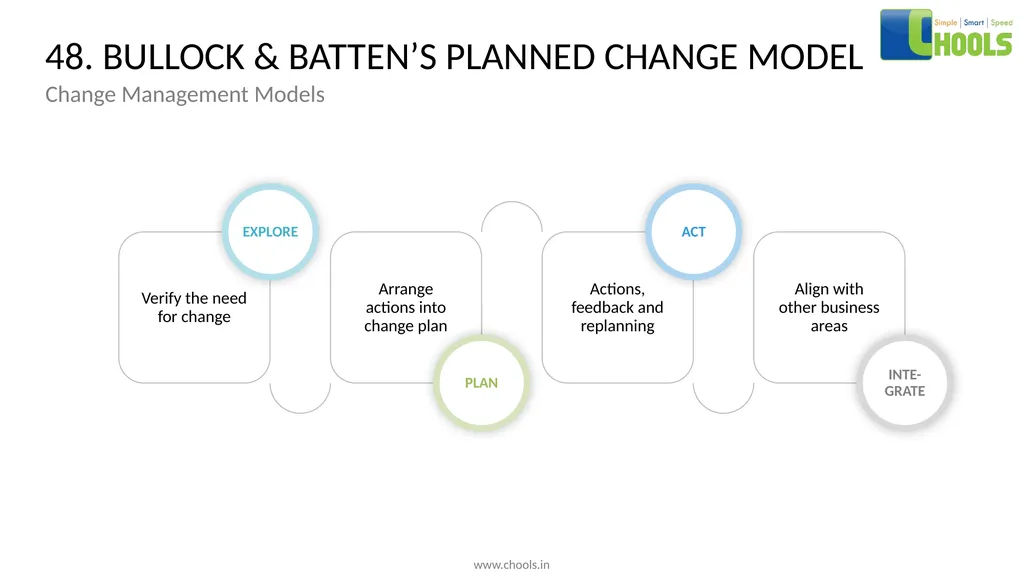
48. BULLOCK & BATTEN’S PLANNED CHANGE MODEL Change Management Models www.chools.in<br>
67
49. CARNALL’S CHANGE MANAGEMENT MODEL Change Management Models www.chools.in<br>
68
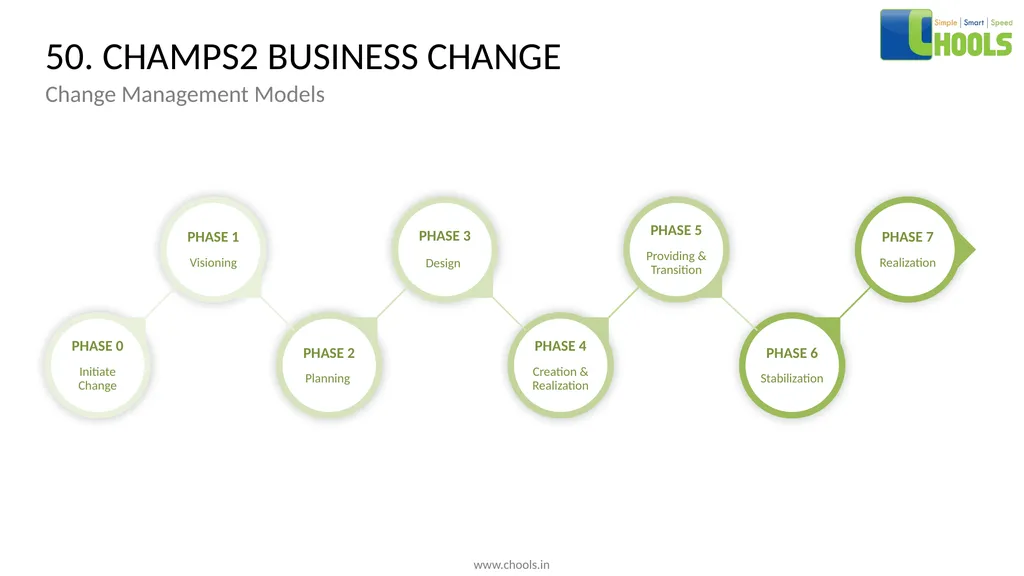
50. CHAMPS2 BUSINESS CHANGE Change Management Models www.chools.in<br>
69
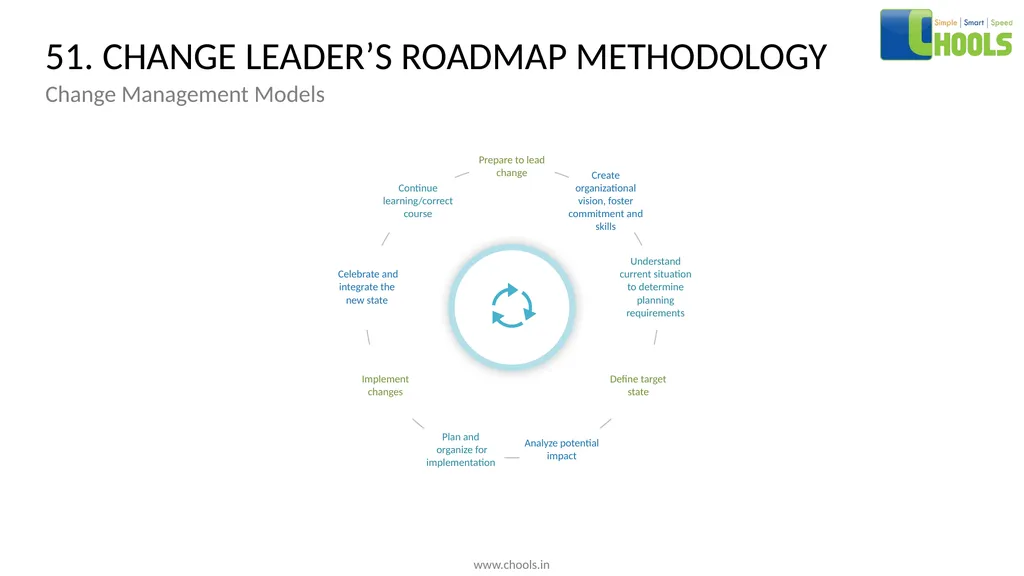
51. CHANGE LEADER’S ROADMAP METHODOLOGY Change Management Models www.chools.in<br>
70
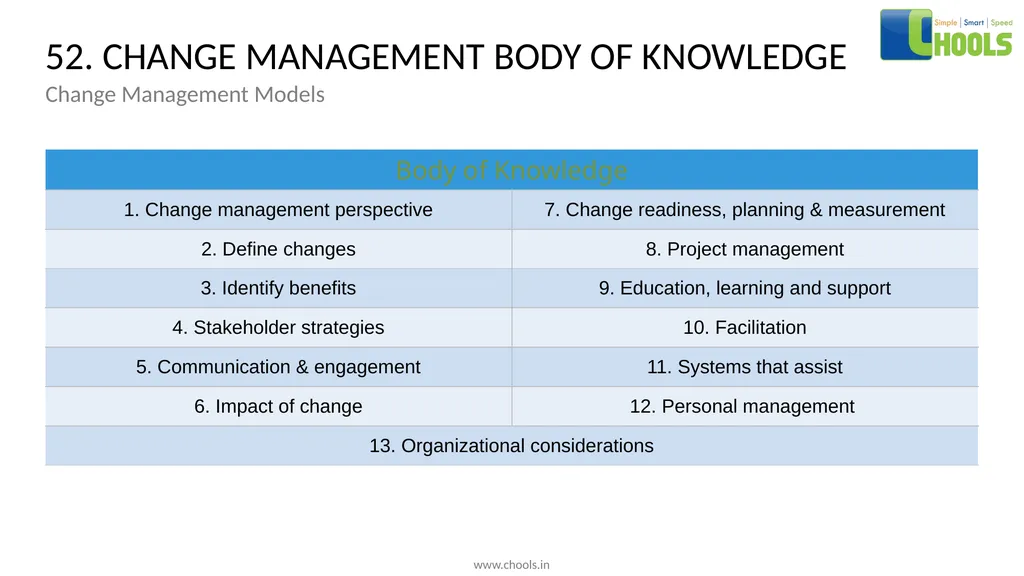
52. CHANGE MANAGEMENT BODY OF KNOWLEDGE Change Management Models www.chools.in<br>
71
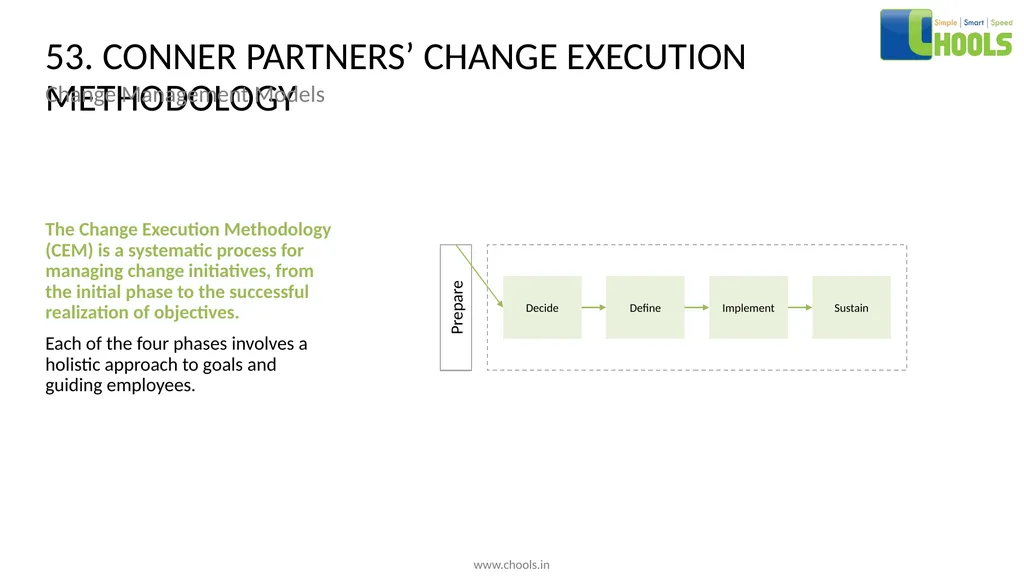
53. CONNER PARTNERS’ CHANGE EXECUTION METHODOLOGY Change Management Models The Change Execution Methodology (CEM) is a systematic process for managing change initiatives, from the initial phase to the successful realization of objectives.
Each of the four phases involves a holistic approach to goals and guiding employees. www.chools.in<br>
Each of the four phases involves a holistic approach to goals and guiding employees. www.chools.in<br>
72
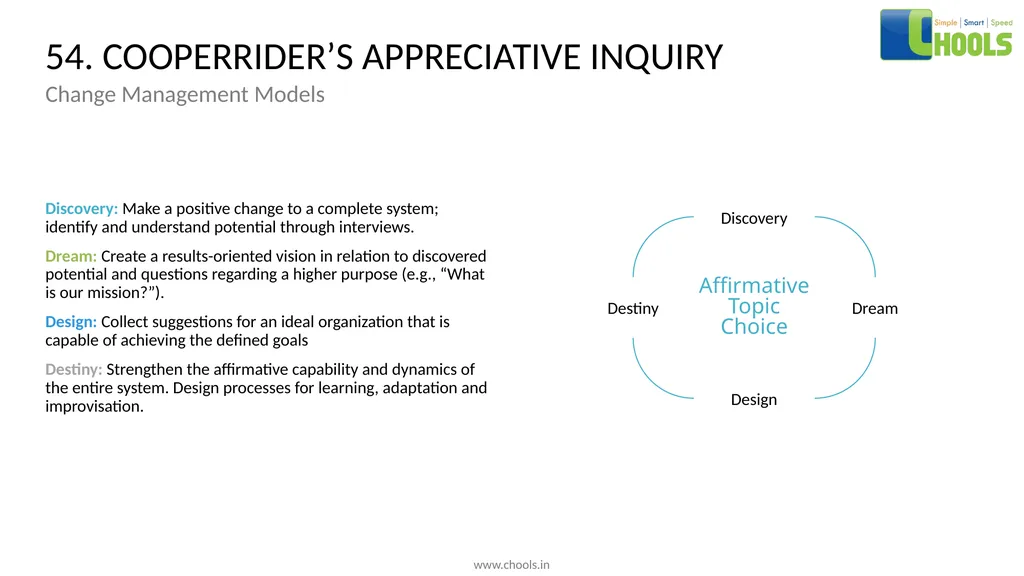
54. COOPERRIDER’S APPRECIATIVE INQUIRY Change Management Models Discovery: Make a positive change to a complete system; identify and understand potential through interviews.
Dream: Create a results-oriented vision in relation to discovered potential and questions regarding a higher purpose (e.g., “What is our mission?”).
Design: Collect suggestions for an ideal organization that is capable of achieving the defined goals
Destiny: Strengthen the affirmative capability and dynamics of the entire system. Design processes for learning, adaptation and improvisation. www.chools.in<br>
Dream: Create a results-oriented vision in relation to discovered potential and questions regarding a higher purpose (e.g., “What is our mission?”).
Design: Collect suggestions for an ideal organization that is capable of achieving the defined goals
Destiny: Strengthen the affirmative capability and dynamics of the entire system. Design processes for learning, adaptation and improvisation. www.chools.in<br>
73
55. CUMMINGS/WORLEY’S CHANGE MANAGEMENT MODEL Change Management Models www.chools.in<br>
74
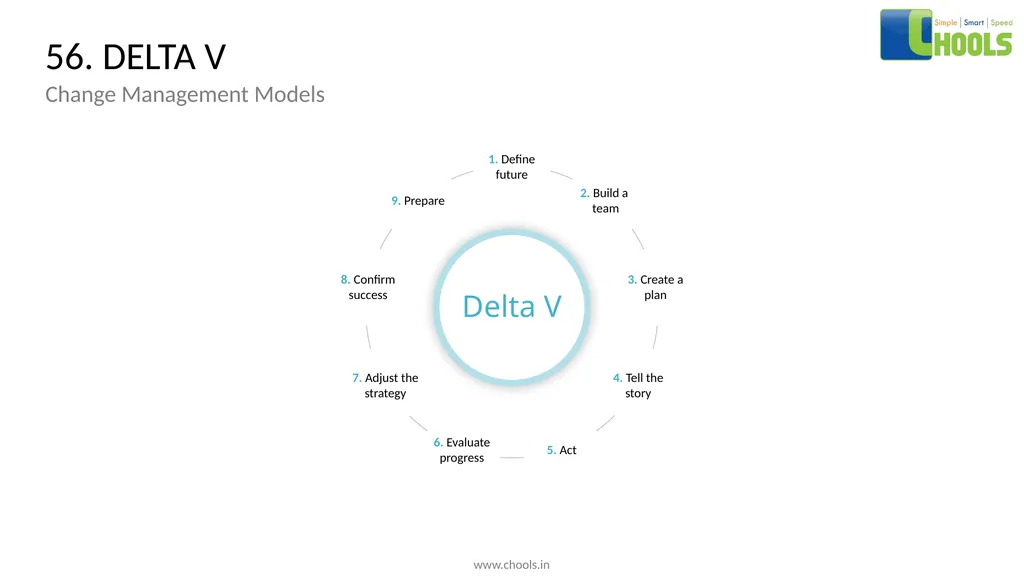
56. DELTA V Change Management Models www.chools.in<br>
75
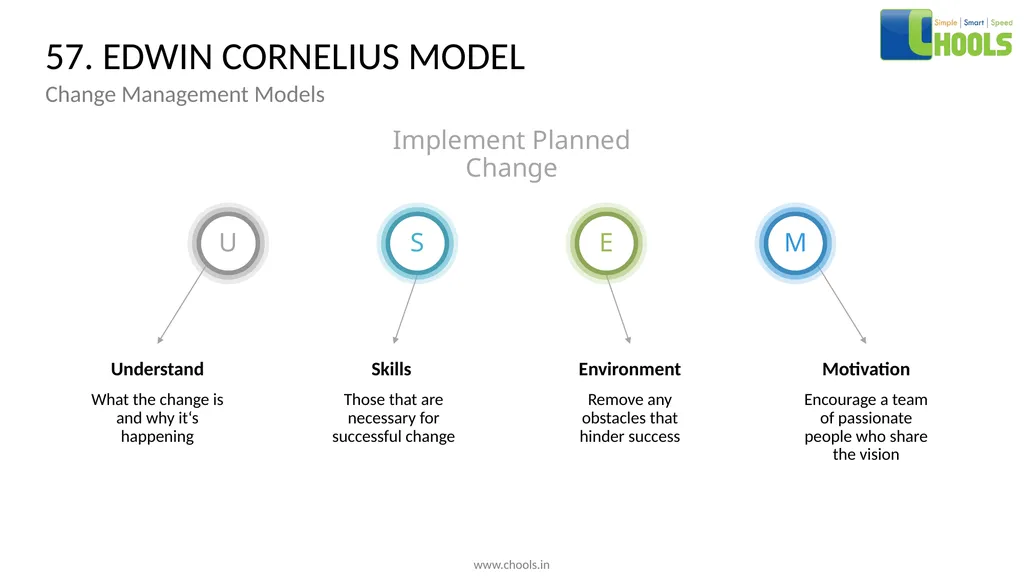
57. EDWIN CORNELIUS MODEL Change Management Models Understand
What the change is and why it‘s happening Skills
Those that are necessary for successful change Environment
Remove any obstacles that hinder success Motivation
Encourage a team of passionate people who share the vision Implement Planned Change www.chools.in<br>
What the change is and why it‘s happening Skills
Those that are necessary for successful change Environment
Remove any obstacles that hinder success Motivation
Encourage a team of passionate people who share the vision Implement Planned Change www.chools.in<br>
76
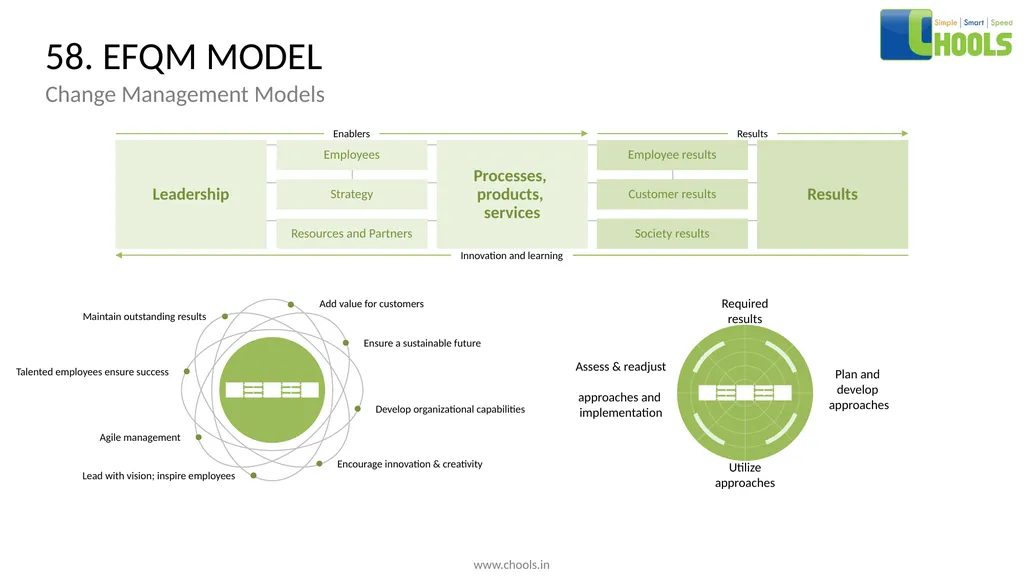
58. EFQM MODEL Change Management Models www.chools.in<br>
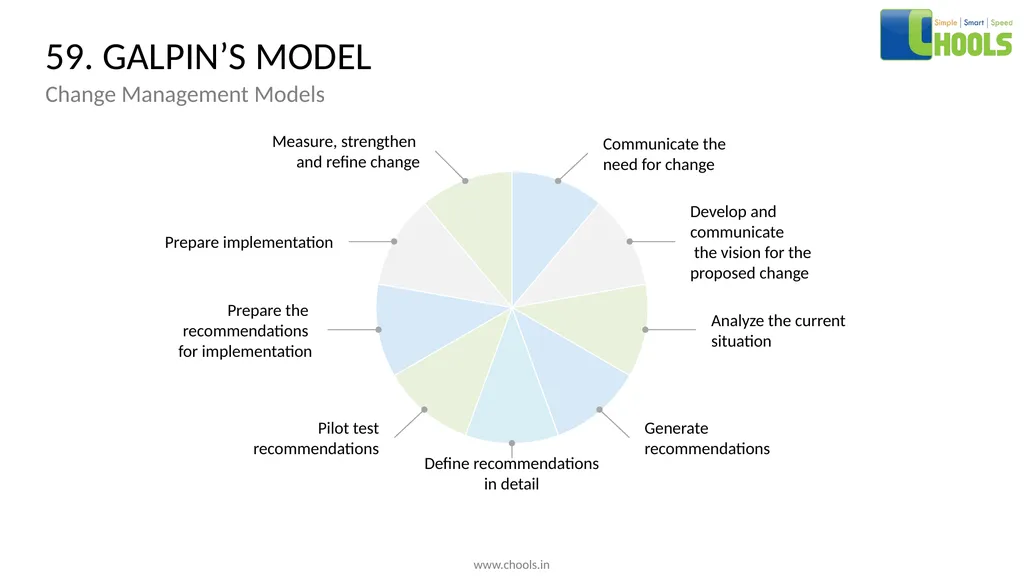
77
59. GALPIN’S MODEL Change Management Models www.chools.in<br>
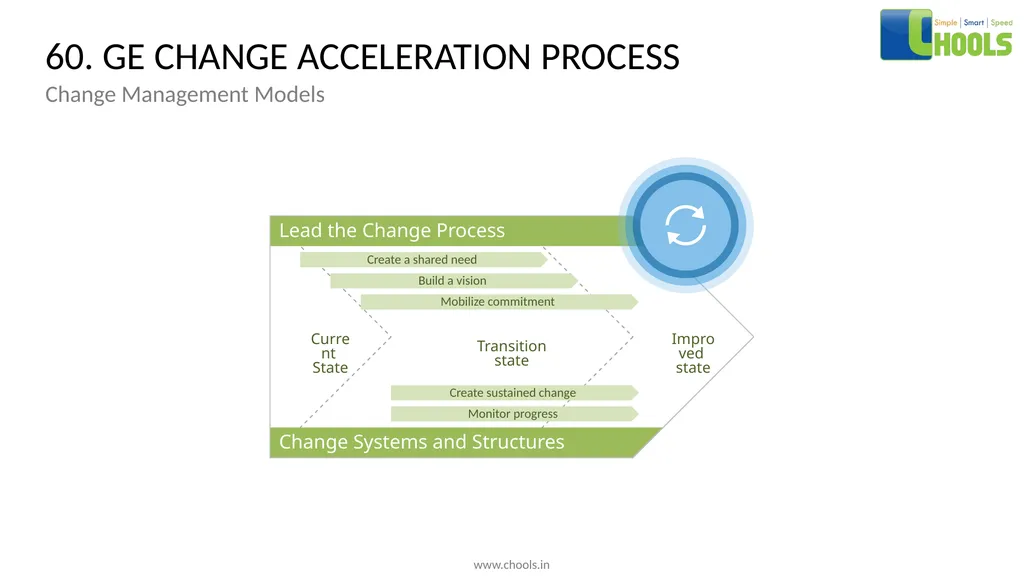
78
60. GE CHANGE ACCELERATION PROCESS Change Management Models www.chools.in<br>
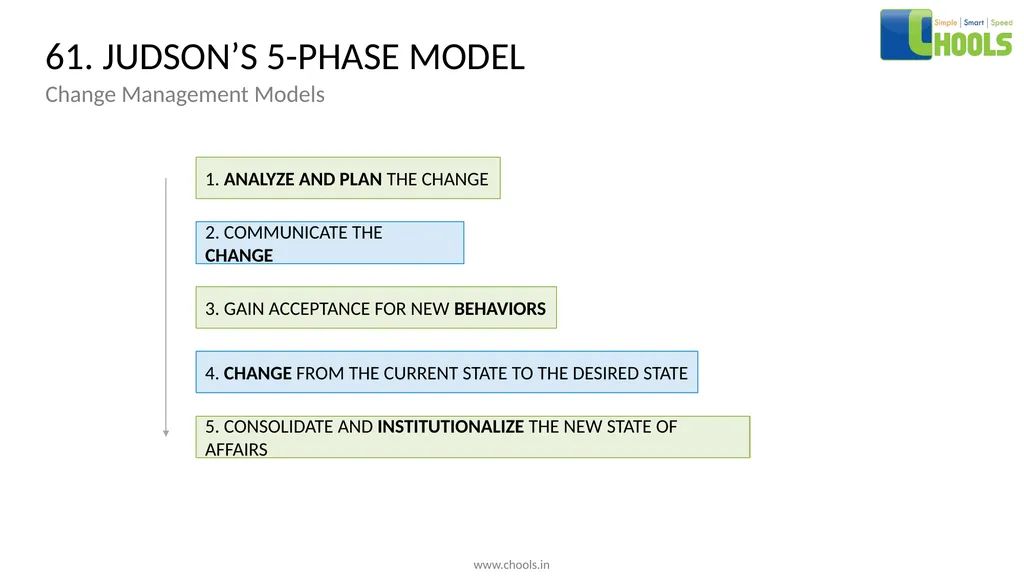
79
61. JUDSON’S 5-PHASE MODEL Change Management Models www.chools.in<br>
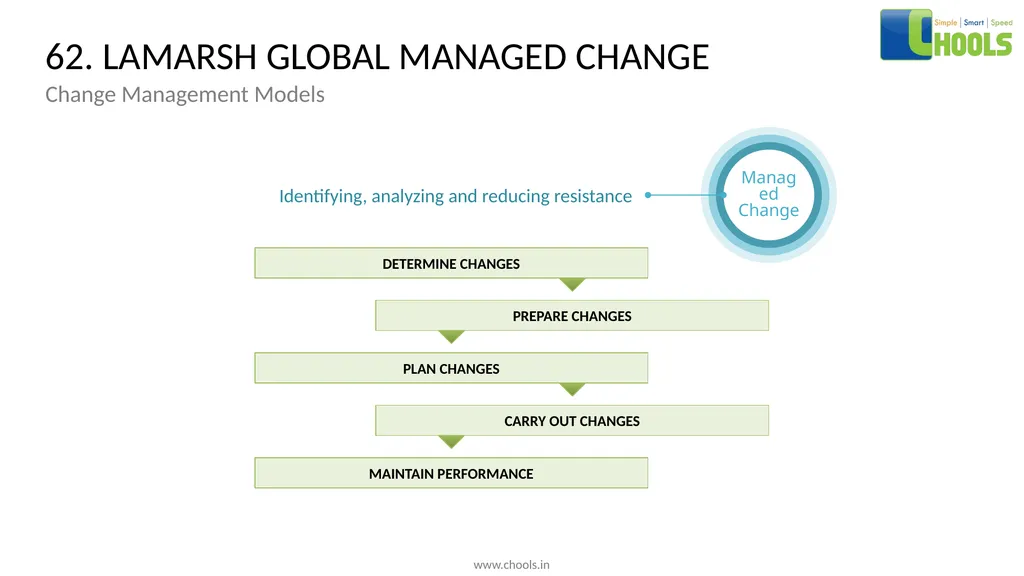
80
62. LAMARSH GLOBAL MANAGED CHANGE Change Management Models www.chools.in<br>
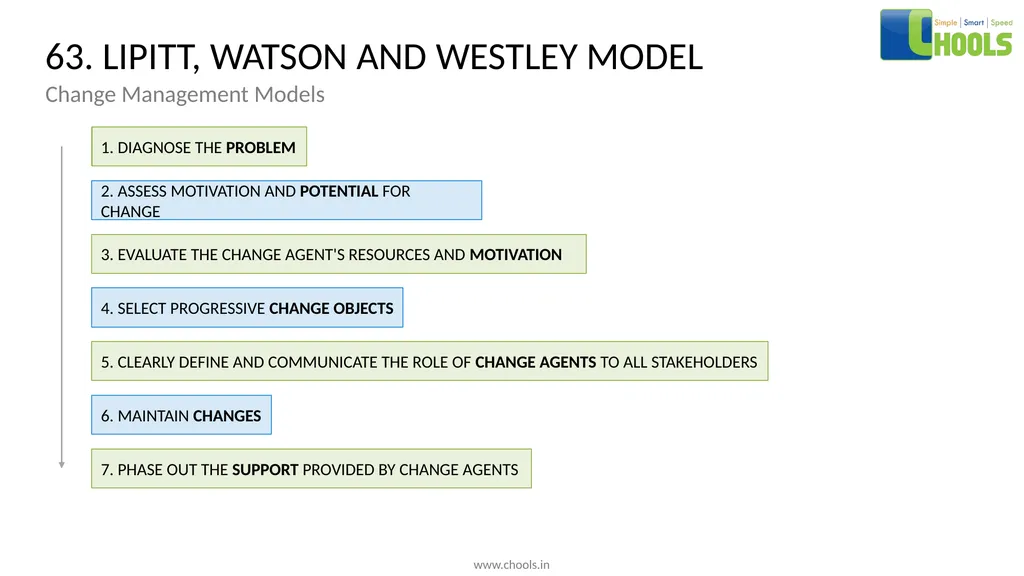
81
63. LIPITT, WATSON AND WESTLEY MODEL Change Management Models www.chools.in<br>
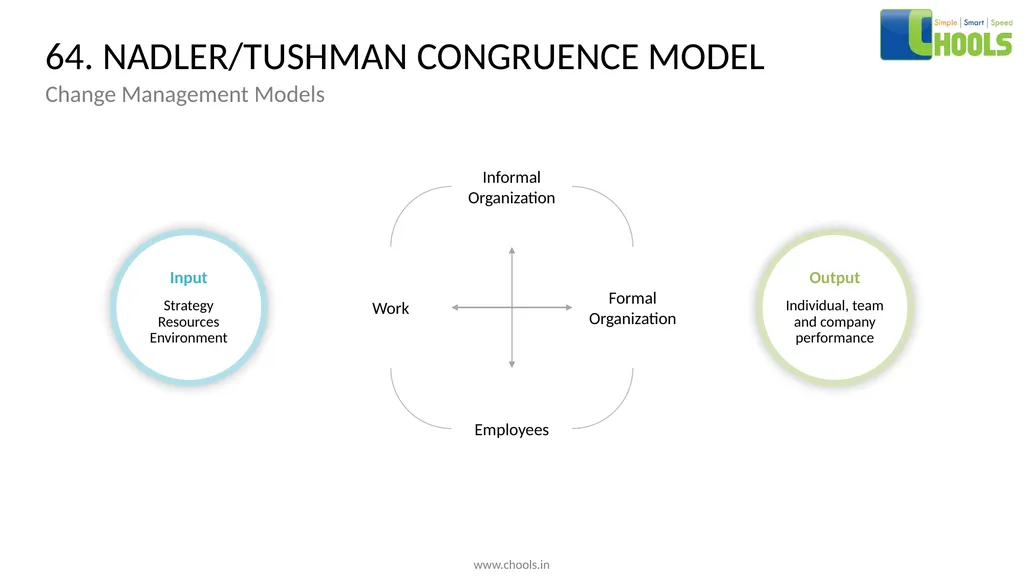
82
64. NADLER/TUSHMAN CONGRUENCE MODEL Change Management Models www.chools.in<br>
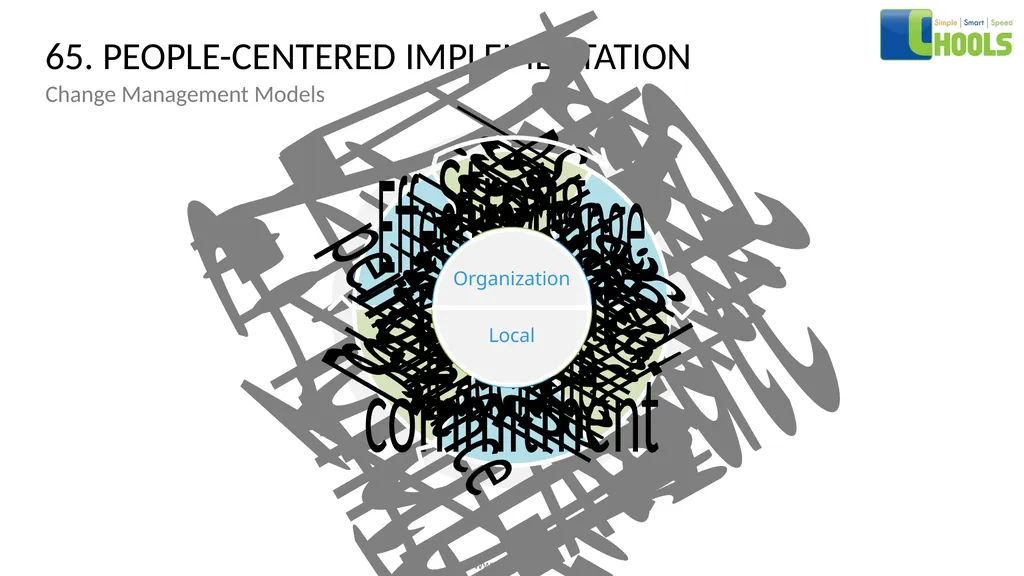
83
65. PEOPLE-CENTERED IMPLEMENTATION Change Management Models www.chools.in<br>
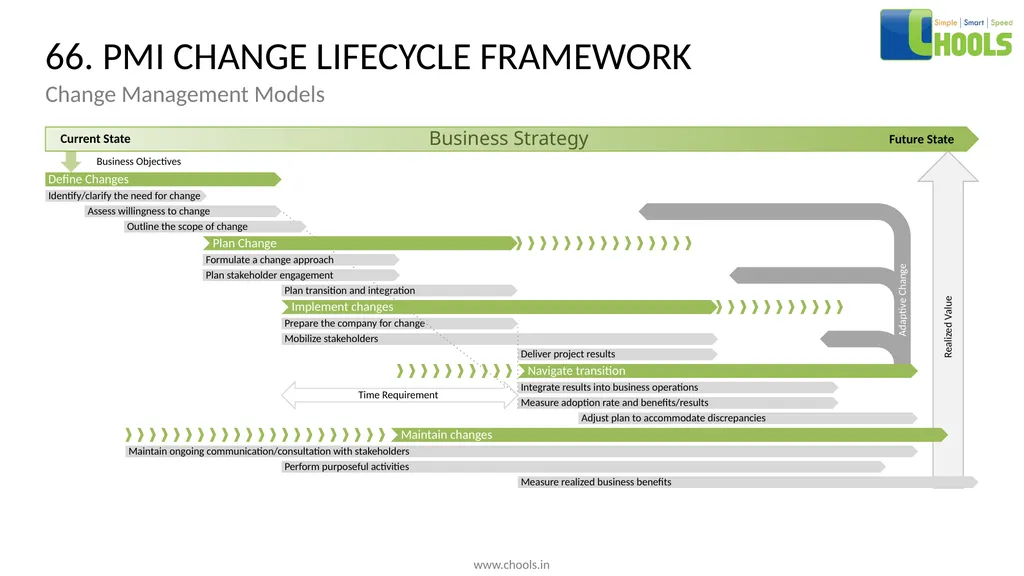
84
66. PMI CHANGE LIFECYCLE FRAMEWORK Change Management Models www.chools.in<br>
85
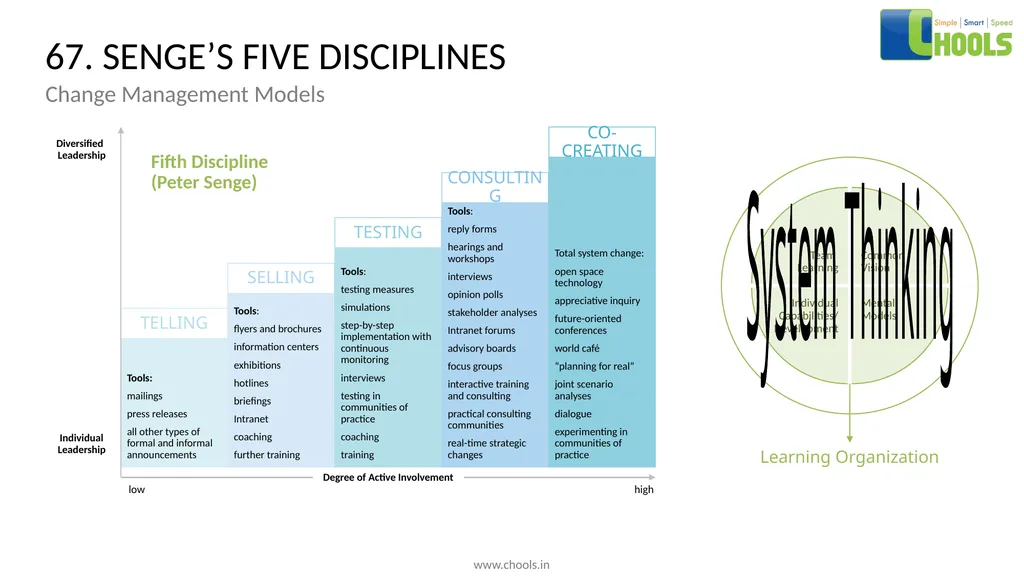
67. SENGE’S FIVE DISCIPLINES Change Management Models www.chools.in<br>
86
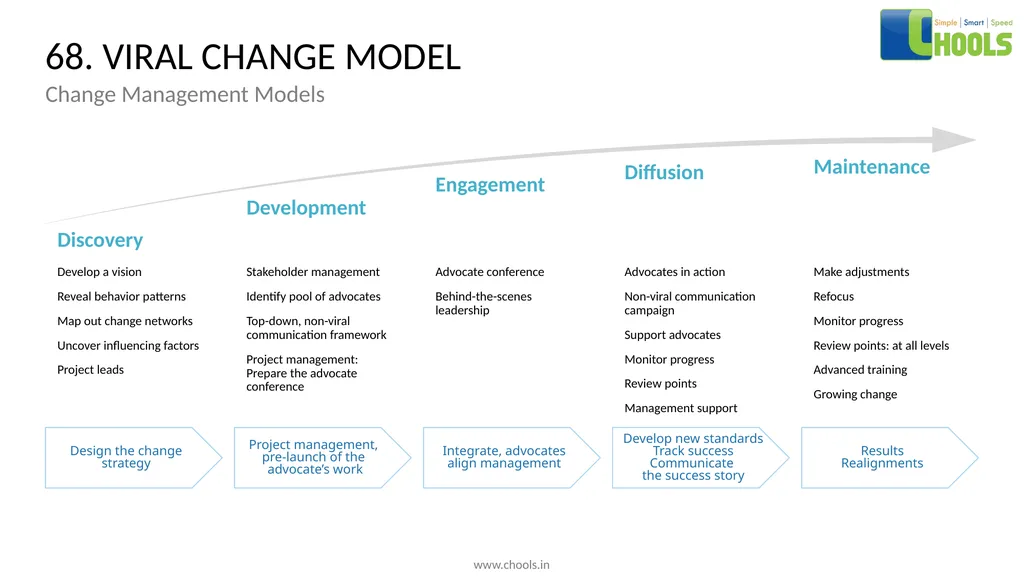
68. VIRAL CHANGE MODEL Change Management Models Discovery Development Engagement Diffusion Maintenance Develop a vision
Reveal behavior patterns
Map out change networks
Uncover influencing factors
Project leads Stakeholder management
Identify pool of advocates
Top-down, non-viral communication framework
Project management: Prepare the advocate conference Advocate conference
Behind-the-scenes leadership Advocates in action
Non-viral communication campaign
Support advocates
Monitor progress
Review points
Management support Make adjustments
Refocus
Monitor progress
Review points: at all levels
Advanced training
Growing change Design the change strategy Project management, pre-launch of the advocate’s work Integrate, advocates align management Develop new standards
Track success Communicate the success story Results
Realignments www.chools.in<br>
Reveal behavior patterns
Map out change networks
Uncover influencing factors
Project leads Stakeholder management
Identify pool of advocates
Top-down, non-viral communication framework
Project management: Prepare the advocate conference Advocate conference
Behind-the-scenes leadership Advocates in action
Non-viral communication campaign
Support advocates
Monitor progress
Review points
Management support Make adjustments
Refocus
Monitor progress
Review points: at all levels
Advanced training
Growing change Design the change strategy Project management, pre-launch of the advocate’s work Integrate, advocates align management Develop new standards
Track success Communicate the success story Results
Realignments www.chools.in<br>
87
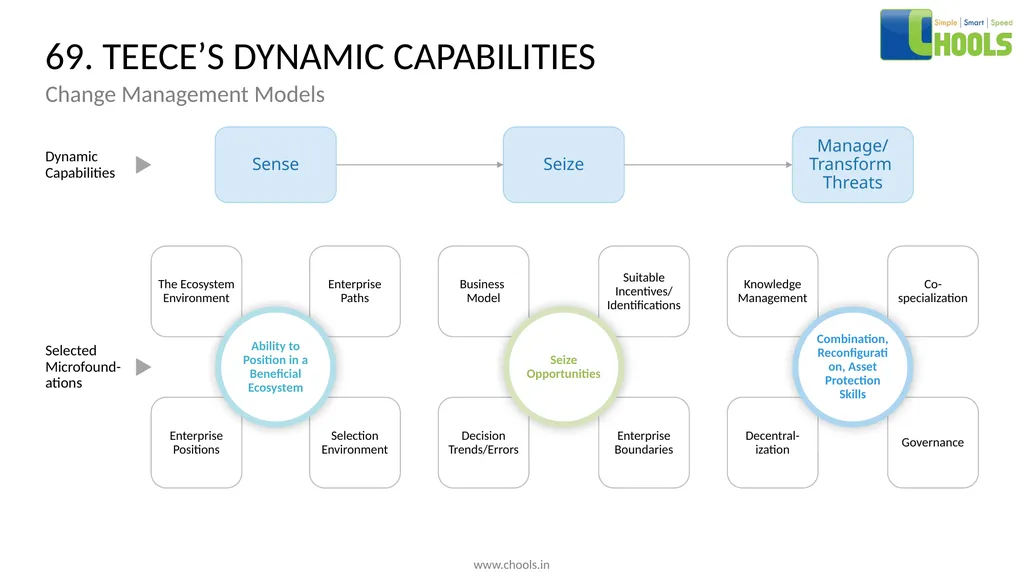
69. TEECE’S DYNAMIC CAPABILITIES Change Management Models www.chools.in<br>
88
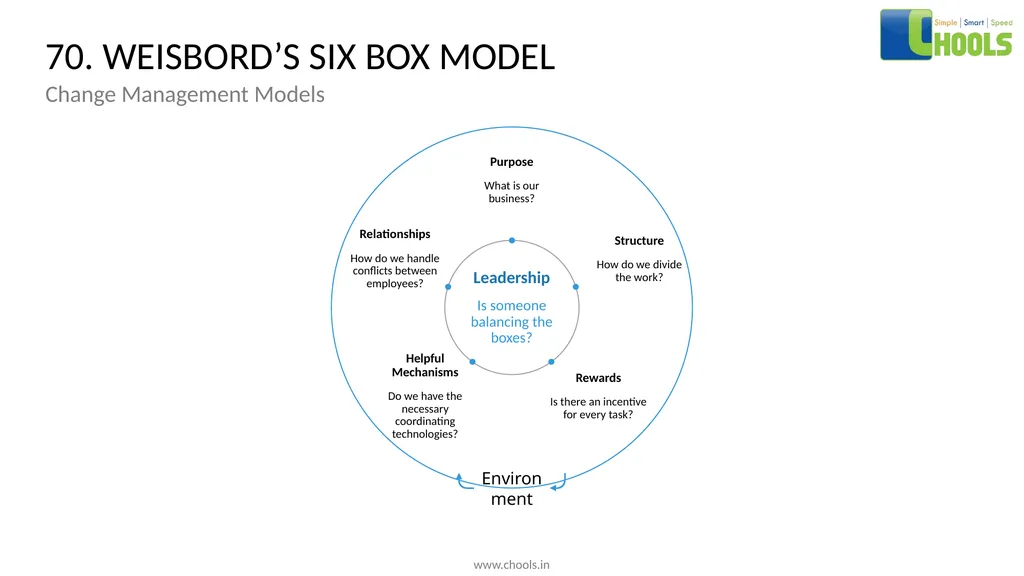
70. WEISBORD’S SIX BOX MODEL Change Management Models www.chools.in<br>
89
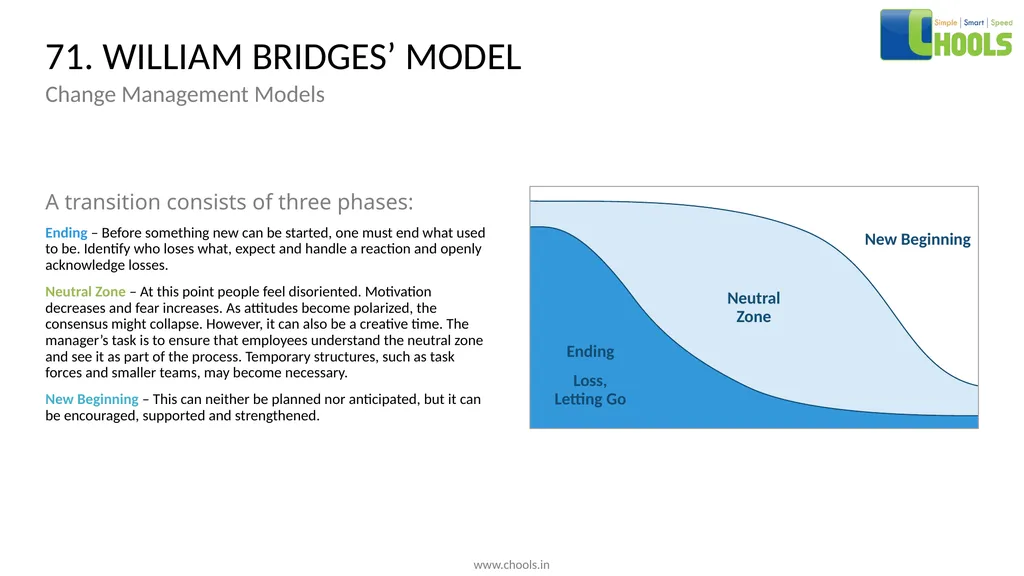
71. WILLIAM BRIDGES’ MODEL Change Management Models A transition consists of three phases:
Ending – Before something new can be started, one must end what used to be. Identify who loses what, expect and handle a reaction and openly acknowledge losses.
Neutral Zone – At this point people feel disoriented. Motivation decreases and fear increases. As attitudes become polarized, the consensus might collapse. However, it can also be a creative time. The manager’s task is to ensure that employees understand the neutral zone and see it as part of the process. Temporary structures, such as task forces and smaller teams, may become necessary.
New Beginning – This can neither be planned nor anticipated, but it can be encouraged, supported and strengthened. www.chools.in<br>
Ending – Before something new can be started, one must end what used to be. Identify who loses what, expect and handle a reaction and openly acknowledge losses.
Neutral Zone – At this point people feel disoriented. Motivation decreases and fear increases. As attitudes become polarized, the consensus might collapse. However, it can also be a creative time. The manager’s task is to ensure that employees understand the neutral zone and see it as part of the process. Temporary structures, such as task forces and smaller teams, may become necessary.
New Beginning – This can neither be planned nor anticipated, but it can be encouraged, supported and strengthened. www.chools.in<br>
90
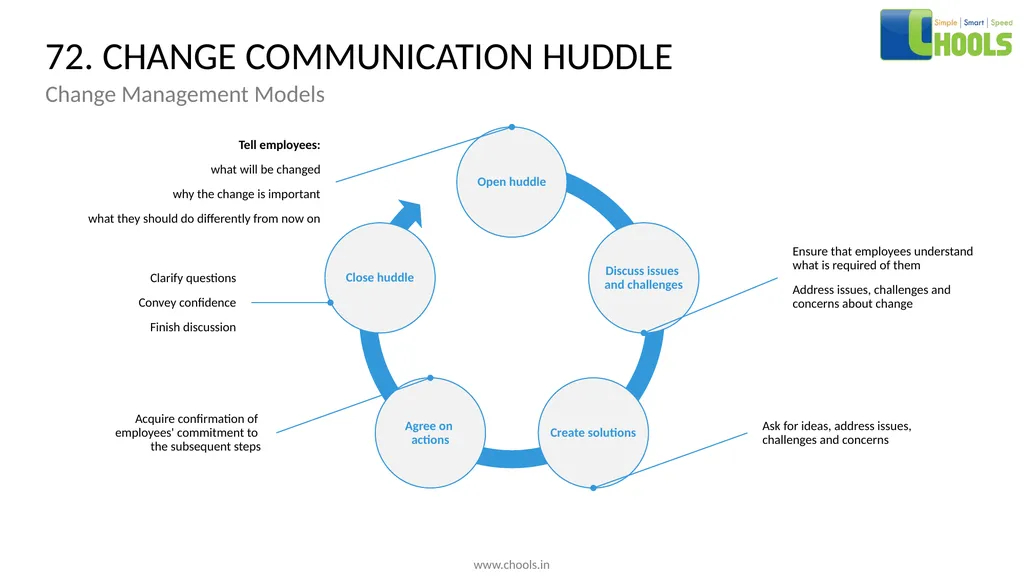
72. CHANGE COMMUNICATION HUDDLE Change Management Models www.chools.in<br>
91
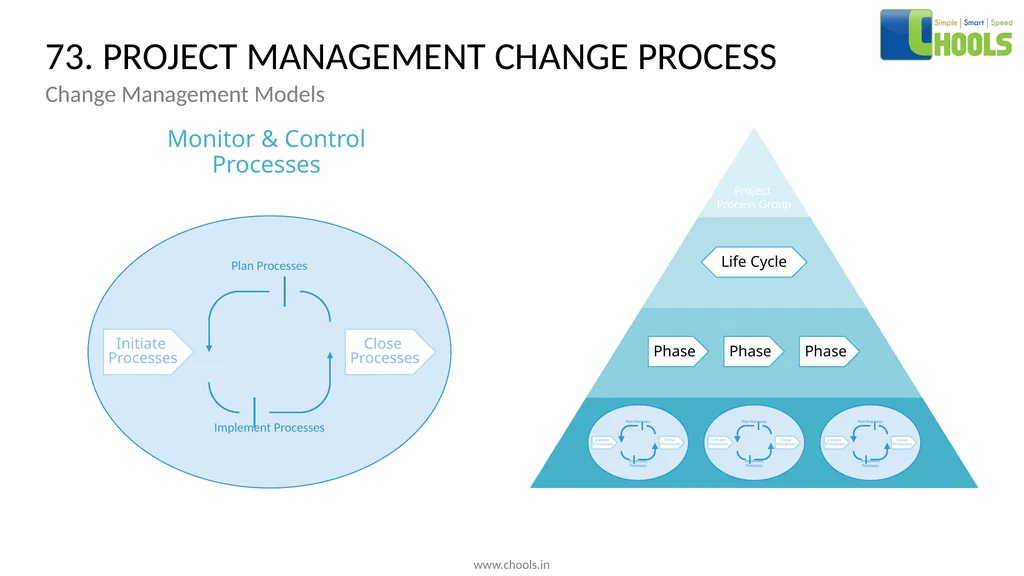
73. PROJECT MANAGEMENT CHANGE PROCESS Change Management Models Monitor & Control
Processes www.chools.in<br>
92
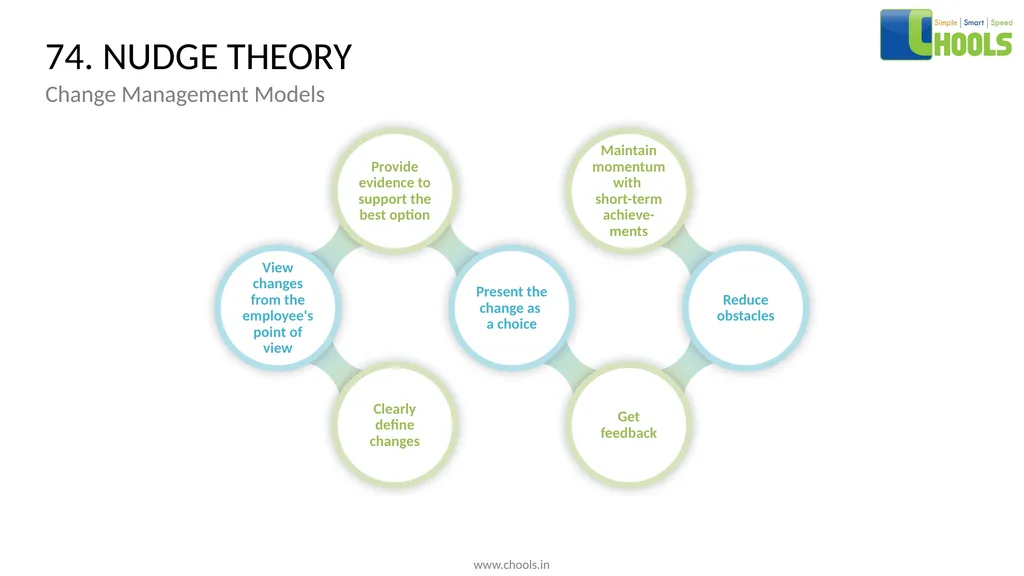
74. NUDGE THEORY Change Management Models www.chools.in<br>
93
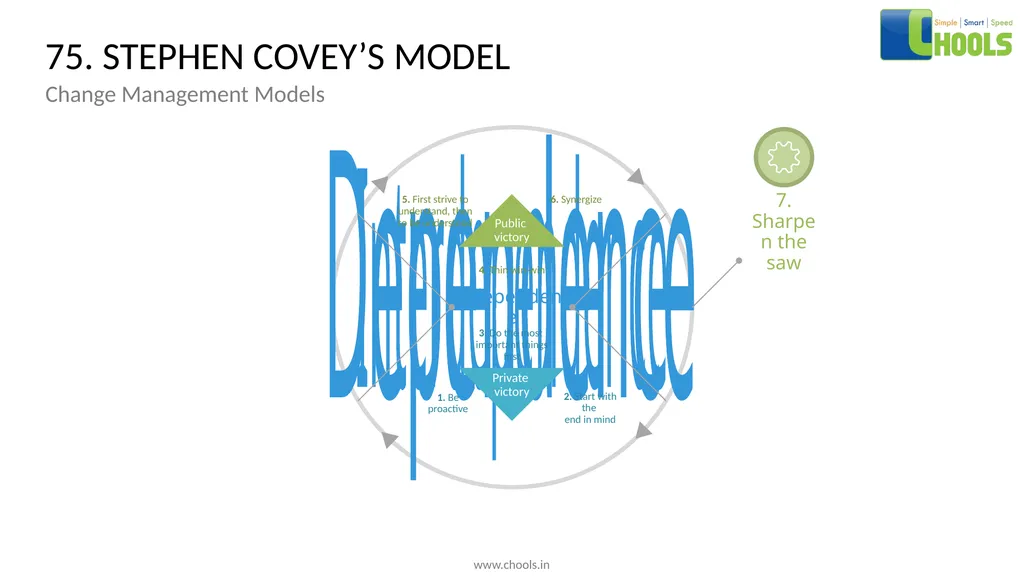
75. STEPHEN COVEY’S MODEL Change Management Models www.chools.in<br>
94
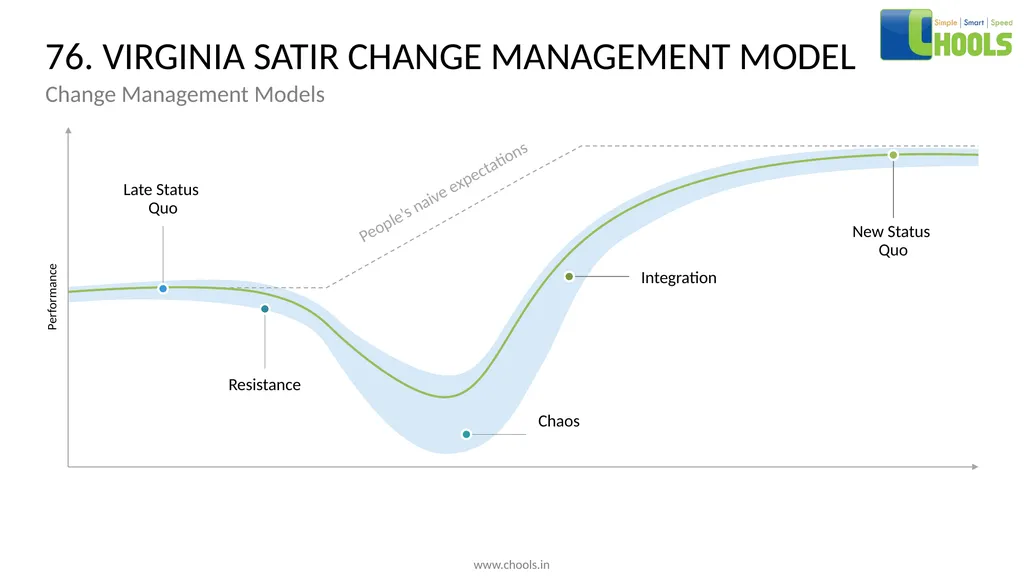
76. VIRGINIA SATIR CHANGE MANAGEMENT MODEL Change Management Models www.chools.in<br>
95
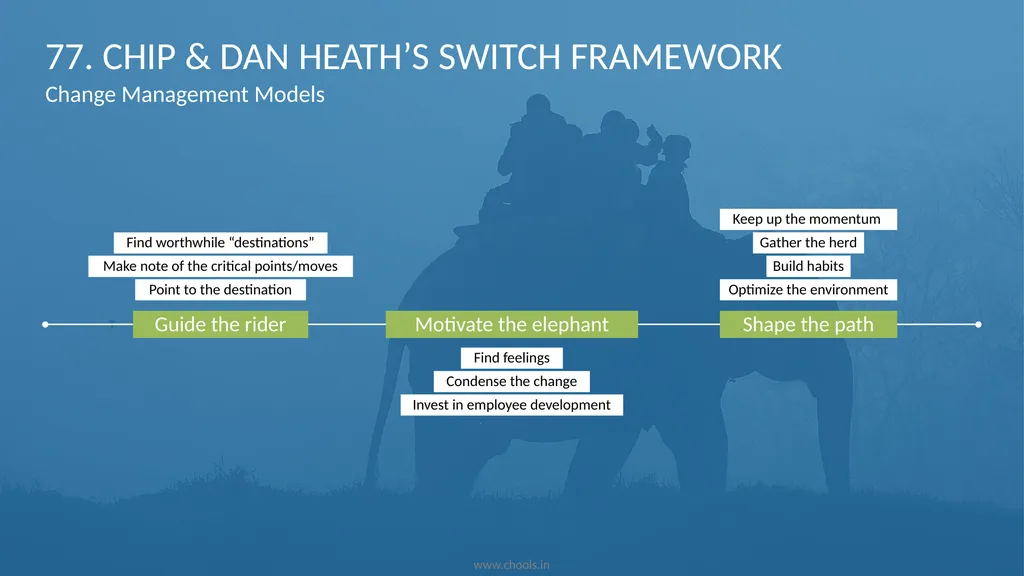
77. CHIP & DAN HEATH’S SWITCH FRAMEWORK Change Management Models www.chools.in<br>
96
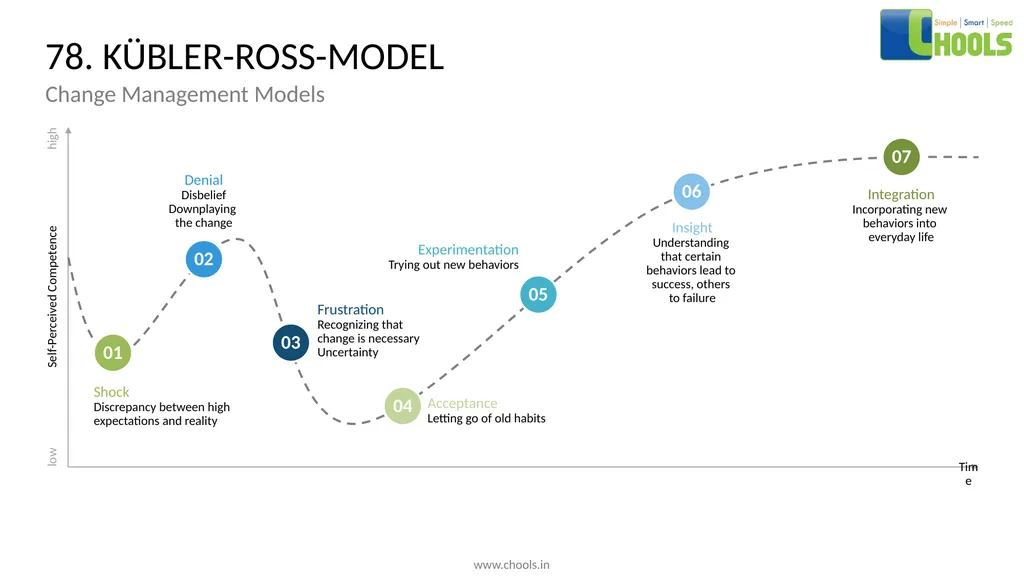
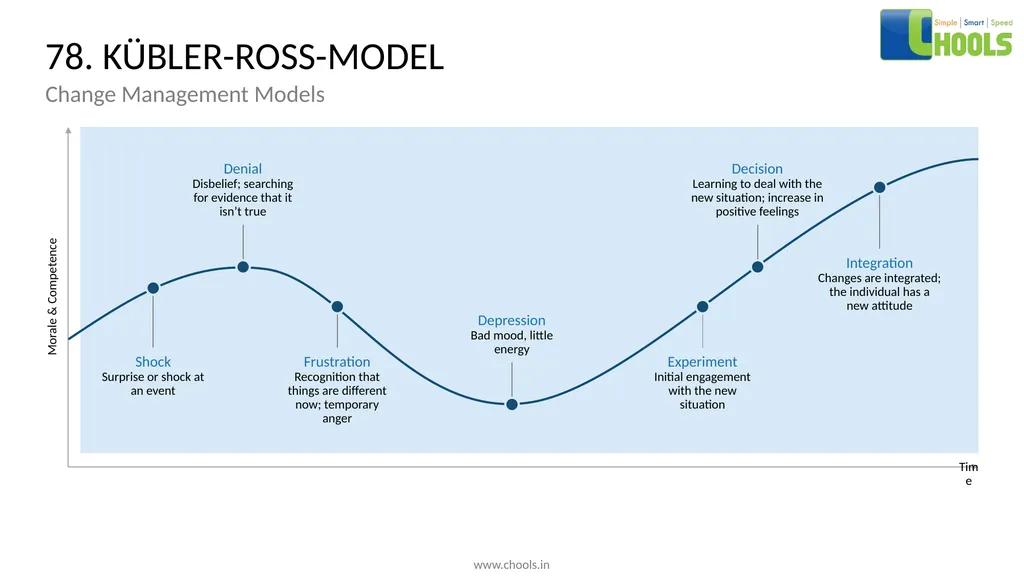
78. KÜBLER-ROSS-MODEL Change Management Models www.chools.in<br>
97
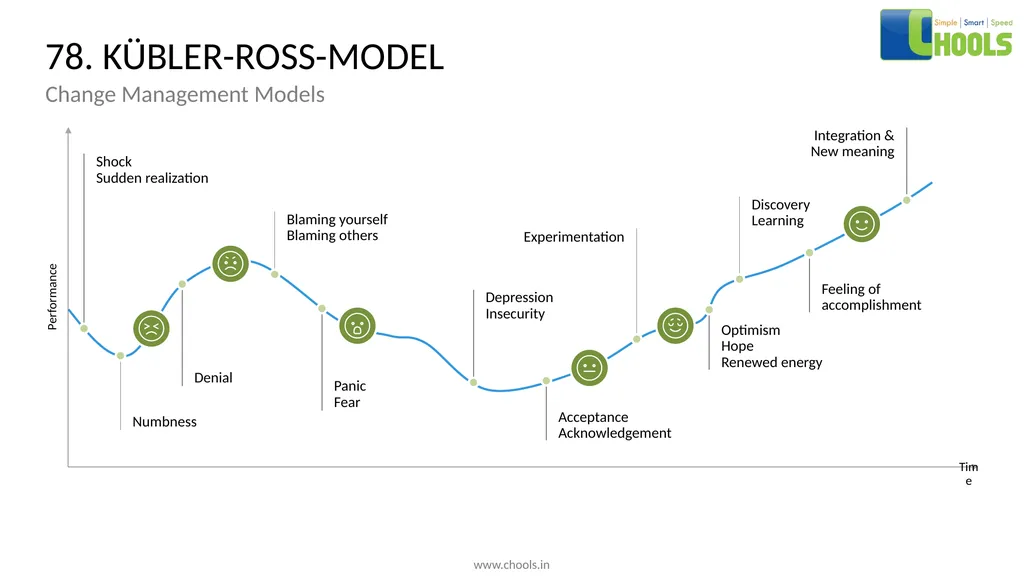
78. KÜBLER-ROSS-MODEL Change Management Models www.chools.in<br>
98
78. KÜBLER-ROSS-MODEL Change Management Models www.chools.in<br>
99
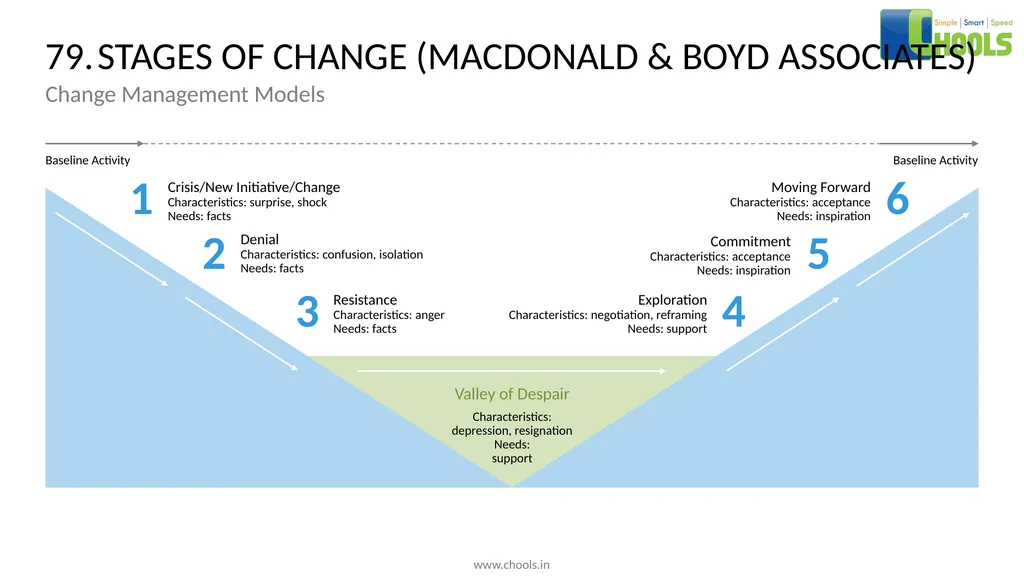
79. STAGES OF CHANGE (MACDONALD & BOYD ASSOCIATES) Change Management Models www.chools.in<br>
100
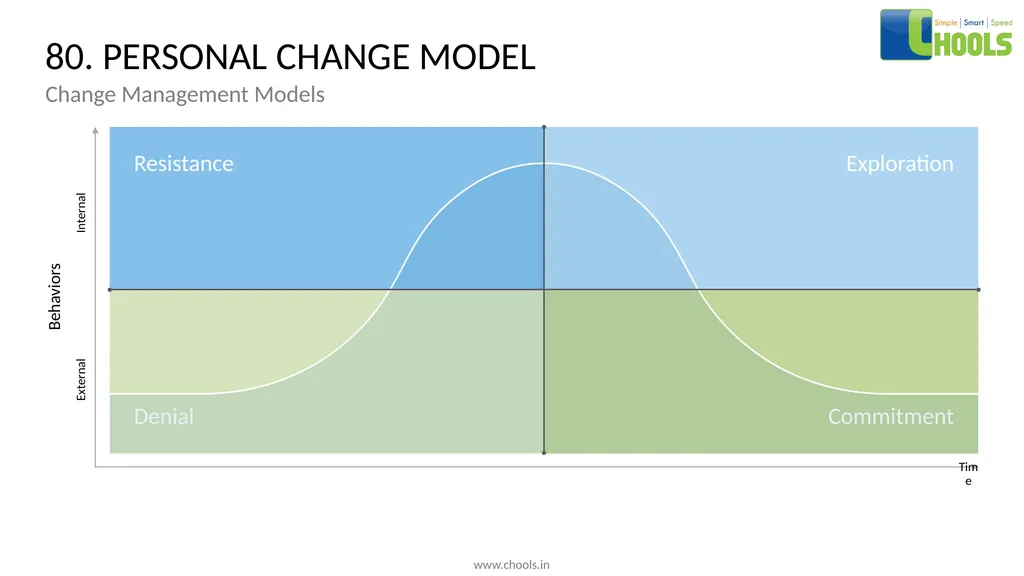
80. PERSONAL CHANGE MODEL Change Management Models www.chools.in<br>
101
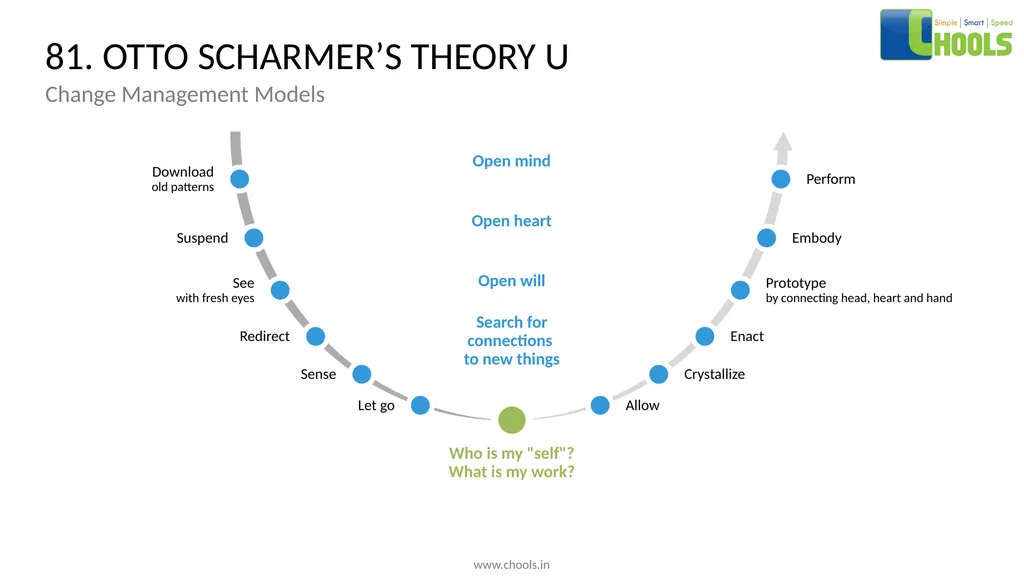
81. OTTO SCHARMER’S THEORY U Change Management Models www.chools.in<br>
102
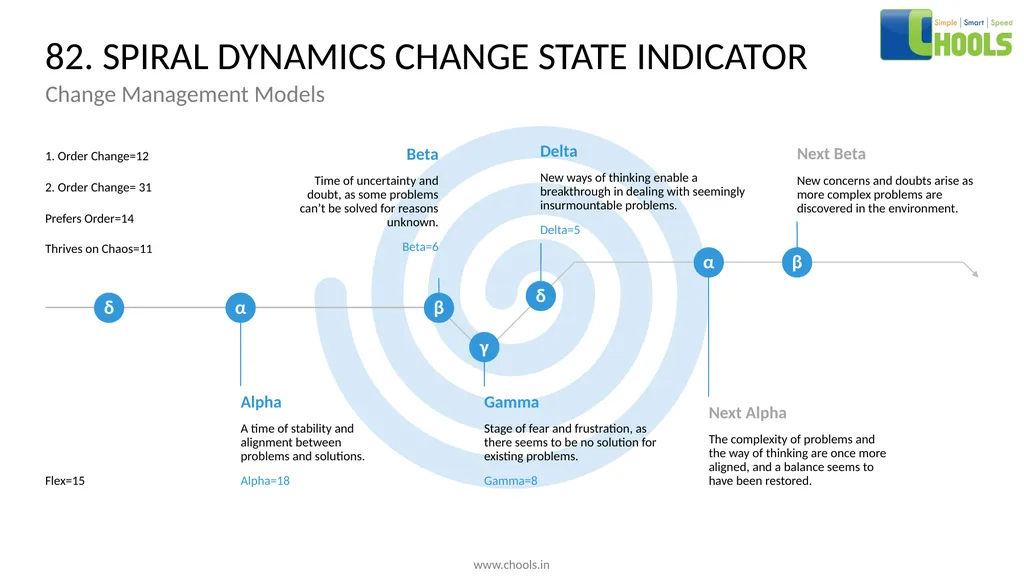
82. SPIRAL DYNAMICS CHANGE STATE INDICATOR Change Management Models www.chools.in<br>
103
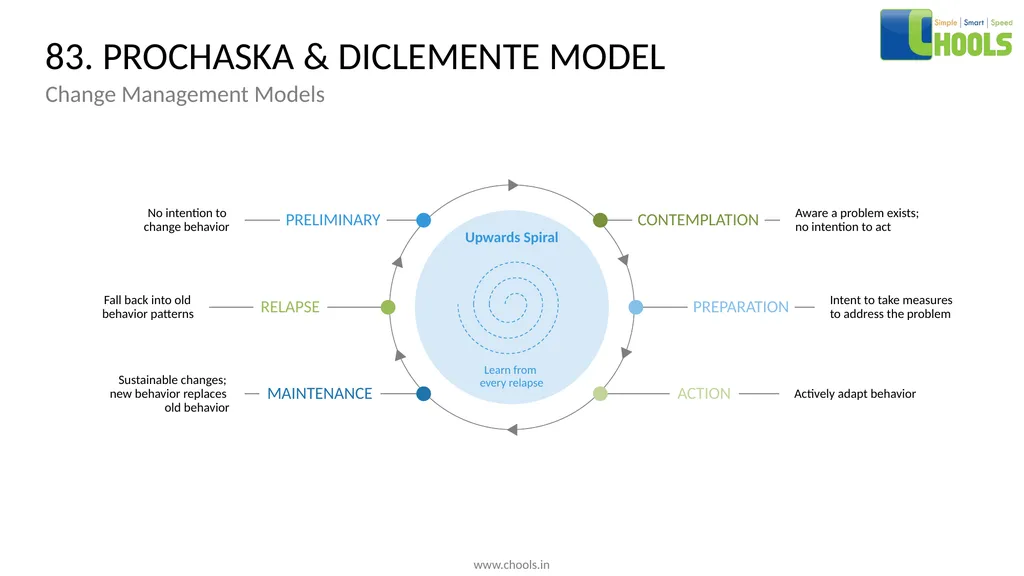
83. PROCHASKA & DICLEMENTE MODEL Change Management Models www.chools.in<br>
104
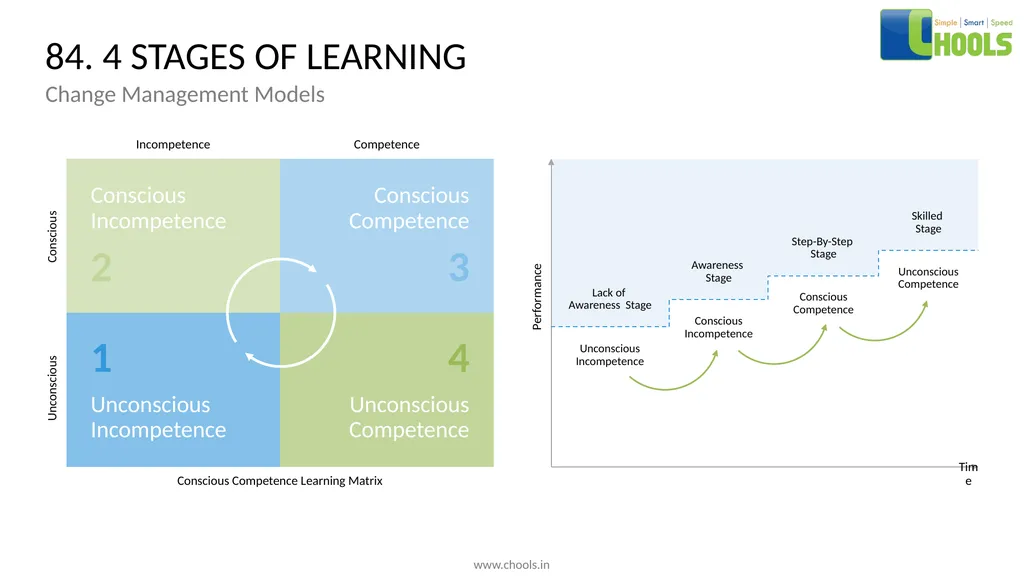
84. 4 STAGES OF LEARNING Change Management Models www.chools.in<br>