
Changes in Aspect Elly van Gelderen Workshop
LD
Published · 77 slides · 0 views
1 / 1


Description
Changes in Aspect Elly van Gelderen Workshop beyond Time, Boulder 7-8 April 2017 Outline Change in verb meaning is due to changes in aspect and theta-roles, which is systematic. Lexical aspect is pre-linguistic and innate; theta-structure
Related Topics
Share
Embed code
Download this presentation From Below
"Changes in Aspect Elly van Gelderen Workshop" is the property of its rightful owner. Permission is granted to download and print the materials on this website for personal, non-commercial use only, and to display it on your personal computer provided you do not modify the materials and that you retain all copyright notices contained in the materials. By downloading content from our website, you accept the terms of this agreement.
Presentation Transcript
01
Changes in Aspect Elly van Gelderen
Workshop beyond Time, Boulder
7-8 April 2017<br>
Workshop beyond Time, Boulder
7-8 April 2017<br>
02
Outline Change in verb meaning is due to changes in aspect and theta-roles, which is systematic. Lexical aspect is pre-linguistic and innate; theta-structure follows from this.
Changes in Lexical Aspect: unaccusative > copula and causative; unergative > transitive. These show the fundamental role of telic/durative/stative aspect.
Changes in Grammatical Aspect involve Cycles: Imperfective and Perfective cycles (ge-, have, -ing, particles).
How each influences the other in change is not clear.<br>
Changes in Lexical Aspect: unaccusative > copula and causative; unergative > transitive. These show the fundamental role of telic/durative/stative aspect.
Changes in Grammatical Aspect involve Cycles: Imperfective and Perfective cycles (ge-, have, -ing, particles).
How each influences the other in change is not clear.<br>
03
Grammatical and lexical aspect Grammatical – lexical
encoded in the connected to the V
grammar
-ing in English, ge- fall vs walk,
-ed particles, light verbs
Lexical > grammatical (Robertson & Law 2009)
Grammatical can shift lexical, e.g. past tense in (1):
(1) He ate the turkey.
But not always, e.g. imperfective over state:
(2) *I am seeing the blue sky (for hours)<br>
encoded in the connected to the V
grammar
-ing in English, ge- fall vs walk,
-ed particles, light verbs
Lexical > grammatical (Robertson & Law 2009)
Grammatical can shift lexical, e.g. past tense in (1):
(1) He ate the turkey.
But not always, e.g. imperfective over state:
(2) *I am seeing the blue sky (for hours)<br>
04
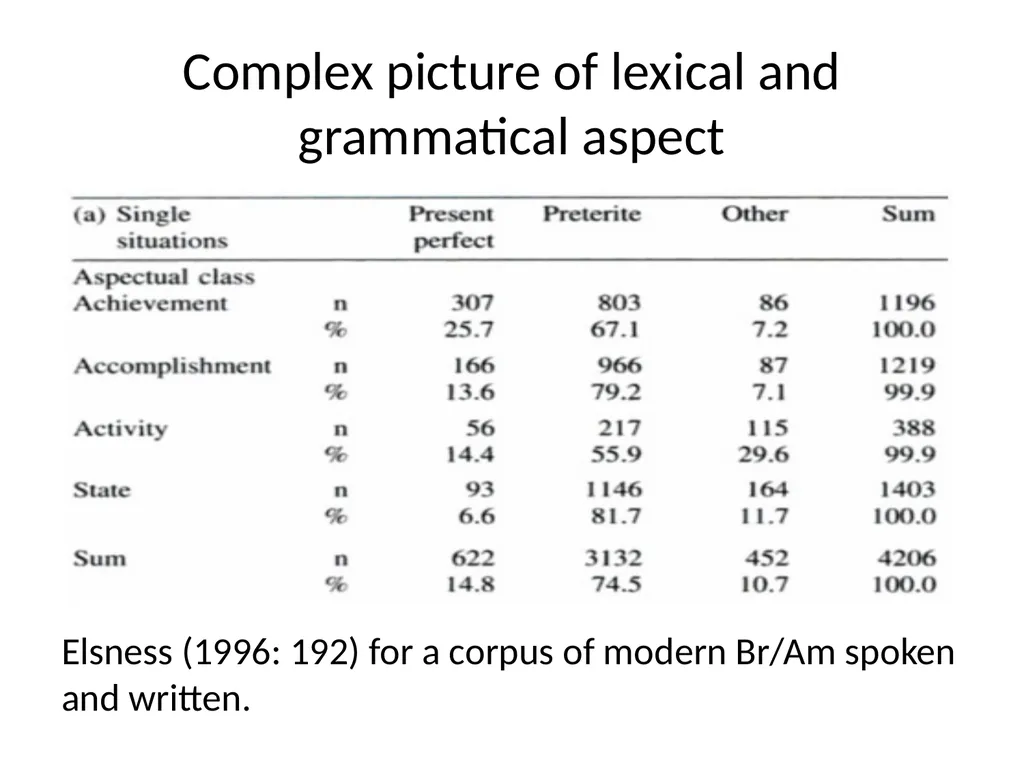
Complex picture of lexical and grammatical aspect Elsness (1996: 192) for a corpus of modern Br/Am spoken and written.<br>
05
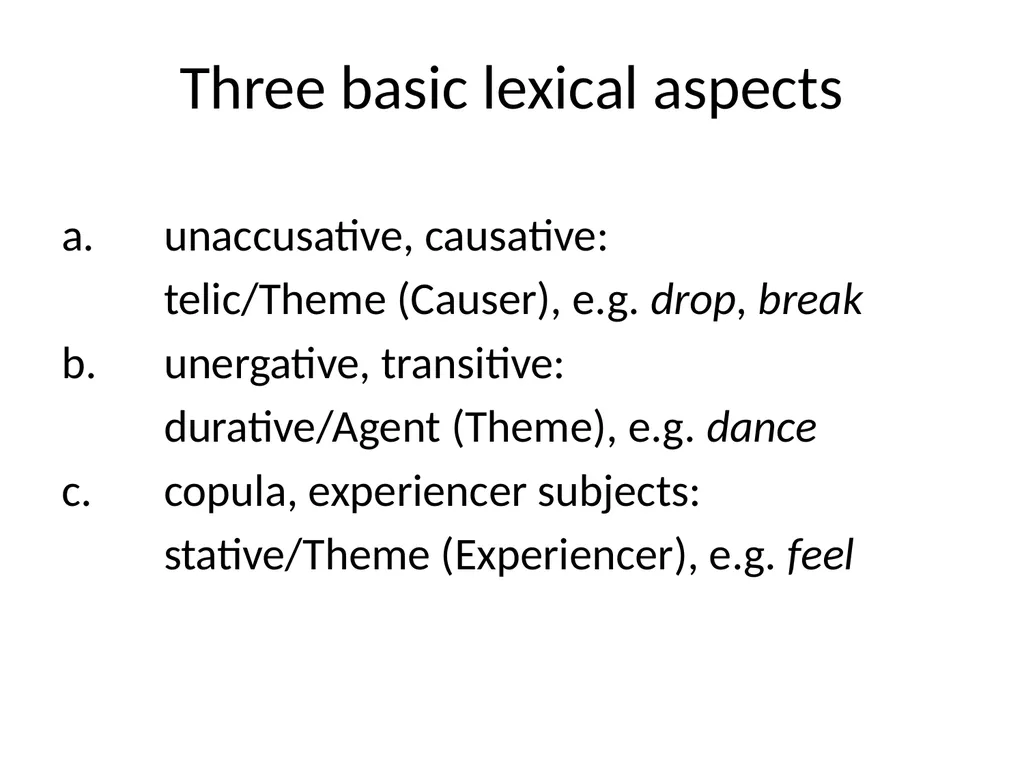
Three basic lexical aspects a. unaccusative, causative:
telic/Theme (Causer), e.g. drop, break
b. unergative, transitive:
durative/Agent (Theme), e.g. dance
c. copula, experiencer subjects:
stative/Theme (Experiencer), e.g. feel<br>
telic/Theme (Causer), e.g. drop, break
b. unergative, transitive:
durative/Agent (Theme), e.g. dance
c. copula, experiencer subjects:
stative/Theme (Experiencer), e.g. feel<br>
06
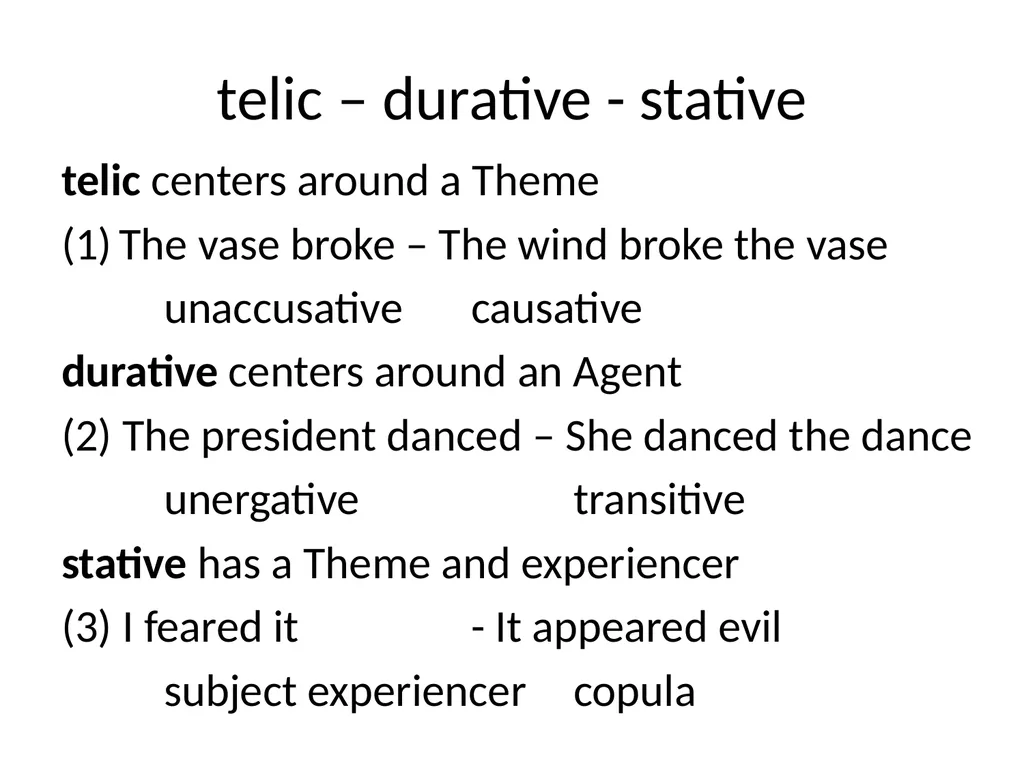
telic – durative - stative telic centers around a Theme
The vase broke – The wind broke the vase
unaccusative causative
durative centers around an Agent
(2) The president danced – She danced the dance
unergative transitive
stative has a Theme and experiencer
(3) I feared it - It appeared evil
subject experiencer copula<br>
The vase broke – The wind broke the vase
unaccusative causative
durative centers around an Agent
(2) The president danced – She danced the dance
unergative transitive
stative has a Theme and experiencer
(3) I feared it - It appeared evil
subject experiencer copula<br>
07
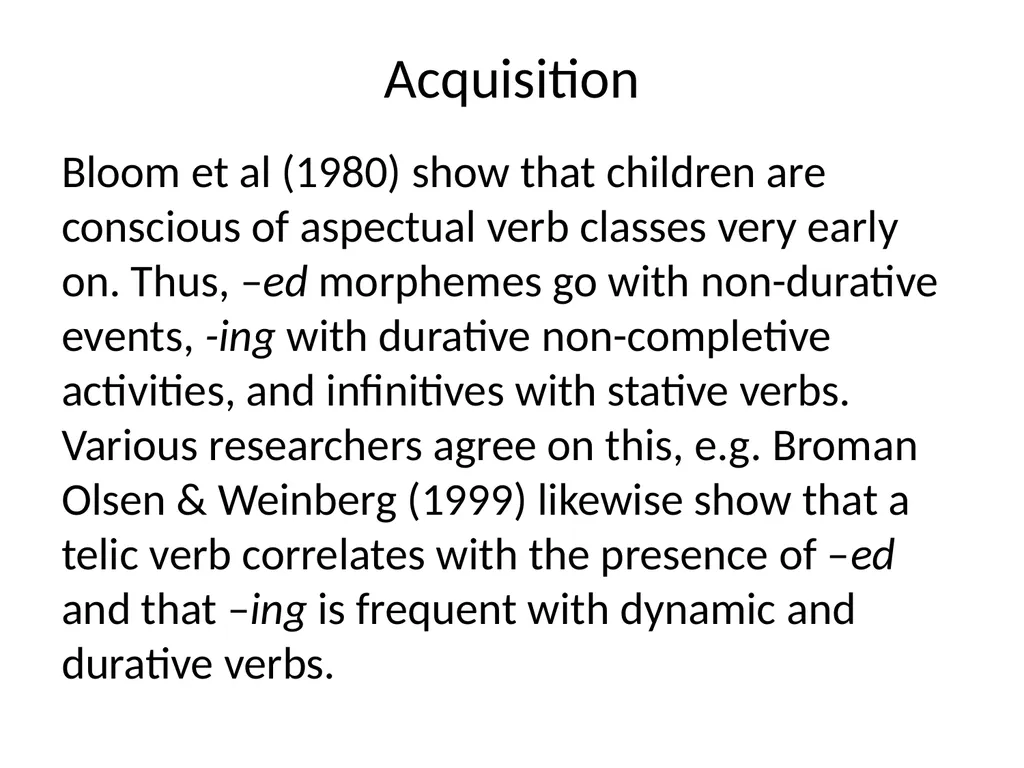
Acquisition Bloom et al (1980) show that children are conscious of aspectual verb classes very early on. Thus, –ed morphemes go with non-durative events, -ing with durative non-completive activities, and infinitives with stative verbs. Various researchers agree on this, e.g. Broman Olsen & Weinberg (1999) likewise show that a telic verb correlates with the presence of –ed and that –ing is frequent with dynamic and durative verbs.<br>
08
Eve (Brown 1973) at 1;6 unaccusative unergative transitive other
block broke (fish are) swimming Eve pencil that radio
(Neil) sit wait, play, cook I did it
down, busy, gone look Eve/you find it
Mommy down, open Eve writing see ya
come down, stand dance doll eat celery
sit down, fall down Mommy step read the puzzle
(finger) stuck Mommy swing? change her
lie down stool man (no) taste it
get her/it
fix (it)/ Mommy fix
bring it
want Mommy letter
write a paper
man/papa have it
(you) find it
play (step)<br>
block broke (fish are) swimming Eve pencil that radio
(Neil) sit wait, play, cook I did it
down, busy, gone look Eve/you find it
Mommy down, open Eve writing see ya
come down, stand dance doll eat celery
sit down, fall down Mommy step read the puzzle
(finger) stuck Mommy swing? change her
lie down stool man (no) taste it
get her/it
fix (it)/ Mommy fix
bring it
want Mommy letter
write a paper
man/papa have it
(you) find it
play (step)<br>
09
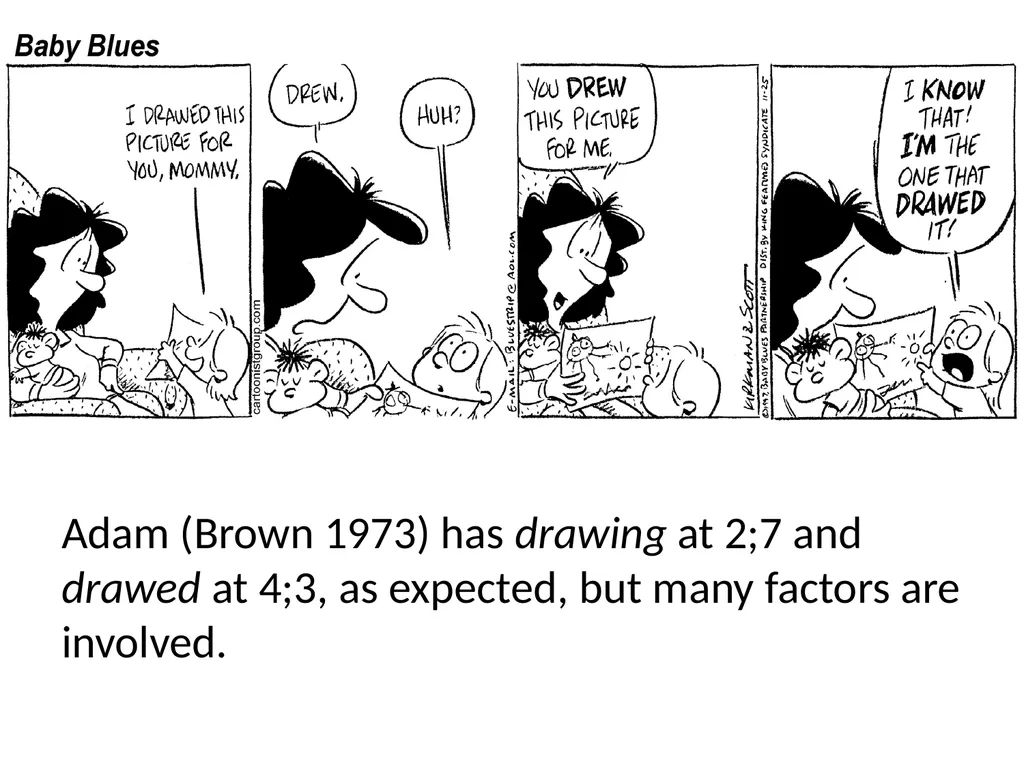
Adam (Brown 1973) has drawing at 2;7 and drawed at 4;3, as expected, but many factors are involved.<br>
10
Argument structure as pre-linguistic Argument structure and lexical aspect are at the basis of our propositions and, without it, there is no meaning. It is likely that AS is part of our larger cognitive system and not restricted to the language faculty.
Bickerton (1990: 185) suggests that the “universality of thematic structure suggests a deep-rooted ancestry, perhaps one lying outside language altogether.”<br>
Bickerton (1990: 185) suggests that the “universality of thematic structure suggests a deep-rooted ancestry, perhaps one lying outside language altogether.”<br>
11
If argument/thematic structure predates the emergence of language, an understanding of causation, intentionality, volition - all relevant to determining theta-structure – is part of our larger cognitive system and not restricted to the language faculty.
Argument structure is relevant to other parts of our cognitive make-up, e.g. the moral grammar. Gray et al. (2007), for instance, argue that moral judgment depends on mind perception, ascribing agency and experience to other entities.
De Waal (e.g. 2006) has shown that chimps and bonobos show empathy, planning, and attribute minds to others.<br>
Argument structure is relevant to other parts of our cognitive make-up, e.g. the moral grammar. Gray et al. (2007), for instance, argue that moral judgment depends on mind perception, ascribing agency and experience to other entities.
De Waal (e.g. 2006) has shown that chimps and bonobos show empathy, planning, and attribute minds to others.<br>
12
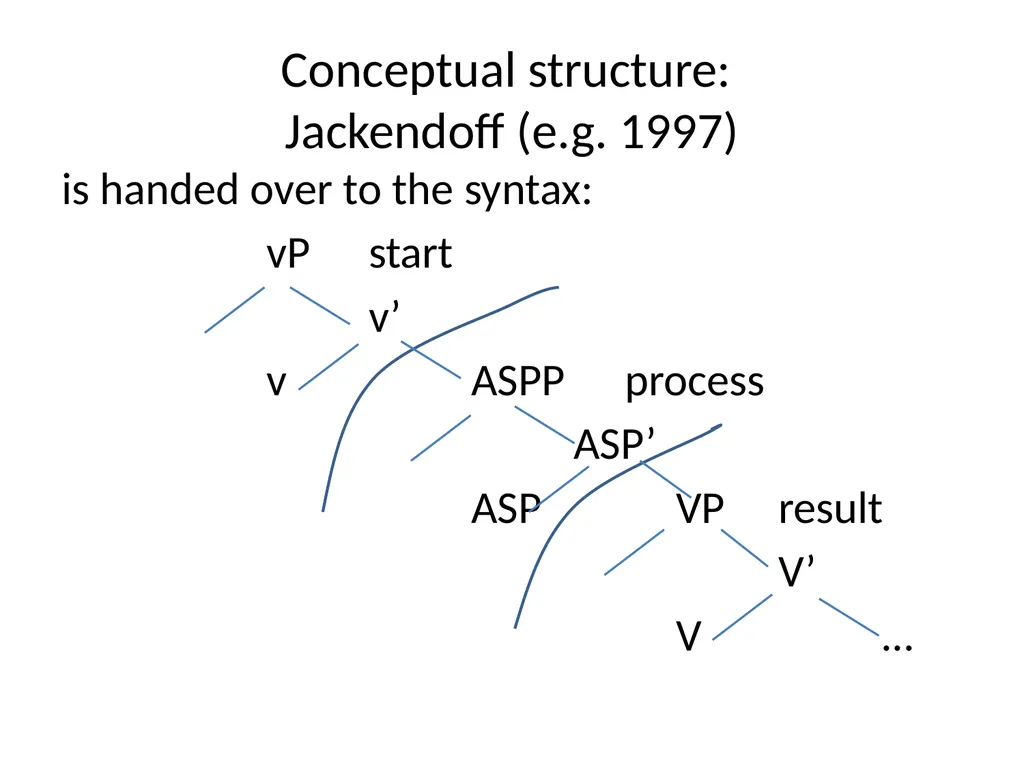
Conceptual structure:
Jackendoff (e.g. 1997) is handed over to the syntax:
vP start
v’
v ASPP process
ASP’
ASP VP result
V’
V ...<br>
vP start
v’
v ASPP process
ASP’
ASP VP result
V’
V ...<br>
13
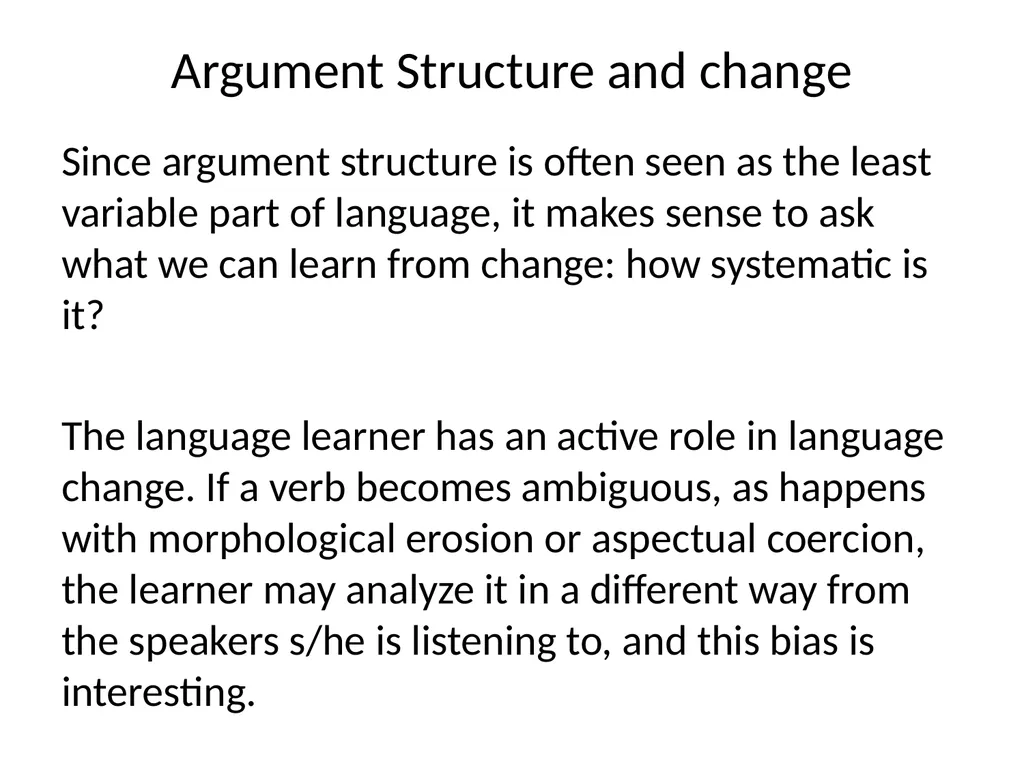
Argument Structure and change Since argument structure is often seen as the least variable part of language, it makes sense to ask what we can learn from change: how systematic is it?
The language learner has an active role in language change. If a verb becomes ambiguous, as happens with morphological erosion or aspectual coercion, the learner may analyze it in a different way from the speakers s/he is listening to, and this bias is interesting.<br>
The language learner has an active role in language change. If a verb becomes ambiguous, as happens with morphological erosion or aspectual coercion, the learner may analyze it in a different way from the speakers s/he is listening to, and this bias is interesting.<br>
14
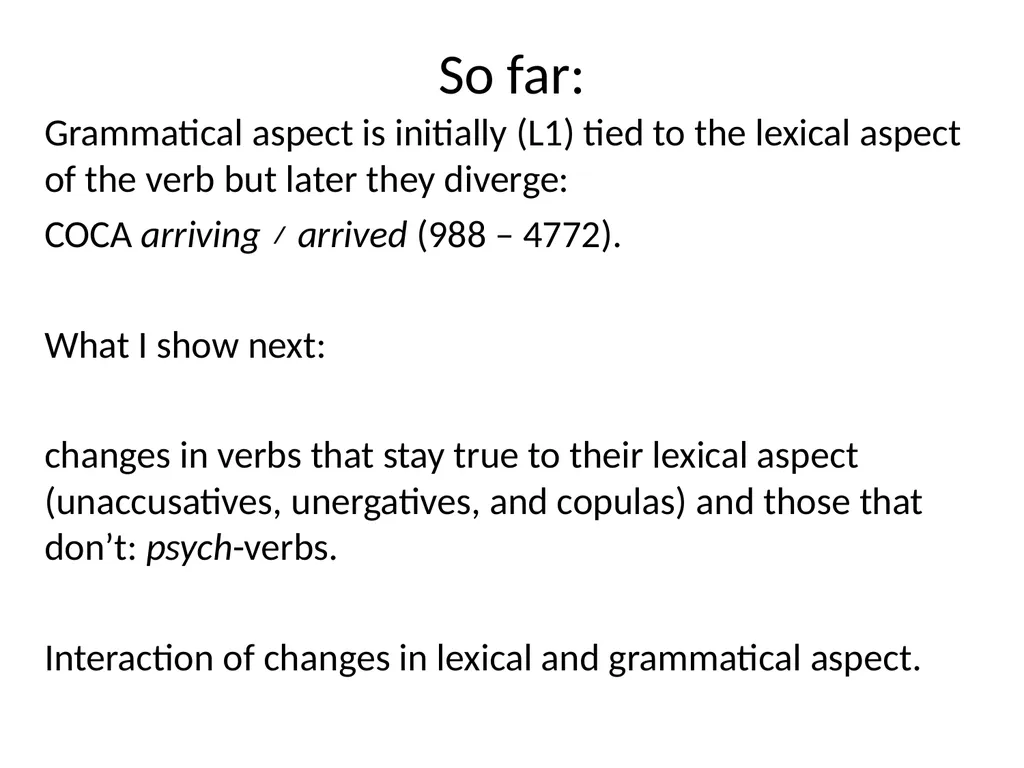
So far: Grammatical aspect is initially (L1) tied to the lexical aspect of the verb but later they diverge:
COCA arriving ≠ arrived (988 – 4772).
What I show next:
changes in verbs that stay true to their lexical aspect (unaccusatives, unergatives, and copulas) and those that don’t: psych-verbs.
Interaction of changes in lexical and grammatical aspect.<br>
COCA arriving ≠ arrived (988 – 4772).
What I show next:
changes in verbs that stay true to their lexical aspect (unaccusatives, unergatives, and copulas) and those that don’t: psych-verbs.
Interaction of changes in lexical and grammatical aspect.<br>
15
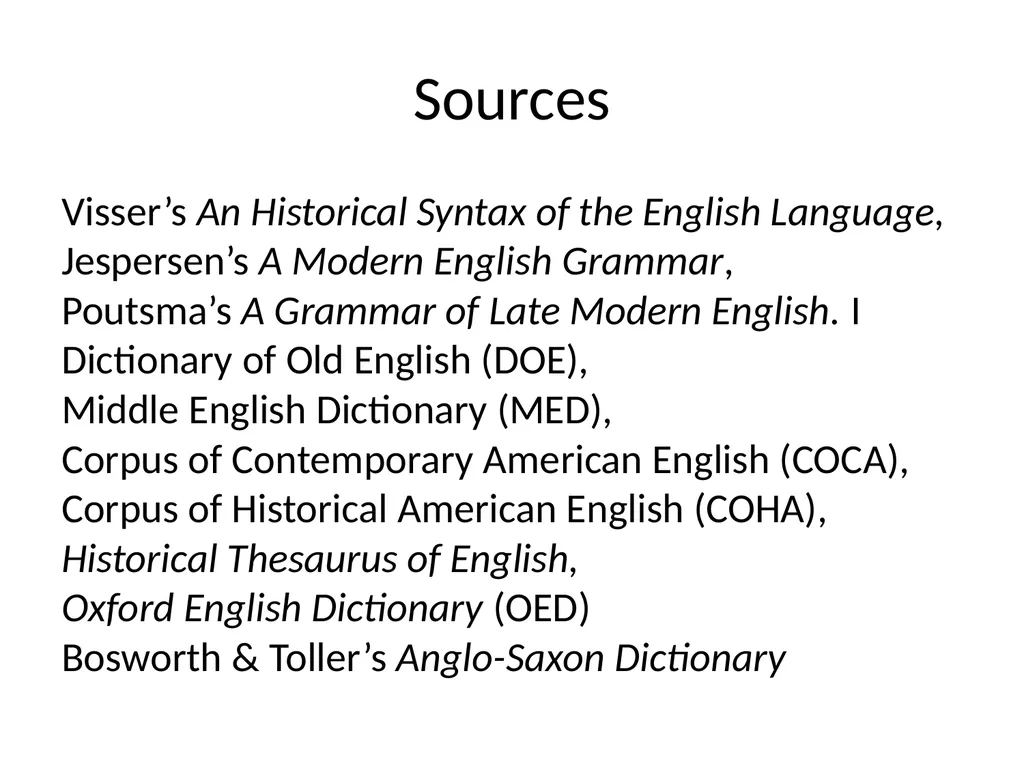
Sources Visser’s An Historical Syntax of the English Language, Jespersen’s A Modern English Grammar,
Poutsma’s A Grammar of Late Modern English. I Dictionary of Old English (DOE),
Middle English Dictionary (MED),
Corpus of Contemporary American English (COCA), Corpus of Historical American English (COHA), Historical Thesaurus of English,
Oxford English Dictionary (OED)
Bosworth & Toller’s Anglo-Saxon Dictionary<br>
Poutsma’s A Grammar of Late Modern English. I Dictionary of Old English (DOE),
Middle English Dictionary (MED),
Corpus of Contemporary American English (COCA), Corpus of Historical American English (COHA), Historical Thesaurus of English,
Oxford English Dictionary (OED)
Bosworth & Toller’s Anglo-Saxon Dictionary<br>
16
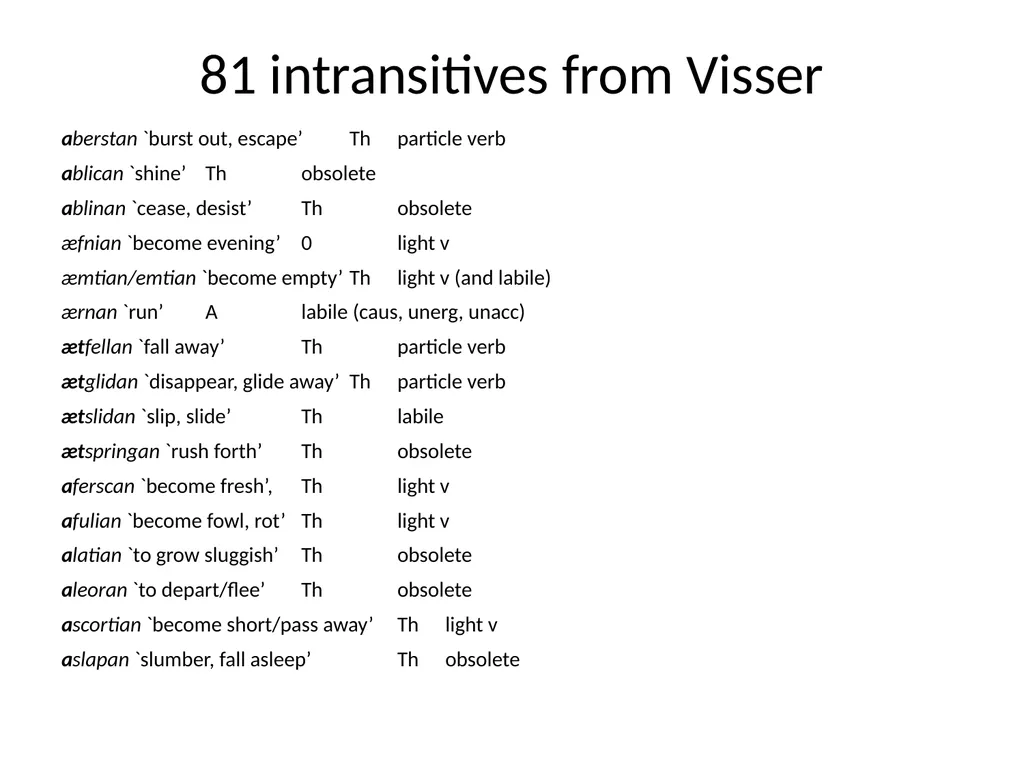
81 intransitives from Visser aberstan `burst out, escape’ Th particle verb
ablican `shine’ Th obsolete
ablinan `cease, desist’ Th obsolete
æfnian `become evening’ 0 light v
æmtian/emtian `become empty’ Th light v (and labile)
ærnan `run’ A labile (caus, unerg, unacc)
ætfellan `fall away’ Th particle verb
ætglidan `disappear, glide away’ Th particle verb
ætslidan `slip, slide’ Th labile
ætspringan `rush forth’ Th obsolete
aferscan `become fresh’, Th light v
afulian `become fowl, rot’ Th light v
alatian `to grow sluggish’ Th obsolete
aleoran `to depart/flee’ Th obsolete
ascortian `become short/pass away’ Th light v
aslapan `slumber, fall asleep’ Th obsolete<br>
ablican `shine’ Th obsolete
ablinan `cease, desist’ Th obsolete
æfnian `become evening’ 0 light v
æmtian/emtian `become empty’ Th light v (and labile)
ærnan `run’ A labile (caus, unerg, unacc)
ætfellan `fall away’ Th particle verb
ætglidan `disappear, glide away’ Th particle verb
ætslidan `slip, slide’ Th labile
ætspringan `rush forth’ Th obsolete
aferscan `become fresh’, Th light v
afulian `become fowl, rot’ Th light v
alatian `to grow sluggish’ Th obsolete
aleoran `to depart/flee’ Th obsolete
ascortian `become short/pass away’ Th light v
aslapan `slumber, fall asleep’ Th obsolete<br>
17
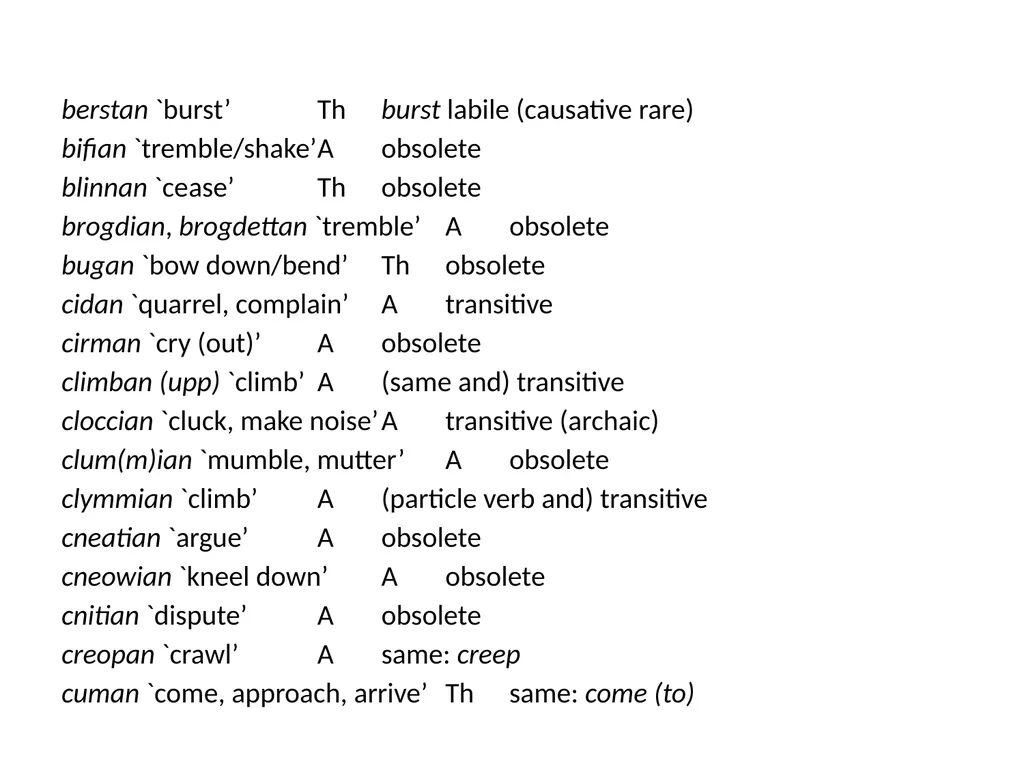
berstan `burst’ Th burst labile (causative rare)
bifian `tremble/shake’ A obsolete
blinnan `cease’ Th obsolete
brogdian, brogdettan `tremble’ A obsolete
bugan `bow down/bend’ Th obsolete
cidan `quarrel, complain’ A transitive
cirman `cry (out)’ A obsolete
climban (upp) `climb’ A (same and) transitive
cloccian `cluck, make noise’ A transitive (archaic)
clum(m)ian `mumble, mutter’ A obsolete
clymmian `climb’ A (particle verb and) transitive
cneatian `argue’ A obsolete
cneowian `kneel down’ A obsolete
cnitian `dispute’ A obsolete
creopan `crawl’ A same: creep
cuman `come, approach, arrive’ Th same: come (to)<br>
bifian `tremble/shake’ A obsolete
blinnan `cease’ Th obsolete
brogdian, brogdettan `tremble’ A obsolete
bugan `bow down/bend’ Th obsolete
cidan `quarrel, complain’ A transitive
cirman `cry (out)’ A obsolete
climban (upp) `climb’ A (same and) transitive
cloccian `cluck, make noise’ A transitive (archaic)
clum(m)ian `mumble, mutter’ A obsolete
clymmian `climb’ A (particle verb and) transitive
cneatian `argue’ A obsolete
cneowian `kneel down’ A obsolete
cnitian `dispute’ A obsolete
creopan `crawl’ A same: creep
cuman `come, approach, arrive’ Th same: come (to)<br>
18
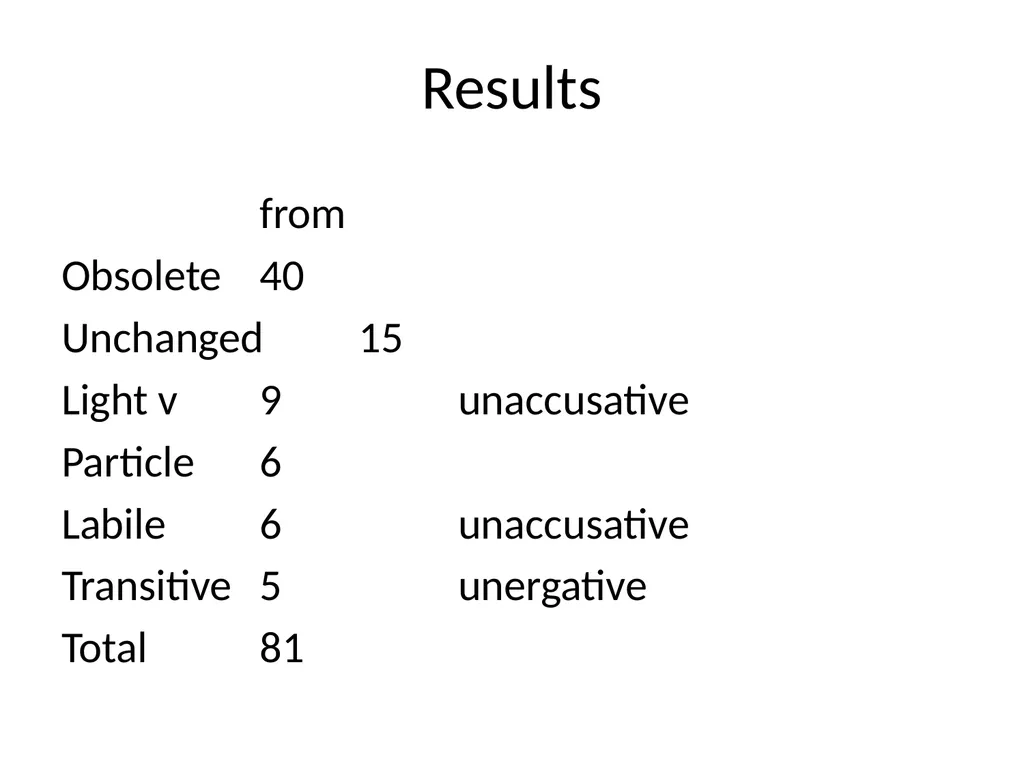
Results from
Obsolete 40
Unchanged 15
Light v 9 unaccusative
Particle 6
Labile 6 unaccusative
Transitive 5 unergative
Total 81<br>
Obsolete 40
Unchanged 15
Light v 9 unaccusative
Particle 6
Labile 6 unaccusative
Transitive 5 unergative
Total 81<br>
19
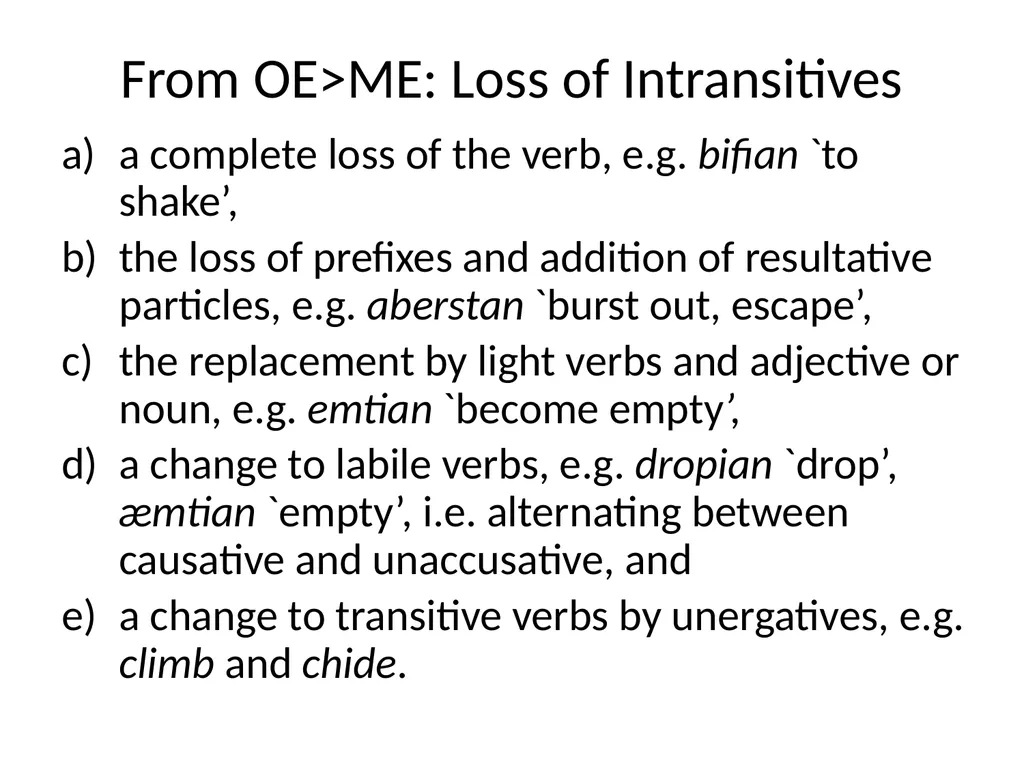
From OE>ME: Loss of Intransitives a complete loss of the verb, e.g. bifian `to shake’,
the loss of prefixes and addition of resultative particles, e.g. aberstan `burst out, escape’,
the replacement by light verbs and adjective or noun, e.g. emtian `become empty’,
a change to labile verbs, e.g. dropian `drop’, æmtian `empty’, i.e. alternating between causative and unaccusative, and
a change to transitive verbs by unergatives, e.g. climb and chide.<br>
the loss of prefixes and addition of resultative particles, e.g. aberstan `burst out, escape’,
the replacement by light verbs and adjective or noun, e.g. emtian `become empty’,
a change to labile verbs, e.g. dropian `drop’, æmtian `empty’, i.e. alternating between causative and unaccusative, and
a change to transitive verbs by unergatives, e.g. climb and chide.<br>
20
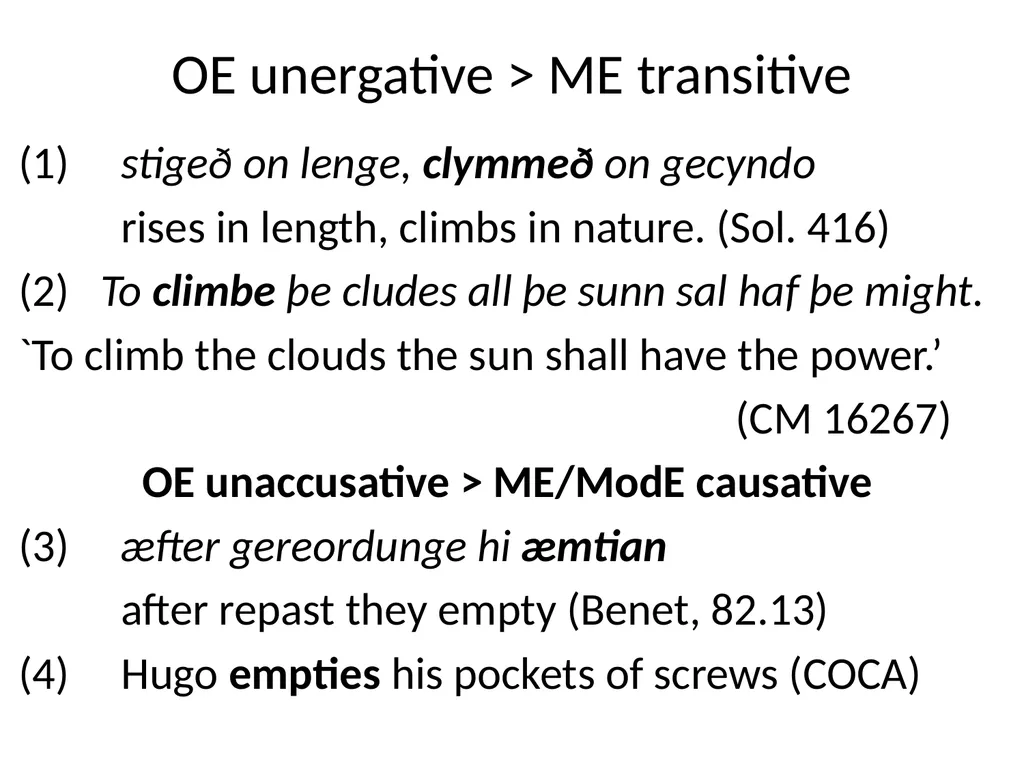
OE unergative > ME transitive (1) stigeð on lenge, clymmeð on gecyndo
rises in length, climbs in nature. (Sol. 416)
(2) To climbe þe cludes all þe sunn sal haf þe might.
`To climb the clouds the sun shall have the power.’
(CM 16267)
OE unaccusative > ME/ModE causative
(3) æfter gereordunge hi æmtian
after repast they empty (Benet, 82.13)
(4) Hugo empties his pockets of screws (COCA)<br>
rises in length, climbs in nature. (Sol. 416)
(2) To climbe þe cludes all þe sunn sal haf þe might.
`To climb the clouds the sun shall have the power.’
(CM 16267)
OE unaccusative > ME/ModE causative
(3) æfter gereordunge hi æmtian
after repast they empty (Benet, 82.13)
(4) Hugo empties his pockets of screws (COCA)<br>
21
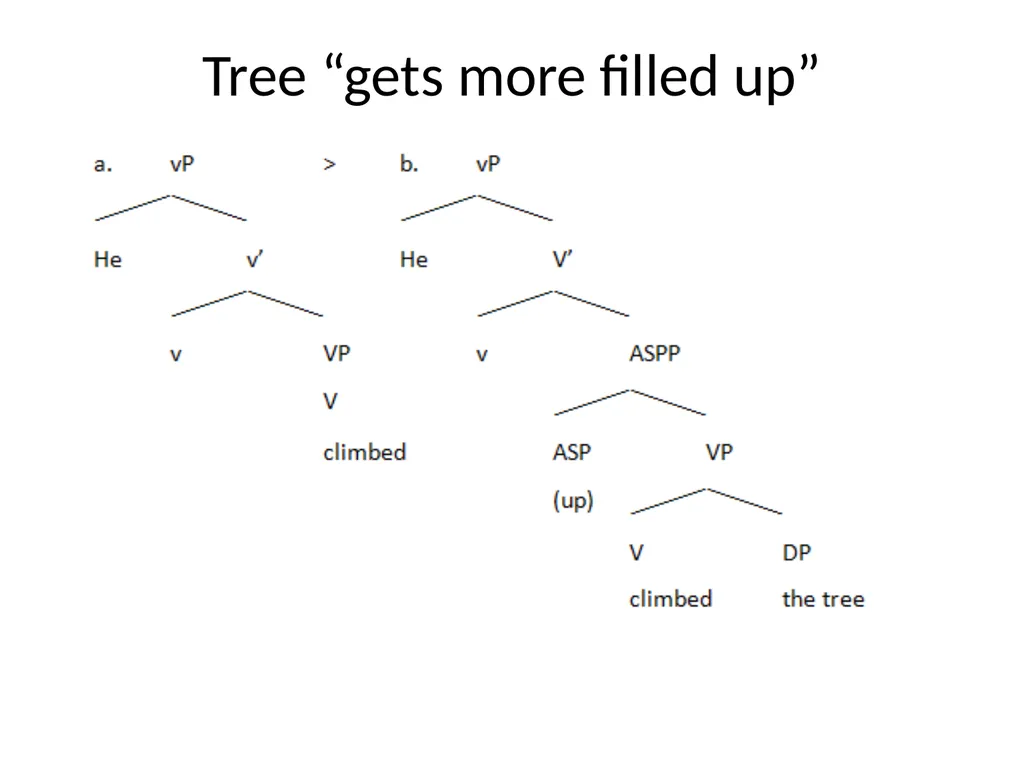
Tree “gets more filled up”<br>
22
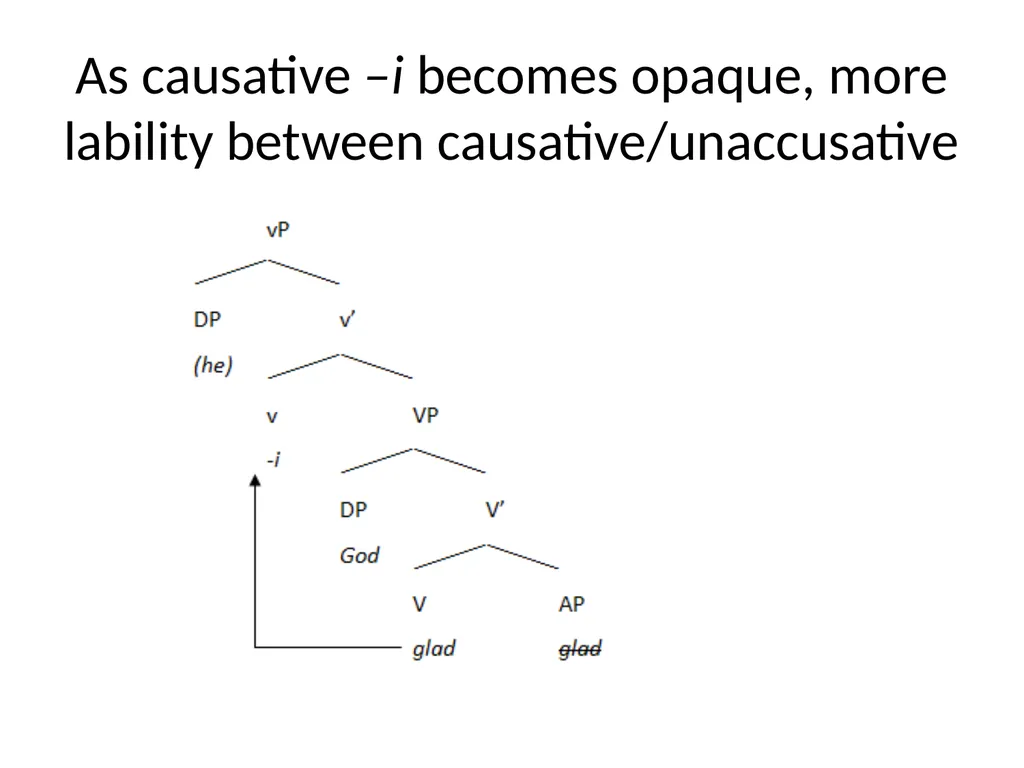
As causative –i becomes opaque, more lability between causative/unaccusative<br>
23
Filling up the v-area The verbs that are replaced by light verbs are deadjectival and denominal verbs, namely æfnian, æmtian, aferscan, afulian, ascortian, dimmian, fordragan, etc: all unaccusative verbs in Old English but the new light verb determines whether it is unaccusative or causative.
The change to labile verb affects ærnan, ætslidan, berstan, droppian, droppetan, and growan. Apart from ærnan, these are all unaccusative and end up with an optional causative. The case of ærnan is complex; it is an unergative in Old English but acquires causative and unaccusative meanings.<br>
The change to labile verb affects ærnan, ætslidan, berstan, droppian, droppetan, and growan. Apart from ærnan, these are all unaccusative and end up with an optional causative. The case of ærnan is complex; it is an unergative in Old English but acquires causative and unaccusative meanings.<br>
24
The new particles replace a prefix, as in aberstan, ætfellan, ætglidan, forscrincan, forþgangangan, and forþræsan. Like the prefixes, the new particles indicate a path or result and `help’ original lexical aspect.
The five unergative verbs that become transitive are cidan, climban, cloccian, clymmian, and felan. Cloccian is archaic but the others acquire a regular Theme. Again: filling up the tree.<br>
The five unergative verbs that become transitive are cidan, climban, cloccian, clymmian, and felan. Cloccian is archaic but the others acquire a regular Theme. Again: filling up the tree.<br>
25
Obsolete? A possible pattern may be that many, among the 40 that become obsolete, are `uncontrolled process’: bifian `tremble/shake’, brogdian, brogdettan `tremble’, cirman `cry (out)’, clum(m)ian `mumble, mutter’, giscian `sob’, glisian `glitter’, and glit(e)nian `glitter, shine’.
These verbs are durative but non-agentive.<br>
These verbs are durative but non-agentive.<br>
26
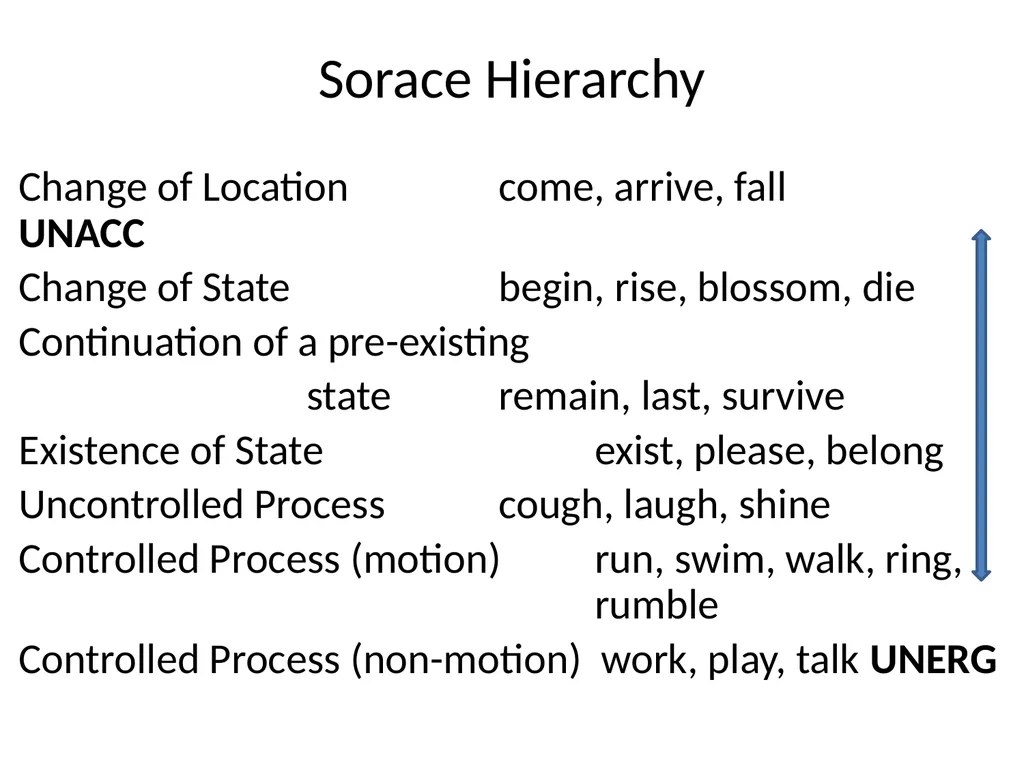
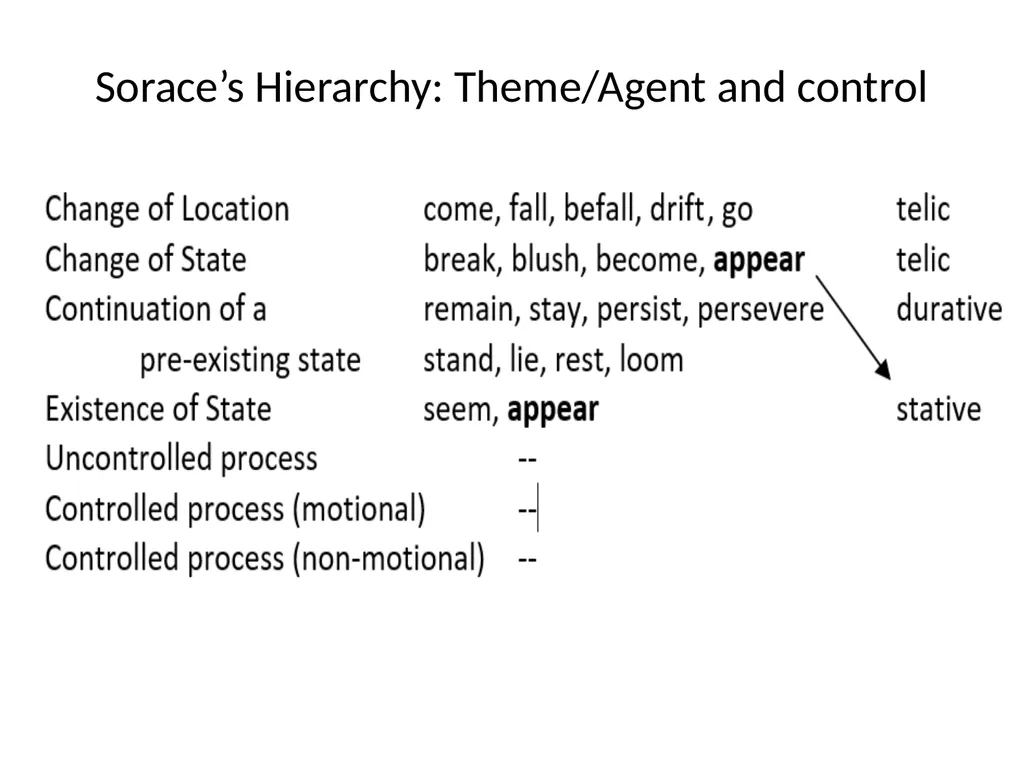
Sorace Hierarchy Change of Location come, arrive, fall UNACC
Change of State begin, rise, blossom, die
Continuation of a pre-existing
state remain, last, survive
Existence of State exist, please, belong
Uncontrolled Process cough, laugh, shine
Controlled Process (motion) run, swim, walk, ring, rumble
Controlled Process (non-motion) work, play, talk UNERG<br>
Change of State begin, rise, blossom, die
Continuation of a pre-existing
state remain, last, survive
Existence of State exist, please, belong
Uncontrolled Process cough, laugh, shine
Controlled Process (motion) run, swim, walk, ring, rumble
Controlled Process (non-motion) work, play, talk UNERG<br>
27
Intransitives Very predictable change:
unaccusative > causative
unergative > transitive
Aspect is stable
L1 acquisition: unergative and unaccusative are distinguished early on.
Next: copulas and psych-verbs<br>
unaccusative > causative
unergative > transitive
Aspect is stable
L1 acquisition: unergative and unaccusative are distinguished early on.
Next: copulas and psych-verbs<br>
28
Change to copulas English: duration (remain and stay), change of state (become and fall), and mood (seem and appear).
Curme (1935: 66-8): 60 copulas in English; “no other language shows such a vigorous growth of copulas” (67). Visser (1963: 213-9) lists over a 100 for the various stages.
Unaccusative > copula: aspect is stable
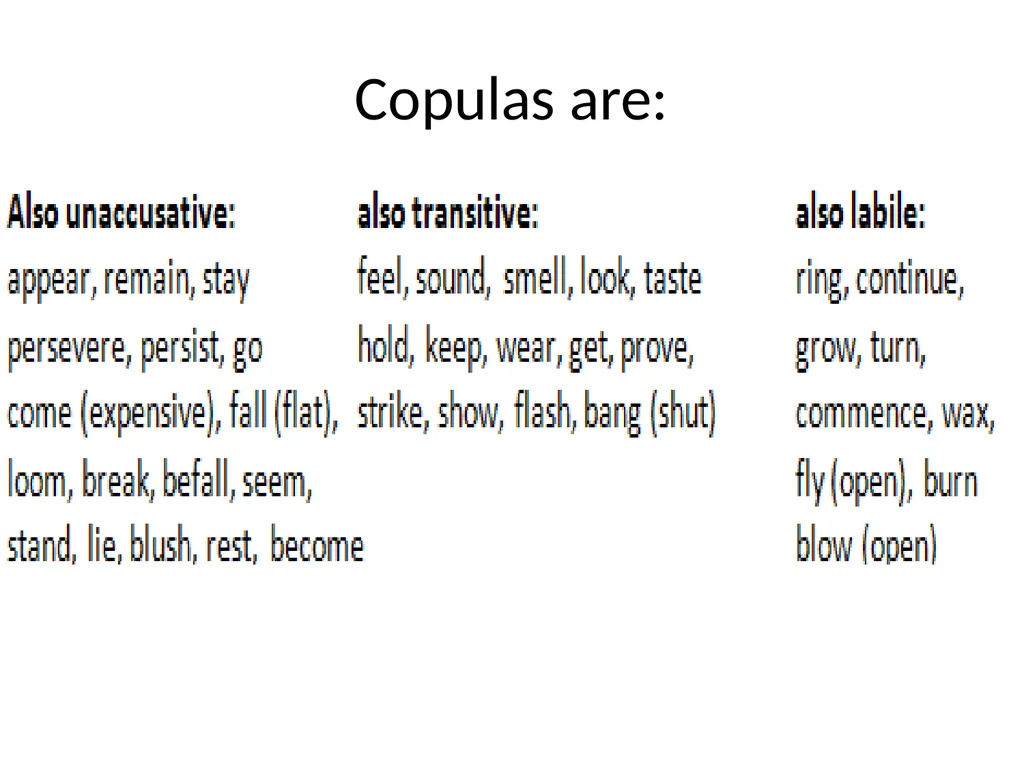
appear, become, fall, go, grow, turn, wane, break, last, remain, rest, stay, continue<br>
Curme (1935: 66-8): 60 copulas in English; “no other language shows such a vigorous growth of copulas” (67). Visser (1963: 213-9) lists over a 100 for the various stages.
Unaccusative > copula: aspect is stable
appear, become, fall, go, grow, turn, wane, break, last, remain, rest, stay, continue<br>
29
Sorace’s Hierarchy: Theme/Agent and control<br>
30
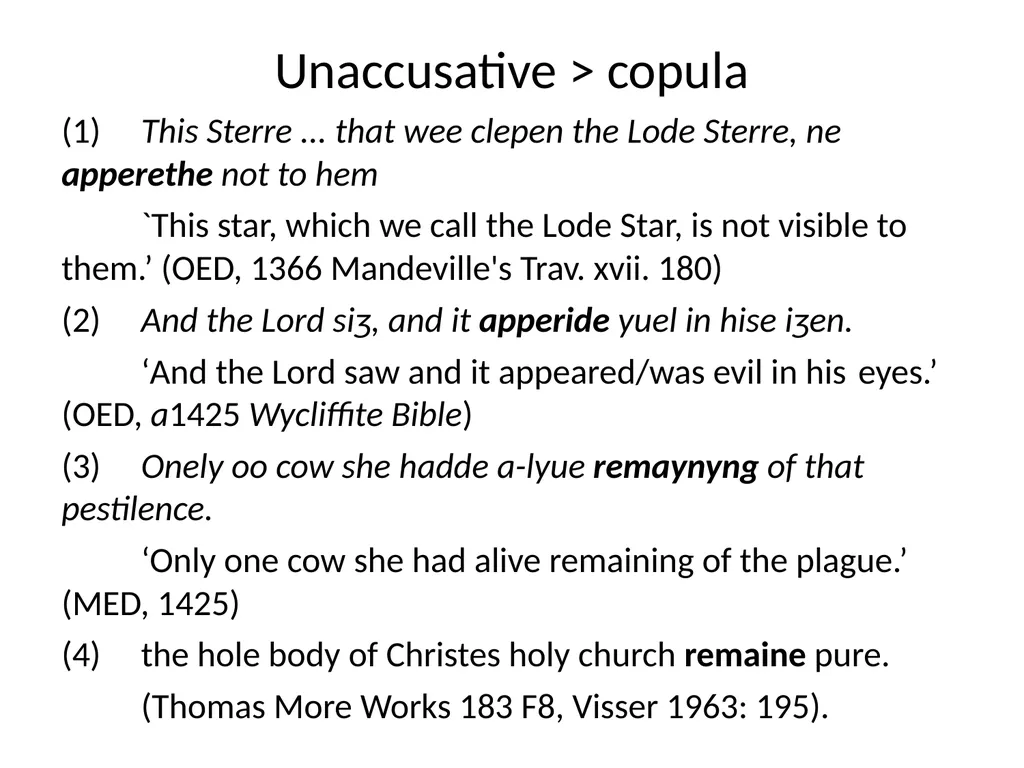
Unaccusative > copula (1) This Sterre ... that wee clepen the Lode Sterre, ne apperethe not to hem
`This star, which we call the Lode Star, is not visible to them.’ (OED, 1366 Mandeville's Trav. xvii. 180)
(2) And the Lord siȝ, and it apperide yuel in hise iȝen.
‘And the Lord saw and it appeared/was evil in his eyes.’ (OED, a1425 Wycliffite Bible)
(3) Onely oo cow she hadde a-lyue remaynyng of that pestilence.
‘Only one cow she had alive remaining of the plague.’ (MED, 1425)
(4) the hole body of Christes holy church remaine pure.
(Thomas More Works 183 F8, Visser 1963: 195).<br>
`This star, which we call the Lode Star, is not visible to them.’ (OED, 1366 Mandeville's Trav. xvii. 180)
(2) And the Lord siȝ, and it apperide yuel in hise iȝen.
‘And the Lord saw and it appeared/was evil in his eyes.’ (OED, a1425 Wycliffite Bible)
(3) Onely oo cow she hadde a-lyue remaynyng of that pestilence.
‘Only one cow she had alive remaining of the plague.’ (MED, 1425)
(4) the hole body of Christes holy church remaine pure.
(Thomas More Works 183 F8, Visser 1963: 195).<br>
31
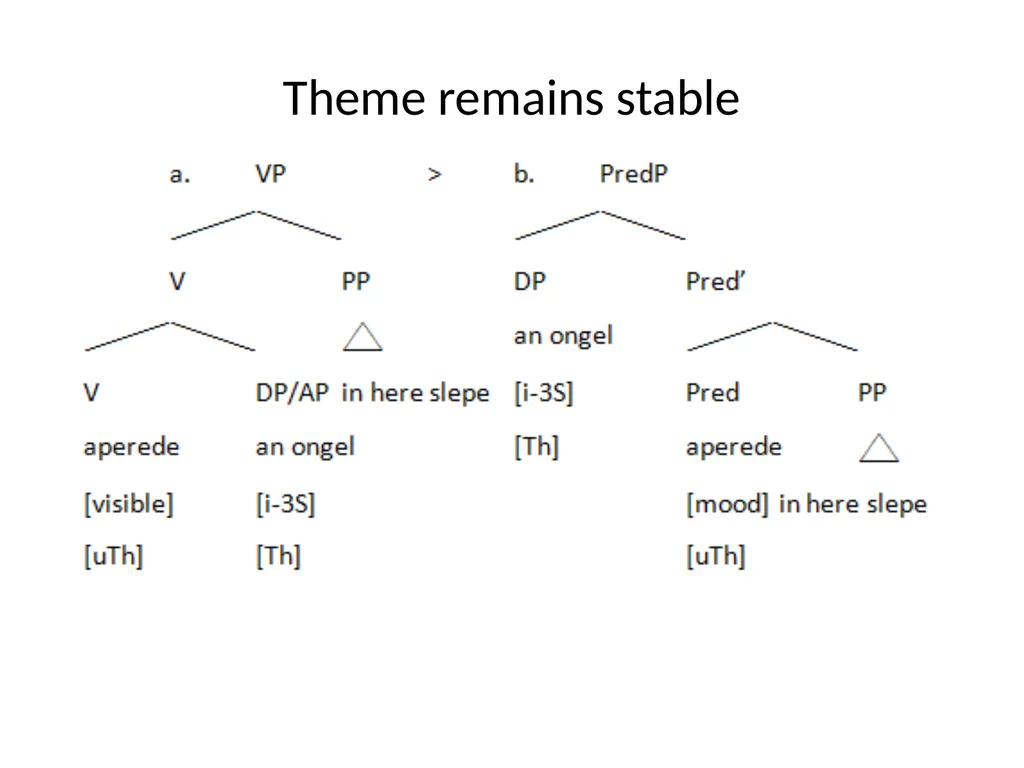
Theme remains stable<br>
32
Copulas are:<br>
33
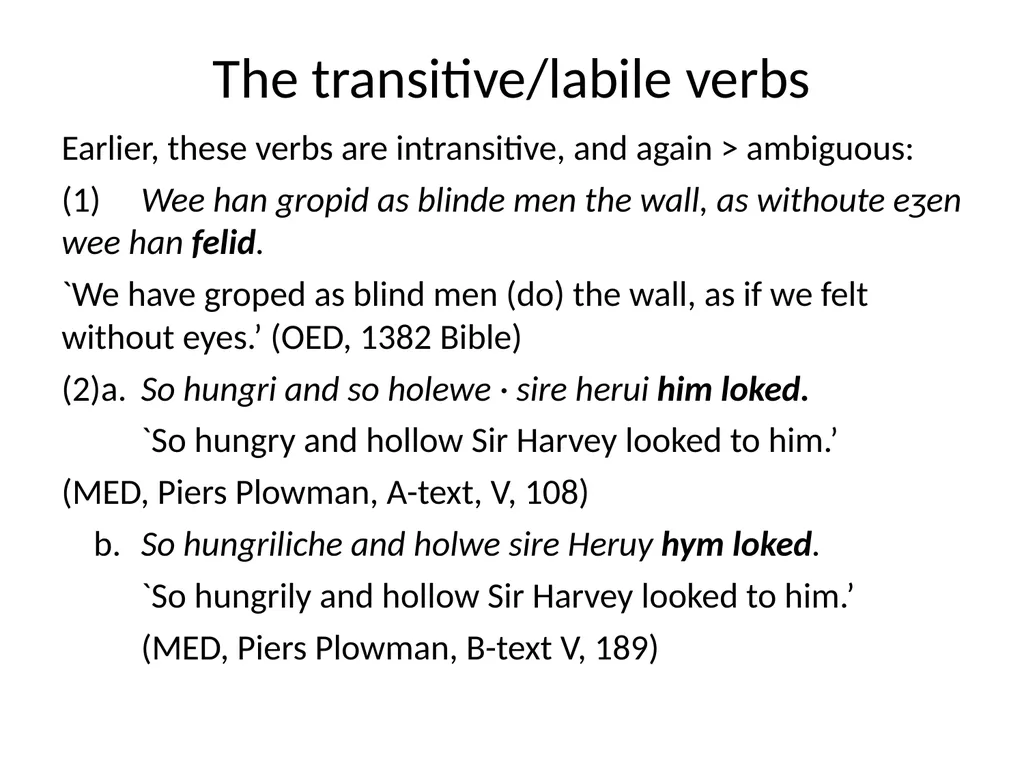
The transitive/labile verbs Earlier, these verbs are intransitive, and again > ambiguous:
(1) Wee han gropid as blinde men the wall, as withoute eȝen wee han felid.
`We have groped as blind men (do) the wall, as if we felt without eyes.’ (OED, 1382 Bible)
(2)a. So hungri and so holewe · sire herui him loked.
`So hungry and hollow Sir Harvey looked to him.’
(MED, Piers Plowman, A-text, V, 108)
b. So hungriliche and holwe sire Heruy hym loked.
`So hungrily and hollow Sir Harvey looked to him.’
(MED, Piers Plowman, B-text V, 189)<br>
(1) Wee han gropid as blinde men the wall, as withoute eȝen wee han felid.
`We have groped as blind men (do) the wall, as if we felt without eyes.’ (OED, 1382 Bible)
(2)a. So hungri and so holewe · sire herui him loked.
`So hungry and hollow Sir Harvey looked to him.’
(MED, Piers Plowman, A-text, V, 108)
b. So hungriliche and holwe sire Heruy hym loked.
`So hungrily and hollow Sir Harvey looked to him.’
(MED, Piers Plowman, B-text V, 189)<br>
34
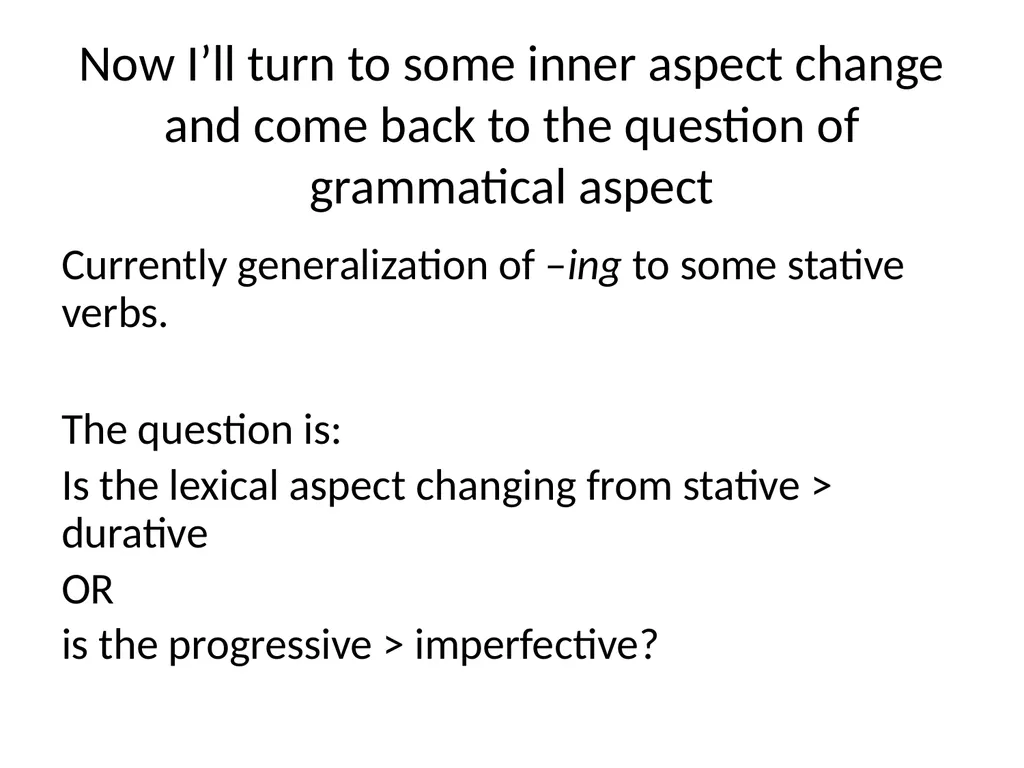
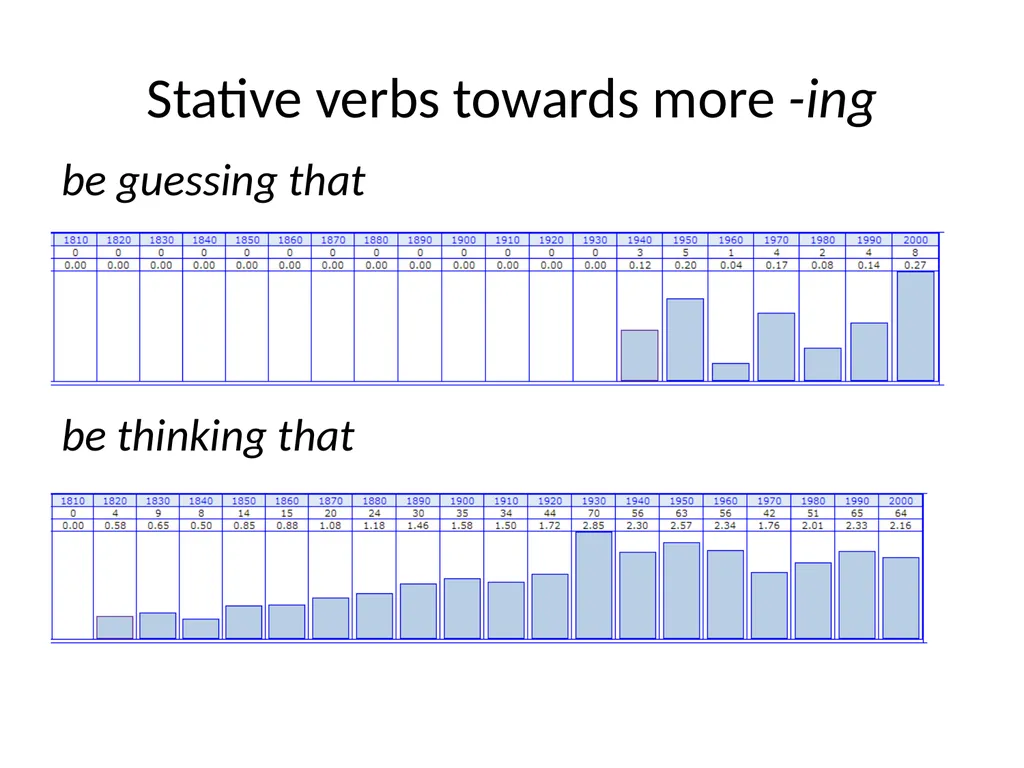
Now I’ll turn to some inner aspect change and come back to the question of grammatical aspect Currently generalization of –ing to some stative verbs.
The question is:
Is the lexical aspect changing from stative > durative
OR
is the progressive > imperfective?<br>
The question is:
Is the lexical aspect changing from stative > durative
OR
is the progressive > imperfective?<br>
35
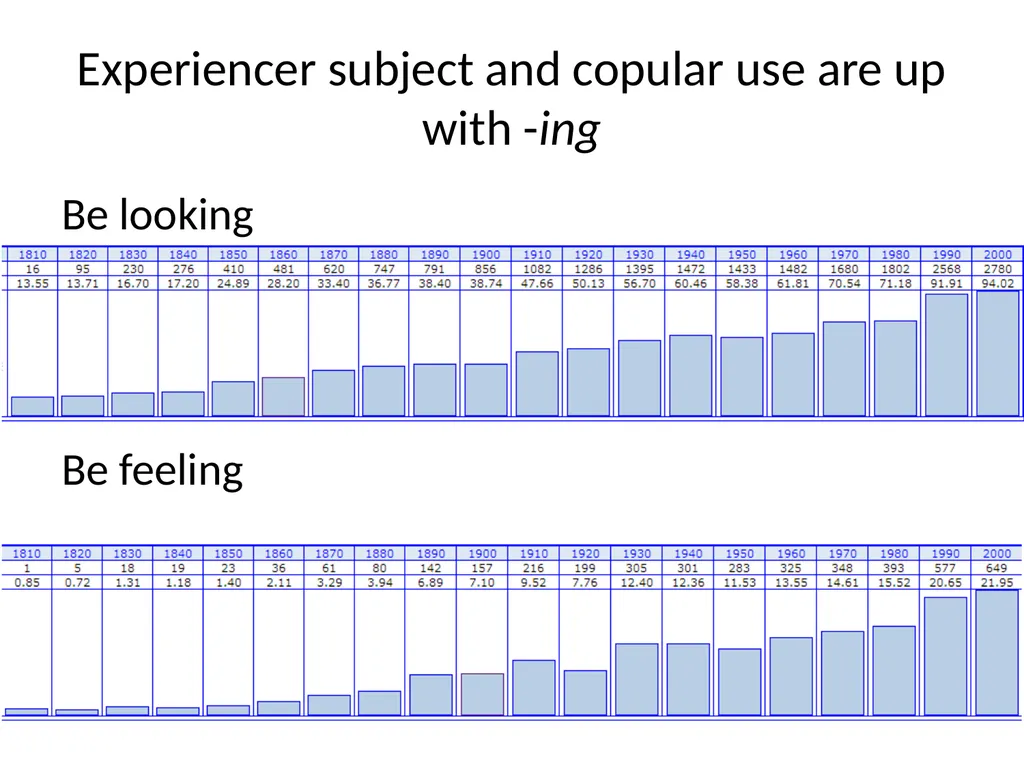
Experiencer subject and copular use are up with -ing Be looking
Be feeling<br>
Be feeling<br>
36
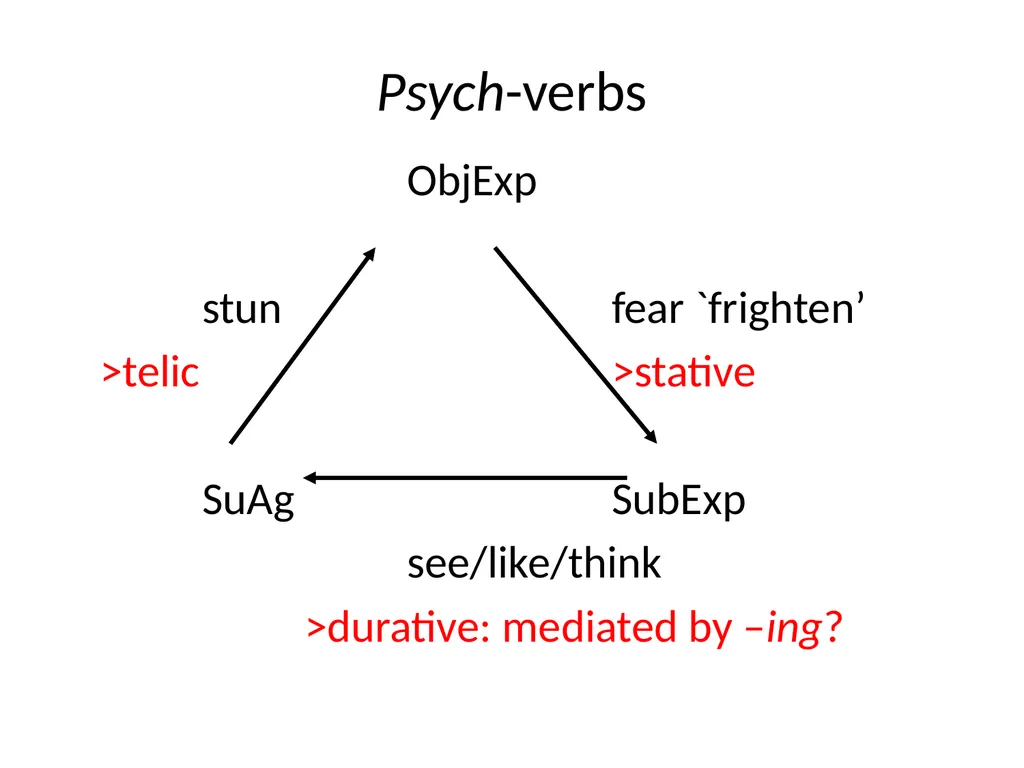
Psych-verbs ObjExp
stun fear `frighten’
>telic >stative
SuAg SubExp
see/like/think
>durative: mediated by –ing?<br>
stun fear `frighten’
>telic >stative
SuAg SubExp
see/like/think
>durative: mediated by –ing?<br>
37
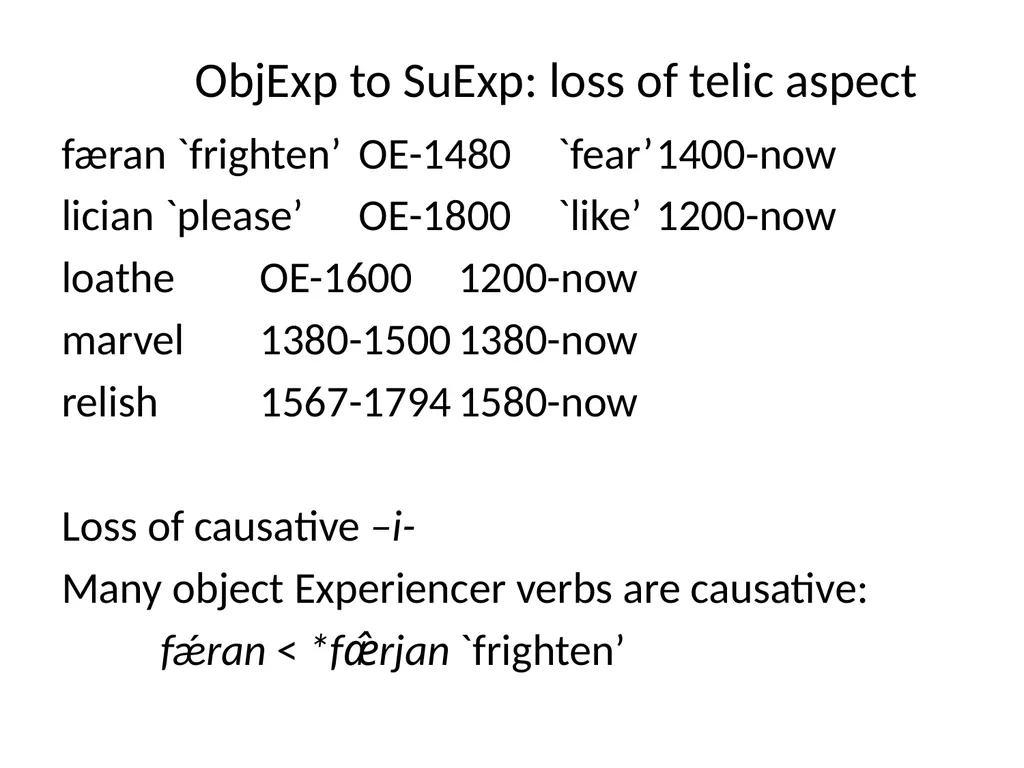
ObjExp to SuExp: loss of telic aspect færan `frighten’ OE-1480 `fear’ 1400-now
lician `please’ OE-1800 `like’ 1200-now
loathe OE-1600 1200-now
marvel 1380-1500 1380-now
relish 1567-1794 1580-now
Loss of causative –i-
Many object Experiencer verbs are causative:
fǽran < *fæ̂rjan `frighten’<br>
lician `please’ OE-1800 `like’ 1200-now
loathe OE-1600 1200-now
marvel 1380-1500 1380-now
relish 1567-1794 1580-now
Loss of causative –i-
Many object Experiencer verbs are causative:
fǽran < *fæ̂rjan `frighten’<br>
38
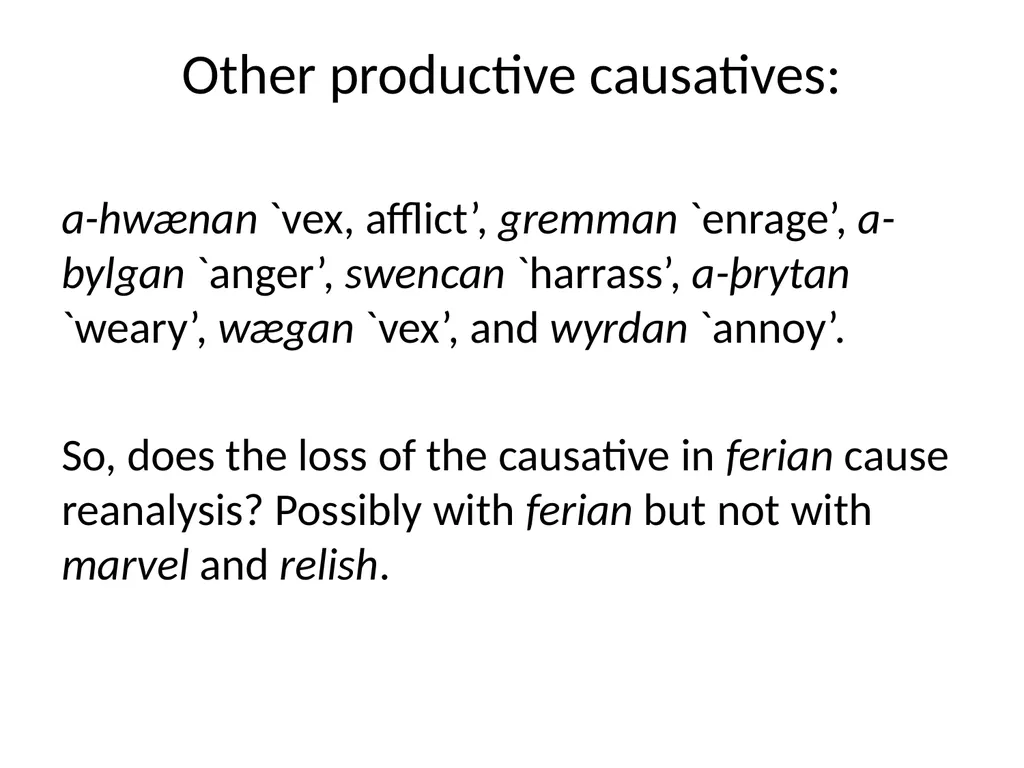
Other productive causatives: a-hwænan `vex, afflict’, gremman `enrage’, a-bylgan `anger’, swencan `harrass’, a-þrytan `weary’, wægan `vex’, and wyrdan `annoy’.
So, does the loss of the causative in ferian cause reanalysis? Possibly with ferian but not with marvel and relish.<br>
So, does the loss of the causative in ferian cause reanalysis? Possibly with ferian but not with marvel and relish.<br>
39
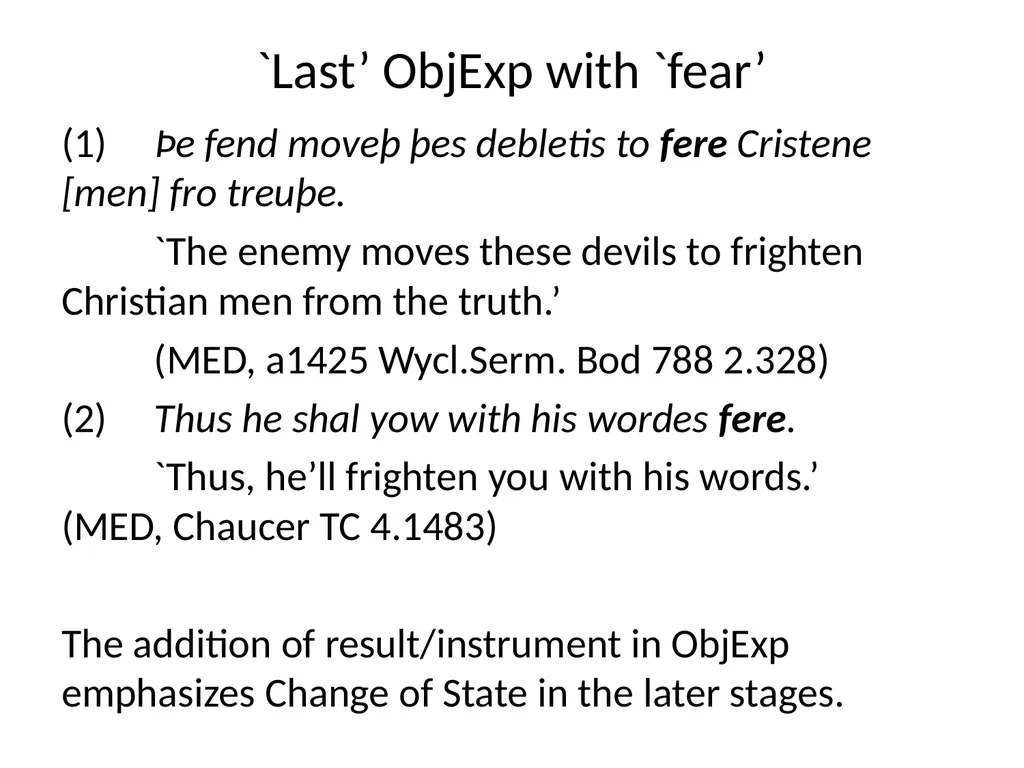
`Last’ ObjExp with `fear’ (1) Þe fend moveþ þes debletis to fere Cristene [men] fro treuþe.
`The enemy moves these devils to frighten Christian men from the truth.’
(MED, a1425 Wycl.Serm. Bod 788 2.328)
(2) Thus he shal yow with his wordes fere.
`Thus, he’ll frighten you with his words.’ (MED, Chaucer TC 4.1483)
The addition of result/instrument in ObjExp emphasizes Change of State in the later stages.<br>
`The enemy moves these devils to frighten Christian men from the truth.’
(MED, a1425 Wycl.Serm. Bod 788 2.328)
(2) Thus he shal yow with his wordes fere.
`Thus, he’ll frighten you with his words.’ (MED, Chaucer TC 4.1483)
The addition of result/instrument in ObjExp emphasizes Change of State in the later stages.<br>
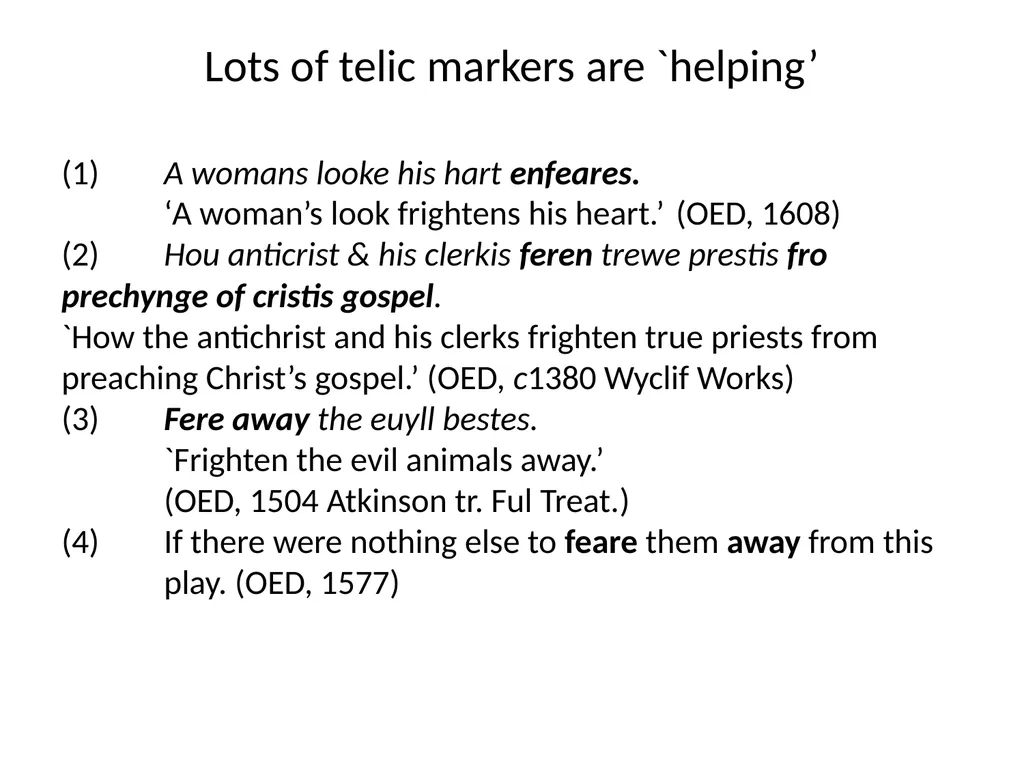
40
Lots of telic markers are `helping’ (1) A womans looke his hart enfeares.
‘A woman’s look frightens his heart.’ (OED, 1608)
(2) Hou anticrist & his clerkis feren trewe prestis fro prechynge of cristis gospel.
`How the antichrist and his clerks frighten true priests from preaching Christ’s gospel.’ (OED, c1380 Wyclif Works)
(3) Fere away the euyll bestes.
`Frighten the evil animals away.’
(OED, 1504 Atkinson tr. Ful Treat.)
(4) If there were nothing else to feare them away from this play. (OED, 1577)<br>
‘A woman’s look frightens his heart.’ (OED, 1608)
(2) Hou anticrist & his clerkis feren trewe prestis fro prechynge of cristis gospel.
`How the antichrist and his clerks frighten true priests from preaching Christ’s gospel.’ (OED, c1380 Wyclif Works)
(3) Fere away the euyll bestes.
`Frighten the evil animals away.’
(OED, 1504 Atkinson tr. Ful Treat.)
(4) If there were nothing else to feare them away from this play. (OED, 1577)<br>
41
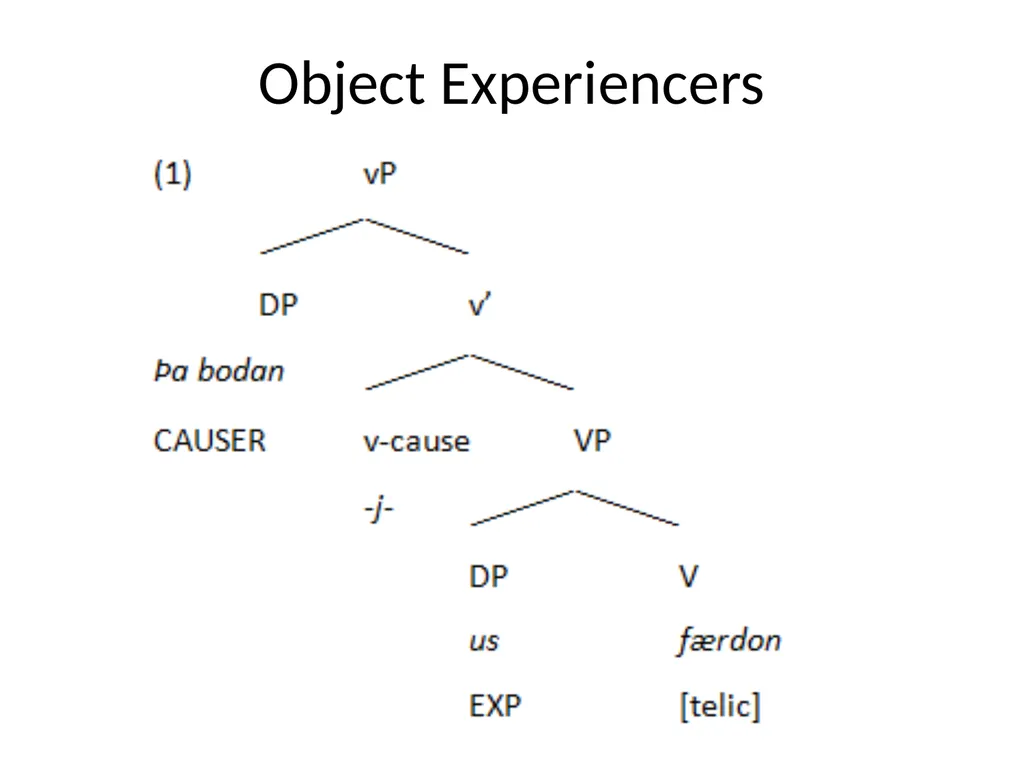
Object Experiencers<br>
42
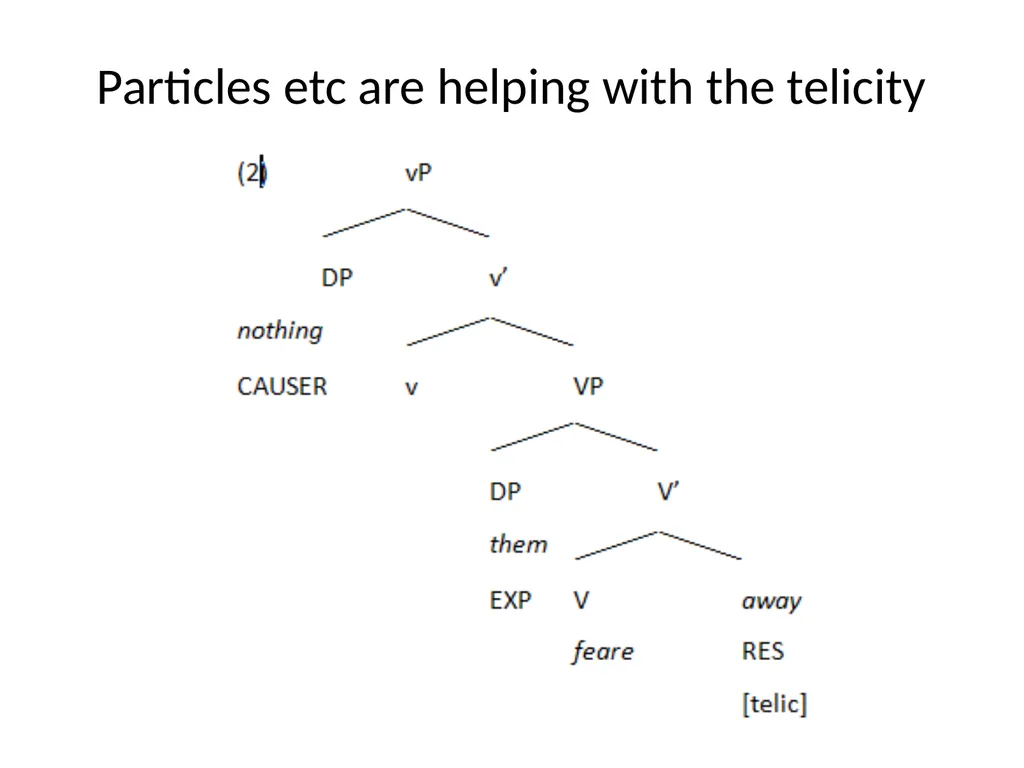
Particles etc are helping with the telicity<br>
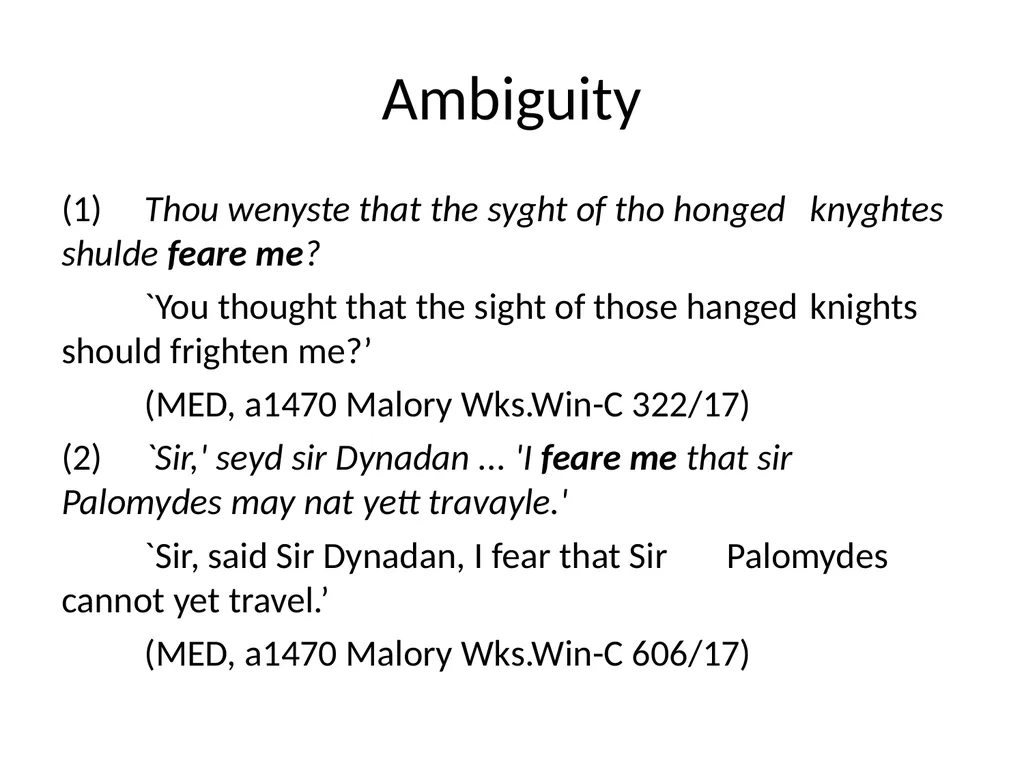
43
Ambiguity (1) Thou wenyste that the syght of tho honged knyghtes shulde feare me?
`You thought that the sight of those hanged knights should frighten me?’
(MED, a1470 Malory Wks.Win-C 322/17)
(2) `Sir,' seyd sir Dynadan ... 'I feare me that sir Palomydes may nat yett travayle.'
`Sir, said Sir Dynadan, I fear that Sir Palomydes cannot yet travel.’
(MED, a1470 Malory Wks.Win-C 606/17)<br>
`You thought that the sight of those hanged knights should frighten me?’
(MED, a1470 Malory Wks.Win-C 322/17)
(2) `Sir,' seyd sir Dynadan ... 'I feare me that sir Palomydes may nat yett travayle.'
`Sir, said Sir Dynadan, I fear that Sir Palomydes cannot yet travel.’
(MED, a1470 Malory Wks.Win-C 606/17)<br>
44
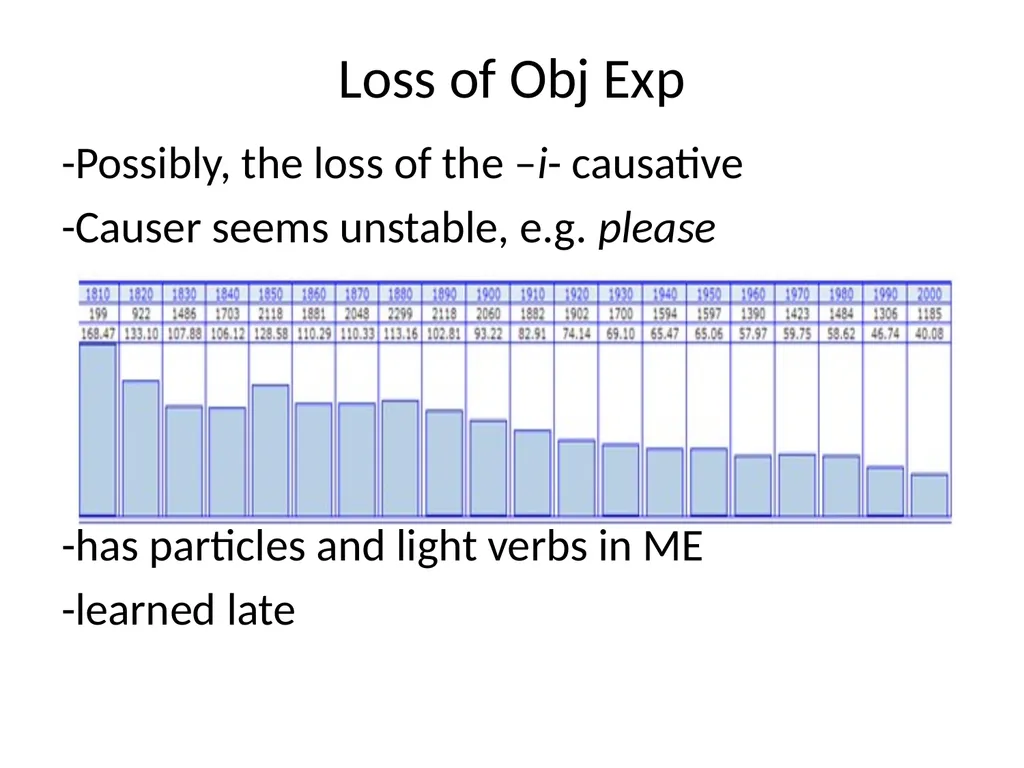
Loss of Obj Exp -Possibly, the loss of the –i- causative
-Causer seems unstable, e.g. please
-has particles and light verbs in ME
-learned late<br>
-Causer seems unstable, e.g. please
-has particles and light verbs in ME
-learned late<br>
45
Acquisition Eve (Brown 1973) has SuExp like, love, want but not ObjExp anger, scare; her hurt is SuExp initially.
Eve love crayon (1;9), want mommy letter (1;6),
want watch (1;6), want mommy out (1;6), want lunch, want down, want mommy read (1;6) ... but: hurt xxx self (1;7), hurt knee (1;9), I hurt my finger (1;11)
Sarah has early want (2;3), love (2;5), and hurt as in: I hurt again (2;9.6). Her scare is late at 3;7:
to scare me on the dark (3;7.16)<br>
Eve love crayon (1;9), want mommy letter (1;6),
want watch (1;6), want mommy out (1;6), want lunch, want down, want mommy read (1;6) ... but: hurt xxx self (1;7), hurt knee (1;9), I hurt my finger (1;11)
Sarah has early want (2;3), love (2;5), and hurt as in: I hurt again (2;9.6). Her scare is late at 3;7:
to scare me on the dark (3;7.16)<br>
46
Current changes: ExpSu>Agent? (1) I am liking/loving/hating it.
E.g. in COCA:
(2) how I got guard duty and how I'm going to be hating that and totally tired.
(3) and I am liking what I see in the classrooms
(4) lately we've been loving broccoli rabe, which
(5) And so everybody in town was knowing that this was happening
(6) I've been fearing the answers.<br>
E.g. in COCA:
(2) how I got guard duty and how I'm going to be hating that and totally tired.
(3) and I am liking what I see in the classrooms
(4) lately we've been loving broccoli rabe, which
(5) And so everybody in town was knowing that this was happening
(6) I've been fearing the answers.<br>
47
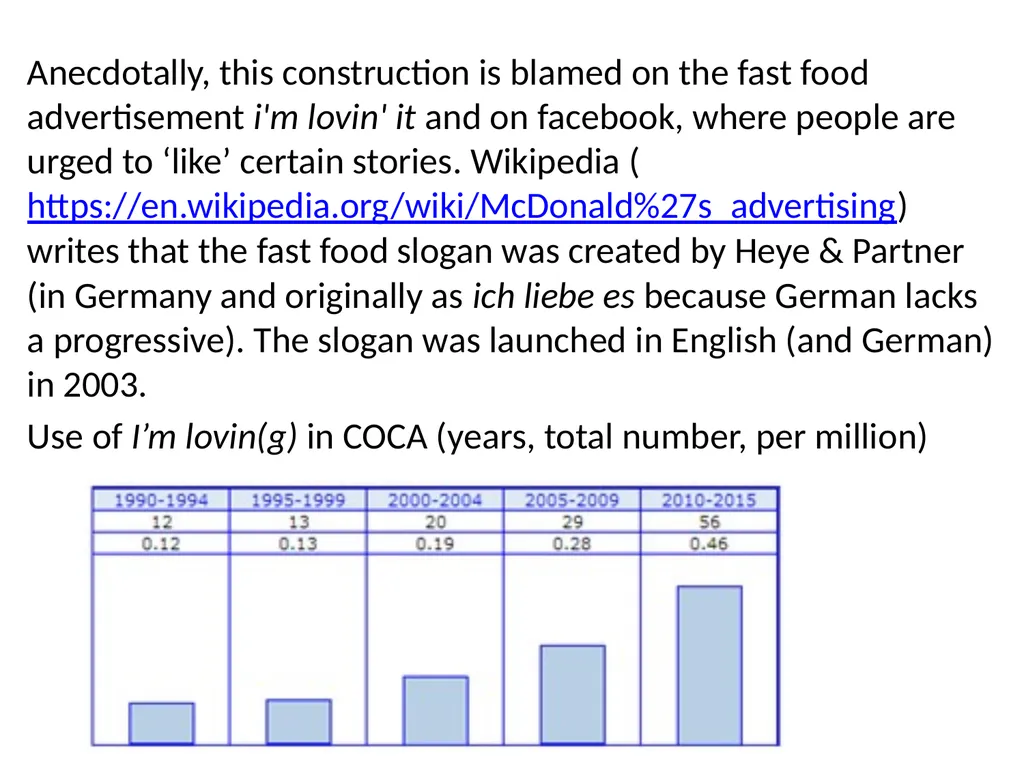
Anecdotally, this construction is blamed on the fast food advertisement i'm lovin' it and on facebook, where people are urged to ‘like’ certain stories. Wikipedia (https://en.wikipedia.org/wiki/McDonald%27s_advertising) writes that the fast food slogan was created by Heye & Partner (in Germany and originally as ich liebe es because German lacks a progressive). The slogan was launched in English (and German) in 2003.
Use of I’m lovin(g) in COCA (years, total number, per million)<br>
Use of I’m lovin(g) in COCA (years, total number, per million)<br>
48
Stative verbs towards more -ing be guessing that
be thinking that<br>
be thinking that<br>
49
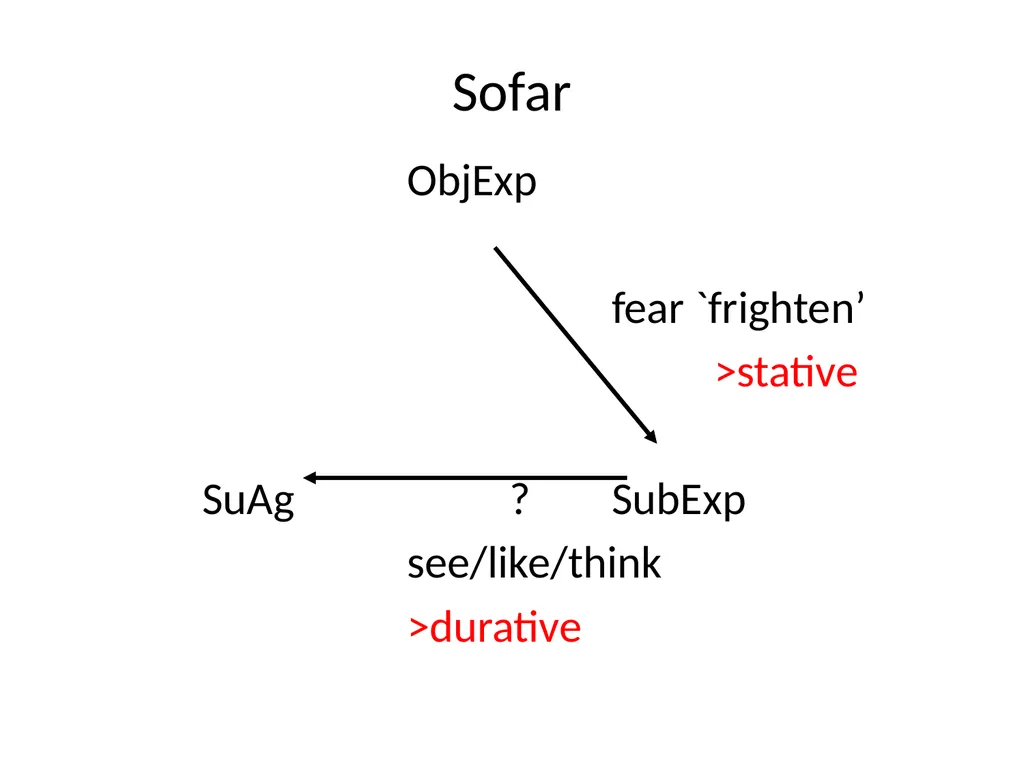
Sofar ObjExp
fear `frighten’
>stative
SuAg ? SubExp
see/like/think
>durative<br>
fear `frighten’
>stative
SuAg ? SubExp
see/like/think
>durative<br>
50
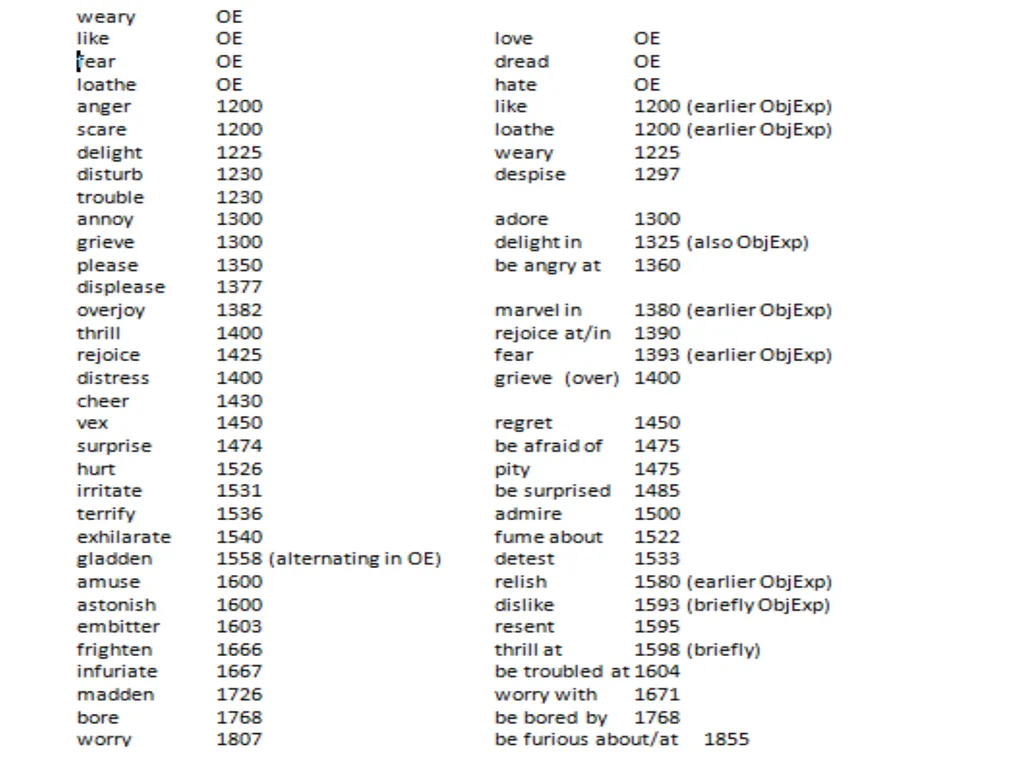
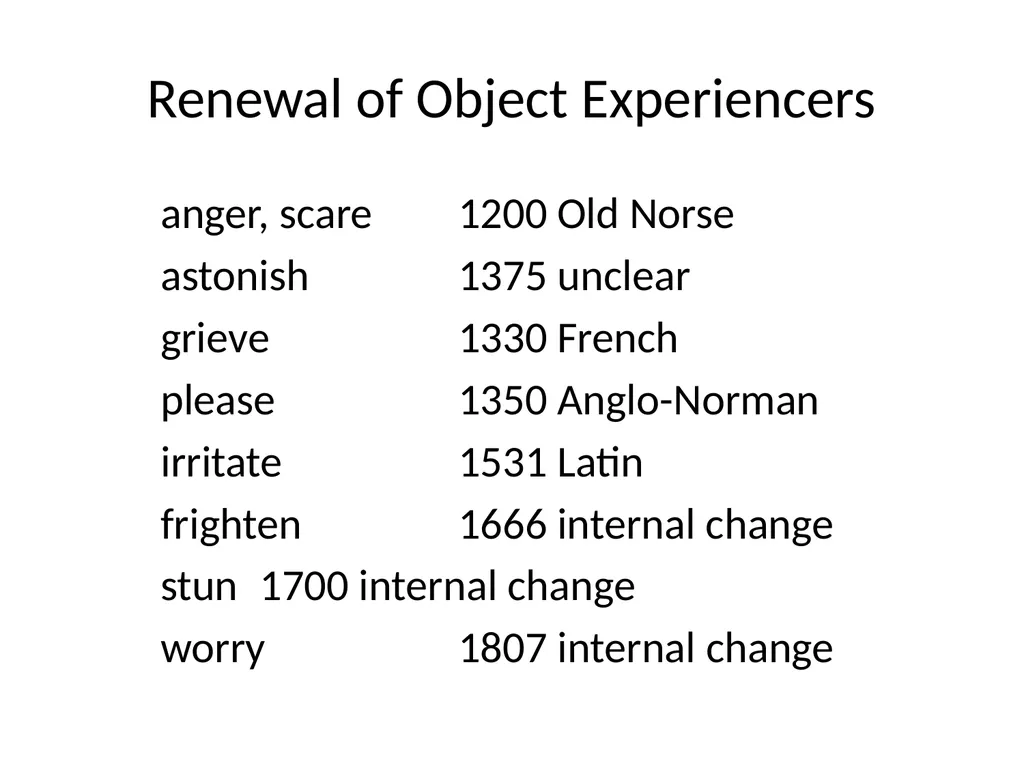
Renewal of Object Experiencers anger, scare 1200 Old Norse
astonish 1375 unclear
grieve 1330 French
please 1350 Anglo-Norman
irritate 1531 Latin
frighten 1666 internal change
stun 1700 internal change
worry 1807 internal change<br>
astonish 1375 unclear
grieve 1330 French
please 1350 Anglo-Norman
irritate 1531 Latin
frighten 1666 internal change
stun 1700 internal change
worry 1807 internal change<br>
51
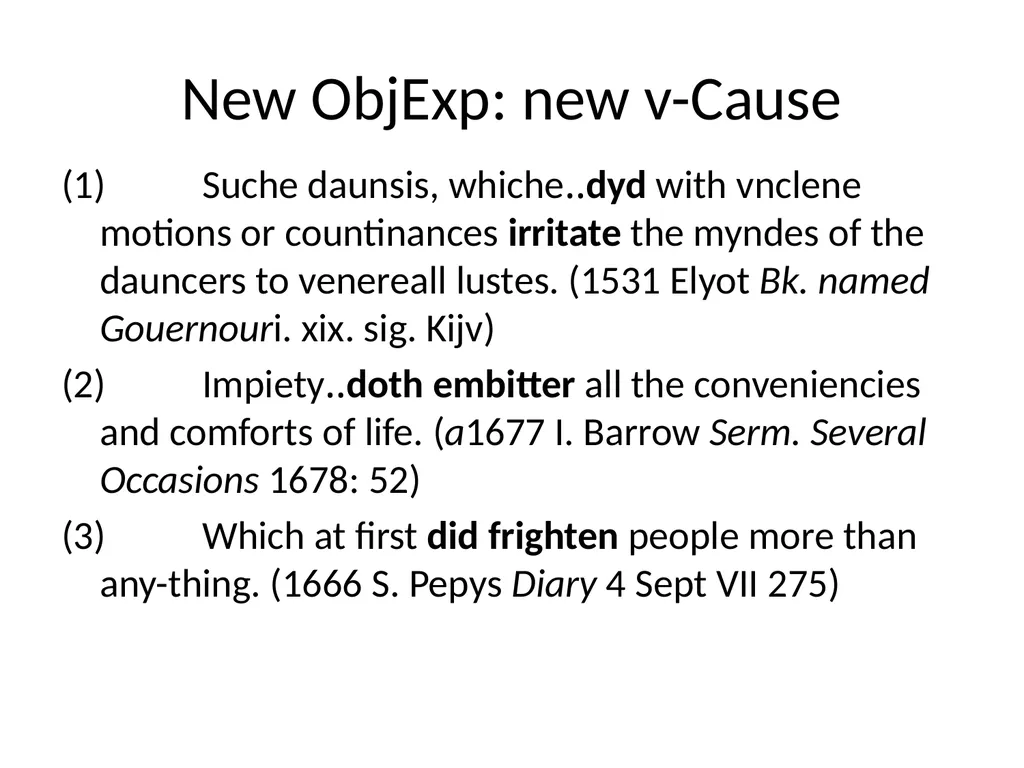
New ObjExp: new v-Cause (1) Suche daunsis, whiche‥dyd with vnclene motions or countinances irritate the myndes of the dauncers to venereall lustes. (1531 Elyot Bk. named Gouernouri. xix. sig. Kijv)
(2) Impiety‥doth embitter all the conveniencies and comforts of life. (a1677 I. Barrow Serm. Several Occasions 1678: 52)
(3) Which at first did frighten people more than any-thing. (1666 S. Pepys Diary 4 Sept VII 275)<br>
(2) Impiety‥doth embitter all the conveniencies and comforts of life. (a1677 I. Barrow Serm. Several Occasions 1678: 52)
(3) Which at first did frighten people more than any-thing. (1666 S. Pepys Diary 4 Sept VII 275)<br>
52
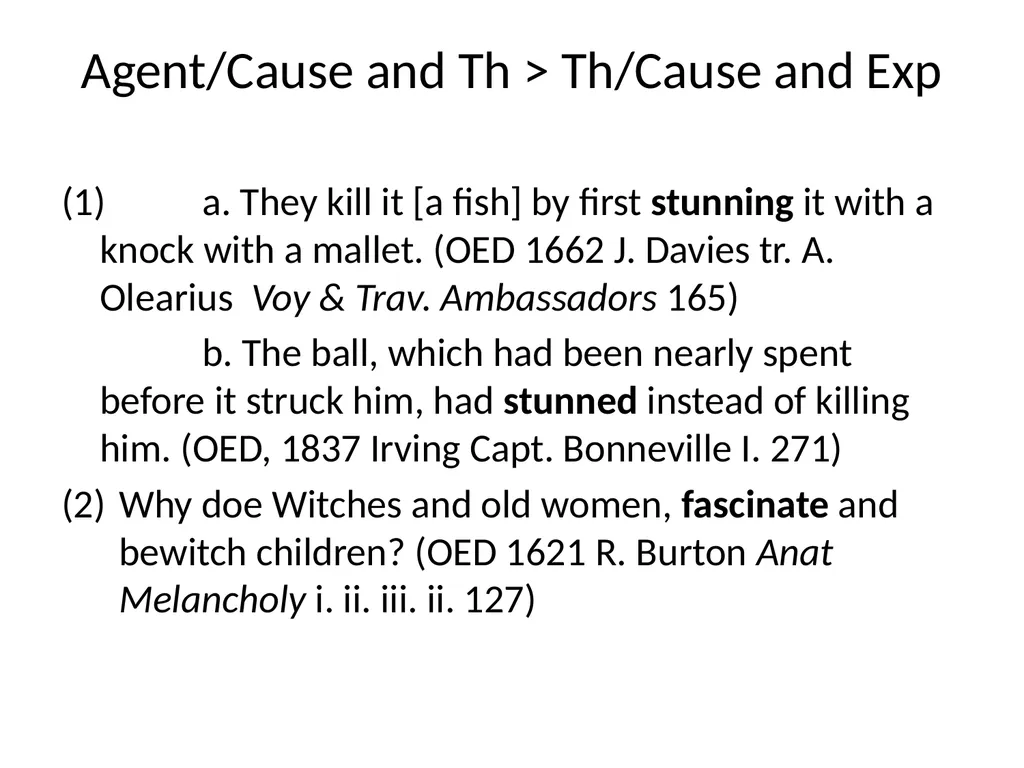
Agent/Cause and Th > Th/Cause and Exp (1) a. They kill it [a fish] by first stunning it with a knock with a mallet. (OED 1662 J. Davies tr. A. Olearius Voy & Trav. Ambassadors 165)
b. The ball, which had been nearly spent before it struck him, had stunned instead of killing him. (OED, 1837 Irving Capt. Bonneville I. 271)
Why doe Witches and old women, fascinate and bewitch children? (OED 1621 R. Burton Anat Melancholy i. ii. iii. ii. 127)<br>
b. The ball, which had been nearly spent before it struck him, had stunned instead of killing him. (OED, 1837 Irving Capt. Bonneville I. 271)
Why doe Witches and old women, fascinate and bewitch children? (OED 1621 R. Burton Anat Melancholy i. ii. iii. ii. 127)<br>
53
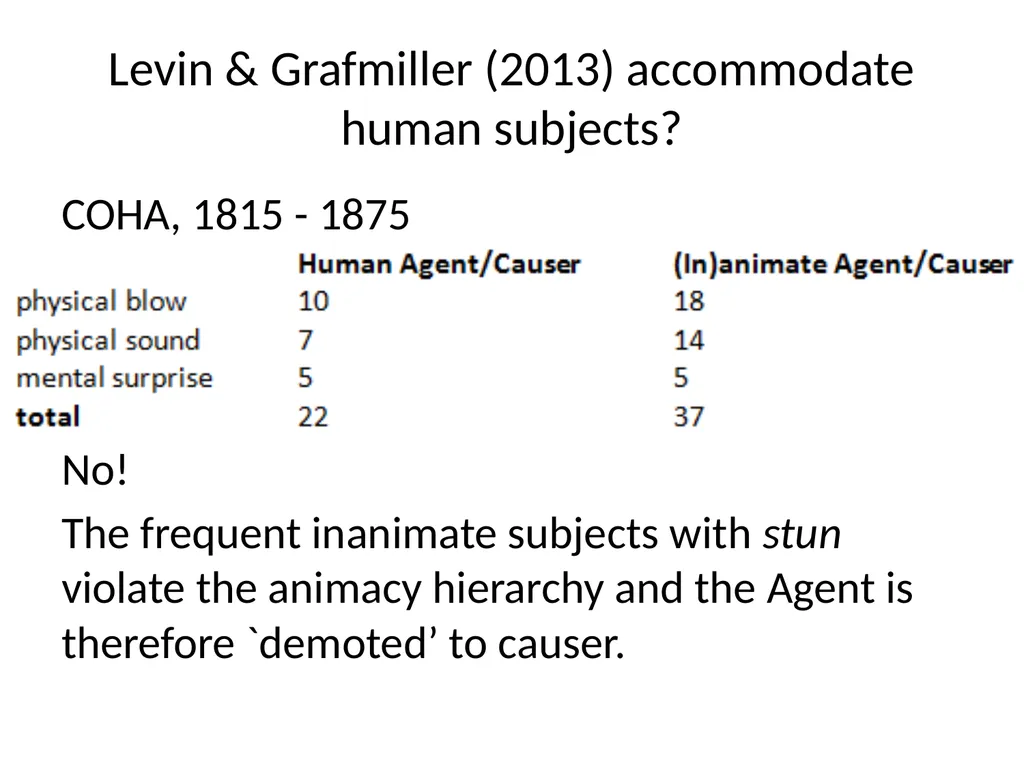
Levin & Grafmiller (2013) accommodate human subjects? COHA, 1815 - 1875
No!
The frequent inanimate subjects with stun violate the animacy hierarchy and the Agent is therefore `demoted’ to causer.<br>
No!
The frequent inanimate subjects with stun violate the animacy hierarchy and the Agent is therefore `demoted’ to causer.<br>
54
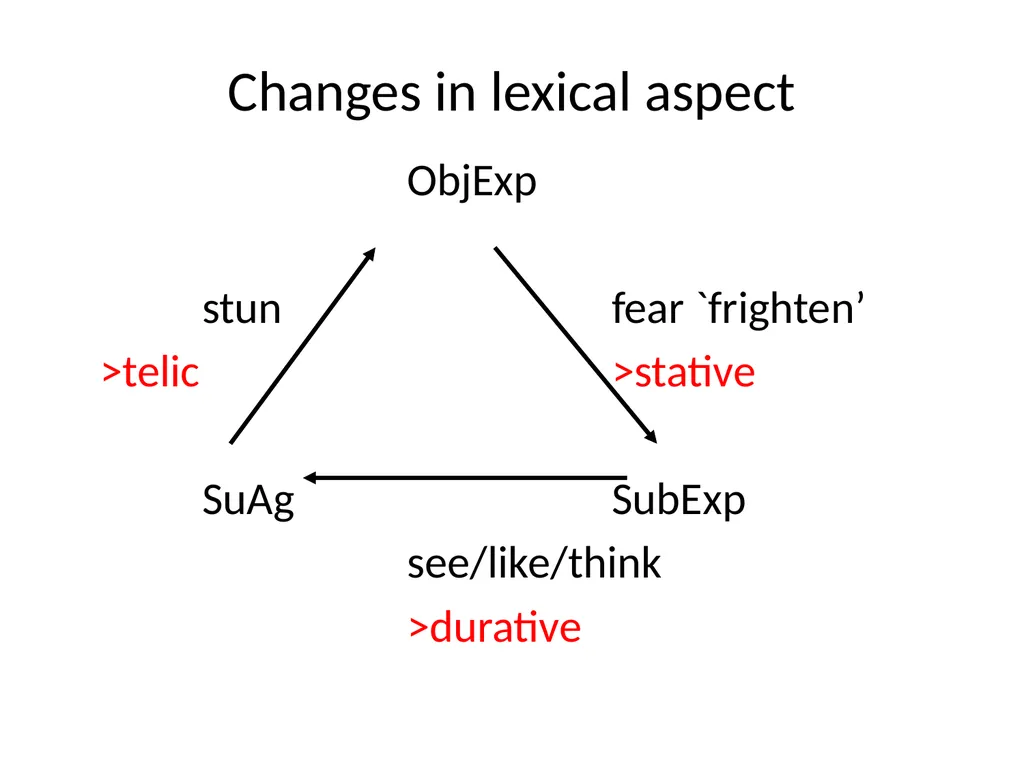
Changes in lexical aspect ObjExp
stun fear `frighten’
>telic >stative
SuAg SubExp
see/like/think
>durative<br>
stun fear `frighten’
>telic >stative
SuAg SubExp
see/like/think
>durative<br>
55
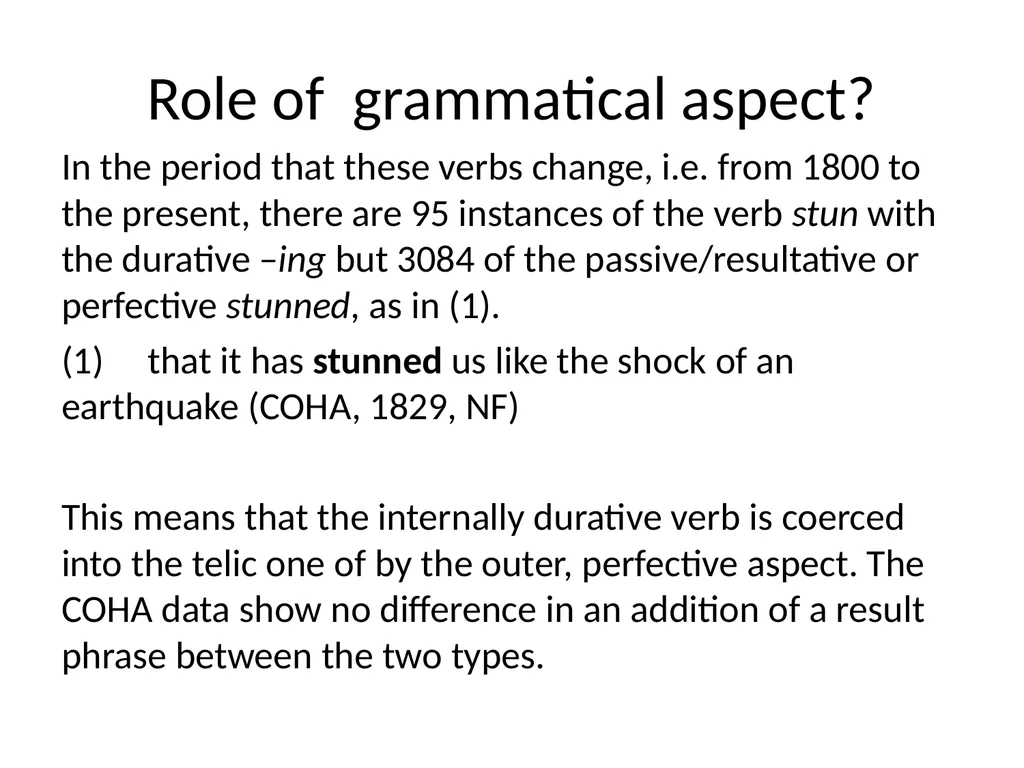
Role of grammatical aspect? In the period that these verbs change, i.e. from 1800 to the present, there are 95 instances of the verb stun with the durative –ing but 3084 of the passive/resultative or perfective stunned, as in (1).
(1) that it has stunned us like the shock of an earthquake (COHA, 1829, NF)
This means that the internally durative verb is coerced into the telic one of by the outer, perfective aspect. The COHA data show no difference in an addition of a result phrase between the two types.<br>
(1) that it has stunned us like the shock of an earthquake (COHA, 1829, NF)
This means that the internally durative verb is coerced into the telic one of by the outer, perfective aspect. The COHA data show no difference in an addition of a result phrase between the two types.<br>
56
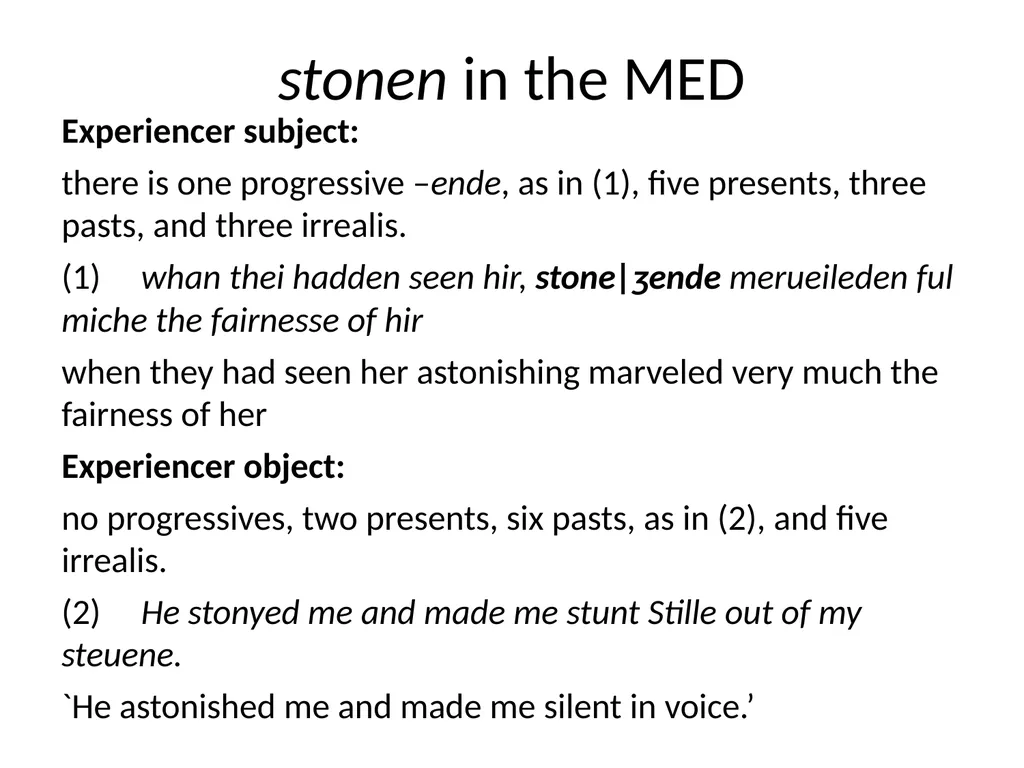
stonen in the MED Experiencer subject:
there is one progressive –ende, as in (1), five presents, three pasts, and three irrealis.
(1) whan thei hadden seen hir, stone|ȝende merueileden ful miche the fairnesse of hir
when they had seen her astonishing marveled very much the fairness of her
Experiencer object:
no progressives, two presents, six pasts, as in (2), and five irrealis.
(2) He stonyed me and made me stunt Stille out of my steuene.
`He astonished me and made me silent in voice.’<br>
there is one progressive –ende, as in (1), five presents, three pasts, and three irrealis.
(1) whan thei hadden seen hir, stone|ȝende merueileden ful miche the fairnesse of hir
when they had seen her astonishing marveled very much the fairness of her
Experiencer object:
no progressives, two presents, six pasts, as in (2), and five irrealis.
(2) He stonyed me and made me stunt Stille out of my steuene.
`He astonished me and made me silent in voice.’<br>
57
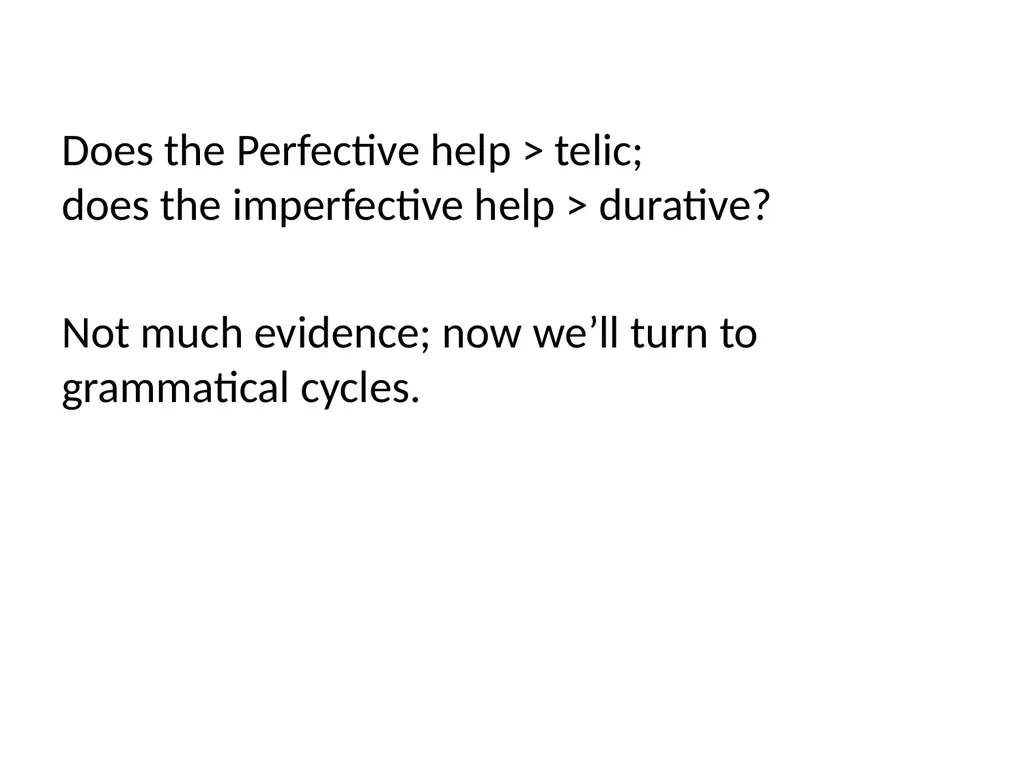
Does the Perfective help > telic;
does the imperfective help > durative?
Not much evidence; now we’ll turn to grammatical cycles.<br>
Not much evidence; now we’ll turn to grammatical cycles.<br>
58
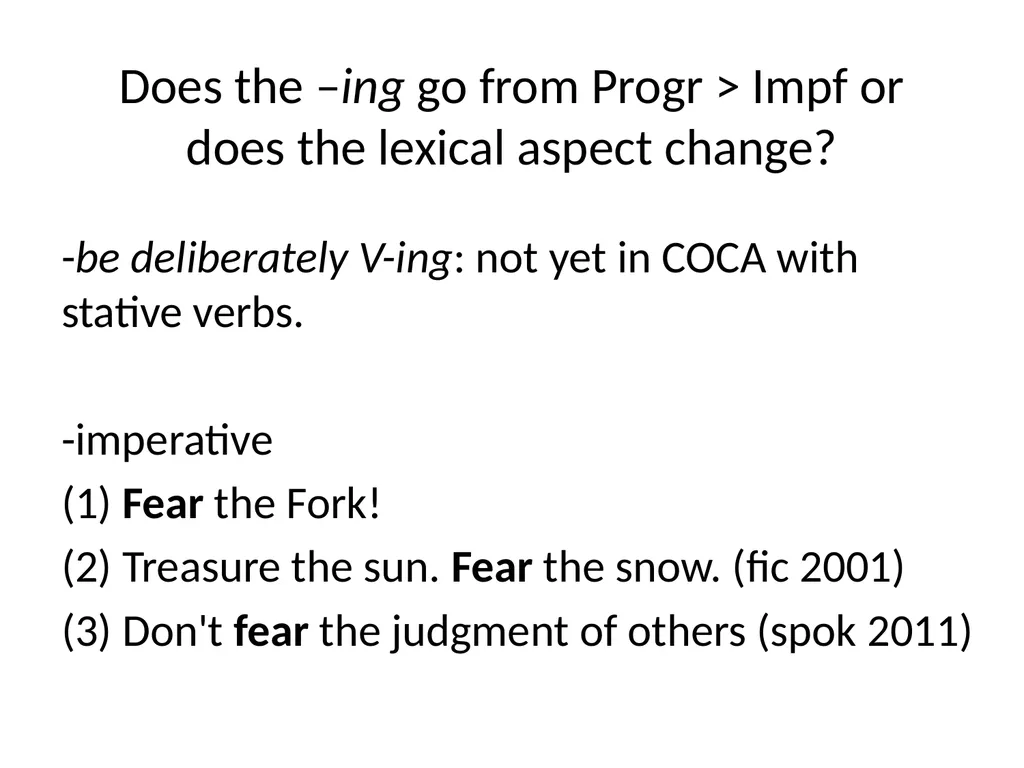
Does the –ing go from Progr > Impf or
does the lexical aspect change? -be deliberately V-ing: not yet in COCA with stative verbs.
-imperative
(1) Fear the Fork!
(2) Treasure the sun. Fear the snow. (fic 2001)
(3) Don't fear the judgment of others (spok 2011)<br>
-imperative
(1) Fear the Fork!
(2) Treasure the sun. Fear the snow. (fic 2001)
(3) Don't fear the judgment of others (spok 2011)<br>
59
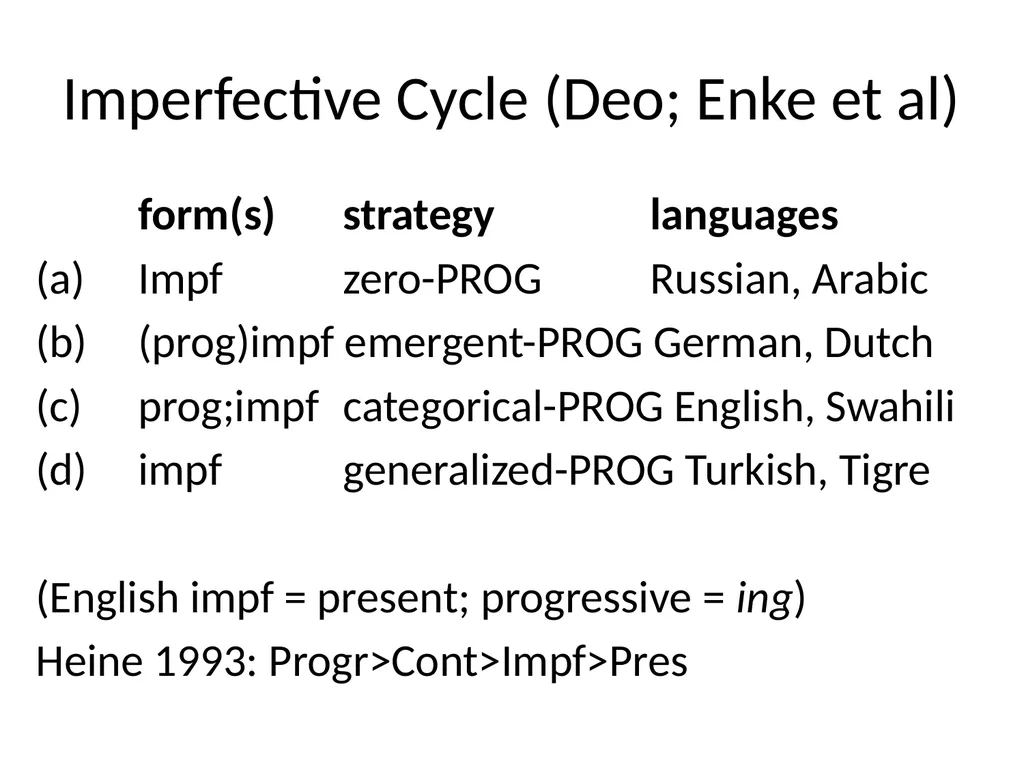
Imperfective Cycle (Deo; Enke et al) form(s) strategy languages
(a) Impf zero-PROG Russian, Arabic
(b) (prog)impf emergent-PROG German, Dutch
(c) prog;impf categorical-PROG English, Swahili
(d) impf generalized-PROG Turkish, Tigre
(English impf = present; progressive = ing)
Heine 1993: Progr>Cont>Impf>Pres<br>
(a) Impf zero-PROG Russian, Arabic
(b) (prog)impf emergent-PROG German, Dutch
(c) prog;impf categorical-PROG English, Swahili
(d) impf generalized-PROG Turkish, Tigre
(English impf = present; progressive = ing)
Heine 1993: Progr>Cont>Impf>Pres<br>
60
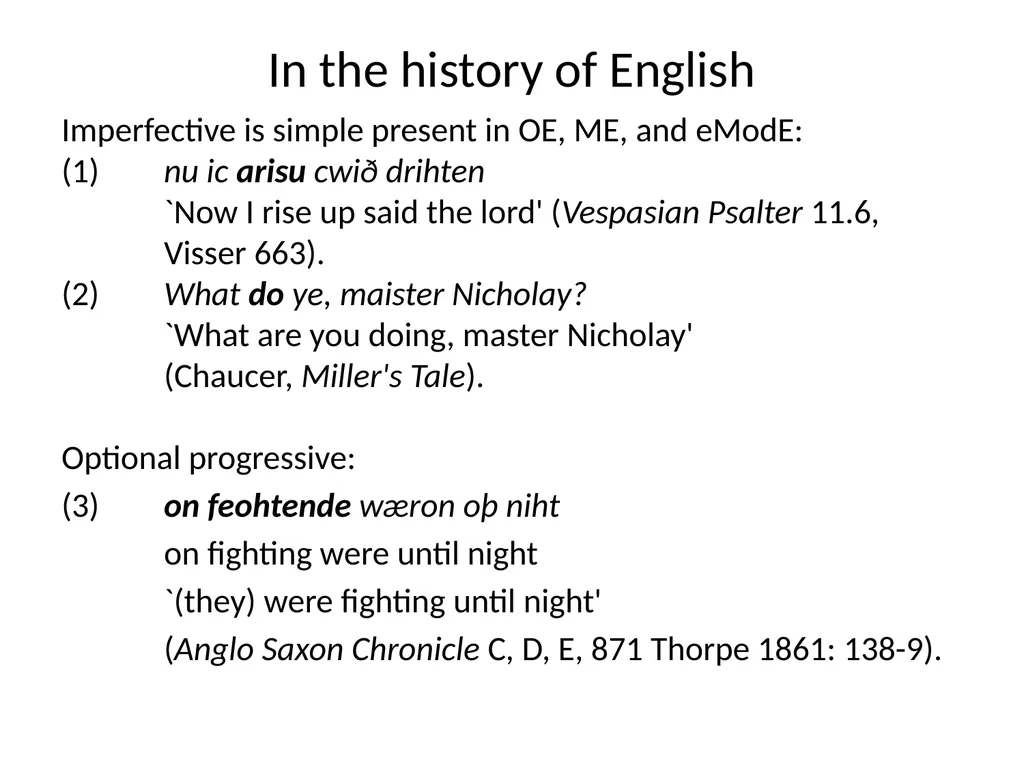
In the history of English Imperfective is simple present in OE, ME, and eModE:
(1) nu ic arisu cwið drihten
`Now I rise up said the lord' (Vespasian Psalter 11.6, Visser 663).
(2) What do ye, maister Nicholay?
`What are you doing, master Nicholay'
(Chaucer, Miller's Tale).
Optional progressive:
(3) on feohtende wæron oþ niht
on fighting were until night
`(they) were fighting until night'
(Anglo Saxon Chronicle C, D, E, 871 Thorpe 1861: 138-9).<br>
(1) nu ic arisu cwið drihten
`Now I rise up said the lord' (Vespasian Psalter 11.6, Visser 663).
(2) What do ye, maister Nicholay?
`What are you doing, master Nicholay'
(Chaucer, Miller's Tale).
Optional progressive:
(3) on feohtende wæron oþ niht
on fighting were until night
`(they) were fighting until night'
(Anglo Saxon Chronicle C, D, E, 871 Thorpe 1861: 138-9).<br>
61
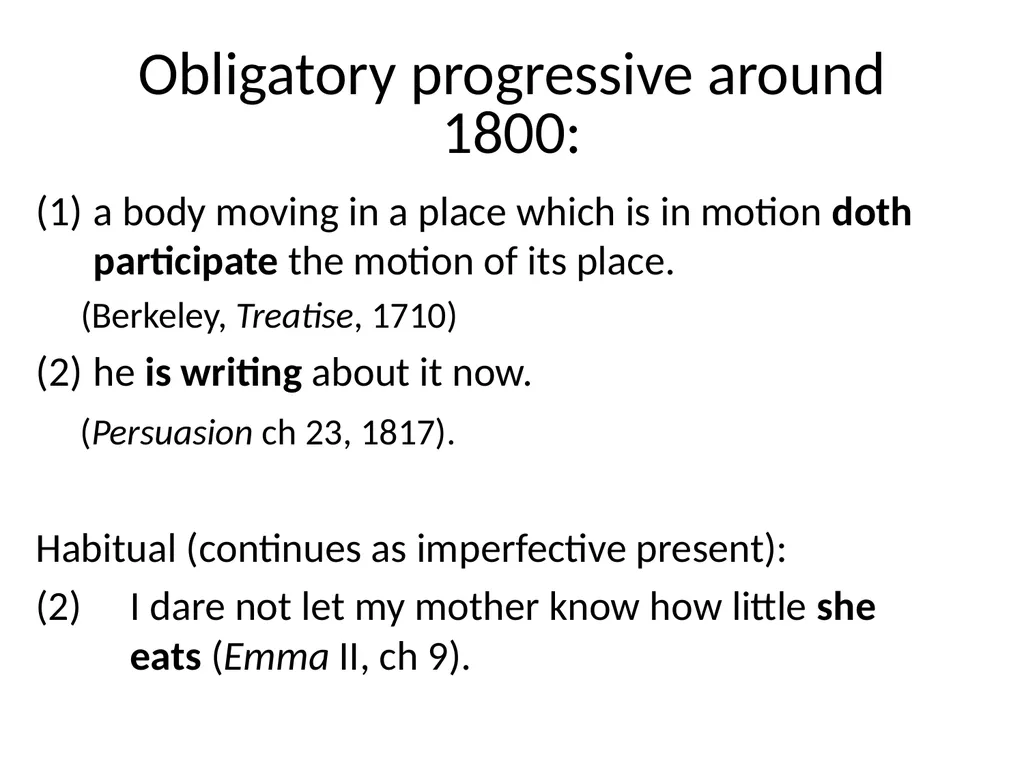
Obligatory progressive around 1800: a body moving in a place which is in motion doth participate the motion of its place.
(Berkeley, Treatise, 1710)
he is writing about it now.
(Persuasion ch 23, 1817).
Habitual (continues as imperfective present):
(2) I dare not let my mother know how little she eats (Emma II, ch 9).<br>
(Berkeley, Treatise, 1710)
he is writing about it now.
(Persuasion ch 23, 1817).
Habitual (continues as imperfective present):
(2) I dare not let my mother know how little she eats (Emma II, ch 9).<br>
62
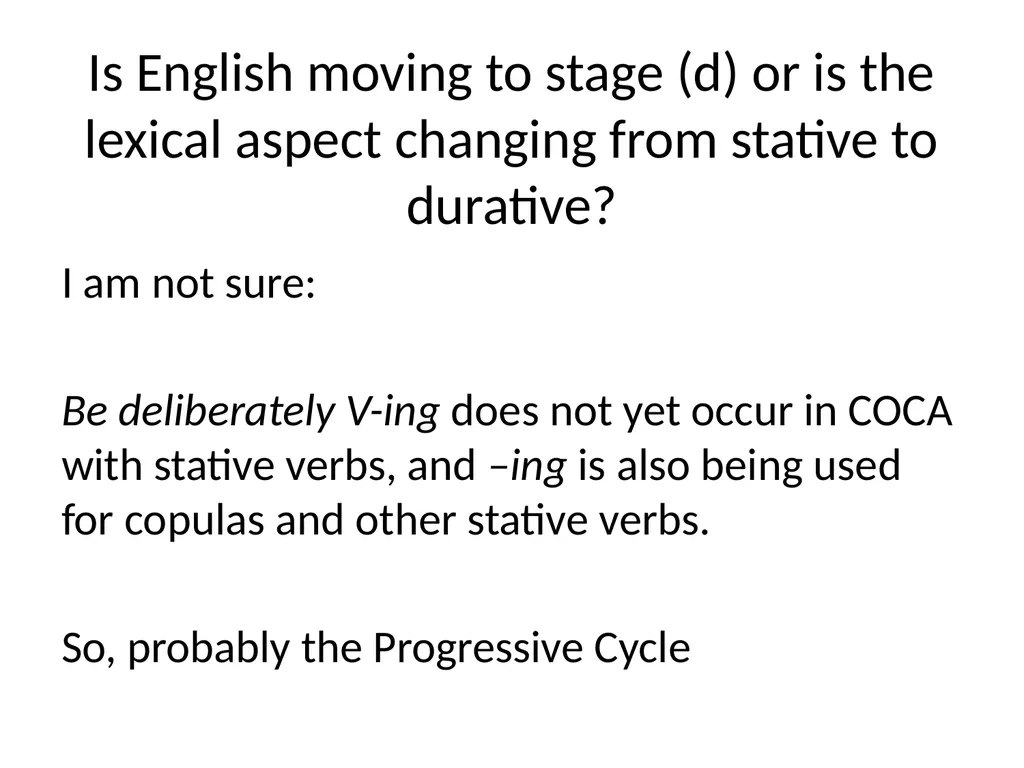
Is English moving to stage (d) or is the lexical aspect changing from stative to durative? I am not sure:
Be deliberately V-ing does not yet occur in COCA with stative verbs, and –ing is also being used for copulas and other stative verbs.
So, probably the Progressive Cycle<br>
Be deliberately V-ing does not yet occur in COCA with stative verbs, and –ing is also being used for copulas and other stative verbs.
So, probably the Progressive Cycle<br>
63
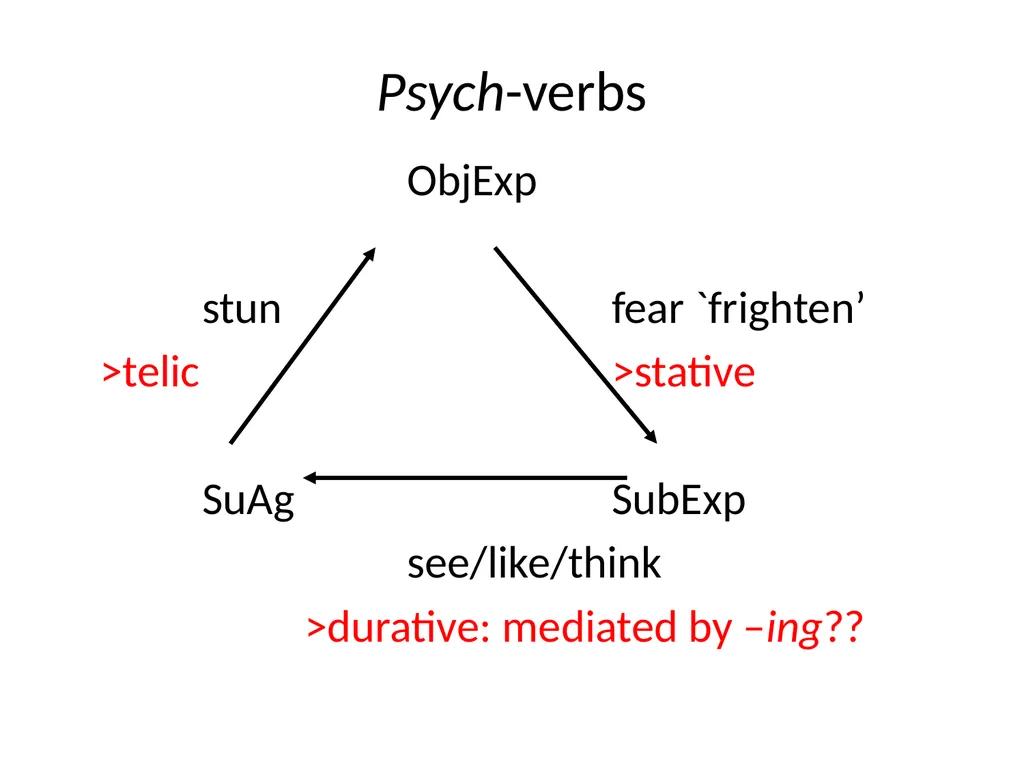
Psych-verbs ObjExp
stun fear `frighten’
>telic >stative
SuAg SubExp
see/like/think
>durative: mediated by –ing??<br>
stun fear `frighten’
>telic >stative
SuAg SubExp
see/like/think
>durative: mediated by –ing??<br>
64
Conclusion: changes in lexical aspect Unaccusative verbs > adding light verbs + labile
and unergatives > transitive
Increase in lability: 80 > 800
Unaccusatives > copulas
Unaccusatives ̸̸> unergatives; Unergatives ̸̸> unaccusatives
Psych-verbs: ObjExp > SuExp; but not the other way round.
Psych-verb and copula: Theme is crucial and stable but aspect is affected by animacy hierarchies.<br>
and unergatives > transitive
Increase in lability: 80 > 800
Unaccusatives > copulas
Unaccusatives ̸̸> unergatives; Unergatives ̸̸> unaccusatives
Psych-verbs: ObjExp > SuExp; but not the other way round.
Psych-verb and copula: Theme is crucial and stable but aspect is affected by animacy hierarchies.<br>
65
Changes in Grammatical aspect: Perfective Cycle: Resultative > anterior > perfective/past
Bybee et al (1994: 105)
Imperfective cycle: Not clear if it influences the lexical aspect<br>
Bybee et al (1994: 105)
Imperfective cycle: Not clear if it influences the lexical aspect<br>
66
Conceptual Structure Aspectual +/-telic, +/- durative is pervasive, especially with changes in intransitives.
Verbs always have a Theme argument but they don’t always have an Agent or Causer. The latter are introduced by optional light verbs which may be overt or not.
The vP shell is stable and may show the conceptual structure with an emphasis on aspect and theta-roles.<br>
Verbs always have a Theme argument but they don’t always have an Agent or Causer. The latter are introduced by optional light verbs which may be overt or not.
The vP shell is stable and may show the conceptual structure with an emphasis on aspect and theta-roles.<br>
67
References Allen, Cynthia. 1995. Case marking and reanalysis. OUP
Borer, Hagit 2005. In Name Only. OUP.
Brinton, Laurel. 1988. The Development of English Aspectual Systems. Cambridge: Cambridge University Press.
Bybee, Joan, Revere Perkins & William Pagliuca 1994. The evolution of grammar. tense, aspect, and modality in the languages of the world. Chicago: Chicago University Press.
Carey, K. 1994. The grammaticalization of the Perfect in Old English: An Account Based on Pragmatics and Metaphor” In William Pagliuca (ed.) Perspectives on grammaticalization, 103-17. Amsterdam: John Benjamins Publishing Company.
Comrie, Bernard 1976. Aspect. Cambridge: Cambridge University Press.
Deo, Ashwini 2015. The semantic and pragmatic underpinnings of grammaticalization paths: The progressive to imperfective shift. Semantics and Pragmatics.
Elsness, Johan 1996. The Perfect and Preterite in Contemporary and Earlier English. Berlin: Mouton de Gruyter.
Enke, Dankmar, Roland Mühlenbernd & Igor Yanovich 2016. The emergence of the progressive to imperfective diachronic cycle in reinforcement learning agents. ms.
Gelderen, Elly van 2011. Valency Changes. JHL 1.1: 106-143.
Gelderen, Elly van 2014. Changes in Psych-Verbs. CJL 13: 99-122.<br>
Borer, Hagit 2005. In Name Only. OUP.
Brinton, Laurel. 1988. The Development of English Aspectual Systems. Cambridge: Cambridge University Press.
Bybee, Joan, Revere Perkins & William Pagliuca 1994. The evolution of grammar. tense, aspect, and modality in the languages of the world. Chicago: Chicago University Press.
Carey, K. 1994. The grammaticalization of the Perfect in Old English: An Account Based on Pragmatics and Metaphor” In William Pagliuca (ed.) Perspectives on grammaticalization, 103-17. Amsterdam: John Benjamins Publishing Company.
Comrie, Bernard 1976. Aspect. Cambridge: Cambridge University Press.
Deo, Ashwini 2015. The semantic and pragmatic underpinnings of grammaticalization paths: The progressive to imperfective shift. Semantics and Pragmatics.
Elsness, Johan 1996. The Perfect and Preterite in Contemporary and Earlier English. Berlin: Mouton de Gruyter.
Enke, Dankmar, Roland Mühlenbernd & Igor Yanovich 2016. The emergence of the progressive to imperfective diachronic cycle in reinforcement learning agents. ms.
Gelderen, Elly van 2011. Valency Changes. JHL 1.1: 106-143.
Gelderen, Elly van 2014. Changes in Psych-Verbs. CJL 13: 99-122.<br>
68
Hale, Ken & Keyser, Samuel Jay. 2002. Prolegomenon to a Theory of Argument Structure. MIT Press.
Haspelmath, Martin 2001. Non-Canonical Marking of Core Arguments in European Languages. In Aikhenvald et al (eds), Non-Canonical Marking of Subjects and Objects, 53-83. Amsterdam: John Benjamins. Jackendoff, Ray 1987. Consciousness and the Computational Mind. MIT Press.
Lavidas, Nikolaos 2013. Null and cognate objects and changes in (in)transitivity: Evidence from the history of English. Acta Linguistica Hungarica 60.1: 69-106.
Leiss, Elisabeth. 2000. Artikel und Aspekt. Berlin: Walter de Gruyter.
Levin, Beth & Malka Rappaport Hovav. 1995. Unaccusativity. MIT Press.
Lohndal, Terje 2014. Phrase structure and argument structure. OUP.
McMillion, Allan. 2006. Labile Verbs in English. Stockholm PhD.
Pinker, Steven 1989. Learnability and Cognition. MIT Press.
Robertson, John & Danny Law 2009. From valency to aspect in the Ch’olan-Tzeltalan family of Mayan. IJAL 75.3: 293-316.
Ryan, John 2012. The Genesis of Argument Structure. Lambert AP.<br>
Haspelmath, Martin 2001. Non-Canonical Marking of Core Arguments in European Languages. In Aikhenvald et al (eds), Non-Canonical Marking of Subjects and Objects, 53-83. Amsterdam: John Benjamins. Jackendoff, Ray 1987. Consciousness and the Computational Mind. MIT Press.
Lavidas, Nikolaos 2013. Null and cognate objects and changes in (in)transitivity: Evidence from the history of English. Acta Linguistica Hungarica 60.1: 69-106.
Leiss, Elisabeth. 2000. Artikel und Aspekt. Berlin: Walter de Gruyter.
Levin, Beth & Malka Rappaport Hovav. 1995. Unaccusativity. MIT Press.
Lohndal, Terje 2014. Phrase structure and argument structure. OUP.
McMillion, Allan. 2006. Labile Verbs in English. Stockholm PhD.
Pinker, Steven 1989. Learnability and Cognition. MIT Press.
Robertson, John & Danny Law 2009. From valency to aspect in the Ch’olan-Tzeltalan family of Mayan. IJAL 75.3: 293-316.
Ryan, John 2012. The Genesis of Argument Structure. Lambert AP.<br>
69
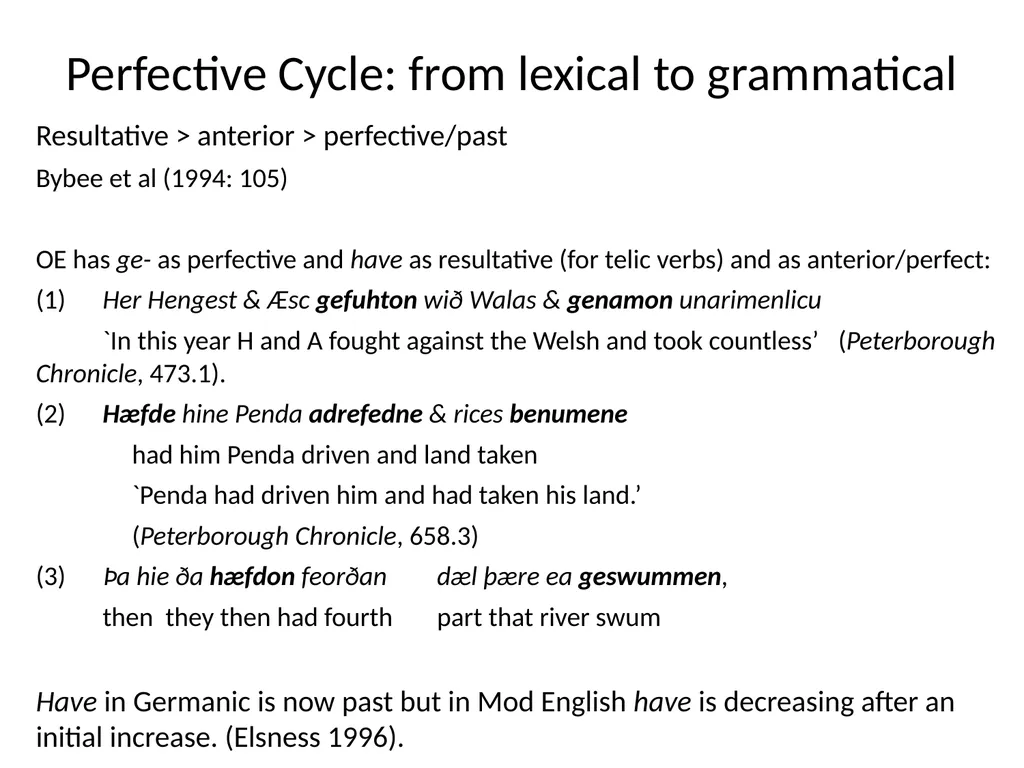
Perfective Cycle: from lexical to grammatical Resultative > anterior > perfective/past
Bybee et al (1994: 105)
OE has ge- as perfective and have as resultative (for telic verbs) and as anterior/perfect:
(1) Her Hengest & Æsc gefuhton wið Walas & genamon unarimenlicu
`In this year H and A fought against the Welsh and took countless’ (Peterborough Chronicle, 473.1).
(2) Hæfde hine Penda adrefedne & rices benumene
had him Penda driven and land taken
`Penda had driven him and had taken his land.’
(Peterborough Chronicle, 658.3)
(3) Þa hie ða hæfdon feorðan dæl þære ea geswummen,
then they then had fourth part that river swum
Have in Germanic is now past but in Mod English have is decreasing after an initial increase. (Elsness 1996).<br>
Bybee et al (1994: 105)
OE has ge- as perfective and have as resultative (for telic verbs) and as anterior/perfect:
(1) Her Hengest & Æsc gefuhton wið Walas & genamon unarimenlicu
`In this year H and A fought against the Welsh and took countless’ (Peterborough Chronicle, 473.1).
(2) Hæfde hine Penda adrefedne & rices benumene
had him Penda driven and land taken
`Penda had driven him and had taken his land.’
(Peterborough Chronicle, 658.3)
(3) Þa hie ða hæfdon feorðan dæl þære ea geswummen,
then they then had fourth part that river swum
Have in Germanic is now past but in Mod English have is decreasing after an initial increase. (Elsness 1996).<br>
70
From result to anterior: Carey (2005) shows present nu `now’ vs anterior ær `before’ siþþan `since’ with have +PP Various claims about perfect > past change in BrE but AmE decrease in perfect.<br>
71
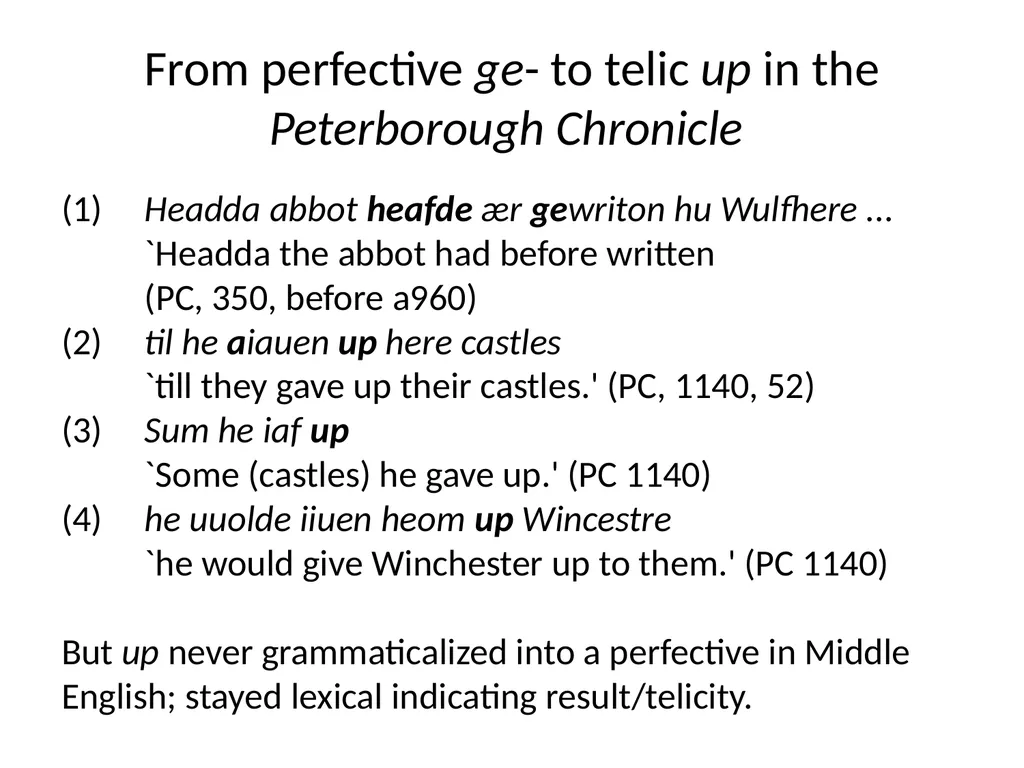
From perfective ge- to telic up in the Peterborough Chronicle (1) Headda abbot heafde ær gewriton hu Wulfhere ...
`Headda the abbot had before written
(PC, 350, before a960)
(2) til he aiauen up here castles
`till they gave up their castles.' (PC, 1140, 52)
(3) Sum he iaf up
`Some (castles) he gave up.' (PC 1140)
(4) he uuolde iiuen heom up Wincestre
`he would give Winchester up to them.' (PC 1140)
But up never grammaticalized into a perfective in Middle English; stayed lexical indicating result/telicity.<br>
`Headda the abbot had before written
(PC, 350, before a960)
(2) til he aiauen up here castles
`till they gave up their castles.' (PC, 1140, 52)
(3) Sum he iaf up
`Some (castles) he gave up.' (PC 1140)
(4) he uuolde iiuen heom up Wincestre
`he would give Winchester up to them.' (PC 1140)
But up never grammaticalized into a perfective in Middle English; stayed lexical indicating result/telicity.<br>
72
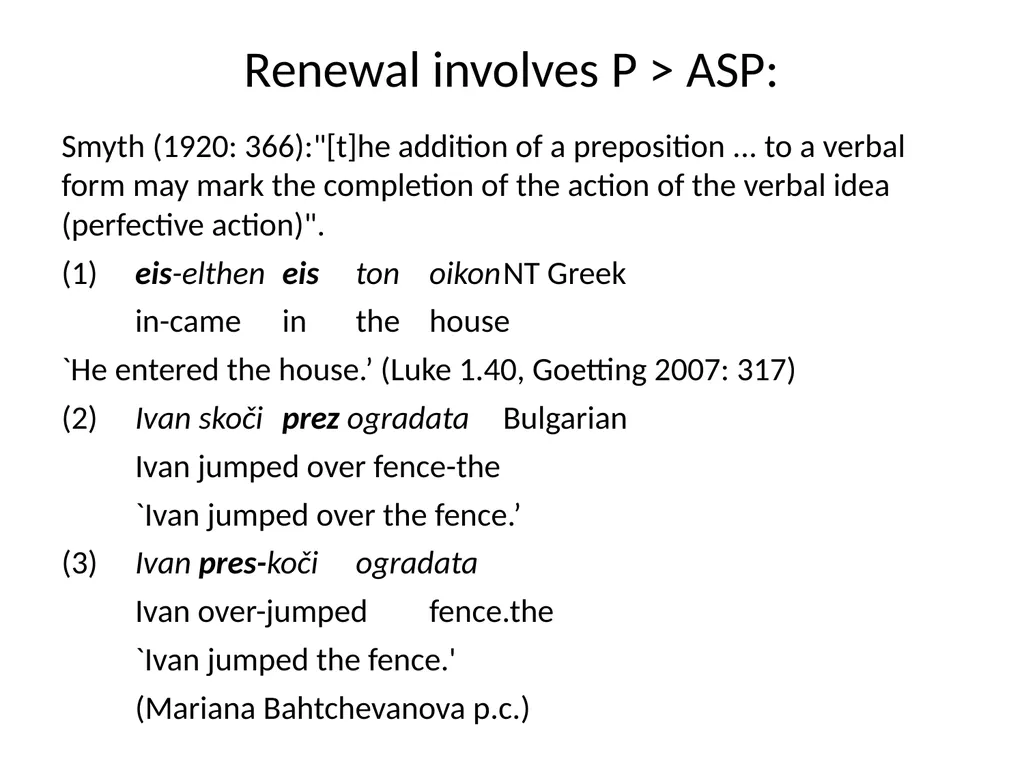
Renewal involves P > ASP: Smyth (1920: 366):"[t]he addition of a preposition ... to a verbal form may mark the completion of the action of the verbal idea (perfective action)".
(1) eis-elthen eis ton oikon NT Greek
in-came in the house
`He entered the house.’ (Luke 1.40, Goetting 2007: 317)
(2) Ivan skoči prez ogradata Bulgarian
Ivan jumped over fence-the
`Ivan jumped over the fence.’
(3) Ivan pres-koči ogradata
Ivan over-jumped fence.the
`Ivan jumped the fence.'
(Mariana Bahtchevanova p.c.)<br>
(1) eis-elthen eis ton oikon NT Greek
in-came in the house
`He entered the house.’ (Luke 1.40, Goetting 2007: 317)
(2) Ivan skoči prez ogradata Bulgarian
Ivan jumped over fence-the
`Ivan jumped over the fence.’
(3) Ivan pres-koči ogradata
Ivan over-jumped fence.the
`Ivan jumped the fence.'
(Mariana Bahtchevanova p.c.)<br>
73
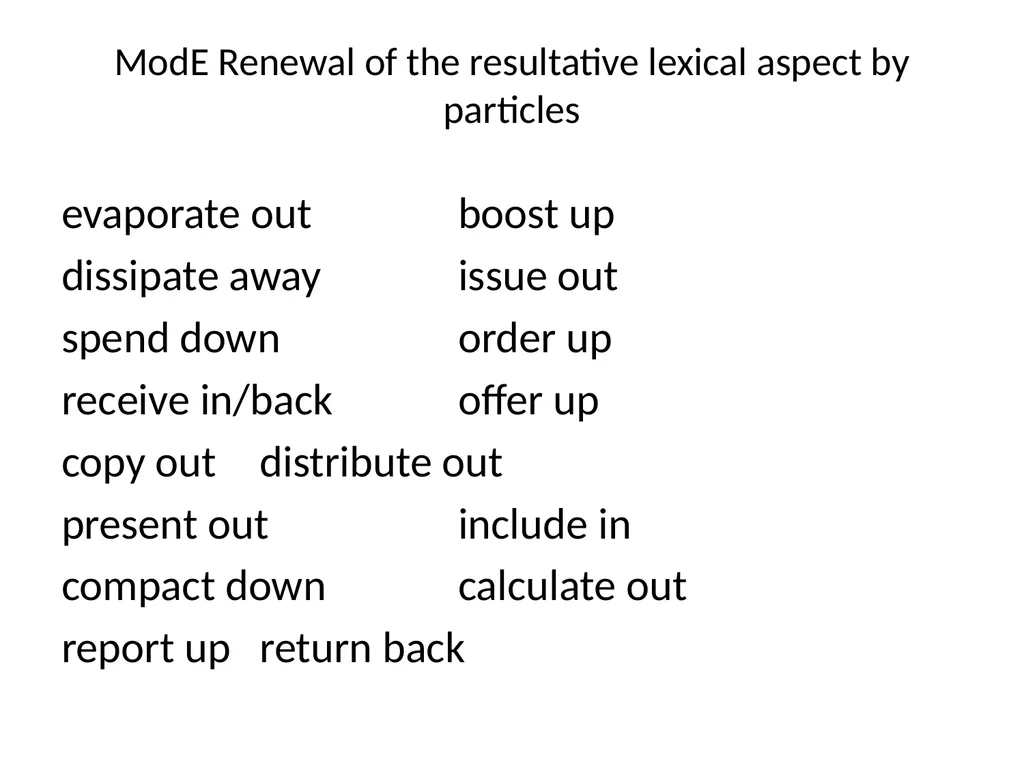
ModE Renewal of the resultative lexical aspect by particles evaporate out boost up
dissipate away issue out
spend down order up
receive in/back offer up
copy out distribute out
present out include in
compact down calculate out
report up return back<br>
dissipate away issue out
spend down order up
receive in/back offer up
copy out distribute out
present out include in
compact down calculate out
report up return back<br>
74
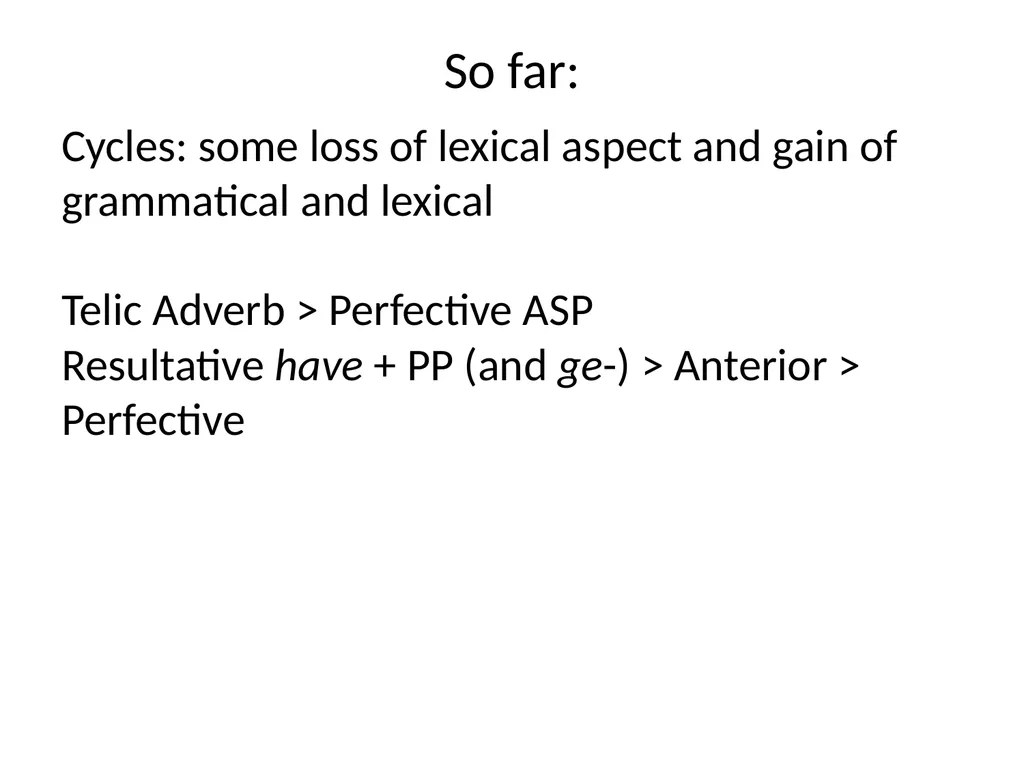
So far: Cycles: some loss of lexical aspect and gain of grammatical and lexical
Telic Adverb > Perfective ASP
Resultative have + PP (and ge-) > Anterior > Perfective<br>
Telic Adverb > Perfective ASP
Resultative have + PP (and ge-) > Anterior > Perfective<br>
75
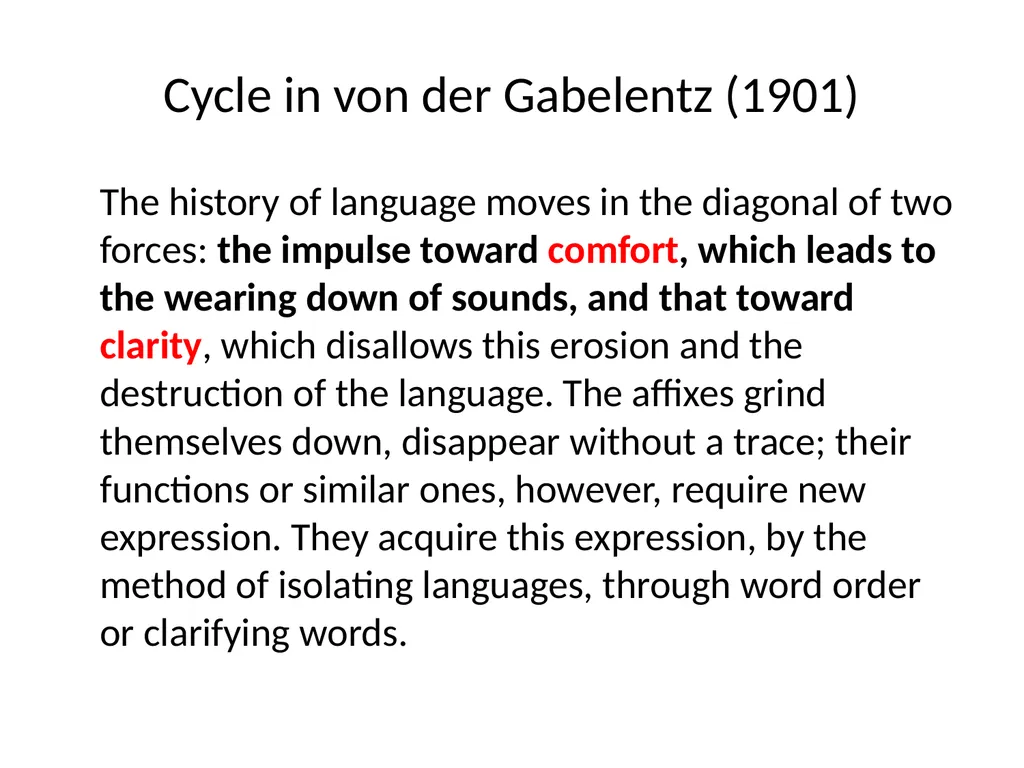
Cycle in von der Gabelentz (1901) The history of language moves in the diagonal of two forces: the impulse toward comfort, which leads to the wearing down of sounds, and that toward clarity, which disallows this erosion and the destruction of the language. The affixes grind themselves down, disappear without a trace; their functions or similar ones, however, require new expression. They acquire this expression, by the method of isolating languages, through word order or clarifying words.<br>
76
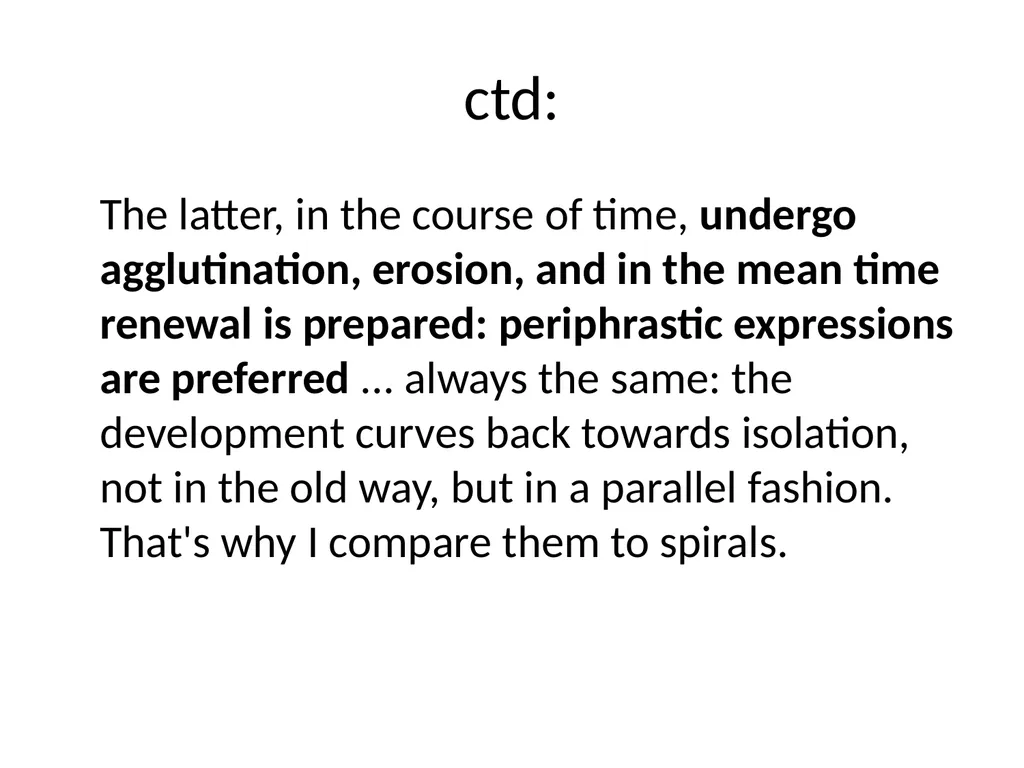
ctd: The latter, in the course of time, undergo agglutination, erosion, and in the mean time renewal is prepared: periphrastic expressions are preferred ... always the same: the development curves back towards isolation, not in the old way, but in a parallel fashion. That's why I compare them to spirals.<br>