
CHAPTER 1 An Overview of Logistics Learning
DP
Published · 49 slides · 0 views
1 / 1

Description
CHAPTER 1 An Overview of Logistics Learning Objectives To understand the economic impacts of logistics To learn what logistics is To learn about the increased importance of logistics To understand the systems and total cost approaches to
Related Topics
Share
Embed code
Download this presentation From Below
"CHAPTER 1 An Overview of Logistics Learning" is the property of its rightful owner. Permission is granted to download and print the materials on this website for personal, non-commercial use only, and to display it on your personal computer provided you do not modify the materials and that you retain all copyright notices contained in the materials. By downloading content from our website, you accept the terms of this agreement.
Presentation Transcript
01
CHAPTER 1
An Overview of Logistics<br>
02
Learning Objectives To understand the economic impacts of logistics
To learn what logistics is
To learn about the increased importance of logistics
To understand the systems and total cost approaches to logistics
To expose you to logistical relationships within the firm
To learn about marketing channels
To provide a brief overview of activities in the logistics channel
To familiarize you with logistics careers © 2008 Prentice Hall 1-2<br>
03
Logistics and the Supply Chain Key Terms
Cost trade-offs
Disintermediation
Economic utility
Form utility
Landed costs
Logistics
Marketing channels Key Terms
Mass logistics
Materials management
Physical distribution
Place utility
Possession utility
Postponement
Power retailer © 2008 Prentice Hall 1-3<br>
04
Logistics and the Supply Chain Key Terms
Sorting function
Stock-keeping units (SKUs)
Stockouts
Sustainable products Key Terms
Systems approach
Tailored logistics
Time utility
Total cost approach © 2008 Prentice Hall 1-4<br>
05
Economic Impacts of Logistics Macroeconomic Impacts © 2008 Prentice Hall 1-5<br>
06
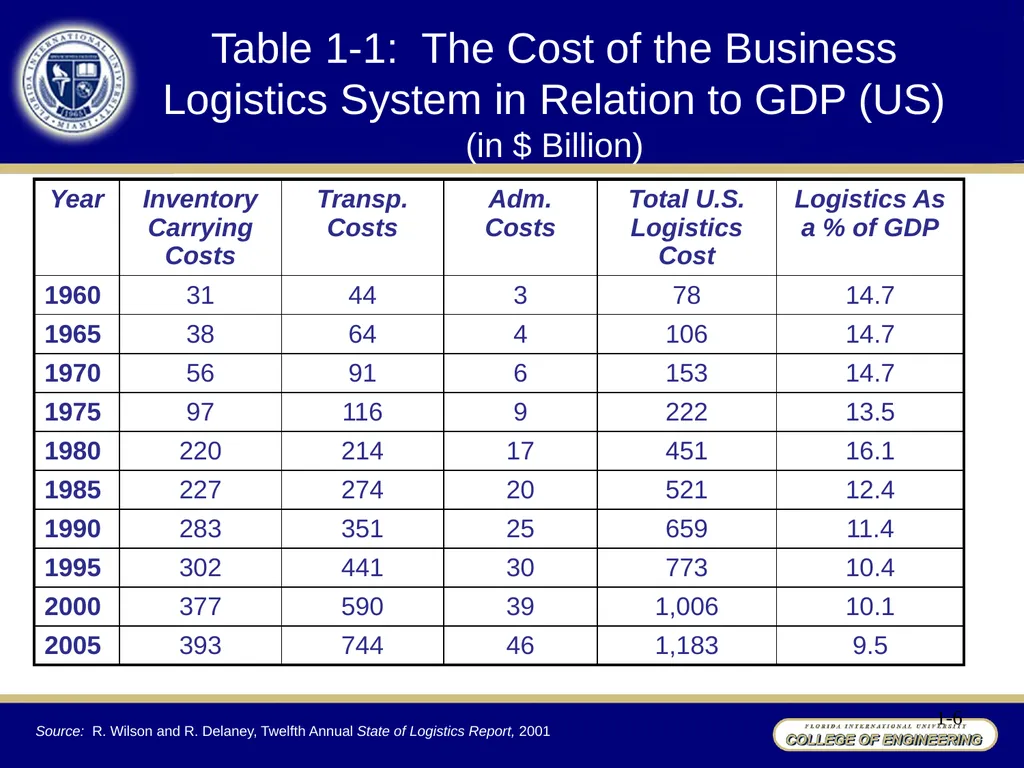
Table 1-1: The Cost of the Business Logistics System in Relation to GDP (US)
(in $ Billion) 1-6 Source: R. Wilson and R. Delaney, Twelfth Annual State of Logistics Report, 2001<br>
07
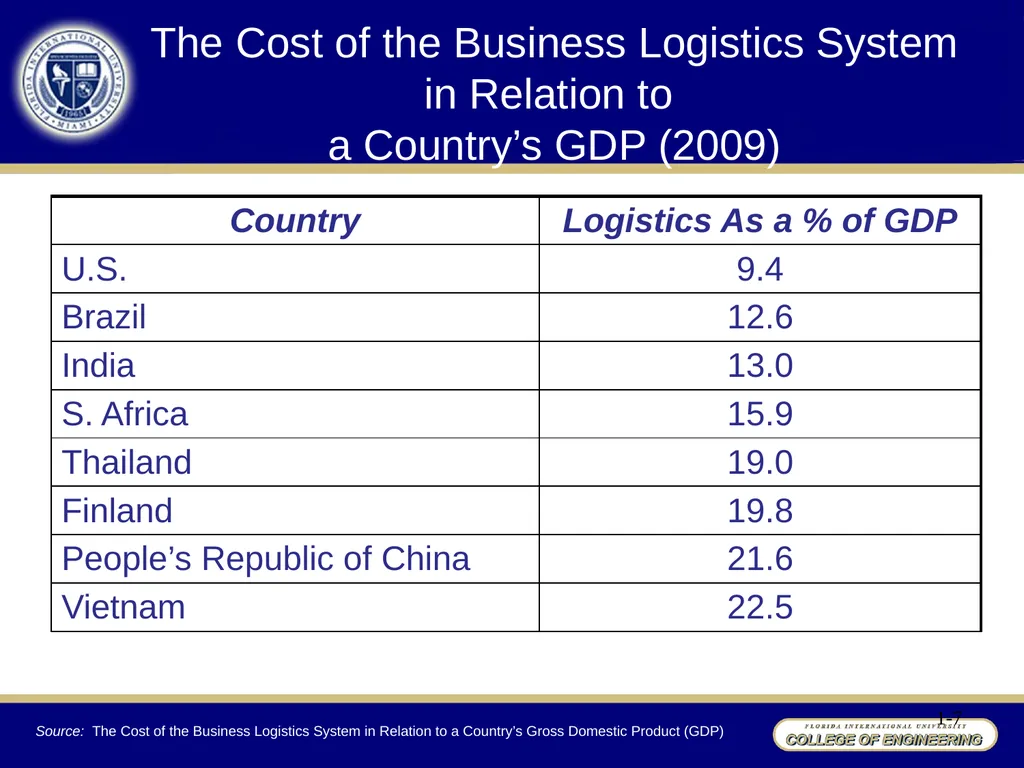
The Cost of the Business Logistics System in Relation to
a Country’s GDP (2009) 1-7 Source: The Cost of the Business Logistics System in Relation to a Country’s Gross Domestic Product (GDP)<br>
08
Importance of Logistics Size of Market – It Is Big
Strategic Advantage – It Can Drive Strategy
Manufacturing is becoming more efficient
SCM offers opportunity for differentiation (Dell) or cost reduction (Wal-Mart)
Increased use of logistics outsourcing –(3PLs, WH)
Globalization – It Covers The World
Requires greater coordination of production & distribution
Increased risk of supply chain interruption
Increases need for robust and flexible supply chains © 2008 Prentice Hall 1-8<br>
09
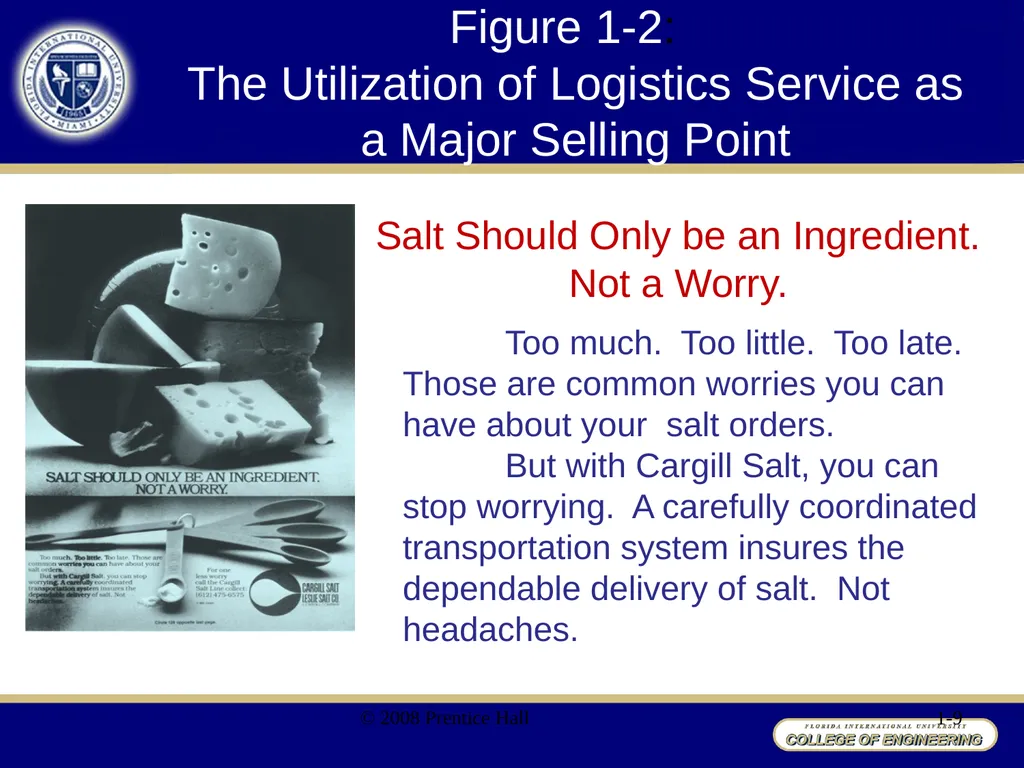
Figure 1-2:
The Utilization of Logistics Service as a Major Selling Point © 2008 Prentice Hall 1-9 Salt Should Only be an Ingredient.
Not a Worry. Too much. Too little. Too late. Those are common worries you can have about your salt orders.
But with Cargill Salt, you can stop worrying. A carefully coordinated transportation system insures the dependable delivery of salt. Not headaches.<br>
10
Importance of Logistics At the company level, logistics impacts:
COST - For many products, 20% to 40% of total product costs are controllable logistics costs.
SERVICE - For many products, performance factors such as inventory availability and speed of delivery are critical to customer satisfaction. © 2008 Prentice Hall 1-10<br>
11
Importance of Logistics Logistics involves intelligent trade-offs:
Purchase discounts <> Raw Materials Inventory
Production efficiency <> Finished Goods Inventory
Freight discounts <> Finished Good Inventory
Lower planned cost <> More stable costs © 2008 Prentice Hall 1-11<br>
12
Other Economic Impacts of Logistics Economic Utility
Possession utility
Form utility
Place utility
Time utility © 2008 Prentice Hall 1-12<br>
13
Logistics: What It Is? CSCMP (Council of Supply Chain Management Professionals) definition:
“Logistics is that part of the Supply Chain Management that plans, implements, and controls the efficient, effective forward and reverse flow and storage of goods, services, and related information between the point of origin and the point of consumption in order to meet customers’ requirements.” © 2008 Prentice Hall 1-13 Source: clm1.org<br>
14
Logistics: What It Is? Supply Chain Management . . . “encompasses every effort involved in producing and delivering a final product or service, from the supplier's supplier to the customer's customer. Supply Chain Management includes managing supply and demand, sourcing raw materials and parts, manufacturing and assembly, warehousing and inventory tracking, order entry and order management, distribution across all channels, and delivery to the customer.”
The Supply-Chain Council © 2008 Prentice Hall 1-14<br>
15
Logistics: Key Observations Integrated activity
X-functions, X-divisions, X-companies, etc.
Coordination of conflicting goals, metrics, etc.
Responsible for multiple flows:
Information (orders, status, contracts)
Physical (finished goods, raw materials, WIP)
Financial (payment, credits, etc.)
Most analysis involves trade-offs
Across different entities
Across metrics: Cost, Service, Time, Risk, etc. © 2008 Prentice Hall 1-15<br>
16
Traditional Logistics Functions Purchasing / Procurement
Inventory Control
Warehousing
Materials Handling
Order Processing
Transportation
Customer Service
Facility Location / Network Design © 2008 Prentice Hall 1-16<br>
17
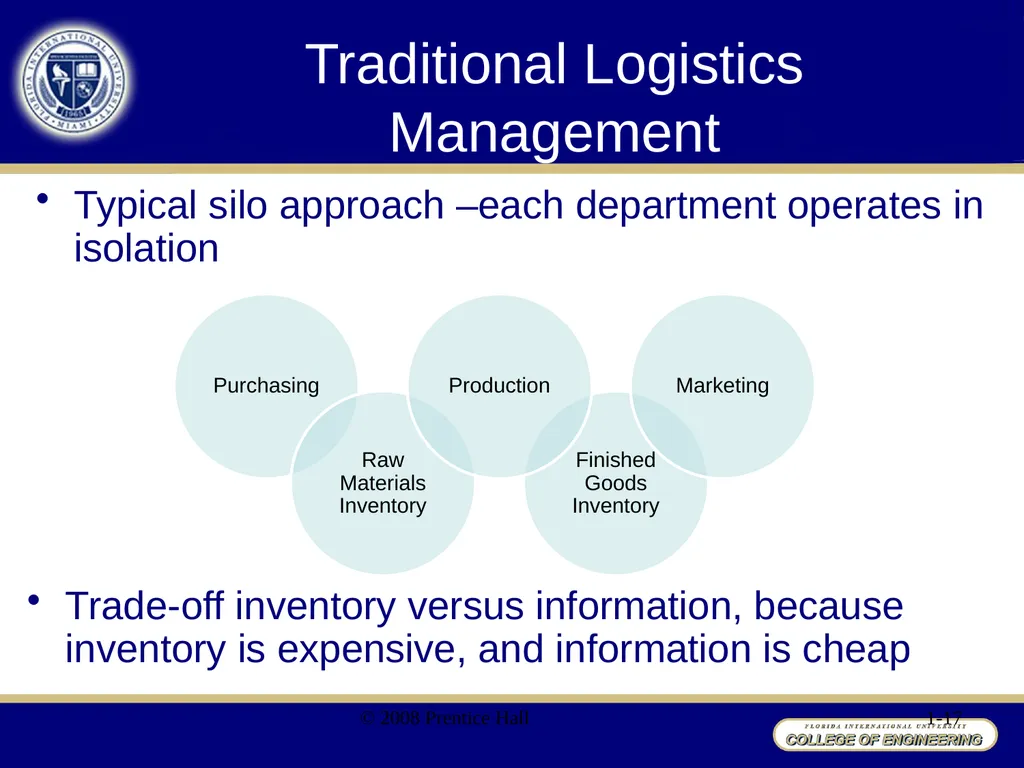
Traditional Logistics Management Typical silo approach –each department operates in isolation © 2008 Prentice Hall 1-17 Trade-off inventory versus information, because inventory is expensive, and information is cheap<br>
18
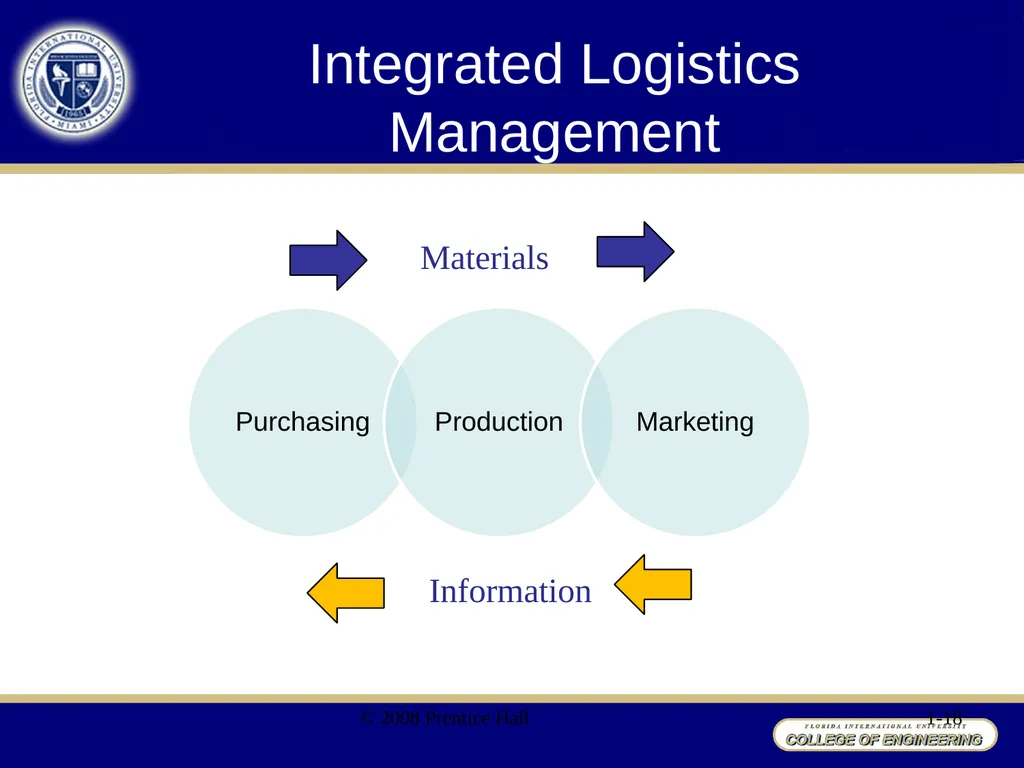
Integrated Logistics Management © 2008 Prentice Hall 1-18 Materials Information<br>
19
Key Concepts Design, operate, and control the physical and information flows as though the channel were one seamless corporate entity.
Let the activities (and costs) migrate across corporate boundaries to where they make the most sense.
Rely on the benefits of channel integration to replace the benefits of open market forces.
Share the risks and the rewards between players. © 2008 Prentice Hall 1-19<br>
20
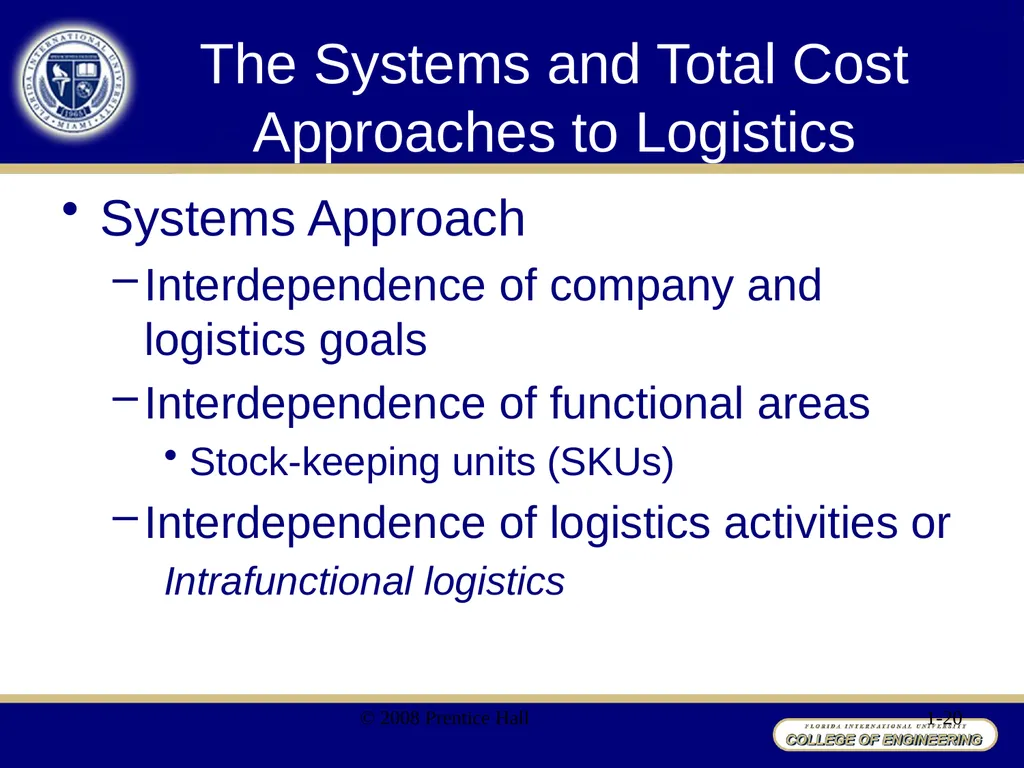
The Systems and Total Cost Approaches to Logistics Systems Approach
Interdependence of company and logistics goals
Interdependence of functional areas
Stock-keeping units (SKUs)
Interdependence of logistics activities or
Intrafunctional logistics © 2008 Prentice Hall 1-20<br>
21
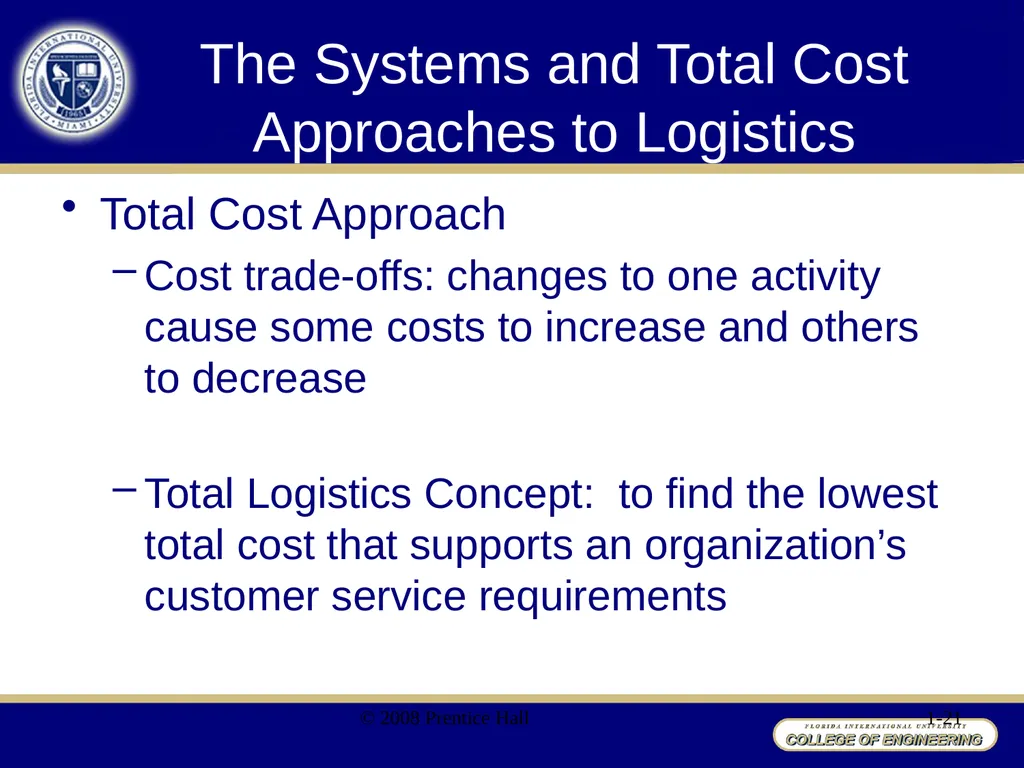
The Systems and Total Cost Approaches to Logistics Total Cost Approach
Cost trade-offs: changes to one activity cause some costs to increase and others to decrease
Total Logistics Concept: to find the lowest total cost that supports an organization’s customer service requirements © 2008 Prentice Hall 1-21<br>
22
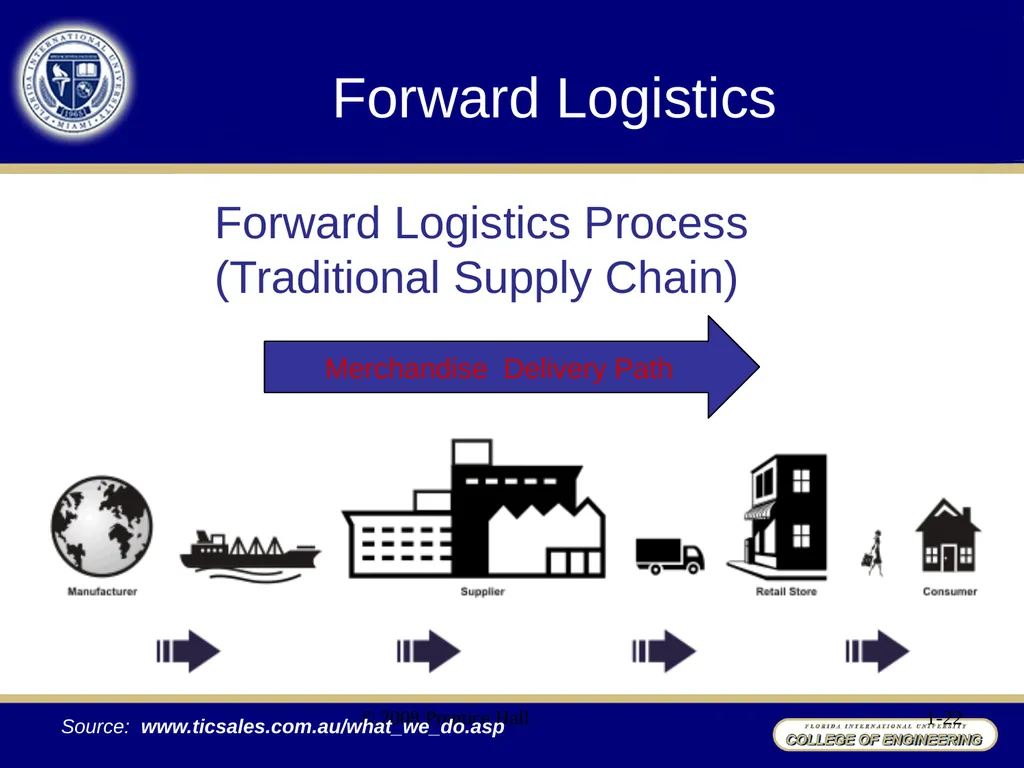
Forward Logistics © 2008 Prentice Hall 1-22 Source: www.ticsales.com.au/what_we_do.asp Forward Logistics Process
(Traditional Supply Chain) Merchandise Delivery Path<br>
23
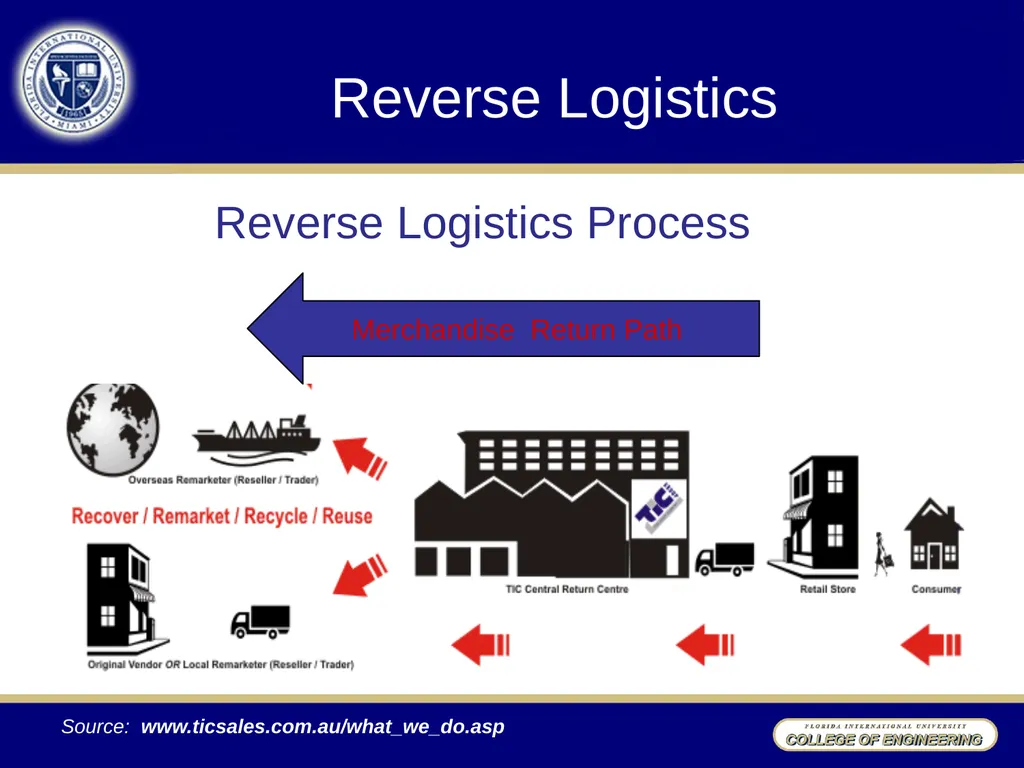
Reverse Logistics Source: www.ticsales.com.au/what_we_do.asp Reverse Logistics Process Merchandise Return Path<br>
24
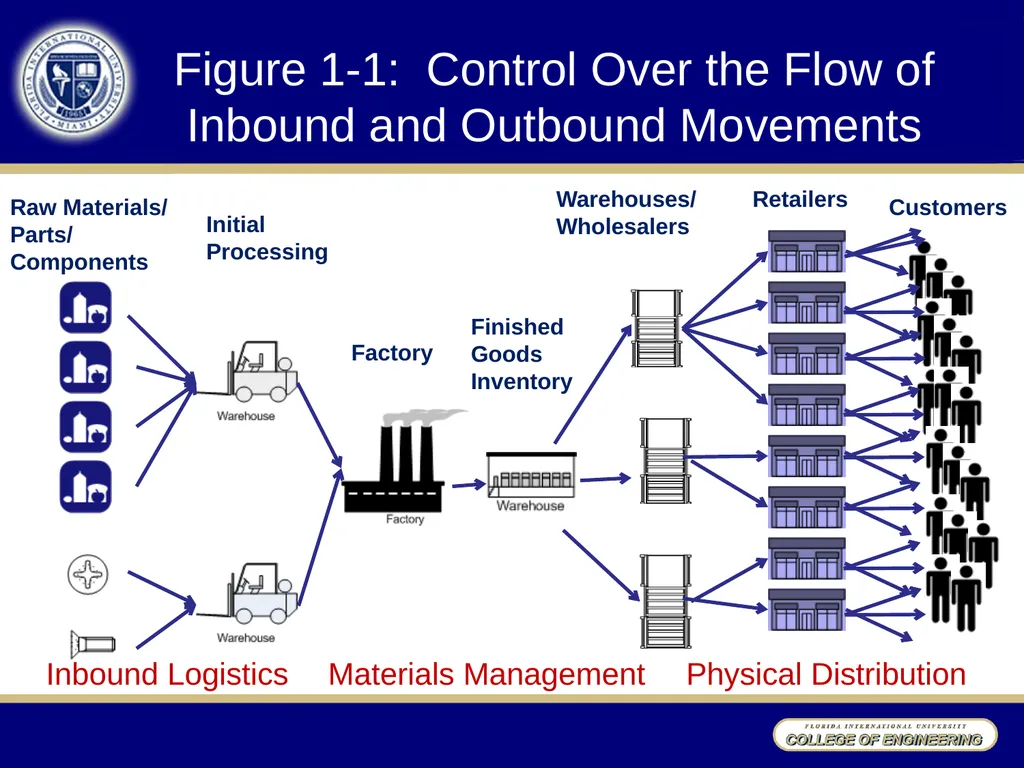
Figure 1-1: Control Over the Flow of Inbound and Outbound Movements Raw Materials/
Parts/ Components Initial Processing Factory Finished Goods
Inventory Warehouses/
Wholesalers Retailers Customers Inbound Logistics Materials Management Physical Distribution<br>
25
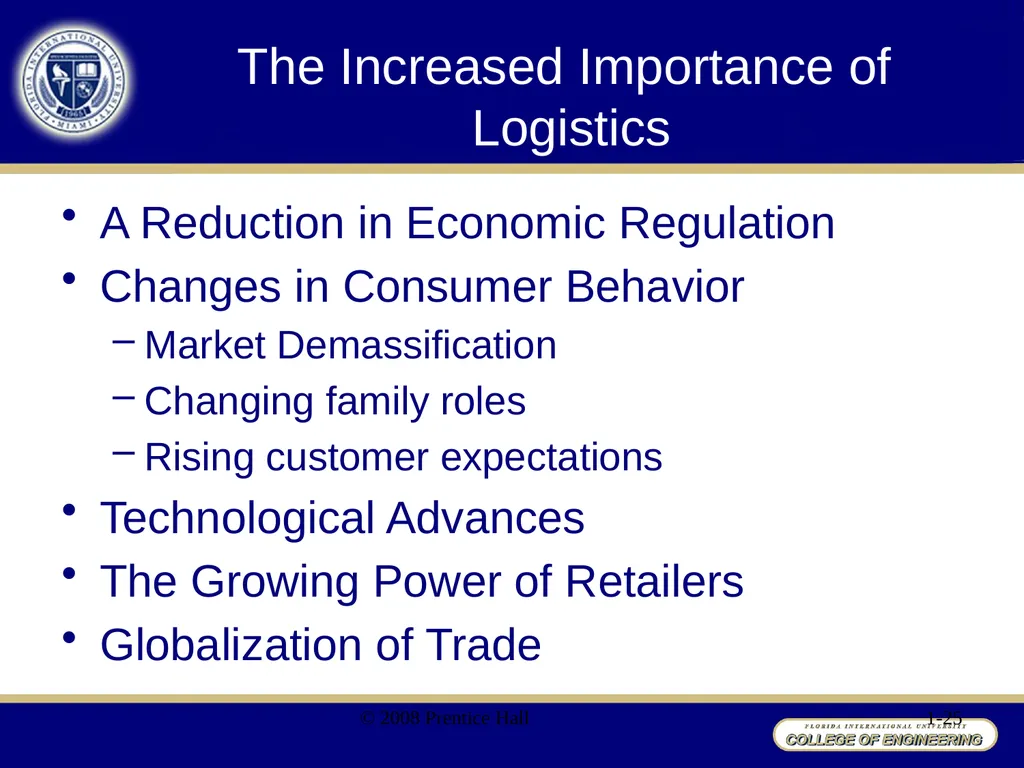
The Increased Importance of Logistics A Reduction in Economic Regulation
Changes in Consumer Behavior
Market Demassification
Changing family roles
Rising customer expectations
Technological Advances
The Growing Power of Retailers
Globalization of Trade © 2008 Prentice Hall 1-25<br>
26
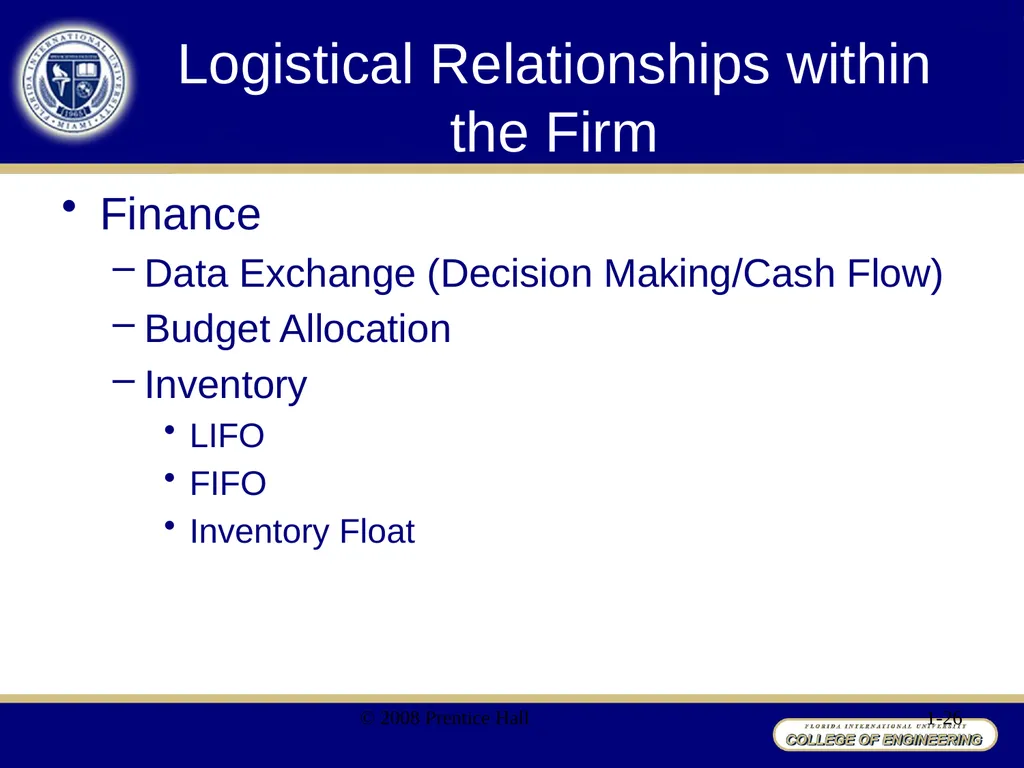
Logistical Relationships within the Firm Finance
Data Exchange (Decision Making/Cash Flow)
Budget Allocation
Inventory
LIFO
FIFO
Inventory Float © 2008 Prentice Hall 1-26<br>
27
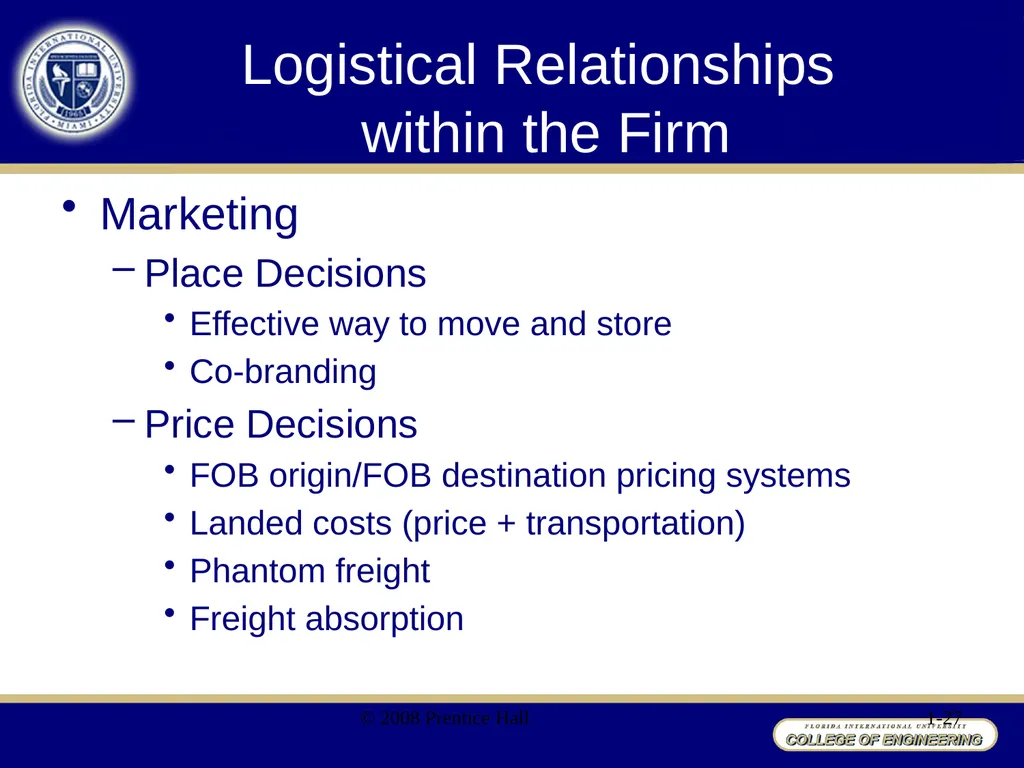
Logistical Relationships
within the Firm Marketing
Place Decisions
Effective way to move and store
Co-branding
Price Decisions
FOB origin/FOB destination pricing systems
Landed costs (price + transportation)
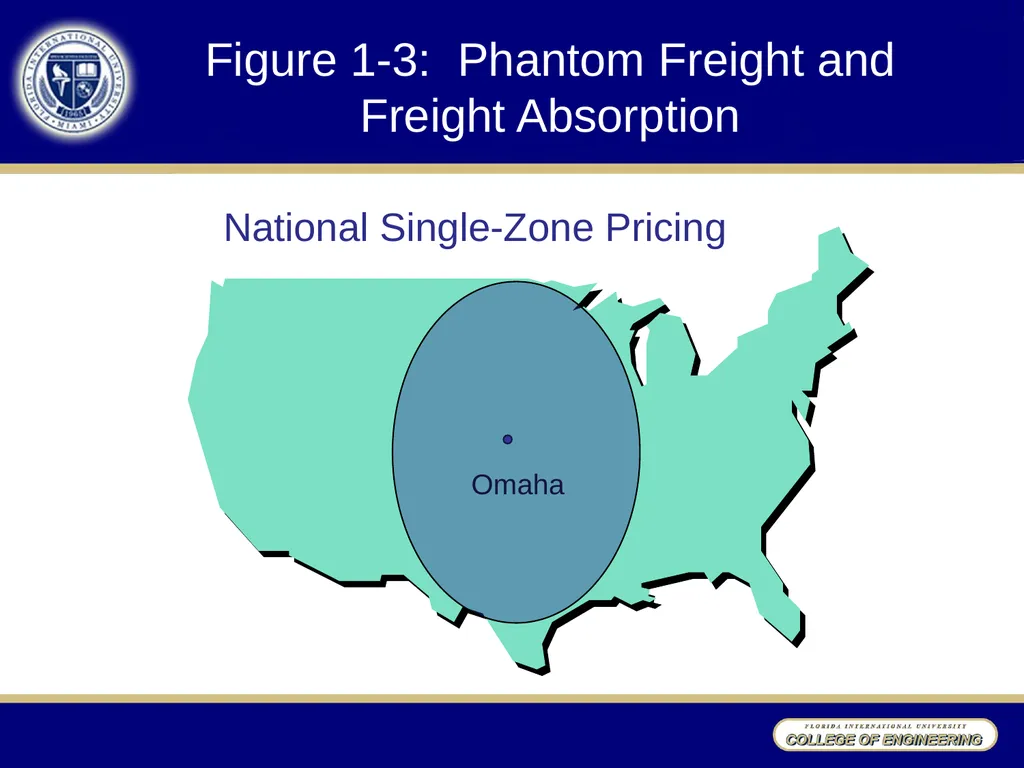
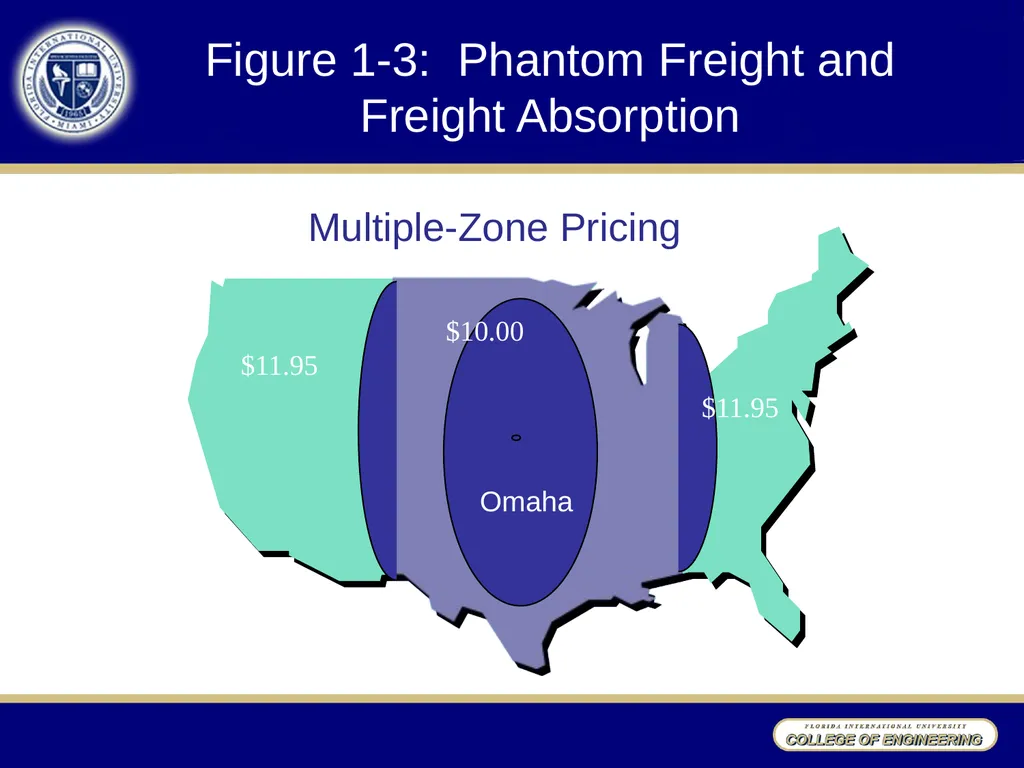
Phantom freight
Freight absorption © 2008 Prentice Hall 1-27<br>
28
Figure 1-3: Phantom Freight and Freight Absorption National Single-Zone Pricing Omaha<br>
29
Figure 1-3: Phantom Freight and Freight Absorption Multiple-Zone Pricing Omaha $11.95 $11.95 $10.00<br>
30
Logistical Relationships within the Firm Marketing
Product Decisions
SKUs
Stockouts
Promotion Decisions © 2008 Prentice Hall 1-30<br>
31
Logistical Relationships
within the Firm Production
Production runs
Postponement concept © 2008 Prentice Hall 1-31<br>
32
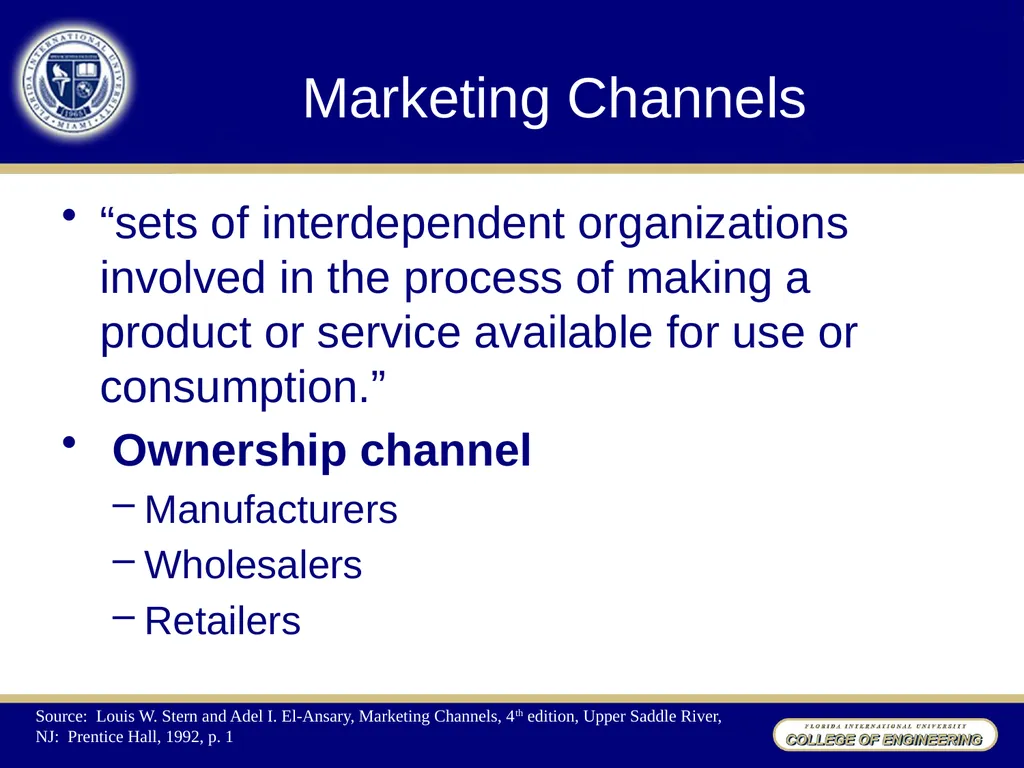
Marketing Channels “sets of interdependent organizations involved in the process of making a product or service available for use or consumption.”
Ownership channel
Manufacturers
Wholesalers
Retailers Source: Louis W. Stern and Adel I. El-Ansary, Marketing Channels, 4th edition, Upper Saddle River, NJ: Prentice Hall, 1992, p. 1<br>
33
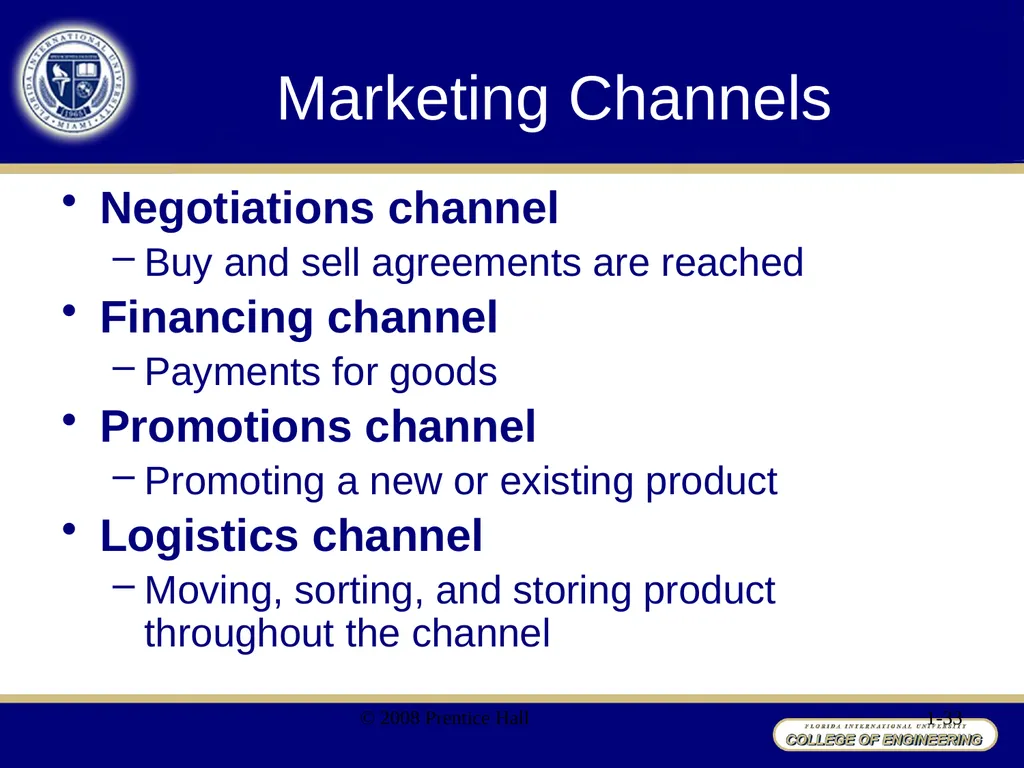
Marketing Channels Negotiations channel
Buy and sell agreements are reached
Financing channel
Payments for goods
Promotions channel
Promoting a new or existing product
Logistics channel
Moving, sorting, and storing product throughout the channel © 2008 Prentice Hall 1-33<br>
34
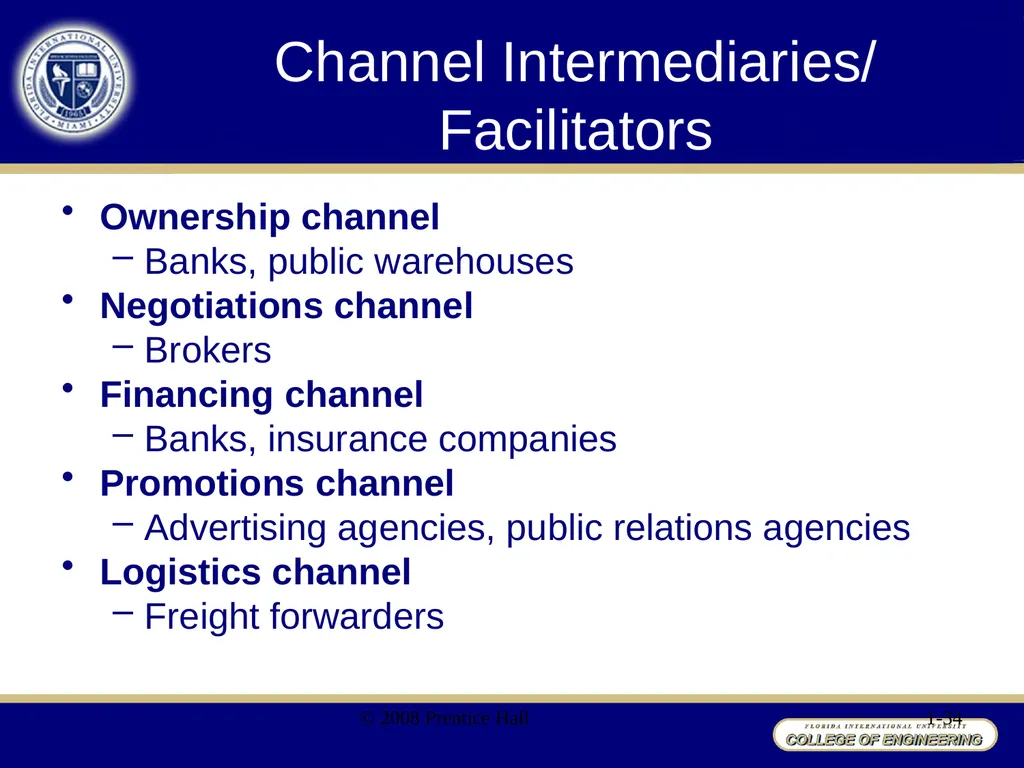
Channel Intermediaries/ Facilitators Ownership channel
Banks, public warehouses
Negotiations channel
Brokers
Financing channel
Banks, insurance companies
Promotions channel
Advertising agencies, public relations agencies
Logistics channel
Freight forwarders © 2008 Prentice Hall 1-34<br>
35
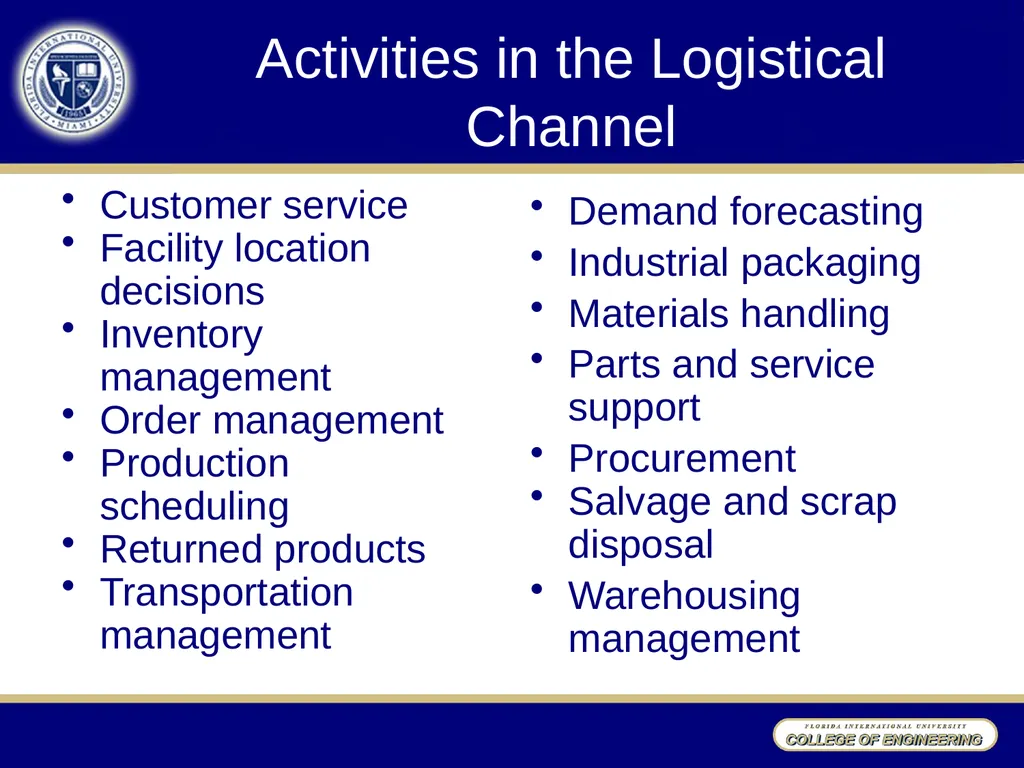
Activities in the Logistical Channel Customer service
Facility location decisions
Inventory management
Order management
Production scheduling
Returned products
Transportation management Demand forecasting
Industrial packaging
Materials handling
Parts and service support
Procurement
Salvage and scrap disposal
Warehousing management<br>
36
Responsibilities of
Logistics Managers A specialist
Freight rates
Warehouse layouts
Inventory analysis
Production
Purchasing
Transportation law A generalist
Understands functional relationships
Relates logistics to other firm operations, suppliers, customers
Controls large expenditures 1-36<br>
37
Logistics Careers Most business organizations are potential employers
Logistics is the second-largest employment sector in the United States
The CEO of Wal-Mart began his Wal-Mart career in the logistics area! © 2008 Prentice Hall 1-37<br>
38
Logistics Professionalism Council of Logistics Management
Canadian Association of Logistics Management
American Production and Inventory Control Society
American Society of Transportation and Logistics Association for Transportation Law, Logistics, and Policy
Delta Nu Alpha
International Society of Logistics
Transportation Research Forum
Warehousing and Education Research Council © 2008 Prentice Hall 1-38 Professional Organizations Dedicated to Advancing the Professional Knowledge of their members:<br>
39
Case 1-1 Sudsy Soap, Inc. Located in Akron, Ohio 1-39 Company Facts: Produced 150 tons (100,000 x 48-ounce cartons) of powdered dish soap each week
Carton size: .5 ft3 Product Facts: Market Facts: Steady share in “a stable market”<br>
40
Case 1-1 Sudsy Soap, Inc. Delivers 15~20 railcar loads / working day
Shipped to various food chain warehouses and large grocery brokers in railcar load
Delivery time: range from 6 days (best) to 43 days (longest) with average of 19 days 1-40 Distribution Facts: Person Involved: Frank Johnson, Outbound Logistics Manager
E. Gerard Beever (Eager), Sales Manager
CEO
Beever’s Friend<br>
41
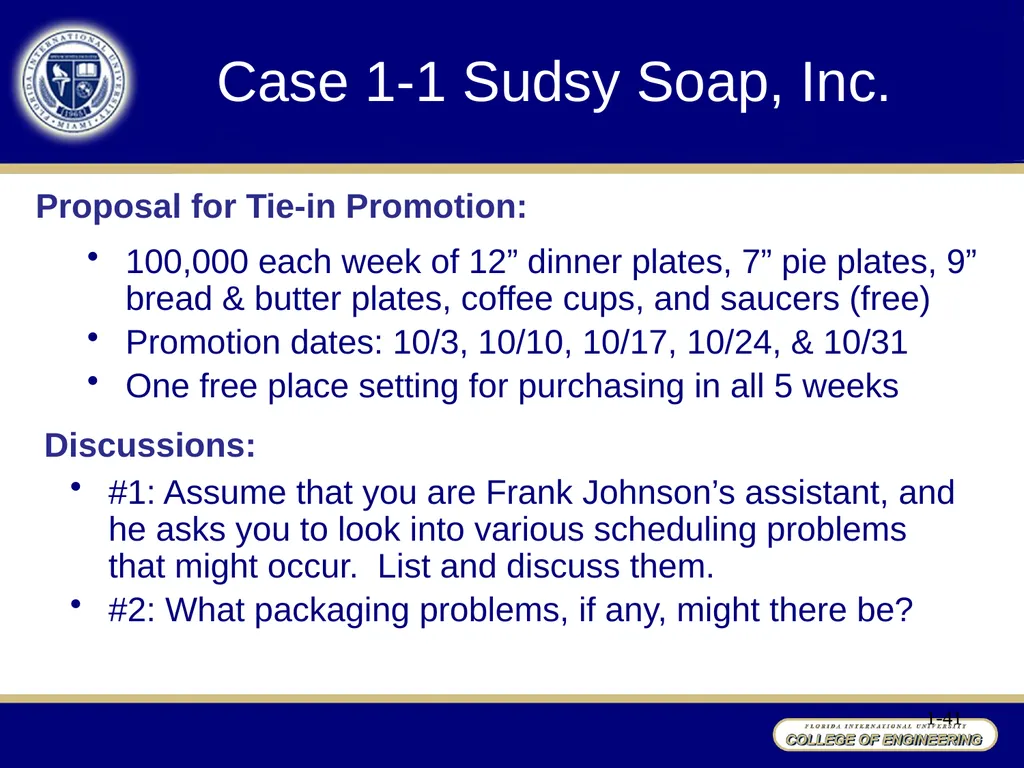
Case 1-1 Sudsy Soap, Inc. 100,000 each week of 12” dinner plates, 7” pie plates, 9” bread & butter plates, coffee cups, and saucers (free)
Promotion dates: 10/3, 10/10, 10/17, 10/24, & 10/31
One free place setting for purchasing in all 5 weeks 1-41 Proposal for Tie-in Promotion: #1: Assume that you are Frank Johnson’s assistant, and he asks you to look into various scheduling problems that might occur. List and discuss them.
#2: What packaging problems, if any, might there be? Discussions:<br>
42
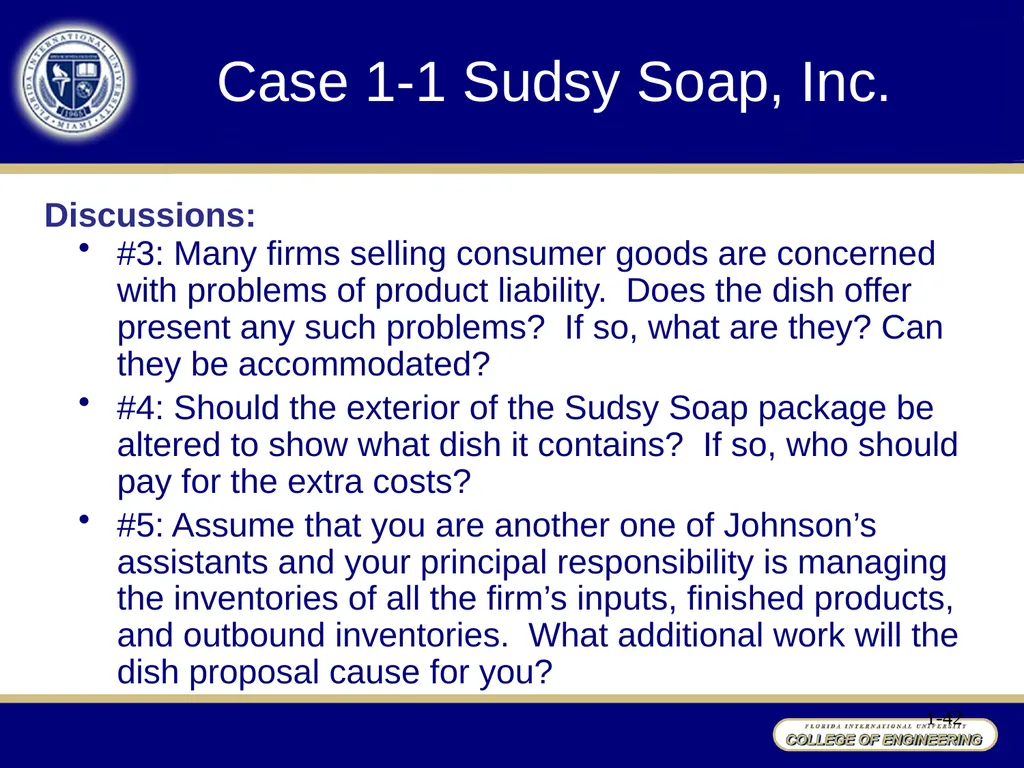
Case 1-1 Sudsy Soap, Inc. 1-42 #3: Many firms selling consumer goods are concerned with problems of product liability. Does the dish offer present any such problems? If so, what are they? Can they be accommodated?
#4: Should the exterior of the Sudsy Soap package be altered to show what dish it contains? If so, who should pay for the extra costs?
#5: Assume that you are another one of Johnson’s assistants and your principal responsibility is managing the inventories of all the firm’s inputs, finished products, and outbound inventories. What additional work will the dish proposal cause for you? Discussions:<br>
43
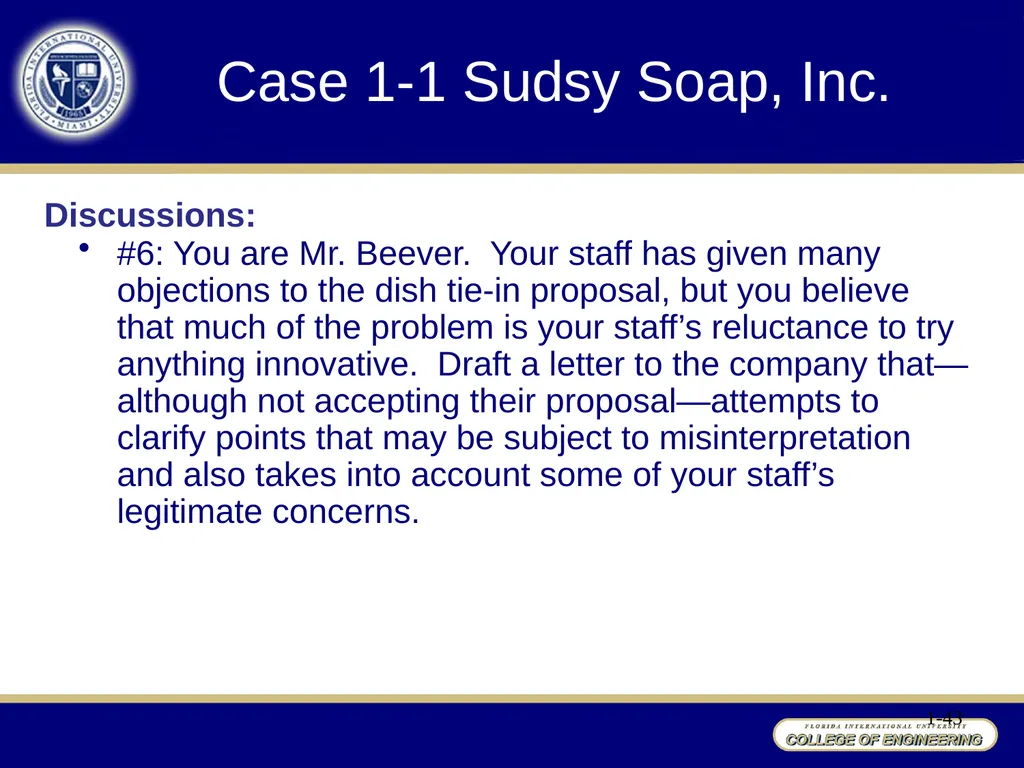
Case 1-1 Sudsy Soap, Inc. 1-43 #6: You are Mr. Beever. Your staff has given many objections to the dish tie-in proposal, but you believe that much of the problem is your staff’s reluctance to try anything innovative. Draft a letter to the company that—although not accepting their proposal—attempts to clarify points that may be subject to misinterpretation and also takes into account some of your staff’s legitimate concerns. Discussions:<br>
44
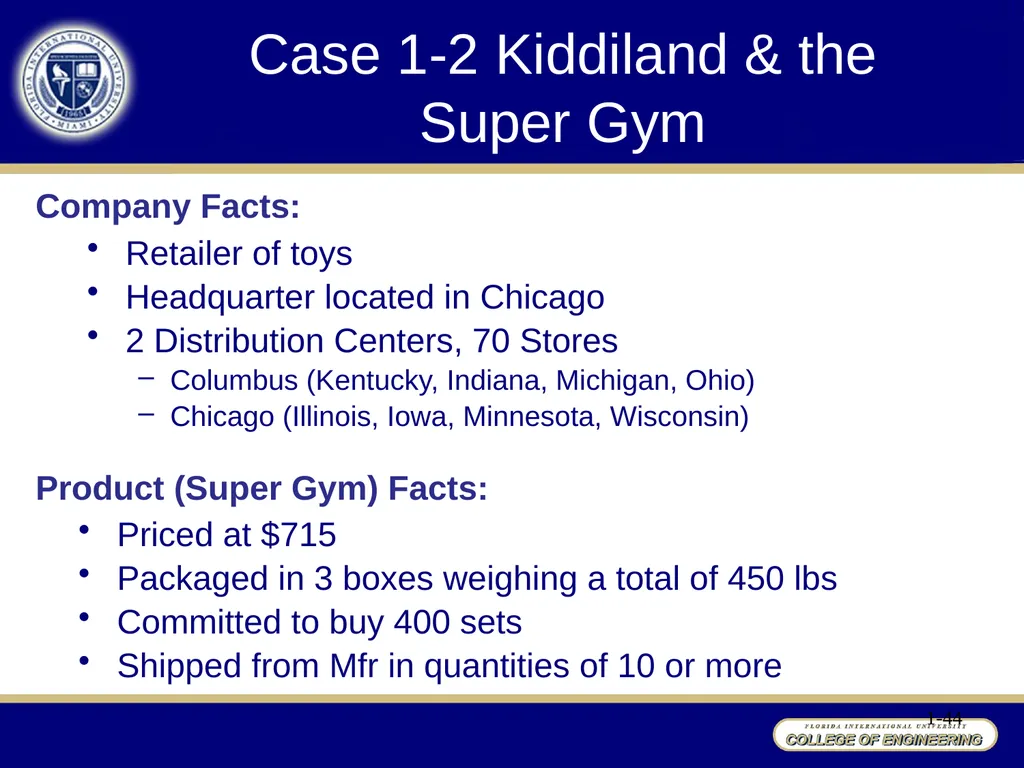
Case 1-2 Kiddiland & the Super Gym Retailer of toys
Headquarter located in Chicago
2 Distribution Centers, 70 Stores
Columbus (Kentucky, Indiana, Michigan, Ohio)
Chicago (Illinois, Iowa, Minnesota, Wisconsin) 1-44 Company Facts: Priced at $715
Packaged in 3 boxes weighing a total of 450 lbs
Committed to buy 400 sets
Shipped from Mfr in quantities of 10 or more Product (Super Gym) Facts:<br>
45
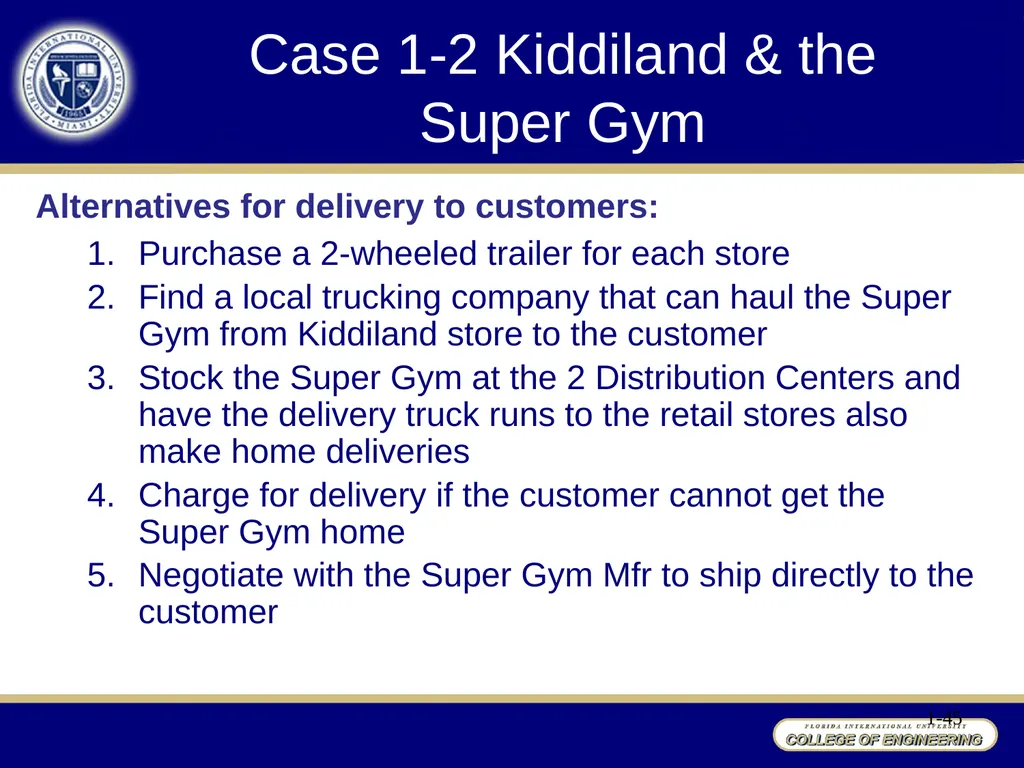
Case 1-2 Kiddiland & the Super Gym Purchase a 2-wheeled trailer for each store
Find a local trucking company that can haul the Super Gym from Kiddiland store to the customer
Stock the Super Gym at the 2 Distribution Centers and have the delivery truck runs to the retail stores also make home deliveries
Charge for delivery if the customer cannot get the Super Gym home
Negotiate with the Super Gym Mfr to ship directly to the customer 1-45 Alternatives for delivery to customers:<br>
46
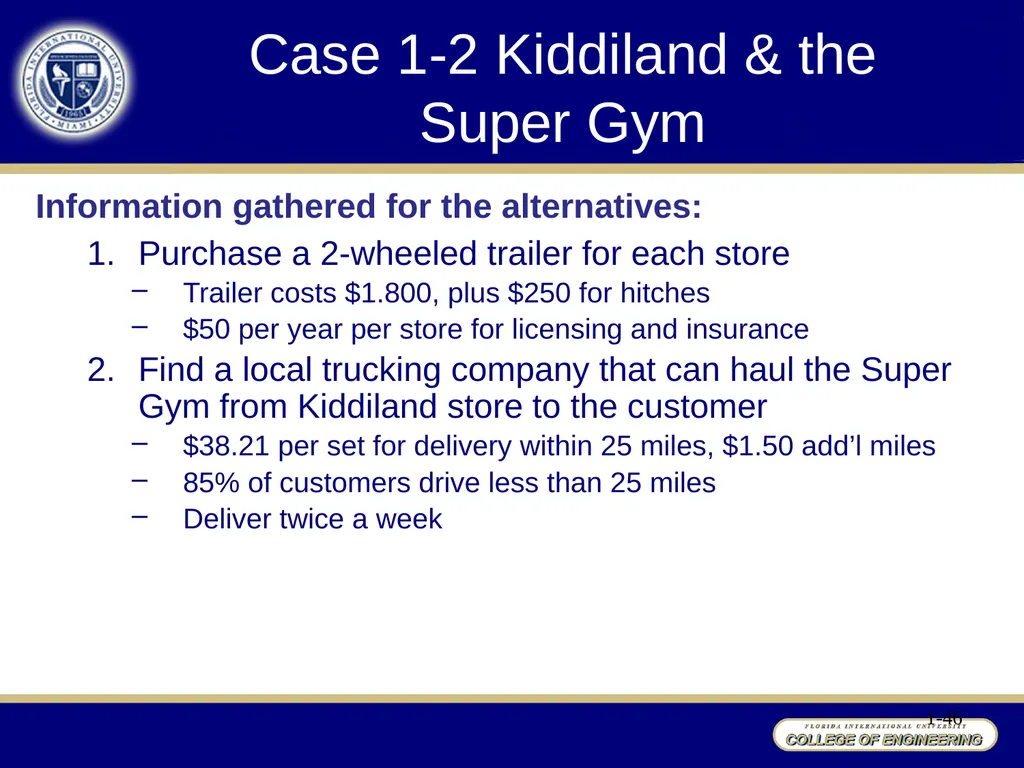
Case 1-2 Kiddiland & the Super Gym Purchase a 2-wheeled trailer for each store
Trailer costs $1.800, plus $250 for hitches
$50 per year per store for licensing and insurance
Find a local trucking company that can haul the Super Gym from Kiddiland store to the customer
$38.21 per set for delivery within 25 miles, $1.50 add’l miles
85% of customers drive less than 25 miles
Deliver twice a week 1-46 Information gathered for the alternatives:<br>
47
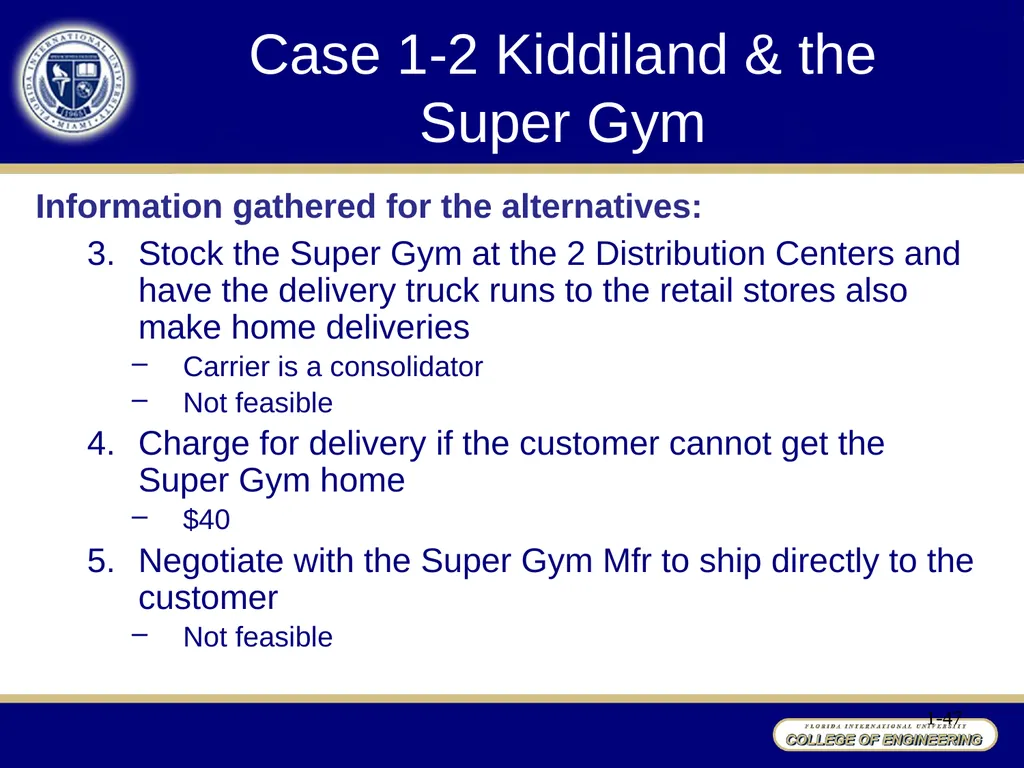
Case 1-2 Kiddiland & the Super Gym Stock the Super Gym at the 2 Distribution Centers and have the delivery truck runs to the retail stores also make home deliveries
Carrier is a consolidator
Not feasible
Charge for delivery if the customer cannot get the Super Gym home
$40
Negotiate with the Super Gym Mfr to ship directly to the customer
Not feasible 1-47 Information gathered for the alternatives:<br>
48
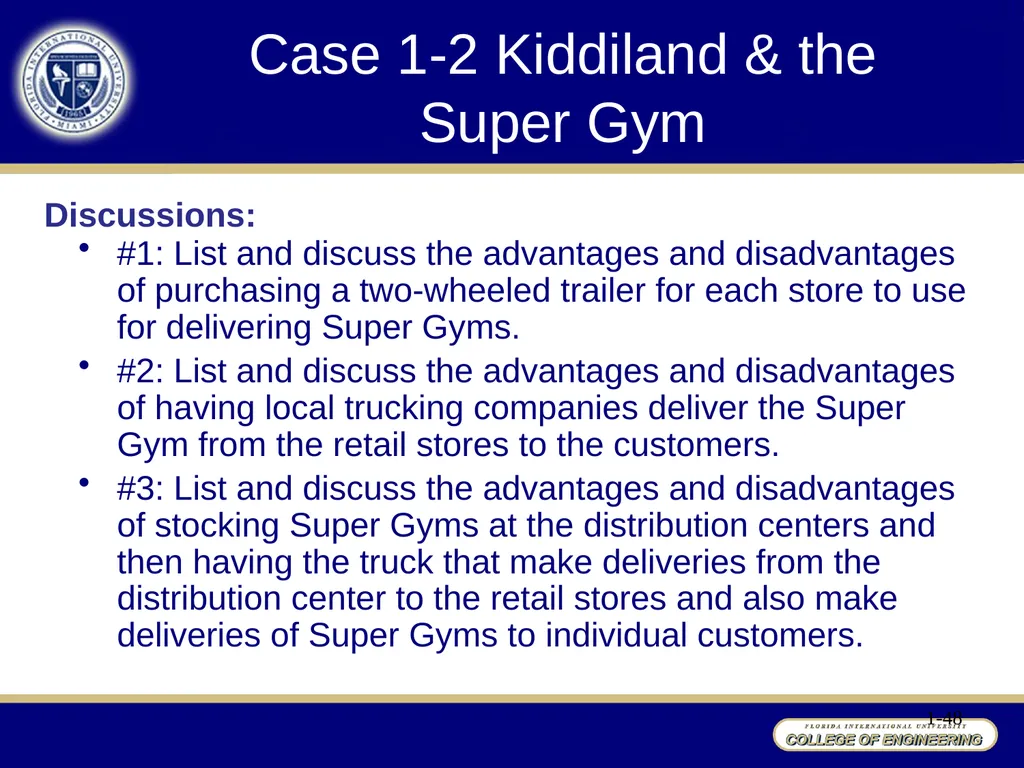
1-48 #1: List and discuss the advantages and disadvantages of purchasing a two-wheeled trailer for each store to use for delivering Super Gyms.
#2: List and discuss the advantages and disadvantages of having local trucking companies deliver the Super Gym from the retail stores to the customers.
#3: List and discuss the advantages and disadvantages of stocking Super Gyms at the distribution centers and then having the truck that make deliveries from the distribution center to the retail stores and also make deliveries of Super Gyms to individual customers. Discussions: Case 1-2 Kiddiland & the Super Gym<br>
49
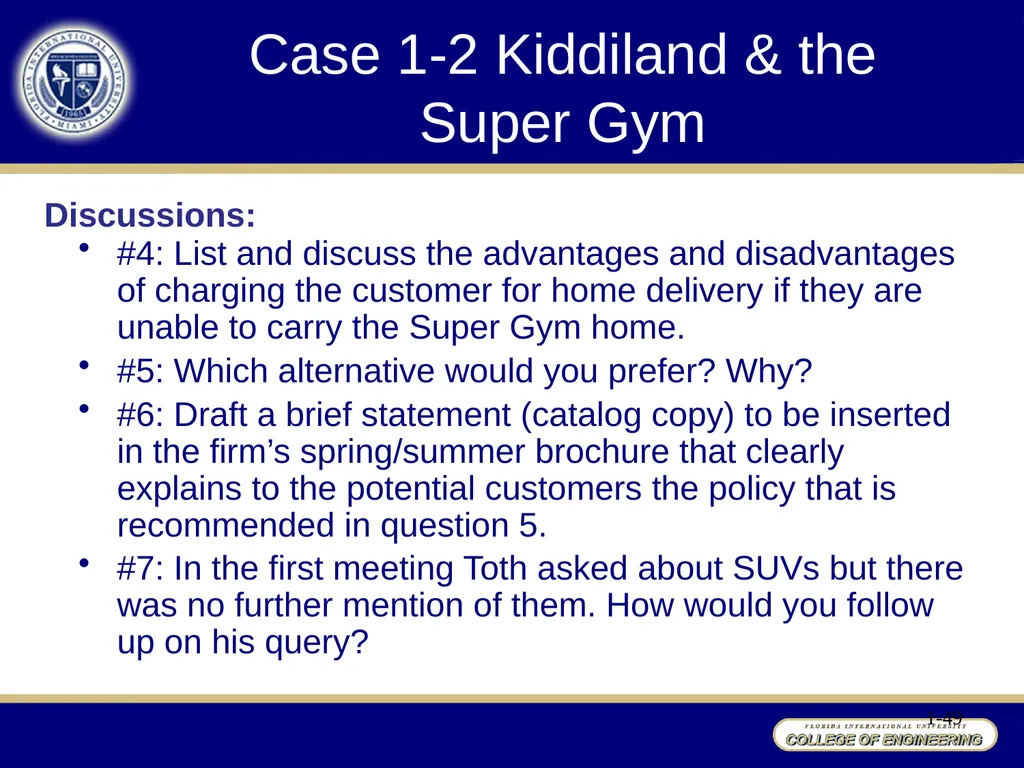
1-49 #4: List and discuss the advantages and disadvantages of charging the customer for home delivery if they are unable to carry the Super Gym home.
#5: Which alternative would you prefer? Why?
#6: Draft a brief statement (catalog copy) to be inserted in the firm’s spring/summer brochure that clearly explains to the potential customers the policy that is recommended in question 5.
#7: In the first meeting Toth asked about SUVs but there was no further mention of them. How would you follow up on his query? Discussions: Case 1-2 Kiddiland & the Super Gym<br>