
Chapter 1 Hazardous Materials: Overview
FD
Published · 62 slides · 0 views
1 / 1

Description
Chapter 1 Hazardous Materials: Overview Objectives: Awareness Level Personnel (1 of 2) Define a hazardous material. (p. 5) Define weapons of mass destruction (WMDs). (p. 5) Identify the location of the emergency response plan andor
Related Topics
Share
Embed code
Download this presentation From Below
"Chapter 1 Hazardous Materials: Overview" is the property of its rightful owner. Permission is granted to download and print the materials on this website for personal, non-commercial use only, and to display it on your personal computer provided you do not modify the materials and that you retain all copyright notices contained in the materials. By downloading content from our website, you accept the terms of this agreement.
Presentation Transcript
01
Chapter 1 Hazardous Materials: Overview<br>
02
Objectives: Awareness Level Personnel (1 of 2) Define a hazardous material. (p. 5)
Define weapons of mass destruction (WMDs). (p. 5)
Identify the location of the emergency response plan and/or standard operating procedures (SOPs). (NFPA 4.4.1(1), p. 5)
Describe the different levels of hazardous materials training: awareness, operations, technician, specialist, and incident commander. (p. 6–11)<br>
Define weapons of mass destruction (WMDs). (p. 5)
Identify the location of the emergency response plan and/or standard operating procedures (SOPs). (NFPA 4.4.1(1), p. 5)
Describe the different levels of hazardous materials training: awareness, operations, technician, specialist, and incident commander. (p. 6–11)<br>
03
Objectives: Awareness Level Personnel (2 of 2) Understand the difference between the standards and federal regulations that govern hazardous material response activities. (p. 6–12)
Explain the difference between hazardous materials incidents and other emergencies. (p. 12)
Explain the need for a planned response to a hazardous materials incident. (p. 13–14)<br>
Explain the difference between hazardous materials incidents and other emergencies. (p. 12)
Explain the need for a planned response to a hazardous materials incident. (p. 13–14)<br>
04
Objectives: Operations Level Responders (1 of 2) Define a hazardous material. (p. 5)
Define weapons of mass destruction (WMDs). (p. 5)
Describe the different levels of hazardous materials training: awareness, operations, technician, specialist, and incident commander. (p. 6–11)<br>
Define weapons of mass destruction (WMDs). (p. 5)
Describe the different levels of hazardous materials training: awareness, operations, technician, specialist, and incident commander. (p. 6–11)<br>
05
Objectives: Operations Level Responders (2 of 2) Understand the difference between the standards and federal regulations that govern hazardous material response activities. (p. 11–12)
Explain the difference between hazardous materials incidents and other emergencies. (p. 12)
Explain the need for a planned response to a hazardous materials incident. (p. 13–14)<br>
Explain the difference between hazardous materials incidents and other emergencies. (p. 12)
Explain the need for a planned response to a hazardous materials incident. (p. 13–14)<br>
06
Responders Fire fighters
Law enforcement personnel
Emergency medical services personnel<br>
Law enforcement personnel
Emergency medical services personnel<br>
07
Incidents Structural fires
Emergency medical calls
Automobile accidents
Confined-space rescues
Water rescues
Acts of terrorism<br>
Emergency medical calls
Automobile accidents
Confined-space rescues
Water rescues
Acts of terrorism<br>
08
Hazardous Materials Involvement Changes nature of incident
Correspondingly changes responder’s mentality<br>
Correspondingly changes responder’s mentality<br>
09
Textbook Goals Recognize hazardous materials/WMD incident.
Take initial actions.
Implement Incident Command System (ICS).
Use basic reference sources.
Select personal protective clothing.
Implement product control measures.
Perform decontamination.
Understand your role in hazardous materials/ WMD response.<br>
Take initial actions.
Implement Incident Command System (ICS).
Use basic reference sources.
Select personal protective clothing.
Implement product control measures.
Perform decontamination.
Understand your role in hazardous materials/ WMD response.<br>
10
Authority Having Jurisdiction Governing body that sets operational policy and procedures for your jurisdiction<br>
11
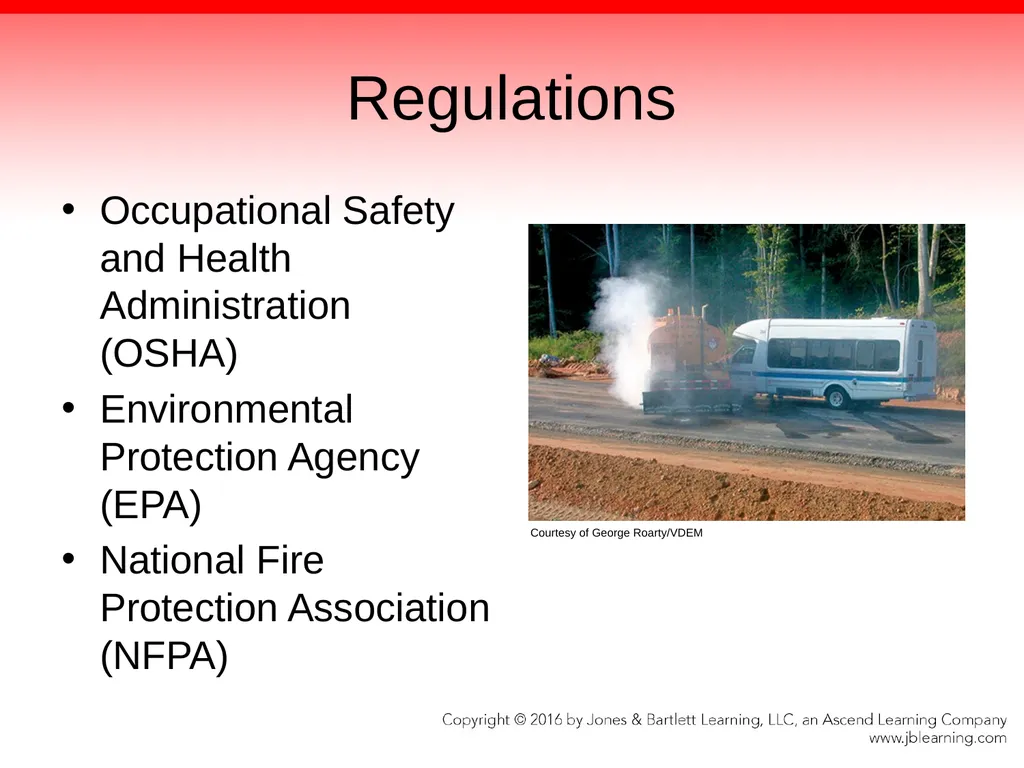
Regulations Occupational Safety and Health Administration (OSHA)
Environmental Protection Agency (EPA)
National Fire Protection Association (NFPA) Courtesy of George Roarty/VDEM<br>
Environmental Protection Agency (EPA)
National Fire Protection Association (NFPA) Courtesy of George Roarty/VDEM<br>
12
Standard Operating Procedures Every responder should know emergency response plans.<br>
13
Hazardous Materials (1 of 2) Definition: substance/material capable of posing unreasonable risk to human health, safety, or the environment when transported, used incorrectly, or not properly contained/stored<br>
14
Hazardous Materials (2 of 2) Includes:
Hazardous substances
Wastes
Marine pollutants
Elevated-temperature materials<br>
Hazardous substances
Wastes
Marine pollutants
Elevated-temperature materials<br>
15
Weapons of Mass Destruction Criminal use of hazardous materials:
Illicit laboratories
Environmental crimes
Industrial sabotage<br>
Illicit laboratories
Environmental crimes
Industrial sabotage<br>
16
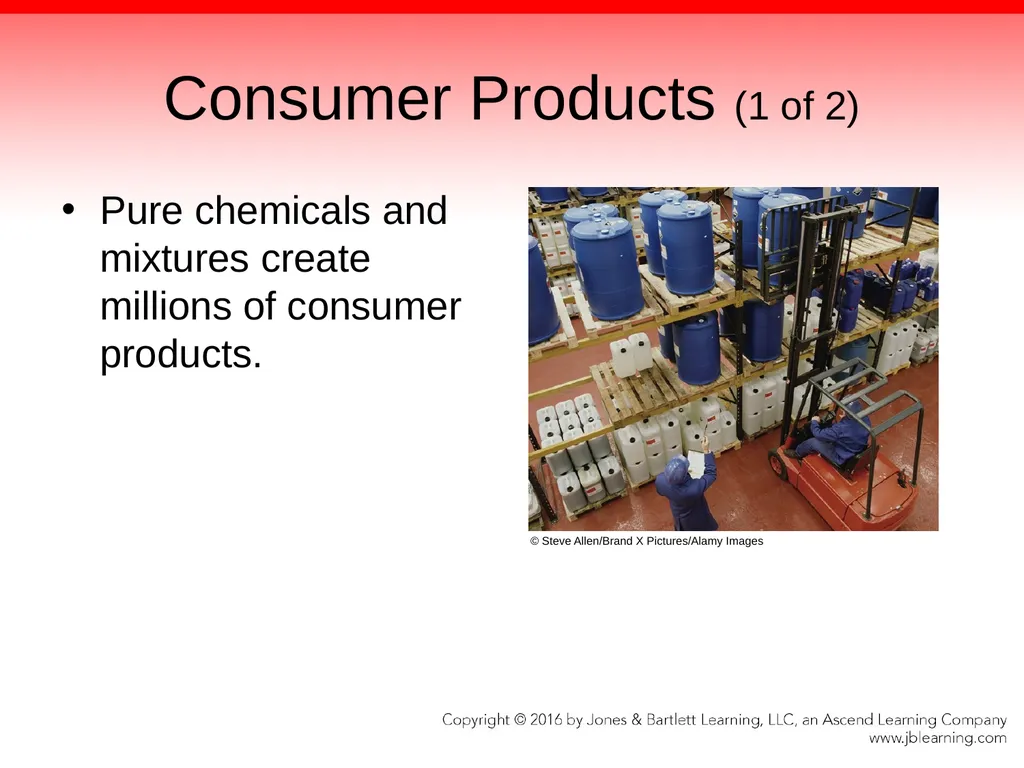
Consumer Products (1 of 2) Pure chemicals and mixtures create millions of consumer products. © Steve Allen/Brand X Pictures/Alamy Images<br>
17
Consumer Products (2 of 2) Chemical Abstracts Service (CAS) produces largest databases on chemical information.
83 million substances registered in the US.<br>
83 million substances registered in the US.<br>
18
Hazardous Waste What remains after a material has been processed and is no longer pure
Can be just as dangerous as pure chemicals
Can comprise mixtures of several chemicals<br>
Can be just as dangerous as pure chemicals
Can comprise mixtures of several chemicals<br>
19
Levels of Training: Regulations and Standards Regulations are issued and enforced by governmental bodies.
Standards may be voluntary.
States that adopt OSHA regulations are state-plan states.
Non-plan states follow Title 40 of the Code of Federal Regulations, Protection of the Environment, Part 311.<br>
Standards may be voluntary.
States that adopt OSHA regulations are state-plan states.
Non-plan states follow Title 40 of the Code of Federal Regulations, Protection of the Environment, Part 311.<br>
20
NFPA Hazardous Materials/WMD Response Standards (1 of 2) NFPA 472, Standard for Competence of Responders to Hazardous Materials/Weapons of Mass Destruction Incidents
NFPA 473, Standard for Competencies for EMS Personnel Responding to Hazardous Materials/Weapons of Mass Destruction Incidents<br>
NFPA 473, Standard for Competencies for EMS Personnel Responding to Hazardous Materials/Weapons of Mass Destruction Incidents<br>
21
NFPA Hazardous Materials/WMD Response Standards (2 of 2) NFPA 473 mission-specific competencies:
ALS Responder Assigned to a Hazardous Materials Team
ALS Responder Assigned to Provide Clinical Interventions at a Hazardous Materials/WMD Incident
ALS Responder Assigned to Treatment of Smoke Inhalation Victims<br>
ALS Responder Assigned to a Hazardous Materials Team
ALS Responder Assigned to Provide Clinical Interventions at a Hazardous Materials/WMD Incident
ALS Responder Assigned to Treatment of Smoke Inhalation Victims<br>
22
OSHA Hazardous Materials/WMD Response Regulations HAZWOPER
HAZardous Waste OPerations and Emergency Response
Training levels:
Awareness
Operations
Technician
Specialist
Incident commander<br>
HAZardous Waste OPerations and Emergency Response
Training levels:
Awareness
Operations
Technician
Specialist
Incident commander<br>
23
Awareness Level Personnel (1 of 3) Different levels of responders and training competencies exist.
Awareness level personnel could encounter an emergency involving hazardous materials/WMD.
Awareness level personnel no longer considered responders.<br>
Awareness level personnel could encounter an emergency involving hazardous materials/WMD.
Awareness level personnel no longer considered responders.<br>
24
Awareness Level Personnel (2 of 3) Examples of awareness level personnel:
Public works employees
Fixed-site security personnel<br>
Public works employees
Fixed-site security personnel<br>
25
Awareness Level Personnel (3 of 3) Awareness level personnel expected on-scene tasks:
Detect presence of hazardous materials/WMD
Identify substance
Use ERG for research
Initiate and implement protective actions
Initiate notification process<br>
Detect presence of hazardous materials/WMD
Identify substance
Use ERG for research
Initiate and implement protective actions
Initiate notification process<br>
26
HAZWOPER Awareness Level HAZWOPER: awareness level “responders”
Knowledge of substances and risks
Potential incident outcomes
Recognize presence of hazardous material
Identify hazardous substances
Role in emergency response plan
Determine need for additional resources and notify communication center<br>
Knowledge of substances and risks
Potential incident outcomes
Recognize presence of hazardous material
Identify hazardous substances
Role in emergency response plan
Determine need for additional resources and notify communication center<br>
27
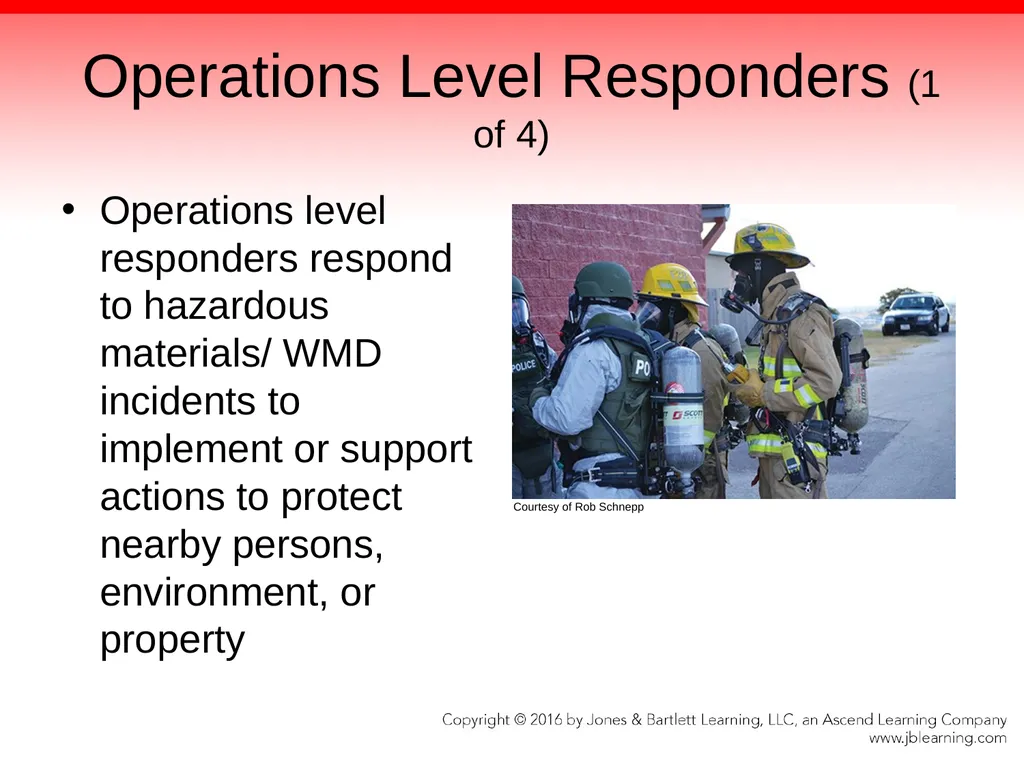
Operations Level Responders (1 of 4) Operations level responders respond to hazardous materials/ WMD incidents to implement or support actions to protect nearby persons, environment, or property Courtesy of Rob Schnepp<br>
28
Operations Level Responders (2 of 4) May be trained in mission-specific competencies
NFPA separates competencies into core and mission-specific.<br>
NFPA separates competencies into core and mission-specific.<br>
29
Operations Level Responders (3 of 4) Core competencies:
Determine scope of emergency
Survey scene
Collect information
Predict likely behavior of hazardous material<br>
Determine scope of emergency
Survey scene
Collect information
Predict likely behavior of hazardous material<br>
30
Operations Level Responders (4 of 4) Core competencies (cont’d):
Estimate potential harm
Plan a response
Perform decontamination
Preserve evidence
Evaluate response effectiveness<br>
Estimate potential harm
Plan a response
Perform decontamination
Preserve evidence
Evaluate response effectiveness<br>
31
Competencies Covered (1 of 2) Personal protective equipment
Technical decontamination
Mass decontamination
Evidence preservation and sampling<br>
Technical decontamination
Mass decontamination
Evidence preservation and sampling<br>
32
Competencies Covered (2 of 2) Product control
Victim rescue and recovery operations
Illicit laboratory incidents
Air monitoring and sampling<br>
Victim rescue and recovery operations
Illicit laboratory incidents
Air monitoring and sampling<br>
33
OSHA HAZWOPER Operations Level Responders (1 of 2) Work to contain a hazardous materials release and protect nearby persons or property
Competencies include:
Hazard and risk assessment techniques
Personal protective equipment
Hazardous materials terms<br>
Competencies include:
Hazard and risk assessment techniques
Personal protective equipment
Hazardous materials terms<br>
34
OSHA HAZWOPER Operations Level Responders (2 of 2) Competencies (cont’d):
Control, containment, and confinement knowledge
Decontamination procedures
Standard operating procedures and termination process<br>
Control, containment, and confinement knowledge
Decontamination procedures
Standard operating procedures and termination process<br>
35
NFPA 472 Technician Level (1 of 2) Responds to hazardous materials/WMD incidents using risk-based response processes
Hazardous materials technicians can:
Analyze the problem
Select decontamination procedures
Control a release<br>
Hazardous materials technicians can:
Analyze the problem
Select decontamination procedures
Control a release<br>
36
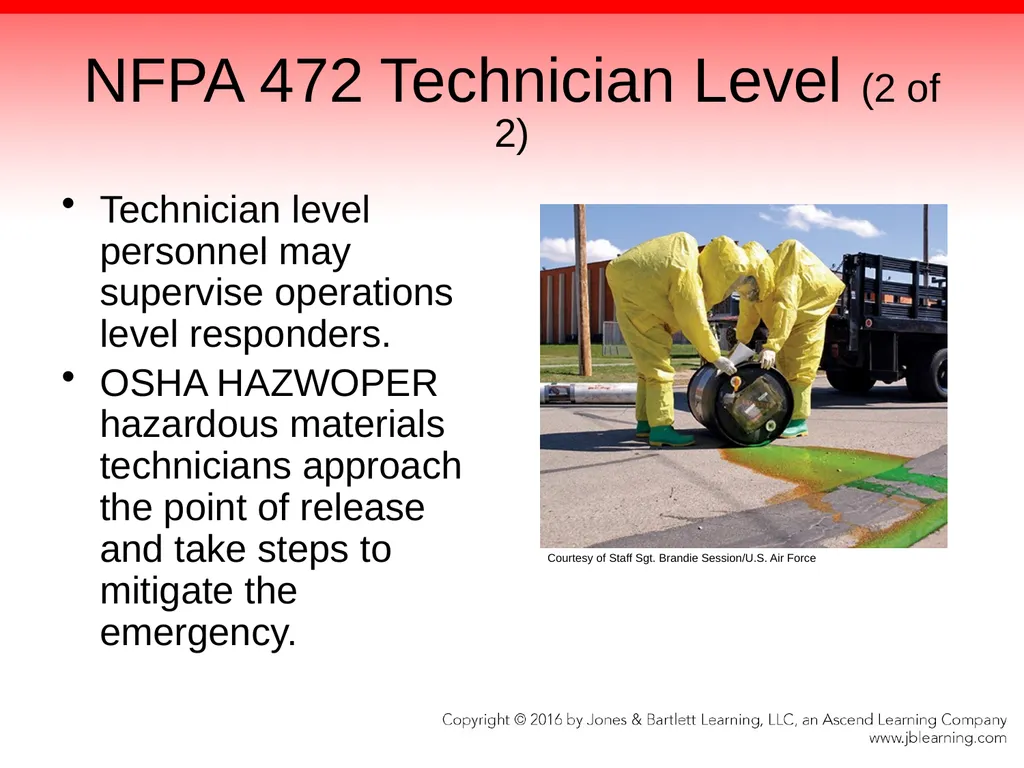
NFPA 472 Technician Level (2 of 2) Technician level personnel may supervise operations level responders.
OSHA HAZWOPER hazardous materials technicians approach the point of release and take steps to mitigate the emergency. Courtesy of Staff Sgt. Brandie Session/U.S. Air Force<br>
OSHA HAZWOPER hazardous materials technicians approach the point of release and take steps to mitigate the emergency. Courtesy of Staff Sgt. Brandie Session/U.S. Air Force<br>
37
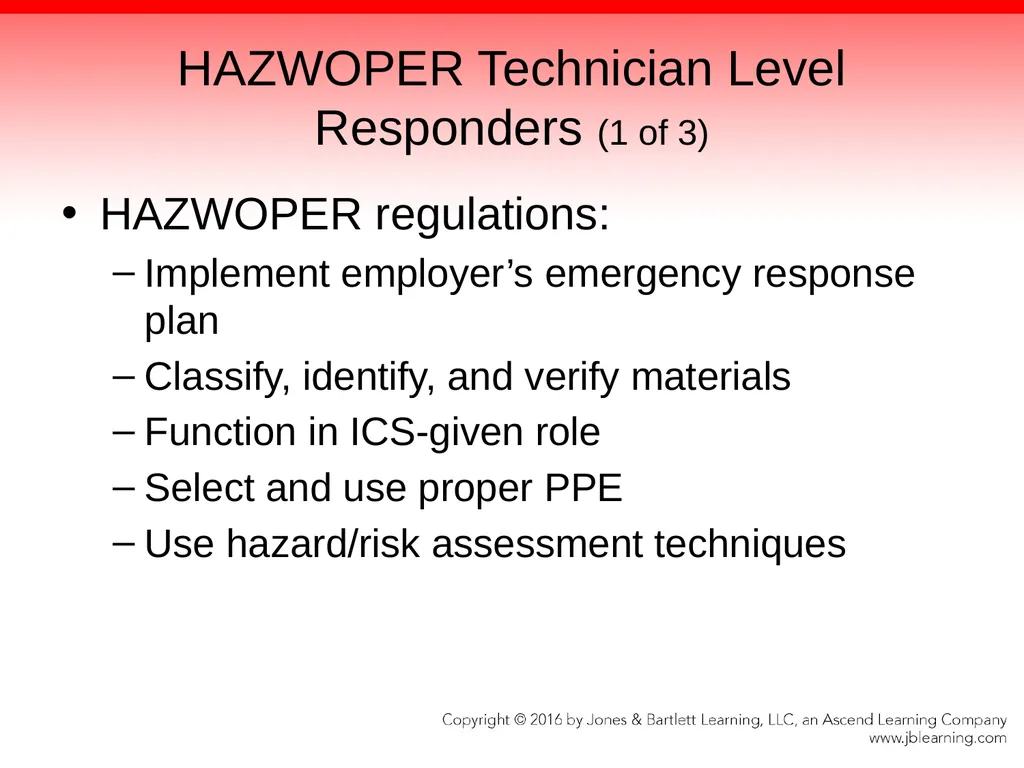
HAZWOPER Technician Level Responders (1 of 3) HAZWOPER regulations:
Implement employer’s emergency response plan
Classify, identify, and verify materials
Function in ICS-given role
Select and use proper PPE
Use hazard/risk assessment techniques<br>
Implement employer’s emergency response plan
Classify, identify, and verify materials
Function in ICS-given role
Select and use proper PPE
Use hazard/risk assessment techniques<br>
38
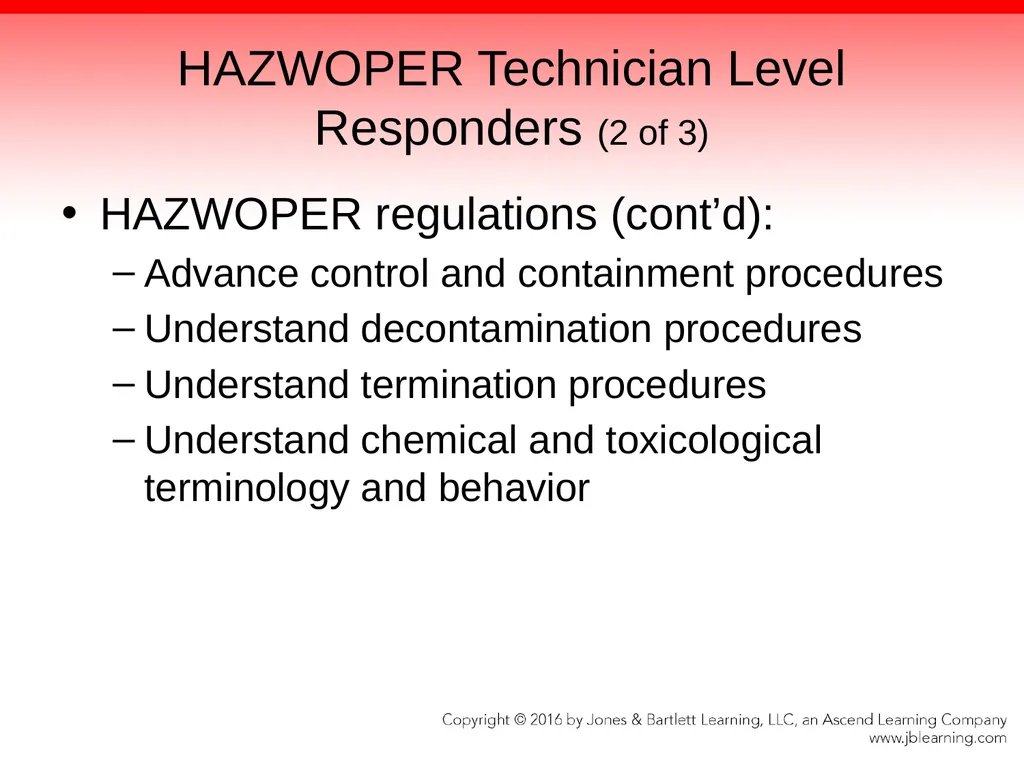
HAZWOPER Technician Level Responders (2 of 3) HAZWOPER regulations (cont’d):
Advance control and containment procedures
Understand decontamination procedures
Understand termination procedures
Understand chemical and toxicological terminology and behavior<br>
Advance control and containment procedures
Understand decontamination procedures
Understand termination procedures
Understand chemical and toxicological terminology and behavior<br>
39
HAZWOPER Technician Level Responders (3 of 3) Specialist level of hazardous materials technicians receives more specialized training than a hazardous materials technician
Identified only in OSHA HAZWOPER<br>
Identified only in OSHA HAZWOPER<br>
40
Incident Commander (1 of 2) Definition: responsible for all incident activities, and the ordering and release of resources
HAZWOPER regulations:
Employer’s ICS
Employer’s emergency response plan<br>
HAZWOPER regulations:
Employer’s ICS
Employer’s emergency response plan<br>
41
Incident Commander (2 of 2) HAZWOPER regulations (cont’d):
Chemical protective clothing
Local emergency response plan
Emergency response plan for state and Federal Regional Response Team
Decontamination procedures
Annual refresher training<br>
Chemical protective clothing
Local emergency response plan
Emergency response plan for state and Federal Regional Response Team
Decontamination procedures
Annual refresher training<br>
42
Governmental Agencies Department of Transportation (DOT)
Promulgates/publishes laws and regulations governing transportation of goods by highway, rail, pipeline, air, marine transport<br>
Promulgates/publishes laws and regulations governing transportation of goods by highway, rail, pipeline, air, marine transport<br>
43
Environmental Protection Agency EPA: Superfund Amendments and Reauthorization Act of 1986
Created standard practice for local community to understand chemical hazards<br>
Created standard practice for local community to understand chemical hazards<br>
44
Emergency Planning and Community Right to Know Act Title III: Emergency Planning and Community Right to Know Act (EPCRA)
Businesses report storage type, quantity, and methods to fire department and local emergency planning committee.<br>
Businesses report storage type, quantity, and methods to fire department and local emergency planning committee.<br>
45
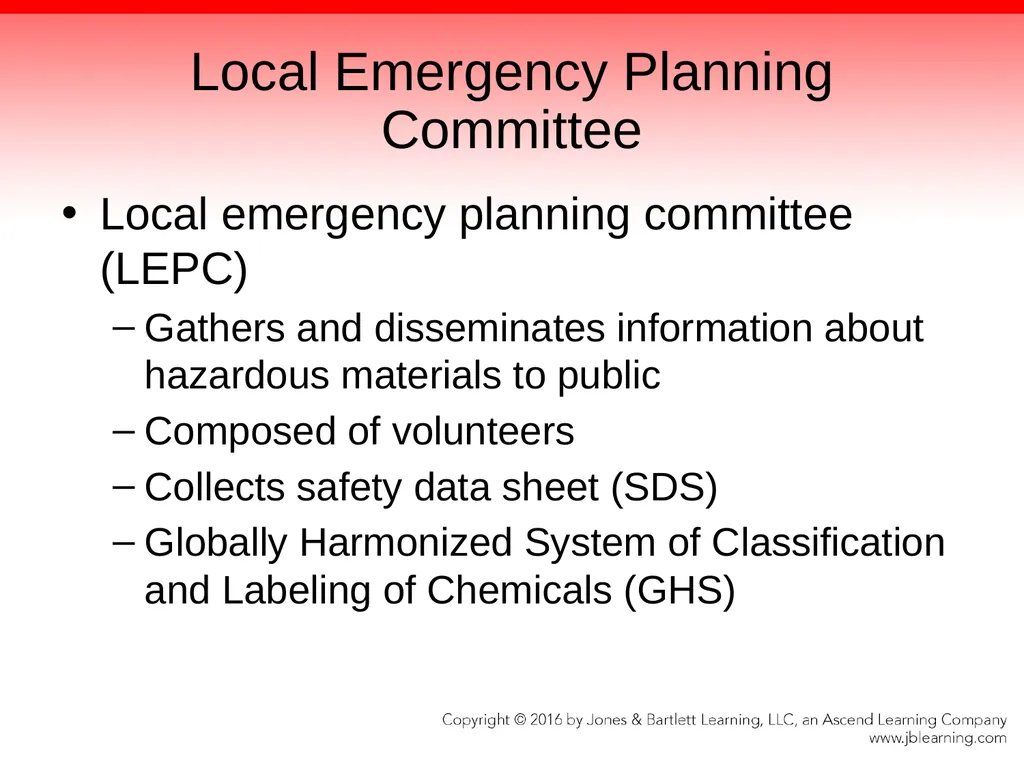
Local Emergency Planning Committee Local emergency planning committee (LEPC)
Gathers and disseminates information about hazardous materials to public
Composed of volunteers
Collects safety data sheet (SDS)
Globally Harmonized System of Classification and Labeling of Chemicals (GHS)<br>
Gathers and disseminates information about hazardous materials to public
Composed of volunteers
Collects safety data sheet (SDS)
Globally Harmonized System of Classification and Labeling of Chemicals (GHS)<br>
46
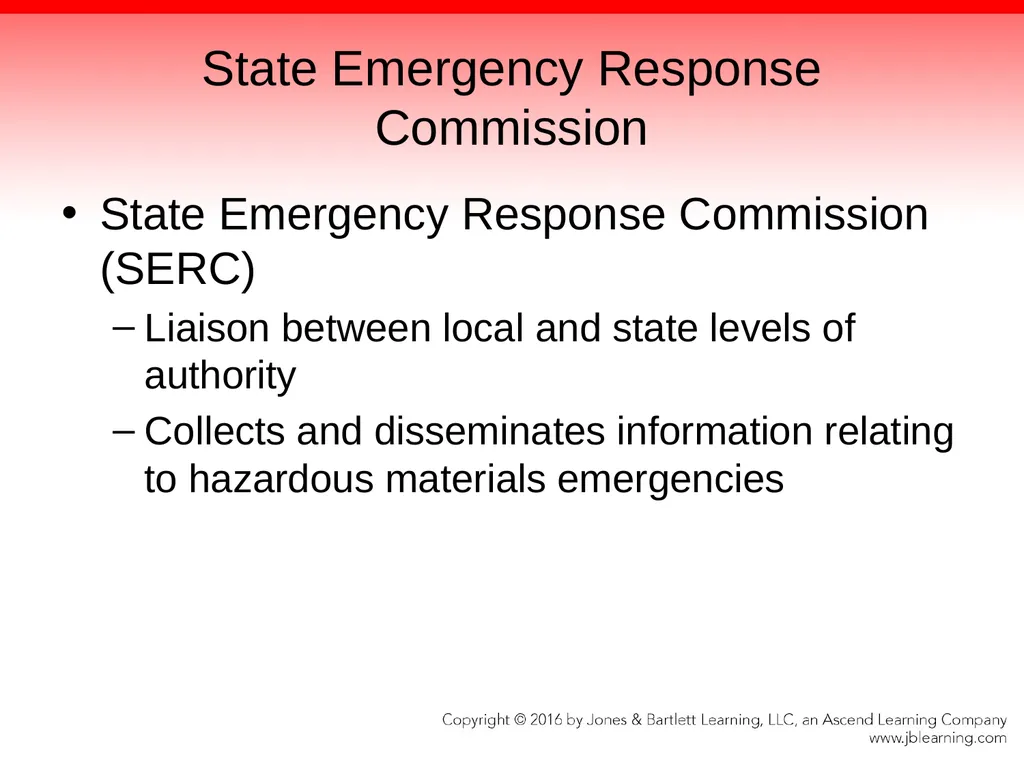
State Emergency Response Commission State Emergency Response Commission (SERC)
Liaison between local and state levels of authority
Collects and disseminates information relating to hazardous materials emergencies<br>
Liaison between local and state levels of authority
Collects and disseminates information relating to hazardous materials emergencies<br>
47
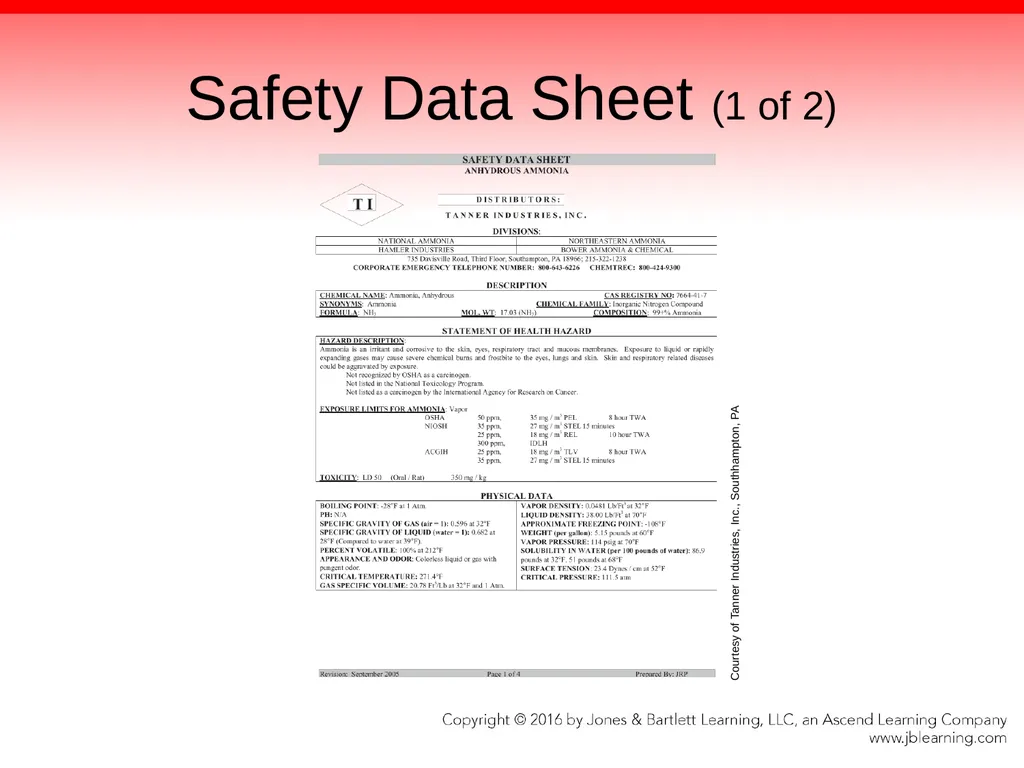
Safety Data Sheet (1 of 2) Courtesy of Tanner Industries, Inc., Southhampton, PA<br>
48
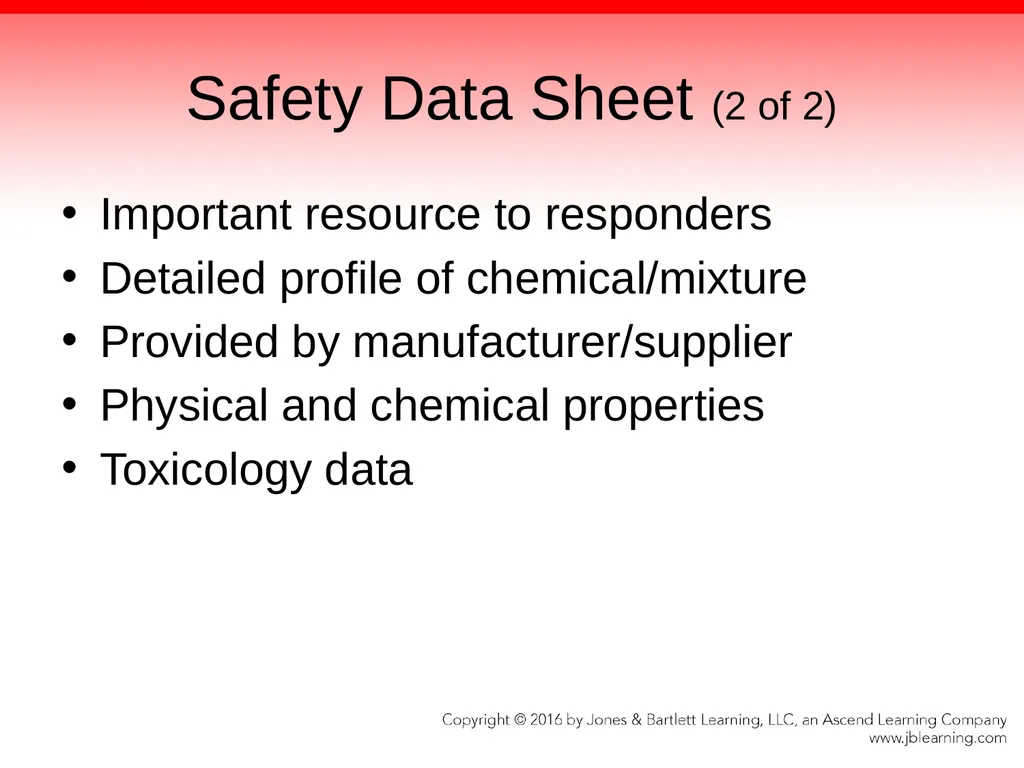
Safety Data Sheet (2 of 2) Important resource to responders
Detailed profile of chemical/mixture
Provided by manufacturer/supplier
Physical and chemical properties
Toxicology data<br>
Detailed profile of chemical/mixture
Provided by manufacturer/supplier
Physical and chemical properties
Toxicology data<br>
49
Approach to Incident Do not approach hazardous materials/WMD incident with same mindset used in structural firefighting
Response to hazardous materials/WMD emergency takes more time than to fight a structure fire<br>
Response to hazardous materials/WMD emergency takes more time than to fight a structure fire<br>
50
Response to Incident If situation is imminently dangerous, events may move quickly.
Environment and materials involved dictate response tactics and strategy.<br>
Environment and materials involved dictate response tactics and strategy.<br>
51
Law Enforcement Be aware of the law enforcement aspect of the incident.
Evidentiary issues
Criminal capture and prosecution<br>
Evidentiary issues
Criminal capture and prosecution<br>
52
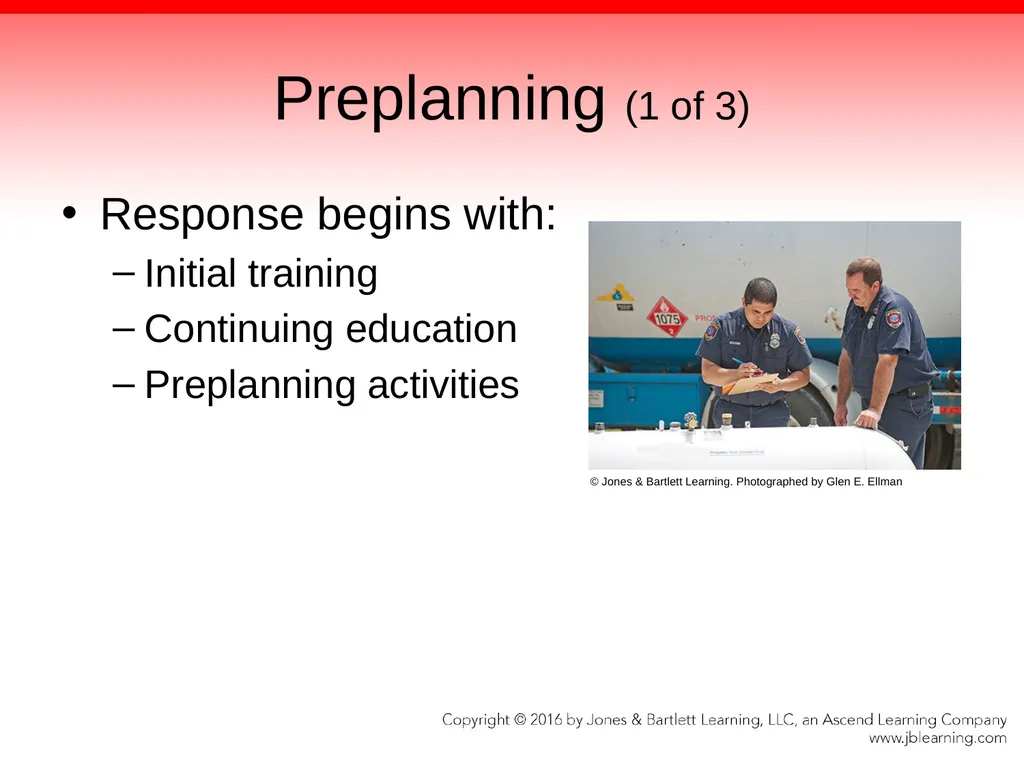
Preplanning (1 of 3) Response begins with:
Initial training
Continuing education
Preplanning activities © Jones & Bartlett Learning. Photographed by Glen E. Ellman<br>
Initial training
Continuing education
Preplanning activities © Jones & Bartlett Learning. Photographed by Glen E. Ellman<br>
53
Preplanning (2 of 3) Preplanning activities take place at target hazards.
Discuss/share information with LEPC.<br>
Discuss/share information with LEPC.<br>
54
Preplanning (3 of 3) Fire departments, police agencies, public health offices, and other governmental agencies have the opportunity to work together in case of a large-scale emergency.<br>
55
Summary (1 of 8) Governmental entities such as OSHA and the EPA issue and enforce regulations concerning hazardous materials emergencies.
The consensus-based NFPA standards relating to hazardous materials/WMD incidents are available for those agencies that choose to adopt them.<br>
The consensus-based NFPA standards relating to hazardous materials/WMD incidents are available for those agencies that choose to adopt them.<br>
56
Summary (2 of 8) A hazardous material is any substance or material that is capable of posing an unreasonable risk to human health, safety, or the environment when transported in commerce, used incorrectly, or not properly contained or stored.
The actions taken at hazardous materials/WMD incidents are largely dictated by the chemicals involved and the way they behave during the release.<br>
The actions taken at hazardous materials/WMD incidents are largely dictated by the chemicals involved and the way they behave during the release.<br>
57
Summary (3 of 8) Two NFPA standards are important to responders who may be called upon to respond to hazardous materials/WMD incidents:
NFPA 472, Standard for Competence of Responders to Hazardous Materials/Weapons of Mass Destruction Incidents
NFPA 473, Standard for Competencies for EMS Personnel Responding to Hazardous Materials/Weapons of Mass Destruction Incidents<br>
NFPA 472, Standard for Competence of Responders to Hazardous Materials/Weapons of Mass Destruction Incidents
NFPA 473, Standard for Competencies for EMS Personnel Responding to Hazardous Materials/Weapons of Mass Destruction Incidents<br>
58
Summary (4 of 8) The OSHA HAZWOPER regulation is found in the CFR, Title 29, Standard 1910.120(q).
The EPA’s version of OSHA’s HAZWOPER can be found in the CFR, Title 40, Protection of the Environment, Part 311: Worker Protection.<br>
The EPA’s version of OSHA’s HAZWOPER can be found in the CFR, Title 40, Protection of the Environment, Part 311: Worker Protection.<br>
59
Summary (5 of 8) The goals associated with the competencies of awareness level personnel are to recognize a potential hazardous materials emergency, to isolate the area, and to call for assistance. Awareness level personnel take protective actions only.
NFPA 472 expands the scope of an operations level responder’s duties by making a distinction between core competencies and mission-specific competencies.<br>
NFPA 472 expands the scope of an operations level responder’s duties by making a distinction between core competencies and mission-specific competencies.<br>
60
Summary (6 of 8) For those who choose to adopt the NFPA 472 standard, the core competencies are required for all operations level responders; each agency can then pick and choose to require any or all of the mission-specific responsibilities. The core competencies of operations level responders are defensive actions.<br>
61
Summary (7 of 8) The mission-specific responsibilities of operations level responders include personal protective equipment, technical and mass decontamination, evidence preservation, product control, basic air monitoring, victim rescue, incidents occurring at illicit laboratories, and operations level responders assigned to perform improvised WMD dispersal device disablement/disruption and operations at improvised explosive laboratories.<br>
62
Summary (8 of 8) Hazardous materials technicians will approach the point of release so as to plug, patch, or otherwise mitigate a hazardous materials emergency.
The hazardous materials incident commander is responsible for all incident activities.<br>
The hazardous materials incident commander is responsible for all incident activities.<br>