
Chapter 1: Introduction and Overview of Critical
LO
Published · 44 slides · 0 views

1 / 1



Description
Chapter 1: Introduction and Overview of Critical Care Transport Trends in Patient Transportation Recent changes in health care have dramatically affected patient transportation Payers and providers refer patients with urgent conditions to
Related Topics
Share
Embed code
Download this presentation From Below
"Chapter 1: Introduction and Overview of Critical" is the property of its rightful owner. Permission is granted to download and print the materials on this website for personal, non-commercial use only, and to display it on your personal computer provided you do not modify the materials and that you retain all copyright notices contained in the materials. By downloading content from our website, you accept the terms of this agreement.
Presentation Transcript
01
Chapter 1:
Introduction and Overview of Critical Care Transport<br>
Introduction and Overview of Critical Care Transport<br>
02
Trends in Patient Transportation Recent changes in health care have dramatically affected patient transportation
Payers and providers refer patients with urgent conditions to alternative destinations
Clinics, freestanding emergency centers, home, telemedicine, specialty centers<br>
Payers and providers refer patients with urgent conditions to alternative destinations
Clinics, freestanding emergency centers, home, telemedicine, specialty centers<br>
03
Critical Care Transport Field Critical care transport (CCT) field is growing exponentially and is increasingly complex
Transports once managed by physicians and nurses now rely on emergency medical technicians (EMTs) and paramedics
Need for specialized and additional education to bridge gap to level of critical care transport professional (CCTP)<br>
Transports once managed by physicians and nurses now rely on emergency medical technicians (EMTs) and paramedics
Need for specialized and additional education to bridge gap to level of critical care transport professional (CCTP)<br>
04
Interfacility Transport vs Specialty Care Transport Interfacility transport
Transport of a patient between two health care facilities
Specialty care transport (SCT)
Interfacility ground transport of a critically ill or injured patient, including medical supplies and services that are beyond the scope of practice of a paramedic<br>
Transport of a patient between two health care facilities
Specialty care transport (SCT)
Interfacility ground transport of a critically ill or injured patient, including medical supplies and services that are beyond the scope of practice of a paramedic<br>
05
Specialty Care Transport Necessary when a patient’s condition necessitates ongoing care from health care providers in areas such as:
Emergency or critical care nursing
Emergency medicine
Respiratory care
Cardiovascular care<br>
Emergency or critical care nursing
Emergency medicine
Respiratory care
Cardiovascular care<br>
06
Critical Care Team Composition and Qualifications (1 of 2) Crew configurations vary
Most common
EMTs
Registered nurses (RNs)
Respiratory therapists
Additional crew members may be required
Perfusionists, surgeons, neonatologists, pediatric intensivists<br>
Most common
EMTs
Registered nurses (RNs)
Respiratory therapists
Additional crew members may be required
Perfusionists, surgeons, neonatologists, pediatric intensivists<br>
07
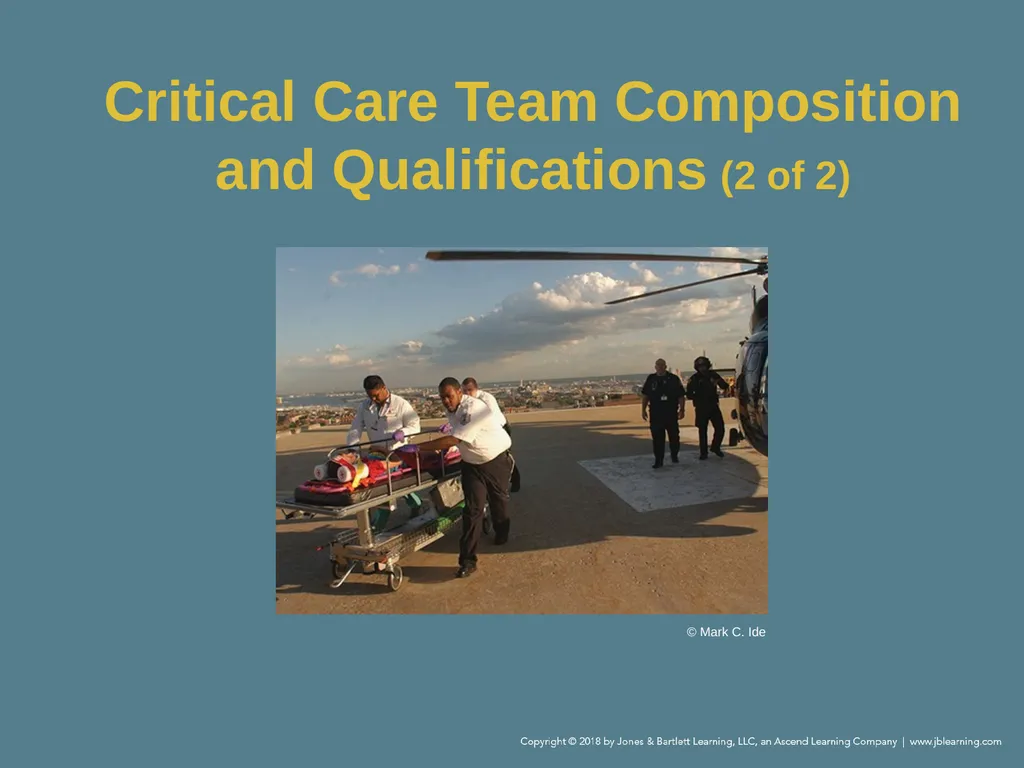
© Mark C. Ide Critical Care Team Composition and Qualifications (2 of 2)<br>
08
CCTP Educational Qualifications Able to provide care at same or greater level than non-CCT counterparts
Educated and skilled in use of advanced practice procedures<br>
Educated and skilled in use of advanced practice procedures<br>
09
CCTP Advanced Practice Procedures (1 of 2) Surgical airways
Management of chest tubes
Blood product administration
Pericardiocentesis
Escharotomies
Intracranial pressure monitoring
Intra-aortic balloon pump therapy<br>
Management of chest tubes
Blood product administration
Pericardiocentesis
Escharotomies
Intracranial pressure monitoring
Intra-aortic balloon pump therapy<br>
10
CCTP Advanced Practice Procedures (2 of 2) Central line management
Invasive arterial and cardiac pressure monitoring
Lab test results/diagnostic imaging
Use/troubleshooting of ventilators and portable ultrasound
Variety of catheters, tubes, drains<br>
Invasive arterial and cardiac pressure monitoring
Lab test results/diagnostic imaging
Use/troubleshooting of ventilators and portable ultrasound
Variety of catheters, tubes, drains<br>
11
Continuing Education Most CCT programs require CCTPs to complete frequent continuing professional education classes.
Usually exceed requirements to maintain state or national certification and/or licensure necessary for employment
Mandatory trainings held each year<br>
Usually exceed requirements to maintain state or national certification and/or licensure necessary for employment
Mandatory trainings held each year<br>
12
CCTP Team Members EMTs
Paramedics
RNs
Respiratory therapists
Perfusionists
Physicians<br>
Paramedics
RNs
Respiratory therapists
Perfusionists
Physicians<br>
13
Several Factors Determine Transportation Mode Patient acuity
Distance between sending and receiving facilities
Ability of the transport service to respond
Weather conditions
Regional topography<br>
Distance between sending and receiving facilities
Ability of the transport service to respond
Weather conditions
Regional topography<br>
14
Three Standard Types of Mobile Intensive Care Units (1 of 3) Mobile (ground) units or ambulances
Used to transport patients for distances of 50 miles or greater when transport is not time critical
Used if patient has contraindications for air transport
Rotary-wing aircraft or helicopters
Used to transport patients in rural settings, can travel distances of up to 150 miles
Able to load patients from side or rear<br>
15
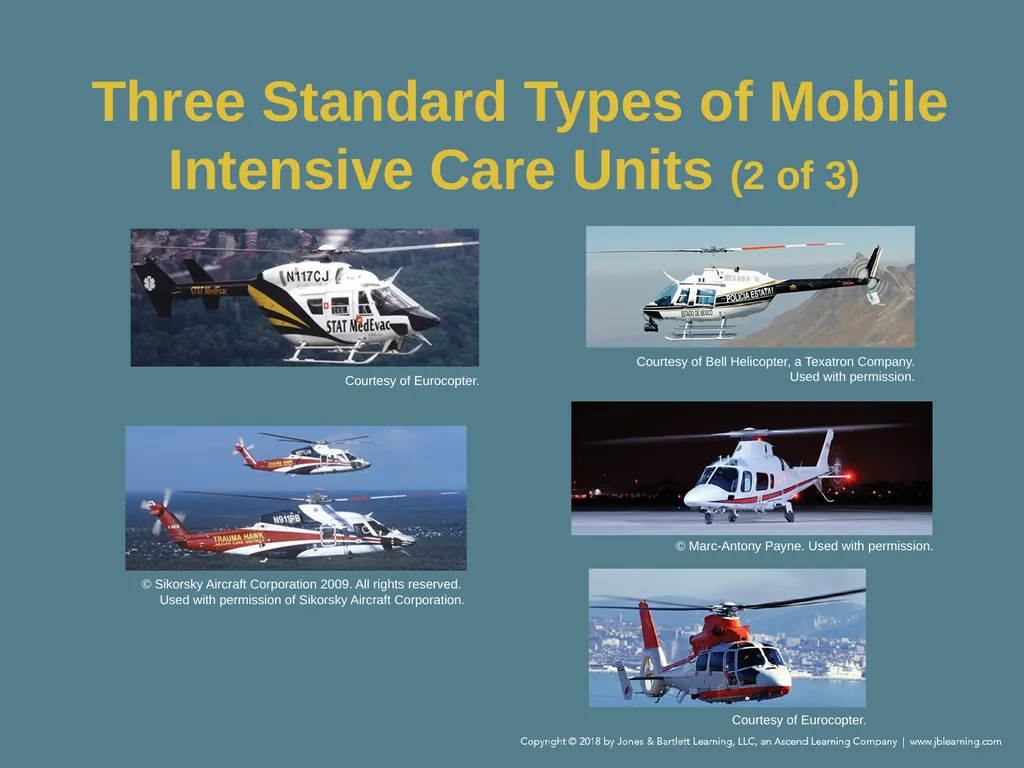
Courtesy of Eurocopter. Courtesy of Bell Helicopter, a Texatron Company.
Used with permission. © Sikorsky Aircraft Corporation 2009. All rights reserved.
Used with permission of Sikorsky Aircraft Corporation. © Marc-Antony Payne. Used with permission. Courtesy of Eurocopter. Three Standard Types of Mobile Intensive Care Units (2 of 3)<br>
16
Fixed-wing aircraft or planes
Used to transport patients a distance of 150 miles or more
Used in combination with mobile critical care units Three Standard Types of Mobile Intensive Care Units (3 of 3)<br>
Used to transport patients a distance of 150 miles or more
Used in combination with mobile critical care units Three Standard Types of Mobile Intensive Care Units (3 of 3)<br>
17
Dispatch Call taker initiates triage process and completes form about patient based on referring facility information.
Clinical supervisor helps decide crew configuration, mode of transportation.
Type of call dictates use of CCT team.<br>
Clinical supervisor helps decide crew configuration, mode of transportation.
Type of call dictates use of CCT team.<br>
18
Situations Requiring CCT Team Mechanical ventilation
Vascular access devices
Vasoactive medications
Blood or blood product infusions
Cardiac-assist devices
Instability requiring frequent interventions<br>
Vascular access devices
Vasoactive medications
Blood or blood product infusions
Cardiac-assist devices
Instability requiring frequent interventions<br>
19
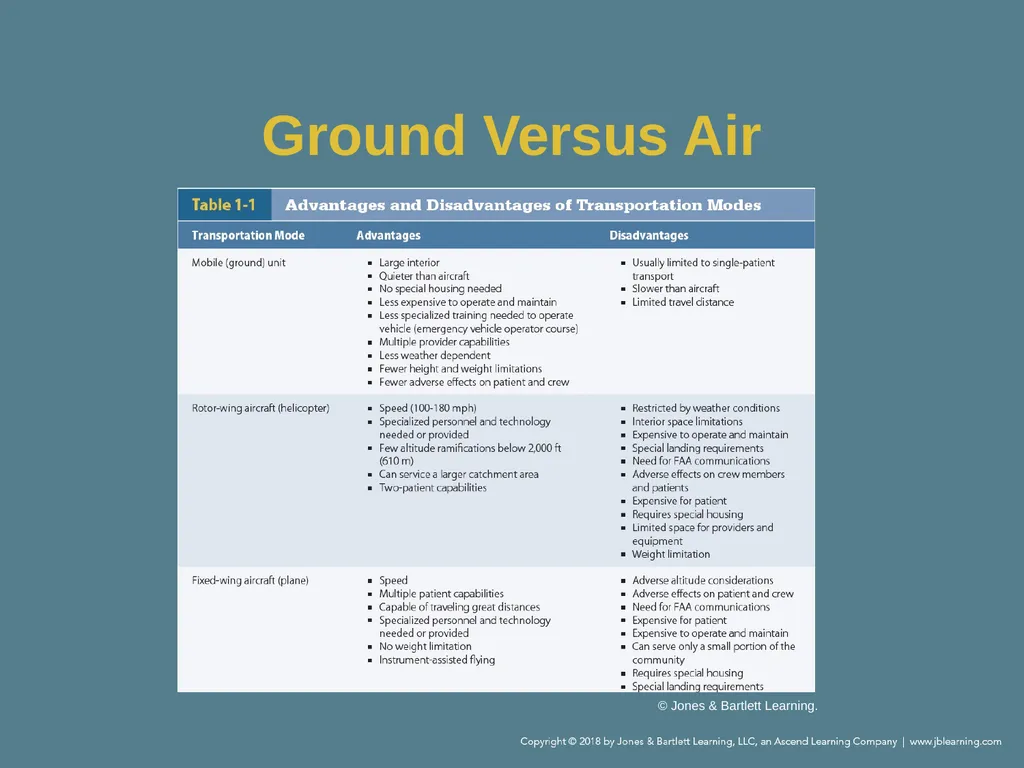
Ground Versus Air © Jones & Bartlett Learning.<br>
20
Time-Sensitive Patient Conditions Acute myocardial infarction
Acute cerebrovascular accident
Severe traumatic injury
Acute intracranial hemorrhage
Need for emergency surgery
Major burns<br>
Acute cerebrovascular accident
Severe traumatic injury
Acute intracranial hemorrhage
Need for emergency surgery
Major burns<br>
21
Other Factors Determining Mode Air travel may be impractical, based on geographic location in relation to patient.
Weather issues may prohibit flight.<br>
Weather issues may prohibit flight.<br>
22
Two Types of Medical
Oversight (1 of 2) Comprehensive set of triage, treatment, and transport protocols, including standing orders
Online medical control/consultation<br>
Online medical control/consultation<br>
23
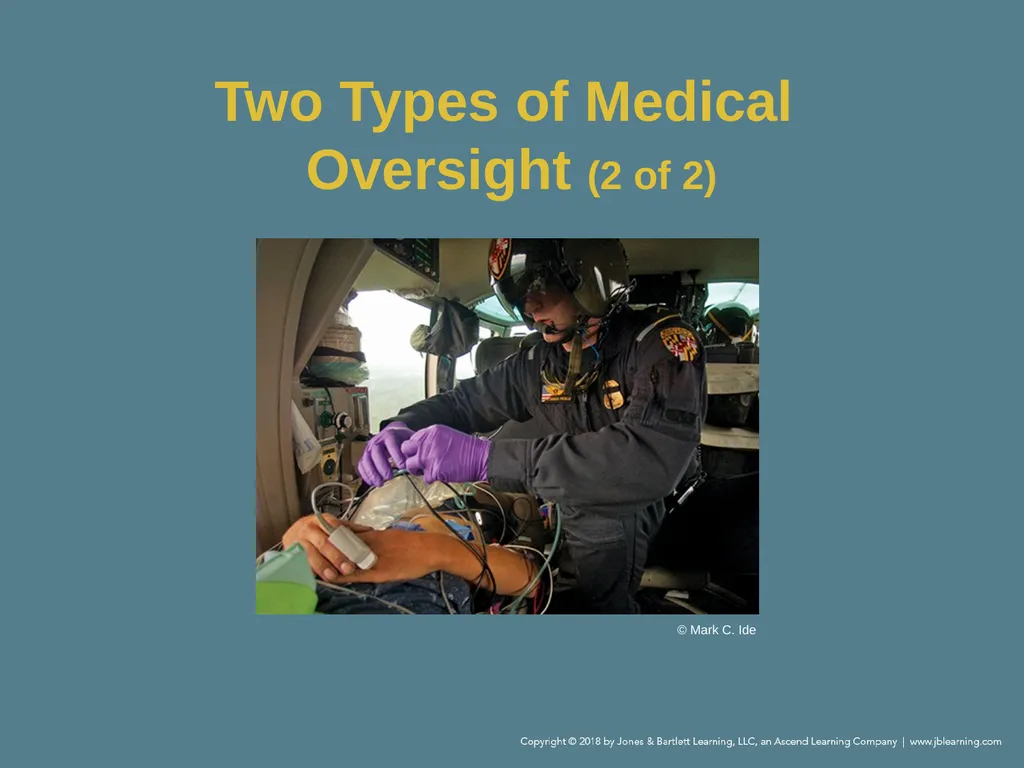
© Mark C. Ide Two Types of Medical
Oversight (2 of 2)<br>
24
State and National
Standards (1 of 2) Most CCT programs follow national standards.
Standards vary by state.
Some states require Commission on Accreditation of Medical Transport Services certification for any air medical service.
Some state organizations govern licensure and certification of air medical services and practitioners.<br>
Standards vary by state.
Some states require Commission on Accreditation of Medical Transport Services certification for any air medical service.
Some state organizations govern licensure and certification of air medical services and practitioners.<br>
25
Individual CCTP’s scope of practice
varies according to the level of certification, state of practice
Contact state agency for most accurate information on governing organizations and scope of practice
No national standards on CCT training courses, but basic course requires at least 80 additional hours of training State and National Standards (2 of 2)<br>
Contact state agency for most accurate information on governing organizations and scope of practice
No national standards on CCT training courses, but basic course requires at least 80 additional hours of training State and National Standards (2 of 2)<br>
26
Well-Being Indicates that people are comfortable, healthy, and happy
Resilience
Key component in maintenance of well-being
Has three determinants
Biology (genetics), attachment, and control<br>
Resilience
Key component in maintenance of well-being
Has three determinants
Biology (genetics), attachment, and control<br>
27
Stress (1 of 2) Both positive and negative life events can have a significant stress impact
CCTPs need to access all life events for stress-inducing value
Spread out controllable events
Focus on cumulative stress<br>
CCTPs need to access all life events for stress-inducing value
Spread out controllable events
Focus on cumulative stress<br>
28
Stress (2 of 2) Suggestions for a personal stress management program could include:
Condition your mind and body
Listen to your inner voice
Never stop growing and learning
Be positive
Have a life outside of your work<br>
Condition your mind and body
Listen to your inner voice
Never stop growing and learning
Be positive
Have a life outside of your work<br>
29
Critical incident stress debriefing and psychological first aid Critical incident stress debriefing
Approach favored since 1980s
Largely replaced by the principles of psychological first aid
Psychological first aid
Implemented in workplace by management and coworkers
Emphasis on encouraging personal resilience<br>
Approach favored since 1980s
Largely replaced by the principles of psychological first aid
Psychological first aid
Implemented in workplace by management and coworkers
Emphasis on encouraging personal resilience<br>
30
Clothing should fit properly, be
flame retardant, never be too tight or loose.
Clothing should include uniform or flight suit, outerwear, and undergarments.
Clothing should be layered for proper ventilation and heat regulations.
Head and eye protection should fit snugly and meet or exceed Occupational Safety and Health Administration specifications. Minimum Criteria for Safety Gear (1 of 2)<br>
31
Minimum Criteria for
Safety Gear (2 of 2) Boots should be leather and be worn to protect feet against elements and fire.
Gloves should be flame retardant to protect the hands against elements and fire.
Uniforms should have reflective materials or striping to increase nighttime visibility.<br>
Gloves should be flame retardant to protect the hands against elements and fire.
Uniforms should have reflective materials or striping to increase nighttime visibility.<br>
32
Ways to Communicate Your Intentions Introduce each team member right away.
Permit family to remain in room when team assesses patient if they desire
Give family time to speak briefly with patient before departure
Answer family’s questions
Honor requests for brief prayer<br>
Permit family to remain in room when team assesses patient if they desire
Give family time to speak briefly with patient before departure
Answer family’s questions
Honor requests for brief prayer<br>
33
Quality Assurance and Improvement Primary function is to generate data to be used to improve the quality of service provided.
First step: Define quality
Second step: Collect and analyze data
Third step: Improve quality<br>
First step: Define quality
Second step: Collect and analyze data
Third step: Improve quality<br>
34
Ground Transport
Timeline (1 of 4) Eleventh century: Birth of emergency medical providers during Crusades by Knights of St. John
1792: Dominique Jean Larrey designs ambulance volante during French Revolution
1862: Jonathan Letterman creates first US ambulance service during Civil War
1869: Bellevue Hospital in New York City establishes America’s first city ambulance service<br>
1792: Dominique Jean Larrey designs ambulance volante during French Revolution
1862: Jonathan Letterman creates first US ambulance service during Civil War
1869: Bellevue Hospital in New York City establishes America’s first city ambulance service<br>
35
© National Library of Medicine. Ground Transport
Timeline (2 of 4)<br>
36
1899: First motorized ambulance developed in Chicago, IL
Early 1900s: Ambulance crews now include driver and person responsible for patient care
1966: Francis Pantridge, MD arranges prehospital coronary care in Dublin, Ireland
1969: First US paramedic program started in Miami, FL; prehospital defibrillation used in United States Ground Transport Timeline (3 of 4)<br>
37
© National Library of Medicine. Ground Transport
Timeline (4 of 4)<br>
38
Air Transport Timeline (1 of 7) 1784: Physicians consider benefits of flight after witnessing balloon flight demonstrations by Montgolfier brothers.
1870: First documented case of air medical transport occurs during Prussian Siege of Paris
1890–1910: M. de Mooy pursues idea of using balloons to transport patients in Holland
1909: US Army Medical Corps builds plane designed to carry patients, but it crashes during testing<br>
1870: First documented case of air medical transport occurs during Prussian Siege of Paris
1890–1910: M. de Mooy pursues idea of using balloons to transport patients in Holland
1909: US Army Medical Corps builds plane designed to carry patients, but it crashes during testing<br>
39
Air Transport Timeline (2 of 7) 1914: Igor Sikorsky invents helicopter
1920s: Post–World War I, US Army focuses on development of air ambulances
1930s: Air ambulances designed with multiple engines, heated cabins, short runway capacity<br>
1920s: Post–World War I, US Army focuses on development of air ambulances
1930s: Air ambulances designed with multiple engines, heated cabins, short runway capacity<br>
40
Air Transport Timeline (3 of 7) April 23, 1944: Wounded airmen transported via helicopter in Burma
during World War II, marking a new
era of air medical transport
August 4, 1950: Wounded soldiers transported to mobile army surgical hospital units in Bell-47 and Sikorsky S-51 helicopters; mortality rates drop<br>
August 4, 1950: Wounded soldiers transported to mobile army surgical hospital units in Bell-47 and Sikorsky S-51 helicopters; mortality rates drop<br>
41
Air Transport Timeline (4 of 7) Late 1950s-1960s:
Vietnam War performs majority of battlefield rescues, stabilizations, and evacuations using Huey
Civilian air medical service organized in Etna, CA
Maryland employs four paramedic-staffed helicopters as part of state police<br>
Vietnam War performs majority of battlefield rescues, stabilizations, and evacuations using Huey
Civilian air medical service organized in Etna, CA
Maryland employs four paramedic-staffed helicopters as part of state police<br>
42
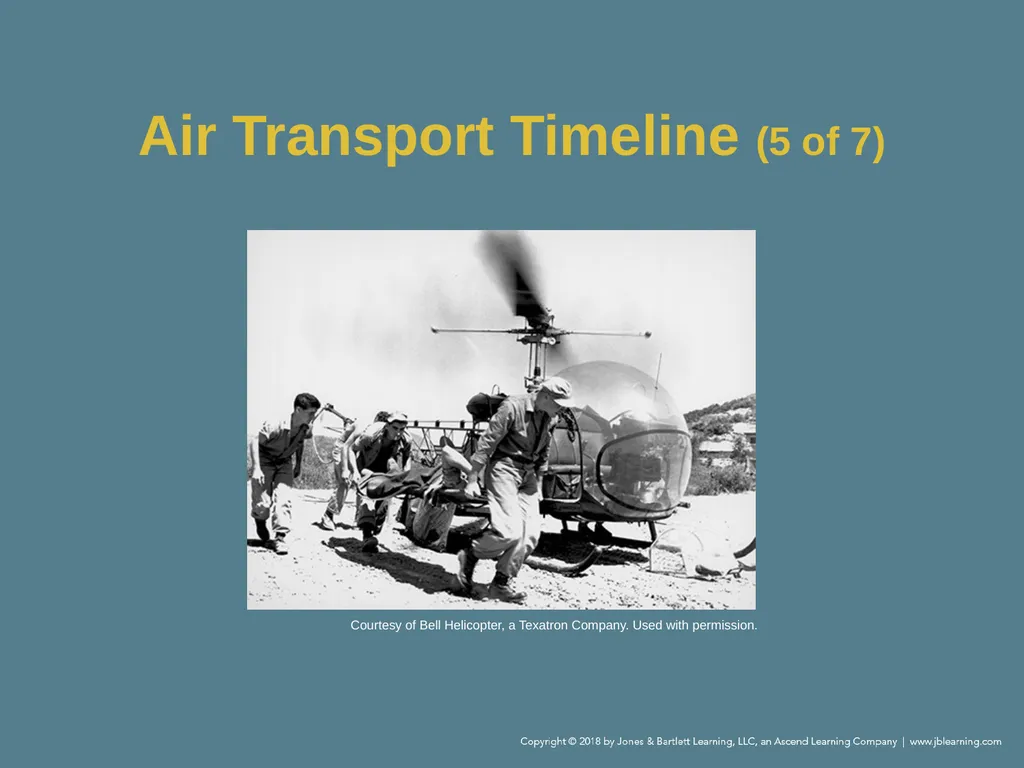
Air Transport Timeline (5 of 7) Courtesy of Bell Helicopter, a Texatron Company. Used with permission.<br>
43
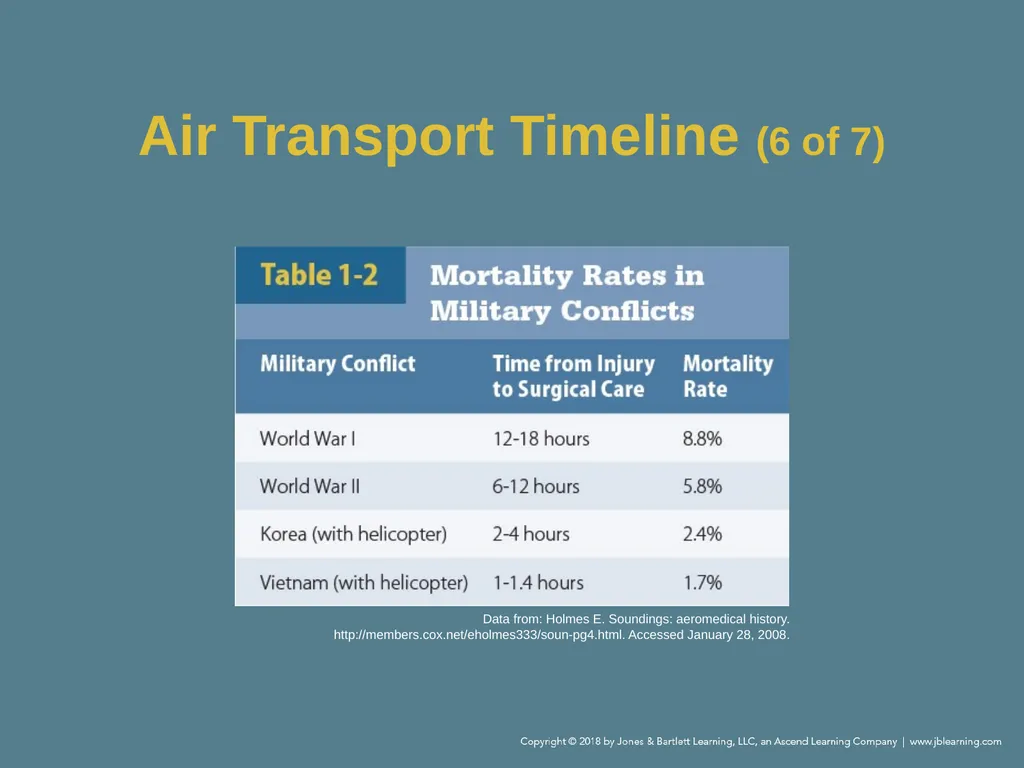
Air Transport Timeline (6 of 7) Data from: Holmes E. Soundings: aeromedical history. http://members.cox.net/eholmes333/soun-pg4.html. Accessed January 28, 2008.<br>
44
Air Transport Timeline (7 of 7) 1970s: St. Anthony’s Hospital in Denver establishes first hospital-based air medical transport program.
1980s: Federal Aviation Administration regulators demand better equipment and specially trained crews for air ambulances as result of National Highway and Transportation Safety Administration study.
2000s: More than 650 air medical programs exist in United States<br>
1980s: Federal Aviation Administration regulators demand better equipment and specially trained crews for air ambulances as result of National Highway and Transportation Safety Administration study.
2000s: More than 650 air medical programs exist in United States<br>