Chapter 1 Introduction to banking sector Banks are institutions that accepts various types of deposits and use these funds for granting loans. It helps in capital formation and capital accumulation. Banks are reservoirs of resources. Banks
"Chapter 1 Introduction to banking sector Banks are" is the property of its rightful owner. Permission is granted to
download and print the materials on this website for personal, non-commercial use only, and to display it
on your personal computer provided you do not modify the materials and that you retain all copyright
notices contained in the materials. By downloading content from our website, you accept the terms of this
agreement.
Presentation Transcript
01
Chapter 1 Introduction to banking sector<br>
02
Banks are institutions that accepts various types of deposits and use these funds for granting loans.
It helps in capital formation and capital accumulation. Banks are reservoirs of resources.
Banks are at the heart of the financial system. Introduction :-<br>
03
The word bank has been derived from the French word ‘Banco /Bancus /Banc/Banque’ which means a ‘bench’.
In India, Bank of Hindustan was the earliest bank started under European directions.
In England, the bankers of “Lombardy” had taken the initiative to start modern banking along with their trading activities. Brief History :-<br>
04
The Banking Regulation Act,1949 (Sec. 5(B)) defines the term ‘Banking Company’ as ‘a company which transact the business of banking in India’, and the term ‘Banking’ has been defined as ‘Accepting for the purpose of lending and investment of deposits of money from the public, repayable on demand, order or otherwise and withdrawable by cheque, draft or order or otherwise. Definitions of Banking :-<br>
05
Dealing in Money
Deposits must be Withdrawable
Dealing with Credit
Middle Man
Commercial in Nature
Risk Transformation
Size Transformation
Nature of Agent Features :-<br>
06
Accepting Deposits From Public
Lending money to public
Transferring money from one place to another
Doing Government Business transactions
Keeping valuables in safe custody
Acting as trustees General Functions:-<br>
07
Principle of Liquidity
Principle of Solvency
Principle of Profitability
Principle of Loan & Investment
Principle of Saving
Principle of Service
Principle of Secrecy
Principle of Efficiency
Other Principles Principles Of Banking:-<br>
08
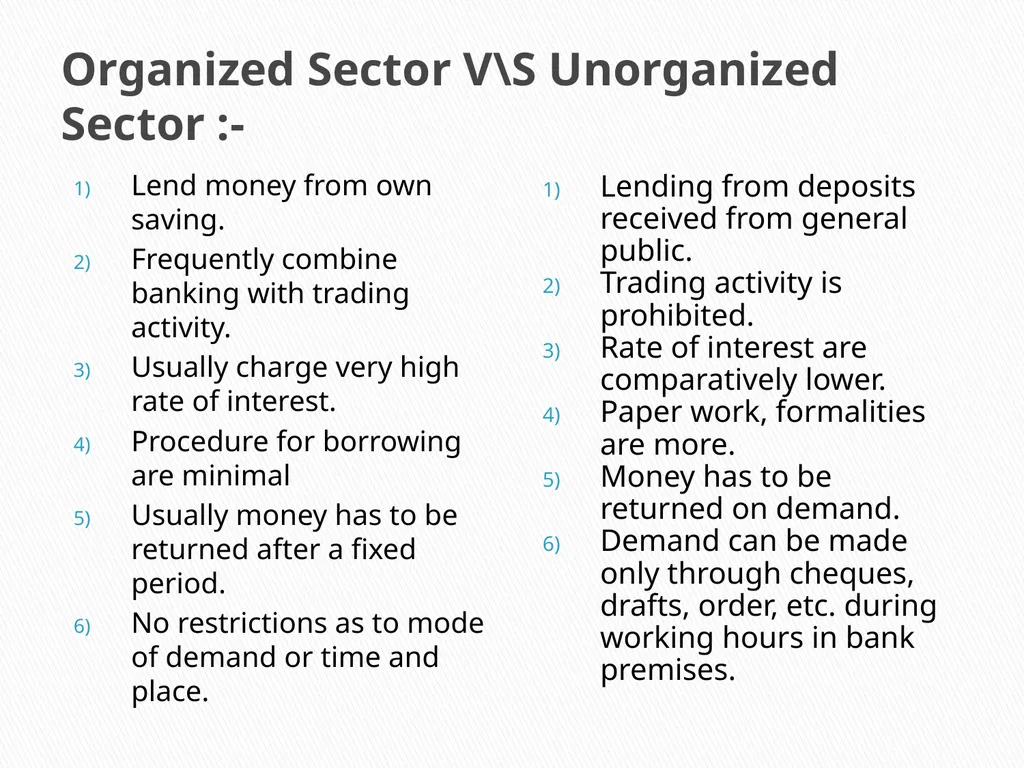
Organized Sector V\S Unorganized Sector :- Lend money from own saving.
Frequently combine banking with trading activity.
Usually charge very high rate of interest.
Procedure for borrowing are minimal
Usually money has to be returned after a fixed period.
No restrictions as to mode of demand or time and place. Lending from deposits received from general public.
Trading activity is prohibited.
Rate of interest are comparatively lower.
Paper work, formalities are more.
Money has to be returned on demand.
Demand can be made only through cheques, drafts, order, etc. during working hours in bank premises.<br>
09
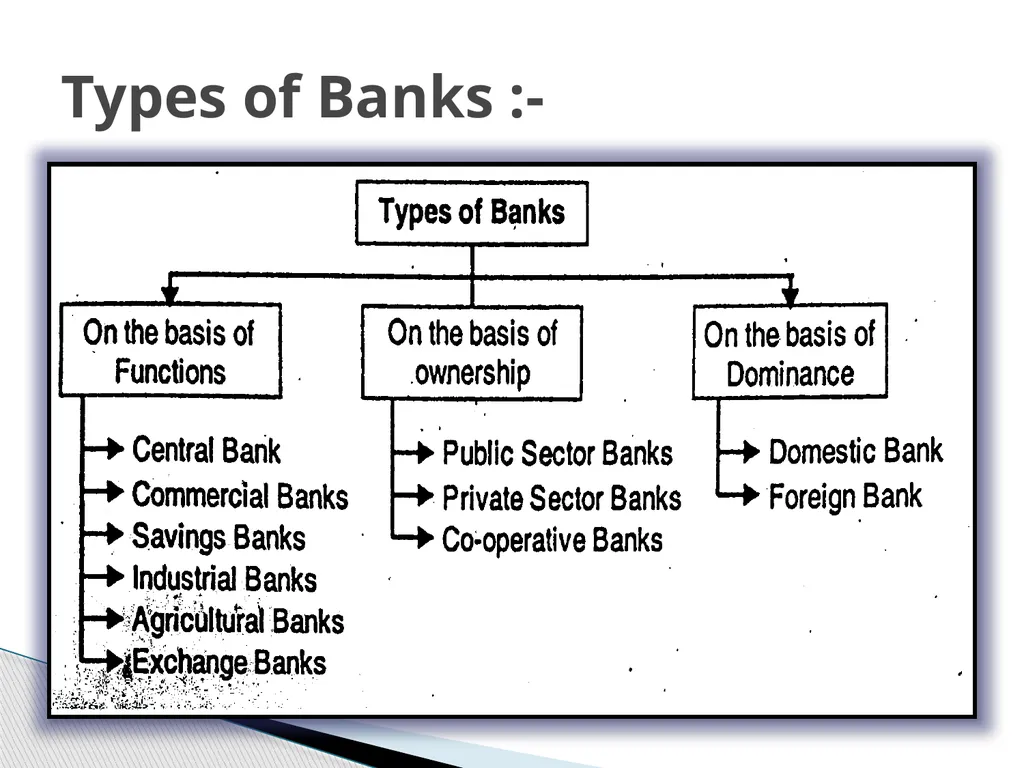
Types of Banks :-<br>
10
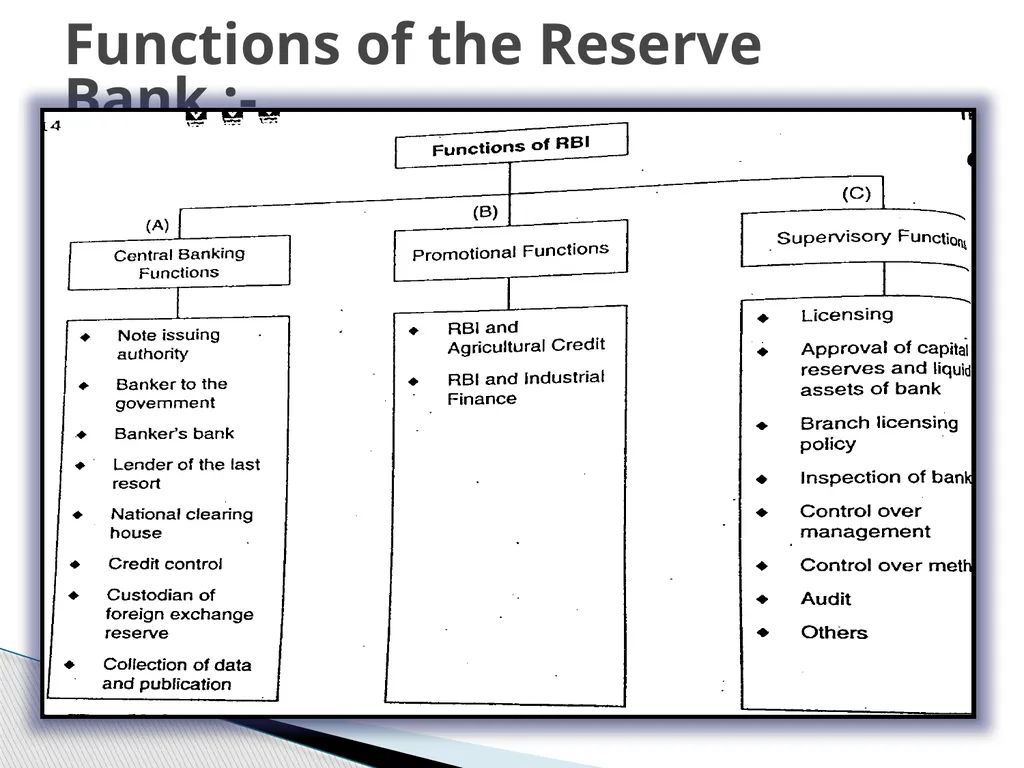
Functions of the Reserve Bank :-<br>
11
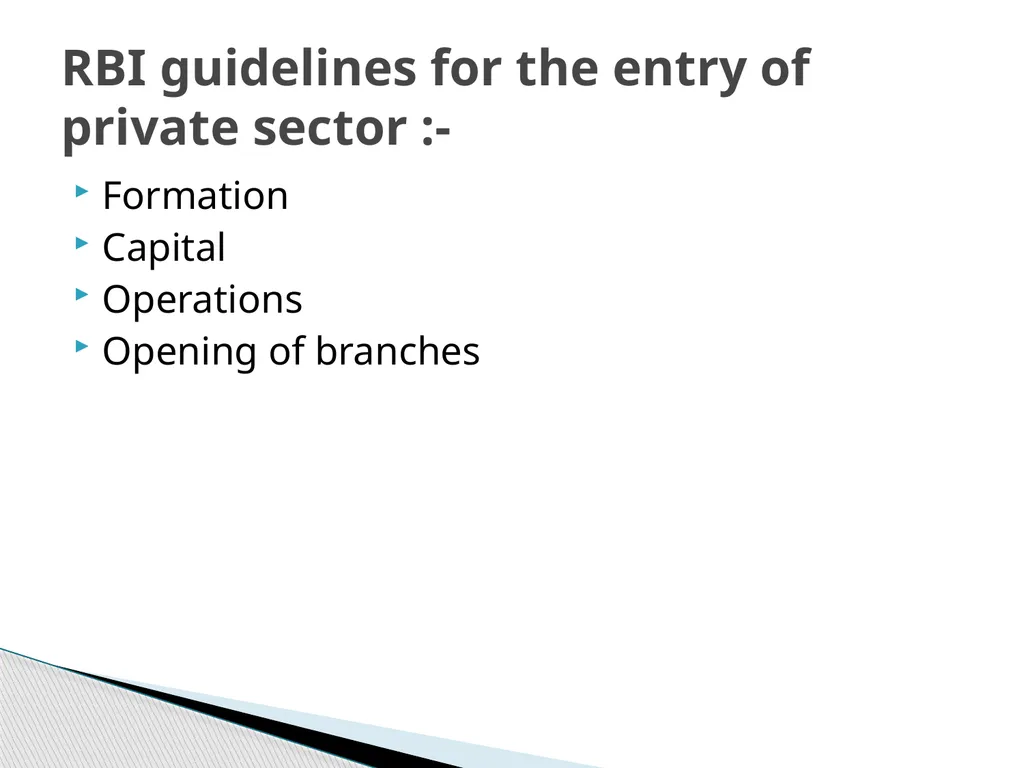
Formation
Capital
Operations
Opening of branches RBI guidelines for the entry of private sector :-<br>
12
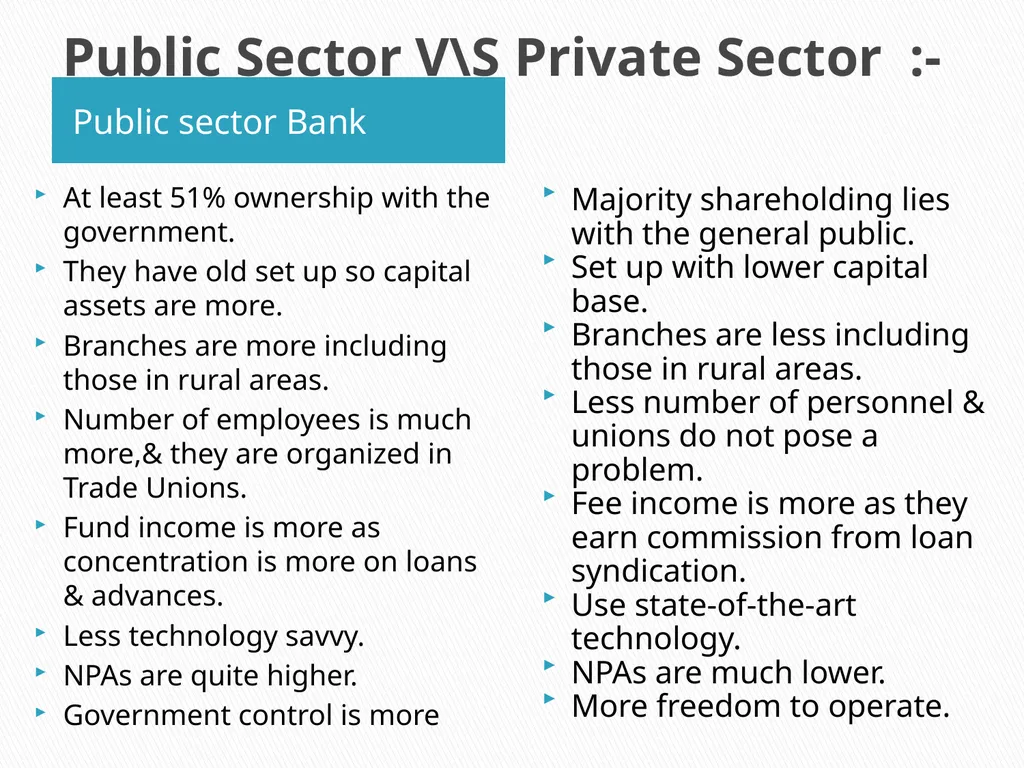
Public Sector V\S Private Sector :- Public sector Bank At least 51% ownership with the government.
They have old set up so capital assets are more.
Branches are more including those in rural areas.
Number of employees is much more,& they are organized in Trade Unions.
Fund income is more as concentration is more on loans & advances.
Less technology savvy.
NPAs are quite higher.
Government control is more Majority shareholding lies with the general public.
Set up with lower capital base.
Branches are less including those in rural areas.
Less number of personnel & unions do not pose a problem.
Fee income is more as they earn commission from loan syndication.
Use state-of-the-art technology.
NPAs are much lower.
More freedom to operate.<br>
13
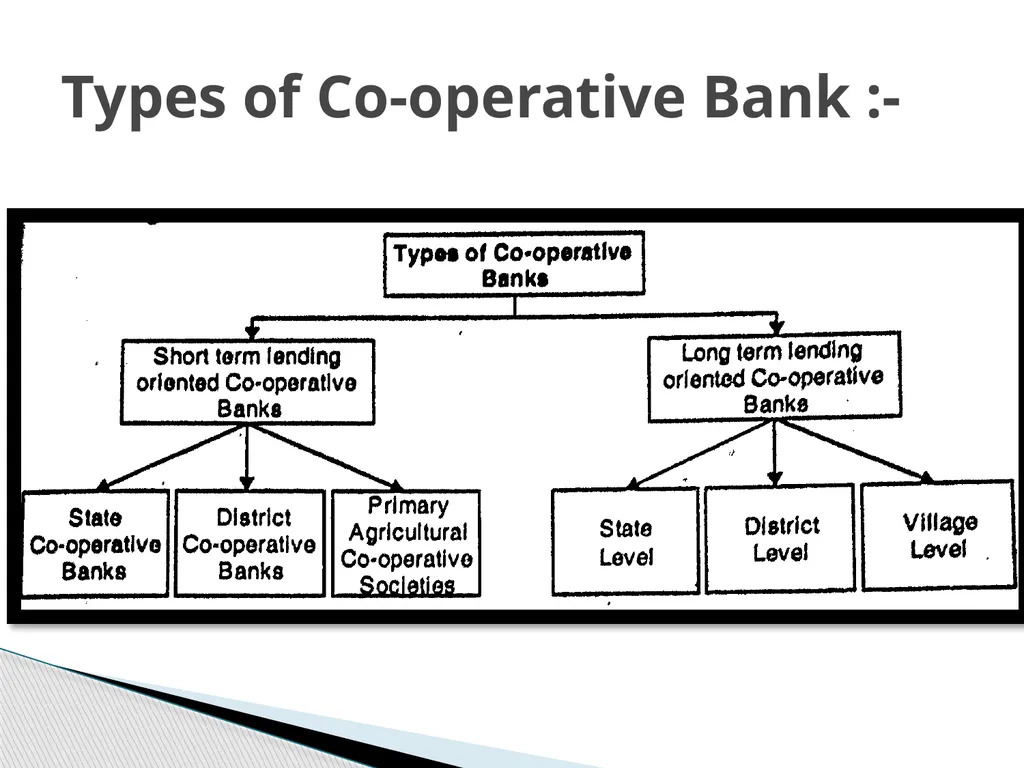
Types of Co-operative Bank :-<br>
14
Commercial bank V\s Co-operative Bank :- Commercial Banks Co-operative Banks These banks function on business line i.e. to earn profit.
Established as joint stock company or registered as public corporation under separate Act of Parliament.
Are organized on unitary basis.
Branch network is spread far and wide within and out of the country.
They are governed by all sections of the Banking Regulation act,1949. The concept of cooperatives banks are “no profit, no loss”.it works on principles of cooperation, self-help & mutual help.
Are established under the cooperation Societies Acts of different states.
Have a three-tier set-up
Area of the operation is restricted to local/district state.
Only some sections of the Act are applicable to them.<br>
15
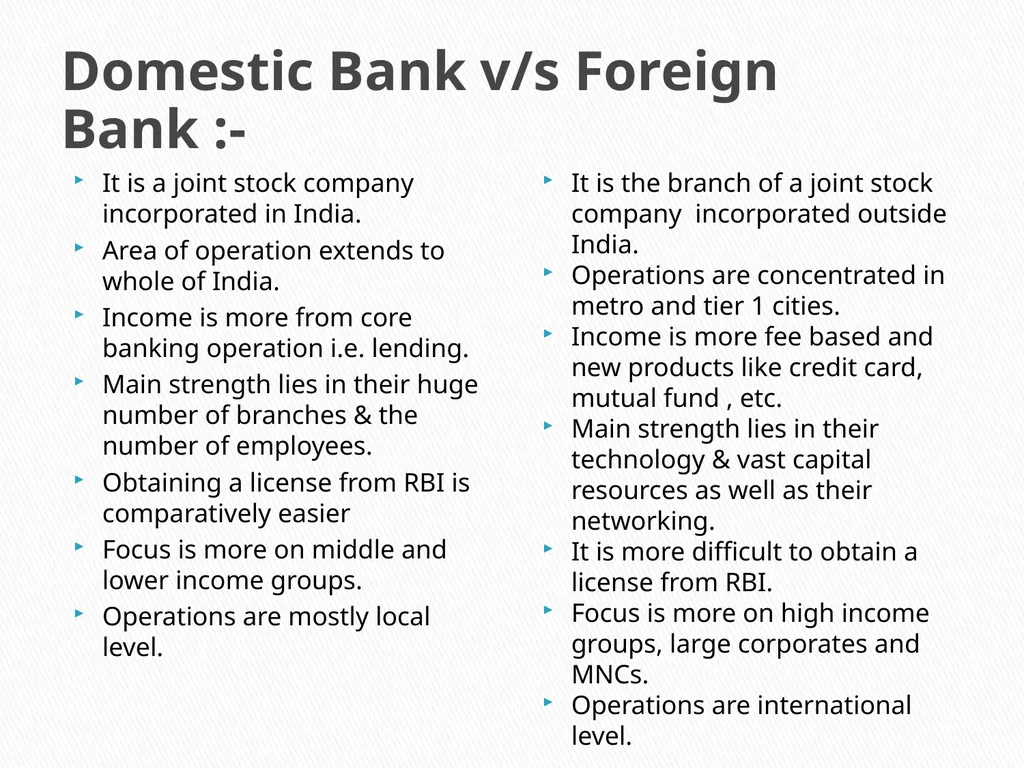
Domestic Bank v/s Foreign Bank :- It is a joint stock company incorporated in India.
Area of operation extends to whole of India.
Income is more from core banking operation i.e. lending.
Main strength lies in their huge number of branches & the number of employees.
Obtaining a license from RBI is comparatively easier
Focus is more on middle and lower income groups.
Operations are mostly local level. It is the branch of a joint stock company incorporated outside India.
Operations are concentrated in metro and tier 1 cities.
Income is more fee based and new products like credit card, mutual fund , etc.
Main strength lies in their technology & vast capital resources as well as their networking.
It is more difficult to obtain a license from RBI.
Focus is more on high income groups, large corporates and MNCs.
Operations are international level.<br>
16
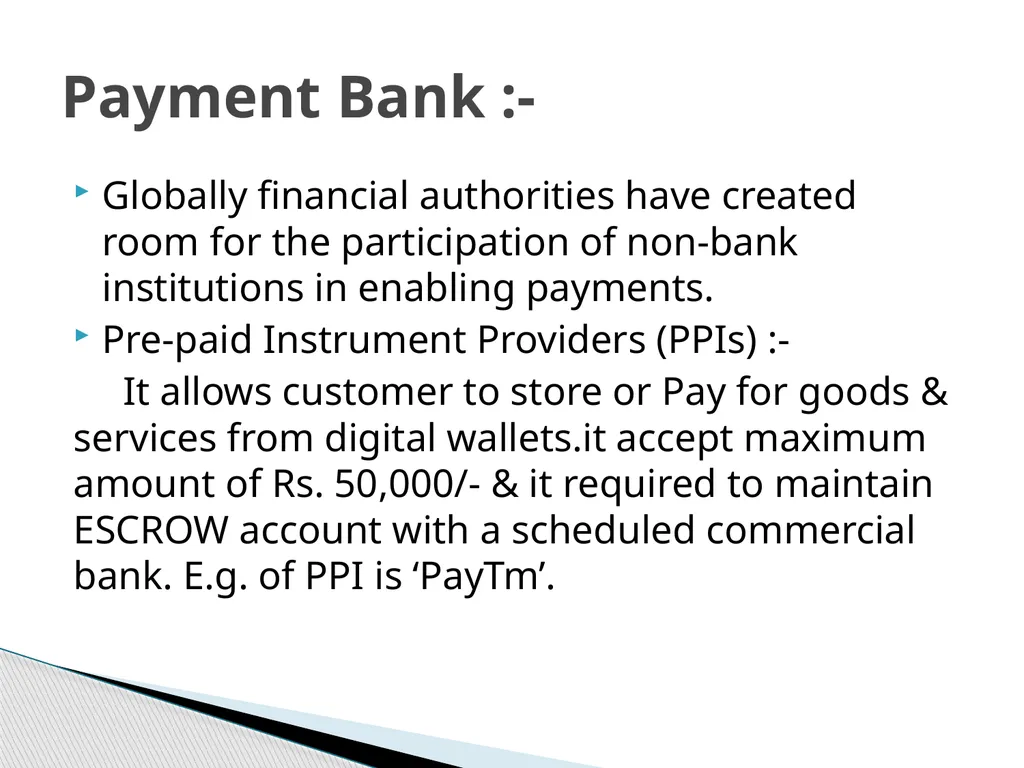
Globally financial authorities have created room for the participation of non-bank institutions in enabling payments.
Pre-paid Instrument Providers (PPIs) :-
It allows customer to store or Pay for goods & services from digital wallets.it accept maximum amount of Rs. 50,000/- & it required to maintain ESCROW account with a scheduled commercial bank. E.g. of PPI is ‘PayTm’. Payment Bank :-<br>
17
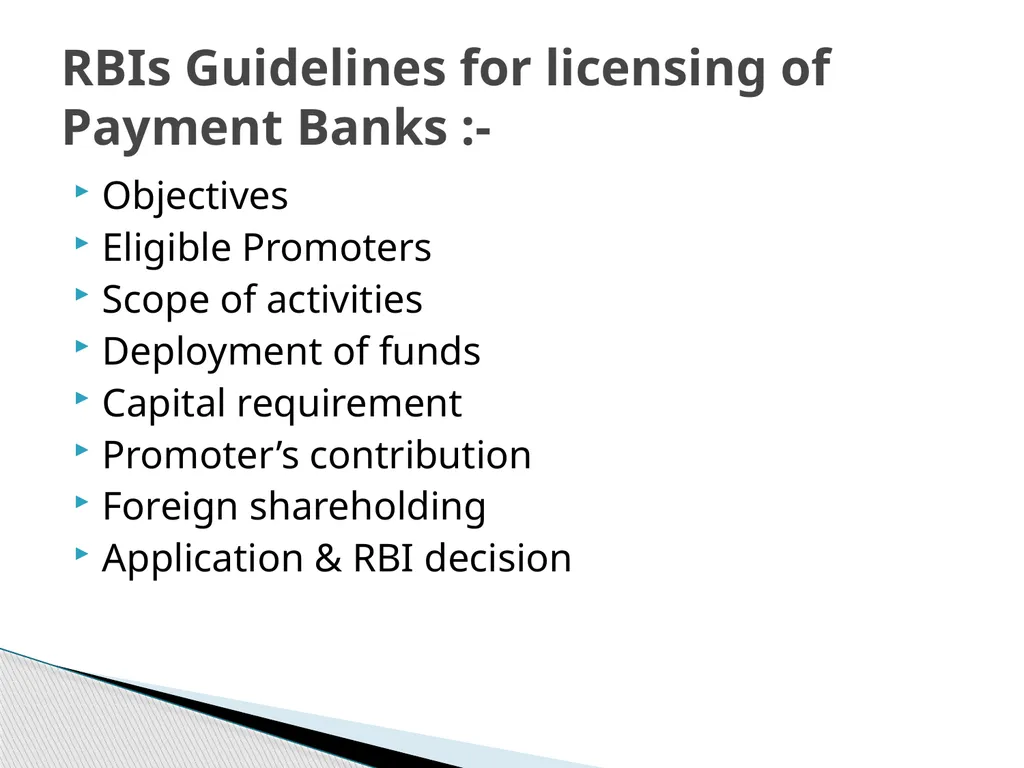
Objectives
Eligible Promoters
Scope of activities
Deployment of funds
Capital requirement
Promoter’s contribution
Foreign shareholding
Application & RBI decision RBIs Guidelines for licensing of Payment Banks :-<br>
18
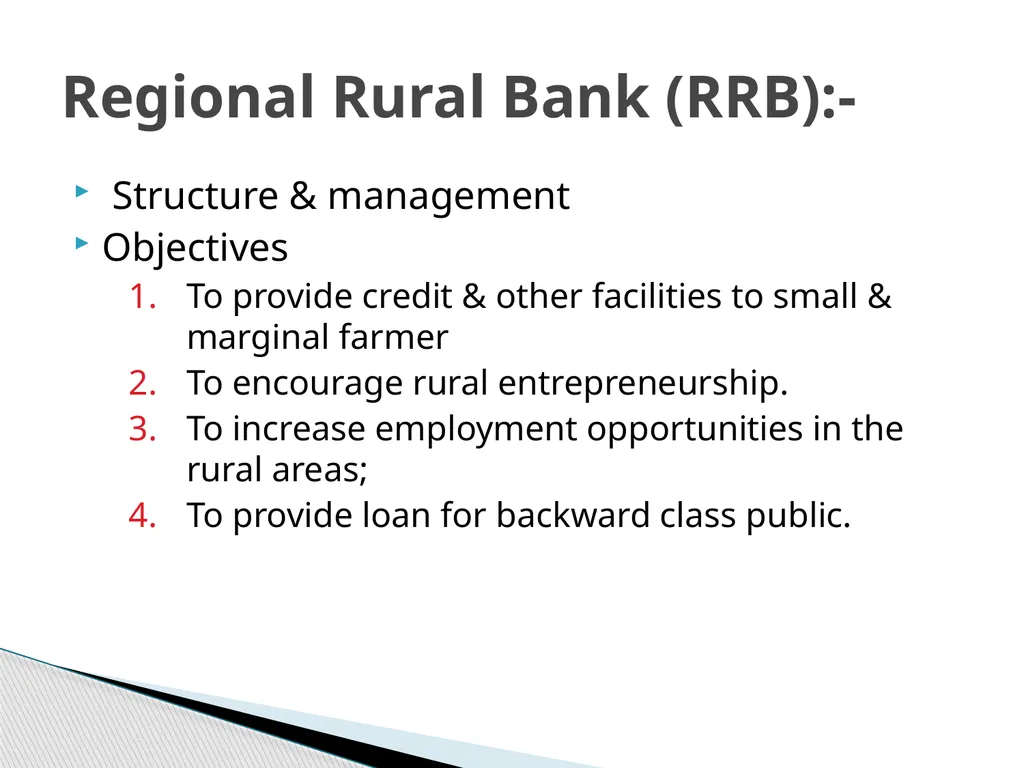
Structure & management
Objectives
To provide credit & other facilities to small & marginal farmer
To encourage rural entrepreneurship.
To increase employment opportunities in the rural areas;
To provide loan for backward class public. Regional Rural Bank (RRB):-<br>
19
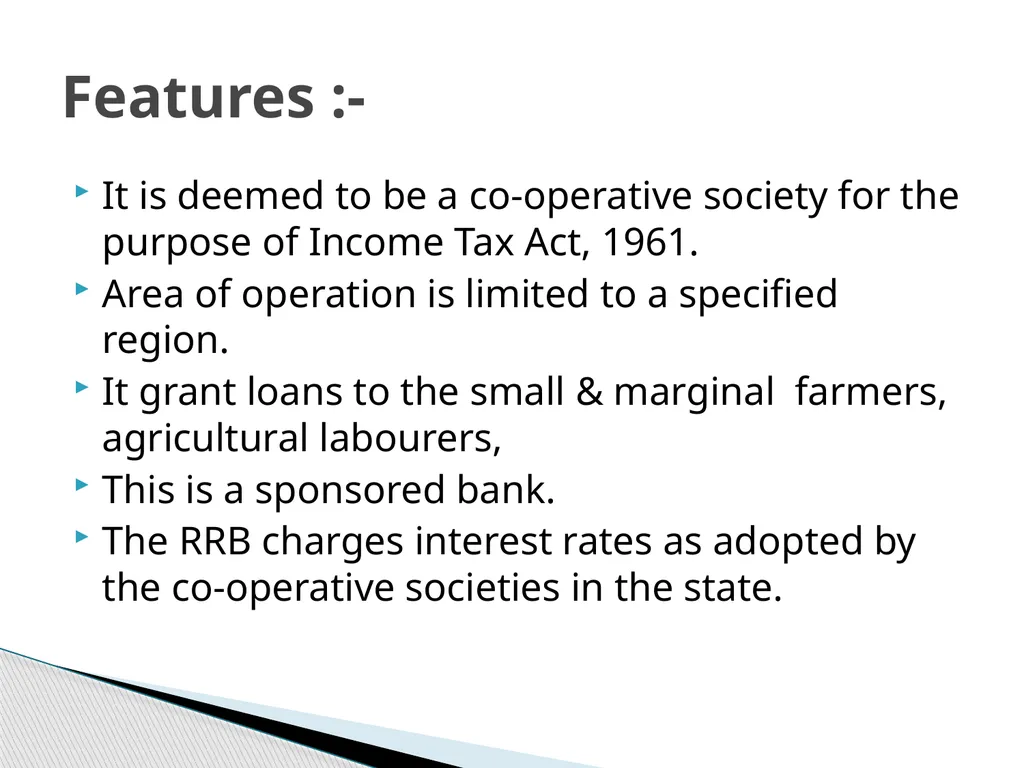
It is deemed to be a co-operative society for the purpose of Income Tax Act, 1961.
Area of operation is limited to a specified region.
It grant loans to the small & marginal farmers, agricultural labourers,
This is a sponsored bank.
The RRB charges interest rates as adopted by the co-operative societies in the state. Features :-<br>
20
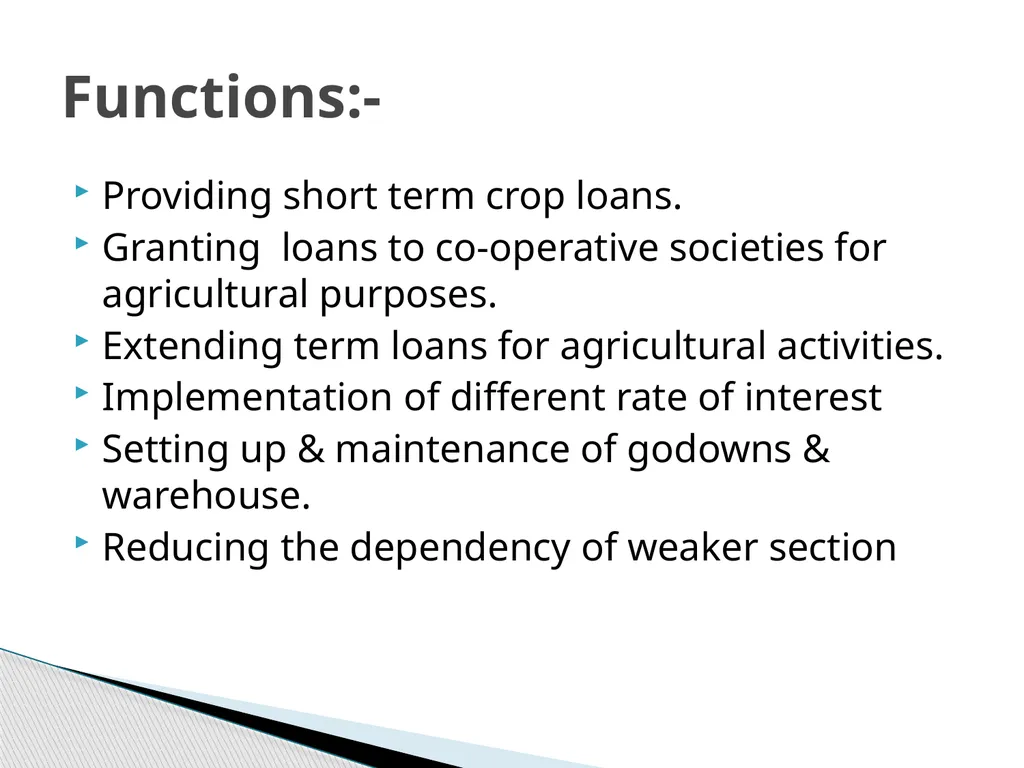
Providing short term crop loans.
Granting loans to co-operative societies for agricultural purposes.
Extending term loans for agricultural activities.
Implementation of different rate of interest
Setting up & maintenance of godowns & warehouse.
Reducing the dependency of weaker section Functions:-<br>