
Chapter 10 Evaluation and improvement of digital
LO
Published · 39 slides · 0 views

1 / 1

Description
Chapter 10 Evaluation and improvement of digital channel performance Chapter 10 Evaluation and improvement of digital channel performance Main topics Performance management for digital channel Content management process Responsibilities for
Related Topics
Share
Embed code
Download this presentation From Below
"Chapter 10 Evaluation and improvement of digital" is the property of its rightful owner. Permission is granted to download and print the materials on this website for personal, non-commercial use only, and to display it on your personal computer provided you do not modify the materials and that you retain all copyright notices contained in the materials. By downloading content from our website, you accept the terms of this agreement.
Presentation Transcript
01
Chapter 10
Evaluation and improvement of digital channel performance<br>
Evaluation and improvement of digital channel performance<br>
02
Chapter 10 Evaluation and improvement of digital channel performance Main topics
Performance management for digital channel
Content management process
Responsibilities for customer experience and site management<br>
Performance management for digital channel
Content management process
Responsibilities for customer experience and site management<br>
03
Introduction Companies that have a successful approach to digital marketing often seem to share common characteristics. They attach great importance and devote resources to monitoring the success of their online marketing, putting in place the processes to continuously improve the performance of their digital channels.
Web or digital analytics: Techniques used to assess and improve the contribution of digital marketing to a business, including reviewing traffic volume, referrals, clickstreams, online reach data, customer satisfaction surveys, leads and sales.<br>
Web or digital analytics: Techniques used to assess and improve the contribution of digital marketing to a business, including reviewing traffic volume, referrals, clickstreams, online reach data, customer satisfaction surveys, leads and sales.<br>
04
Performance management for digital channels The processes and systems intended to monitor and improve the performance of an organisation are known by business operations researchers as performance management systems and are based on the study of performance measurement systems .
Performance management system: A process used to evaluate and improve the efficiency and effectiveness of an organisation and its processes.
Performance measurement system: The process by which metrics are defined, collected, disseminated and actioned.<br>
Performance management system: A process used to evaluate and improve the efficiency and effectiveness of an organisation and its processes.
Performance measurement system: The process by which metrics are defined, collected, disseminated and actioned.<br>
05
Performance management for digital channels There are three stages of creating and implementing a performance management system:
Stage 1: Creating a performance management system
Stage 2: Defining the performance metrics framework
Stage 3: Tools and techniques for collecting insight, running processes and summarising results<br>
Stage 1: Creating a performance management system
Stage 2: Defining the performance metrics framework
Stage 3: Tools and techniques for collecting insight, running processes and summarising results<br>
06
Stage 1: Creating a performance management system The need for a structured performance management process is clear when we examine the repercussions if an organisation does not have one. These include: poor linkage of measures with strategic objectives or even absence of objectives; key data not collected; data inaccuracies; data not disseminated or analysed; or no corrective action.<br>
07
Stage 1: Creating a performance management system Many of the barriers to improvement of measurement systems reported by respondents in Adams et al. (2000) also indicate the lack of an effective process. The barriers can be grouped as follows:
• Senior management myopia: performance measurement not seen as a priority, not understood or targeted at the wrong area reducing costs rather than improving performance.
• Unclear responsibilities: for delivering and improving the measurement system.
• Resourcing issues: lack of time (perhaps suggesting lack of staff motivation), the necessary technology and integrated systems.
• Data problems: data overload or of poor quality, limited data for benchmarking<br>
• Senior management myopia: performance measurement not seen as a priority, not understood or targeted at the wrong area reducing costs rather than improving performance.
• Unclear responsibilities: for delivering and improving the measurement system.
• Resourcing issues: lack of time (perhaps suggesting lack of staff motivation), the necessary technology and integrated systems.
• Data problems: data overload or of poor quality, limited data for benchmarking<br>
08
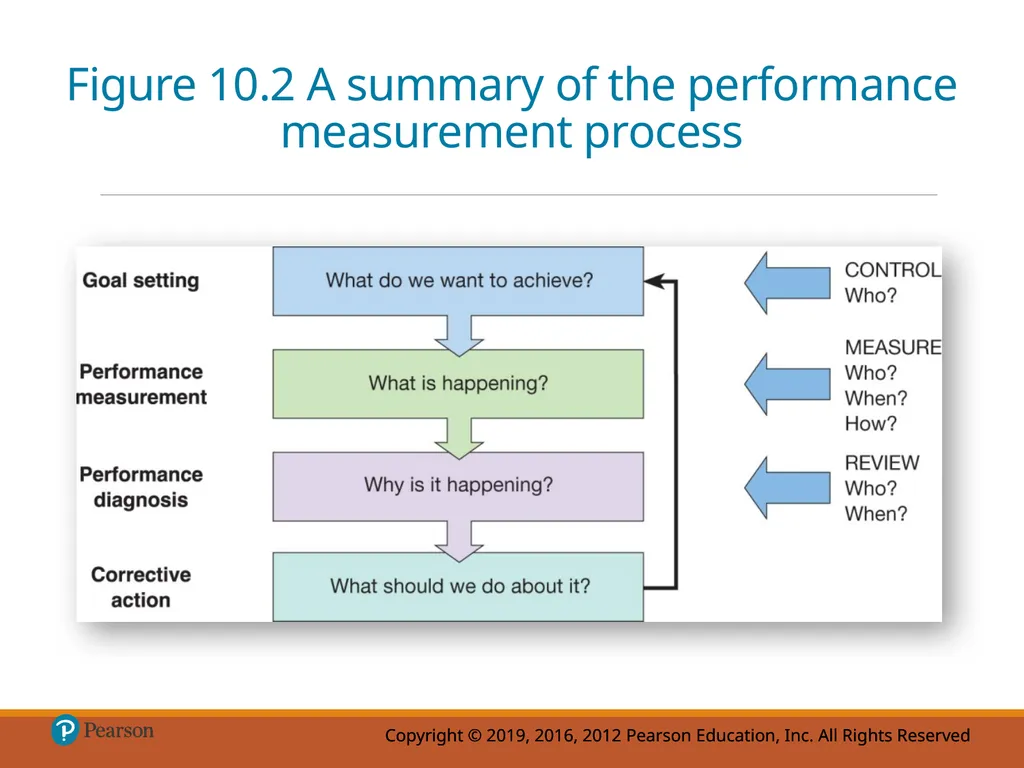
Figure 10.2 A summary of the performance measurement process<br>
09
Figure 10.2 indicates four key stages in a measurement process. These were defined as key aspects of annual marketing plan control by Kotler (1997):
Stage 1 is a goal-setting stage where the aims of the measurement system are defined – this will usually take the strategic digital marketing objectives as an input to the measurement system. The aim of the measurement system will be to assess whether these goals are achieved and specify corrective marketing actions to reduce variance between target and actual key performance indicators.
Stage 2, performance measurement, involves collecting data to determine the different metrics that are part of a measurement framework.<br>
Stage 1 is a goal-setting stage where the aims of the measurement system are defined – this will usually take the strategic digital marketing objectives as an input to the measurement system. The aim of the measurement system will be to assess whether these goals are achieved and specify corrective marketing actions to reduce variance between target and actual key performance indicators.
Stage 2, performance measurement, involves collecting data to determine the different metrics that are part of a measurement framework.<br>
10
Stage 3, performance diagnosis, is the analysis of results to understand the reasons for variance from objectives and selection of marketing solutions to reduce variance.
In a digital marketing context, Stage 4, corrective action, is the implementation of these solutions as updates to content, design, ongoing marketing communications and CRO. After this stage the continuous cycle repeats, possibly with modified goals.<br>
In a digital marketing context, Stage 4, corrective action, is the implementation of these solutions as updates to content, design, ongoing marketing communications and CRO. After this stage the continuous cycle repeats, possibly with modified goals.<br>
11
Stage 2: Defining the performance metrics framework Measurement for assessing the effectiveness of digital marketing should assess the contribution of digital marketing at different levels:
1. Are business objectives defined in the digital marketing strategy being met?
2. Are marketing objectives plans achieved?
3. Are marketing communications objectives achieved<br>
1. Are business objectives defined in the digital marketing strategy being met?
2. Are marketing objectives plans achieved?
3. Are marketing communications objectives achieved<br>
12
Stage 2: Defining the performance metrics framework Chaffey (2000) suggested that organisations define a measurement framework or create a management dashboard that defines groupings of specific metrics used to assess digital marketing performance. He suggested that suitable measurement frameworks will fulfil these criteria:
Include macro-level effectiveness metrics
Include micro-level metrics
Assess the impact of digital marketing on the satisfaction, loyalty and contribution of key stakeholders (customers, investors, employees and partners)
Enable comparison of performance of different digital channels with other channels<br>
Include macro-level effectiveness metrics
Include micro-level metrics
Assess the impact of digital marketing on the satisfaction, loyalty and contribution of key stakeholders (customers, investors, employees and partners)
Enable comparison of performance of different digital channels with other channels<br>
13
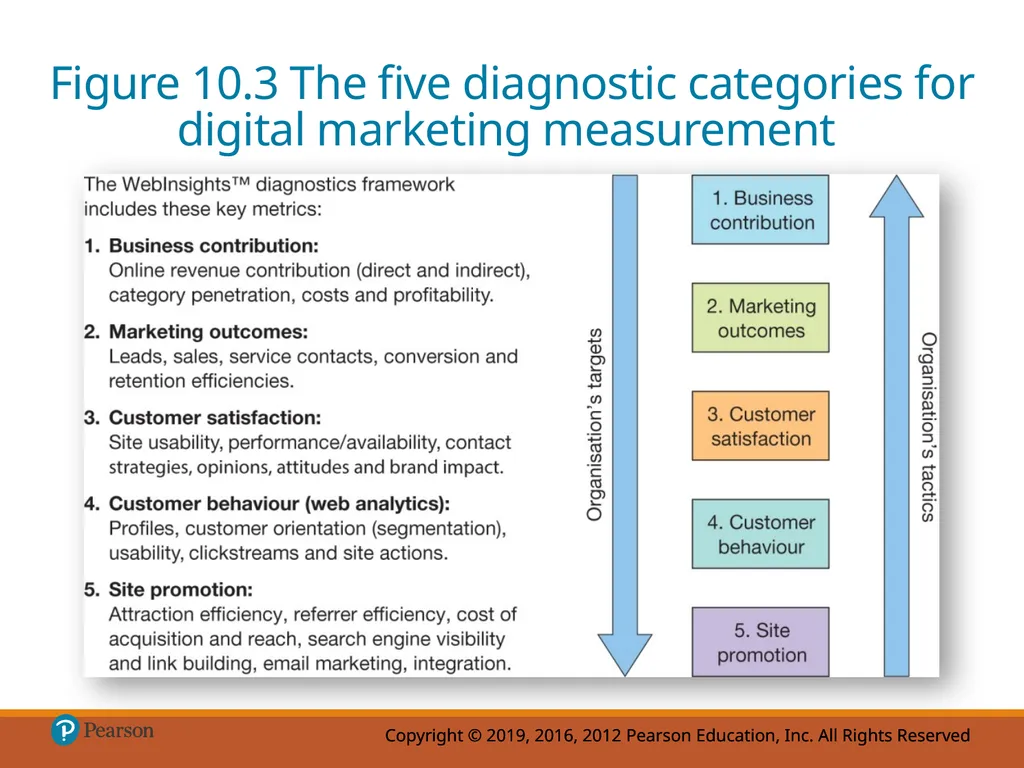
Figure 10.3 The five diagnostic categories for digital marketing measurement<br>
14
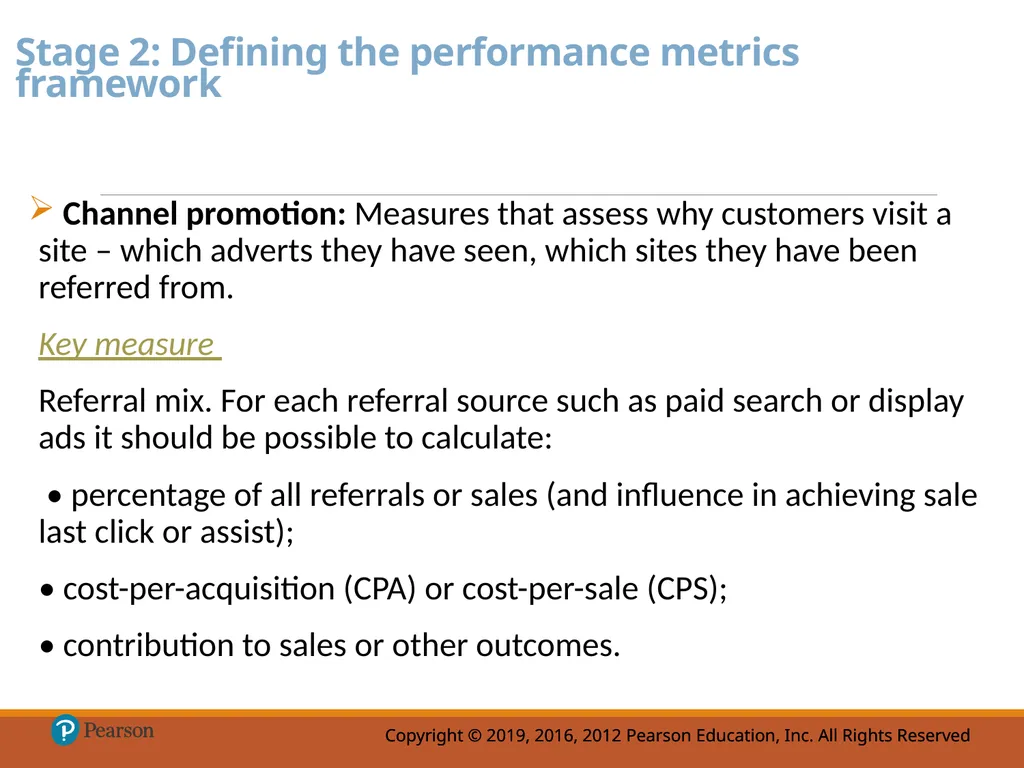
Stage 2: Defining the performance metrics framework Channel promotion: Measures that assess why customers visit a site – which adverts they have seen, which sites they have been referred from.
Key measure
Referral mix. For each referral source such as paid search or display ads it should be possible to calculate:
• percentage of all referrals or sales (and influence in achieving sale last click or assist);
• cost-per-acquisition (CPA) or cost-per-sale (CPS);
• contribution to sales or other outcomes.<br>
Key measure
Referral mix. For each referral source such as paid search or display ads it should be possible to calculate:
• percentage of all referrals or sales (and influence in achieving sale last click or assist);
• cost-per-acquisition (CPA) or cost-per-sale (CPS);
• contribution to sales or other outcomes.<br>
15
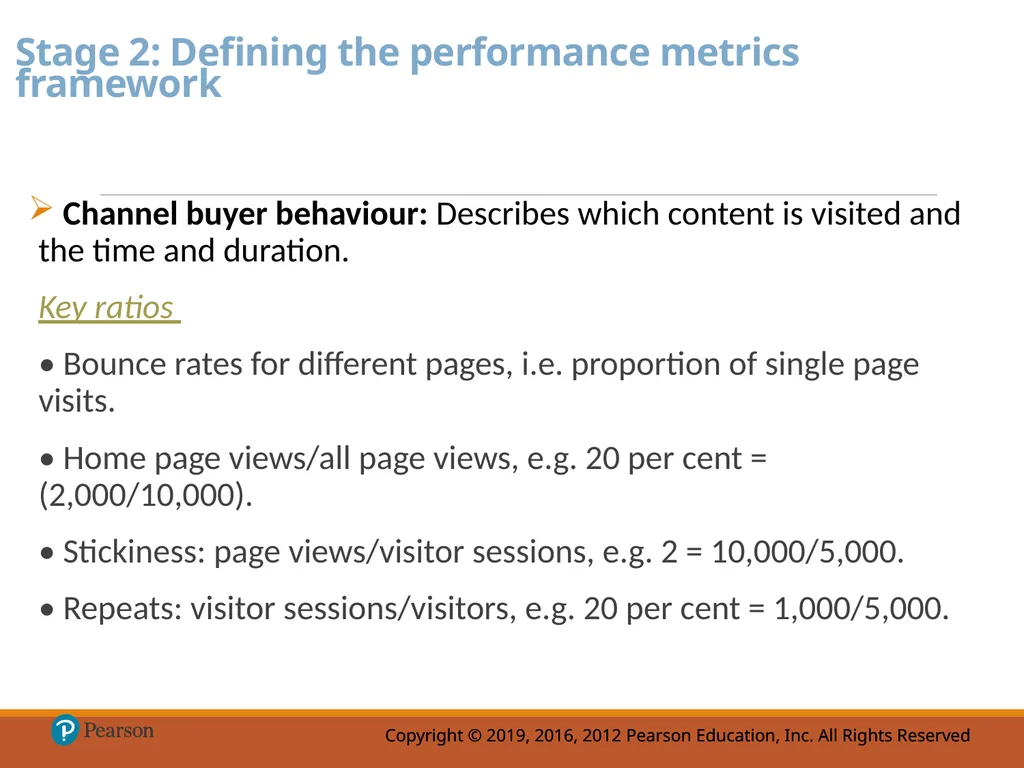
Stage 2: Defining the performance metrics framework Channel buyer behaviour: Describes which content is visited and the time and duration.
Key ratios
• Bounce rates for different pages, i.e. proportion of single page visits.
• Home page views/all page views, e.g. 20 per cent = (2,000/10,000).
• Stickiness: page views/visitor sessions, e.g. 2 = 10,000/5,000.
• Repeats: visitor sessions/visitors, e.g. 20 per cent = 1,000/5,000.<br>
Key ratios
• Bounce rates for different pages, i.e. proportion of single page visits.
• Home page views/all page views, e.g. 20 per cent = (2,000/10,000).
• Stickiness: page views/visitor sessions, e.g. 2 = 10,000/5,000.
• Repeats: visitor sessions/visitors, e.g. 20 per cent = 1,000/5,000.<br>
16
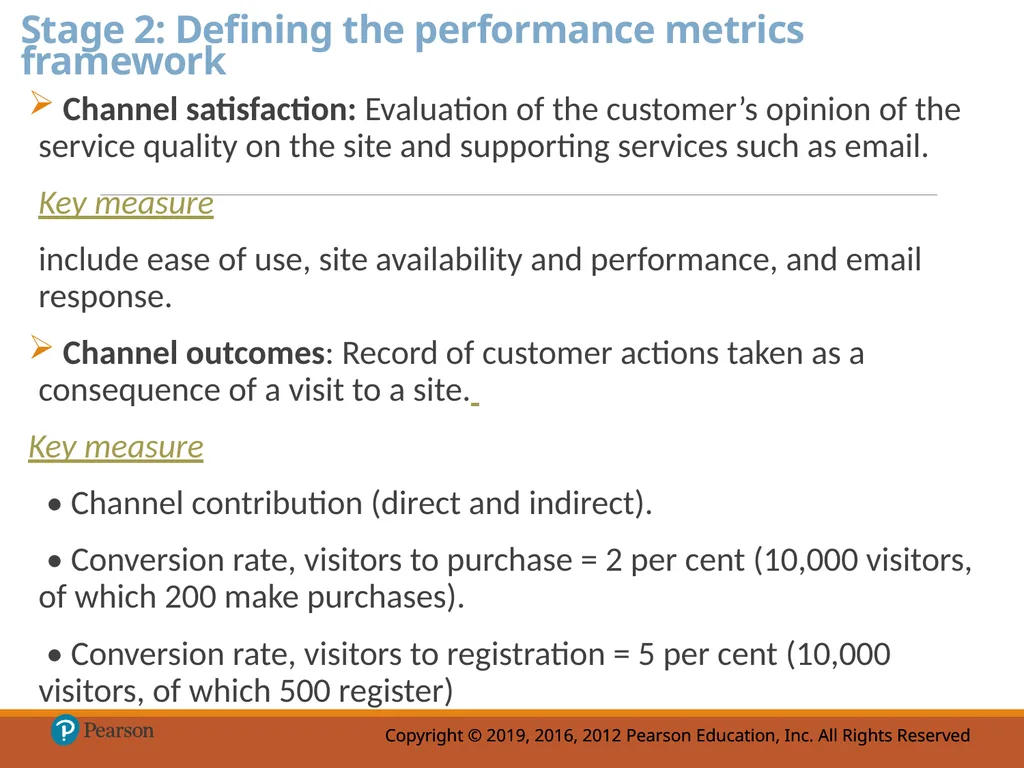
Stage 2: Defining the performance metrics framework Channel satisfaction: Evaluation of the customer’s opinion of the service quality on the site and supporting services such as email.
Key measure
include ease of use, site availability and performance, and email response.
Channel outcomes: Record of customer actions taken as a consequence of a visit to a site.
Key measure
• Channel contribution (direct and indirect).
• Conversion rate, visitors to purchase = 2 per cent (10,000 visitors, of which 200 make purchases).
• Conversion rate, visitors to registration = 5 per cent (10,000 visitors, of which 500 register)<br>
Key measure
include ease of use, site availability and performance, and email response.
Channel outcomes: Record of customer actions taken as a consequence of a visit to a site.
Key measure
• Channel contribution (direct and indirect).
• Conversion rate, visitors to purchase = 2 per cent (10,000 visitors, of which 200 make purchases).
• Conversion rate, visitors to registration = 5 per cent (10,000 visitors, of which 500 register)<br>
17
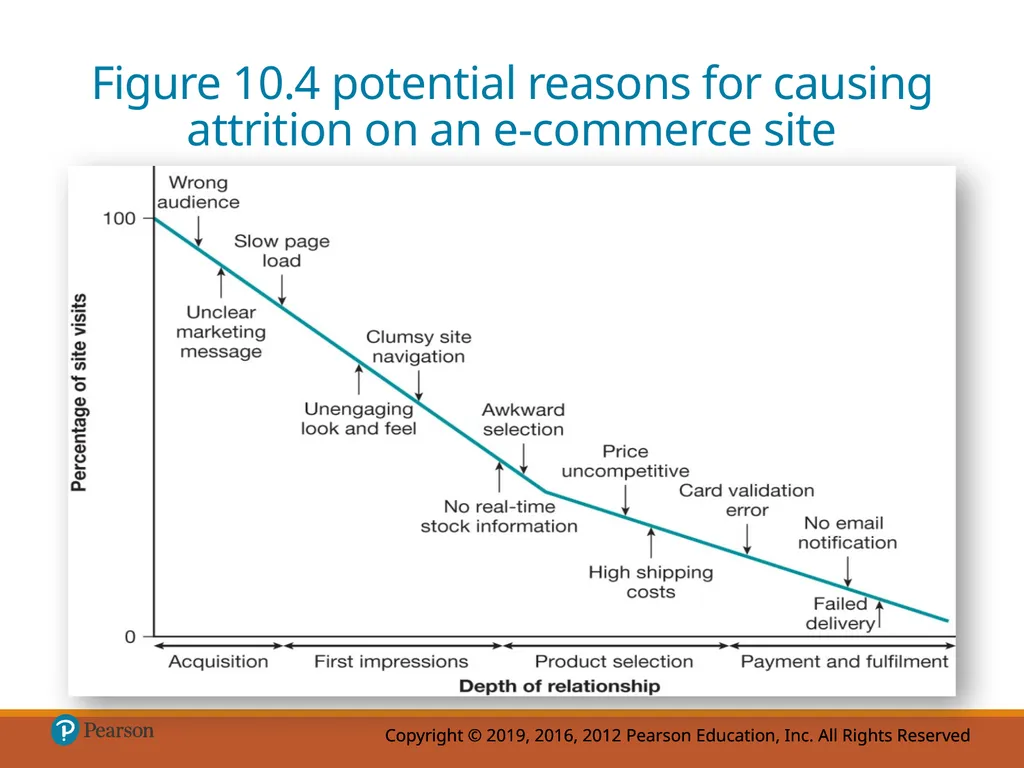
Figure 10.4 potential reasons for causing attrition on an e-commerce site<br>
18
Stage 2: Defining the performance metrics framework Conversion rate: Percentage of site visitors who perform a particular action such as making a purchase.
Attrition rate: Percentage of site visitors lost at each stage in making a purchase.
Channel profitability: The profitability of the website, taking into account revenue and cost and discounted cash flow.<br>
Attrition rate: Percentage of site visitors lost at each stage in making a purchase.
Channel profitability: The profitability of the website, taking into account revenue and cost and discounted cash flow.<br>
19
Stage 3: Tools and techniques for collecting insight, running processes and summarising results Organisations need to select the most appropriate tools for collecting and reporting metrics that meet requirements, such as reporting of marketing performance, accuracy, analysis and visualisation tools, integration with other marketing information systems (import, export and integration using XML standards), ease of use, configuration (e.g. creation of custom dashboards and email alerts), support quality, cost of purchase, configuration and ongoing support.<br>
20
Stage 3: Tools and techniques for collecting insight, running processes and summarising results Techniques to collect metrics include:
the collection of site-visitor activity data such as that stored in web analytics systems such as Google Analytics and Adobe Analytics
and in site log files;
and the collection of metrics about outcomes such as online sales or email enquiries and traditional marketing research techniques such as questionnaires and focus groups, which collect information on the customer’s experience on the website.<br>
the collection of site-visitor activity data such as that stored in web analytics systems such as Google Analytics and Adobe Analytics
and in site log files;
and the collection of metrics about outcomes such as online sales or email enquiries and traditional marketing research techniques such as questionnaires and focus groups, which collect information on the customer’s experience on the website.<br>
21
Marketing research using the Internet and digital media internet-based market research: The use of online questionnaires and focus groups to assess customer perceptions of a website or broader marketing issues.
internet-based market research has wider applications of gaining feedback from customers about a brand and how it could develop in future. Smart Insights (2010) identifies different classes of online feedback tools:
Website feedback tools. Provide a permanent facility for customers to give feedback by prompts on every page. They are run continuously to enable continuous feedback, including ratings on page content and also products and services.<br>
internet-based market research has wider applications of gaining feedback from customers about a brand and how it could develop in future. Smart Insights (2010) identifies different classes of online feedback tools:
Website feedback tools. Provide a permanent facility for customers to give feedback by prompts on every page. They are run continuously to enable continuous feedback, including ratings on page content and also products and services.<br>
22
Site-user intent-satisfaction surveys. These tools measure the gap between what the user had hoped to do on the site and what they actually achieved.
Crowdsourcing product-opinion software. These are broader than web feedback, enabling customers to comment about potential new services.
General online survey tools. Tools such as Zoomerang® (www.zoomerang.com) and Survey-MonkeyTM (www.surveymonkey.com) enable companies to survey their audience at a low cost. The full options for conducting survey research include interviews, questionnaires and focus groups.<br>
Crowdsourcing product-opinion software. These are broader than web feedback, enabling customers to comment about potential new services.
General online survey tools. Tools such as Zoomerang® (www.zoomerang.com) and Survey-MonkeyTM (www.surveymonkey.com) enable companies to survey their audience at a low cost. The full options for conducting survey research include interviews, questionnaires and focus groups.<br>
23
Questionnaires often take the form of pop-up surveys. The key issues are:
A/ Encouraging participation. Techniques that can be used are:
• interruption on entry – a common approach where every 100th customer is prompted;
• continuous, for example ‘click on a button to complete survey’;
• on registration on-site the customer can be profiled;
• after an activity such as sale or customer support, the customer can be prompted for their opinion about the service;
• incentives and promotions (this can also be executed on independent sites);
• by email (an email prompt to visit a website to fill in a survey or a simple email survey).<br>
A/ Encouraging participation. Techniques that can be used are:
• interruption on entry – a common approach where every 100th customer is prompted;
• continuous, for example ‘click on a button to complete survey’;
• on registration on-site the customer can be profiled;
• after an activity such as sale or customer support, the customer can be prompted for their opinion about the service;
• incentives and promotions (this can also be executed on independent sites);
• by email (an email prompt to visit a website to fill in a survey or a simple email survey).<br>
24
B/ Stages in execution. It is suggested that there are five stages to a successful questionnaire survey:
1. attract (button, pop-up, email as above);
2. incentivise (prize or offer consistent with required sample and audience);
3. reassure (why the company is doing it – to learn, not too long and that confidentiality is protected);
4. design and execute (brevity, relevance, position);
5. follow-up (feedback)<br>
1. attract (button, pop-up, email as above);
2. incentivise (prize or offer consistent with required sample and audience);
3. reassure (why the company is doing it – to learn, not too long and that confidentiality is protected);
4. design and execute (brevity, relevance, position);
5. follow-up (feedback)<br>
25
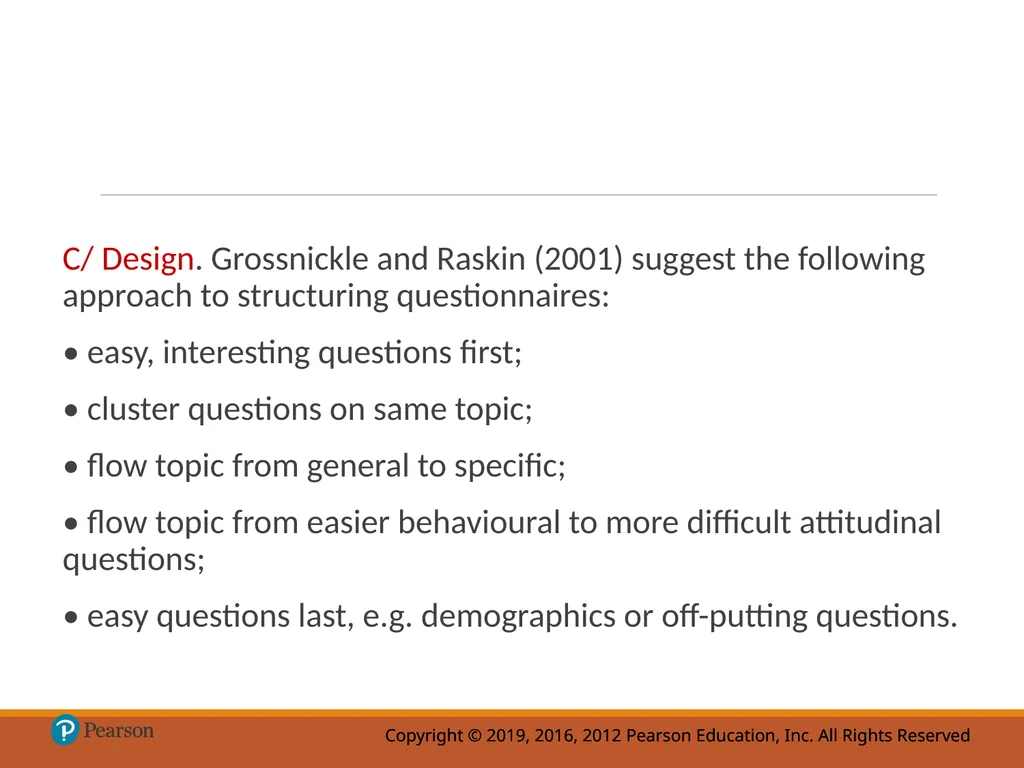
C/ Design. Grossnickle and Raskin (2001) suggest the following approach to structuring questionnaires:
• easy, interesting questions first;
• cluster questions on same topic;
• flow topic from general to specific;
• flow topic from easier behavioural to more difficult attitudinal questions;
• easy questions last, e.g. demographics or off-putting questions.<br>
• easy, interesting questions first;
• cluster questions on same topic;
• flow topic from general to specific;
• flow topic from easier behavioural to more difficult attitudinal questions;
• easy questions last, e.g. demographics or off-putting questions.<br>
26
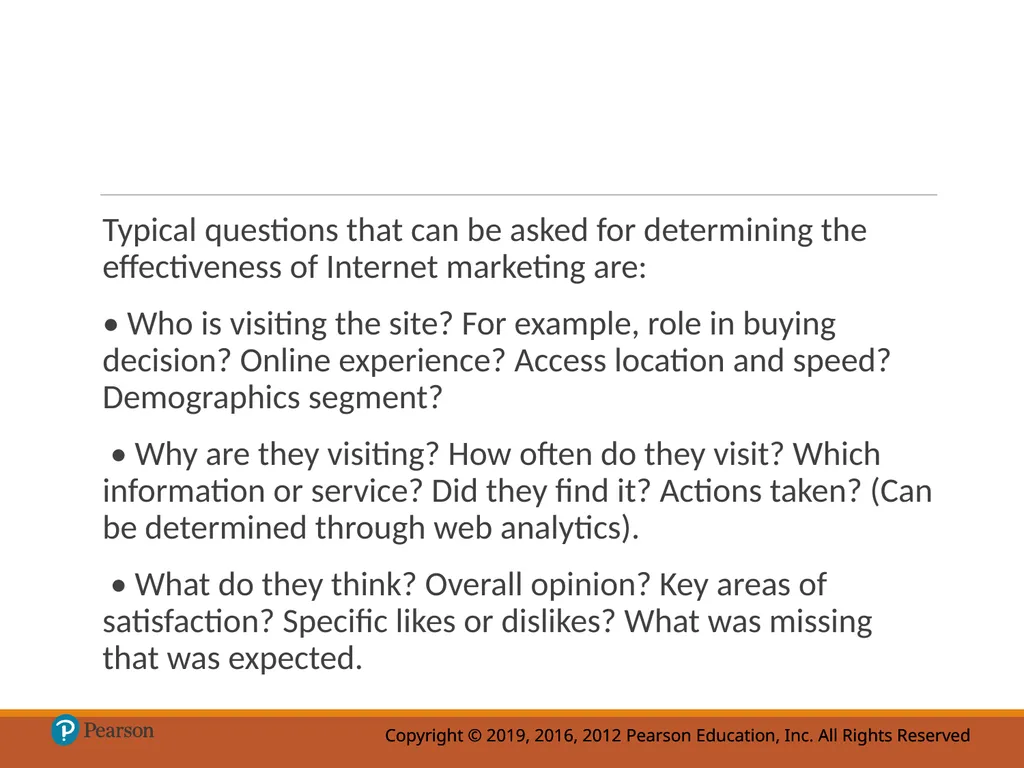
Typical questions that can be asked for determining the effectiveness of Internet marketing are:
• Who is visiting the site? For example, role in buying decision? Online experience? Access location and speed? Demographics segment?
• Why are they visiting? How often do they visit? Which information or service? Did they find it? Actions taken? (Can be determined through web analytics).
• What do they think? Overall opinion? Key areas of satisfaction? Specific likes or dislikes? What was missing that was expected.<br>
• Who is visiting the site? For example, role in buying decision? Online experience? Access location and speed? Demographics segment?
• Why are they visiting? How often do they visit? Which information or service? Did they find it? Actions taken? (Can be determined through web analytics).
• What do they think? Overall opinion? Key areas of satisfaction? Specific likes or dislikes? What was missing that was expected.<br>
27
Content management process The key to keeping a website dynamic is to have a clear content and communications strategy based on a regularly updated content or social hub.
The site and content update process should be understood by all staff contributing content to the site, with their responsibilities clearly identified in their job descriptions.<br>
The site and content update process should be understood by all staff contributing content to the site, with their responsibilities clearly identified in their job descriptions.<br>
28
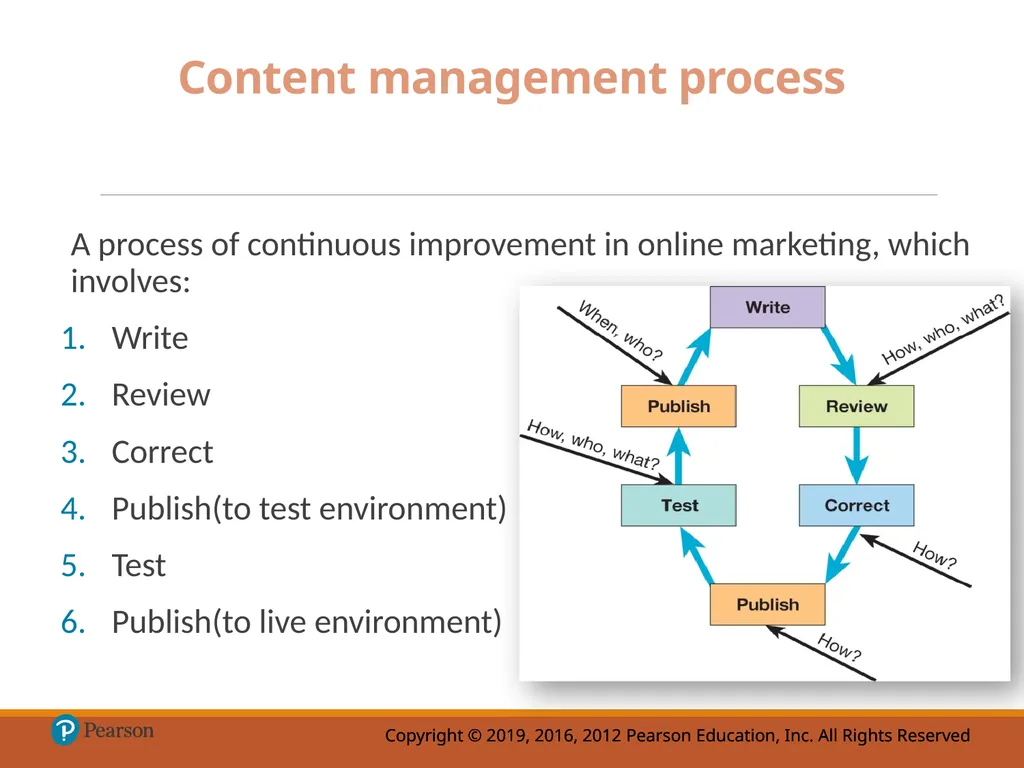
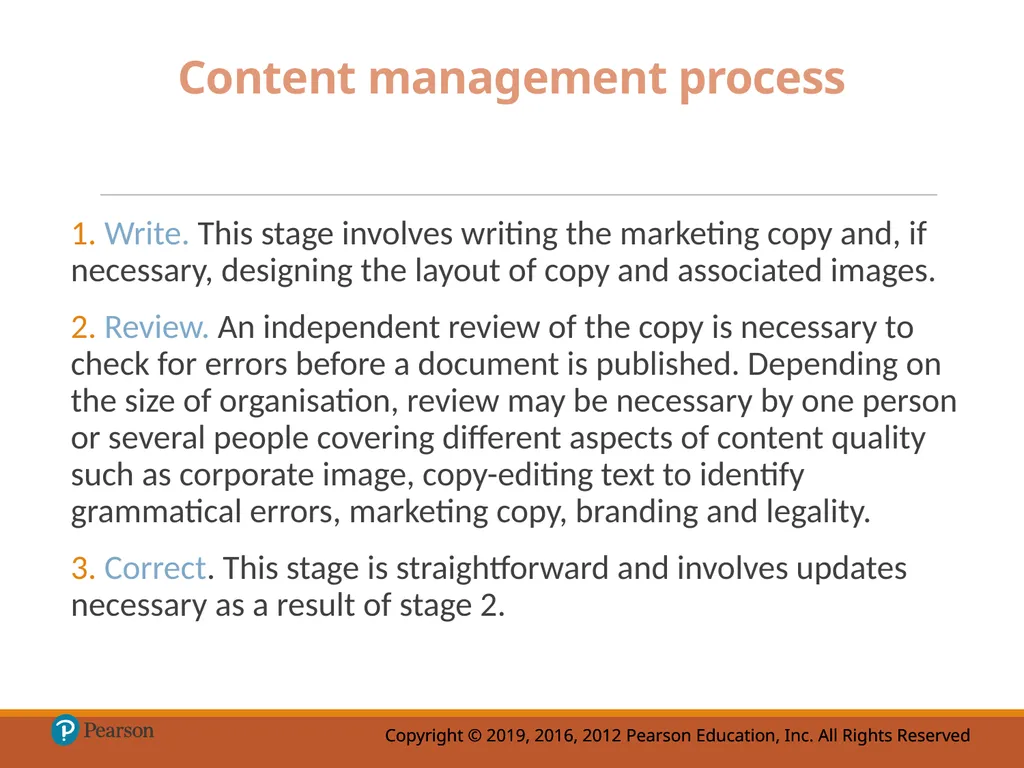
Content management process A process of continuous improvement in online marketing, which involves:
Write
Review
Correct
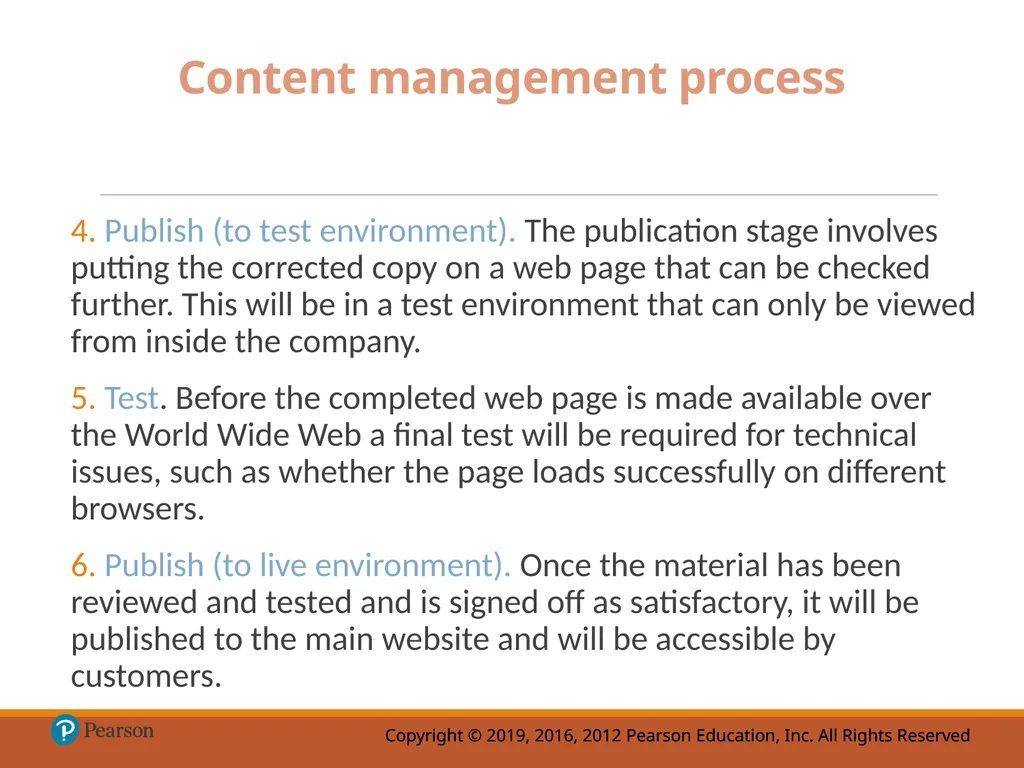
Publish(to test environment)
Test
Publish(to live environment)<br>
Write
Review
Correct
Publish(to test environment)
Test
Publish(to live environment)<br>
29
Content management process 1. Write. This stage involves writing the marketing copy and, if necessary, designing the layout of copy and associated images.
2. Review. An independent review of the copy is necessary to check for errors before a document is published. Depending on the size of organisation, review may be necessary by one person or several people covering different aspects of content quality such as corporate image, copy-editing text to identify grammatical errors, marketing copy, branding and legality.
3. Correct. This stage is straightforward and involves updates necessary as a result of stage 2.<br>
2. Review. An independent review of the copy is necessary to check for errors before a document is published. Depending on the size of organisation, review may be necessary by one person or several people covering different aspects of content quality such as corporate image, copy-editing text to identify grammatical errors, marketing copy, branding and legality.
3. Correct. This stage is straightforward and involves updates necessary as a result of stage 2.<br>
30
Content management process 4. Publish (to test environment). The publication stage involves putting the corrected copy on a web page that can be checked further. This will be in a test environment that can only be viewed from inside the company.
5. Test. Before the completed web page is made available over the World Wide Web a final test will be required for technical issues, such as whether the page loads successfully on different browsers.
6. Publish (to live environment). Once the material has been reviewed and tested and is signed off as satisfactory, it will be published to the main website and will be accessible by customers.<br>
5. Test. Before the completed web page is made available over the World Wide Web a final test will be required for technical issues, such as whether the page loads successfully on different browsers.
6. Publish (to live environment). Once the material has been reviewed and tested and is signed off as satisfactory, it will be published to the main website and will be accessible by customers.<br>
31
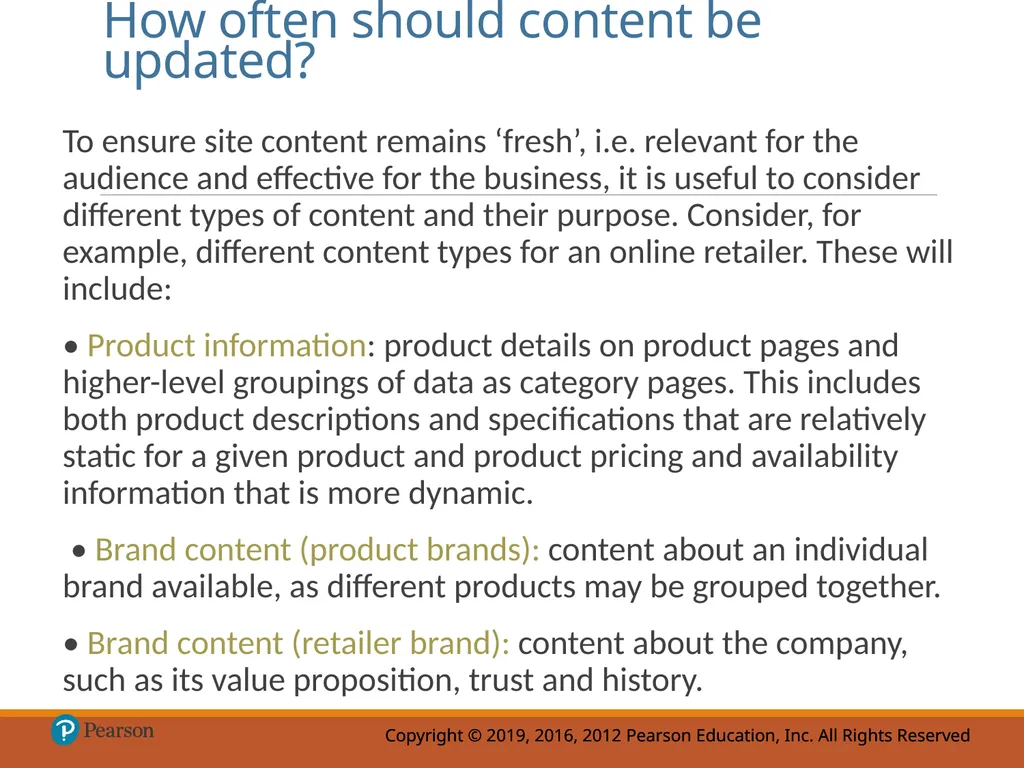
To ensure site content remains ‘fresh’, i.e. relevant for the audience and effective for the business, it is useful to consider different types of content and their purpose. Consider, for example, different content types for an online retailer. These will include:
• Product information: product details on product pages and higher-level groupings of data as category pages. This includes both product descriptions and specifications that are relatively static for a given product and product pricing and availability information that is more dynamic.
• Brand content (product brands): content about an individual brand available, as different products may be grouped together.
• Brand content (retailer brand): content about the company, such as its value proposition, trust and history. How often should content be updated?<br>
• Product information: product details on product pages and higher-level groupings of data as category pages. This includes both product descriptions and specifications that are relatively static for a given product and product pricing and availability information that is more dynamic.
• Brand content (product brands): content about an individual brand available, as different products may be grouped together.
• Brand content (retailer brand): content about the company, such as its value proposition, trust and history. How often should content be updated?<br>
32
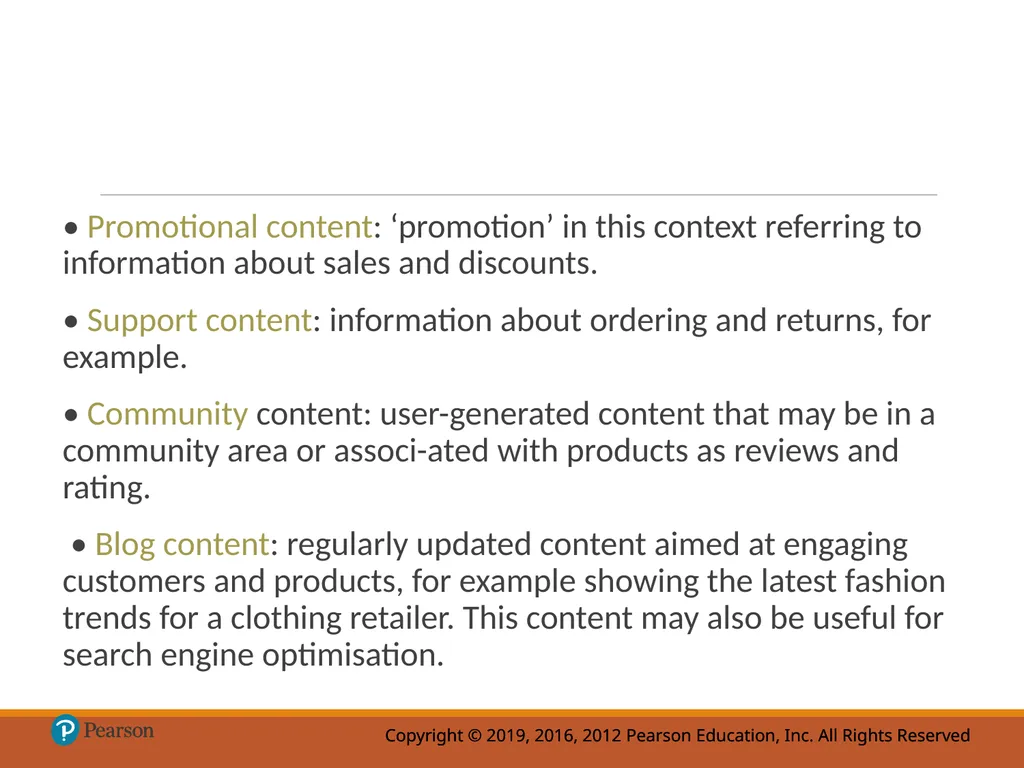
• Promotional content: ‘promotion’ in this context referring to information about sales and discounts.
• Support content: information about ordering and returns, for example.
• Community content: user-generated content that may be in a community area or associ-ated with products as reviews and rating.
• Blog content: regularly updated content aimed at engaging customers and products, for example showing the latest fashion trends for a clothing retailer. This content may also be useful for search engine optimisation.<br>
• Support content: information about ordering and returns, for example.
• Community content: user-generated content that may be in a community area or associ-ated with products as reviews and rating.
• Blog content: regularly updated content aimed at engaging customers and products, for example showing the latest fashion trends for a clothing retailer. This content may also be useful for search engine optimisation.<br>
33
As part of content marketing, which requires that existing businesses must act more like publishers, an editorial calendar.
Editorial calendar: A plan for scheduling the creation of new or updated content for different audiences to support business goals for new visitors or increased conversion as part of content marketing.<br>
Editorial calendar: A plan for scheduling the creation of new or updated content for different audiences to support business goals for new visitors or increased conversion as part of content marketing.<br>
34
Responsibilities for customer experience and site management Maintenance is relatively easy in a small company with a single person updating the website. Although they may be working on many tasks, one person is able to ensure that the style of the whole site remains consistent.
For a large organisation with many different departments and offices in different countries, site maintenance becomes very difficult, and production of a quality site is only possible when there is strong control to establish a team who all follow the same standards.
Sterne (2001) suggests that the essence of successful maintenance is to have clearly identified responsibilities for different aspects of updating the website. The questions to ask are: Who owns the process?
Who owns the content? Who owns the format?
Who owns the technology?<br>
For a large organisation with many different departments and offices in different countries, site maintenance becomes very difficult, and production of a quality site is only possible when there is strong control to establish a team who all follow the same standards.
Sterne (2001) suggests that the essence of successful maintenance is to have clearly identified responsibilities for different aspects of updating the website. The questions to ask are: Who owns the process?
Who owns the content? Who owns the format?
Who owns the technology?<br>
35
How will this process actually occur? The following process stages need to be followed:
1. Graduate reviews promotional literature and rewrites copy on a word processor and modifies graphical elements as appropriate for the website. This is the write stage .
2. Product and/or marketing manager reviews the revised web-based copy. This is part of the review stage .
3. Corporate communications manager reviews the copy for suitability. This is also part of the review stage .
4. Legal adviser reviews copy. This is also part of the review stage .
5. Copy revised and corrected and then re-reviewed as necessary. This is the correct stage .
6. Copy converted to web format and then published. This will be performed by a technical person such as a site developer. This is the first publish stage. Who owns the process?<br>
1. Graduate reviews promotional literature and rewrites copy on a word processor and modifies graphical elements as appropriate for the website. This is the write stage .
2. Product and/or marketing manager reviews the revised web-based copy. This is part of the review stage .
3. Corporate communications manager reviews the copy for suitability. This is also part of the review stage .
4. Legal adviser reviews copy. This is also part of the review stage .
5. Copy revised and corrected and then re-reviewed as necessary. This is the correct stage .
6. Copy converted to web format and then published. This will be performed by a technical person such as a site developer. This is the first publish stage. Who owns the process?<br>
36
7. The new copy on the site will be reviewed by the graduate for accuracy, and needs to be tested on different web browsers and screen resolutions if it uses a graphical design different from the standard site template. This type of technical testing will need to be carried out by the webmaster. The new version could also be reviewed on the site by the communications manager or legal adviser at this point. This is part of the test stage .
8. Once all interested parties agree the new copy is suitable, the pages on the test website can be transferred to the live website and are then available for customers to view. This is the second publish stage.<br>
8. Once all interested parties agree the new copy is suitable, the pages on the test website can be transferred to the live website and are then available for customers to view. This is the second publish stage.<br>
37
For a medium-to-large site where the content is updated regularly, it will soon become impossible for one person to update all the content. It is logical and practical to distribute the responsibility for owning and developing different sections of the site to the people in an organisation who have the best skills and knowledge to develop that content.
Content developer: A person responsible for updating web pages within part of an organisation. Who owns the content?<br>
Content developer: A person responsible for updating web pages within part of an organisation. Who owns the content?<br>
38
The format refers to different aspects of the design and layout of the site, commonly referred to as its ‘look and feel’.
The key aim is consistency of format across the whole website. For a large corporate site, with different staff working on different parts of the site, there is a risk that the different areas of the site will not be consistent.
Defining a clear format or site design templates for the different page or content types means that the quality of the site and customer experience will be better:
• The site will be easier to use.
• The design elements of the site will be similar.
• The corporate image and branding will be consistent.
Site design template(s): A standard page layout format that is applied to each page of a website for particular page types, e.g. category pages, product or blog pages. Who owns the format?<br>
The key aim is consistency of format across the whole website. For a large corporate site, with different staff working on different parts of the site, there is a risk that the different areas of the site will not be consistent.
Defining a clear format or site design templates for the different page or content types means that the quality of the site and customer experience will be better:
• The site will be easier to use.
• The design elements of the site will be similar.
• The corporate image and branding will be consistent.
Site design template(s): A standard page layout format that is applied to each page of a website for particular page types, e.g. category pages, product or blog pages. Who owns the format?<br>
39
There are detailed technical issues for which the technical staff in the company need to be made responsible. These include:
• availability and performance of the website server;
• checking HTML for validity and correcting broken links;
• managing different versions of web pages in the test and live environments and content management. Who owns the technology?<br>
• availability and performance of the website server;
• checking HTML for validity and correcting broken links;
• managing different versions of web pages in the test and live environments and content management. Who owns the technology?<br>