
CHAPTER 11 Decontamination Learning Objectives
CS
Published · 73 slides · 0 views
1 / 1









Description
CHAPTER 11 Decontamination Learning Objectives Overview Knowledge Objectives Skills Objectives Introduction (1 of 2) Proper decon is essential to safety. Decon methods and procedures must be considered early in the incident. Introduction (2
Related Topics
Share
Embed code
Download this presentation From Below
"CHAPTER 11 Decontamination Learning Objectives" is the property of its rightful owner. Permission is granted to download and print the materials on this website for personal, non-commercial use only, and to display it on your personal computer provided you do not modify the materials and that you retain all copyright notices contained in the materials. By downloading content from our website, you accept the terms of this agreement.
Presentation Transcript
01
CHAPTER 11
Decontamination<br>
Decontamination<br>
02
Learning Objectives Overview Knowledge Objectives
Skills Objectives<br>
Skills Objectives<br>
03
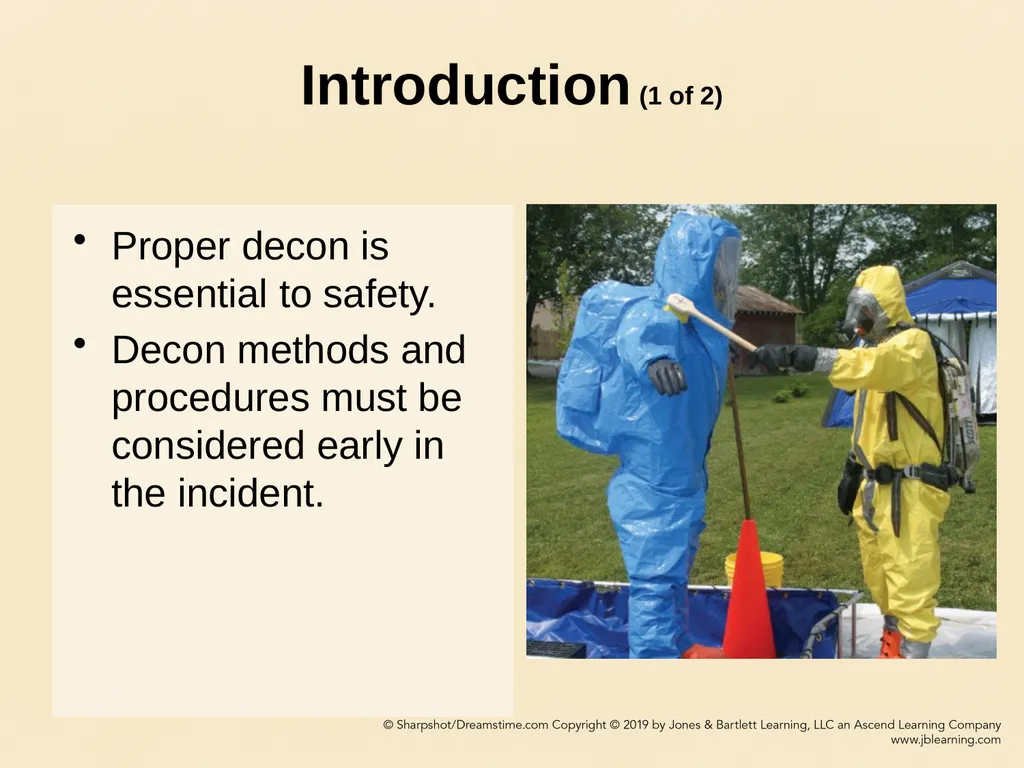
Introduction (1 of 2) Proper decon is essential to safety.
Decon methods and procedures must be considered early in the incident.<br>
Decon methods and procedures must be considered early in the incident.<br>
04
Introduction (2 of 2) The basic principles of decontamination are simple and have not changed much over time.
Decon needs to be an adaptive and flexible process.
The hazards and risks of the incident will define the scope, nature, and complexity of decon operations.<br>
Decon needs to be an adaptive and flexible process.
The hazards and risks of the incident will define the scope, nature, and complexity of decon operations.<br>
05
Basic Principles of
Decontamination Decontamination basically involves the physical removal of contaminants.
Decon of victims in the field speeds up the process of patient care.
Decontamination should be directed toward confinement of the contaminant within the hot zone.
The first rule of decontamination is to avoid contamination.<br>
Decon of victims in the field speeds up the process of patient care.
Decontamination should be directed toward confinement of the contaminant within the hot zone.
The first rule of decontamination is to avoid contamination.<br>
06
Terminology and Definitions
(1 of 3) ALARA
Contaminant
Contamination
Exposure
Decontamination officer
Decontamination<br>
Contaminant
Contamination
Exposure
Decontamination officer
Decontamination<br>
07
Terminology and Definitions
(2 of 3) Degradation
Disinfection
Sterilization
Safe refuge area
Decontamination team
Decontamination corridor<br>
Disinfection
Sterilization
Safe refuge area
Decontamination team
Decontamination corridor<br>
08
Terminology and Definitions
(3 of 3) Phases and methods of decon includes:
Gross decontamination
Secondary decontamination
Emergency decontamination
Technical decontamination
Mass decontamination<br>
Gross decontamination
Secondary decontamination
Emergency decontamination
Technical decontamination
Mass decontamination<br>
09
Understanding the Basics of
Contamination Four basic concepts of contamination include:
How to prevent contamination
Surface versus permeation contamination
Direct versus cross-contamination
Types of contaminants<br>
How to prevent contamination
Surface versus permeation contamination
Direct versus cross-contamination
Types of contaminants<br>
10
Preventing Contamination
(1 of 4) Emergency responders sometimes get the terms “contamination” and “exposure” confused.
Contamination is any form of hazardous material (solid, liquid, or gas) that physically remains on people, animals, or objects.
Exposure occurs when a toxic substance or harmful physical agent enters into the body through any route of entry.<br>
Contamination is any form of hazardous material (solid, liquid, or gas) that physically remains on people, animals, or objects.
Exposure occurs when a toxic substance or harmful physical agent enters into the body through any route of entry.<br>
11
Preventing Contamination
(2 of 4) Basic principles to prevent contamination:
Stress work practices that minimize contact.
Move contaminated personnel to a safe refuge area within the hot zone until they can be decontaminated.
Keep your respiratory protection on as long as possible during the decon process.
Once you have unzipped your chemical protective clothing, be aware of where your hands go and what they touch.<br>
Stress work practices that minimize contact.
Move contaminated personnel to a safe refuge area within the hot zone until they can be decontaminated.
Keep your respiratory protection on as long as possible during the decon process.
Once you have unzipped your chemical protective clothing, be aware of where your hands go and what they touch.<br>
12
Preventing Contamination
(3 of 4) Basic principles to prevent contamination:
Use of limited-use/disposable protective clothing or overgarments can significantly lighten your decon requirements.
Use a systematic approach to decon.
When performing decontamination duties, remember to “do unto others as you would like them to do unto you.”
Be methodical and don’t skip steps.<br>
Use of limited-use/disposable protective clothing or overgarments can significantly lighten your decon requirements.
Use a systematic approach to decon.
When performing decontamination duties, remember to “do unto others as you would like them to do unto you.”
Be methodical and don’t skip steps.<br>
13
Preventing Contamination
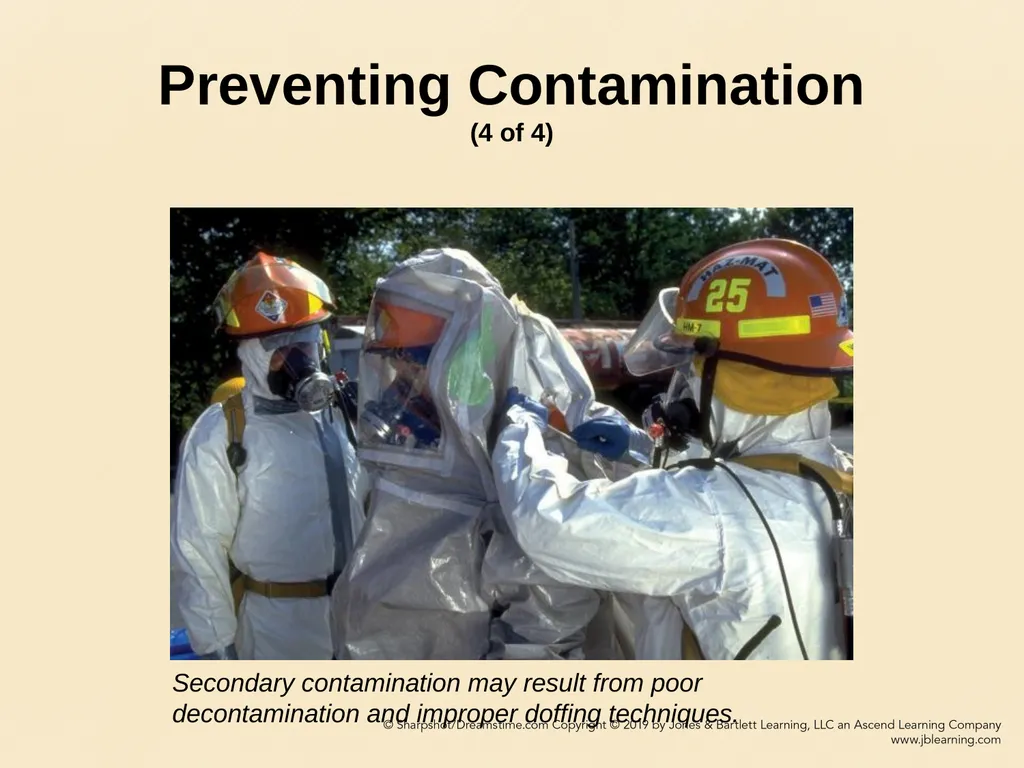
(4 of 4) Secondary contamination may result from poor decontamination and improper doffing techniques.<br>
14
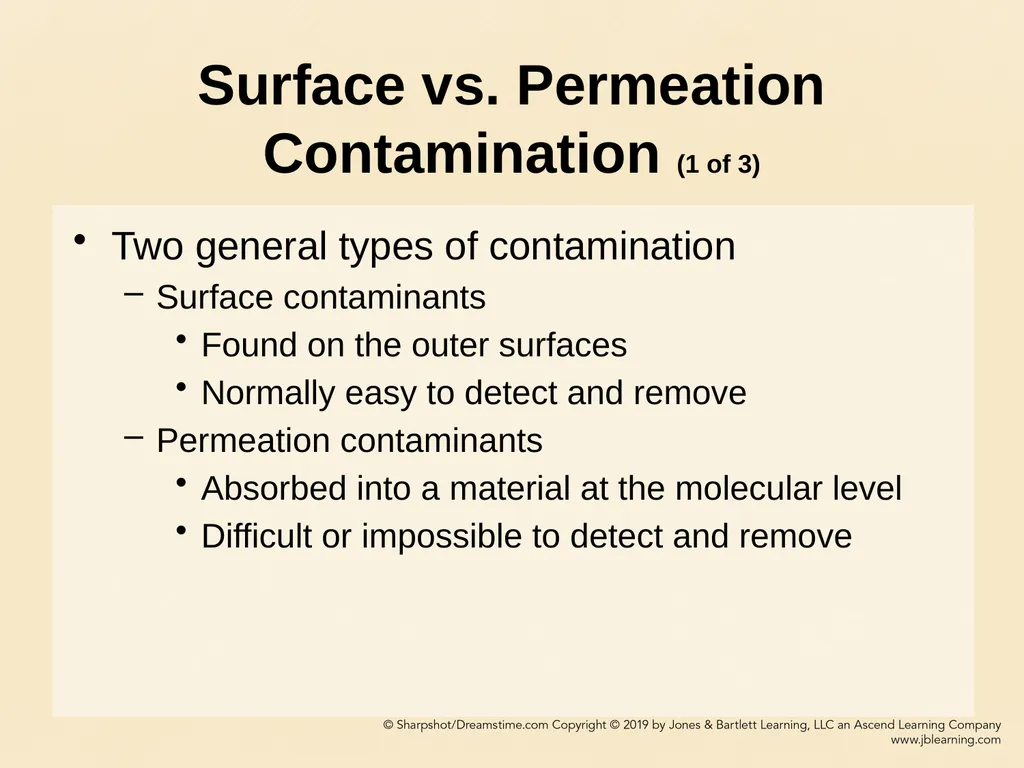
Surface vs. Permeation
Contamination (1 of 3) Two general types of contamination
Surface contaminants
Found on the outer surfaces
Normally easy to detect and remove
Permeation contaminants
Absorbed into a material at the molecular level
Difficult or impossible to detect and remove<br>
Surface contaminants
Found on the outer surfaces
Normally easy to detect and remove
Permeation contaminants
Absorbed into a material at the molecular level
Difficult or impossible to detect and remove<br>
15
Surface vs. Permeation
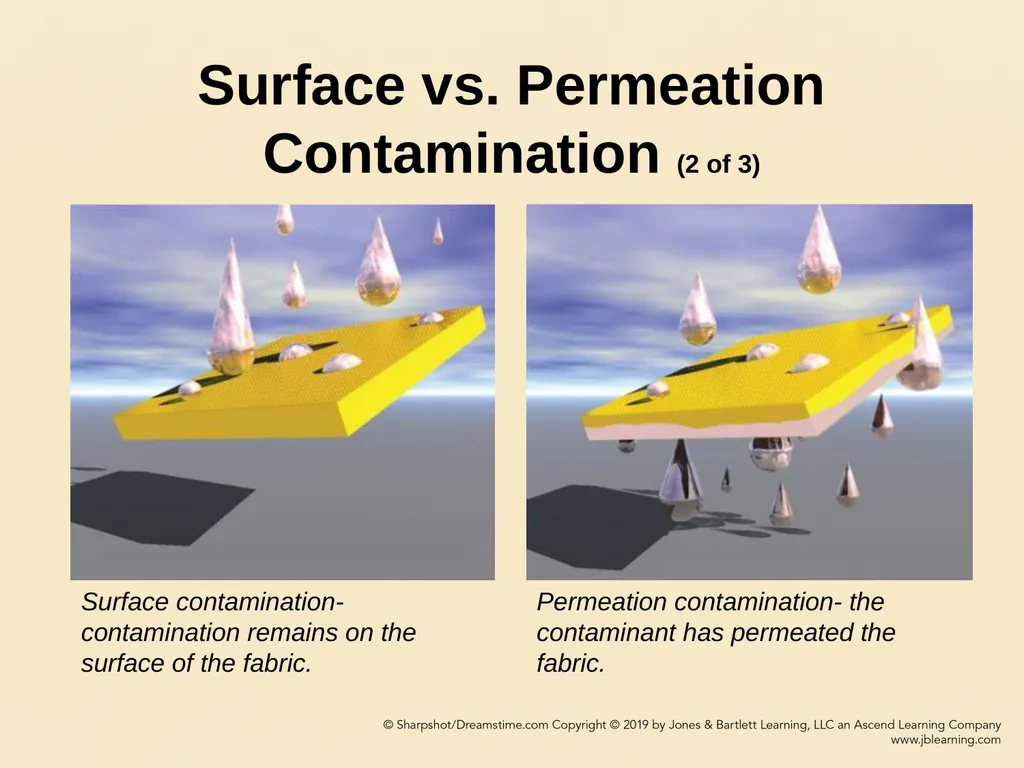
Contamination (2 of 3) Surface contamination- contamination remains on the surface of the fabric. Permeation contamination- the contaminant has permeated the fabric.<br>
16
Surface vs. Permeation
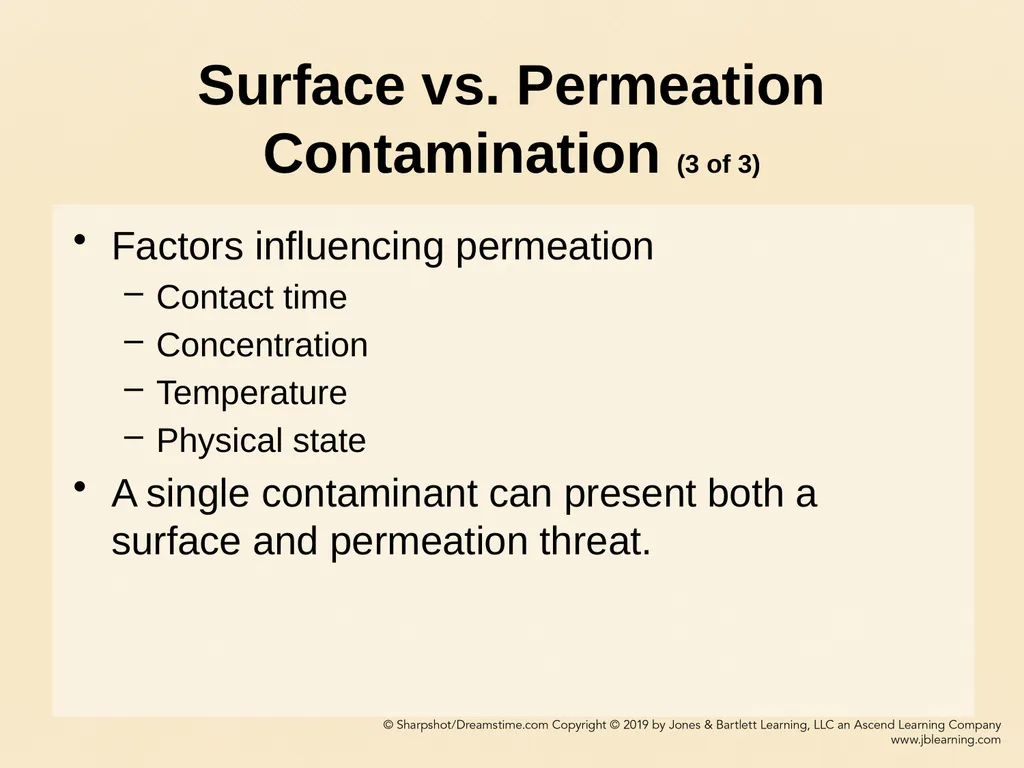
Contamination (3 of 3) Factors influencing permeation
Contact time
Concentration
Temperature
Physical state
A single contaminant can present both a surface and permeation threat.<br>
Contact time
Concentration
Temperature
Physical state
A single contaminant can present both a surface and permeation threat.<br>
17
Direct vs. Cross-Contamination
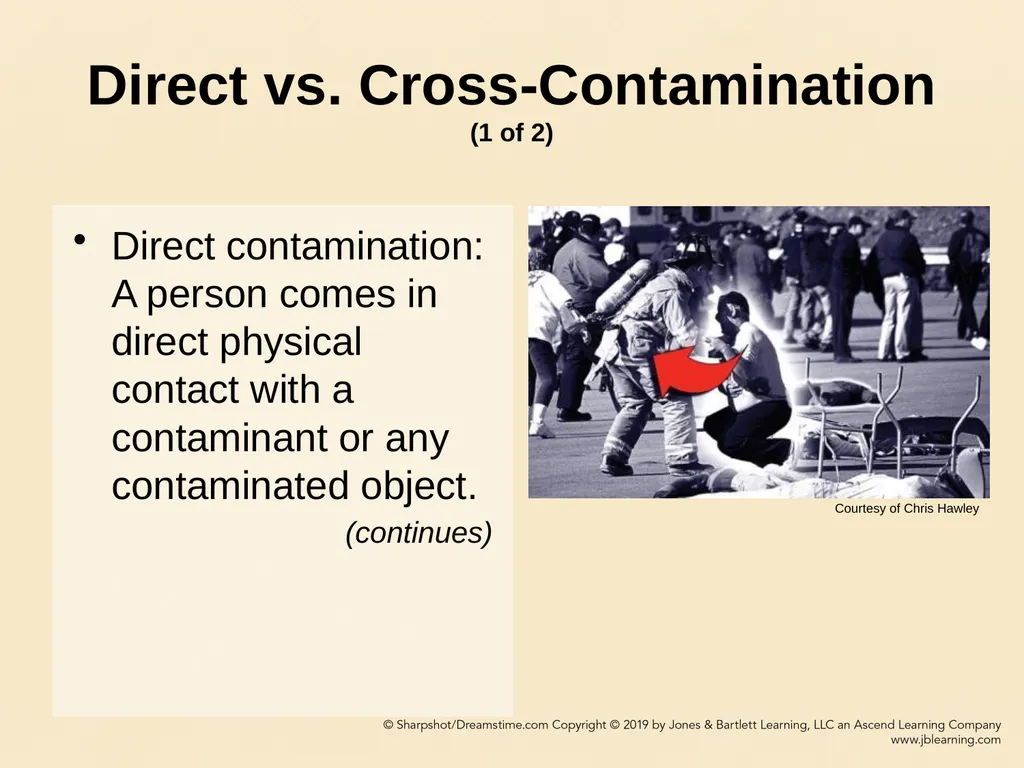
(1 of 2) Direct contamination: A person comes in direct physical contact with a contaminant or any contaminated object.
(continues) Courtesy of Chris Hawley<br>
(continues) Courtesy of Chris Hawley<br>
18
Direct vs. Cross-Contamination
(2 of 2) Direct contamination (cont’d):
Secondary (cross) contamination: A contaminated person makes contact with a person or object that was not previously contaminated.<br>
Secondary (cross) contamination: A contaminated person makes contact with a person or object that was not previously contaminated.<br>
19
Types of
Contaminants (1 of 4) Types of contaminants based on their primary hazards:
High−acute toxicity contaminants
Moderate-to-highly chronic toxicity contaminants
Embryotoxic contaminants
Allergenic contaminants<br>
High−acute toxicity contaminants
Moderate-to-highly chronic toxicity contaminants
Embryotoxic contaminants
Allergenic contaminants<br>
20
Types of
Contaminants (2 of 4) Types of contaminants based on their primary hazards:
Flammable contaminants
Highly reactive or explosive contaminants
Water-reactive contaminants
Etiologic contaminants
Radioactive contaminants<br>
Flammable contaminants
Highly reactive or explosive contaminants
Water-reactive contaminants
Etiologic contaminants
Radioactive contaminants<br>
21
Types of
Contaminants (3 of 4) Four factors influence an etiologic or biological material’s ability to invade and alter the human body:
Virulence
Dose
Physical environment
Personal health status<br>
Virulence
Dose
Physical environment
Personal health status<br>
22
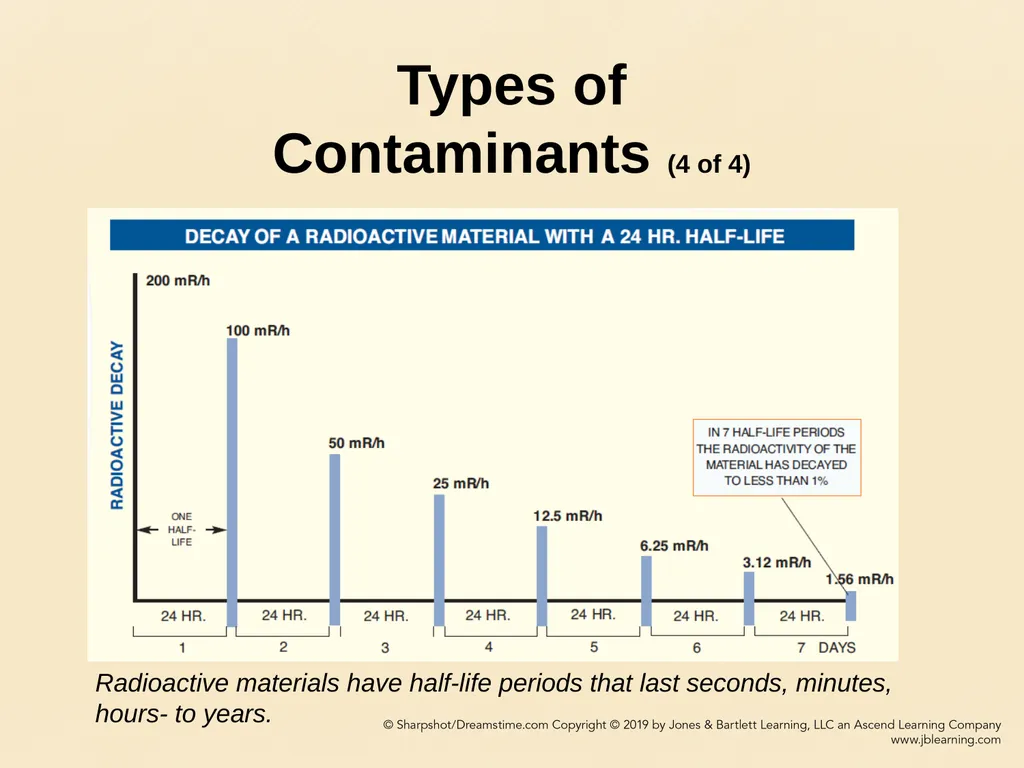
Radioactive materials have half-life periods that last seconds, minutes, hours- to years. Types of
Contaminants (4 of 4)<br>
23
Decontamination Methods
(1 of 3) There is no universal decon method that will work for every hazmat incident.
Decontamination methods can be divided into two basic categories:
Physical
Chemical<br>
Decontamination methods can be divided into two basic categories:
Physical
Chemical<br>
24
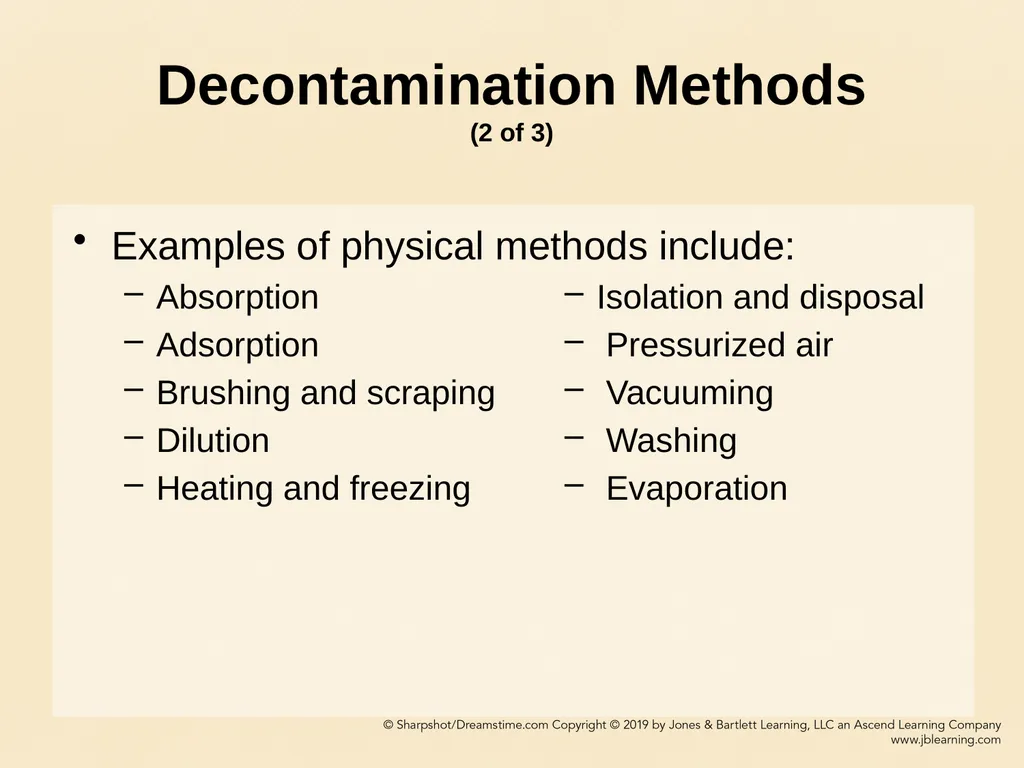
Examples of physical methods include: Decontamination Methods
(2 of 3) Absorption
Adsorption
Brushing and scraping
Dilution
Heating and freezing
Isolation and disposal
Pressurized air
Vacuuming
Washing
Evaporation<br>
Adsorption
Brushing and scraping
Dilution
Heating and freezing
Isolation and disposal
Pressurized air
Vacuuming
Washing
Evaporation<br>
25
Decontamination Methods
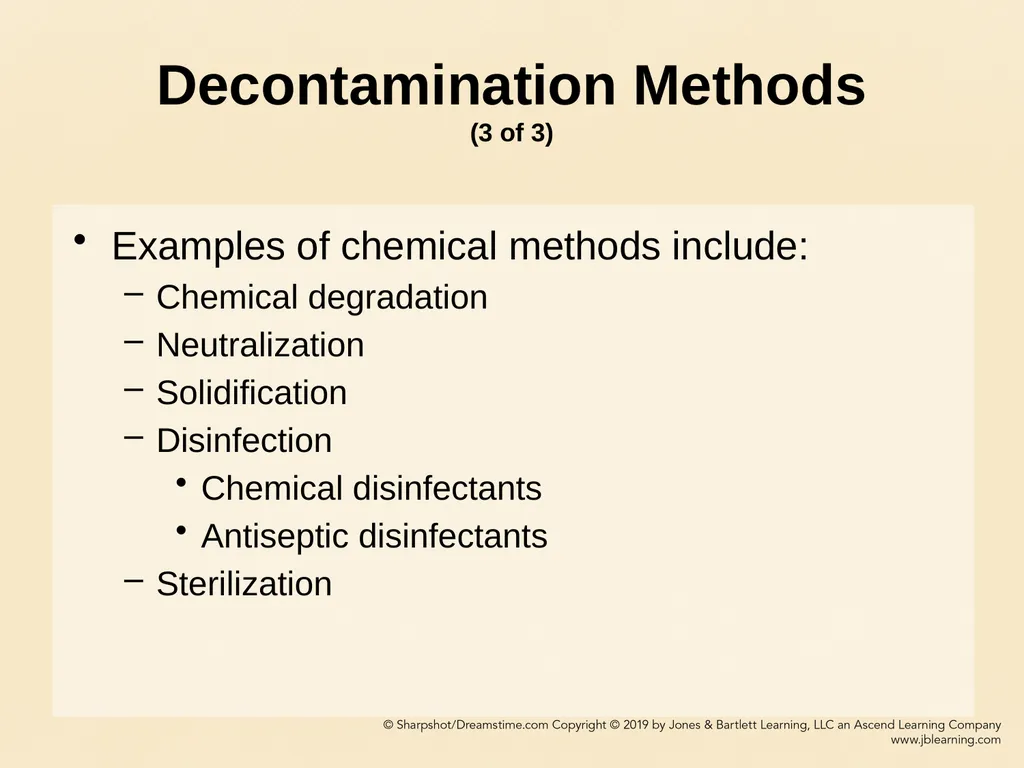
(3 of 3) Examples of chemical methods include:
Chemical degradation
Neutralization
Solidification
Disinfection
Chemical disinfectants
Antiseptic disinfectants
Sterilization<br>
Chemical degradation
Neutralization
Solidification
Disinfection
Chemical disinfectants
Antiseptic disinfectants
Sterilization<br>
26
Evaluating the Effectiveness of
Decon Operations (1 of 2) Five simple criteria can be used for evaluating decon effectiveness:
No personnel are exposed to concentrations above the TLV/TWA.
Personnel are not exposed to skin contact with materials presenting a skin hazard.
Contamination levels are reduced as personnel move through the decon corridor.
Contamination is confined to the hot zone and decon corridor.
Contamination is reduced to a level of ALARA.<br>
No personnel are exposed to concentrations above the TLV/TWA.
Personnel are not exposed to skin contact with materials presenting a skin hazard.
Contamination levels are reduced as personnel move through the decon corridor.
Contamination is confined to the hot zone and decon corridor.
Contamination is reduced to a level of ALARA.<br>
27
Evaluating the Effectiveness of
Decon Operations (2 of 2) Methods for assessing the effectiveness of decontamination include:
Visual observation
Monitoring devices
Wipe sampling<br>
Visual observation
Monitoring devices
Wipe sampling<br>
28
Decon Site Selection and
Management (1 of 2) Hazmat group supervisor and the decon leader must decide:
How much and what decon method is required
To what extent decon will be accomplished in the field<br>
How much and what decon method is required
To what extent decon will be accomplished in the field<br>
29
Decon Site Selection and
Management (2 of 2) Decon decisions should be based on the answers to the following questions:
Can decon be conducted safely?
Are existing resources immediately available to decon personnel and equipment?
If not, where can they be obtained, and how long will it take to get them?
Can the equipment used be decontaminated?<br>
Can decon be conducted safely?
Are existing resources immediately available to decon personnel and equipment?
If not, where can they be obtained, and how long will it take to get them?
Can the equipment used be decontaminated?<br>
30
The Decontamination Team
(1 of 2) The decon team’s functions include:
Research and development of the decon plan
Set-up and operation of an effective decontamination area
If necessary, coordinate the establishment of a safe refuge area<br>
Research and development of the decon plan
Set-up and operation of an effective decontamination area
If necessary, coordinate the establishment of a safe refuge area<br>
31
The Decontamination Team
(2 of 2) The decon leader and members should be trained to the NFPA 472 hazardous materials technician level.
The decon leader should use a formal checklist to ensure that important items are not overlooked.<br>
The decon leader should use a formal checklist to ensure that important items are not overlooked.<br>
32
Decon Site Selection
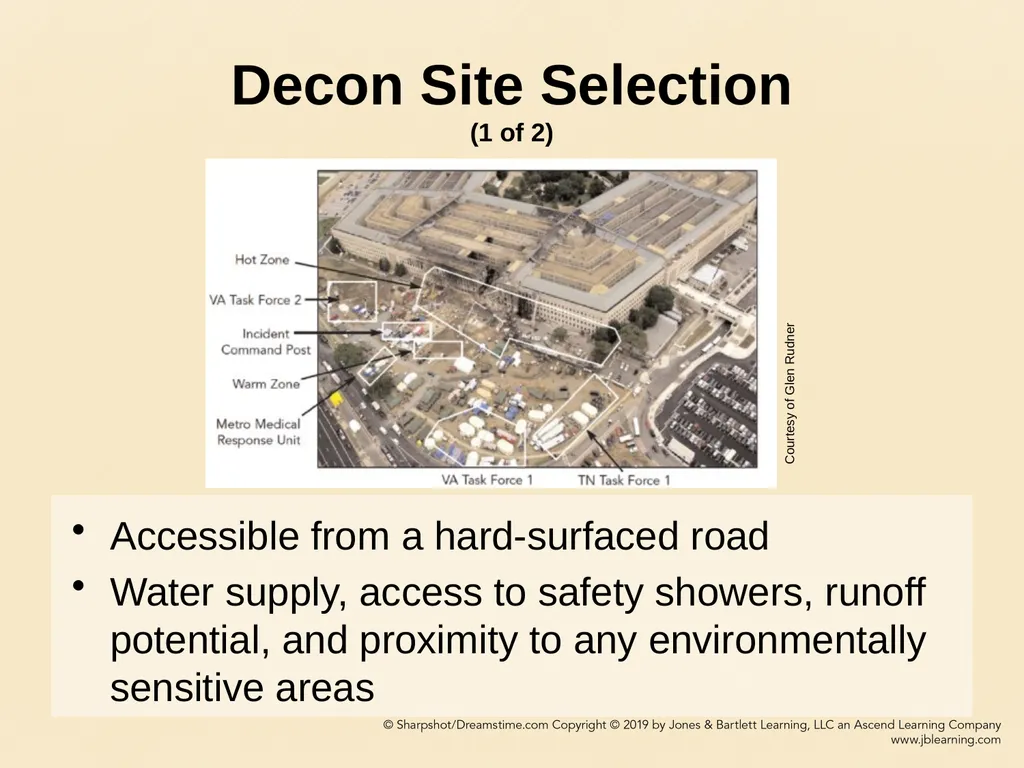
(1 of 2) Accessible from a hard-surfaced road
Water supply, access to safety showers, runoff potential, and proximity to any environmentally sensitive areas Courtesy of Glen Rudner<br>
Water supply, access to safety showers, runoff potential, and proximity to any environmentally sensitive areas Courtesy of Glen Rudner<br>
33
Decon Site Selection
(2 of 2) Upwind and uphill from the incident
Remote from drains, manholes, and waterways
Close enough to the scene to limit the spread of contaminants<br>
Remote from drains, manholes, and waterways
Close enough to the scene to limit the spread of contaminants<br>
34
Decontamination Corridor
(1 of 2) The decon corridor is a pathway from the hot zone into the decon area, with the exit point near the warm zone/cold zone interface.
Decon area should be clearly identified.
Some incidents will require multiple decon corridors.<br>
Decon area should be clearly identified.
Some incidents will require multiple decon corridors.<br>
35
Decontamination Corridor
(2 of 2) The decon area should be organized with clear entry and exit areas for the technical decon corridor.<br>
36
Staffing and Personal Protection
of the Decon Team (1 of 3) Decon is a labor-intensive operation.
The level of skin and respiratory protection required by decon team members will be dependent upon:
The type of contaminants involved
The level of contamination encountered by entry personnel
Where individuals are working along the decon line<br>
The level of skin and respiratory protection required by decon team members will be dependent upon:
The type of contaminants involved
The level of contamination encountered by entry personnel
Where individuals are working along the decon line<br>
37
Staffing and Personal Protection
of the Decon Team (2 of 3) Tactical and safety considerations will include the following:
Team dressed and equipped based on the hazards and risks of the contaminants they will be decontaminating
The most common level of protection is Level B clothing and self-contained breathing apparatus.
Extended entry operations will require an uninterrupted air supply.<br>
Team dressed and equipped based on the hazards and risks of the contaminants they will be decontaminating
The most common level of protection is Level B clothing and self-contained breathing apparatus.
Extended entry operations will require an uninterrupted air supply.<br>
38
Staffing and Personal Protection
of the Decon Team (3 of 3) Tactical and safety considerations will include the following:
Respiratory protection may be downgraded to PAPRs or APRs along with air monitoring.
All decon team personnel must be decontaminated before leaving the decon area.<br>
Respiratory protection may be downgraded to PAPRs or APRs along with air monitoring.
All decon team personnel must be decontaminated before leaving the decon area.<br>
39
Types of Field Decontamination:
Basic Concepts (1 of 2) Decon basic principles:
Contaminated people and equipment generally flow from the dirty end to the clean end.
Decontamination requires a multiple-step process to reduce contaminants to an acceptable level.<br>
Contaminated people and equipment generally flow from the dirty end to the clean end.
Decontamination requires a multiple-step process to reduce contaminants to an acceptable level.<br>
40
Types of Field Decontamination:
Basic Concepts (2 of 2) Multistep decon operations can be broken into two broad phases:
Gross decon
The initial phase in the decon process
Secondary decon
Designed to physically or chemically remove surface contaminants to a safe and acceptable level<br>
Gross decon
The initial phase in the decon process
Secondary decon
Designed to physically or chemically remove surface contaminants to a safe and acceptable level<br>
41
Decon Information
Sources Sources for determining the appropriate decon methods include the following:
Product specialists representing the chemical manufacturer
Technical information specialists
Technical information centers
Safety data sheets (SDSs)
Emergency response references<br>
Product specialists representing the chemical manufacturer
Technical information specialists
Technical information centers
Safety data sheets (SDSs)
Emergency response references<br>
42
Types of Field
Decontamination (1 of 2) Types of decontamination may be required based on:
The nature of the problem
The urgency of the situation
The number of people contaminated
The scope of the contamination
The hazards and risks of the contaminants<br>
The nature of the problem
The urgency of the situation
The number of people contaminated
The scope of the contamination
The hazards and risks of the contaminants<br>
43
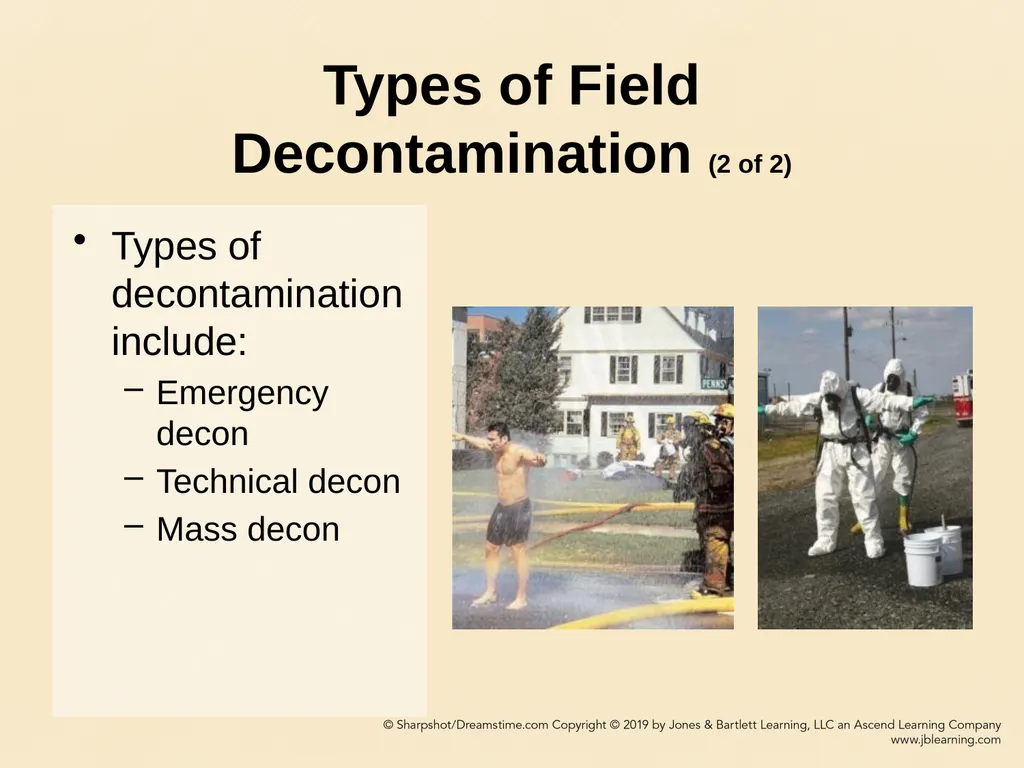
Types of decontamination include:
Emergency decon
Technical decon
Mass decon Types of Field Decontamination (2 of 2)<br>
Emergency decon
Technical decon
Mass decon Types of Field Decontamination (2 of 2)<br>
44
Emergency
Decontamination Key points:
Establish an area of refuge as soon as possible.
Establish a gross decon area using some form of water.
Remove any contaminated clothing.
If time allows, construct a basin or use a place that will hold the runoff.
Graded on speed, not neatness
Provide emergency medical care for victims.<br>
Establish an area of refuge as soon as possible.
Establish a gross decon area using some form of water.
Remove any contaminated clothing.
If time allows, construct a basin or use a place that will hold the runoff.
Graded on speed, not neatness
Provide emergency medical care for victims.<br>
45
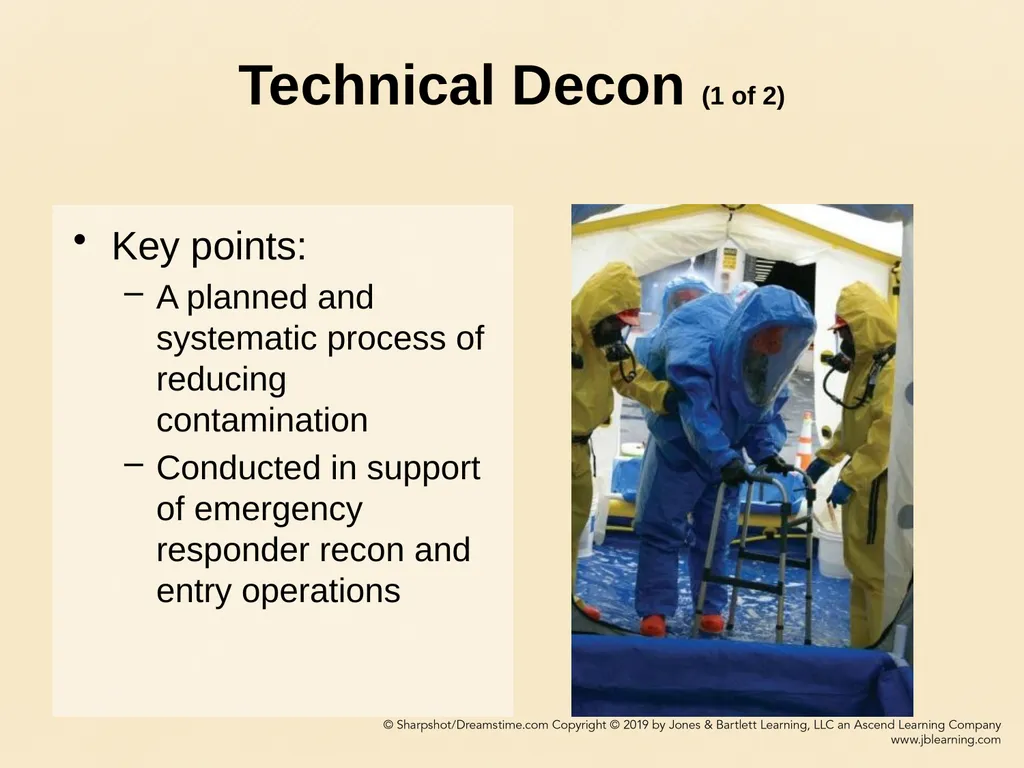
Technical Decon (1 of 2) Key points:
A planned and systematic process of reducing contamination
Conducted in support of emergency responder recon and entry operations<br>
A planned and systematic process of reducing contamination
Conducted in support of emergency responder recon and entry operations<br>
46
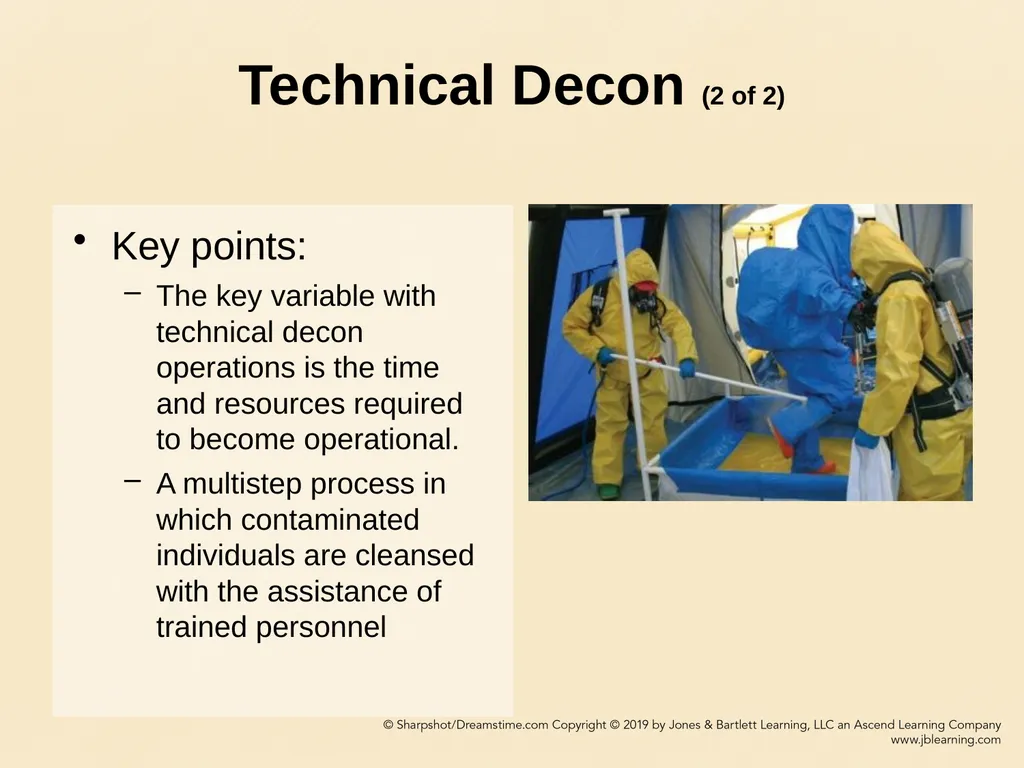
Technical Decon (2 of 2) Key points:
The key variable with technical decon operations is the time and resources required to become operational.
A multistep process in which contaminated individuals are cleansed with the assistance of trained personnel<br>
The key variable with technical decon operations is the time and resources required to become operational.
A multistep process in which contaminated individuals are cleansed with the assistance of trained personnel<br>
47
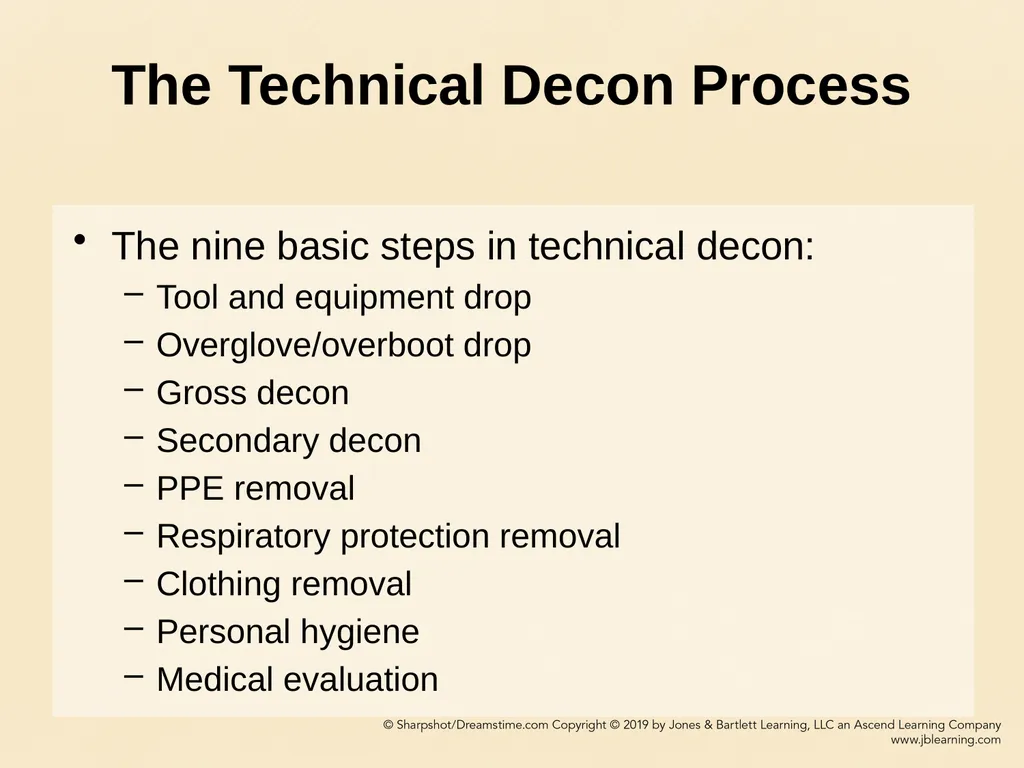
The Technical Decon Process The nine basic steps in technical decon:
Tool and equipment drop
Overglove/overboot drop
Gross decon
Secondary decon
PPE removal
Respiratory protection removal
Clothing removal
Personal hygiene
Medical evaluation<br>
Tool and equipment drop
Overglove/overboot drop
Gross decon
Secondary decon
PPE removal
Respiratory protection removal
Clothing removal
Personal hygiene
Medical evaluation<br>
48
Mass Decontamination (1 of 3) Established when large numbers of people need to be decontaminated
Mass decon is a gross decontamination process.
Relies on the use of water or soap and water solutions<br>
Mass decon is a gross decontamination process.
Relies on the use of water or soap and water solutions<br>
49
Mass Decontamination (2 of 3) Mass decon operations basic principles:
Removing clothing can remove the majority of the contaminants.
Can account for the removal of up to 80% of the contaminant
Flushing a victim with a low-pressure/high-volume water shower will remove additional amounts of the contaminant.
Optimal operating pressures 30 to 50 psi, with average flows of 150 gpm per nozzle<br>
Removing clothing can remove the majority of the contaminants.
Can account for the removal of up to 80% of the contaminant
Flushing a victim with a low-pressure/high-volume water shower will remove additional amounts of the contaminant.
Optimal operating pressures 30 to 50 psi, with average flows of 150 gpm per nozzle<br>
50
Mass Decontamination (3 of 3) Mass decon operations basic principles:
Water flushing methods include following:
Handlines or master fog streams from fire engines or aerial devices
Use of portable shower set-ups
Use of indoor or outdoor swimming pools
The use of sprinkler heads in a building
Multiple bathroom showers<br>
Water flushing methods include following:
Handlines or master fog streams from fire engines or aerial devices
Use of portable shower set-ups
Use of indoor or outdoor swimming pools
The use of sprinkler heads in a building
Multiple bathroom showers<br>
51
It’s All about People Greatest mass decon challenge is the management and control of people
Lessons learned:
Timing is everything!
Law enforcement will play a key role.
Establishing a safe refuge area and maintaining effective site management and control will be critical.
Psychology will play a major factor in a mass decon scenario.
Quick air monitoring and detection is crucial.<br>
Lessons learned:
Timing is everything!
Law enforcement will play a key role.
Establishing a safe refuge area and maintaining effective site management and control will be critical.
Psychology will play a major factor in a mass decon scenario.
Quick air monitoring and detection is crucial.<br>
52
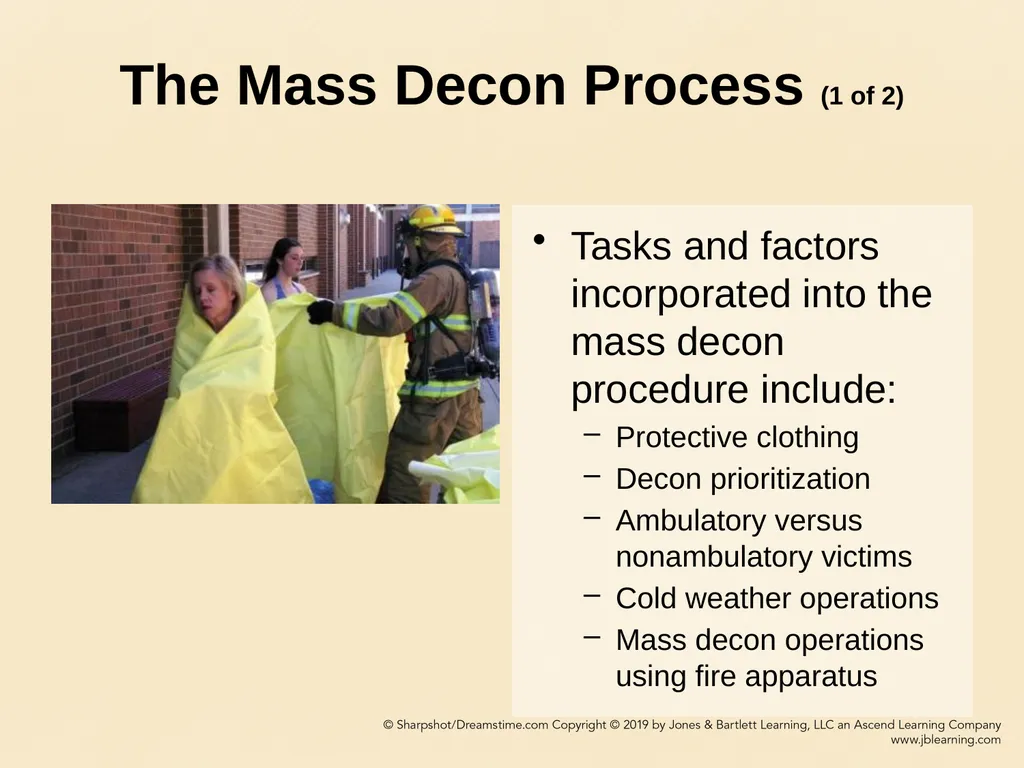
The Mass Decon Process (1 of 2) Tasks and factors incorporated into the mass decon procedure include:
Protective clothing
Decon prioritization
Ambulatory versus nonambulatory victims
Cold weather operations
Mass decon operations using fire apparatus<br>
Protective clothing
Decon prioritization
Ambulatory versus nonambulatory victims
Cold weather operations
Mass decon operations using fire apparatus<br>
53
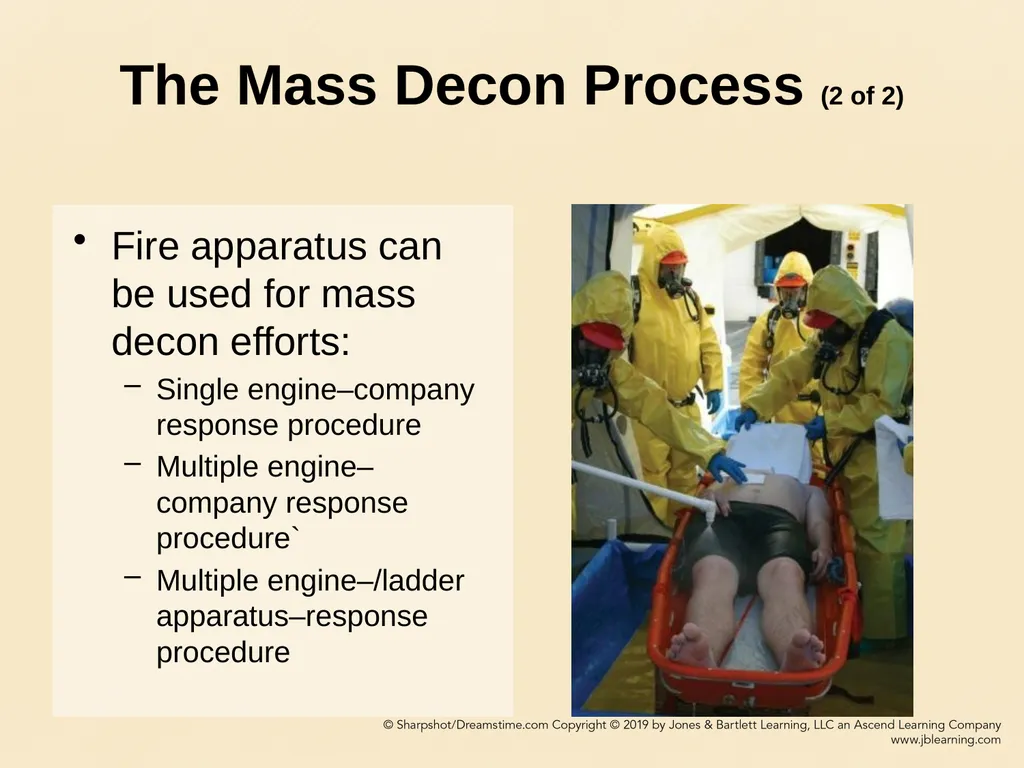
The Mass Decon Process (2 of 2) Fire apparatus can be used for mass decon efforts:
Single engine–company response procedure
Multiple engine–company response procedure`
Multiple engine–/ladder apparatus–response procedure<br>
Single engine–company response procedure
Multiple engine–company response procedure`
Multiple engine–/ladder apparatus–response procedure<br>
54
Mass Decontamination Methods
(1 of 2) Prepackaged mass decontamination showers for ambulatory victims (able to walk) and nonambulatory victims (unable to walk without assistance) are available.<br>
55
Mass Decontamination Methods
(2 of 2) It is important to choose a system that fits the responding agency’s needs, based on the following:
Staffing levels
Anticipated number of casualties
Topography
Proximity to other mass decontamination units in the region<br>
Staffing levels
Anticipated number of casualties
Topography
Proximity to other mass decontamination units in the region<br>
56
Decon Operations Inside Special
Buildings (1 of 3) Some buildings are designed and engineered for emergency response scenarios:
High hazard research facilities
Manufacturing facilities
Hospital emergency departments<br>
High hazard research facilities
Manufacturing facilities
Hospital emergency departments<br>
57
Decon Operations Inside Special
Buildings (2 of 3) Responders should evaluate the features of the following assets within fixed facilities:
Decon rooms
Ventilation systems<br>
Decon rooms
Ventilation systems<br>
58
Decon Operations Inside Special
Buildings (3 of 3) These fixed systems may be monitored:
Positive and negative pressure atmospheres
Safety showers
Emergency eyewash fountains
Fixed air supply systems
Personal protective clothing and equipment<br>
Positive and negative pressure atmospheres
Safety showers
Emergency eyewash fountains
Fixed air supply systems
Personal protective clothing and equipment<br>
59
Decontamination of
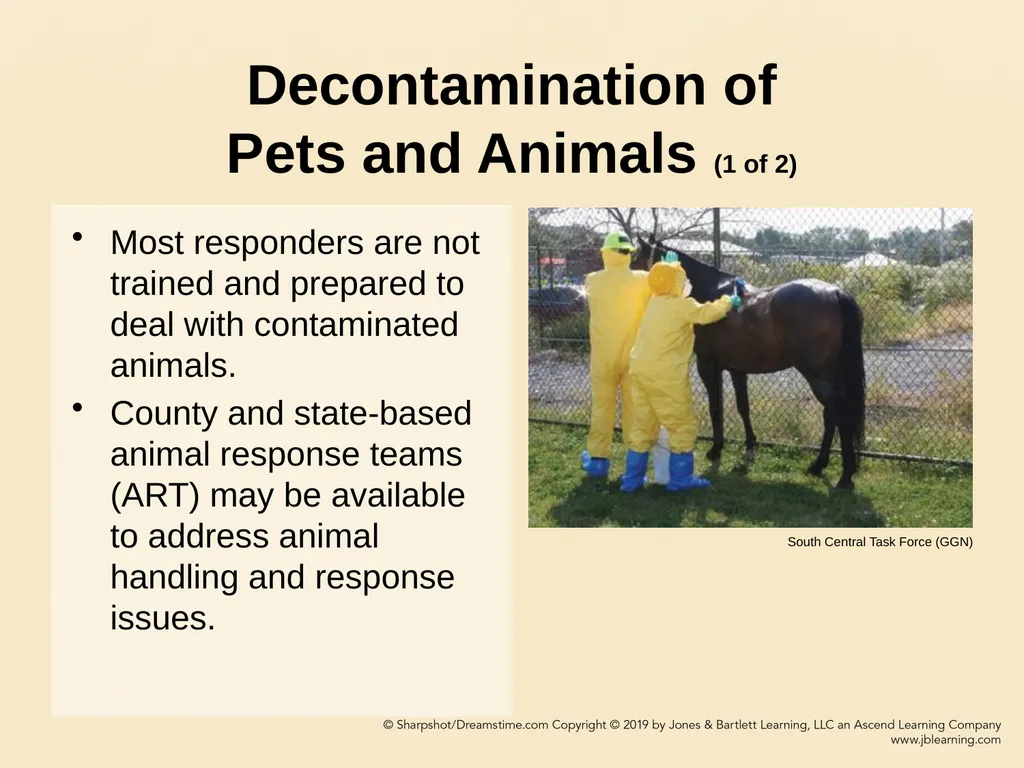
Pets and Animals (1 of 2) Most responders are not trained and prepared to deal with contaminated animals.
County and state-based animal response teams (ART) may be available to address animal handling and response issues. South Central Task Force (GGN)<br>
County and state-based animal response teams (ART) may be available to address animal handling and response issues. South Central Task Force (GGN)<br>
60
Decontamination of
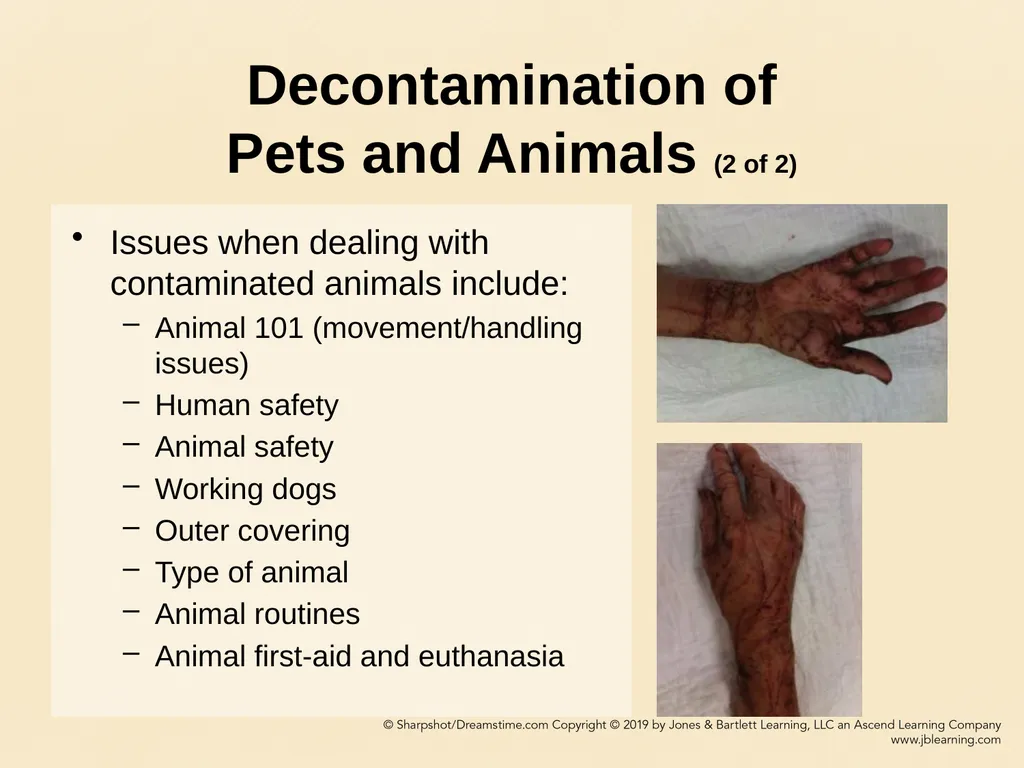
Pets and Animals (2 of 2) Issues when dealing with contaminated animals include:
Animal 101 (movement/handling issues)
Human safety
Animal safety
Working dogs
Outer covering
Type of animal
Animal routines
Animal first-aid and euthanasia<br>
Animal 101 (movement/handling issues)
Human safety
Animal safety
Working dogs
Outer covering
Type of animal
Animal routines
Animal first-aid and euthanasia<br>
61
Clean-Up Operations Any work performed at the emergency scene by responders, directed toward removing contamination from protective clothing, tools, dirt, water, and so on
Clean-up may also involve responder decontamination of some debris, damaged containers, and so on.<br>
Clean-up may also involve responder decontamination of some debris, damaged containers, and so on.<br>
62
General Clean-Up
Options The incident commander has two clean-up options:
Conduct a limited-scale clean-up of key emergency response equipment such as the fire apparatus
Conduct clean-up using a qualified and authorized environmental contractor<br>
Conduct a limited-scale clean-up of key emergency response equipment such as the fire apparatus
Conduct clean-up using a qualified and authorized environmental contractor<br>
63
Equipment Clean-Up General
Guidelines Can be difficult and very expensive
Consult product specialists first.
Responder with authority should supervise.
Avoid direct contact with contaminated equipment.
Protective clothing and respiratory protection must be worn until hazard is abated.<br>
Consult product specialists first.
Responder with authority should supervise.
Avoid direct contact with contaminated equipment.
Protective clothing and respiratory protection must be worn until hazard is abated.<br>
64
Small and Portable Equipment
Clean-Up All small-to-medium−sized equipment, such as monitoring instruments and hand tools, should be decontaminated before leaving the site.
Responders should become familiar with the issues and concerns when decontaminating hand tools, monitoring equipment, and the fire hose.<br>
Responders should become familiar with the issues and concerns when decontaminating hand tools, monitoring equipment, and the fire hose.<br>
65
Motor Vehicle and Heavy
Equipment Clean-Up Vehicle decontamination recommendations:
Establish a decon pad as a primary wash station.
Completely wash and rinse vehicles several times with an appropriate detergent.
Engines exposed to toxic dusts or vapors should have their air filters replaced.<br>
Establish a decon pad as a primary wash station.
Completely wash and rinse vehicles several times with an appropriate detergent.
Engines exposed to toxic dusts or vapors should have their air filters replaced.<br>
66
Post-Incident Decon Concerns Debriefing
Site security and custody
Hazardous waste handling and disposal
Regulatory compliance
Hazardous waste containers<br>
Site security and custody
Hazardous waste handling and disposal
Regulatory compliance
Hazardous waste containers<br>
67
Summary (1 of 7) Decontamination is the process of making people, equipment, and the environment safe from hazardous materials contaminants.
The basic concepts of decontamination are relatively simple.
If contact with the contaminant can be controlled and minimized, the need for decontamination can be reduced.<br>
The basic concepts of decontamination are relatively simple.
If contact with the contaminant can be controlled and minimized, the need for decontamination can be reduced.<br>
68
Summary (2 of 7) Decon needs to be an adaptive and flexible process that respects the hazards and the behavior of the contaminants, as well as human behavior under stress.
Contamination is any form of hazardous material (solid, liquid, or gas) that physically remains on people, animals, or objects.<br>
Contamination is any form of hazardous material (solid, liquid, or gas) that physically remains on people, animals, or objects.<br>
69
Summary (3 of 7) Direct contamination occurs when a person comes in direct physical contact with a contaminant or contaminated clothing or equipment.
Cross-contamination occurs when a person who is already contaminated makes contact with a person or object not contaminated.<br>
Cross-contamination occurs when a person who is already contaminated makes contact with a person or object not contaminated.<br>
70
Summary (4 of 7) Exposure means that a person has been subjected to a toxic substance or harmful physical agent through any route of entry into the body (e.g., inhalation, ingestion, injection, or by direct contact [skin absorption]).<br>
71
Summary (5 of 7) The best field decontamination procedures emphasize the need to confine contaminants to a limited area.
There is no universal decon method that will work for every hazmat incident or release.
The decontamination corridor is from the hot zone into the decon area, with the exit point near the warm zone/cold zone interface.<br>
There is no universal decon method that will work for every hazmat incident or release.
The decontamination corridor is from the hot zone into the decon area, with the exit point near the warm zone/cold zone interface.<br>
72
Summary (6 of 7) Multistep decon operations can be broken into two broad phases: gross decon and secondary decon.
Emergency decontamination is the physical process of immediately reducing contamination of individuals in potentially life-threatening situations with or without the formal establishment of a decontamination corridor.<br>
Emergency decontamination is the physical process of immediately reducing contamination of individuals in potentially life-threatening situations with or without the formal establishment of a decontamination corridor.<br>
73
Summary (7 of 7) Technical decon is a multistep process in which contaminated individuals are cleansed with the assistance of trained personnel.
Mass decontamination is established when large numbers of people (i.e., civilians or responders) need to be decontaminated at the scene of a hazmat emergency.<br>
Mass decontamination is established when large numbers of people (i.e., civilians or responders) need to be decontaminated at the scene of a hazmat emergency.<br>